Tag Archives: glaciers

GPS, Geocaching, and Greenland Glaciers

Navigating ice, ocean, and land, brave women and men have always used the stars for guidance. Just think of the three kings who followed a star to witness the birth of Jesus Christ in Bethlehem 2015 years ago. They were 6 days late. Keeping track of time track was always difficult for navigating, especially at sea and the British Navy lost many ships as a result of poor time keeping. There are books written on the history of determining longitude, the best of which is called, well, “Longitude.” Now why would I ponder these questions and histories two hours before I am boarding the Swedish icebreaker Oden to travel by sea and ice to Petermann Glacier?

The Global Position System (GPS) that many of us have in our smart phones or tiny hand-held devices makes navigating easy. Both measure time as our civilization has put “stars” into space that guide hikers out in the back-country, urban dwellers to the next bar or restaurant, and missiles into a target the size of the dot over the letter “i” on a license plate of a car. Few know that the GPS satellites only sent time from an atomic clock to our GPS receivers and smart phones. Time is of the essence, there is something almost spiritual about time and how to define it. And time is linked to space not just because of Einstein’s theory of relativity, but also the way we measure space by measuring the time that waves travel through space.
Waiting for the plane to get 58 scientists to Thule to board the I/B Oden, I went for a geocaching trip an hour or two from the town of Kangerlussuaq. My wife got me into this 2 years ago as a way to explore areas via hiking without much planning. All we do is enter some GPS position of places where other people have placed “treasures” and we head out to find them. These geocaches are everywhere: within 100 feet of my home, in every city I went to in Poland, Sweden, or Germany, and now Greenland, too. My favorite GPS unit is a little hand-held $99 Garmin eTrex 10. It does a marvelous job to get me anywhere within about 3-6 feet (1-2 meters).

As part of our Petermann research, we also got four “fancy” GPS systems which we want to place on the ice shelf of Petermann Gletscher to measure tidal motions. The water under the glacier is connected to ocean that moves the Empire-State-Building thick ice up and down every 12 hours or so. We do not know by how much, though, and when it moves up and when it moves down. There should also be daily cycles and longer periods caused by winds and waves. Now these fancy $25,000 GPS are able to track over 400 satellites (not just the 9 that my Garmin does) and they receive the time information in a very raw and accurate format at more than one radio frequency in more than one way. If one has several of these, we got four, then it is possible to built a network that reduces common errors in position to a few millimeters in the horizontal, and 1-2 centimeter in the vertical after some smart processing. So these “fancy GPS” can sense the difference of the top of your smart phone from the bottom, and I do not mean its length or width, but its thin height. And this is blowing my mind. We need this accuracy to measure tides, and tides we will measure for the 20-30 days that we are working in and around Petermann Gletscher.

Wish us luck as we are heading from the green part of Greenland in the south to its white (ice), black (ocean), and gray (land) parts. There are few colors where we will be the next 4 weeks. Our internet will be gone, but I will try to send text files and small photos until we return on 4 September or so, but time will be hard to find. Wish all of us luck …

Petermann Glacier Tidal Heaving

Some glaciers float on the ocean around Antarctica and Greenland. Petermann Gletscher in North Greenland is one of these. It spawned massive Manhattan-sized ice islands in 2010 and 2012. Could tides influence when and where such break-ups occur? After all, the tides under the floating glacier move the ice up and down. But how does a 50 km long, 15 km wide, and 300 m thick floating glacier pivots about its “hinge?” Does it do so like a rigid plate of steel or does it bend and buckle like jelly? I do not know, because nobody has measured the tidal motions of Petermann’s floating ice. So, one of many projects this summer will be to measure tides on Petermann with fancy GPS systems.

Shape of the floating part of Petermann Gletscher (right panel) drom laser altimeters along two tracks flown along the glacier in 2014 (left panel).

Shape of the floating portion of Petermann Gletscher from laser altimeters (right panel) along two tracks flown along the glacier in May of 2014 (left panel).

Martin Jakobsson of Stockholm University posed these questions, sort of, when he asked us American oceanographers, if we had any fancy GPS units to work with one he plans to put high on a cliff overlooking Petermann Fjord. He needs exact positions to map the bottom of the ocean. The cliff-GPS station is fixed while he moves about in a small boat that also has a GPS. Taking the difference of the raw travel times received by the cliff-GPS and the boat-GPS, he can reduce GPS position errors from several meters to several centimeters. People call this differential GPS and he wondered if we oceanographers had any use of it to perhaps give him the tidal corrections he also needs as the measures bottom depths from a boat. Well, this was not initially part of our plan and we did not get funded to study the glacier or the tides under it, but his question got me thinking while Alan Mix of Oregon State University did some organizing. One always squeezes extra science into such great opportunities. Discoveries lurk everywhere to inquiring minds.

Small survey boat loaded onto I/B Oden in Landskrona, Sweden, June 2015.

Small survey boat loaded onto I/B Oden in Landskrona, Sweden, June 2015.

Alan managed to find not one, not two, but three fancy GPS units from an organization that I had never heart of. It is called UNAVCO:

UNAVCO, a non-profit university-governed consortium, facilitates geoscience research and education using geodesy. We challenge ourselves to transform human understanding of the changing Earth by enabling the integration of innovative technologies, open geodetic observations, and research, from pole to pole.

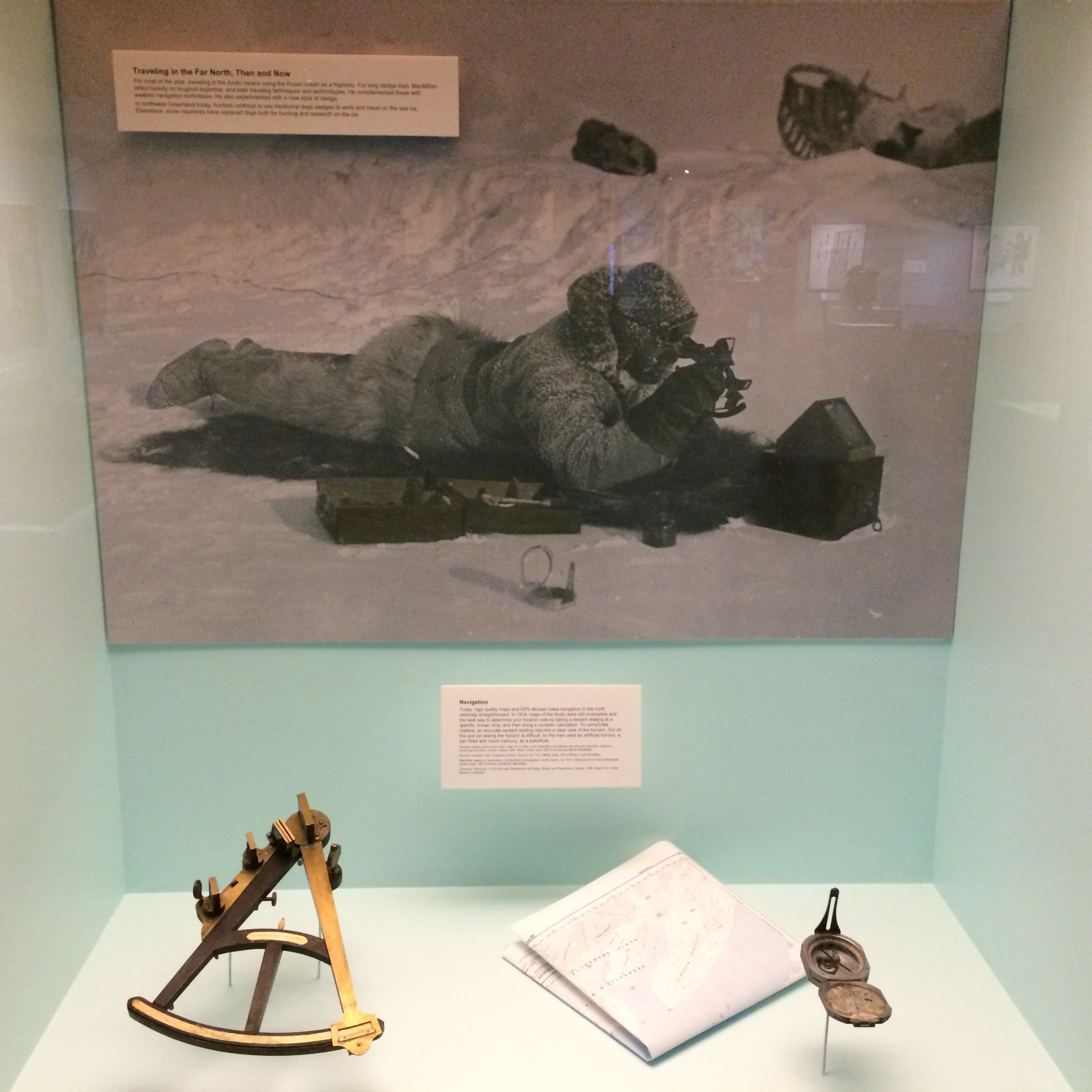
“Geodetic observations” are measurements of locations on the earth’s surface. In the old days surveyors walked about with sextant, clocks, tripods, and optical devices to fix a location and reference it to another. Nowadays satellites and lasers do this faster, but I digress. Suffice it to say, UNAVCO is giving us 3 fancy GPS system to carry with us to Petermann Gletscher to make measurements of tides on the ice. So we can pick 3 locations on the ice where we leave these GPS for the 3-4 weeks next month. I have never done this before, so there will be lots of new learning.

Navigation during early Arctic exploration. Photo taken during a visit of the Peary MacMillan Arctic Museeum at Bowdoin University in Brunswick, Maine.

Navigation during early Arctic exploration. Photo taken during a visit of the Peary MacMillan Arctic Museeum at Bowdoin University in Brunswick, Maine.

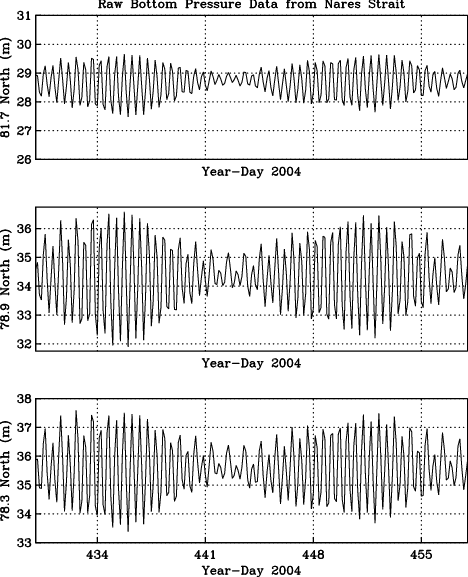
I have worked with tides since plunging my head into tidal mud-flats of north-west Germany where I grew up and camping on the shores of the Conwy Estuary in North-Wales where I collected data for my MS thesis. Below I show a 4 week record from three locations in Nares Strait where the tidal elevations range from more than 4 meters at the southern entrance to less than 2 meters in Hall Basin next to Petermann Fjord. The data are from bottom pressure sensors that were deployed for 3-9 years, but I here only want to show the spring-neap cycle. So we already have some idea on how the tides in the ocean next to Petermann Glacier behave.

Sea level fluctuations in meters for 28 days at Discovery Harbor or Fort Conger, Canada near 81.7 N latitude (top), Alexandra Fjord, Canada near 78.9 N latitude (middle), and Foulke Fjord, Greenland near 78.3 N latitude (bottom).

Sea level fluctuations in meters for 28 days at Discovery Harbor or Fort Conger, Canada near 81.7 N latitude (top), Alexandra Fjord, Canada near 78.9 N latiude (middle), and Foulke Fjord, Greenland near 78.3 N latitude (bottom).

Models of tides in Nares Straits do really well if, and only if, the bottom topography is known. And this is where Martin’s mapping of the ocean floor in Petermann Fjord and our tidal observations on the floating glacier come together: We both need good bottom topography, we both use fancy GPS, and we both need to know tides to get accurate bottom depths and we need to know bottom depths to predict tides.

Coastal Oceanography off North-East Greenland

Greenland is melting, but it is not entire clear why. Yes, air temperatures continue to increase, but what does it matter, if those temperatures are below freezing most of the time. What if the ocean does most of the melting a few 100 m below the surface rather than the air above? It means that gut feeling and everyday experience can be poor guides for science, it means that there is more than meets the eye, and it means that some of Greenland’s melting happens out of sight without the dramatic imagery of a rapidly disintegrating glacier that sends icebergs out to sea.

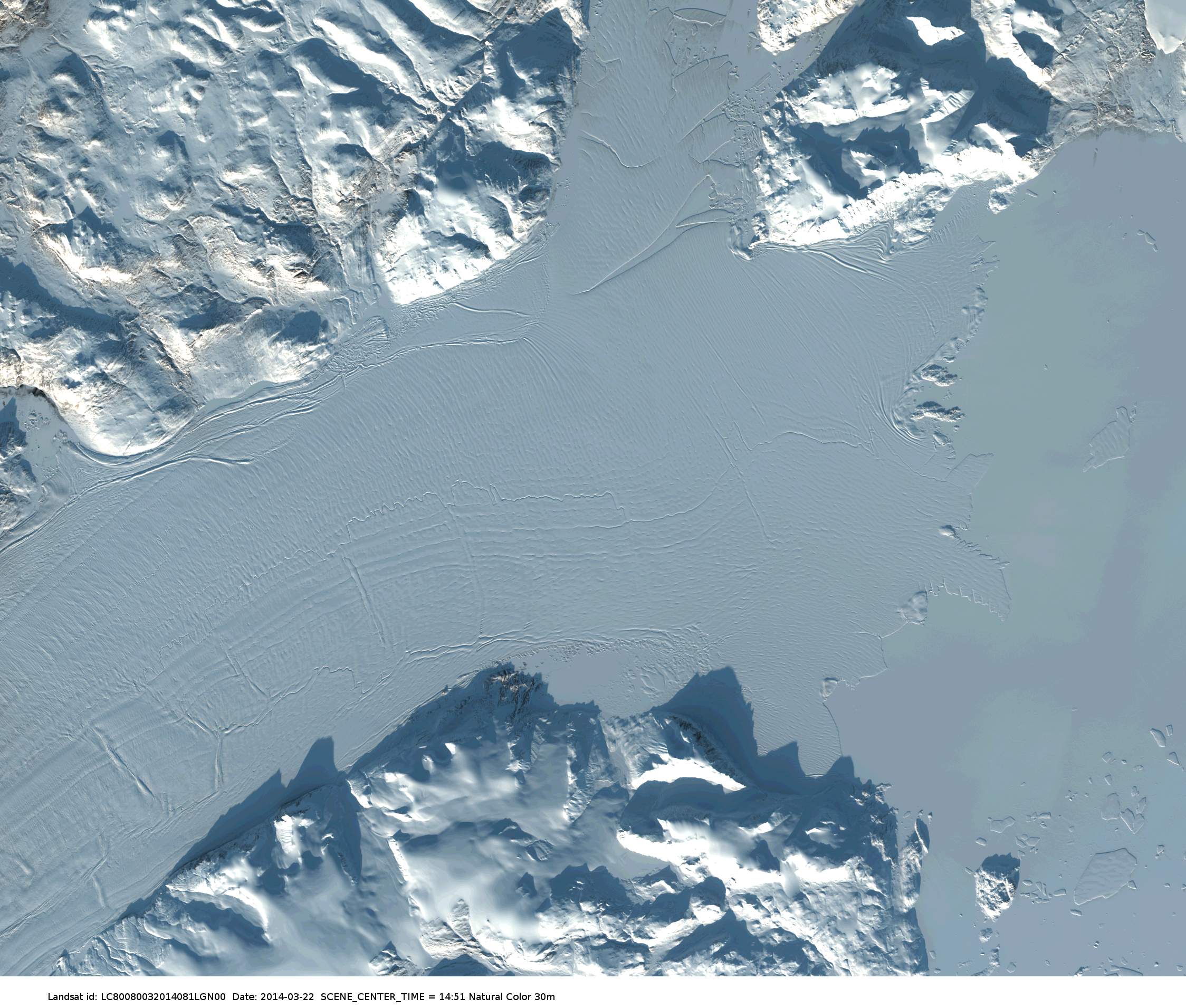
Floating section of 79N Glacier in north-east Greenland as seen from LandSat in march 2014.

Floating section of 79N Glacier in north-east Greenland as seen from LandSat in march 2014.

In order to “see” where changes may happen out of sight American tax payers supported me via the National Science Foundation (NSF) to use available University of Delaware ocean sensors from an available German ship to investigate the ocean near two large glaciers off north-east Greenland. The sensors are in the water for over a year now and will stay there for another to collect data every half hour. The data are stored on computers inside the sensors and it is a marvel of smart engineering that we can measure water temperature, salinity, and velocity at the bottom of an ice-covered ocean. Now what would I do with such data?

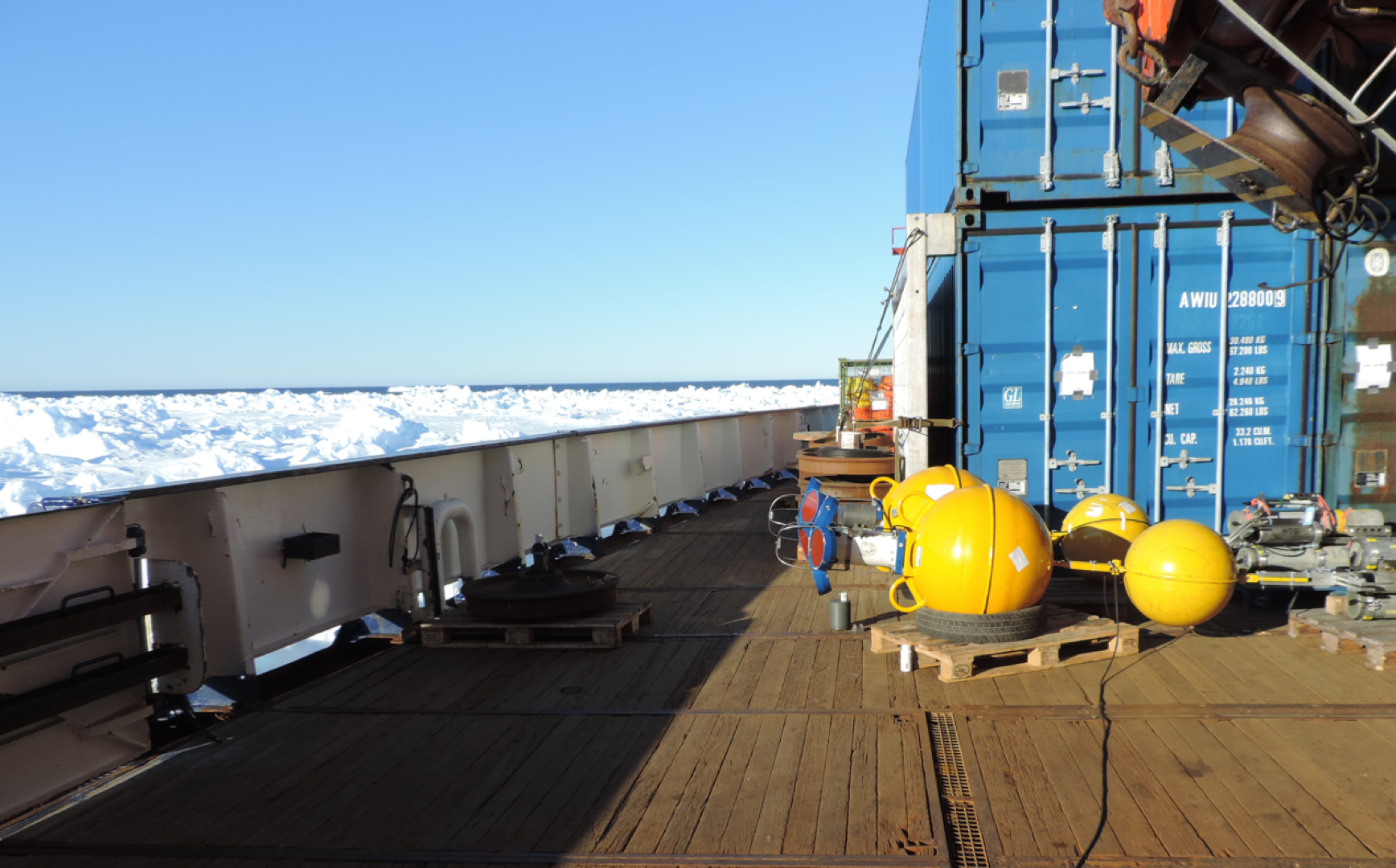
Two ocean sensor packages ready for deployment near Isle de France, Greenland 10 June 2014.

Two ocean sensor packages ready for deployment near Isle de France, Greenland 10 June 2014.

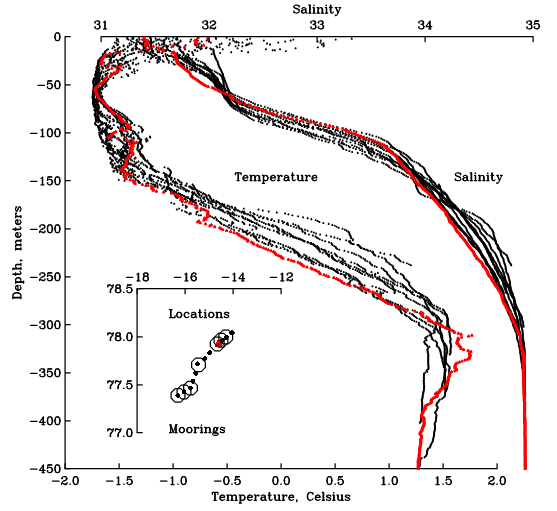
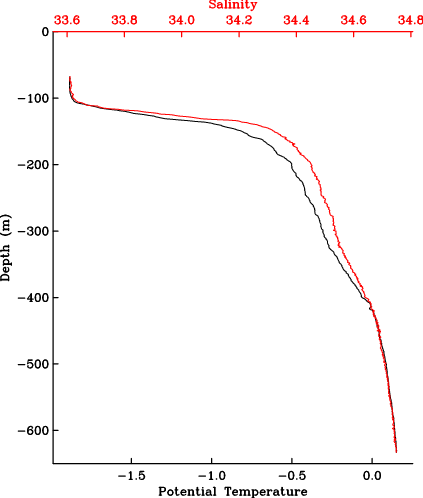
First, one needs to know that in the Arctic Ocean temperature increases as one moves a thermometer from the surface towards the bottom for the first 900 feet or 300 meters. This only make sense, if the warm water is heavier than the cold water above. This is the case in the Arctic, because the warm water at depth is also very salty. The cold waters above contain less salt and that’s why they float. The warmest waters originate from the Atlantic Ocean to the south-east of Iceland. Lets call it Atlantic Water for this reason. The surface waters contain sea ice and its fresh melt water and thus are always close to the freezing point, so lets call them Polar Waters.

Vertical profiles of temperature and salinity across Norske Ore Trough, Greenland. The insert shows station locations for profiles (small symbols) and moorings (large circles). The red dot marks the location of the red profile.

Vertical profiles of temperature and salinity across Norske Ore Trough, Greenland. The insert shows station locations for profiles (small symbols) and moorings (large circles). The red dot marks the location of the red profile.

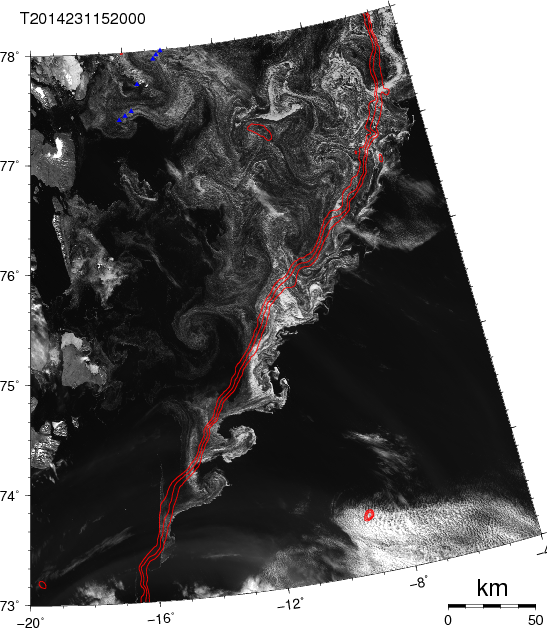
All along the East Coast of Greenland, we find a strong southward flow of ice and Polar Water called the East Greenland Current. On a rare clear day one can “see” this flow as a beautifully structured undulating band separating the deep Greenland Sea from the shallow and broad continental shelves. Now recall that the warmest waters are in the Atlantic layer way down and somewhat offshore. How do these waters cross the East Greenland current and the very wide continental shelf to reach the glaciers along the coast? It is this question my project tries to answer with lots of help from NSF and German friends.

Satellite image ocean current instabilities on Aug.-19, 2014 as traced by ice along the the shelf break, red lines show 500, 750, and 1000 meter water depth. Small blue triangles top left are ocean moorings.

Satellite image ocean current instabilities on Aug.-19, 2014 as traced by ice along the the shelf break, red lines show 500, 750, and 1000 meter water depth. Small blue triangles top left are ocean moorings.

We think that the warm and salty waters flow near the bottom below the East Greenland Current at deep bottom depressions such as canyons. Testing this idea, we placed our sensors in a line across the canyon with a small ice-capped island called the Isle of France on one side and Belgica Bank on the other. We deployed seven instrument as an array across the canyon to measure the speed and direction of the flow as well as its temperatures and salinities. Our canyon connects the deep Greenland Sea 150 miles to the east with two glaciers another 100 miles to the north-west. We all anxiously hope that no iceberg wiped out bottom moorings and that they all record data faithfully until the summer of 2016 when we plan to recover instruments and data.

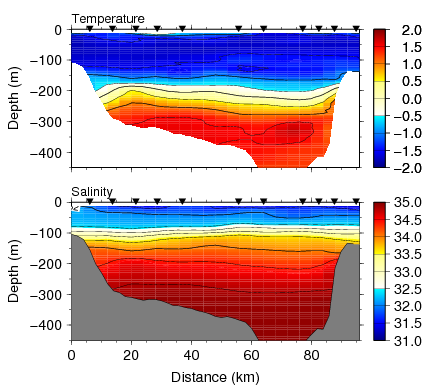
Section of temperature across Norske Ore Trough with Isle de France, Greenland on the left and Belgica Bank towards Fram Strait on the right. The view is towards 79N Glacier.

Section of temperature across Norske Ore Trough with Isle de France, Greenland on the left and Belgica Bank towards Fram Strait on the right. The view is towards 79N Glacier.

Before and after the placement of our moored instruments, however, we did survey the section from the ship and I show the temperature and salinity across our canyon. We now see that the water below 200 m depth are indeed very warm and salty as expected, but there is a detail that I cannot yet explain: notice the slight upward sloping contours of salinity near km-80 at the rim of the canyon and the downward sloping contours on the other side near km-10. Such sloping contours represent a flow out of the page at km-80 and into the page at km-10 which is exactly the opposite of what I expected. All I can say at the moment is that this snapshot does not resolve motions caused by the tides, the winds, and the seasonal cycles properly, but our moorings do. So, there are still mysteries to be solved by the data sitting on the bottom of the ocean guarded by towering spectacles of ice.

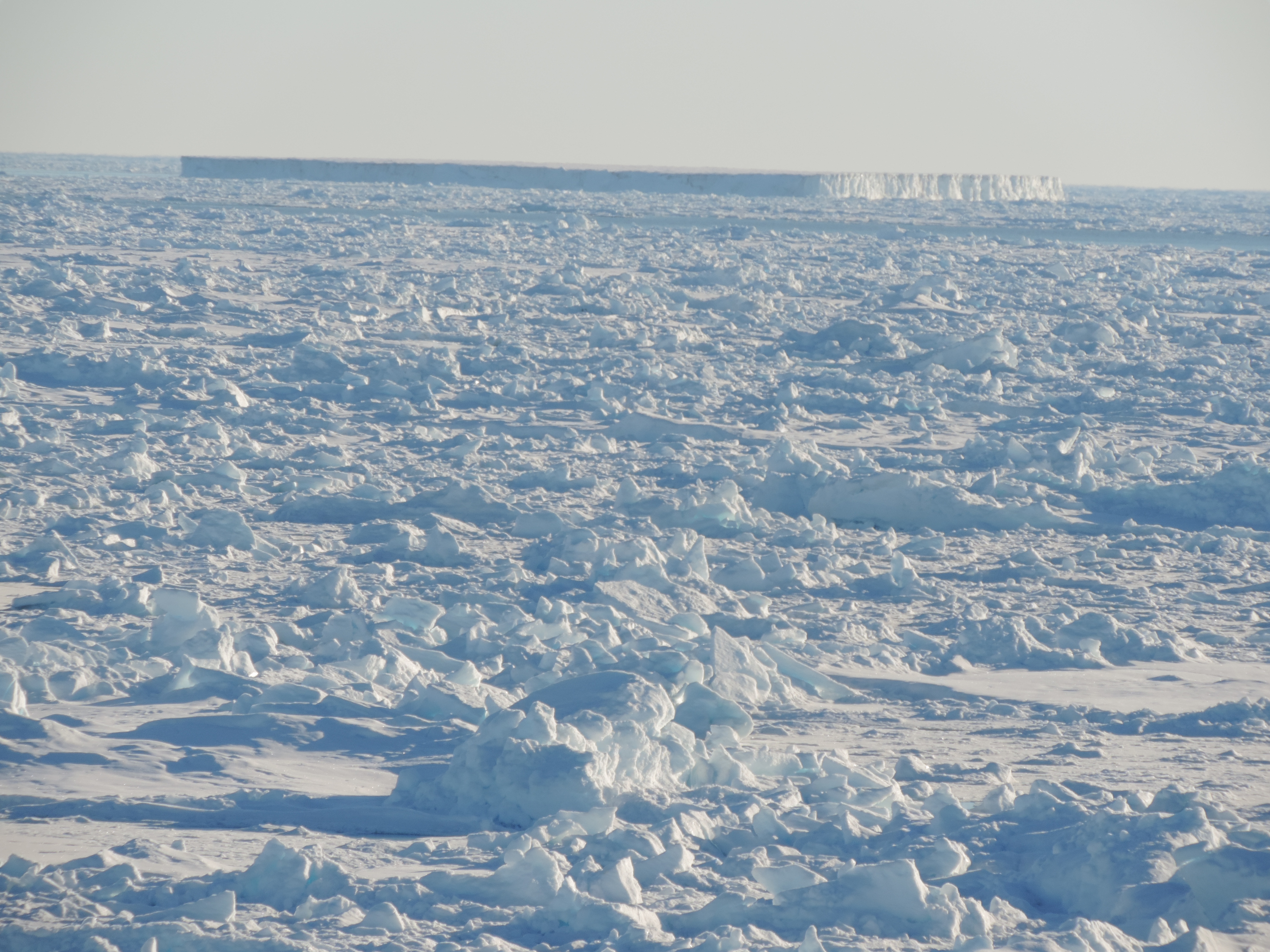
Tabular iceberg and sea ice cover near Isle de France 10 June 2014

Tabular iceberg and sea ice cover near Isle de France 10 June 2014

[This entry will be submitted to NSF as a Final Outcome Report for award 1362109 “Shelf-Basin Exchange near 79N Glacier and Zachariae Isstrom, North-East Greenland.” The work would not have been possible without the generous support of NSF as well as the German Government as represented by the Alfred Wegener Institute who sponsored the expedition to North-East Greenland in 2014. Torsten Kanzow, Benjamin Rabe, and Ursula Schauer of AWI all deserve as much and even more credit for this work than do I.]

Budéus, G., & Schneider, W. (1995). On the hydrography of the Northeast Water Polynya Journal of Geophysical Research, 100 (C3) DOI: 10.1029/94JC02024

Hughes, N., Wilkinson, J., & Wadhams, P. (2011). Multi-satellite sensor analysis of fast-ice development in the Norske Øer Ice Barrier, northeast Greenland Annals of Glaciology, 52 (57), 151-160 DOI: 10.3189/172756411795931633

Reeh, N., Thomsen, H., Higgins, A., & Weidick, A. (2001). Sea ice and the stability of north and northeast Greenland floating glaciers Annals of Glaciology, 33 (1), 474-480 DOI: 10.3189/172756401781818554

Wadhams, P., Wilkinson, J., & McPhail, S. (2006). A new view of the underside of Arctic sea ice Geophysical Research Letters, 33 (4) DOI: 10.1029/2005GL025131

Lab Notes of a Physical Oceanographer

I go to sea to learn about oceans, glaciers, weather, and climate. Despite dramatic photos of exciting field work, those action-packed scenes or serene nature shots of beauty and violence are misleading. Most of my time is spent sitting an a desk in a spacious office with books, papers, telephone, and most important of all, my computers.

Most of my time is spent writing. The writing is varied and ranges from illustrated essays on IcySeas.org to computer code. Add technical writing of research proposals, papers, and reviews for funding agencies and scientific journals. My screen rarely looks like what is shown above with the beautiful LandSat image of 79N Glacier as a screen-saver, it actually looks like this

Picture 2

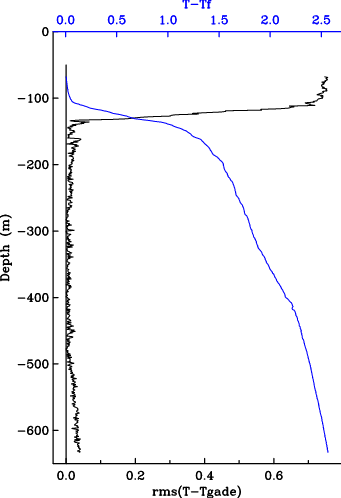
The blog-writing window is open on the right while a Fortran computer code is in the top left. The code processes temperature, salinity, and pressure data from Petermann Glacier. When the code is run in the bottom-left window, it produces numbers. In this specific case, the numbers are from the only profile of temperature and salinity that exists from Petermann Glacier. Koni Steffen collected the data in 2002. Columns are depths that start at -68 (meters), salinity at 33.774 (no units, think of this as grams per kilogram), temperature at -1.885 (degrees centigrade), and the last column is the density anomaly These numbers are better presented as a graph:

Koni2002raw

Notice that temperature and salinity start only at -68 meters. This is because the ice at this location was about 68-m thick. The Big Ben clock in London is about 96-m high, but this piece if Petermann was chosen because it was less hard to drill through 2/3 of Big Ben’s height when compared to drilling through the glacier ice a mile away where the ice is thicker than the Empire State Building in New York; but I digress.

The profile above reveals a pattern we find almost anywhere in deeper Arctic Waters: Temperature increases with depth. Under the ice at 68-m depth, water is at its freezing point. As you move down the water towards the bottom, salinity increases and so does temperature. It is still cold, about +0.2 degrees Celsius, but this is heat from the North Atlantic Ocean that for perhaps 20-50 years circled all the way around the Arctic Ocean from northern Norway, past Siberia, past Alaska, past Canada to reach this spot of Greenland. While this appears marvelous, and it is, this is NOT what gets a physical oceanographer excited, but this does:

Koni2002Gade

It is the same data, but I did some reading, physics, algebra and code-writing in that order. First, instead of temperature, the blue line shows the difference between temperature T and the temperature Tf above the freezing. The difference T-Tf relates to the amount of heat available to melt the ice somewhere. The black line is the real killer, though. It combines salinity and temperature observations to reveal where the glacier water resides at this location that was melted somewhere else. Without going into the physical details, glacier meltwater is present where the black line touches zero (the so-called Gade-line, so named after a Swedish oceanographer who proposed its use in 1979). This happens at a depth from about 280-m to 500-m depth. This means that the glacier is NOT melting where it is as thin as Big Ben, but instead where it is as thick as the Empire State Building. So this is where we will need to place our instruments.

Proving my initial point, I spent two hours of fun writing this blog. I now will have to focus on more technical writing to pay the many bills of sea-going research. These “lab-notes” also serve as a document to raise $10,845 to install instruments this summer through Petermann Gletscher, have a look and give a little, if you can at

https://experiment.com/projects/ocean-warming-under-a-greenland-glacier

Greenland Glacier Ocean Warming

The Swedish icebreaker Oden will visit Petermann Fjord in northern Greenland in 6 months time. The US National Science Foundation (NSF) funded a large geophysical and geological experiment after excruciating peer-review over a 4-year period. The experiment shall reveal climate histories from sediment cores, geomagnetics, and both bottom and sub-bottom sonar profiling. Besides this main mission Oden also supports several smaller auxiliary projects some of which are funded by NSF while others are not. It will be a fine collaboration between Swedish and American scientists working together in perhaps one of the most difficult to reach and beautiful places on earth.

Seaward front of Petermann Glacier Aug.-11, 2012. View is from a small side-glacier towards the south-east across Petermann Fjord with Petermann Gletscher to the left (east). [Photo Credit: Erin Clarke, Canadian Coast Guard Ship Henry Larsen]

Seaward front of Petermann Glacier Aug.-11, 2012. View is from a small side-glacier towards the south-east across Petermann Fjord with Petermann Gletscher to the left (east). [Photo Credit: Erin Clarke, Canadian Coast Guard Ship Henry Larsen]

I will aboard the ship to deploy sensors some of which exist and are funded while others are neither. Let me outline first the funded part and then part where you the reader and I can perhaps join forces. First, we will test first elements of an underwater acoustic communication system. Think cell-phones, except the phone towers are under water where they are called modes. The modems talk to each other by sending sound back and forth the same way that whales do talk to each other.

Here is a narwhals sound

that you can use as a ringtone, credit goes to Voices of the Sea web-site at Scripps Institution of Oceanography. These whales visit Petermann Fjord in summer and we saw many of them frolicking in August of 2012 when I visited the area with the Canadian Coast Guard whom I credit for these photos:

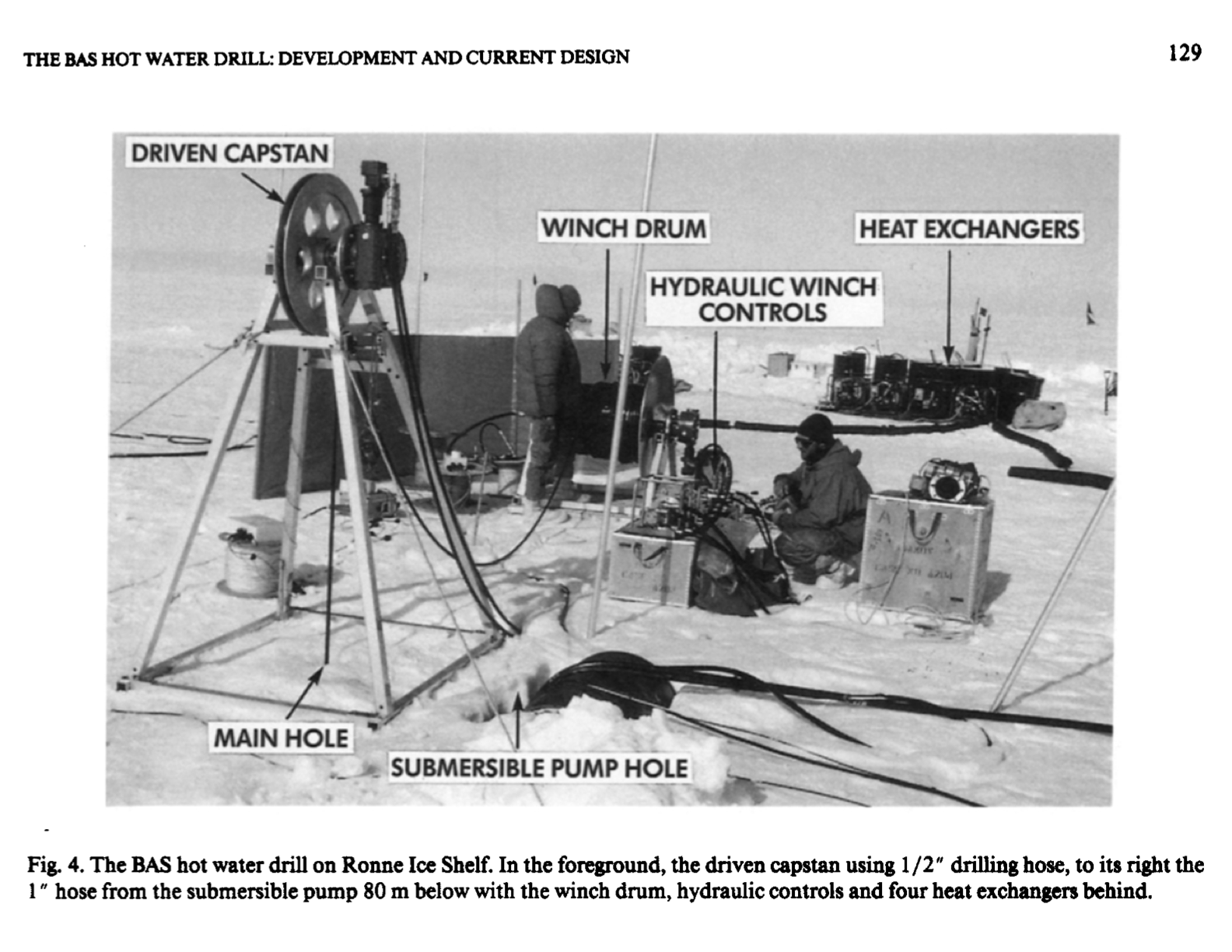
Our man-made sound is very quiet, but because it is quiet, it only moves 3-10 km through the water. To increase our range, we plan to install several quiet sound sources that whisper from one water-phone (=hydrophone) to the next. The goal is to get data from ocean sensors moved along this whispering system of underwater “cell phones” to reach a listening station that we plan to install at the edge of Petermann Gletscher’s floating ice shelf. The ice is 200 meters or 600 feet thick and it is not trivial to drill through that much ice, but it can be done, and the British Antarctic Survey is aboard with a team of experts to do so to get sediment cores from the bottom below the ice:

Makinson1993-Fig04

Today I ordered a first cable that will connect the underwater modem hanging under the 200-m thick ice to the surface where a fancy computer connects it to the internet via to a satellite phone. All data calls that the underwater listening station receives will move up the cable to the glacier surface and on to us all via the internet. This challenging engineering project is funded, but I like to use the same hole, computer, and satellite link to get additional ocean and air data.

Additional stations will be drilled through the ice-shelf farther inland to reach the ocean also. Here we also need cables and instruments that tells us how the glacier is melted by the ocean at different location along its 50 km long floating ice shelf. The incremental costs are small relative to the cost of getting a ship and helicopters there, but NSF cannot easily fund small projects rapidly. It takes a long time to pass scientific peer review. This is where you, my dear reader come in: I need your help to raise $10,000 to add science and observations to an engineering feasibility study that is the underwater whispering sound system.

The motivation and details are described with videos, pictures, laboratory notes, plots, ideas, as well as some short, quirky, yet technically correct descriptions at the crowd-funding site

https://experiment.com/projects/ocean-warming-under-a-greenland-glacier.

I created and launched it today, it will be up for 30 more days. If you can and if you like the science, work, and fun that I describe on these pages, please consider making a small donation. You have the power to make this happen and I will share all data both from below and above the ocean and glacier surface with you.

As a physicist, gardener, teacher, writer, traveler, ping-pong player, and geocacher I am naturally curious about both our natural and social world. I love experiments and to me the crowd-funding at Experiment.com is a most enjoying experiment to connect to people in a new way. Full disclosure, however, this company takes 8% of all funds generated to supports its wonderful software and staff. Perhaps you like to join this experiment by spreading the word and, if you can afford it, help pay for some of the technology needed to bring Greenland and its mysteries to everyone who wants to connect to it.