Category Archives: Ice Cover

Thule, Greenland in Sharp Focus

I want to fly like an eagle
To the sea
Fly like an eagle
Let my spirit carry me

Steve Miller Band, 1976

The eagle “sees” the ground, because the twinkling sensation of light tickles her nerves. Today’s cameras work without the twinkle and tickle. They store numbers (digits) that approximate the amount of light passing through the lens. Satellite sensors work the same way. The data they beam to earth give me the soaring feeling of flying like an eagle, but there is more to the bits and bytes and digits sent home from space to our iPhones, laptops, and the internet.
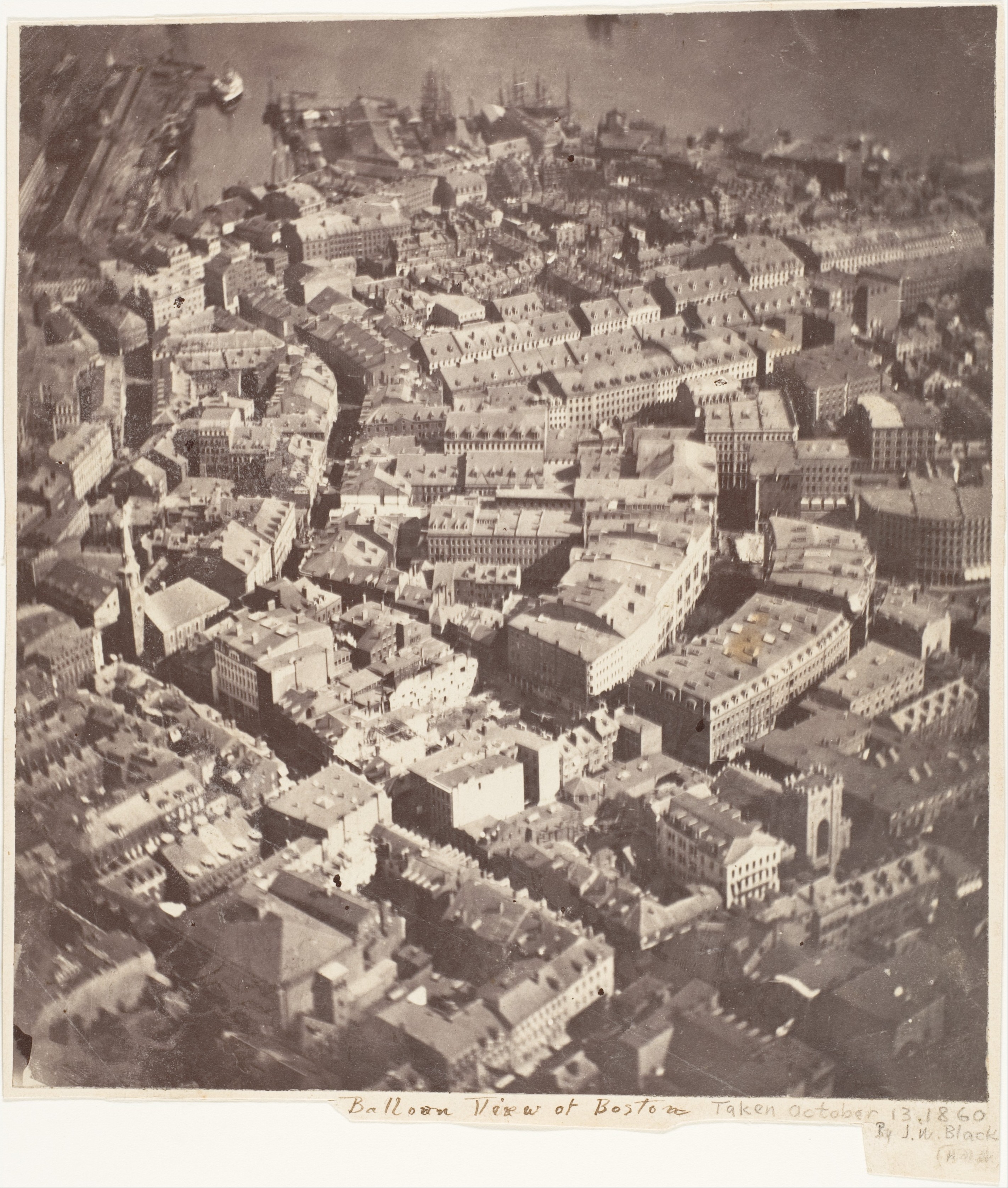
Aerial photo taken Oct.-13, 1860 of Boston, MA by J.W. Black.

Aerial photo taken Oct.-13, 1860 Boston, MA from a balloon by J.W. Black.

The Metropolitan Museum of Art in New York houses the earliest existing aerial photo that was taken from a balloon hovering 600 meters above Boston, Massachusetts. Within a year the American Civil War broke out and this new technology became an experimental tool of war. It advanced rapidly, when air craft replaced the balloon during the First World War. Sharp photos of bombed-out battle and killing fields along the entire Western Front in France were taken by both Allied and German soldiers every day. Placing these photos on a map for efficient analyses of how a land- sea- or ice-scape changes over time, however, was impossible, because photos do not record precise locations.

Modern satellite photos are different. We now have fancy radar beams, computers, and several Global Position Systems (GPS) with atomic clocks to instantly calculation satellite tracks every second. This is why we now can both take photos from space AND map every dot or pixel that is sensed by the satellite moving overhead at 17,000 miles an hour snapping pictures from 430 miles above. The camera is so good that it resolves the ground at about 45 feet (15 meters). This is what such a (LandSat) picture looks like
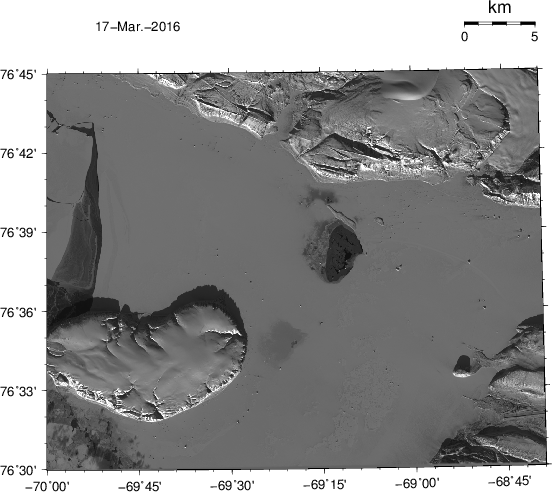
LandSat photo/map of Thule, Greenland Mar.-17, 2016. The airfield of Thule Air Force Base is seen near the bottom on the right. The island in ice-covered Westenholme Fjord is Saunders Island (bottom left) while the glacier top right is Chamberlin Gletscher.

LandSat photo/map of Thule, Greenland Mar.-17, 2016. The airfield of Thule Air Force Base is seen near the bottom on the right. The island in ice-covered Westenholme Fjord is Saunders Island (bottom left) while the glacier top right is Chamberlin Gletscher.

Everyone can download these photos from the United States Geological Survey which maintains a wonderful photo and data collection archive at

http://earthexplorer.usgs.gov

but the tricky part is to turn these images or photos into maps which I have done here. More specifically, I wrote a set of c-shell and nawk scripts along with Fortran programs on my laptop to attach to each number for the light sensed by the satellite (the photo) another two numbers (the map). These are latitude and longitude that uniquely fix a location on the earth’s surface. A “normal” photo today has a few “Mega-Pixels,” that is, a few million dots. Each scene of LandSat, however, has about 324 million dots. This is why you can discern both the runways of Thule Air Force Base at 68 degrees 45′ West longitude and 76 degrees 32′ North latitude. The pier into the ice-covered ocean is just a tad to the south of Dundas Mountain at 68:54′ W and 76:34′ N. A scale of 5 kilometers is shown at the top on the right. For spatial context, here is a photo of the pier with the mountain in the background, that is, the object shown in the photo such as mountain, ship, and Helen serves a rough, but imprecise reference:

Dr. Helen Johnson in August 2009 on the pier of Thule AFB with CCGS Henry Larsen and Dundas Mountain in the background. [Credit: Andreas Muenchow]

Dr. Helen Johnson in August 2009 on the pier of Thule AFB with CCGS Henry Larsen and Dundas Mountain in the background. [Credit: Andreas Muenchow]

This photo shows the airfield and Saunders Island

Thule AFB with its airport, pier, and ice-covered ocean in the summer. The island is Saunders Island. The ship is most likely the CCGS Henry Larsen in 2007. [Credit: Unknown]

Thule AFB with its airport, pier, and ice-covered ocean in the summer. The island is Saunders Island. The ship is most likely the CCGS Henry Larsen in 2007. [Credit: Unknown]

The satellite image of the ice-covered fjord with Thule, Saunders Island, and Chamberlin Gletschers shows a richly texture field of sea ice. The sea ice is stuck to land and not moving except in the west (top left) where it starts to break up as seen by the dark gray piece that shows ‘black’ water peeking from below a very thin layer of new ice. There is also a polynya at 69:15′ W and 76:39′ N just to the south of an island off a cape. A polynya is open water that shows as black of very dark patches. A similar albeit weaker feature also shows to the east of Saunders Island, but it is frozen over, but the ice there is not as thick as it is over the rest of Westenholme Fjord. I suspect that larger tidal currents over shallow water mix ocean heat up to the surface to keep these waters covered by water or dangerously thin ice. There are also many icebergs grounded in the fjord. They cast shadows and from the length of these shadows one could estimate their height. Here is another such photo from 2 days ago:

LandSat photo/map of Thule, Greenland Mar.-21, 2016. The airfield of Thule Air Force Base is seen near the bottom on the right. The island in ice-covered Westenholme Fjord is Saunders Island (bottom left) while the glacier top right is Chamberlin Gletscher.

LandSat photo/map of Thule, Greenland Mar.-21, 2016. The airfield of Thule Air Force Base is seen near the bottom on the right. The island in ice-covered Westenholme Fjord is Saunders Island (bottom left) while the glacier top right is Chamberlin Gletscher.

I am using the satellite data and maps here to plan an experiment on the sea ice of Westenholme Fjord. Next year in March/April I will lead a team of oceanographers, engineers, and acousticians to place and test an underwater network to send data from the bottom of the ocean under the sea ice near Saunders Island to the pier at Thule and from there on to the internet. We plan to whisper from one underwater listening post to another to communicate over long ranges (20-50 kilometers) via a network of relay stations each operating smartly at very low energy levels. We will deploy these stations through holes drilled through the landfast ice 1-2 meters thick. The work is very exploratory and is funded by the National Science Foundation. Wish us luck, as we can and will use it … along with aerial photography that we turn into maps.
Oceanography of Nares Strait Ice Flushing

I need the ice out of Nares Strait, a 20 mile wide and 300 miles long pathway to the North Pole between northern Canada and Greenland. The ice blocks our way to Petermann Fjord where a large glacier pushes thick ice out so sea as a floating ice shelf. We plan to drill through the floating section of the glacier that is about as thick as the Empire State Building is high. The ship to get us there is the Swedish icebreaker Oden (Location Map). She is passing the Faroe Islands to the north-west of Scotland and will arrive in 2 weeks at Thule Air Force Base where we will meet her.

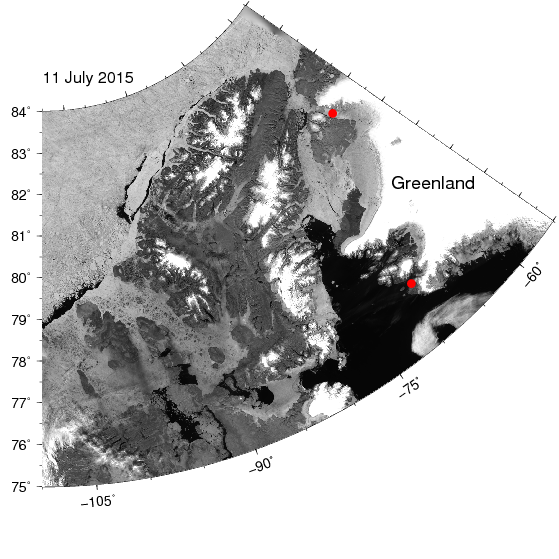
Image of northern Greenland (top right) and Ellesmere Island (center) showing open water as black, land as gray, and sea ice as gray/white. The two red dots are Thule Air Force Base in the south and Petermann Glacier in the north. Note the bands of black water along the coast of Ellesmere Island that result from east to west blowing winds that move ice offshore.

Image of northern Greenland (top right) and Ellesmere Island (center) showing open water as black, land as gray, and sea ice as gray/white. The two red dots are Thule Air Force Base in the south and Petermann Glacier in the north. Note the bands of black water along the coast of Ellesmere Island that result from east to west blowing winds that move ice offshore and reduce the southward flow in Nares Strait.

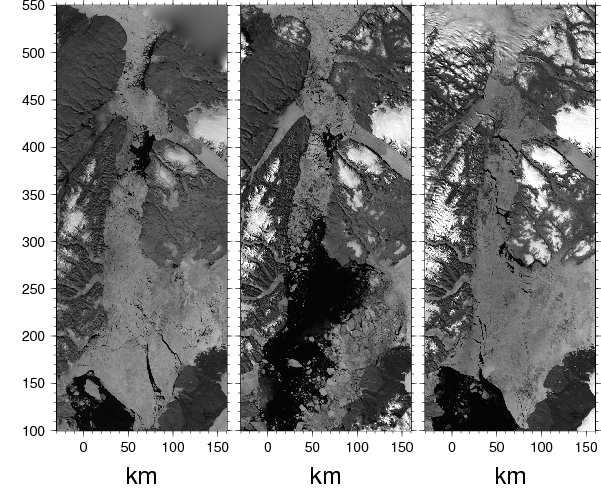
The voyage from Thule to Petermann usually takes about 2-3 days, but if the sea ice does not flush out with the generally southward currents, then it may take a week or two wrecking havoc to our busy science schedule. So, why is the ice still lingering in Nares Strait this year?

Nares Strait ice cover in July of 2015 (left), 2014 (center), and 2013 (right) from MODIS Terra.

Nares Strait ice cover in July of 2015 (left), 2014 (center), and 2013 (right) from MODIS Terra.

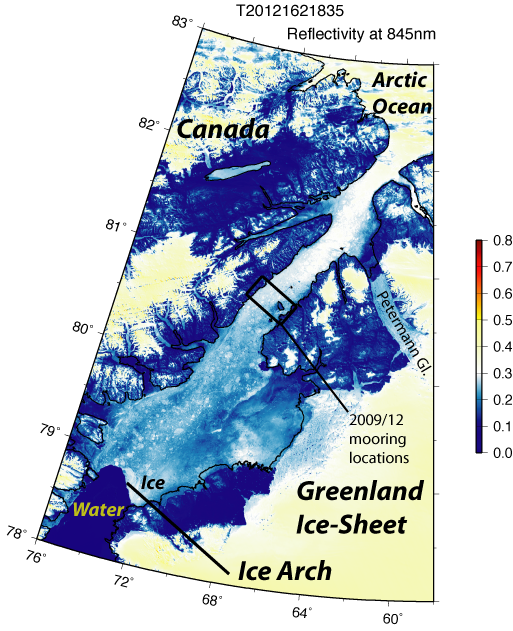
There are three parts to the answer: First, a sturdy ice arch at the southern entrance of Nares Strait has to break. It has done so only last week. Second, a strong and perhaps oscillating flow has to thoroughly collapse the large pieces of ice at a narrow choke point that is Smith Sound. This has not happened yet. And third, a persistent flow to the south has to flush out ice into Baffin Bay to the south faster than it enters from the Arctic Ocean in the north. This flow is much weaker at the moment than is normal, because winds in the Arctic Ocean have been from east to west right now. These winds moved water (and ice) offshore to the north, so sealevel along northern Greenland and Canada drops. We can see this in today’s satellite imagery as prominent black bands of open water along the coast of northern Canada.

Lets take a closer look of this same image and zoom in on the southern part of Nares Strait as it looked this morning.

Collapsing ice arch at the southern entrance to Nares Strait on 13 July 2015 from MODIS AQUA.

Collapsing ice arch at the southern entrance to Nares Strait on 13 July 2015 from MODIS AQUA.

What used to be a solid frozen mass of ice along the Greenland coast (bottom right) has become a broken and loose mass of smaller ice floes. The larger blocks farther from the coast are now sliding southward as the loose ice along the coast reduces friction or lubricates the edges. The sides lose their grip on the ice and the entire construction fails and collapses. A most beautiful video on the stability of arches is posted by Open University here about lines of action or thrust.

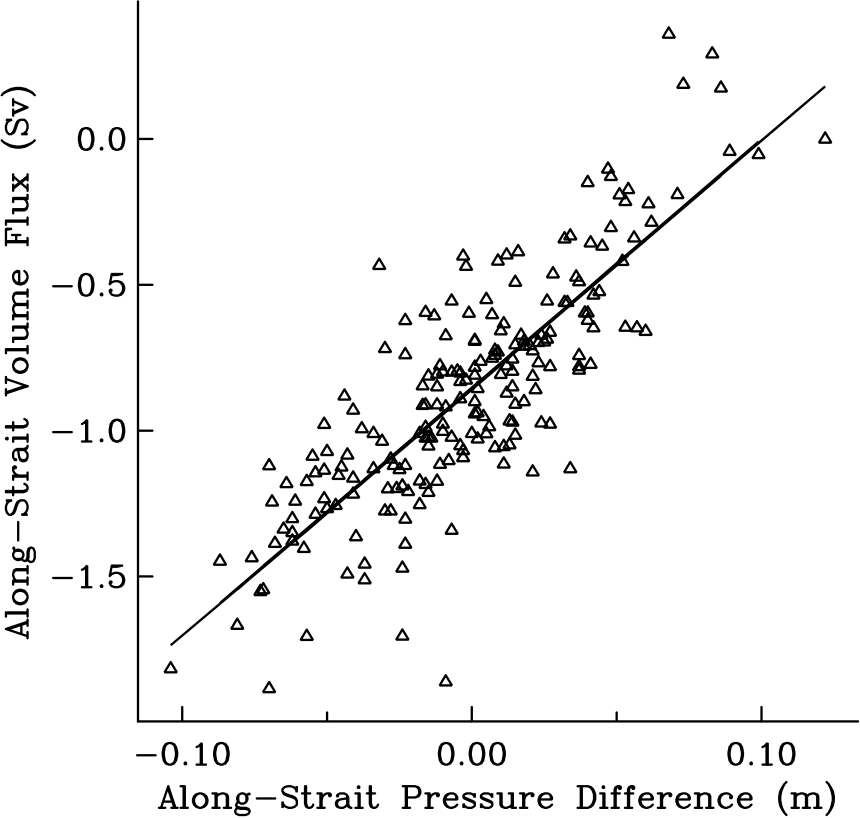
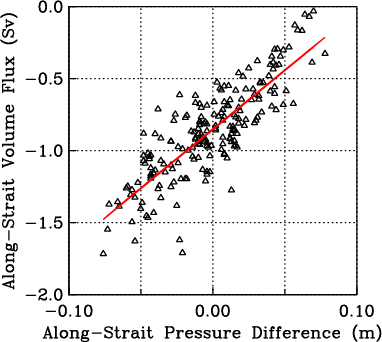
All we now need for the ice to flush out of Nares Strait is a weakening or reversal of the winds at the other northern entrances to Nares Strait. Much of the generally southward flow is caused by the ocean’s surface being higher in the north than it is in the south. There are details that I am skipping, but basically much of the flow rolls downhill like a ball. And with the winds up north being from east to west, there is not much of a hill that the water can flow down, so we got somewhat stagnant waters. I have actually measured the height of this “hill of water” many times over the many years with ocean sensors that measure how much water is above them. This figure summarizes 3 years of data collected every 3 hours or so

Graph showing how water flow (called “volume flux”) varies with the steepness of the hill (called “pressure gradient”). The “hill” is at most 10 centimeters or 3 inches) high. [Adapted from Muenchow, 2015]

Now there is more to the “hill” story that is modified near the surface by the earth’s rotation in a fluid that has different densities at different depths. In a nutshell, the surface flow is 2-3 times as strong as the depth averaged flow. Furthermore, the surface flow on the Canadian side of Nares Strait is often twice as strong as that closer to Greenland, but all these spatial variations in flow actually help to smash large pieces of ice by moving and rotating them different sides of the same large piece of ice differently.

So, lets all hope that we get a few days of strong winds from the north flowing south, that should clear Nares Strait quickly before Oden arrives there in 2 weeks time. Those winds from the north not only flush out ice from Nares Strait, they also keep it nicely on one, the Canadian side. Earth rotation does wonderful and magical things to fluids such as water and air.

Muenchow, A, 2015: Volume and freshwater flux observations from Nares Strait to the west of Greenland at daily time scales from 2003 to 2009. J. Phys. Oceanogr., re-submitted July 2015, .pdf

Sun Set in Nares Strait, Greenland

The sun bathed the southern reaches of Nares Strait in light again after four months of total darkness of the polar night. It is still cold, about -30 degrees centigrade, but the long shadows cast by mountains, hills, and even icebergs from Humbold Glacier are a feast for my eyes:

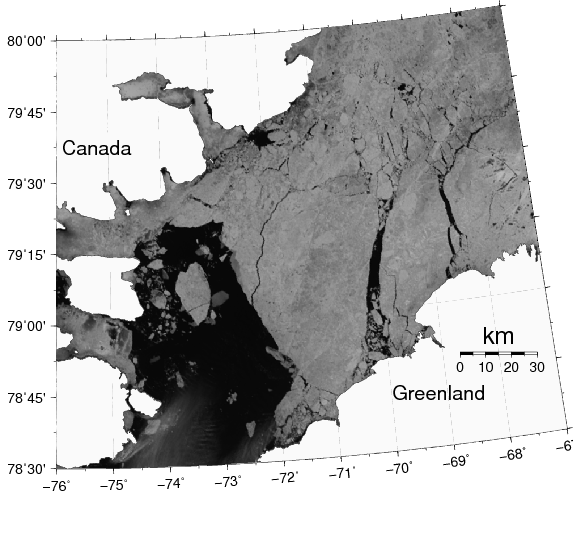
Kane Basin with Humbold Glacier, Greenland in the east, Ellesmere Island, Canada in the west as well as Smith Sound in the south, and Kennedy Channel of Nares Strait in the north. The visible image was taken Mar.-2, 2015 at 17:30 UTC by MODIS Terra.

Kane Basin with Humbold Glacier, Greenland in the east, Ellesmere Island, Canada in the west as well as Smith Sound in the south, and Kennedy Channel of Nares Strait in the north. The visible image was taken Mar.-2, 2015 at 17:30 UTC by MODIS Terra.

The sun dipped above the southern horizon just for a few hours. The light reflected by the ice and snow of North Greenland was captured by a satellite overhead. From these data I constructed the above image with the axes in km. The frame is big enough to fit both Denmark and Massachusetts into it. The image shows the southern entrance to Nares Strait with its prominent ice arch and the “North Water” polynya in the south. You can “see” individual ice floes in this image as well as rows of sea smoke over the thin ice of the polynya that are all resolved at the 250-m pixel size. Petermann is still dark and not shown, but give it a week, and we’ll get sun there also.

I will be watching this ice arch closely, because together with a group of 50 international scientists I am scheduled to sail these icy waters aboard the Swedish icebreaker Oden this summer for a multitude of experiments to take place in Petermann Fjord with data sampling of adjacent ice, ocean, and land. As a group we will try to reconstruct climate and its physical processes that impact change from tidal to glacial cycles.

Changing Weather, Climate, and Drifting Arctic Ocean Sensors

Three people died in Buffalo, New York yesterday shoveling snow that arrived from the Arctic north. The snow was caused by a southward swing of air from the polar vortex that is all wobbly with large meanders extending far south over eastern North-America where I live. Physics deep below the thinly ice-covered Arctic Ocean hold a key on why we experience the Arctic cold from 2000 km north and not the Atlantic warmth from 100 km east.

A wobbly jet stream that separates cold Arctic air from warmer mid-latitude air. Note the strong gradients over eastern North America. [From wxmaps.org]

A wobbly jet stream on Nov.-19, 2014 that separates cold Arctic air from warmer mid-latitude air. Note the strong differences over eastern North America and how balmy Europe, Russia, and Alaska are. [From wxmaps.org]

The Arctic Ocean holds so much heat that it can melt all the ice within days. The heat arrives from the Atlantic Ocean that moves warm water along northern Norway and western Spitsbergen where the ocean is ice-free despite freezing air temperatures even during the months of total darkness during the polar night. As this heat moves counter-clockwise around the Arctic Ocean to the north of Siberia and Alaska, it subducts, that is, it is covered by cold water that floats above the warm Atlantic water.

North-Atlantic Drift Current turning into the Norwegian Current that brigs warm Atlantic waters into the Arctic Ocean to the north of Norway and Spitsbergen. [Credits: Ruther Curry of WHOI and Cecilie Mauritzen of Norwegian] Meteorological Institute]

North-Atlantic Drift Current turning into the Norwegian Current that brigs warm Atlantic waters into the Arctic Ocean to the north of Norway and Spitsbergen. [Credits: Ruther Curry of WHOI and Cecilie Mauritzen of Norwegian] Meteorological Institute]

But wait a minute, how can this be? We all learn in school that warm air rises because it is less dense. We all know that oil floats on water, because it is less dense. Well, the warm Atlantic water is also salty, very salty, while the colder waters that cover it up are fresher, because many larger Siberian rivers enter the Arctic Ocean, ice melted the previous summer, and fresher Pacific waters enter also via Bering Strait. So, the saltier and more dense Atlantic water sinks below the surface and a colder fresher layer of water above it acts as a insolation blanket that limits the amount of ocean heat in contact with the ice above. Without this blanket, there would be no ice in the Arctic Ocean and the climate everywhere on earth would change because the ocean circulation would change also in an ice-free Arctic Ocean, but this is unlikely to happen anytime soon.

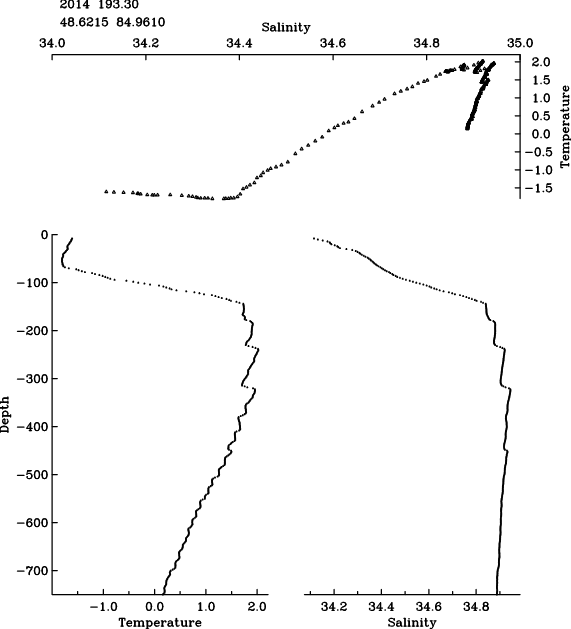
A single profile of temperature and salinity from an ice-tethered profile (ITP-74) off Siberia in July 2014. Note the warm Atlantic water below 150 meter depth.

A single profile of temperature and salinity from an ice-tethered profile (ITP-74) off Siberia in July 2014. Note the warm Atlantic water below 150 meter depth.

Some wonderful and new science and engineering gives us a new instant perspective on how temperature and salinity change over the top 700 meters of the Arctic Ocean every 6 hours. Scientists and engineers at the Woods Hole Oceanographic Institution with much support from American tax-payers keep up many buoys that float with the ice, measure the oceans below, and send data back via satellites overhead to be posted for all to see on the internet. Over the last 10 years these buoys provide in stunning detail how the Arctic Ocean has changed at some locations and has been the same at other locations. I used these data in an experimental class for both undergraduate and graduate students to supplement often dry lecture material with more lively and noisy workshops where both I and the students learn in new ways as the data are new … every day.

For well over 50 years the Soviet Union maintained stations on drifting Arctic sea ice that stopped when its empire fell apart in 1991. Russia restarted this program in 2003, but unlike the US-funded automated buoys, the Russian-funded manned stations do not share their data openly. No climate change here …

A Short Summary of Nares Strait Physics

The Arctic Ocean is a puddle of water covered by ice that melts, moves, and freezes. Grand and majestic rivers of Siberia and America discharge into the puddle and make it fresher than Atlantic Ocean waters. The fate of the Arctic freshwater helps decide if Europe and the US become warmer or colder, experience more or less storms, droughts, or floods, and if global sea level will rise or fall. In a nutshell: the fate of Arctic freshwater determines climate.

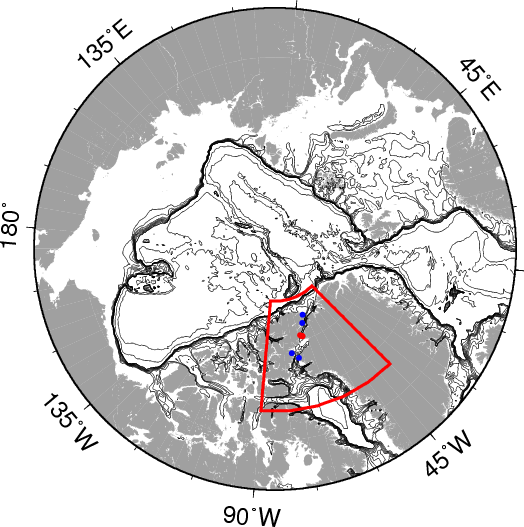
Arctic Ocean with Nares Strait study area (red box) with tide gauge locations as blue symbols and section of moored array as red symbol. Contours are bottom topography that emphasize ocean basins and continental shelf areas.

Arctic Ocean with Nares Strait study area (red box) with tide gauge locations as blue symbols and section of moored array as red symbol. Contours are bottom topography that emphasize ocean basins and continental shelf areas.

Nares Strait connects the Arctic and Atlantic Oceans to the west of Greenland. It is narrower than Fram Strait, but it transports as much fresh ocean water as does its wider sister facing Europe. Few people know this, including climate scientists who often model it with a bathymetry that is 10,000 years out of date from a time when Nares Strait did not yet exist. This is why the US National Science Foundation funded a group of oceanographers to use icebreakers, sensors, computers, and innovative engineering to collect and analyze data on the ice, the water, and the atmosphere.

Acoustic Doppler Current Profiler mooring deployment in Nares Strait from aboard the CCGS Henry Larsen in 2009.

Acoustic Doppler Current Profiler mooring deployment in Nares Strait from aboard the CCGS Henry Larsen in 2009.

Within days of the start of the grant I had to appear before the US Congress to answer questions on Petermann Glacier that discharges into Nares Strait. In 2010 a large 4-times Manhattan-sized ice islands broke off and people wanted to know if global warming was to blame. I was asked how ocean temperatures and currents relate to this and other events and what may happen next. My few data points were the only existing data for this remote region, but I had not yet had the time to analyze and publish much. Two years later another large 2-Manhattan sized ice island formed from the same glacier, but this time we were better prepared and people world-wide went directly to our data, thoughts, and stories when this blog was sourced in news papers in France, Germany, and China. Al Jezeraa, BBC, and PBS reported on it, too, giving me chance to connect via TV, radio, and pod-casting to a larger public.

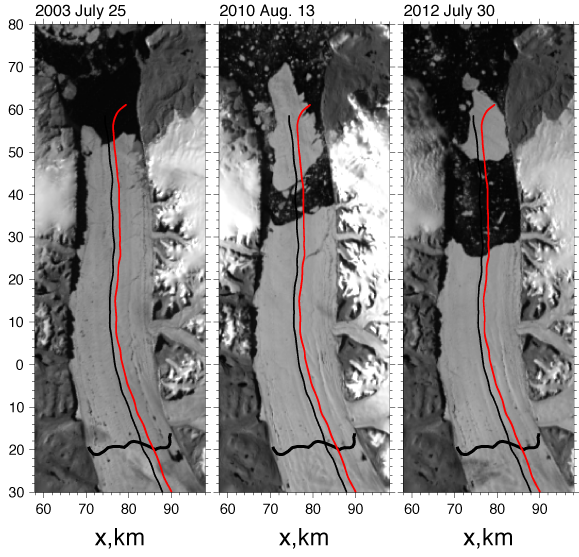
Petermann Gletscher in 2003, 2010, and 2012 from MODIS Terra in rotated co-ordinate system with repeat NASA aircraft overflight tracks flown in 2002, 2003, 2007, and 2010. Thick black line across the glacier near y = -20 km is the grounding line location from Rignot and Steffen (2008).

Petermann Gletscher in 2003, 2010, and 2012 from MODIS Terra in rotated co-ordinate system with repeat NASA aircraft overflight tracks flown in 2002, 2003, 2007, and 2010. Thick black line across the glacier near y = -20 km is the grounding line location from Rignot and Steffen (2008).

While it was exciting and fun to share Nares Strait and Petermann Gletscher physics with a global audience, it is not what we had planned to do. Our goal was to put real numbers to how much water, ice, and freshwater was moving from the Arctic to the Atlantic via Nares Strait. So the next 3 years we labored through our extensive records to first describe and then to understand what was happening in Nares Strait. We found that ocean currents move water always to the south no matter if ice covers Nares Strait or not, no matter if the ice is moving or not, no matter which way the wind is blowing. The physical cause for this southward flow is that the sea level is always a few inches higher in the Arctic Ocean than it is in Baffin Bay and the Atlantic Ocean to the south.

Linear regression of volume flux  through Nares Strait from current meters with along-strait sea level difference from tide gauges (unpublished).

Linear regression of volume flux through Nares Strait from current meters with along-strait sea level difference from tide gauges. (unpublished).

We know, because we measured this with tide gauges that we placed in protected coastal bays. We recovered 3 sensors; most rewarding was the recovery of one sensor that we had failed to reach in 2005, 2006, 2007, and 2009, but in 2012 we finally got the instrument and 9-years of very good data. Batteries and computers inside were still running and recording. I have never seen as clean and as long a time series.

Results from a 2003-12 tide record shows as power spectra with named tidal constituents at diurnal (~24 hours) and semi-diurnal (~12 hours) periods. The red line is a modeled red noise spectra (unpublished).

Results from a 2003-12 tide record shown as a power spectra with named tidal constituents at diurnal (~24 hours) and semi-diurnal (~12 hours) periods. Data are shown as the relative amplitudes of oscillations at frequencies in cycles per day or cpd. The red line is a modeled red noise spectra (unpublished).

From satellite data that we analyzed as part of this grant, we know when the ice moves and when it stops moving. The freeze-up of Nares Strait comes in one of three forms: 1. Ice stops moving in winter, because an ice barrier (ice arch or ice bridge) forms in the south that blocks all southward motion of ice; 2. only new and young ice moves southward, because an ice barrier forms in the north that blocks all entry of Arctic ice into Nares Strait; and 3. Arctic ice moves freely through Nares Strait, because no ice barriers are present. Our 2003-12 study period covers years for each of these different ice regimes. And each of these regimes leads to very different ocean (and ice) flux as a result of very different ocean physics.

Data alone cannot make definite statements on what will happen next with our climate, but we know much new physics. The physics suggest certain balances of forces and energy for which we have mathematical equations, but these equations must be solved on computers that can only approximate the true physics and mathematics. These computer models are our only way to make predictions ito the future. The data we here collected and our analyses provide useful checks on existing models and will guide improved models.

June-10, 2012 MODIS-Terra image showing location of moored array that was deployed in Aug. 2009 to be recovered in Aug. 2012.

June-10, 2012 MODIS-Terra image showing location of moored array that was deployed in Aug. 2009.

Johnson, H., Münchow, A., Falkner, K., & Melling, H. (2011). Ocean circulation and properties in Petermann Fjord, Greenland Journal of Geophysical Research, 116 (C1) DOI: 10.1029/2010JC006519

Münchow, A., Falkner, K., Melling, H., Rabe, B., & Johnson, H. (2011). Ocean Warming of Nares Strait Bottom Waters off Northwest Greenland, 2003–2009 Oceanography, 24 (3), 114-123 DOI: 10.5670/oceanog.2011.62

Münchow, A., Padman, L., & Fricker, H. (2014). Interannual changes of the floating ice shelf of Petermann Gletscher, North Greenland, from 2000 to 2012 Journal of Glaciology, 60 (221), 489-499 DOI: 10.3189/2014JoG13J135

Münchow, A., Falkner, K., & Melling, H. (2014). Baffin Island and West Greenland Current Systems in northern Baffin Bay Progress in Oceanography DOI: 10.1016/j.pocean.2014.04.001

Rabe, B., Johnson, H., Münchow, A., & Melling, H. (2012). Geostrophic ocean currents and freshwater fluxes across the Canadian polar shelf via Nares Strait Journal of Marine Research, 70 (4), 603-640 DOI: 10.1357/002224012805262725