Author Archives: Andreas Muenchow

Oceanography of Nares Strait Ice Flushing

I need the ice out of Nares Strait, a 20 mile wide and 300 miles long pathway to the North Pole between northern Canada and Greenland. The ice blocks our way to Petermann Fjord where a large glacier pushes thick ice out so sea as a floating ice shelf. We plan to drill through the floating section of the glacier that is about as thick as the Empire State Building is high. The ship to get us there is the Swedish icebreaker Oden (Location Map). She is passing the Faroe Islands to the north-west of Scotland and will arrive in 2 weeks at Thule Air Force Base where we will meet her.

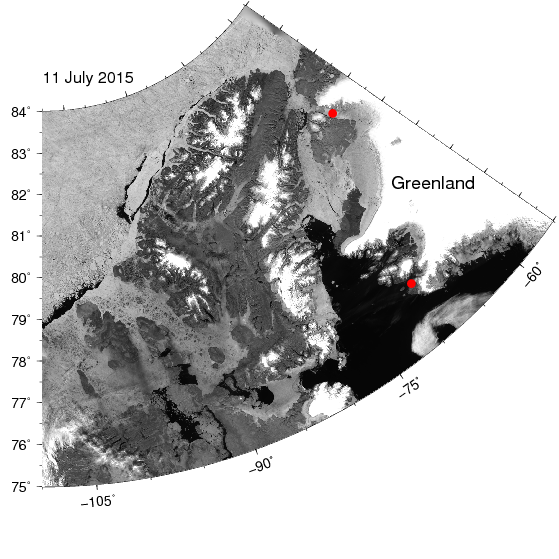
Image of northern Greenland (top right) and Ellesmere Island (center) showing open water as black, land as gray, and sea ice as gray/white. The two red dots are Thule Air Force Base in the south and Petermann Glacier in the north. Note the bands of black water along the coast of Ellesmere Island that result from east to west blowing winds that move ice offshore.

Image of northern Greenland (top right) and Ellesmere Island (center) showing open water as black, land as gray, and sea ice as gray/white. The two red dots are Thule Air Force Base in the south and Petermann Glacier in the north. Note the bands of black water along the coast of Ellesmere Island that result from east to west blowing winds that move ice offshore and reduce the southward flow in Nares Strait.

The voyage from Thule to Petermann usually takes about 2-3 days, but if the sea ice does not flush out with the generally southward currents, then it may take a week or two wrecking havoc to our busy science schedule. So, why is the ice still lingering in Nares Strait this year?

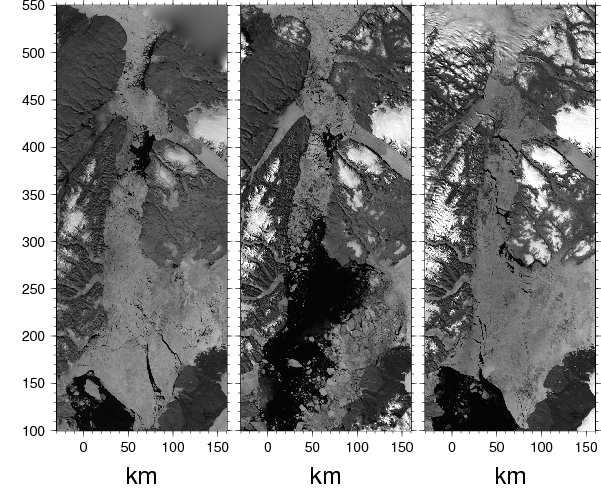
Nares Strait ice cover in July of 2015 (left), 2014 (center), and 2013 (right) from MODIS Terra.

Nares Strait ice cover in July of 2015 (left), 2014 (center), and 2013 (right) from MODIS Terra.

There are three parts to the answer: First, a sturdy ice arch at the southern entrance of Nares Strait has to break. It has done so only last week. Second, a strong and perhaps oscillating flow has to thoroughly collapse the large pieces of ice at a narrow choke point that is Smith Sound. This has not happened yet. And third, a persistent flow to the south has to flush out ice into Baffin Bay to the south faster than it enters from the Arctic Ocean in the north. This flow is much weaker at the moment than is normal, because winds in the Arctic Ocean have been from east to west right now. These winds moved water (and ice) offshore to the north, so sealevel along northern Greenland and Canada drops. We can see this in today’s satellite imagery as prominent black bands of open water along the coast of northern Canada.

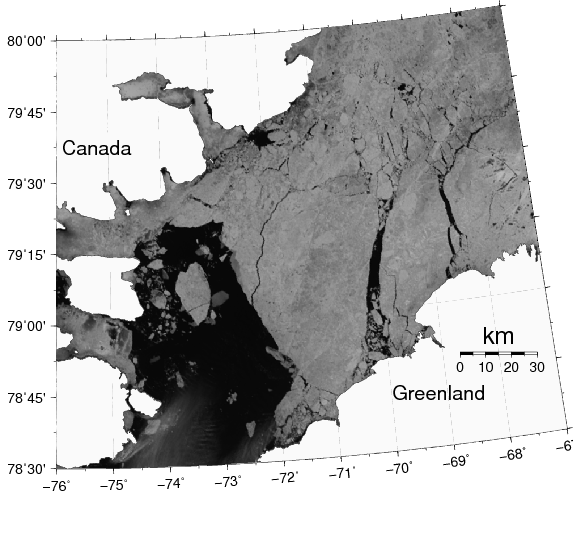
Lets take a closer look of this same image and zoom in on the southern part of Nares Strait as it looked this morning.

Collapsing ice arch at the southern entrance to Nares Strait on 13 July 2015 from MODIS AQUA.

Collapsing ice arch at the southern entrance to Nares Strait on 13 July 2015 from MODIS AQUA.

What used to be a solid frozen mass of ice along the Greenland coast (bottom right) has become a broken and loose mass of smaller ice floes. The larger blocks farther from the coast are now sliding southward as the loose ice along the coast reduces friction or lubricates the edges. The sides lose their grip on the ice and the entire construction fails and collapses. A most beautiful video on the stability of arches is posted by Open University here about lines of action or thrust.

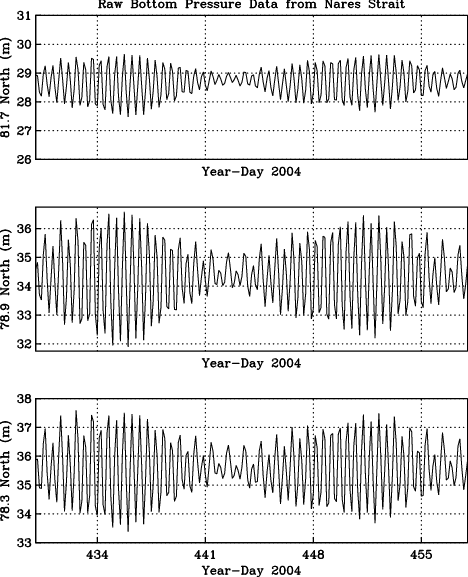
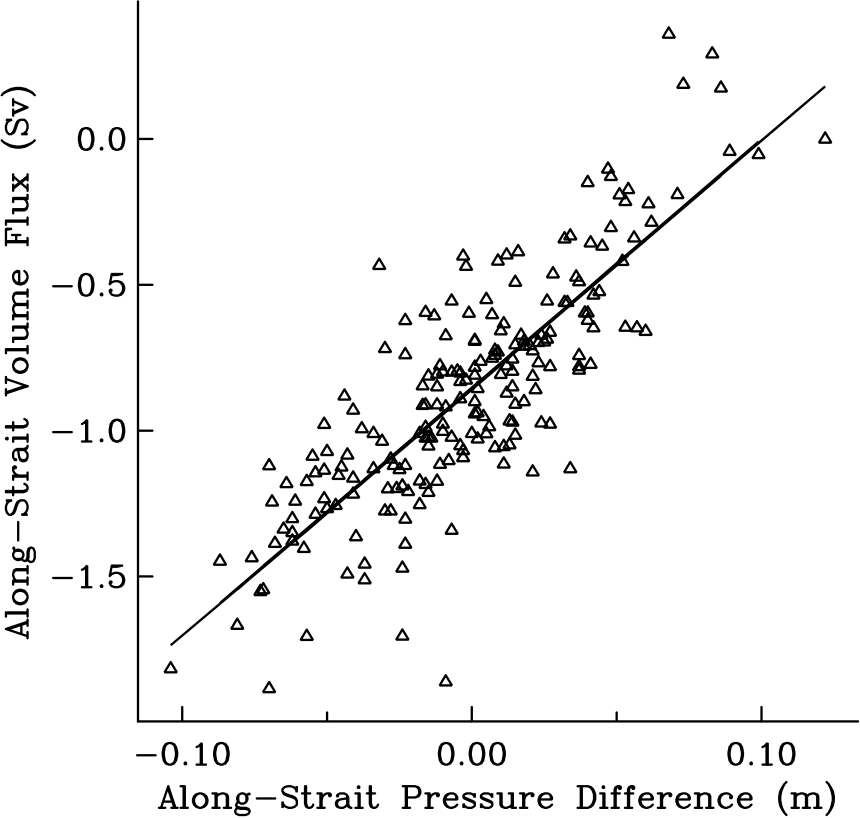
All we now need for the ice to flush out of Nares Strait is a weakening or reversal of the winds at the other northern entrances to Nares Strait. Much of the generally southward flow is caused by the ocean’s surface being higher in the north than it is in the south. There are details that I am skipping, but basically much of the flow rolls downhill like a ball. And with the winds up north being from east to west, there is not much of a hill that the water can flow down, so we got somewhat stagnant waters. I have actually measured the height of this “hill of water” many times over the many years with ocean sensors that measure how much water is above them. This figure summarizes 3 years of data collected every 3 hours or so

Graph showing how water flow (called “volume flux”) varies with the steepness of the hill (called “pressure gradient”). The “hill” is at most 10 centimeters or 3 inches) high. [Adapted from Muenchow, 2015]

Now there is more to the “hill” story that is modified near the surface by the earth’s rotation in a fluid that has different densities at different depths. In a nutshell, the surface flow is 2-3 times as strong as the depth averaged flow. Furthermore, the surface flow on the Canadian side of Nares Strait is often twice as strong as that closer to Greenland, but all these spatial variations in flow actually help to smash large pieces of ice by moving and rotating them different sides of the same large piece of ice differently.

So, lets all hope that we get a few days of strong winds from the north flowing south, that should clear Nares Strait quickly before Oden arrives there in 2 weeks time. Those winds from the north not only flush out ice from Nares Strait, they also keep it nicely on one, the Canadian side. Earth rotation does wonderful and magical things to fluids such as water and air.

Muenchow, A, 2015: Volume and freshwater flux observations from Nares Strait to the west of Greenland at daily time scales from 2003 to 2009. J. Phys. Oceanogr., re-submitted July 2015, .pdf

Coastal Oceanography off North-East Greenland

Greenland is melting, but it is not entire clear why. Yes, air temperatures continue to increase, but what does it matter, if those temperatures are below freezing most of the time. What if the ocean does most of the melting a few 100 m below the surface rather than the air above? It means that gut feeling and everyday experience can be poor guides for science, it means that there is more than meets the eye, and it means that some of Greenland’s melting happens out of sight without the dramatic imagery of a rapidly disintegrating glacier that sends icebergs out to sea.

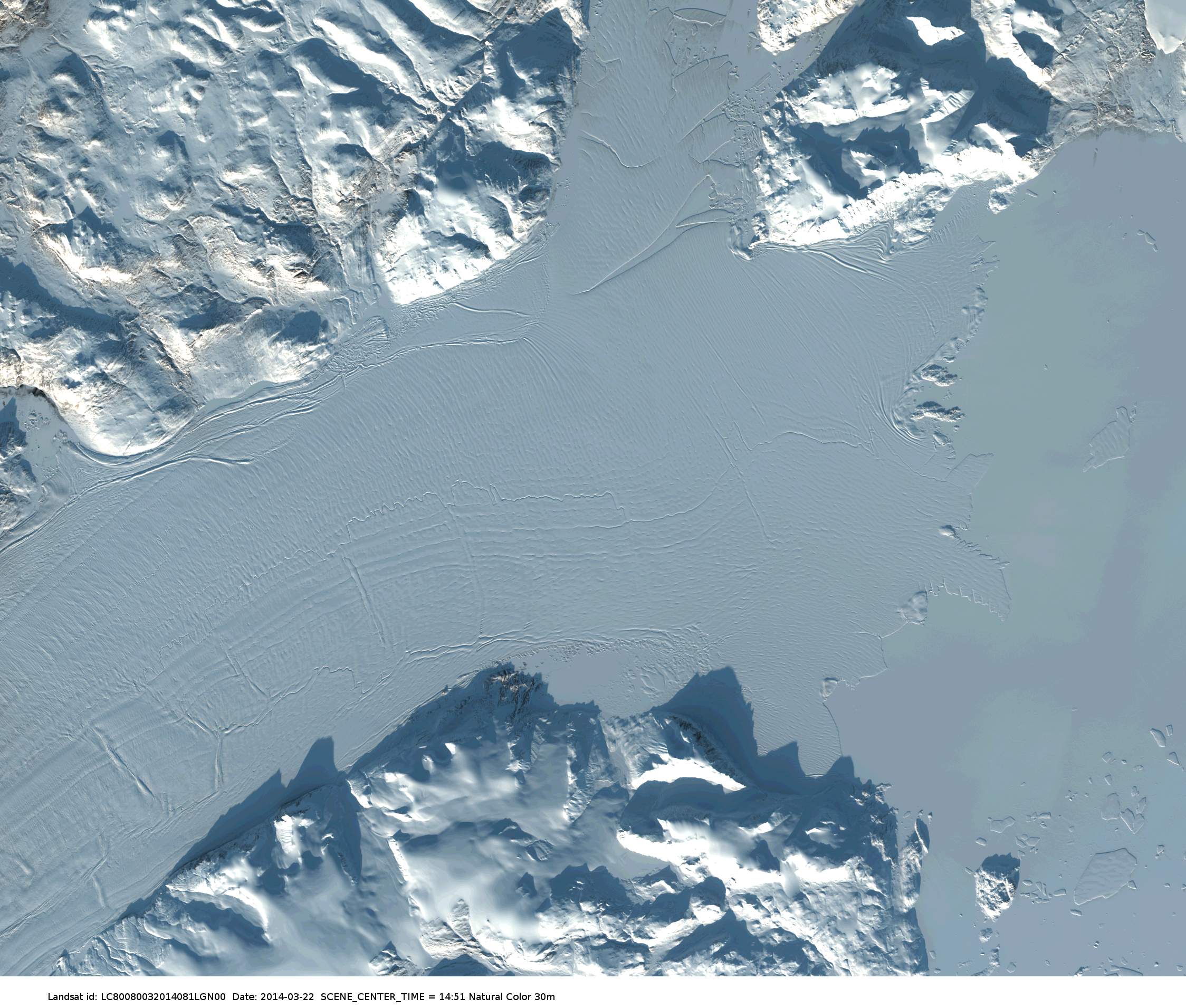
Floating section of 79N Glacier in north-east Greenland as seen from LandSat in march 2014.

Floating section of 79N Glacier in north-east Greenland as seen from LandSat in march 2014.

In order to “see” where changes may happen out of sight American tax payers supported me via the National Science Foundation (NSF) to use available University of Delaware ocean sensors from an available German ship to investigate the ocean near two large glaciers off north-east Greenland. The sensors are in the water for over a year now and will stay there for another to collect data every half hour. The data are stored on computers inside the sensors and it is a marvel of smart engineering that we can measure water temperature, salinity, and velocity at the bottom of an ice-covered ocean. Now what would I do with such data?

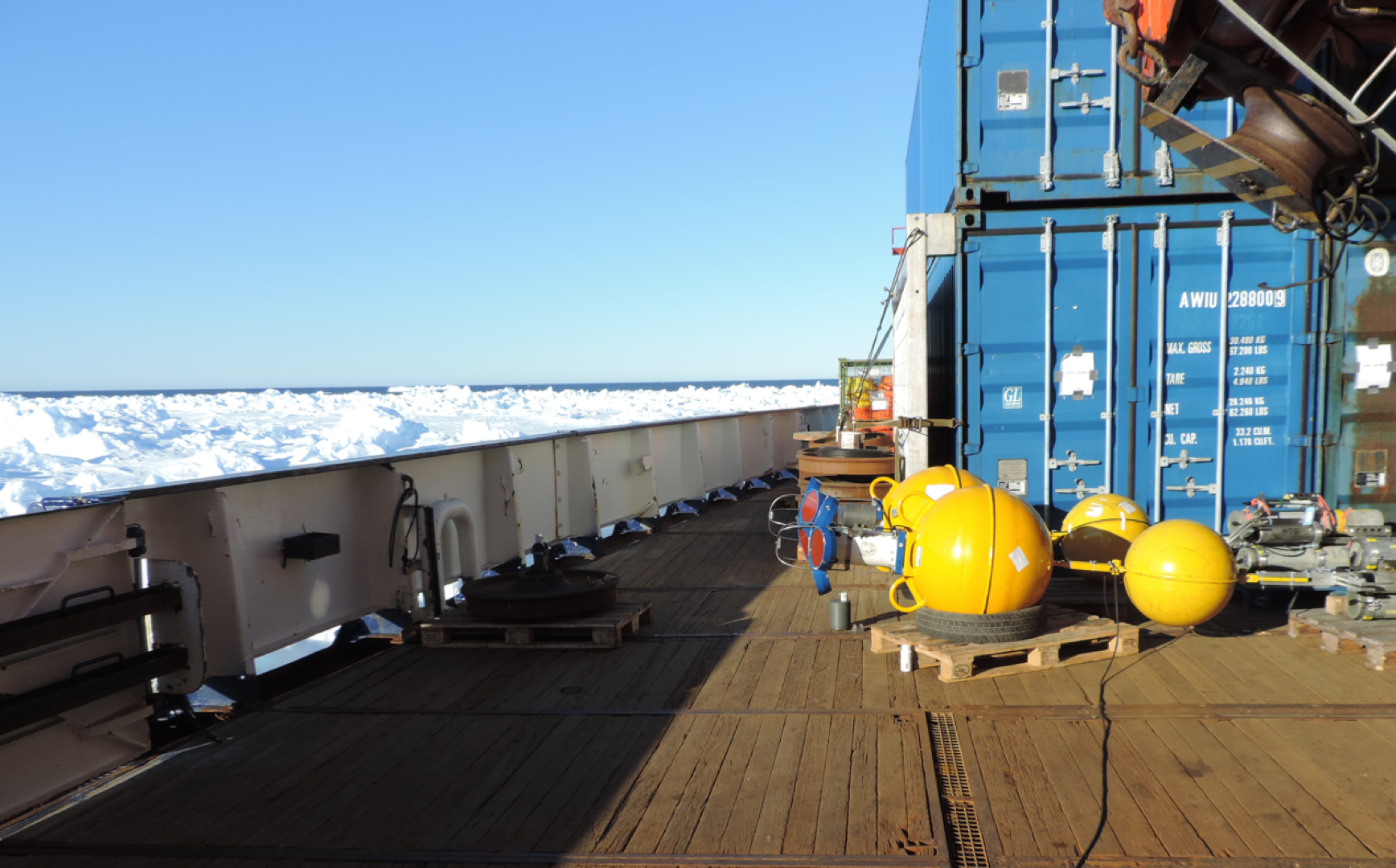
Two ocean sensor packages ready for deployment near Isle de France, Greenland 10 June 2014.

Two ocean sensor packages ready for deployment near Isle de France, Greenland 10 June 2014.

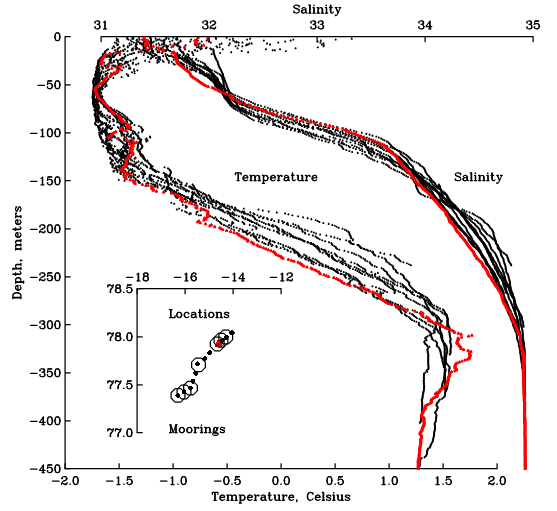
First, one needs to know that in the Arctic Ocean temperature increases as one moves a thermometer from the surface towards the bottom for the first 900 feet or 300 meters. This only make sense, if the warm water is heavier than the cold water above. This is the case in the Arctic, because the warm water at depth is also very salty. The cold waters above contain less salt and that’s why they float. The warmest waters originate from the Atlantic Ocean to the south-east of Iceland. Lets call it Atlantic Water for this reason. The surface waters contain sea ice and its fresh melt water and thus are always close to the freezing point, so lets call them Polar Waters.

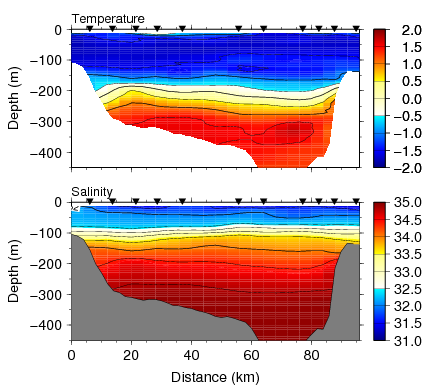
Vertical profiles of temperature and salinity across Norske Ore Trough, Greenland. The insert shows station locations for profiles (small symbols) and moorings (large circles). The red dot marks the location of the red profile.

Vertical profiles of temperature and salinity across Norske Ore Trough, Greenland. The insert shows station locations for profiles (small symbols) and moorings (large circles). The red dot marks the location of the red profile.

All along the East Coast of Greenland, we find a strong southward flow of ice and Polar Water called the East Greenland Current. On a rare clear day one can “see” this flow as a beautifully structured undulating band separating the deep Greenland Sea from the shallow and broad continental shelves. Now recall that the warmest waters are in the Atlantic layer way down and somewhat offshore. How do these waters cross the East Greenland current and the very wide continental shelf to reach the glaciers along the coast? It is this question my project tries to answer with lots of help from NSF and German friends.

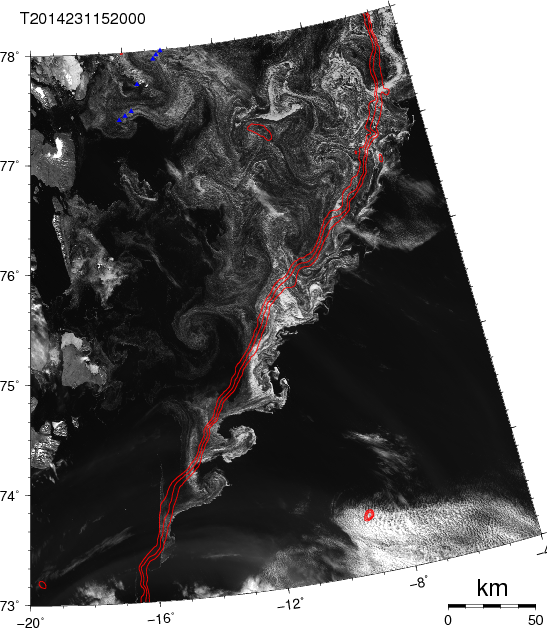
Satellite image ocean current instabilities on Aug.-19, 2014 as traced by ice along the the shelf break, red lines show 500, 750, and 1000 meter water depth. Small blue triangles top left are ocean moorings.

Satellite image ocean current instabilities on Aug.-19, 2014 as traced by ice along the the shelf break, red lines show 500, 750, and 1000 meter water depth. Small blue triangles top left are ocean moorings.

We think that the warm and salty waters flow near the bottom below the East Greenland Current at deep bottom depressions such as canyons. Testing this idea, we placed our sensors in a line across the canyon with a small ice-capped island called the Isle of France on one side and Belgica Bank on the other. We deployed seven instrument as an array across the canyon to measure the speed and direction of the flow as well as its temperatures and salinities. Our canyon connects the deep Greenland Sea 150 miles to the east with two glaciers another 100 miles to the north-west. We all anxiously hope that no iceberg wiped out bottom moorings and that they all record data faithfully until the summer of 2016 when we plan to recover instruments and data.

Section of temperature across Norske Ore Trough with Isle de France, Greenland on the left and Belgica Bank towards Fram Strait on the right. The view is towards 79N Glacier.

Section of temperature across Norske Ore Trough with Isle de France, Greenland on the left and Belgica Bank towards Fram Strait on the right. The view is towards 79N Glacier.

Before and after the placement of our moored instruments, however, we did survey the section from the ship and I show the temperature and salinity across our canyon. We now see that the water below 200 m depth are indeed very warm and salty as expected, but there is a detail that I cannot yet explain: notice the slight upward sloping contours of salinity near km-80 at the rim of the canyon and the downward sloping contours on the other side near km-10. Such sloping contours represent a flow out of the page at km-80 and into the page at km-10 which is exactly the opposite of what I expected. All I can say at the moment is that this snapshot does not resolve motions caused by the tides, the winds, and the seasonal cycles properly, but our moorings do. So, there are still mysteries to be solved by the data sitting on the bottom of the ocean guarded by towering spectacles of ice.

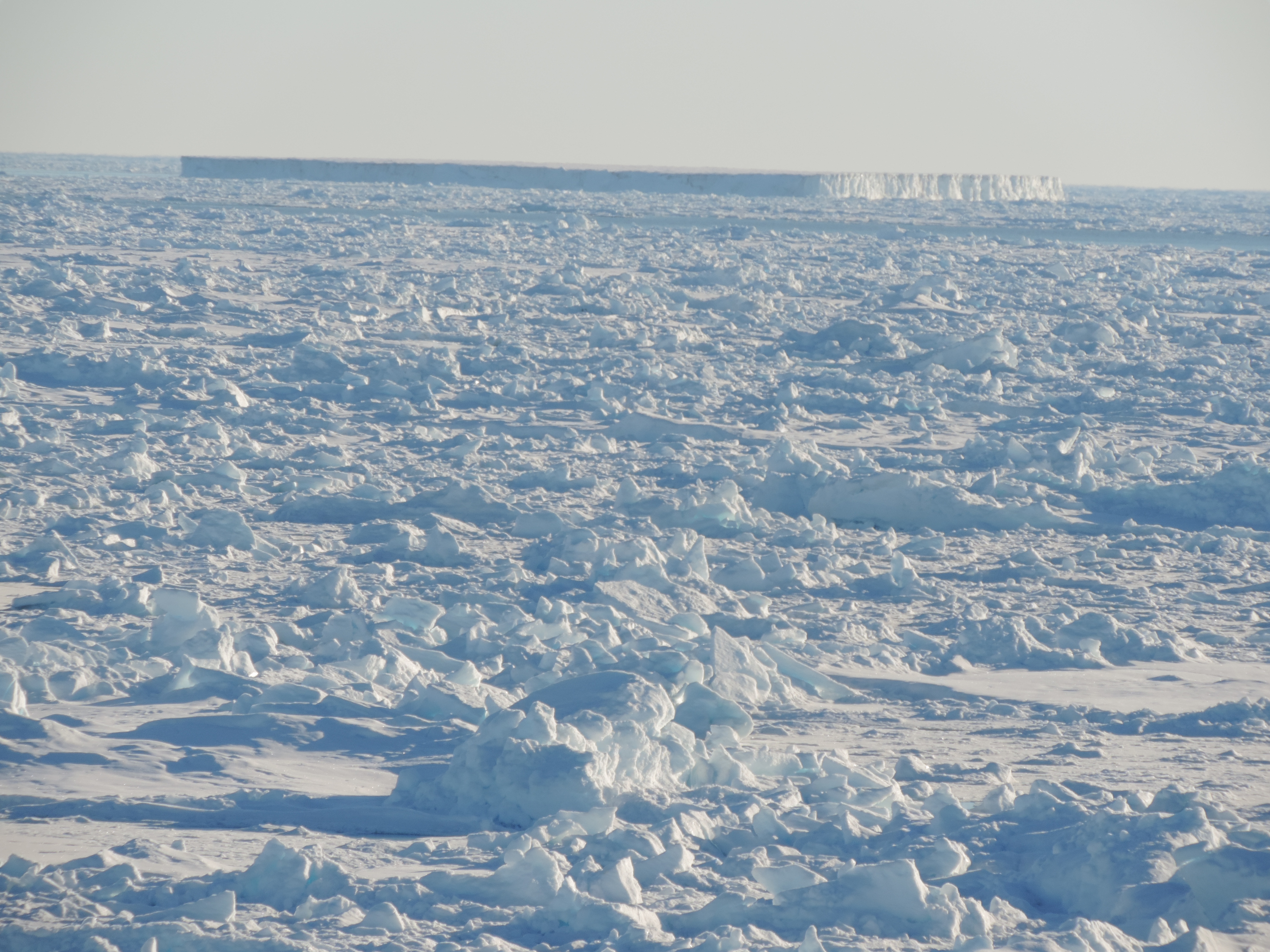
Tabular iceberg and sea ice cover near Isle de France 10 June 2014

Tabular iceberg and sea ice cover near Isle de France 10 June 2014

[This entry will be submitted to NSF as a Final Outcome Report for award 1362109 “Shelf-Basin Exchange near 79N Glacier and Zachariae Isstrom, North-East Greenland.” The work would not have been possible without the generous support of NSF as well as the German Government as represented by the Alfred Wegener Institute who sponsored the expedition to North-East Greenland in 2014. Torsten Kanzow, Benjamin Rabe, and Ursula Schauer of AWI all deserve as much and even more credit for this work than do I.]

Budéus, G., & Schneider, W. (1995). On the hydrography of the Northeast Water Polynya Journal of Geophysical Research, 100 (C3) DOI: 10.1029/94JC02024

Hughes, N., Wilkinson, J., & Wadhams, P. (2011). Multi-satellite sensor analysis of fast-ice development in the Norske Øer Ice Barrier, northeast Greenland Annals of Glaciology, 52 (57), 151-160 DOI: 10.3189/172756411795931633

Reeh, N., Thomsen, H., Higgins, A., & Weidick, A. (2001). Sea ice and the stability of north and northeast Greenland floating glaciers Annals of Glaciology, 33 (1), 474-480 DOI: 10.3189/172756401781818554

Wadhams, P., Wilkinson, J., & McPhail, S. (2006). A new view of the underside of Arctic sea ice Geophysical Research Letters, 33 (4) DOI: 10.1029/2005GL025131

Sweden’s Icebreaker for Petermann Gletscher 2015

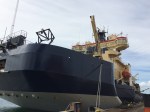
Sweden’s icebreaker I/B Oden will sail for Greenland this summer to pick up about 50 scientists to work the ice, land, water, and glaciers of north-west Greenland with Petermann Gletscher as its focus. I will be working with Celine Heuze of Gothenburg University, Jari Kruetsfeldt of Stockholm Technical University, and Christina, a Swedish High School teacher. Together we are responsible to run the water sampling and ocean sensing.

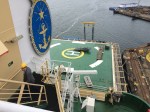
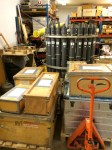
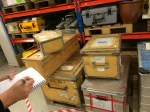
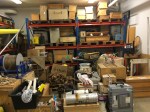
We met 3 weeks ago on the ship in Landskrona, Sweden where we loaded all our boxes filled with computers, electronics, bottles, rubber hoses, and some more computers. We also met the ship’s crew and a larger group of scientists and engineers from Oregon State University in the US, Gothenburg and Stockholm Universities in Sweden, and the Swedish Polar Research Secretariat that runs the ship. For 3 days we worked, ate, slept (somewhat), and worked some more to get ourselves and our equipment unpacked and organized.

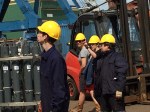
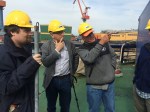
There is nothing romantic about working in an industrial area lugging boxes and stuff up and down stairs from back to front and back again. Despite all the cranes, winches, fork lifts, A-frames, and other tools, it is still back-breaking labor as much is still carried to and fro by hand while watching for heavy loads overhead, sharp corners below, and tight corners to maneuver around. Hard-hats and steel-toed boots are NOT optional. The only positive here is that shared pain brings people together to lower the pain via teamwork.

While most people seem fresh and happy, this wears off after 3 days of intense work not captured in photos. Sleep deprivation sets in as everyone tries to cram too much work into the 24 hours available. And yet, it is during these short and intense work periods, that new friendships and scientific collaborations emerge quickly even though people do not always look their best.

As an example, here is me as a zombie after about 4 nights with little sleep

As always, I try too much as I perform my duties on the water sampling and ocean sensing during the day and fight a nasty Iridium satellite communication problem  at night.  At the University of Delaware we designed, assembled, and shipped off to Sweden an air and ocean weather station to be deployed above and below the floating tongue of Petermann Gletscher. There was no time for testing as all gear to deployed on Petermann Gletscher in August had to be in Landskrona in May.

Despite the looks, I was ecstatic on the inside, because I had just solved a crucial sub-problem when an e-mail reached me that a small NASA grant was coming my way to actually pay for the science that I hope to do during this summer. This, however, is another story for another day.

Accidental Careers: Oceanography and Marine Engineering

A student at a vocational High School in Tulsa, Oklahoma asked me three questions today about my career choices as he ponders his’ in Marine Engineering

1. If you had to do anything over, related to your career or education, would you do anything differently?
2. What advice would you give to me as someone interested in pursuing a career path similar to yours?
3. How many coworkers or workers do you work with on average in your job position?

that I answered as follows

The author working at sea in 2003 or 2004. [Photo credit: Chris Linder, WHOI]

The author working at sea in 2003 or 2004. [Photo credit: Chris Linder, WHOI]

1. No.

2. Follow your passions; do what you enjoy doing; try new things; don’t be afraid to make mistakes, but learn from them; find people who share your passion and try to work with them.

3. It varies, let me add it up the people I had direct contact with the last 10 days; 2 scientists in Sweden plus 2 scientists in England, plus 2 scientists in Oregon, plus my 2 PhD students, plus 3 UDel colleagues all to prepare for two expeditions this summer to Greenland and Alaska; plus 3 UDel administrators, plus 1 undergraduate in a class, plus 5 professors on a budget committee to teach and help run the university, plus 1 person in California (fund-raising), plus 1 colleague in New York (writing papers), plus 2 engineers in Massachusetts (instrumentation), plus 1 sales manager in California (cable design), plus my wife for moral support, stress relief, and discussions … that adds up to about 26 people.

As your first question did not really count, I do add a personal comment on careers and career choices:

We all have only one past that we cannot change, but the future is always wide open with infinite new possibilities, new opportunities, and new people that all too often we cannot imagine or plan for ahead of time. For example, I grew up in a family in Germany where NOBODY on either my mom’s or my dad’s side of the family ever finished High School. As a result I had no idea what one does with High School (I wanted to become a paratrooper at 16, an anarchist at 18, a student at 20, a nurse at 21, etc.), what one does with a university degree, what one does after a PhD, etc. I always enjoyed reading, learning, and traveling, but it was unimaginable to me that this could lead to a job or career. Thirty years later I am still in awe and stunned by it. I did neither know nor touch computers until I left Germany for Britain at age 26. Now 90% of my work is writing and coding on a range of computers. Most things along my specific career path happened by chance and pluck, some bad, but mostly good. This is why item #2 above is so important. Passions and people also change over time, and so do we.

Thank you for the questions, Hunter.

Sun Set in Nares Strait, Greenland

The sun bathed the southern reaches of Nares Strait in light again after four months of total darkness of the polar night. It is still cold, about -30 degrees centigrade, but the long shadows cast by mountains, hills, and even icebergs from Humbold Glacier are a feast for my eyes:

Kane Basin with Humbold Glacier, Greenland in the east, Ellesmere Island, Canada in the west as well as Smith Sound in the south, and Kennedy Channel of Nares Strait in the north. The visible image was taken Mar.-2, 2015 at 17:30 UTC by MODIS Terra.

Kane Basin with Humbold Glacier, Greenland in the east, Ellesmere Island, Canada in the west as well as Smith Sound in the south, and Kennedy Channel of Nares Strait in the north. The visible image was taken Mar.-2, 2015 at 17:30 UTC by MODIS Terra.

The sun dipped above the southern horizon just for a few hours. The light reflected by the ice and snow of North Greenland was captured by a satellite overhead. From these data I constructed the above image with the axes in km. The frame is big enough to fit both Denmark and Massachusetts into it. The image shows the southern entrance to Nares Strait with its prominent ice arch and the “North Water” polynya in the south. You can “see” individual ice floes in this image as well as rows of sea smoke over the thin ice of the polynya that are all resolved at the 250-m pixel size. Petermann is still dark and not shown, but give it a week, and we’ll get sun there also.

I will be watching this ice arch closely, because together with a group of 50 international scientists I am scheduled to sail these icy waters aboard the Swedish icebreaker Oden this summer for a multitude of experiments to take place in Petermann Fjord with data sampling of adjacent ice, ocean, and land. As a group we will try to reconstruct climate and its physical processes that impact change from tidal to glacial cycles.