Tag Archives: oceanography

Travels by Mind to the Glaciers and Oceans off North-East Greenland

Our minds travel easier than the body. My eyes have never seen East Greenland, but I moved across its white Continue reading

Oceanography and Icebergs in Baffin Bay: LCDR Edward “Iceberg” Smith

In 1928 Edward H. “Iceberg” Smith took the 125 feet long Coast Guard Cutter “Marion” on an 8,100 mile journey from Boston, MA to New York City, NY via Disko Bay, Greenland. Along the way he defined operational Arctic Oceanography to explain and predict iceberg entering the busy sea lanes off North-America. The Titanic was sunk in 1912, the International Ice Patrol was formed in 1914, and LCDR Smith sailed to Greenland in 1928. The data are priceless 85 years later still. I used them to place modern observations from 2003 into a context of climate variations. First, however, let me give credit to one of the pioneers on whose scientific shoulders I stand:
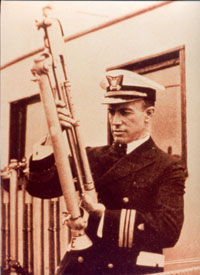
Edward H. "Iceberg" Smith of the US Coast Guard with reversing thermometer.

Edward H. “Iceberg” Smith of the US Coast Guard with reversing thermometer.

“Iceberg” Smith entered the Coast Guard Academy at age 21 in 1910 and served during World War I as a navigator on Atlantic convoy escort duty. After this war his ship was detailed to the International Ice Patrol and he became one of its first scientific observers at age 32 in 1921. As such he was sent for a year to Bergen, Norway in 1925 to learn the latest theories in physical oceanography. Scandinavian explorers like Nansen, Ekman, Sverdrup, Bjerknes, and Helland-Hansen defined physical oceanography at this time by applying physics on a rotating earth to phenomena that they observed from ships sailing at sea or ships frozen in Arctic ice. Much of this revolutionary work is now elementary oceanography taught in introductory courses, but then, nobody knew much about why ice and ocean move they way they do. It was time to put ideas to a thorough test which is what “Iceberg” Smith did, when he got his ship and orders to explore in 1928.

USCGC Marion built in 1927 [from http://laesser.org/125-wsc/]

USCGC Marion built in 1927. Note the scale indicated by a person standing on the lower deck. [From http://laesser.org/125-wsc]

Armed with new ideas, knowledge, and the tiny USCGC Marion “Iceberg” Smith set to out to map seas between Labrador, Baffin Island, and Greenland to explain and predict the number of icebergs to enter the North-Atlantic Ocean. During his 10 weeks at sea he mapped ocean currents from over 2000 discrete measurements of temperature and salinity at many depths. This was before computers, GPS, and electronics. In 1928 this was slow to work with cold water collected in bottles with “reversing thermometers” that cut off the mercury to preserve temperatures measured in the ocean at depth to be read later aboard. Salinity was measured at sea by tedious chemical titrations. Imagine doing all of this from a rocking and rolling shallow draft cutter that bounces in icy seas for 10 weeks within fog much of the time. No radar to warn of icebergs either, and you want to study icebergs, so you move exactly where they are or where you think they are coming from. And they though that the Titanic was unsinkable.
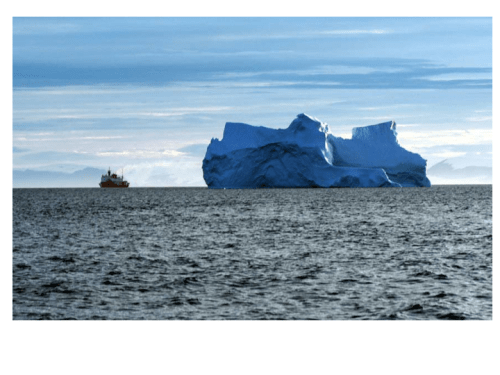
Iceberg in the fog off Upernarvik, Greenland in July of 2003. [Photo Credit: Andreas Muenchow]

Iceberg in the fog off Upernavik, Greenland in July of 2003. [Photo Credit: Andreas Muenchow]

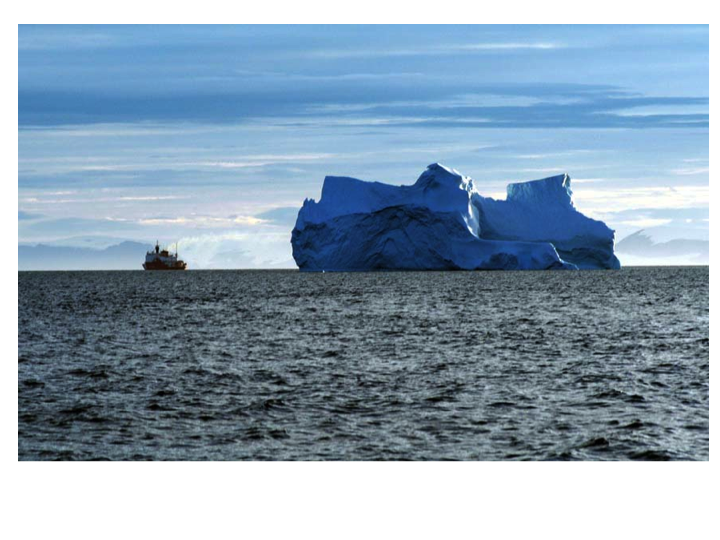
USCGC Healy in northern Baffin Bay in July 2003 with iceberg. Ellesmere Island is in the background.

USCGC Healy in northern Baffin Bay in July 2003 with iceberg. Ellesmere Island is in the background.

The 1928 Marion Expedition was the first US Coast Guard survey in Baffin Bay while the last such expedition took place 2003. Unlike “Iceberg” Smith we then had military grade GPS, radar, and sonar systems. These sensor systems allowed me to directly measure ocean currents from the moving ship every minute continuously from the surface to about 600 meters down. Oh, we also took water samples in bottles, but temperature, depth, and salinity are all measured electronically about 24 times every second. As a result we can actually test, if the physics that had to be assumed to be true in 1928 actually are true. As it turns out, the old theory to estimate currents from temperature and salinity sections works well off Canada, but not so well off Greenland. Furthermore, we found several eddies or vortices in the ocean from the current profiling sonars.

And finally, it took Edward H. “Iceberg” Smith only 3 years to publish most of his data and insightful interpretations while I am still working on both his and my own data 85 years and 10 years later, respectively. Sure, I got more data from a wider range of moored, ship-borne, and air-borne sensors, but I do wonder, if I really consider my data and interpretations as careful and think as thorough as LCDR Smith did. Furthermore, he had no computers and performed all calculations, crafted all graphs, and typed all reports tediously by hand. I would not want to trade, but all this makes me admire his skills, dedication, and accomplishments even more.

Dr Helen Johnson on acoustic Doppler current profiler (sonar to measure ocean velocity) watch aboard the USCGC Healy in Baffin Bay in 2003. [Photo credit: Andreas Muenchow]

Dr Helen Johnson on acoustic Doppler current profiler (sonar to measure ocean velocity) watch aboard the USCGC Healy in Baffin Bay in 2003. [Photo credit: Andreas Muenchow]

P.S.: The New Yorker has three stories on the subject published in 1938, 1949, and 1959. I eagerly await to read those.

ResearchBlogging.orgSmith, E. (1928). EXPEDITION OF U. S. COAST GUARD CUTTER MARION TO THE REGION OF DAVIS STRAIT IN 1928 Science, 68 (1768), 469-470 DOI: 10.1126/science.68.1768.469

Oceanography, Technology, and Ships

Sea-going oceanography is in transition. Times are exciting as we developed new tools, sensors, and ideas on how to observe the ocean and the stuff that lives in it, floats on it, and is submerged below it. I just learned about an awesome interview with Eli Kintisch which is posted as a podcast at the American Association for the Advancement of Science:

Better technology, but less money: Eli Kintisch discusses the crossroads facing U.S. oceanography.(Podcast)

I will write more about this, but I have to run off to meet with an electrical engineer to discuss ideas on how we perhaps can get data from bottom-mounted sensors out of the ocean in ice-covered seas instantly, rather than waiting 2-3 years to get instruments back with a ship.

Kintisch, E. (2013). A Sea Change for U.S. Oceanography Science, 339 (6124), 1138-1143 DOI: 10.1126/science.339.6124.1138

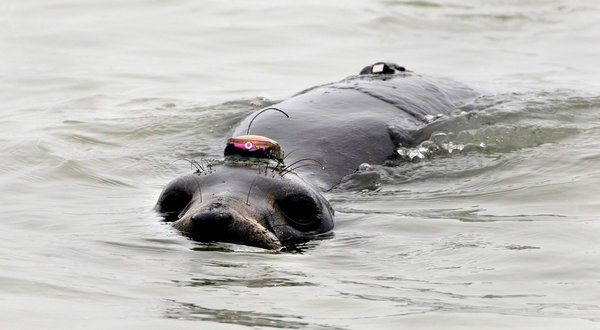
Seal with ocean sensor.

Seal with ocean sensor.

Elephant seal off Antarctica with ocean sensor transmitting data via satellite [Credit Lars Boehme]

Elephant seal off Antarctica with ocean sensor transmitting data via satellite [Credit Lars Boehme]

CCGS Henry Larsen in thick and multi-year ice of Nares Strait in August 2009. View is to the south with Greenland in the background. [Photo Credit: Dr. Helen Johnson]

CCGS Henry Larsen in thick and multi-year ice of Nares Strait in August 2009. View is to the south with Greenland in the background. [Photo Credit: Dr. Helen Johnson]

Shades of White as the Sun Rises over Nares Strait

After four months of total darkness the sun is back up in Nares Strait. It transforms the polar night into thousand shades of white as mountains, glaciers, and ice take in and throw back the new light. Our satellites receive some of the throw-away light as the landscape reflects it back into space. During the long dark winter months these satellites could only “see” heat, but this will change rapidly as Alert atop of Arctic Canada receives 30 minutes more sun with each passing day.

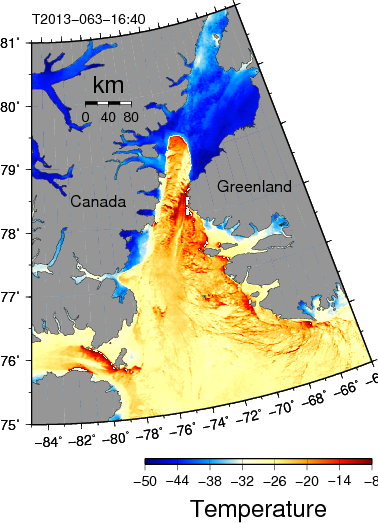
Surface temperature in degrees centigrade over northern Baffin Bay on March-4, 2013 16:20 UTC from MODIS Terra.

Surface temperature in degrees centigrade over northern Baffin Bay on March-4, 2013 16:20 UTC from MODIS Terra. Warm colors (reds) show thin and/or ice while cold colors (blues) suggest thick ice stuck in place.

A very strong ice arch at the southern entrance to Nares Strait separates thick (and cold) ice to north from thin (and warm) ice to the south. The thick and cold ice is not moving, it is stuck to land, but the ocean under the ice is moving fast from north to south. The ocean currents thus sweep the newly formed thin ice away to the south. This ice arch formed way back in early November just after the sun set for winter over Nares Strait.

Now that the sun is up, we can also “see” more structures in the ice by the amount of light reflected back to space. A very white surface reflects lots while a darker surface reflects less. We are looking at the many shades of white here … even though I color them in reds and blues:

Surface reflectance at 865 nm in northern Baffin Bay on March-4, 2013 16:20 UTC from MODIS Terra.

Surface reflectance at 865 nm in northern Baffin Bay on March-4, 2013 16:20 UTC from MODIS Terra. A true color image (which this is not) would show only white everywhere. Hence I show the very bright white as red and the less bright white as blue. This artificial enhancement makes patterns and structures more visible to the eye.

Zooming into the area where the ice arch separates thick ice to the north that is not moving from thin ice in the south that is swept away by ocean currents, I show this image at the highest possible resolution:

Surface reflectance at 865 nm at the southern entrance to Nares Strait on March-4, 2013. Contours are 200-m bottom depth showing PII2012 grounded at the north-eastern sector of the ice arch.

Surface reflectance at 865 nm at the southern entrance to Nares Strait on March-4, 2013. Contours are 200-m bottom depth showing PII2012 grounded at the north-eastern sector of the ice arch.

Note, however, that the sun is far to south and barely peeking over the horizon. This low sun angle shows up as shadows cast by mountains. And since the sun is still far to the south, the shadows cast are to the north. This “shadow” makes visible the ice island from Petermann Gletscher that anchors this ice arch as it is grounded. I labeled it PII2012 in the picture.

From laser measurements we know that the ice islands stands about 20 meter (or 60 feet) above the rest of the ice field. This height is enough to cast a visible shadow towards the north (slightly darker = less red) as well as a direct reflection off its vertical wall facing south (brighter = more red) towards the sun. At its thickest point, PII2012 is about 200 meters (~600 feet) thick. For this reason, I also show the 200-m bottom contour that moves largely from north to south along both Ellesmere Island, Canada on the left and Greenland on the right.

The sun brings great joy to all, especially those hardy souls who live in the far north. The sun’s rise also shows the delicate interplay of light and shadows that we can use to solve puzzles on how ice, oceans, and glaciers work. At the entrance of Nares Strait the playful delights of the sea ice, ocean currents, and ice islands gives us a large area of thin ice. The thin ice will soon melt and perhaps has already started to set into motion a spring bloom of ocean plants. Ocean critters will feed on these to start another cycle of life. Whales, seals, and polar bears all depend on it for 1000s of years now.

Sketch of the biological pieces that a large area of open water near a fixed ice edge like that of a polynya may support. [From Northern Journal>/a>]

Sketch of the biological pieces that a large area of open water near a fixed ice edge like that of a polynya may support. [From Northern Journal]

Petermann Glacier Ice Islands: Where are they now?

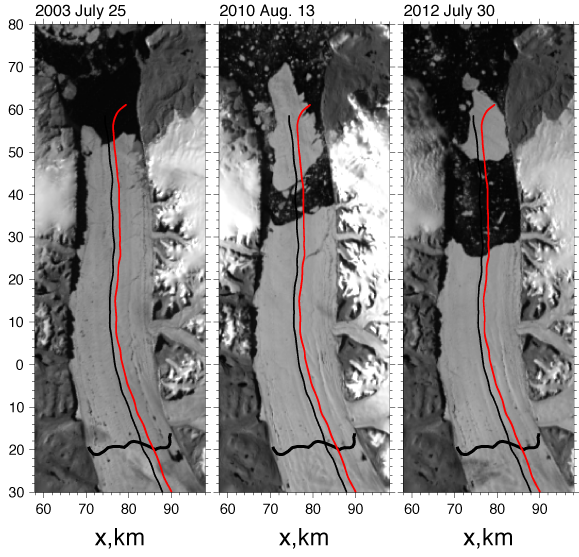
Two large calving events in 2010 and 2012 reduced the floating part of Petermann Gletscher by 44 km (28 miles) in length, 6 Manhattans (380 km^2) in area, and 42 gigatons in mass. But what’s a gigaton? Writing in The Atlantic Magazine, Julio Friedman states that if we put all people living on earth onto a scale, then we will get half a gigaton. So, Petermann’s two ice island weigh more than eighty times as all humanity combined. As a reminder, this is what the break-ups looked like:

Petermann Gletscher in 2003, 2010, and 2012 from MODIS Terra in rotated co-ordinate system with repeat NASA aircraft overflight tracks flown in 2002, 2003, 2007, and 2010. Thick black line across the glacier near y = -20 km is the grounding line location from Rignot and Steffen (2008).

Petermann Gletscher in 2003, 2010, and 2012 from MODIS Terra in rotated co-ordinate system with repeat NASA aircraft overflight tracks flown in 2002, 2003, 2007, and 2010. Thick black line across the glacier near y = -20 km is the grounding line location from Rignot and Steffen (2008).

It turns out that the smaller 2012 ice island is just as heavy as the 2010 island, because it is much thicker, about 200 m, 600 feet, or half the height of the Empire State Building in Manhattan. These thick and thin islands have since left Petermann Fjord and Nares Strait for more southern climes. The thinnest piece reached Newfoundland in the summer of 2011 where it melted away. Most of the thicker, larger, and heavier ice islands from Petermann and Ryder Glaciers now litter almost the entire eastern seaboard of Canada as the two largest pieces have split, broken, and splintered into many smaller pieces. Each of these still represents an exceptionally large and dangereous piece of ice that can wipe any offshore oil platform off its foundation. Luc Desjardins of the Canadian Ice Service now tracks more than 40 segments, some still bigger than Manhattan, some as small as a football field. The distribution along the 1500 km (1000 miles) of coast is staggering:

RadarSat imagery of eastern Baffin Island (bottom, right), western Greenland (top, right), and Nares Strait with Petermann Fjord (top, left) with pieces of Petermann and Ryder Ice Islands identified. [Credit: Luc Lesjardins, Canadian Ice Service]

RadarSat imagery of eastern Baffin Island (bottom, right), western Greenland (top, right), and Nares Strait with Petermann Fjord (top, left) with pieces of Petermann and Ryder Ice Islands identified as green dots. [Credit: Luc Lesjardins, Canadian Ice Service]

What stands out is that most pieces are close to the coast of Canada. This is expected, because often the ocean moves in ways to balance pressure gradient and Coriolis forces as we live on an earth that rotates once every day around its axis. This force balance holds both in the ocean and the atmosphere. We are all familiar with winds around a low-pressure system such as Hurricane Sandy where the winds move air counter-clockwise around the eye (the center of low pressure). This eye of low pressure in our ocean story is permanently near the center of Baffin Bay. Ocean currents then move water counter-clockwise around this eye. This results in a flow to the south off Canada and a flow to the north off Greenland. On a smaller scale this balance holds also, such as Delaware Bay or Petermann Fjord, but I will not bore you with the details of graduate level physics of fluids in motions … as important as they may be.

So, almost all the ice islands we see in the above imagery will make their way further south towards the Grand Banks off Newfoundland. Some are grounded to the bottom of the shallow coastal ocean and may sit in place for a year, or a month, or until the next high tide will lift the ice off the bottom and move it back into deeper water. Some ice islands will keep moving rapidly, some will further break apart, but none will go away anytime soon. If you want to see some of Petermann’s Ice Islands for yourself, take the ferry from North Sidney, Nova Scotia to Port aux Basques, Newfoundland and Labrador and head for the Great Northern Peninsula. That’s what I hope to do one of the next summers.

ResearchBlogging.org
Johnson, H., Münchow, A., Falkner, K., & Melling, H. (2011). Ocean circulation and properties in Petermann Fjord, Greenland Journal of Geophysical Research, 116 (C1) DOI: 10.1029/2010JC006519

Münchow, A., & Garvine, R. (1993). Dynamical properties of a buoyancy-driven coastal current Journal of Geophysical Research, 98 (C11) DOI: 10.1029/93JC02112

Rignot, E., & Steffen, K. (2008). Channelized bottom melting and stability of floating ice shelves Geophysical Research Letters, 35 (2) DOI: 10.1029/2007GL031765