Category Archives: Ice Cover

Exploring Greenland’s Coastal Currents: A Journey of Discovery with Icebreaker Polarstern

Icebreaker Polarstern reached its home port of Bremerhaven in Germany just before Orkan “Joshua” hit northern Germany hard. The ship returned after 3 month at sea with 48 crew and 46 scientists working on ocean biology, chemistry, and physics. The 7-week expedition from Svalbard to Greenland and back to Germany culminated 3 years of planing and preparations led by the Alfred Wegener Institute (AWI). As one of 46 scientists I stepped onto the ship almost two months ago in Longyearbyen. We planned to explore what moves ice and fresh Arctic water into the Atlantic Ocean with sensors to probe the coastal circulation.  Analyzing these data, I will now live in Bremerhaven for a few months.
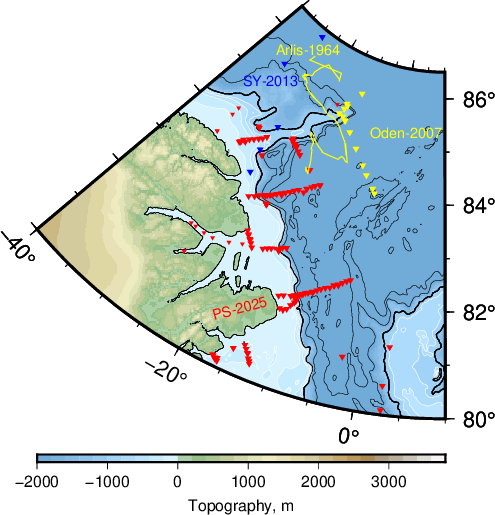
The map above shows where we went to the north of Greenland. I am coloring the coastal ocean shallower than 1000 m in light blue and the deeper ocean in dark blue. Our 2025 Polarstern data are the red symbols while yellow and blue symbols show data locations from 1964 ice island, 2007 icebreaker,  and 2013 helicopter surveys. This area contains the last and thickest sea ice of the Arctic Ocean and prior ocean observations originate from floating ice islands that both the Soviet Union and the U.S.A. used during the Cold War 1947-91 such as the Arlis-1964 track (yellow line). Helicopter surveys collected a few data in 2013 (blue symbols) while the Swedish icebreaker Oden collected data along two lines farther offshore (yellow symbols).
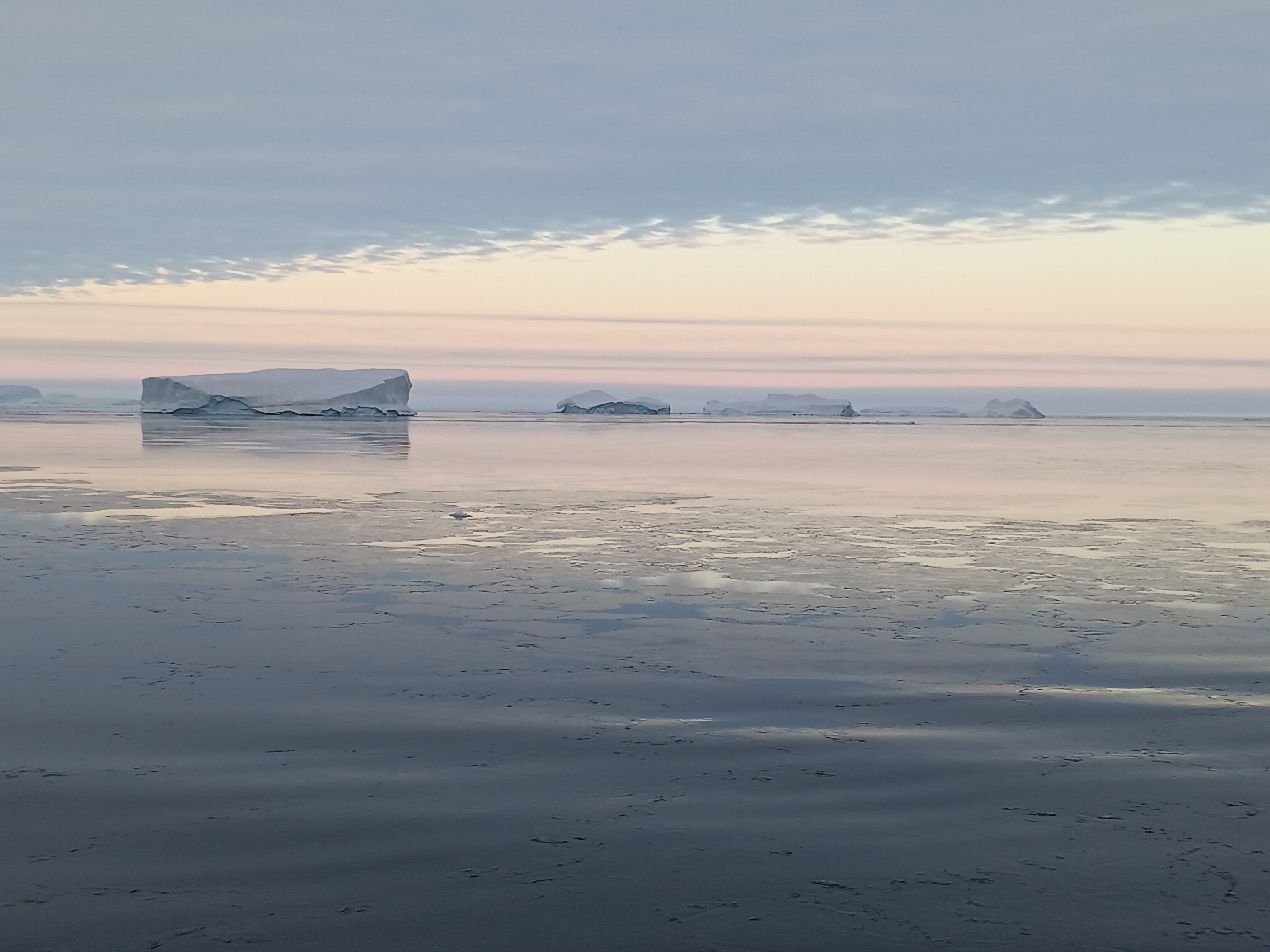
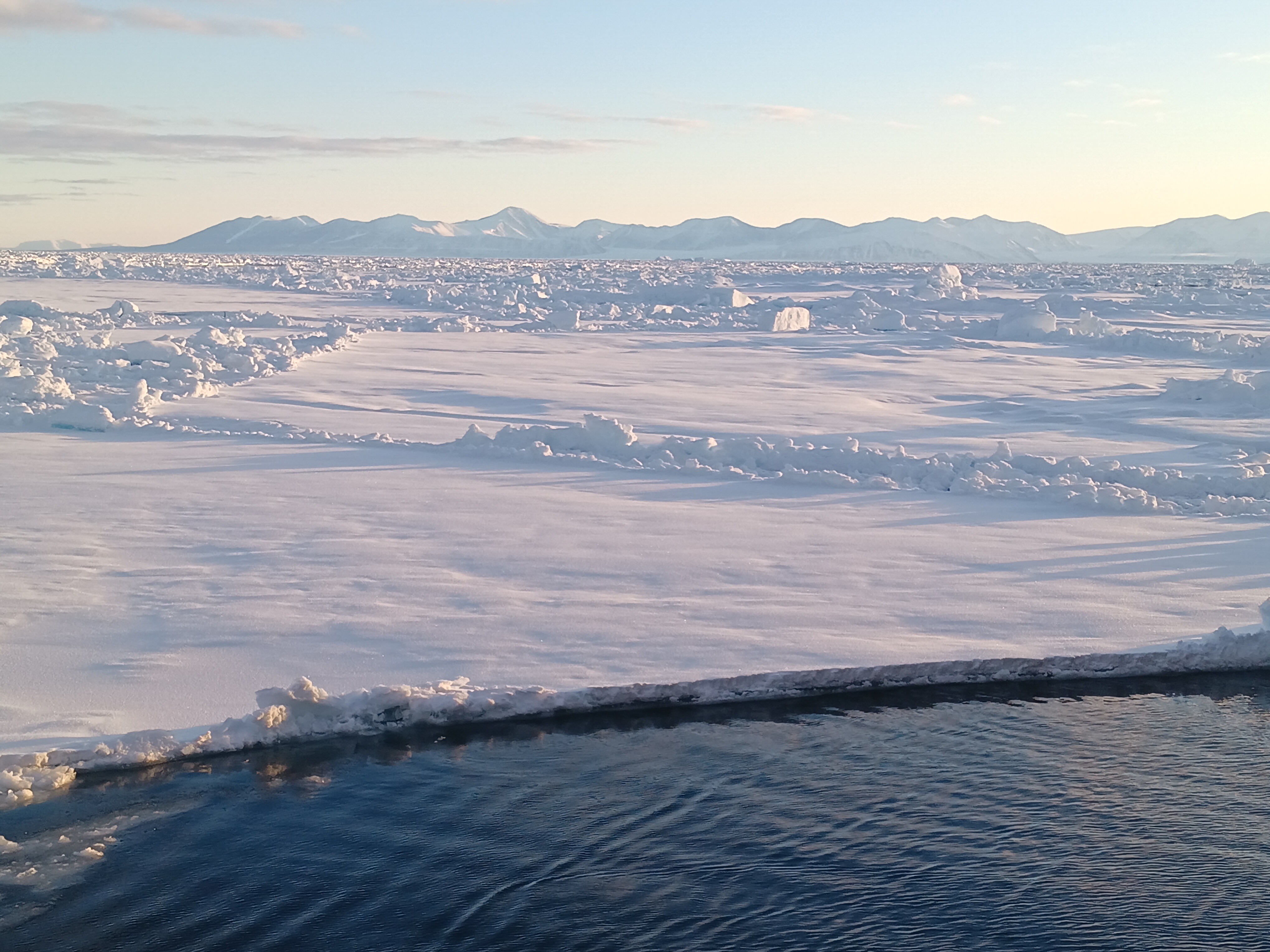
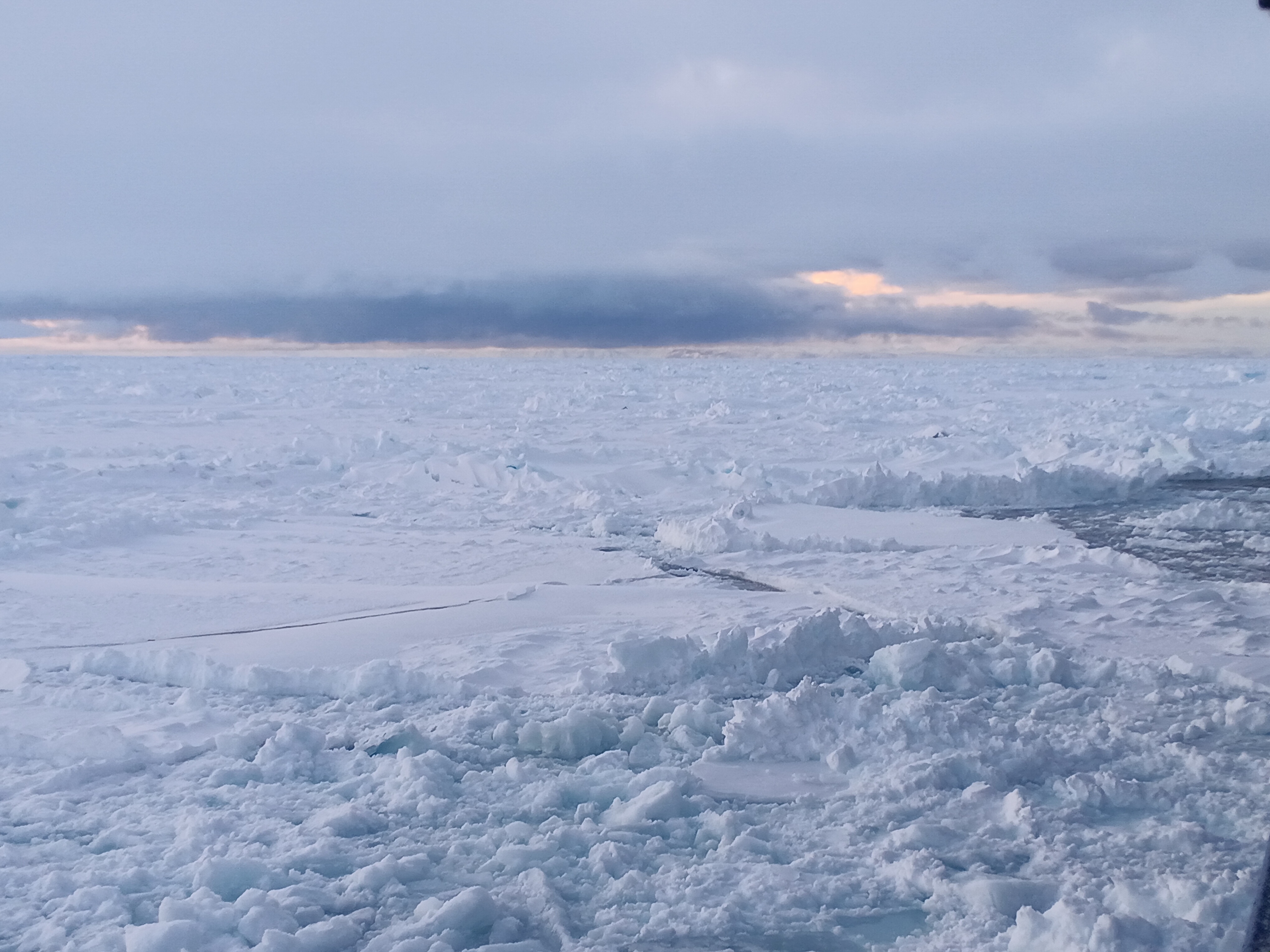
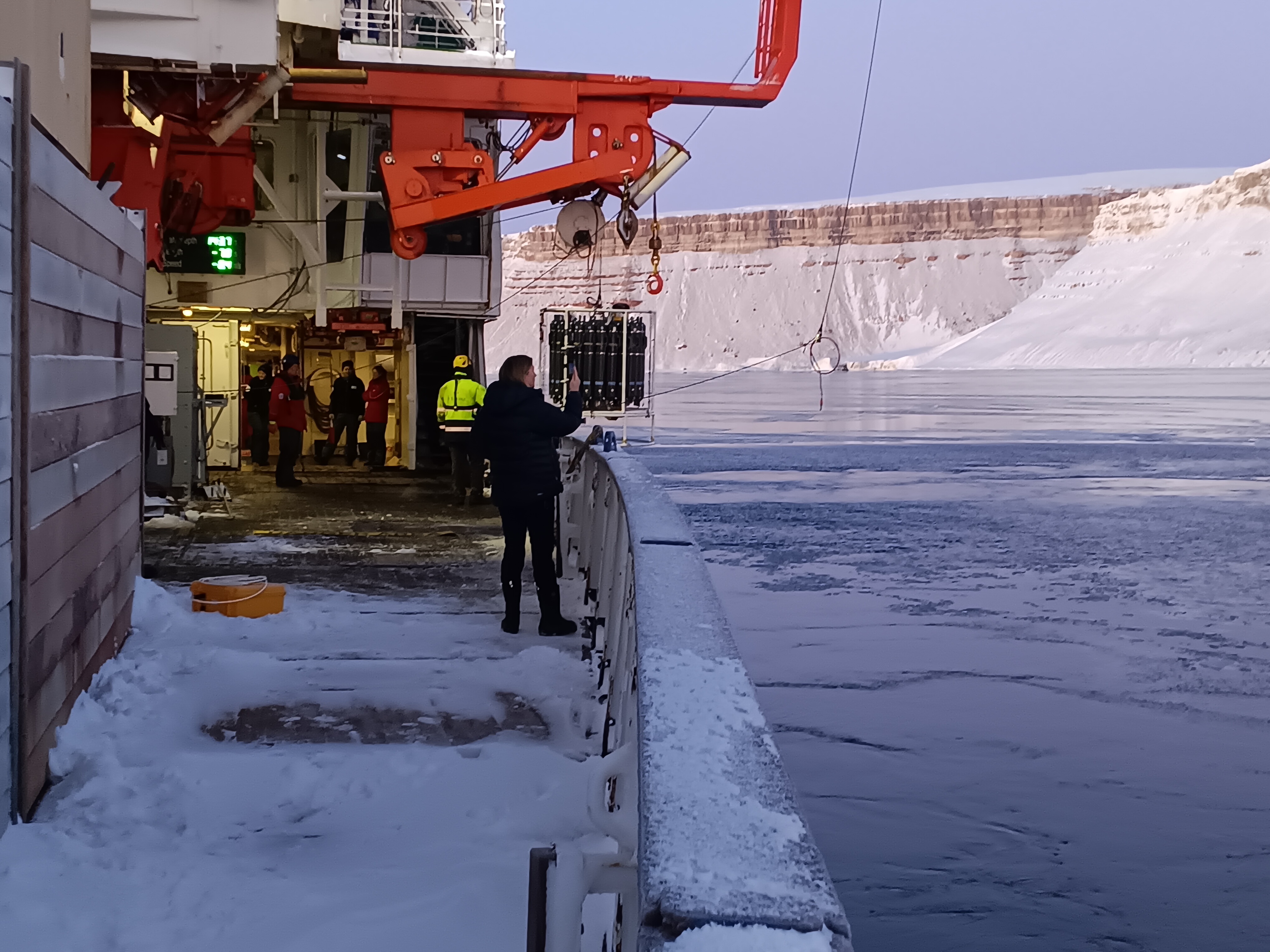
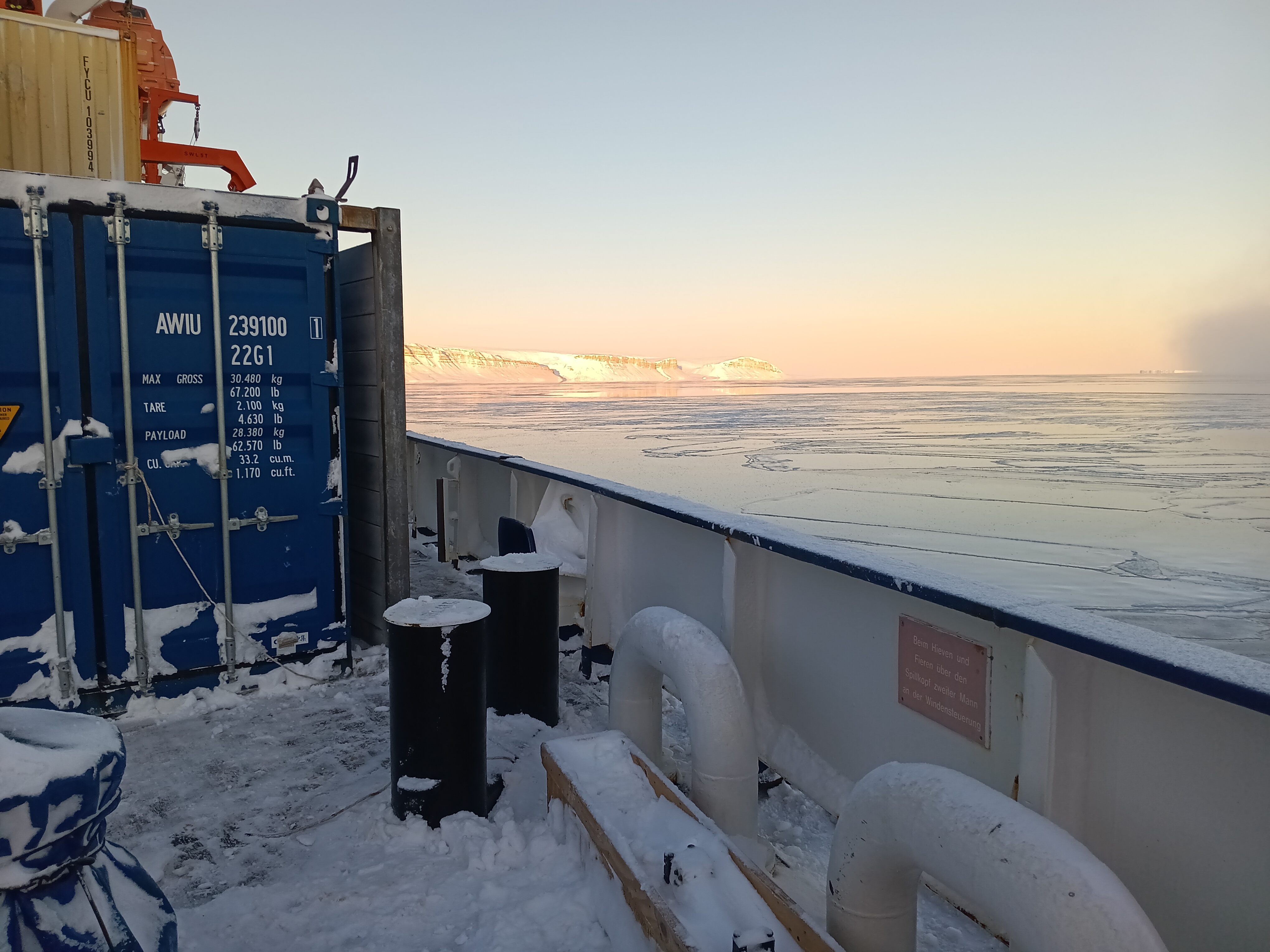
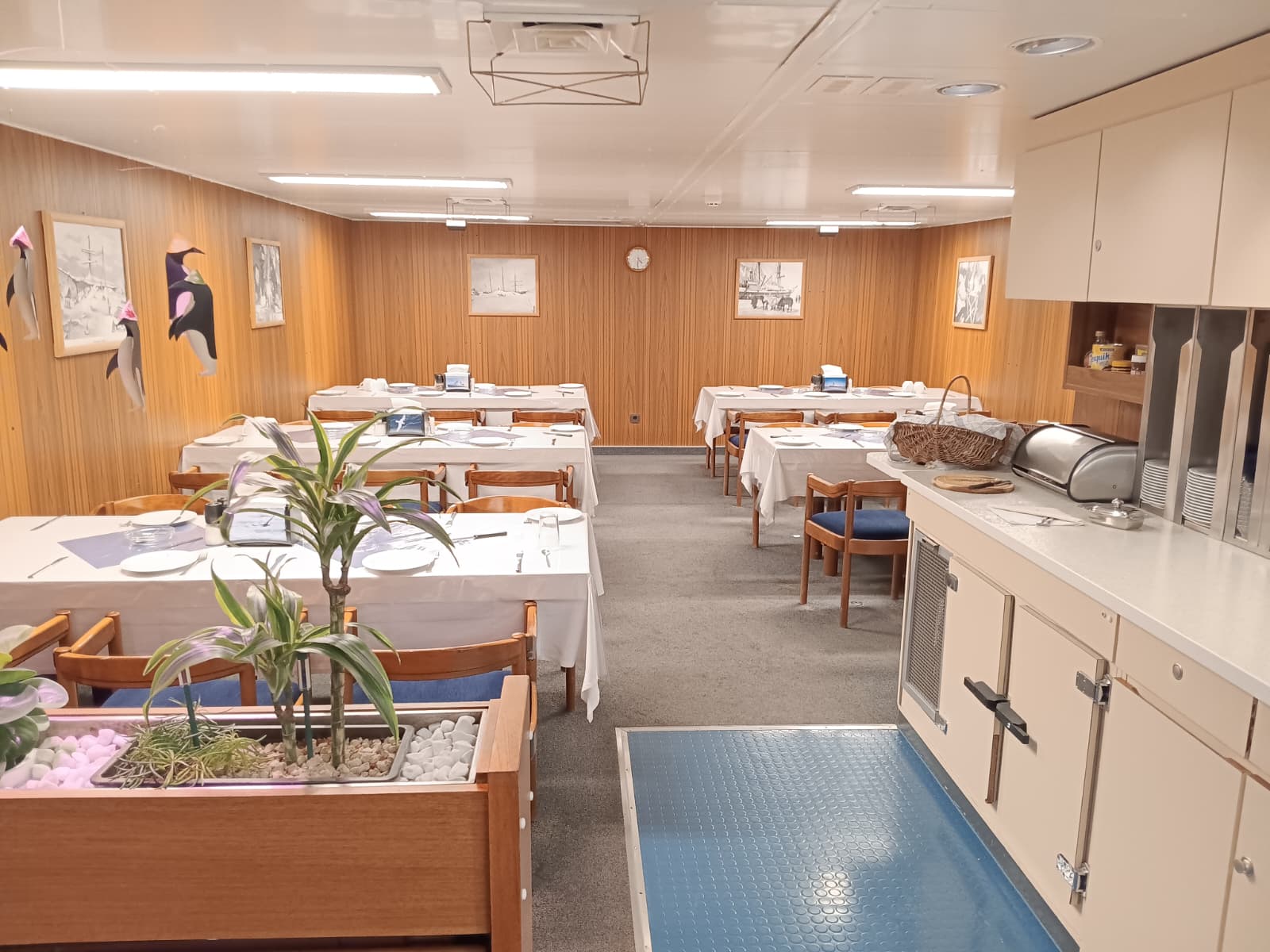
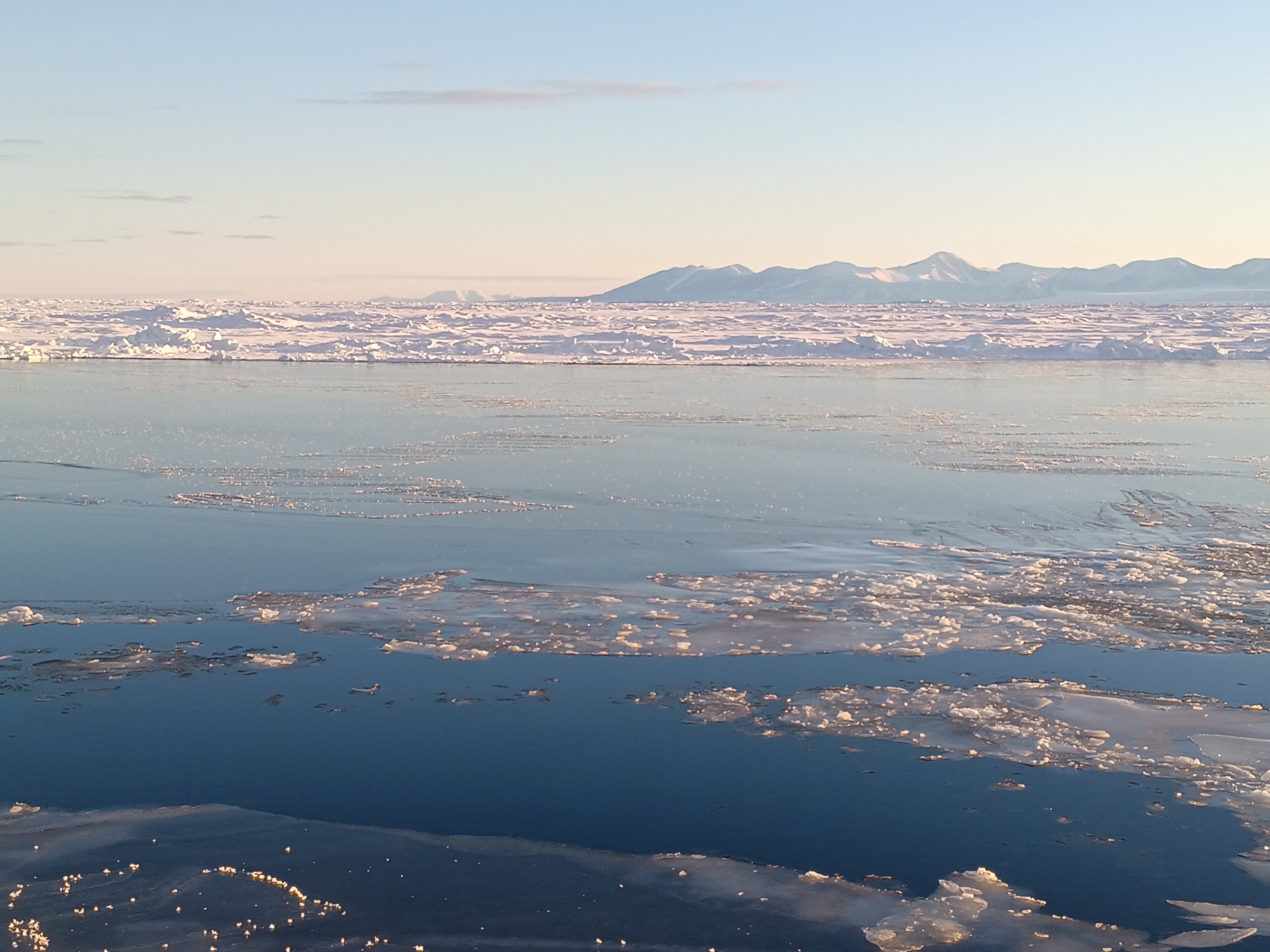
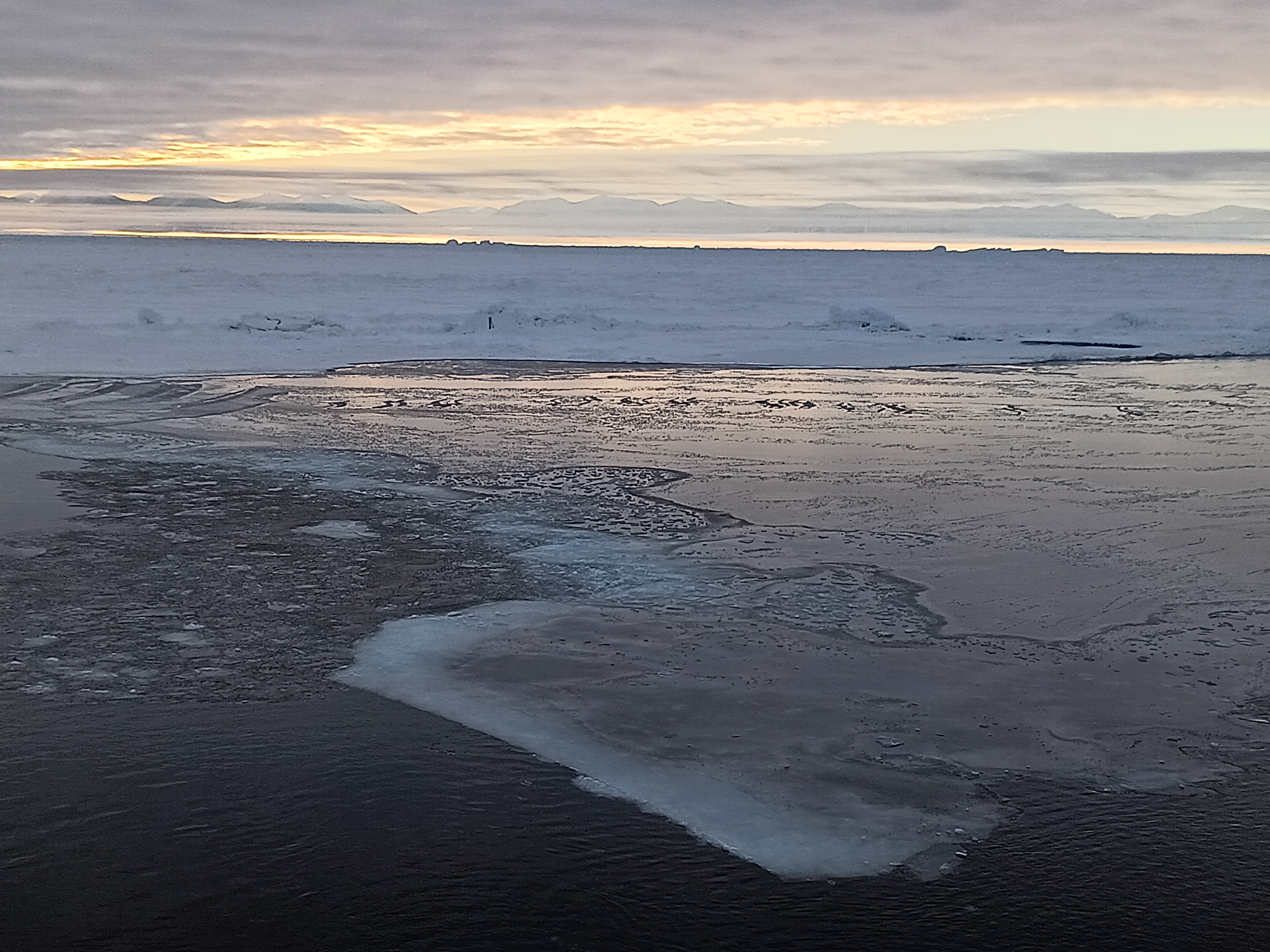
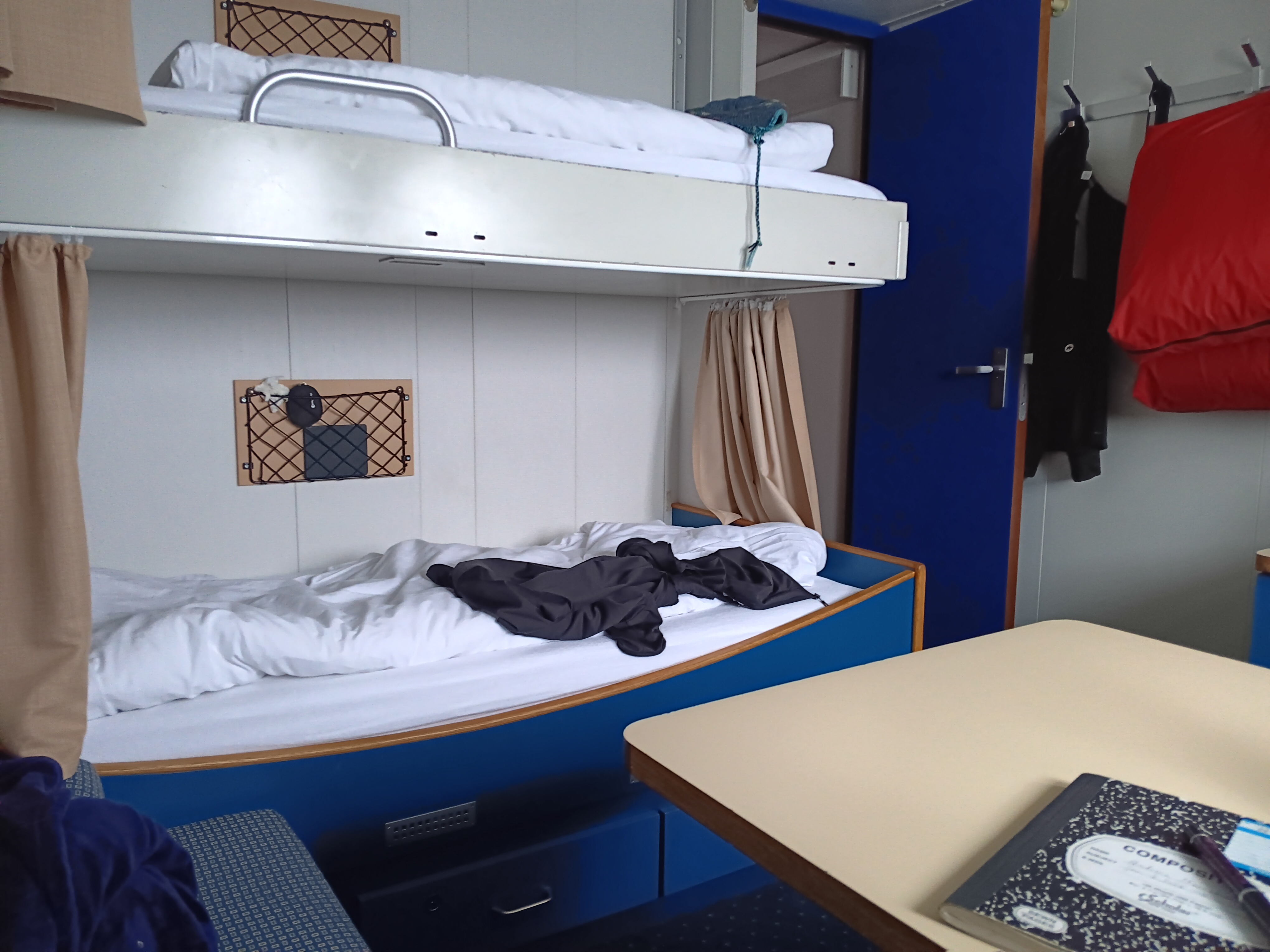
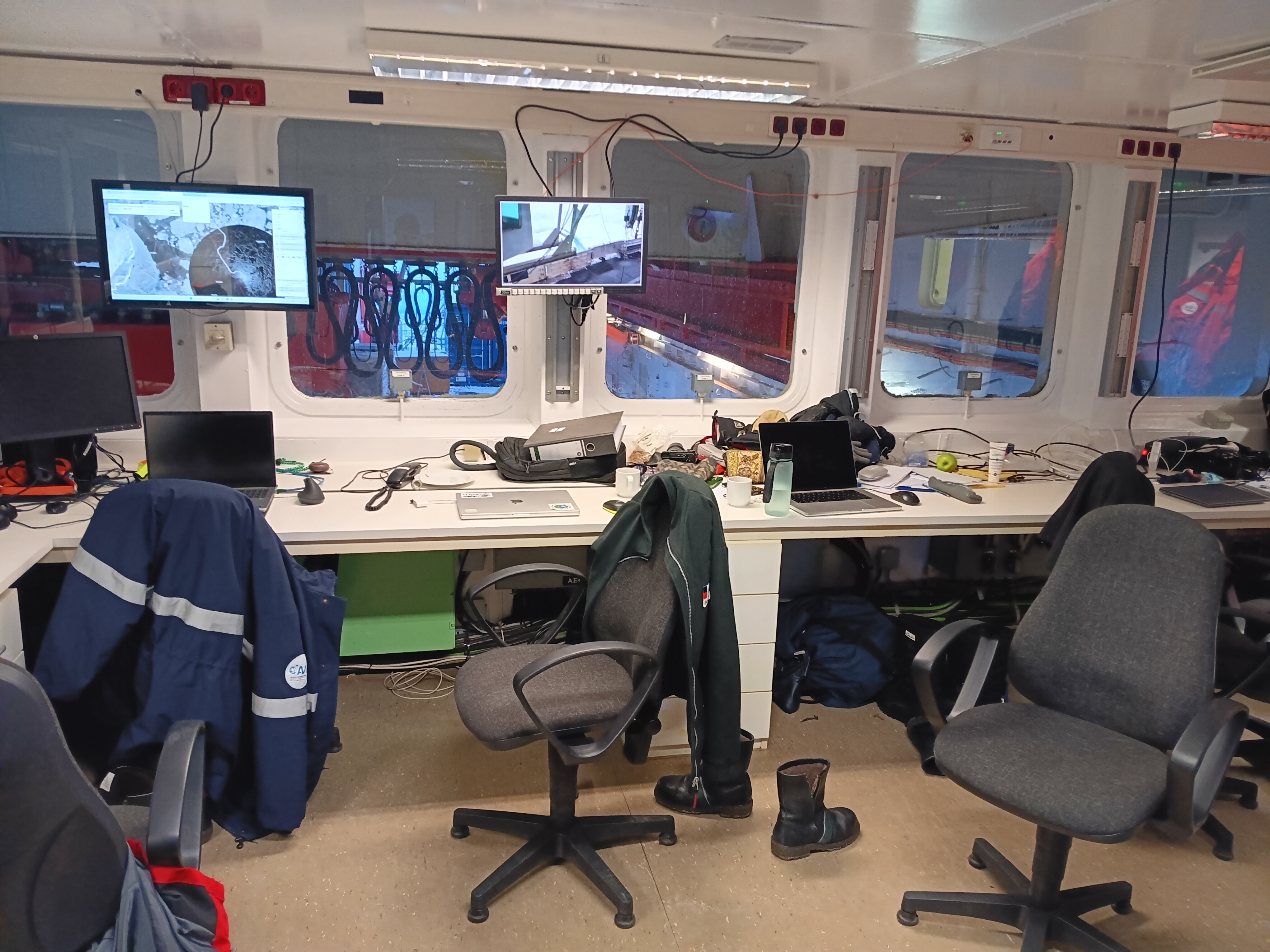
Now how does Greenland look from the ship? Well, there is always ice and it is always cold. The coldest days we had near the coast when the skies were clear. The coldest day we had -20 C, that is -4 F for my American friends, but most of the time we had clouds and storms with temperatures warmer at -12 C (10 F) with clouds and little visibility. It snowed alot and shoveling the ship’s deck was an almost daily chore. A relaxing “cruise” it was not. We worked sensors systems in the windy cold outside during all hours of the day and night. Pictures like the above were almost always taken during my 8 hours “off” that for me was from 08:00 to 16:00, because my shift was from 16:00 to 24:00. After a phone call to my wife after midnight and a peppermint tea to warm up, I slept from 01:00 to breakfast at 07:30. As almost all scientists aboard I shared my cabin with others, so there is not too much privacy. The photos below show my bunk bed (I slept atop), shared work spaces, and the rarely empty dining room. We often ate in shifts, too, because not all 50 people would fit the dining room in one sitting. So we often had 2 sittings. A comfortable living room was next door for desert, tea, coffee, games, and conversations.
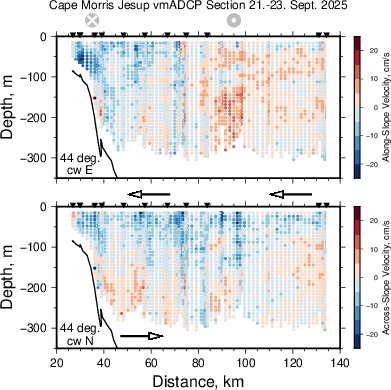
Now what about science, you may ask. Here we made a major discovery, I felt. A mathematician used her craft to predict a coastal current to the north of Greenland that, I admit, made no sense to me as it contradicted 30+ years of training and intuition in which direction such currents would flow, that is, the coast should be on the right hand side looking in the direction of the flow. The curious thing was that to the north of Greenland it should go in the opposite direction, that is, with the coast on the left. In Claudia’s numerical computer model run for months on super computers, this current-in-the-wrong-direction was a both prominent and persistent feature. I always discarded it as an unrealistic feature of some computer code run amok. And yet, when we actually reach the coast of northern Greenland and I measure ocean currents from a ship sensor that runs 24/7 to tell me current speed and direction, here this weired or “wrong” current was. It screamed at me from the screen the moment I plotted the data and shared it with Claudia who was aboard with the comment: “Your model is right and my intuition was wrong. Your current is at the same location, the same speed, and in the same direction as your model said it would.” Furthermore, a distinct and separate way to estimate ocean currents from ocean temperature and salinity observations showed the exact same thing. That’s now two good complementary confirmation of the current that nobody has ever seen or measured … until now that we aboard Polarstern did so on Sept.-23, 2025:
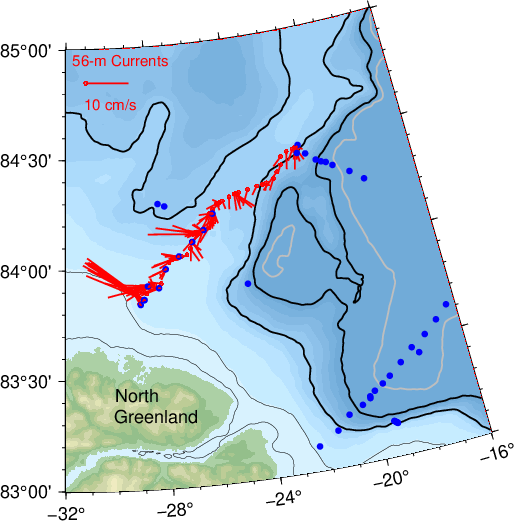
The map on the left shows our study area to the north of North Greenland. On it in red are sticks whose length indicate the speed or strength of the ocean current (at 56 meters below the surface) while its orientation gives the direction of the current. The light blue is shallow and dark blue is deep water as before. The current is sluggish offshore with a weak component to the south. In contrast, closest to the coast of North Greenland we find long sticks that point to towards the left (west by north-west). This is Claudia’s Coastal Current.

The two plots on the left provide more detail, as it shows how the current varies with depth and distance from the coast along a line from the coast towards offshore. The bottom of the shallow ocean is the black line from 100-m to 350-m meter at a distance of 20-40 km from the coast. The top-left panel shows the current (in colors) across the section where blue colors indicate currents flow into the page while red colors indicate currents that flow out of the page towards us viewing it with the coast on the left. The bottom-left panel shows the velocity component along the section with a flow that is mostly onshore near the surface.

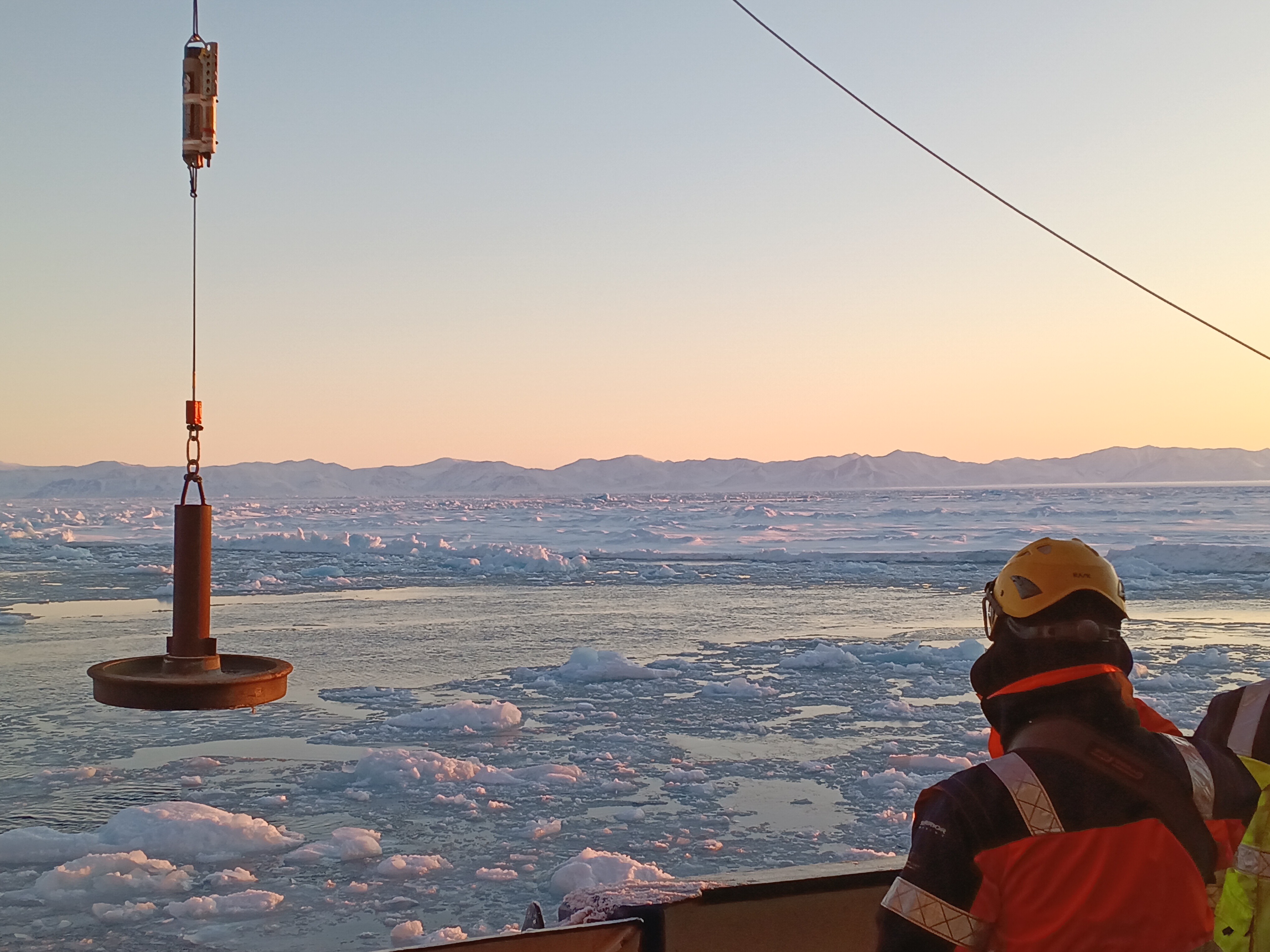
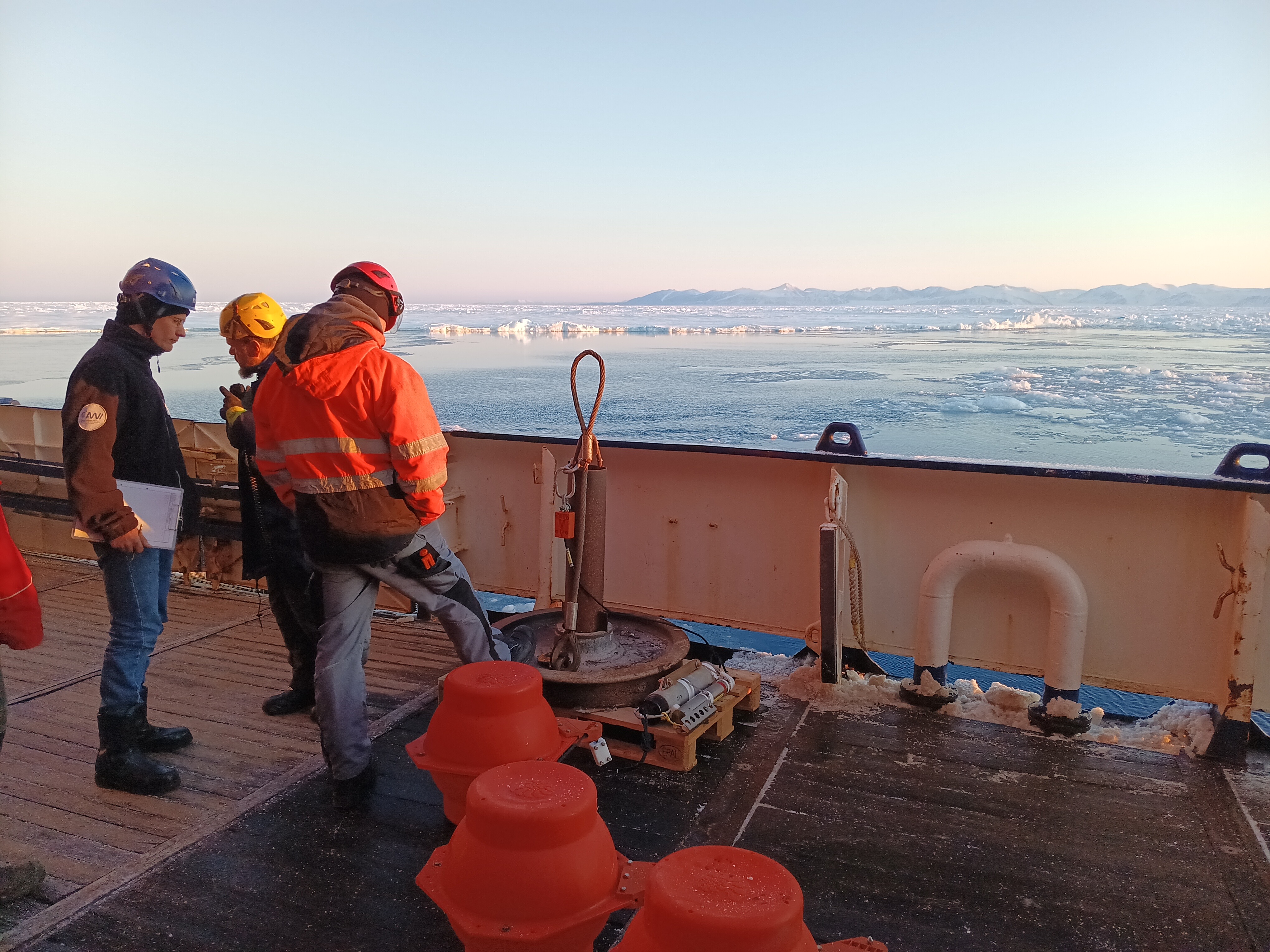
There is so much more to this story as well as additional stories, notice the red dots in the top-left panel between 150-m and 300-m depth that indicate a strong flow to the south and east, but I save this for later. I also do not wish to tell you about the two ocean sensors we quickly deployed at this location to stay there until we, perhaps, recover them with new data next year or the year there after. I do wish to close this essay, however, with the view of Greenland that we had where we discovered Claudia’s coastal current. Science is fun, exciting, and always surprises.
How to whisper under sea ice: Wireless Acoustic Sensor Network Design

I want to build a cell phone system under water. I want it to send me a text messages every 30 minutes from 200 feet below the ocean that is covered by sea ice next to a glacier in northern Greenland where polar bears roam to catch seals for food at -40 Fahrenheit. Why would I want to do this and is this is even possible?

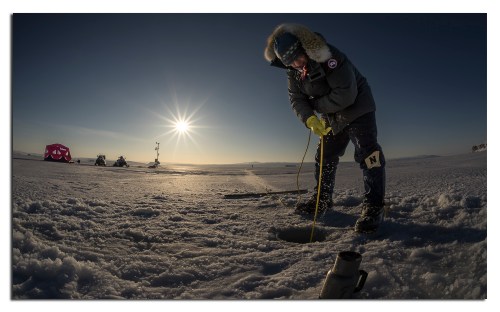
The author measuring sea ice thickness in Wolstenholme Fjord, Greenland April-17, 2017.

The author measuring sea ice thickness in Wolstenholme Fjord, Greenland April-17, 2017.

Our project successfully showed that it is possible to move data as text messages from a computer in the ocean to another and on to another and then via a cable to a weather station and then on to a satellite and then on to my laptop at home somewhere, anywhere, really [Intellectual Merit]. The ocean data that we moved by whispering from modem to modem (my acoustic cell phone towers) under water can be anything that any scientist may want to study. It could, for example, detect pollutants in the water that seep out of the sediment like gas or oil or radioactive materials burried accidentally [Broader Impacts] such as a nuclear-tipped B-52 bomber that crashed into Wolstenholme Fjord on January-21, 1968 at the height of the Cold War. The propagation of sound under ice also has military applications, because our communication network operates in both ways, that is, if I can receive a text message, I can also send one [Broader Impacts].

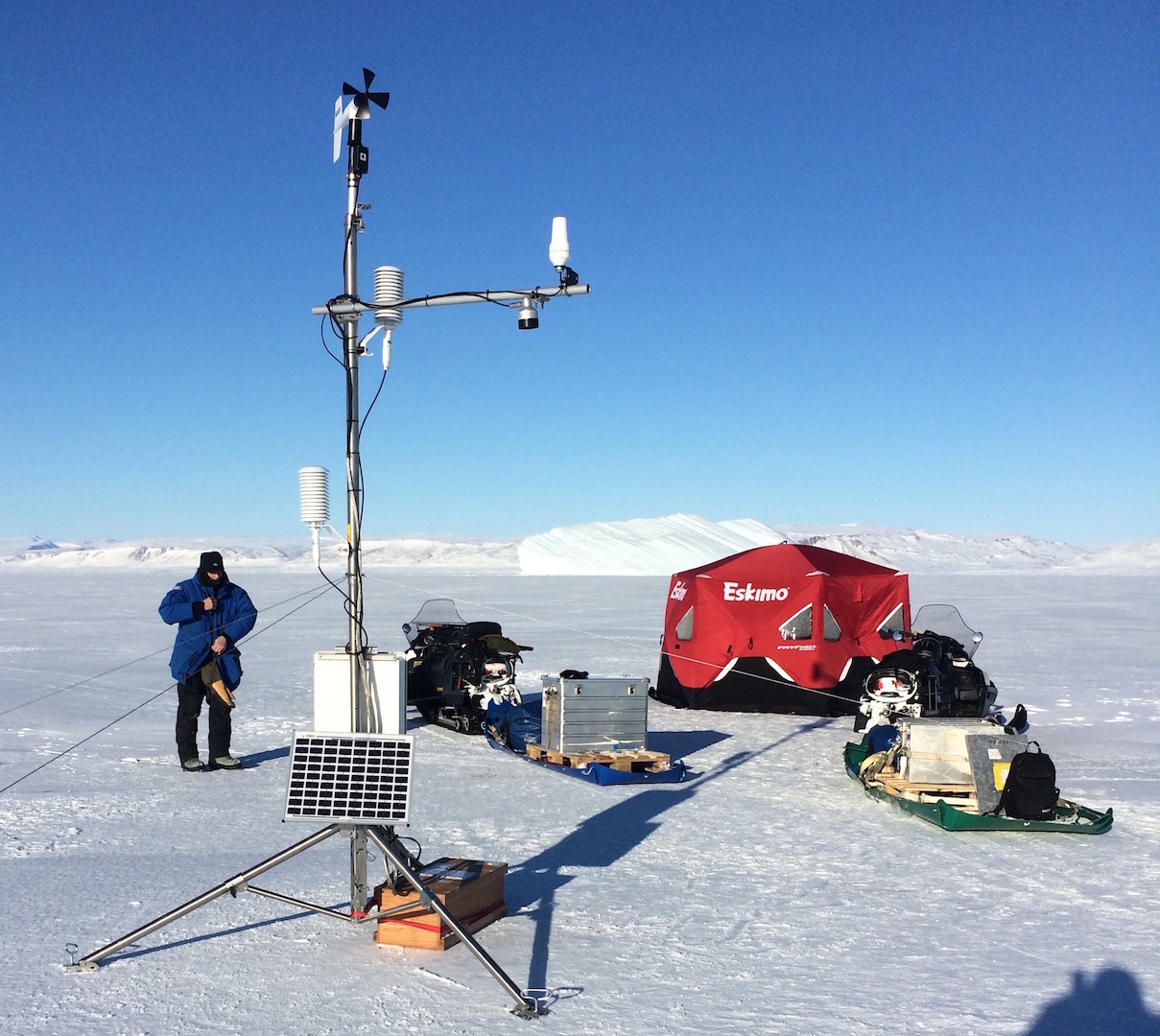
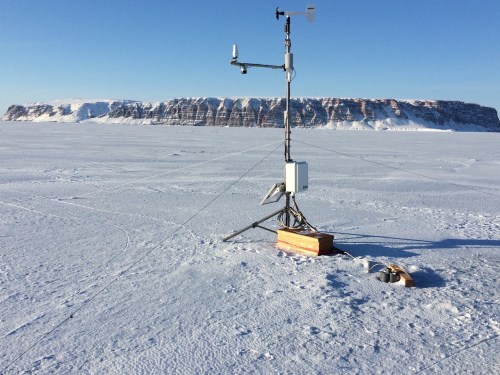
Installation of Automated Weather Station on Mar.-23, 2017 near Thule, Greenland via snowmobile. The station includes a satellite connection to the internet and a cable to the ocean.

Installation of Automated Weather Station on Mar.-23, 2017 near Thule, Greenland via snowmobile. The station includes a satellite connection to the internet and a cable to the ocean.

While the problem sounds simple enough, it is hard, real hard, because it requires many different people with very different skill sets. Our project included mechanical, electrical, and computer engineers but also scientists who know about acoustics, oceanography, and sea ice, as well as technicians with common sense and practical abilities to keep machines and people moving and running safely. This includes guns that we had to carry while working on the sea ice via snowmobile to protect from polar bears and medically trained personnel who could spot frostbites before they bite. All of this has to come together in just the right way and right time. Good and successful science is more than just engineering and machines, there is a strong human element in all polar field work such as ours. 

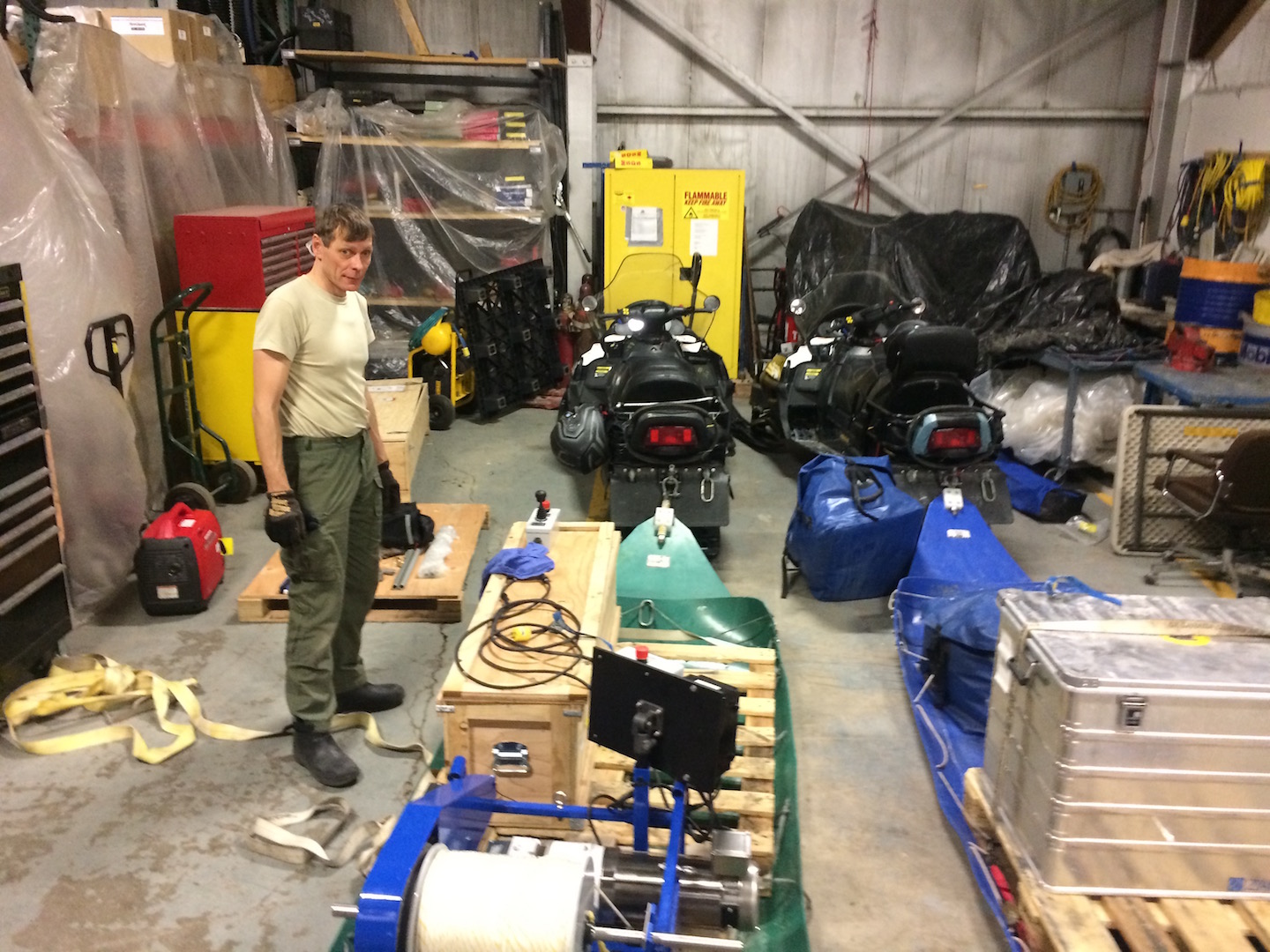
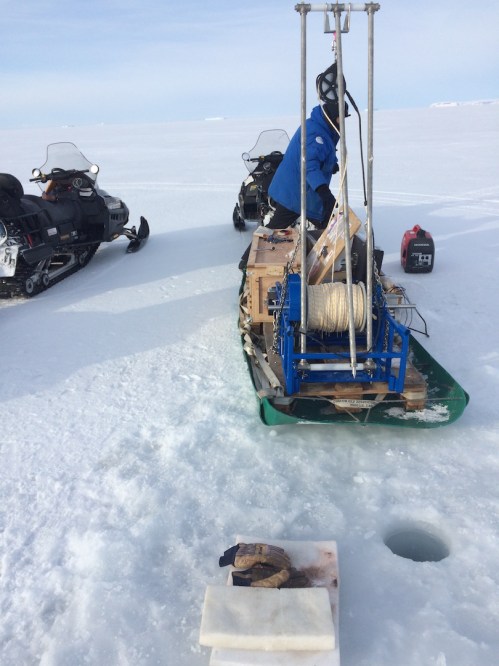
A local volunteer is designing, building, and rigging the Research Sled R/S Peter Freuchen for profiling the ocean below the sea ice in March 2017 on Thule Air Base.

A local volunteer is designing, building, and rigging the Research Sled R/S Peter Freuchen for profiling the ocean below the sea ice in March 2017 on Thule Air Base.

The first step in our project involved the design of the acoustic modems that Lee Freitag of Woods Hole Oceanographic Institution did many years back. It took us about 2 years to select this design that Lee then modified for this application in 2014-15). The second step involved the selection of a study site where our small group of 6 people could work and experiment and learn by some trial and error without incurring extra-ordinary costs (2015-16). It helped that I was in and out of Thule Air Base on unrelated projects in 2015 and 2016 when we settled for the final experiment to take place in March and April of 2017. Satellite remote sensing tools where then developed to quantify sea ice conditions for safe operation and navigation traveling on the  ice. We uncovered a barely visible area of thin ice to the south of Manson Island that recurs at the same location every year. We stayed clear of this area.

Thule2017_CTD

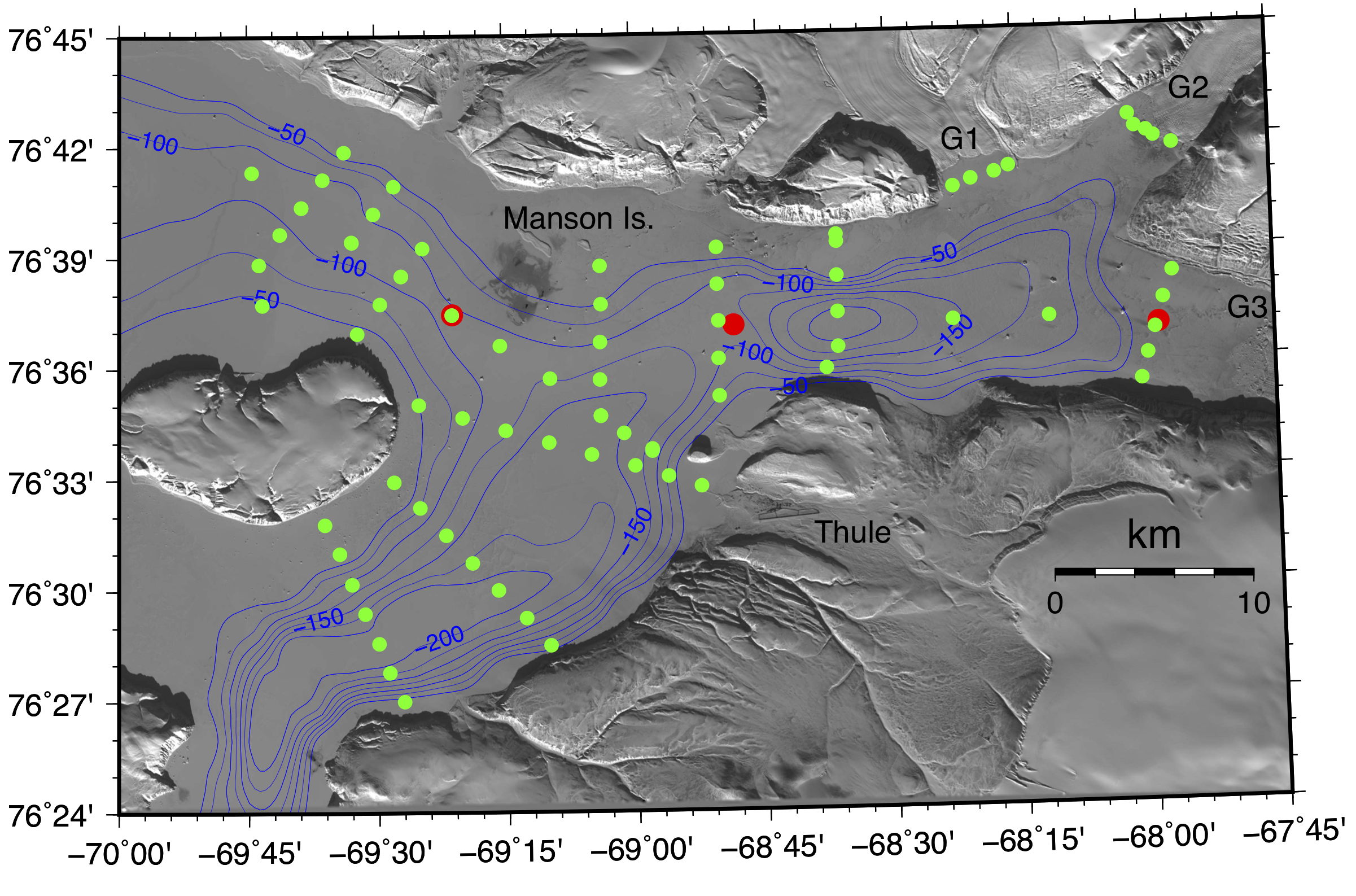
Satellite image of ice-covered Wolstenholme Fjord, Greenland with water column profiling station (green dots) and acoustic modems (red dots). Blue lines are water depths in meters. Labels G1, G2, and G3 indicate three tide-water glaciers while Thule refers to Thule Air Base. Saunders Island is near the center left while the weather station is the red dot halfway between Saunders and Manson Islands.

Field work started with a survey of sea ice thickness on Mar. 18/19, 2017 by drilling 2” holes through the sea ice that varied in measured thickness from 0.12 m (4 inches) near Manson Island to 1.25 m (4 feet) near Thule Air Base. On Mar.-23, 2017 we deployed the weather station along with a tent and survival gear at the center of our study area. An ocean temperature mooring was deployed to complement in time a spatial survey of ocean sound speed profiles estimated from conductivity, temperature, depth (CTD) measurements. We drilled 10” holes through the sea ice for our profiling CTD operated via an electrical winch. Our CTD survey spanned the entire fjord from three tidewater glaciers in the east to the edge of the sea ice in the west. Concurrently ocean testing of acoustic communication between modems commenced Apr.-8, 2017 and the final array was deployed Apr.-14/15 to be fully operational Apr.-16/18. All gear was recovered and stored at Thule Air Base Apr.-18/19, 2017 before our departure Apr.-20, 2017.

Research Sled

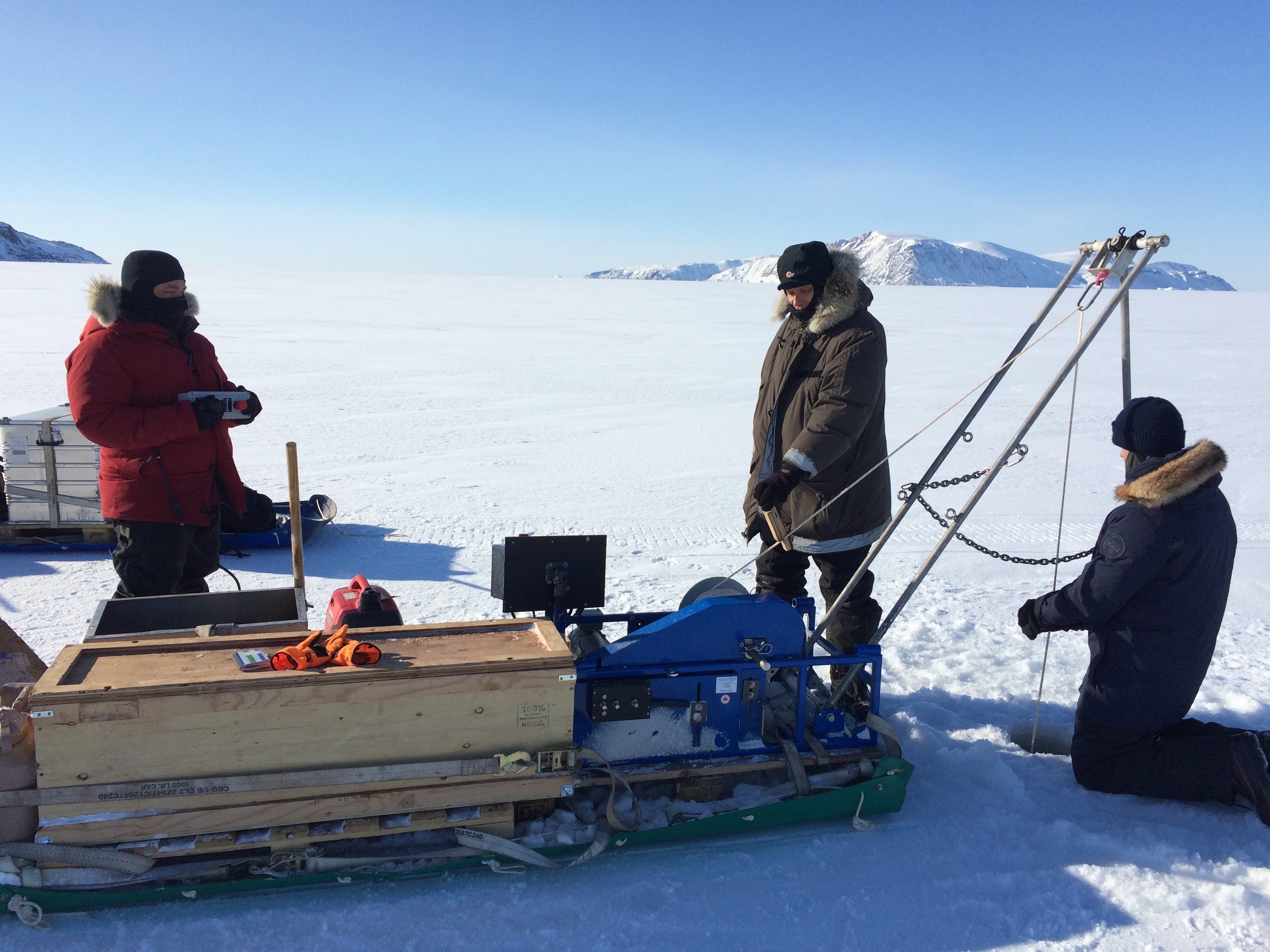
Research Sled “Peter Freuchen” with wooden CTD storage box, electrical winch, tripod, and electrical motor during deployment on Apr.-7, 2017. View is to the west with Cape Atholl on the left and Wolstenholme Island on the right background. University of Delaware technician operates the winch via joy stick while a student monitors the instrument’s descent through water column visually at the 10” hole and acoustically via a commercial Fish-Finding sonar.

Subsequent analysis in 2017/18 revealed a successful experiment as data from ocean sensors traveled along multiple paths to the weather station and on to the internet. All data were submitted to the NSF Arctic Data Center where after review they will become public at

https://arcticdata.io/catalog/view/urn:uuid:d2775281-3231-47d0-ab79-b2e506ea8d04

This graph is just one of many in desperate need of a proper peer-reviewed publication. There is always more work to do …

Time series of ocean temperature at the weather station from 10-m (top) to 100-m (bottom below the sea ice. The red line gives the -1.7 Celsius for reference. The temperature field dominates the speed of sound field. Note the presence and absence of tidal oscillations.

Time series of ocean temperature at the weather station from 10-m (top) to 100-m (bottom below the sea ice. The red line gives the -1.7 Celsius for reference. The temperature field dominates the speed of sound field. Note the presence and absence of tidal oscillations.

Northern Winds and Currents off North-East Greenland

I spent 6 weeks aboard the German research icebreaker R/V Polarstern last year leaving Tromso in Norway in early September and returned to Bremerhaven, Germany in October. We successfully recovered ocean sensors that we had deployed more than 3 years before. It felt good to see old friends, mates, and sensors back on the wooden deck. Many stories, some mysterious, some sad, some funny and happy could be told, but today I am working on some of the data as I reminisce.

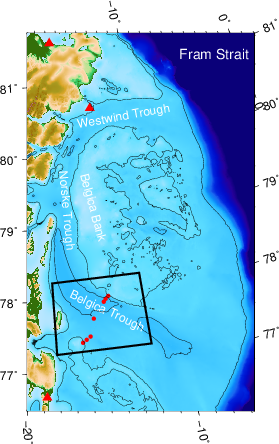
The location is North-East Greenland where Fram Strait connects the Arctic Ocean to the north with the Atlantic Ocean in the south. We worked mostly on the shallow continental shelf areas where water depths vary between 50 and 500 meters. The map shows these areas in light bluish tones where the line shows the 100 and 300 meter water depth. Fram Strait is much deeper, more than 2000 meters in places. I am interested how the warm Atlantic water from Fram Strait moves towards the cold glaciers that dot the coastline of Greenland in the west.

Map of study area with 2014-16 mooring array in box near 78 N across Belgica Trough. Red triangles place weather data from Station Nord (81.2 N), Henrik Kr\o yer Holme (80.5 N), and Danmarkhaven (76.9 N). Black box indicates area of mooring locations.

There is also ice, lots of sea icebergs, and ice islands that we had to navigate. None of it did any harm to our gear that we moored for 1-3 years on the ocean floor that can and often is scoured by 100 to 400 meter thick ice from glaciers, however, 2-3 meter thick sea ice prevented us to reach three mooring locations this year and our sensors are still, we hope, on the ocean floor collecting data.

Ahhh, data, here we come. Lets start with the weather at this very lonely place called Henrik Krøyer Holme. The Danish Meteorological Institute (DMI) maintains an automated weather station that, it seems, Dr. Ruth Mottram visited and blogged about in 2014 just before we deployed our moorings from Polarstern back in 2014:

Weather station on Henrik Kroeyer Holme [Credit: Dr. Ruth Mottram, DMI]

It was a little tricky to find the hourly data and it took me more than a day to process and graph it to suit my own purposes, but here it is

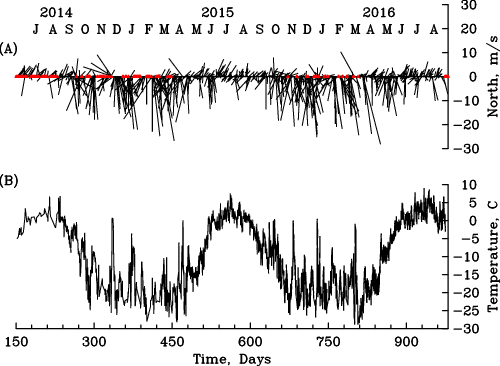
Winds (A) and air temperature (B) from an automated weather station at Henrik Kroeyer Holme from 1 June, 2014 through 31 August, 2016. Missing values are indicated as red symbols in (A).

The air temperatures on this island are much warmer than on land to the west, but it still drops to -30 C during a long winter, but the end of July it reaches +5 C. The winds in summer (JJA for June, July, and August) are weak and variable, but they are often ferociously strong in winter (DJF for December, January, February) when they reach almost 30 meters per second (60 knots). The strong winter winds are always from the north moving cold Arctic air to the south. The length of each stick along the time line relates the strength of the winds, that is, long stick indicates much wind. The orientation of each stick indicates the direction that the wind blows, that is, a stick vertical down is a wind from north to south. I use the same type of stick plot for ocean currents. How do these look for the same period?

Ocean current vectors at four selected depths near the eastern wall of Belgica Trough. Note the bottom-intensified flow from south to north. A Lanczos low-pass filter removes variability at time scales smaller than 5 days to emphasize mean and low-frequency variability.

Ocean currents and winds have nothing in common. While the winds are from north to south, the ocean currents are usually in the opposite direction. This becomes particular clear as we compare surface currents at 39 meters below the sea surface with bottom currents 175 or even 255 meters below the surface. They are much stronger and steadier at depth than at the surface. How can this be?

Image of study area on 15 June 2014 with locations (blue symbols) where we deployed moorings a few days before this satellite image was taken by MODIS Terra. The 100-m isobath is shown in red.

Well, recall that there is ice and for much of the year this sea ice is not moving, but is stuck to land and islands. This immobile winter ice protects the ocean below from a direct influence of the local winds. Yet, what is driving such strong flows under the ice? We need to know, because it is these strong currents at 200 to 300 meter depth that move the heat of warm and salty Atlantic waters towards coastal glaciers where they add to the melting of Greenland. This is what I am thinking about now as I am trying to write-up for my German friends and colleagues what we did together the last 3 years.

Oh yes, and we did reach the massive terminus of 79 North Glacier (Nioghalvfjerdsfjorden) that features the largest remaining floating ice shelf in Greenland:

We recovered ocean moorings from this location also, but this is yet another story that is probably best told by scientists at the Alfred-Wegener-Institute who spent much time and treasures to put ship, people, and science on one ship. I am grateful for their support and companionship at sea and hopefully all of next year in Bremerhaven, Germany.

Only in Thule Greenland

… do you find a machinist working metal to take photos while I do oceanography the old-fashioned way by pulling up 100 meters of kevlar line to recover an ocean probe.

Wolstenholme Fjord March-26, 2017. [Photo by Mogens Werth Christensen]

The data were subsequently used by ocean acousticians to test speed of sound propagation as part of an NSF project on testing an underwater communication system to move data from A to B via C or D. The automated weather station reports ocean temperature and saltiness as well at

http://ows.udel.edu/ice

Web-site is low-bandwidth to be used operationally by Air Force personnel in Greenland and local communities where internet access and speeds are severely limited.

Greenland Oceanography by Sled and Snowmobile

Wind chill matters in Greenland because one must see and breath. This implies exposed skin that will hurt and sting at first. Ignoring this sting for a few minutes, I notice that the pain goes away, because the flesh has frozen which kills nerves and skin tissue. The problem becomes worse as one drives by snowmobile to work on the sea ice which I do these days almost every day.

Navigating on the sea ice by identifying ice bergs with LandSat imagery. The imagery also shows polynyas and thin ice in the area. [Photo Credit: Sonny Jacobsen]

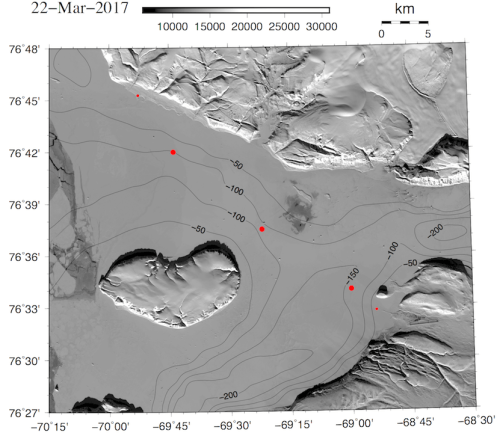
Mar.-22, 2017 LandSat image of study area with Thule Air Base near bottom right, Saunders Island in the center. Large red dots are stations A, B, and C with Camp-B containing weather station, shelter, and first ocean mooring. My PhD student Pat Ryan prepared this at the University of Delaware.

My companion on the ice is Sonny Jacobsen who knows and reads the land, ice, and everything living on and below it. He teaches me how to drive the snowmobile, how to watch for tracks in the snow, how to pack a sled, and demonstrates ingenuity to apply tools and materials on-hand to fix a problem good enough to get home and devise a new and better way to get a challenging task done. Here he is designing and rigging what is to become our “Research Sled” R/S Peter Freuchen, but I am a little ahead of my story:

Sonny Jacobsen on Mar.-27, 2017 on Thule Air Base building a self-contained sled for ocean profiling.

First we set up a shelter in the center of what will hopefully soon become an array of ocean sensors and acoustic modems to move data wirelessly through the water from point A in the north-west via point B to point C. Point C will become the pier at Thule Air Base while the tent is at B that I call Camp-B:

Ice Fishing shelter to the north-east of Saunders Island seen to the left in the background.

Next, we set up an automated weather station (AWS) next to this site, because winds and temperatures on land next to hills, glaciers, and ice sheets are not always the same 10 or 20 km offshore in the fjord. It is a risk-mitigating safety factor to know the weather in the study area BEFORE driving there for 30-60 minutes to spend the day out on the ice. It does not hurt, that this AWS is also collecting most useful scientific data, but again, I am slightly ahead of my story:

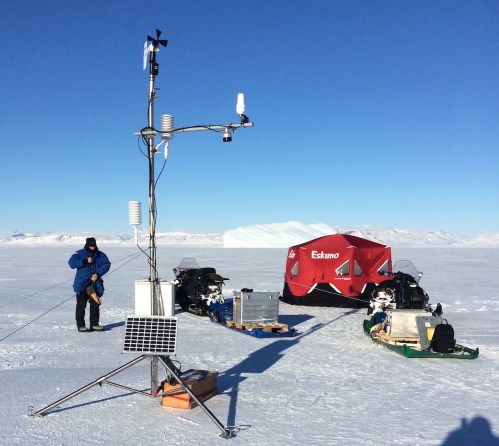
Weather station with shelter at Camp-B with the northern shores of Wolstenholme Fjord in the background. Iridium antenna appears just above the iceberg on the sidebar of the station. Winds are measured at 3.2 m above the ground.

With shelter and weather station established and working well, we decided to drill a 10” hole through 0.6 m thin ice to deploy a string of ocean instruments from just below the ice bottom to the sea floor 110 m below. Preparing for this all friday (Mar.-24), we deploy 22 sensors on a kevlar line of which 20 record internally and must be recovered while 2 connect via cables to the weather station to report ocean temperature and salinity along with winds and air temperatures. It feels a little like building with pieces of Lego as I did as a kid. Engineers and scientists, perhaps, are trained early in this sort of thing.

Weather station with ocean mooring (bottom right) attached with eastern Saunders Island in the background on Sunday Mar.-26, 2017.

Sadly, only the ocean sensor at the surface works while the one at the bottom does not talk to me. I can only suspect that I bend a pin on the connector trying to connect very stiff rubber sealing copper pins from the cable with terminations equally stiff in the cold, however, there are other ways to get at the bottom properties albeit with a lot more effort … which brings me to R/S Peter Freuchen shown here during its maiden voyage yesterday:

R/S Peter Freuchen in front of 10” hole (bottom right) for deployment of a profiling ocean sensor. The long pipes looking like an A-frame on a ship become a tripod centered over the hole with the electrical winch to drive rope and with sensors (not shown) over a block into the ocean. This was yesterday Mar.-28, 2017 on the way from Camp-B back to Thule Air Base.

The trial of this research sled was successful, however, as all good trials, it revealed several weaknesses and unanticipated problems that all have solutions that we will make today and tomorrow. The design has to be simple to be workable in -25 C with some wind and we will strip away layers of complexities that are “nice to have” but not essential such as a line counter and the speed at which the line goes into the water. There can not be too many cables or lines or attachments, because any exposure to the elements becomes hard labor. This becomes challenging with any gear leaving the ocean (rope, sensors) and splattering water on other components. Recall that ocean water is VERY hot at -1.7 C relative to -25 C air temperatures. This means that ANYTHING from the ocean will freezes instantly when in contact with air. Efficiency and economy matter … as does body heat to keep critical sensors and batteries warm.

A big Thank-You to Operation IceBridge’s John Woods for something related to this post that I wish not to advertise 😉