Tag Archives: travel

Lviv, Ukraine: Cobble Stones, Public Art and Food

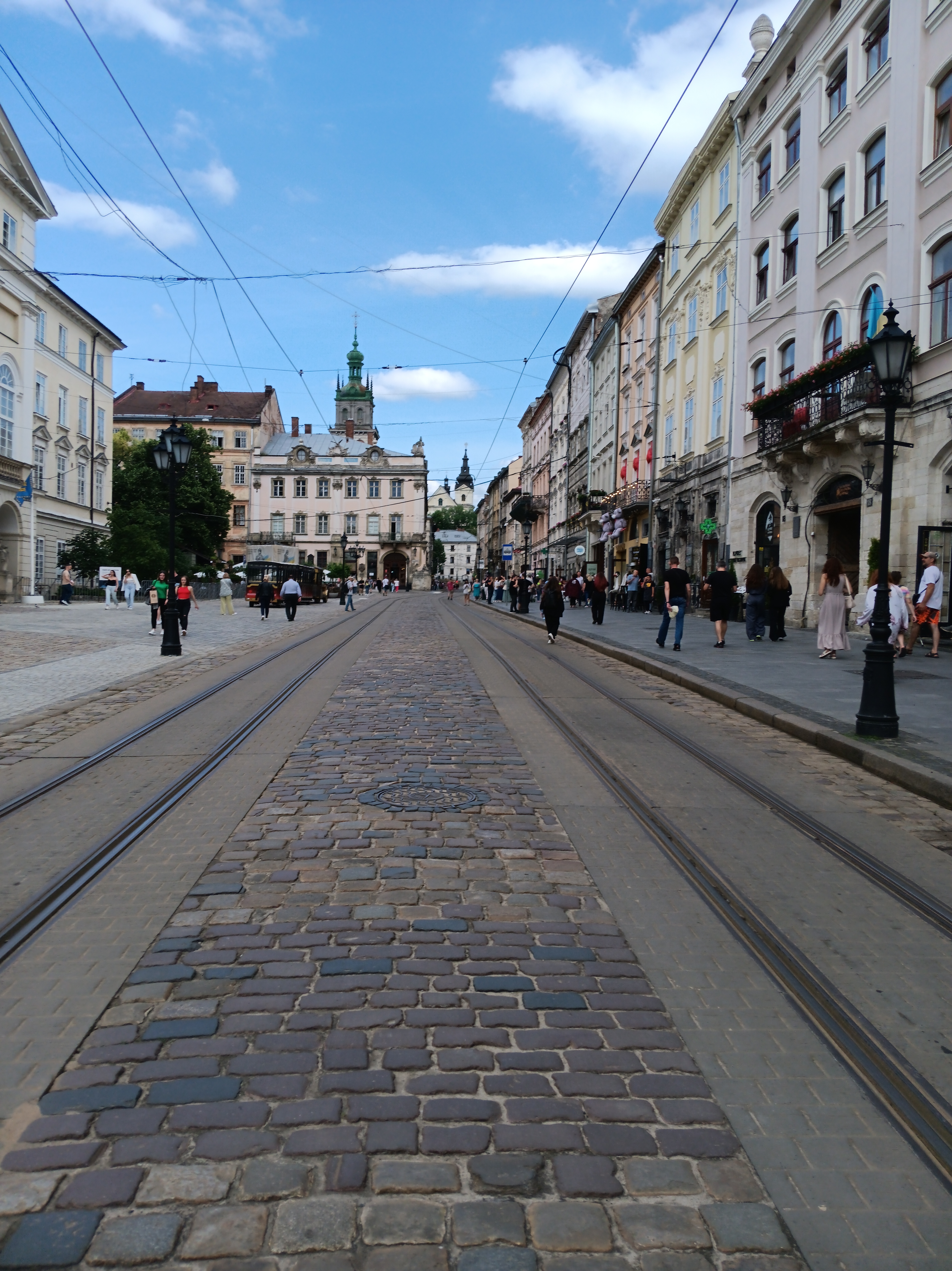
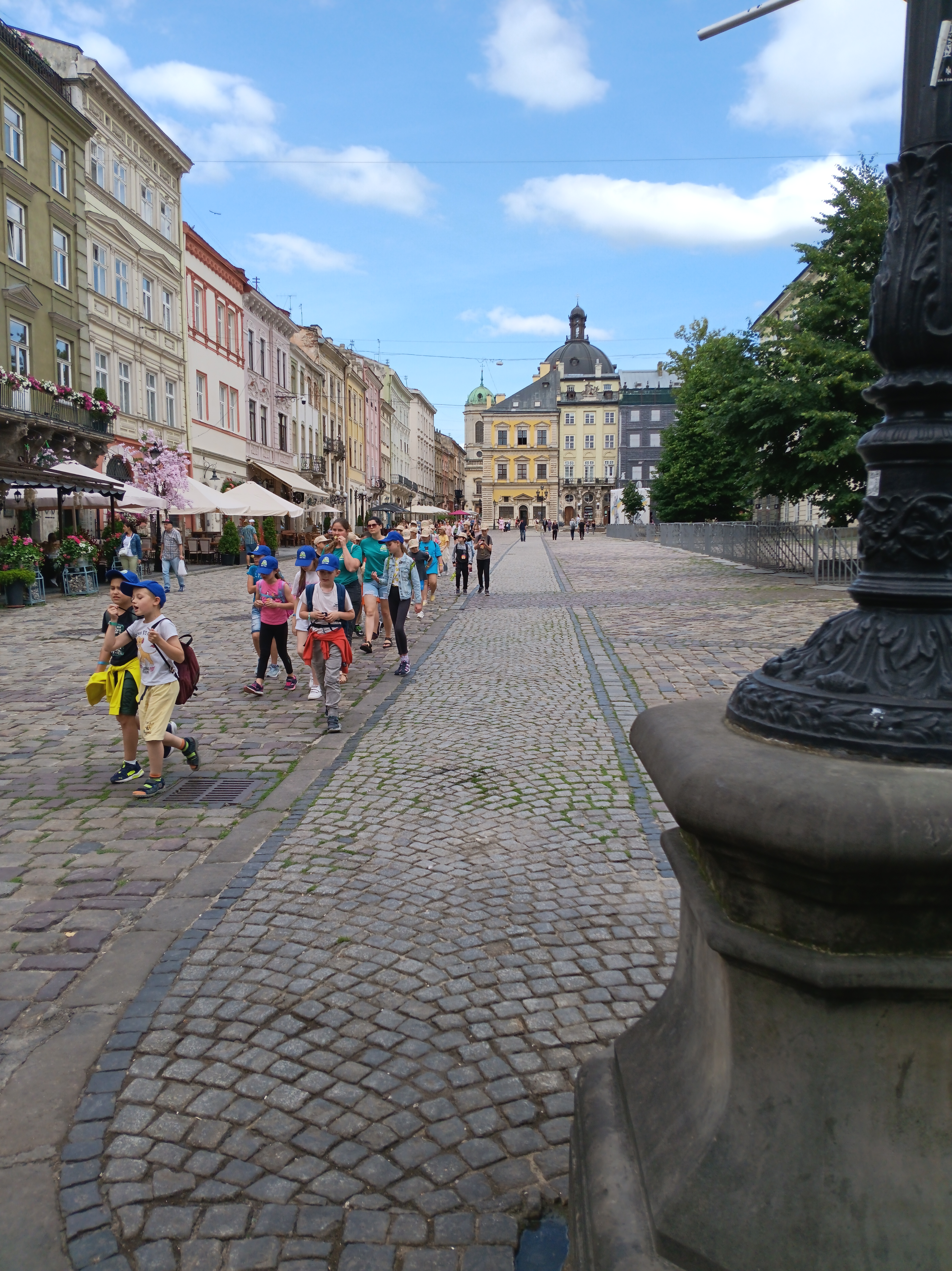
Cobble stones pave the streets of Lviv everywhere. The pedestrian Old Town merges sidewalks and streets with its center at Rynok Square. In Old Town restaurants, cafes, churches, museeums, and small shops all spill onto sidewalks in front of the 150-200 year old buildings. On the 2-3 floors up people live in appartments with 10 foot ceilings. My 1-room appartment was in one of these. Exiting the building and turning left, I reached Rynok Square within two minutes. Turning right, I entered Dominican Church within a minute. Along the short ways I pass several shops, cafes, and a small flea market. Electric trams but not cars zip across Old Town and for 20 Hryvnias ($0.50) one can hop on and go as far as the tram goes.
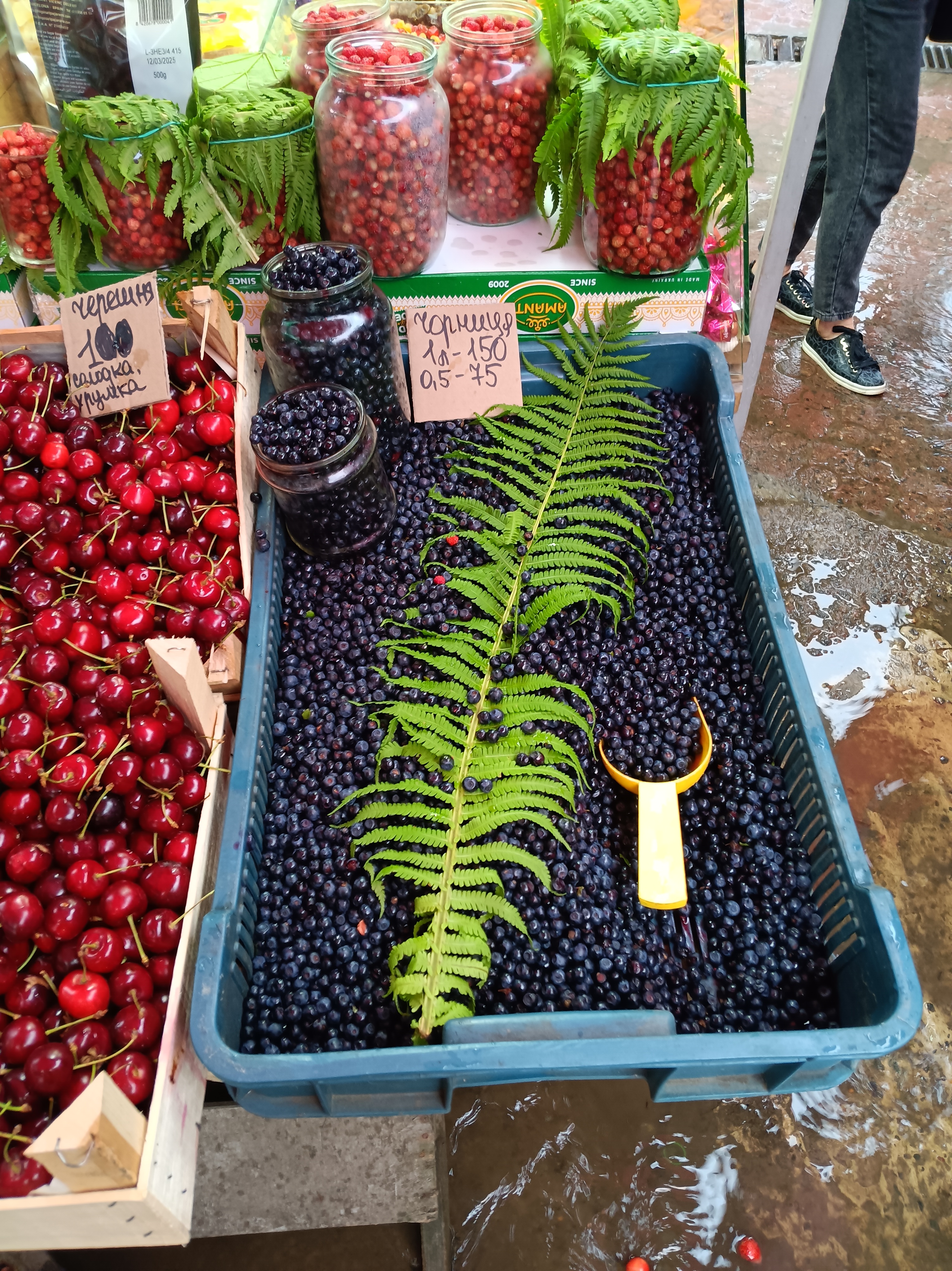
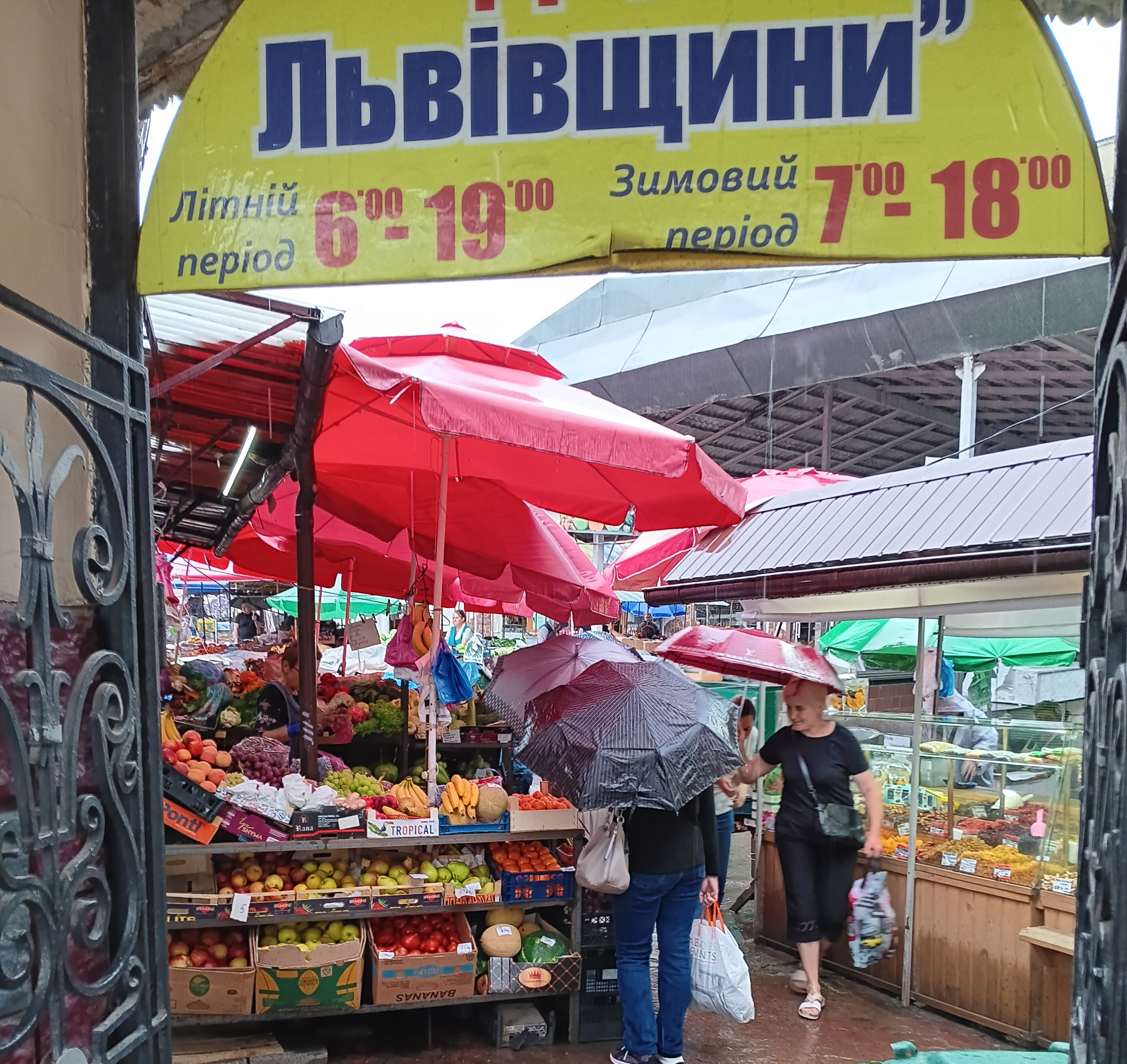
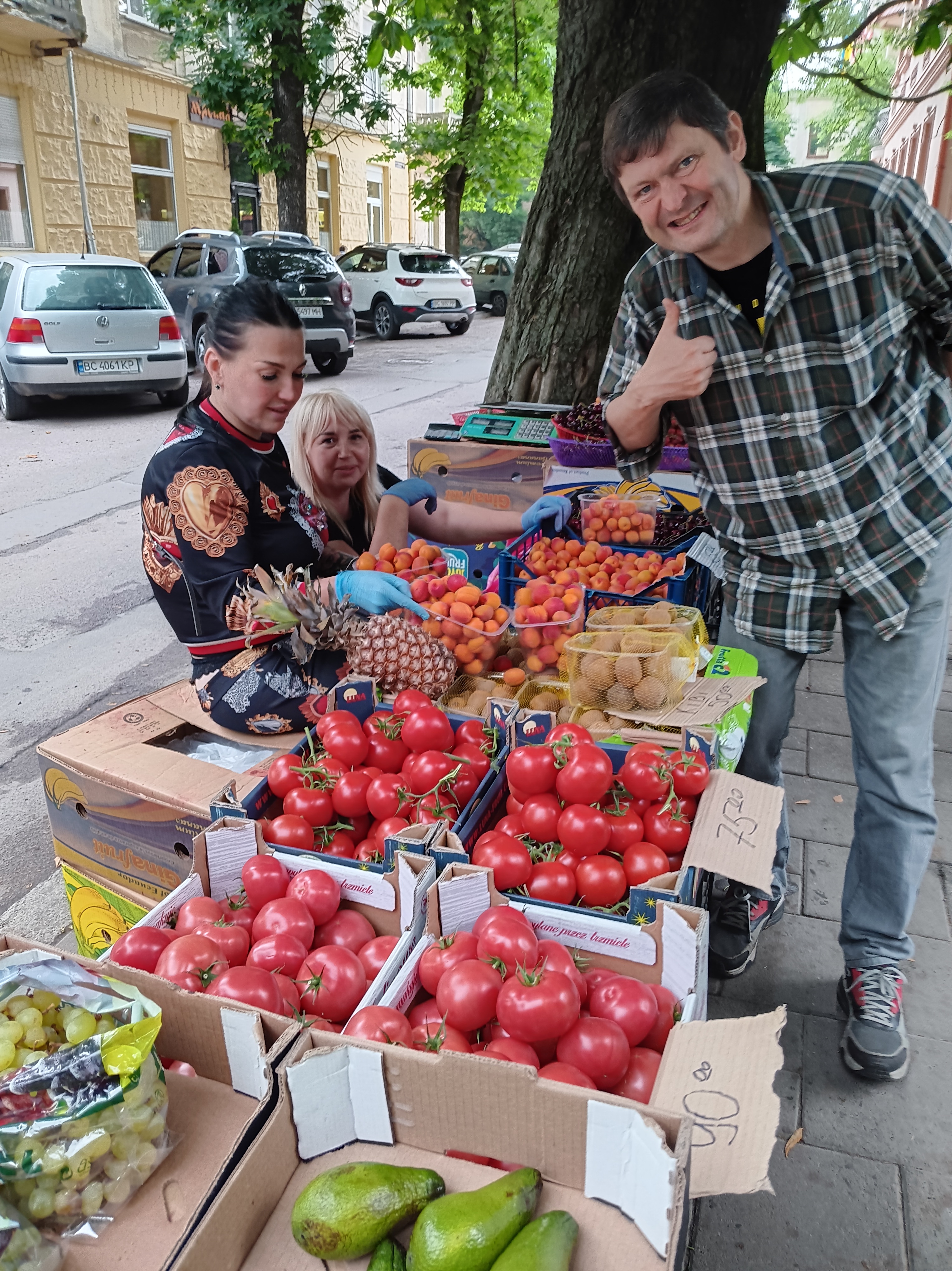
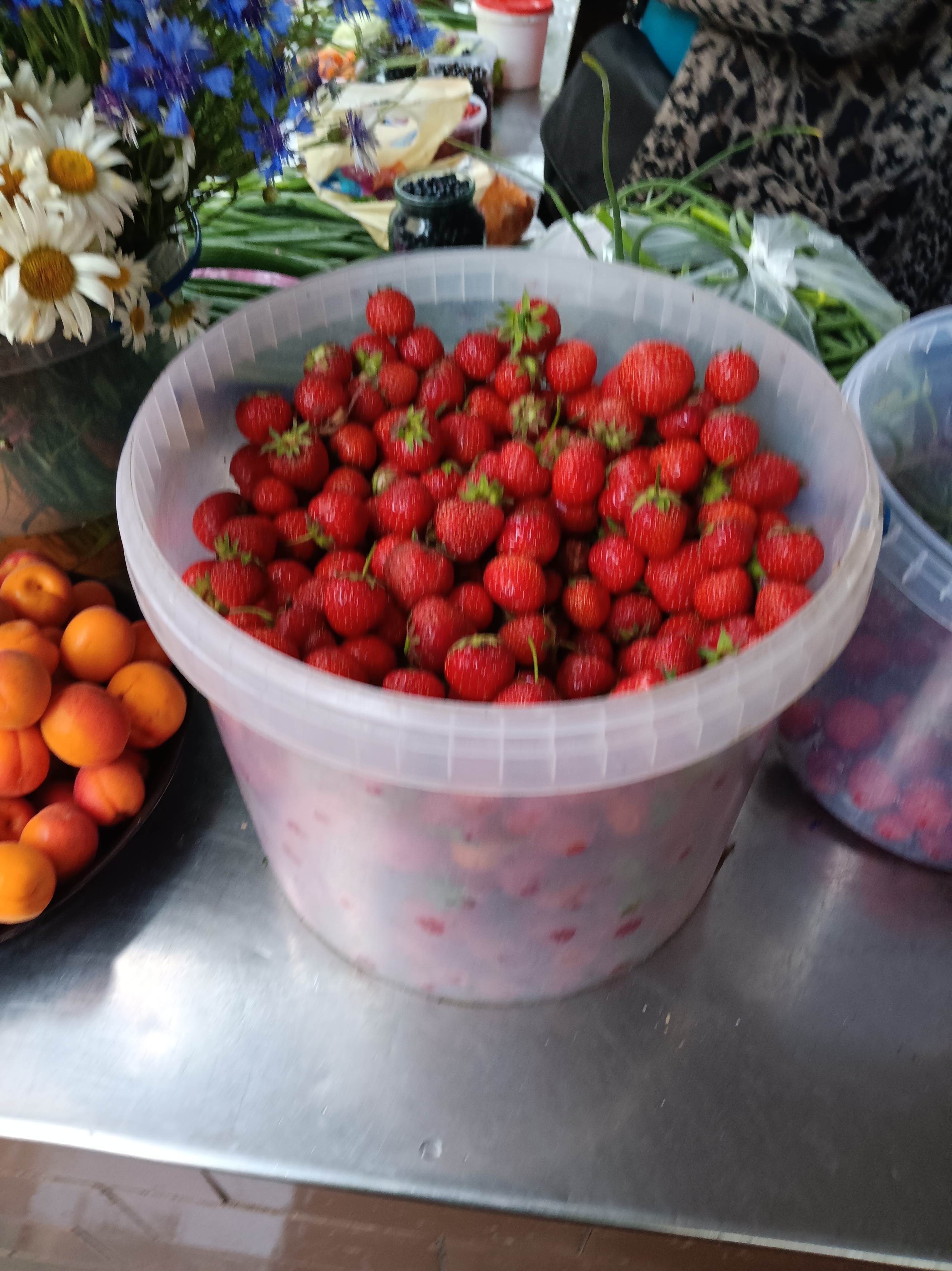
Walking past Old Town, I quickly found street vendors and a farmer’s market within a mile or so. Both local (currants, strawberries, cherries, gooseberries) and foreign fruit were sold. I bought half a pound of cherries and half a pound of “mirabellen” (small yellow plums) to eat during my first morning stroll through Lviv. Initially I spit the pits into the street, but I stopped when I noticed how clean both the streets and sidewalks were. This differs from all cities I have visited previously. Lviv expunges any and all litter in public places. So, my cherry pits went back into the bag.
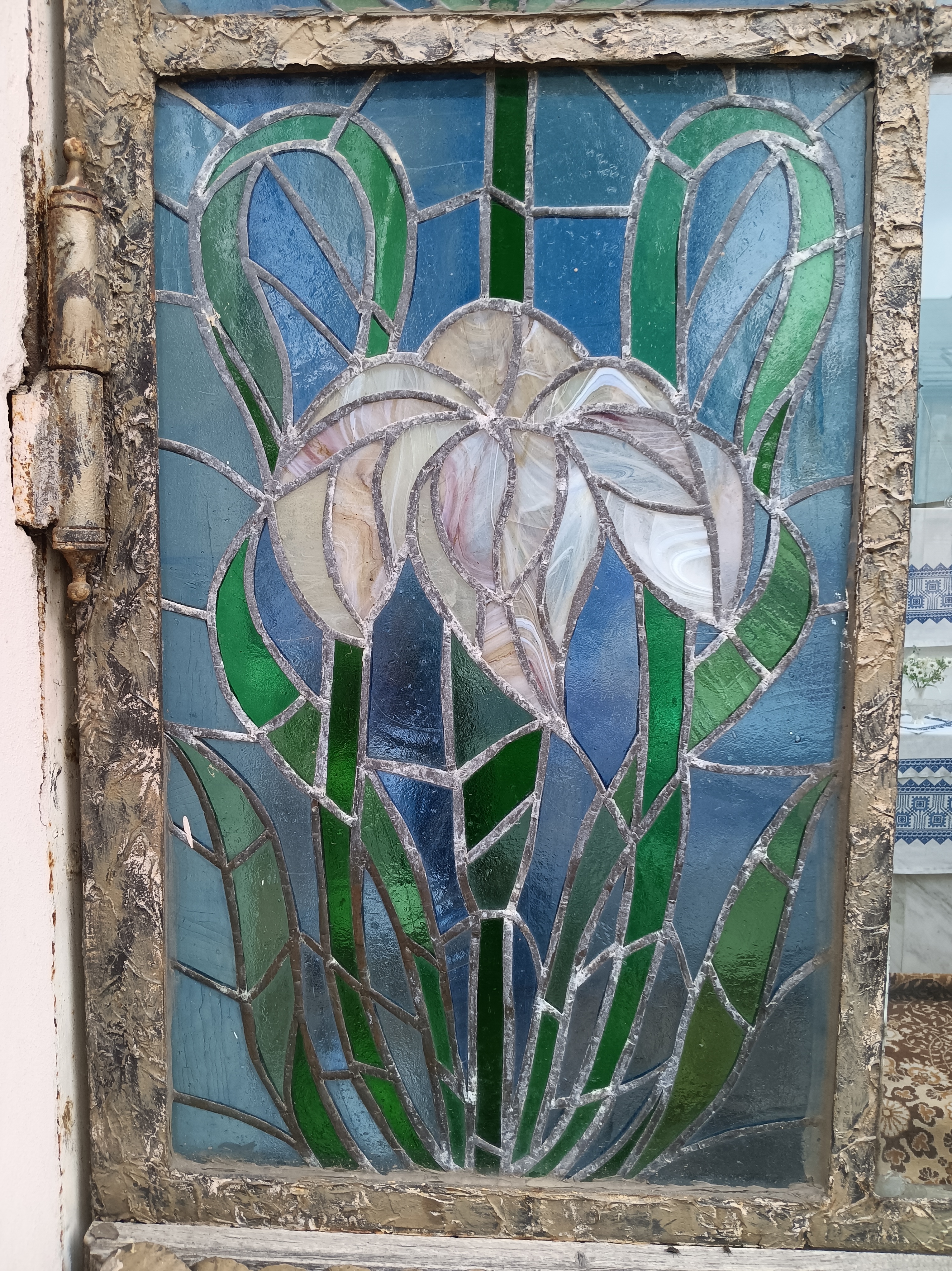
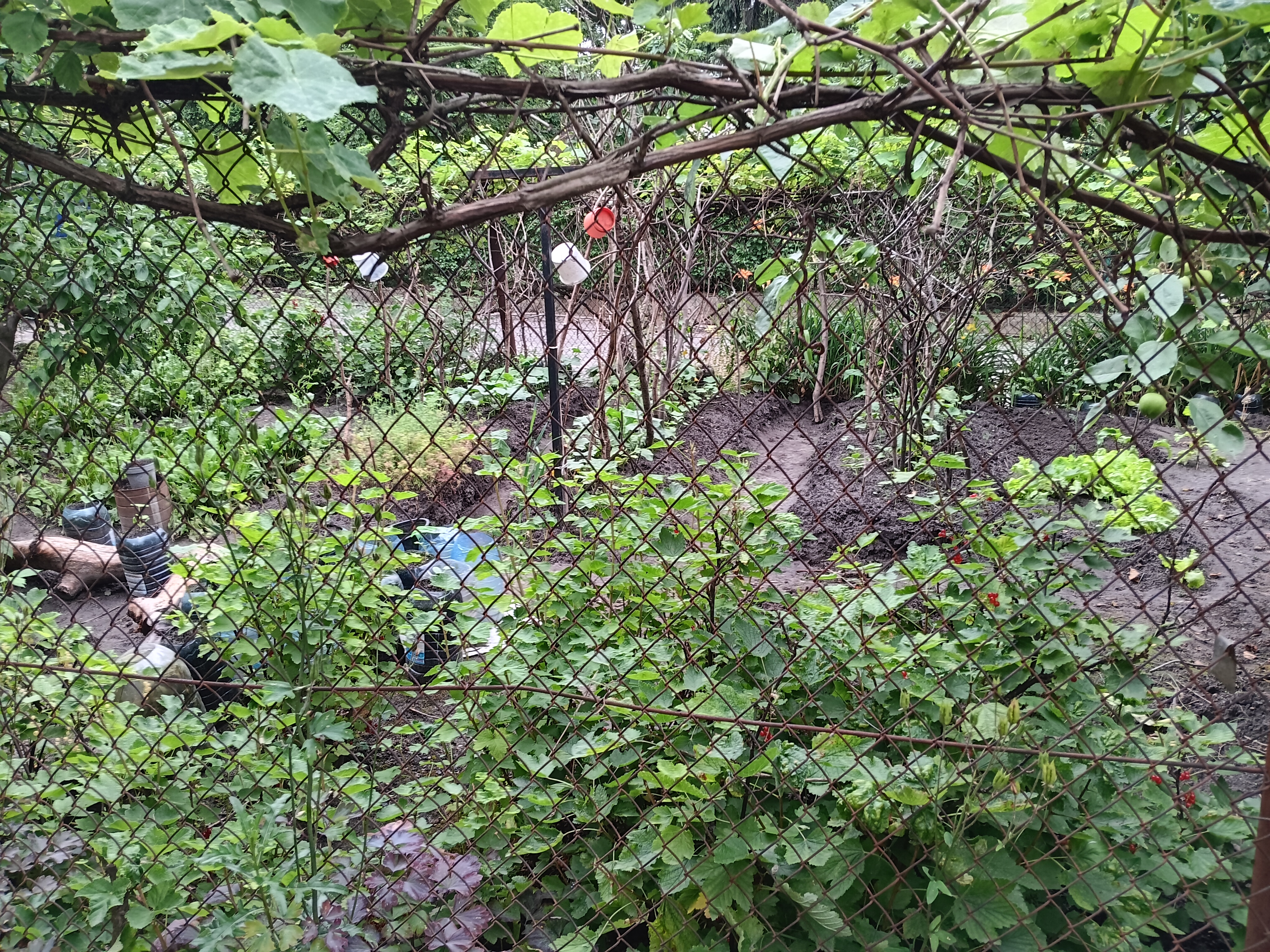
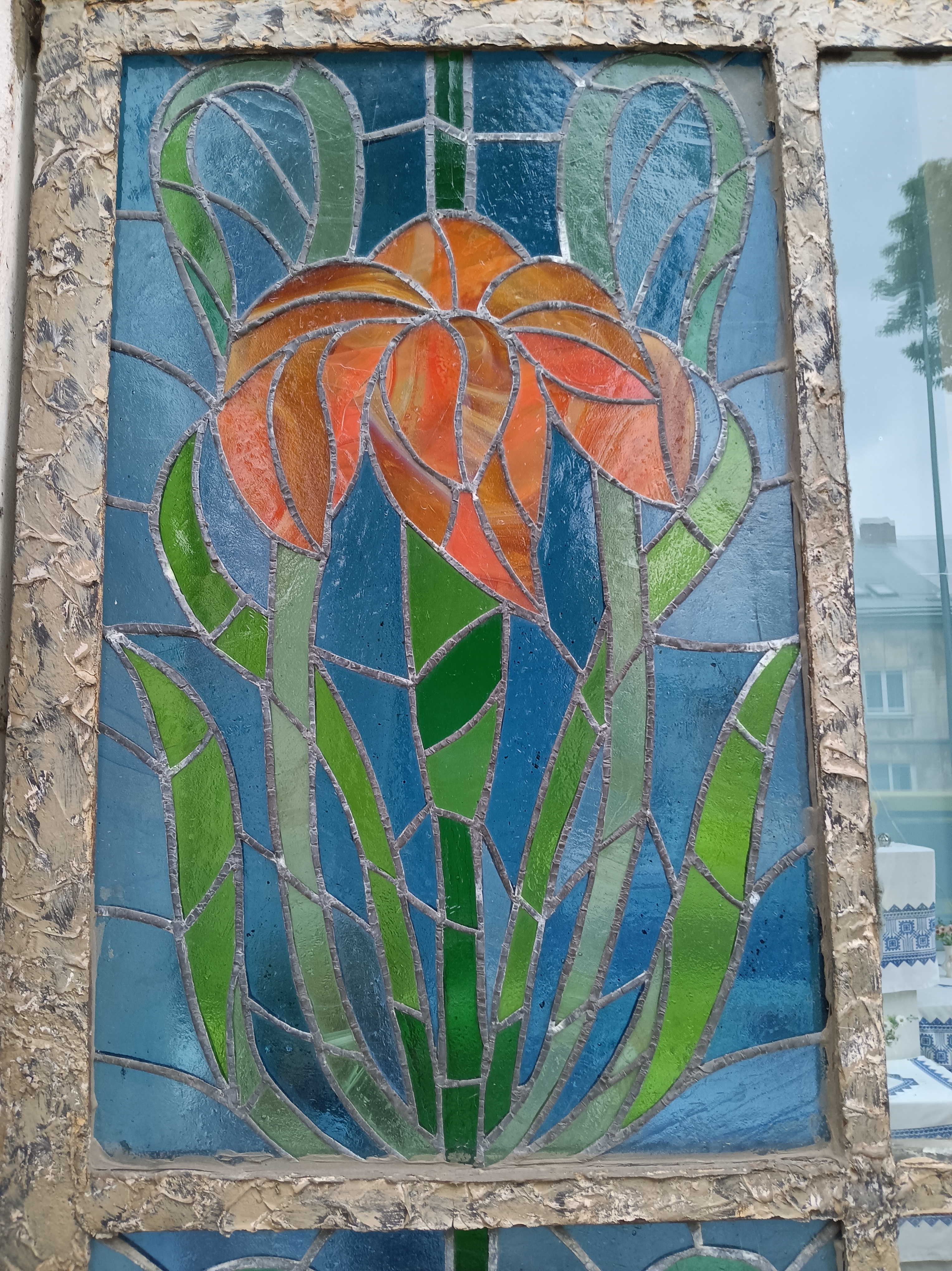
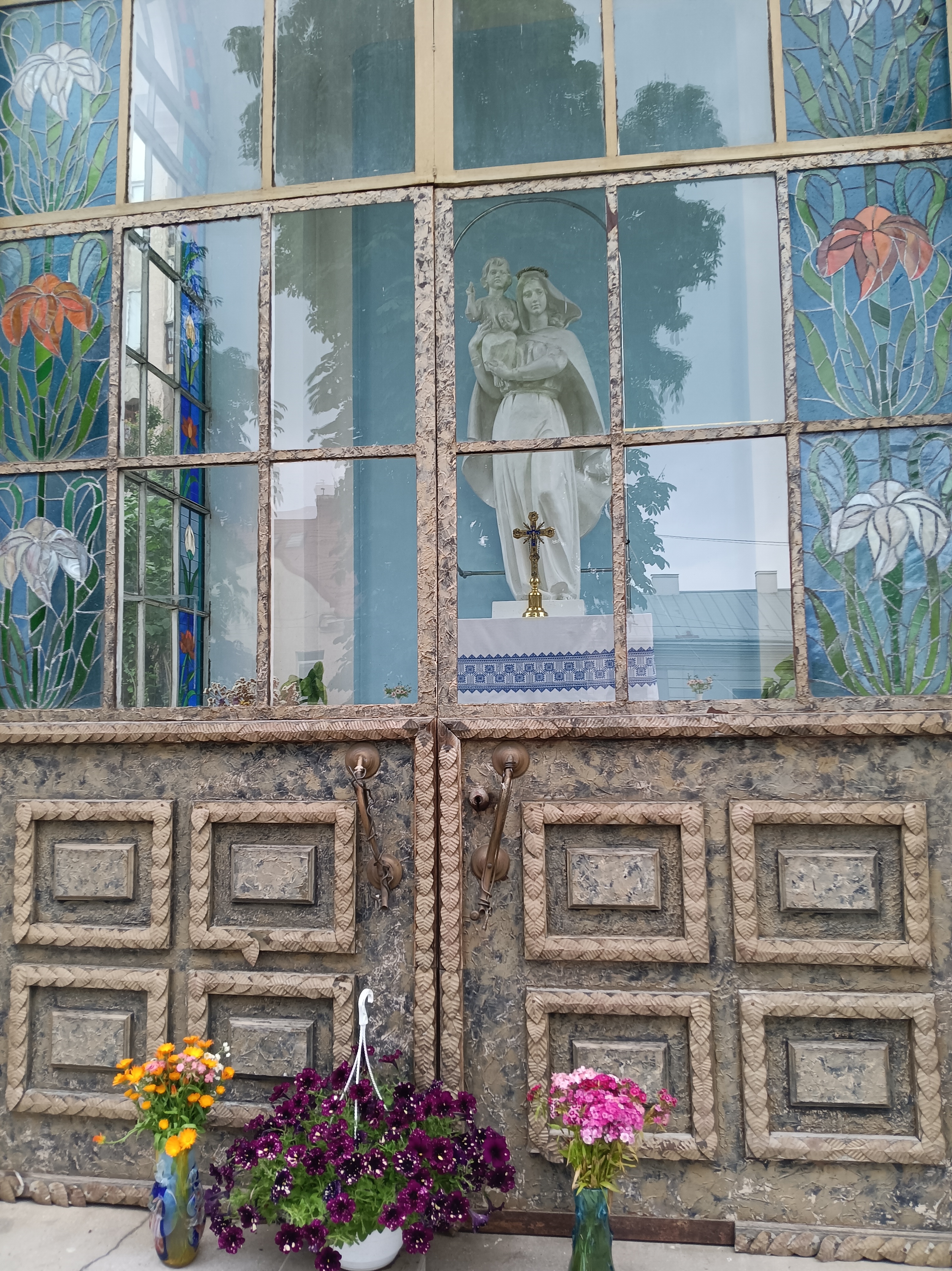
Later I discovered that fruit and vegetables are grown within city limits in small garden plots that people nurture. On half the space of my Delaware gardens they grow twice the fruit. The soil in the Lviv gardens is a dark and black. One such plot nestled in front of a large residential appartment complex adjacent to a religious shrine. Three sides of the shrine are framed with stained glass window pains similar to those my wife Dragonfly Leathrum makes. Looking closely, I discern identical designs of the flowers, however, the variation of the glass color and its arrangement is not. It is only now that I see the design and its symmetries, but I do recall the soothing and calming effect the shapes and colors had on me when I walked past it 15 days ago.
The tiny garden contained an apple tree, several Red Currants bushes, grapes growing up and along the fence, beans, carrots, beets, and cucumber. The stage of all these plants was similar to those that I grow in my own garden. A plastic bag of kitchen scraps for a compost was hanging over the door to enter the plot. It almost seems that neigbors left these for the owner to work into the soil. My sister Christina does the same for me when she visits sundays and leaves her kitchen scraps for my compost.

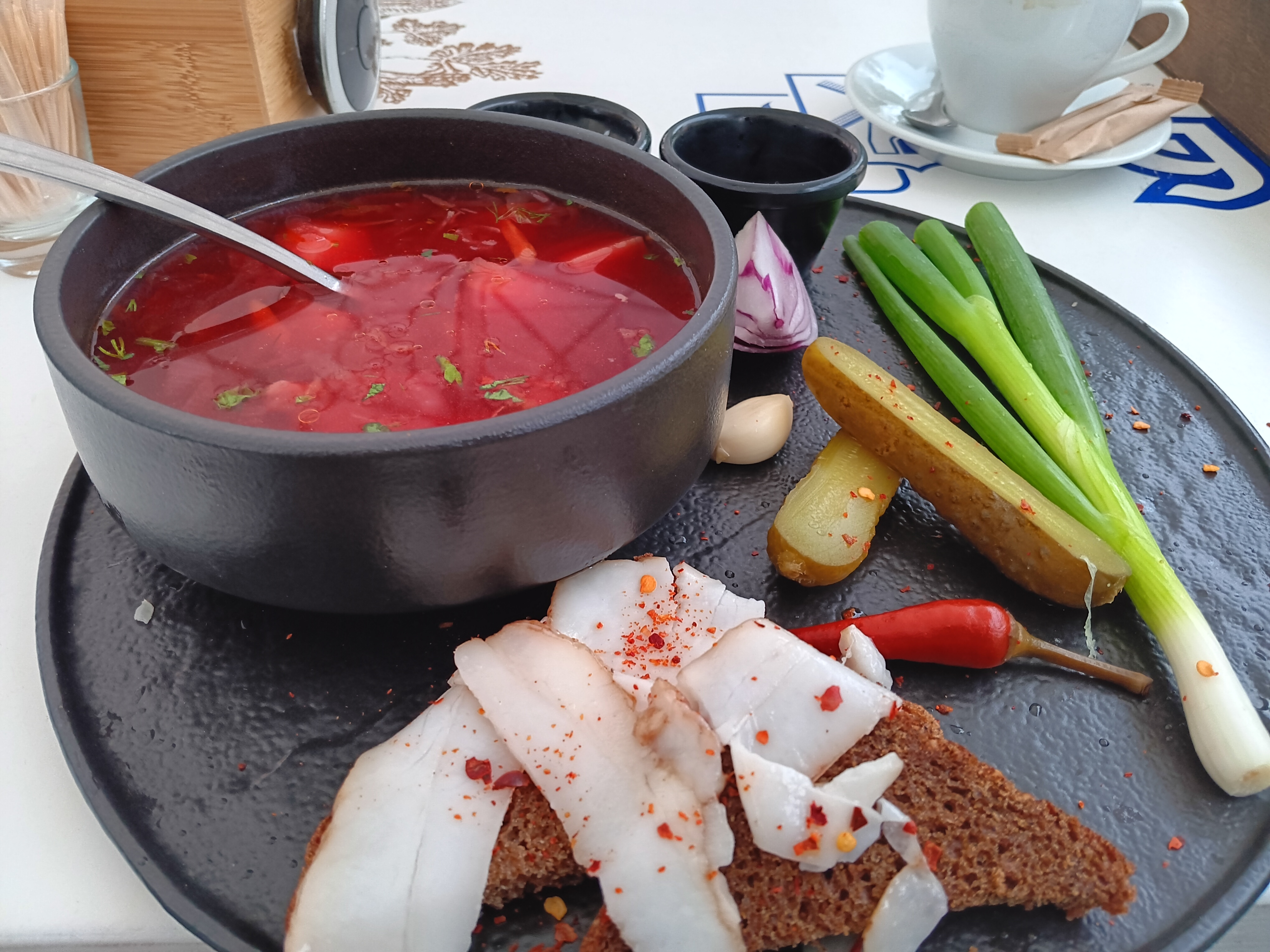
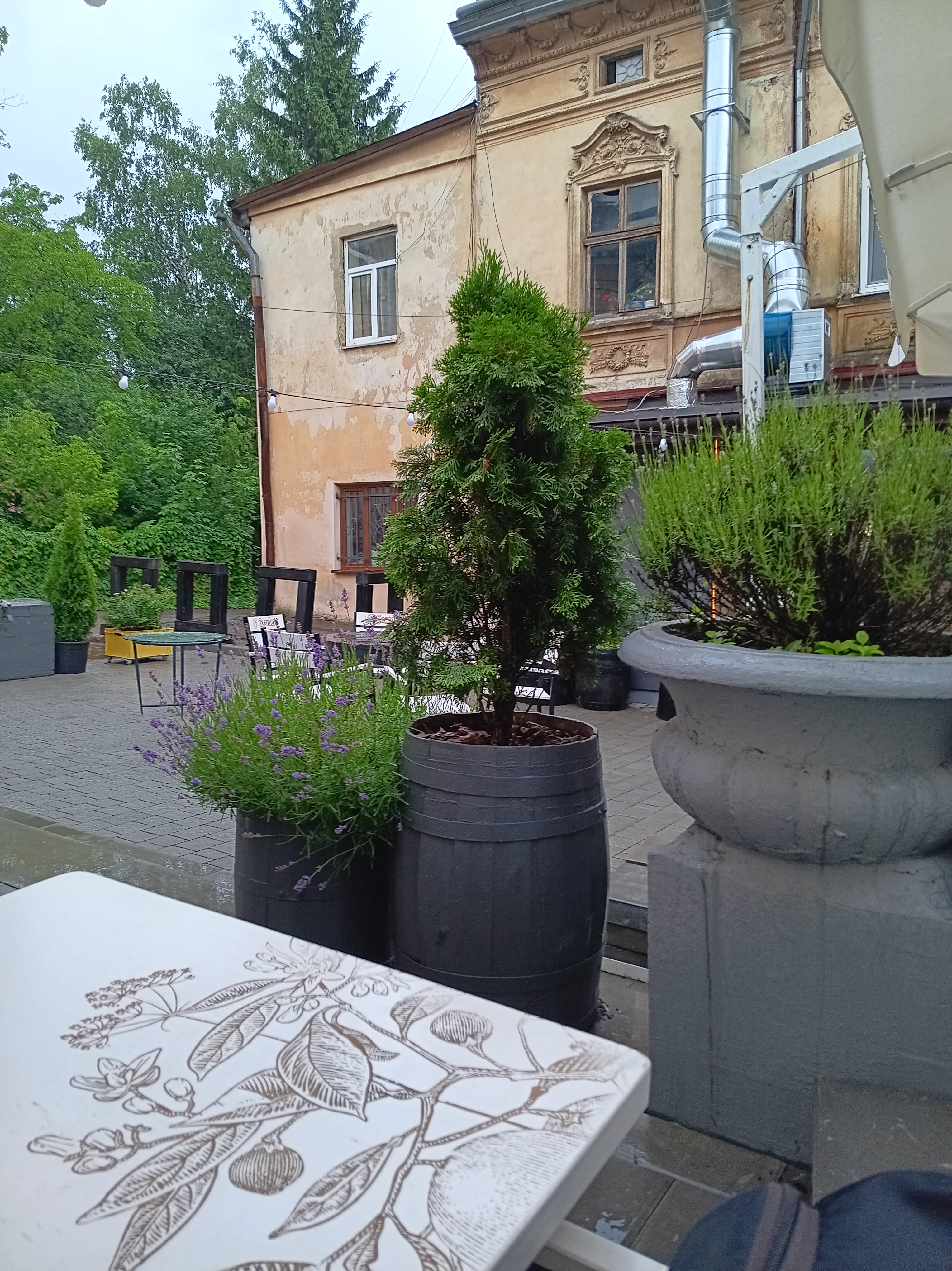
Rain moved me away from the shrine and its adjacent garden to seek shelter. I quickly found a restaurant with covered outdoor seating. My first meal since arriving in Ukraine was Borscht. Tiny rib bones with meat were in the soup, the pure white pork belly fat was on dark rye bread, and a shot of vodka came with it at the end. The presentation of the plate, too, reveals artful intent. The red onion, pepper, pickles, garlic, and scallion are all arranged carefully. Even the sprinkles of red chili flakes on the white fat are no accident and like a painting complement the red of the soup. The outstanding restaurant has a website, e.g., https://marinad-meat-bar.choiceqr.com/, as I just learnt 😉
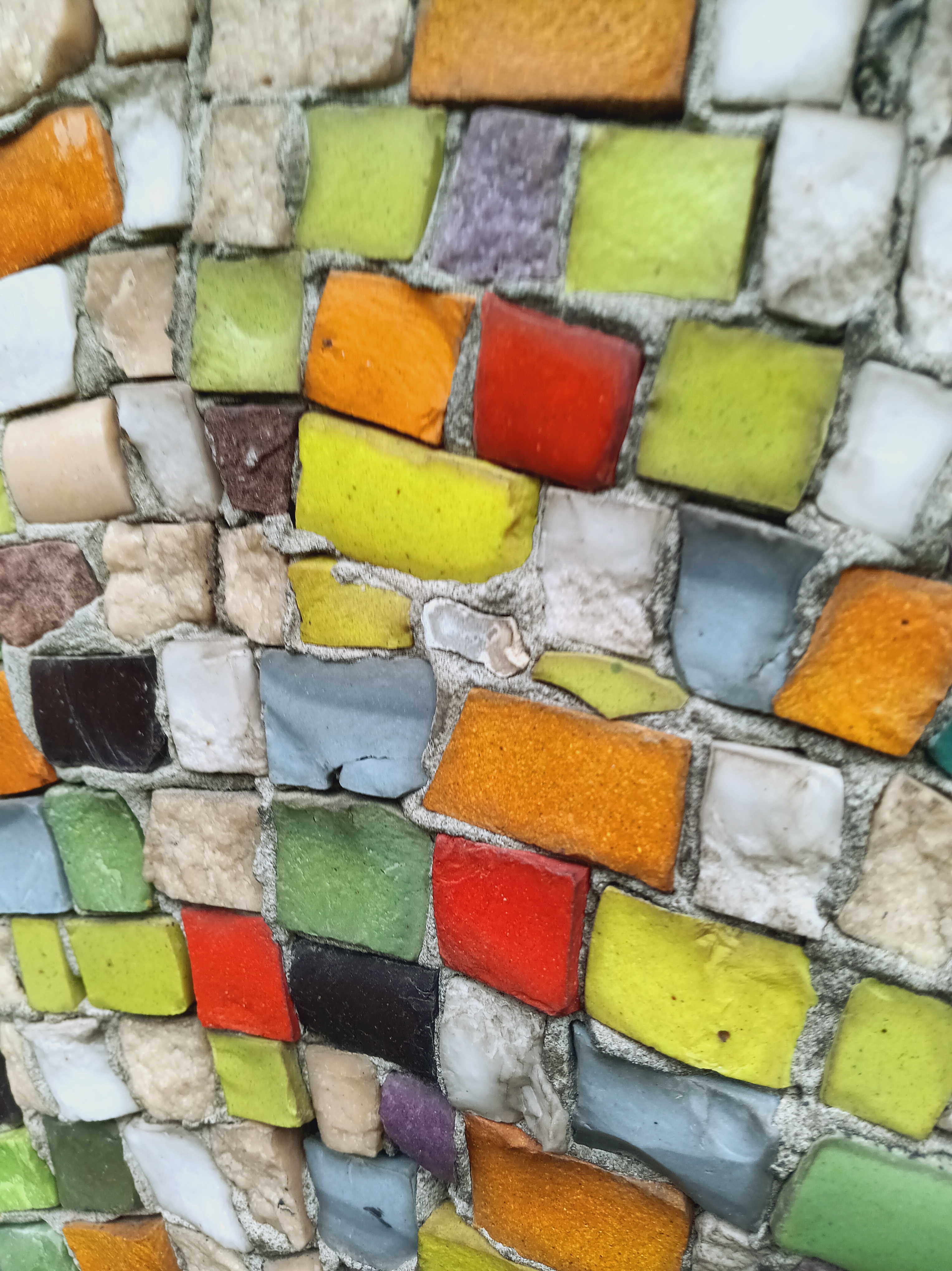
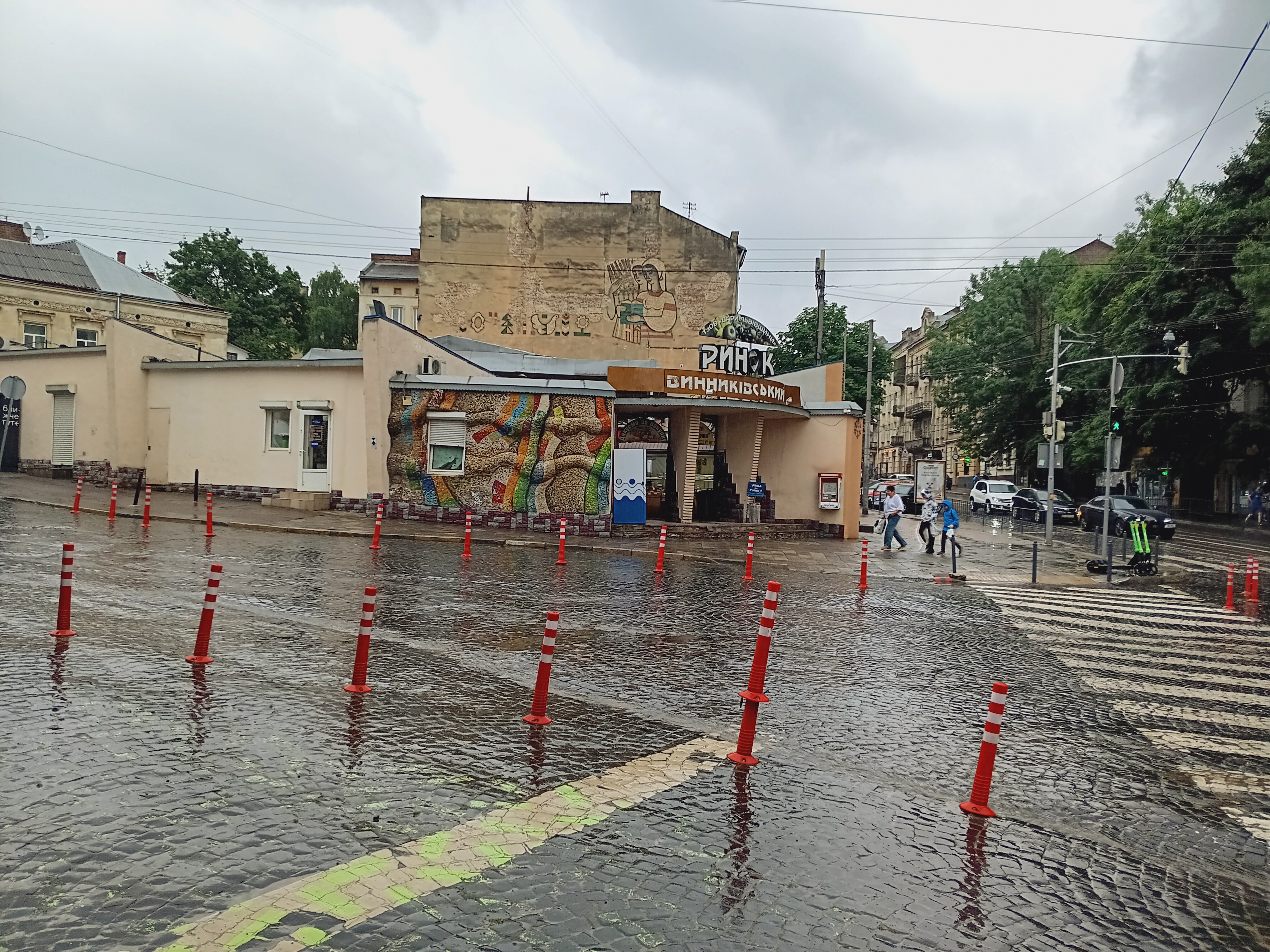
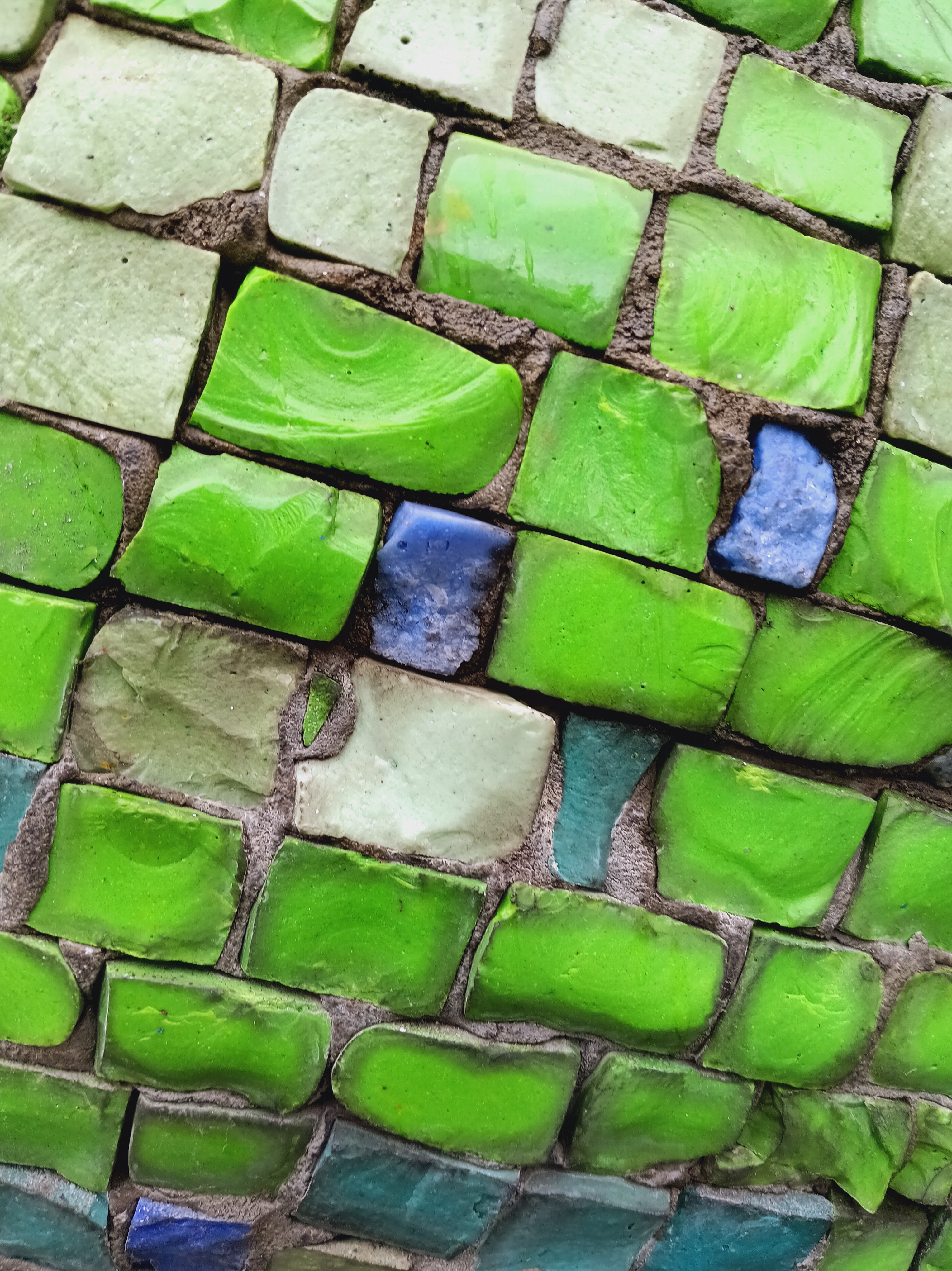
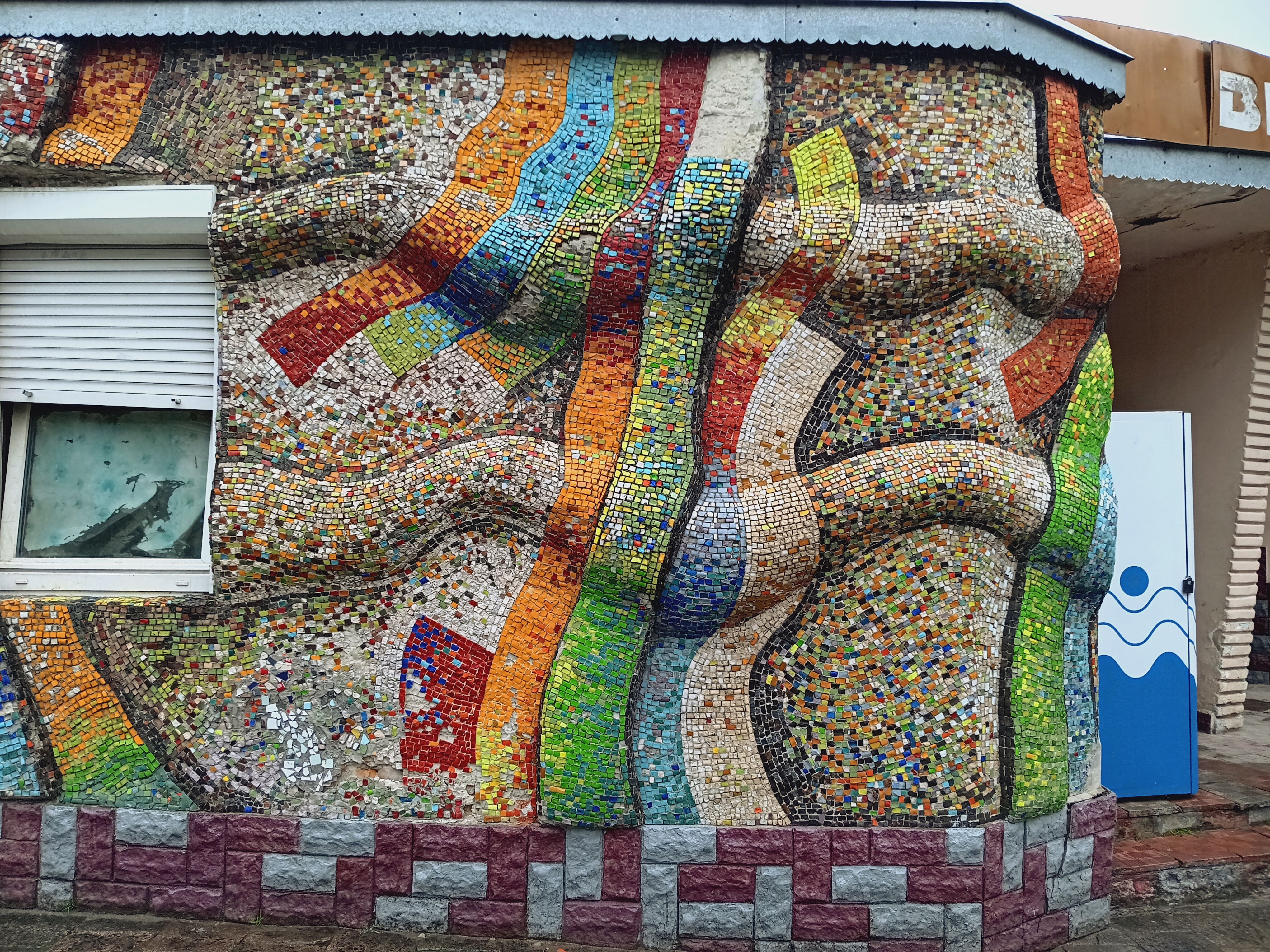
Talking about art in public places, I return to a mosaic sculpture at the farmer’s market. The market sits on a wide corner at the intersection of two large cobblestone streets. A tram line goes towards the shrine and the restaurant where I had my late lunch. A low wall encloses the fruit and vegetable stands inside and on one side this wall contains an exquisite mosaic of tiny colorful tiles. From afar colorful strands emerge that intersect and overlap smoothly without any color or strand dominating. Someone had to design this and someone had to put this together and I do not know who did this when, but I admire their love, care, and dedication to colorful and diverse cultures.
Notice also the mural on the wall above the market of the residential building. Two women tend to something and a line of symbols emerges along the base. Like most street art in Lviv, this one is not signed by the artist(s) either. I discern a peace dove and a sunflower … Again I only now notice this detail in the photo.

My own private Iceland

Reading Halldor Laxness’ epic novel “Independent People,” I am in Iceland for the last 10 days. I re-discovered this author after reading a small essay the New Yorker published last week. This book is set in Iceland of the early 1900s to the mid 1920ies. Sheep, starvation, and spirits evil and otherwise all play roles as does time that changes people, politics, and procreation. Finishing it sunday, I feel I have been here before.

Lifted from fioncchu,blogspot.com

My first Laxness novel “Islandklukken” (Iceland’s Bell in English) I read as a 20-year old during the Cold War when I served my country for 16 month more than 40 years ago. At the time I dreamt of the world as it had not yet revealed itself to me. My pre-college mind had a romantic notion of walking remote and wild areas of Norway and Iceland after an unromantic 1981 motorcycle trip across southern Norway the prior summer. I now worked as a paramedic in the drizzly gray German town of Husum by the North Sea. During this first winter away from parents and High School friends I bought my first Laxness and immediate afterwards “Die Saga von Egil” (Egil Skallagrimsson Saga). This Icelandic saga was written about 1200 AD and it chronicles the life of a viking poet farmer who killed many men for the 91 years after his birth in 904 AD. Along with this book I also bought a topographic map of Iceland published by the Touring Club of Iceland at a scale of 1:750,000 printed in 1979 in Reykjavik. It cost me 29.90 Deutsche Mark or about 10% of my monthly income at the time. Such armed, I followed Egil Skallagrimsson across Iceland starting at his place of birth about 35 miles north of Reykjavik.


Oil on canvas: “Summer in the Greenland coast circa the year 1000” painted by Danish painter Carl Rasmussen in 1874.

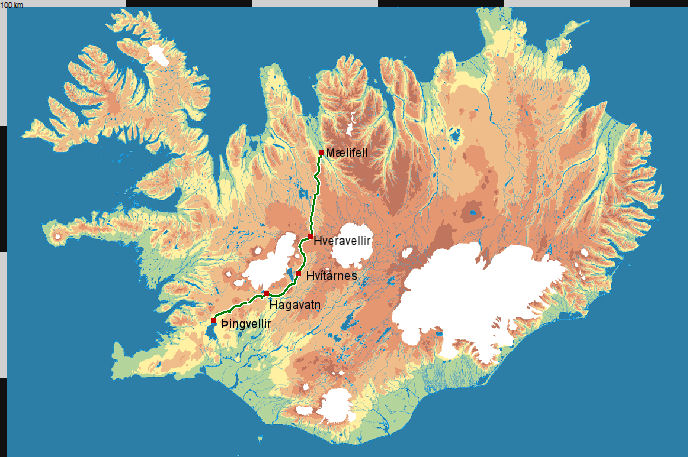
The same map follows me on my current travels across Iceland until I find the many databases of the Icelandic Geodedic Survey. High-resolution (1:50,000 scale, say) are generated instantly whereever I want. For days now I am hiking for days across the Icelandic highlands in the East and West, across interior deserts in the center, and wet coasts in the North. My first trip was across the Highlands from Pingvellir to Reykir past the glacier Langjoekull to the North and West and the glacier Hofsjoekull in the East and South. My maps locate many backcountry huts where I stay or pitch my tent. I here follow Dieter Graser’s excellent descriptions, photos, and GPS waypoints when he hiked the “Kjalvegur” alone in 2007. I even stole this map from his content-rich web-site where I spent the last 2 days traveling with finger on maps, books, and internets

Dieter Graser’s hike from Pingvellir in the south-west to Maellfell near Reykir in the north-east. It took him 19 days to complete this hike in August of 2007. [Credit Dieter Graser]

I even got a first intinary: My direct Iceland Air flight leaves Baltimore on Aug.-16 at 8:30 pm in the evening and arrives in Reykjavik the next morning at 6:25 am. A Grey Line bus gets me into the Highland for less than $48 in 2 1/2 hours, but it does not leave until 8 am on the next day. Hence there is plenty of time in iceland’s capital city to explore, get provisions, and perhaps visit the Landsbjoerg which is Iceland’s Search and Rescue organization. It is good practice to let someone local know when you will be where and back as one heads into the backcountry. The bus will let me off in Hviternes from where it is a 40 km hike to Hveravellir where there are two web-cams: the first points to the West while the second points East. I got 5 days to do this 3-day hike, so there is time for a day or two to do nothing, read, or just soak in the scenery and/or a hot spring and/or both at the same time. The bus will pick me up at the hot springs of Hveravellir at 2:30 pm on Aug.-22 to get me back to Reykjavik at 7:30 pm which is plenty of time to catch my plane back home the next day at 5:10 pm with an arrival 6 hours later. The return flight comes to $746 and even includes my backpack (<50 lbs).

There is just one problem … my passport expired.

P.S.: The three photos below are all from Dieter Graser who shared them at his outstanding web-site at http://www.isafold.de/

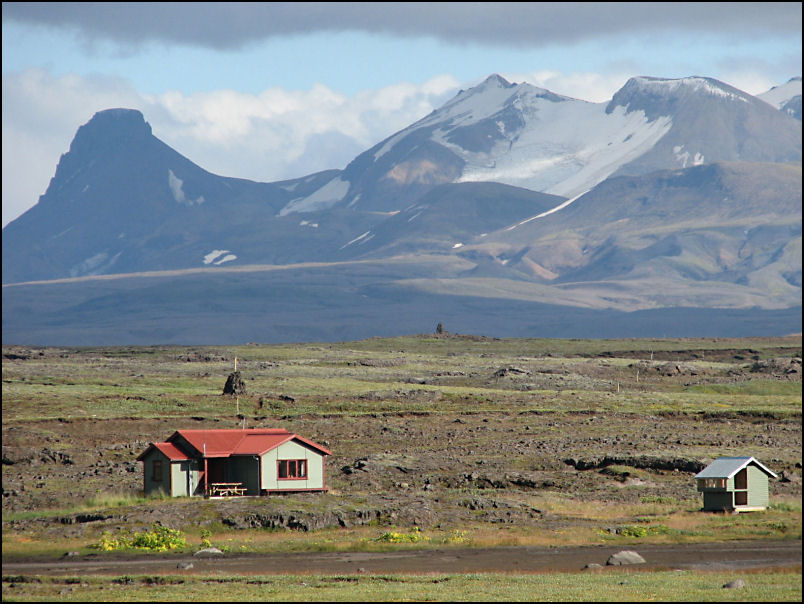
The hut Þverbrekknamúli along the “Kjalvegur.” The view is to the east with the Kerlingarfjöll in the back. [Credit Dieter Graser]
Dieter Graser at Hvítárnes in 2007. [Credit Dieter Graser].
Hveravellir in August 2007. [Credit Dieter Graser]

Germany 1985 to 2018

I left my native Germany in 1985 to study oceanography in North Wales. I returned in 2018 as an American Professor of polar oceanography.  

  Much has changed in 33 years. For one, the divided country that I left is no more. The largely peaceful unification of Germany and Europe removed barbed wires, concrete walls, and shoot-to-kill orders along a violent border. The Cold War was over, I saw the scenes of joy on TV in a bar in Newark, Delaware more than 4100 miles (5600 km) away:

https://abcnews.go.com/Archives/video/nov-10-1989-celebration-berlin-wall-8980622

I experienced the “new” Germany for the first time when sailing aboard Germany’s icebreaker R/V Polarstern in 2014 to deploy ocean moorings. At the time I counted four distinct German cultures.  

  Today is a national holiday that celebrates the “Tag der Deutschen Einheit” or “Day of German Unity.” It is very much work in progress as Germany is becoming more diverse with its over 10 Million people born in countries other than Germany. Turkey (1.5 Mil), Poland (0.9 Mil), and Syria (0.7 Mil) field the most foreign-born people as of 2017. From my American perspective Germany has become a more normal country with its recent politics, troubles, inconveniences, and strengths that these diverse backgrounds entail.

Dragonfly and I arrived in Bremerhaven three months ago to live and work here for at least a year. It took us two days to get bicycles and another two days to find a well-furnished apartment. My parents visited the second weekend and we became Bremerhaven tourists for two days. We purchased the required catastrophic health insurance from a credible company for about €550/year each, but after 3 months we are still waiting for the installation of an internet connection at our home, but we are hopeful that this may change soon.

Author aboard German research vessel F/S Maria S. Merian in port of Longyearbyen, Svalbard in the fall of 2018. [Photo by Dragonfly Leathrum.]

Author aboard German research vessel F/S Maria S. Merian in port of Longyearbyen, Svalbard in the fall of 2018. [Photo by Dragonfly Leathrum.]


North Greenland Sea Ice: Wolstenholme Fjord and Thule Air Base

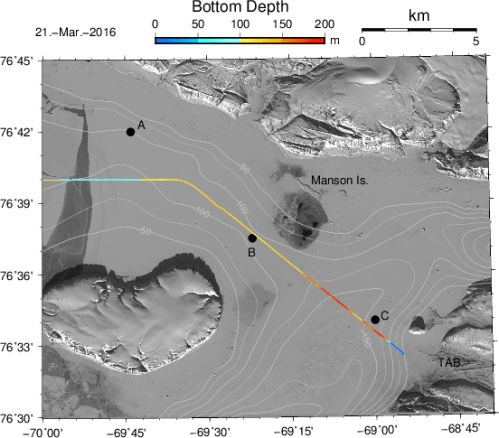
Greenland hunters, seals, and polar bears all need sea ice atop a frozen ocean to eat, breath, or live. The sea ice around northern Greenland changes rapidly by becoming thinner, more mobile, and less predictable as a result of warming ocean and air temperatures. I will need to be on the sea ice to the north and west of Thule Air Base in March and April about 6 weeks from to conduct several connected science experiments. The ice should be “land fast,” that is, it should be a solid, not moving plate of ice. The work is funded by the National Science Foundation who asked me to prepare a sea ice safety plan to keep the risk to people working with me to a minimum. In a science plan I included this satellite image of what the ice and land looked like in march of 2016:

Optical satellite image of Wolstenholme Fjord, Greenland on March-21, 2016 with Thule Air Base in bottom right. Darker areas show thin ice.

Optical satellite image of Wolstenholme Fjord, Greenland on March-21, 2016 with Thule Air Base in bottom right. Darker areas show thin ice.

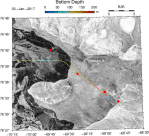
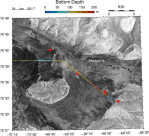
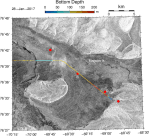
This LandSat image captures the reflection of sun light during a cloud-free day at ~15 m pixel size. No such imagery exists for 2017 yet, because the sun does not set until late February with this US satellite overhead. The European Space Agency (ESA), however, flies a radar on its Sentinel satellite. This radar sends out its own radio waves that are then reflected back to its antenna. The radar sees not only during the polar night, it can also see through clouds. And ESA provides these data almost instantaneous to anyone who wants it and knows how to deal with large data files. If you think your 8 mega pixels are sharp, these images are closer to 800 mega pixels. Here are three such images from January 3, 24, and 28 (yesterday):

The lighter white tones indicate that lots of radar signals return to the satellite. The many tiny white specks to the south of the Manson Islands are grounded icebergs. The different shades of gray indicate different types of ice and snow. The Jan.-24 and Jan.-28 images show a clear boundary near longitude of -70 degrees to the north of the island (Saunders Island) that separates land-fast ice to the east from thinner and mobile ice in Baffin Bay to the west.

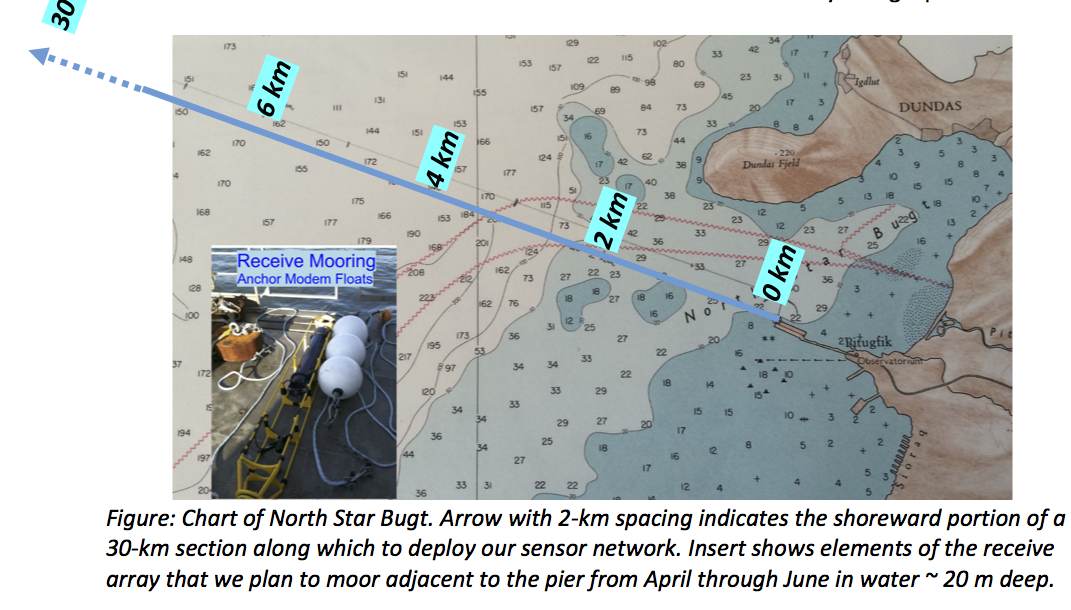
I plan to work from Thule Air Base (red dot bottom right) out along points C, B, towards A. The color of line near these points is a section where I have very accurate bottom depth from a 2003 US Coast Guard Icebreaker that was dropping off scientists at Thule on August 15, 2003. I was then one of the scientist dropped off after a 3 week excursion into Nares Strait and Petermann Fjord. Along this section I hope to test and deploy and under-water acoustic network that can send data via whispers from C to A via B. First, however, we will need to know how sound moves along this track and before that, for my ice safety plan, I will need to know how thick or thin the ice is. The imagery does not tell me ice thickness.

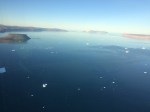
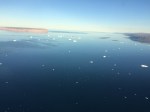
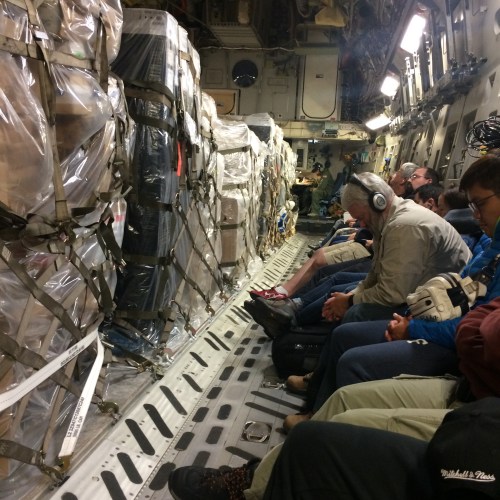
Flying to Thule Greenland with US Air force Air Mobility Command delivering cargo and people.

Flying to Thule Greenland with US Air force Air Mobility Command delivering cargo and people.

Arriving in Thule on Mar.-8, we will first need to measure ice thickness along this A-B-C section with a sharp ice-cutting Kovacs drill and a tape measure. The US National Snow and Ice Data Center (NSIDC) distributes a “Handbook for community-based sea ice monitoring” that we will follow closely. This first ice survey will also give us a feel and visual on how the radar satellite imagery displays a range of ice and snow surfaces. One of my PhD students, Pat Ryan, will process and send us the ESA Sentinel-1 radar data while a small University of Delaware and Woods Hole Oceanographic Institution group will work on the ice in early April.

The mental preparation for this scientific travel to Thule and the sea ice beyond gives me the freedom and pleasure to explore new data such as Sentinel-1 imagery and perspectives on tremendous local traditional knowledge of the Inugguit who have lived with the sea ice for perhaps 4000 years. The town of Qaanaaq is 45 minutes by helicopter to the north of Thule Air Base (TAB) at Pituffik. The town was established in 1953 when local populations living in the TAB area were forcibly removed. Despite these challenges the displaced people have prospered throughout the Cold War, but a less predictable and rapidly changing sea ice poses a severe threat to the community whose culture, health, and livelihood still depends on hunting and traveling on sea ice. Stephen Leonard is an anthropological linguist at the University of Cambridge who lived in Qaanaaq for a year in 2010/11 when he made this video:

P.S.: If possible, I would very much like to work with a local person who knows sea ice and wild life that we would need protection from. Danish contacts are reaching out on my behalf to people they know in Siorapaluk, Qaanaaq, and Savissivik.

Polar Bears and Guns and Politics

Polar bears are endangered and need protection. They hunt and eat meat to survive. Seals are such meat as are scientists walking and working on the sea ice. I am planing an experiment in polar bear habitat. Do I need a gun to protect myself and my students working with me? About 10 people told me “YES” last week, all with experience working in polar bear habitat. Who am I to say no? Encounters between bears and people happen, but only rarely. None of the 10 people advising me to carry a shotgun or rifle ever discharged their weapon or had a bear encounter.

Polar bear as seen in Kennedy Channel on Aug.-12, 2012. [Photo Credit: Kirk McNeil, Labrador from aboard the Canadian Coast Guard Ship Henry Larsen]

Polar bear as seen in Kennedy Channel on Aug.-12, 2012. [Photo Credit: Kirk McNeil, Labrador from aboard the Canadian Coast Guard Ship Henry Larsen]

In 3 month’s time I hope to do ~20 day trips from Thule Air Base near Pituffik, Greenland to explore the oceanography and acoustics of the local fjord covered by sea ice. The US National Science Foundation supports this work, maintains a dormitory where we sleep, and provides us with two snowmobiles. We will use these motorcycles on skies to reach science stations on the ice covering Wolstenholme Fjord. We will drill 10” holes through 3-5 feet of sea ice, set-up an electric winch connected to a small generator, and probe the ocean’s temperature, salinity, bottom depth, and ice thickness to prepare for a quiet acoustic communication system to move data under water from the outer fjord to the pier at Thule and the internet.

Thule-NSF2017

Leading this science effort, I will have to estimate and manage potential risks which include encounters with polar bears. I will have to decide how much money to allocate to each risk that then may not be available for other activities such as to support students, buy better sensors, or return in the summer. The first and almost always best response is to hire a local hunter who knows the area along with its bears, ice, and weather. There are about 600 people living in Qaanaaq about 100 miles to the north. Most of them are children and grand-children who were forcibly removed from Pituffik in 1952 when more than 13,000 Americans built a large air field during the height of the Cold War. The local llanguage spoken in remote Qaanaaq is the Inuktitut dialect of north-west Greenland, the first foreign language learnt in school is Danish, and English is not widely spoken, however, Qaanaaq has two non-Inuit villagers who originate from Denmark and Japan.

Relations between Qaanaaq and Thule Air Base are complex and sensitive with regard to politics and finances. One of many perspective is that of Kim Petersen who writes in Dissident Voice about “The Struggle against Colonialism and Imperialism in Kalaallit Nunaat.” Kalaallit Nunaat refers to Greenland in the local language. While the forced removal of native populations from Pituffik to Qaanaaq in 1952 and the crash of a nuclear armed B-52 bomber into Wolstenholme Fjord in 1968 are not in dispute, the political arguments presented seem to me rather narrow, one-dimensional, and rooted in a tired ideological Left-Wing mode of conspiracy-thinking. Does this perspective represent the community of Qaanaaq? Perhaps I need to ask someone who may know:

Working on the sea ice off northern Greenland [Photo credit, Steffen Olsen]

Working on the sea ice off northern Greenland [Photo credit, Steffen Olsen]

It is not straight-forward to bring a gun to Greenland as it requires a large amount of paper work. Another layer of regulations relates to bringing a gun to an US military installation. Shooting a polar bear is a burocratic and political nightmare, because strict quotas exist for the “taking” of polar bears. International complications include Canada, because the quotas are assigned to Canadian and Greenlandic hunters from the same bear population. It is a sensitive topic in many dimensions, a riddle for which I have no solution.

How much time do I spent to prepare for an unlikely event such as a fatal polar bear encounter? Could I not argue with ethics that were instilled into me when hiking in the back-country of Denali National Park (no guns there). Park rangers then told me that I enter bear habitat and should do so respectfully with minimal impact. They gave me useful pointers on how to lower contact and I saw no bears hiking for 4 days alone without a gun, but grizzlies eat berries while polar bears do not.

So, should I carry a gun, if I am not ready to kill a bear while working in bear country? I can accept the consequences of injury and death for myself, however, I cannot do so for those who are with me. Perhaps this then is a path to a solution: Discuss this with all who will be with me on the ice.