Tag Archives: Greenland

Exploring Greenland’s Coastal Currents: A Journey of Discovery with Icebreaker Polarstern

Icebreaker Polarstern reached its home port of Bremerhaven in Germany just before Orkan “Joshua” hit northern Germany hard. The ship returned after 3 month at sea with 48 crew and 46 scientists working on ocean biology, chemistry, and physics. The 7-week expedition from Svalbard to Greenland and back to Germany culminated 3 years of planing and preparations led by the Alfred Wegener Institute (AWI). As one of 46 scientists I stepped onto the ship almost two months ago in Longyearbyen. We planned to explore what moves ice and fresh Arctic water into the Atlantic Ocean with sensors to probe the coastal circulation.  Analyzing these data, I will now live in Bremerhaven for a few months.
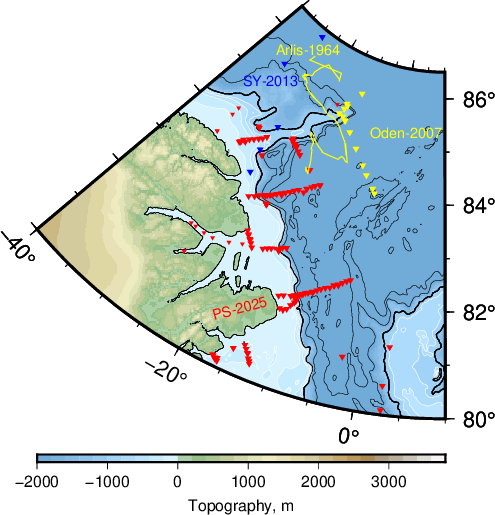
The map above shows where we went to the north of Greenland. I am coloring the coastal ocean shallower than 1000 m in light blue and the deeper ocean in dark blue. Our 2025 Polarstern data are the red symbols while yellow and blue symbols show data locations from 1964 ice island, 2007 icebreaker,  and 2013 helicopter surveys. This area contains the last and thickest sea ice of the Arctic Ocean and prior ocean observations originate from floating ice islands that both the Soviet Union and the U.S.A. used during the Cold War 1947-91 such as the Arlis-1964 track (yellow line). Helicopter surveys collected a few data in 2013 (blue symbols) while the Swedish icebreaker Oden collected data along two lines farther offshore (yellow symbols).
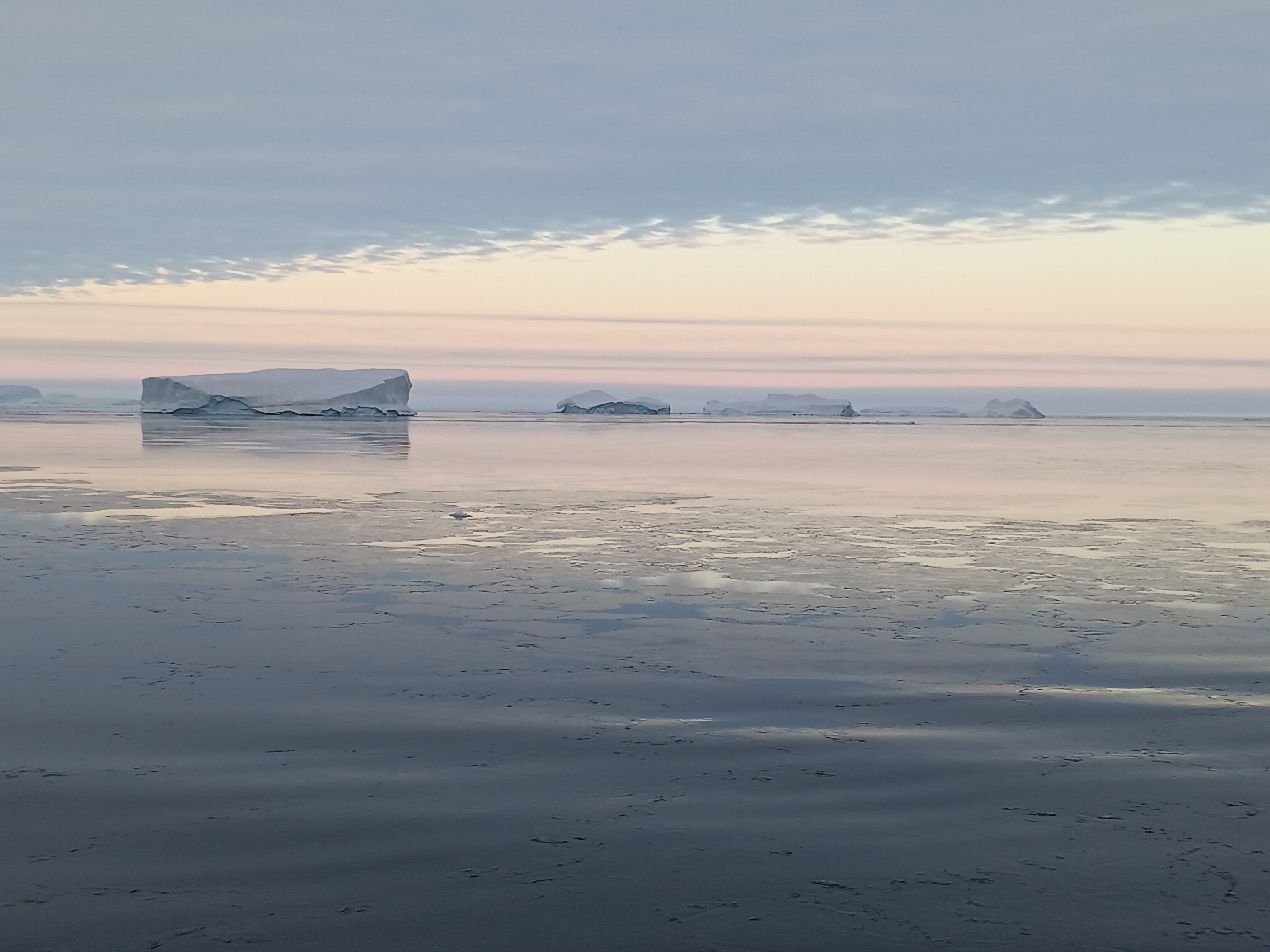
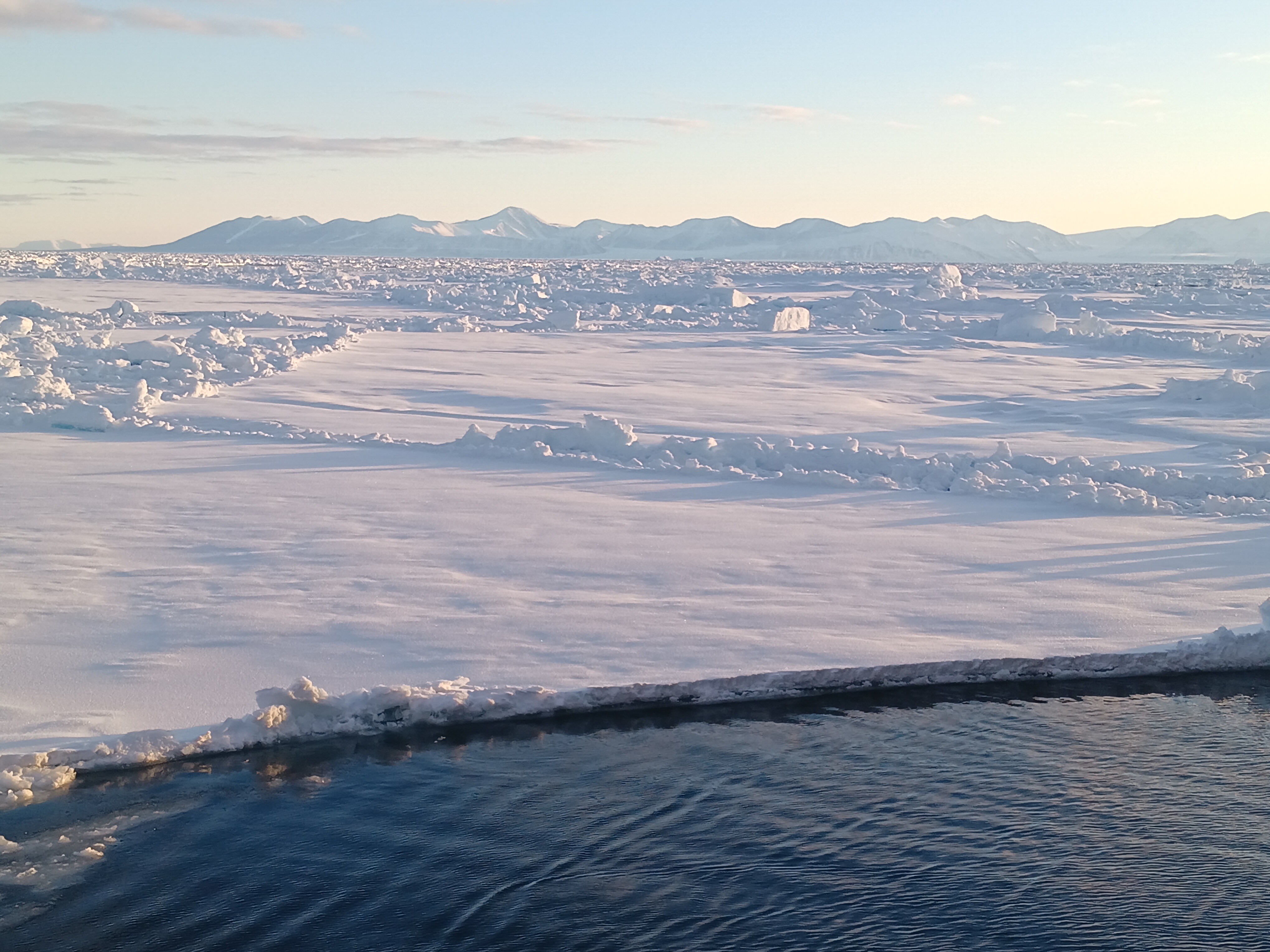
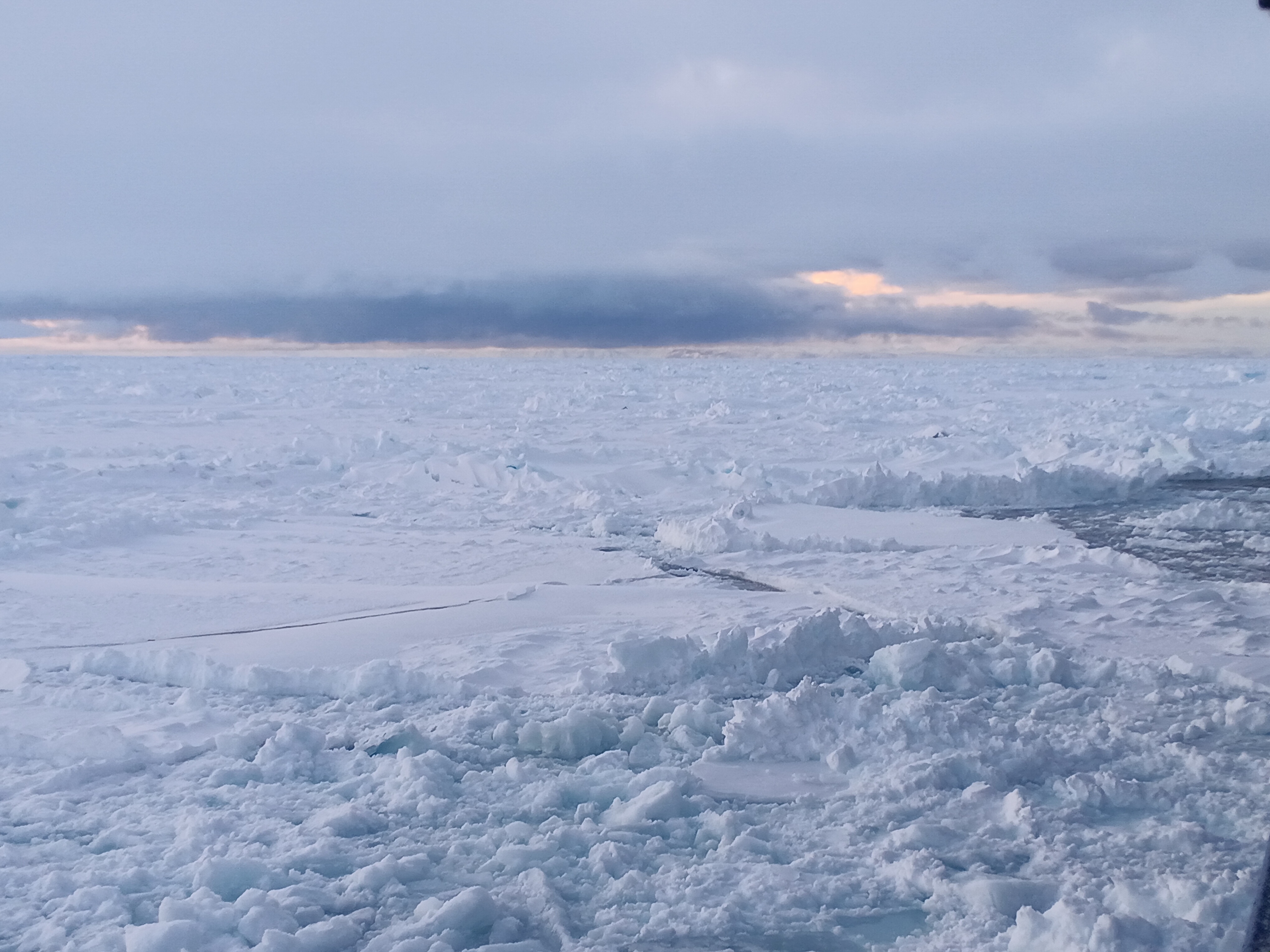
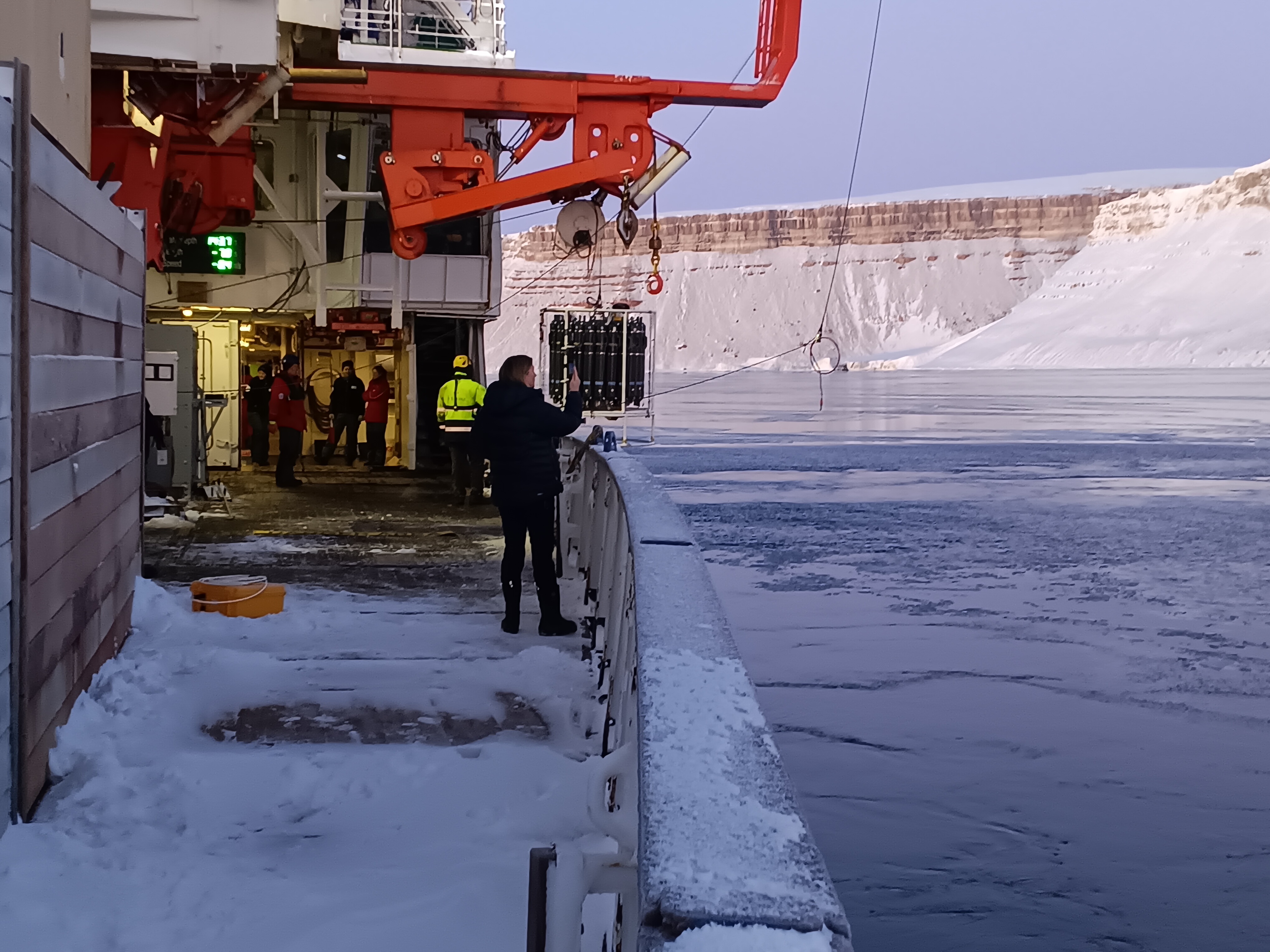
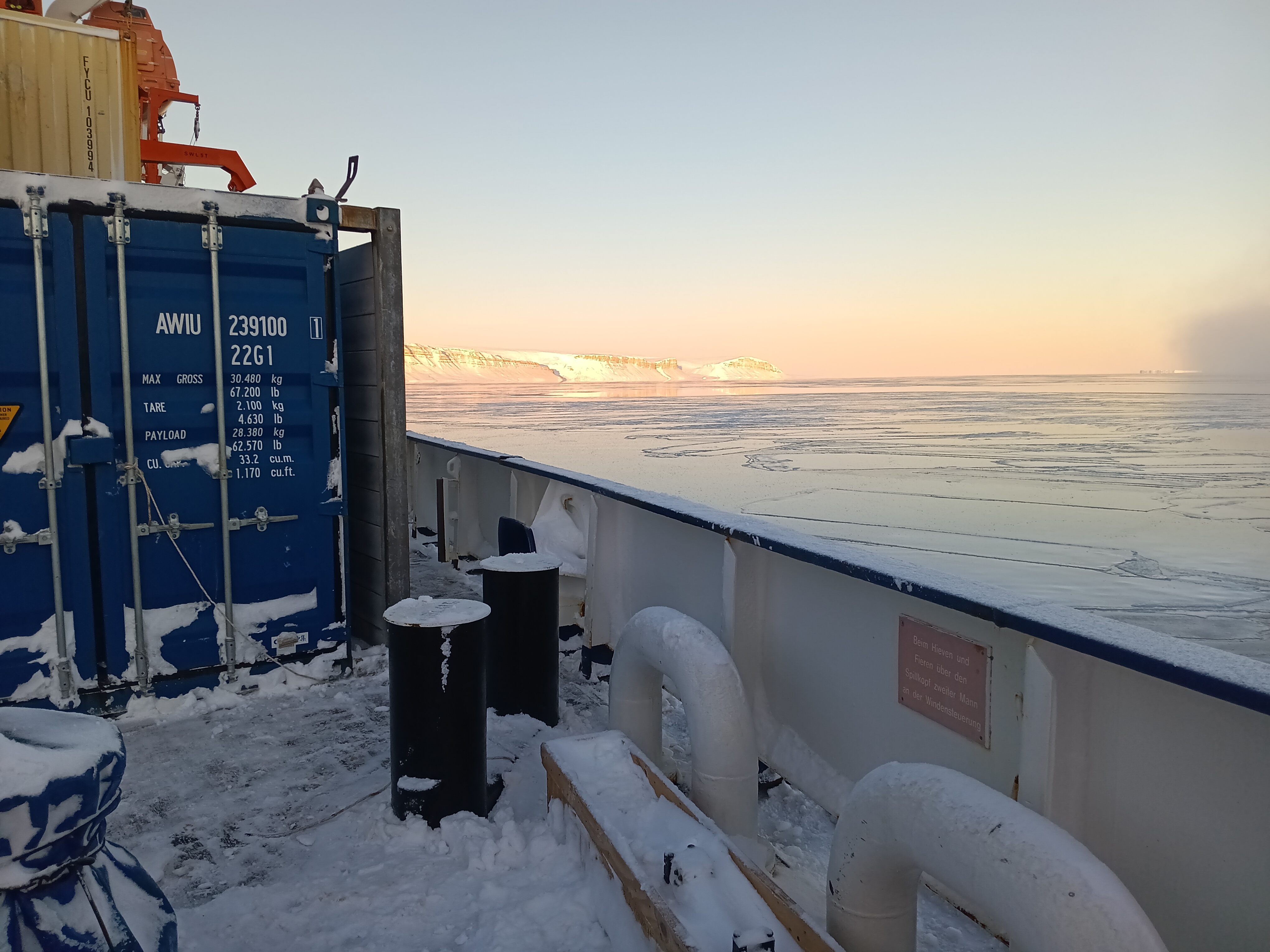
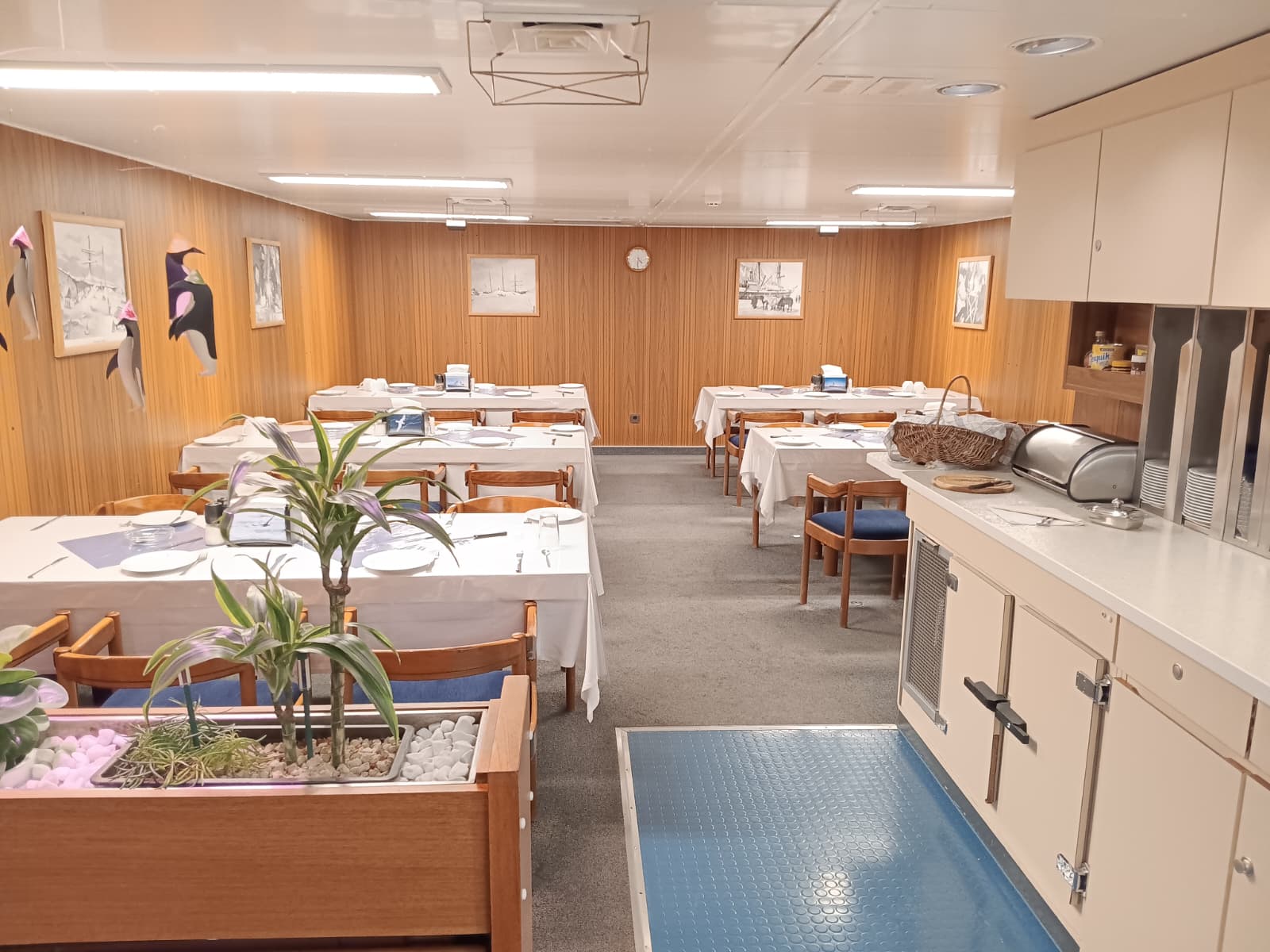
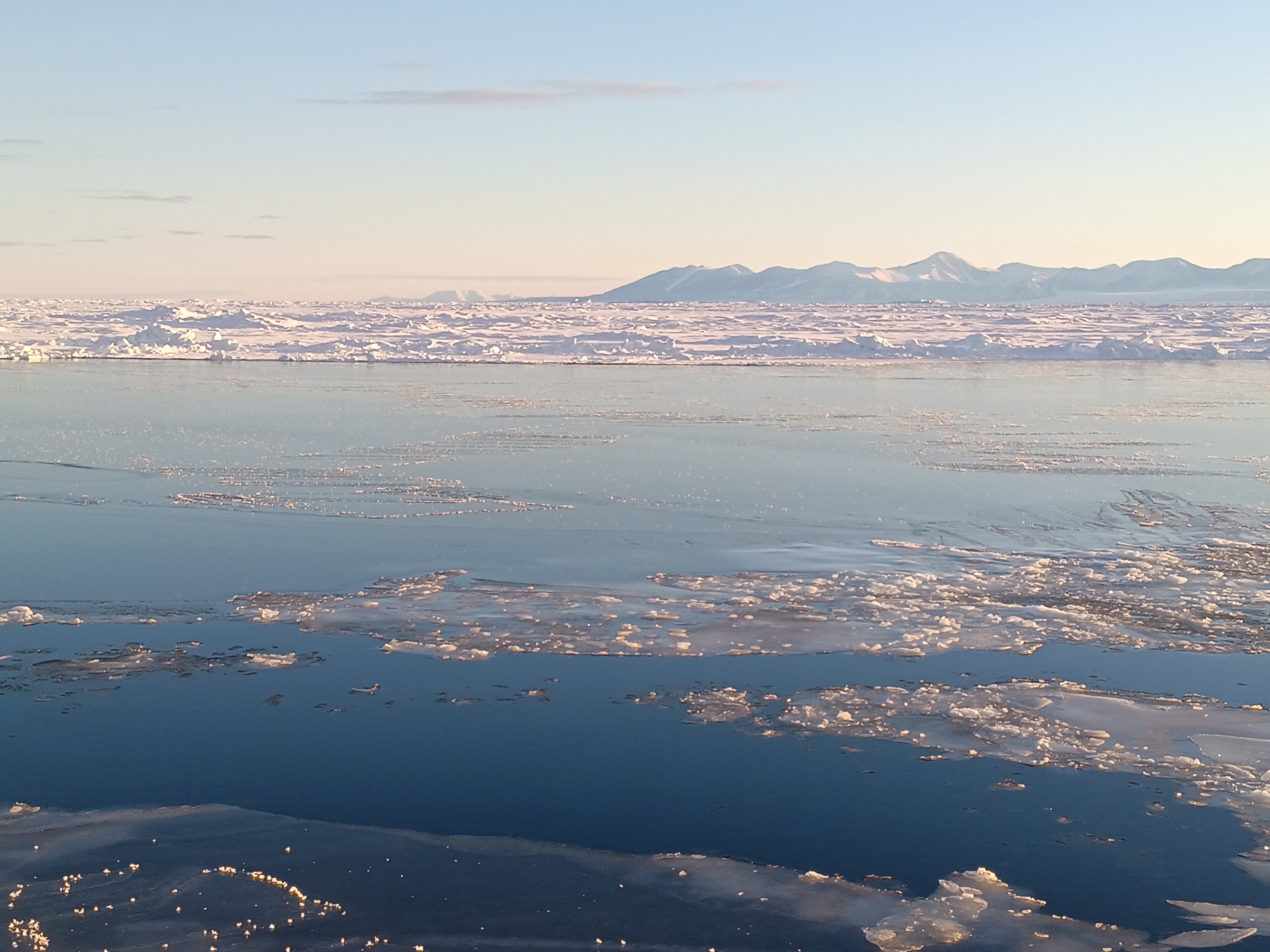
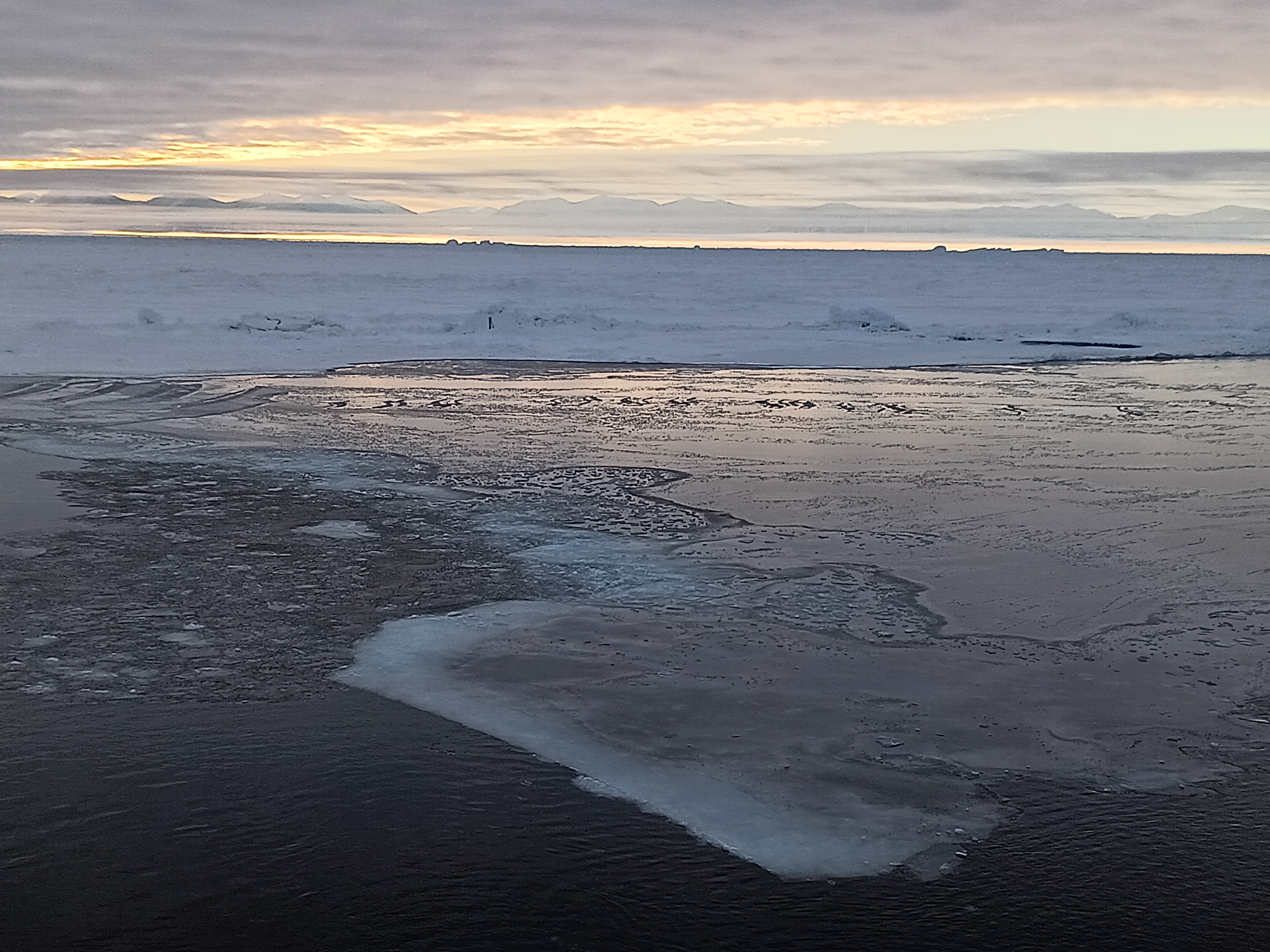
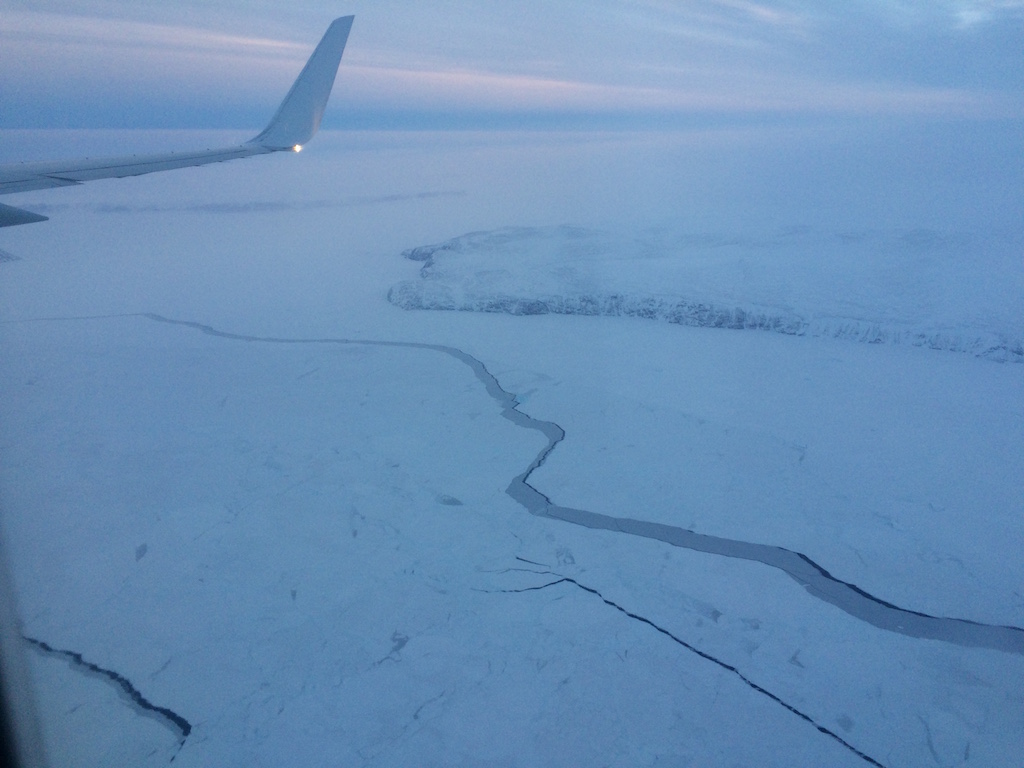
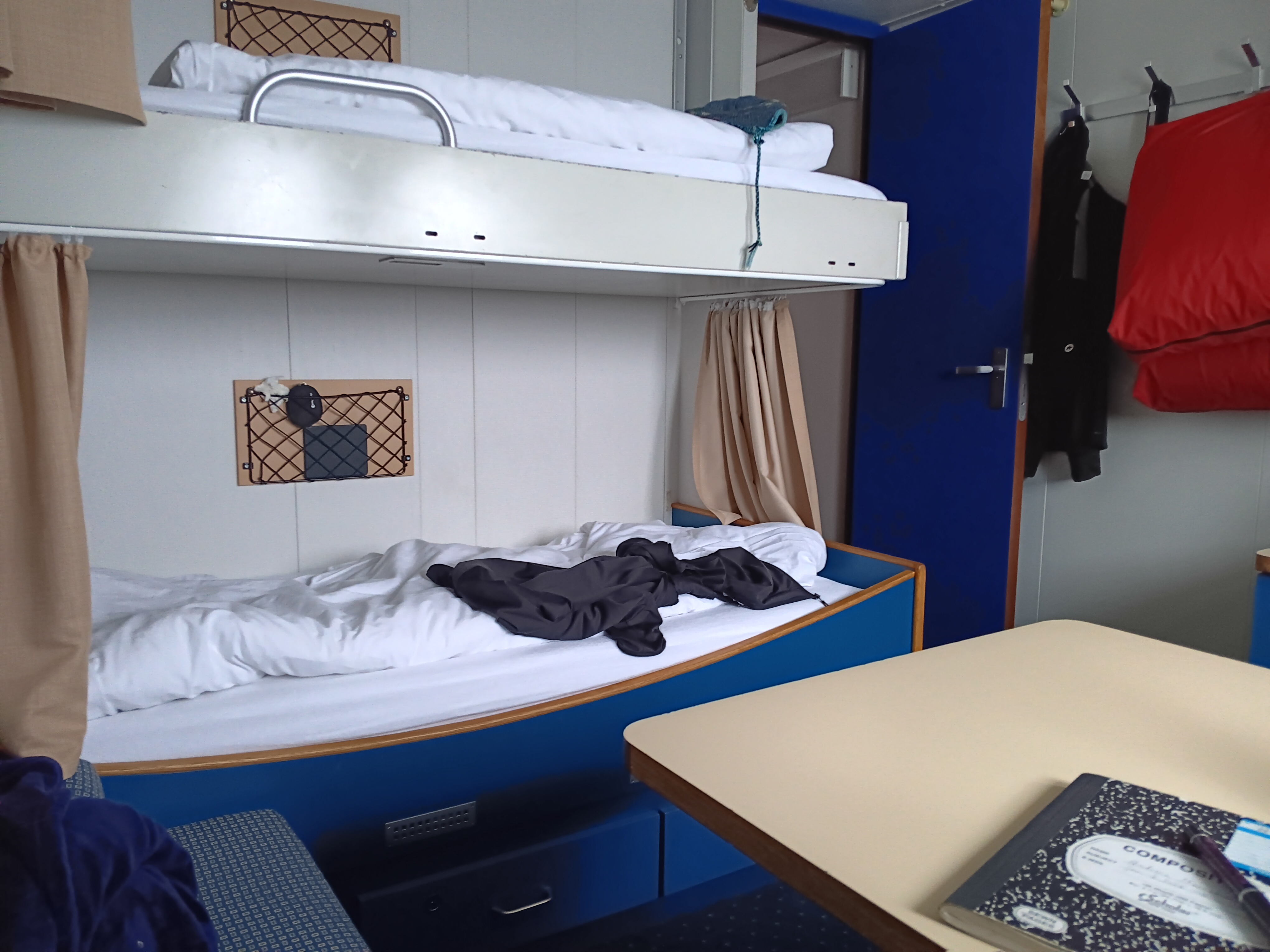
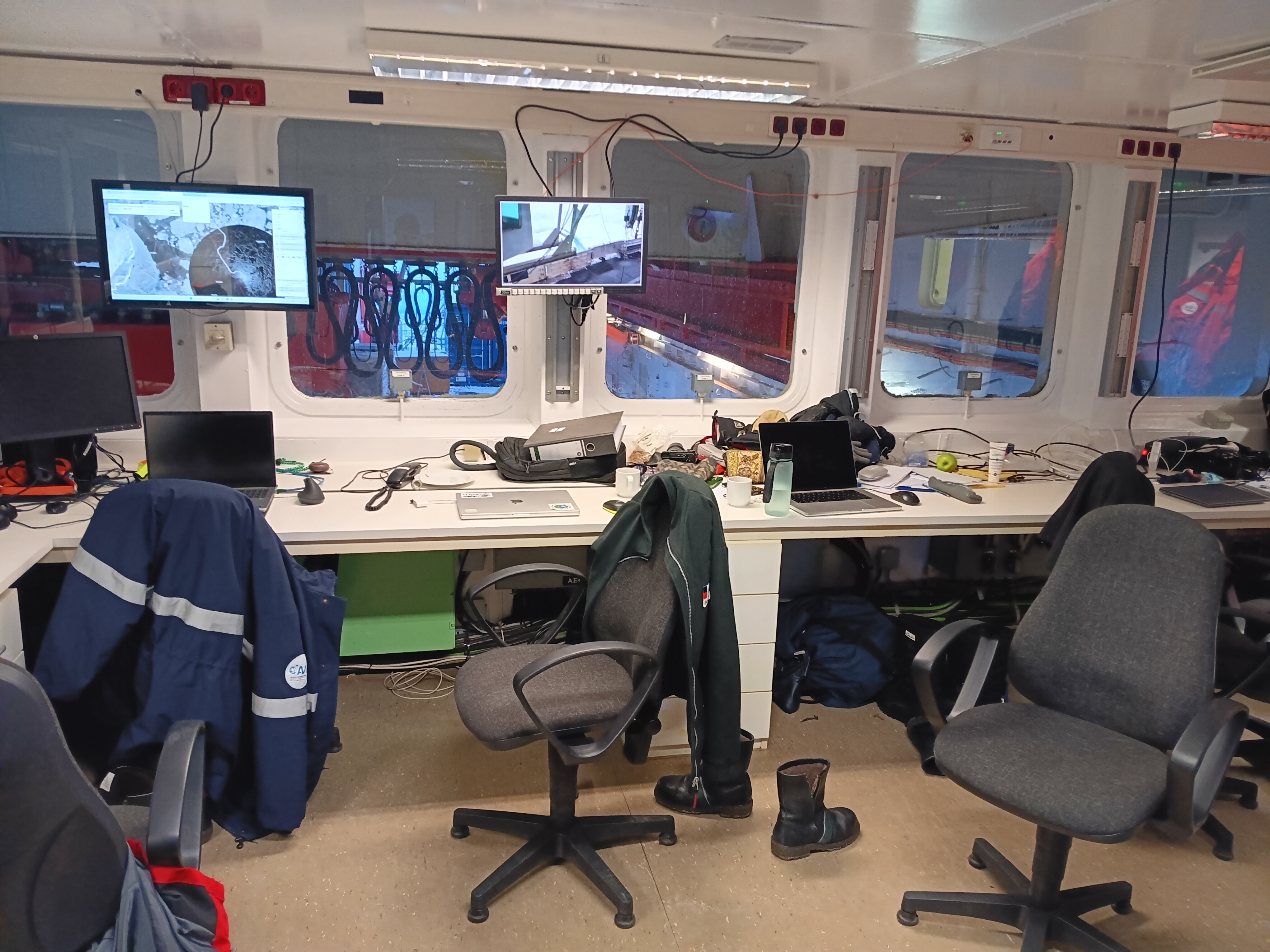
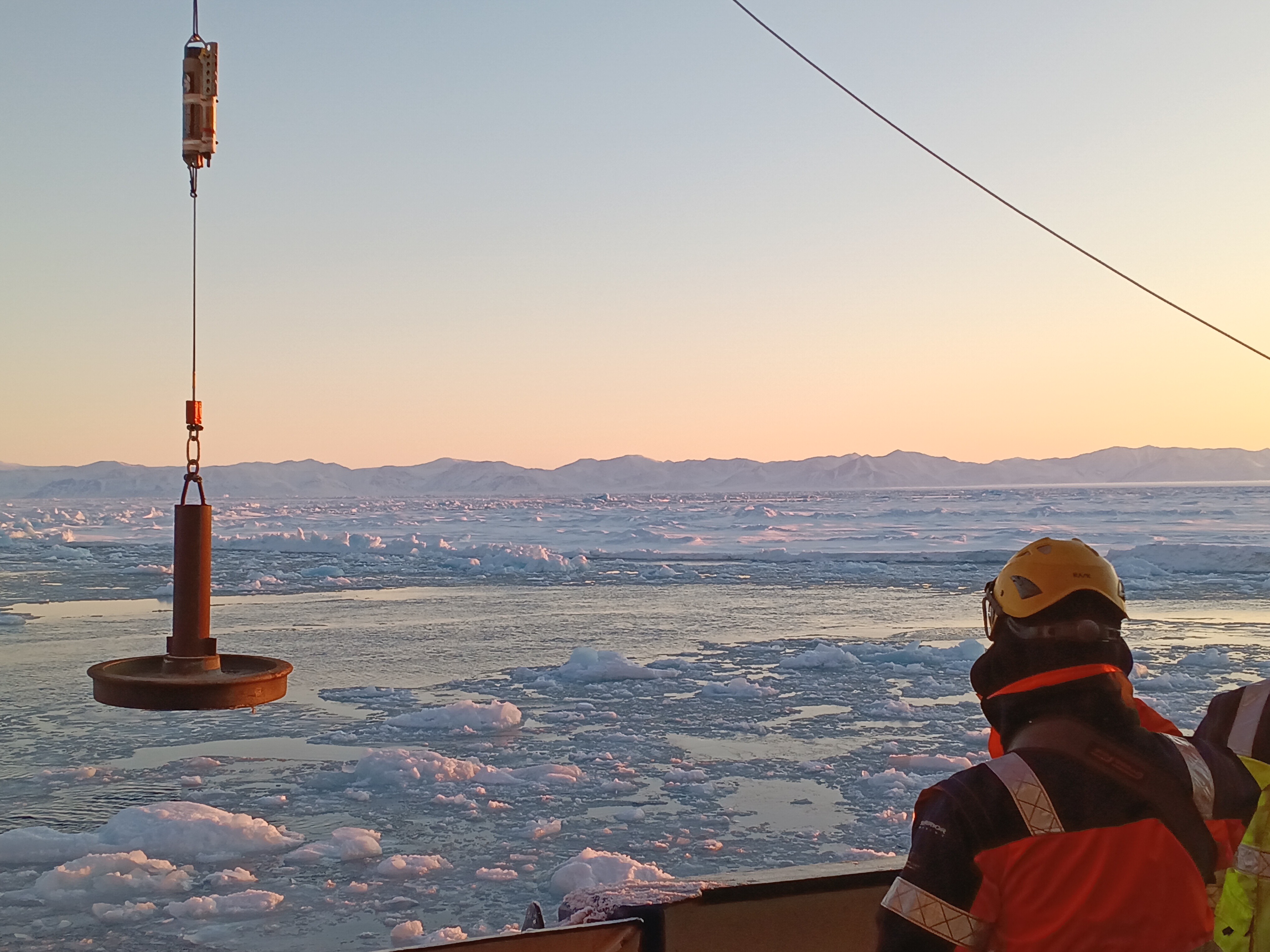
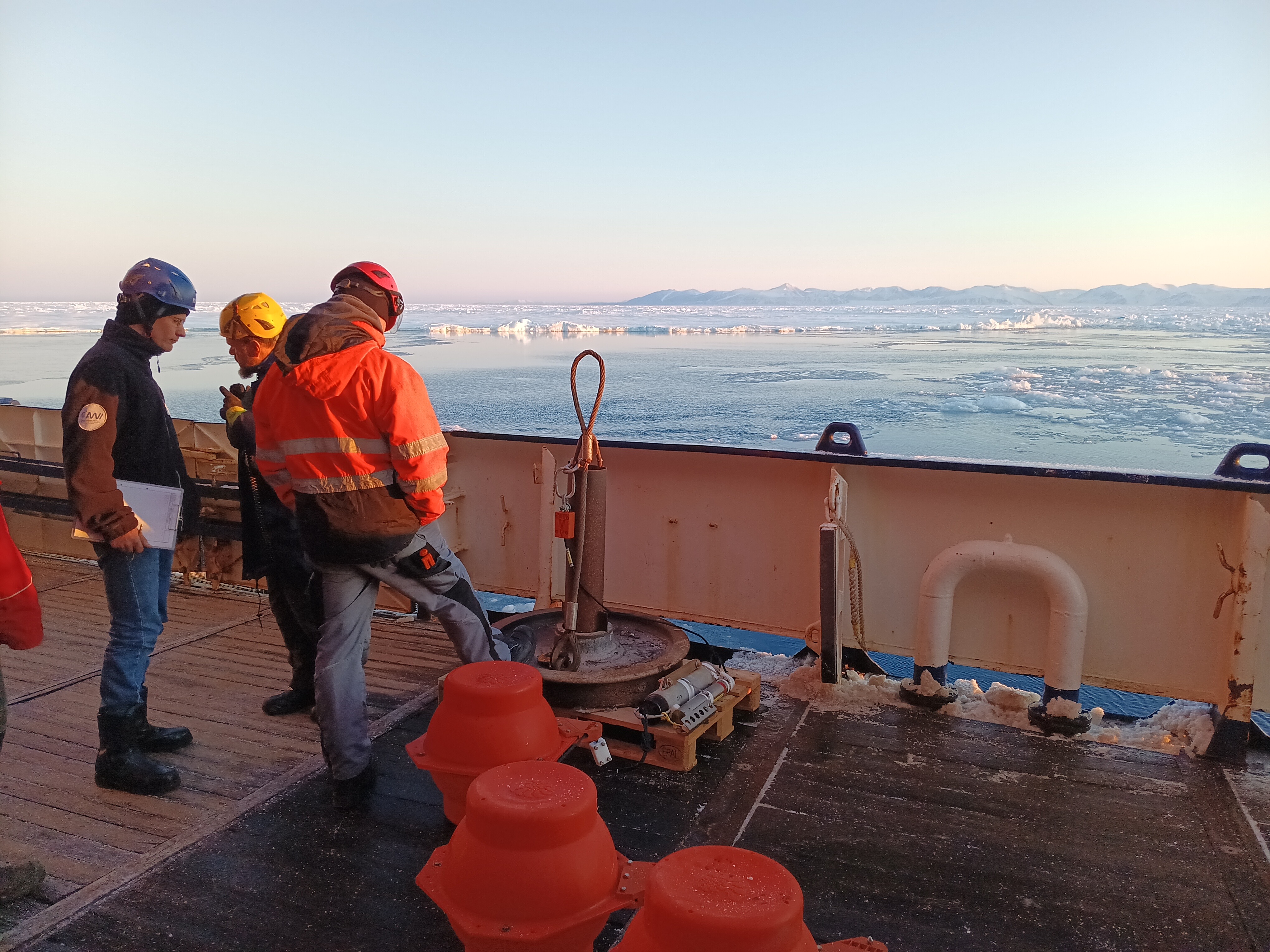
Now how does Greenland look from the ship? Well, there is always ice and it is always cold. The coldest days we had near the coast when the skies were clear. The coldest day we had -20 C, that is -4 F for my American friends, but most of the time we had clouds and storms with temperatures warmer at -12 C (10 F) with clouds and little visibility. It snowed alot and shoveling the ship’s deck was an almost daily chore. A relaxing “cruise” it was not. We worked sensors systems in the windy cold outside during all hours of the day and night. Pictures like the above were almost always taken during my 8 hours “off” that for me was from 08:00 to 16:00, because my shift was from 16:00 to 24:00. After a phone call to my wife after midnight and a peppermint tea to warm up, I slept from 01:00 to breakfast at 07:30. As almost all scientists aboard I shared my cabin with others, so there is not too much privacy. The photos below show my bunk bed (I slept atop), shared work spaces, and the rarely empty dining room. We often ate in shifts, too, because not all 50 people would fit the dining room in one sitting. So we often had 2 sittings. A comfortable living room was next door for desert, tea, coffee, games, and conversations.
Now what about science, you may ask. Here we made a major discovery, I felt. A mathematician used her craft to predict a coastal current to the north of Greenland that, I admit, made no sense to me as it contradicted 30+ years of training and intuition in which direction such currents would flow, that is, the coast should be on the right hand side looking in the direction of the flow. The curious thing was that to the north of Greenland it should go in the opposite direction, that is, with the coast on the left. In Claudia’s numerical computer model run for months on super computers, this current-in-the-wrong-direction was a both prominent and persistent feature. I always discarded it as an unrealistic feature of some computer code run amok. And yet, when we actually reach the coast of northern Greenland and I measure ocean currents from a ship sensor that runs 24/7 to tell me current speed and direction, here this weired or “wrong” current was. It screamed at me from the screen the moment I plotted the data and shared it with Claudia who was aboard with the comment: “Your model is right and my intuition was wrong. Your current is at the same location, the same speed, and in the same direction as your model said it would.” Furthermore, a distinct and separate way to estimate ocean currents from ocean temperature and salinity observations showed the exact same thing. That’s now two good complementary confirmation of the current that nobody has ever seen or measured … until now that we aboard Polarstern did so on Sept.-23, 2025:
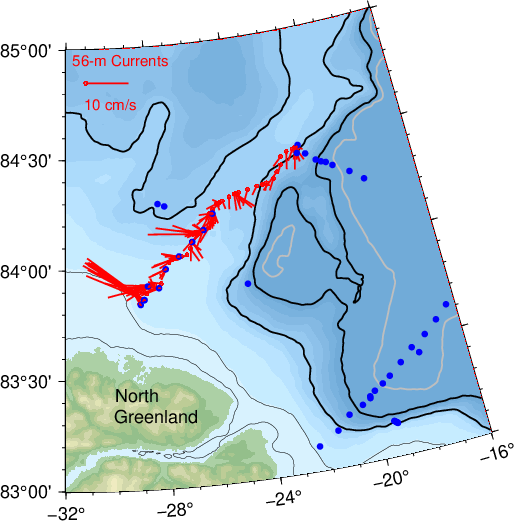
The map on the left shows our study area to the north of North Greenland. On it in red are sticks whose length indicate the speed or strength of the ocean current (at 56 meters below the surface) while its orientation gives the direction of the current. The light blue is shallow and dark blue is deep water as before. The current is sluggish offshore with a weak component to the south. In contrast, closest to the coast of North Greenland we find long sticks that point to towards the left (west by north-west). This is Claudia’s Coastal Current.

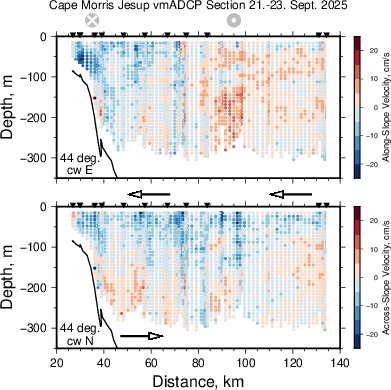
The two plots on the left provide more detail, as it shows how the current varies with depth and distance from the coast along a line from the coast towards offshore. The bottom of the shallow ocean is the black line from 100-m to 350-m meter at a distance of 20-40 km from the coast. The top-left panel shows the current (in colors) across the section where blue colors indicate currents flow into the page while red colors indicate currents that flow out of the page towards us viewing it with the coast on the left. The bottom-left panel shows the velocity component along the section with a flow that is mostly onshore near the surface.

There is so much more to this story as well as additional stories, notice the red dots in the top-left panel between 150-m and 300-m depth that indicate a strong flow to the south and east, but I save this for later. I also do not wish to tell you about the two ocean sensors we quickly deployed at this location to stay there until we, perhaps, recover them with new data next year or the year there after. I do wish to close this essay, however, with the view of Greenland that we had where we discovered Claudia’s coastal current. Science is fun, exciting, and always surprises.
Viking and Inuit in Greenland

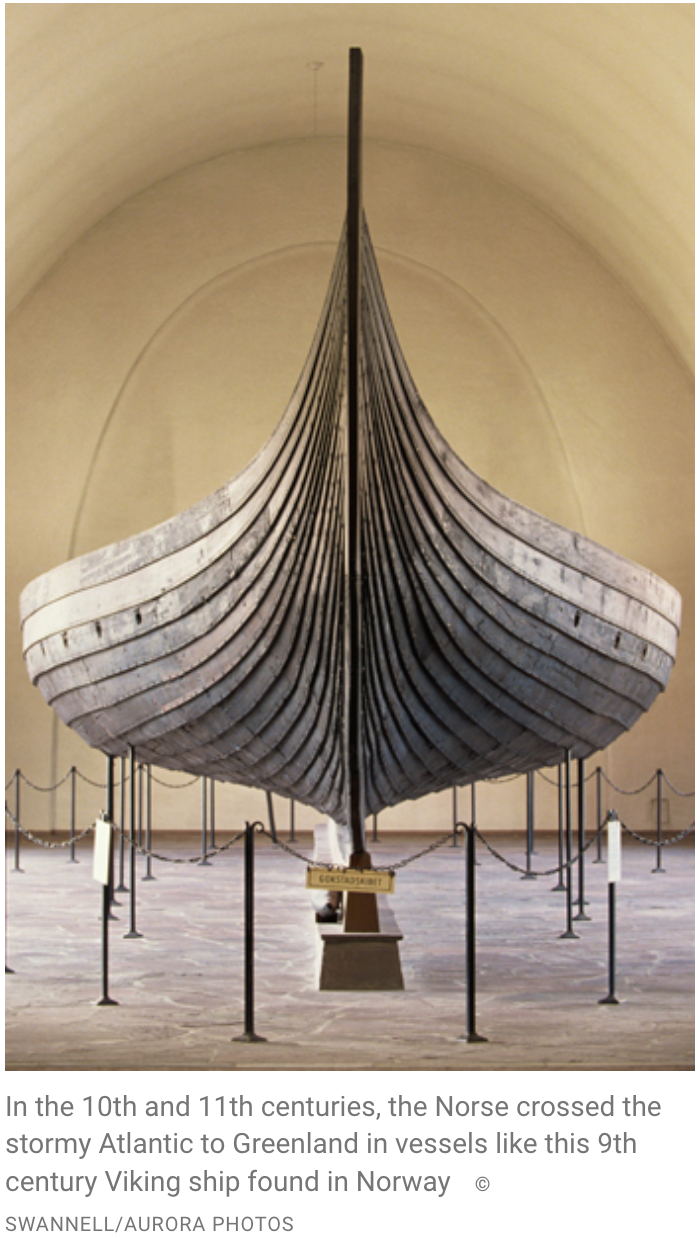
While Viking rulers of Kyiv in Ukraine formally converted to Christianity in 988 CE at the outer limits of eastern Europe, two small viking settlements emerged at the southern tip of Greenland close to the Americas. The Norse settlers of Greenland left Iceland with 25 ships, but 11 of these either turned back to Iceland or were lost at sea. The remaining 14 boats arrived near 61 N latitude to establish an “Eastern” settlement which over time grew to more than 190 farms and 12 churches. Farther north near 64 N latitude a smaller “Western” settlement eventually grew to about 90 farms and four churches near Nuuk, today’s capital of Greenland. The “Western” settlement had a warmer and milder continental climate, because their farms were located far inland within a wide and complex fjord system that sheltered the farmers from atrocious coastal storms. The “Eastern” settlement was hit harder by these storms, because here the farms were closer to shore, closer to the icesheet, and closer to the center of the North-Atlantic storm activity.

North-Atlantic location map with Norse trading routes between Europe and Greenland adapted from Jackson et al. (2018)

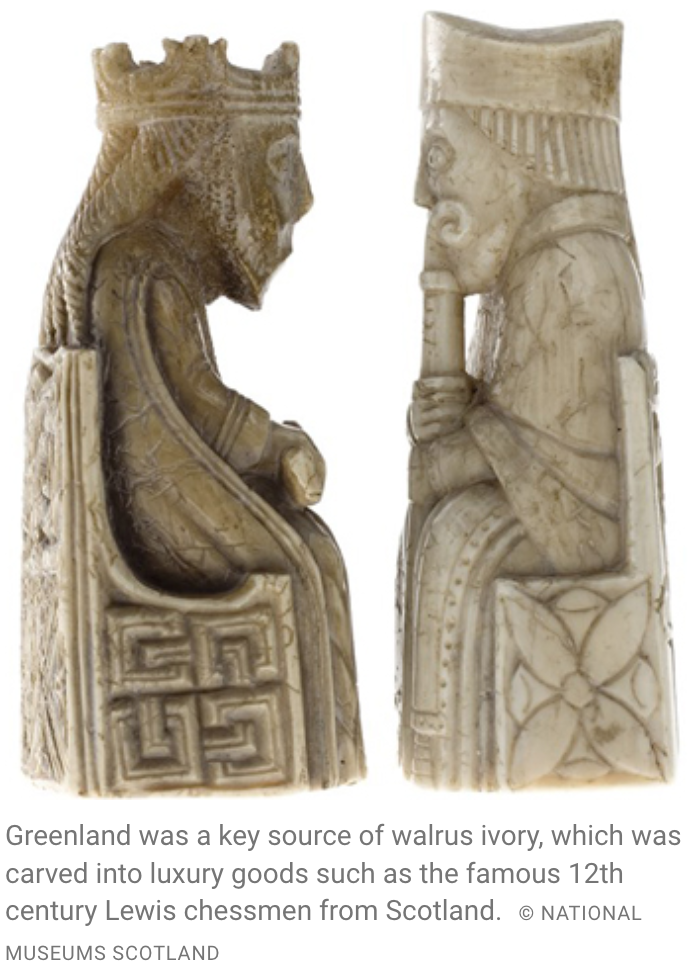
For about 200-300 years the settlements flourished and reached a population of about 4,000 people. They paid taxes to the King of Norway, donated tithes to their churches, and imported clothing, iron, and food stuff from Scandinavia. They paid with ivory from narwhales and walrus that they hunted in Disko Bay at 69 N latitude. Three viking hunters scratched their names in stone on a cairn they built about 1333 CE on an island near Upernavik at 73 N latitude (Francis, 2011). At these “Northern Hunting Grounds” the vikings from both “Eastern” and “Western” settlements likely met the Inuit of the Thule culture who at the time were moving south along West Greenland after a 3000 km migration from coastal Alaska within a few generations.

Runestone of Kingittorsuaq found at 72°57′55″N 56°12′45″W stating “Erlingur the son of Sigvat and Bjarni Þorðar’s son and Eindriði Oddr’s son, the washingday (Saturday) before Rogation Day, raised this mound and rode…” [Photo Credit: Ukendt /Nationalmuseet, Danmark]

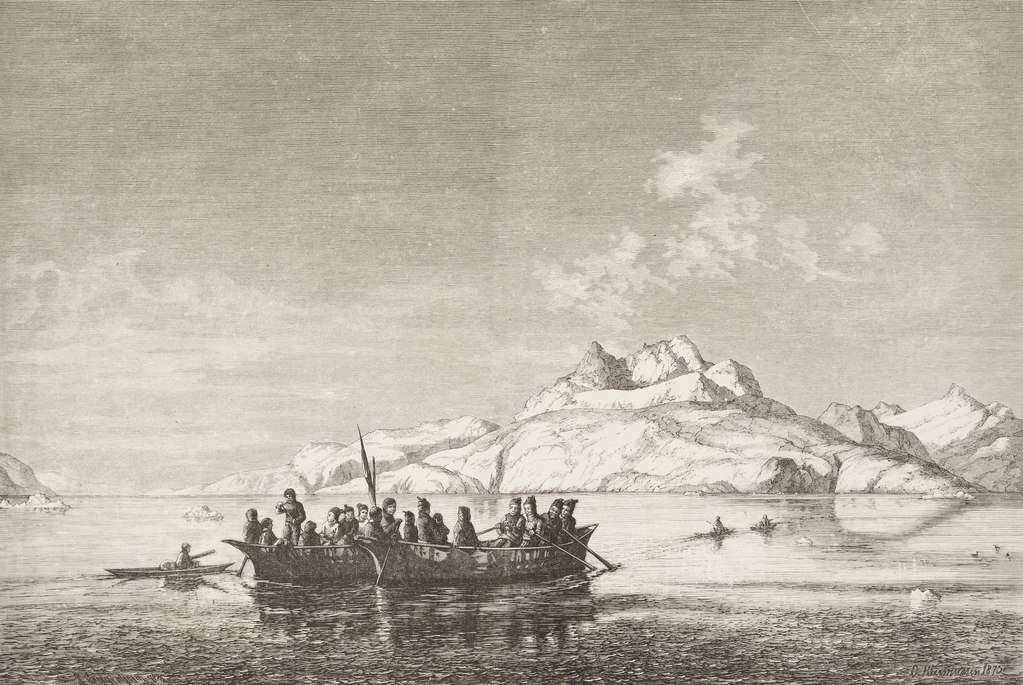
The modern Inuit of the Thule culture arrived in Greenland about 200-300 years after the vikings did. They arrived on foot, by dog sled, and in umiaks from the Bering Sea area of Alaska and Siberia (Friesen, 2016). They were equally adept to hunt caribou on land with bow and arrow, seals on sea ice with spears, and whales on open ocean with sophisticated harpoons. They crossed Smith Sound at 79 N latitude about 1300 CE to reach Greenland spreading south towards the viking settlements and north-east towards Fram Strait separating Greenland from Svalbard. On a beach off Independence Fjord in North-East Greenland at almost 83 N latitude Eigil Knuth found the frame of one of their skin-hulled umiak in 1949 (Knuth, 1952).

Umiak in Greenland as depicted by Carl Rasmussen in 1875 adapted from https://en.wikipedia.org/wiki/Umiak

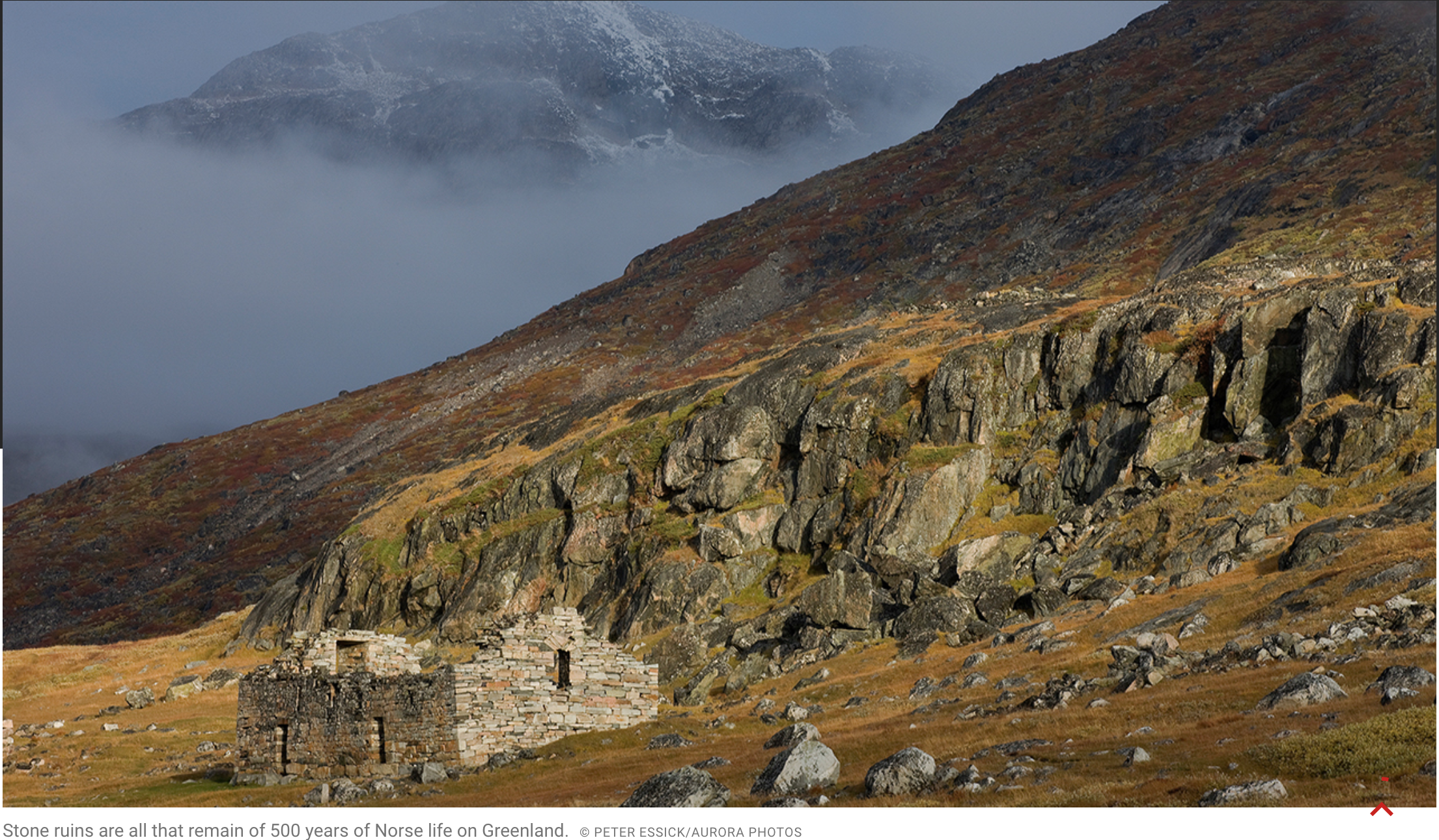
The vikings built “permanent” houses of stone, farmed the land, and kept sheep, goat, and cows. They hunted walrus and narwhal for its ivory to trade with Europe to import metals, clothes, and foods. Their diet until about 1300 CE was high on terrestrial and low on marine resources as indicated by isotopic studies of their bone structure. This changed when a cooling climate challenged animal husbandry in Greenland and the Norse transitioned towards a marine-based diet of fish, seals, and marine mamals (Jackson et al., 2018).

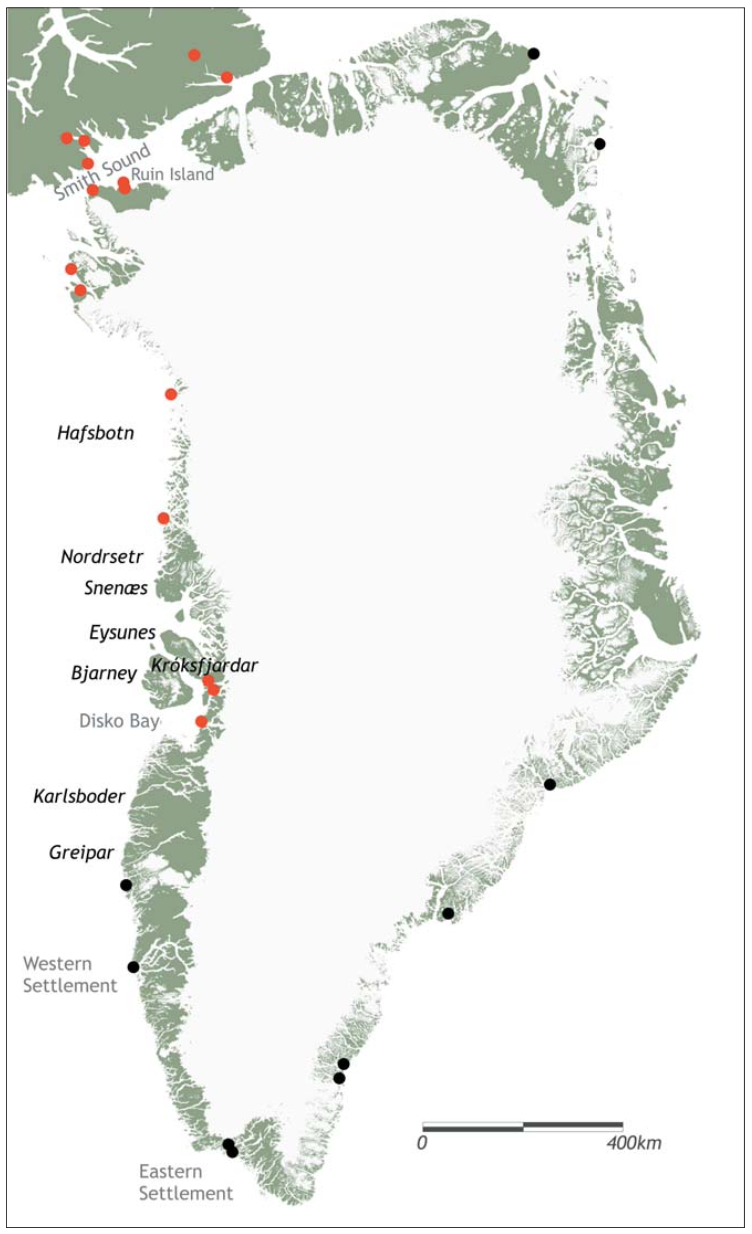
Map of Greenland and Ellesmere Islands adapted from Gullov (2008). Red symbols indicate Norse artifacts found at Inuit sites occupied in the 13th and 14th century while black dots represent location of such artifacts at 15th and 16th century.

In contrast, the Inuit embraced a more mobile life-style as entire family units moved large distances to new sites from year to year and seasonally from summer to winter camps. Their hunting was tied to the sea ice and they developed fancy techniques to hunt larger whales, walrus, and polar bears for food, fuel, and clothing. Their technologies and behaviors adapted rapidly in an extreme environment and climate that kept changing in time. Inuit often viewed themselves and their animal prey as mutually connected with energies flowing from animal to Inuit and vice versa. Both were part of one nature which changes in time on many different cycles that one needs to read and understand for survival. This view differed from that of the more pastoral vikings who saw themselves and their homes as “safe inner spaces” and everything on the outside as “wild and hostile” nature. They constantly tried to modify, improve, and control the landscape while the Inuit moved and adapted within it (Jackson et al., 2018).

Viking settlement on Greenland (left), chess figures from walrus ivory (center), and viking longboat from the 10th century.

The vikings vanished without a trace in the 15th century. Their fate is still researched and debated in academic and popular outlets alike. In contrast, the Inuit expanded their range along all of Greenland where in the 18th and 19th centuries they were “re-discovered” in the South by Danish and Moravian colonists and missionaries and in the North by the English Navy, American adventurers, and Danish scientists.

In 1910 two Danes Knut Rasmussen and Peter Freuchen established a trading post at North Star Bay near 77 N Latitude. They called “Thule.” Over the next 20 years Thule became a focal point of about 200 nomadic Inughuit that all are direct descendants of the Thule culture Inuit. There are about 700 of them today and most still live in Qaanaaq. Linguist Stephen Pax Leonard lived among them for a year in 2010/11 when he produced a 10 minute video that documents contemporary Inuit life and language.

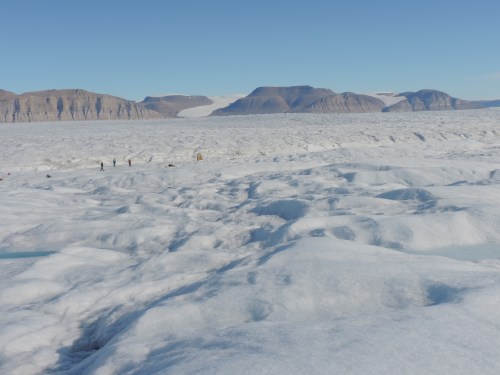
Contemporary photos of Qaanaaq and Thule region. Photos on left panel by Dr. Steffen Olsen near Tracy Glacier in Inglefield Fjord while images in right panel are of North Star Bay and Thule Air Base by the author.

References:

Francis, C.S., 2011: The Lost Western Settlements of Greenland, 1342, California State Univ. Sacramento, MA Thesis, 84 pp.

Friesen, T.M., 2016: Pan-Arctic Population Movements, Chap.-28 of “The Prehistoric Arctic,” Oxford Univ. Press, 988 pp.

Gullov, H.C., 2008: The Nature of Contact between Native Greenlanders and Norse, J. North Atlantic, 1, 16-24.

Jackson, R., J. Arneborg, A. Dugmore, C. Madsen, T. McGovern, K. Smiarowski, R. Streeter, 2018: Disequilibrium, Adaptation, and the Norse Settlement of Greenland, Human Ecology, 46 (5), https://doi.org/10.1007/s10745-018-0020-0.

Kintsch, E., 2016: Why did Greenland’s Vikings disappear? Science, 10.1126/science.aal0363, accessed as https://www.science.org/content/article/why-did-greenland-s-vikings-disappear

Knuth, E., 1952: An Outline of the Archaeology of Peary Land, Arctic, 5(1), pp. 17-33.

Greenland Glacier-Driven Ocean Circulation

Greenland’s coastal glaciers melt, shrink, and add to globally rising sealevel. They also drive local ocean currents that move icebergs around unless they are stuck on the bottom. The glaciers’ melt is cold fresh water while the adjacent ocean is both salty and warm. Checking on what we may expect against observations, I here use data from NASA’s Ocean Melts Greenland initiative that dropped ocean probes from an airplane into the ice waters off coastal Greenland to measure ocean temperature and salinity.

For six years these data show how the coastal ocean off Greenland varies from location to location next to glaciers as well as from year to year. More specifically, I picked Melville Bay in North-West Greenland for both its many glaciers and many dropped NASA ocean sensors. The ocean data allow me to estimate ocean currents by using a 100 year old physics method. I just taught this to a small class of undergraduate science students at the University of Delaware. My students are strong in biology, but weak on ocean physics. This essay is for them.

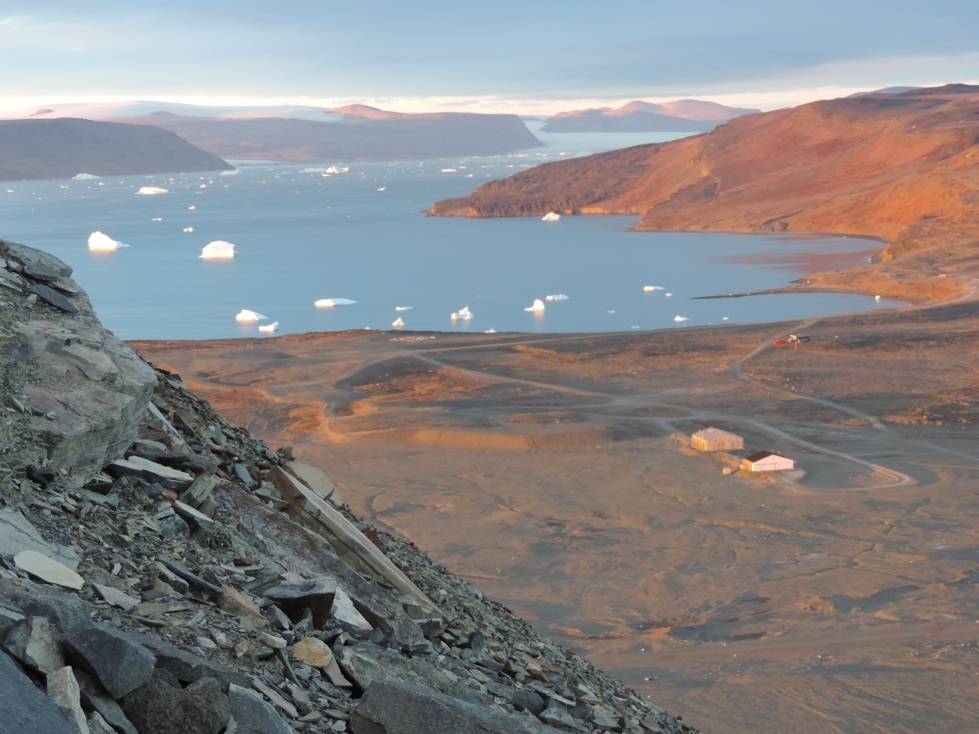
Melville Bay is a coastal area off north-west Greenland between the town of Upernavik (Kalaallisut in Greenlandic) near 73 N latitude where 1100 people live and the village of Savissivik (Havighivik in Inuktun) at 76 N latitude where 60 Inuit live. There are no other towns or settlements between these two villages that are about as far apart as Boston is from Philadelphia, PA. Imagine there were no roads from Boston to New York to Philadelphia but only one large glacier next to another large glacier. This is Melville Bay.

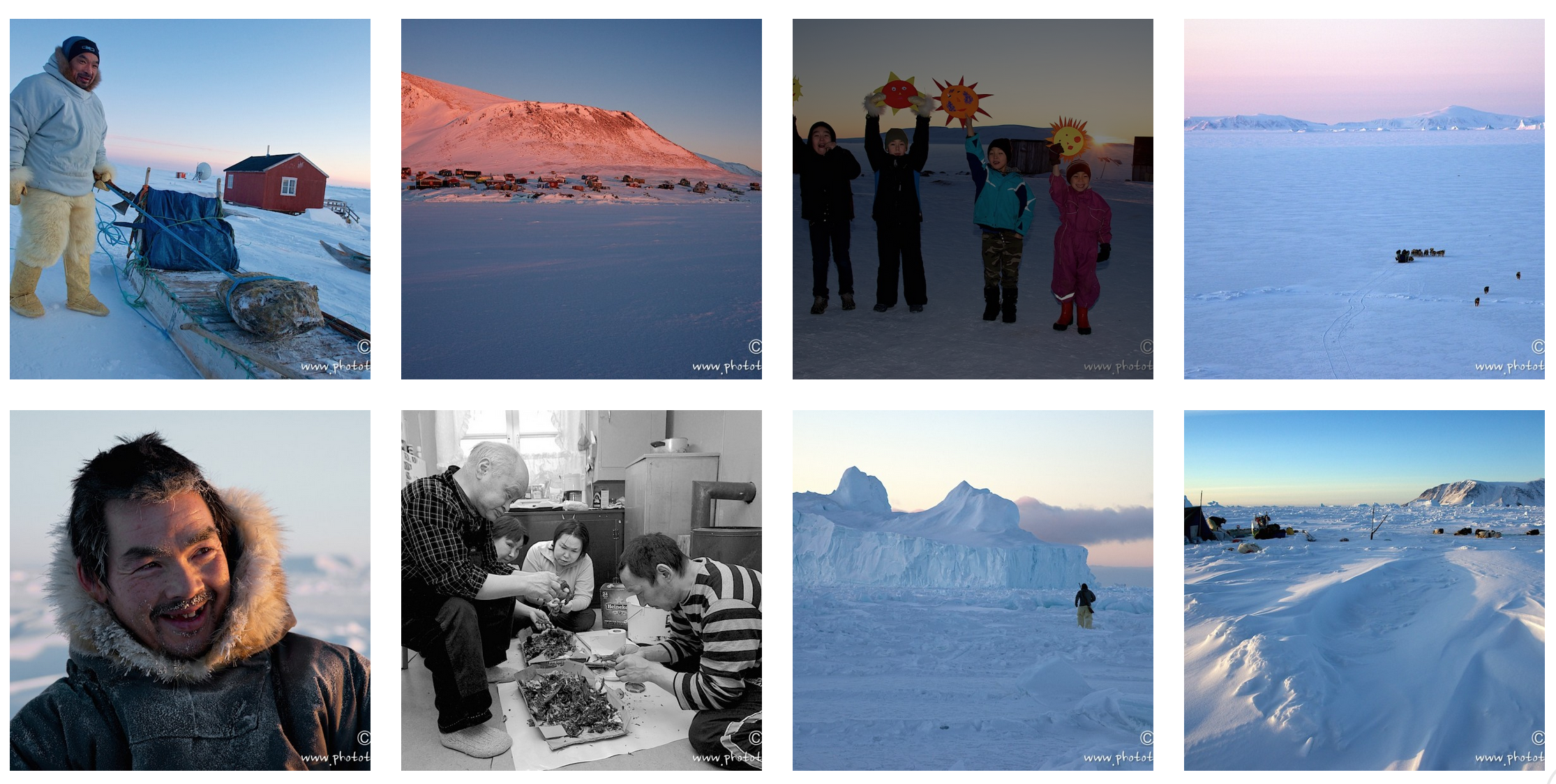
Below I show an excellent set of photos of Savissivik by a French husband and wife team who visited in 2013/14. Their photographic gallery captures elements of contemporary subsistence living in remote Greenland where animals like seals, birds, fish, narwhal, and polar bears provide food, fuel, clothing, and income.

NASA dropped some 50 ocean sensors into Melville Bay froma plane during the short summer seasons each year 2016 through 2021. I met NASA pilots, engineers, and scientists doing their experiments when I was doing mine from a snowmobile in April of 2017 and again with Danish friends from a Navy ship in August of 2021, but these are stories for another day.

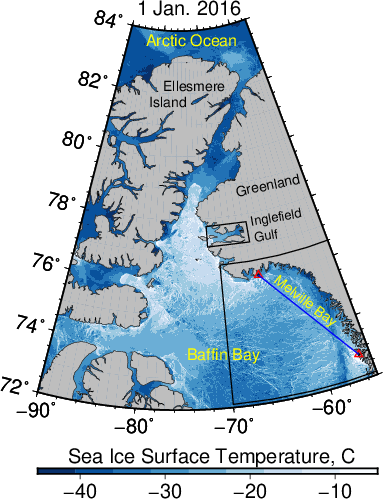
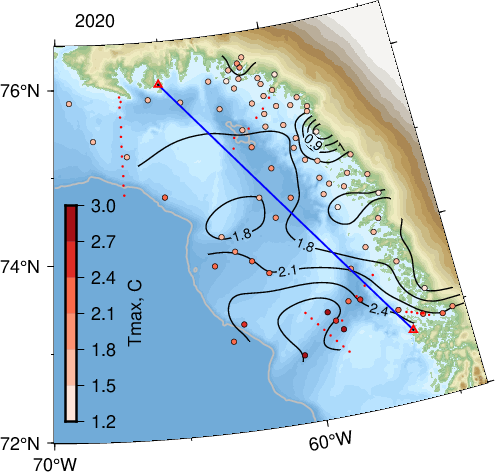
Let me start with a map of where NASA dropped their ocean profiling floats into Melville Bay and thus introduce the data. While the surface waters are usually near the freezing point, waters 300-400 meters deep down are much warmer. They originate from the Atlantic Ocean to the south and one of the goals of NASA’s “Ocean Melts Greenland” campaigns was to determine if and how these Atlantic waters reach the coastal glaciers. Most glaciers of Melville extend into this warm ocean layer and thus are melted by the ocean.

In the map above I paint the maximal temperatures in red and the bottom depths in blue tones. The profile on the right shows data for all depths at one station. As salinity increases uniformly (red curve) the temperature increases to a maximum near 300-m depth (black curve). It is this maximal subsurface temperature that I extract for each station and then put on the contour and station map on the left. The straight blue line connects Upernavik in the south with Sassivik in the north. It is an arbitrary line, coast-to-coast cutting across Melville Bay.

The warmest warm waters we find near Upernavik in the south and within a broad submarine canyon that brings even warmer waters from Baffin Bay towards the coast. Temperatures here exceed 2.4 or even 2.7 degrees Celsius. Most coastal waters along Melville Bay have a temperature maximum of about 1.5 to 1.8 degrees Celcius (about 35 Fahrenheit) and this “warm Atlantic” ocean water melts the coastal glaciers. The ocean melts the glaciers summer and winter while the warm air melts it only in summer.

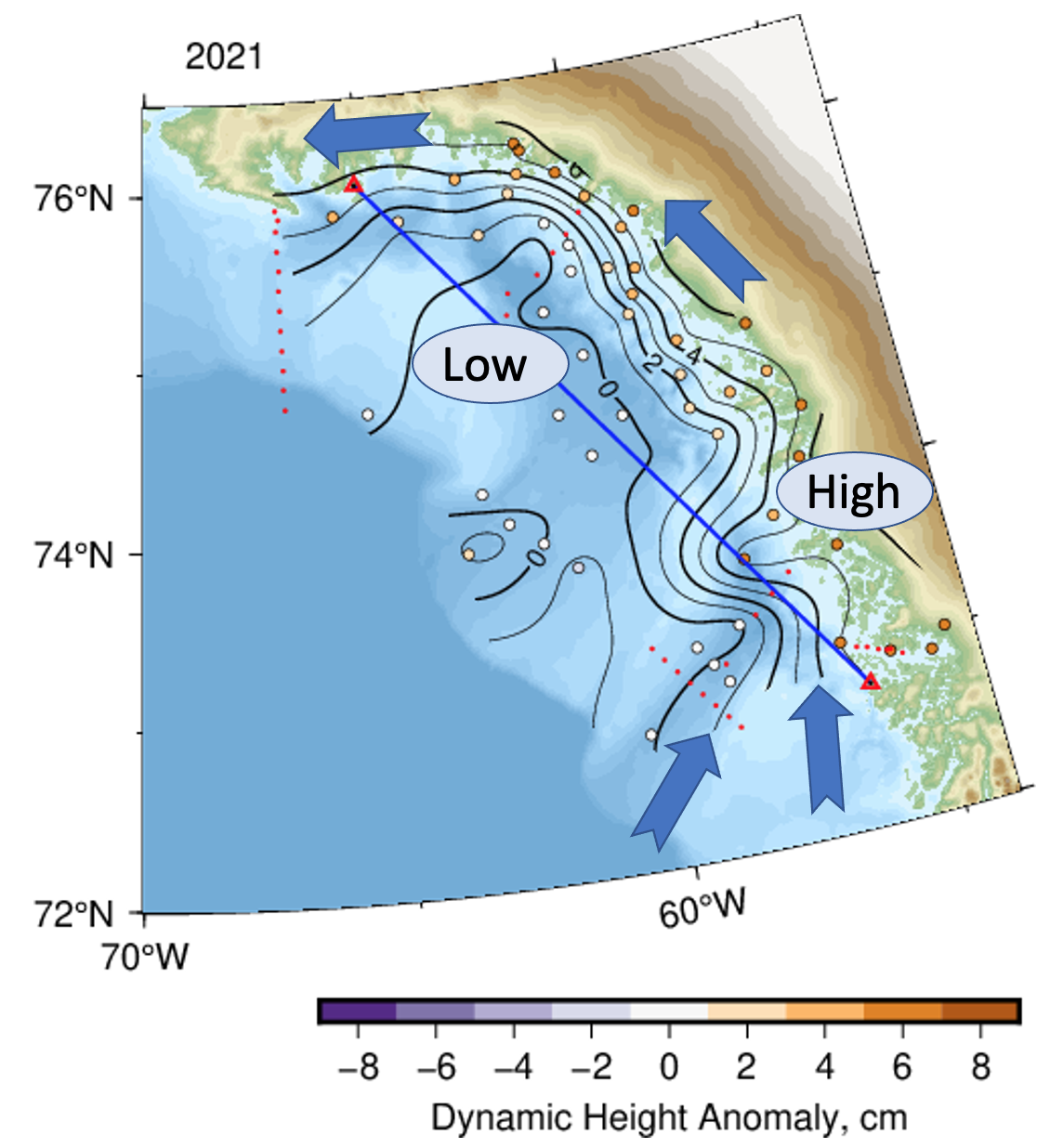
There is more, because the glaciers’ melt also discharge fresh water into the ocean where it mixes to to form a layer of less dense or buoyant water. The buoyant waters create a local sealevel that is a little higher along the coast than farther offshore. The map above indicates that this “little higher sealevel” comes to about 4 cm or 2 inches. If this pressure difference across the shore is balanced by the Coriolis force, as it often does, then an along-shore coastal current results. This coastal current would move all icebergs from south to north unless they get stuck on the bottom. Along the northern coastline of Melville Bay the surface flow is from east to west. The coastal current is strongest near Savissivik where we find a (geostrophic) surface current larger than 40 cm/s. At that speed an iceberg would move more than 21 miles per day. Such strong surface flows are exceptional and diminish rapidly with depth. Hence a freely floating iceberg with a draft of several hundred meters would move much slower than the surface current.

I met a hunter from Savissivik in April of 2017 and for a fast-moving night we discussed the state of local fishing, hunting, living, traveling, and working on the sea ice next to the glaciers of Melville Bay. He invited me to become his apprentice. As such I would now ask him about the surface currents outside his home. Which way does he observe the icebergs to move in summer or winter? Has hunting on the sea ice in winter changed over his life time? When is it safe to travel there with a dog-sled? Could he and I perhaps work together during the spring to deploy ocean sensors through the sea ice? I am dreaming again …

Ice, ocean, and glacier change in northern Greenland

Steffen Olsen is a Danish physical oceanographer with a skill to present beauty to an artist like my wife and a scientist like me. Three days ago he posted a photo on Twitter with these words

Local hunters from Qaanaaq navigating our CTD system in the frozen ice mélange in front of Tracy Galcier 66W 77N to measure the ocean below. Heat loss to melting of glacial ice leaves the ocean at sub-zero temperatures down to 400m @arctic_passion @dmidk @ruth_mottram

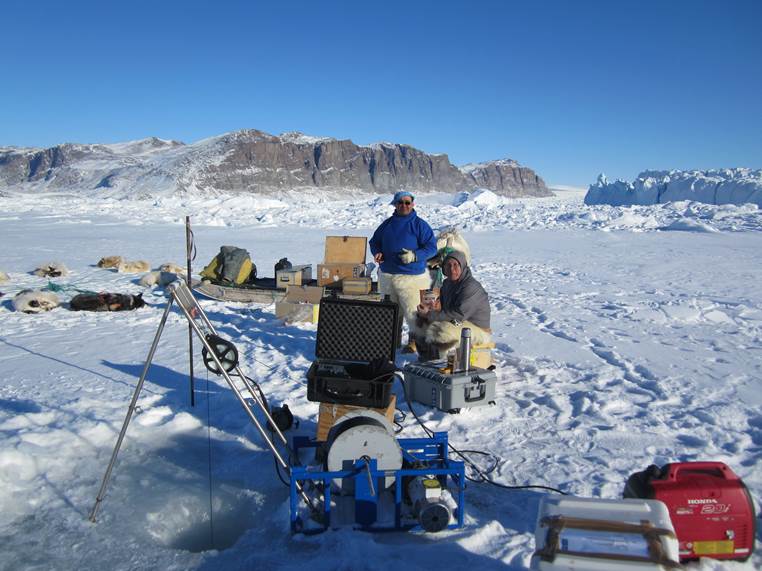
Photo: Dogsled from Qaanaaq near the northern edge of Tracy Gletscher in Inglefield Fjord April 2022. [Credit: Dr. Steffen Olsen, Danish Meteorological Institute.]

Steffen’s photo shows his study area, research platform, and mode of transportation. There is a glacier in the background between the rocks on the left (north) and unseen mountains to the right (south). Equally unseen is the ocean under all this crushed and broken and piled up sea ice covered by fresh snow. We see tracks of people walking to the vantage point from where the photo is taken. The dogs rest on a small patch of level sea ice perhaps 3-5 feet (1 to 1.5 meters) thick.

There are boxes on the sled that contain gear to drill through the sea ice and then to send a probe down towards the ocean bottom to measure ocean temperature, saltiness, and oxygen during its decent. I did similar work with a snowmobile in 2017 based at Thule Air Base for 6 weeks. Steffen and I work together on such data. He collected these every year since 2011 both adjacent to Tracy Gletscher and along most of the ~120 km long and ~1000 meter deep fjord. I am grateful to Steffen to share this photo: It helps me to focus on my passions rather than my outrage at soldiers and leaders of the Russian Federation in their war to destroy Ukraine and its people building a free, vibrant, and democratic country for themselves. There is more, but I stop here now.

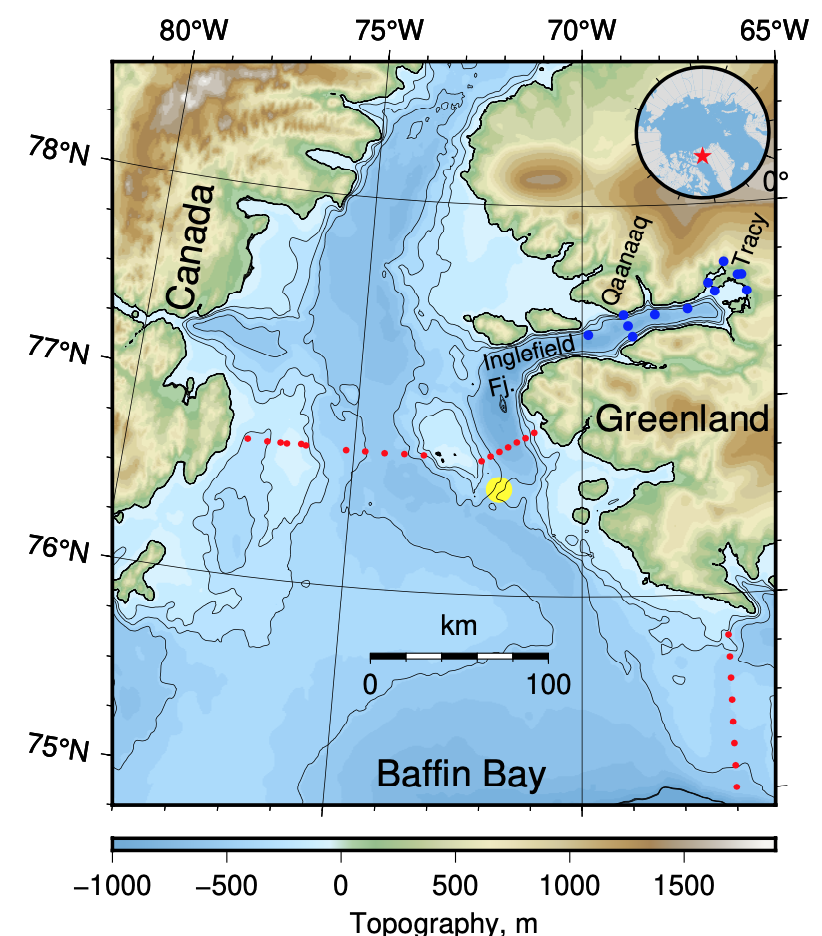
Let me start with a map of where in Greenland the photo was taken and where Steffen collected his data each since 2011. The red star in the insert top-right shows the location of the map between Canada and Greenland. I color ocean bottom depths in blue shades and land heights in green, yellow, and brown shades. The glacier in Steffen’s photo is at the north-eastern end of Inglefield Fjord where I placed the label Tracy. The label Qaanaaq shows where about 650 Inughuit live along the coast near the center of the fjord. It probaby took the dogs about 2-3 days to travel with their cargo from Qaanaaq to Tracy Gletscher. Red dots are stations served by a Danish Navy ship in the summer of 2015, but I here only talk about the blue dots.

Figure: Map of the study area with ocean sampling stations in Inglefield Fjord (blue dots) and adjacent northern Baffin Bay. [Unpublished own work.]

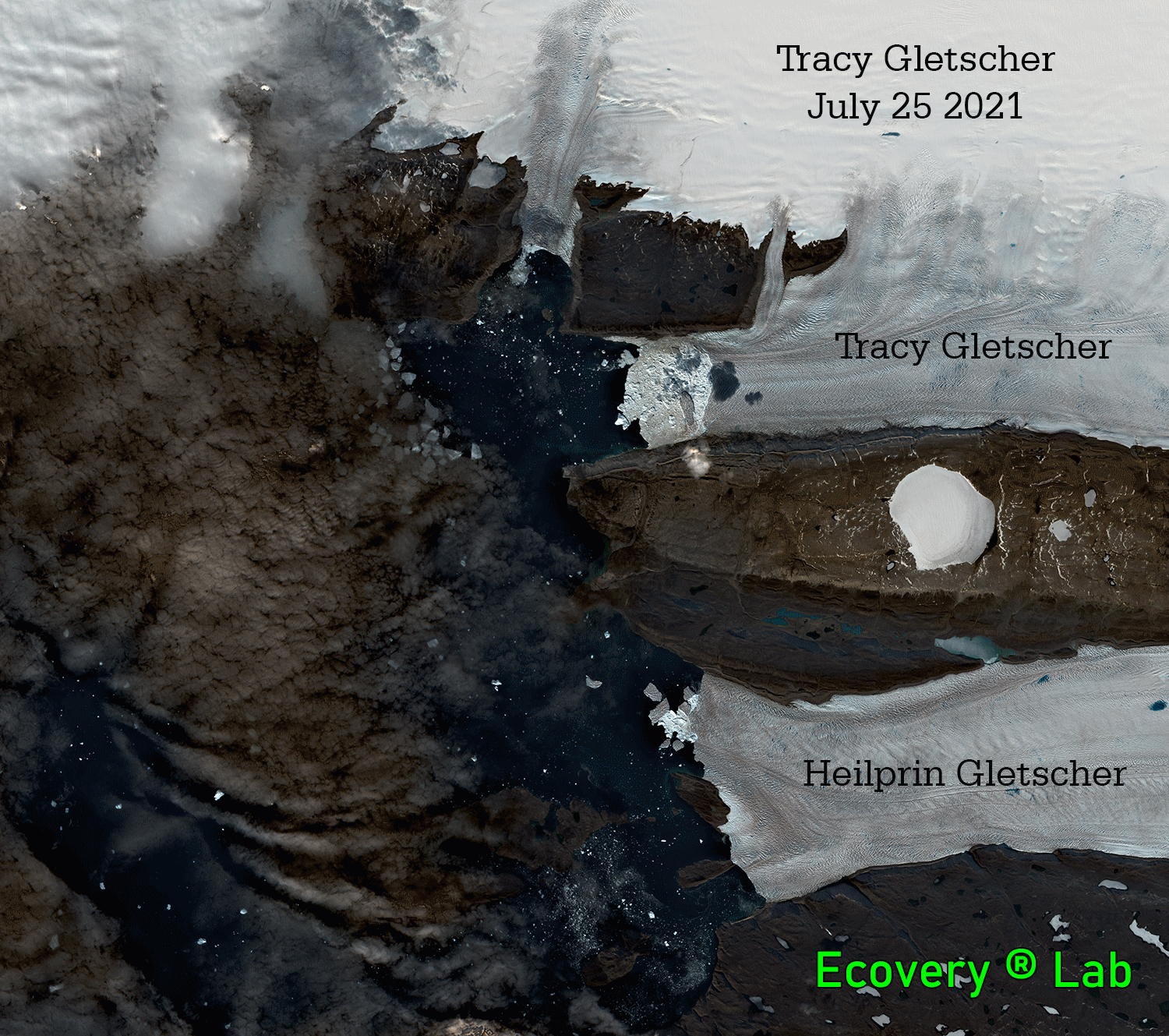
The blue dots are stations where Steffen and his companions drilled through the sea ice in 2018. Note that some of those ocean stations appear on land. This cannot be, but the glacier has retreated between the time the topographic data was collected and 2018 when Steffen collected the ocean data. Three LandSat satellite images below show how the glacier changed from 1973 to July and August of 2021. Icebergs are visible, too. A citizen scientist with the handle “Espen” at the Arctic Sea Ice Forum extracted these satellite photos from public U.S. databases. He is part of an online international community of Greenland and sea ice enthusiasts who posts at this forum for over a decade making daily discovers. These are people with regular jobs that in their spare time post satellite imagery and open data they found which they share openly often with insightful interpretations. It is citizen science at its very best. I go there often to read, ask, and learn. I even met a prominent member once for lunch when visiting Copenhagen on my way to Greenland. He gifted me LandSat imagery of my favorite glaciers printed on cloth that I framed for its scientific and artistic beauty. Thank you, Espen 😉

Gallery: Space photography (LandSat) of glaciers terminating from the Greenland ice sheet in Inglefield Fjord in 1973 (right), July 2021 (center), and August 2021 showing the retreat of Tracy but not Heilprin Gletscher. [Credit: Espen Olsen at Arctic Sea Ice Forum.]

So how does the ocean below all this ice next to a glacier look? Well, lets look at a set of station from Qaanaaq to Tracy Gletscher that shows how temperature, salinity, and oxygen of the water changes both with depth and along the fjord. We always find very cold, somewhat fresher, and highly oxygenated water near the ocean surface about 40 m (near glacier) to 100 m (near Qaanaaq) below the sea ice and warmer, saltier, and less oxygenated water below with a temperature maximum of 1 degree Celsius near 300 m depth. It is this warm water that melts the adjacent glacier. As Dr. Olsen says “… Heat loss to melting of glacial ice leaves the ocean at sub-zero temperatures …” In other words, the deeper waters 1. enter the fjord at temperatures above zero degrees Centigrade, 2. reach the glacier, 3. cool down as they melt the glacier, and 4. leave the fjord at temperatures below zero degrees Centigrade. This is why the two stations near the glacier show slightly fresher and cooler waters between 300 and 500 m depth. This water contains the glacial melt. The section represents the 10 year average from 2011 through 2020.

Figure: Section of salinity (bottom), temperature (center), and dissolved oxygen (top) along Inglefield Fjord as an average of data collected annually between 2011 and 2020. [Unpublished own work.]

Earlier this year I tried to visit Copenhagen to finish this work that places this emerging story into both a historical and spatial context, but Covid restrictions derailed this and other plans. Nevertheless, have excellent data from 1928 when this fjord was first surveyed by Danish oceanographers. At that time the waters had dramatically different temperatures (much colder) and salinities (a little fresher) both inside the fjord and in Baffin Bay adjacent to it. The changes are probably related to a much changed sea ice cover and perhaps ocean circulation that relates how the winds impact the ocean with and without sea ice. For the 1979 to present satellite record, we can quantify how much sea ice covers both the fjord and adjacent ocean. I made the graph below last week from 14073 almost daily satellite images whose data the U.S. National Snow and Ice Data Center distributes freely. I show annual averages for each of the 42 years that these SSM/I satellites have been measuring sea areal coverage from space.

Figure: Annual averages of sea ice cover 1979 through 2021 with linear trend lines for two 21-year subsets (blue) and the entire 42-year record (red). [Unpublished own work.]

Before the year 2000 the sea ice cover fluctuated between 26,000 and 39,000 km2 and if one for how these changes are trending between 1979 and 2002, one finds a slight increase in the blue line, however, this increase is not significantly different from zero at a high 95% level of confidence. For the second period after 2002, the ice covered area fluctuates much less, from about 22,000 to 28,000 km2 and the trend line in blue now indicates decreasing sea ice cover. As before, however, this blue trend line is no different from zero at the same high level of confidence. We also notice that there is a red trend line that I derive from using all 42 years of data. This line is very different and statistically significant, but it does not quiet do justice to the almost step-like change that appears to happen around 2000 through 2005. What happened then? I do not know, yet, but this is the fun of doing science: There is always more to discover. The sea ice cover in northern Greenland does not always follow a straight line. This is not different from our climate or life. Expect the unexpected, adjust, and keep moving. Or in Dr. Olsen’s words:

“… you have a number of years where conditions don’t follow the more linear track of (predicted) scenarios,” explained Dr. Olsen. “A warming tendency can be reversed for some years, for example.” [From https://phys.org, Oct.-13, 2021]

How oceans interact with Greenland’s last floating glaciers

Testifying before the US Congress back in 2010, I refused to endorse the view that a first large calving at Petermann Gletscher in North Greenland was caused by global warming. When a second Manhattan-sized iceberg broke off in 2012, I was not so sure anymore and looked closely at all available data. There was not much, but what little I found suggested that ocean temperatures were steadily increasing. Could it be that warm waters 1000 feet below the surface could melt the glacier at all times of the year? Did this melting from below thin the glacier? Did these changes increase the speed at which it moves ice from land into the ocean? These were the questions that motivated a number of projects that began in earnest in 2015 aboard the Swedish icebreaker I/B Oden. Professional videos of this expeditions are at https://icyseas.org/2019/07/04/petermann-glacier-videos-science/

Scientists and technicians from the British Antarctic Survey drilled three holes through the floating section of Petermann Gletscher to access the ocean and ocean sediments below it. The ocean temperature and salinity profile confirmed both the warming trend observed in the fjord and ocean adjacent to the glacier, but more importantly, we placed ocean sensors below the glacier ice to measure temperature and salinity every hour for as long as the sensors, cables, and satellite data transmission would work. This has never been done around Greenland, so our data would be the first to report in real time on ocean properties below 100 to 300 m thick glacier ice at all times. What we saw when the data started to come in after 2 weeks, a month, and half a year stunned us, because (a) the ocean waters under the glacier changed by a very large amount every two weeks. Nobody has ever seen such regular and large changes in tempertures (and salinity) under a glacier bathed in total darkness at air temperatures of -40 degrees Celsius and Fahrenheit, but then our station went offline after 6 months and did not report any data to us via satellite.

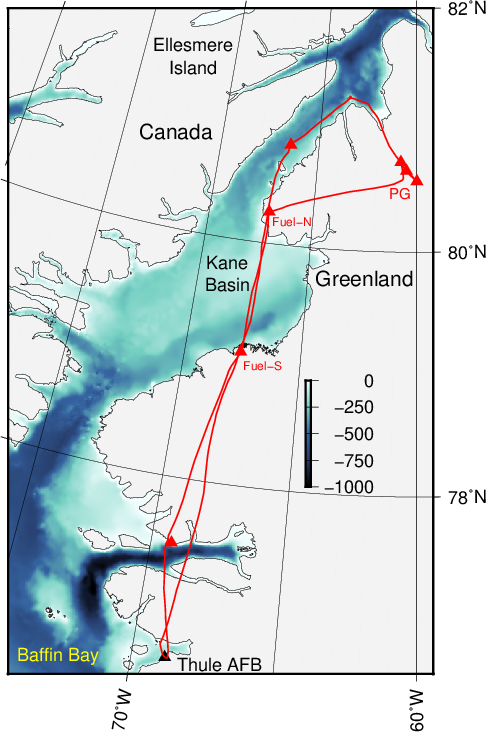
Helicopter flight path on 27/28 August 2016 to reach Petermann Gletscher (PG) via southern (Fuel-S) and northern (Fuel-N) fuel stops in northern Inglefield and southern Washington Land, respectively. Background color is ocean bottom depth in meters.

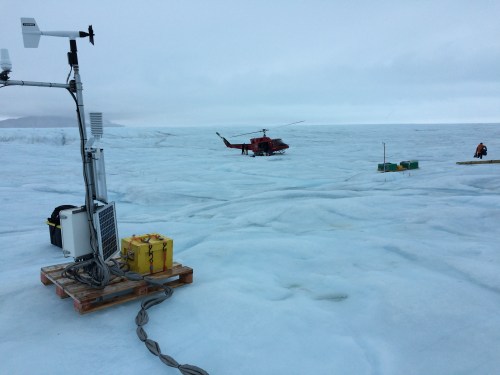
Refurbished Petermann Glacier Ocean Weather station on 28. August 2016 with Greenland Air helicopter and British Antarctic radar station in the background.

The first work on the grant was to visit our station by helicopter in 2016 using two fuel caches that we placed the year prior from the Swedish icebreaker. At this point Petermann Gletscher and our projects attracted the attention of journalists of the Washington Post who had read some of the blog articles at this site. The two journalists accompanied us for a week and produced a beautiful visual report of our work that is posted at

https://www.washingtonpost.com/sf/business/2016/12/30/with-enough-evidence-even-skepticism-will-thaw/

A detailed news report on our science and new findings appeared on page-1 of the Washington Post on January 1, 2017 [Broader Impacts]. I briefly summarize the results and findings of our subsequent data analyses of all data from August of 2015 through October of 2017 [Intellectual Merit]:

1a. Ocean temperatures increase at all five depths below the 100-m thick floating ice shelf of the glacier. These warmer waters are also saltier which demonstrates their Atlantic origin.

1b. Surface sensors indicate short, but intense pulses of meltwater passing our ocean array at spring-neap tidal cycles.

2a. Melt rate data reveal that these pulses occur during reduced tidal amplitudes and follow peaks in glacier melting that exceeded 30 feet per year.

2b. Statistical analyses indicate that the melt waters originate from a location near where the glacier sits on bed rock and that the melt water then moves seaward towards the ocean.

3a. Ocean melting below the glacier varies from summer (strong) to winter (weak) rising from a winter mean of 6 feet per year to a maximum of 240 feet per year during the summer.

3b. The large summer melting is caused by the increased discharge of subglacial runoff into the ocean near the grounding line.

3c. The larger discharge strengthens ocean currents under the floating glacier that drive ocean heat toward the glacier’s ice base.

The work formed one basis for the dissertation of PhD student Peter Washam who published the items #2 and #3 in the Journal of Physical Oceanography and Journal of Glaciology, respectively. He helped to drill holes and install sensors for the project that we first described at #1 in Oceanography. These three peer-reviewed journal articles are all published by not-for-profit professional organizations and societies dedicated to higher learning and public outreach. Furthermore we placed three separate data sets (1 | 2 | 3) at the Arctic Data Center that is funded by the National Science Foundation. More will come as we continue to work on the hard-won data from below Petermann Gletscher.

Look down the 0.3 meter wide drill hole. Yellow kevlar rope supports cable and ocean sensors.

Post Scriptum:
A modified version of the above was submitted the US National Science Foundation as part of the final reporting on grant 1604076 (“Glacier-Ocean interactions at a Greenland ice shelf at tidal to interannual time scales”) that funded this work with $360,400 at the University of Delaware from August 2016 through July 2019.