Category Archives: sea ice

Greenland Ocean Expeditions, Science, and Fun

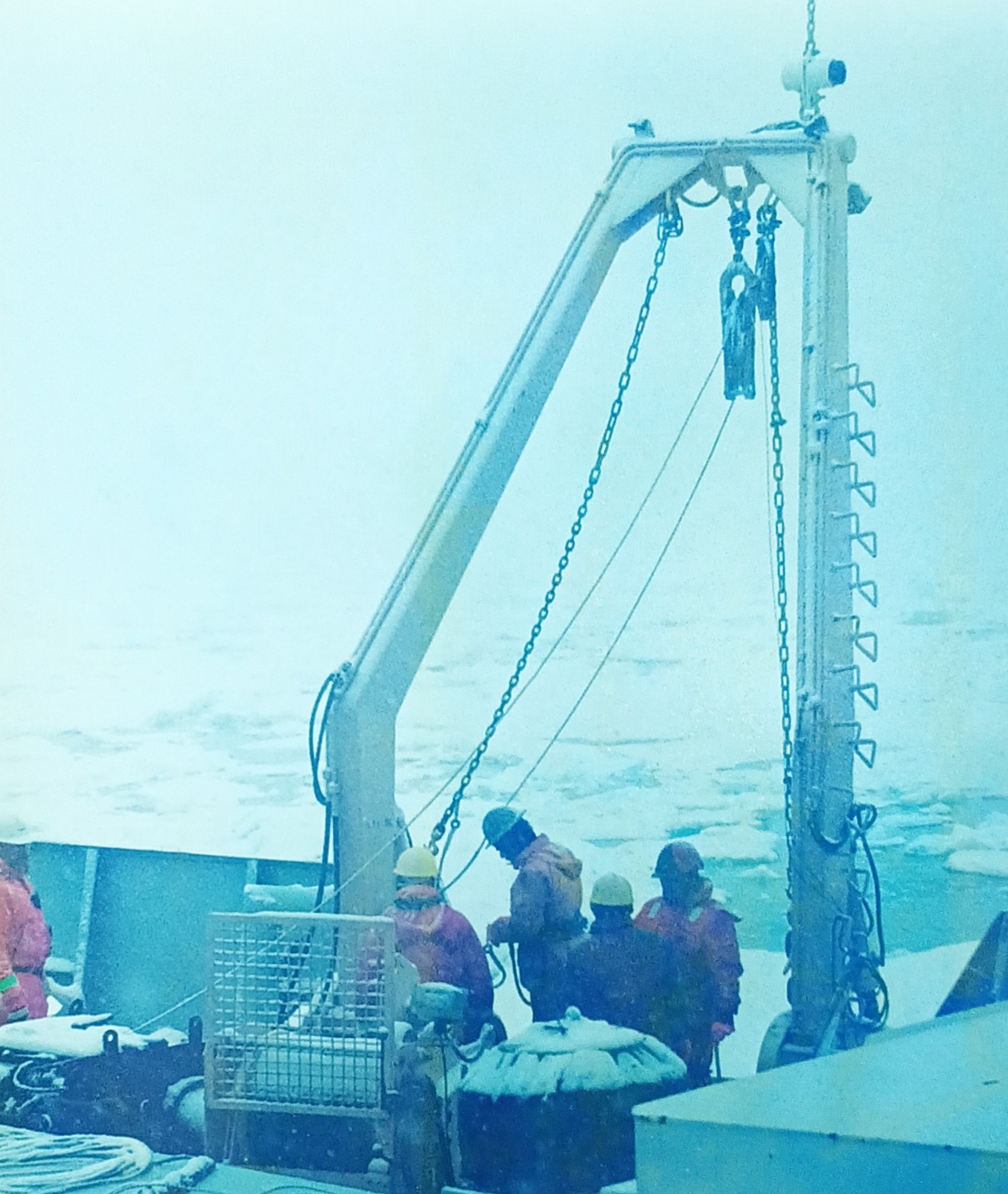
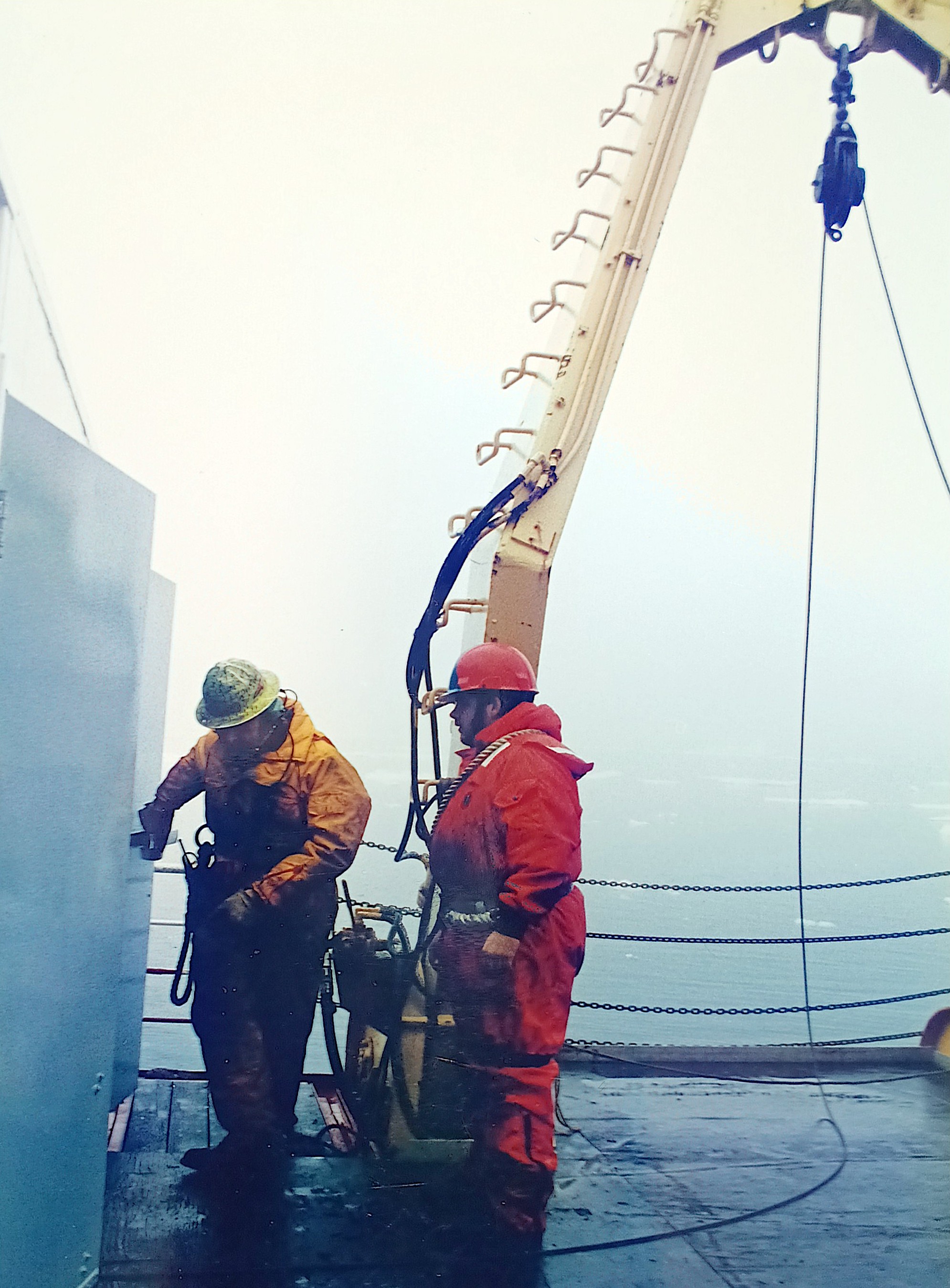
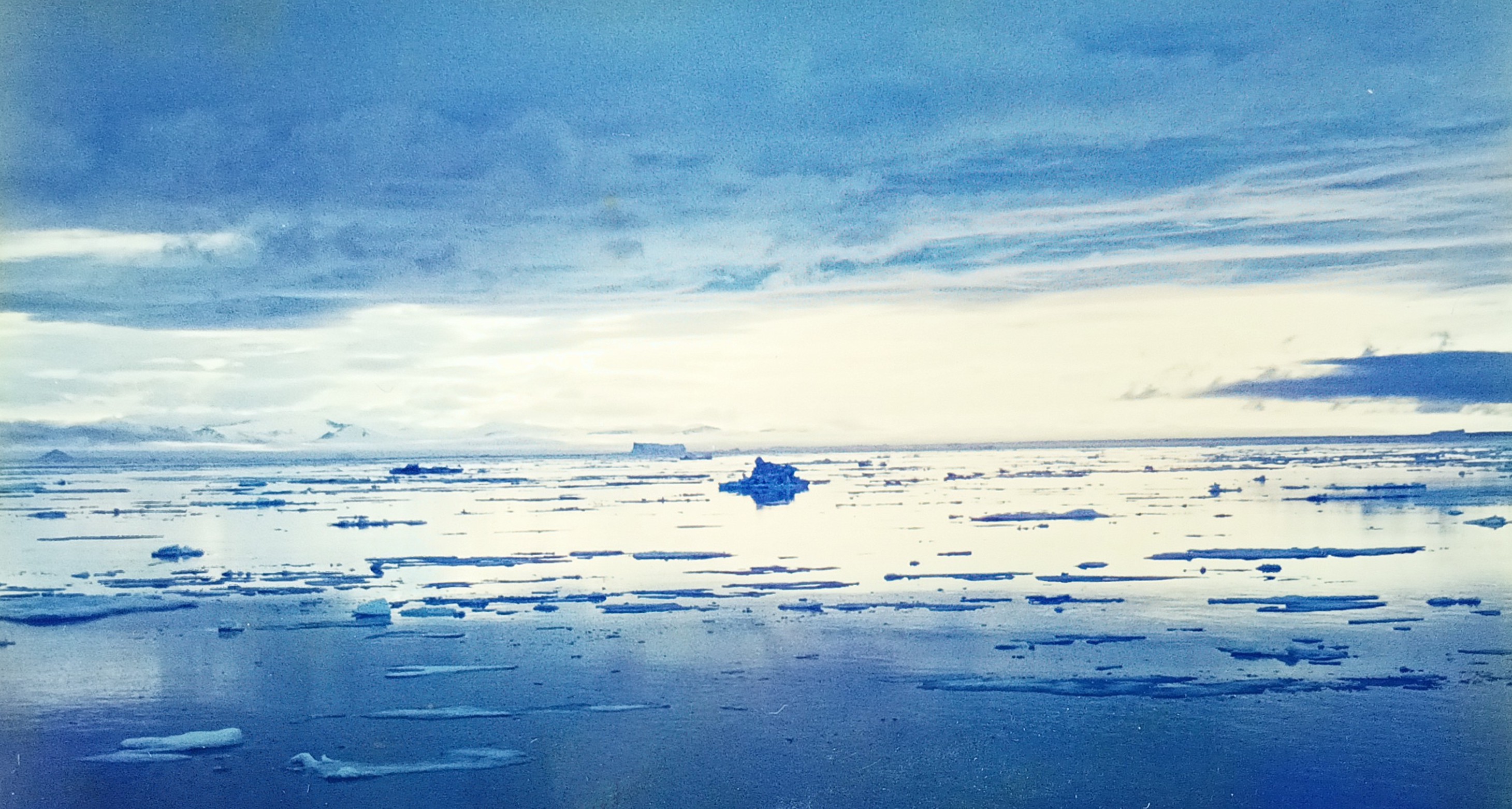
Science and Greenland both combine discovery, adventure, and diverse people. I do this work free of academic constraints, responsibilities, and pay, because I retired from my university three months ago drawing on savings that accumulated since 1992 with my first job in San Diego, California. It was there and then, that my interest in polar physics started, but my first glimpse of Greenland had to wait until 1997 when a Canadian icebreaker got me to the edge of the ice in northern Baffin Bay between Canada and Greenland. It was a cold and foggy summer day as these pre-digital photos show:
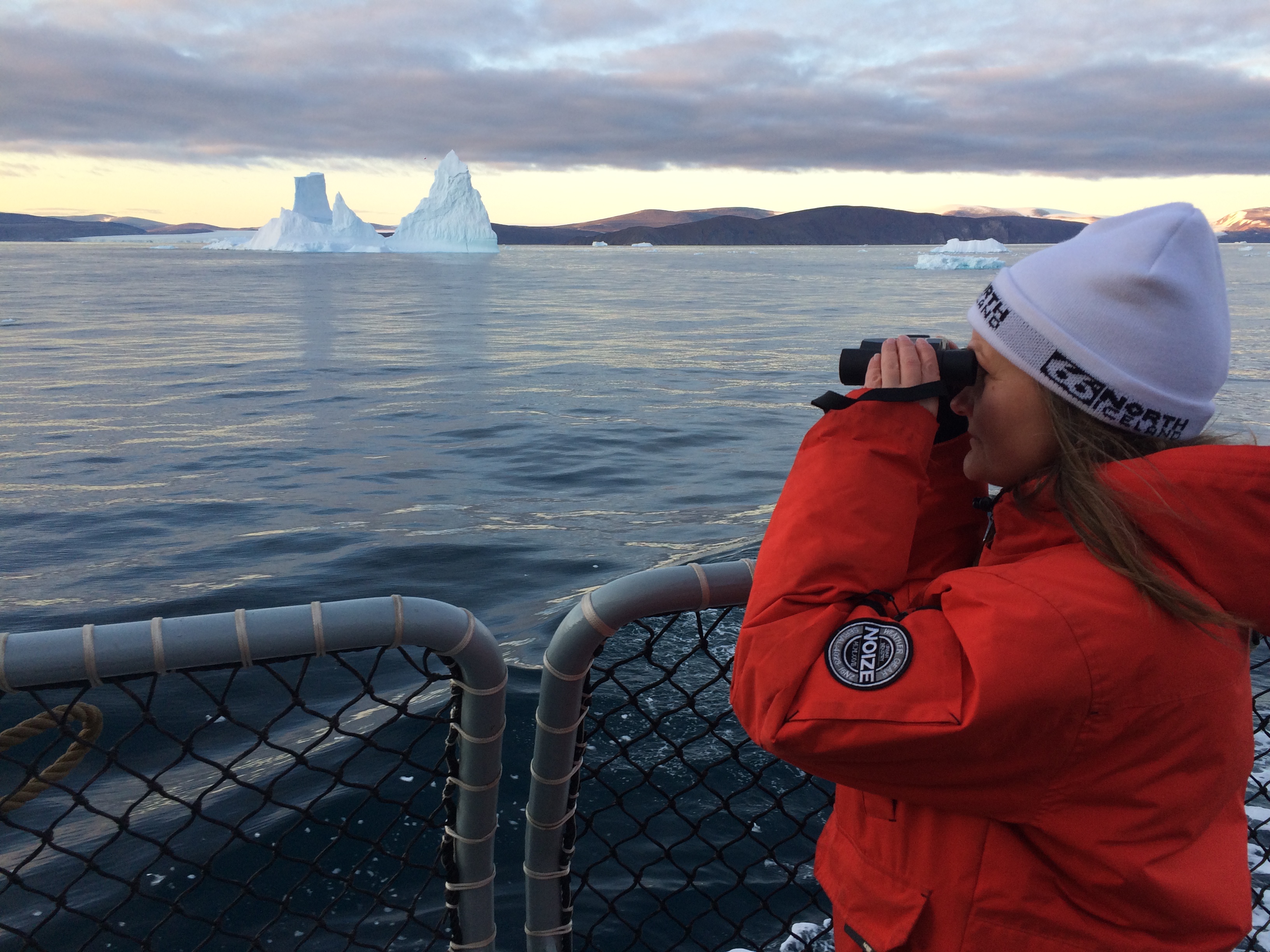
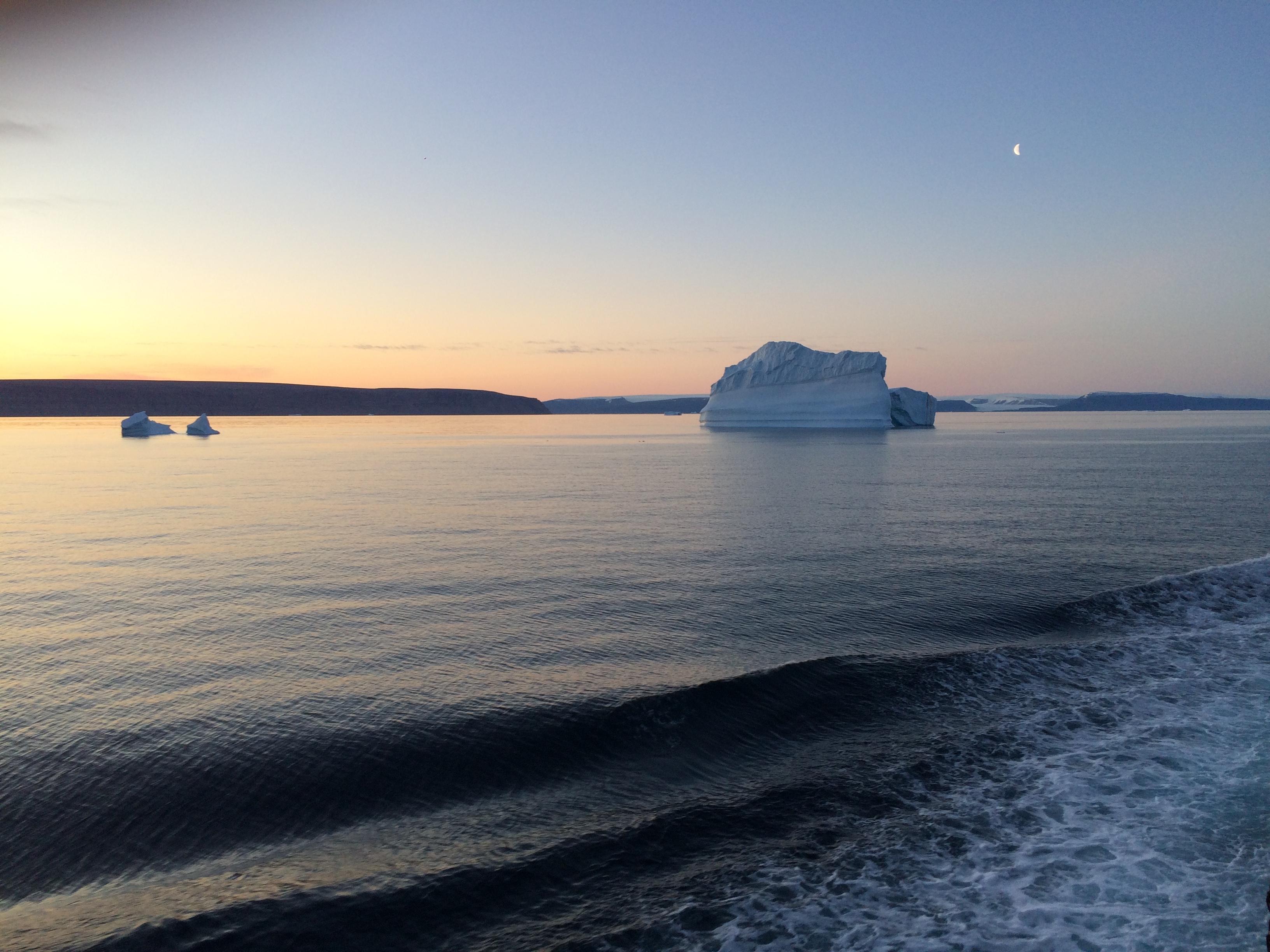
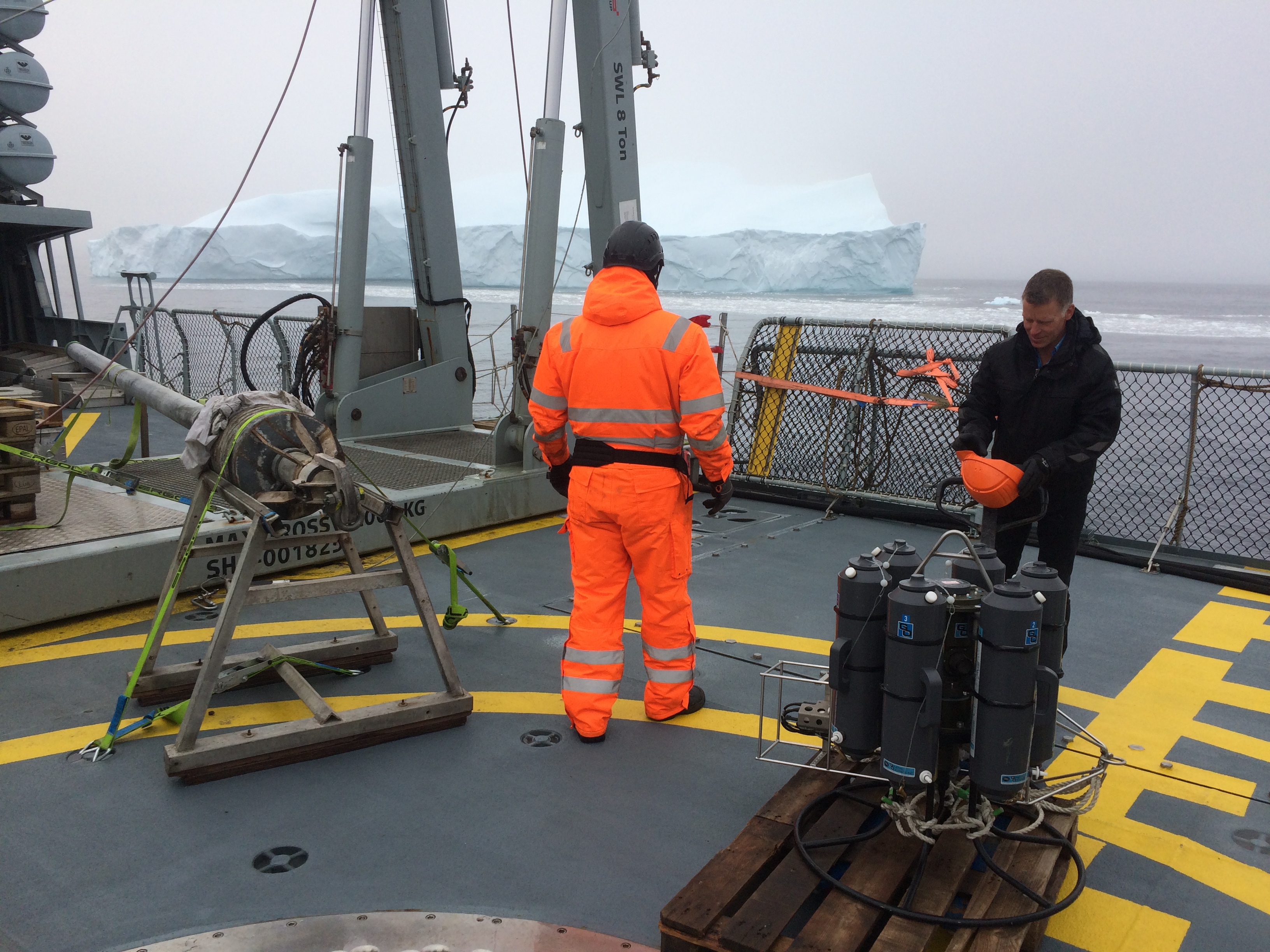
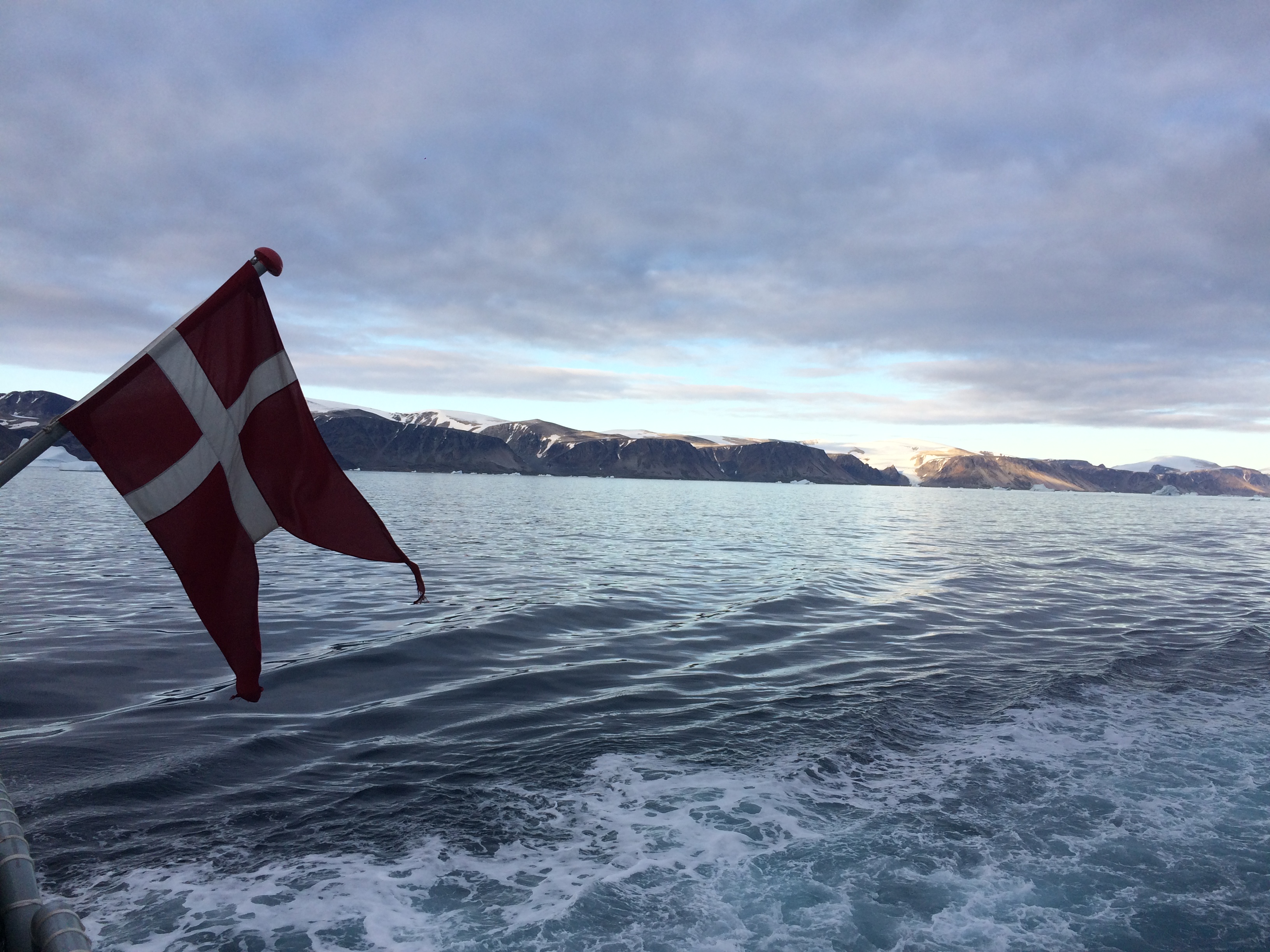
Almost 25 years later I visited the area again with Her Danish Majesty Ship HDMS Lauge Koch, a Danish Navy vessel, which surveyed the coastal waters between Disko Bay in the south and Thule Air Base (now Pituffik Space Base) in the north. Two Danish goverment agencies led this expedition: the Geological Survey of Denmark and Greenland (Dr. Sofia Ribeirio, GEUS) and the Danish Metorological Institute (Dr. Steffen Olsen, DMI). Our small team of 11 scientists and 12 soldiers surveyed the seafloor with fancy acoustics, drilled into the bottom with piston corers, fished for plankton with towed nets, and collected water properties with both electronics and bottle samples. As this was during the Covid-19 pandemic, all scientists had to be both vaccinated and tested prior to boarding the flight from Copenhagen to Greenland. We also quarantined for 3 days in Aasiaat, Greenland prior to boarding the ship.
Now in retirement, I thoroughly enjoy the time to just just revisit the places and people via photos that finally get organized. More importantly, I finally feel free to explore the data fully that we collected both on 14 separate expeditions to Greenland between 1997 and 2021. For example, only in retirement did I discover that Baffin Bay was visited in 2021 by both a Canadian and an American in addition to our Danish ship. Data from these separate Baffin Bay experiments are all online and can be downloaded by anyone. I did so and processed them for my own purposes. Furthermore, NASA scientists of the Ocean Melts Greenland program flew airplanes all over Greenland to drop ocean sensors to profile and map the coastal ocean with fjords and glaciers hard to reach by ships. All these are highly complementary data that describe how icy glaciers, deep fjords, coastal oceans, and deep basins connect with each other and the forces that winds, sea ice, and abundant icebergs impose on them.

It requires a bit of skill and computer code, however, to process data from different ships, countries, and sensors into a common format to place onto a common map for different years, but here is one such attempt to organize:
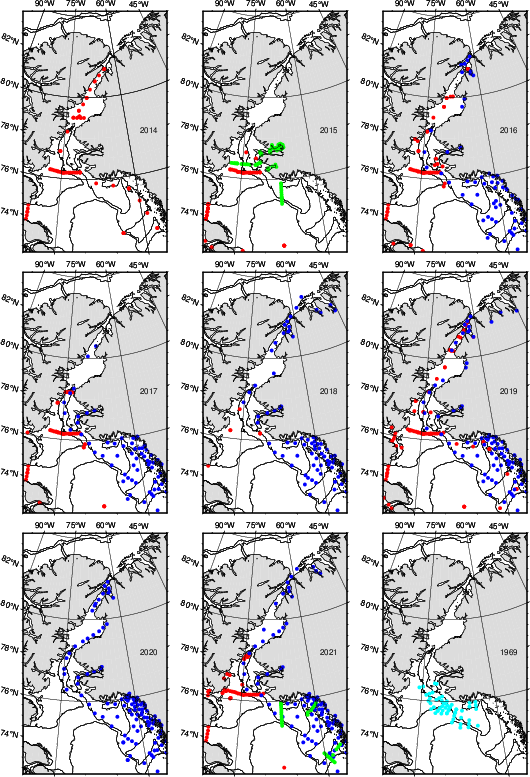
There is one map for each of 9 years, i.e., station locations are shown in a top (2014, 2015, 2016), center (2017, 2018, 2019), and bottom row (2020, 2021, 1968). Land is gray with Canada on the left (west) and Greenland on the right (east) while the solid contour lines represent the 500-m and 1000-m water depth. Each colored symbol represents one station where the ship stopped to deploy a sensor package to measure temperature, depth, and salinity of the ocean water from the surface to the bottom of the ocean adjacent to the ship. The different colors represent data from Canada in red, Denmark in green, and USA in blue. The light blue color represents historical data from a study that investigated the waters after a nuclear armed B-52 bomber crashed into the ocean near Thule/Pituffik on 17 Jan. 1968 with one nuclear war head still missing. A Wikipedia story called 1968 Thule Air Base B-52 Crash provides details, references, and Cold War context, but lets return to the data and ocean physics:

Notice a single red dot near the bottom center of some maps such as 2015, 2017, or 2021. For this single dot I show the actual temperature and salinity data and how it varies with depth (labeled pressure, at 100-m depth the pressure is about 100 dbar) and from year to year:
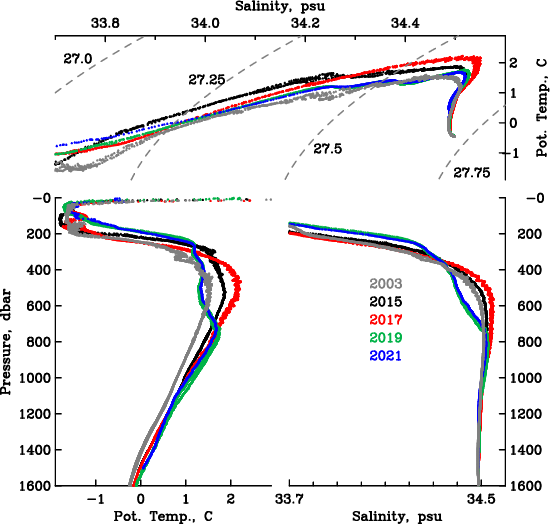
The two bottom panels show how temperature (left) and salinity (right) change with depth (or pressure). Notice that the coldest water near freezing temperature of -1.8 degrees Celsius (29 Fahrenheit) occurs between 30-m and 200-m depth (30 to 200 dbar in pressure). Below this depth the ocean water actually becomes warmer to a depth of about 500-600 m to then become cooler again. The effects of pressure on temperature are removed, this is why I call this potential temperature and label it “Pot. Temp.” The warmest waters at 600-m depth are also the most salty (about 34.5 grams of salt per 1000 grams of water). This saltiness makes this water heavier and denser than the colder waters above. This is a common feature that one finds almost anywhere in polar regions. The top panel shows the same data without reference to depth (or pressure), but contours of density show how this property changes with temperature and salinity. It takes a little mental gymnastic to “see” how density always increases as pressure increases, but the main thing here is that both salinity and temperature can change the density of seawater.
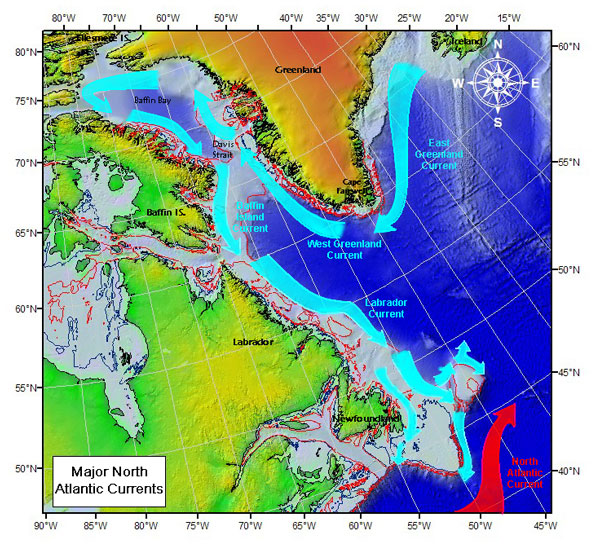
Sketch of ocean current systems off Greenland and eastern Canada. Colors represent topography of ocean, land, and Greenland ice sheet.

U.S. Coast Guard, International Ice Patrol

The origin of the warmer (and saltier) waters is the Atlantic Ocean to the south. Currents move heat along the coast of Greenland to the north. Icebergs in Baffin Bay extend into this Atlantic Layer and thus move first north along the coast of Greenland before turning west in the north and then south along the coast of Canada. This deep ocean heat does reach coastal tidewater glaciers which are melted by this warm ocean water. So the year-to-year changes of temperature and salinity determine in part how much the coastal glaciers of Greenland melt. The temperature and salinity maxima change from year to year being warmest in 2015 and 2017 and coldest in 2019 and 2021. No “global warming” here, but notice what happens closer to the bottom at 1500-m, say. These waters are separated from the Atlantic and Arctic Oceans to the south and north by water depths that do not exceed 600-m in the south and 400-m in the north. These almost stagnant waters increase their temperatures steadily from 2003 to 2015 to 2017 to 2019 to 2021. This is the global warming signal.

My former student Melissa Zweng published a more thorough and formal study in 2006 using all then available data from Baffin Bay between 1916 and 2003. Her Figure-7 shows the results for those parts of Baffin Bay that are deeper than 2000-m for two different depth ranges. Notice that the year to year variations (up and down) is small, but a steady increase in temperature is apparent from perhaps -0.3 Celsius in 1940 to -0.05 in 2003 for the 1400-1600 m depth range. We also did a very formal error analysis on the straight line we fitted to the data and find that deep temperatures increase by +0.03 C/decade. We are 95% sure, that the error or uncertainty on this warming is +/- 0.015 C/decade. So there is a 1 in 20 chance, that our deep warming trend is below +0.005 C/decade and an equal 1 in 20 chance, that our warming trend exceed +0.045 C/decade. In 19 out of 20 cases the (unknown) true warming value is between 0.005 and 0.045 C/decade.
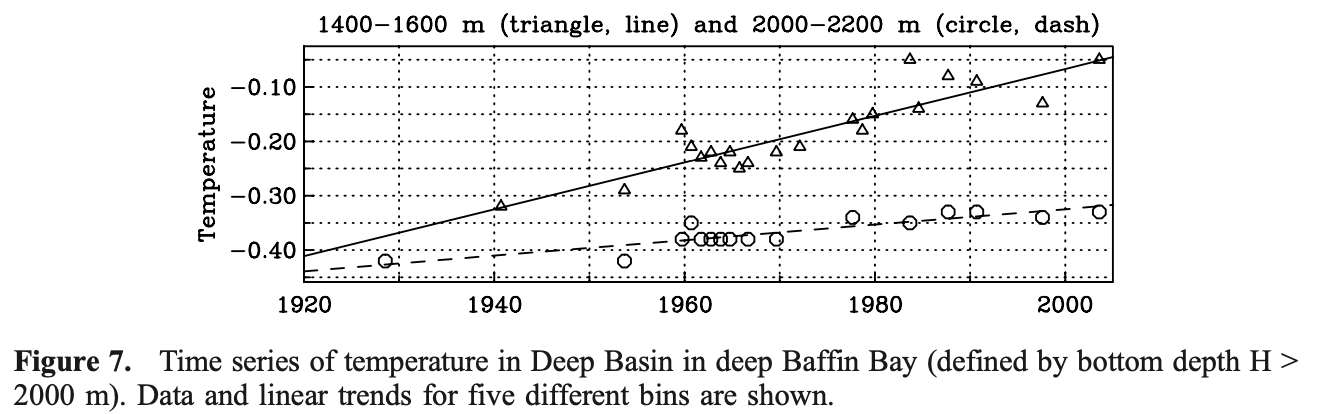
So, more than 20 years have passed since Melissa’s work. The data I here showed between 2003 and 2021 thus gives us a chance to test our statistical predictions that we made 20 years ago. So, deep temperatures should be between 0.01 and 0.09 degrees Celsius warmer than they were in 2003. I have not done this test yet, but science is fun even if the data are old.

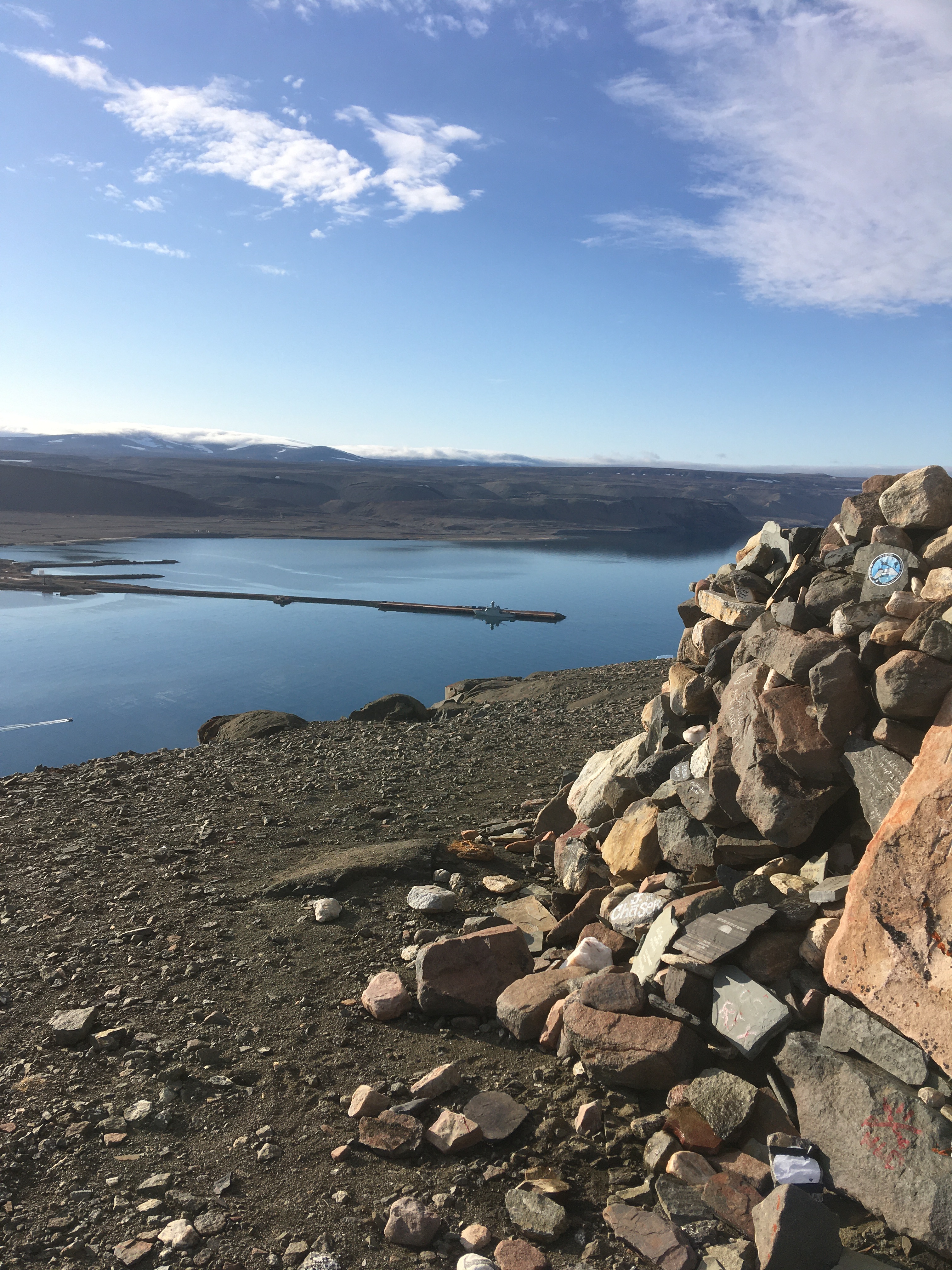
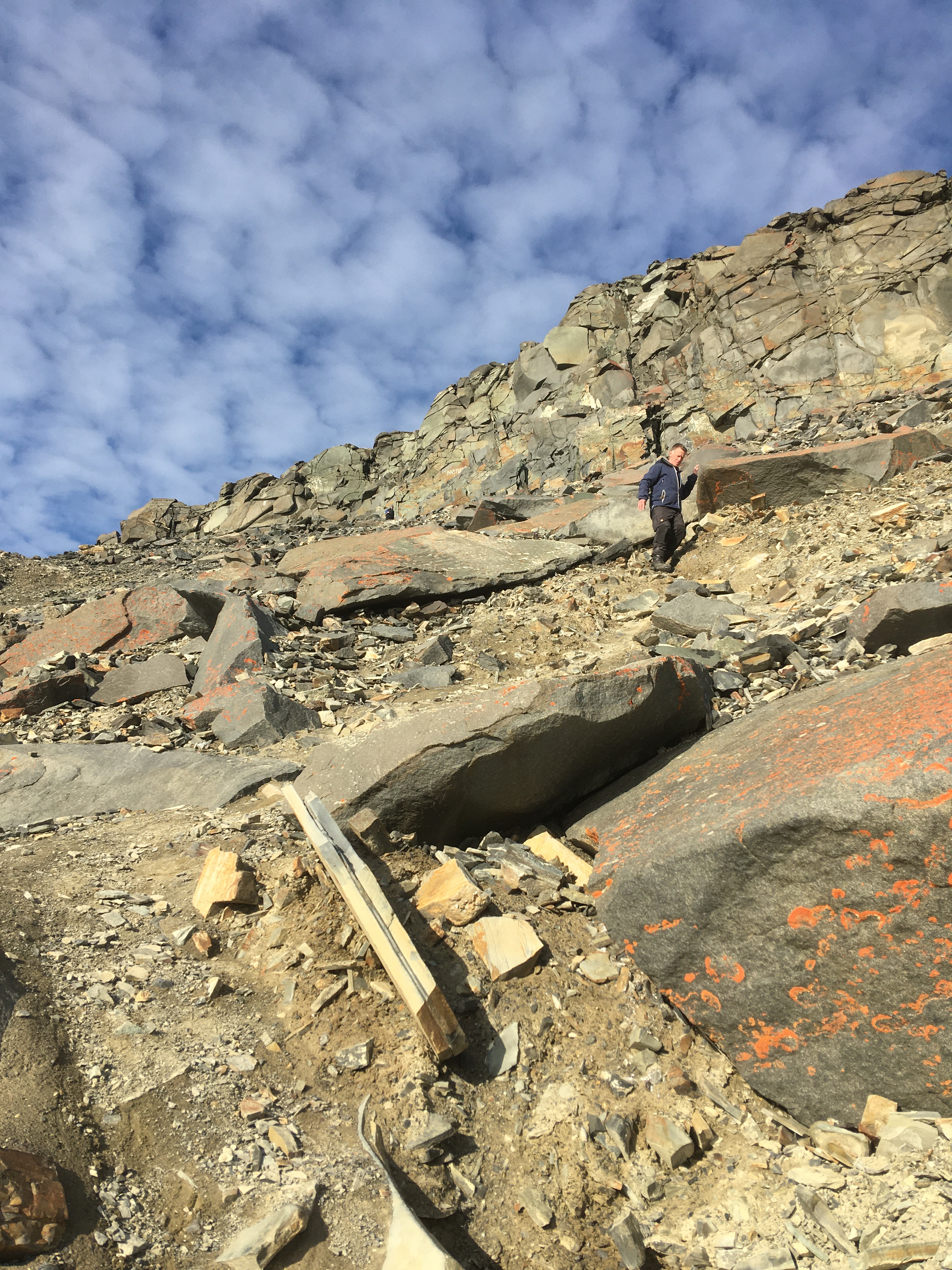
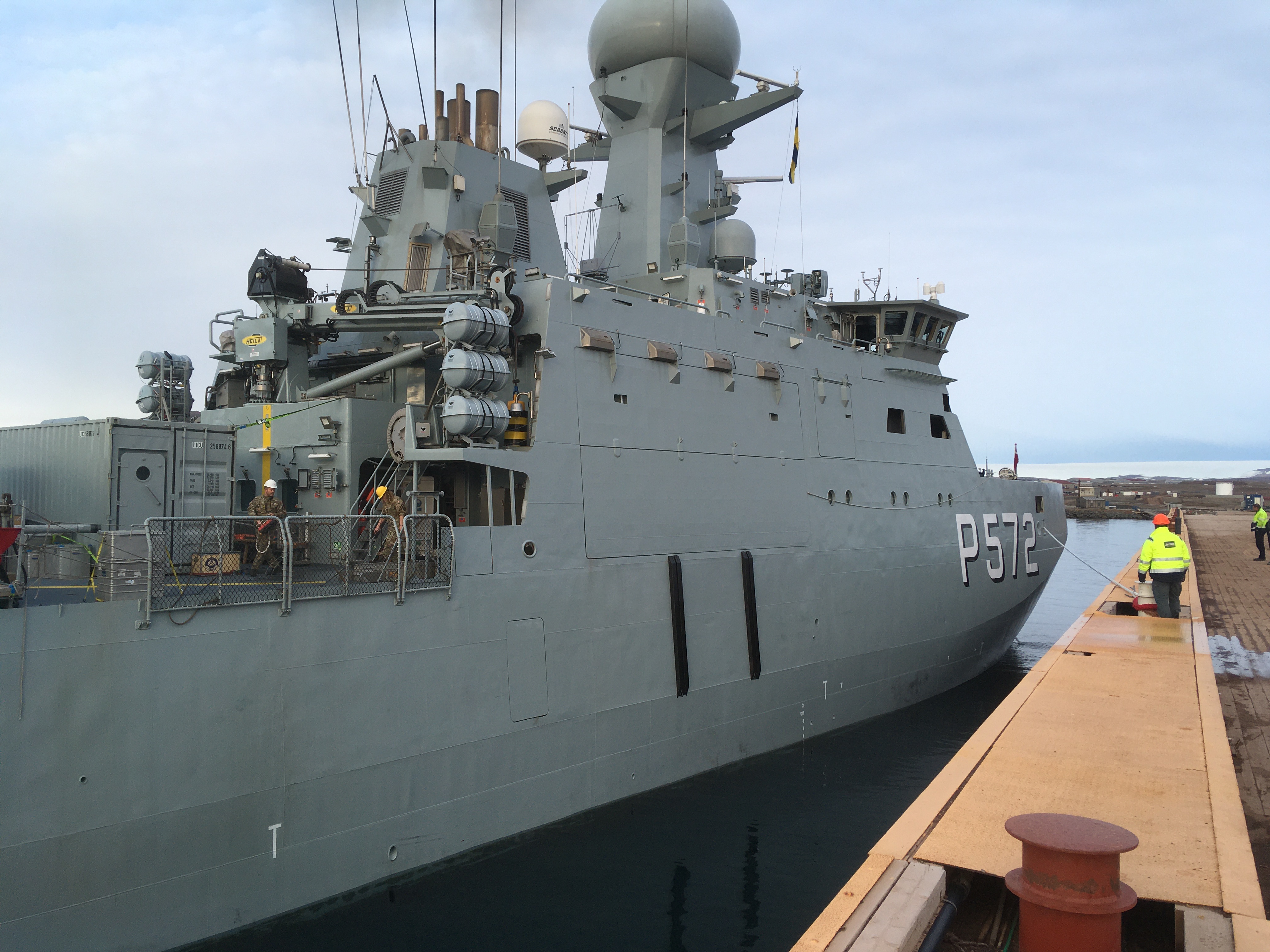
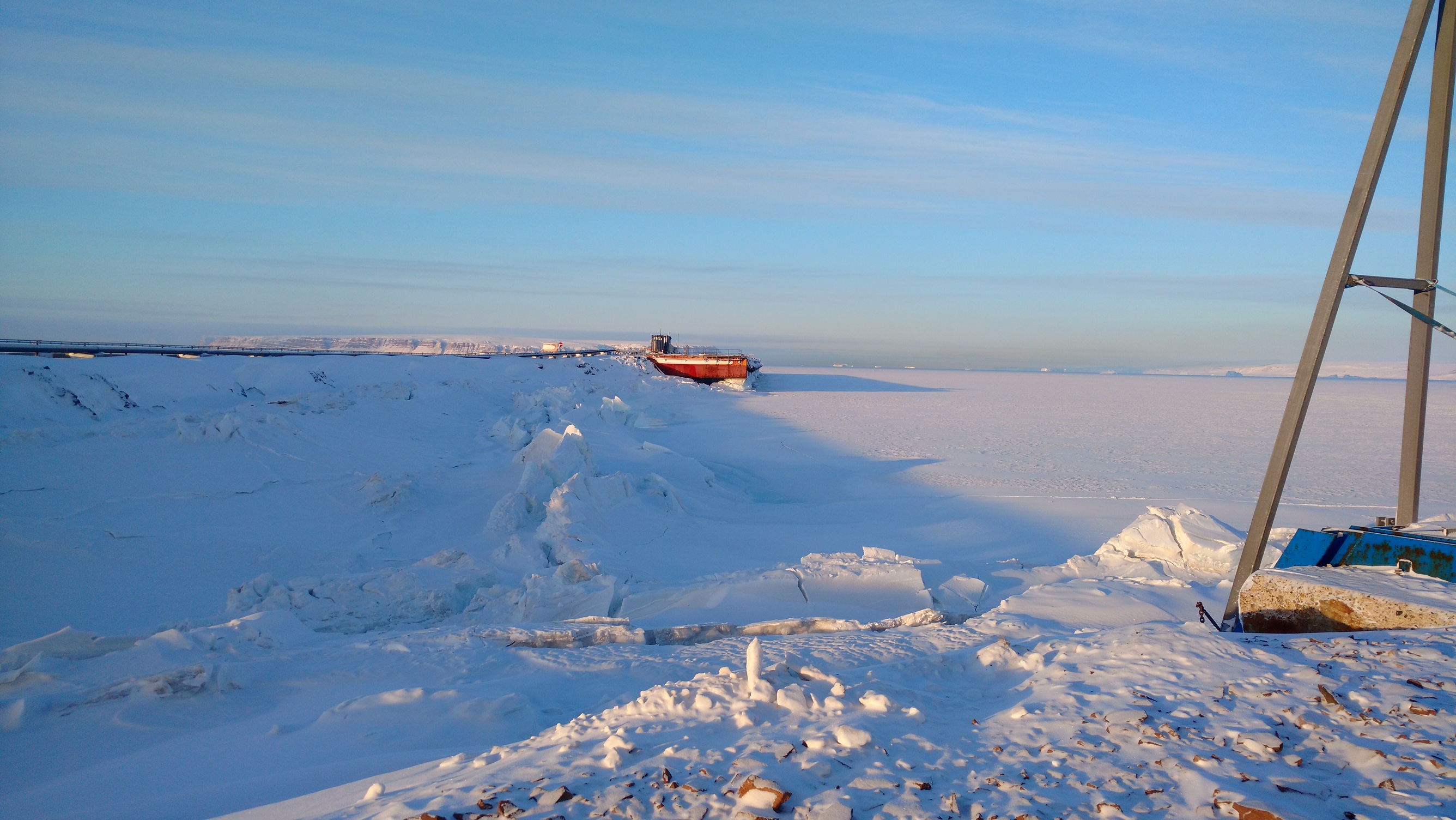
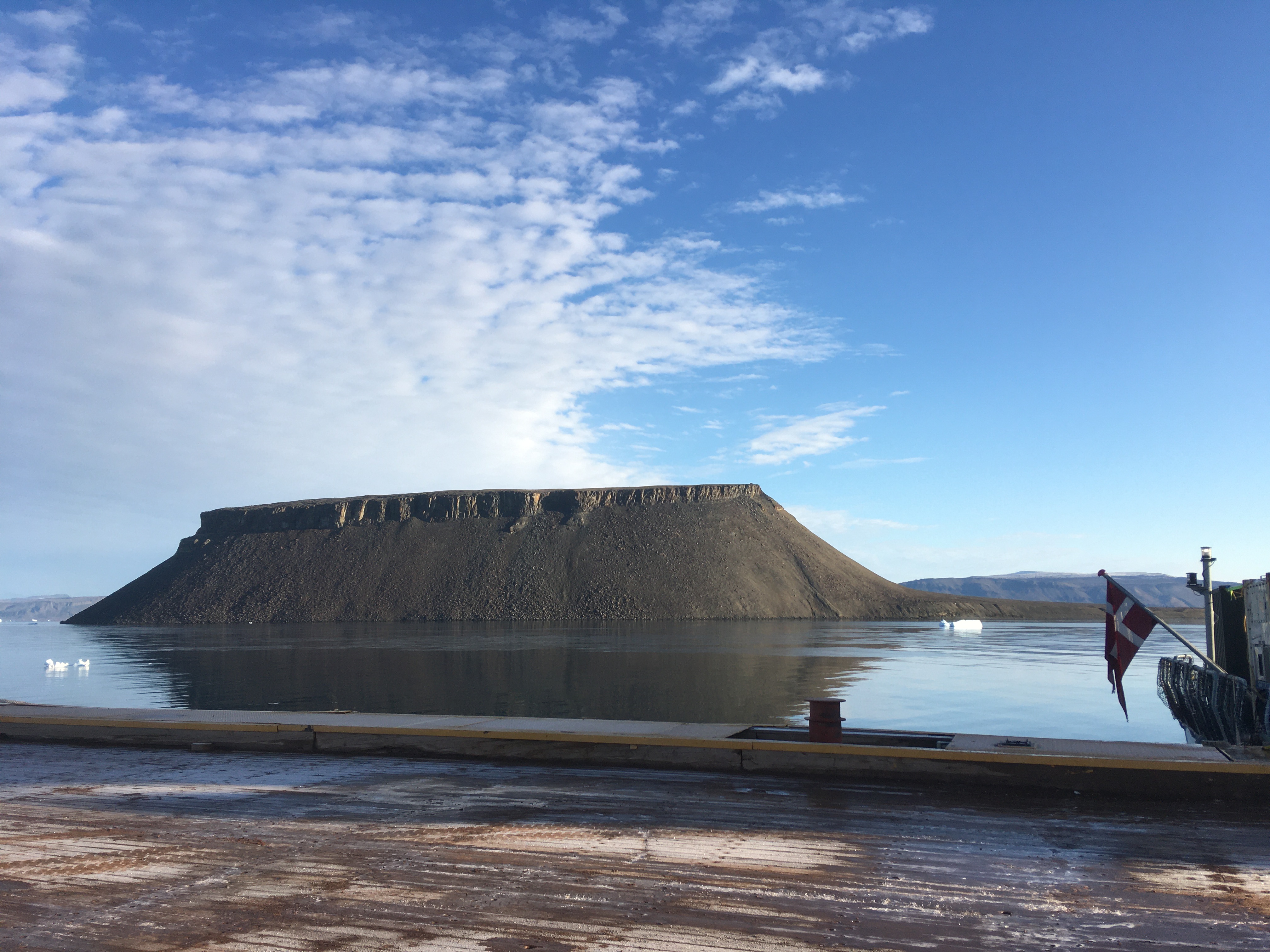
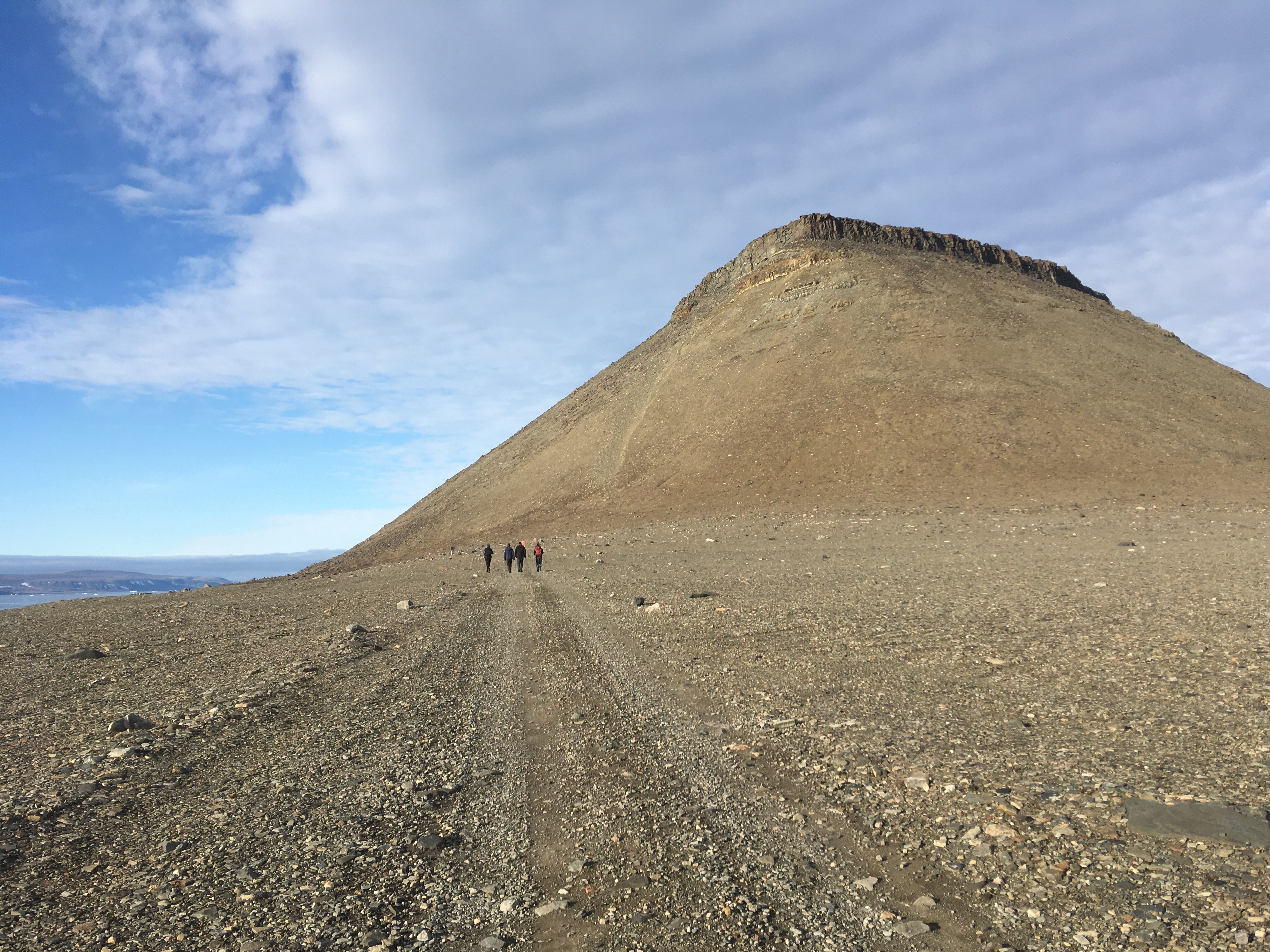
After getting off the ship at Thule Air Base (now called Pituffik Space Base) in 2021, us scientists climbed Dundas Mountain to stretch our legs, take in the varied landscape, and view our ship and home for a week from a distance. Notice how small HDMS Lauge Koch at the pier appears. All photos below were taken by geophysicist Dr. Katrine Juul Andresen of Aarhus University, Denmark:
References:

Münchow, A., Falkner, K.K. and Melling, H.: Baffin Island and West Greenland Current Systems in northern Baffin Bay. Progr. Oceanogr., 132, 305-317, 2015.

Ribeiro, S., Olsen, S. M., Münchow, A., Andresen, K. J., Pearce, C., Harðardóttir, S., Zimmermann, H. H., & Stuart-Lee, A.: ICAROS 2021 Cruise Report. Ice-ocean interactions and marine ecosystem dynamics in Northwest Greenland. GEUS, Danmarks og Grønlands Geologiske Undersøgelse Rapport, 70, 2021.

Zweng, M.M. and Münchow, A.: Warming and Freshening of Baffin Bay, 1916-2003. J. GEOPHYS. RES., 111, C07016, doi:10.1029/2005JC003093, 2006.
Northern Winds and Currents off North-East Greenland

I spent 6 weeks aboard the German research icebreaker R/V Polarstern last year leaving Tromso in Norway in early September and returned to Bremerhaven, Germany in October. We successfully recovered ocean sensors that we had deployed more than 3 years before. It felt good to see old friends, mates, and sensors back on the wooden deck. Many stories, some mysterious, some sad, some funny and happy could be told, but today I am working on some of the data as I reminisce.

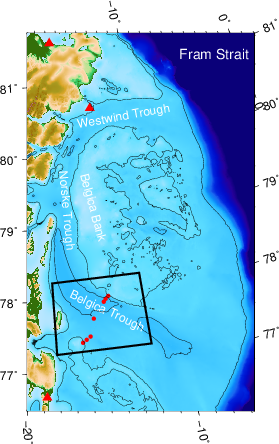
The location is North-East Greenland where Fram Strait connects the Arctic Ocean to the north with the Atlantic Ocean in the south. We worked mostly on the shallow continental shelf areas where water depths vary between 50 and 500 meters. The map shows these areas in light bluish tones where the line shows the 100 and 300 meter water depth. Fram Strait is much deeper, more than 2000 meters in places. I am interested how the warm Atlantic water from Fram Strait moves towards the cold glaciers that dot the coastline of Greenland in the west.

Map of study area with 2014-16 mooring array in box near 78 N across Belgica Trough. Red triangles place weather data from Station Nord (81.2 N), Henrik Kr\o yer Holme (80.5 N), and Danmarkhaven (76.9 N). Black box indicates area of mooring locations.

There is also ice, lots of sea icebergs, and ice islands that we had to navigate. None of it did any harm to our gear that we moored for 1-3 years on the ocean floor that can and often is scoured by 100 to 400 meter thick ice from glaciers, however, 2-3 meter thick sea ice prevented us to reach three mooring locations this year and our sensors are still, we hope, on the ocean floor collecting data.

Ahhh, data, here we come. Lets start with the weather at this very lonely place called Henrik Krøyer Holme. The Danish Meteorological Institute (DMI) maintains an automated weather station that, it seems, Dr. Ruth Mottram visited and blogged about in 2014 just before we deployed our moorings from Polarstern back in 2014:

Weather station on Henrik Kroeyer Holme [Credit: Dr. Ruth Mottram, DMI]

It was a little tricky to find the hourly data and it took me more than a day to process and graph it to suit my own purposes, but here it is

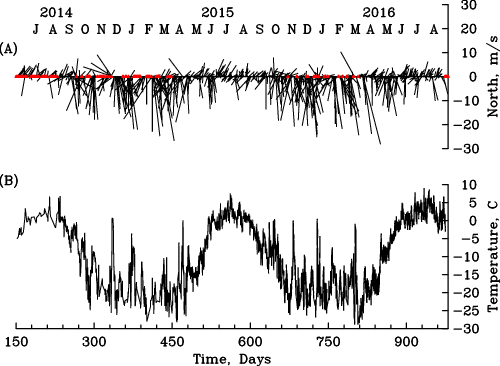
Winds (A) and air temperature (B) from an automated weather station at Henrik Kroeyer Holme from 1 June, 2014 through 31 August, 2016. Missing values are indicated as red symbols in (A).

The air temperatures on this island are much warmer than on land to the west, but it still drops to -30 C during a long winter, but the end of July it reaches +5 C. The winds in summer (JJA for June, July, and August) are weak and variable, but they are often ferociously strong in winter (DJF for December, January, February) when they reach almost 30 meters per second (60 knots). The strong winter winds are always from the north moving cold Arctic air to the south. The length of each stick along the time line relates the strength of the winds, that is, long stick indicates much wind. The orientation of each stick indicates the direction that the wind blows, that is, a stick vertical down is a wind from north to south. I use the same type of stick plot for ocean currents. How do these look for the same period?

Ocean current vectors at four selected depths near the eastern wall of Belgica Trough. Note the bottom-intensified flow from south to north. A Lanczos low-pass filter removes variability at time scales smaller than 5 days to emphasize mean and low-frequency variability.

Ocean currents and winds have nothing in common. While the winds are from north to south, the ocean currents are usually in the opposite direction. This becomes particular clear as we compare surface currents at 39 meters below the sea surface with bottom currents 175 or even 255 meters below the surface. They are much stronger and steadier at depth than at the surface. How can this be?

Image of study area on 15 June 2014 with locations (blue symbols) where we deployed moorings a few days before this satellite image was taken by MODIS Terra. The 100-m isobath is shown in red.

Well, recall that there is ice and for much of the year this sea ice is not moving, but is stuck to land and islands. This immobile winter ice protects the ocean below from a direct influence of the local winds. Yet, what is driving such strong flows under the ice? We need to know, because it is these strong currents at 200 to 300 meter depth that move the heat of warm and salty Atlantic waters towards coastal glaciers where they add to the melting of Greenland. This is what I am thinking about now as I am trying to write-up for my German friends and colleagues what we did together the last 3 years.

Oh yes, and we did reach the massive terminus of 79 North Glacier (Nioghalvfjerdsfjorden) that features the largest remaining floating ice shelf in Greenland:

We recovered ocean moorings from this location also, but this is yet another story that is probably best told by scientists at the Alfred-Wegener-Institute who spent much time and treasures to put ship, people, and science on one ship. I am grateful for their support and companionship at sea and hopefully all of next year in Bremerhaven, Germany.

Greenland Oceanography by Sled and Snowmobile

Wind chill matters in Greenland because one must see and breath. This implies exposed skin that will hurt and sting at first. Ignoring this sting for a few minutes, I notice that the pain goes away, because the flesh has frozen which kills nerves and skin tissue. The problem becomes worse as one drives by snowmobile to work on the sea ice which I do these days almost every day.

Navigating on the sea ice by identifying ice bergs with LandSat imagery. The imagery also shows polynyas and thin ice in the area. [Photo Credit: Sonny Jacobsen]

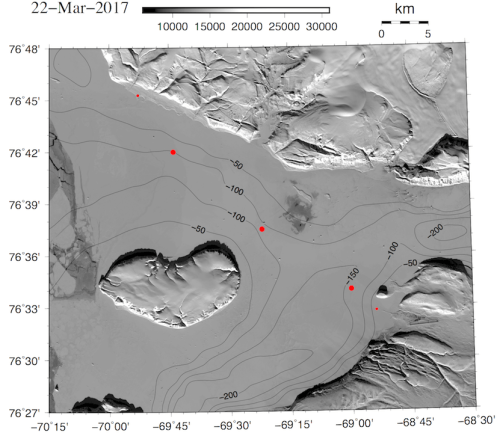
Mar.-22, 2017 LandSat image of study area with Thule Air Base near bottom right, Saunders Island in the center. Large red dots are stations A, B, and C with Camp-B containing weather station, shelter, and first ocean mooring. My PhD student Pat Ryan prepared this at the University of Delaware.

My companion on the ice is Sonny Jacobsen who knows and reads the land, ice, and everything living on and below it. He teaches me how to drive the snowmobile, how to watch for tracks in the snow, how to pack a sled, and demonstrates ingenuity to apply tools and materials on-hand to fix a problem good enough to get home and devise a new and better way to get a challenging task done. Here he is designing and rigging what is to become our “Research Sled” R/S Peter Freuchen, but I am a little ahead of my story:

Sonny Jacobsen on Mar.-27, 2017 on Thule Air Base building a self-contained sled for ocean profiling.

First we set up a shelter in the center of what will hopefully soon become an array of ocean sensors and acoustic modems to move data wirelessly through the water from point A in the north-west via point B to point C. Point C will become the pier at Thule Air Base while the tent is at B that I call Camp-B:

Ice Fishing shelter to the north-east of Saunders Island seen to the left in the background.

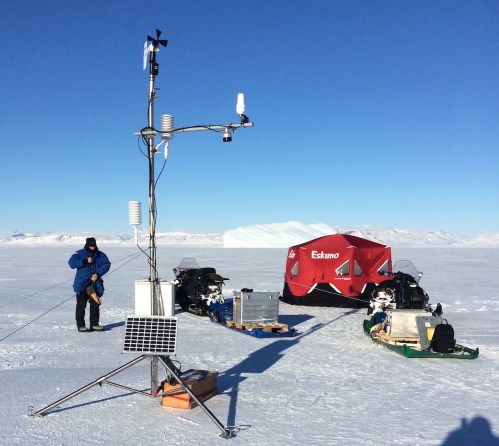
Next, we set up an automated weather station (AWS) next to this site, because winds and temperatures on land next to hills, glaciers, and ice sheets are not always the same 10 or 20 km offshore in the fjord. It is a risk-mitigating safety factor to know the weather in the study area BEFORE driving there for 30-60 minutes to spend the day out on the ice. It does not hurt, that this AWS is also collecting most useful scientific data, but again, I am slightly ahead of my story:

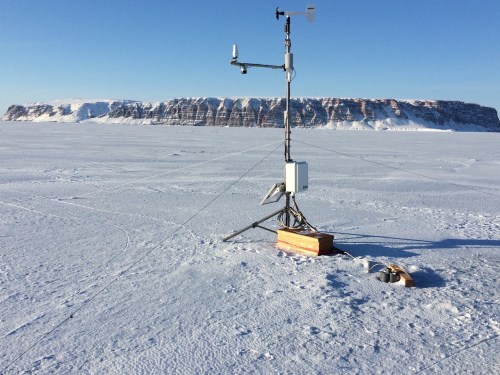
Weather station with shelter at Camp-B with the northern shores of Wolstenholme Fjord in the background. Iridium antenna appears just above the iceberg on the sidebar of the station. Winds are measured at 3.2 m above the ground.

With shelter and weather station established and working well, we decided to drill a 10” hole through 0.6 m thin ice to deploy a string of ocean instruments from just below the ice bottom to the sea floor 110 m below. Preparing for this all friday (Mar.-24), we deploy 22 sensors on a kevlar line of which 20 record internally and must be recovered while 2 connect via cables to the weather station to report ocean temperature and salinity along with winds and air temperatures. It feels a little like building with pieces of Lego as I did as a kid. Engineers and scientists, perhaps, are trained early in this sort of thing.

Weather station with ocean mooring (bottom right) attached with eastern Saunders Island in the background on Sunday Mar.-26, 2017.

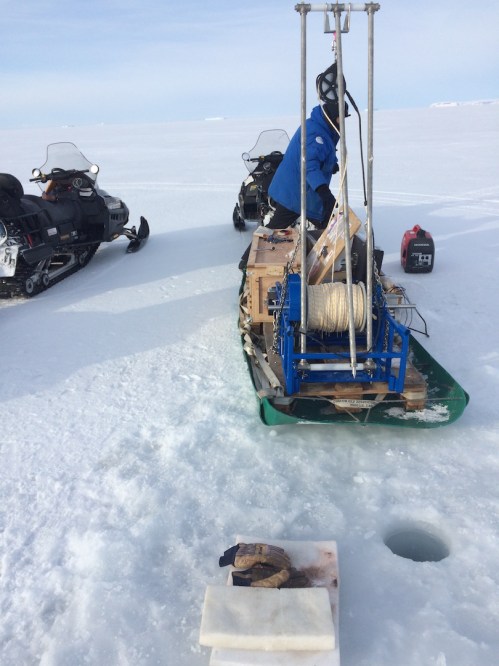
Sadly, only the ocean sensor at the surface works while the one at the bottom does not talk to me. I can only suspect that I bend a pin on the connector trying to connect very stiff rubber sealing copper pins from the cable with terminations equally stiff in the cold, however, there are other ways to get at the bottom properties albeit with a lot more effort … which brings me to R/S Peter Freuchen shown here during its maiden voyage yesterday:

R/S Peter Freuchen in front of 10” hole (bottom right) for deployment of a profiling ocean sensor. The long pipes looking like an A-frame on a ship become a tripod centered over the hole with the electrical winch to drive rope and with sensors (not shown) over a block into the ocean. This was yesterday Mar.-28, 2017 on the way from Camp-B back to Thule Air Base.

The trial of this research sled was successful, however, as all good trials, it revealed several weaknesses and unanticipated problems that all have solutions that we will make today and tomorrow. The design has to be simple to be workable in -25 C with some wind and we will strip away layers of complexities that are “nice to have” but not essential such as a line counter and the speed at which the line goes into the water. There can not be too many cables or lines or attachments, because any exposure to the elements becomes hard labor. This becomes challenging with any gear leaving the ocean (rope, sensors) and splattering water on other components. Recall that ocean water is VERY hot at -1.7 C relative to -25 C air temperatures. This means that ANYTHING from the ocean will freezes instantly when in contact with air. Efficiency and economy matter … as does body heat to keep critical sensors and batteries warm.

A big Thank-You to Operation IceBridge’s John Woods for something related to this post that I wish not to advertise 😉

Travels to Greenland in Winter

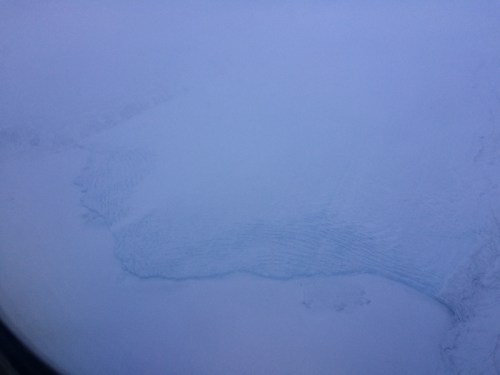
Waking up after 5 hours on a plane from Baltimore, Maryland to Thule, Greenland large white Pitugfik Gletscher distinguishes itself from the white sea ice by its ragged snout as the plane approaches my new home for the next 6 weeks. I am traveling with 9 midshipmen of the US Naval Academy of which two are women, their 4 professors, and bear guard from Alaska. We will be working and living together for the next 7 days.

Pitugfik Glacier during the early morning hours of Mar.-9, 2017.

A little further along the coast we enter Wolstenholme Fjord where from the plane wide cracks of open water stand out as black against the bluish white horizon. This will be the outer margin of where I plan to work the ice and ocean underneath the next 6 weeks. We need to stay on the shore side of this transition of land-fast to mobile sea ice. I have watched this boundary for the last 4 months with satellite imagery, but seeing with my own eyes is an entire different and humbling experience.

Sea ice near Kap Atholl with heads of open water that separate land-fast ice that does not move from mobile ice.

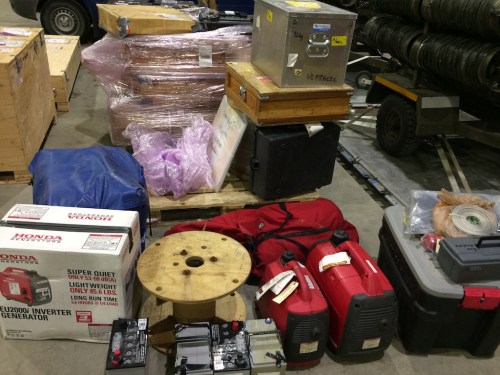
We land safely at the airport, get our passport stamped by Danish officials, pick up our luggage, and are received by wonderful people working for both NASA and the National Science Foundation. After a hearty lunch of dark rye bread and my beloved pickled herrings christmas arrives in the form of many carefully wrapped packages: I try to find my Arctic clothing that I shipped months before. It is much-needed as the -33 C take your breadth away. I also find the 2,500 lbs of science gear, some of which had arrived directly from Canada after it was ordered Dec.-10, 2016: Without this $22,000 electrical winch, I would be hard pressed to send sensors to the bottom of the ocean and back. Everything appears to be in place and fine, but some acoustic gear is still missing as its large lithium batteries need diplomatic clearances which takes a little longer. Perhaps they will be on the plane that is about to land. There is only 1 flight per week that connects Thule to the US. Hence advance planing is needed and those lithium batteries are not needed until April 6 when Lee and Taylor arrive from Massachusetts.

Where in this pile are my snow boots? Palletized gear on arrival in Thule Greenland.

The next day we put some of our gear out to measure how thick the sea ice is near the coast. While drilling a hole requires power tools, the ice is actually cut by a razor-sharp drill bit that is sensitive to damage when it refuses to cut the ice and no amount of force available can force it through the 3-4 feet of ice we find. We all learn the hard way when we accidentally drill into the frozen sea bed without finding any water. One drill bit down, we only got 2 more and are much, much more careful with it. The remaining drill bits have to last for the next 6 weeks … actually, they do not, because I can change the blades should one bit become dull. [I did not tell this the Naval Academy guys who were doing much of this drilling to support NASA’s Operation IceBridge.]

And on this note, I am heading out to sea at 7:59 am to drill one more hole to prepare for a first mooring deployment. A wooden stick without sensors attached will simulate a mooring that I want to recover after it is frozen in. More later …

P.S.: More photos and stories on this week’s adventures can be found at

https://www.facebook.com/USNAPolarScienceProgram/

Preparing Ocean Work outside Thule Air Base

I am heading to North Greenland in 3 days time to work where temperatures will be close to -20 F. The ocean is covered by 3-4 feet of sea ice that is frozen to land. We will drill lots of ice holes to deploy ocean sensors that will connect via cables to weather stations and satellite phone. Fancy $20,000 GPS units will measure the tides across the fjord and provide a group of future Naval officers a reference for their fancy electronic gear to measure sea ice thickness remotely by walking and comparing results to those obtained from planes overhead. Cool and cold fun.

img_20170302_111051404

The ocean pier at Thule Air Base in Greenland in March 2017. The view is towards the north-west along my proposed mooring line [Photo Credit: Sean Baker]

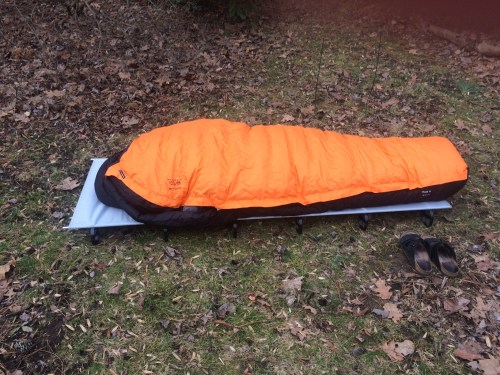
There has been much packing and shipping the last weeks, about 2300 lbs to be precise,which made my body stiff and sore. Another way to hurt my aging body was to learn shotgun shooting for the unlikely polar bear encounter on the sea ice. My shoulder still hurts from the recoil blasts of the 12 gauge pump-action gun with 3” long cartridges that included a 1 oz. lead slug. I also tested a cot and sleeping bag that will be with me on the ice for emergencies. The night in my garden a few days ago was cozy, but the cot required an insulation mattress, as it was too close to the ground. It was rough sleeping, because of unexpected noises not cold, but I did sleep some and woke up when the sun came up.

Cot, air mattress, and down sleeping bag testing in my garden after a rough night.

Cot, air mattress, and down sleeping bag testing in my garden after a rough night.

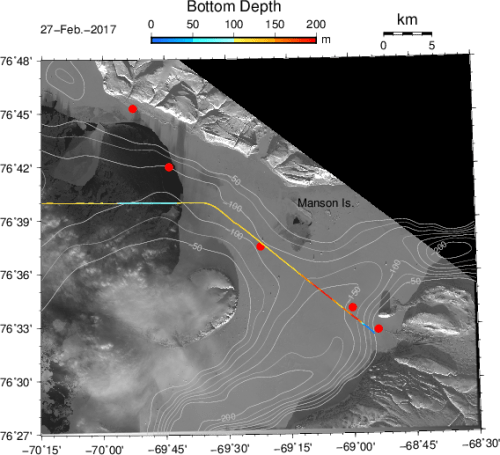
The clear skies over Thule during the 2 weeks that the sun is up again also gave me the first Landsat image. It shows the landfast sea ice, but it also shows its very limited extend as very thin ice and perhaps even open water occurs while the winds blow along the coast from the north. This cold wind moves the mobile sea ice offshore to the west thus opening up the oceans that will promptly freeze, however, the back ocean still shows under the inch-thin new ice:

Wolstenholme Fjord as seen by LandSat on Feb.-27, 2017. The line with the red dots extends from Thule pier seaward towards the north-west. Note the dark spot near the left-top corner that shows thin new ice or even open water. White contours are ocean depths in meters.

Wolstenholme Fjord as seen by LandSat on Feb.-27, 2017. The line with the red dots extends from Thule pier seaward towards the north-west. Note the dark spot near the left-top corner that shows thin new ice or even open water. White contours are ocean depths in meters.

This thin new ice is the limit of where I expect to be working. After measuring ice thickness directly via drilling through the ice, my first measurement will be that of how temperature and salinity varies from under the ice to the bottom of the ocean.

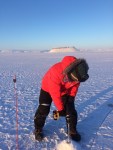
Working on the sea ice off northern Greenland [Photo credit, Steffen Olsen]

Working on the sea ice off northern Greenland [Photo credit, Steffen Olsen]

Danish friends do this routinely about 60 miles to the north where they work out of the Inughuit community of Qaanaaq, but Inglefield Fjord is much deeper and connects to warm Atlantic waters from the south that, I believe, we do not have in Wolstenholme Fjord. Hence I expect much less heat inside Wolstenholme Fjord and perhaps a different response of three glaciers to ocean forcing. This theory does not help me much as I will have to lower instruments via rope and a winch into the water. How to attach rope to instruments and winch? Knots.

I am very poor at making knots as my hand-eye co-ordination and memory is poor. So I spent some time this week to learn about knots such as

that should work on my braided Kevlar lines that I connect to shackles

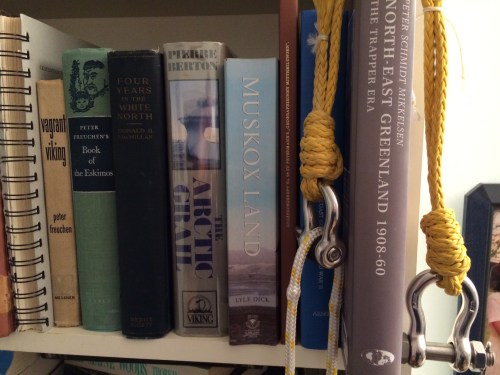
Fancy knots on shackles in my home office ... yes, Peter Freuchen is on the bookshelf, too.

Fancy knots on shackles in my home office … yes, Peter Freuchen is on the bookshelf, too.

There are always devils in the many details of field work. Another worry is that my 10” ice-drill is powered by 1 lbs bottles of propane. It is not possible to send these camping propane canisters via air, but larger 20 lbs tanks exist in Thule for grill cooking at the NSF dormitory where I will be staying. So I also will have to learn how to fill the smaller container from the large one. Just ordered another adaptor from Amazon to travel with me on my body to do this.

I am both terribly nervous and excited about the next 6 weeks. This is my first time working on the ice, because before I have always been on icebreakers in summer. These past Arctic summer expeditions on ships created an unreal and distant connection that, I hope, will be shattered by this spring. I will get closer to the cold and icy seas that are my passion. Oceanography by walking on water … ice.