Category Archives: Polar Exploration

Mapping North Greenland 100 years ago

Living off the land, Greenland’s early explorers ate their dogs, fungi, and roots of plants a few inches high to not starve to death. There is nothing romantic in the detailed reports of Knud Rasmussen, Peter Freuchen, and Lauge Koch that mapped in much detail coastlines, glaciers, and fjords of North Greenland between Thule in the west and Independence Fjord in the east. These Danes worked and lived closely with Inuit hunters and their families at what still is the northern edge of where a small number of people can survive by hunting seals, walrus, whales, and polar bears on the ice and musk ox, reindeer, and rabbits on land. Most people did not live as long and as well as we do now, because life and food were always in short supply.
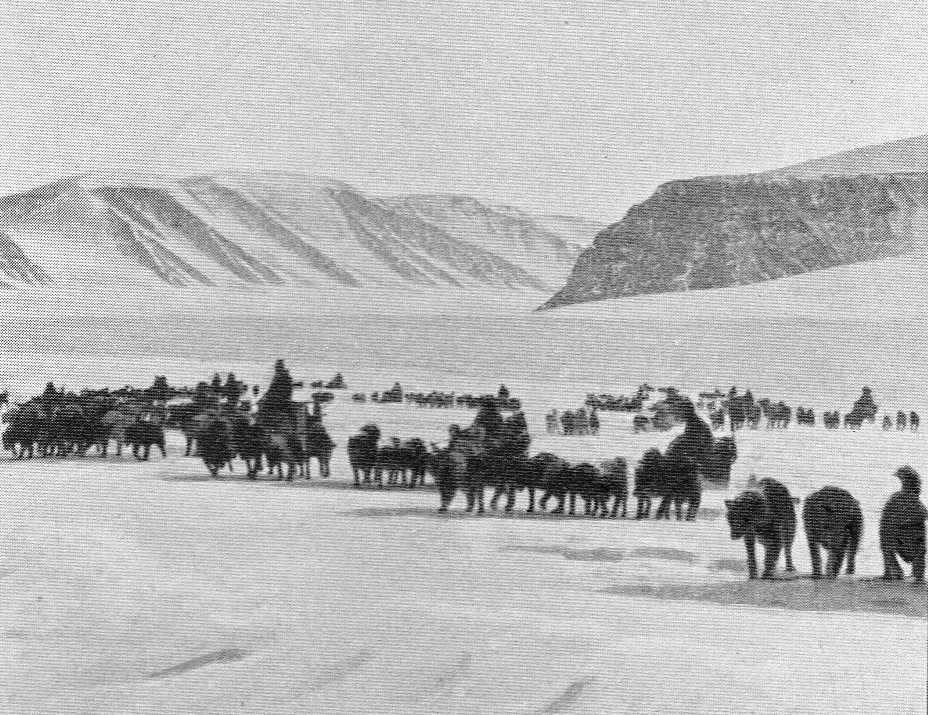
Ascent of the Inland ice in April 1912 as the First Thule Expedition starts from Clemens Markham's Glacier to Independence Fjord. All 4 explorers returned, but only 8 of the 54 dogs did.

Ascent of the Inland ice in April 1912 as the First Thule Expedition starts from Clemens Markham’s Glacier to Independence Fjord. All 4 explorers returned, but only 8 of the 54 dogs did.

I am reading the reports of the First Thule Expedition of 1912 (4 people), the Second Thule Expedition of 1917 (7 people), and the Bicentenary Jubilee Expedition of 1921 (4 people). Each person had its own dog sled team with 10-14 dogs per team. Knud Rasmussen and Peter Freuchen with Uvdloriaq and Inukitsoq successfully crossed the ice sheet in 1912 from east to west and back. Only 5 of the 7 members of the Second Thule Expedition returned, because Greenlander Hendrik Olsen disappeared while hunting wolves which may have killed him and the Swedish scientist Dr. Thorild Wulff starved to death when he gave up walking as witnessed by Lauge Koch and Inuit Nasaitsordluarsuk and Inukitsoq.
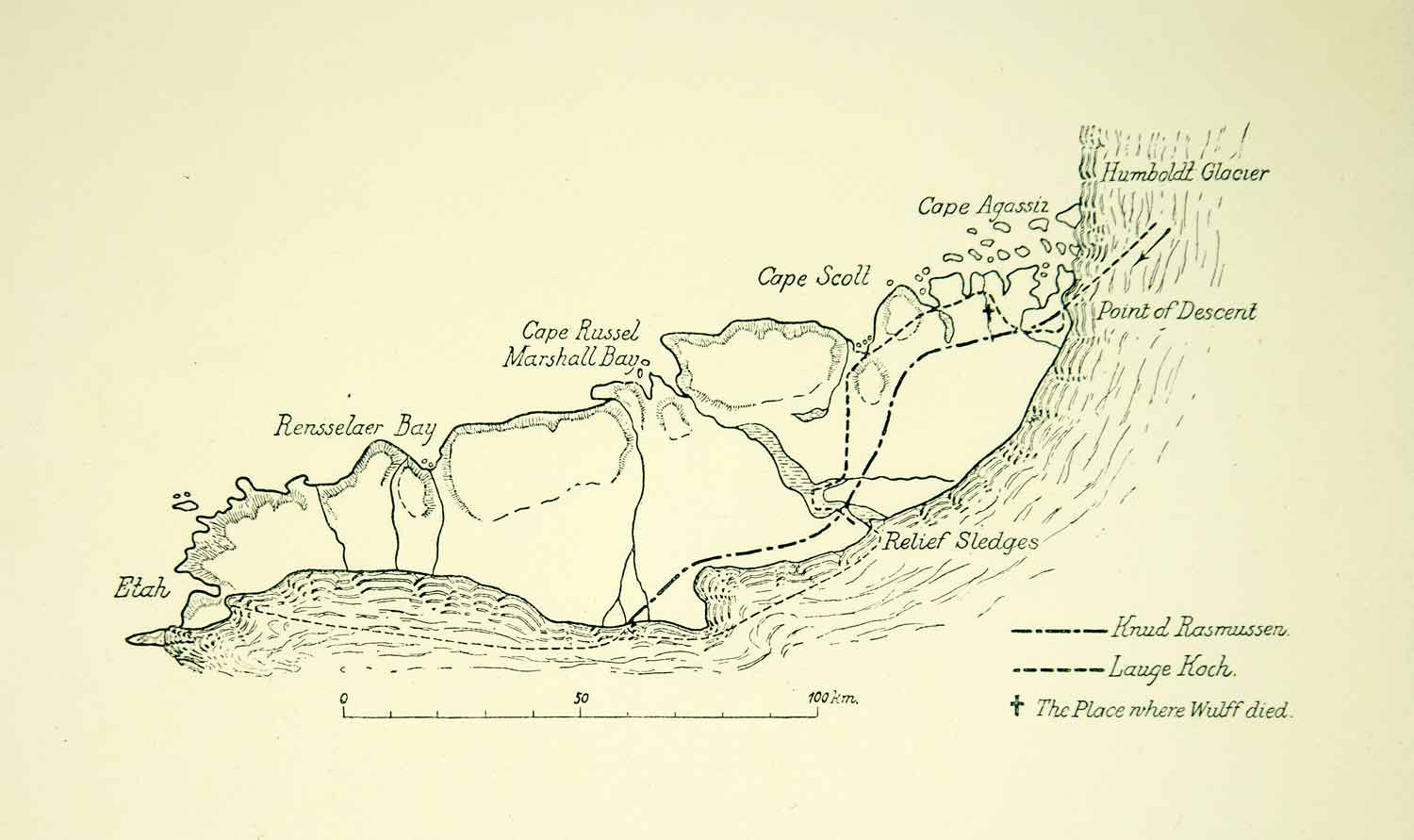
Map detail of Inglefield Land with tracks from Second Thule Expedition after leaving the ice sheet, from Rasmussen (1923). Humboldt Glacier is on the right with Kane Basin to the top.

Map detail of northern Inglefield Land with tracks from Second Thule Expedition after leaving the ice sheet with the location of Dr. Wulff’s death. Humboldt Glacier is on the right with Kane Basin to the top. From Rasmussen (1923).

This last death cast a life-long spell on Lauge Koch who never forgave Knud Rasmussen and Peter Freuchen for insisting on a formal Court of Inquiry in local Greenland and not remote Denmark to clear Lauge Koch of any wrong-doing. Both believed that Koch had acted properly when he choose to live and walk and not starve with Wulff, but they felt that local Inuit witnesses and local knowledge in Greenland would make the legal task to clear Koch easier sooner than a more removed Court in Denmark.
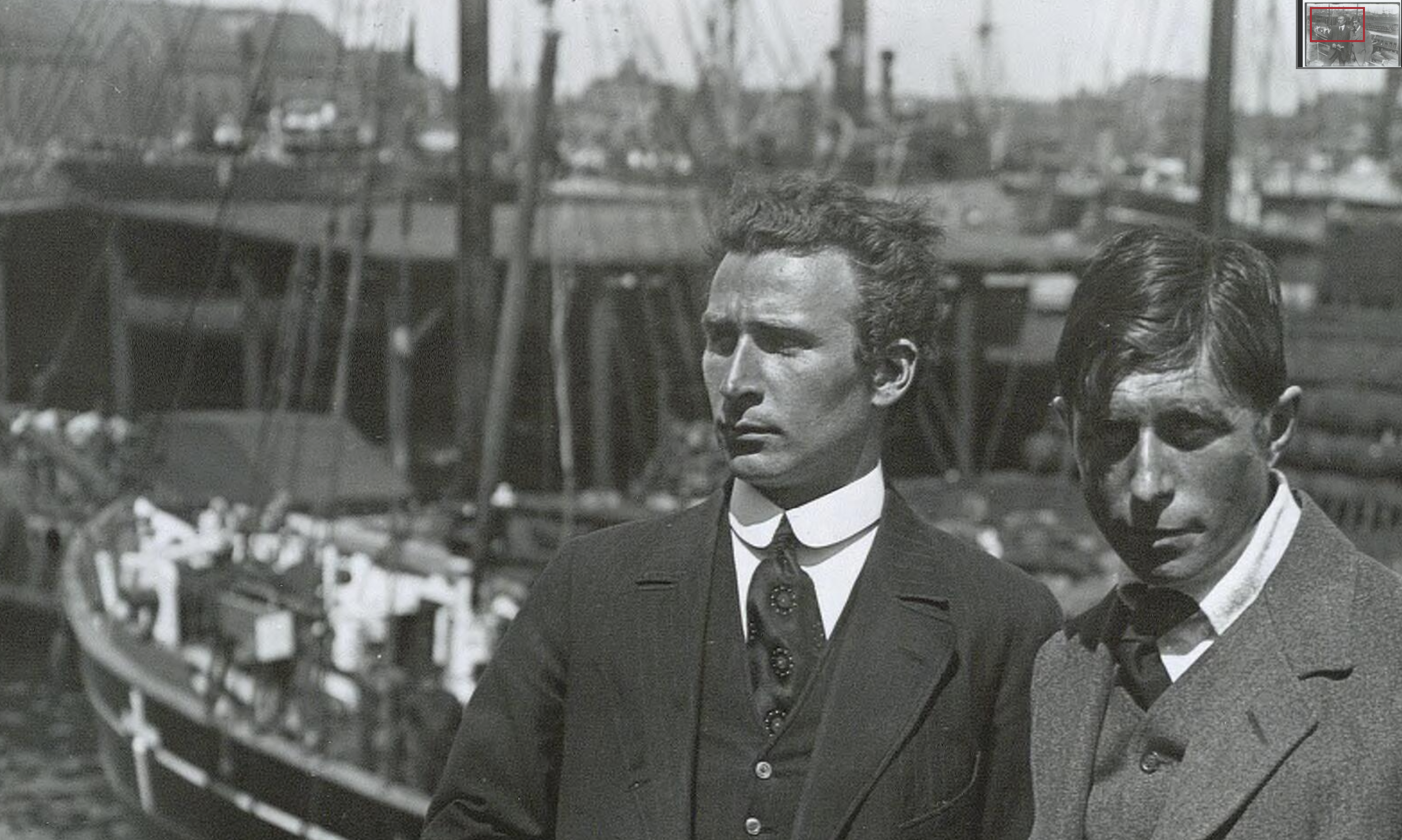
Knud Rasmussen (right) and Lauge Koch (left). [Photo: Holger Damgaard, National Library of Denmark.

Knud Rasmussen (right) and Lauge Koch (left). [Photo: Holger Damgaard, National Library of Denmark.

The Freuchen family on a visit to Denmark: Naravana, Pipaluk, Peter, and Mequsaq [Source: Freuchen, P., 1953: Vagrant Viking. Julian Messner Inc., NY, 312 pp.]

The Freuchen family on a visit to Denmark: Naravana, Pipaluk, Peter, and Mequsaq [Source: Freuchen, P., 1953: Vagrant Viking. Julian Messner Inc., NY, 312 pp.]

These Danish expeditions represent the second phase of exploration of North Greenland after the quest of national glory to reach the farthest north by British and Americans was settled when Robert Peary claimed to have reached the North Pole in 1909. The many American and English expeditions through Nares Strait from about 1853 (Elisha Kane) had relied on native guides, hunters, and polar skills, but the sheer number of whites and their massive material wealth change both local cultures and wildlife. For example, the early Europeans and American explorers provided guns and new technologies which were traded for furs, clothing, and local knowledge of survival. In return Inuit families provided food, clothing, and native polar technologies. These often proved crucial for survival as demonstrated by Joe Eberling and Hans Hendrik with their families who kept 18 people alive for 6 months in 1873 when their party of British and German men was stranded on an ice floe drifting more than 1800 miles to the south until they were picked up by a whaling ship off Labrador.

After the “Imperial” expeditions ended with the “conquest of the North Pole” in 1909, the local Inuit were left without contact to southern material goods such ammunition for their guns until Knud Rasmussen and Peter Freuchen privately founded the Thule Trading Post in Westenholme Fjord. Their goal was to set up a base to support their aspiration to explore and map northern Greenland via small expeditions and to show a link between Denmark and the people living in what was then called the Thule district of Greenland. Their choice of location was excellent and even today, Thule is still the hub to get to northern Greenland by ship or by air. I traveled through Thule in 2003, 2006, 2007, 2009, 2012, and 2015 as I boarded US, Canadian, or Swedish icebreaker at this only deep water north of the polar circle outside Scandinavia.
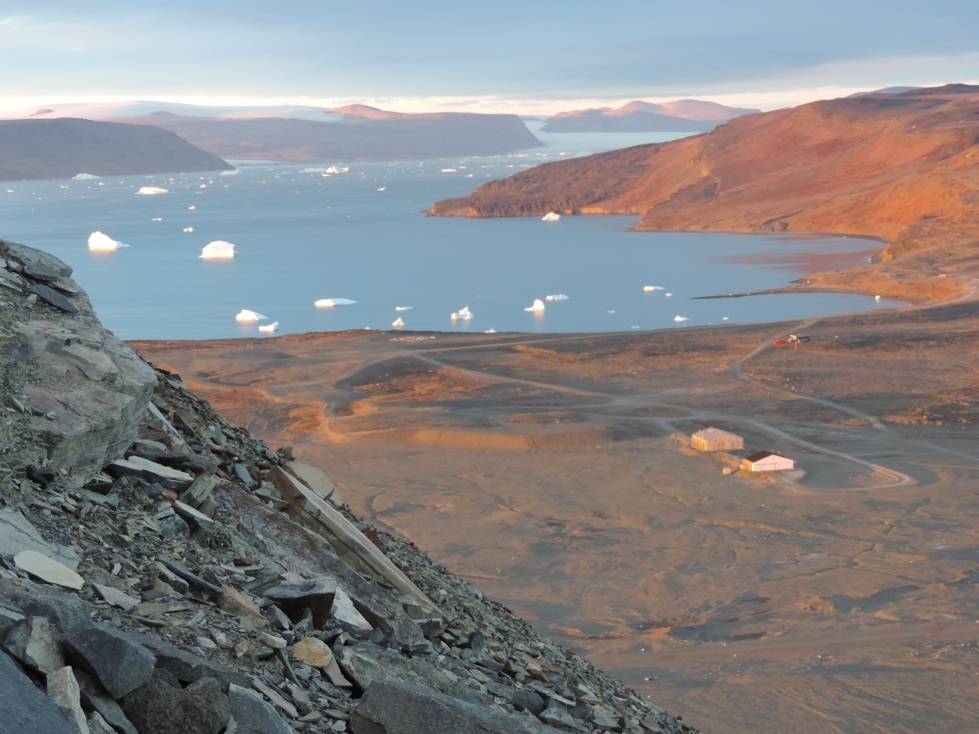
Inner section of Westenholme Fjord to the north-east of Thule AFB as seen on the descent from Dundas Mountain during sunset on Sept.-2, 2015,

Inner section of Westenholme Fjord to the north-east of Thule AFB as seen on the descent from Dundas Mountain during sunset on Sept.-2, 2015,

Peter Freuchen, Lauge Koch, and Knud Rasmussen were all in their 20ies and 30ies when they traveled across a harsh, unvisited, and at times beautiful landscape. Despite local help, skill, and knowledge to adapt to this environment, Greenland almost killed them by starvation or accident as it did to some of their companions. They all were excellent writers and communicators who found the moneys to pay for their adventures in creative ways. Knud died young in 1933 at age 54 in Copenhagen while Peter buried his Inuit wife Navarana in 1921 when he was only 35 years old, but lived another 36 years. Lauge Koch became an international academic authority on the geology and geography of Greenland until he died at age 72 in 1964. They all lived rich, admired, and controversial lives with their writing, their maps, their loves, and above all their frail humanity.

Maps of North Greenland before (top) and after (bottom) the First and Second Thule Expeditions from Rasmussen (1923).

Maps of North Greenland before (top) and after (bottom) the First and Second Thule Expeditions from Rasmussen (1923).

Freuchen, P., 1953: Vagrant viking, my life and adventures, Julian Messner, Inc. New York, NY, 312 pp.

Hendrik, H, 1878: Memoirs of Hans Hendrik, the Arctic traveler serving under Kane, Hayes, Hall, and Nares 1853-1876, reprinted in Cambridge University Press, Cambridge, UK, 100 pp.

Koch, L., 1926: Report on the Danish Bicentenary Jubilee Expedition north of Greenland 1920-23, 232 pp.

Rasmussen, K., 1912: Report of the First Thule Expedition 1912.

Rasmussen, K., 1923: Greenland by the Polar Sea: The story of the Thule Expedition from Melville Bay to Cape Morris Jesup, Frederick A. Stokes Company, New York, NY, 328 pp.

Ghosts of Discovery Harbor: Digging for Data

Death by starvation, drowning, and execution was the fate of 19 members of the US Army’s Lady Franklin Bay Expedition that was charged in 1881 to explore the northern reaches of the American continent. Only six members returned alive, however, they carried papers of tidal observations that they had made at Discovery Harbor at almost 82 N latitude, less than 1000 miles from the North Pole. Air temperatures were a constant -40 (Fahrenheit or Celsius) in January and February. While I knew and wrote of this most deadly of all Arctic expeditions, only 2 days ago did I discover a brief 1887 report in Science that a year-long record of hourly tidal observations exist. How to find these long forgotten data?

My first step was to search for the author of the Science paper entitled “Tidal observations of the Greely Expedition.” Mr. Alex S. Christie was the Chief of the Tidal Division of the US Coast and Geodedic Survey. He received a copy of the data from Lt. Greely. His activity report dated June 30, 1887 confirms receipt and processing of the data, but he laments about “deficient computer power” and requests “two computers of standard ability preferable by young men of 16 to 20 years.” Times and language have changed: In 1887 a computers was a man hired to crunch numbers with pen and paper.

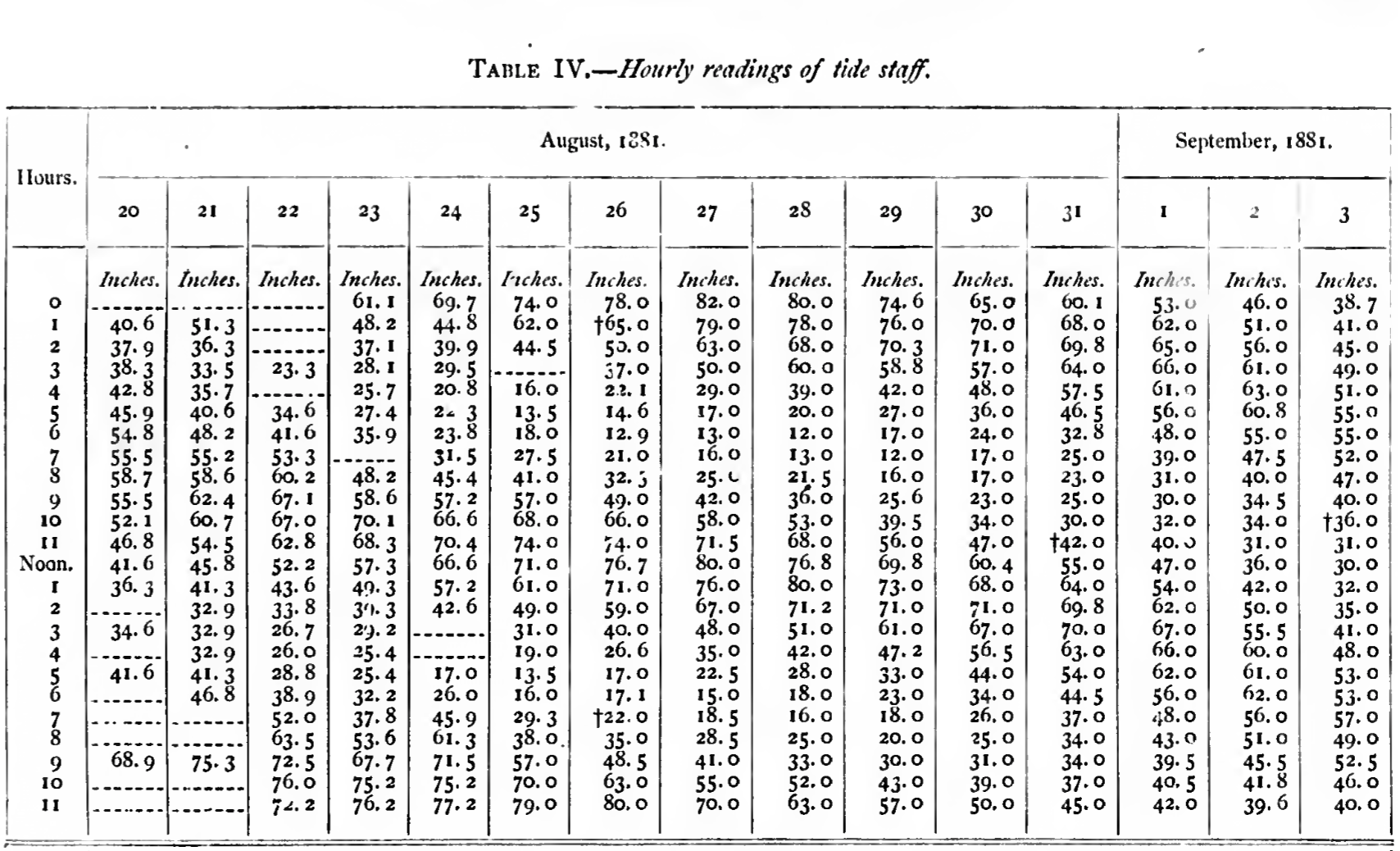
Data table of 15 days of hourly tidal sea level observations extracted from Greely (1888).

Data table of 15 days of hourly tidal sea level observations extracted from Greely (1888).

While somewhat interesting, I still had to find the real data shown above, but further google searches of the original data got me to the Explorer’s Club in New York City where in 2003 a professional archivist, Clare Flemming, arranged and described the “Collection of the Lady Franklin Bay Expedition 1881-1884.” This most instructive 46 page document lists the entire collection of materials including Series III “Official Research” that consists of 69 folders in 4 Boxes. Box-4 File-15 lists “Manuscript spreadsheet on Tides, paginated. Published in Greely (1888), 2:651-662” as well as 3 unpublished files on tides and tide gauges. With this reference, I did find the official 1888 “Report on the United States Expedition to Lady Franklin Bay” of the Government Printing Office as digitized from microfiche as

https://archive.org/details/cihm_29328

which on page 641 shows the above table. There are 19 more tables like it, but at the moment I have digitized only the first one. Unlike my colleagues at the US Coast and Geodedic Survey in 1887, I do have enough computer power to graph and process these 15 days of data in mere seconds, e.g.,

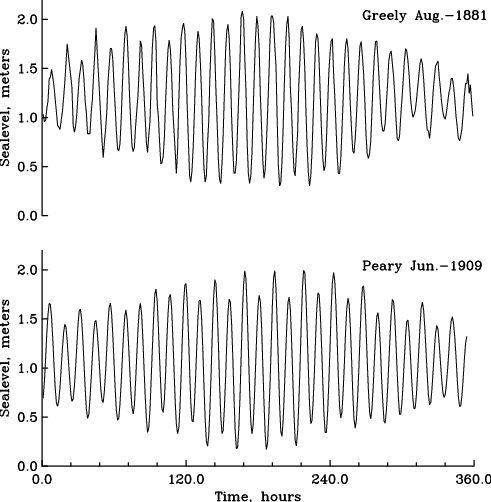
Hourly tidal observations at Discovery Harbor taken for 15 days by Greely in 1881 and Peary in 1909.

Hourly tidal observations at Discovery Harbor taken for 15 days by Greely in 1881 and Peary in 1909.

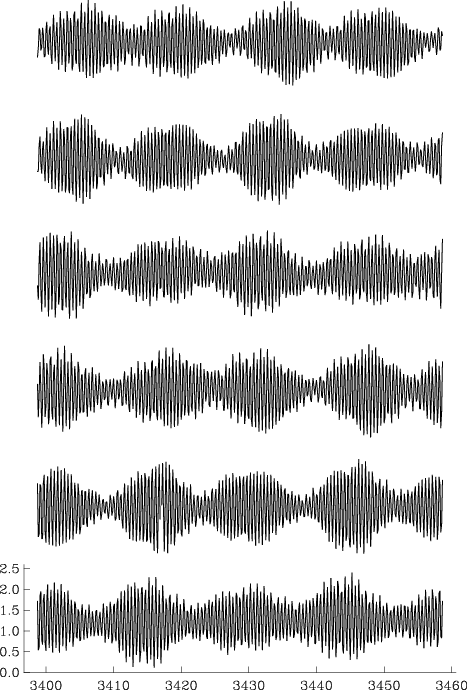
A more technical “harmonic” analyses reveals that Greely’s 1881 (or Peary’s 1909) measured tides at Discovery Harbor have amplitudes of about 0.52 m (0.59) for the dominant semi-diurnal and 0.07 m (0.12) for the dominant diurnal oscillation. My own estimates from a 9 year 2003 to 2012 record gives 0.59 and 0.07 m for semi-diurnal and diurnal components. This gives me confidence, that both the 1881 and 1909 data are good, just have a quick look at 1 of the 9 years of data I collected:

Tidal sea level data from a pressure sensor placed in Discovery Harbor in 2003. Each row is 2 month of data starting at the top (August 2003) and ending at the bottom (July 2004).

Tidal sea level data from a pressure sensor placed in Discovery Harbor in 2003. Each row is 2 month of data starting at the top (August 2003) and ending at the bottom (July 2004).

There is more to this story. For example, what happened to the complete and original data recordings? Recall that Greely left Discovery Harbor late in the fall of 1883 after supply ships failed to reach his northerly location two years in a row. This fateful southward retreat from a well supplied base at Fort Conger and Discovery Harbor killed 19 men. Unlike ghostly Cape Sabine where most of the men perished, Discovery Harbor had both local coal reserves and musk ox in the nearby hills that could have provided heat, energy, and food for many years.

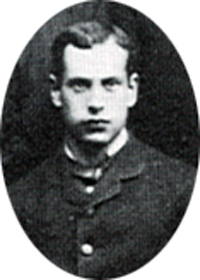
It amazes me, that a 1-year copy of tidal data survived the death march of Greely’s party. It took another 18 years for the complete and original records to be recovered by Robert Peary who handed them to the Peary Arctic Club which in 1905 morphed into Explorer’s Club of New York City. I suspect (but do not know), that these archives contain another 2 years of data that nobody but Edward Israel in 1882/83 and the archivist in 2003 laid eyes on. Sergeant Edward Israel was the astronomer who collected the original tidal data. He perished at Cape Sabine on May 29, 1884, 25 years of age.

Edmund Israel, astronomer of the Lady Franklin Bay Expedition of 1881-1884.

Edmund Israel, astronomer of the Lady Franklin Bay Expedition of 1881-1884.

References:

Christie, A.S., 1887: Tidal Observations of the Greely Expedition, Science, 9 (214), 246-249.

Greely, A.W., 1888: Report on the Proceedings of the United States Expedition to Lady Franklin Bay, Grinnell Land, Government Printing Office, Washington, DC.

Guttridge, L., 2000: The ghosts of Cape Sabine, Penguin-Putnam, New York, NY, 354pp.

Below Petermann Glacier: The First 100 Days

I am still stunned to see data coming to me hourly from below a glacier in northern Greenland while I sip my breakfast coffee. Each and every day for the last 100 days I got my data fix from the Ocean Weather Station that was born 100 days ago. Every morning at 8:15 the station sends me data from 5 ocean sensors below the glacier. A year ago I did not even know that I would be going to northern Greenland with the Swedish icebreaker I/B Oden in the summer of 2015, never mind that we would be able to pull off the engineering challenge to set up the first and only ocean observing system of Greenland. Today, I am over-joyed to report, we got 100 days of data.

IMG_3029

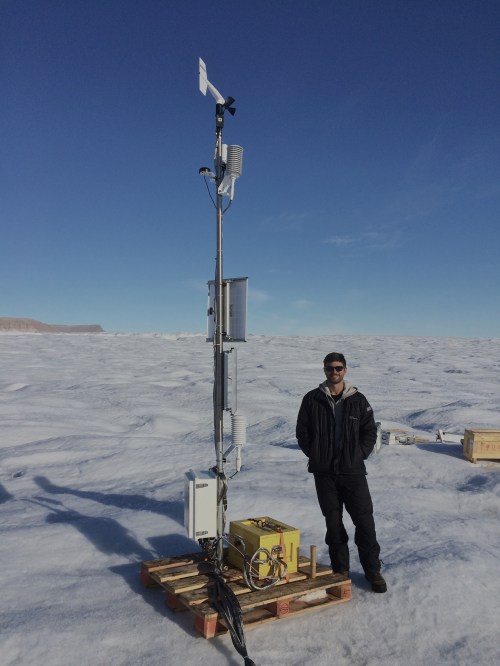
University of Delaware PhD student Peter Washam at the Ocean-Weather station on Petermann Gletscher after final installation 2015-Aug.-20, 17:00 UTC at 80 39.9697 N and 60 29.7135 W.

It all started when a French PhD student approached me at a scientific meeting in San Francisco last December. Céline is a now a doctor of oceanography, but at the time she was not. At the meeting Dr. Céline Heuzé of the University of Gothenburg in Sweden asked me for data and insights on how the ocean circulation in Nares Strait worked, so that she could connect results from planned field work in northern Greenland to her science interests in the Labrador Sea more than 1000 miles to the south. She also introduced me to Dr. Anna Wåhlin and the three of us got very excited about Petermann Fjord, Sweden, and polar oceanography. Here we are in Sweden preparing and off Greenland working:

A few weeks prior the US government and Sweden had just agreed to work together on a joint expedition to Petermann Fjord in northern Greenland. Friends at Oregon State University needed a ship to collect data with which to reconstruct and understand changes of the land- sea-, and ice-scape of North Greenland during the last 10,000 to 50,000 years. They wanted to uncover where past glaciers were located and where sea level was at that time. For this, they needed many sediment cores from the adjacent ocean, fjord, and below the floating glacier. Today this glacier is as thick as the Empire State Building in Manhattan is high. The British Antarctic Survey (BAS) agreed to drill the holes, collect the sediment samples, and take a profile of ocean properties from below the glacier ice to the bottom of the ocean. They estimated it would take about 5 days to drill each hole. Our idea was to use these holes to keep sensors, computers, and satellite phones in place to collect hourly data into the future as long as possible … 100 days so far.

After the Dec.-2014 San Francisco meeting we decided to use these holes to measure ocean temperature, salinity, and pressure for as long as the batteries would last, about 3-4 years, but I had neither money, cables, data logging computers, nor satellite phones to do any of this, only the ocean sensors. When I told Keith Nicholls of BAS about the idea and my predicament, he said that he could find some computers and satellite phones from experiments he had done in Antarctica. I then said that I would organize cables, a weather station, and some funds to pay for it.

A crowd-funding experiment in February failed to generate funds, but NASA came to the rescue by opening a way to compete for the needed $60,000 to cover the cost of hardware, travel, and satellite phone charges. The funds allowed us to ship about 1200 pounds of gear from Delaware to Sweden where it had to be loaded onto the ship in May of 2015. We did not have much time to built the system and had no time left to test it. Two drums of cable arrived with only 5 hours to spare before the ship left Sweden in June for Greenland. We met the ship in Thule, Greenland in July.

Fast-forward to the 20th of August 2015 when our ocean observing system went into the salty ocean waters below Petermann Gletscher. The surface weather station with satellite connections was deployed 10 days earlier to test satellite communications and collect weather data for Oden’s extensive helicopter flight operations on and around the glacier. It included a rushed visit by a large team from CBS News 60 Minutes who were flown and shown all over the place. We last saw the station during 24 hours of day light on 27th August when we calibrated the wind sensors, but to me the daily satellite phone call of the station with new data is a sign of life from an ocean outpost that survived another day in the total darkness of the polar night. It draws energy from two car batteries that run even at the -36 degree Centigrade (-33 F).

AWS

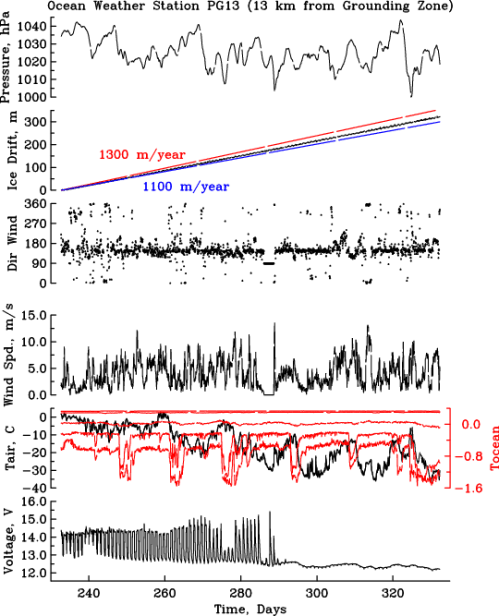
First 100 days of ocean and weather observations from the University of Delaware Ocean Weather Station on Petermann Gletscher, Greenland. Panels show (from bottom to top) time series of 1. battery voltage, 2. ocean (red) and air (black) temperatures, 3. wind speed, 4. wind direction, 5. glacier movement, and 6. atmospheric pressure. Time is given in year-day, Nov.-28 is Day-332. The sun set on Day-290 or Oct.-17.

New data are posted at

http://ows.udel.edu

which over the next few weeks we will develop into a web-site to distribute the daily observations to everyone. I am most thankful to many of scientists, engineers, technicians, sailors, and women in England, Sweden, and the United States of America, but this Thanks-Giving weekend I am grateful to the men and women of a great nation that gave me a place to study, work, and live doing while exploring ocean and now glacier physics as well.

EDIT: I just discovered this 7 minute video on our expedition, credits go to Saskia Madlener at 77th Parallel Productions:

https://vimeo.com/145664210

Tribal Interactions and Arctic Research

Arctic field work connects people of different backgrounds, disciplines, and tribes. Last week I spent 3 days in Maine where I met with Arctic archeologists, anthropologists, and students of all ages. Susan Kaplan and Genevieve LeMoine run the Arctic Peary-McMillan Museum and do extensive field work in Labrador, Cape Sheridan atop Ellesmere Island (Canada), and northern Greenland. A class of smart sophomore asked more questions than I could answer in the morning and a diverse group of citizen did the same in the evening. I represented the “physics tribe.”

We learnt of each other after I posted an illustrated essay “Ruins of Fort Conger” that contained this image taken near Petermann Fjord in 2012

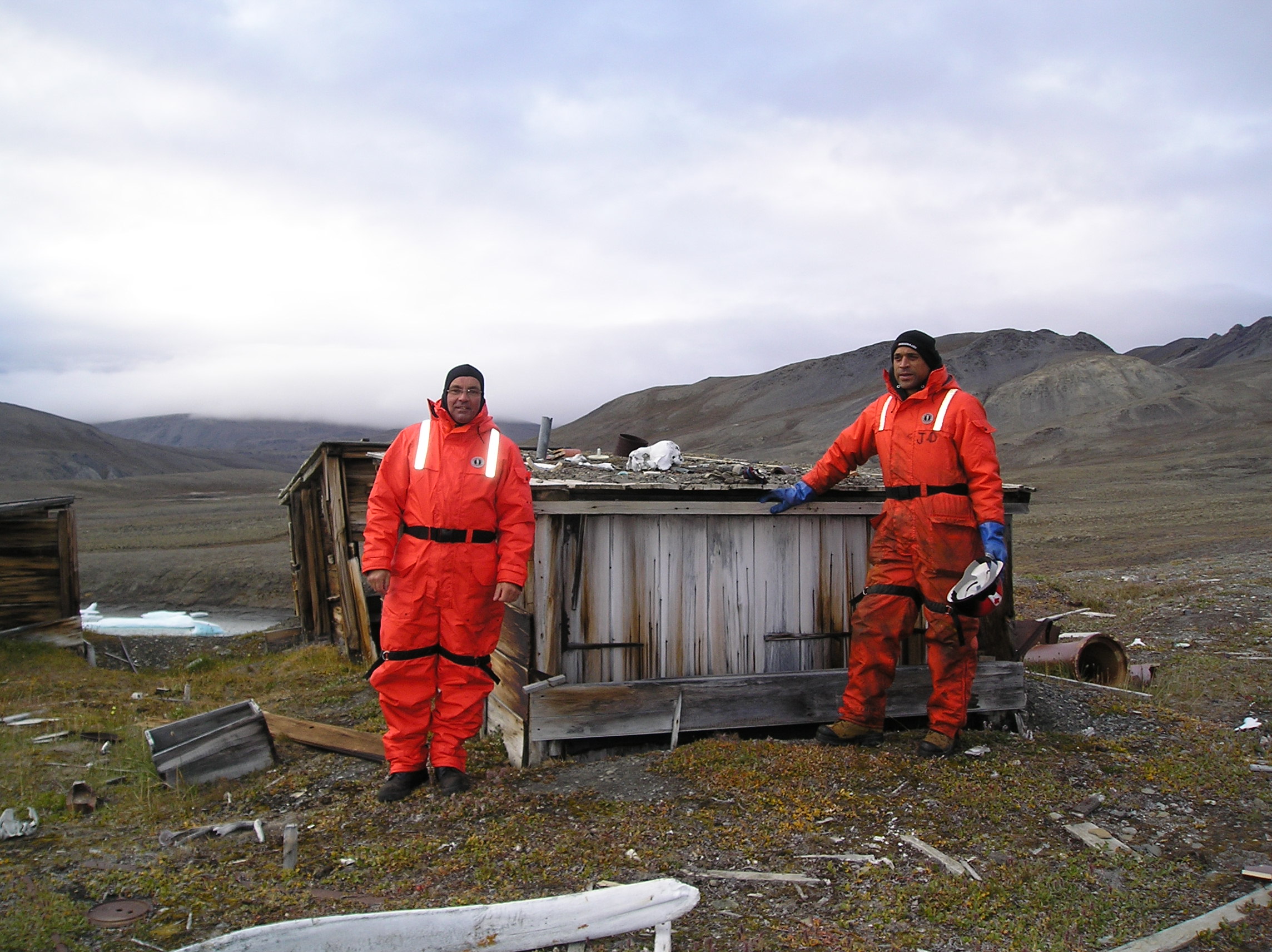
Fort Conger rebuilt 1900 by Peary

Carl Rose on the left was a seaman on our last 2012 expedition while Jonathan Poole is a marine field technician with whom I work often. They stand before a hut built by Admiral Robert Peary in 1900 on one of his early excursions to reach the North Pole. The 2012 photo bears remarkable similarity to one taken in 1909 that Genevieve LeMoine describes on her blog with title “Tides of the Arctic.”

Donald MacMillan and Jack Barnes at Fort Conger, spring 1909 [From LeMoine, 2013]

Donald MacMillan and Jack Barnes at Fort Conger, spring 1909 [From LeMoine, 2013]

It shows Donald McMillan and Jack Barnes in 1909 during a later Peary expedition. The pictures and histories are displayed at the “Glimmer of the Polar Sea” exhibition at the Bowdoin’s Peary-McMillan Arctic Museum. These huts are the closest “shelter” to Petermann Fjord about 50 miles to the east. The men visiting Fort Conger in 1909 and 2012 look towards the ocean which in 2012 looked like this

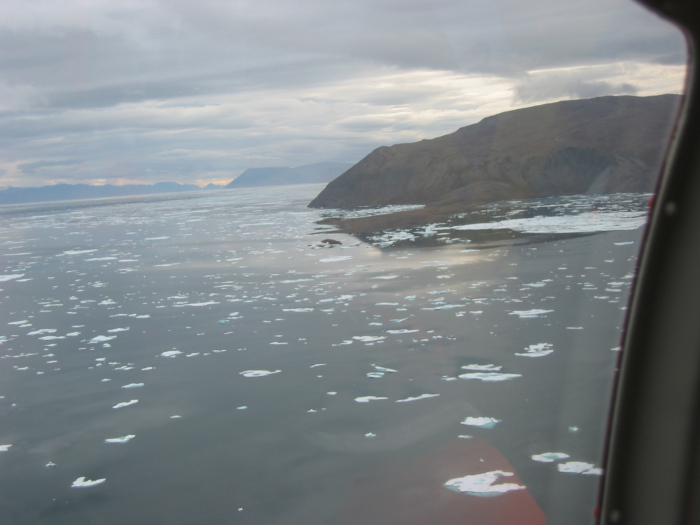
Discovery Harbor off Fort Conger, Ellesmere Island as seen from helicopter in 2012.

Discovery Harbor off Fort Conger, Ellesmere Island in 2012.

We visited the site in 2012 to recover an ocean sensor that, so we hoped, had measured tides and temperatures for 9 years earlier. For 9 long years we had no way to tell, if either sensor or data existed. Only after recovery in 2012 did we jubilantly find sensors and data. At the time we deployed this sensor in 2003 technology did not exist to get data out from the ice-covered ocean. We are trying to develop technology to change this. The non-trivial goal is to get such data out as it is collected without waiting for 9 years. That’s what my crowd-funding project is about: Develop new technologies and share all data, results, and excitement.

If funded, this project will produce results immediately as ocean temperatures (and salinities) will be transmitted to the word wide web for anyone to use as she or he sees fit. Please help and be part of the cutting edge of Arctic Oceanography: Tell your friends, tell your family, and tell your colleagues about the science, about the Arctic, about the beauty, about the climate, and about the physics of the ocean.

Men and Women on the Edge 1

EDIT: Original post was too long and rambling. One advice by wise female council, I decided to turn this into two separate posts. This is the first. July 5, 2014.

The “Quiet American” is not a popular book in the United States of America, but to me it described the dilemma and dangers of being American very well. Continue reading