Category Archives: Oceanography

Oceanography of Petermann Fjord and Glacier Melting

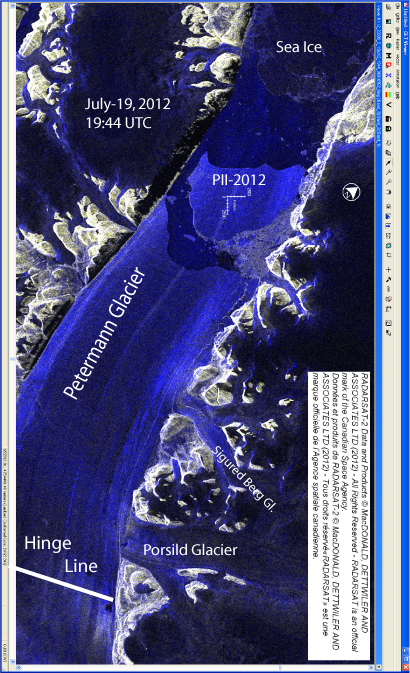
Trudy Wohlleben just send a group of scientists in Denmark, England, Canada, and the US the latest RADARSAT image of the ice island that formed in Petermann Glacier earlier this week.

RadarSat Image of Petermann Ice Island (PII-2012) and Glacier kindly provided by Trudy Wohlleben, Canadian Ice Service. The location of the hinge line is approximate only.

The current position of the remaining ice shelf of Petermann Glacier is the farthest landward since recorded observations. Dr. Croppinger was the first to provide a map of the glacier Continue reading

Petermann Glacier, Ice Islands, and Changing Climate

Petermann Glacier is a tidewater glacier in the remote north-west of Greenland. The glacier is grounded at about 600-m below sea level. It has calved two large ice islands, a 4-Manhattan sized island in 2010 and a 2-Manhattan sized one in 2012. These losses cover much of the area shown in this 2009 photo:

Eastern wall of Petermann Fjord as seen from CCGS Henry Larsen’s helicopter in August 2009 with the floating ice shelf. Most of the visible ice shelf has been lost during the 2010 and 2012 calving events. [Photo Credit: David Riedel, British Columbia.]

From selected imagery, I created a short movie (0.7 MB) which shows (a) the 2010 calving, (b) the advance of the new front in 2011 and early 2012, and (c) the 2012 calving. The glacier has moved at a rate of about Continue reading

Petermann Ice Islands Stuck in Ice

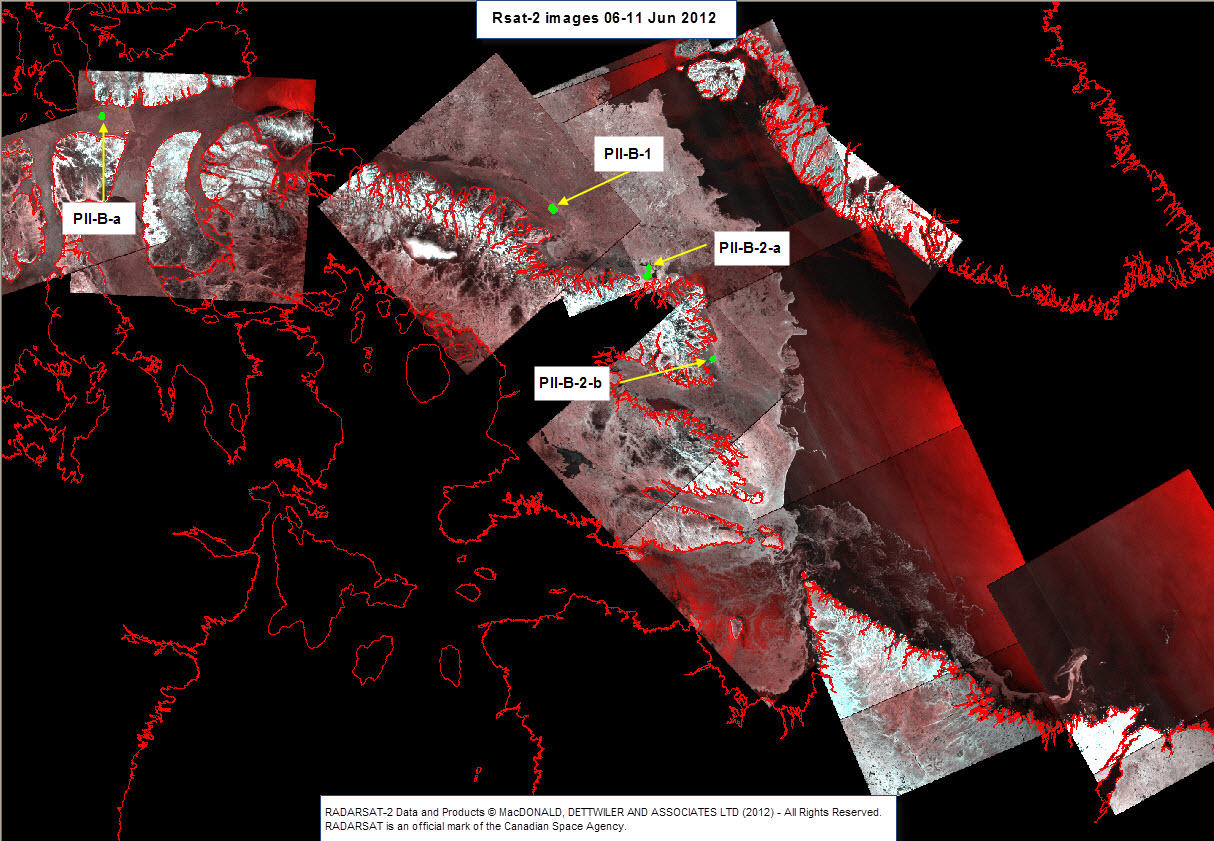
Several pieces of the Manhattan-sized ice island that broke off Petermann Glacier, Greenland in 2010 arrived, dispersed, and melted off Newfoundland last summer. They provided stunning displays visible to the naked eye from the coast. The Canadian Ice Service just distributed this set of radar images showing 4 pieces that are all grounded and/or stuck in ice. None are moving.
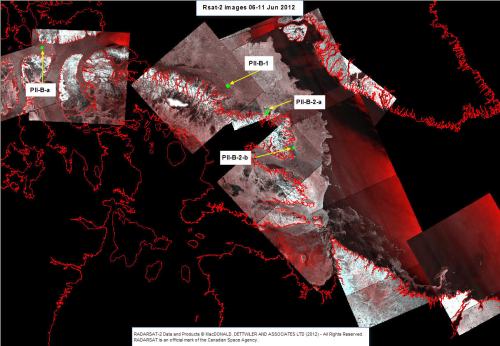
Overview of fragments of Ice Islands that broke off Petermann Glacier, Greenland in 2010 as of June-11, 2012 from RadarSat composites. [Credit: Luc Desjardins, Canadian Ice Service]

In the open ocean ice is moved by winds stressing the ice from above and by ocean currents stressing the ice from below. Typical sea ice varies in thickness from 1-5 meters (3-15 feet) which is much less than the 30-130 meters (90-400 feet) thick ice islands. Winds thus push thick ice islands much less than they do push the thinner sea ice. Thick ice islands are moved by ocean currents, not winds.

This is why oceanographers like myself love these bits of ice islands to bits: they tell us about the ocean below the surface that satellites do not see, but, sadly, all fragments are stuck either to the seafloor in shallow coastal waters or are cemented in place by immobile sea ice that is “land-fast:” Think of it as ice that is glued to land and to each other. This sheet of glued-together ice extends some distance offshore. The distance can be a few yards during a cold winter night in Maine or 100s of miles off Siberia. Offshore islands, rocky outcroppings, or grounded ice islands all anchor land-fast ice by adding local support and thus strength and stability to the immobile land-fast ice.

Too much talk, lets explain this with an image of the largest ice islands, called PII-B1. It is about 4 km wide and 9 km long. I dropped a black dot in its center as it is hard to see where to look in this image. I also show land in grey, open water in blue, and ice in shades of white and yellow:
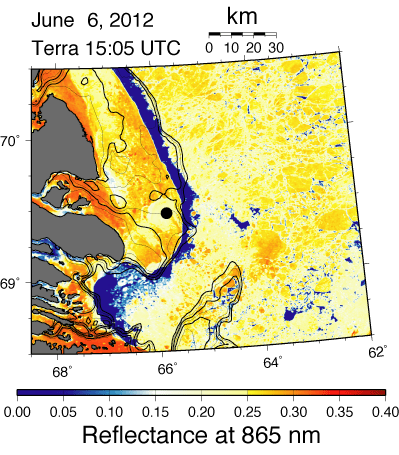
Land-fast and mobile sea ice off Baffin Island with Petermann Ice Island PII-B1 grounded near the 150 meter isobath (black dot). Thick lines are 100, 200, and 300-m bottom depths. MODIS Terra data at 250-m resolution from June-6, 2012, 15:05 UTC.

There is clearly a 30-km wide band of ice attached to the land with a line of blue water separating it from ice that is mobile and has different signatures. A blue band of ocean has emerged, I speculate, as the result of winds from the south that moved the mobile ice to the north-east (to the right in the image). Neither the land-fast nor the grounded ice island PII-B1 embedded in it moved, so open water appears where there was mobile ice before. This is called a shore lead and I bet there are plenty of seals and whales feasting there now. Note also the arched entrance to Home Bay (bottom left) where loose ice is scattered towards the headland of Henry Kater Peninsula.

As summer is arriving fast in the Arctic, the land-fast ice will disappear, breaking up as the sun and air above and the ocean below weakens the ice by melting. This will expose the thicker ice islands and icebergs to wind-forced storms and waves more violently than it does now. And even those ice island grounded to the bottom of the ocean in shallow water will become free during a time of higher than normal sea level, perhaps during a spring tide, perhaps during strong winds from the north. Then these currently stuck-in-the-ice ice islands will continue their journey south towards Newfoundland and the Atlantic Ocean that they began in 2010 when they were born in northern Greenland.

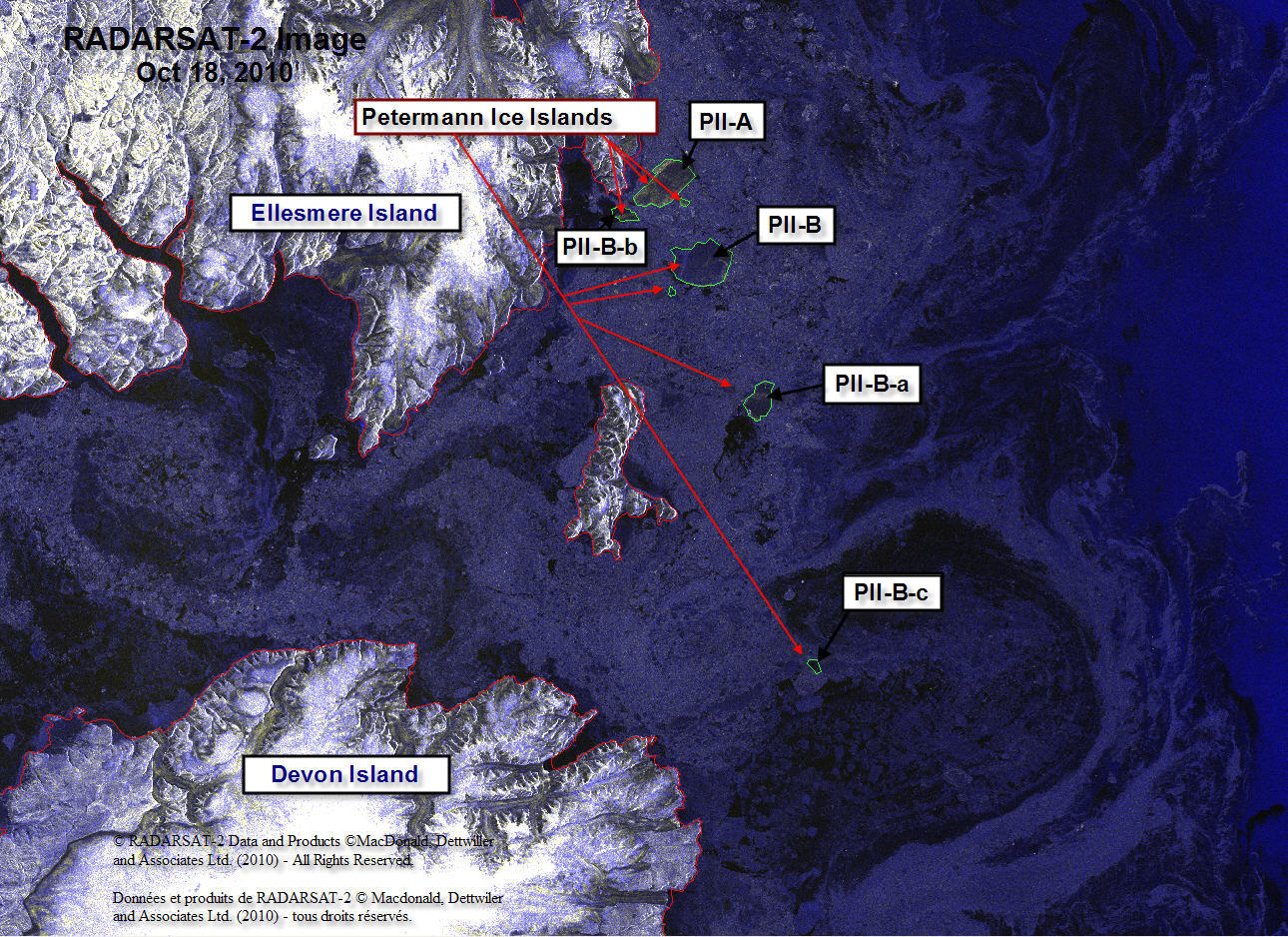
EDIT: For context I append an earlier RadarSat image from October-18, 2010 when all segments were much closer in space.
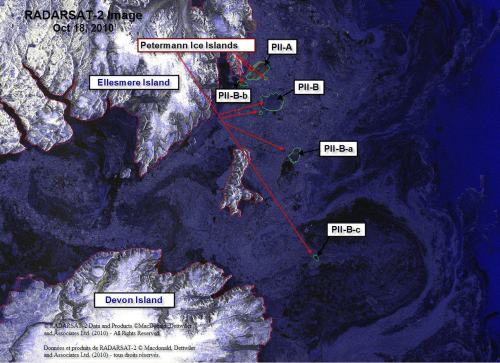
Petermann Ice Islands in northern Baffin Bay of Coburg Island, Canada at 76 N latitude on Oct.-18, 2010, about 2 month after they separated from Petermann Glacier, Greenland at 81N latitude. [Credit: Luc Desjardins, Canadian Ice Service]

Ice Arches and Gothic Cathedrals

Soaring towards heaven awash in light, Gothic Cathedrals awed medieval kings, jesters, and peasants alike. Their upward pointing arches allowed walls of stained windows to filter light into these massive buildings when most dwellings from royal castle to decrepit hut were dark, damp, and filthy. While the power of god was both invoked and abused, it was physics and engineering that allowed these cathedrals to scrape the skies. A delicate balance of forces is of the essence to avoid accelerations and collapse.

Arched windows within an arch inside the Cathedral of Reims, France.

Hence it should not surprise that ice arches buttressed by land show similar elegance and stability, but also dramatic collapse. When these ice arches form and collapse is one factor to determine when the Arctic Ocean will be free of ice in summer.

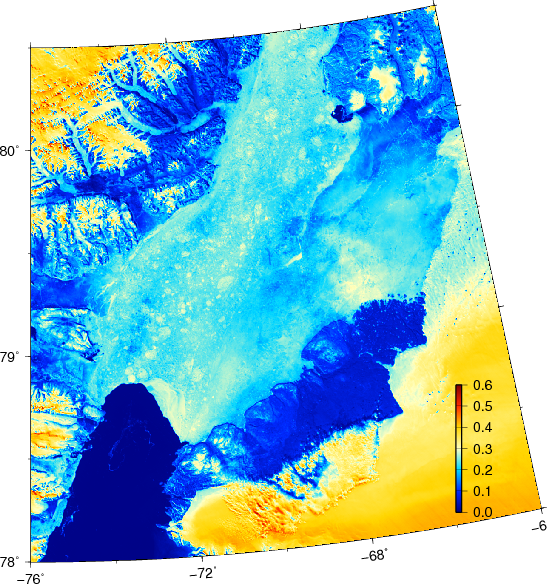
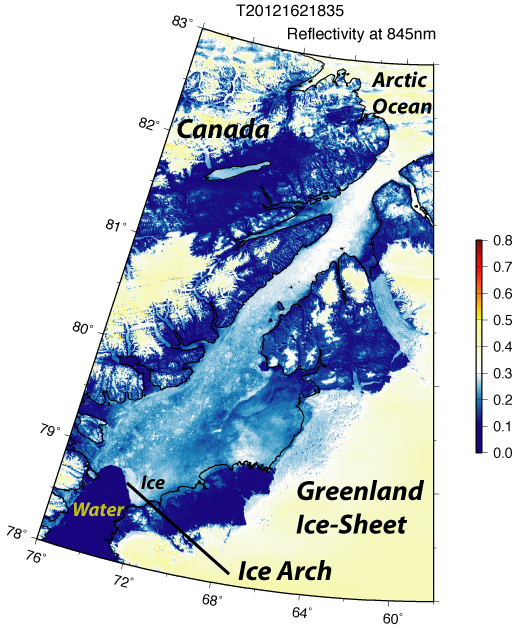
June-10, 2012 ice arch in Nares Strait between northern Greenland and Canada. The arch has been in place since Dec.-8, 2011.

Nares Strait Jun.-10, 2012 image showing land-fast ice between northern Greenland and Canada as well as the ice arch in the south (bottom left) separating sea ice from open water (North Water).

The Nares Strait ice arch forms between December and April most winters. Unlike the medieval cathedrals it consists of blocks of ice. Once in place, the arch shuts down all ice movement. The ocean water under the ice moves undisturbed southward sweeping newly formed ice away. This creates the North-Water polynya, first reported by William Baffin in his ship logs in 1616. The North Water supports wild life for millenia providing food and trading items for people. Even viking remnants from the time the first Gothic Cathedrals were built in Europe were found here: sections of chain mail, iron point blades, cloth, and boat rivets.

I want the ice arch in Nares Strait to collapse as soon as possible so that a Canadian ice breaker can get us to where we like to recover instruments and data that we deployed in 2009. And while I researched the stability of ice arches and studied Moira Dunbar’s 1969 satellite imagery, I came across a wonderful NOVA broadcast on medieval skyscrapers of glass and stone.” PBS stations will show it on Sept.-9, 2012.

Digging a little deeper, I also found a series of Open University podcasts and videos. My favorite 3-minute segment covers lines of thrust where barely connected irregular blocks of wood form a surprisingly stable yet wobbly arching bridge. If you want to build your own arch, then play interactively for fun with the physics of stone arches.

Since I want to understand and predict when the ice arch of Nares Strait collapses, I must understand how medieval architects and engineers designed their Gothic Cathedrals. I will also need understand why some cathedrals are still standing while others collapsed. My icy building blocks in Nares Strait are not as solid as the stones of Reims Cathedral, but unlike the medieval scientists, today we have computers and mathematics to help … as well as more than 800 more years of experience in science and engineering.

Moira Dunbar, Arctic Exploration, and Women in Science

Throughout history, the ocean has been the domain of sea monsters, Neptune and men. The women found in nautical history are portrayed as distractions or a sailor’s connection to land.  Robert Louis Stevenson only wrote one female character in Treasure Island, Jim Hawkins’ mother, who only briefly graces the pages with her presence.  Pirates and sailors alike did not tolerate women on ships except for a captain’s wife, mistress, or daughter.

This attitude towards women in sailing continued even after American women were given the right to vote in 1920. Born 2 years earlier in Scotland, Moira Dunbar was an extraordinary woman fighting for her right to go to sea in the name of science.

Originally from Edinburgh, Dunbar emigrated to Canada in 1947, where she studied ice movement for the Joint Intelligence Bureau of Canada. She later moved to the Defense Research Board in 1952, where she fought notions that a woman couldn’t go to the Arctic on reconnaissance planes of the Royal Canadian Air Force. She co-authored Arctic Canada From the Air with Keith R. Greenaway in 1956. She logged over 600 flight hours and became the first woman to sail as part of a science crew on board a Royal Canadian Navy icebreaker.

The M/V Calanus as seen August 2007 in Iqualuit (formerly Frobisher Bay) on Baffin Island. Moira Dunbar published hydrographic data collected off Baffin Island from this ship in 1958.[Photo Credit: Andreas Muenchow]

Moira Dunbar persisted in breaking through barriers traditionally placed on her gender, blazing a trail for women in science and research. She wasn’t satisfied with standing by idle while her male colleagues went to the Arctic to study, in person, what she was researching, so she made her own way.

Since Dunbar’s entrance into the world of polar science, women have faced fewer challenges entering scientific fields, but are still underrepresented. Men occupied 74% of science and engineering jobs in the United States in 2006 according to a 2011 National Science Foundation (NSF) study. Within the sciences, even fewer women are in physical sciences and engineering.

Even though these statistics may appear daunting to a woman entering the sciences, there is good news: the number of women in science and engineering has been increasing steadily for a long time. From 1979 to 2008, the number of women and minorities as a percentage of full-time, full professors with science and engineering doctorates has more than quadrupled.

Every year, more women enter the sciences and my experience reflects this: entering Macalester College, St. Paul, MN in 2009 as a first-year female physics major, I found not a single woman in the graduating class. In contrast, I can now name at least 5 beside myself. And in such a small major (only 15-20 students), 5 is quite a large number. Women are heading out into the world of science, just as Moira Dunbar did more than 60 years ago. I know many women working on ships in both the Pacific and Atlantic Oceans as skippers, scientists, cooks, and engineers, and I am looking forward to boarding a Canadian Coast Guard Vessel later this summer for some Arctic research myself.