Author Archives: Andreas Muenchow

Pine Island Glacier on the Move

Pine Island Glacier, Antarctica, is the focus of a large observational effort to better understand how glaciers and floating ice shelves interact with the ocean.

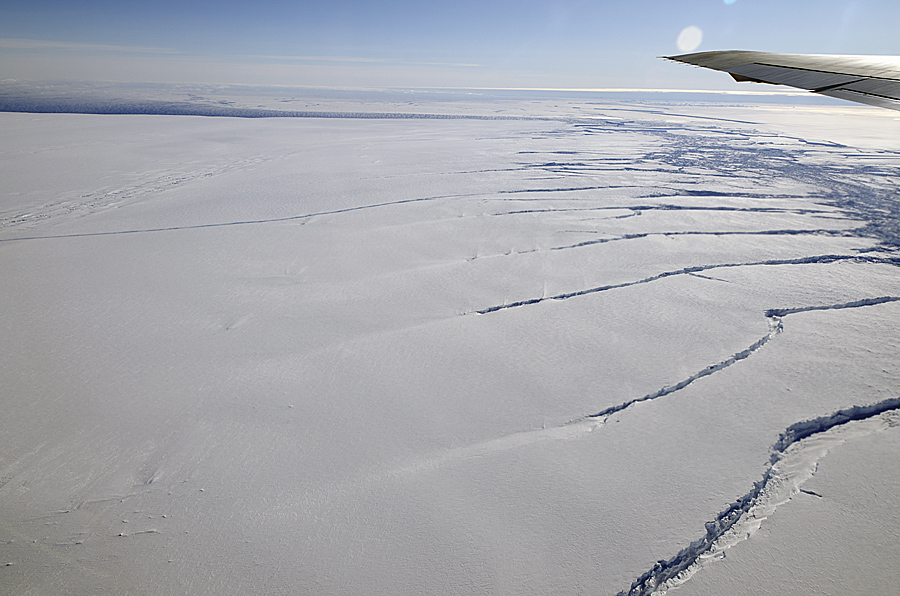
Pine Island Glacier (view is to the north, ocean in the top left) with crevasses and large crack extending from the east (right) to the west (left) as seen from aboard NASA's DC-8 research aircraft in October 2011. Credit: Michael Studinger/NASA

Scientists, pilots, technicians, and students working with NASA’s IceBridge and NSF’s Antarctic programmes tried hard for several years now to reach this glacier, set up a base, and drill through the 400-600 m thick ice shelf to reach the ocean. The data from these gargantuan efforts will reveal physics of ice-ocean interactions. This process is poorly represented in the climate models that are used to project past and present climates into the future. Harsh and hostile conditions cut these efforts short today, again, as reported by OurAmazingPlanet.

The expedition leader, NASA’s Dr. Bindschadler wrote today, that

A decision had been made by NSF the day we left McMurdo that if the helos were not able to be flown to PIG by Saturday, January 7, this year’s field work would be cancelled … We worked through our cargo—some had not been seen for two years when we tested our equipment at Windless Bight—preparing for either helos or the Twin Otter to start moving us onto the ice shelf. Neither came. Weather worsened.

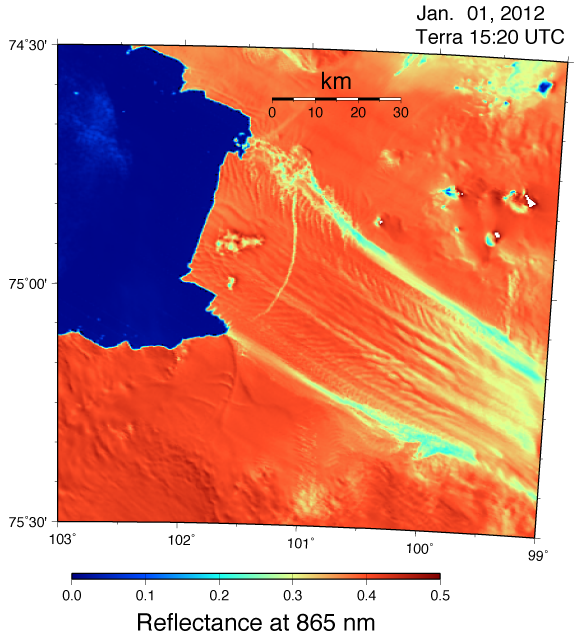
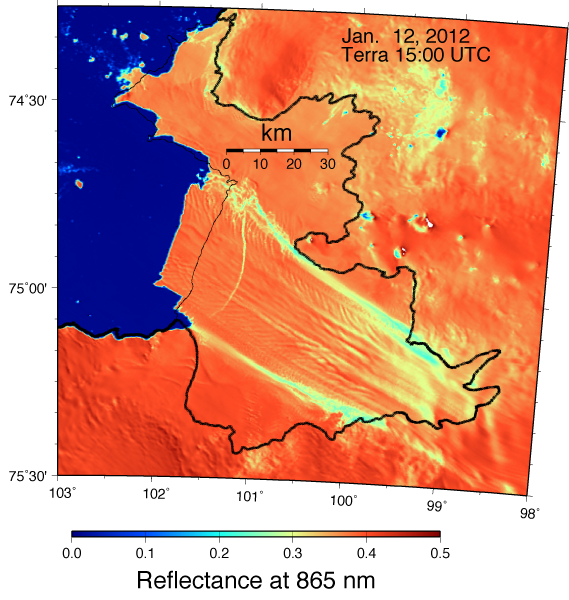
Despite this dramatic turn of events, skies were clear over Pine Island Glacier today as they on New Year Jan.1, 2012. Two MODIS images show detailed features at 250-m resolution. I here show the near infra-“red” signals that the satellite receives (865 nm). The dark ocean reflects little of red (low reflectance) as it is all absorbed while the bright snow and ice reflects lots of red (high reflectance). Recall that the color “white” looks white, because it reflects all colors into our eyes including red, while “black” absorbs all colors, so none are left to reach our eyes.

Pine Island Glacier and Bay, Antarctica on Jan.-1, 2012 as seen by MODIS Terra, notice the whitish crack near the center of the image.

I show lots of the near infra-“red” as, well, red, and I color little red as blue. I chose the colors of the “crayons” to do the coloring. The technical term for this is contouring. Formally, I am depicting a function f=f(x,y) where f is the amount of red and x and y are locations east and north, respectively.

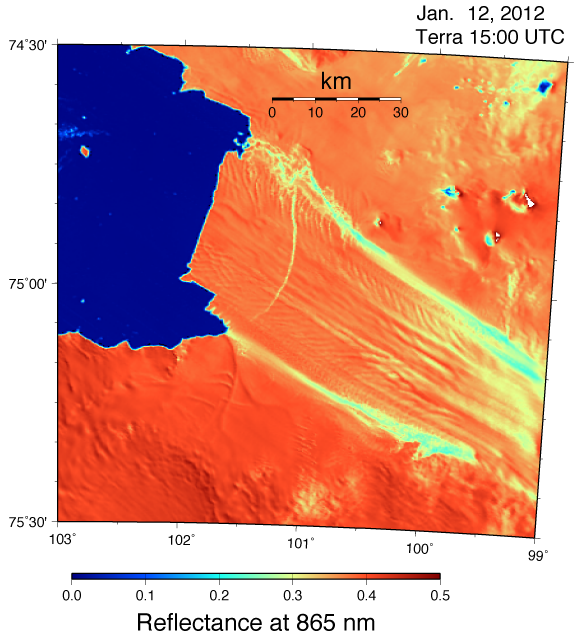
Pine Island Glacier and Bay, Antarctica on Jan.-12, 2012 as seen by MODIS Terra, notice the whitish crack near the center of the image.

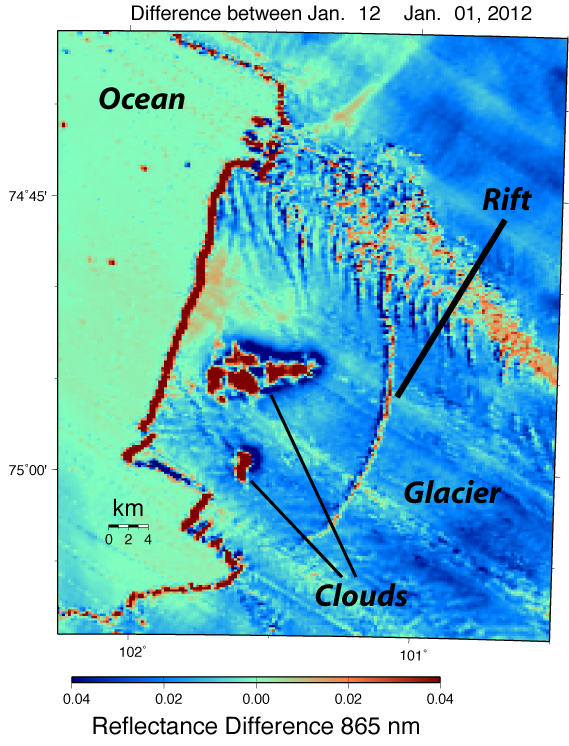
They almost look the same, don’t they? If they were identical, then the difference would get zero. Except, glaciers move, especially this one. It is also about to spawn a large ice island. A crack was first reported in Oct.-2011 by scientists aboard a DC-8 of a NASA Icebridge flight. This crack is also widening as, I speculate, the front moves faster seaward of the crack than it does landward. My question is if I can see movements in these easily accessible public MODIS images. And my first answer, to be refined later, is 80 meters per day plus or minus 50%:

Difference of reflectance by subtracting Jan.-1 reflectances from those on Jan.-12, 2012. Very dark red colors show large positive numbers, meaning that the ice occupies a place on Jan.-12 that was water on Jan.1.

I am neither a glaciologist nor a remote sensing person, so I may be running a few red lights differencing two images and assign meaning to it. For example, I estimate the speed at which the front of the glacier moves by dividing the width of the very dark thick red line (about 1 km wide) by 12 days to get 80 meters per day or 3.5 meters per hour. The error here is at least 2 pixels (500-m), about half the estimated speed. My assumption here is that the high reflectance on Jan.-12 at a location with a low reflectance on Jan.1 means that the “bright” glacier has moved to a place that was “dark” ocean before. There is more to this, but I have to start somewhere.

Incidentally, Dr. Bindschadler, the leader of the current Pine Island field project who had to leave the base camp near Pine Island Glacier today, is the very person who wrote a wonderful peer-reviewed paper in 2010 with the title “Ice Sheet Change Detection by Satellite Image Differencing.” I will need to study it more closely … along with the vagarities of field work in polar regions.

It is difficult to get data from the field as opposed to data from remote sensing or modeling. This is especially true for remote and hostile locations the ice and the oceans interact. It is frustrating to be sent home early because of inclement weather and the very narrow window of opportunity when the few available helicopters and planes can fly or the ships can sail near Antarctica and Greenland.

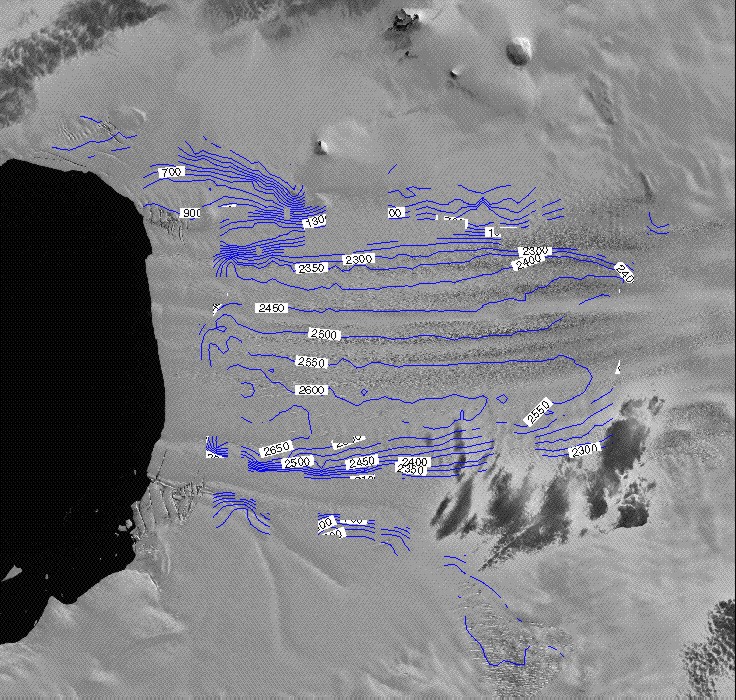
EDIT Jan.-13: The National Snow and Ice Center estimated speeds of Pine Island Glacier as determined from two LandSat images from 1986 and 1988:

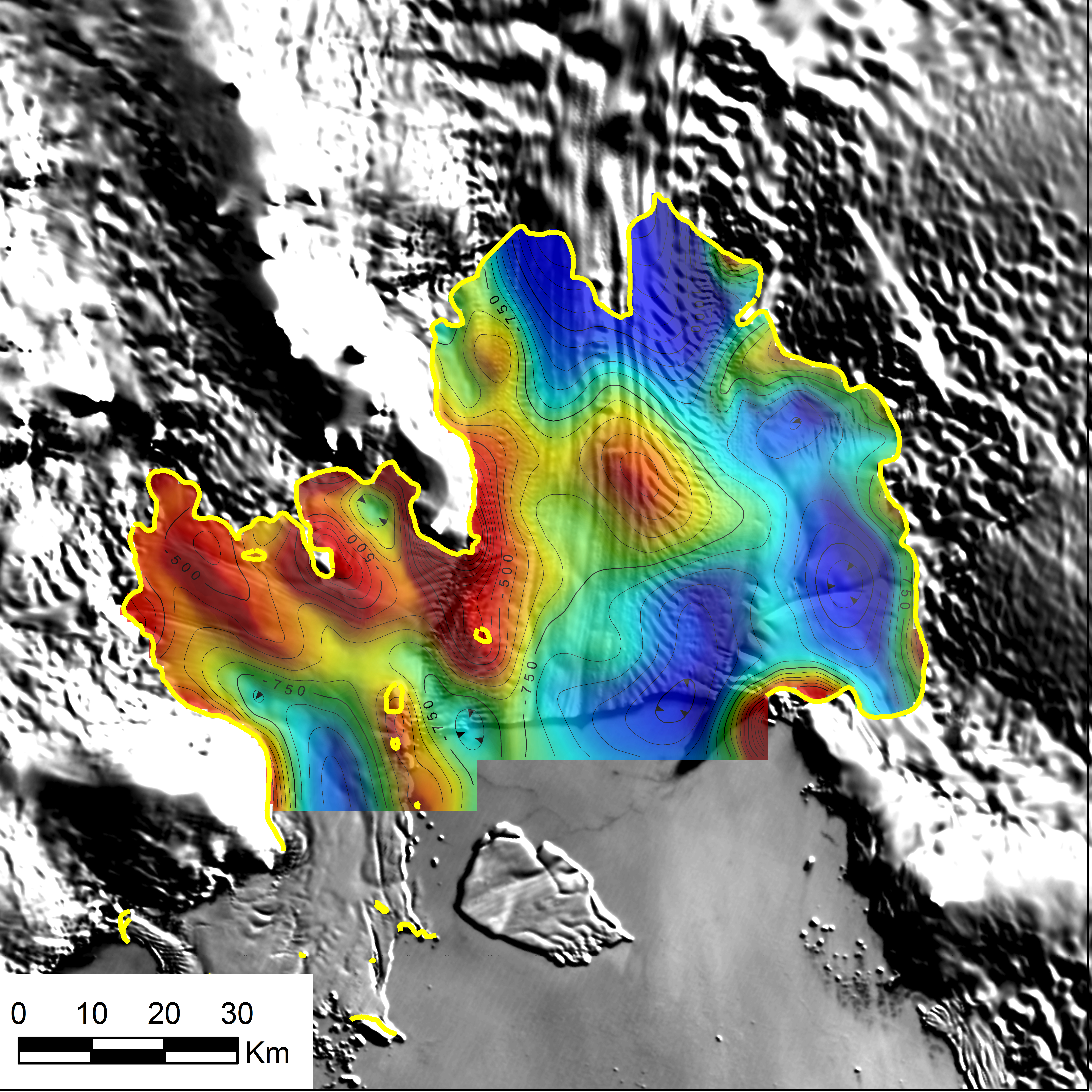
Contours of glacier speeds in meter per year of Pine Island Glacier from 1986 and 1988 LandSat Imagery, National Snow and Ice Center

These speeds are very different, 2-3 km per year versus 1 km in 12 days. The former estimate is made from 2 carefully geolocated images 2 years apart without a crack across the floating glacier, while my estimate yesterday is more noisy, but it is for a segment of the glacier that is barely connected to it. Perhaps we should consider the segment seaward fo the crack a separate ice island that is moving with the ocean rather than the glacier?

Melting Greenland’s Icebergs and Ice Islands by the Ocean

The BBC keeps asking good and penetrating questions about the fate of Greenland’s many icebergs in general and Petermann Glacier’s Ice Island in particular. A poor telephone connection across the Atlantic this morning prevented an interview, but made me answer a number of questions in writing. When answering these questions, I was thinking of those icebergs and ice islands one finds in abundance in the frigid waters of Baffin Bay, the Labrador Sea, and next to Greenland. I am not talking about what happens once icebergs enter the subtropical Atlantic Ocean and meet the Gulf Stream to the south of the Grand Banks, that is a different story.
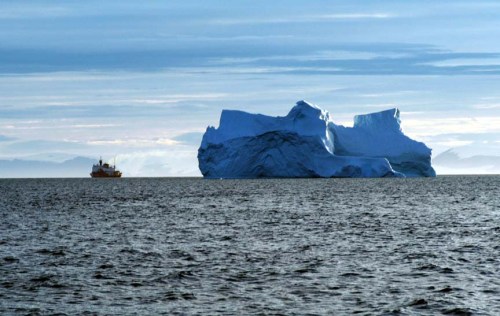
USCG Healy besides massive iceberg in northern Baffin Bay, July 2003

1. What can icebergs tell us about oceans?

Icebergs are particles that track averaged ocean currents over the top 200-m or so. These currents are often refered to as “geostrophic” currents which is really a different word for an ocean force balance between pressure gradients (estimated from measurements of temperature and salinity changes with depth at many locations) and the Coriolis force due to the earth’s rotation. This is why RADM Edward H. “Iceberg” Smith of the US Coast Guard spent so much time sailing and taking measurements off northern Canada in the 1920ies and 1930ies as part of the International Ice Patrol. His outstanding publications 80 years old are a first example on how to apply theory (the Scandinavian or Bergen School of the 1920ies regarding dynamical physical oceanography) to a very specific application.

2. How does the trajectory of the ice-islands/ and other icebergs show information about the ocean currents?

Ice islands and icebergs are thick (50-200 m) and mostly submerged below the surface. Hence they are largely moved by the ocean currents about 30-200 m below the surface. I think of them as ocean drifters with a very large and deep drogue element that changes with time as the iceberg melts or tips over. This is different from sea ice that may reach only 5-m into the water column and thus only “sees” the very surface layer of the ocean that is largely influenced by winds. This is not entirely true for icebergs, because they are driven by ocean currents below the thin (10-20 m) ocean “mixed layer” that sea ice is embedded in.

3. What are the current unknowns or poorly understood parameters with regards to iceberg science and iceberg interactions with oceans in the High Arctic?

I think the problem with any prediction scheme of individual particles is that the ocean always has a strong turbulent and unpredictable part to it. This problem is fundamentally no different from trying to predict where oil from a spill will come ashore. We can do it “on average” rather well, but we are very poor trying to do in one specific case for a specific iceberg (or spill). Oh, this certainly also applies to climate predictions, easy to do “on average,” very hard to do in a specific case for a specific time and place that may be affected.

4. What sort of temperatures would the water be?

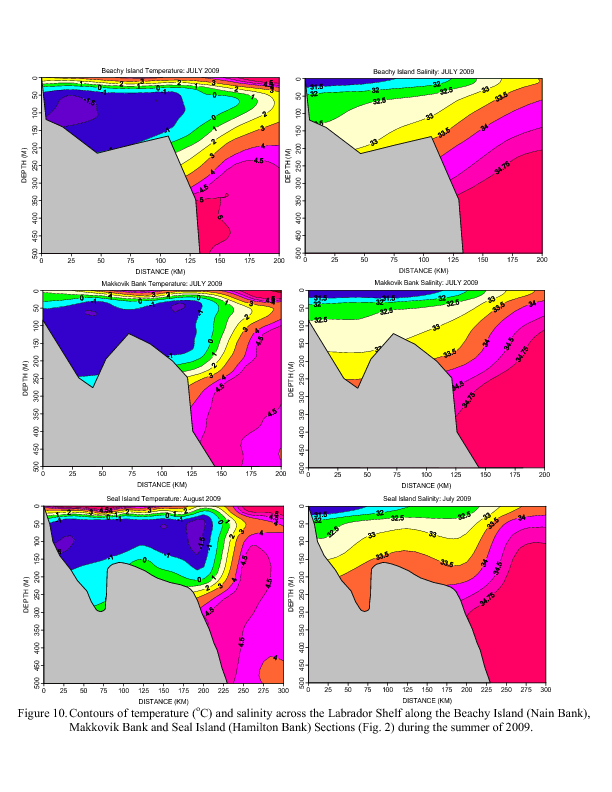
Meltwater plumes at zero salinity with pieces of ice floating in it have a temperature of 0 C, meltwater plumes with pieces of ice in it at ocean salinities have temperatures of about -1.8C, depending on the amount of sunlight and how much mixing takes place, these fresh and very thin surface layers (1-10 meters) can heat up substantially fast, and cool just as fast. In June/July you have 24 hours of sunlight, so temperatures of 4-10 C are not out of the ordinary, but these waters will do very little melting, because most of the mass is well below a 10 m depth of such fresh surface plumes.
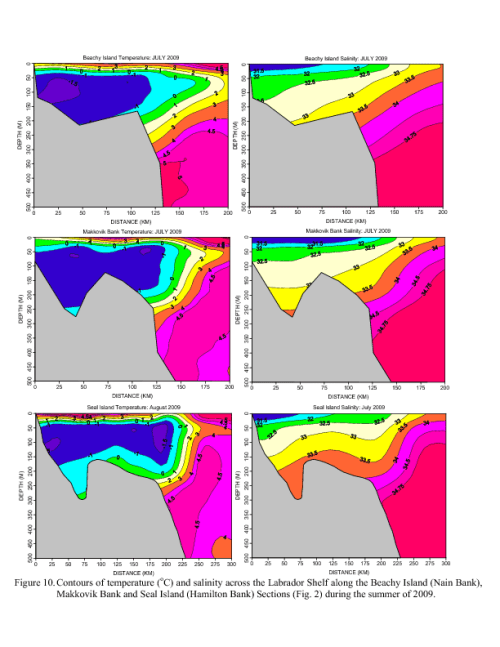
Temperature (left) and salinity (right) distribution off Labrador in the summer of 2009 with depth and distance from the coast (from Colbourne et al., 2010). Note the very cold waters near the freezing point (blue and purple) on the continental shelf below 50-m depth.

5. How would changes in ocean stratification and temperature alter the melting of icebergs?

First, ocean temperature (or heat) and stratification are two very different things. In the Arctic almost all stratification is done by salinity, temperature is a tracer that has very little effect on density stratification. This is also the reason, that most of the ocean’s heat in the Arctic is at depths 200-400 m below the surface. This warm water does NOT rise towards the surface, because it is also salty water, it is often refered to the Atlantic Layer. This deep reservoir of heat is what many oceanographers (myself included) have in mind when they talk about the melting of Greenland’s glaciers by the ocean from below.

Petermann Glacier, for example, has a grounding line at 600-m below the surface. This grounding line is in contact with the heat from the Atlantic Layer that is melting it, but the melted water is fresh and cold, immediately stratifying the water column under the ice, so a source of energy is needed also to move or mix this cold fresh melt water away. An inclined slope may do so, tides may do so, internal waves traveling and breaking on the interface between cold-fresh and warm-salty waters may do so. At Petermann Glacier this Atlantic layer does not reach most of the floating element of this glacier, because it is only 100-200 m thick and thus does not extend into the heat of the Atlantic Layer. So, vertical stratification and location of heat are two different things.
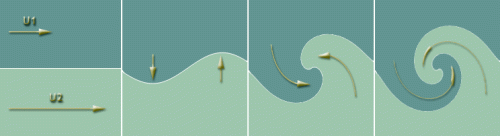
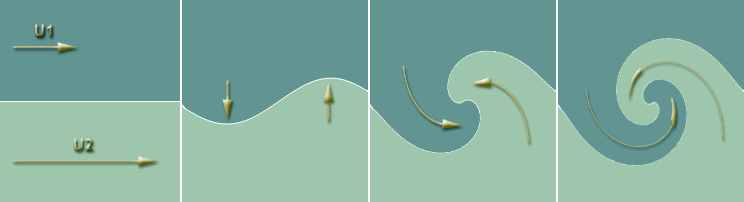
Breaking waves on an interface due to a shear instability, i.e., flow in the (fresh and cold) upper layer is less than the flow in the denser (warm and salty) lower layer.

Second, think of ocean stratification as a blanket that insulates one region from the other. Removing the blanket requires kinetic energy (something or someone has to do the work, doing work requires energy). As you melt freshwater ice via conduction of heat to the ice, the melt has zero salinity and a temperature at the freezing point. This zero salinity water acts as the insolation blanket that reduces the heat reaching the ice. So, again, you need (a) a source of kinetic energy to do work to break down the stratification (of salinity) to (b) enable the transfer of heat from the ocean to the ice.

6. Can you recommend any key journal papers you think we should read?

The classical paper on this subject is [Gade, H.G., 1979: Melting of ice in sea water: A primitive model with application to the Antarctic Ice Shelf and Icebergs. J. Phys. Oceanogr., 9, 189-198], but this paper is a thorough theoretical development. I have professors of glaciology asking me what it means, so the material is not easy to penetrate. In a 2011 publication on the oceanography of Petermann Fjord impacting this Glacier, we made extensive use of the arguments and concepts presented in Gade (1979). That publication is more readable and accessible.

Its first author is Dr. Helen Johnson at Oxford University with whom I have collaborated since 2003 aboard US and Canadian icebreakers. She also published an illustrated diary of our 2007 expedition to Nares Strait.

ADDED Jan-12: My mind yesterday was unclear on the in situ temperature at which glacier ice of zero salinity is melting in seawater such as found on the Labrador shelf. The comment below points this out concisely, while this link to TheNakedScientist perhaps provides the longer and more visual explanation. Another fun explanation of the melting and freezing of ice in a salt solution relates to the making of ice cream. A subsurface temperature at -1.5 C at a salinity of 33.5 psu such as found on the Labrador shelf does melt the zero salinity ice of the iceberg somewhat. A boundary layer consisting of fresh meltwater will lower the salinity adjacent to the iceberg which will increase the freezing point which will reduce the melting until a new stable equilibria is reached.

Ice Drift from Nares Strait to Newfoundland: The 1871 Polaris Expedition and Petermann Ice Islands

“Nineteen ship-wrecked members of the Polaris expedition of 1871-72
drifted on ice floes a distance of over 2500 km from Nares Strait near
79°N latitude to Newfoundland. Surviving this six months long ordeal,
they inadvertently mapped for the first time a drift of icy waters
from the Arctic to the North Atlantic Ocean. That they survived to
tell the tale is tribute to two Inuit, Joe Ebierbing and Hans Hendrik,
whose hunting skills and diligence provided food for the entire party
(Hendrik, 1878). Almost a century later, 1962-64, ice island WH-5 was
carefully tracked via ships and aircraft from north of Ellesmere
Island (83°N) to the Atlantic via Nares Strait (Nutt, 1966). The
movements of ice and water so revealed are one link in the global
hydrological cycle whose significance to global climate has yet to be
understood …” [from Muenchow et al. (2007)]

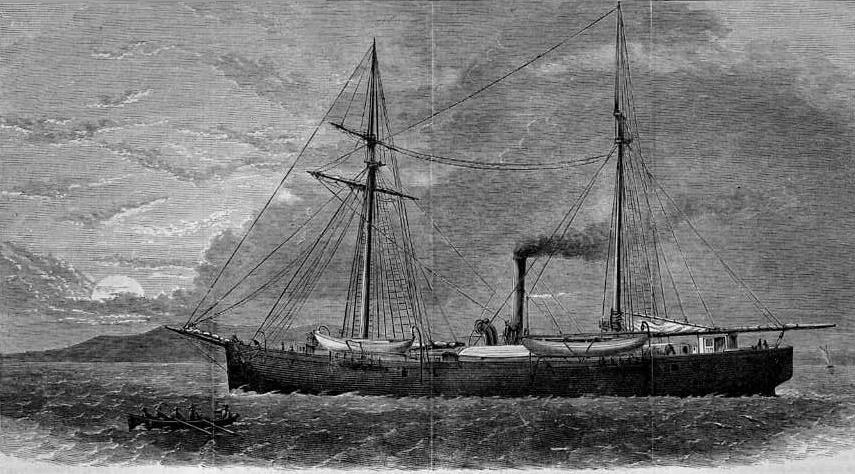
'Captain Hall's Arctic Expedition -- The "Polaris"'', a wood engraving published in ''Harper's Weekly'', May 1873.

The BBC contacted me this morning asking great questions related to the Petermann Ice Islands and icebergs. These reminded me of the opening paragraph quoted from a paper on the oceanography of Nares Strait. I published it in 2007 with two friends and fellow sailors of icy waters, Kelly Falkner and Humfrey Melling. In 2003 we sailed together on the US Coast Guard icebreaker Healy and making detailed measurements on ice, water,and bottom sediments. We reported strong southward currents from the Arctic Ocean into Baffin Bay opposing the local winds. Ocean currents were particular strong about 100 meters below the surface on the Canadian coast of Nares Strait. I am still working on these data as they relate to the flux of fresher Arctic waters into the Atlantic Ocean and their climate impacts.

There is history and drama in these places: Hall Basin is named after the leader of the Polaris Expedition, Charles Francis Hall, an American who was likely poisoned in 1871 with arsenic by his German Chief Scientist Dr. Emil Bessel aboard the Polaris beset in ice in Hall Basin. Bessel has a tiny fjord off Greenland named after him, it is located about 10 miles south of Petermann Fjord, named after August Heinrich Petermann, a German cartographer who traveled little himself but mapped much of what others had traveled. Joe Island, named after the Inuit hunter Joe Ebierbing of the Polaris ice drift, is the island that broke the 2010 Petermann Ice Island at the entrance of Petermann Fjord into PII-A and PII-B. The second Inuit hunter of the infamous 1872 drift, Hans Hendrick has Hans Island named after him which is very much in the center of Nares Strait and is currently claimed by both Canada and Denmark.

The Wikipedia entry on the Polaris Expedition has a well-written introduction while the book by Pierre Berton”The Arctic Grail”provides the story along with many other foolish and professional travails to reach the North Pole during the 19th and early 20th centuries.

Petermann Ice Island(s) 2010 through 2011, Part-1

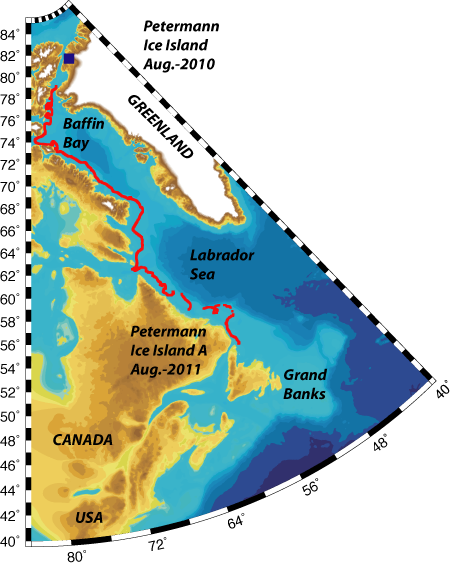
An ice island 4 times the size of Manhattan spawned from a remote floating glacier in north-western Greenland the first week in August of 2010, but it quickly broke into at least 3-4 very large pieces as soon as it flowed freely and encountered smaller, but real and rocky islands. A beacon placed on the ice transmit its location several times every day. It shows a rapid transit from the frigid, ice-infested Arctic waters off Canada’s Ellesmere, Devon, and Baffin Islands to the balmier coasts of Labrador and Newfoundland:

Track of Petermann Ice Island from Aug.-2010 through Aug.-2011 traveling in shallow water from northern Greenland along Baffin Island and Labrador to Newfoundland.

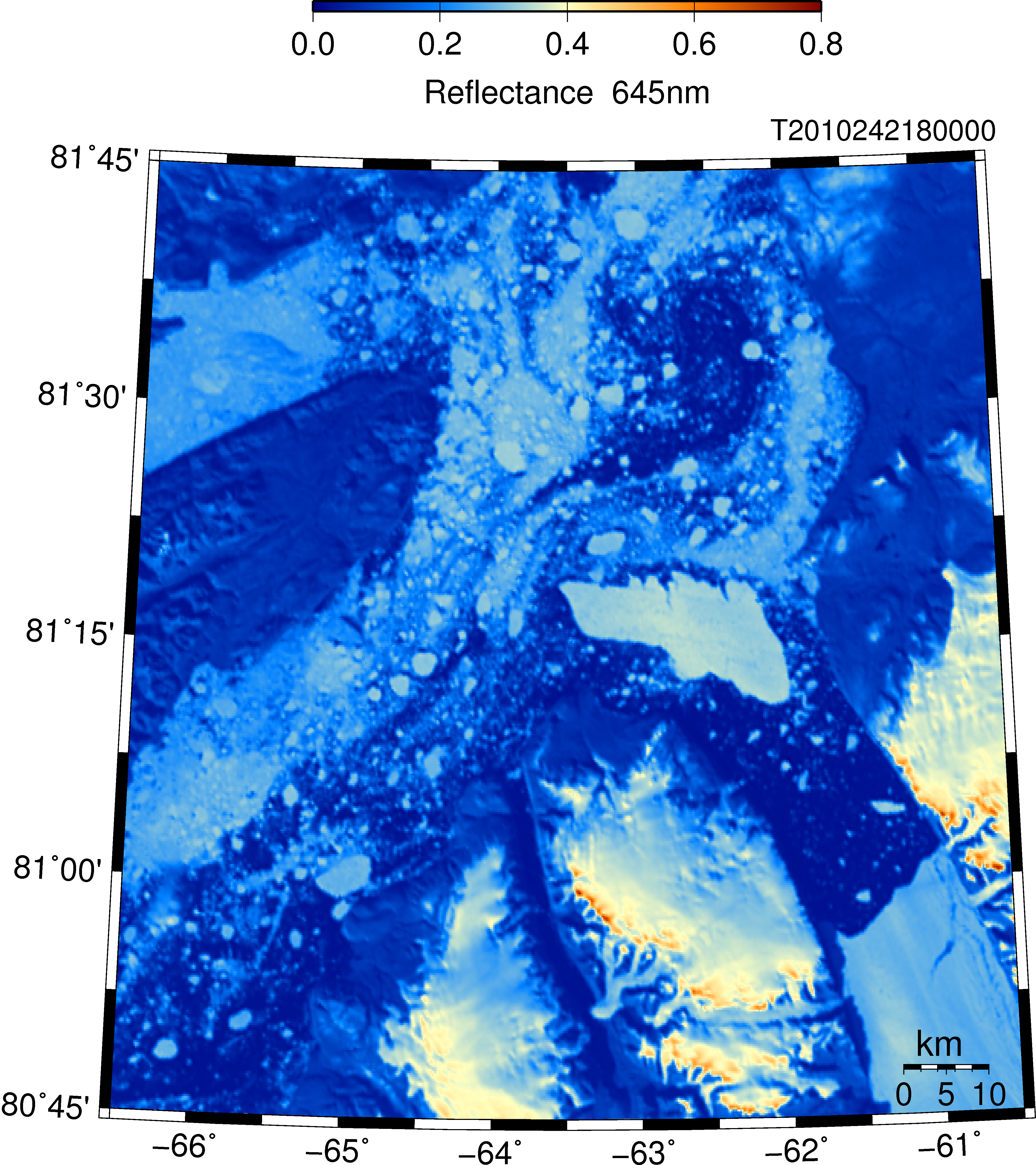
Initial progress was slow as it took the new ice island almost 30 days to wiggle itself free of the narrow constraints of Petermann Fjord:

Petermann Glacier discharges its large ice island into Nares Strait on Aug.-30, 2010.

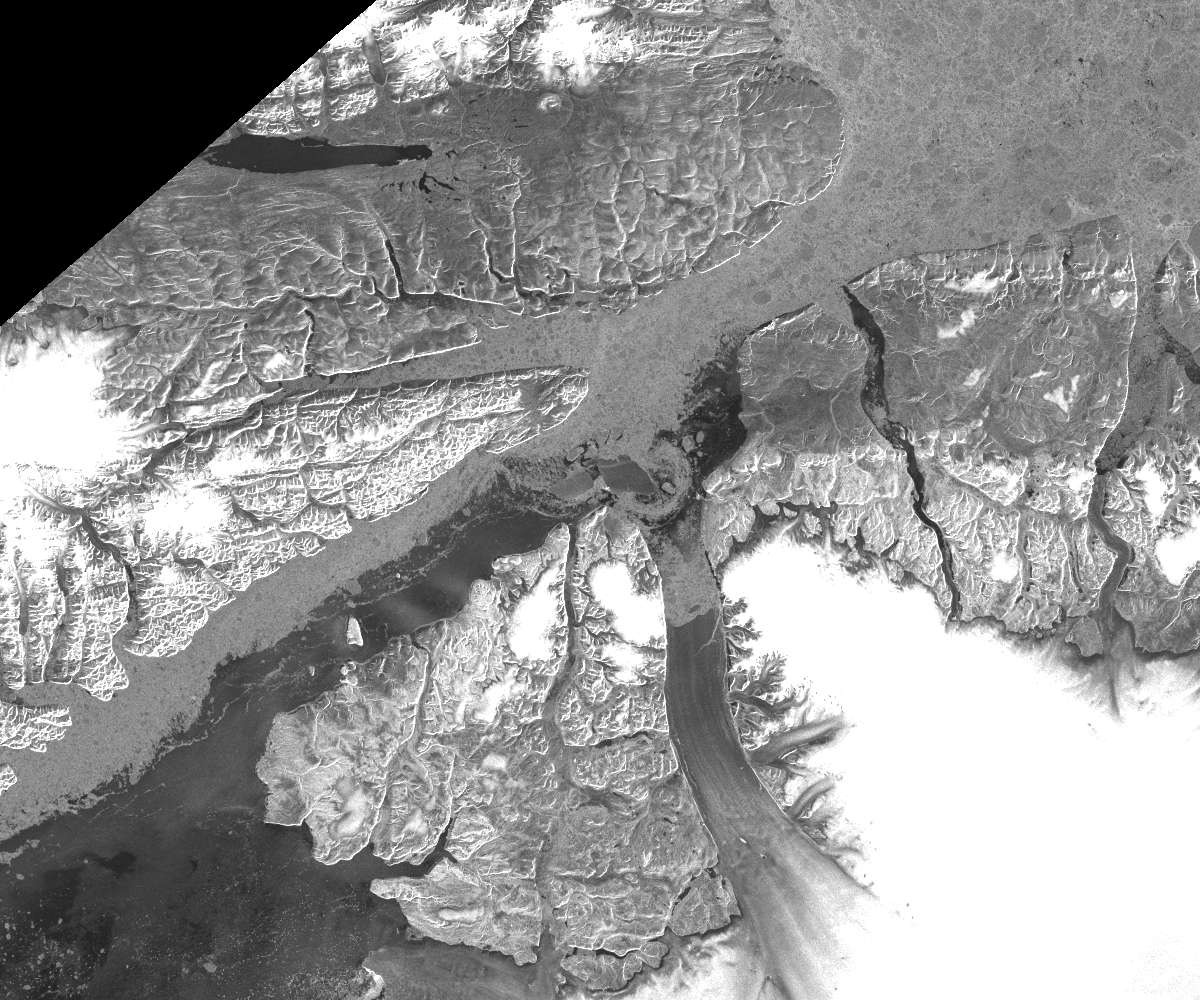
As soon as it left its home port, it hit broke hit tiny Joe Island on Sept.-9, 2010 and broke into two pieces, PII-A and PII-B for Petermann Ice Island A and B. Not a good start for a new island setting out to sail all the way to Newfoundland where PII-A arrived a year later, but I am getting ahead of my story.

Petermann Ice Island breaks into two segments on Sept.-9, 2010 as seen in this radar image provided by the European Space Agency. Greenland is at the bottom right, Canada top left, the Arctic Ocean is at the top right.

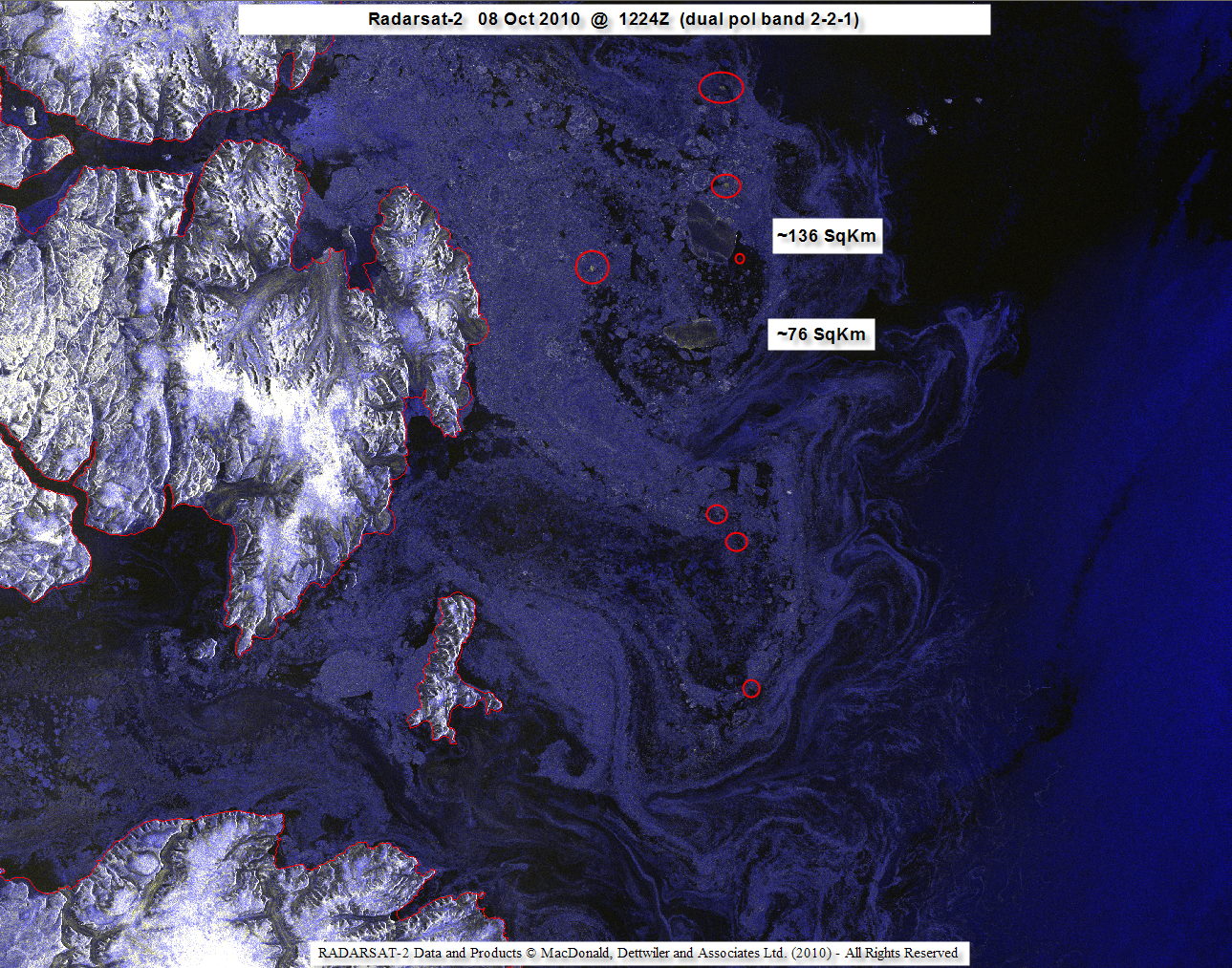
Once in Nares Strait both ice islands experienced a very strong and persistent ocean current. PII-A, about 1.5 the size of Manhattan went first followed by the larger (about 2.5 Manhattans) and thicker PII-B. Their tracks follow each other closely and they almost kiss on Oct.-8, 2010 when both are caught in the same eddy or meander of a prominent coastal current flowing south along Ellesmere and Devon Islands.

Pieces of Petermann Ice Island on Oct.-8, 2010 off southern Ellesmere Island about 600-km to the south of their origin. RadarSat imagery is courtesy of Luc Desjardins of the Canadian Ice Service, Government Canada.

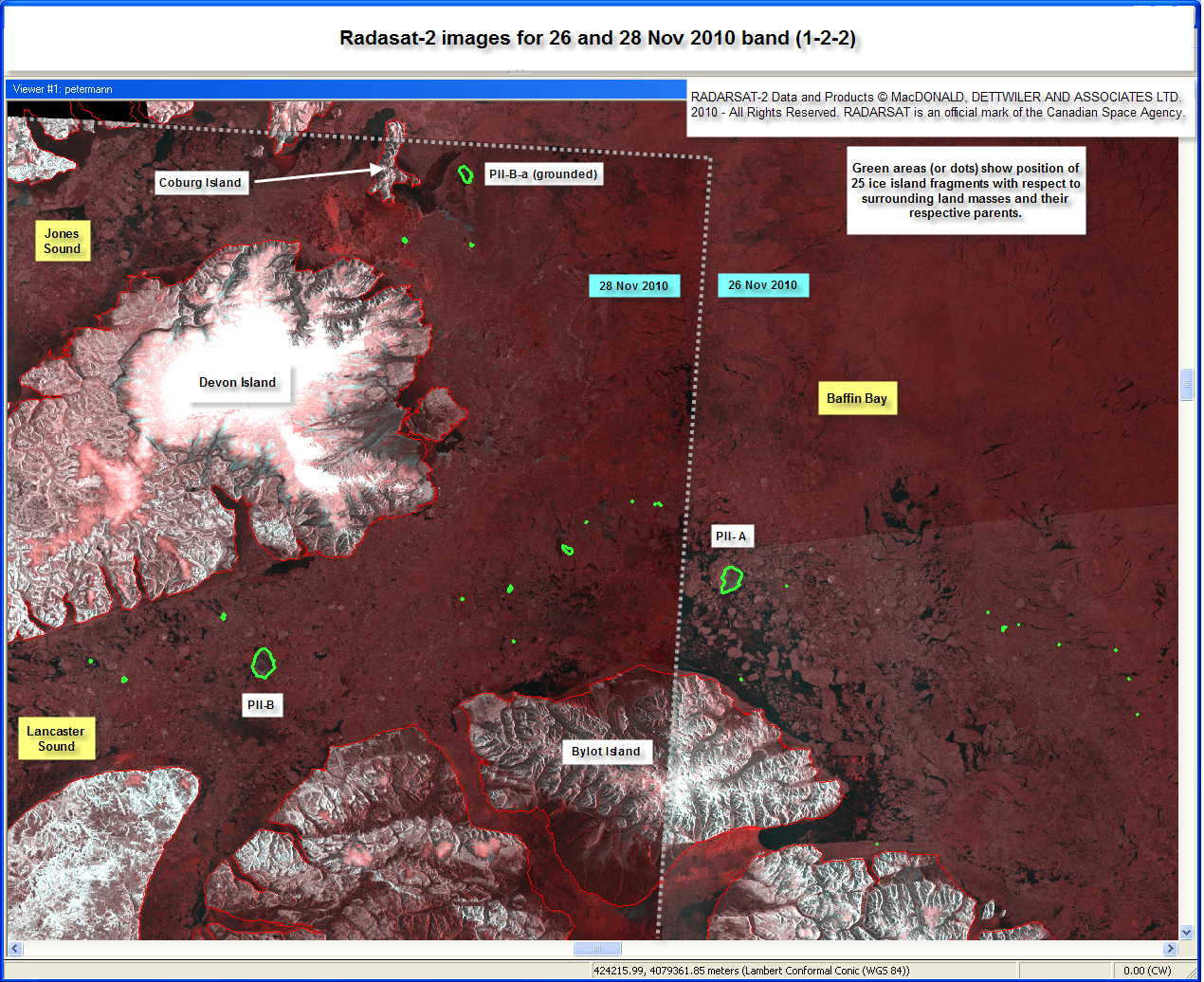
Within a week the larger 136 km^2 piece PII-B breaks into three pieces of 93.5, 28.9, and 11.3 km^2 by Oct.-16 while PII-A stays largely intact at 73.6 km^2. These are all very large islands, the land area of Manhattan is about 60 km^2 for comparison. Some of these pieces approach the coast, some become grounded for a few days to a few weeks, some break off smaller pieces and spawn massive ice bergs that are not always visible from space. PII-A enters Lancaster Sound a week ahead of PII-B on Nov.-14, but exits it within 2 weeks:

Multiple pieces spawned from Petermann Ice Island as seen by RadarSat on Nov.-26 and Nov.-28, 2010 composited and anotated by Luc Desjardins of the Canadian Ice Service, Government Canada.

Notice also the evolution of a string of segments that Luc Desjardins of the Canadian Ice Service identified as pieces from Petermann Glacier. Glacier ice has a darker radar backscatter signature than the sea ice around it. All these pieces eventually enter the Baffin Island Current, a prominent large ocean current that extends from the surface to about 200-300 m depth. The Petermann pieces are moved mostly by ocean currents, not winds, because there is more drag on the submerged pieces of the 40-150 meter thick glacier ice. In contrast, the much thinner sea ice is mostly driven by the winds. This is also the reason one often finds areas in the lee of icebergs and islands free of older ice which is swept away by the winds as the iceberg moves slower as it is driven by deeper ocean currents. I will talk more of these in a later post.

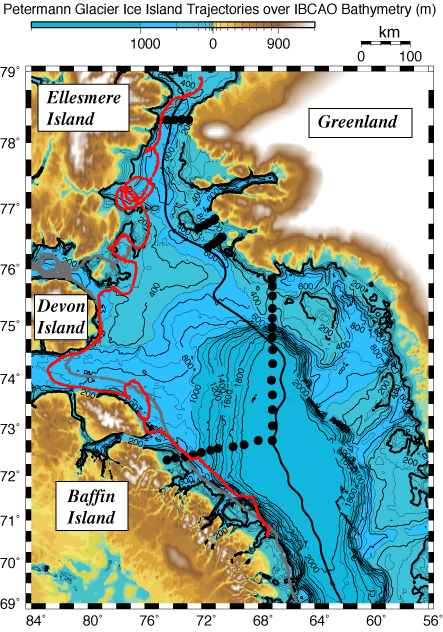
As part of a large oceanography program in northern Baffin Bay and Nares Strait in 2003, we collected ocean temperature, salinity, chemistry, and current data along lines roughly perpendicular to both Baffin Island in the west and Greenland in the east along with the trajectory of PII-A in the fall of 2010 (red dots) and the almost identical track of a much smaller ice island from Petermann Glacier that passed the area in 2008:

Map of the study area with trajectory of a 2010 (red) and 2008 (grey) beacons deployed on Petermann Glacier ice islands over topography along with CTD station locations (circles) and thalweg (black line). Nares Strait is to the north of Smith Sound.

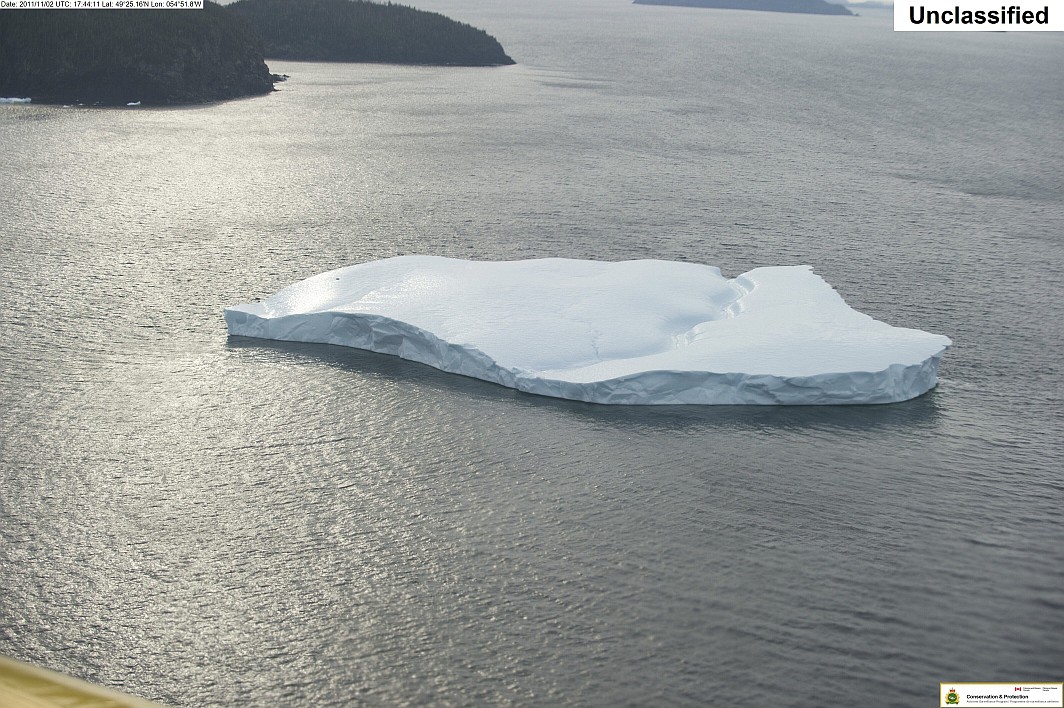
I will talk about these data and the subsequent tracks of PII-A and PII-B from 2010 into 2011 in Part-2 of this summary on how the first of this piece (PII-A) arrived off coastal Newfoundland in the late summer of 2011. Rest assured that there are many more pieces coming to coastal Labrador and Newfoundland in 2012 and 2013 where they put on a majestic display of abundant icebergs such as this last remnant of PII-A as seen from the air on Nov.-2, 2011 in Notre Dame Bay, Newfoundland.

Last surviving fragments of PII-A on Nov.-2, 2011 from a survey by air of southern Notre Dame Bay conducted by Canadian Ice Service, Government Canada..

Ice Arch off North-West Greenland Locks Ice Motion in Nares Strait

Winter has come to north-west Greenland as the sea ice of Nares Strait has locked itself to land and stopped movement of all ice from the Arctic Ocean in the north to Baffin Bay and the Atlantic Ocean in the south. While there is no sunlight for several more months now during the polar night, the warm ocean beneath the ice emits heat through the ice which becomes visible to heat-sensing satellites. The light yellow and reddish colors show thin ice while the darker bluish colors show thicker ice today:

Dec.-13, 2011 surface brightness temperature of Nares Strait showing an ice arch in Smith Sound separating thin and moving ice (reddish, yellow) from thick land-fast ice (blue).

The prior 2010/11 winter was the first in several years that these normal conditions have returned. The ice arch in Smith Sound did not form in 2009/10, 2008/09, and 2007/08 winters while a weak arch in 2007/08 fell apart after only a few days. Conditions in 2009 were spectacular, as only a northern ice arch formed. Since the ocean moves from north to south at a fast and steady clip, it kept Nares Strait pretty clear of ice for most of the winter as no Arctic ice could enter these waters and all locally formed new “first-year ice” is promptly swept downstream:

March-25, 2009 map Nares Strait, north-west Greenland showing heat emitted during the polar night from the ocean and sensed by MODIS satellite.

The very thin and mobile ice in Nares Strait of 2009 exposed the ocean to direct atmospheric forcing for the entire year. I reported substantial warming of ocean bottom temperatures here during this period. This new 2011/12 ice arch formed the last few days. If it consolidates during the next weeks, then it is very likely to stay in place until June or July of 2012. It decouples the ocean from the atmosphere and, perhaps more importantly, prevents the Arctic Ocean from losing more of its oldest, thickest, and hardest sea ice. This is very good news for the Arctic which has lost much ice the last few years.

For more daily thermal MODIS imagery take a peek at http://muenchow.cms.udel.edu/Nares2011/Band31/ for 2011. Replace Nares2011 with Nares2003 or any other year, and an annual sequence appears. Furthermore, my PhD student Patricia Ryan just sent me a complete list of files that I need to process until 2017. Fun times.