My President Donald J. Trump threatens to take Greenland and does not rule out force to do so. A conflict emerges between the current United States’ administration and the people of Greenland and Denmark. My loyalities as an American citizen lie with the U.S. Constitution and the people of Denmark and Greenland. I worry about my government’s malicious incompetence when it interacts with friends and allies of more than 100 years such as Denmark. This tiny NATO country (half the size of South Carolina) of 6 million people (like Wisconsin or Minnesota) supported us during our 20-year long war in Afghanistan. Their price in blood (people killed) was as high as ours relative to their population [Source]. Hence I consider the statement of my current Secretary of Defence Pete Hegseth malicious, incompetent, and shameful when he responds to my Vice-President J.D. Vance that “… I fully share your loathing of the European free-loading. It’s PATHETIC …” [his caps, not mine].
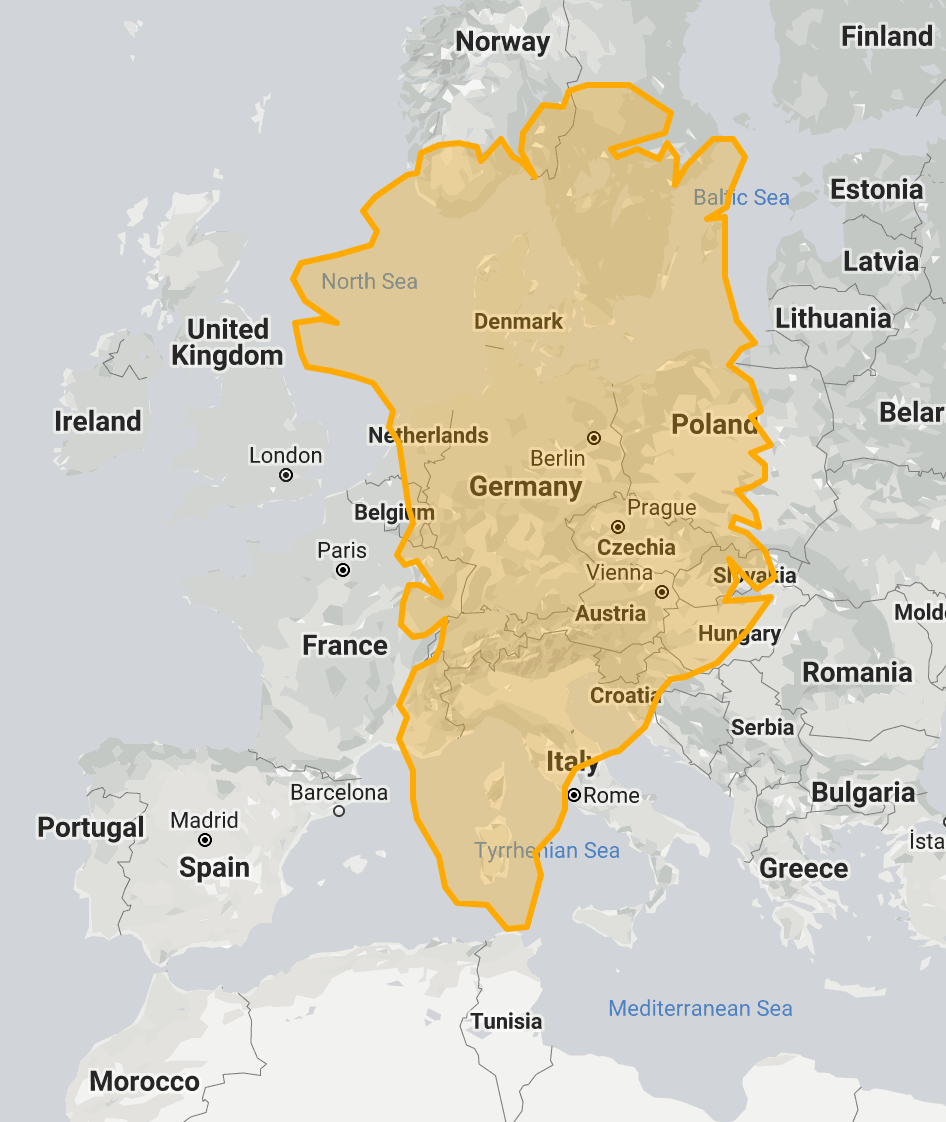
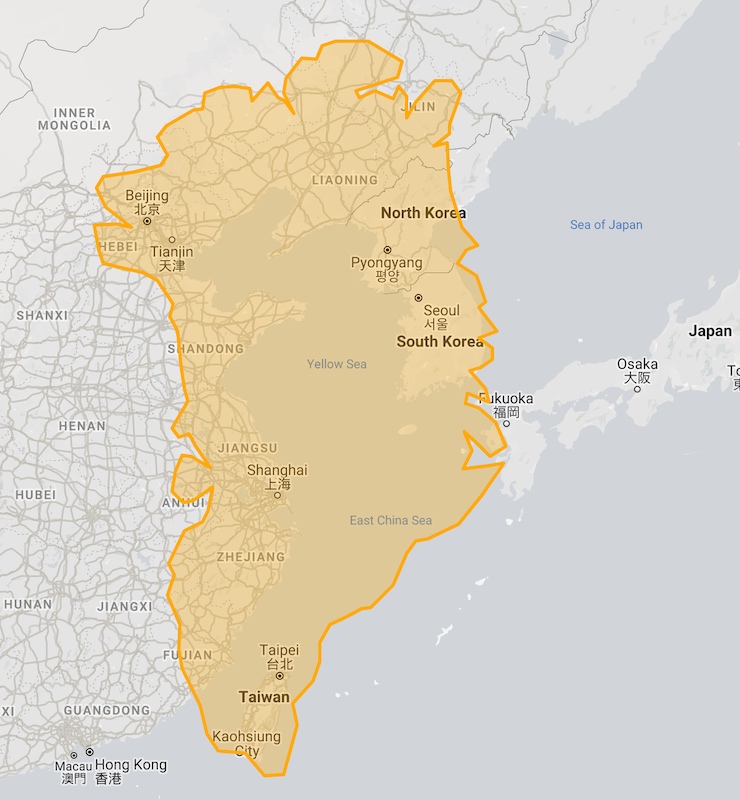
Greenland to scale over USA (left), Europe (center), and Asia (right).
Greenland is large, but only 55,000 people live there. Its northern reaches have been mapped only about 100 years ago by small groups of Danish explorers, scientists, and Inuit hunters moving by dog-sleds. Some died, but most survived. Even today, the Danish military patrols the northern reaches by dog sleds and satellite phones. These Sirius patrols consist of six teams of 2 Special Forces soldiers each who cover an area about the size of New England without encountering another person during months of steady traveling.
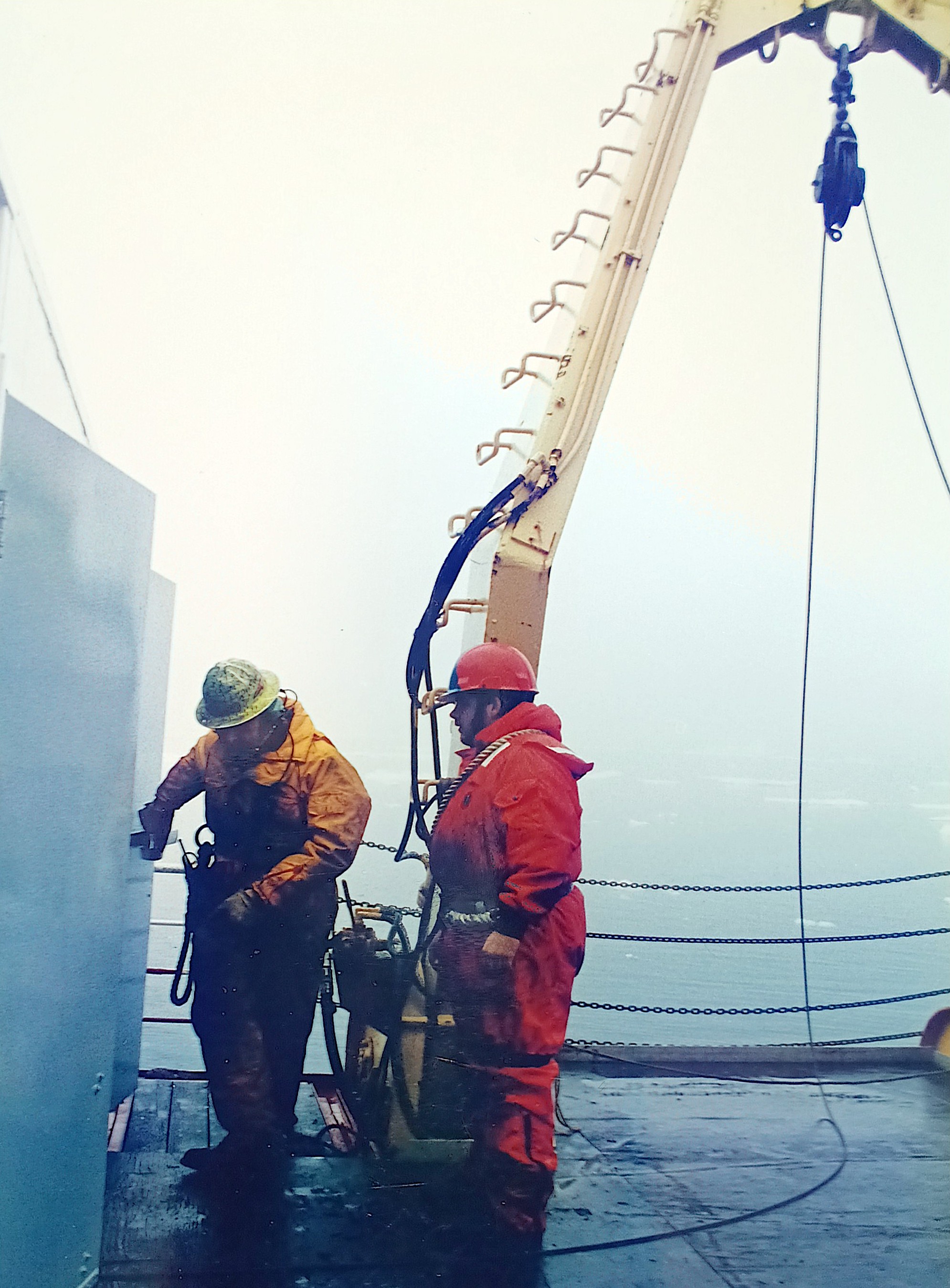
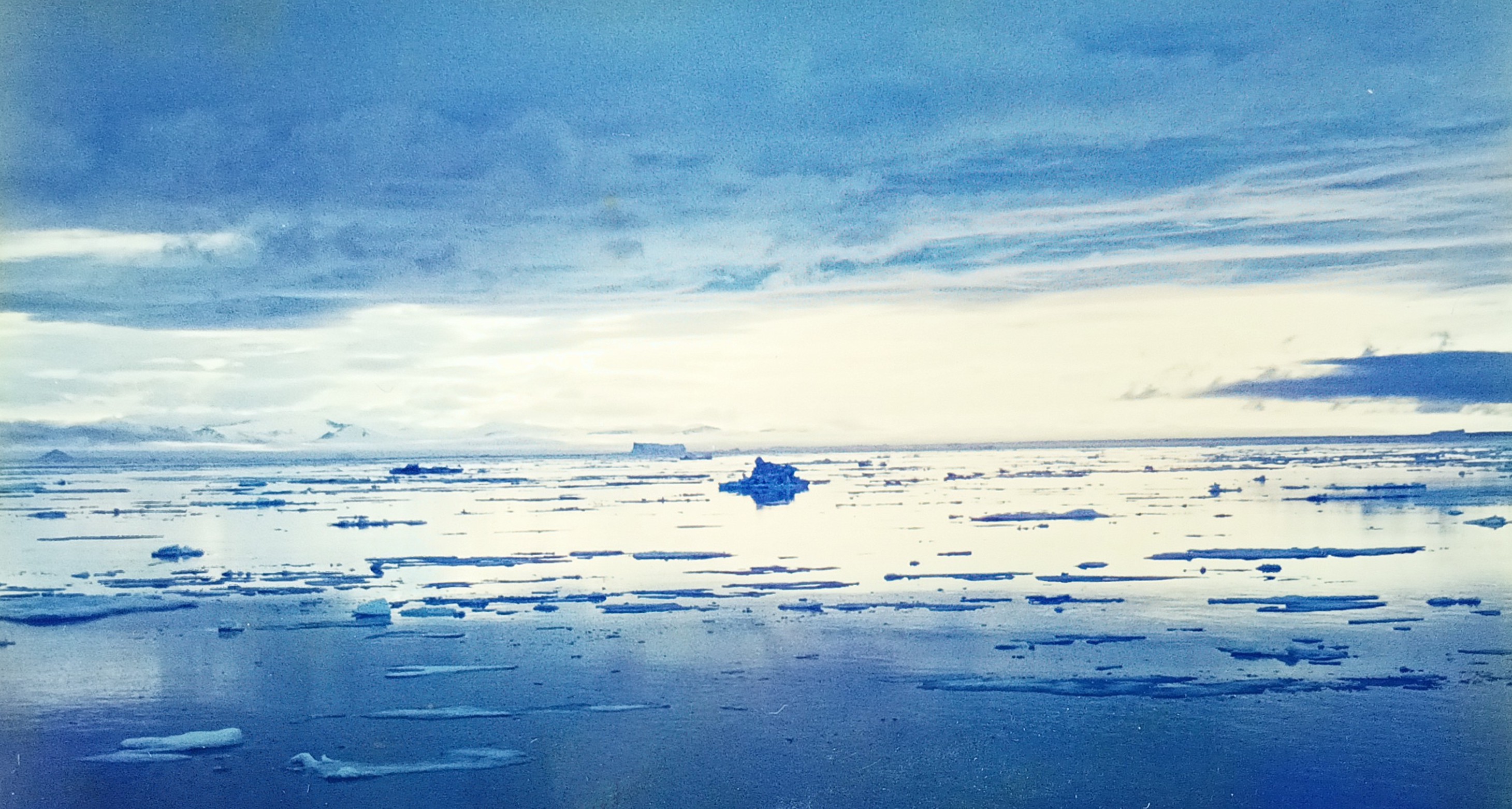
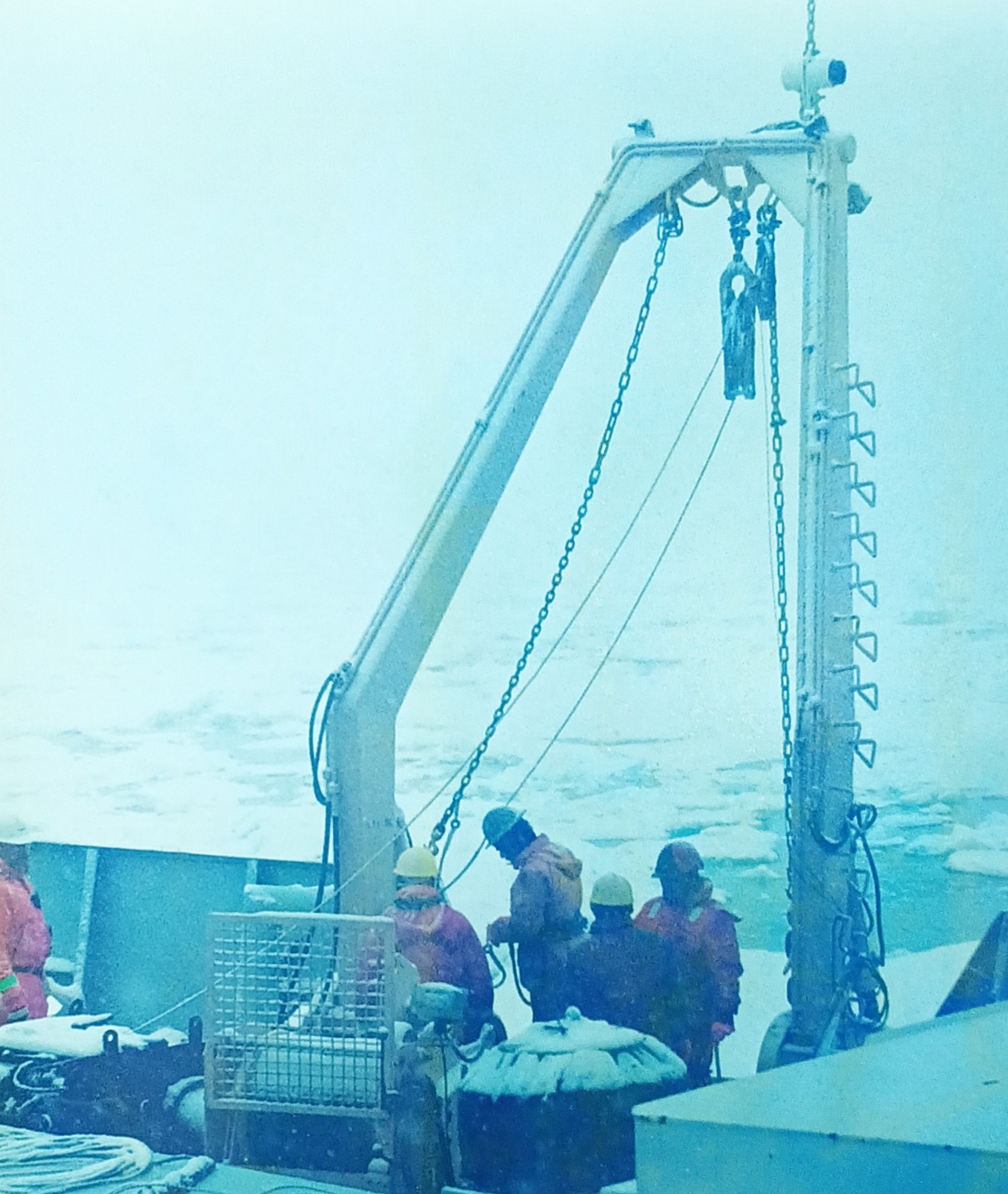
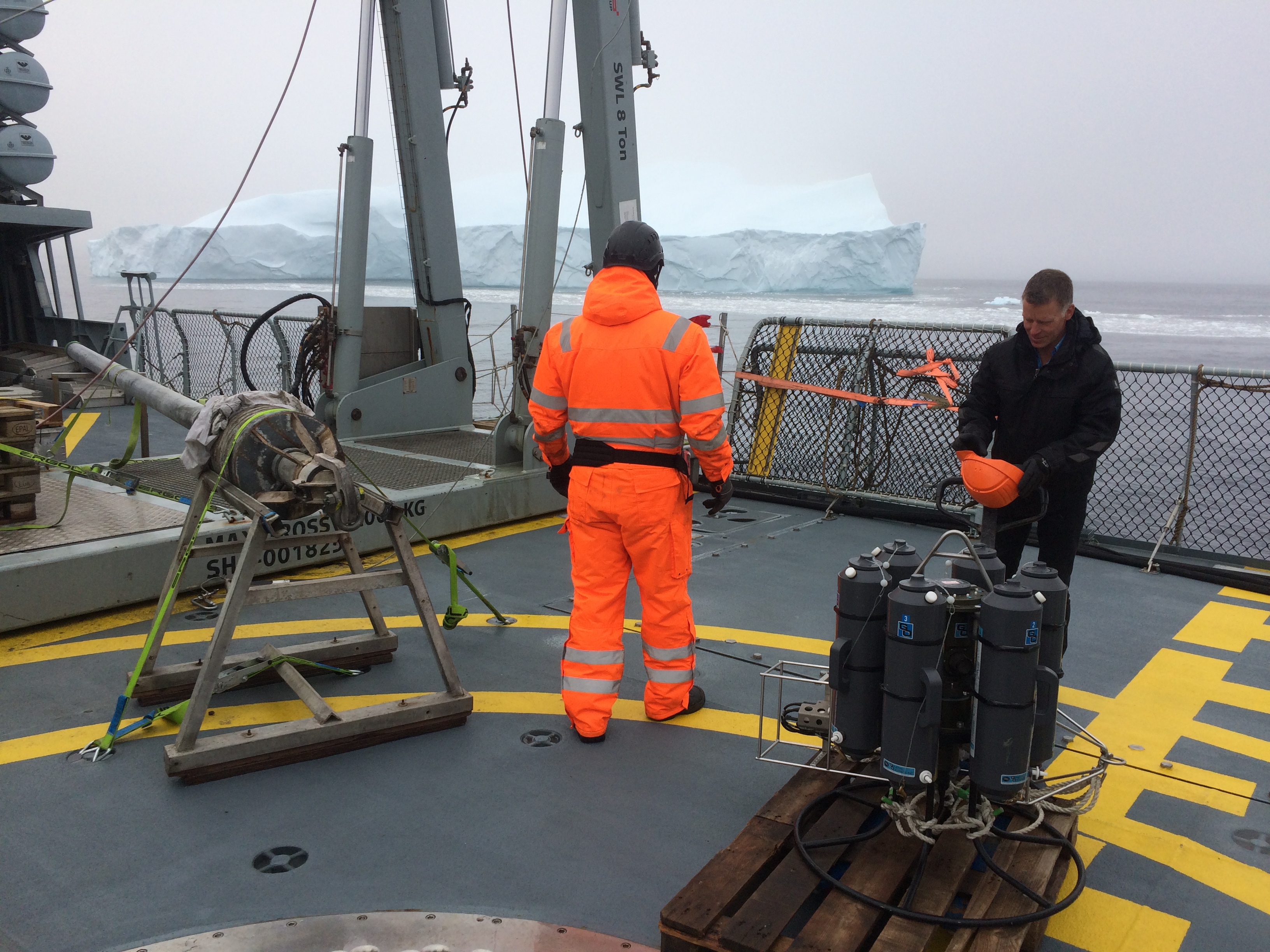
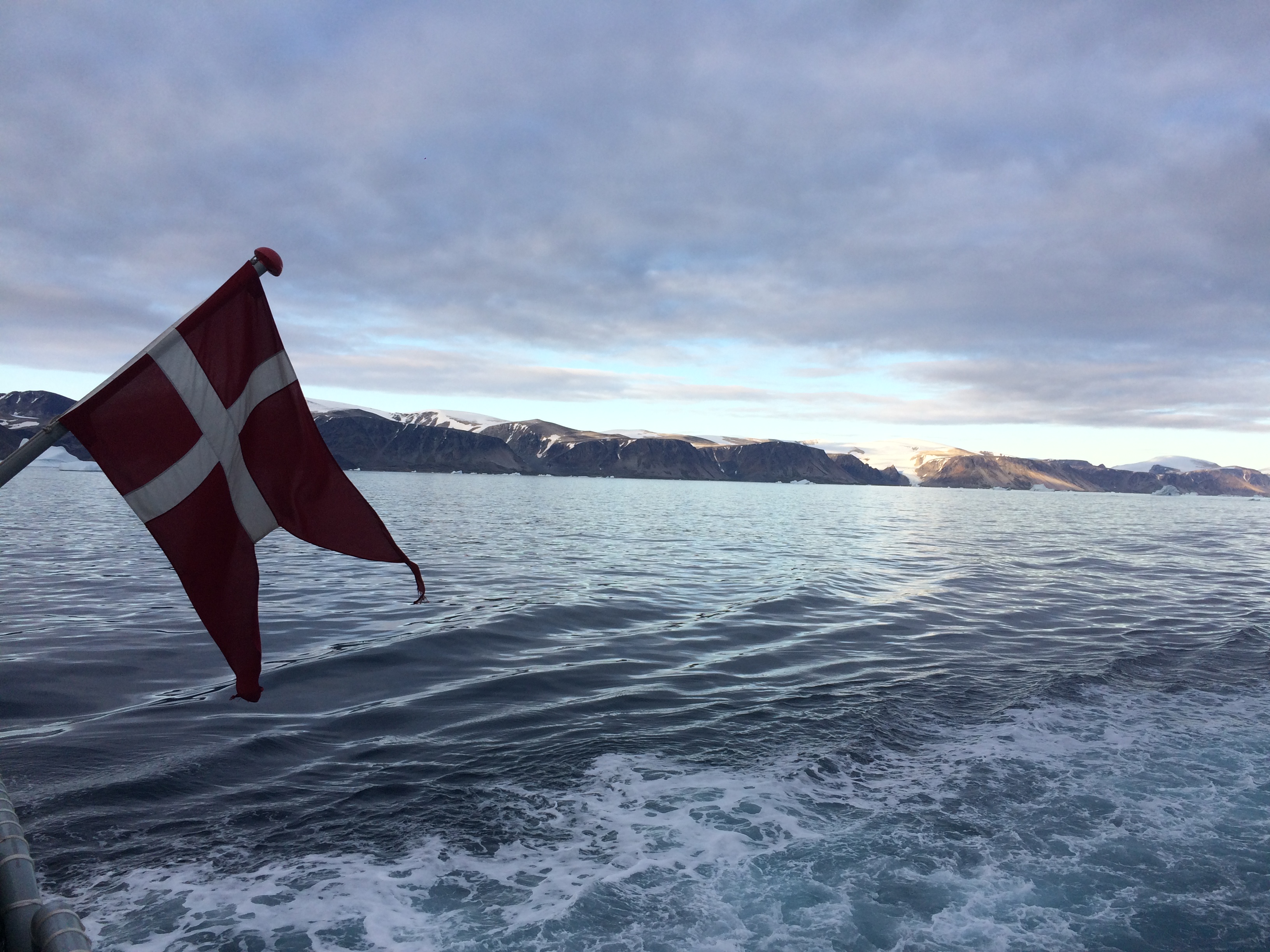
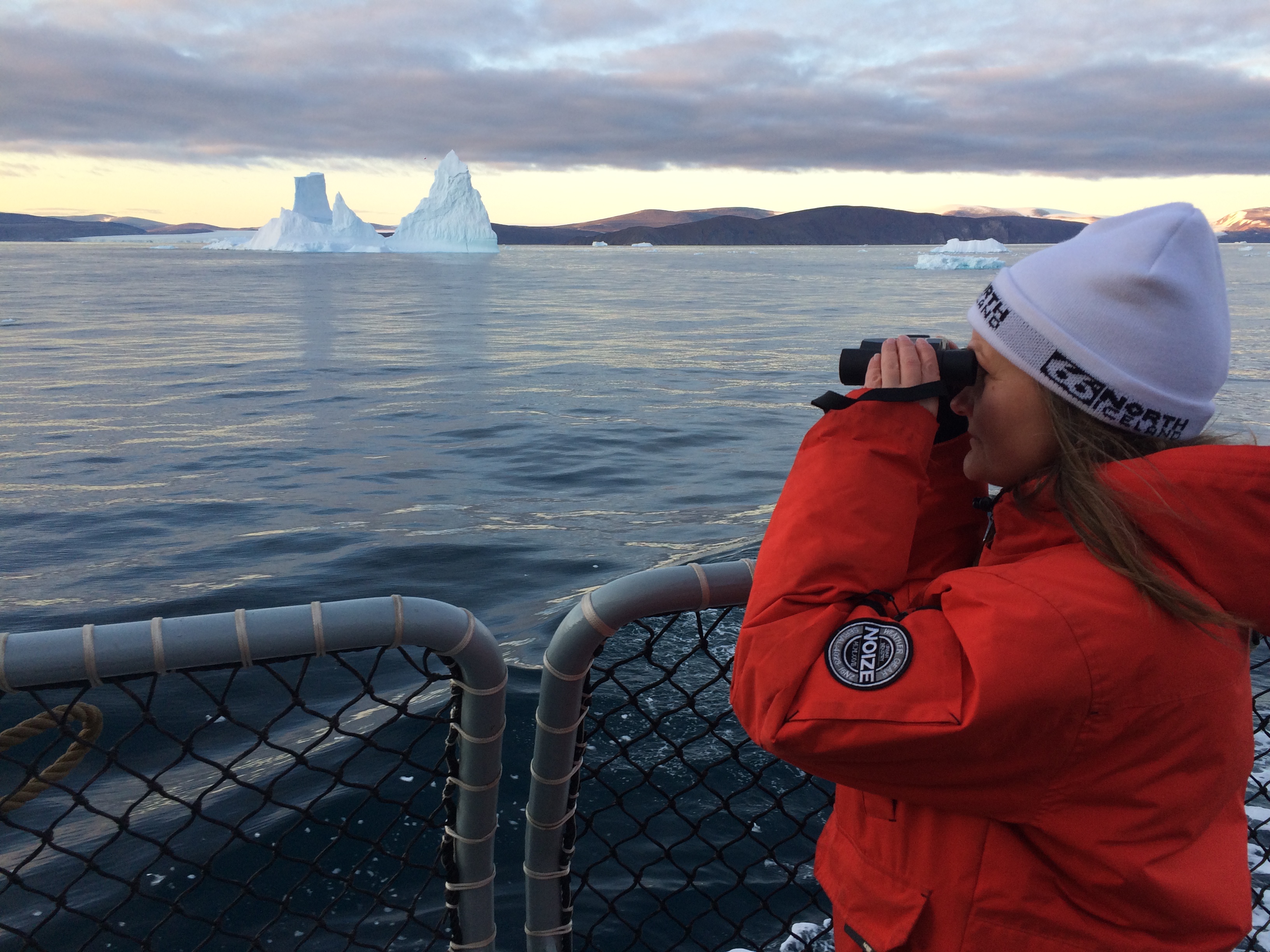
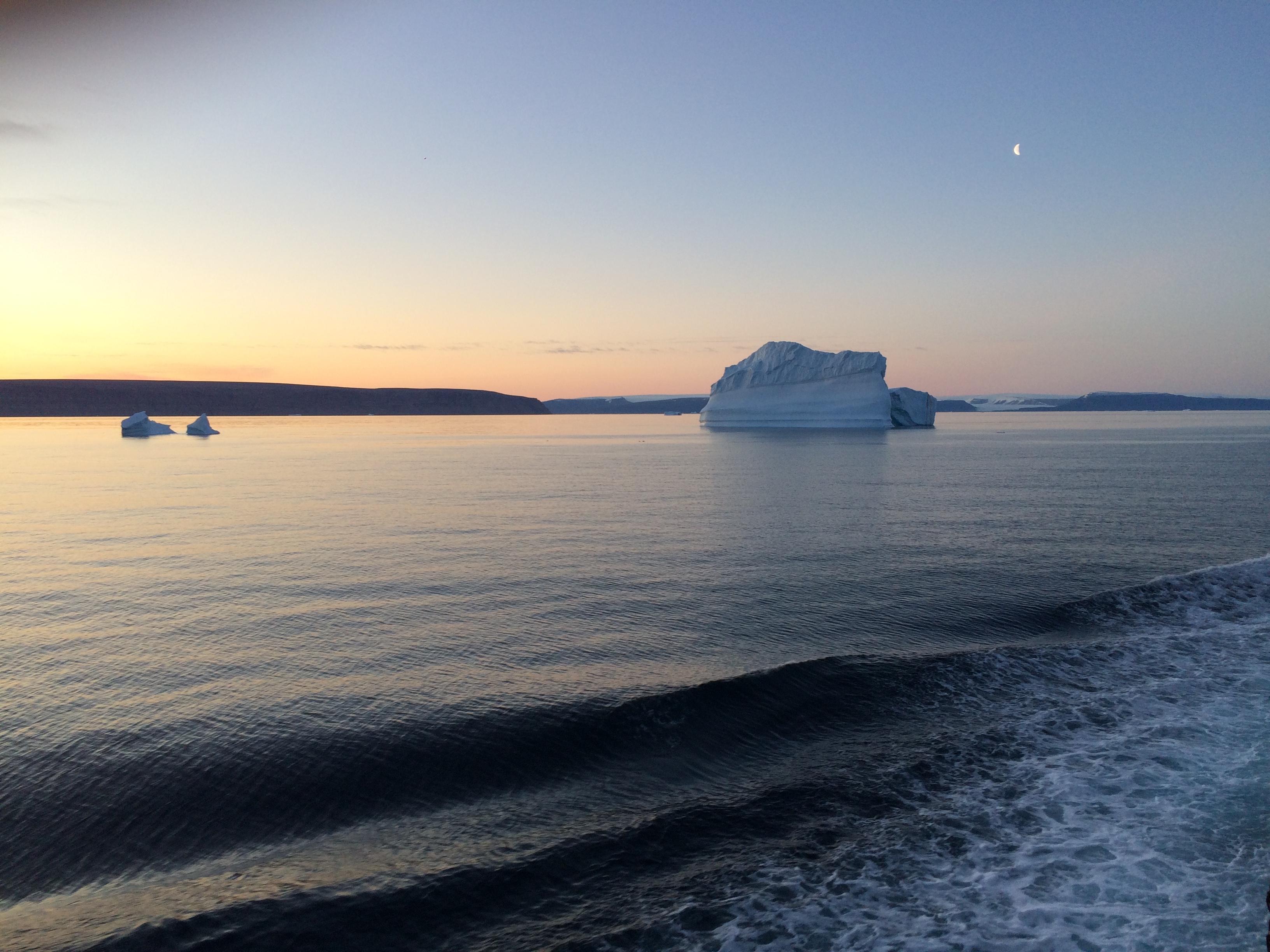
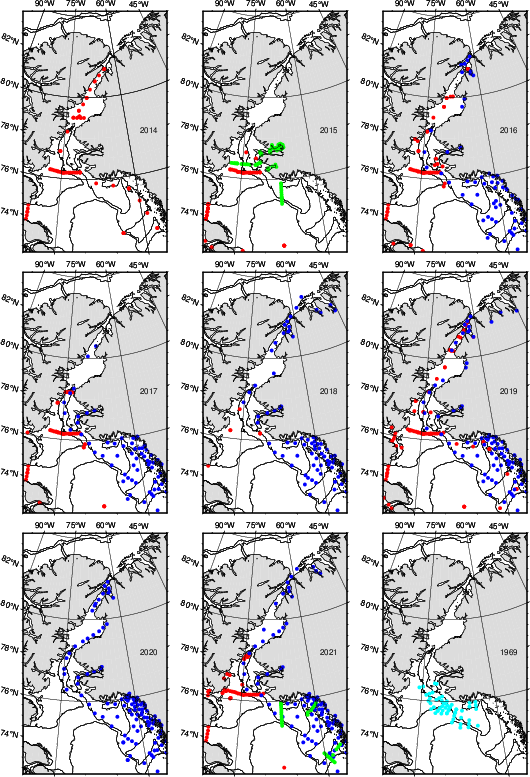
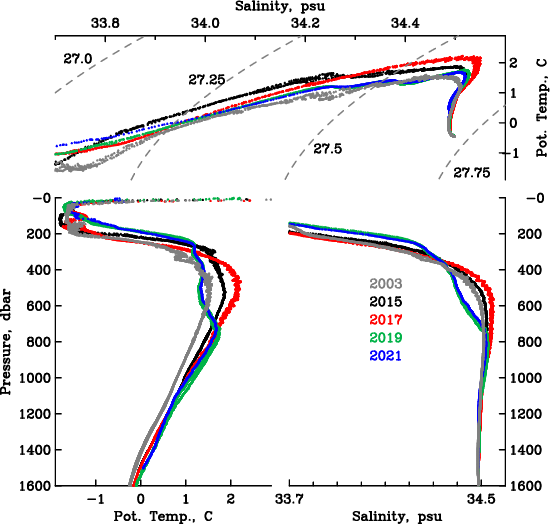
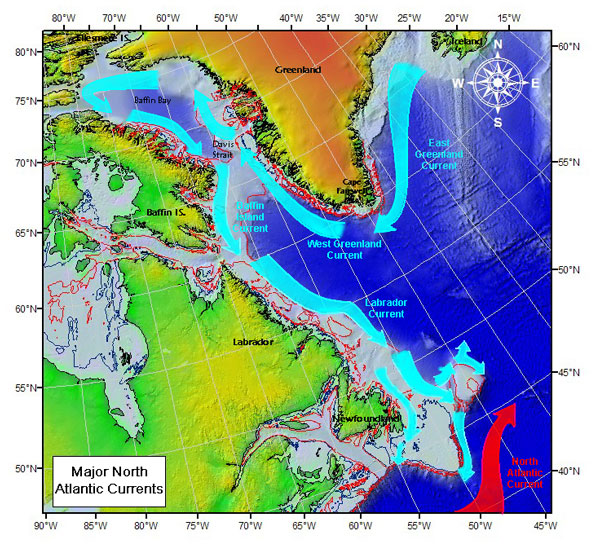
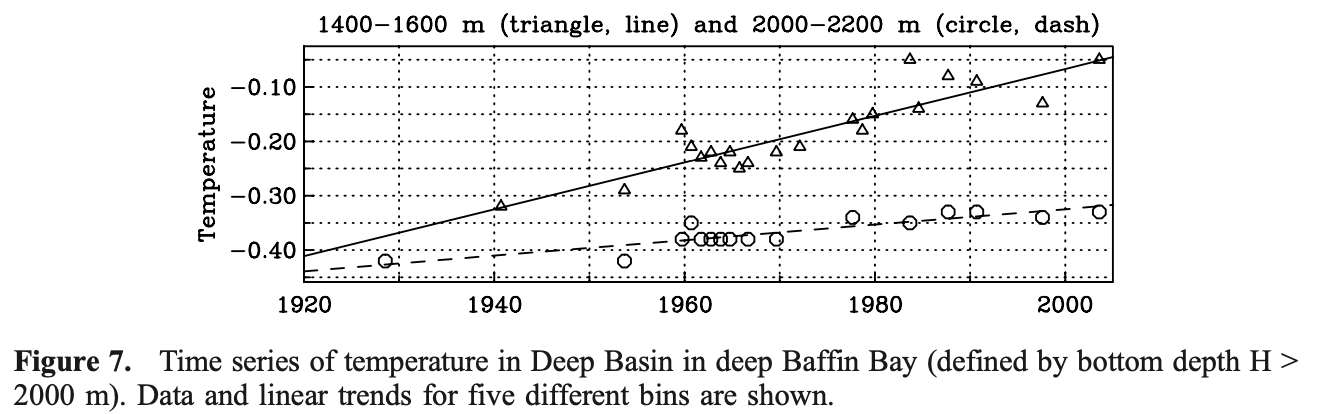
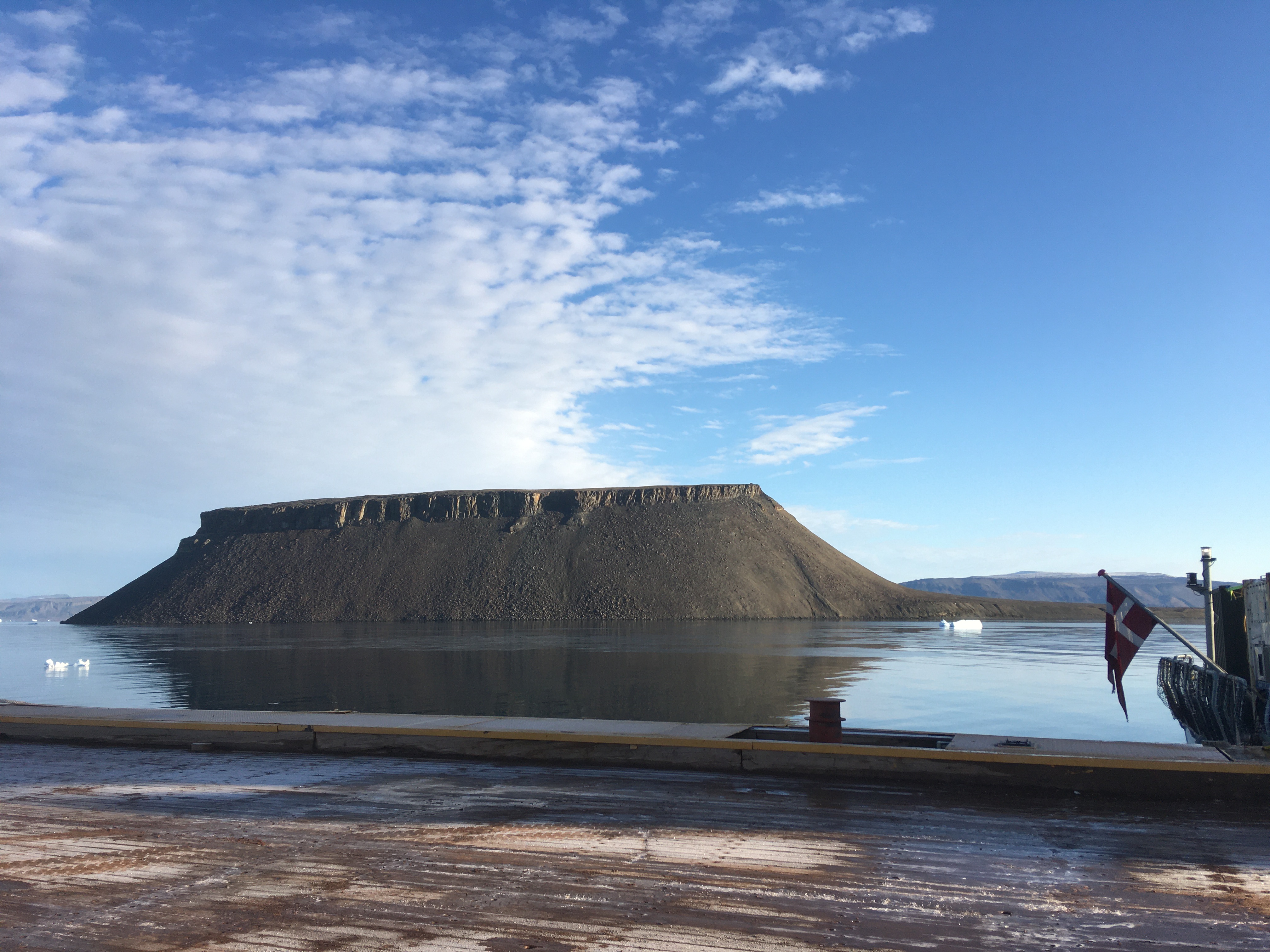
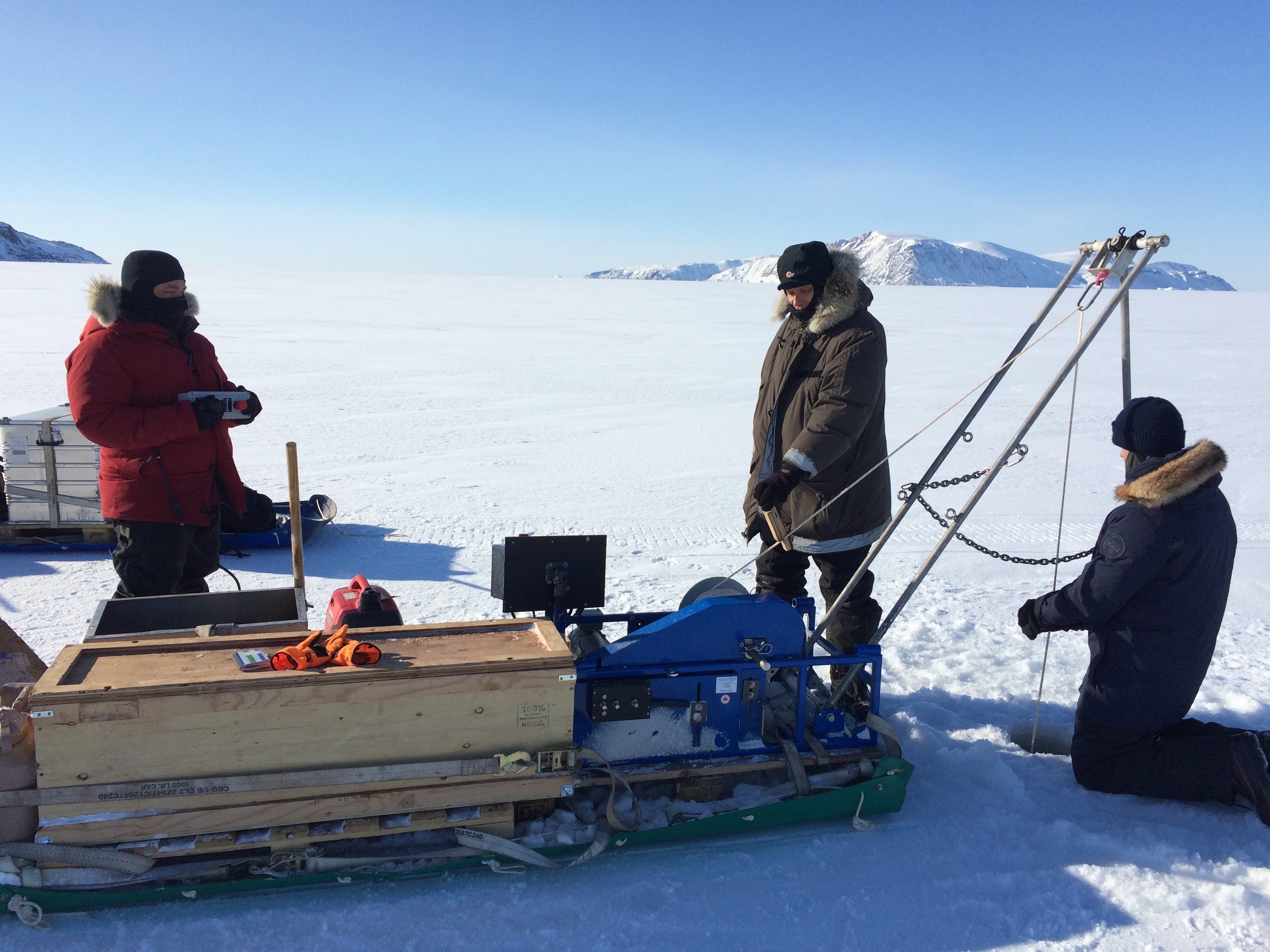
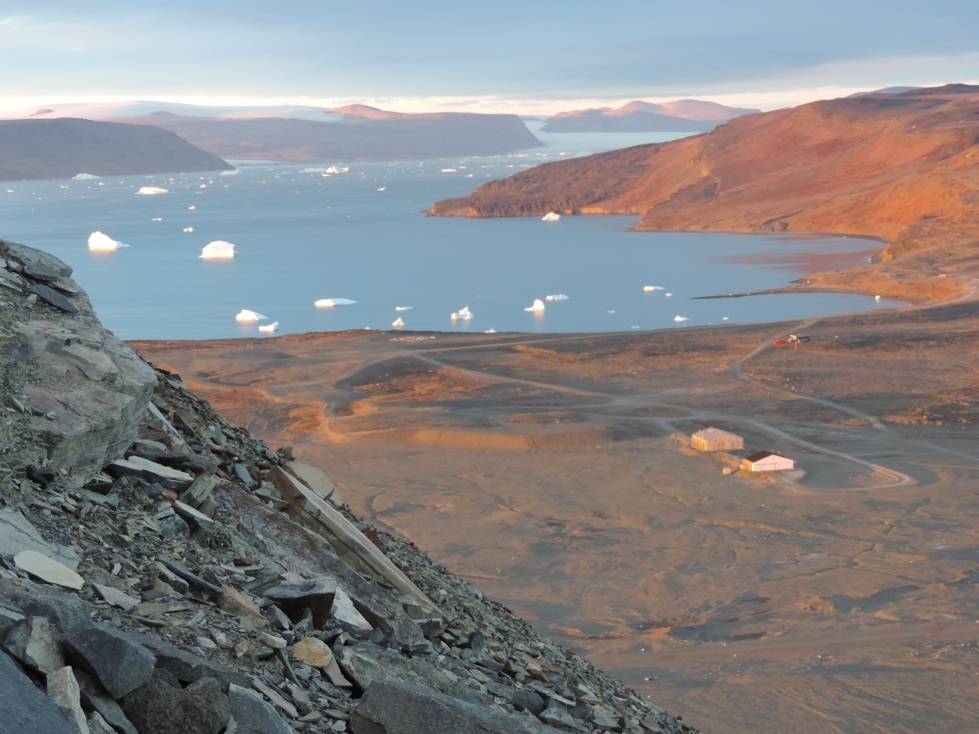
I traveled to Greenland 1997, 2003, 2005, 2006, 2007, 2012, 2014, 2015, 2016, 2017, 2018, 2021 and, hopefully, again in 2025. As a polar scientist my work relates to the physics of oceans and glaciers. All this work involves ships and people from the United States of America as well as Canada, Germany, Sweden, and Denmark. So I spent about 12 months of my life on ships in the coastal waters of Greenland, but in 2017 I also lived for 6 weeks at Thule Air Base which is now called Pituffik Space Base. We then surveyed the coastal waters and glaciers via daily snowmobile trips on the 1-3 feet thick sea ice. I met Inuit hunters both on the sea ice working and on base visiting. I met Danish Soldiers in Thule/Pituffik who in prior lives climbed out of the torpedo tubes of U.S. submarines and stormed beaches in Somalia and/or Yemen in joint military missions. I met Danish dentists, grocers, barristas, carpenters, policemen, cooks, electricians, and plumbers. They all support shared values of democracy, freedom, and respect for each other. They are our friends, not our enemies. They are good people, they are European, and they are not “PATHETIC” as current U.S. government officials call them.
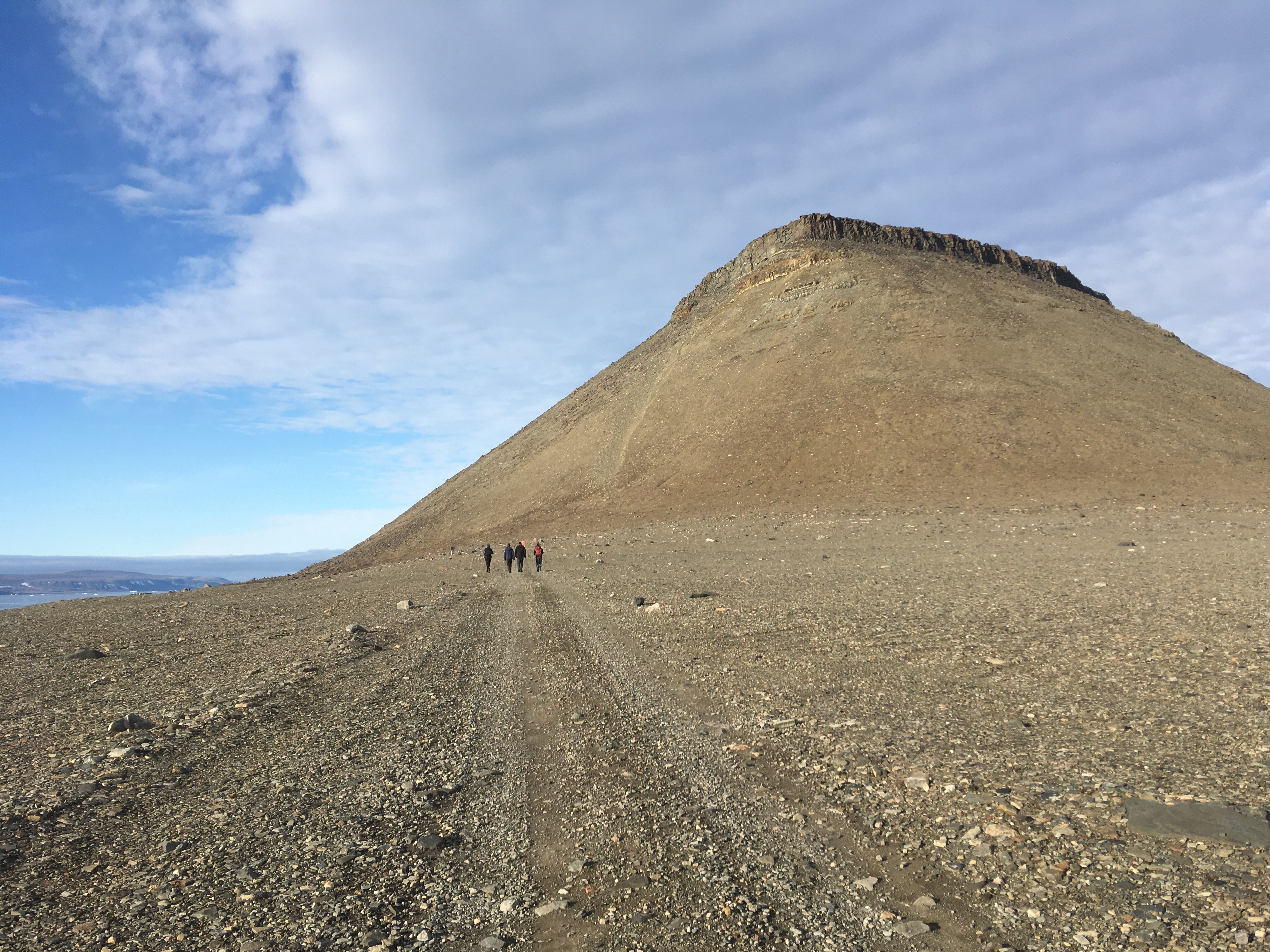
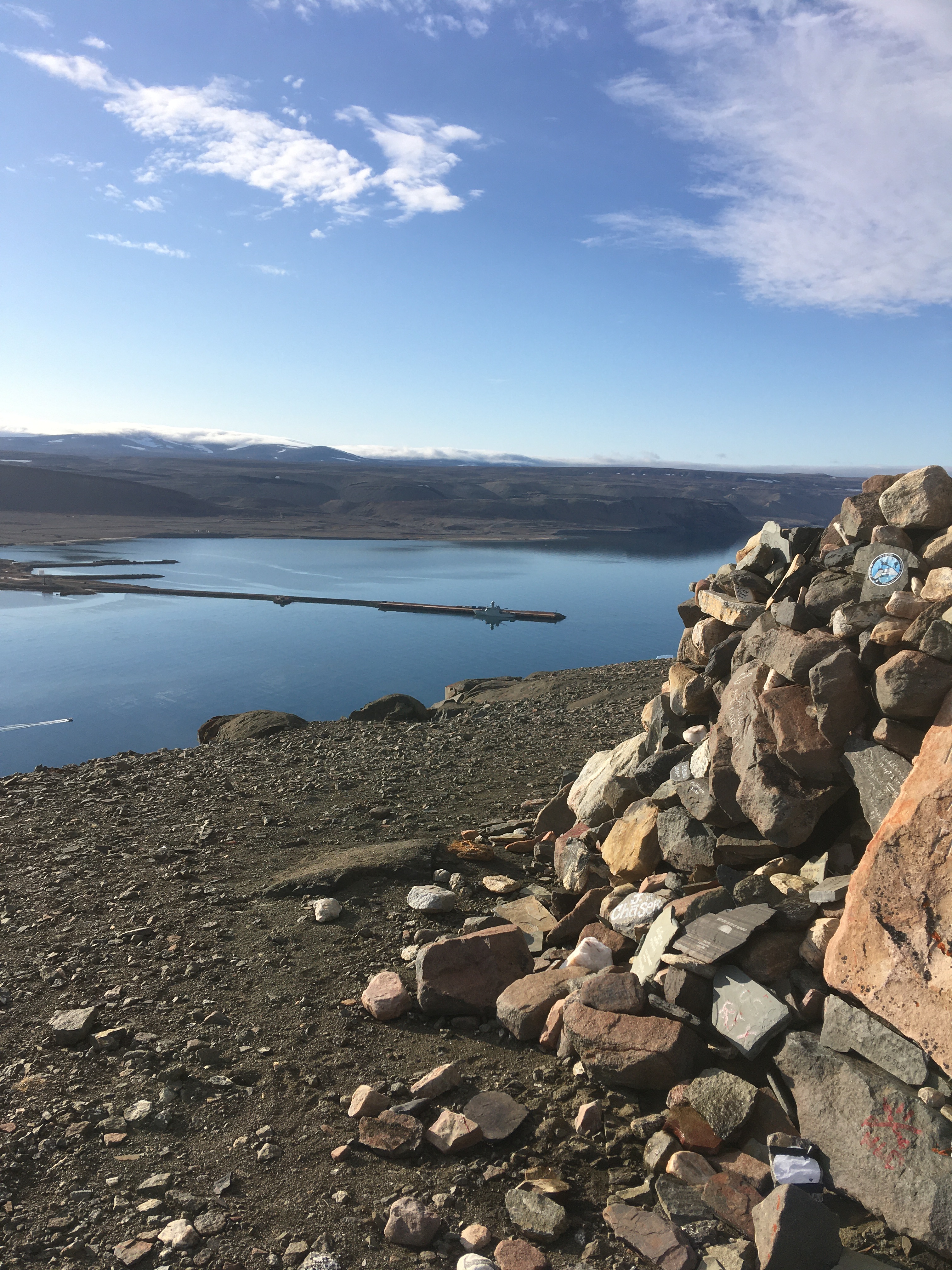
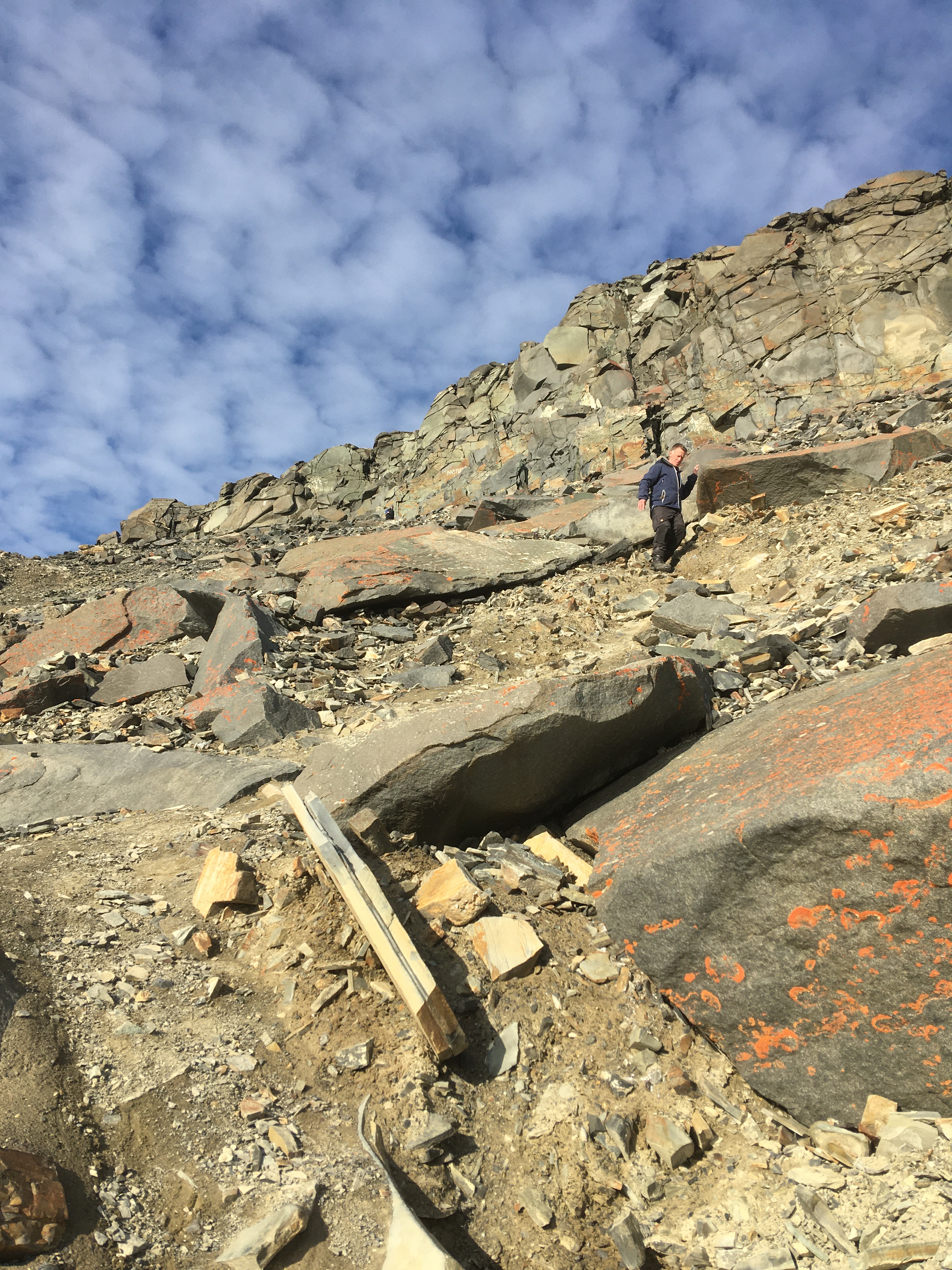
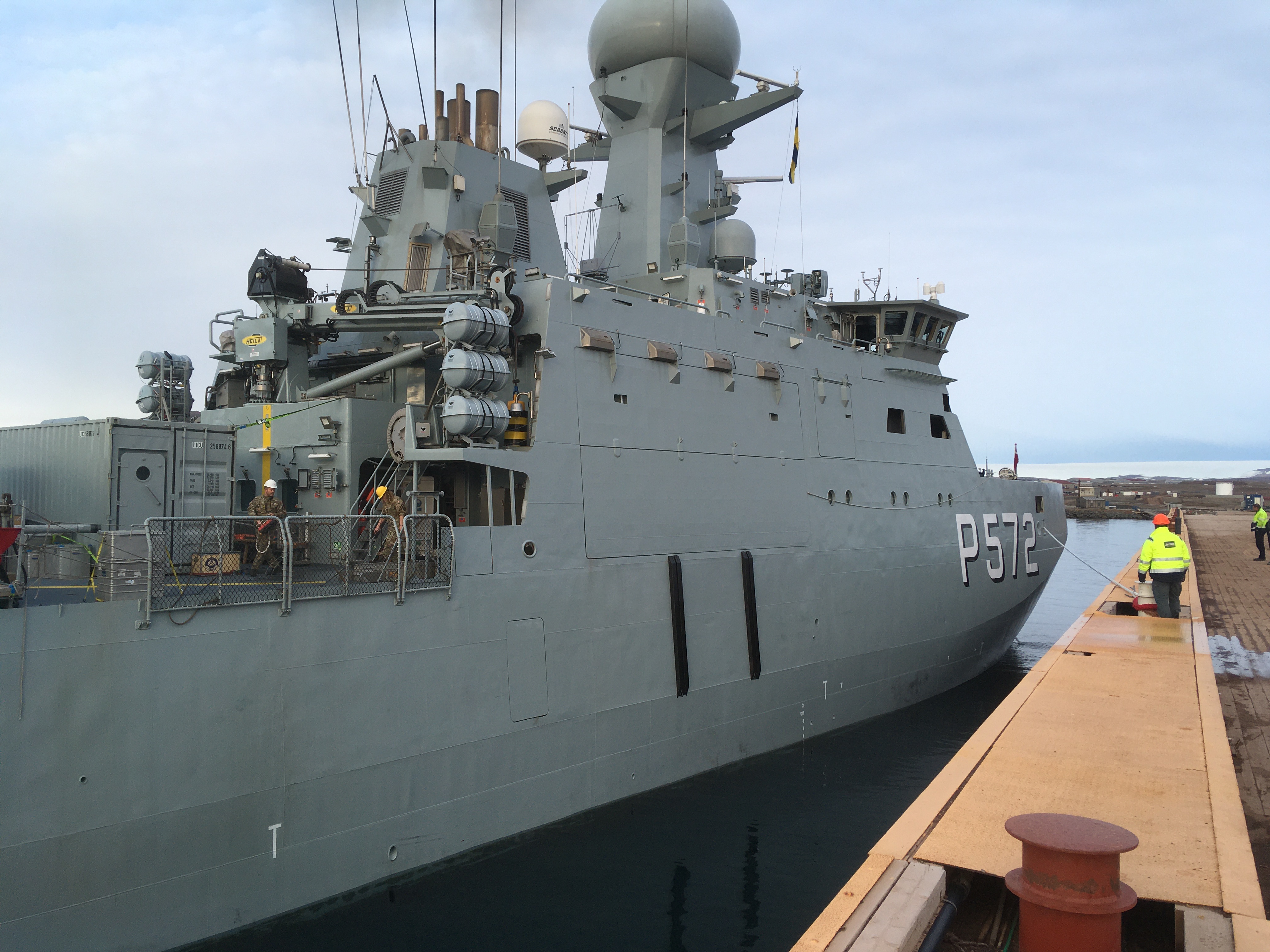
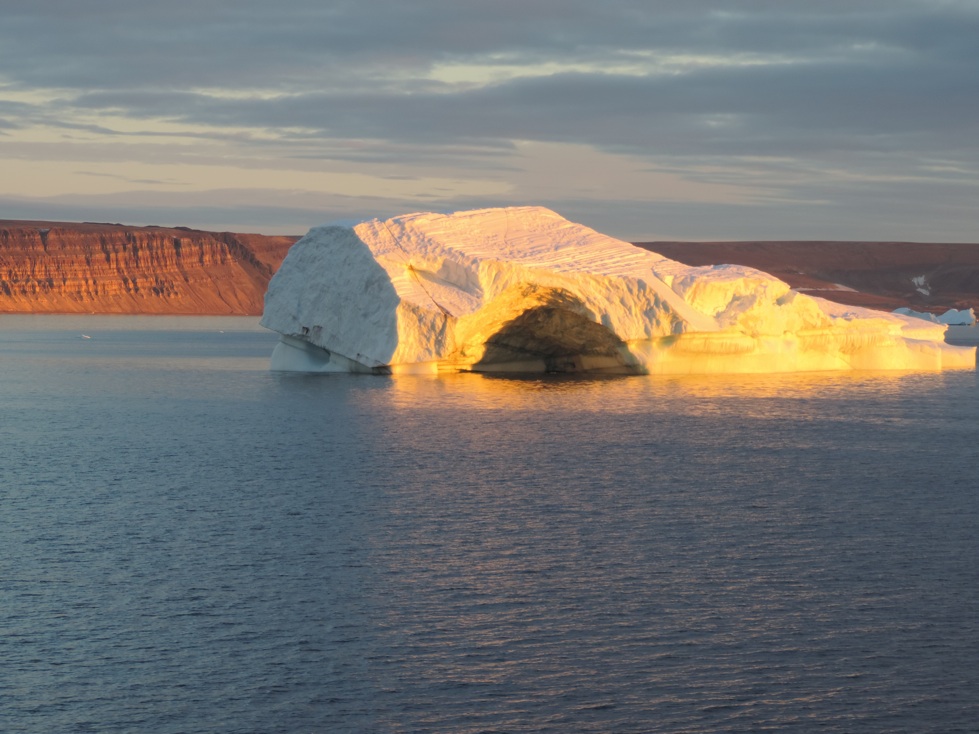
Greenland near Thule Air Base or Pituffik Space Base in the fall of 2015 and spring of 2017.
More than 400 Danes and Greenlanders operate the base such as providing heat, water, food, plumbing, snow removal, civil administration, medical services, and general repair of all things non-military. They also form the experienced backbone of the base, because most of them have worked here for 5, 10, 20, or more years. In contrast, the U.S. soldiers rotate in and out every year as did my former father-in-law when Thule housed up to 11,000 US soldiers during the Cold War.
Today my Vice-President visits this Pituffik in North-West Greenland for a few hours. I do not know, but I doubt he will even spent the night where about 150 Americans operate large radar installations as well as an large airport and deep water seaport. I also doubt he, his wife, or National Security Advisors will gain understanding of people, place, or culture during their brief fly-by. They did get the firm message from the leaders of both Danish and Greenlandic governments, however, that they are not wanted. The uninvited U.S. officials changed plans and visited a remote military base at Pituffik rather than to expose themselves to Greenlanders and Danes in public at the central population center of Sisimut during a national sport’s event.
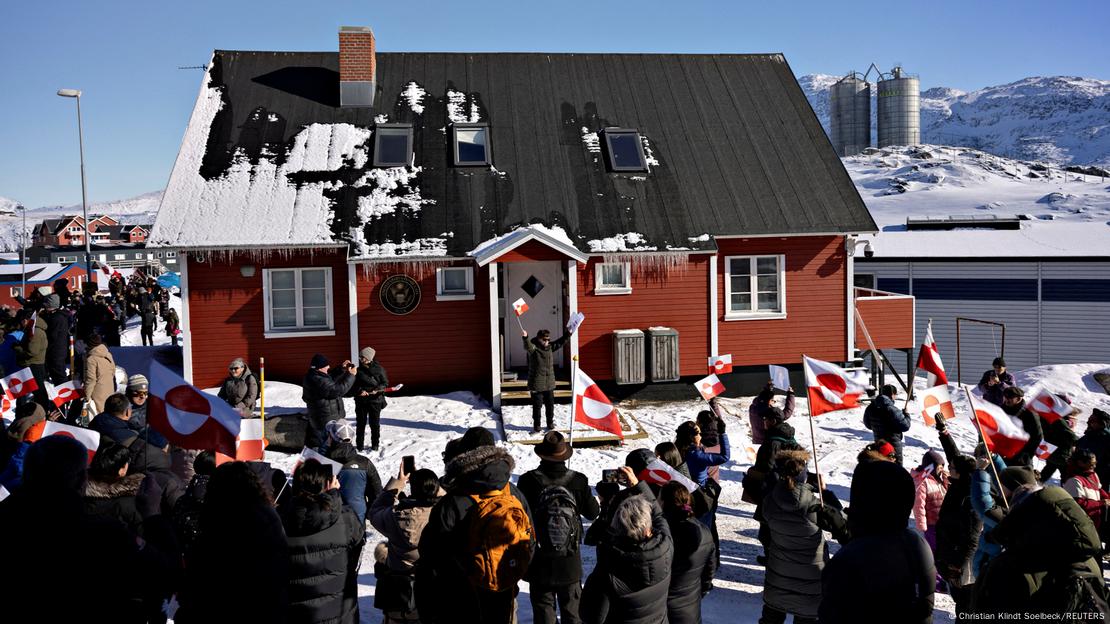
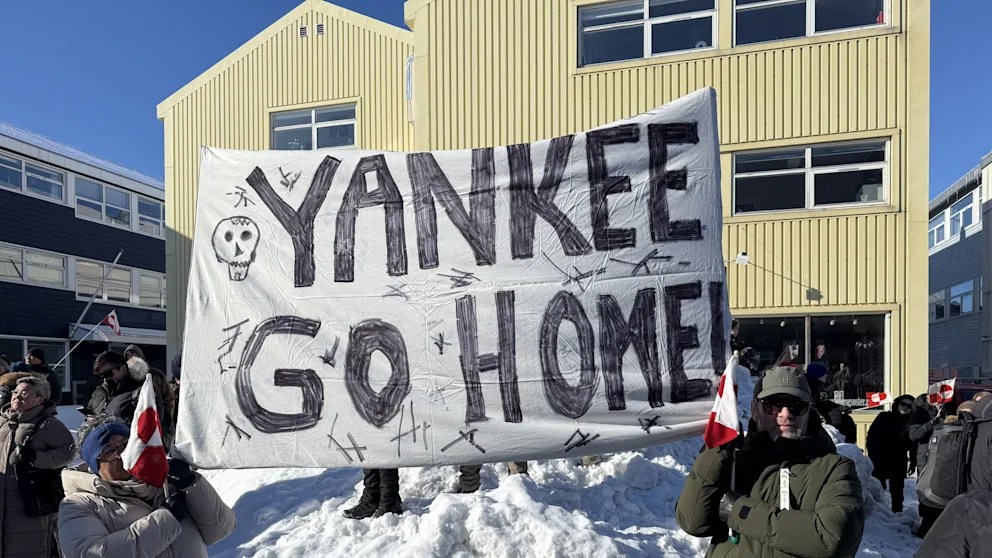
Two weeks ago almost 2% of Greenland’s population took to the streets in their capital Nuuk to expressed their views regarding their country [Source]. Relative to population, this would be the same, as if 6 million Americans would march in Washington, DC. Perhaps we need such a march to prevent the ongoing “Russification of the USA” where the malicious incompetence of my current government shreds the Law and undermines the Constitution of our United States of America.
Sleeping and camping in California’s Wilderness requires a permit. The most desired permit starts in Yosemite National Park to hike the 220 mile John Muir Trail (JMT) through Yosemite, Kings Canyon and Sequoia National Parks as well as Ansel Adams, John Muir, and Golden Trout Wilderness. This spectacular and scenic hike along the spine of the Sierra Nevada takes 3-4 weeks to complete without ever crossing a road or seeing a car. Chances to score a permit are slim (less than 1:10), so about 9 out of 10 applicants fail to win this “Golden Ticket” via a lottery. Last year I was one of the 9 and thus had to be creative, because I wanted to hike the JMT. Here is my “solution” from 2024:
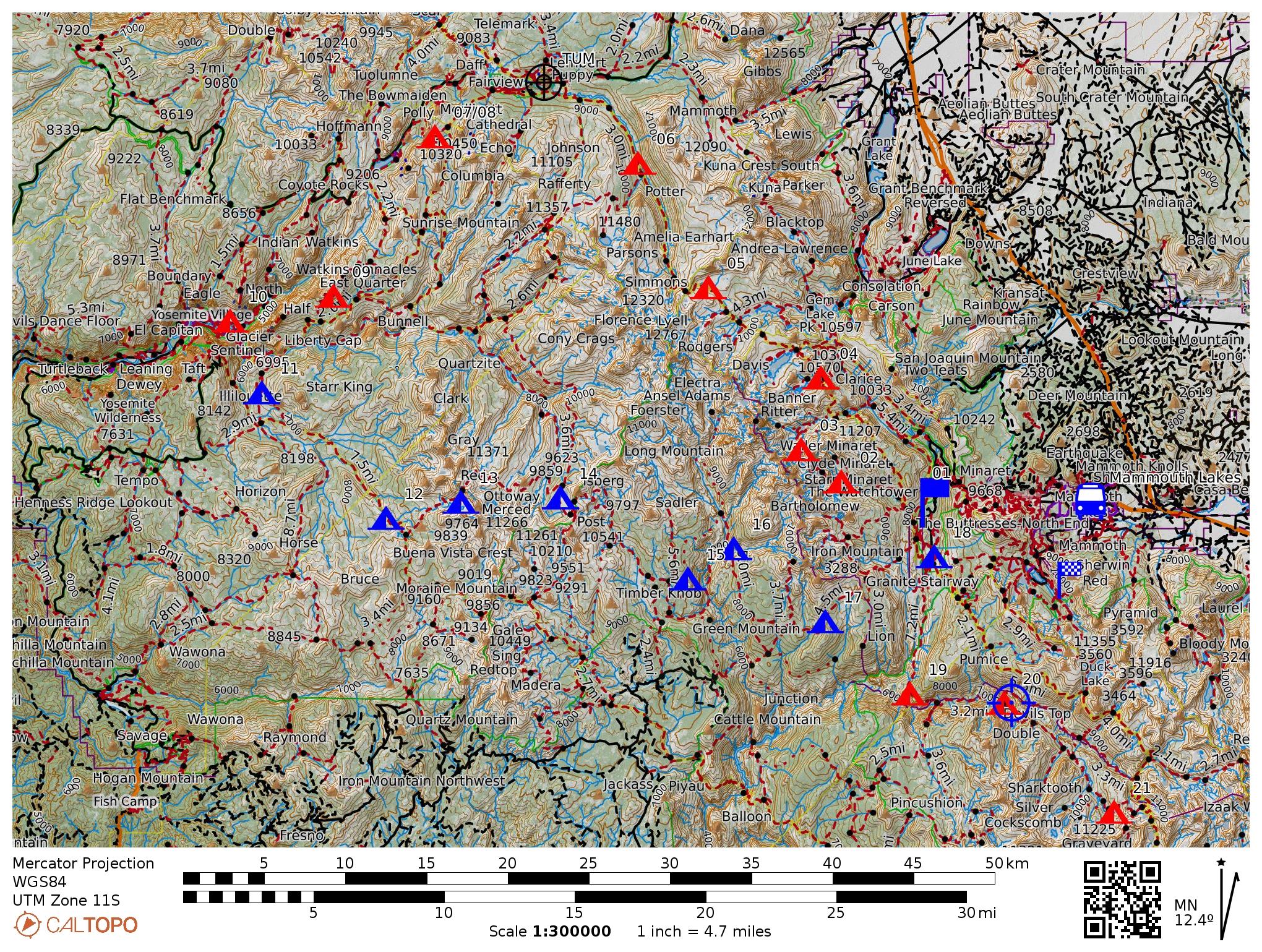
My 2024 loop through Yosemite National Park. I acclimated at Mammouth Lakes (blue bus) for 2 days and took a city bus to my trailhead at Devils Postpile (blue flag). From there I hiked north to Yosemite Village via Donahue Pass along 8 campsites (red tents). This was my first permit. The second permit carried me from Yosemite Village via Red Peak Pass and Isberg Pass along another 8 campsites (blue tents) back to Mammouth Lakes. Subsequently, I continued walking on the same second permit south loosely following the John Muir Trail (JMT) and past it to Horseshoe Meadow near Lone Pine, CA.
My solution included two different, easy-to-get permits to loop counter-clockwise through Yosemite. Starting at Mammouth Lakes (Devils Postpile trailhead), I first headed north loosely following the JMT by crossing Donahue Pass (11,067′ or 3370m high) to reach Tuolumne Meadows (8,619′ or 2630 m low), Clouds Rest, and finally Yosemite Village. Resupplying there, I picked up my second permit, and hiked south back to Mammouth Lakes via Red Peak Pass in the Clarke Range. Back on the JMT at Devils Postpile 8 days later I slept at Reds Meadow (camp #18) to walk south for the next 18 days to complete my own JMT Plus.
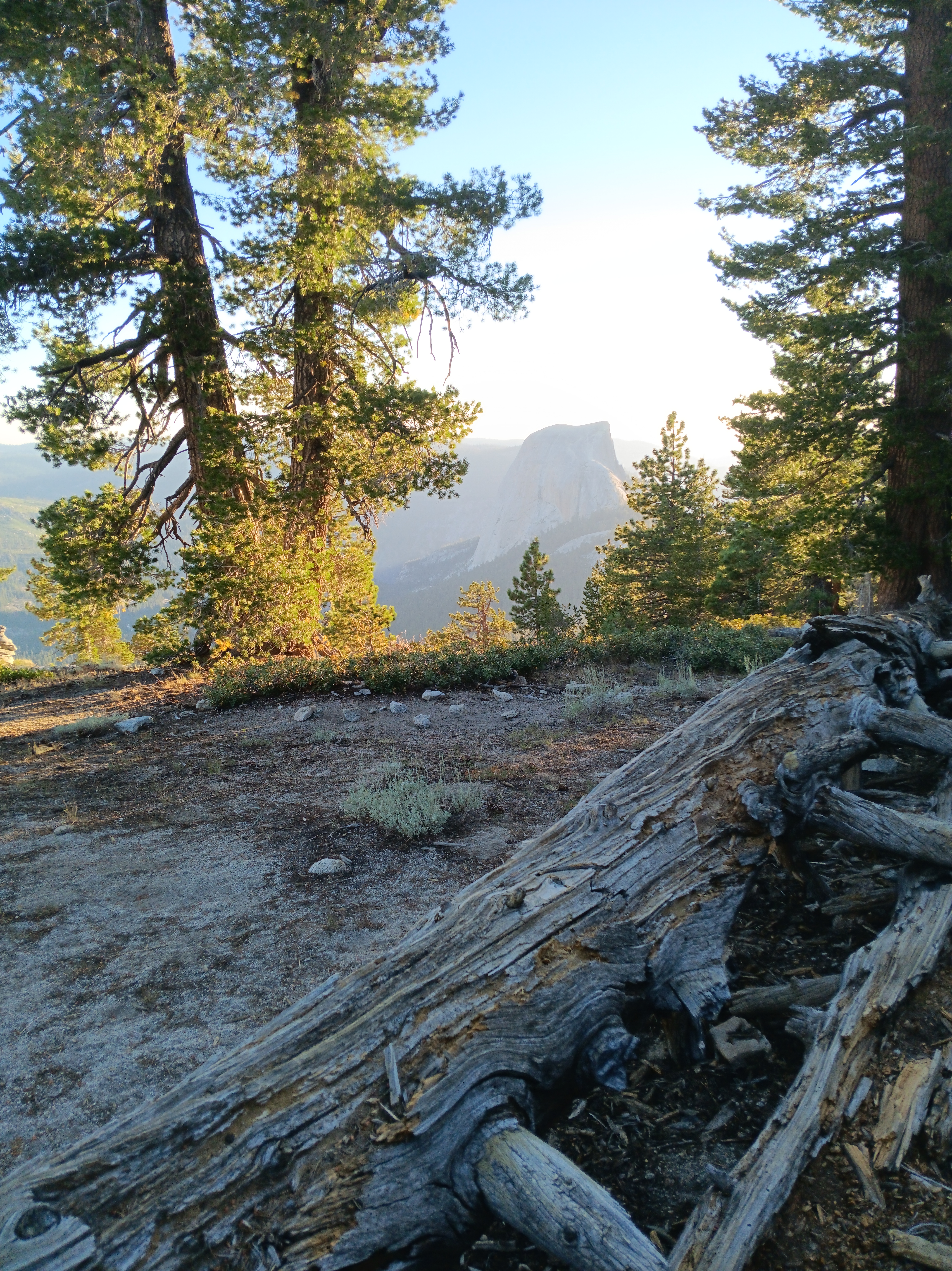
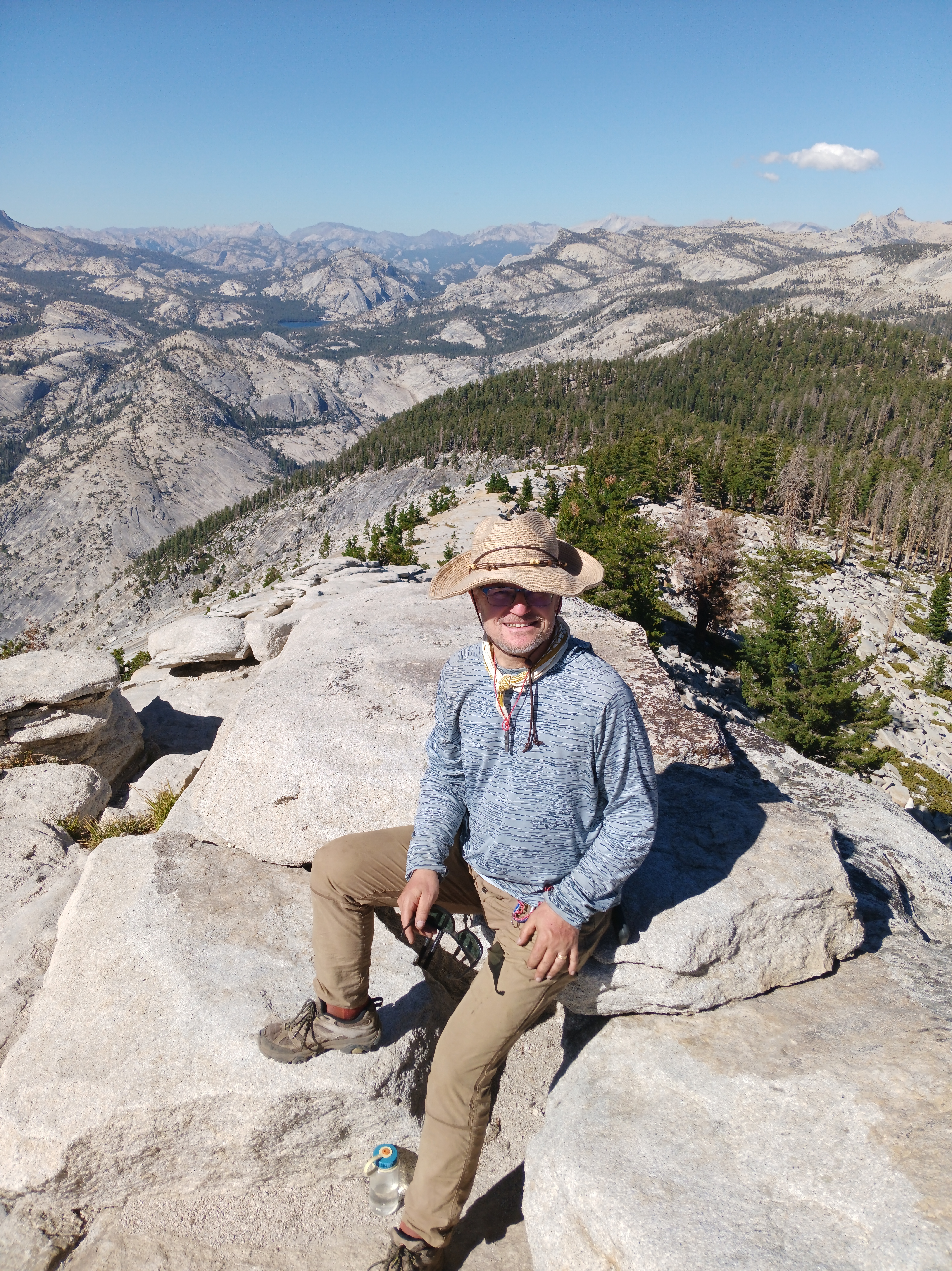
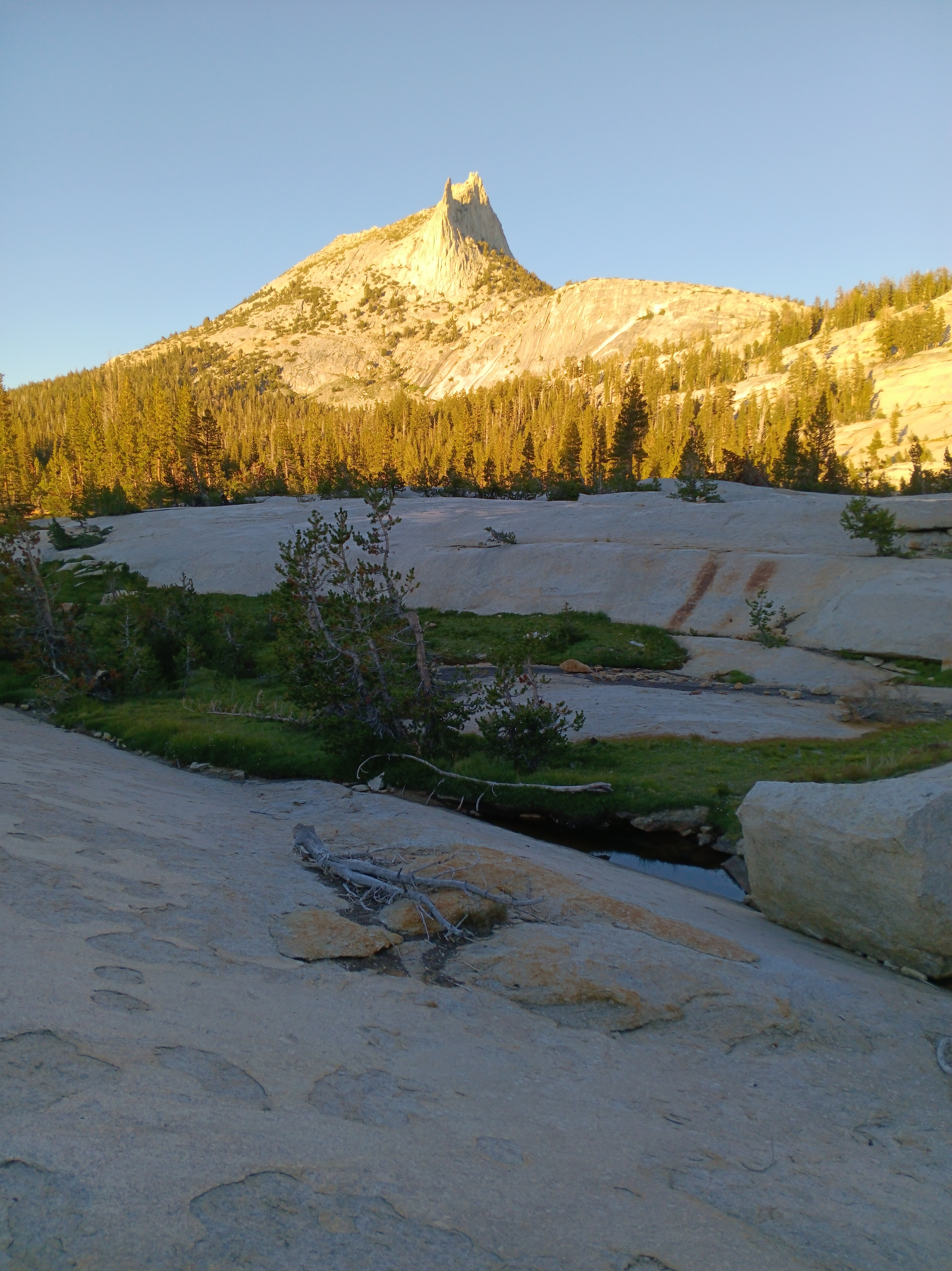
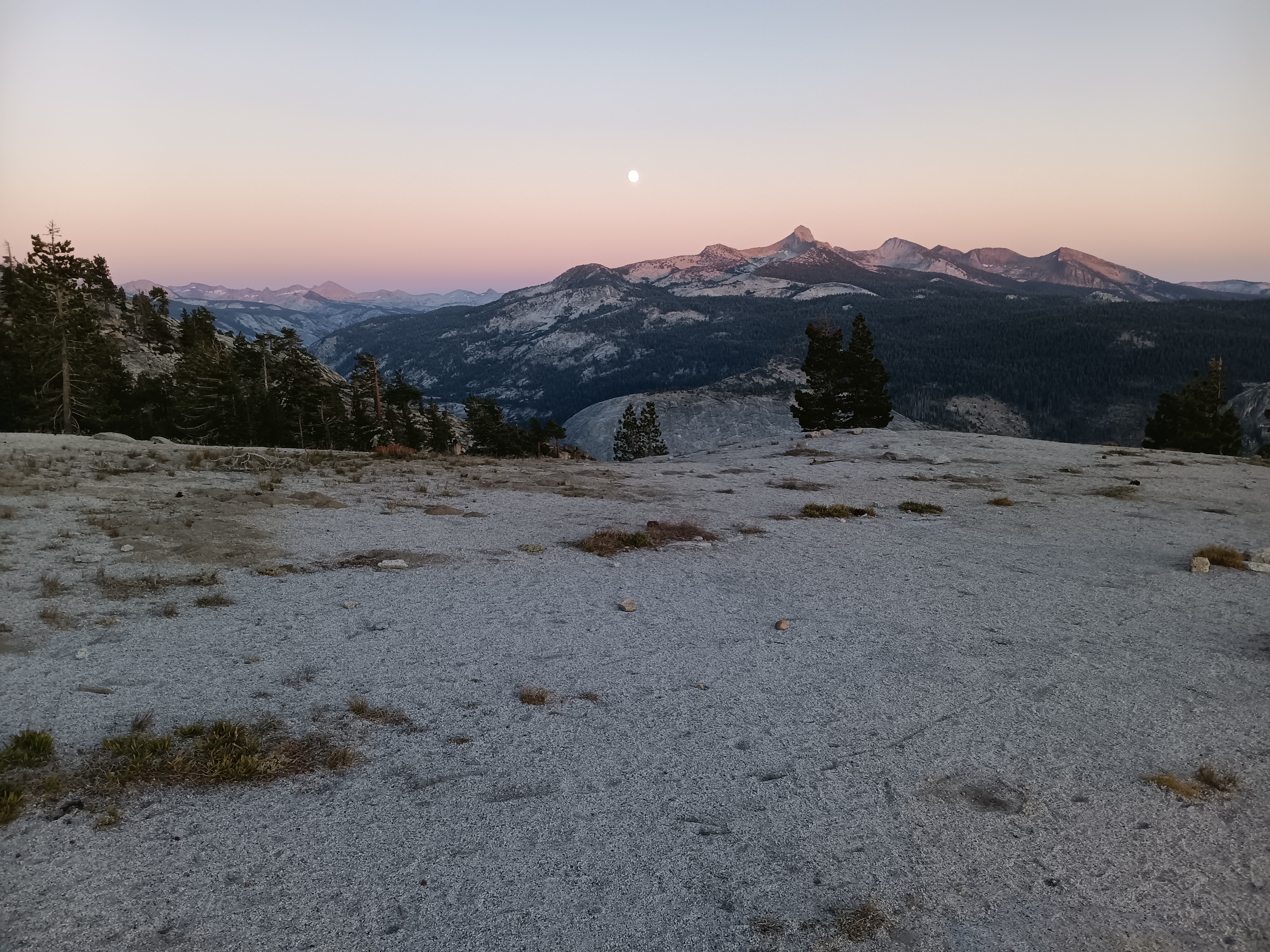
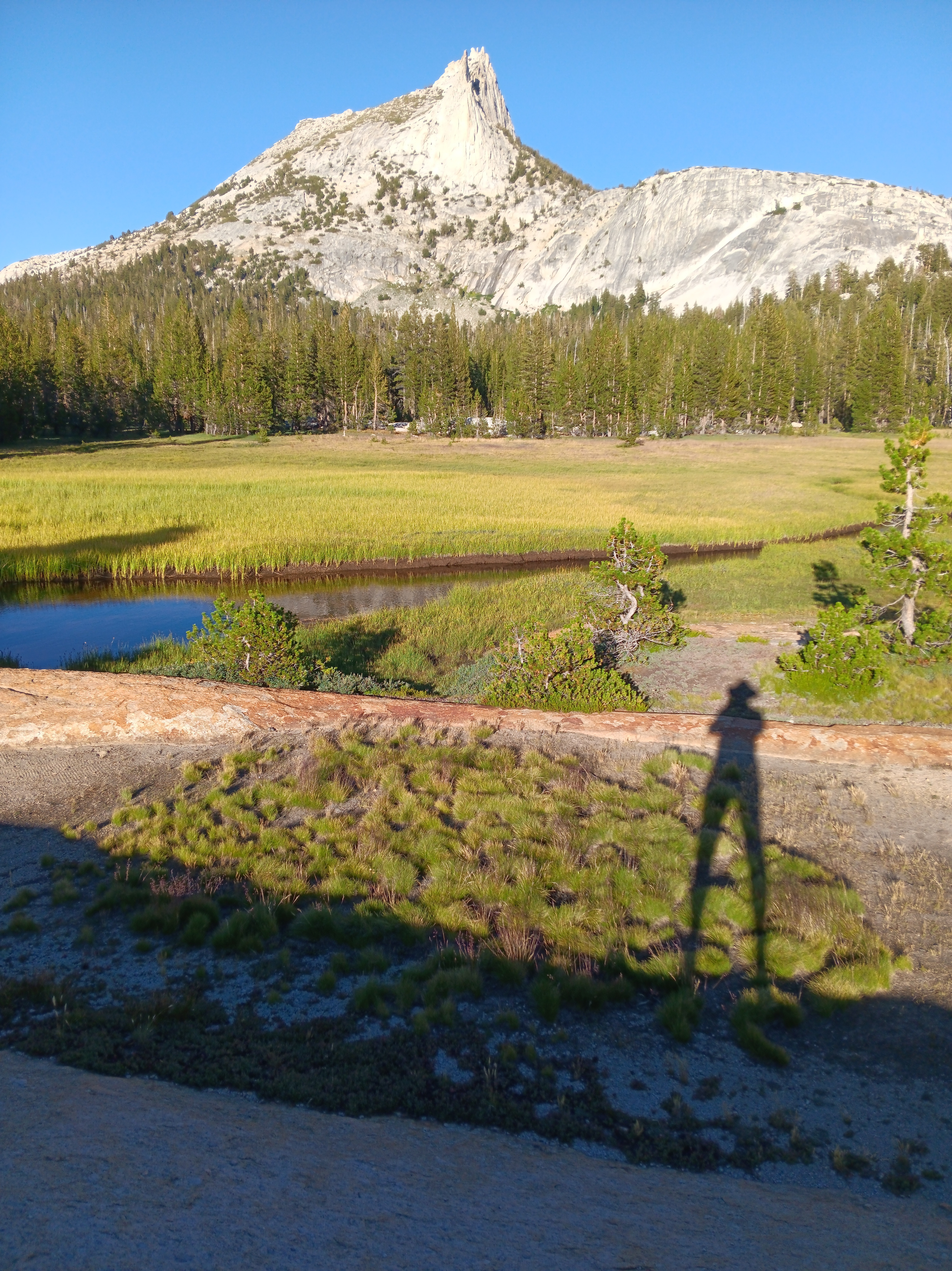
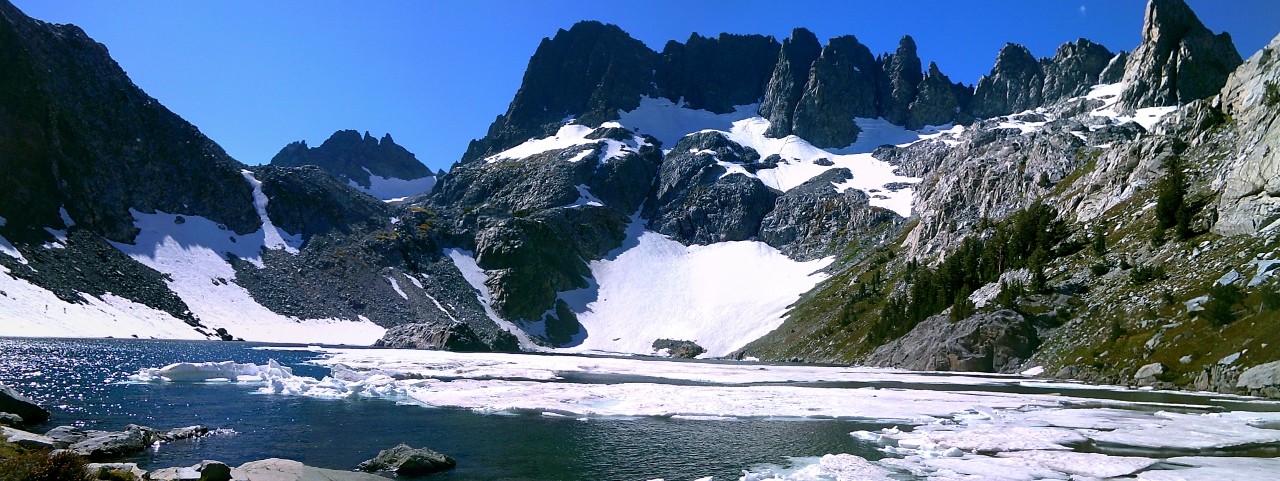
The return loop through Yosemite added 82 miles, but these 82 miles required a different set of physical and mental skills, because away from the JMT both people and trails disappear intermittently for days which does not happen on the JMT. The gallery below shows my camp #9 above Half Dome (top left), myself on Clouds Rest (top center), and Cathedral Mountain seen from Lower Cathedral Lake (top right) either on or near the JMT. The larger bottom photo shows the Clarke Range in the distance that I crossed 5 days later. I took the photo above Clouds Rest before descending to Yosemite Village the next day.
The JMT is a shoulder-wide super-highway through the wilderness. The trails are always well maintained and one meets about 10 to 30 people every day from all over the world of all ages. Only on the last 5 miles past iconic Half Dome into Yosemite Village 100s or 1000s of people moved up and down the trails for the day. Sleeping at the backpacker’s campground in Yosemite Village (camp #10) for $8, I splurged on an awesome $40 breakfast at the majestic Ahwahnee Hotel. These are my priorities and I was back on serene trails turning right (west) near Nevada Falls to head up towards the Illilouette Valley. The last day hikers were a lovely couple from Lithuania with their two lively and happy children. Two hours later I reached the Illilouette watershed where I slept solidly on a thick and soft bed of pine needles (camp #11).
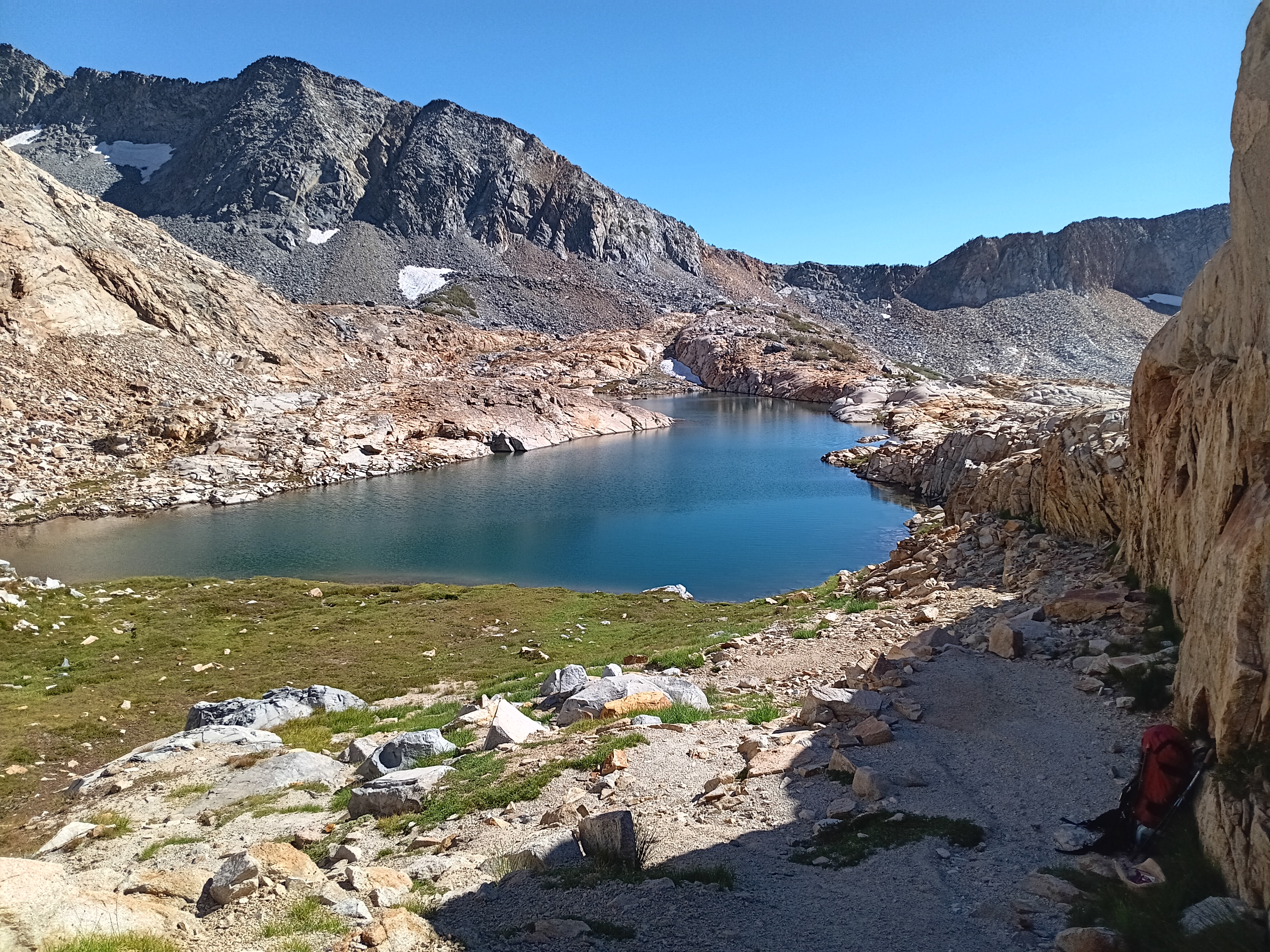
The next two days I only met one group of 2 hikers on my way to Merced Pass Lakes (camp #12) and nobody to Ottoway Lakes just below Red Peak Pass in the Clarke Range. My campsite #13 in the top-left photo below is the small flat area in the shade next to a 20 feet high block of granite. My view towards the west included Merced Peak at 11,726 feet (3574 m) and nearby patches of snow.
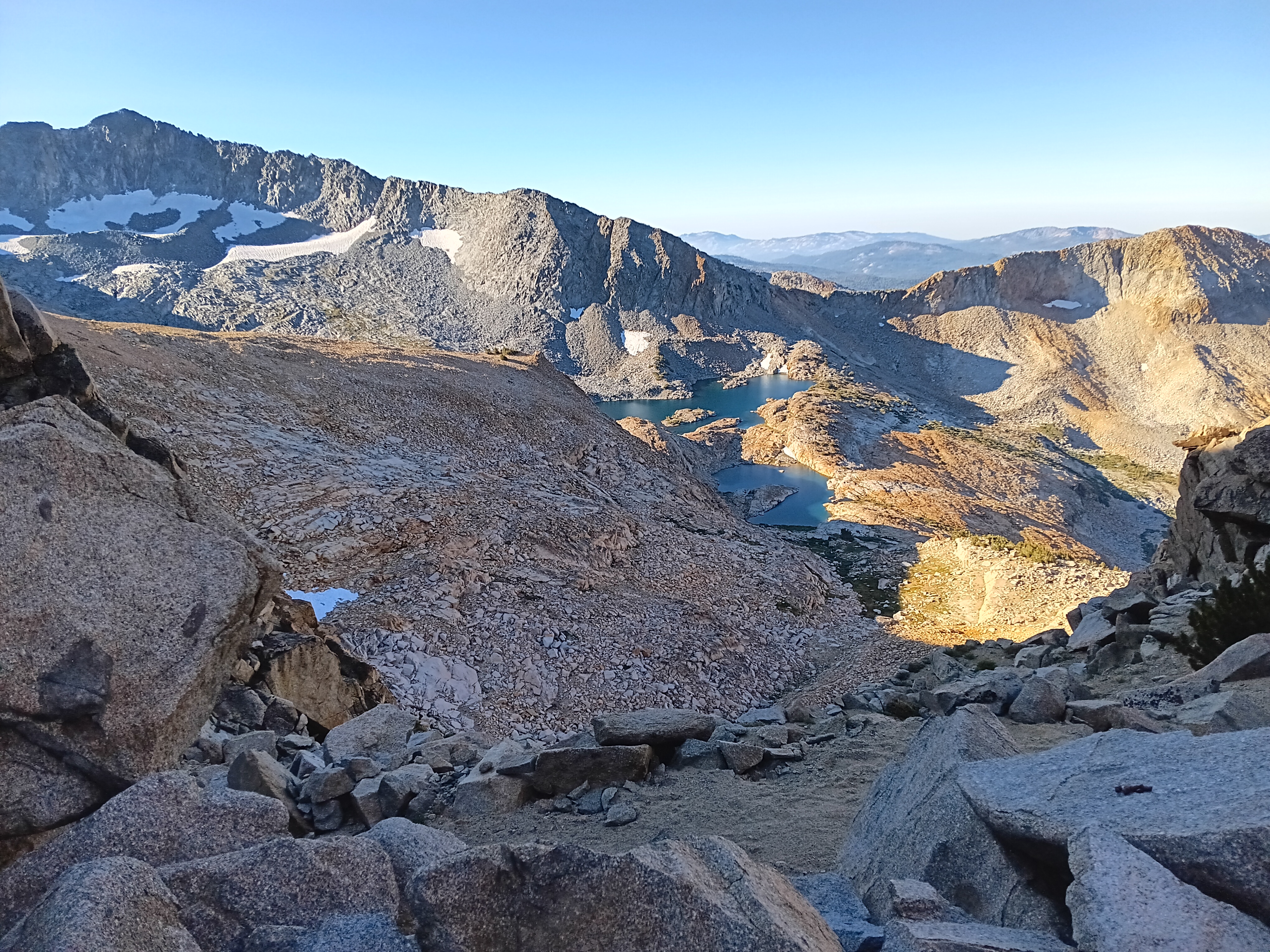
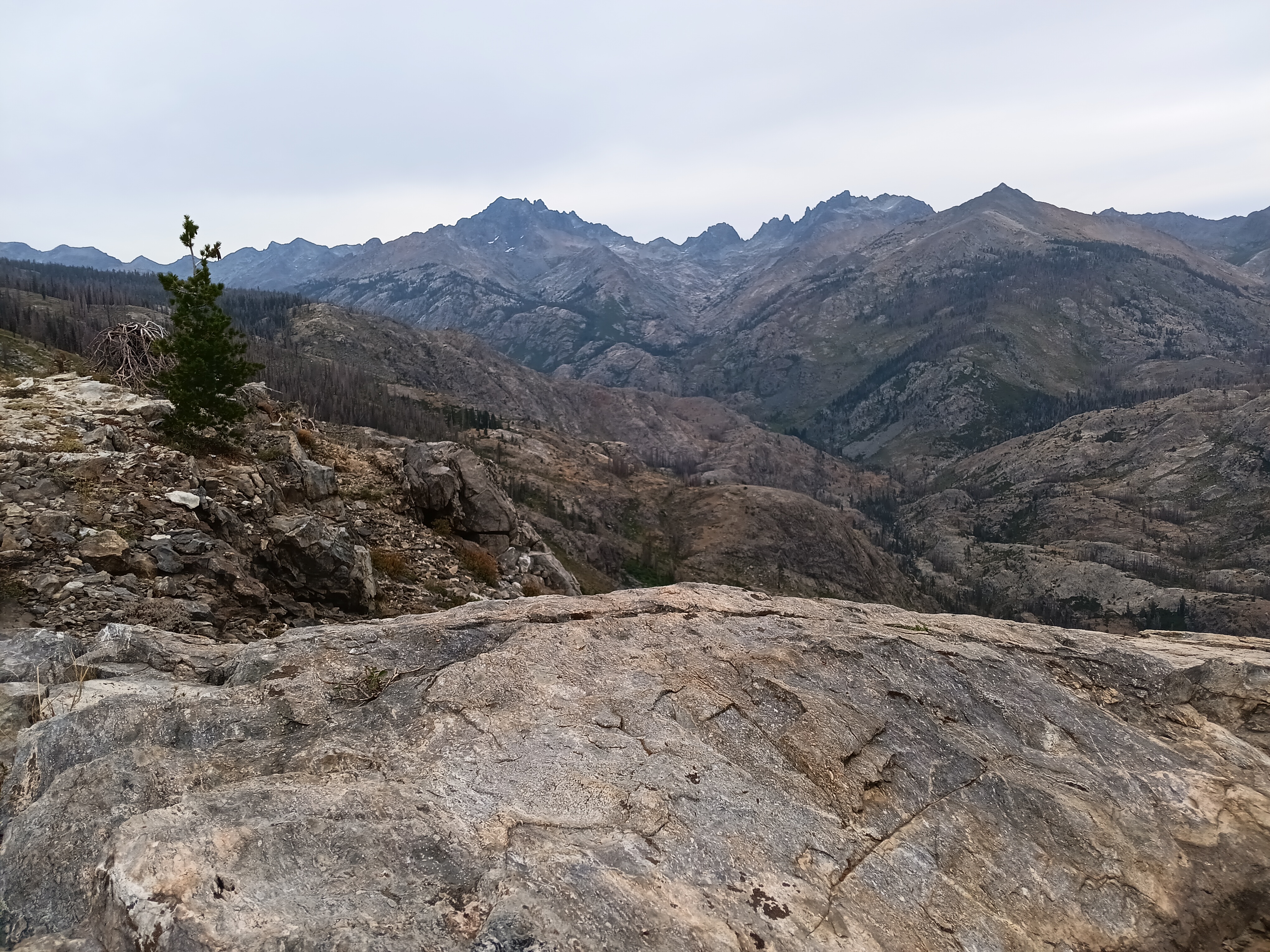
The photo above shows Merced Peak the tallest mountain of Yosemite’s Clarke Range. I crossed this range the next morning via 11,150′ (3400 m) high Red Peak Pass from where the photo above was taken at 8 am in the morning. The many switchbacks made this an easy hike both up and down into Merced Valley. Here I met, surprisingly, a group of 2 women from my home state of Delaware: we are a small and flat (<480′ or 140 m) state. Crossing the Merced River at 9,150′ (2790 m) elevation, I climbed up again towards Isberg Pass at 10,510′ (3200 m). The Delaware women told me that a snow storm was predicted the next day and stormy it was, indeed, at my campsite #14. Clouds and wind bursts rolled in and out over Isberg Pass all night and the next day. Without breakfast I left this unpleasantly cold and windy camp at 6:30 am to stay ahead of the snow storm trying to reach lower elevations. Easier said than done …
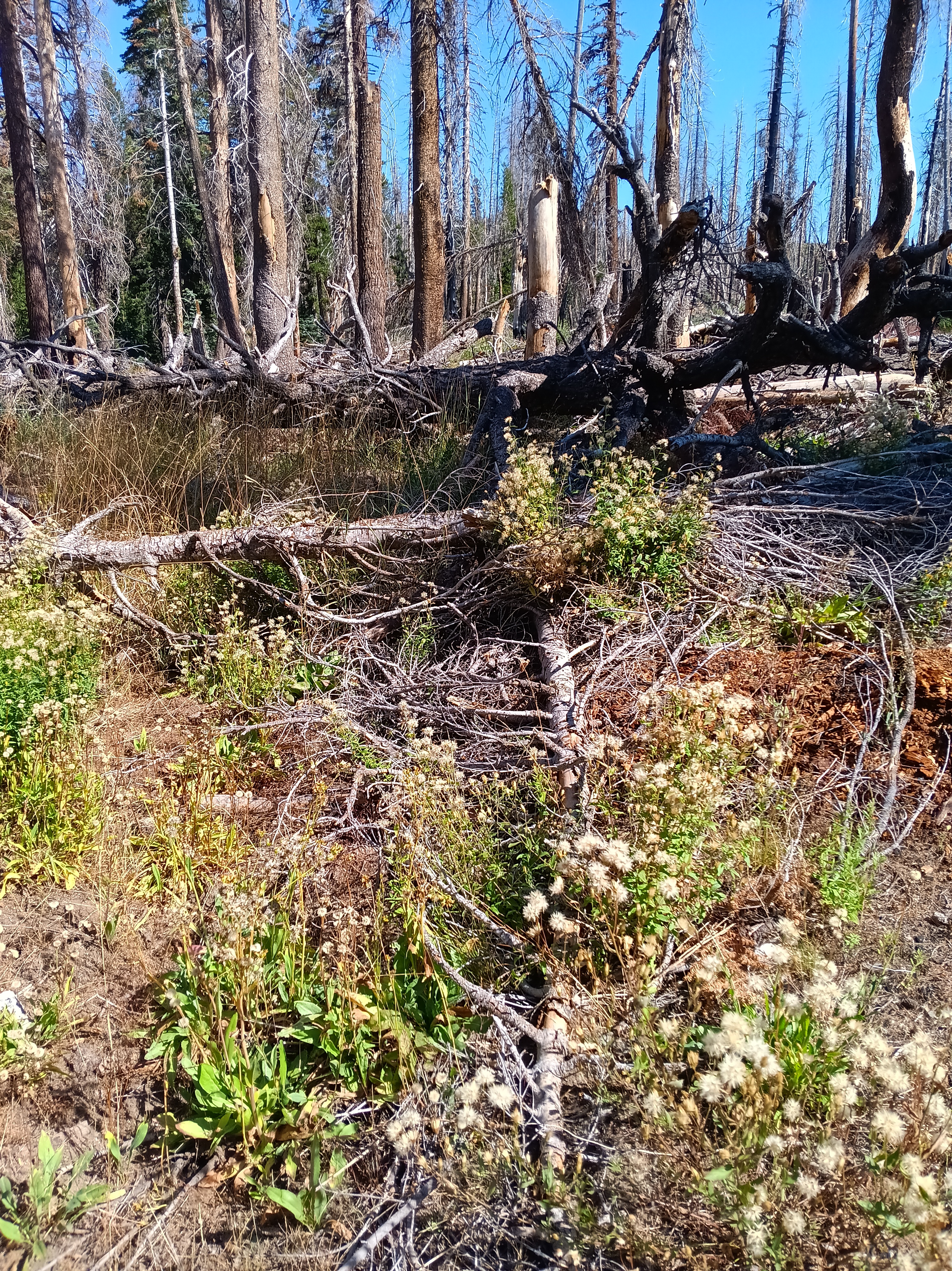
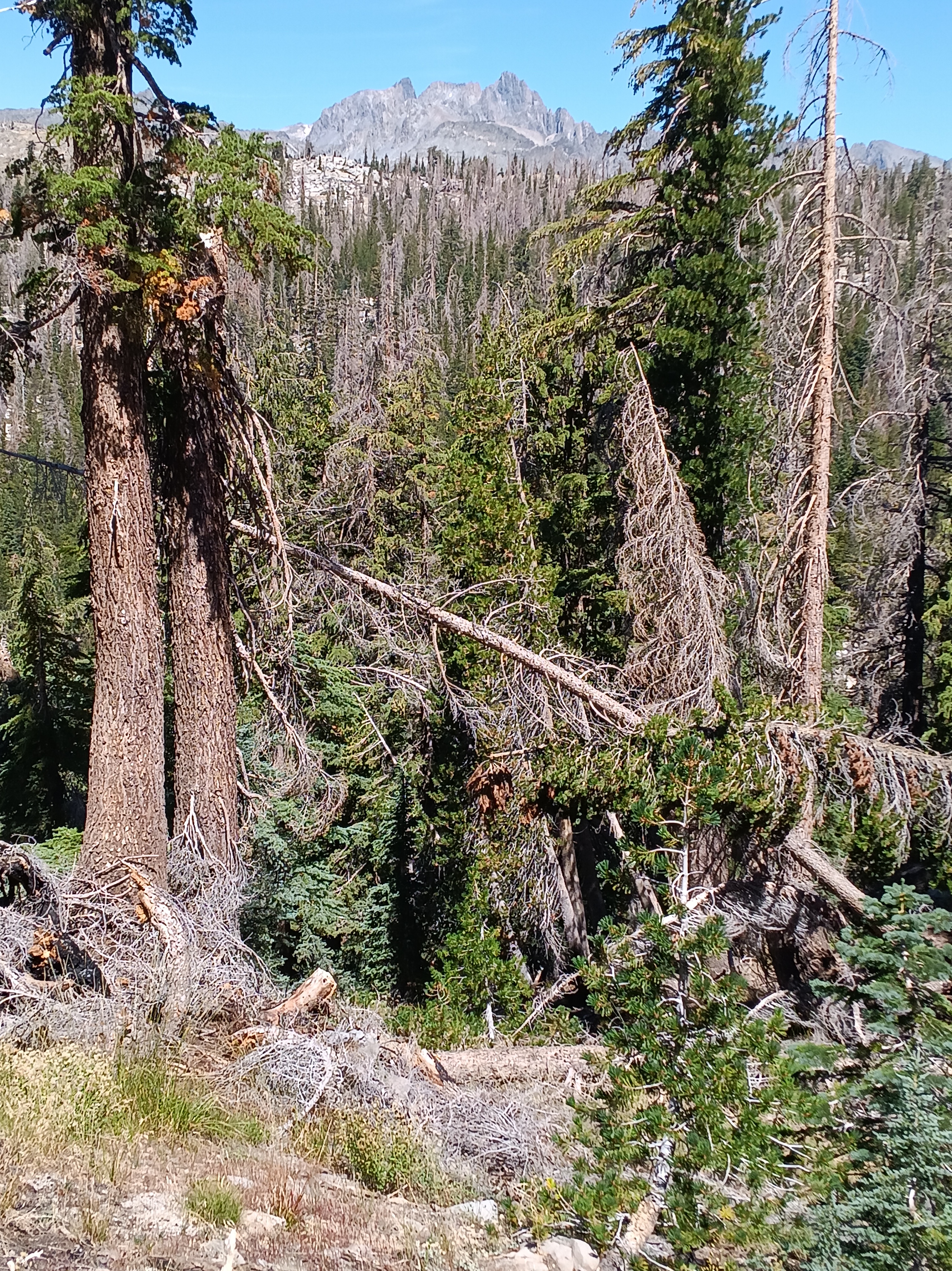
My old Tom Harrison paper map of Ansel Adams Wilderness showed a “maintained trail” for the next 16.6 miles to Hemlock Crossing (7555′ or 2300 m), a bridge across the North Fork of the San Joaquin River, and another 16.9 miles to Devils Postpile via Granite Stairway (9014′ or 2750 m). Such mileage usually takes me 2-3 days of comfortable walking, but this specific hike took me 4 long and exhausting days of navigation through dense brush and forest often without a trail. I gained a new respect for those who initially explored this wilderness 150 years ago without the contour maps, satellite navigation, text messaging, and SOS buttons that I had with me.
Almost immediately after crossing Isberg Pass, the trail disappeared. No problem here, because at ~11,000′ one is well above the tree line and thus sees clearly where one has to go. It is not hard to boulder over large rocks or walk on flat benches of granite or stroll down gently sloping dry stream beds. Furthermore, as soon as the trees reappeared near 9,500′ the trail reappears also. About half way between Isberg Pass and its trailhead near Clover Meadow Ranger Station I met the last group of people for the next 3 days. They were led by a “preacher” my age (63 years) without a backpack and four disciples ~20 years younger who carried heavy loads for their 4-5 day “revival” at Turner Lake in Yosemite. They were friendly, tried to convert me with good humor, and we talked for about 20-30 minutes about nature, god, and life as we know it, but then they headed up towards Isberg Pass and Yosemite while I headed down towards Bugg Meadow and Devils Postpile. All good.
Three hours later the trail almost disappears as I turn east at Detachment Meadow away from all trailheads. The trail becomes fainter with every mile, yet suddenly a posted junction sign points me towards Bugg Meadow and Hemlock Crossing. Good, this is my destination, but the trail immediately disappears. I pitched my tent (camp #15) near a fire-scarred rocky out-crop 2000 feet above the mighty valley the North Fork of the San Joaquin River just before it started to sleet. The next 3 days were the most difficult of my 35 days in the mountains:
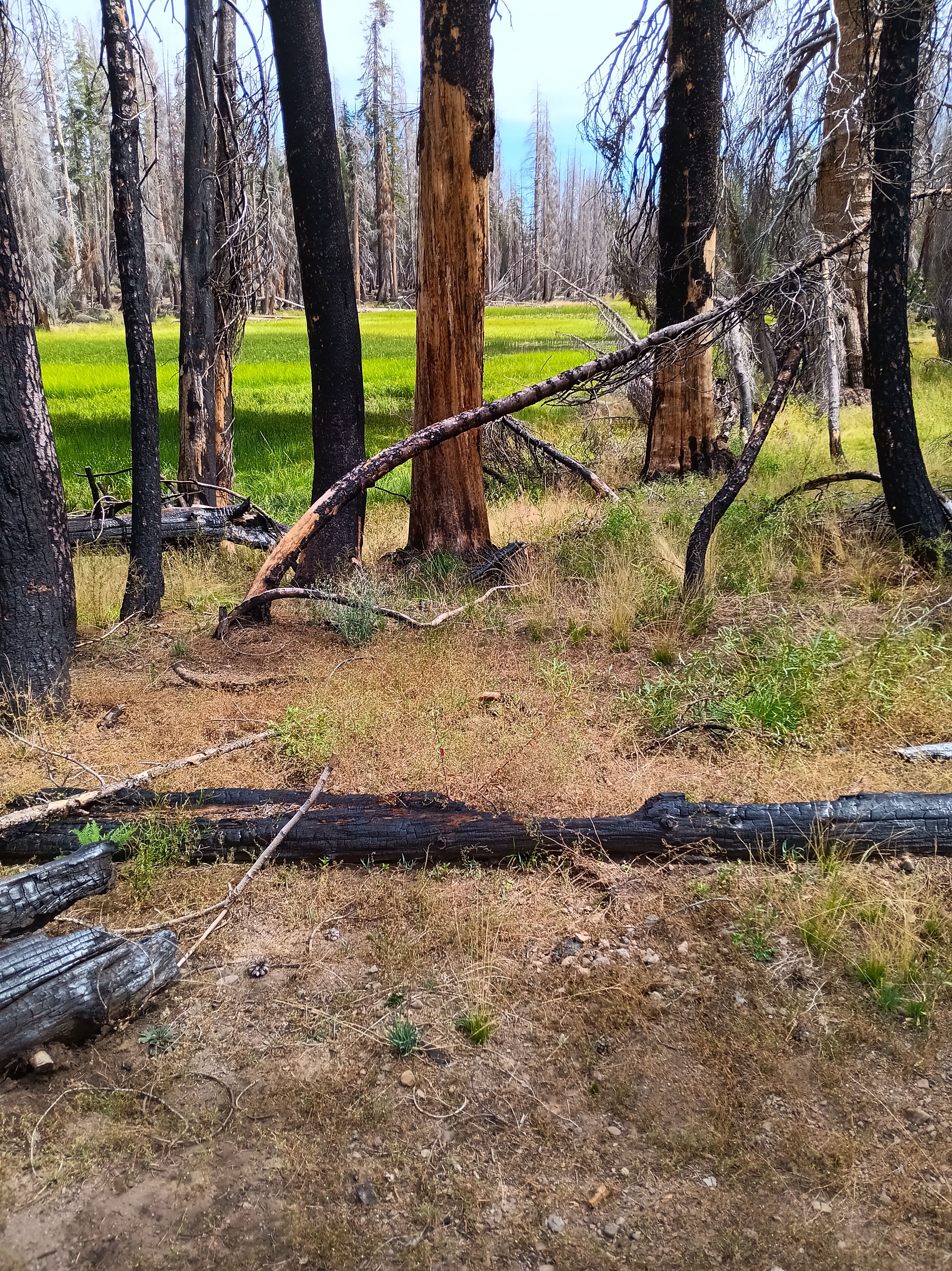
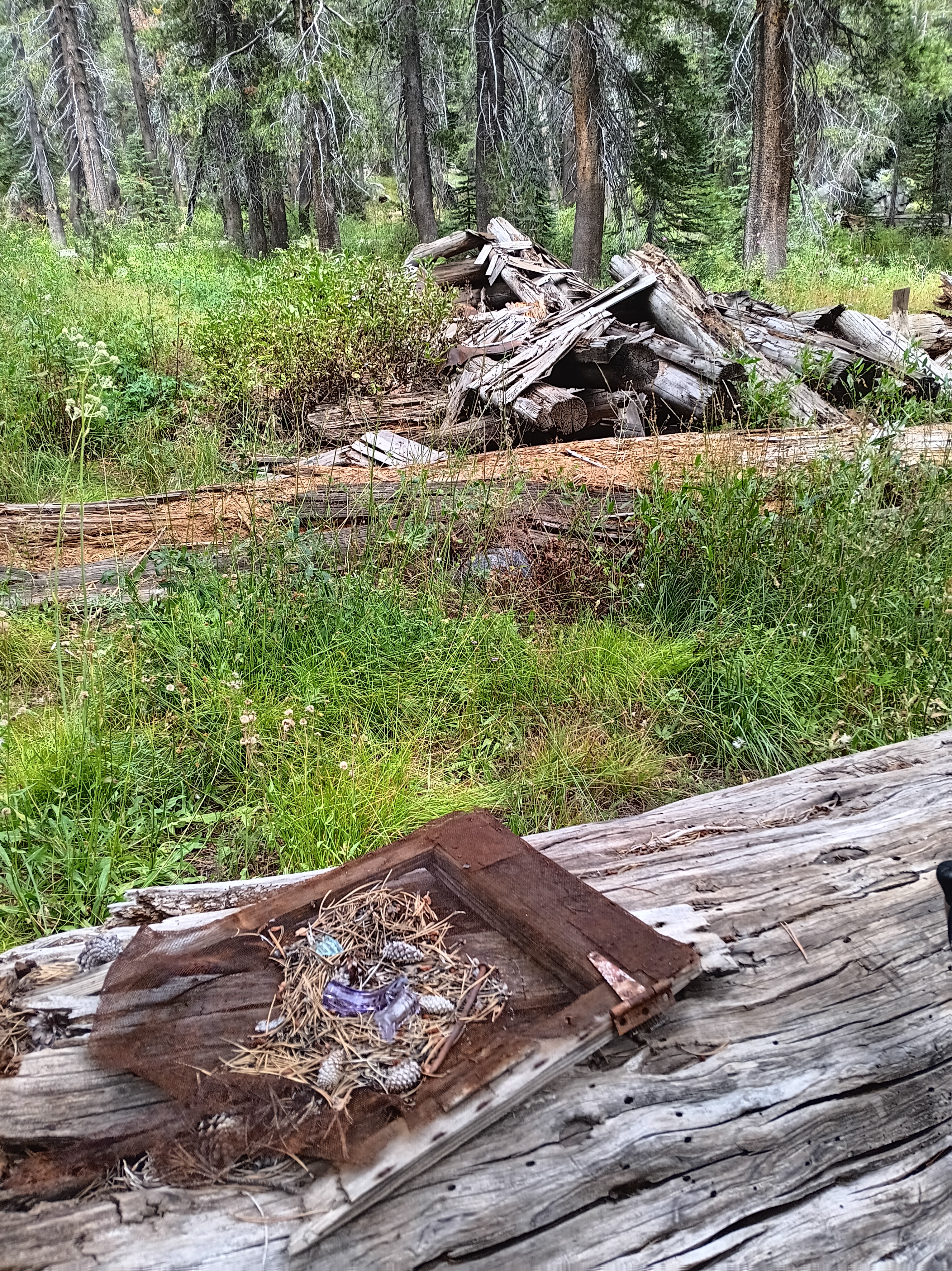
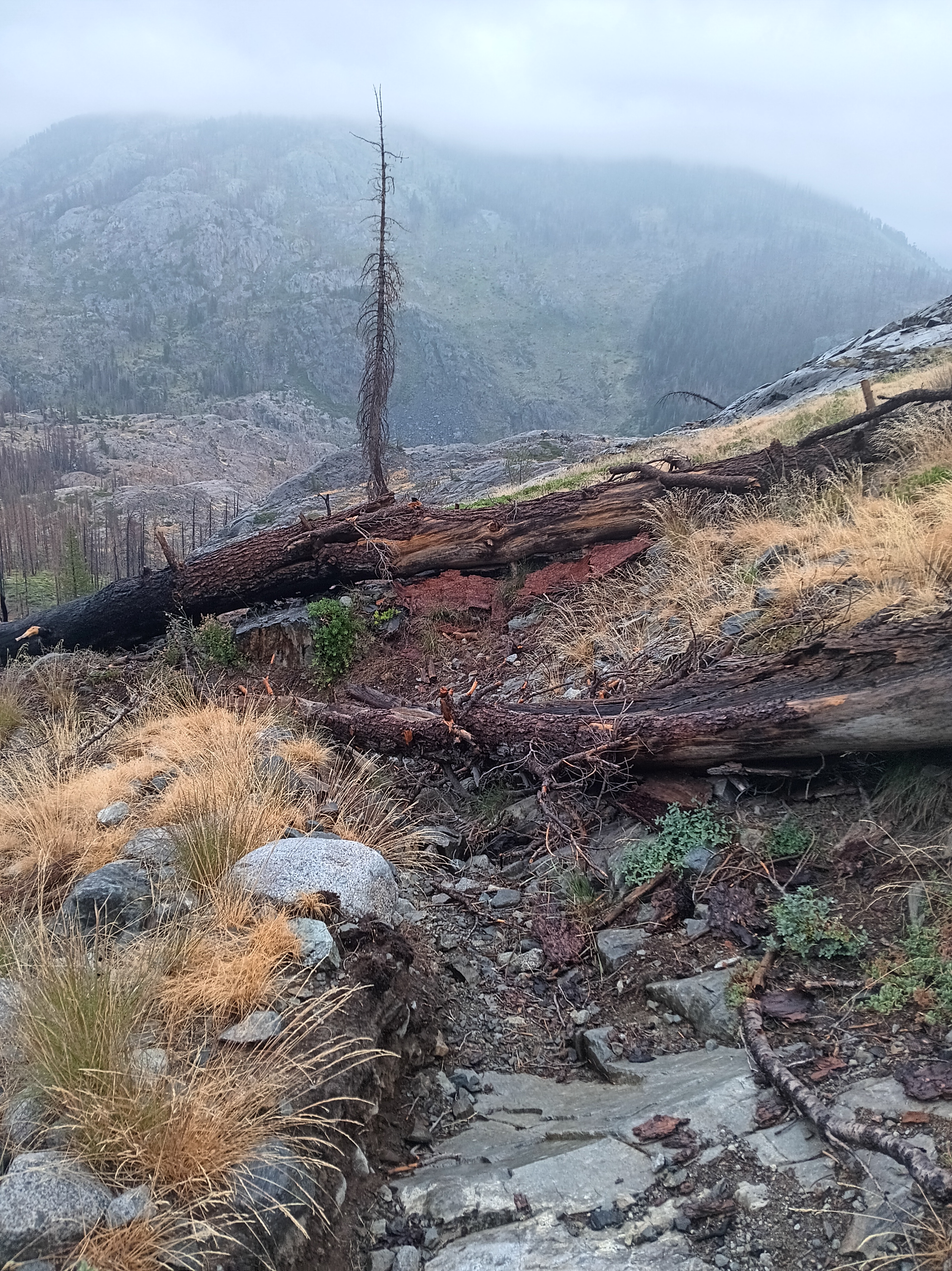
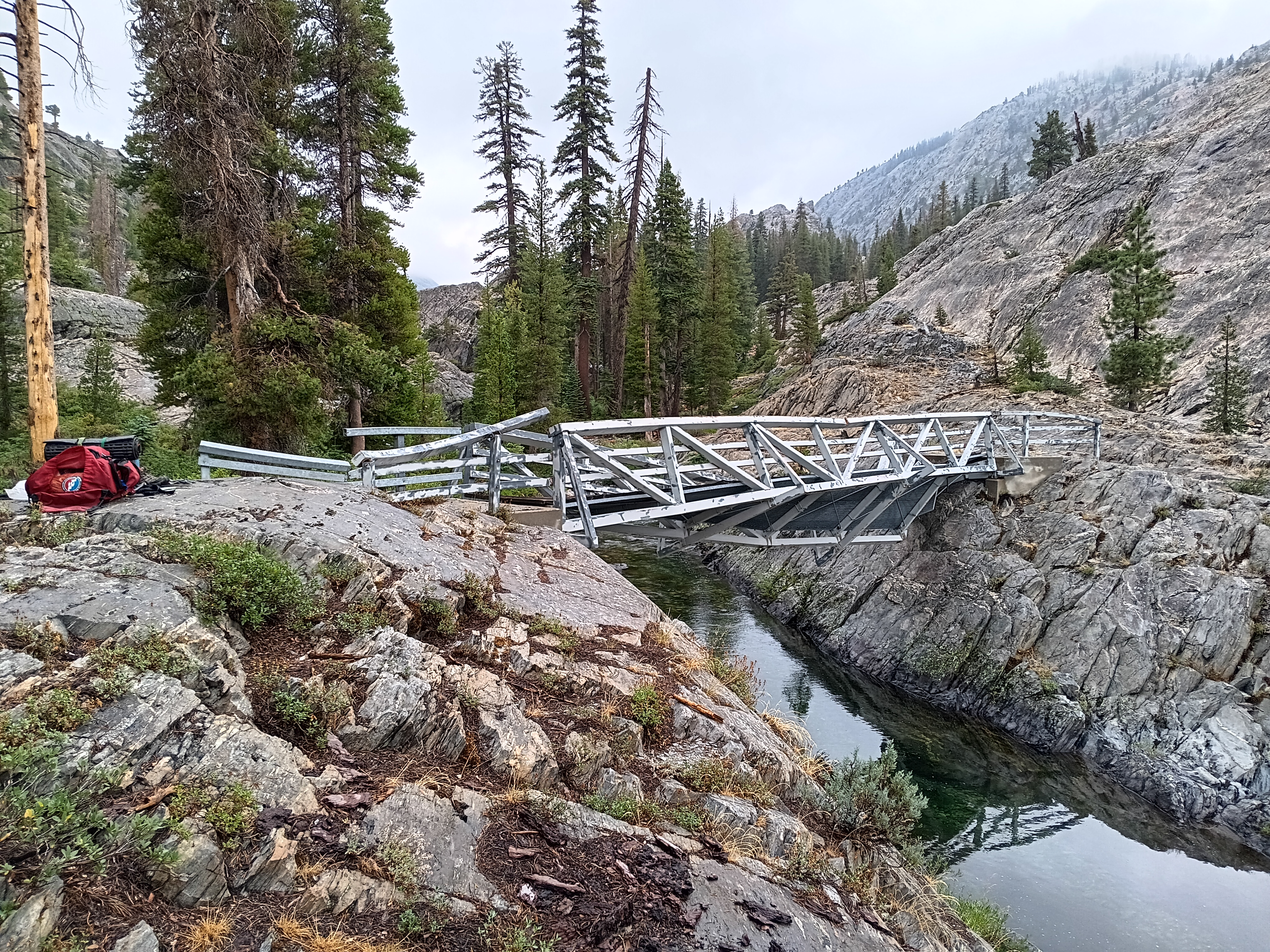
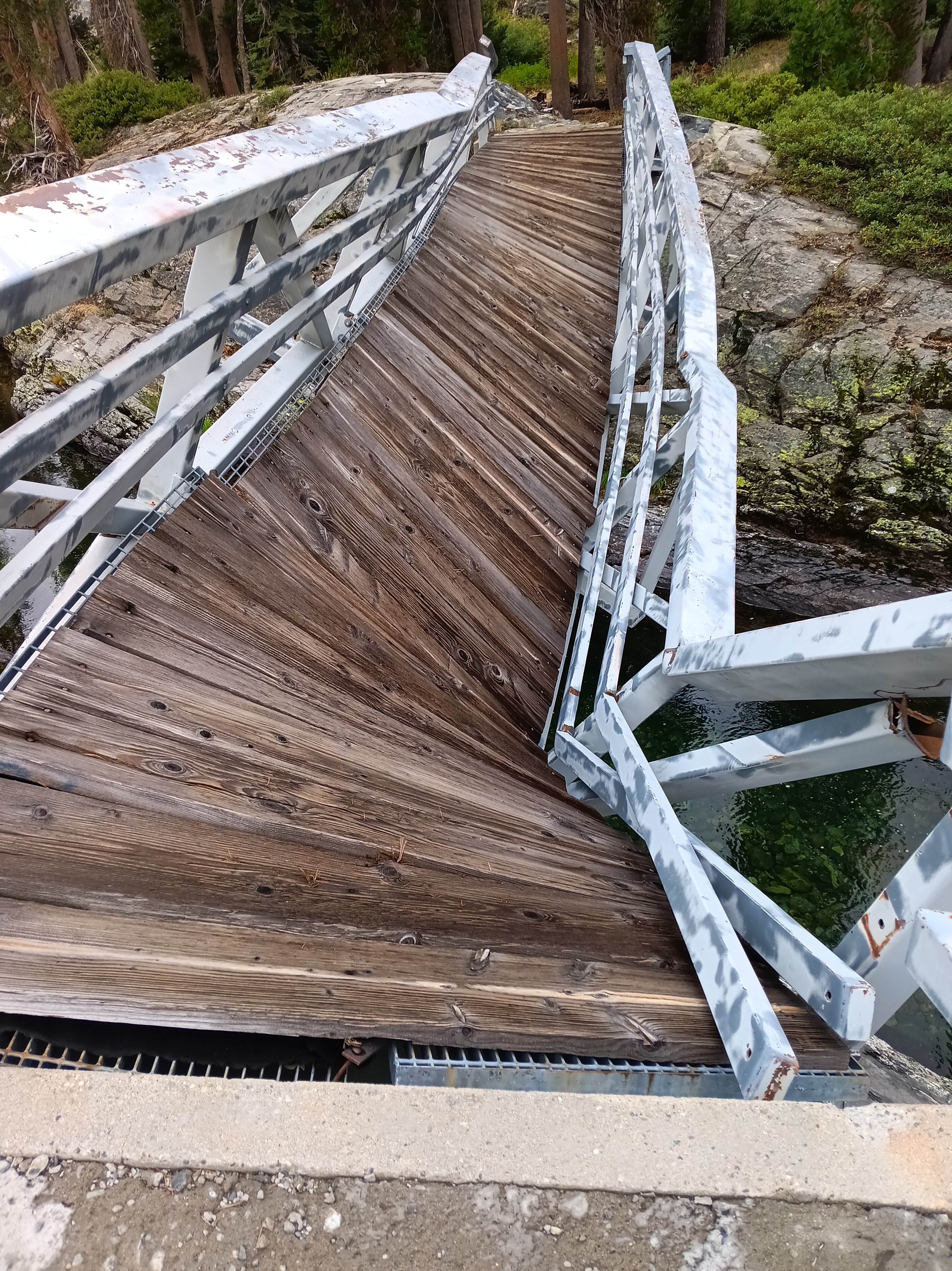
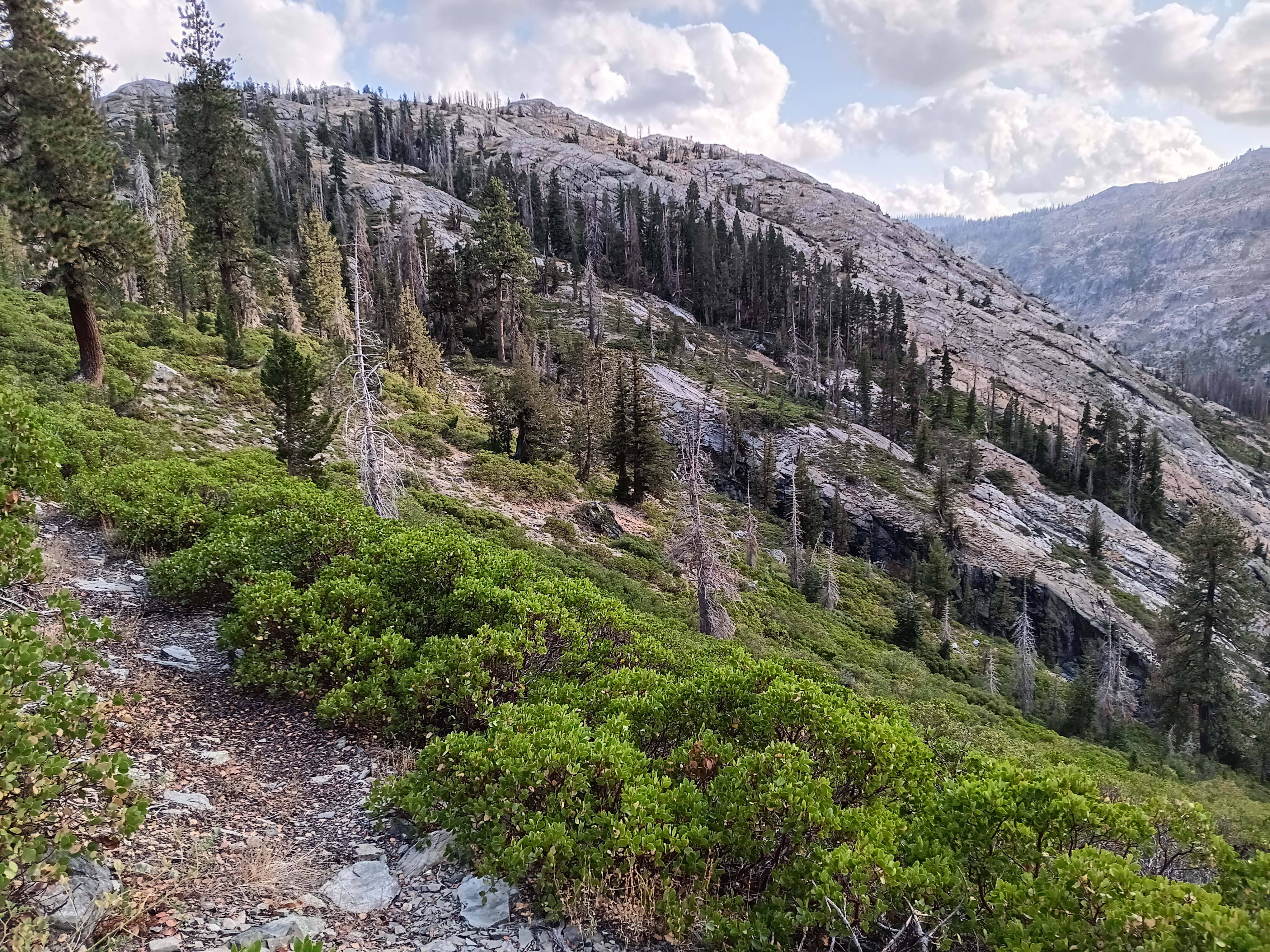
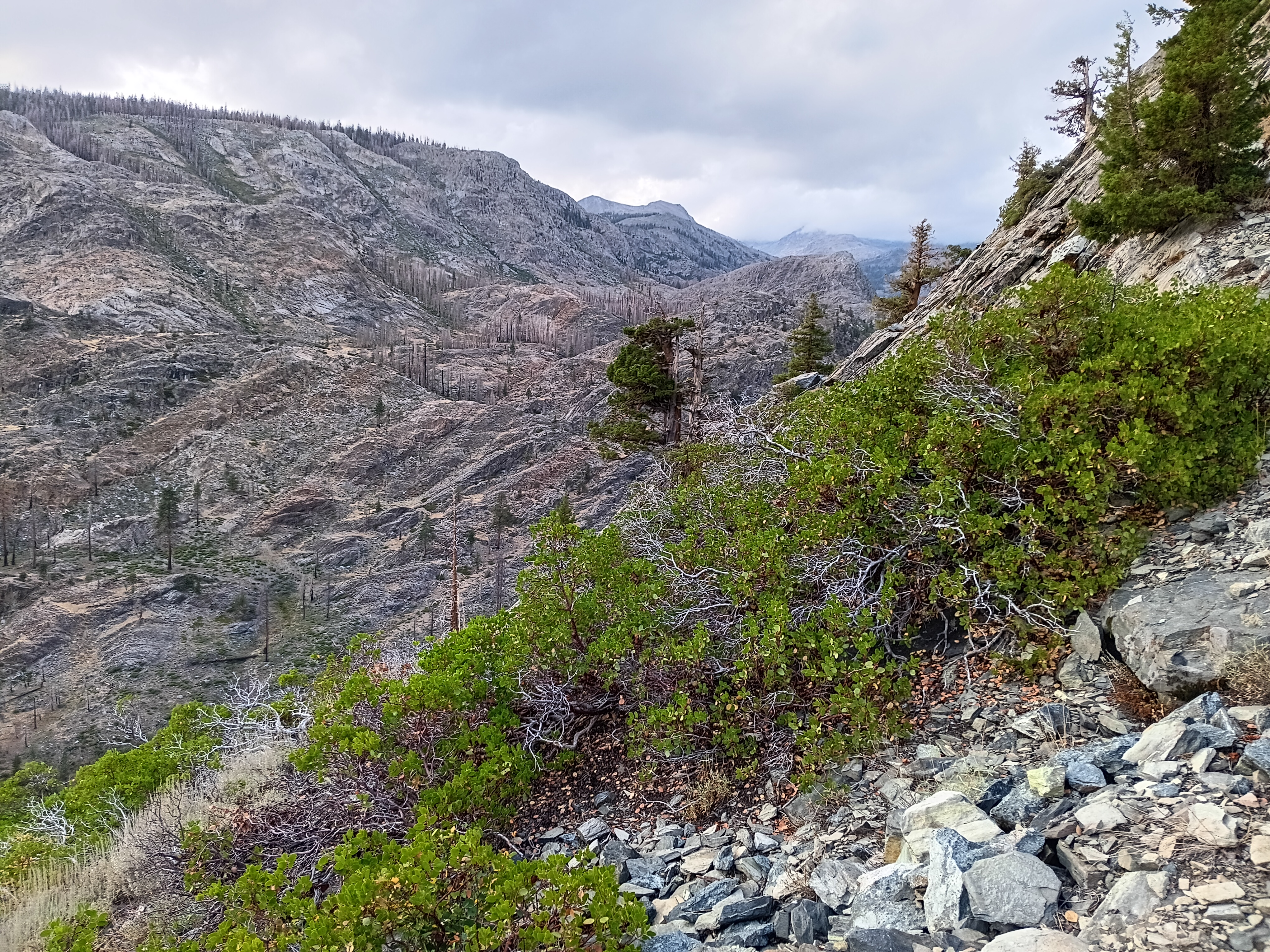
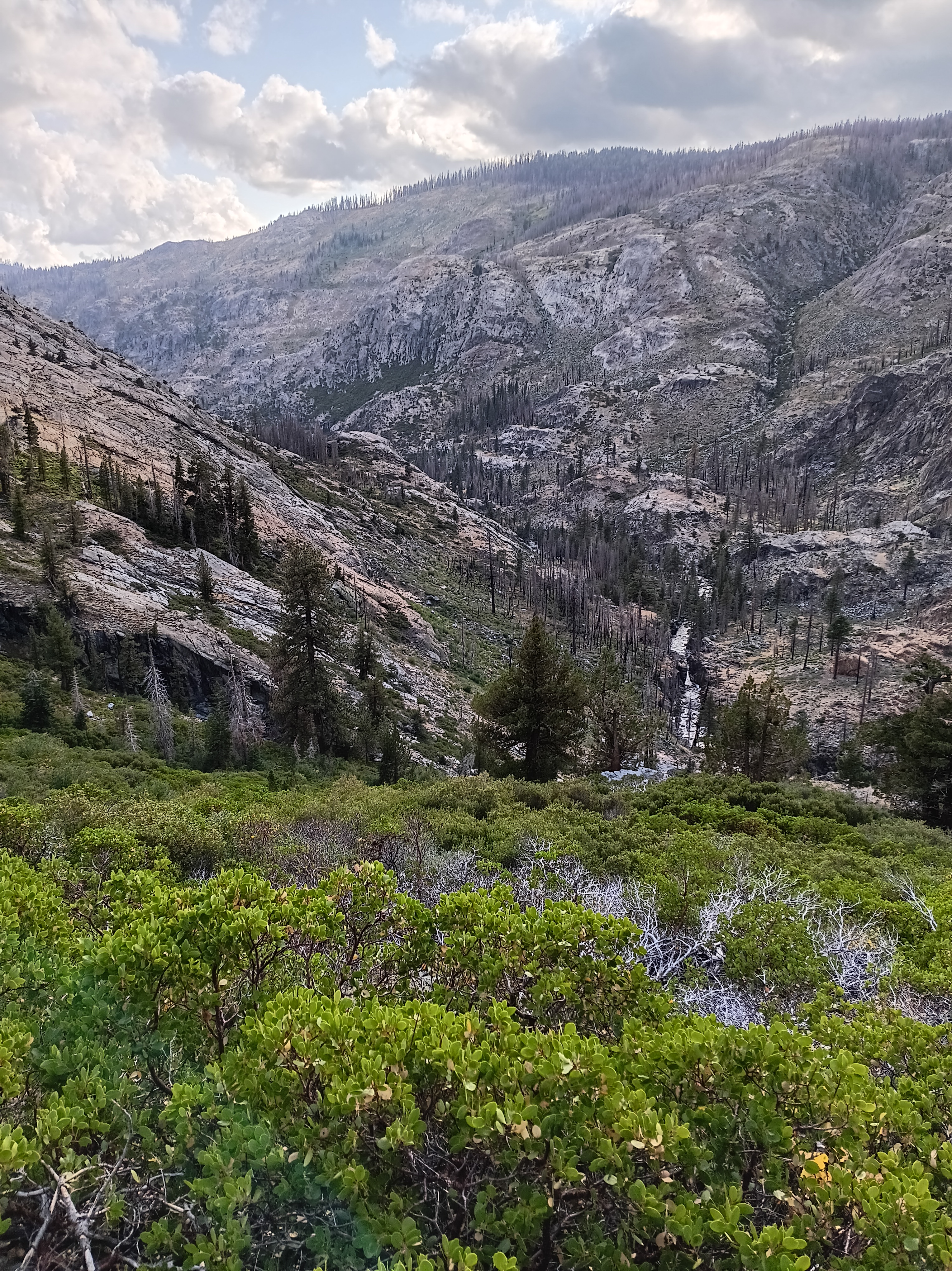
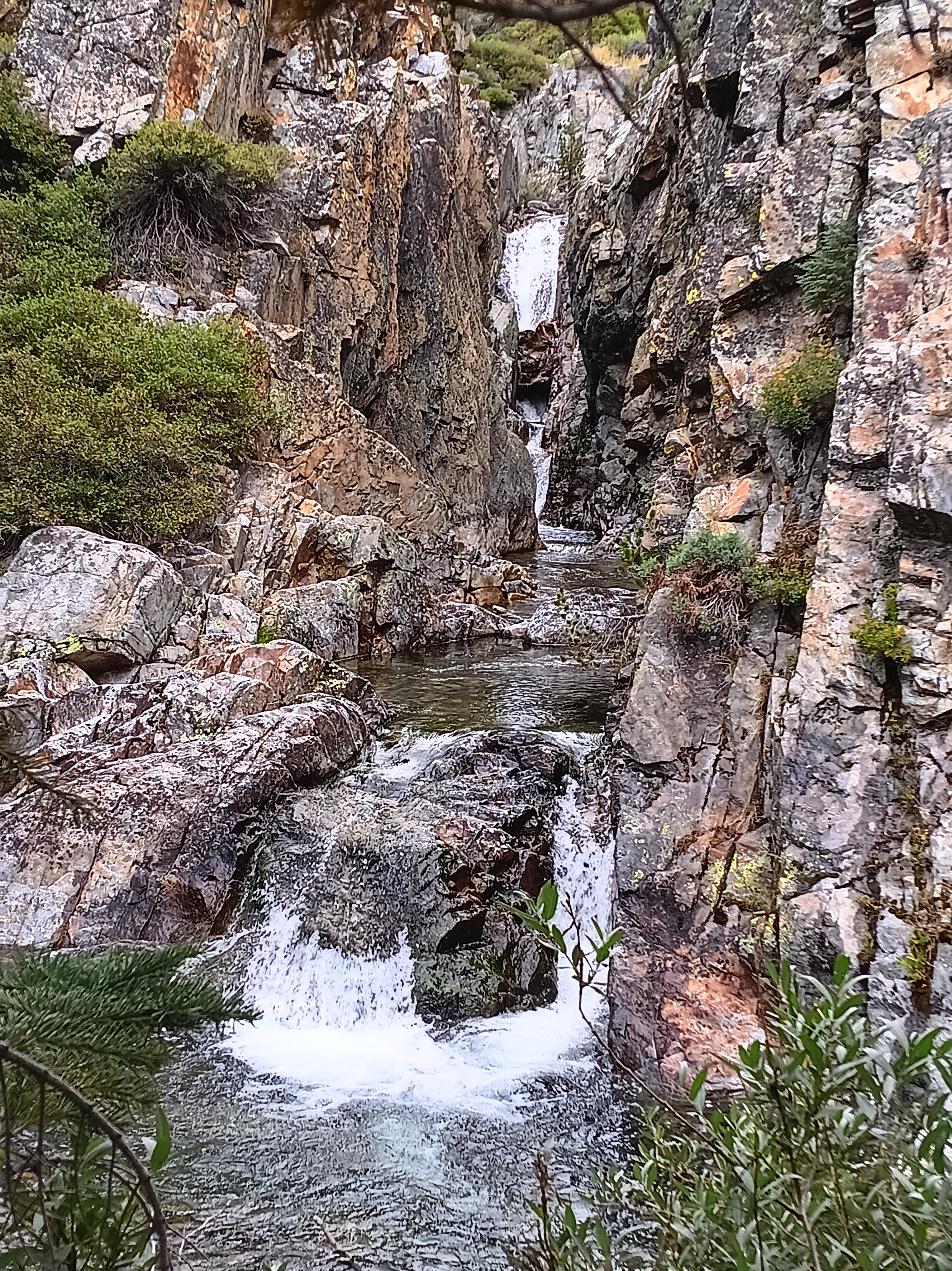
All the above photos are on and along this disappeared “maintained” trail where most trees had burnt in many prior forest fires, the steel bridge over the San Joaquin River at Hemlock Crossing had washed out 2022, and snow, rain, and sleet drenched me. Not the best conditions to navigate by map, compass, and GPS altitude through chest-high, wet brush. Wilderness.
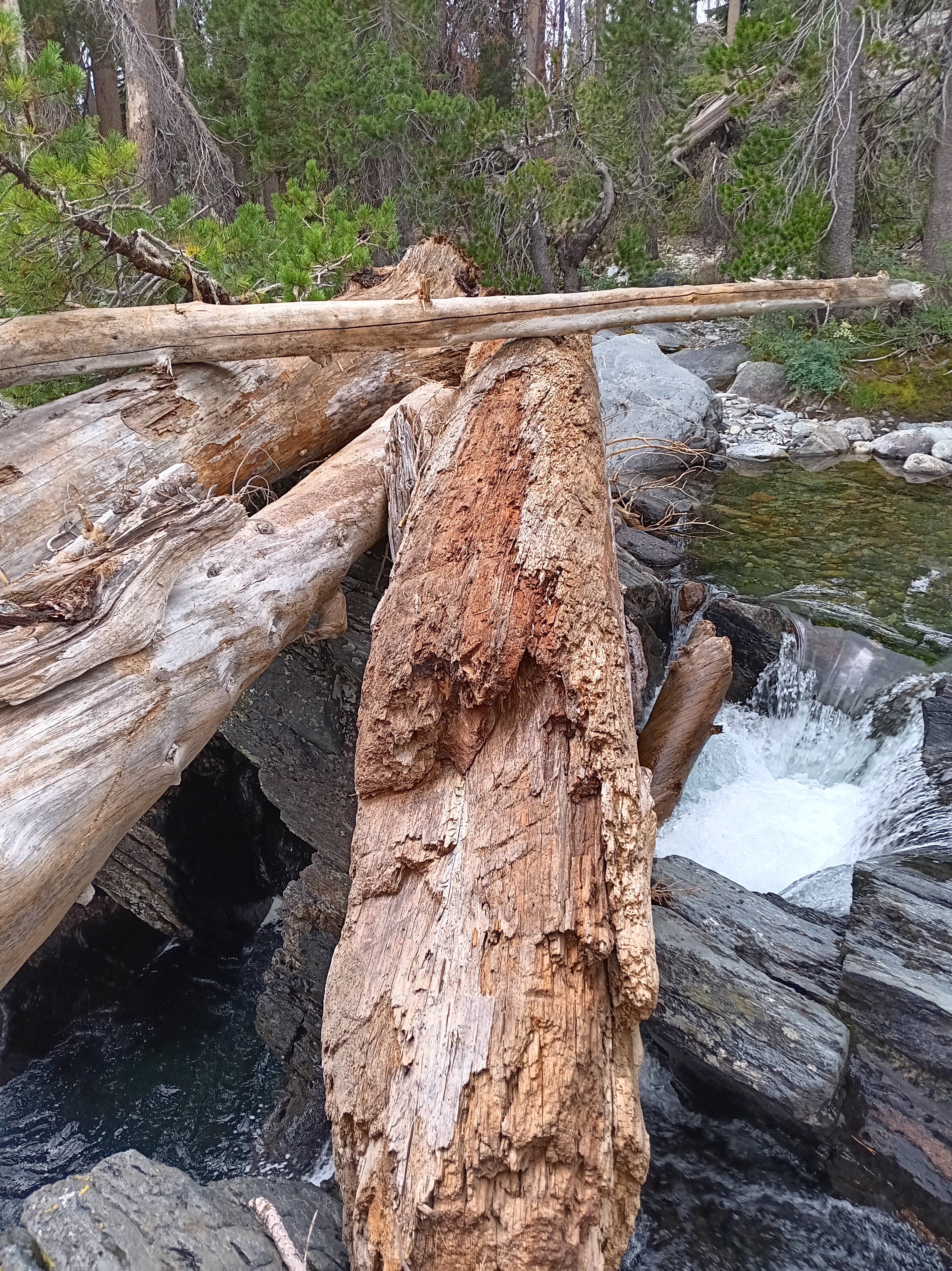
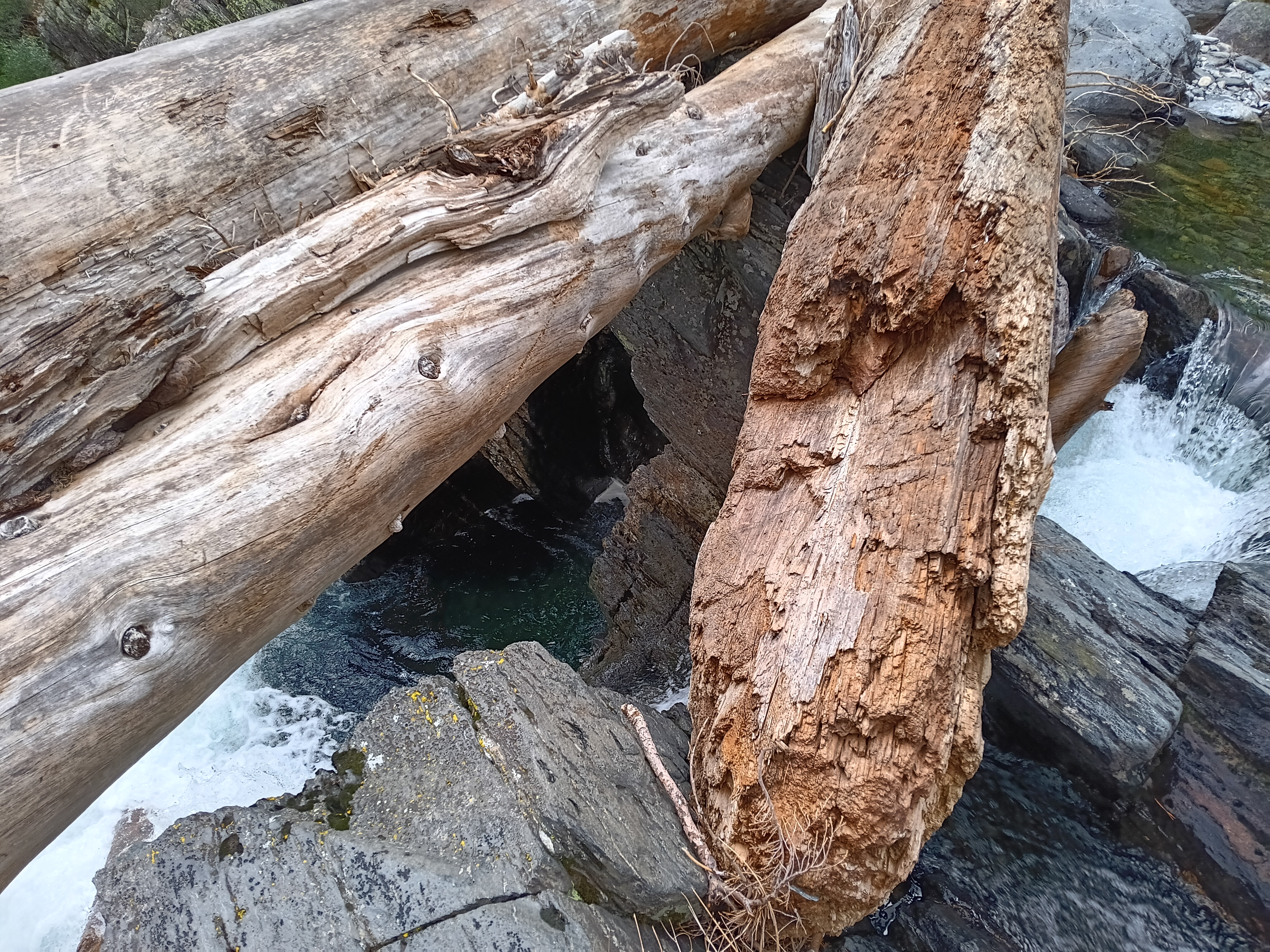
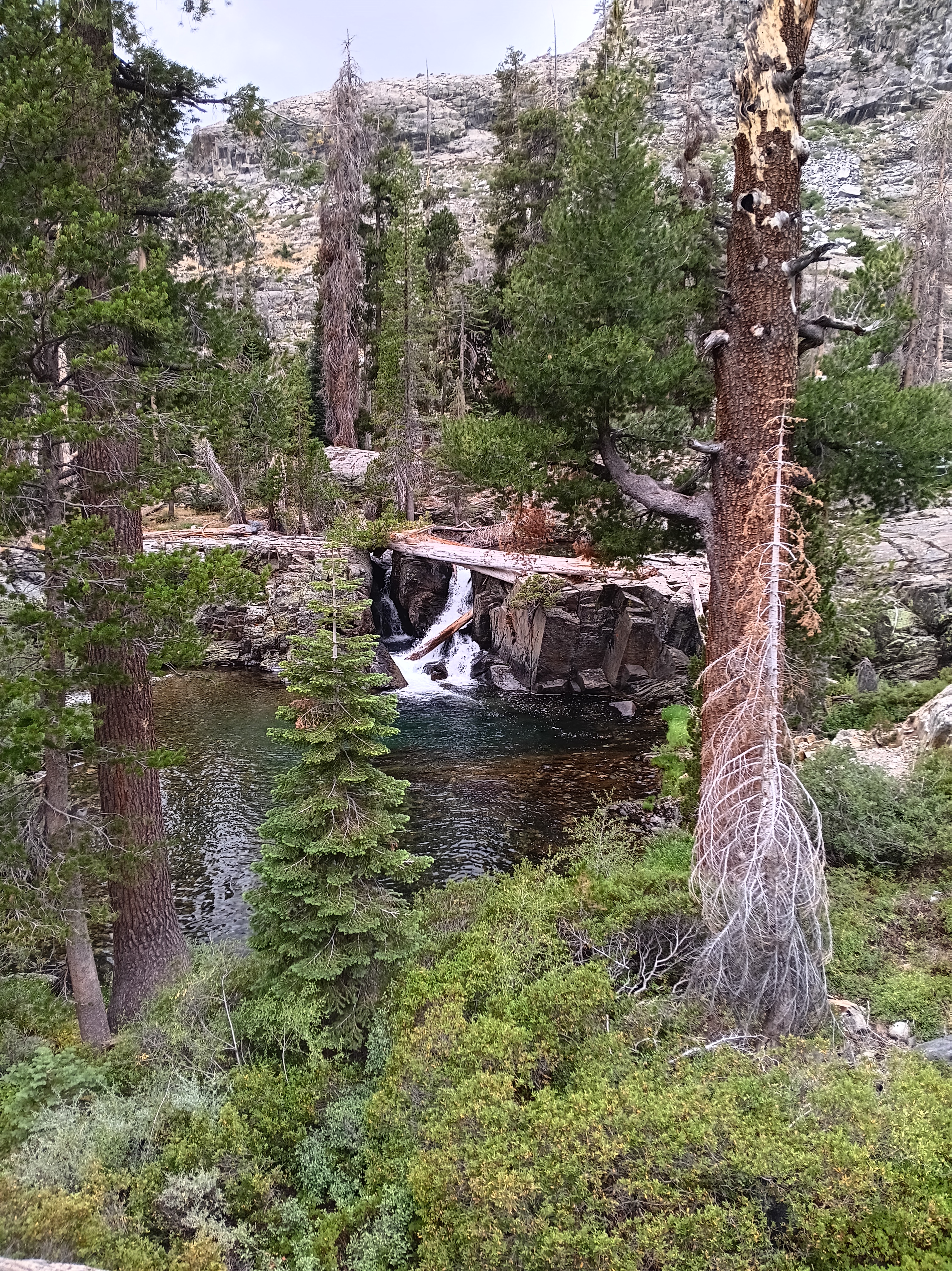
Wet, hungry, and discouraged I reached Hemlock Crossing at noon on Aug.-24, 2024 and discovered its badly damaged bridge. What to do? Rest, eat, and dry out before deciding. Feeling refreshed after a large, warm, hour-long lunch and dry clothes, I decided that the twisted bridge was unsafe to use, but that several logs downstream perhaps offered a better way across the swollen river. Strapping my backpack very tightly to my shoulders, I slid on all fours onto and along two large logs hugging them tightly. A climb over a smaller log lodged across the two larger logs was an added challenge (see photo below top left). This “bridge” was above a 20 feet waterfall downstream and a deep pool of water on the upstream side. I cried on the other side happy to be alive.
Furthermore, there was a trail on the eastern side of the San Joaquin heading both north towards Bench Canyon and Lake Catherine below Ritter and Banner Mountains and heading south towards Mammouth Lakes where I headed, but again I was soon on my own again without a trail. The path looks pretty clear on the map along a steeply sloping V-shaped valley near the 7,460′ contour, but where my boots hit the ground along this contour were just walls of brush, meadows, overgrown puddles of water, rocks, fallen logs. At one point I dropped my back-pack to move up the slope to 7,700′ to reconnoiter to find a path forward. There was none for 4 hours until I reached Iron Creek where I stayed for the night (Camp #16).
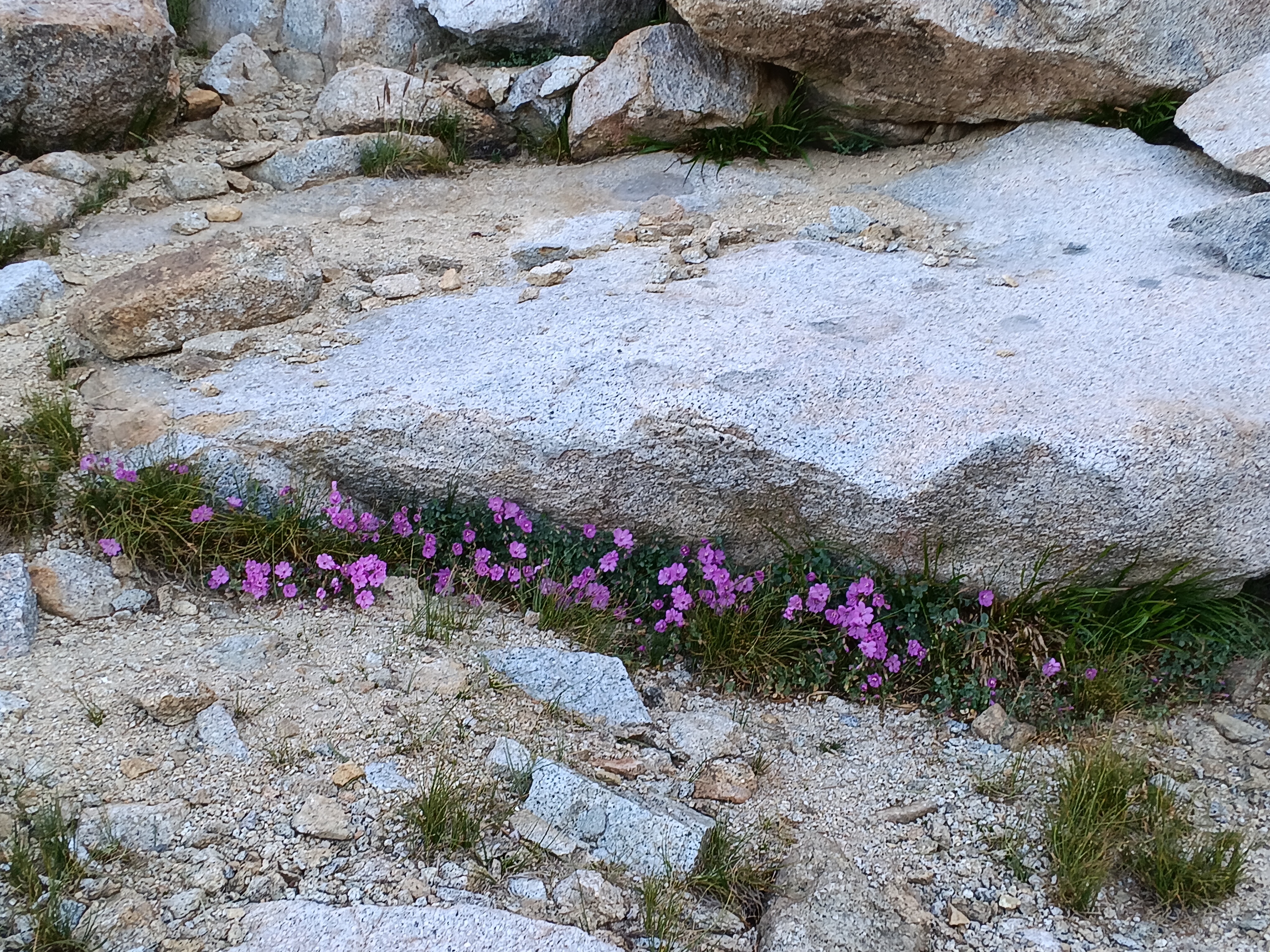
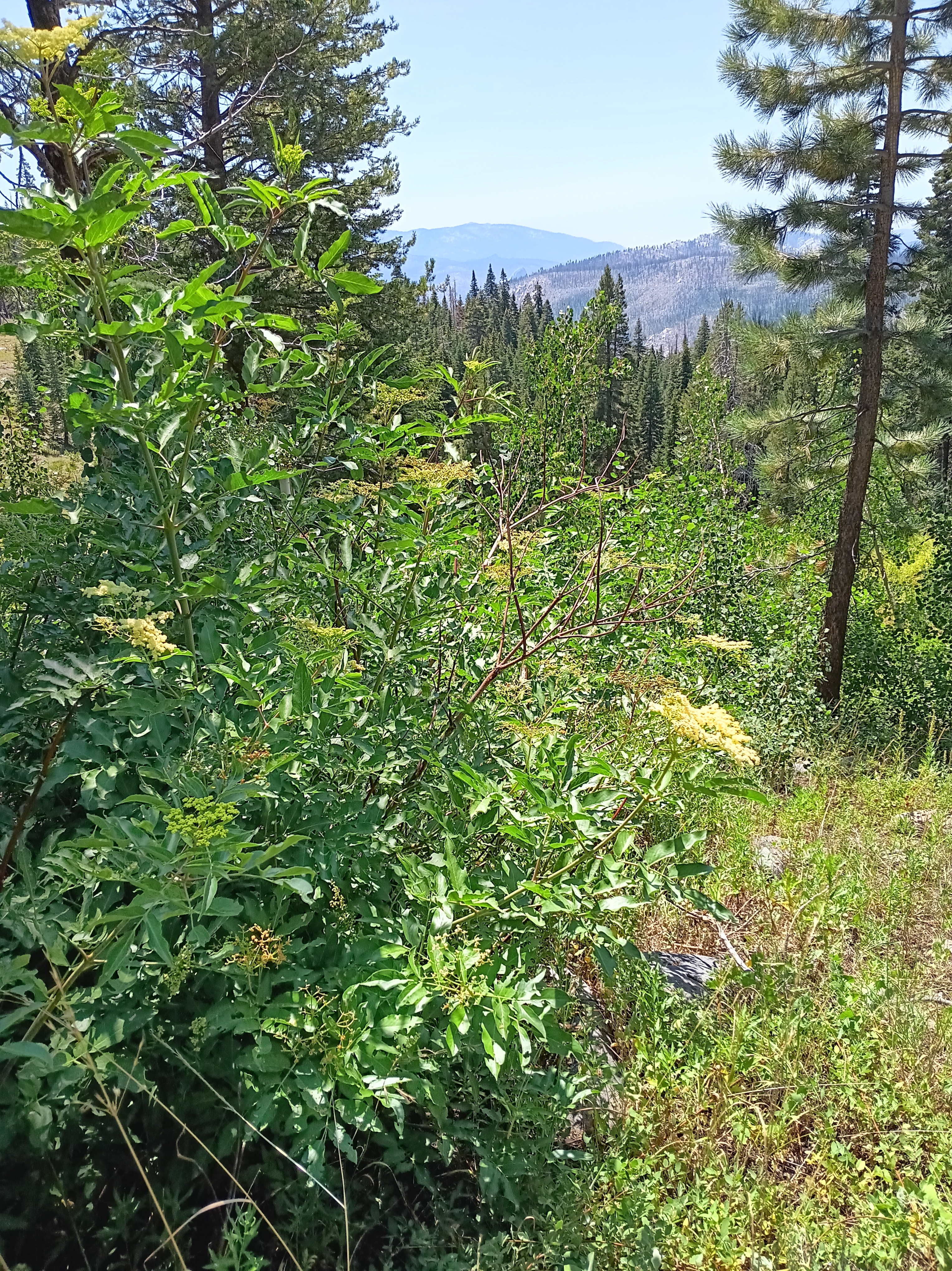
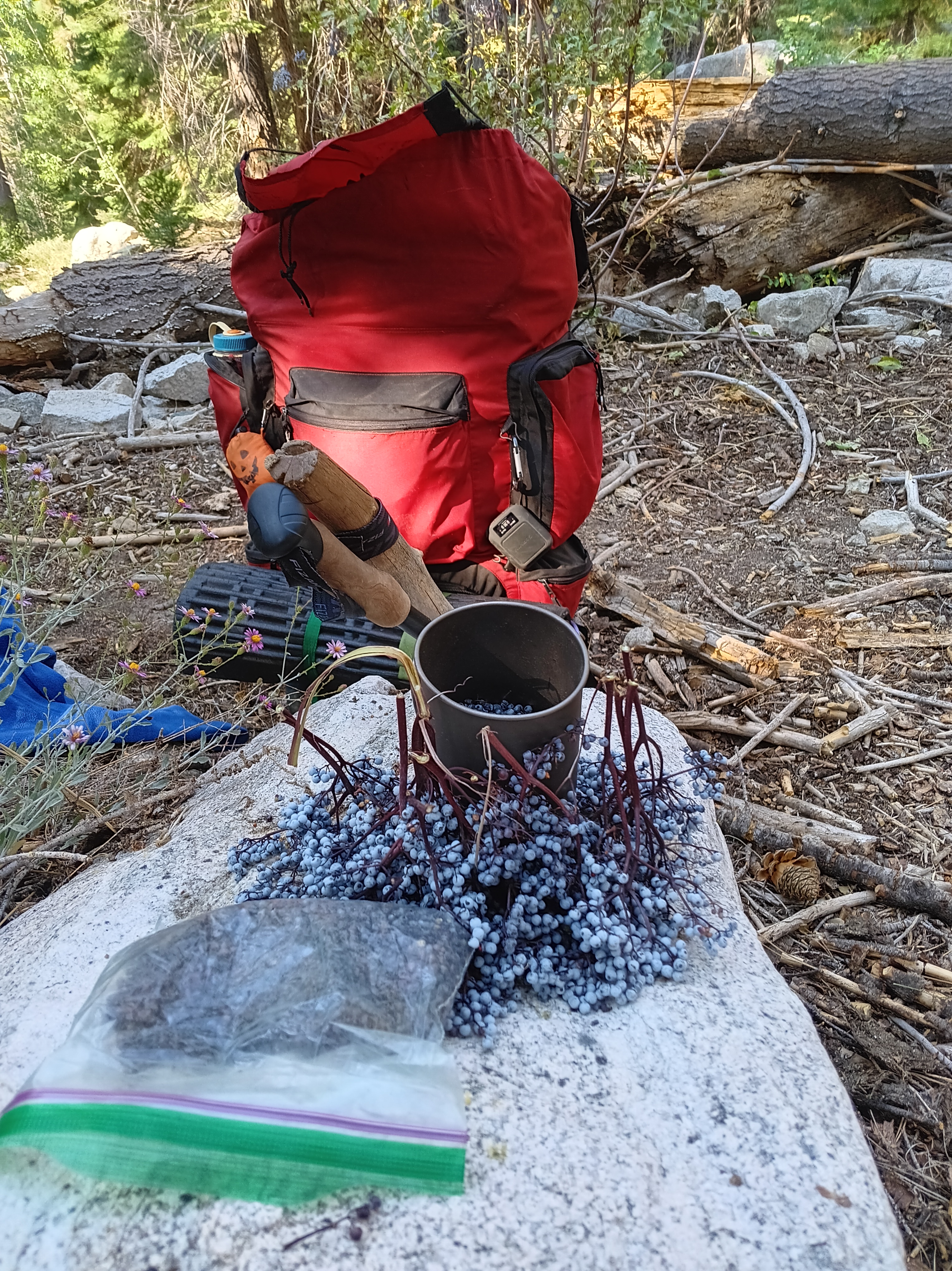
The sun emerged again the next day (Aug.-25), but the trail disappeared again within an hour from camp, but now I was in a dry forest that had not been burnt too badly and the map told me to go uphill. I did so for most of the day getting away from the treacherous San Joaquin River. Trouble awaited only in the meadows as here the terrain was wet, level, and overgrown with brush. My spirits lifted, however, when I noticed wild Elderberries. The photo above (bottom left) shows their blossoms, but later I found big, dark, black elderberries that I devoured after cooking them. The names of the meadows in the forest without a trail invoked emotions, too, such as “Naked Lady Meadow” followed by “Earthquake Meadow” followed by “Headquarters Meadow” followed by “Corral Meadow” followed by “Cargyle Meadow” before I reached a meadow without a name at the end of the day. These names tell me that people traveled and lived here in the past. There probably are stories that I do not yet know.
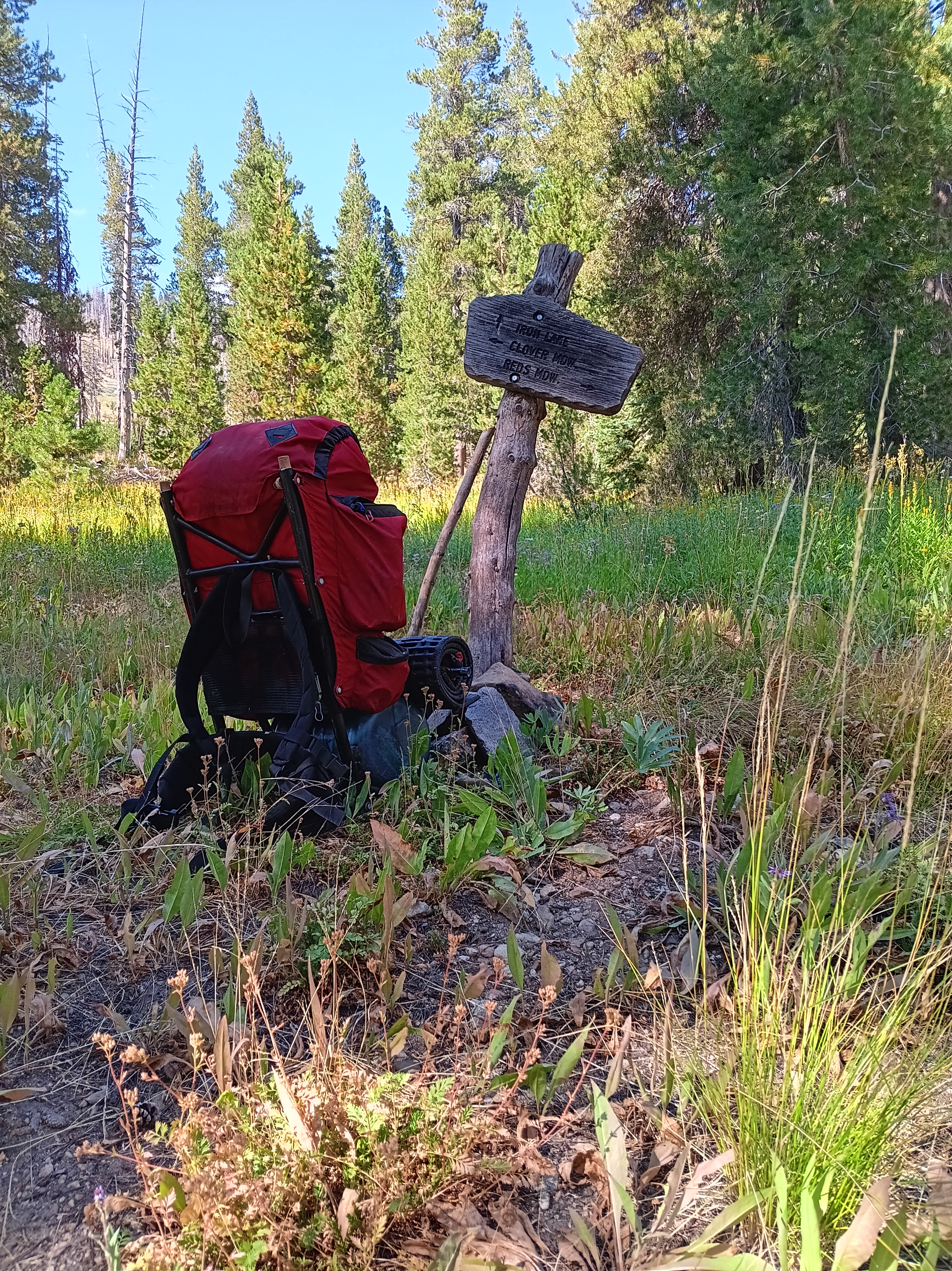
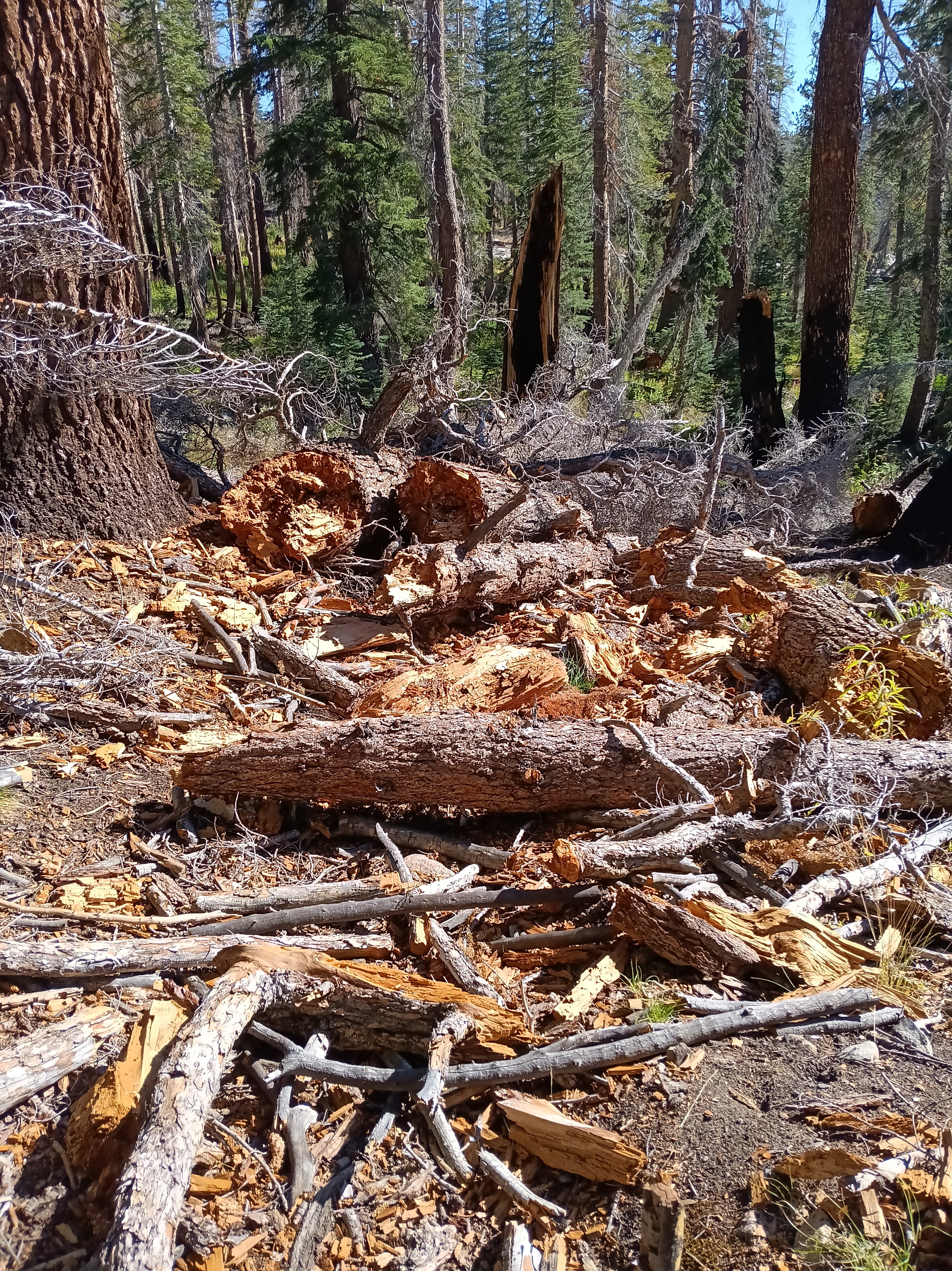
My senses sharpened during this day without a trail as I noticed more and more fallen tree logs that had a flat cut surface. At first I recorded each such sighting with its GPS position, but over time I could tell where they were. In the middle of these wild wanderings along a disappeared trail, I found this sign post (top left below) pointing out that this is the intersection of the trail to Mammouth Lakes to the right and Iron Mountain straight ahead. My navigation was good, but the so-called trail after this point was just one pile of wood after another pile of wood where I had to climb over, under, or walk around. Looking back, I find it amazing what one gets used to and how much punishment my then 62-year old body was able to take. After 10 miles of this I made camp at the unnamed meadow at 8,577′ (2610 m) below “Stairway Meadow,” “Granite Stairway,” and “Summit Meadow.” After that, a JMT-type trail emerged that led me down the mountain for 8 fast and furious miles downhill to Reds Meadow. Here civilization expressed itself in the form of a shower, beer, and double cheeseburger in that order. These last 8 miles passed faster than the prior 2 miles navigating wood piles:
Did my solution work? Yes it did for me in 2024, but it may not do so for everyone. During the 8-day return loop via the Clarke Range and North Fork of the San Joaquin River I met three other hiking groups: First 2 students from San Francisco, then the 2 women from Delaware, and finally the friendly “preacher” and his disciples. That was it in terms of people for 8 days. Along the way I learnt to read and interpret both the map and the landscape in front of me.
What served me well was to always listen to my body. I was NOT fighting to reach a destination. I walked only as long as it was fun (mostly) and always stopped for an hour or two when I felt like it. I took off my pack to investigate a pretty flower or a bee on it, watched a bird, or picked wild Elderberries, Red Currants, Rasberries, and even Blueberries. I made camp when I felt like, I was prepared to go home any day that was not fun, completion of the JMT or a certain section was not important. Some days I felt like walking 6-7 miles, but on other days it was 12 miles (to reach that cheeseburger at Red Meadow) or 17 miles (my last day on the trail to reach Lone Pine). It also made me enjoy the well maintained John Muir Trail the next 18 days.
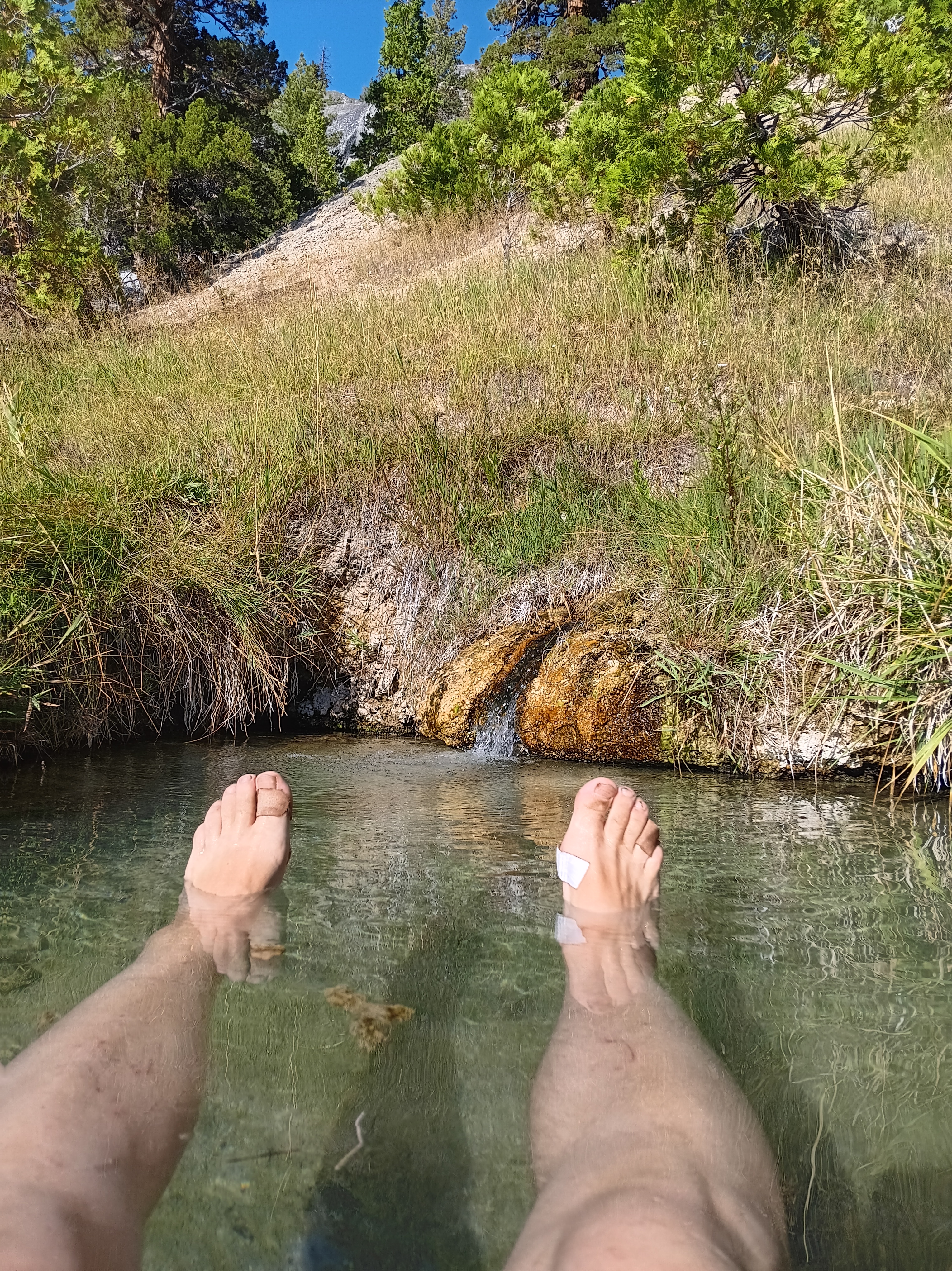
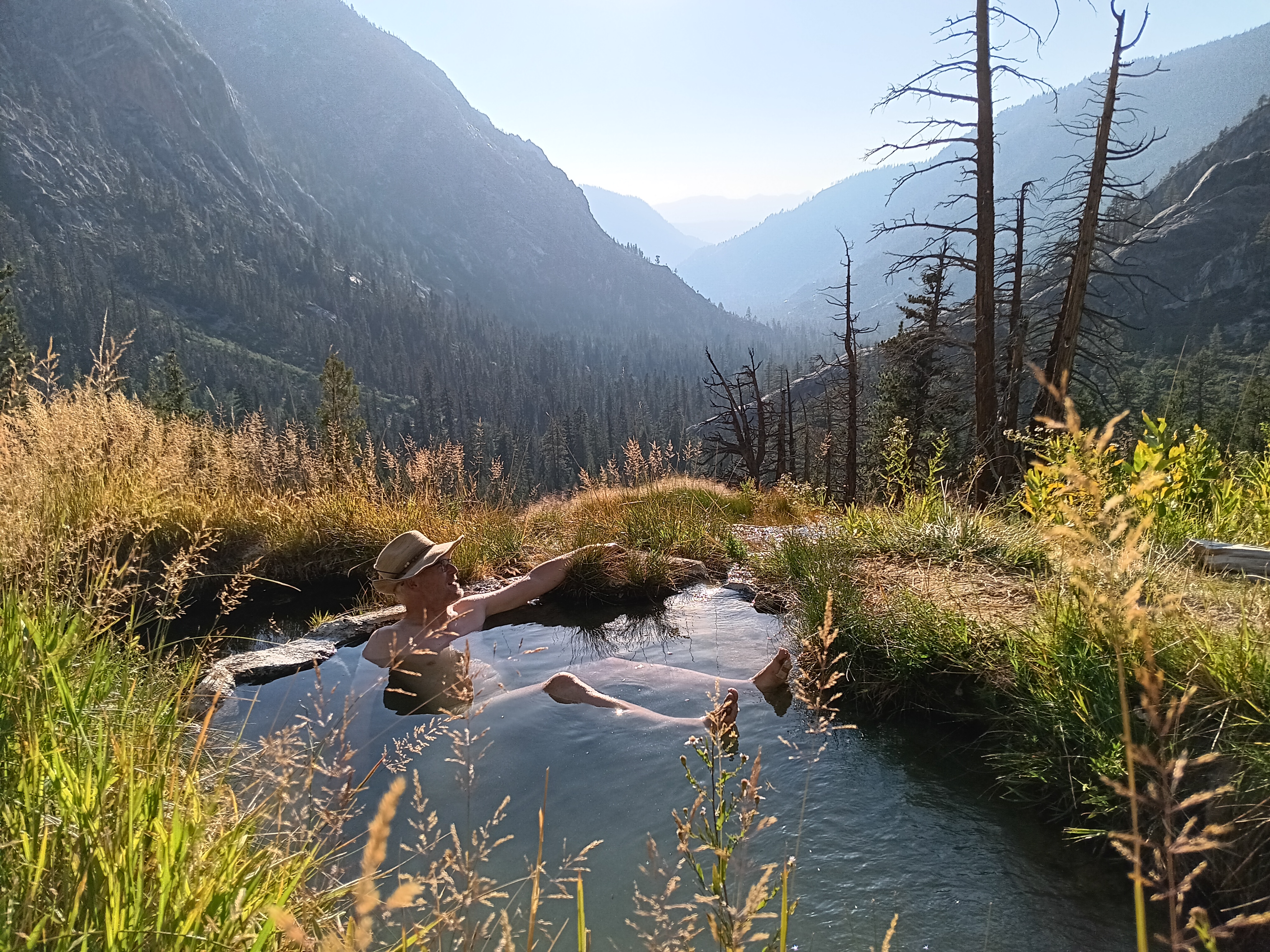
Now, would I do this exact hike again? Probably not, but only now do I know how to read a map of what is out there. In the future I will focus on the many trails that intersect with JMT. That’s where you will find me. The JMT is the scenic highway that leads to all the others. Two days after my shower and cheeseburger at Reds Meadow, I found the Hot Springs of Fish Valley (camp #20). [Photo Credit to Justin from Bend, Oregon; he appeared out of nowhere from above, staged, and took the picture. I met him several times again the next 10 days, but that’s another story.]
Hot pool and spring in Fish Valley; view is to the west.
So, my next solution would be turn east at Toulumne Meadows and then turn south to cross Parker Pass (11,115′ or 3390 m), Koip Peak Pass (12,280′ or 3740 m), and Agnew Pass (9,900′ or 3320 m). Then follow the Pacific Crest Trail along the Middle Fork of the San Joaquin River back to Mammouth Lakes.
I started my California hike in the wrong direction heading south rather than north trying to reach the Ansel Adams Wilderness on my way to Yosemite National Park. It took me two hours to notice my error and another hour to get back to my starting point. Thus I was already exhaused with blisters on my feet before my hike had even started. “Expert move” my trail diary states dryly, as I had spent the prior 5 months pouring over maps, gear, and spreadsheets. And yet, I could not tell north from south. A more serious error the next day almost ended my big pre-retirement adventure on its second day.
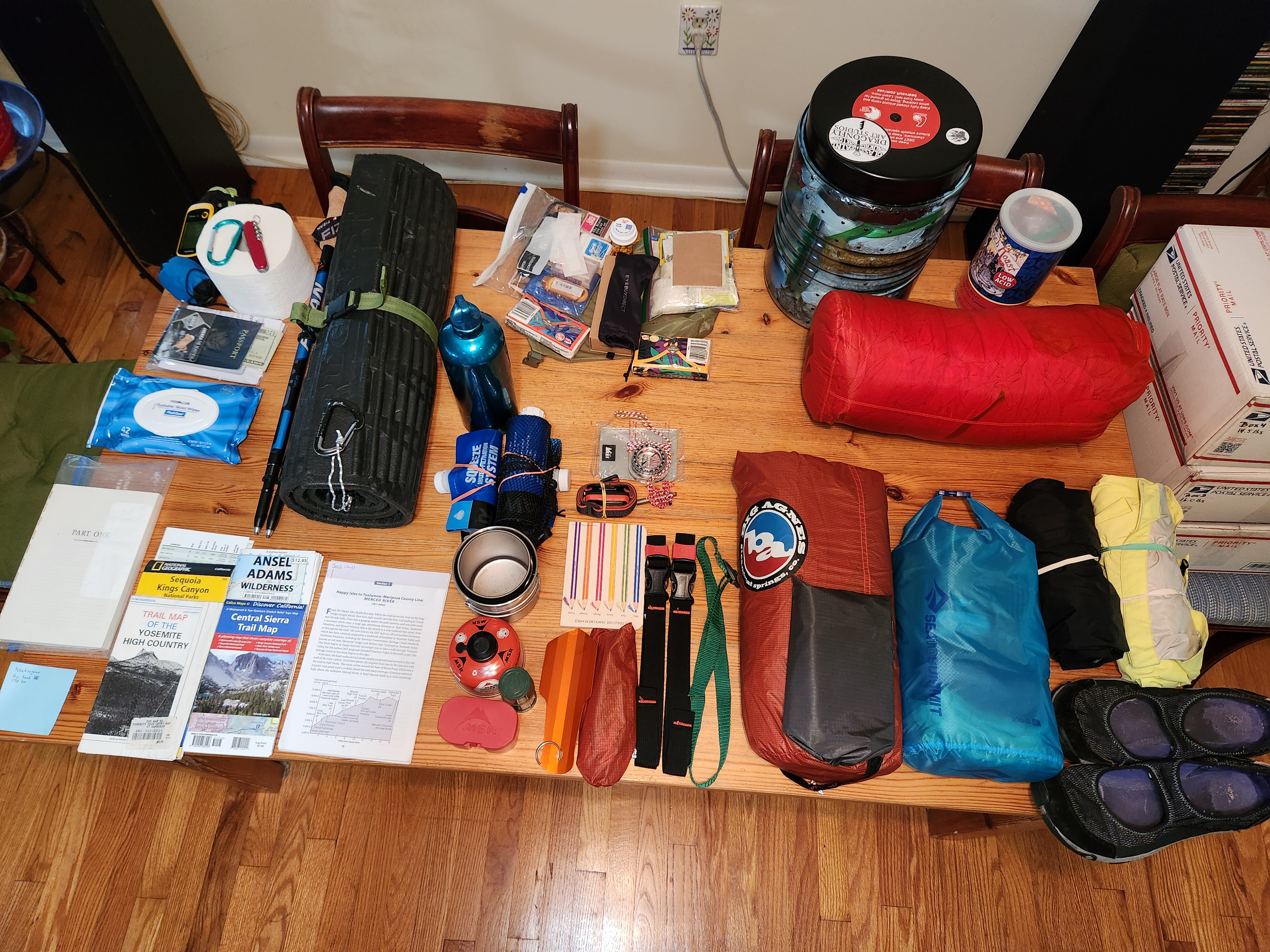
The photo above on the left shows my three U.S. Postal Service packages with food to resupply my backpack filled with the stuff in the center photo. Each food package weighted about 14 lbs (~6.5 kg) to give me 3500 kcal for each of 7 days. So I was planing for a 28-day trip, but it turned out that I spent 35 days in the wilderness and used only 2 of those 3 resupply packages. I also feasted on restaurant food the day before my hike in Mammoth Lakes (a large steak on Aug.-9), the day of my first resupply stop in Yosemite Valley (an unlimited breakfast buffet on Aug.-19), the day of my first shower at Reds Meadow (a double cheeseburger for dinner and a massive breakfast burito on Aug.-26), and the day of my second and last resupply stop at Vermillion Valley Resort (a pizza with 4 beers for dinner and a Lumberjack breakfast on Sept.-1/2). My body shed 20 lbs (8 kg) during those 5 weeks in the mountains.
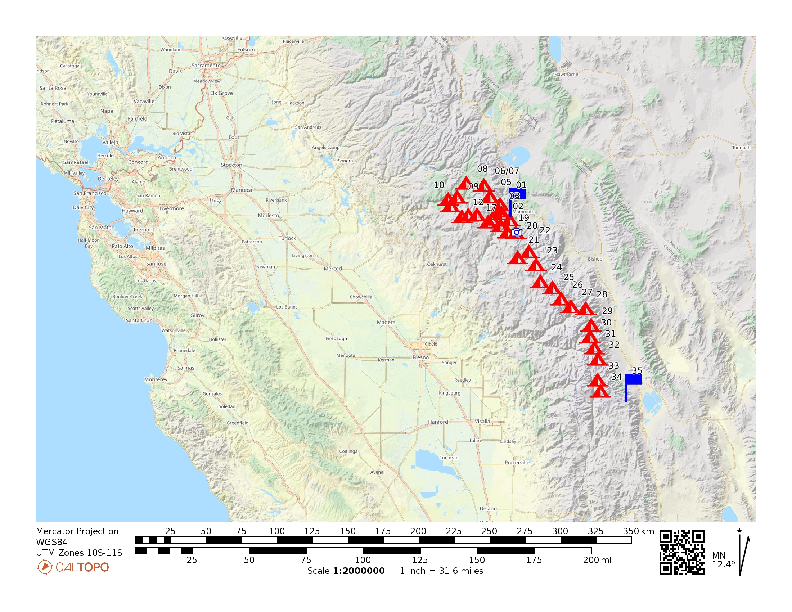
The map below shows San Francisco, the Central Valley of California, and the Sierra Nevada Mountains with my start (north) and end (south) point in blue. The red symbols show where I pitched my tent. The first part is a loop into and out of the backcountry of Yosemite National Park. Starting at Devil’s Postpile National Monument near Mammouth Lakes, I walked to Yosemite Village in 9 and back in 8 days. The second part was much easier as I stayed mostly on the John Muir Trail heading south for about 17 days. My lowest campsite was at 4000′ (1220 m) in Yosemite Village where I picked up first food resupply package while my highest campsite was at 11,700′ (3560 m) just below Muir Pass where I helped a Park Ranger with the evacuation of a hurt hiker by a police helicopter. You can access the interactive map at
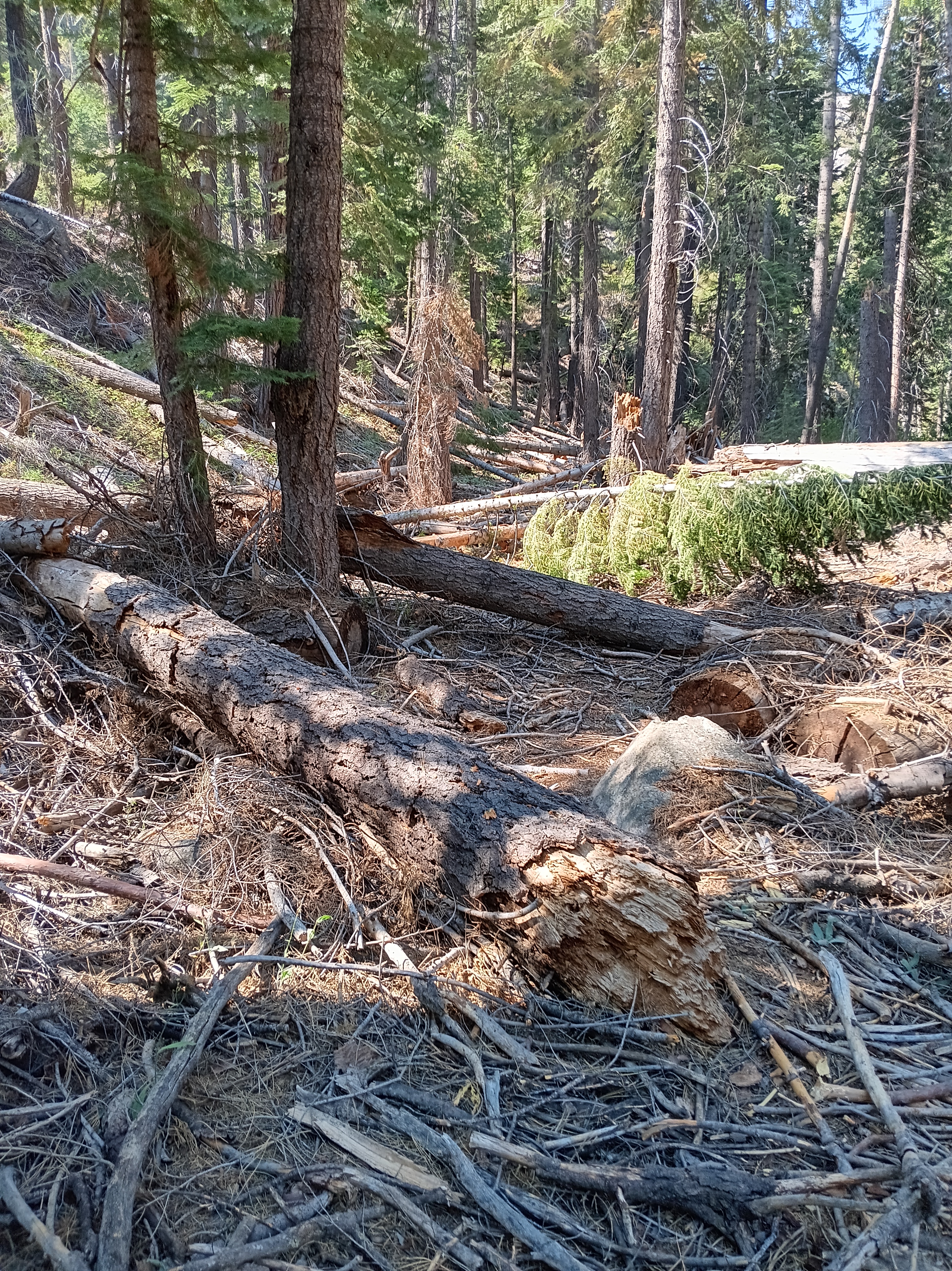
On Day-20 I found Ida Bell Hot Springs in Fish Valley. It was rough to get there, because that day I had to climb over and under constant wood piles created by toppled trees. The photo below on the left show the path that is littered by fallen trees along the steeply sloping V-shapped valley. This went on for 3 miles or 3 hours. Without the wood piles I usually hike at twice that speed. A more fun way to get slowed down, though, is to find, collect, and cook wild elderberries (middle photo below). Setting up camp along Fish Creek later, eating dinner with elderberry soup for desert, I went another 1.5 miles to look for the hot springs.
There are several hot springs, the hot water just emerges from rocks in the ground and is pooled (right photo with my blistered feet), but the one I liked best is at 7536′ (my tent was at 7133′). Its location offers a stunning view downstream into Fish Valley from where I had walked that day. The photo in the bottom shows me during a 2 hour soaking. And before I went to sleep at 8pm, I had another elderberry soup that I cooked with a tiny bit of water and the protein/dextrose/sugar mix that usually refurbishes my muscles at the end of each day. My trail diary states “Elderberries and soup were out of this world.” It was certainly one of many highlights of my 35 days walking in the wilderness.
Now, why did my adventure almost fail on the second day? Looking back, I did not know how to read maps just yet. My high resolution paper map has a dotted line that connects Minaret Lake with Cecile Lake, and Iceberg Lake just north of my trailhead (see map below). A dotted line means “Unmaintained Trail,” but I now know that this generally means that there is no trail at all. One thus has to “bushwack,” however, this dotted line was above the tree line near 10300′ (3140 m) without vegitation. Instead it was all rocks, boulders, talus, and scree. My trail diary states “… hard scramble almost vertical at times is hard with a heavy pack …” All was well initially, because I carefully navigated across a field of boulders, but these disappeared near the shore of Cecile Lake where dense vegitation gave the false impression of a more even ground. And here I twisted my ankle really bad. Initially I thought it was broken, but since I could wiggle my toe, I was lucky. Taking off my backpack, shoes, and socks, I cooled my ankle in the lake for an hour to minimize swelling. I then limped slowly along Cecile Lake at 10240′ and down past a tiny glacier discharging into Iceberg Lake at 9774′. Here I camped for the night nursing my ankle.
The Minaret Mountains in the west with Minaret, Cecile, Iceberg, and Ediza Lakes to the east along with my first two camping locations. The cross-hair indicates where my injury occured near the “unmaintained trail” indicated by the dotted line. Notice the steep slopes up and down from Cecile Lake.
I walked and limped only 6 miles this day and cooled my ankle again in Iceberg Lake with a view on two small glaciers discharging their ice into the correctly names Iceberg Lake. There are no photos, because I had bricked my cell phone the night before by turning it off to save power not knowing the PIN of my SIM-cards. So I found this image of Iceberg Lake posted by Denise at beaut-tree.net
Iceberg Lake in the fore and Minarets in the back. The view is from north to south. Cecile Lake is above the dam or step ledge on the left. The photo was taken in 2011, but the snow and ice fields were not that different when I limped down with a swollen ankle on Aug.-11, 2024.
I was much surprised how well sleep, rest, and a positive attitude heals the body. As a result I walked 8 careful miles the next day only as my body allowed and felt comfortable. My trail diary states “… I need to be very careful where to place each step … I learnt my lesson. No bushwacking even if there is a dotted line on the map.”
There was another lesson, though, that served me well the next 33 days: Listen to your body and enjoy the moment. If your body wants to stop for a rest, a nap, or the day, do so. Hence I never knew where I would be at the end of the day or sleep the day after. There was a general plan, but the path was the goal and I quickly abandoned any plan or goal that was not fun or caused pain here or there. This, I believe, is why I succeeded to enjoy every day of the 35 days in the mountains. Mental fitness trumps physical fitness.
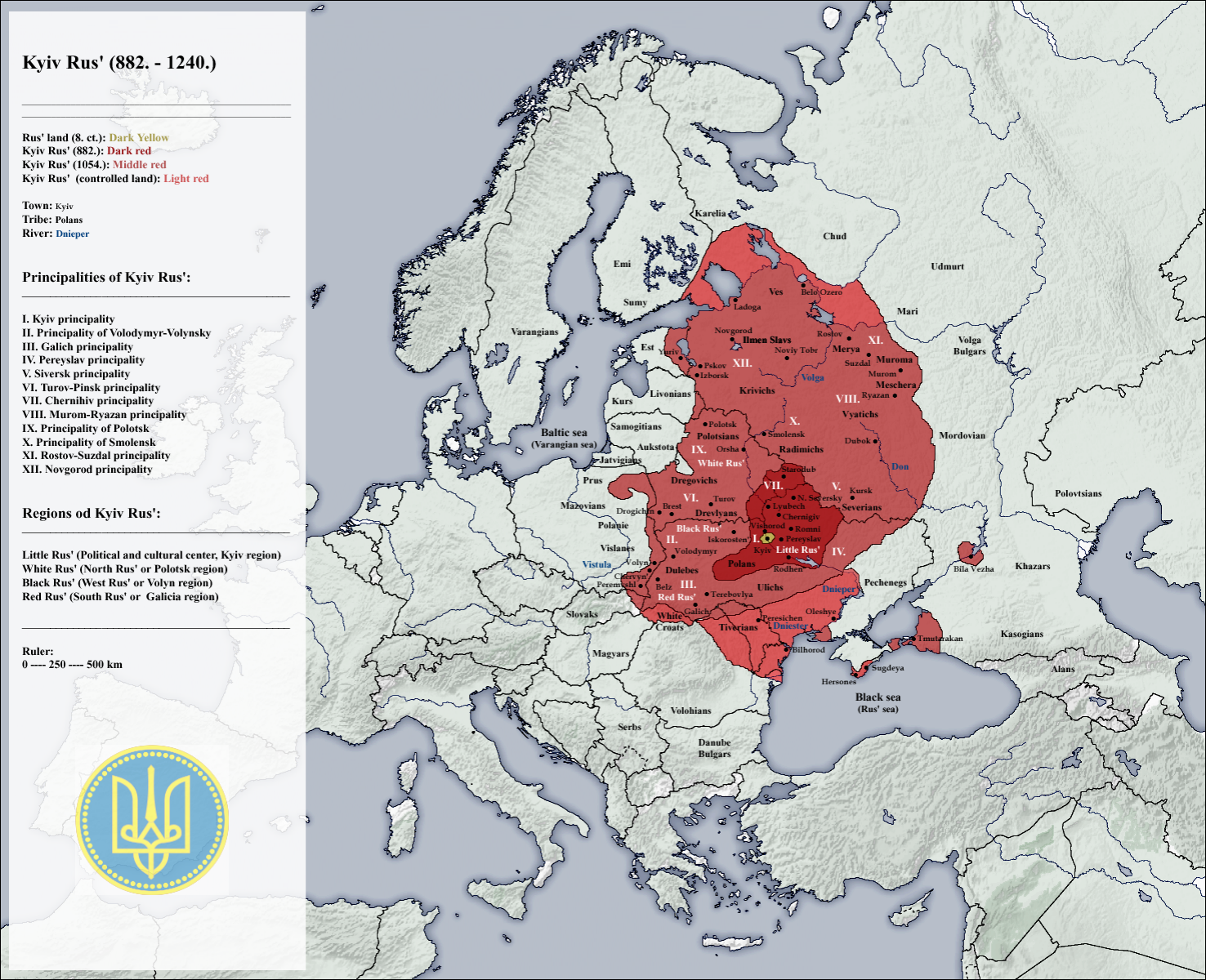
The Russian dictator Vladimir Putin claims Ukraine based on a false reading of “Kyivan Rus” (see map below) about 1100 years ago. With equal ignorance I here claim it for Sweden or Denmark or Lithuania or Poland, because the Kyivan Rus were a mishmash of Slavic, Viking, and nomadic tribes who settled and ruled the forests and steppes between the Baltic and Black Seas between 800 to 1100 AD. Furthermore, while “Rus” is the root for “Russia” (or “Russland” in German), “Rus” derives from the Old Norse “rods” which means “men who row.”
Putting another spin on old histories, I proclaim that Russia is, historically, a fringe principality that belongs to Ukraine. So, lets call Putin’s claim to Ukraine what it is: A colonial, imperialistic land grab along the same lines of an Adolf Hitler and a Joseph Stalin who divided Eastern Europe in 1939 with no regard to the people they both oppressed and slaughtered. Visiting Lviv in the summer of 2024, I find the bloody histories of these “Bloodlands” (Snyder, 2010) everywhere:
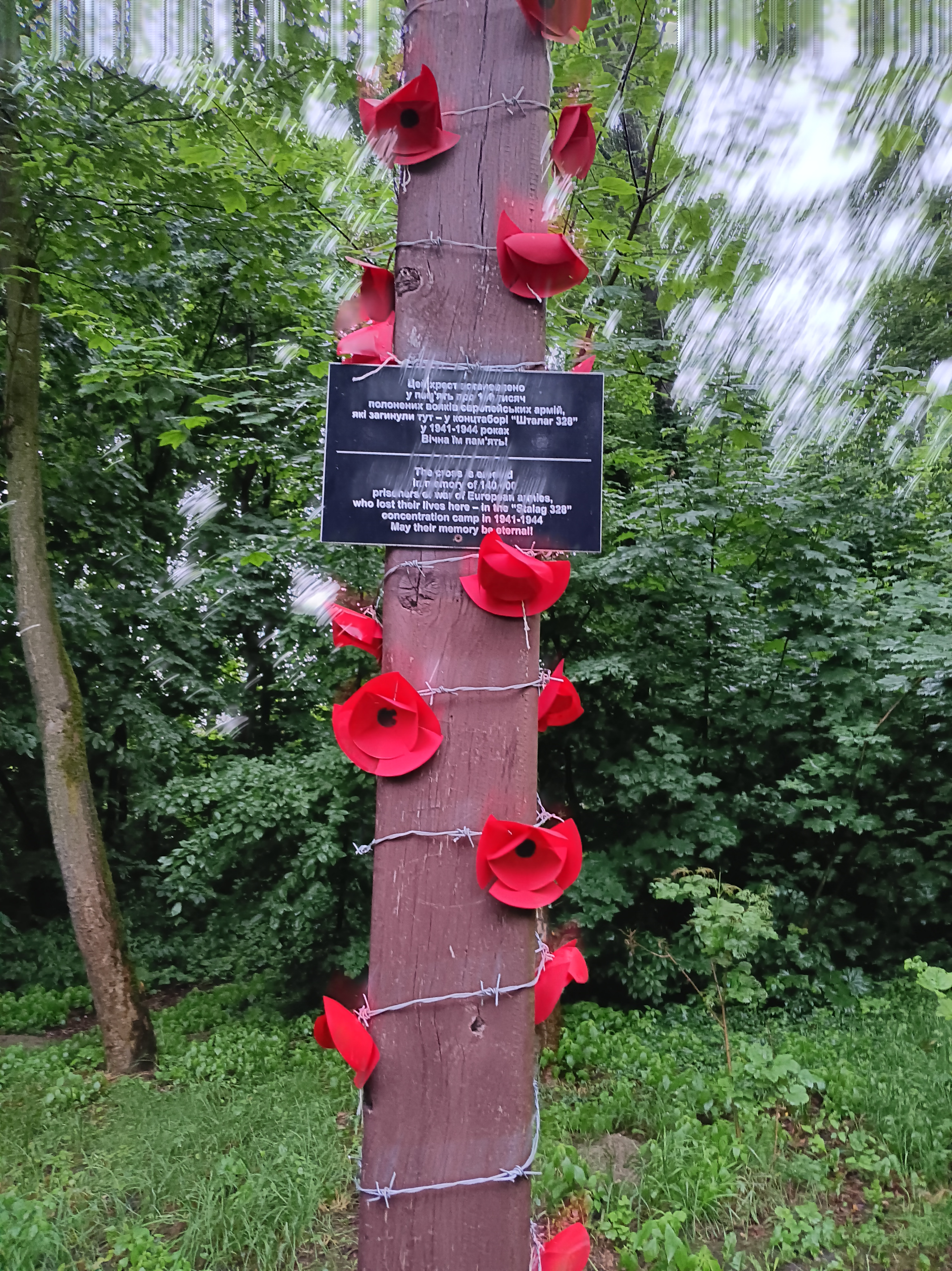
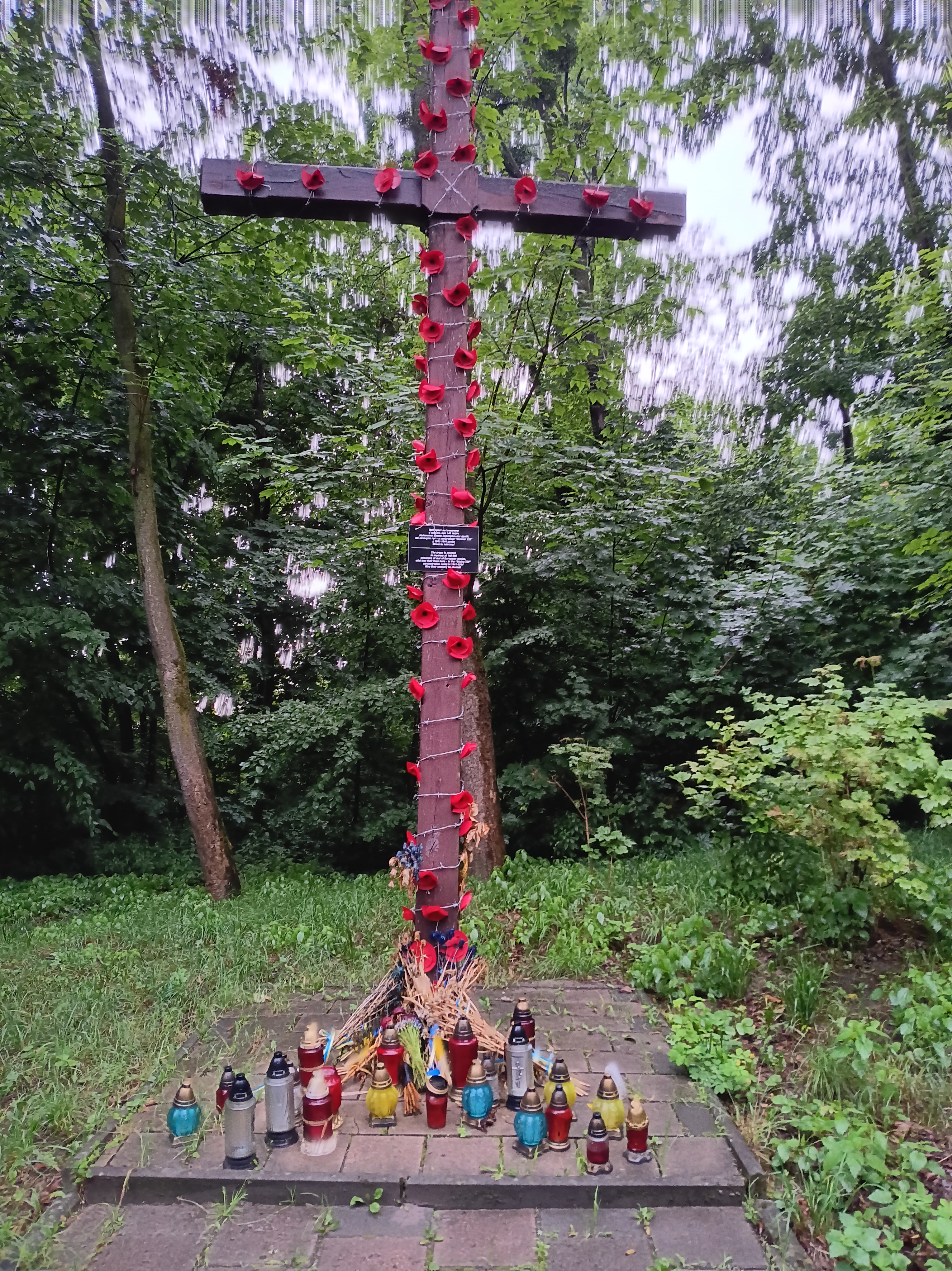
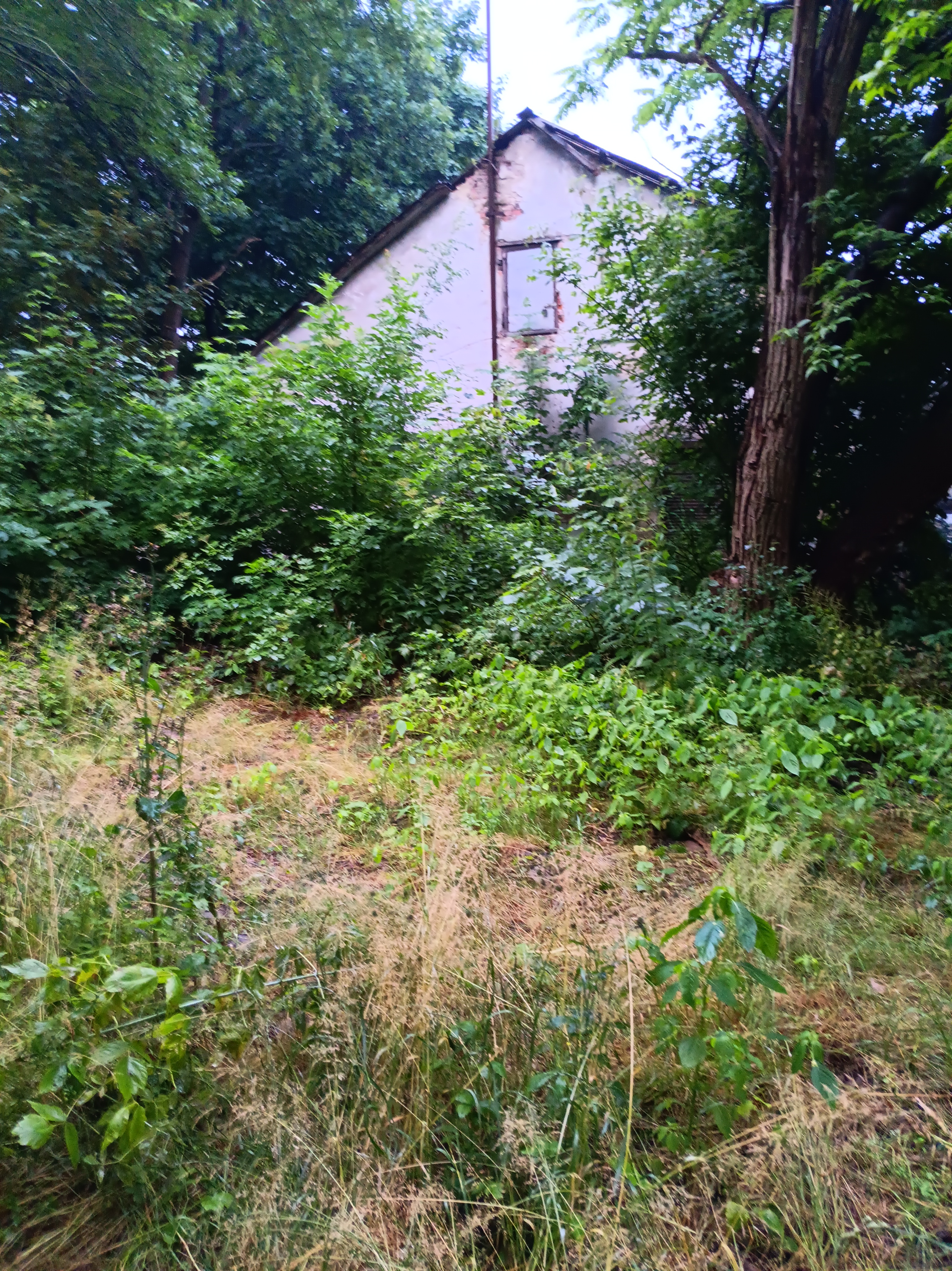
On my evening stroll on my first day in Lviv I stumble across an overgrown and unkept green space at the end of a small and winding residential street up a hill. Along my accidental path I find a 10 feet high wooden cross near semi-collapsed and overgrown one-story buildings that resemble barracks. Red poppies and barbed wire enclose the cross while burnt candles litter its base. An inscription in both Ukrainian and English tells me, that I am standing within Stalag-328 where 140,000 prisonors of war (POW) were murdered 1941-44. Nazi-Germany maintained this POW camp where the death rate among its Soviet, Belgian, French, and Italian soldiers exceeded 50%.
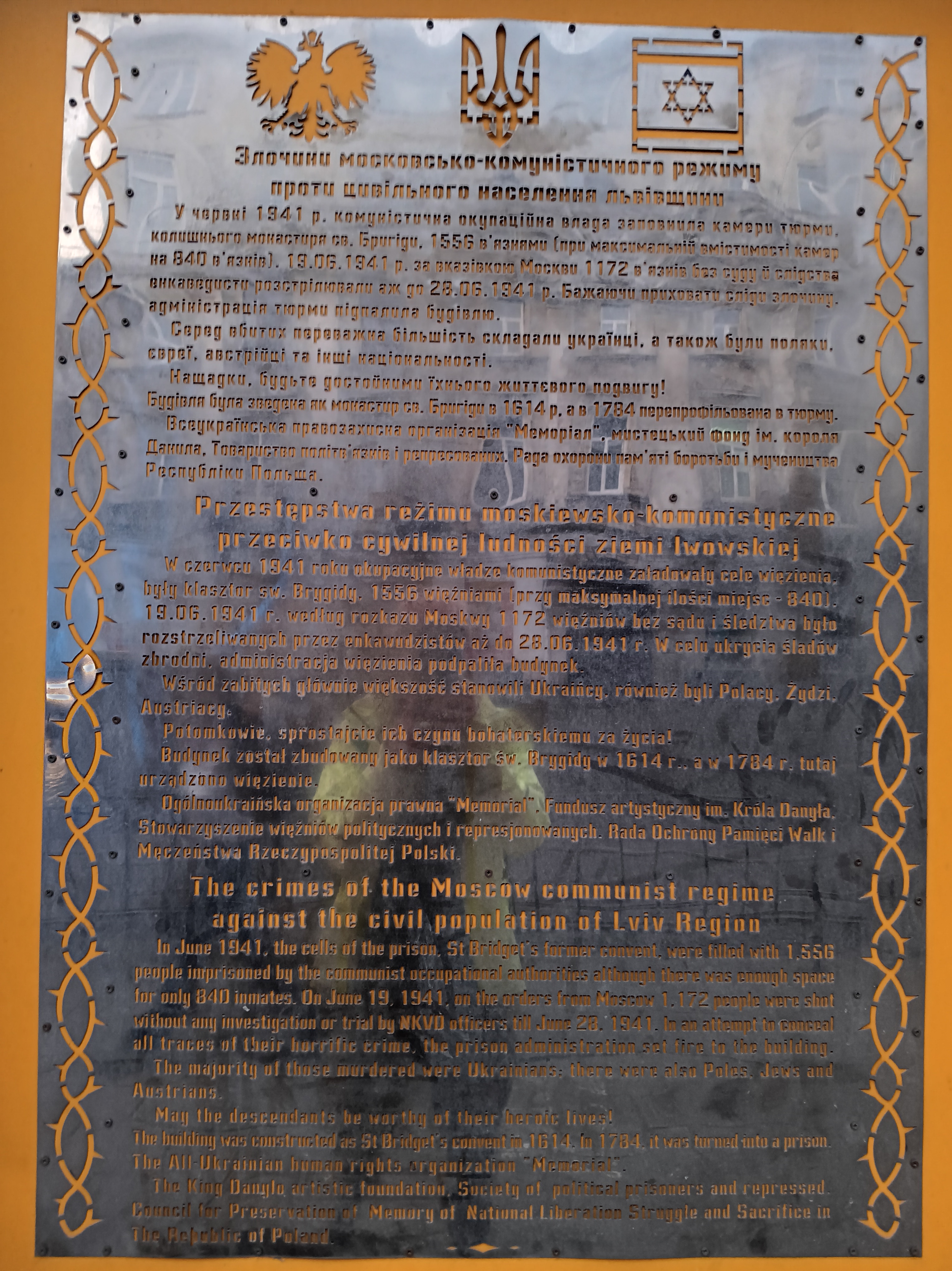
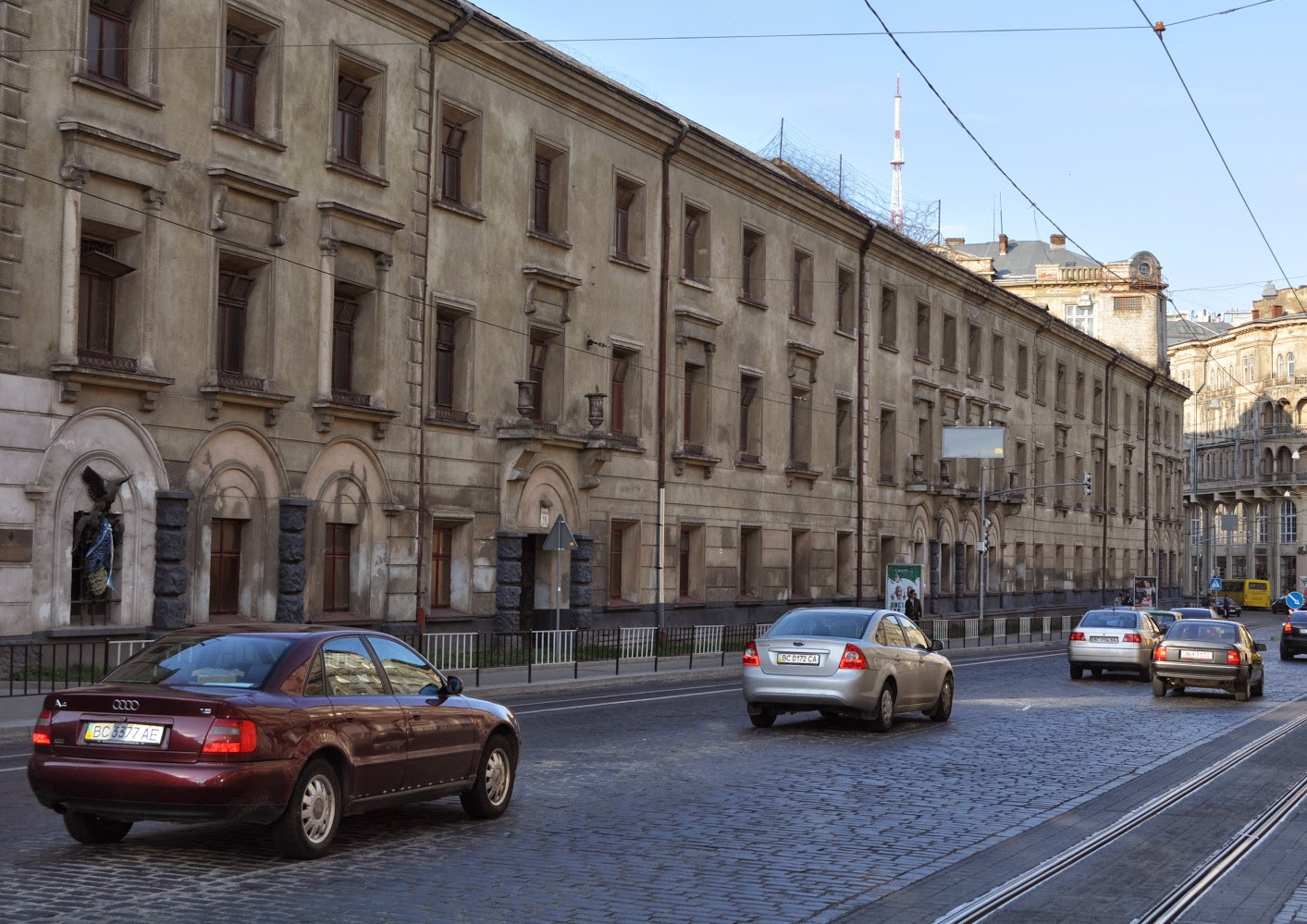
Half an hour later I find a huge 3-story building along a busy road that covers an entire city block. Later I find out, that this is the St. Bridget’s Convent for Women built in the 17th century, but it serves as a prison for the last 250 years which perhaps explains its decrepit look on Horodotska Street. On one of its walls I find a plaque in Ukrainian, Polish, and English stating that the Stalin’s Secret Police, the NKVD, shot 1,172 citizens of Lviv in this building on 19th of June 1941. This massacre at the Brygidki prison was part of a mass killing throughout Soviet occupied Poland and Ukraine.
For context, the Hitler-Stalin treaty of 1939 divided Poland such that Lviv was occupied by Stalin’s troops from 1939-41. About 1.25 Mil. “Enemies of the People” of Polish and Ukrainian descent where deported in 2 years. This occupation ended when Nazi-Germany invaded the Soviet Union and captured Lviv on 30th of June 1941. Throughout Lviv, Poland, and Ukraine the NKVD committed massacres of local populations. In Lviv alone about 7,000 Ukrainian, Polish, and Jewish citizen were shot or blow up in their prison cells days before Hitler’s troops entered the city to start another massive killing cycle.
Immediately after German troops occupied Lviv progroms of the Jewish population started. Encouraged and supported by German authorities members of the Organization of Ukrainian Nationalists (OUN) belonging to militias of Stepan Bandera participated in the progroms June 30 to July 2 and July 25 to July-30 (Himka, 2011). More than 6,000 Jews were murdered this first month of German occupation of Lviv. Inciting the local population to round-up, humiliate, and kill Jewish men, women, and children, German propaganda justified the progroms with the NKVD massacres by falsely blaming the Jewish population for it. While OUN leadership never directly endorsed participation in the progroms, they also did nothing to stop their members who participated enthusiastically. Their hatred of Poles and Jews, however, was part of an ideological program modeled on the German and Italian totalitarian regimes headed by Adolf Hitler and Benito Mussolini.
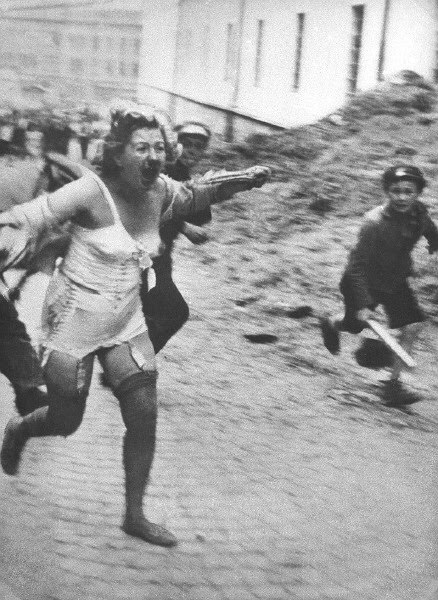
The photo above was taken the first day of the Lviv Progrom July-1, 1941 by an unknown photographer who stands on Vesela Street a block north-east of the Opera House. I walked those streets admiring street art and murals not knowing what had happened on these streets 83 years before: A grown woman has her dress ripped off, has her face bloodied, and is chased with wodden sticks by a mob of teenagers. She has only shoes and undergarments left to protect her, as she runs up a hill in terror while a large crowd of spectators in the background care not. Himka (2011) reproduces this photo and places it into a larger context.
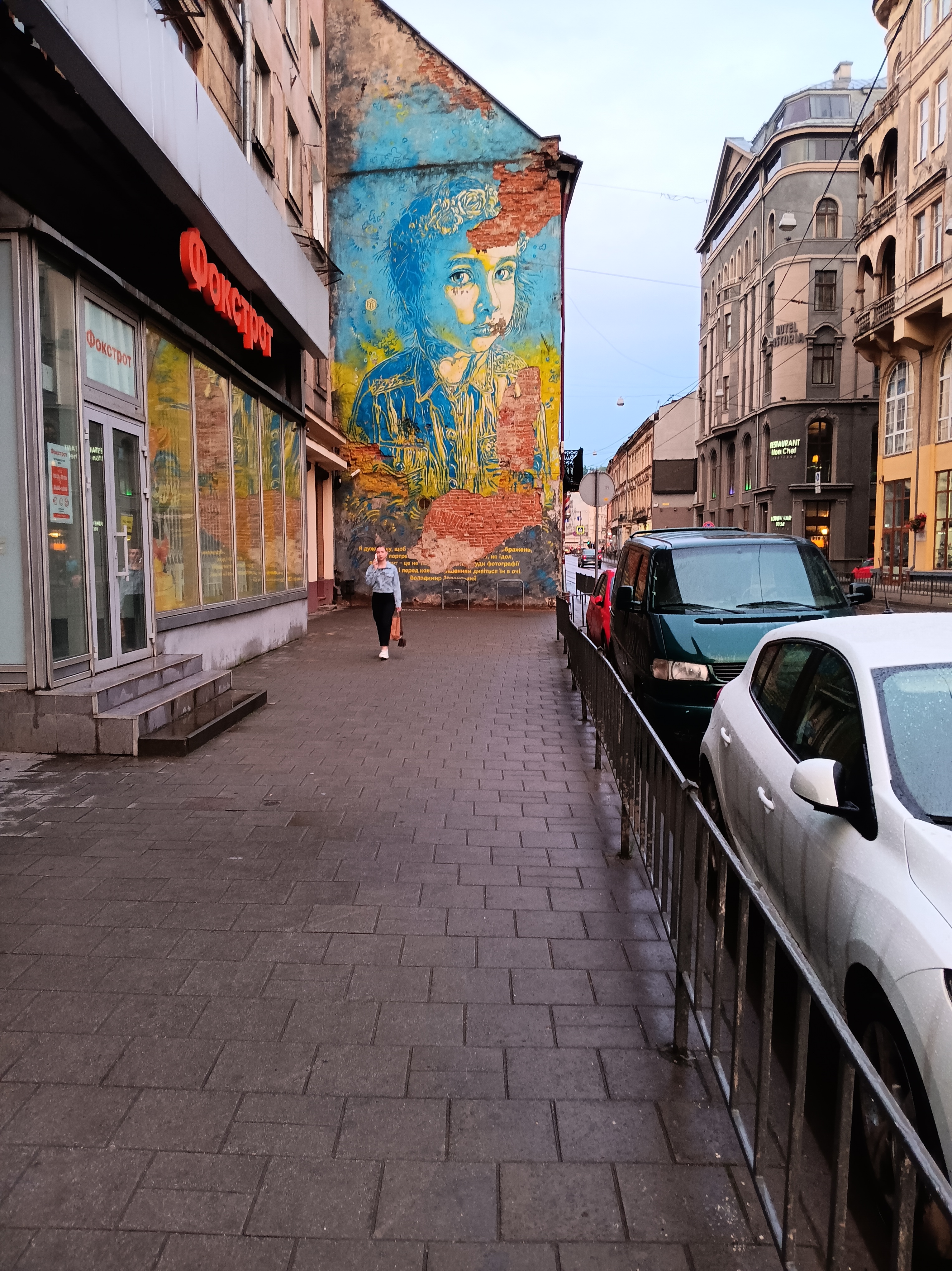
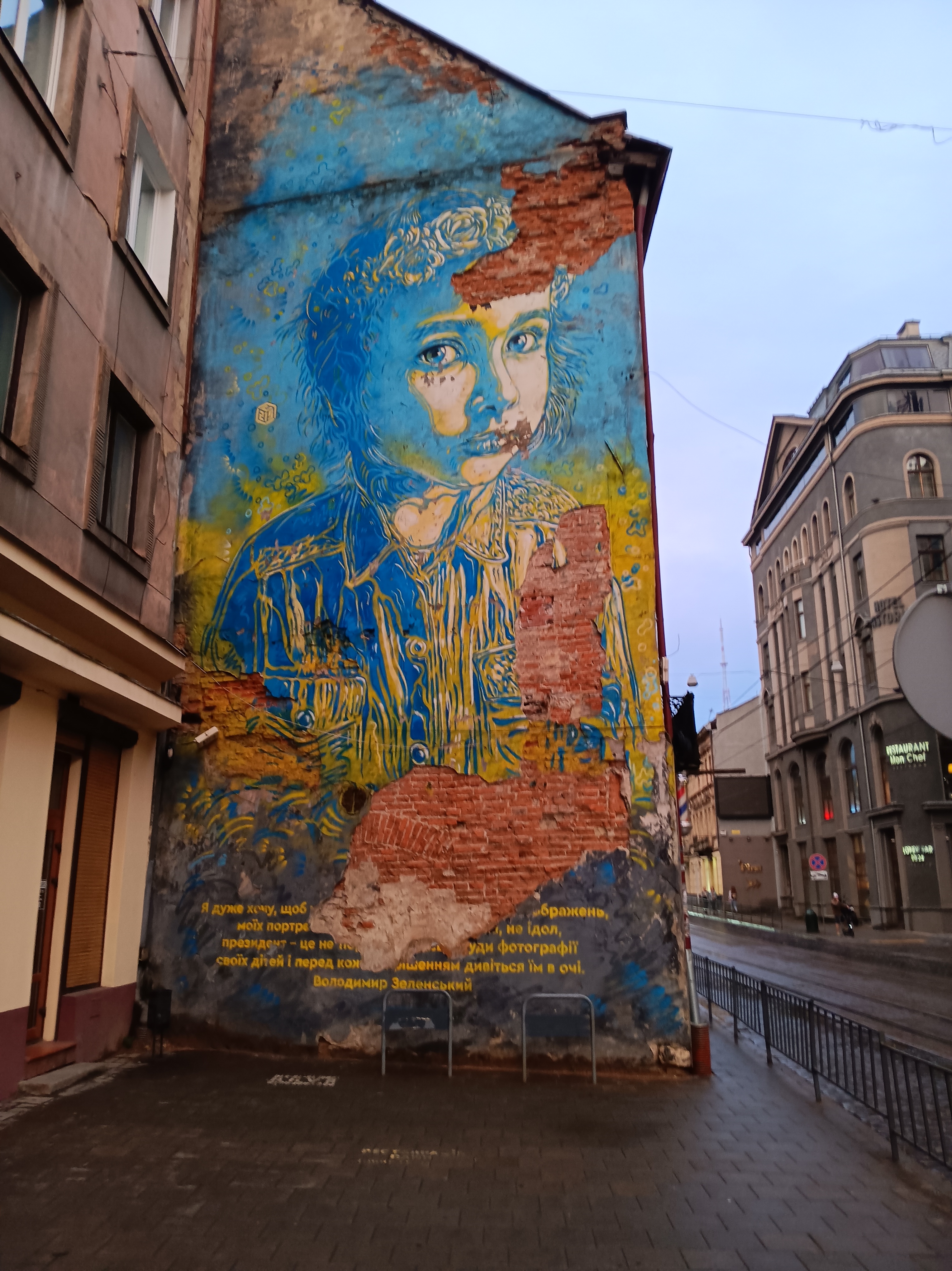
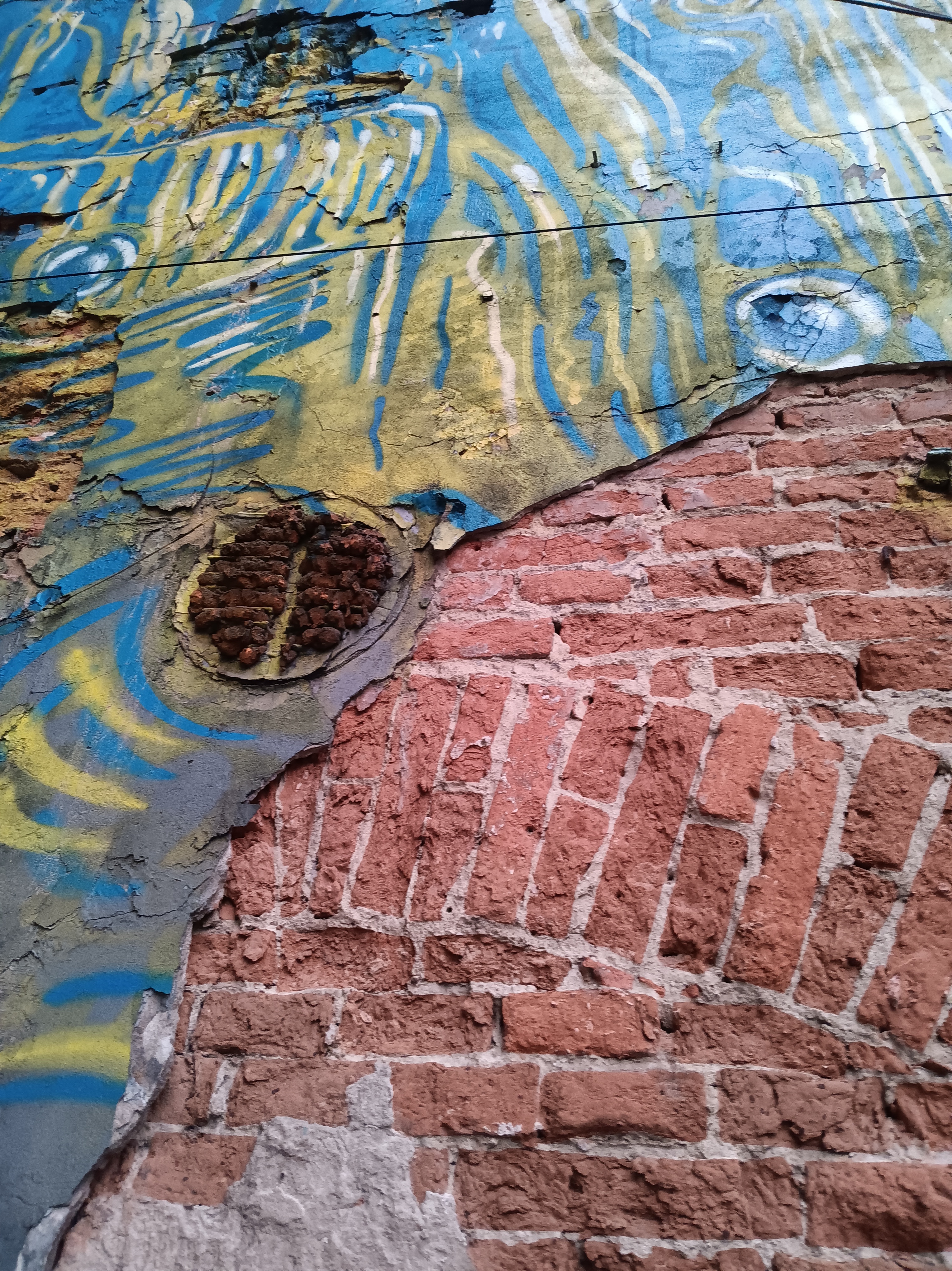
On my way home from Brygidki Prison I pass a beautiful mural that brings me back into the present. The blue and yellow of the mural reminds me of the colors of the Ukrainian flag. The braided flowers on the head perhaps symbolize this person as a women from Ukrainian. In my present sad mind, I see the the same human in both the symbol of a Ukrainian woman in this mural and the actual Ukrainian women in the 1941 photo. The paint peeling reveals red brick and an arch, but I also see an accidental thumbs-up sign in red. The mural is about two blocks west of the Opera House and thus near the center where the Lviv progroms took place.
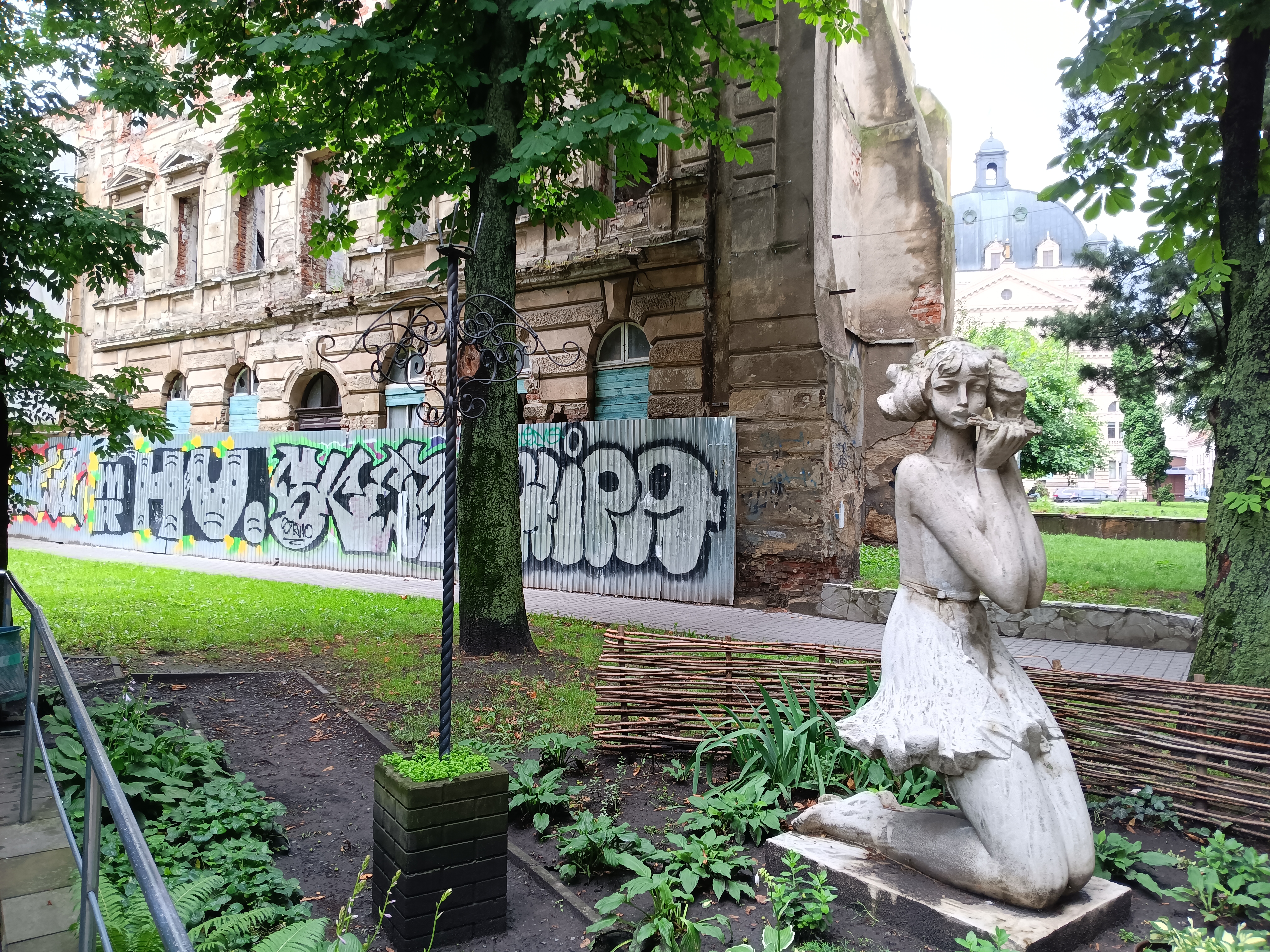
The bottom photo shows the Opera House from the north. There probably is a story in the small peaceful statue and the building directly behind it, but I do not (yet) know it.
Later that day my first Air Raid Alarm woke me up at night. In this war Vladimir Putin wants to re-establish the old Soviet Empire with the boundaries that Hitler and Stalin had agreed upon in 1939. The past is in the present and both are insane.
P.S.: Edited Oct.-20, 2024 by rewriting the last paragraph and removing some ill-fitting photos.
References:
Himka, J.-P., 2011: The Lviv Pogrom of 1941: The Germans, Ukrainian Nationalists, and the Carnival Crowd. Canadian Slavonic Papers, Vol. 53, No. 2/4, 209-243.
Plokhy, S., 2021: The Gates of Europe, a History of Ukraine, Basic Books, New York, NY.
Snyder, T., 2010: Bloodlands, Europe between Hitler and Stalin, Basic Books, New York, NY.
Cobble stones pave the streets of Lviv everywhere. The pedestrian Old Town merges sidewalks and streets with its center at Rynok Square. In Old Town restaurants, cafes, churches, museeums, and small shops all spill onto sidewalks in front of the 150-200 year old buildings. On the 2-3 floors up people live in appartments with 10 foot ceilings. My 1-room appartment was in one of these. Exiting the building and turning left, I reached Rynok Square within two minutes. Turning right, I entered Dominican Church within a minute. Along the short ways I pass several shops, cafes, and a small flea market. Electric trams but not cars zip across Old Town and for 20 Hryvnias ($0.50) one can hop on and go as far as the tram goes.
Walking past Old Town, I quickly found street vendors and a farmer’s market within a mile or so. Both local (currants, strawberries, cherries, gooseberries) and foreign fruit were sold. I bought half a pound of cherries and half a pound of “mirabellen” (small yellow plums) to eat during my first morning stroll through Lviv. Initially I spit the pits into the street, but I stopped when I noticed how clean both the streets and sidewalks were. This differs from all cities I have visited previously. Lviv expunges any and all litter in public places. So, my cherry pits went back into the bag.
Later I discovered that fruit and vegetables are grown within city limits in small garden plots that people nurture. On half the space of my Delaware gardens they grow twice the fruit. The soil in the Lviv gardens is a dark and black. One such plot nestled in front of a large residential appartment complex adjacent to a religious shrine. Three sides of the shrine are framed with stained glass window pains similar to those my wife Dragonfly Leathrum makes. Looking closely, I discern identical designs of the flowers, however, the variation of the glass color and its arrangement is not. It is only now that I see the design and its symmetries, but I do recall the soothing and calming effect the shapes and colors had on me when I walked past it 15 days ago.
The tiny garden contained an apple tree, several Red Currants bushes, grapes growing up and along the fence, beans, carrots, beets, and cucumber. The stage of all these plants was similar to those that I grow in my own garden. A plastic bag of kitchen scraps for a compost was hanging over the door to enter the plot. It almost seems that neigbors left these for the owner to work into the soil. My sister Christina does the same for me when she visits sundays and leaves her kitchen scraps for my compost.
Rain moved me away from the shrine and its adjacent garden to seek shelter. I quickly found a restaurant with covered outdoor seating. My first meal since arriving in Ukraine was Borscht. Tiny rib bones with meat were in the soup, the pure white pork belly fat was on dark rye bread, and a shot of vodka came with it at the end. The presentation of the plate, too, reveals artful intent. The red onion, pepper, pickles, garlic, and scallion are all arranged carefully. Even the sprinkles of red chili flakes on the white fat are no accident and like a painting complement the red of the soup. The outstanding restaurant has a website, e.g., https://marinad-meat-bar.choiceqr.com/, as I just learnt 😉
Talking about art in public places, I return to a mosaic sculpture at the farmer’s market. The market sits on a wide corner at the intersection of two large cobblestone streets. A tram line goes towards the shrine and the restaurant where I had my late lunch. A low wall encloses the fruit and vegetable stands inside and on one side this wall contains an exquisite mosaic of tiny colorful tiles. From afar colorful strands emerge that intersect and overlap smoothly without any color or strand dominating. Someone had to design this and someone had to put this together and I do not know who did this when, but I admire their love, care, and dedication to colorful and diverse cultures.
Notice also the mural on the wall above the market of the residential building. Two women tend to something and a line of symbols emerges along the base. Like most street art in Lviv, this one is not signed by the artist(s) either. I discern a peace dove and a sunflower … Again I only now notice this detail in the photo.