Tag Archives: NASA

Petermann Glacier, Ice Islands, and Changing Climate

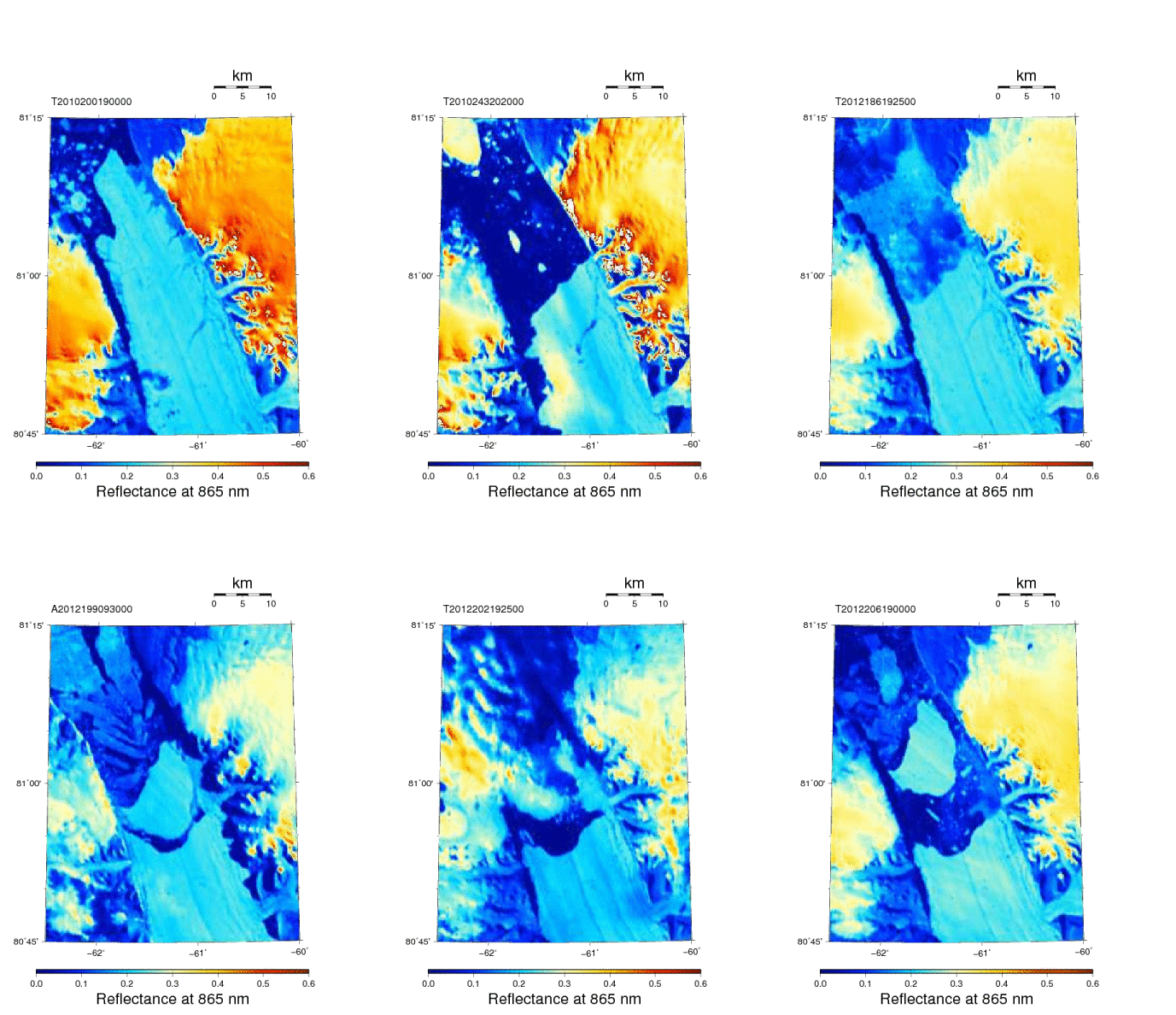
Petermann Glacier is a tidewater glacier in the remote north-west of Greenland. The glacier is grounded at about 600-m below sea level. It has calved two large ice islands, a 4-Manhattan sized island in 2010 and a 2-Manhattan sized one in 2012. These losses cover much of the area shown in this 2009 photo:

Eastern wall of Petermann Fjord as seen from CCGS Henry Larsen’s helicopter in August 2009 with the floating ice shelf. Most of the visible ice shelf has been lost during the 2010 and 2012 calving events. [Photo Credit: David Riedel, British Columbia.]

From selected imagery, I created a short movie (0.7 MB) which shows (a) the 2010 calving, (b) the advance of the new front in 2011 and early 2012, and (c) the 2012 calving. The glacier has moved at a rate of about Continue reading

Greenland’s Glaciers, Science, Sea-Level, and Teachers

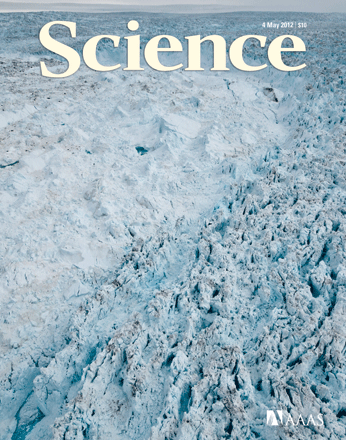
Science Magazine hit climate change hard today. They cover how Greenland’s glaciers and ice sheets change as they interact with the ocean and contribute to sea-level rise feature in 3 related stories. The reality check of these three stories puts a damper on the usual doomsday scenarios of those whose skill is limited to grabbing public attention to move a political agenda. Real science works differently:

May-4, 2012 Science Magazine Cover: A jumble of icebergs forms in front of the heavily crevassed calving front of Jakobshavn Isbræ, one of the fastest outlet glaciers draining the Greenland Ice Sheet. The ~5-kilometer-wide ice front rises ~80 meters out of the water and extends more than 600 meters underwater. Recent research shows that the speeds of Greenland glaciers are increasing. See page 576. [Photo Credit: Ian Joughin, APL/UW]

The solid new research is that of Twila Moon, a graduate student at the University of Washington whose dissertation work relates to the evolution of Greenland’s outlet glaciers over the last 10 years. She uses data from Canadian, German, and Japanese radars flown on satellites. She applies fancy mathematics to the data and feds data and mathematics into modern computer codes. And with all that, she cracks the puzzle on how fast more than 200 of Greenland’s largest glaciers go to town, eh, I mean, to sea. Furthermore, she shows how this flow has changed over the last 10 years.

Twila Moon, graduate student and scientist at the University of Washington and first author of “21st-Century Evolution of Greenland Outlet Glacier velocities” that appeared in Science Magazine on May-4, 2012. [Photo Credit: APL/UW website]

Back in the days of 2008, crude, but simple back-on-the-envelope calculation suggested that Greenland contributes 0.8-2.0 meters to global sea-level rise by 2100. In stark contrast, the 2000-2010 data now reveals, that even the low-end estimate is too high by a factor of 10. A glacier here or there may accelerate at a large rate to give the 0.8-2.0 m, but these rates do not occur at the same time at all glaciers. Ms. Moon’s more comprehensive and careful analyses of accelerating glaciers bring down Greenland’s contributions to sea-level rise to below 0.1 m by 2100, that comes to about 1 mm/year or an inch in 30 years.

A commentary written by Professor Richard Alley relates to the ice-sheets that feed these glaciers. Dr. Alley is famous for his work on Greenland’s ice sheet as he participated in 2-Mile Time Machine, a project that revolutionized the way that we view climate and its variability the last 100,000 years. The title refers to the 2-mile long ice-core from Greenland’s ice-sheet that trapped and stored air and stuff from the last 100,000 years. Dr. Alley is also featured in Andrew Revkin’s dot-earth blog of the New York Times as the Singing Climatologist. His comment on “Modeling Ice-Sheet Flow” references Ms. Moon’s observations as evidence that ice sheets change quickly. It also contains the sentence that “The lack of a firm understanding of ice-sheet-ocean interaction, constrained by reliable ocean data, remains a critical obstacle to understanding future changes.” I could not agree more with this sentiment, these data are darn hard to come by … not as hard as getting to the bottom of the 2-mile time machine, though.

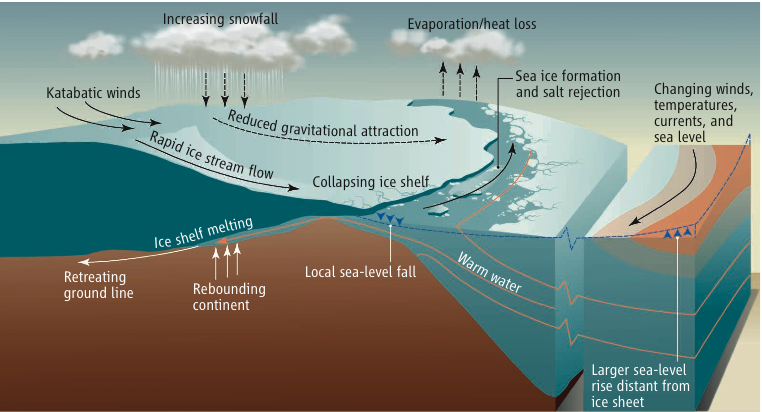
While Ms. Moon addressed changes in Greenland’s glaciers, Dr. Alley addressed the ice-sheets feeding those glaciers, another comment by physical oceanographer Dr. Josh Willis of NASA’s Jet Propulsion Laboratory relates to the sea-level changes caused by accelerating glaciers to make “Regional Sea-Level Projections.” He works mostly on massive computer models which devour massive amounts of data to get climate right. Sometimes this works, sometimes is does not, but he does comment that these earth system models give sea-level projections that are a factor 2 smaller than those derived from statistical relations and semi-empirical models using surface temperature and radiative forcing to extrapolate past trends into the future. The difference probably relates to smaller and more regional processes that involve the physics of ocean circulation and its interaction with ice-shelves off Antarctic and Greenland.

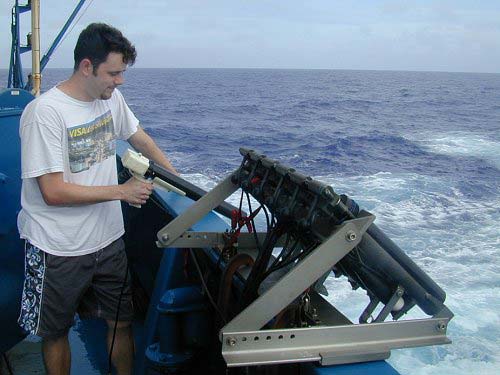
Dr. Josh Willis conducting an oceanographic experiment studying sea temperatures between New Zealand and Hawaii. [Credit: JPL/NASA]

My great oceanography hero, Henry Stommel of Woods Hole oceanographic Institution once wrote in his “View of the Sea,” that “Science is both an individual and a social activity.” I am sure that graduate student Ms. Moon, NASA researcher Dr. Willis, and veteran professor and science communicator Prof. Alley all work hard and lonely at night some nights … and party hard while discussing science and adventures over a beer, dinner, coffee in some city, remote field, or on a ship. The one group of people missing in this picture are … the science teachers, that is, those dedicated, over-worked, and under-paid professionals who encourage, motivate, and helped us to become scientists before we went to college.

The editorial of this week’s Science Magazine is entitled “Empowering Science Teachers.” It compares the social and professional status of pre-college science teachers in Finland and the USA. I will only say in the words of Anne Baffert, chemistry teacher at Salpointe Catholic High School in Tucson, Arizona, that too many science “… teachers work in a command-and-control environment, managed by those who lack any real understanding of how to improve the system.” The editorial suggests on how scientists can improve science teaching, such as “… active involvement in science through structured collaborations with scientists …” Apparently, Finland succeeds while we in the USA are challenged to get our graduate students into a pre-college class room teaching. More stuff for me to munch on here …

Pine Island Glacier on the Move

Pine Island Glacier, Antarctica, is the focus of a large observational effort to better understand how glaciers and floating ice shelves interact with the ocean.
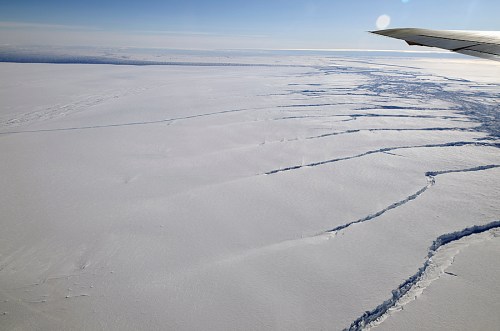
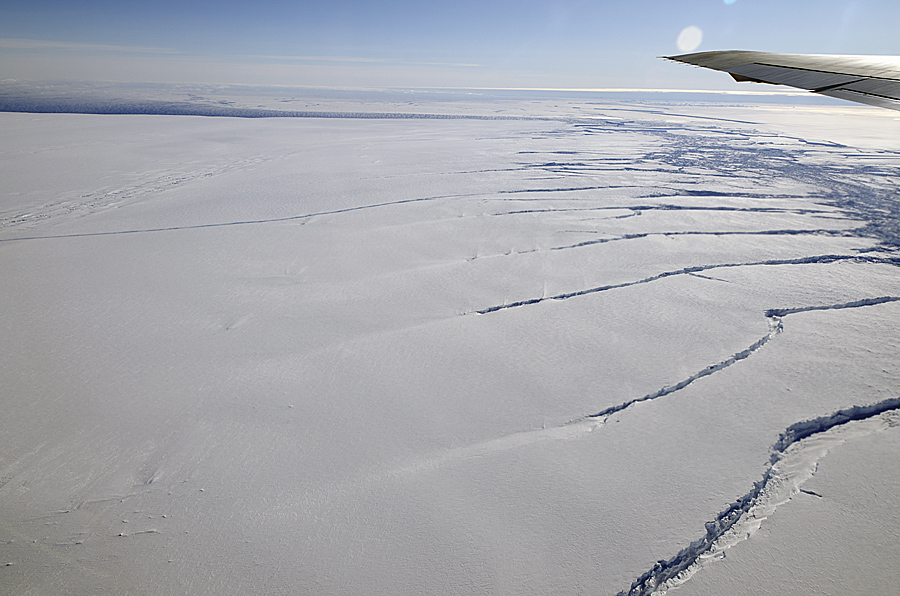
Pine Island Glacier (view is to the north, ocean in the top left) with crevasses and large crack extending from the east (right) to the west (left) as seen from aboard NASA's DC-8 research aircraft in October 2011. Credit: Michael Studinger/NASA

Scientists, pilots, technicians, and students working with NASA’s IceBridge and NSF’s Antarctic programmes tried hard for several years now to reach this glacier, set up a base, and drill through the 400-600 m thick ice shelf to reach the ocean. The data from these gargantuan efforts will reveal physics of ice-ocean interactions. This process is poorly represented in the climate models that are used to project past and present climates into the future. Harsh and hostile conditions cut these efforts short today, again, as reported by OurAmazingPlanet.

The expedition leader, NASA’s Dr. Bindschadler wrote today, that

A decision had been made by NSF the day we left McMurdo that if the helos were not able to be flown to PIG by Saturday, January 7, this year’s field work would be cancelled … We worked through our cargo—some had not been seen for two years when we tested our equipment at Windless Bight—preparing for either helos or the Twin Otter to start moving us onto the ice shelf. Neither came. Weather worsened.

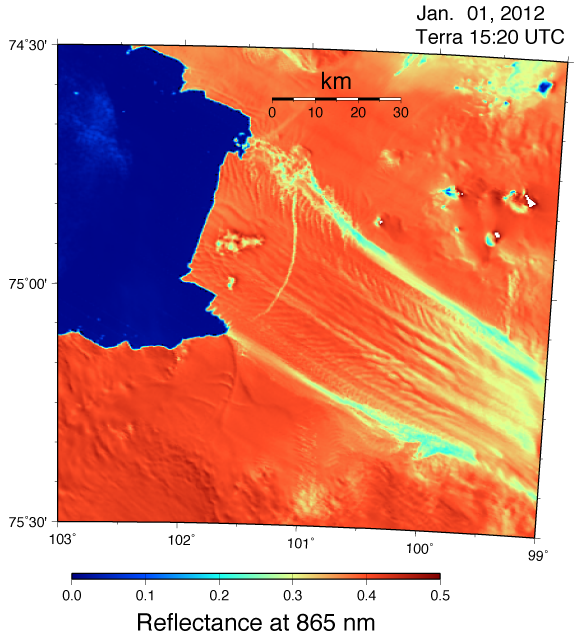
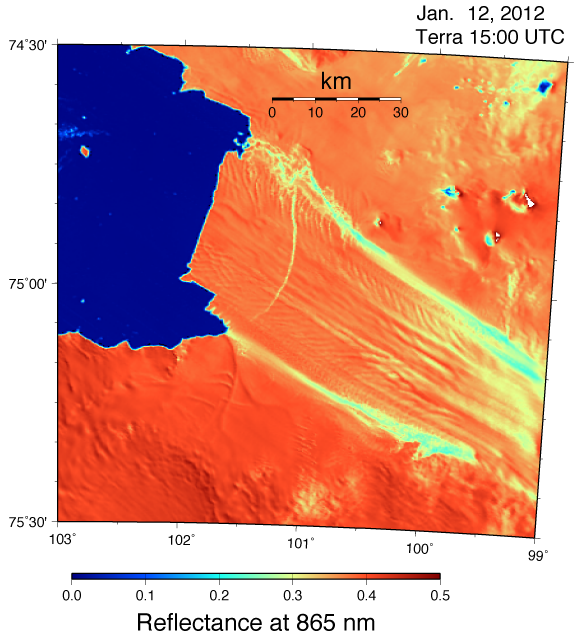
Despite this dramatic turn of events, skies were clear over Pine Island Glacier today as they on New Year Jan.1, 2012. Two MODIS images show detailed features at 250-m resolution. I here show the near infra-“red” signals that the satellite receives (865 nm). The dark ocean reflects little of red (low reflectance) as it is all absorbed while the bright snow and ice reflects lots of red (high reflectance). Recall that the color “white” looks white, because it reflects all colors into our eyes including red, while “black” absorbs all colors, so none are left to reach our eyes.
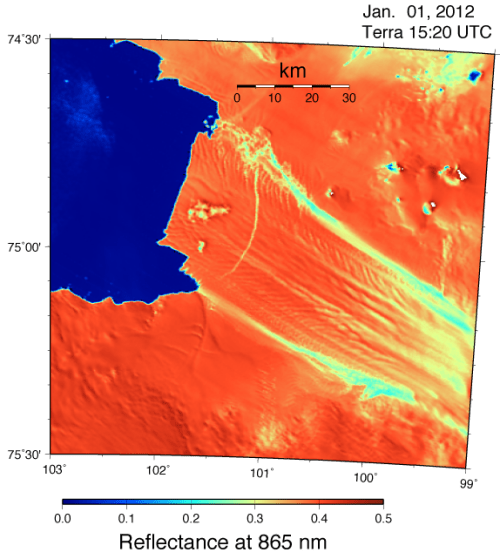
Pine Island Glacier and Bay, Antarctica on Jan.-1, 2012 as seen by MODIS Terra, notice the whitish crack near the center of the image.

I show lots of the near infra-“red” as, well, red, and I color little red as blue. I chose the colors of the “crayons” to do the coloring. The technical term for this is contouring. Formally, I am depicting a function f=f(x,y) where f is the amount of red and x and y are locations east and north, respectively.
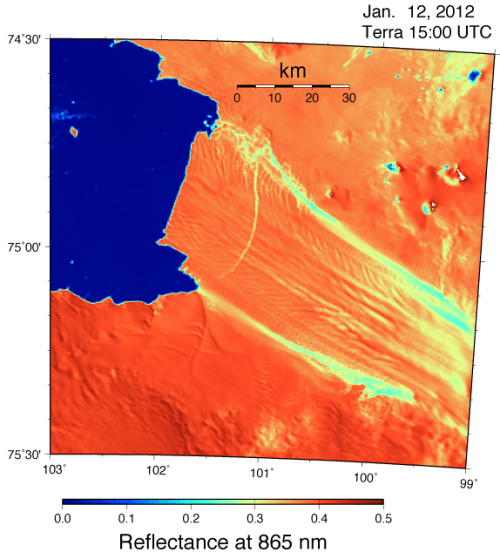
Pine Island Glacier and Bay, Antarctica on Jan.-12, 2012 as seen by MODIS Terra, notice the whitish crack near the center of the image.

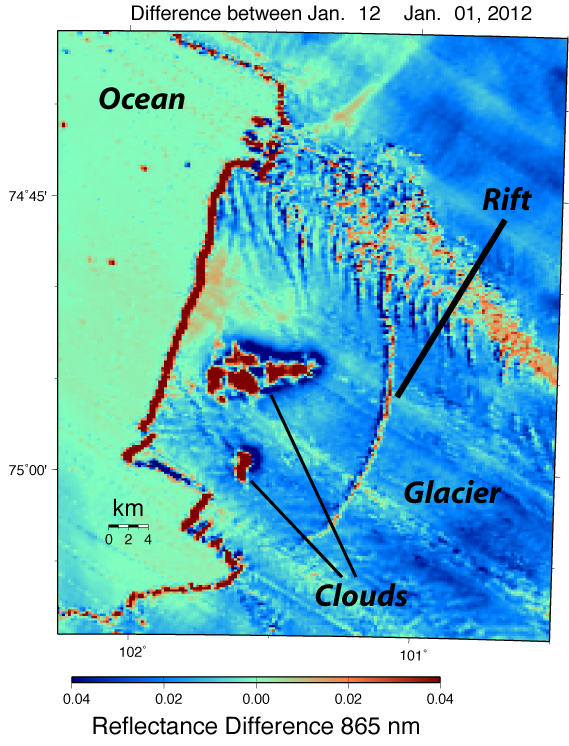
They almost look the same, don’t they? If they were identical, then the difference would get zero. Except, glaciers move, especially this one. It is also about to spawn a large ice island. A crack was first reported in Oct.-2011 by scientists aboard a DC-8 of a NASA Icebridge flight. This crack is also widening as, I speculate, the front moves faster seaward of the crack than it does landward. My question is if I can see movements in these easily accessible public MODIS images. And my first answer, to be refined later, is 80 meters per day plus or minus 50%:
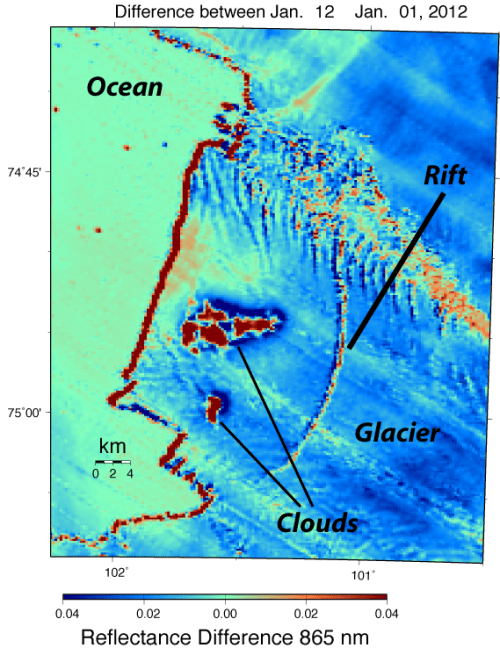
Difference of reflectance by subtracting Jan.-1 reflectances from those on Jan.-12, 2012. Very dark red colors show large positive numbers, meaning that the ice occupies a place on Jan.-12 that was water on Jan.1.

I am neither a glaciologist nor a remote sensing person, so I may be running a few red lights differencing two images and assign meaning to it. For example, I estimate the speed at which the front of the glacier moves by dividing the width of the very dark thick red line (about 1 km wide) by 12 days to get 80 meters per day or 3.5 meters per hour. The error here is at least 2 pixels (500-m), about half the estimated speed. My assumption here is that the high reflectance on Jan.-12 at a location with a low reflectance on Jan.1 means that the “bright” glacier has moved to a place that was “dark” ocean before. There is more to this, but I have to start somewhere.

Incidentally, Dr. Bindschadler, the leader of the current Pine Island field project who had to leave the base camp near Pine Island Glacier today, is the very person who wrote a wonderful peer-reviewed paper in 2010 with the title “Ice Sheet Change Detection by Satellite Image Differencing.” I will need to study it more closely … along with the vagarities of field work in polar regions.

It is difficult to get data from the field as opposed to data from remote sensing or modeling. This is especially true for remote and hostile locations the ice and the oceans interact. It is frustrating to be sent home early because of inclement weather and the very narrow window of opportunity when the few available helicopters and planes can fly or the ships can sail near Antarctica and Greenland.

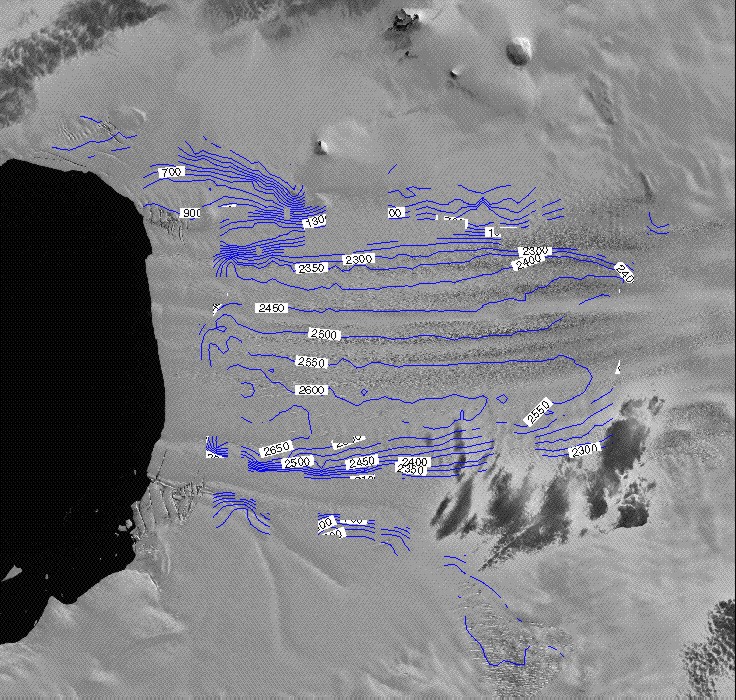
EDIT Jan.-13: The National Snow and Ice Center estimated speeds of Pine Island Glacier as determined from two LandSat images from 1986 and 1988:
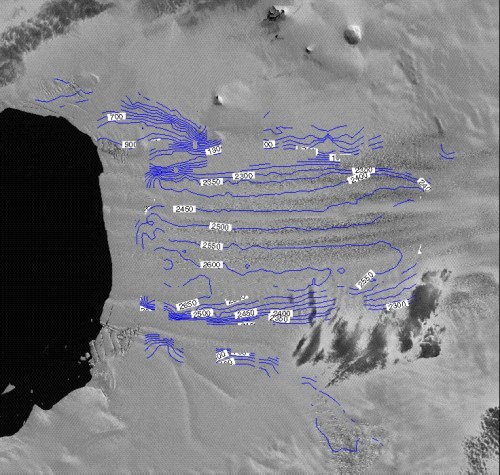
Contours of glacier speeds in meter per year of Pine Island Glacier from 1986 and 1988 LandSat Imagery, National Snow and Ice Center

These speeds are very different, 2-3 km per year versus 1 km in 12 days. The former estimate is made from 2 carefully geolocated images 2 years apart without a crack across the floating glacier, while my estimate yesterday is more noisy, but it is for a segment of the glacier that is barely connected to it. Perhaps we should consider the segment seaward fo the crack a separate ice island that is moving with the ocean rather than the glacier?

New Ice Island Forming at Pine Island Glacier, Antarctica

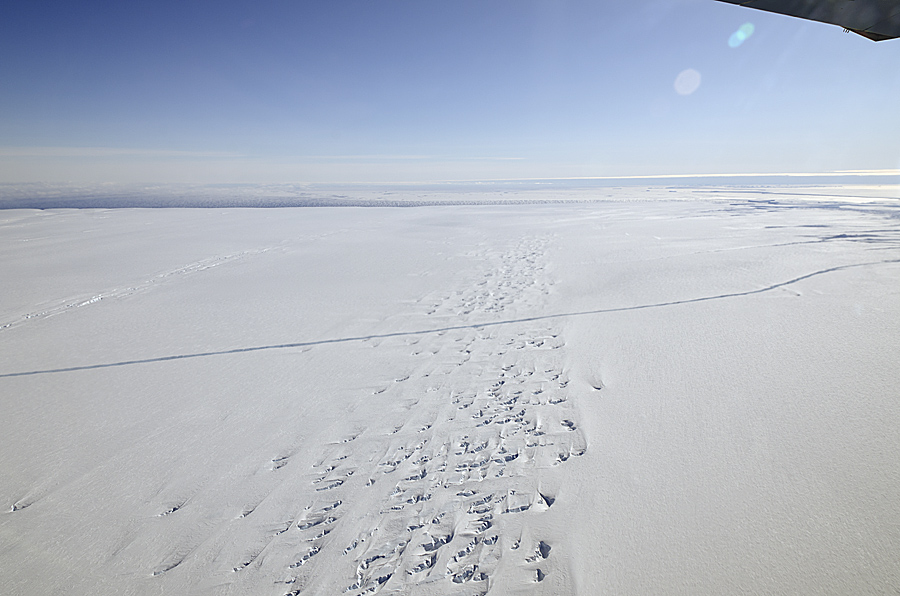
A new ice island is about to form as spring and summer arrive in Antarctica. NASA researchers working on Pine Island Glacier (PIG) as part of the IceBridge Mission discovered a 30 km wide rift some 25 km from the ocean during overflights in a DC-8 research aircraft.The rift will eventually will break off into a tabular iceberg about 10 times the size of Manhattan. The rift is wide enough to be visible in optical satellite imagery that has a spatial resolution of 250 meters. A BBC report credits NASA scientist stating that this large calving of an ice island is part of a natural, roughly decadal cycle.

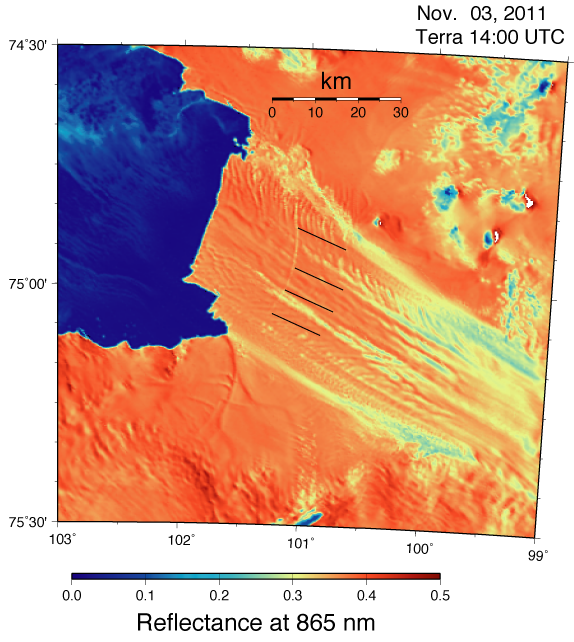
Pine Island Glacier from MODIS/Terra with crack visible at 250-m spatial resolution.

A crack runs across the floating ice shelf of Pine Island Glacier in Antarctica, seen from NASA's DC-8 on Oct. 14, 2011. Credit: Michael Studinger/NASA

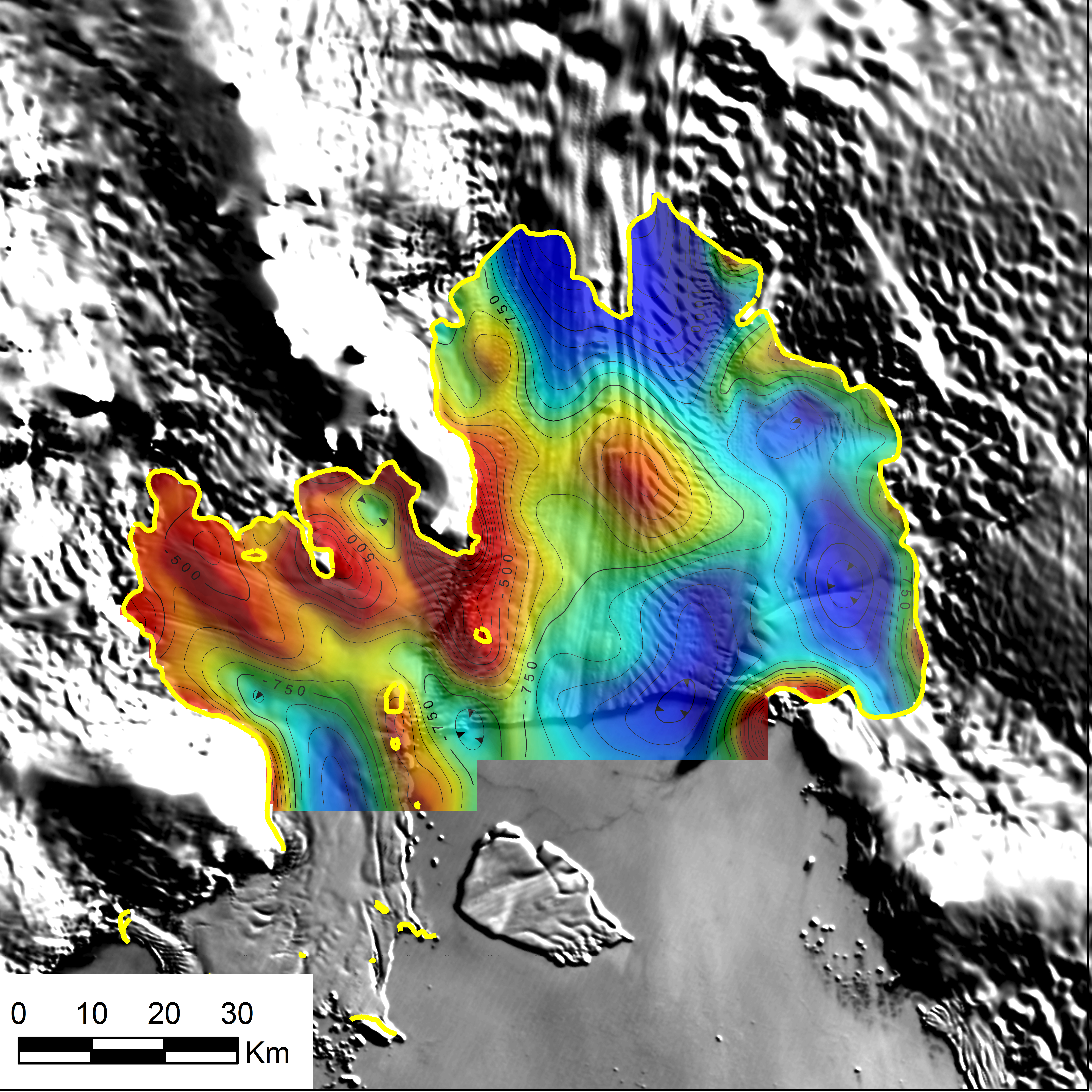
Antarctic massive ice sheets contain 70% of all freshwater and 90% of all ice on earth. Most of this is contained within the stable East Antarctic ice sheet where temperatures have increased little. In contrast, the West Antarctic ice sheet has seen warming by about 0.2 degrees Celsius and a net loss of ice to raise global sea level by perhaps 2-3 inches in 100 years. The grounding line Pine Island Glacier (where ocean, bedrock, and ice meet) has retreated for several decades as warmer ocean waters near the bottom cross a sill and plunge into a landward depression of the bedrock. This leads to enhanced melting of the floating ice-sheet and a potential instability that could lead to a collapse of the ice-shelf and much enhanced discharge of the Pine Island Glacier to draw down a large fraction of the West Antarctic Ice Sheet.

Bottom topography under Pine Island Glacier and grounding line. Blue colors show greater depths and its connection to the open ocean (bottom, north). (credit: NASA)

A similar physical process, albeit at a smaller scale, is potentially working at Petermann Glacier off Greenland where the grounding line is at a local maximum of bedrock elevation. Petermann’s grounding line has probably not moved substantially the last 100 years or so.

More detail on the evolving Pine Island Glacier, Antarctica event can be found at a NASA media briefing.

Petermann Ice Island Seen from International Space Station

Ron Garan aboard the International Space Station just send this photograph of Petermann Ice Island PII-A down to earth as reported by Jason Major.

Petermann Ice Island PII-A on July-25/26, 2011 as seen by MODIS/Terra and the International Space Station

While the detailed photo indicates that the ice island was about as close to the coast as it is long, it has since moved offshore and to the south. The ice island is on its way to clear the similar sized island of Belle Isle in the middle of a channel that separates Labrador in the north from Newfoundland in the south. The distance from the coast is not all that relevant, but the water depth is. Classical physical oceanography says so and I urge you to watch this MIT movie.

In a nutshell: The rotating earth limits large-scale flows, such as those that propel the ice island, to move in ways that seem to make no sense. More specifically, if there is a tiny change of the bottom depth, then the flow at all depths, and this includes the surface, will want to go around this obstacle to stay with the depth it started at. It is very hard to move water from water 200 meters deep such as on continental shelves to water 2000 meters deep such as further offshore. There are exceptions to this rule, of course, but they involve other forces that usually, but not always, are small.

It is so much fun to watch and predict where this ice island will move next, especially if one can be proven wrong so easily. “The proof of the pudding is,” as Cervantes has Don Quixote say so wisely, “in the eating.”