The Ukrainian Catholic University in Lviv invited me to teach at their Summer Language School. Until last week I worked with ~50 Ukrainian students from about 10 in the morning to 5 in the evening monday through saturday. We met daily in classrooms, on the lawn outside, and in pubs over food and beer. The main purpose of the Summer School for the 17-21 year old students was to learn German as their second, third, or fourth foreign language. Their Ukrainian teachers knew every rule of German grammar, spoke perfect German, and half of them had PhDs in German literature, linguistics, education, and/or language theory.
Students and teachers alike love their country, their faith, and their freedom deeply. All hate the war that Russia wages on them personally: Every day Russia tries to kill them by drones and missiles, tries to erase their history, tries to pillage their resources, and tries to exterminate their language, culture, and freedom. Russia’s war is present in Ukraine at every location for every person at all times. Nevertheless, I went to open-air concerts, bars, restaurants, and churches filled with joyous young and old people with and without small children. This very public life serves as a defiant and powerful act of resistance to Russia’s war as does vibrant street art and music.
The people of Ukraine need our weapons to protect their freedom to be human and to be free from the violence, terror, and oppression imposed by Russia on them. Never have I seen a people believing in God as strongly as the Ukrainian students and teachers whom I met last 3 weeks. Furthermore, Lviv centers many overlapping faiths with churches of the Greek Catholic, Roman Catholic, Armenian Catholic, Ukrainian Orthodox, Russian Orthodox, and even a small Jewish community. Furthermore, I met both atheist and agnostic students studying at the Ukrainian Catholic University. This rich and diverse tapestry of believes exists in overlapping circles of ancient history, song, prayers, and common purpose. All are united and opposed to Russia’s terror of random death by drone or missile. People are tired, yes, tired and exhaused by 3.5 years of war, but people are united for the noble purpose to be free, to be at peace with their neighbors, and to be part of a liberal and democratic Europe. Russia responded to these desires with war, because Russia perceives a free, creative, and productive Ukraine as a threat to its own sclerotic, decadent, and corrupt society.
Unlike Russia, Ukraine values individual life and liberty, but Russia has 4 soldiers for every one Ukraine has. How can I best help my Ukrainian friends in their just defence to protect their freedom and to be part of a peaceful Europe? They need air defence radars and missile systems, they need artillery shells and cannons, they need tanks, helicopters, and fighter jets, they need drones and electronic jamming gear. I struggle with this question, write and call my U.S. senators and Congresswoman in Delaware to support Ukraine, and talk to friends and family about my travels to Ukraine, but it all seems puny and I am frustrated and impatient. In those moments I recall the wise words passed on to me 2 weeks ago by an older man of Irish-Catholic faith:
Act like the world depends on you, but pray it depends on God.
Arctic field work connects people of different backgrounds, disciplines, and tribes. Last week I spent 3 days in Maine where I met with Arctic archeologists, anthropologists, and students of all ages. Susan Kaplan and Genevieve LeMoine run the Arctic Peary-McMillan Museum and do extensive field work in Labrador, Cape Sheridan atop Ellesmere Island (Canada), and northern Greenland. A class of smart sophomore asked more questions than I could answer in the morning and a diverse group of citizen did the same in the evening. I represented the “physics tribe.”
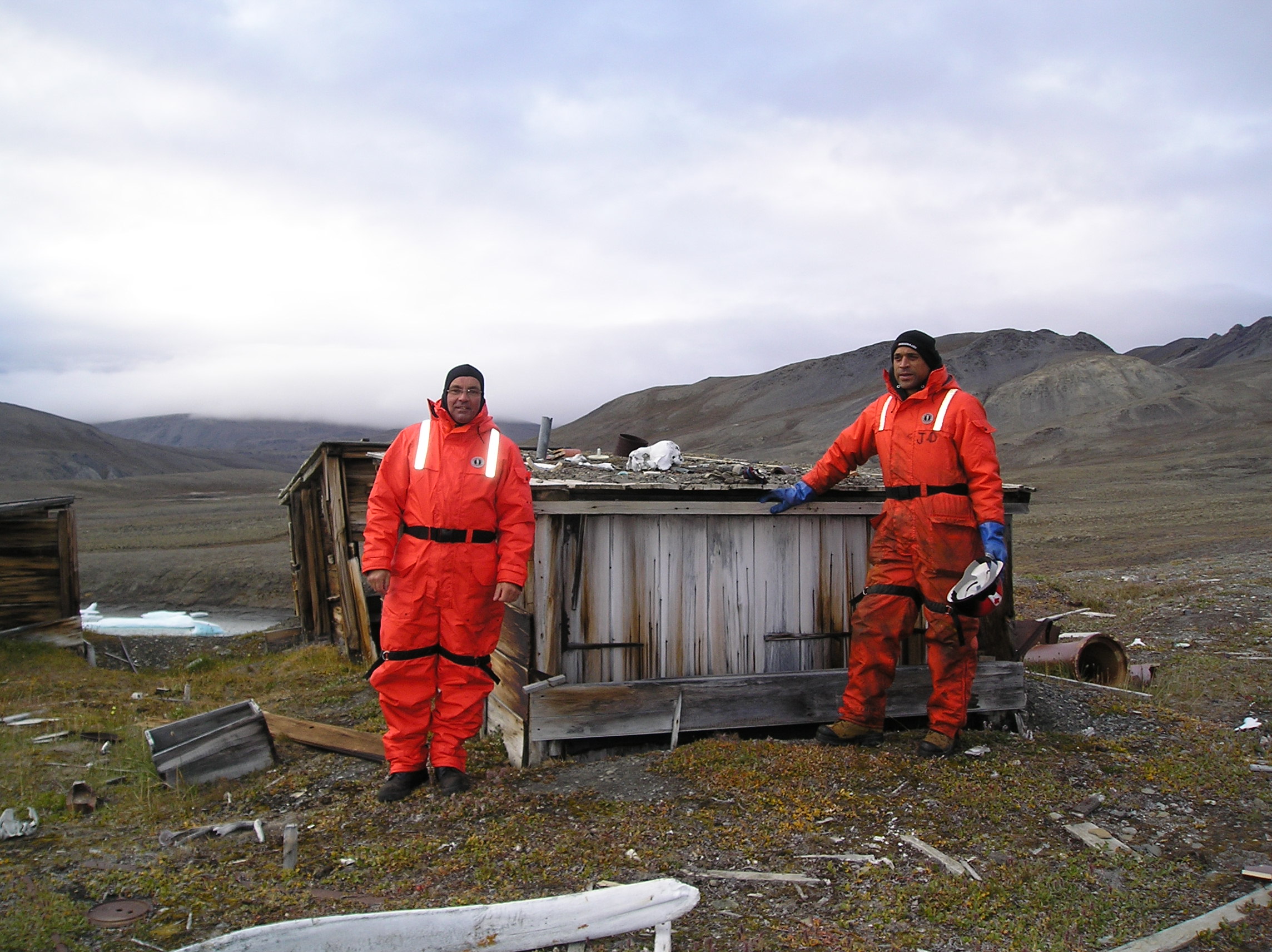
We learnt of each other after I posted an illustrated essay “Ruins of Fort Conger” that contained this image taken near Petermann Fjord in 2012
Carl Rose on the left was a seaman on our last 2012 expedition while Jonathan Poole is a marine field technician with whom I work often. They stand before a hut built by Admiral Robert Peary in 1900 on one of his early excursions to reach the North Pole. The 2012 photo bears remarkable similarity to one taken in 1909 that Genevieve LeMoine describes on her blog with title “Tides of the Arctic.”
Donald MacMillan and Jack Barnes at Fort Conger, spring 1909 [From LeMoine, 2013]
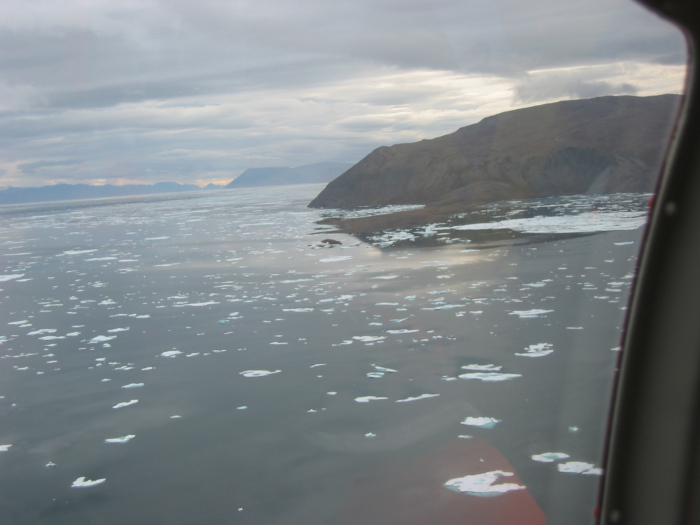
It shows Donald McMillan and Jack Barnes in 1909 during a later Peary expedition. The pictures and histories are displayed at the “Glimmer of the Polar Sea” exhibition at the Bowdoin’s Peary-McMillan Arctic Museum. These huts are the closest “shelter” to Petermann Fjord about 50 miles to the east. The men visiting Fort Conger in 1909 and 2012 look towards the ocean which in 2012 looked like this
Discovery Harbor off Fort Conger, Ellesmere Island in 2012.
We visited the site in 2012 to recover an ocean sensor that, so we hoped, had measured tides and temperatures for 9 years earlier. For 9 long years we had no way to tell, if either sensor or data existed. Only after recovery in 2012 did we jubilantly find sensors and data. At the time we deployed this sensor in 2003 technology did not exist to get data out from the ice-covered ocean. We are trying to develop technology to change this. The non-trivial goal is to get such data out as it is collected without waiting for 9 years. That’s what my crowd-funding project is about: Develop new technologies and share all data, results, and excitement.
If funded, this project will produce results immediately as ocean temperatures (and salinities) will be transmitted to the word wide web for anyone to use as she or he sees fit. Please help and be part of the cutting edge of Arctic Oceanography: Tell your friends, tell your family, and tell your colleagues about the science, about the Arctic, about the beauty, about the climate, and about the physics of the ocean.



![Donald MacMillan and Jack Barnes at Fort Conger, spring 1909 [From LeMoine, 2013]](https://icyseas.org/wp-content/uploads/2015/02/3000-32-1808v2b_blog.jpg)

 Icy Seas