Tag Archives: glaciers

Steensby Gletscher Sheds 10 km^2 Ice Island

Following the rapid southward motion of Petermann’s 2012 Ice Island (PII-2012) via MODIS satellite imagery, I noticed a larger piece of Steensby Gletscher nearby breaking off. Steensby discharges into Sankt George Fjord whose upper reaches are narrower than Petermann’s (4.5 km vs. 15.5 km wide). The new ice island is smaller than the Manhattan-sized ice islands from Petermann, but it is still about three times the size of Manhattan’s Central Park (~ 10 km^2).
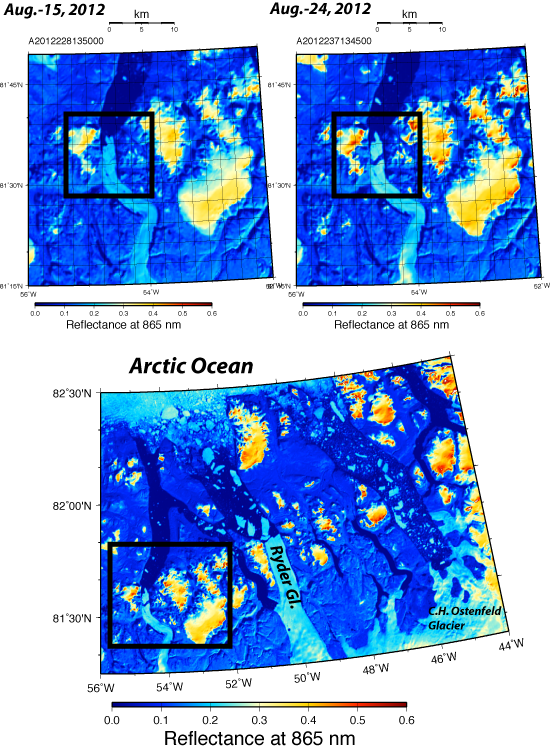
Steensby Gletscher and Sankt George Fjord on Aug.-15 and Aug.-24, 2012 (top) and fjords and glaciers of north-west Greenland facing the Arctic Ocean as seen by MODIS-Aqua on Aug.-24, 2012 13:45 UTC (bottom). All data are shown at 250-m spatial resolution. Note the segment of Steensby Gletscher which is separating from the glacier to form a new ice island.

The floating ice shelf of Steensby Gletscher is also two to three times thicker, but it moves more slowly. It appears, that a lateral crack or rift broke off sometime between Aug.-21 and Aug.-22, 2012 to form the ice island, this one about 1/10 the size of PII-2012. This latest calving is about 7 years of steady advance of this glacier. Comparing the front of the glacier with that observed in 1947, 1953, and 1971, I find its current site well within the earlier bounds reported by Dr. Anthony Higgins of the Geological Survey of Greenland. The same cannot be said for Petermann Gletscher about 40 nautical miles to the south-west. Unlike Petermann’s Ice Islands, Steensby’s are likely to linger and stay inside its fjord for several years as many of those calving from neighboring Ryder and C.H. Ostenfeld Gletschers do.

Michael Studinger of NASA’s IceBridge project provides stunning aerial photography of Steensby Gletscher when he flew over North-West Greenland in May of 2011.

Addendum 8-25: Mauri Pelto posted equally stunning high-resolution Landsat imagery and provides more context, analyses, and references.

Higgins, A.K., 1990: North Greenland glacier velocities and calf ice production. Polarforschung, 60, 1-23.
Nares Strait 2012: Charting New Waters in Petermann Fjord

By Andreas Muenchow, off Joe Island, Greenland, Aug.-11, 2012

We just left Petermann Fjord, squeezing by a Manhattan-sized ice island blocking much of its entrance. An armada of 100s of ship-sized tabular icebergs were all jockeying for positions behind the big one. Captain Wayne Duffett of the Canadian Coast Guard commanded the CCGS Henry Larsen into the new waters of Petermann Fjord, Greenland, with skill, experience, and a calculated dose of daring, trusting both his instincts and his crew. These new waters were formed when Petermann Glacier lost as much as 1/3 of its floating ice shelf during massive break-off events in 2010 and again in 2012. The Henry Larsen was the first and only ship for years to sail and survey this mare incognita for the last 22 hours. It was a long day.

I slept only one of the last 24 hours, skipped dinner, and will head for breakfast in 10 minutes. Being excited and working hard with 24 hours of daylight is exhausting, draining, but also immensely satisfying. We completed a spatial bathymetric survey, collected water and water properties along the new seaward face of the glacier from the surface to 1200 meter depth, and did the same for a section along the axis of the fjord that used to be covered by an ice-shelf.

I tried to document and capture the changing icy seas and their interactions with both land and ocean by taking plenty of photos and video, to later share with those who cannot be here. Several pods of narwhales — they really do have 3-ft long tusks (a tooth really) — were feeding on ocean fronts within a mile of Petermann Glacier’s new face…

Breakfast is ready; I am sending this off as is, without much editing (too tired) {Editor’s note:  Good thing there are those less distracted by the excitement of new icy worlds to do some proofreading…}, then some sleep while those who sleep will install a new weather station on Joe Island.  Science aboard a ship like the CCGS Henry Larsen never really stops…

Nares Strait 2012: Entering Uncharted Waters

Allison Einolf, Aug.-11, 2012

As scientists, we are constantly exploring new things, but usually our exploration is within the realm of knowledge. Rarely do we get an opportunity to sail unexplored waters or tread where no one has tread before. Yesterday, our location was plotted inside of what was the Petermann Glacier on the now outdated navigational chart. We were in uncharted waters.

As a child, I read hundreds and hundreds of books about exploration. Some were fictional, some were historical, some were futuristic, and some were mythical. I read about traveling to the furthest reaches of the universe or the depths of the ocean. I read about fantasy worlds, I read about sailing off into the distance with the only goal being adventure, and I longed for the life of an adventurer. So I made igloos out of blankets, and my younger brother and I fought off dragons and found new worlds in our basement and the nearby parks.

Growing up, I became slightly disappointed that most of the world we live in is charted and mapped and although I love being able to get directions online, it took the adventure out of things. I came to accept that I would have to find different ways to explore the world around me, and I turned my love of adventure to science.  I would never have guessed that science would bring me to a place of complete unknowns.

I was excited when we saw the Petermann Ice Island at the mouth of the fjord. I was thrilled and amazed, and I kept on taking pictures instead of going inside to get a hat and gloves. That was when it first sunk in that no one had seen this before. The ice island has been talked about and examined from satellite imagery, but no one previously had gotten so close that they almost felt like they could touch it.

I was filled with awe as I took pictures because I realized I could only see the edges of it near the ship, where it was narrower, and that it was so huge that I could barely comprehend it’s size. Pat and Jo got to go up in the helicopter with the ice specialist to check out the extent of the ice, and it was impossible to get the whole island in a photo, even from 3000ft in the air. Although there have been many jokes about the comparison of the ice island to the size of Manhattan, I think it was appropriate. Manhattan may not be a very large island, but it is immense in character, and the ice island is twice it’s physical size and definitely has character of it’s own. The rolling hills and rivers and lakes that cover the surface of the ice may not be as large as the lakes I am used to, but the expanse of white goes on forever. It’s awe-inspiring.

My excitement at the edge of the ice island was nothing compared to my exhilaration as we broke through the ice at the mouth of the fjord and sailed into uncharted waters. Of course the edges of the fjord have been charted, and they can be seen from satellite imagery, but nothing was known about what lay under the ice.

As we lowered the first rosette and brought back the first water samples, I once again realized that we were pioneers. We were the first to be here, since the water here has been covered in ice for at least 180 years, and probably much, much longer. We were the first to take water samples, and the first to take depth soundings. We are explorers. The adventure of it has had me smiling constantly since we first saw the ice island, and I don’t think that anything I write will come anywhere close to describing the wonder of how it feels to be here.


The currents and winds of Nares Strait

[Editor’s Note: Undergraduate Allison Einolf of Macalester College in Minnesota summarizes her work at the University of Delaware that was supervised by Andreas Muenchow as part of an NSF-funded summer internship.]

I’m about to fly to Thule, Greenland for a research expedition into the Nares Strait. We had planed to survey Petermann Fjord, but our proposed cruise track is facing an obstacle twice the size of Manhattan.

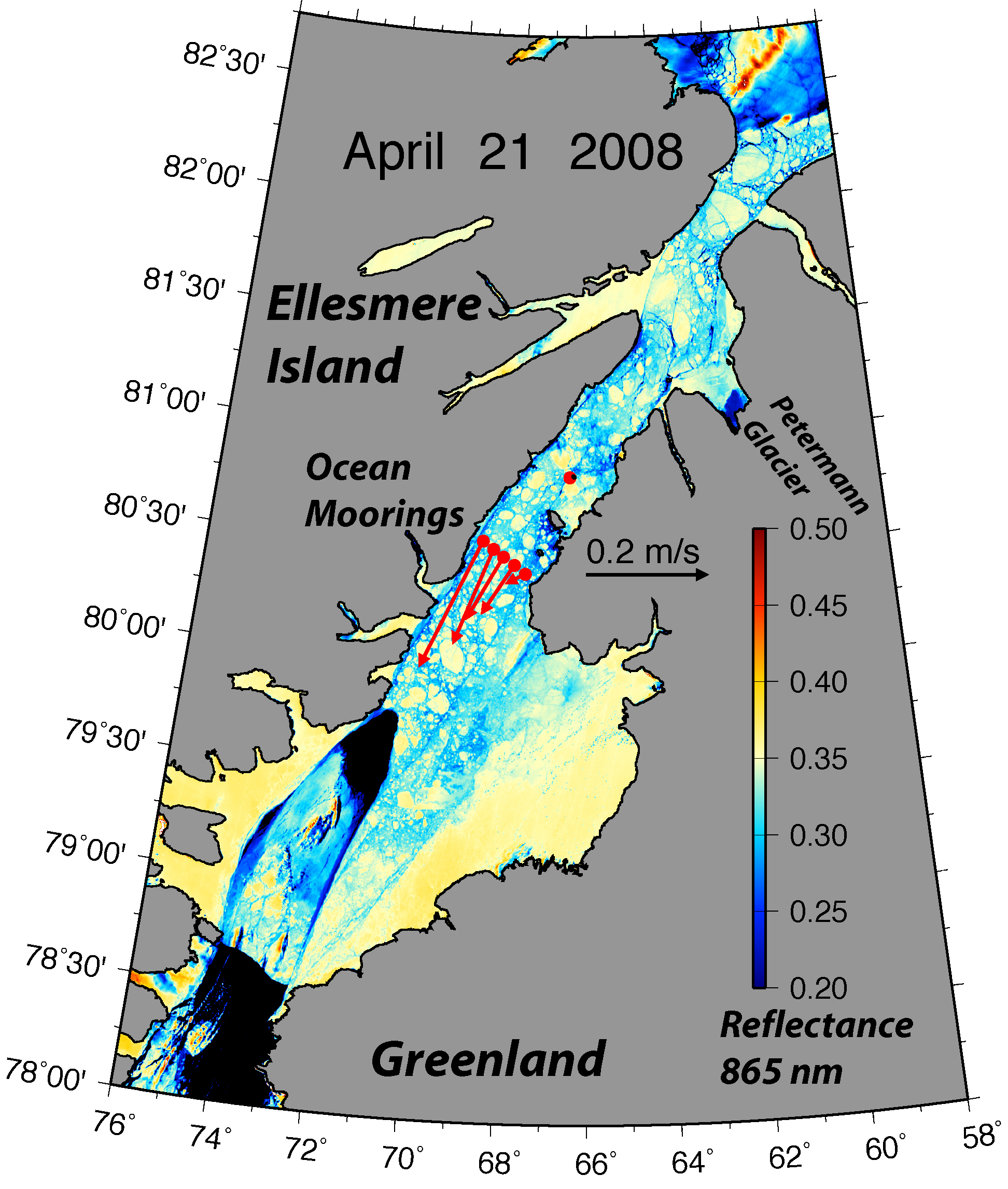
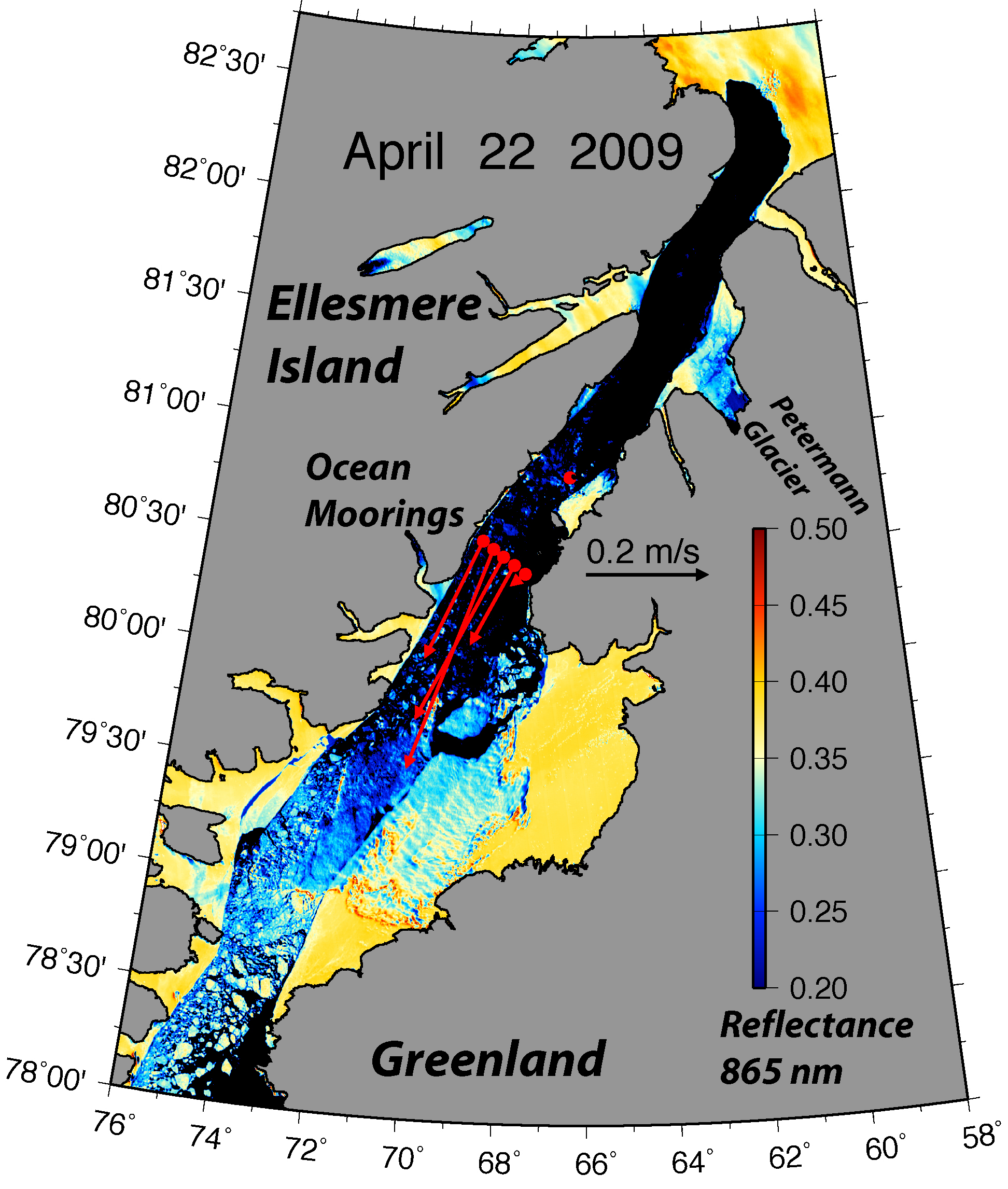
We’re heading up north to pick up instruments that have recorded current velocities, salinity, temperature, and ice thickness in Nares Strait since 2009. I’ve been working all summer on data retrieved on a similar cruise three years ago, focusing on what effects the ice arches have on currents north of the ice arches.

Nares Strait MODIS satellite imagery of the study area and ice arch April 21, 2008. Red dots are instrument locations. Arrows show current velocities.

Nares Strait MODIS satellite imagery of the study area and ice arch April 22, 2009. Red dots are instrument locations. Arrows show current velocities. Note the lack of the southern ice arch, but the presence of one north of the study area.

Continue reading

Oceanography of Petermann Fjord and Glacier Melting

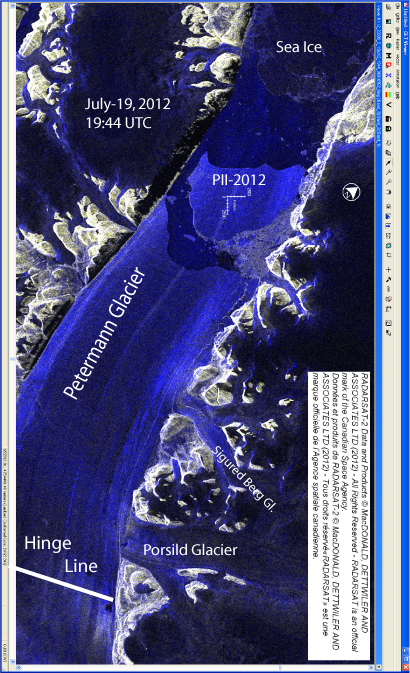
Trudy Wohlleben just send a group of scientists in Denmark, England, Canada, and the US the latest RADARSAT image of the ice island that formed in Petermann Glacier earlier this week.

RadarSat Image of Petermann Ice Island (PII-2012) and Glacier kindly provided by Trudy Wohlleben, Canadian Ice Service. The location of the hinge line is approximate only.

The current position of the remaining ice shelf of Petermann Glacier is the farthest landward since recorded observations. Dr. Croppinger was the first to provide a map of the glacier Continue reading