Petermann and Ryder Glacier Ice Island

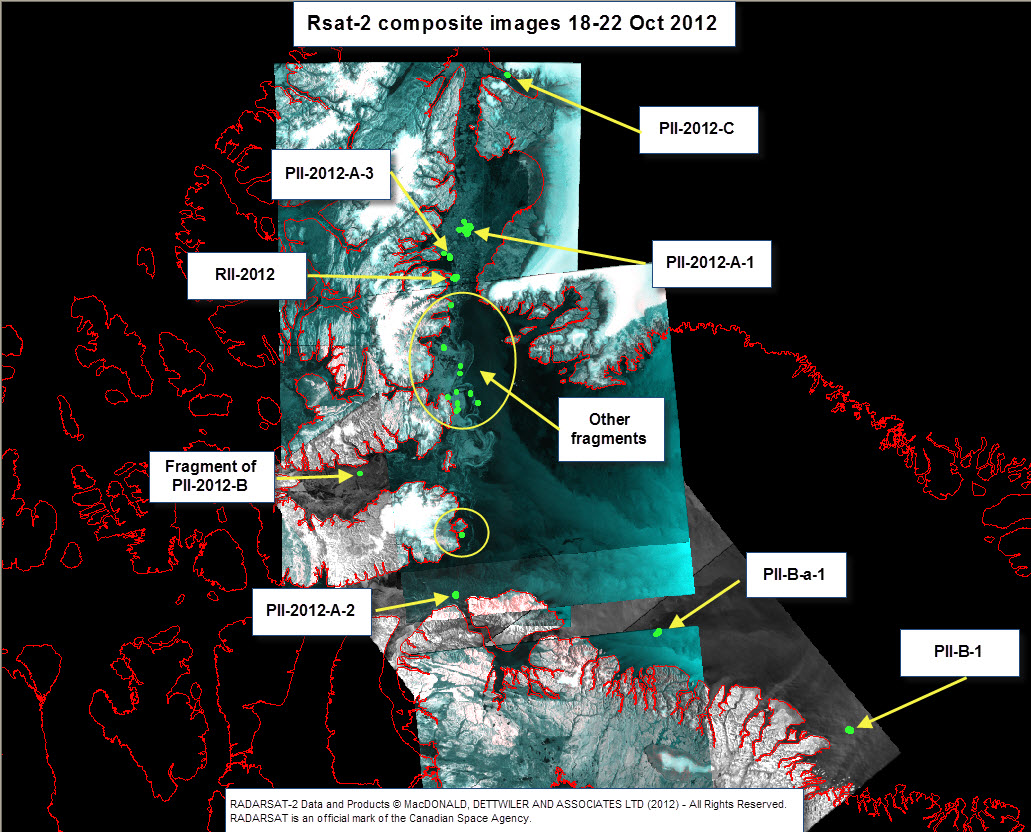
Ice island from 2010 and 2012 calvings litter Nares Strait and northern Baffin Island, Canada. All these glacier fragments originate from Petermann and Ryder Gletscher in north-west Greenland. The image below is a composite that Luc Desjardins of the Canadian Ice Service compiled from RadarSat imagery. He painstakingly identified 25 segments in these imagery.

Ice Islands and fragments from Petermann and Ryder glacier 2010 and 2012 calvings. [Credit: Luc Desjardings, Canadian Ice Service]

The largest piece is PII-2012-A1 and it covers an area a little less than 2 Manhattans (100 km^2). We see it in Kane Basin for several weeks now as it pivots back and forth with the tides around the point where it is stuck to the bottom of the ocean. The second largest piece is RII-2012 roughly half the size of Manhattan (33 km^2) and it originates from Ryder Gletscher which is to the north by north-east of Petermann Gletscher. Trudy Wohleben identified this piece when it was entered Nares Strait from the north about 4 weeks ago and together we traced it back to Ryder Gletscher where it had lingered for several years. RII-2012 is now moving rapidly south and is about exit Nares Strait to enter Baffin Bay:

Two of these ice island send their position several time each day with the data made available at for PII-2010-B-a (9 km^2) and for PII-2012-A2 (13 km^2). The last piece broke off from Petermann on July 16, 2012 and it entered Nares Strait in August when we passed it during our explorations of Petermann Fjord on Aug. 10/11, 2012 aboard the CCGS Henry Larsen:

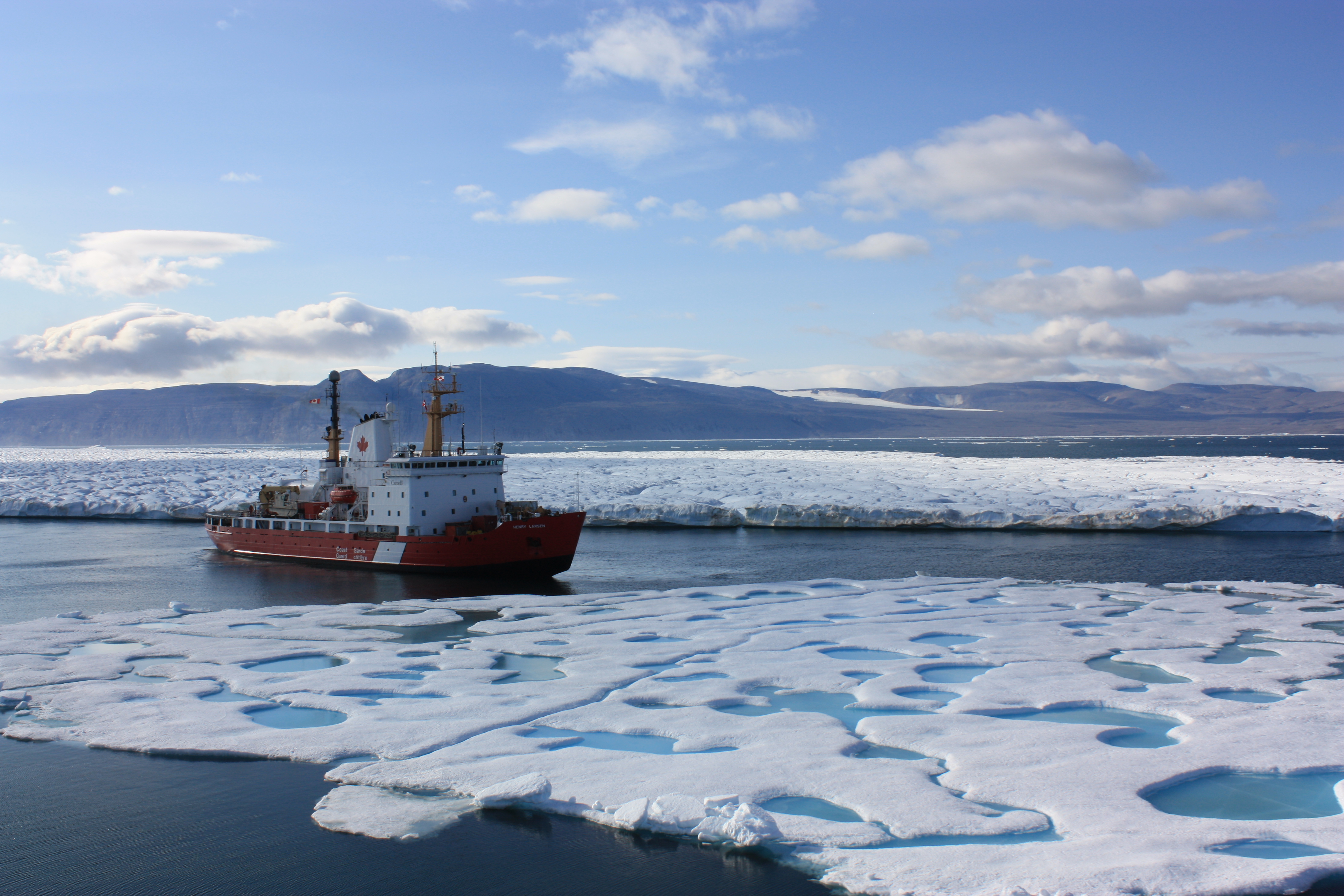
Canadian Coast Guard Ship Henry Larsen at the entrance to Petermann Fjord on Aug.-10, 2012. The ice island PII-2012 is in the background with puddles on sea ice in the foreground. Polaris Bay, Greenland is in the far back. [Photo Credit: CCGS Henry Larsen and Jo Poole.]

Science Writing: George Orwell and Richard Garvine

How to write, read, and review as part of large science teams when millions of dollars are at stake? Writing and reviewing science projects for the National Aeronautical and Space Agency and the National Science Foundation, I came up with a list of 6 loose rules that make for good science proposal writing:

1. Think about your audience, as the message is conveyed best, if the reading is fun;
2. Avoid technical detail, cite the peer-reviewed paper instead;
3. Present and explain the big picture concisely and accurately in engaging ways;
4. Less is more. Focus on the why, not the how;
5. Avoid shady ambiguity, convoluted arguments, and incomplete explanations;
6. If it can’t be said simply, don’t say it.

This list then reminded me of a short essay that George Orwell wrote in 1946 titled “Politics and the English Language.” It concludes with these 6 rules:

(i) Never use a metaphor, simile, or other figure of speech which you are used to seeing in print.
(ii) Never use a long word where a short one will do.
(iii) If it is possible to cut a word out, always cut it out.
(iv) Never use the passive where you can use the active.
(v) Never use a foreign phrase, a scientific word, or a jargon word if you can think of an everyday English equivalent.
(vi) Break any of these rules sooner than say anything outright barbarous.

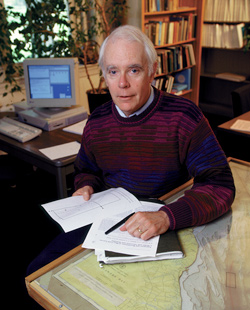
I read the essay in the spring of 1989 when I spent much time at sea with Richard Garvine. Rich was my PhD advisor and he probably suggested this essay to me, his German graduate student with poor writing skills. Rich taught me both science and writing. I miss him.

Richard Garvine in his office at the University of Delaware in the 1990ies.

Petermann Glacier Shape and Melt Channels

Radars, lasers, and fancy computers all shape the way we see the shape of glaciers. An airplane flies along a line down the glacier with (1) a good GPS. It carries (2) a vertical laser that measures the distance from the plane to the surface below while (3) an ice-penetrating radar measures where the ice meets the ocean. All these data are distributed freely by the University of Kansas’ Center for Remote Sensing of Ice Sheets (CReSIS) that is part of NASA’s Operation IceBridge.

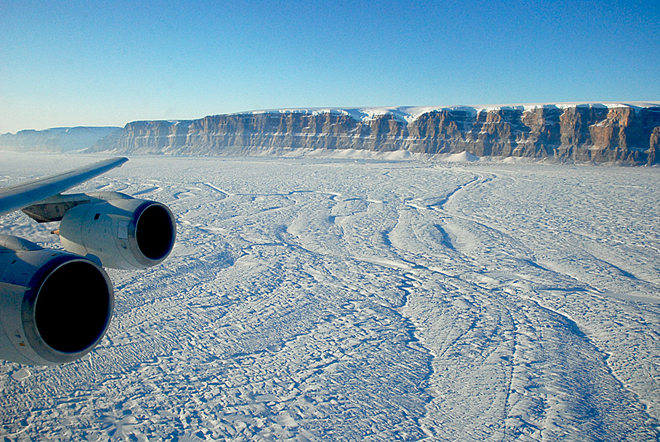
March-24, 2010 view of Petermann Glacier from NASA’s DC-8 aircraft. Photo credit goes to Michael Studinger of NASA’s IceBridge program who also blogged about this flight.

From CReSIS I gathered the data from Petermann Glacier before its break-up in 2010 and 2012. I show two flight tracks on a MODIS map for the same day that NASA’s DC-8 was collecting the shape data. There are two tracks as the airplane flies along the fjord out towards the ocean, turns, and flies back up inland. The seaward (red) track is slightly offset from the landward (black) track.

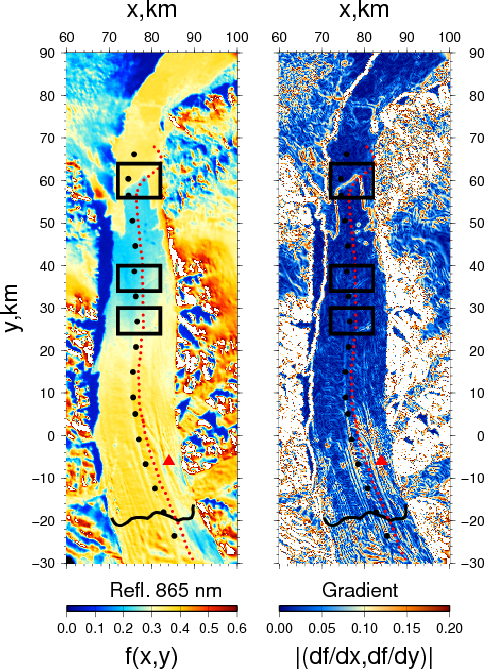
Petermann Glacier on March 24, 2010 from MODIS. The left panel shows the reflectance while the right panel shows the magnitude of the spatial gradient of this signal. Red and black dots are the flight tracks from which the shape of the glacier was measured by radar flown on a DC-8. The dark black line indicates where the glacier is grounded to bed rock ~500 meters below sea-level. The 3 boxes indicate location where the floating ice shelf terminated before 2010 (top box), after 2010 (middle box), and now (bottom box) due to the 2010 and 2012 ice islands. Top left are clouds, mountain shadows on left also.

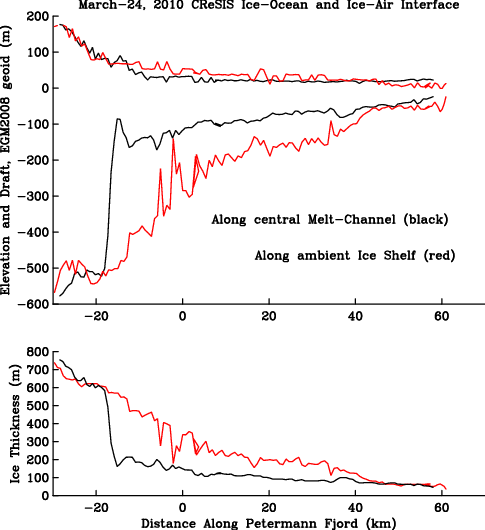
The laser gives us the top surface of the ice while the radar gives us the bottom surface. Connect these two and we get ice thickness. Below I show how these ice elevations change along the glacier. The ocean is to the right near 65 km while the grounding line of the glacier is near -20 km, so the part of the glacier that is floating on the ocean was about 80 km in 2010, that’s about 50 miles. Now why is the red shape so different from the black line?

Shape of Petermann Glacier’s floating ice shelf on March 24, 2010 (top panel) and ice thickness (bottom panel). Radar data from University of Kansas, Center for Remote Sensing of Ice Sheets (CReSIS) with EGM2008 geoid corrections applied by me.

Well, the two tracks were NOT the same and these data show that the glacier varies in thickness and shape at small scales. The floating ice-sheet has lots of topography. It has hills, valleys, channels, and troughs. It stuns me to see how long and how steep this one specific channel is: it changes by almost 200 meters in 2 km. That’s huge. We do not fully understand how these channels form, why they are there, if they change over time, or perhaps most importantly, how do they relate to the stability of this or other glaciers. A first theoreticial PhD thesis was recently submitted by Carl Gladish. It is thought-provoking, but it does not settle the issue. We do not even know how many such channels there are, but there are ideas on how to perhaps do this with data both in hand and more to be collected.

Simplifying future analyses, I changed my Petermann MODIS and CReSIS co-ordinate system from latitude and longitude to a distance in kilometers along and across the glacier. The standard MODIS “color” (lets call this f) varies as one walks the glacier in its along-stream (call this x) and across-stream (call this y) directions. The color f is a function of x and y which scientists write as f=f(x,y). Now compare this color f(x,y) with the SPATIAL CHANGE (call this the slopes) of color that I show in the right panel. The MODIS data are the same, but why do they look so different in the two panels?

Well, the slopes draw the eye to smaller scale features in the right panel. This technique sharpens edges, fronts, and small spatial irregularities that our eyes tend to skip over. Our brains are trained to integrate and to condense information looking for the largest patterns first. So, taking the difference between adjacent values to get slopes and shapes, I do exactly the opposite and make sure that small irregularities stand out:

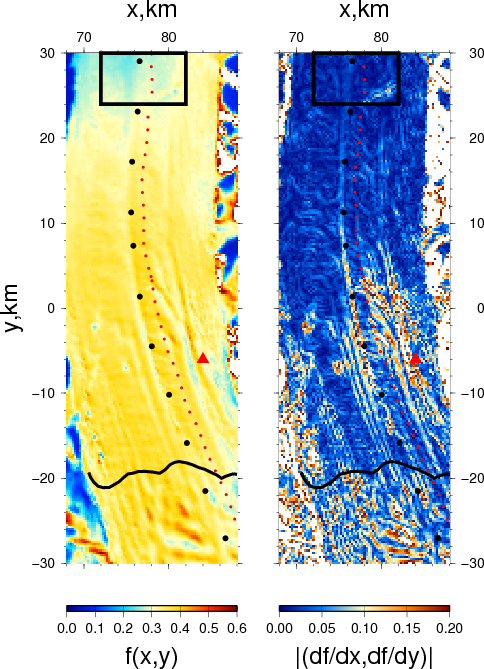
Close-up of March 24, 2010 MODIS image from the grounding line (black line at bottom) to the location of the present seaward front of the glacier (black box at top).

Notice the many stripes along the glacier near the bottom (x=0) right (y=80) near where the red triangle is. I believe these structures relate to sub-surface melt-channels of intense ice-ocean interactions, but belief is not truth and as scientists we must proof our believes and truths in ways that other people can check by repeating the experiments or calculations. There is so much more fun work to do, but, sadly, there are only 24 hours to a day.

Oh, and a (British) submarine is perhaps on the way to dive under this ice-shelf to take a close look and lots of data of under-ice topography, temperature, salinity, and bottom topography, if we can get a ship and experiment to get it there. So much work to do … [to be continued]

Arctic Sea Ice Cover and Extreme Weather Explained

Addendum Sept.-24, 2012: A New Climate State, Arctic Sea Ice 2012 (video by Peter Sinclair).

I just discovered an outstanding interview that Dr. Jennifer Francis of Rutgers University gave to a non-profit community radio station out of Vancouver, British Columbia.

Jennifer Francis Interview 20120910

She connects and explains global warming, its much amplified signal in the Arctic, the extreme record minimal Arctic sea ice cover this summer, and how the warming Arctic and its disappearing sea ice impacts our weather in the northern hemisphere by slowing down the atmospheric jet stream separating polar from mid-latitude air masses. She explains all of this in non-technical language without loss of accuracy.

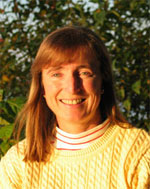
Dr. Jennifer Francis, Rutgers University [Photo Credit: ARCUS]

If this program piques your interest and you want to read more, Andrew Revkin of the New York time has led an informed discussion at his New York Times blog Dot Earth. And finally, Climate Central presented and illustrated Dr. Francis’ observations and ideas rather well with graphics and videos.

CCGS Henry Larsen: More on People, Places, and Services

The Canadian Coast Guard Ship is powered by such a diverse and talented group of women and men from Newfoundland, Labrador, and beyond, that one or even two posts here hardly do justice to describe how well they run their ship and its many facilities that many mid-sized cities do not have. Monday I wrote about the people who run the power plant and electric departments as well as the seamen who fight fires and run fishing fleet and port facilities. Today I want to show the airport and talk a little about the civil administration that oversees and manages all aboard the ship.
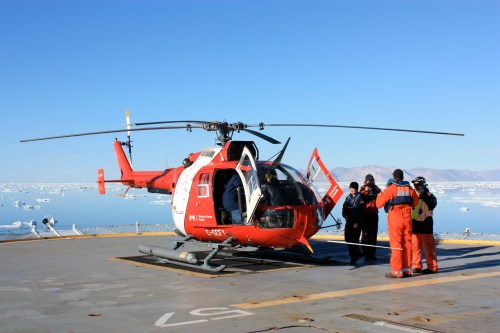
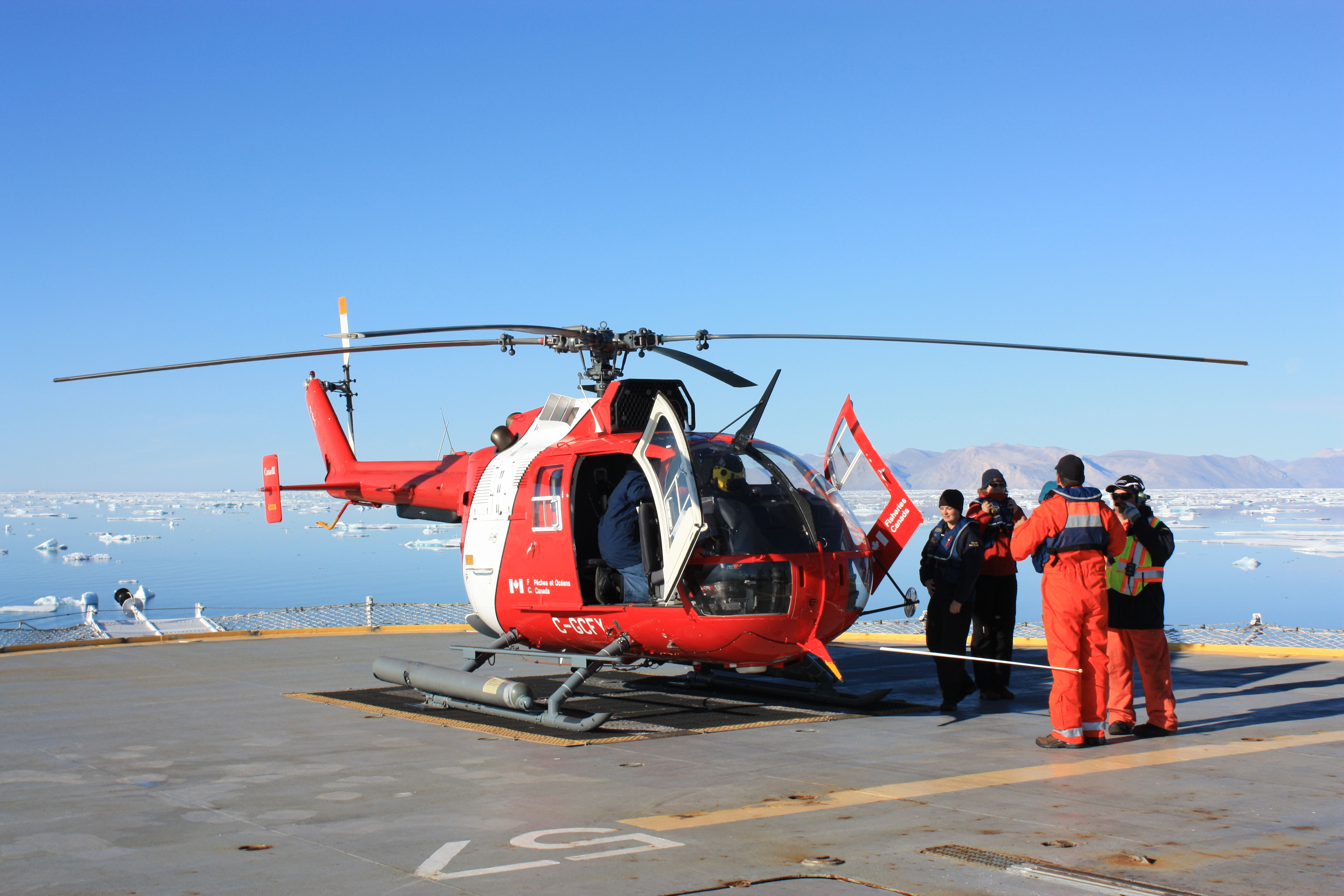
Landing deck of the CCGS Henry Larsen with aircraft preparing for take-off to survey the ice conditions ahead. Shown are Chief Officer Brian Legge (far right) who is in command of the airport and is talking to Pilot Don Dobbin (2nd from right), scientist Renske Gelderloos (3rd from right), Ice Services Specialist Erin Clarke (4th from right), and Helicopter Engineer Pierre Autran performs last checks inside the helicopter. [Photo Credit: Canadian Coast Guard Ship Henry Larsen]

The airport consists of hangar, landing pad, helicopter, traffic control, and fire fighting stations. Don Dobbin was our pilot and Pierre Autran his engineer who was pulled out of retirement for this trip. Incidentally, Pierre and I had sailed together on the same ship in 1993 more than 200 miles north of eastern Siberia. Then all flights were prohibited by Russian aviation authorities: Politics were different 20 years ago, one hopes. No such threat of being shot down existed this year between Greenland and Canada, but for severe ice conditions and poor internet connections, the airport was very busy almost every day for both ice surveys ahead and behind the ship. It also supported landing parties to set up and/or service 4 weather stations.

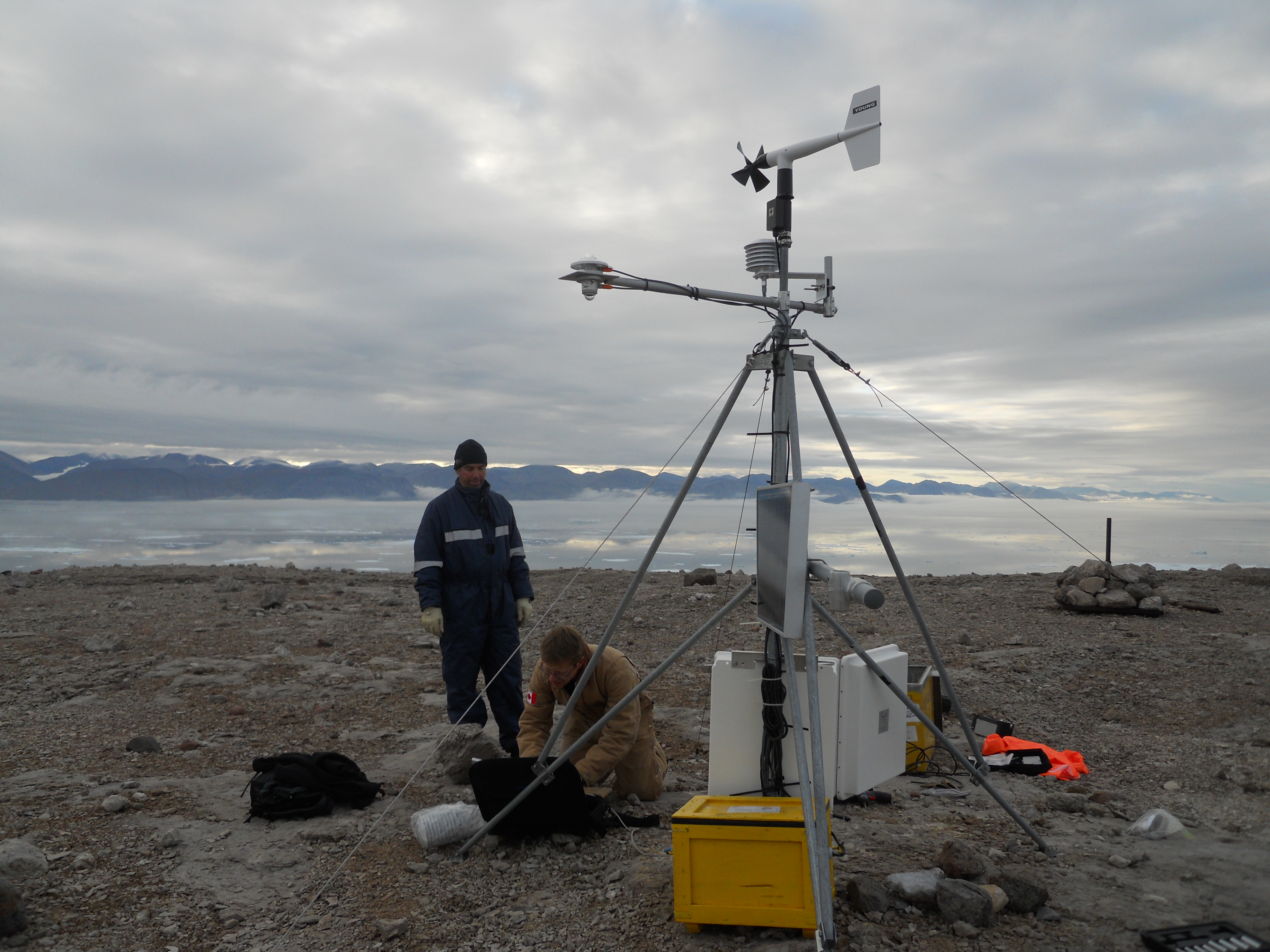
Helicopter pilot Don Dobbin with scientist Dave Riedel on Hans Island servicing a weather station in the center of Nares Strait. Ellesmere Island in the background. [Photo Credit: Allison Einolf, Minnesota]

The air traffic control takes place both on the flight deck where Chief Officer Brian Legge is in charge and from the bridge where the officer-of-the-deck is in overall command as either First Officer Chris Steward or Second Officer Rebecca Acton-Bond place the ship, alert the entire ship, and often oversee other science operations as well. All of these are demanding jobs, all these jobs need precision in the concise communication of orders and permissions granted or denied as well as execution of all operations, because helicopter operations are probably one of the most dangerous and critical operations possible on the ship.

Attention to detail, clear communication, and calm execution lower the risk of death and destruction that helicopters can and often do cause. The National Science Foundation sent me to a 4-day course in helicopter safety and what to do if accidents happen over water or on land. It was a sobering course. For this reason, perhaps, Captain Wayne Duffett is almost always on the deck during flight operations, but as all good chief executives, he lets his officers and navigators run the operations but is available for help on consultation should it be needed.
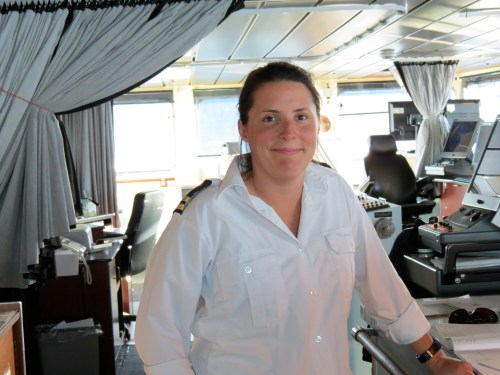
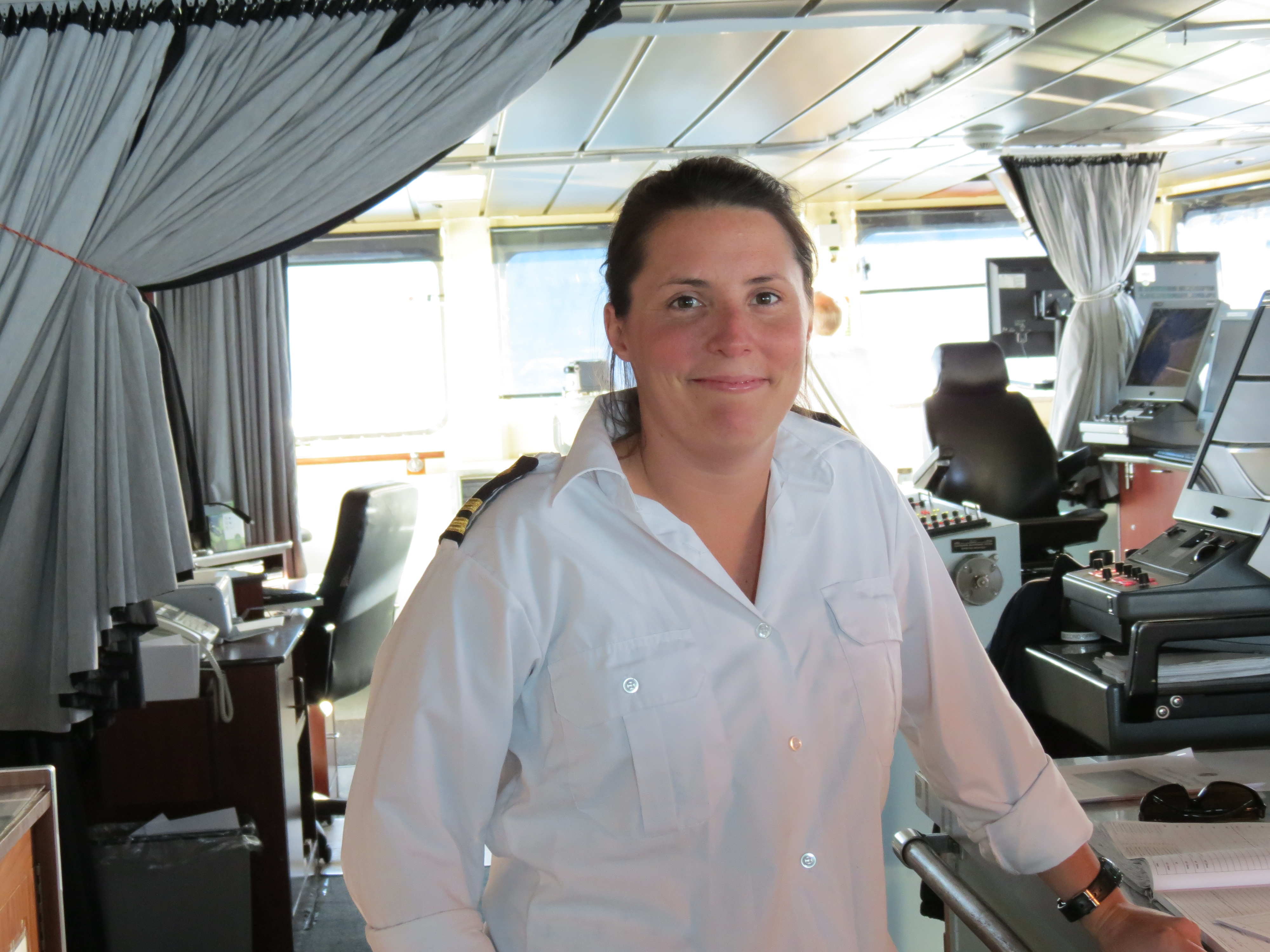
Second Officer and navigator Rebecca Acton-Bond on a sunday on the bridge of the CCGS Henry Larsen in August of 2012 in Nares Strait. [Photo Credit: Canadian Coast Guard, Kirk McNeil, Labrador]
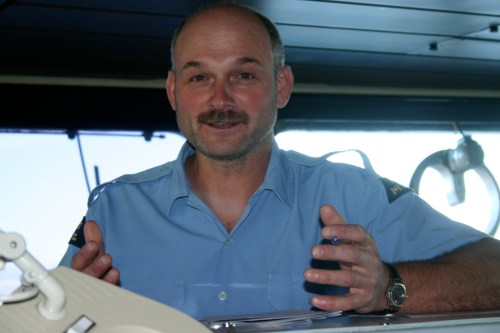
Leading Seaman and helmsman Melvin Cobb on the bridge. [Photo Credit: Canadian Coast Guard Ship Henry Larsen]

The navigator always works with a helmsman or quartermaster who steers the ship following instructions of the officer of the deck, they are on the look-out for ice and bergs to find the best routes. “Best” here refers to the route that requires the least amount of ice breaking. So, if there is one thing that icebreakers like the Larsen are really good at, it is how to avoid ice, because it is a violent and high-energy activity. Fuel is not cheap and less ice is broken, the faster and more efficient the tasks at hand can be accomplished.

And as all people on the ship, everyone has more than one job and this includes the helmsmen and quartermasters like Melvin Cobb or firefighters like Derick Stone, Carl Rose, Paul Gillingham, and Rueben Hillier. They are often members of the deck crew that help landing parties to get ashore and stay save while ashore. This involves the zodiac as well as guns to protect from polar bears:
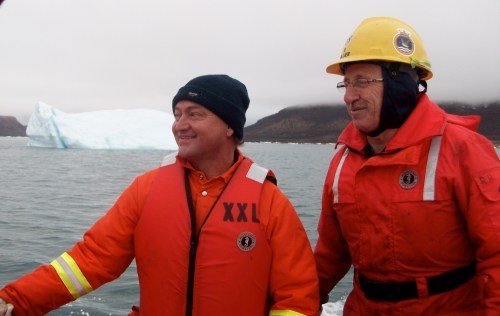
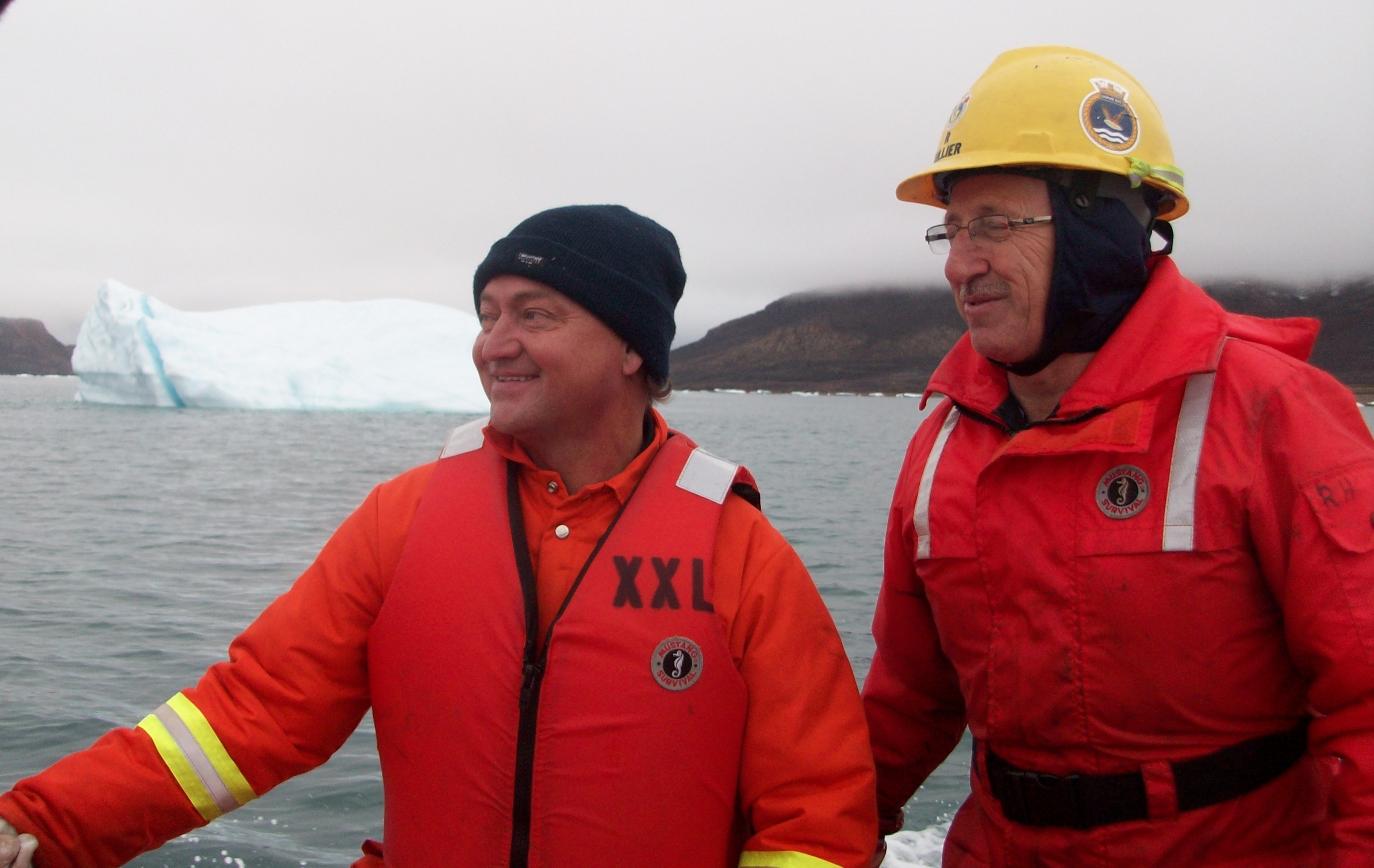
Seamen Paul Gillingham and Rueben Hillier in the zodiac steered by Chief Officer Brian Legge in Alexandra Fjord, Ellesmere Island on Aug.-13, 2012. A tide gauge was recovered and re-deployed near this site. [Photo Credit: Canadian Coast Ship Henry Larsen, Barbara O’Connell]
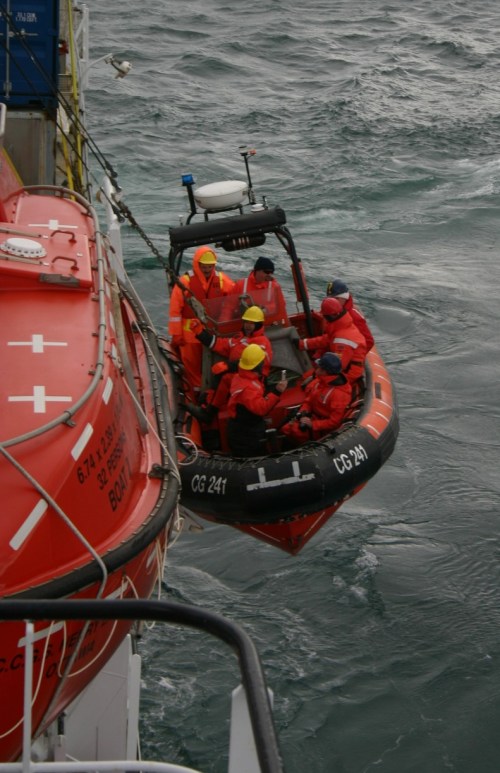
Zodiac launched for a landing part to dismantle a weather station at Cape Baird, Ellesmere Island. Chief Officer Brian Legge at the helm with Melvin Cobb and Derick Stone in the back and center left of the boat filled with scientists Humfrey Melling, David Riedel, Andreas Muenchow, and Renske Geldeloos. [Photo Credit: Canadian Coast Guard Ship Henry Larsen]

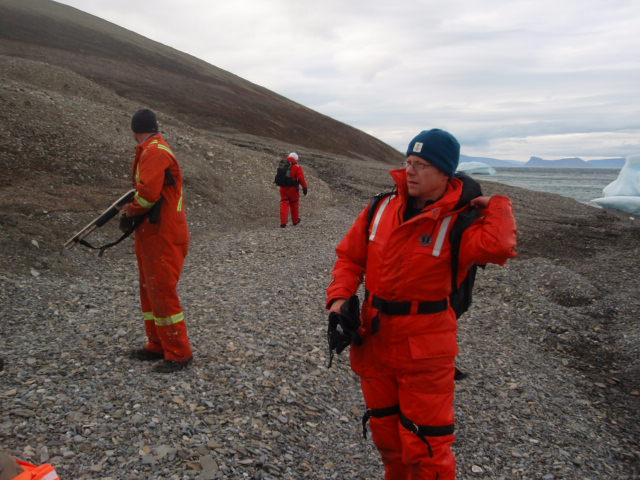
Landing party at Cape Baird, Ellesmere Island to dismantle a weather station. Scientists David Riedel (foreground) and Humfrey Melling (background) are protected by Melvin Cobb (with gun) from polar bears. View is towards the north-west across Lady Franklin Bay to the west of Nares Strait. [Photo Credit: Renske Gelderloos, Oxford University]

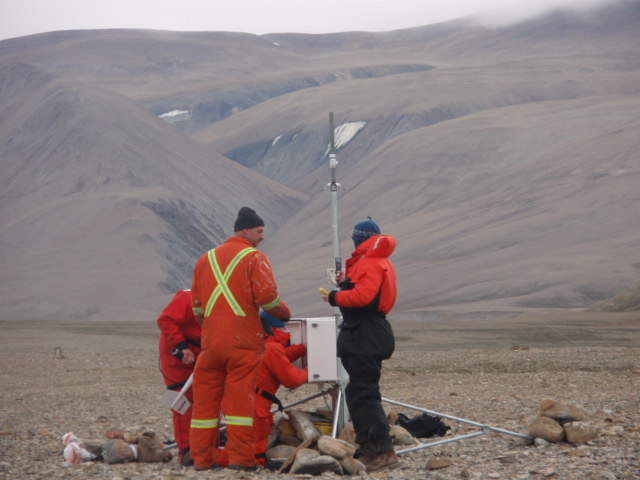
Taking down a weather station on Cape Baird, Ellesmere Island, view is to the south-west. People from right to left, the author, David Riedel (kneeling), Melvin Cobb, and Humfrey Melling (covered). [Photo Credit: Renske Gelderloos, Oxford University]
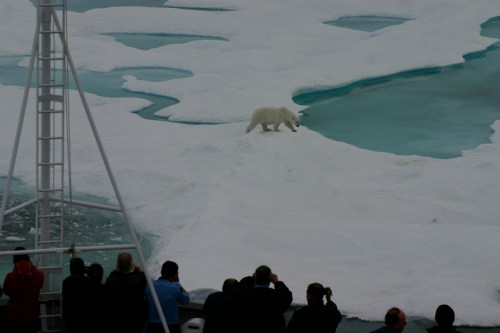
Polar bear on an ice floe in Kennedy Channel as seen from the bridge as the ship was approaching a station a day’s polar bear walk from Cape Baird. [Photo Credit: Canadian Coast Guard Ship Henry Larsen]

There is still more to describe such as the hospital, the restaurant and bar, as well as the superior fishing of sailors and fishermen from Newfoundland to find and hook valuable items such as sensors and computers that some scientists left unattended for 3 or 5 or 9 years at the bottom of the unspoiled seas that border Arctic Greenland and Canada. There will be more … as there are more great people who make great science possible.