Category Archives: Petermann Glacier

Nares Strait 2012: First Mooring Recovered

We have received word back from the intrepid Arctic explorers of some early success.  Here is Andreas Muenchow’s latest report:
“Recovered first mooring at 80.7 N and 67.7 W. Ice profiling sonar was hit by ice 100-m below surface, light damage on guard rail, but transducers look ok. Clear skies, light winds from the south, and air temperatures of 1.9 Celsius provided optimal condition. Never before did we recover a mooring this quickly: acoustic interrogation was less than 5 minutes, another 2 minutes after release command the mooring popped up in open water 300 feet from the ship, zodiak lassoed mooring, and 20 minutes later all was aboard. It does not get better than this … attention to detail by Dr. Melling’s mooring group (Joe, Ron, Dave, and Dave) in 2009 paid off.
Petermann Ice Island edged another 1 km towards Nares Strait. I saw at least 3 much smaller segments of likely Petermann Glacier pieces yesterday, all tiny, about the size of our ship. We are now also within helicopter range of Petermann Fjord, but we have 6 more moorings to go. Good start.”
by Andreas Muenchow, Aug.-6, 2012, 12:41UTC

Nares Strait 2012: First Challenges and Petermann Ice Island Coming

Petermann Glacier’s 2012 ice island is heading south, the Canadian Coast Guard Ship Henry Larsen is heading north, and my passport went through the washer. Ticket agents at Philadelphia airport refused to accept my worn passport to get into Canada. My journey appeared at a dead-end, but ticket agents, U.S. State Department employees in downtown Philadelphia, and a Jordanian cab driver got me to Canada with a new passport, a new ticket, and a new lesson learnt in 4 hours. I did not believe it possible, but it was. I arrived in Canada with an entire day to spare.

Over the years I learnt to plan and budget generously for Arctic research, and then improvise with what is available. I was taught to bring spares of all critical equipment to prepare for loss and failure. I learnt to allow for extra time as missed planes, weather, and who knows what always make tight schedules tighter, like passports going through washers. I learnt that patience, civility, co-operations, and seeing the world through other people’s eyes and responsibilities get me farther than fighting. After I got my PhD in 1992, I learnt that the very people who cause troubles by enforcing rules and regulations are often also the most likely to know the way out of trouble. The ticket agent who denied my passport was also critical to help me get a new one. Thank you, Beth.

Our science party of eight from Delaware and British Columbia and the ship’s crew of 30-40 from Newfoundland will meet on the tarmac of St. John’s tomorrow at 4:30am, fly to and refuel at Iqaluit, Nunavut, and arrive at the U.S. Air Force Base at Thule, Greenland. The crew who got the ship from St. John’s to Thule will return with the plane home. It usually takes two days sailing north by north-west to reach Nares Strait from Thule, but this year the ice will be a challenge far greater than getting a new passport in 4 hours.
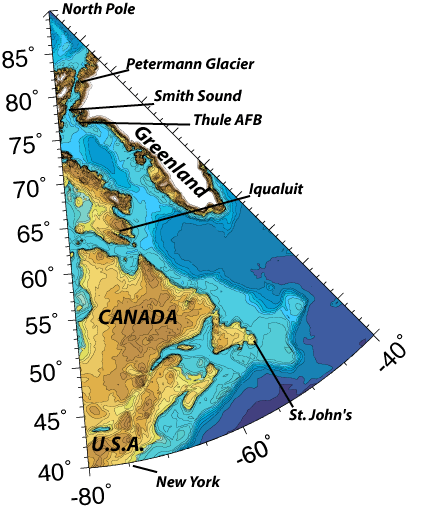
Western North-Atlantic and Arctic regions with Greenland in the west (top right) and Canada (left). Blue colors show bottom depth (light blue are shelf areas less than 200-m deep) and grey and white colors show elevations. Nares Strait is the 30-40 km wide channel to the north of Smith Sound, Baffin Bay is the body of water to the south of Thule.


The ice island PII-2012 is moving rapidly towards the outer fjord at a rate that increased from 1 km/day last week to 2 km/day over the weekend. I expect it to be out of the fjord an in Nares Strait by the weekend when we were hoping to recover the moorings with data on ocean currents, ice thickness, and ocean temperature and salinities that we deployed in 2009. The ice island is threatening us from the north: Without a break-up, it is big enough to block the channel as another large ice island did for almost 6 months in 1962.
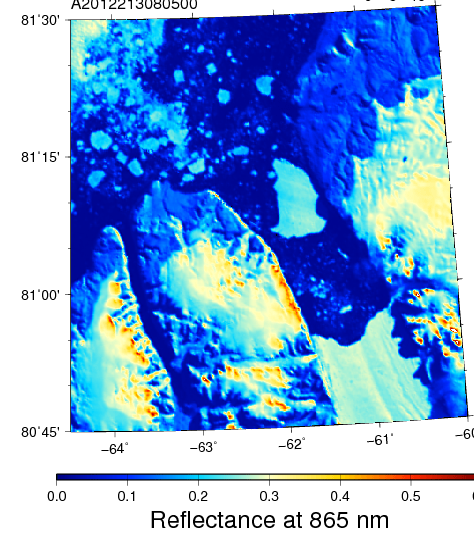
Petermann Glacier, Fjord, and Ice Island on July 31, 2012 at 08:05 UTC. Nares Strait is to the top left. Petermann Glacier, Greenland is on bottom right. PII-2012 is at the center.


At the southern entrance to Nares Strait, lots of multi-year ice is piling up near the constriction of Smith Sound. Winds and currents from the north usually flush this ice into Baffin Bay to the south, however, the same winds and currents will move the ice island out of Petermann Fjord and into Nares Strait. We will need patience, humility, and luck to get where we need to be to recover our instruments and data. A challenge that cannot be forced, we will likely wait and go with the flow rather than fight nature. We will have to play it smart. We are the only search and rescue ship for others. I am nervous, because this year looks far more difficult than did 2003, 2006, 2007, or 2009. In 2005 we were defeated by the winds, but that is a story for a different day.

The currents and winds of Nares Strait

[Editor’s Note: Undergraduate Allison Einolf of Macalester College in Minnesota summarizes her work at the University of Delaware that was supervised by Andreas Muenchow as part of an NSF-funded summer internship.]

I’m about to fly to Thule, Greenland for a research expedition into the Nares Strait. We had planed to survey Petermann Fjord, but our proposed cruise track is facing an obstacle twice the size of Manhattan.

We’re heading up north to pick up instruments that have recorded current velocities, salinity, temperature, and ice thickness in Nares Strait since 2009. I’ve been working all summer on data retrieved on a similar cruise three years ago, focusing on what effects the ice arches have on currents north of the ice arches.

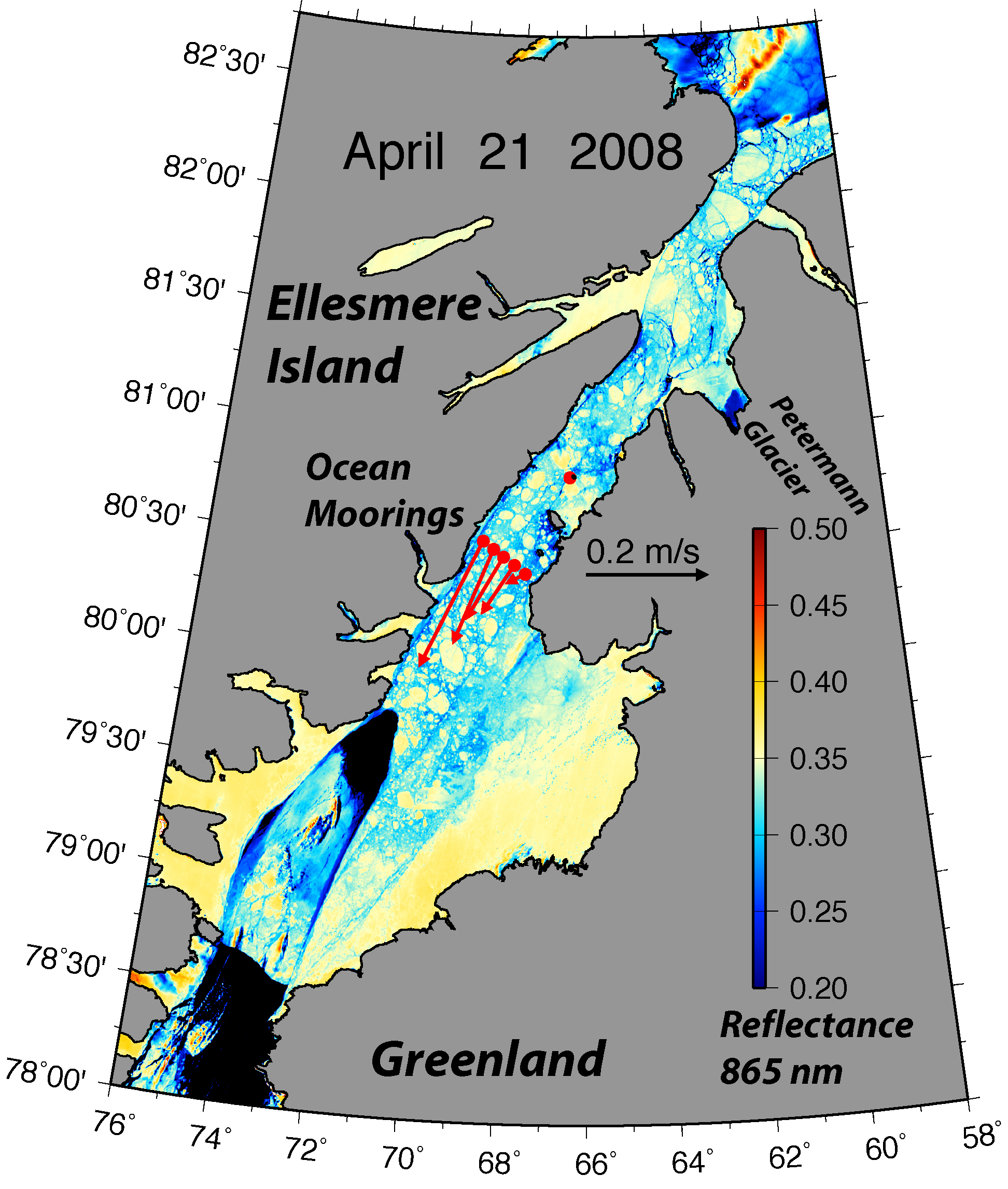
Nares Strait MODIS satellite imagery of the study area and ice arch April 21, 2008. Red dots are instrument locations. Arrows show current velocities.

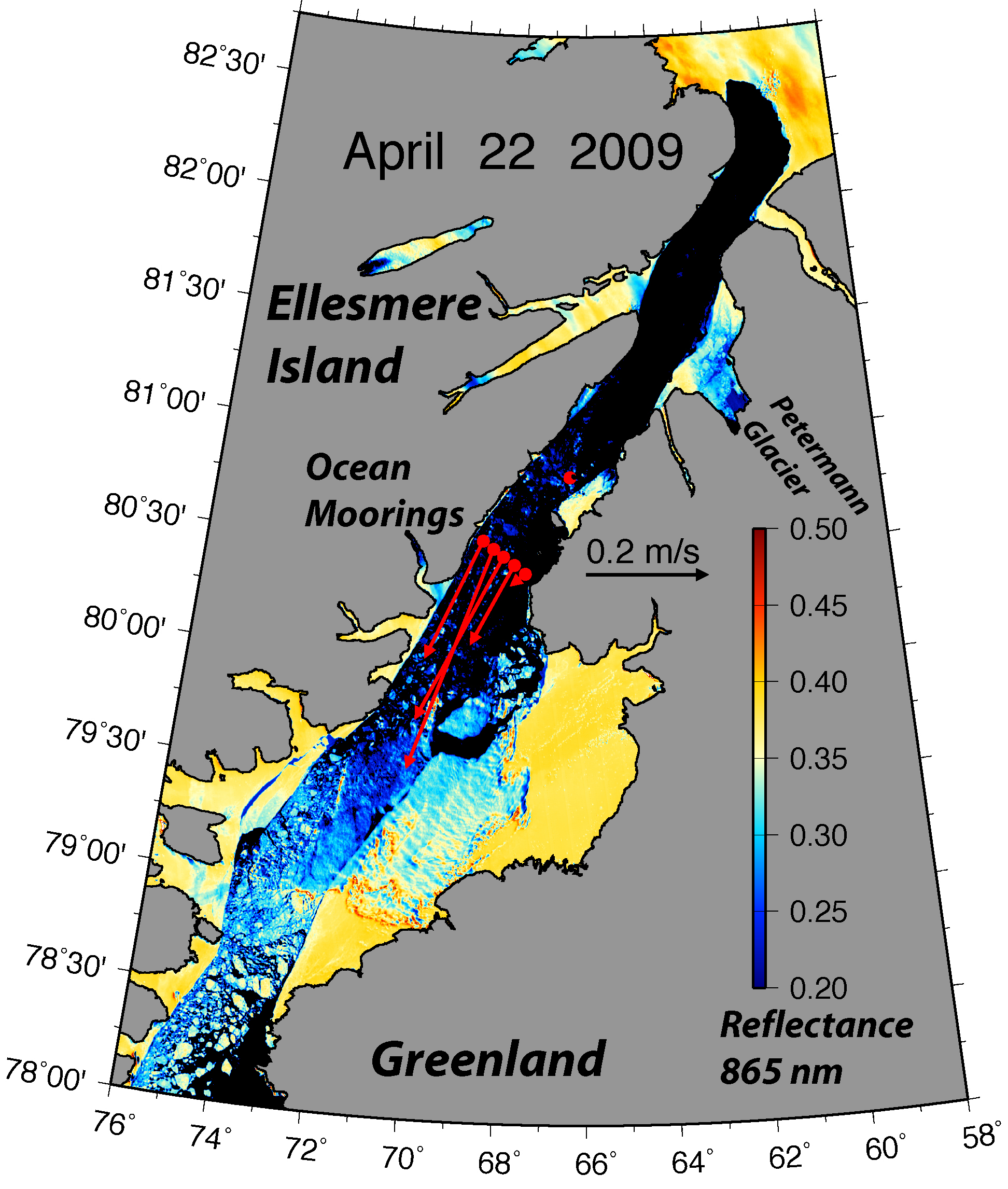
Nares Strait MODIS satellite imagery of the study area and ice arch April 22, 2009. Red dots are instrument locations. Arrows show current velocities. Note the lack of the southern ice arch, but the presence of one north of the study area.

Continue reading

Oceanography of Petermann Fjord and Glacier Melting

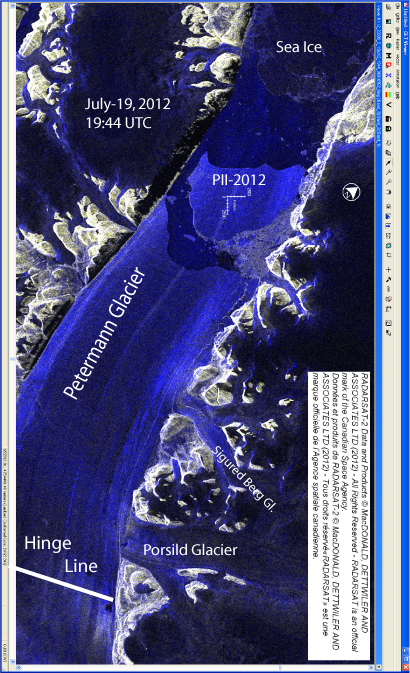
Trudy Wohlleben just send a group of scientists in Denmark, England, Canada, and the US the latest RADARSAT image of the ice island that formed in Petermann Glacier earlier this week.

RadarSat Image of Petermann Ice Island (PII-2012) and Glacier kindly provided by Trudy Wohlleben, Canadian Ice Service. The location of the hinge line is approximate only.

The current position of the remaining ice shelf of Petermann Glacier is the farthest landward since recorded observations. Dr. Croppinger was the first to provide a map of the glacier Continue reading

Manhattan and Petermann Glacier: Physical and Mental Space

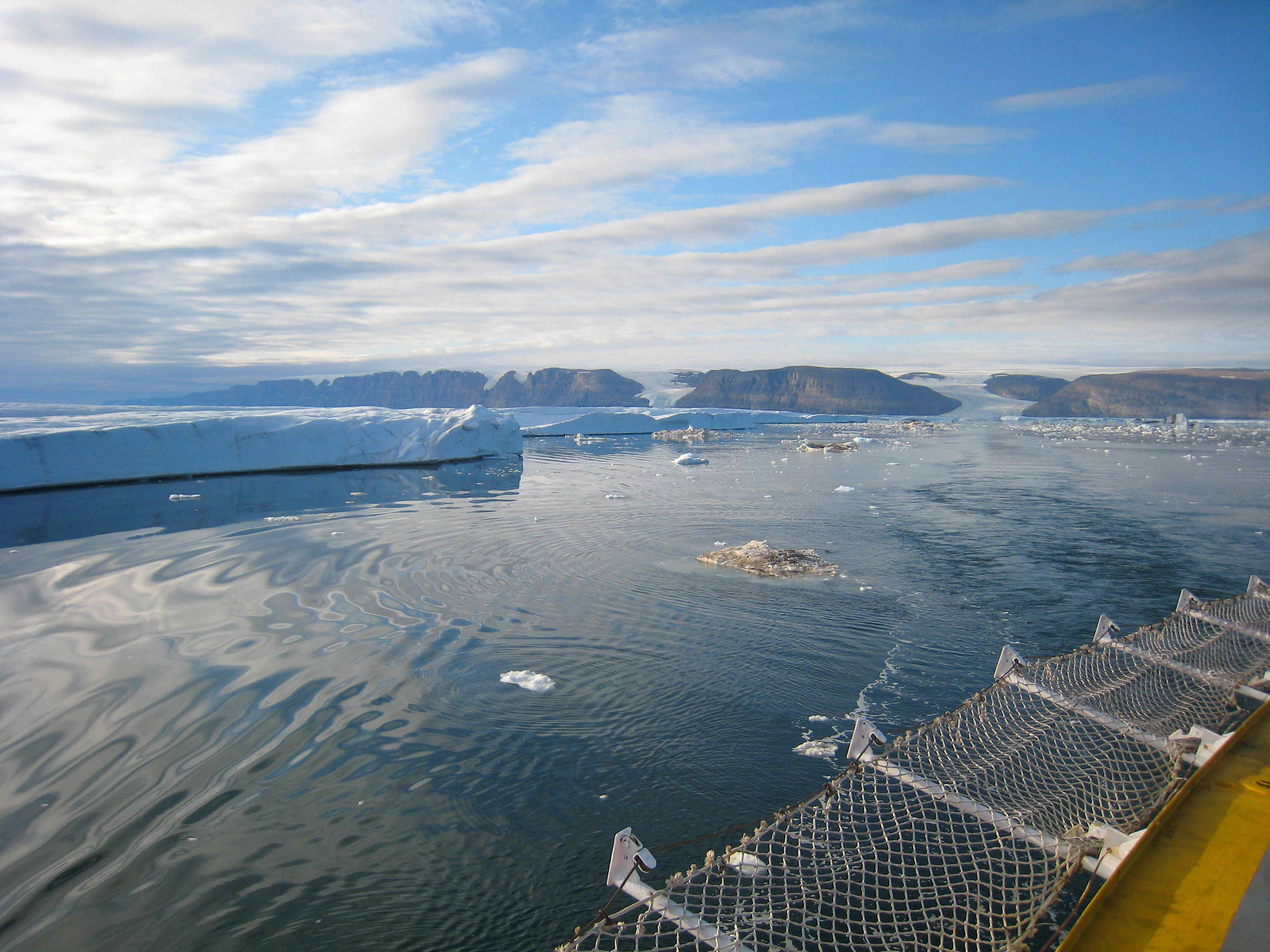
Front of Petermann Glacier 2009 from the CCGS Henry Larsen. [Photo Credit: Pete Davis, Oxford University]

Bob Collins writes with wit and eloquence at Minnesota Public Radio about Petermann Glacier and Manhattan:

Why is it always about you, New York?

This week an iceberg “twice the size of Manhattan” broke off from Greenland’s Petermann Glacier.

What else is twice the size of Manhattan? Just about everywhere else. Manhattan is tiny at only 22 square miles. Manhattan isn’t even the size of Woodbury.

You know what’s bigger than the iceberg? Minneapolis. It’s 53 square miles. But “an iceberg that would easily fit into the boundaries of Minneapolis” (and you, too, Saint Paul) doesn’t quite cut it in the drama department.

Why use Manhattan as the measure of size? Because it suggests something is huge that is not, in fact, as huge as we’re led to believe. We think of Manhattan as big because of the size of the buildings there and the number of people there. The iceberg actually would’ve fit nicely into the Bronx. But people don’t think of the Bronx as huge.

This blog, Icy Seas, compares the entire area to the number of Manhattans. But it brings up an important point that a collapsing iceberg the size of Minneapolis obscures: Most of the melting of glaciers is occurring from below.

I agree. Manhattan is tiny, I walked its streets. But do not all numbers and measures contain or evoke emotions? Drudgery is one, drama another. Stay with me for an example: the color red is a wave that is 0.000000645 meters (=645 nanometers or nm) long. What comes to mind, when I talk about reflectances at 645 nm? Nothing or just a blank stare, perhaps? But if I say “RED,” we may engage and argue. Yet 645 nm is more precise than “red,” because there are many shades of red while there are no such shades of 645 nm. Furthermore, red triggers emotions: just ask a Red Sox fan.

Manhattan is a huge place in my mind, just as Bob Collins says it is. For me it is not the height of buildings or the number of people, but it is Manhattan’s tapestry of world cultures, skin colors, styles of clothing, languages, foods, and histories made anew each day. It is all in our minds, it is a symbol. More people can relate to Manhattan better than they can relate to 58 square kilometers. Most people can relate to the color RED with its dramatic emotions, but few can relate to 645 nm with its precise physics. There is beauty in both.

Shades of red and blues … Vincent Van Gough.