Category Archives: Global Warming

Greenland Ocean Expeditions, Science, and Fun

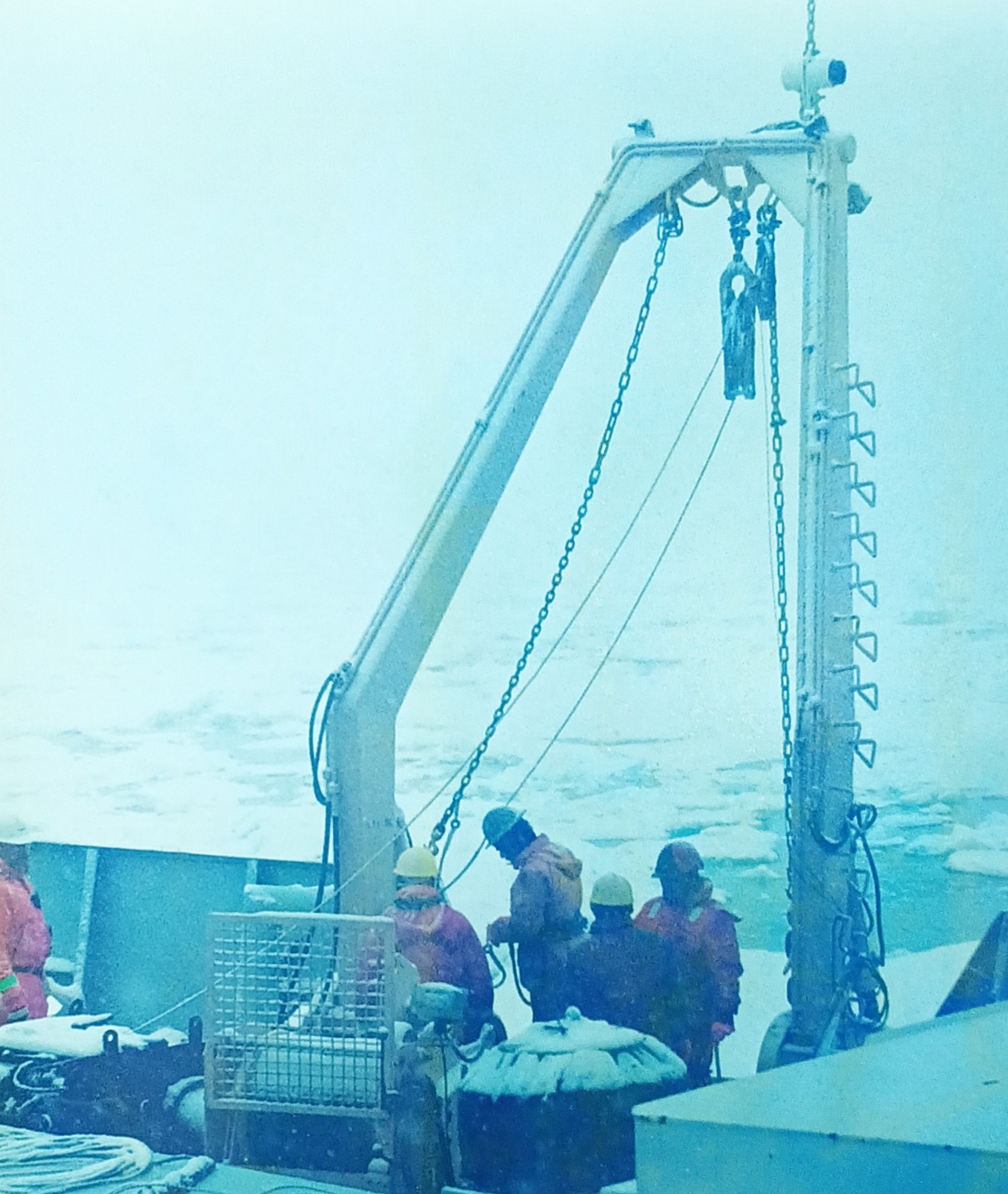
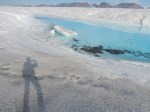
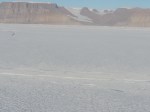
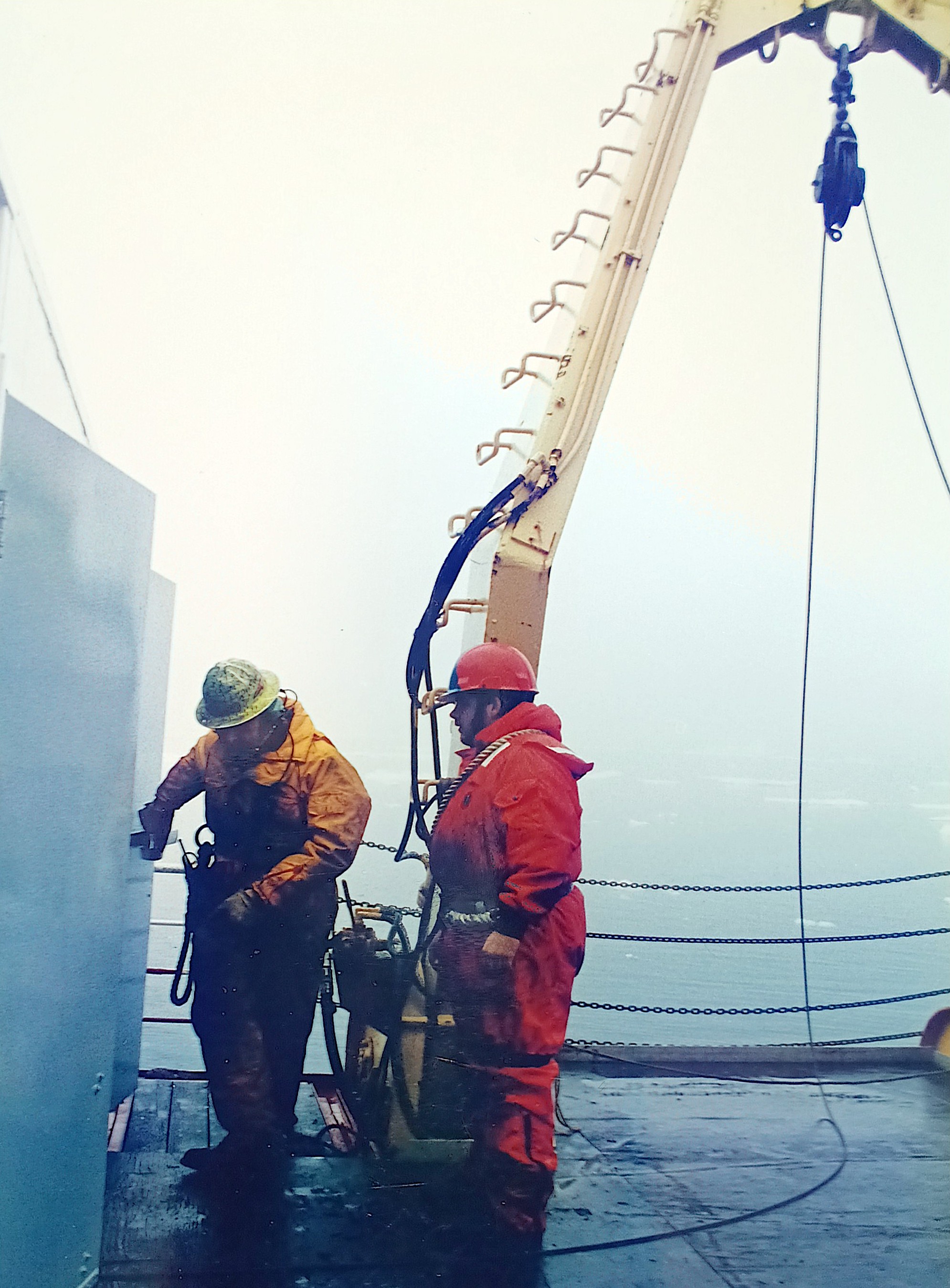
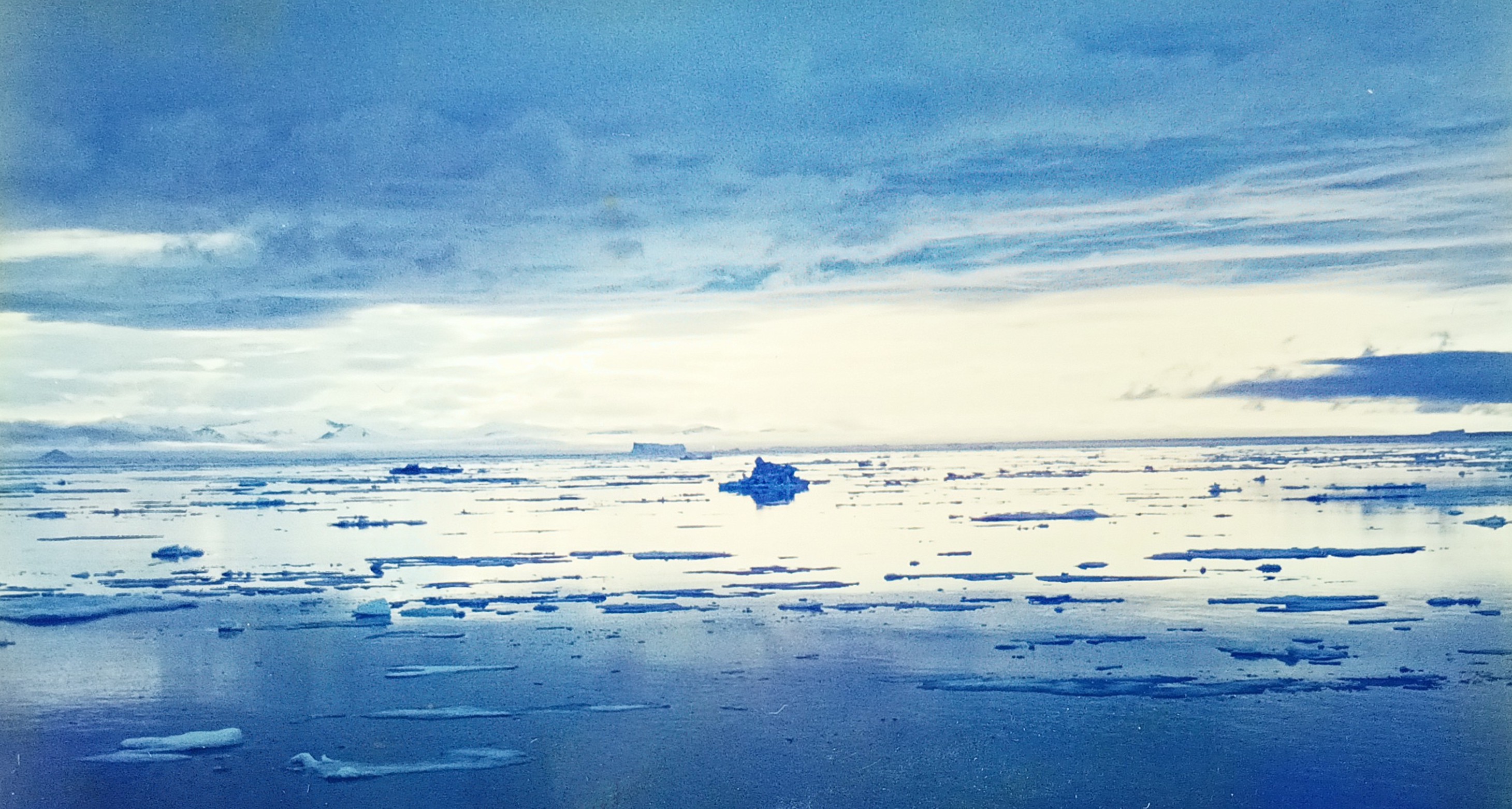
Science and Greenland both combine discovery, adventure, and diverse people. I do this work free of academic constraints, responsibilities, and pay, because I retired from my university three months ago drawing on savings that accumulated since 1992 with my first job in San Diego, California. It was there and then, that my interest in polar physics started, but my first glimpse of Greenland had to wait until 1997 when a Canadian icebreaker got me to the edge of the ice in northern Baffin Bay between Canada and Greenland. It was a cold and foggy summer day as these pre-digital photos show:
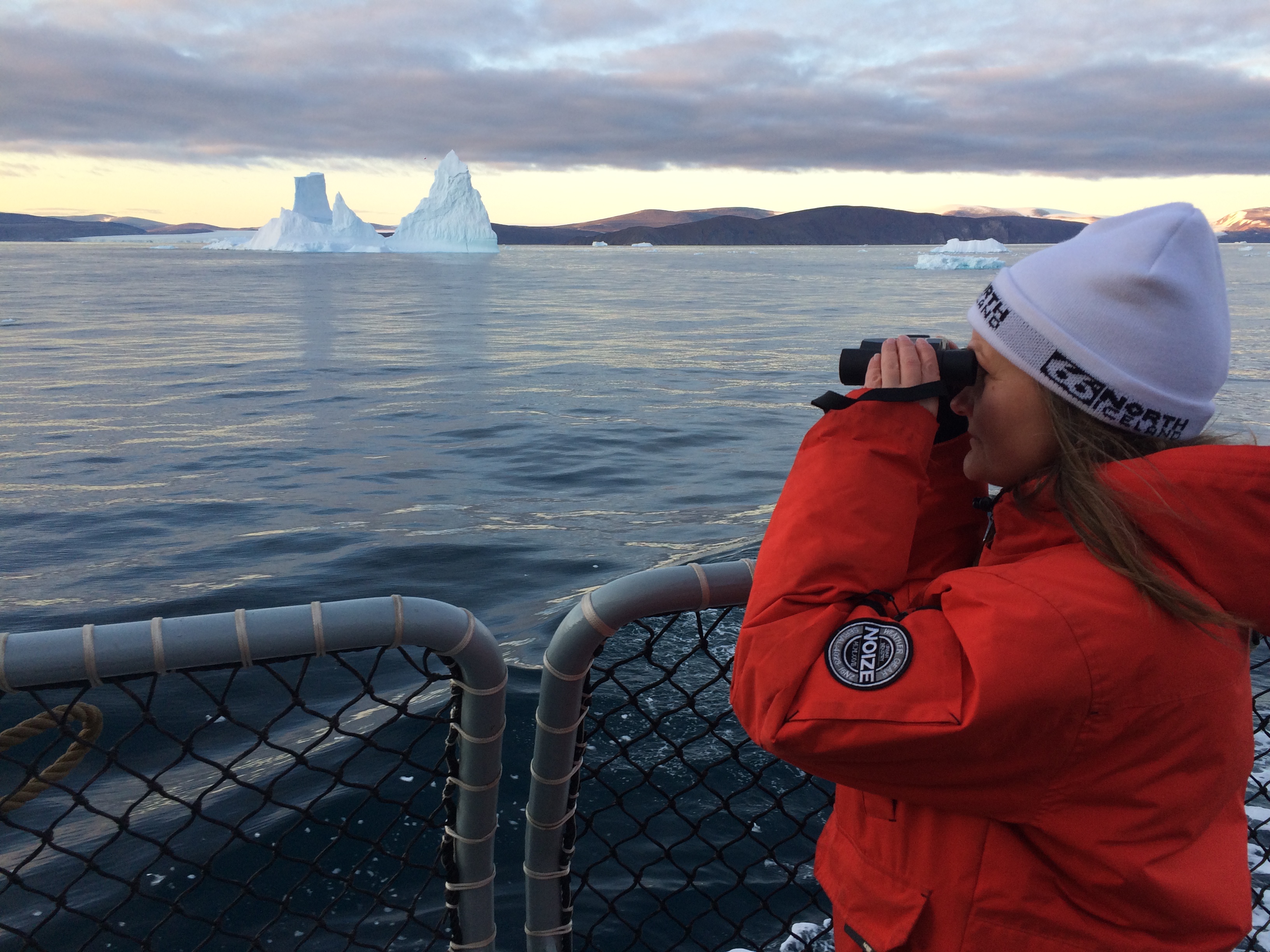
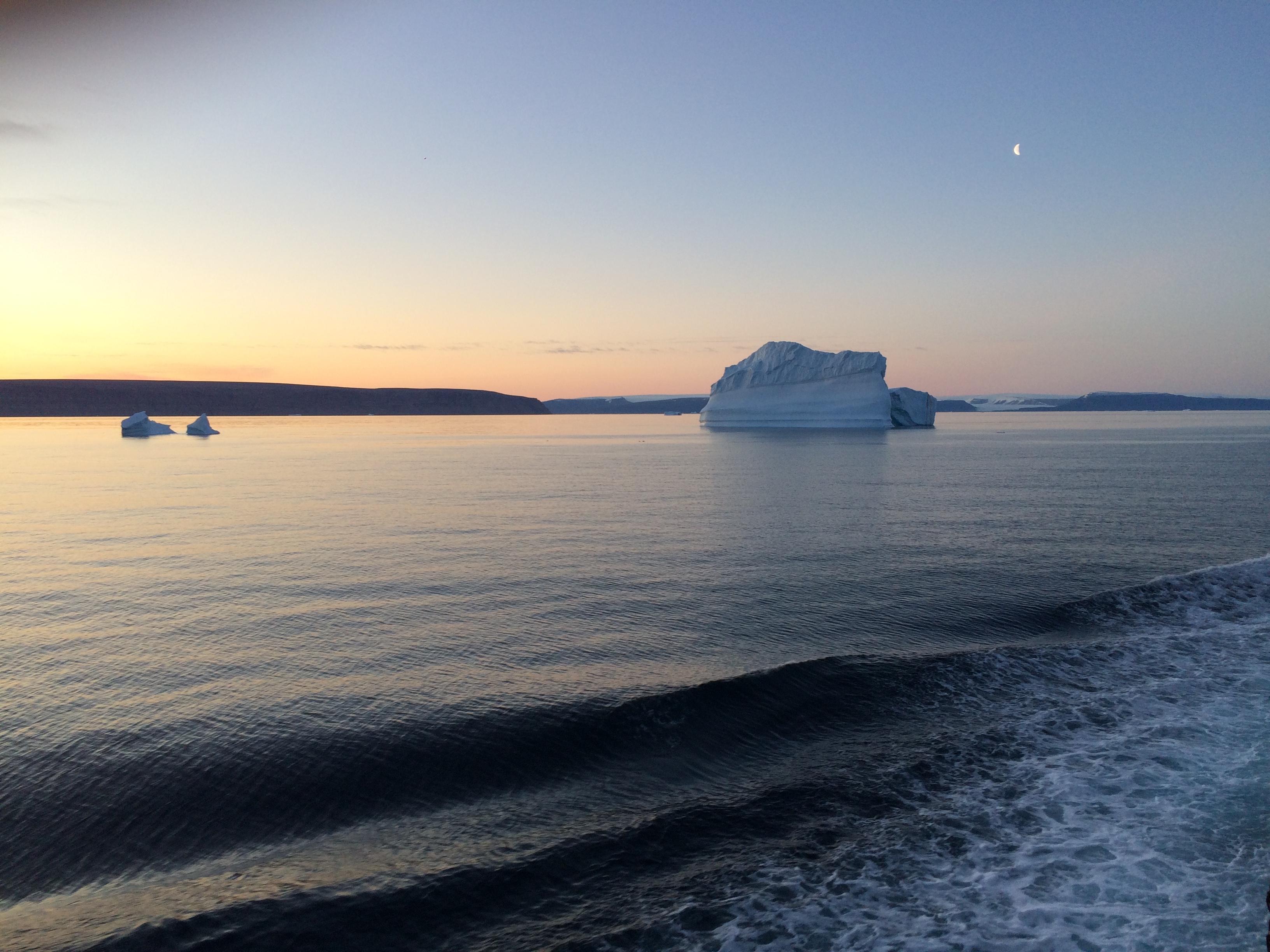
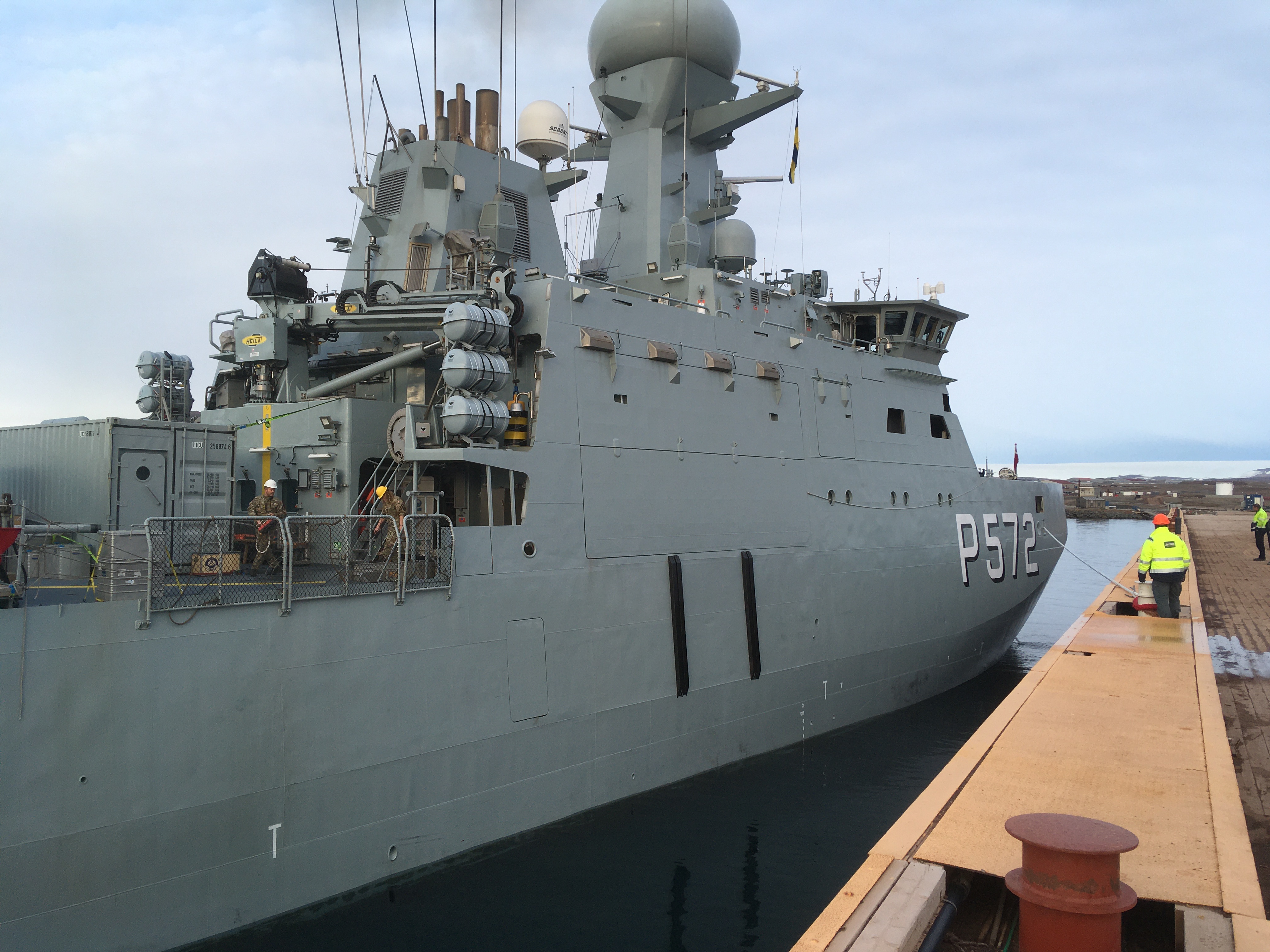
Almost 25 years later I visited the area again with Her Danish Majesty Ship HDMS Lauge Koch, a Danish Navy vessel, which surveyed the coastal waters between Disko Bay in the south and Thule Air Base (now Pituffik Space Base) in the north. Two Danish goverment agencies led this expedition: the Geological Survey of Denmark and Greenland (Dr. Sofia Ribeirio, GEUS) and the Danish Metorological Institute (Dr. Steffen Olsen, DMI). Our small team of 11 scientists and 12 soldiers surveyed the seafloor with fancy acoustics, drilled into the bottom with piston corers, fished for plankton with towed nets, and collected water properties with both electronics and bottle samples. As this was during the Covid-19 pandemic, all scientists had to be both vaccinated and tested prior to boarding the flight from Copenhagen to Greenland. We also quarantined for 3 days in Aasiaat, Greenland prior to boarding the ship.
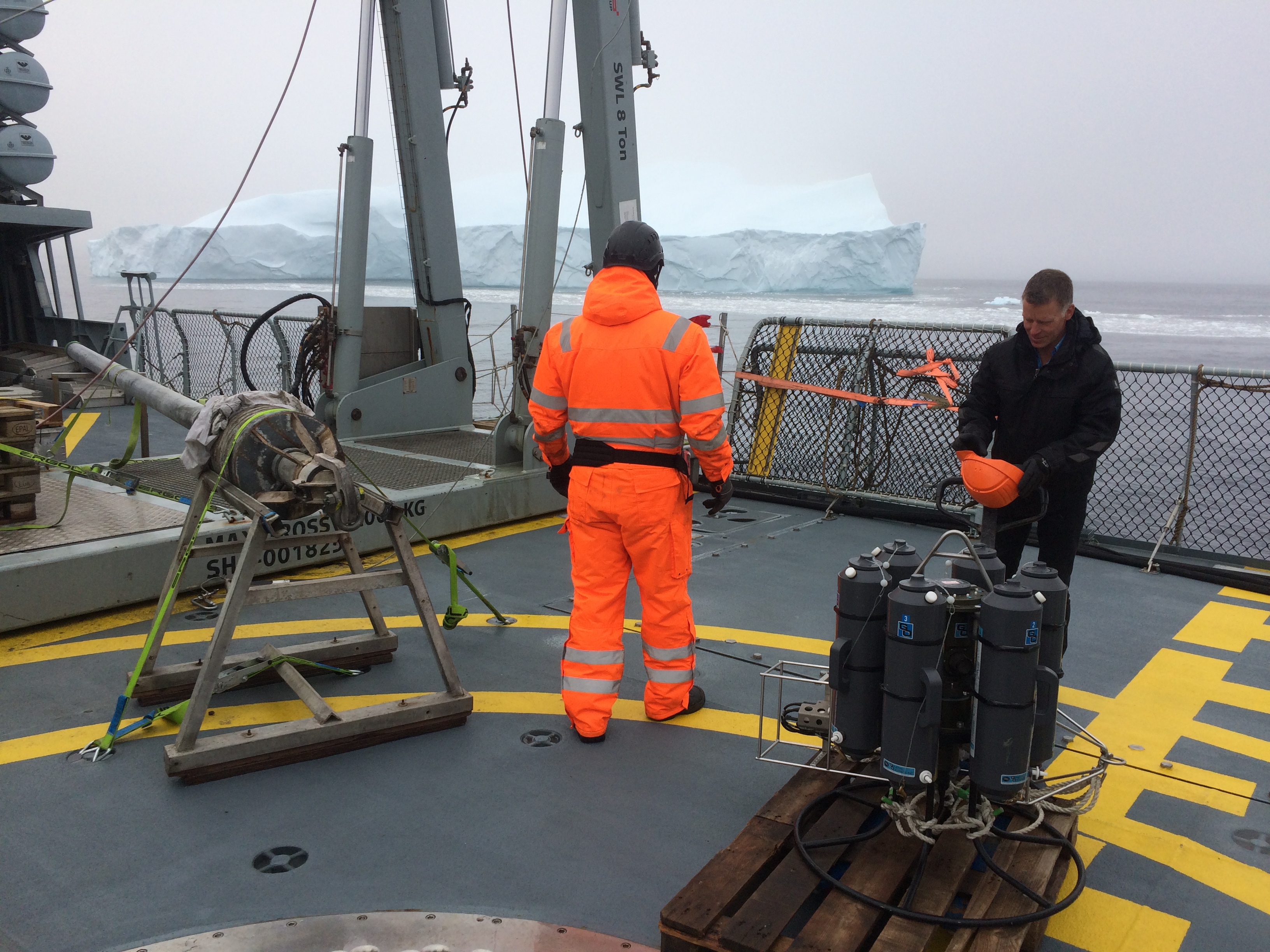
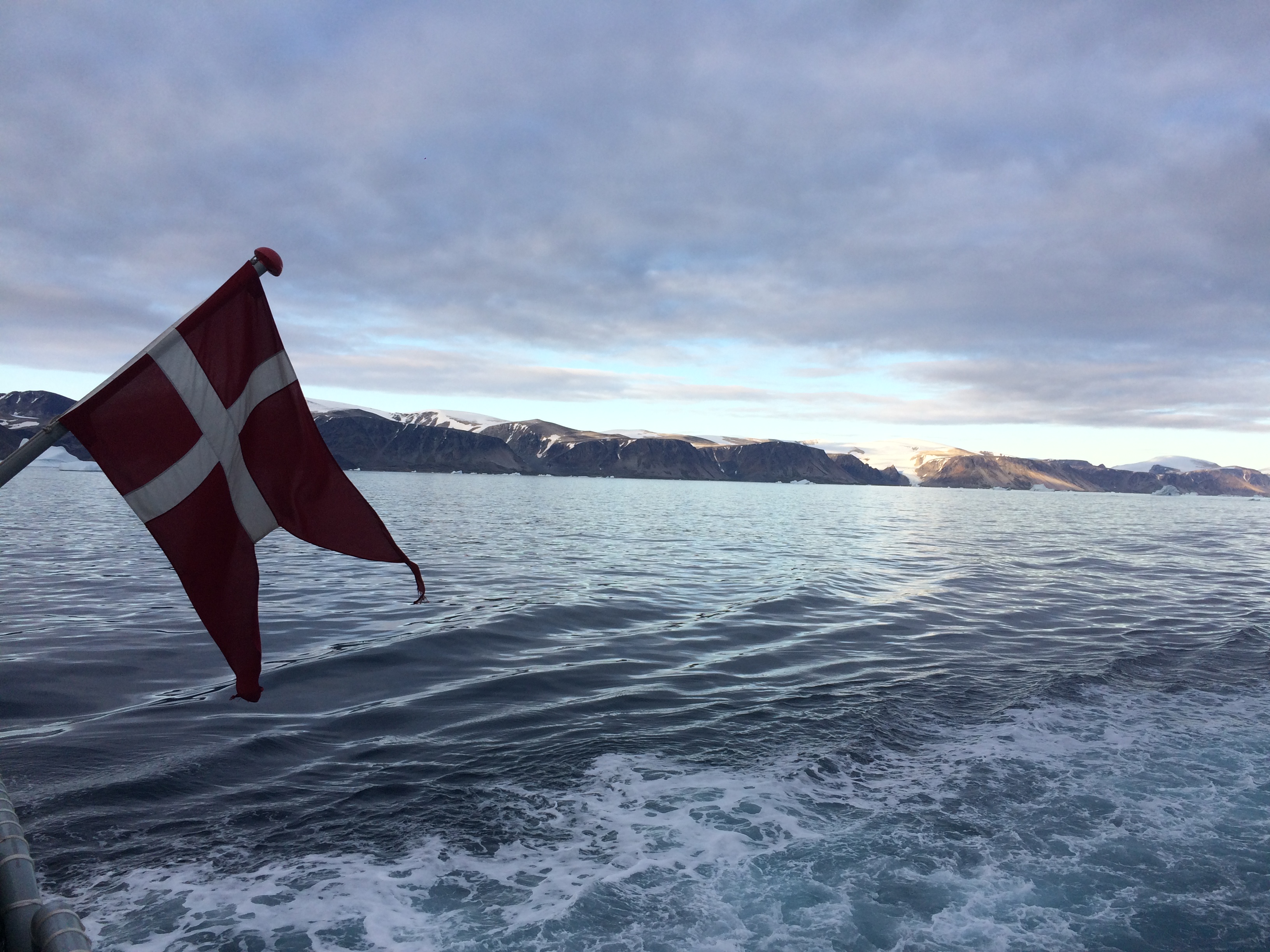
Now in retirement, I thoroughly enjoy the time to just just revisit the places and people via photos that finally get organized. More importantly, I finally feel free to explore the data fully that we collected both on 14 separate expeditions to Greenland between 1997 and 2021. For example, only in retirement did I discover that Baffin Bay was visited in 2021 by both a Canadian and an American in addition to our Danish ship. Data from these separate Baffin Bay experiments are all online and can be downloaded by anyone. I did so and processed them for my own purposes. Furthermore, NASA scientists of the Ocean Melts Greenland program flew airplanes all over Greenland to drop ocean sensors to profile and map the coastal ocean with fjords and glaciers hard to reach by ships. All these are highly complementary data that describe how icy glaciers, deep fjords, coastal oceans, and deep basins connect with each other and the forces that winds, sea ice, and abundant icebergs impose on them.

It requires a bit of skill and computer code, however, to process data from different ships, countries, and sensors into a common format to place onto a common map for different years, but here is one such attempt to organize:
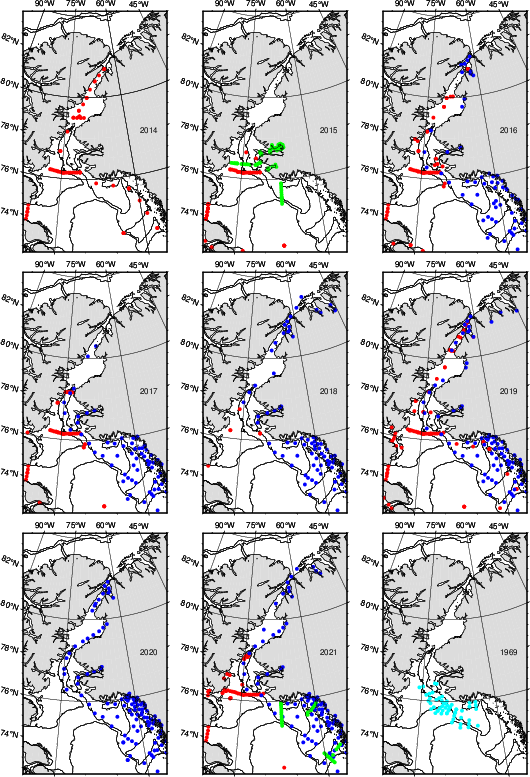
There is one map for each of 9 years, i.e., station locations are shown in a top (2014, 2015, 2016), center (2017, 2018, 2019), and bottom row (2020, 2021, 1968). Land is gray with Canada on the left (west) and Greenland on the right (east) while the solid contour lines represent the 500-m and 1000-m water depth. Each colored symbol represents one station where the ship stopped to deploy a sensor package to measure temperature, depth, and salinity of the ocean water from the surface to the bottom of the ocean adjacent to the ship. The different colors represent data from Canada in red, Denmark in green, and USA in blue. The light blue color represents historical data from a study that investigated the waters after a nuclear armed B-52 bomber crashed into the ocean near Thule/Pituffik on 17 Jan. 1968 with one nuclear war head still missing. A Wikipedia story called 1968 Thule Air Base B-52 Crash provides details, references, and Cold War context, but lets return to the data and ocean physics:

Notice a single red dot near the bottom center of some maps such as 2015, 2017, or 2021. For this single dot I show the actual temperature and salinity data and how it varies with depth (labeled pressure, at 100-m depth the pressure is about 100 dbar) and from year to year:
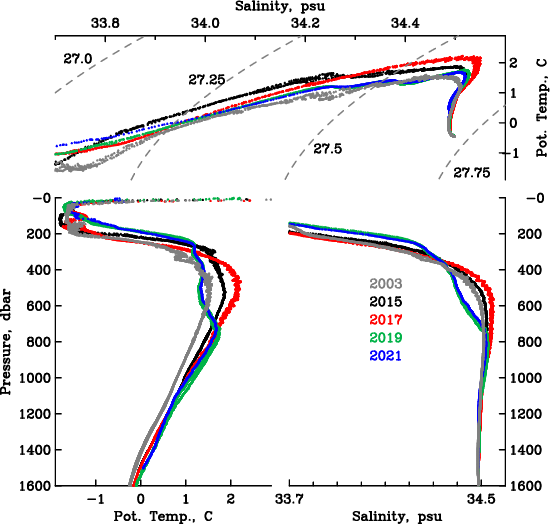
The two bottom panels show how temperature (left) and salinity (right) change with depth (or pressure). Notice that the coldest water near freezing temperature of -1.8 degrees Celsius (29 Fahrenheit) occurs between 30-m and 200-m depth (30 to 200 dbar in pressure). Below this depth the ocean water actually becomes warmer to a depth of about 500-600 m to then become cooler again. The effects of pressure on temperature are removed, this is why I call this potential temperature and label it “Pot. Temp.” The warmest waters at 600-m depth are also the most salty (about 34.5 grams of salt per 1000 grams of water). This saltiness makes this water heavier and denser than the colder waters above. This is a common feature that one finds almost anywhere in polar regions. The top panel shows the same data without reference to depth (or pressure), but contours of density show how this property changes with temperature and salinity. It takes a little mental gymnastic to “see” how density always increases as pressure increases, but the main thing here is that both salinity and temperature can change the density of seawater.
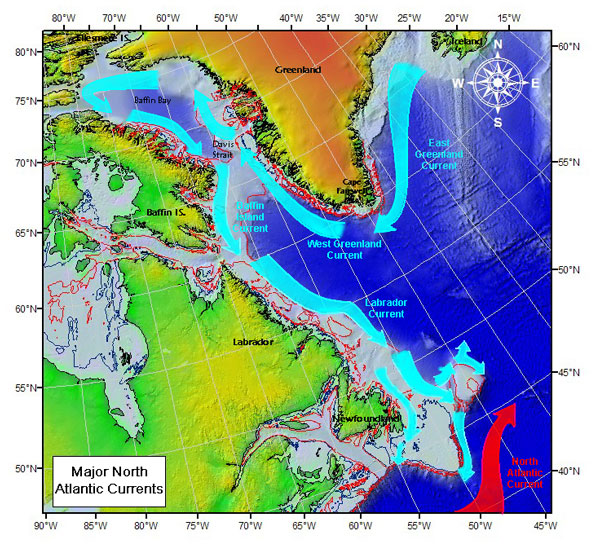
Sketch of ocean current systems off Greenland and eastern Canada. Colors represent topography of ocean, land, and Greenland ice sheet.

U.S. Coast Guard, International Ice Patrol

The origin of the warmer (and saltier) waters is the Atlantic Ocean to the south. Currents move heat along the coast of Greenland to the north. Icebergs in Baffin Bay extend into this Atlantic Layer and thus move first north along the coast of Greenland before turning west in the north and then south along the coast of Canada. This deep ocean heat does reach coastal tidewater glaciers which are melted by this warm ocean water. So the year-to-year changes of temperature and salinity determine in part how much the coastal glaciers of Greenland melt. The temperature and salinity maxima change from year to year being warmest in 2015 and 2017 and coldest in 2019 and 2021. No “global warming” here, but notice what happens closer to the bottom at 1500-m, say. These waters are separated from the Atlantic and Arctic Oceans to the south and north by water depths that do not exceed 600-m in the south and 400-m in the north. These almost stagnant waters increase their temperatures steadily from 2003 to 2015 to 2017 to 2019 to 2021. This is the global warming signal.

My former student Melissa Zweng published a more thorough and formal study in 2006 using all then available data from Baffin Bay between 1916 and 2003. Her Figure-7 shows the results for those parts of Baffin Bay that are deeper than 2000-m for two different depth ranges. Notice that the year to year variations (up and down) is small, but a steady increase in temperature is apparent from perhaps -0.3 Celsius in 1940 to -0.05 in 2003 for the 1400-1600 m depth range. We also did a very formal error analysis on the straight line we fitted to the data and find that deep temperatures increase by +0.03 C/decade. We are 95% sure, that the error or uncertainty on this warming is +/- 0.015 C/decade. So there is a 1 in 20 chance, that our deep warming trend is below +0.005 C/decade and an equal 1 in 20 chance, that our warming trend exceed +0.045 C/decade. In 19 out of 20 cases the (unknown) true warming value is between 0.005 and 0.045 C/decade.
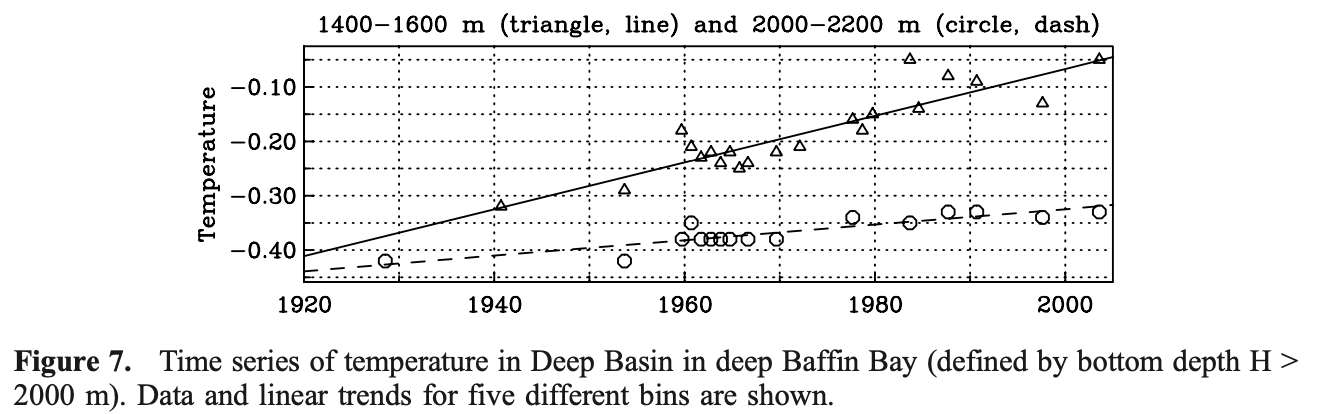
So, more than 20 years have passed since Melissa’s work. The data I here showed between 2003 and 2021 thus gives us a chance to test our statistical predictions that we made 20 years ago. So, deep temperatures should be between 0.01 and 0.09 degrees Celsius warmer than they were in 2003. I have not done this test yet, but science is fun even if the data are old.

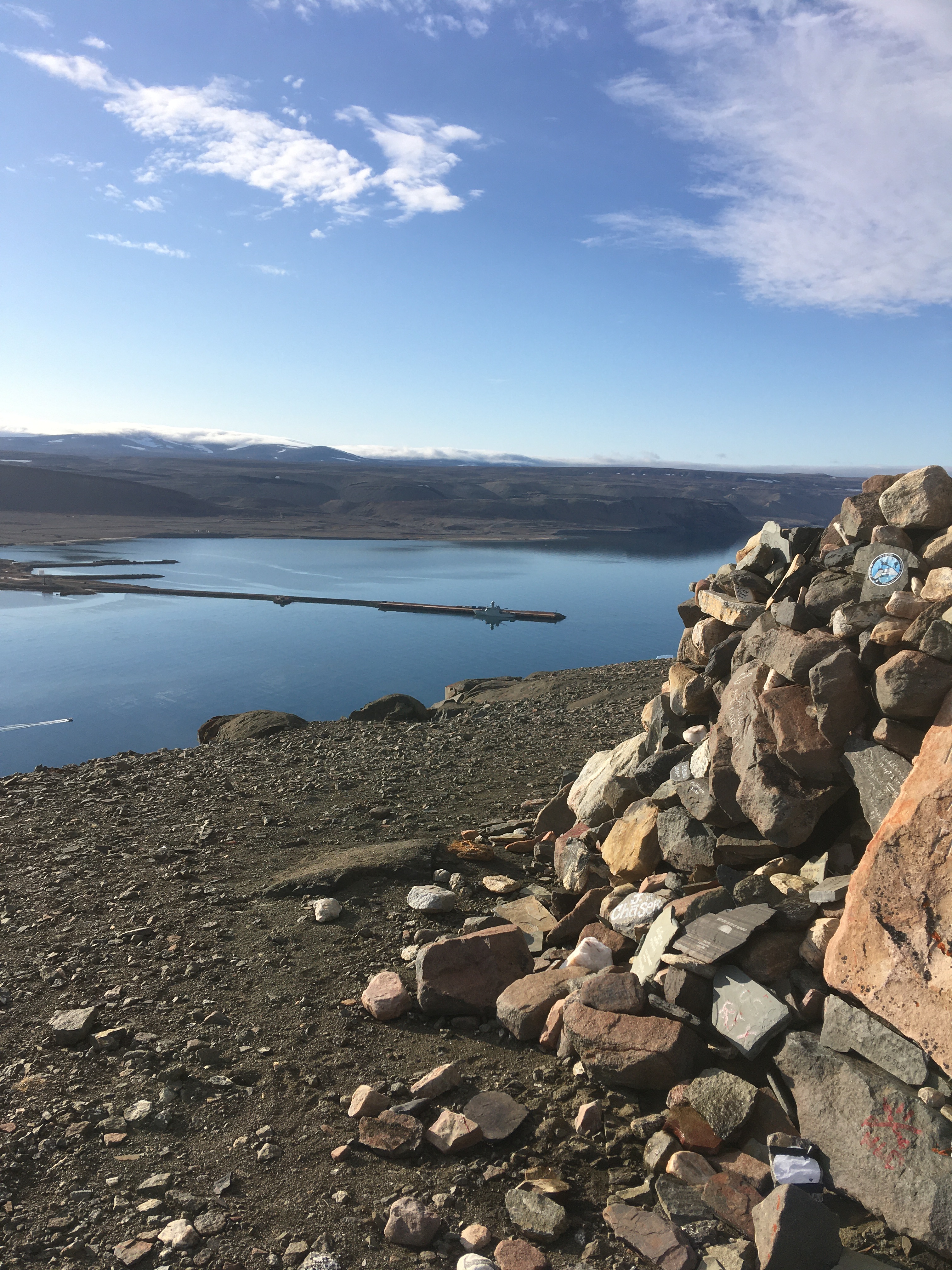
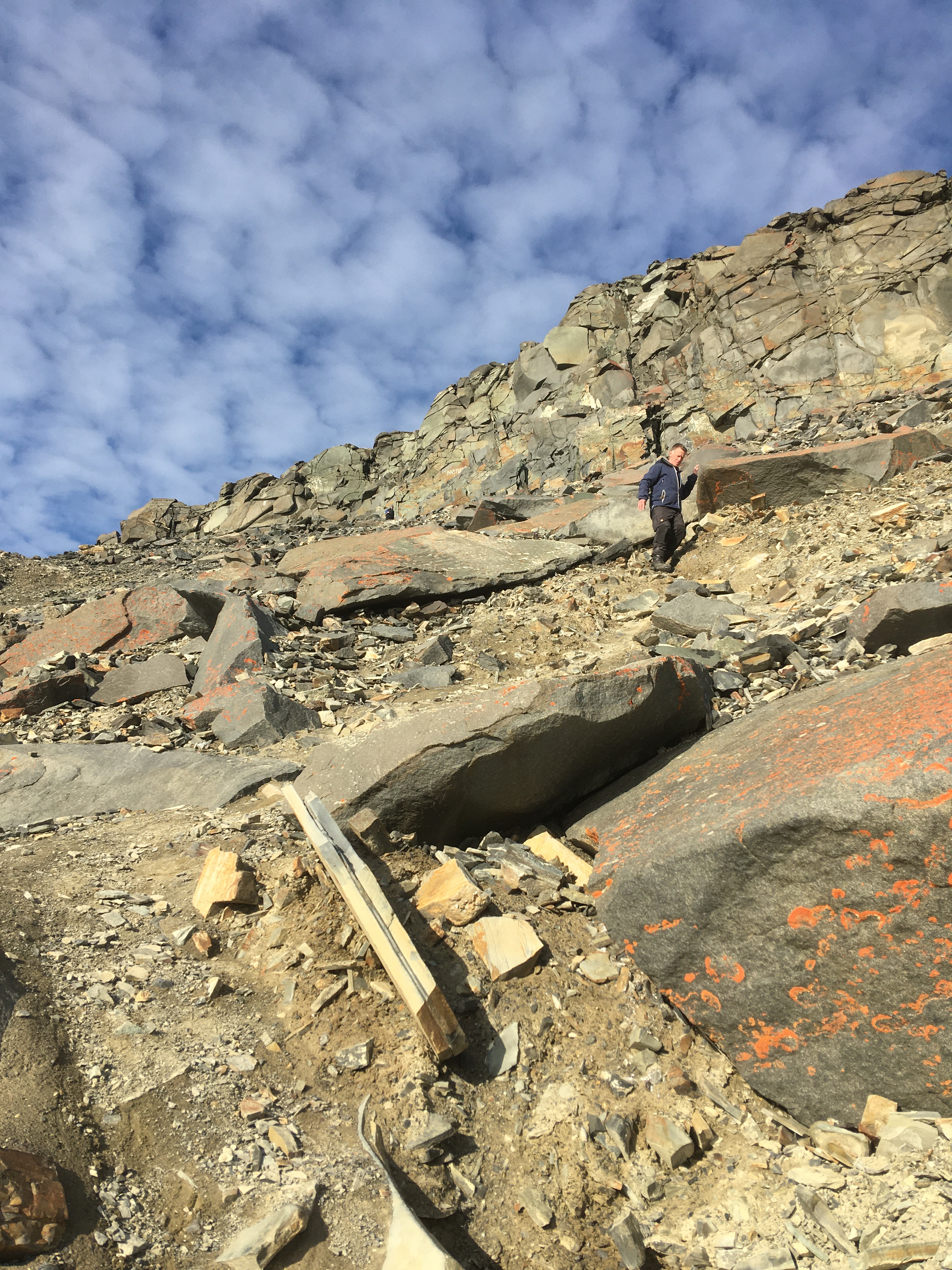
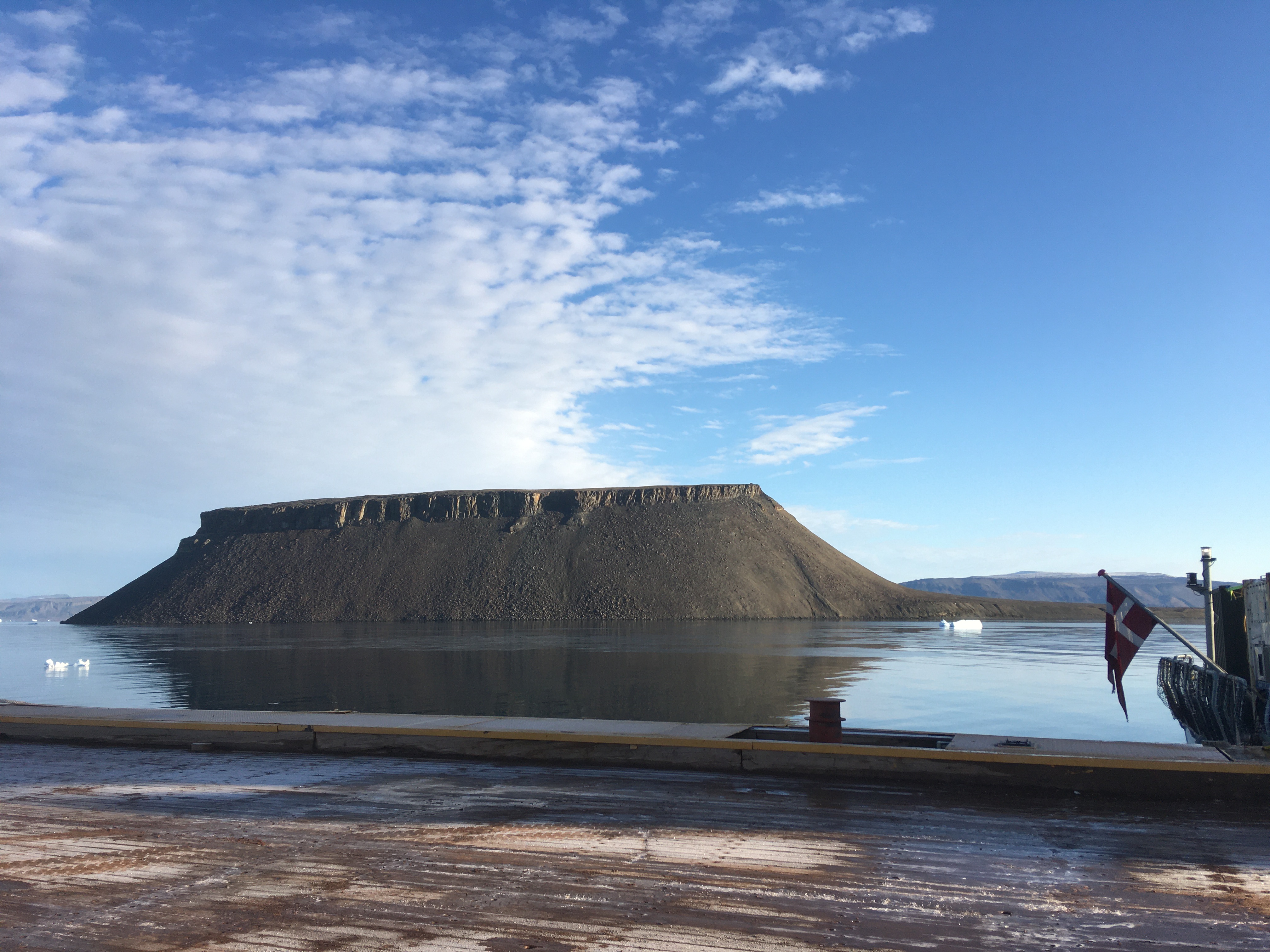
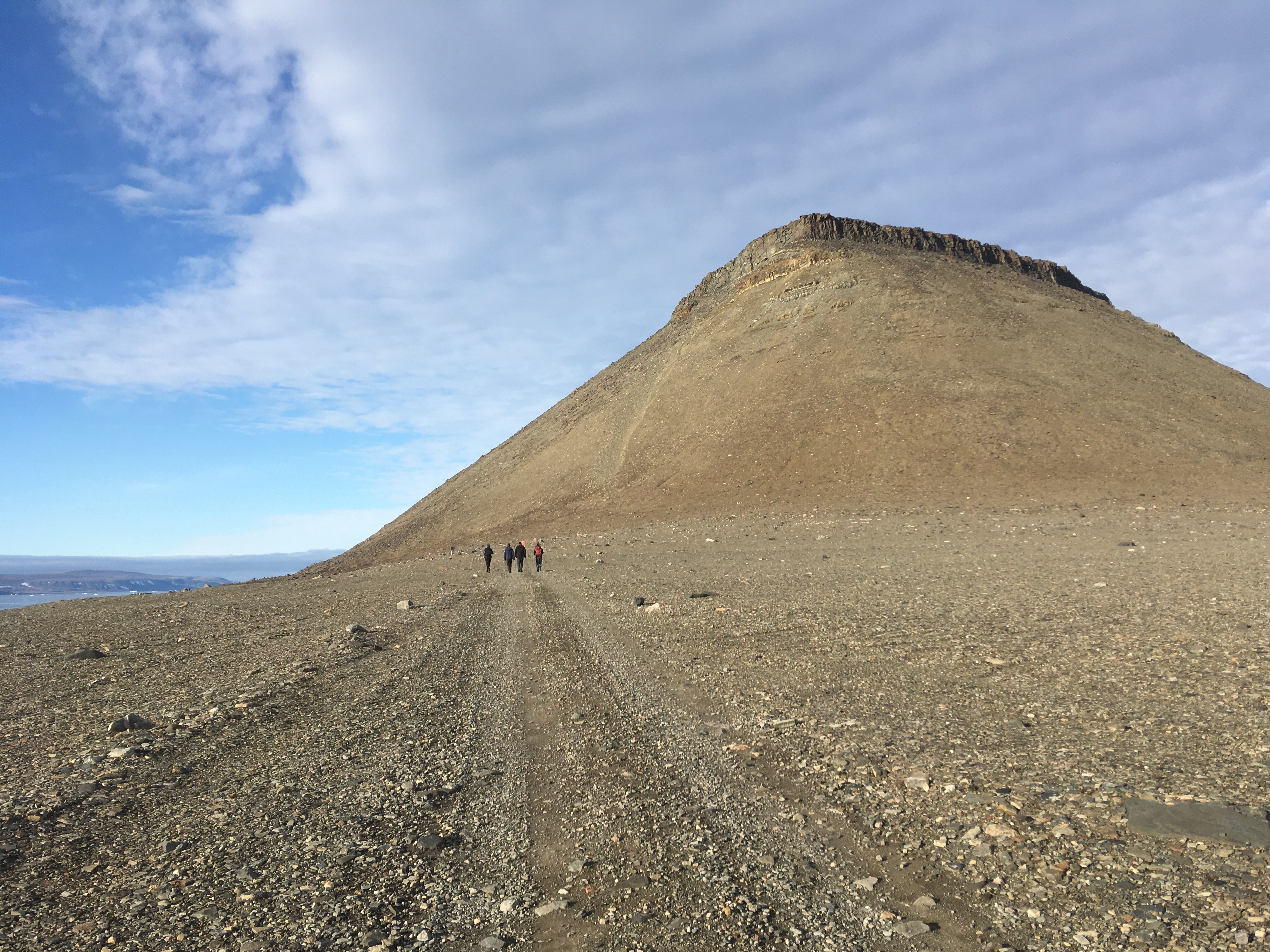
After getting off the ship at Thule Air Base (now called Pituffik Space Base) in 2021, us scientists climbed Dundas Mountain to stretch our legs, take in the varied landscape, and view our ship and home for a week from a distance. Notice how small HDMS Lauge Koch at the pier appears. All photos below were taken by geophysicist Dr. Katrine Juul Andresen of Aarhus University, Denmark:
References:

Münchow, A., Falkner, K.K. and Melling, H.: Baffin Island and West Greenland Current Systems in northern Baffin Bay. Progr. Oceanogr., 132, 305-317, 2015.

Ribeiro, S., Olsen, S. M., Münchow, A., Andresen, K. J., Pearce, C., Harðardóttir, S., Zimmermann, H. H., & Stuart-Lee, A.: ICAROS 2021 Cruise Report. Ice-ocean interactions and marine ecosystem dynamics in Northwest Greenland. GEUS, Danmarks og Grønlands Geologiske Undersøgelse Rapport, 70, 2021.

Zweng, M.M. and Münchow, A.: Warming and Freshening of Baffin Bay, 1916-2003. J. GEOPHYS. RES., 111, C07016, doi:10.1029/2005JC003093, 2006.
Adaptations of Genetically Isolated Polar Bears in Southeast Greenland

Ms. Amanda Winton wrote this essay as an extra-curricular activity developed from a science communication assignment for MAST383 – Introduction to Ocean Sciences. The editor teaches this course at the University of Delaware and was assisted by Ms. Terri Gillespie in a final formal edit. ~Editor

“… The intense winds blow against my white fur. The chunks of white, frosty glacial ice float below me. I lift my eyes, scanning my surroundings for my next meal. I see a dark gray mass sliding along the ice a few hundred feet away. My mouth waters as my paws ready for the hunt. I have not eaten, nor seen any prey, in 12 days. I begin my slow and steady pursuit. The terrain below me is rough, unlike the abundant flat sea ice that was my ancestors’ hunting grounds.

It is a little bit more difficult to maneuver, taking more time to get to my prey than I would have hoped. Minutes later, I jump into the water, about to swim to the ice my prey is lounging on. Unfortunately, I grossly underestimated how far away it is, and by the time I swim to this meal, it’s gone. Now I am left with no food, and my stomach grumbles for the fifth time today.”

This short, first-person narrative is written from the perspective of a Greenland polar bear in the summertime. In particular, this polar bear is part of a subpopulation that hunts on a glacial mélange within fjords, rather than on larger frozen ice caps. Of course, I do not know what polar bears think in their pursuits, migration, or other actions. I can only use my own experiences and compassion to imagine their point of view and desires. Based on my biocentric view, all animals have their own importance in the world and are worthy of preservation. Since human intervention causes polar bears to struggle in their own environment, people have the responsibility to save them and recover their habitat.

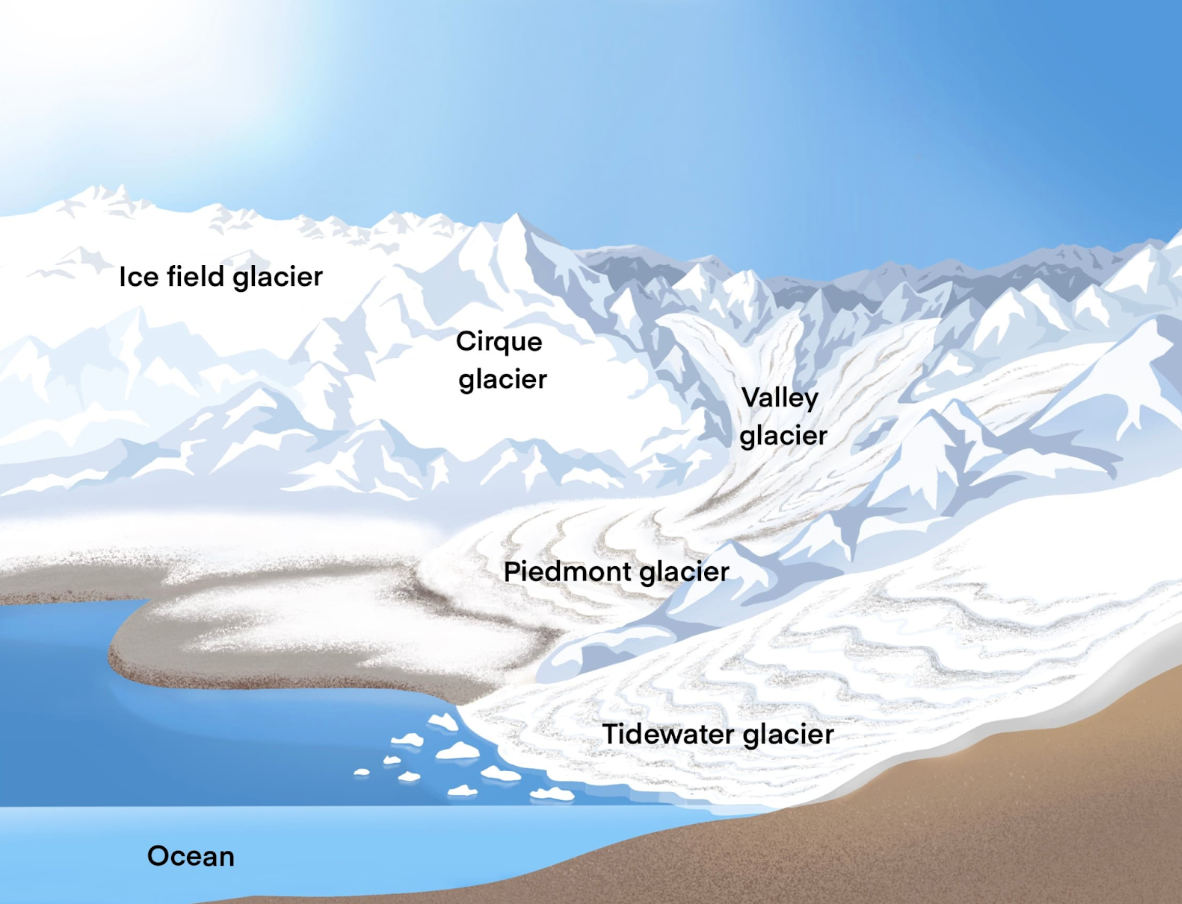
Figure 1. This depicts the types of glaciers that can be present in different places, depending on the snow and ice available as well as the pressure and heat present. [adapted from National Snow and Ice Data Center]

Polar bears are losing their land due to the indirect and direct effects of human interaction with the environment, called climate change. Atmospheric warming leads to scarce and thinner glaciers, as well as less advancement in the growth season. The breakup of ice in the spring due to melting occurs nine days earlier than it did before global warming was identified in 1938 (Maslin, 2016), and the freezing of ice in the fall occurs ten days later (EPA, 2022). Not only is there less ice, but the ice exists for a shorter period of time. This leads to less territory, which can be detrimental to any species.

When Glacier National Park in Montana was established in 1910, about 150 glaciers existed. Now, less than 30 remain (Glick, 2021). Polar bears are forced to look for land and food elsewhere because they do not have as much space to hunt and breed. There is not much land or food present, so the natural selection rate for this animal is increasing dramatically every day, at a rate as fast as climate change (Peacock, 2022). Polar bears are forced by their environment to either die or adapt. This is not an easy adaptation, either.

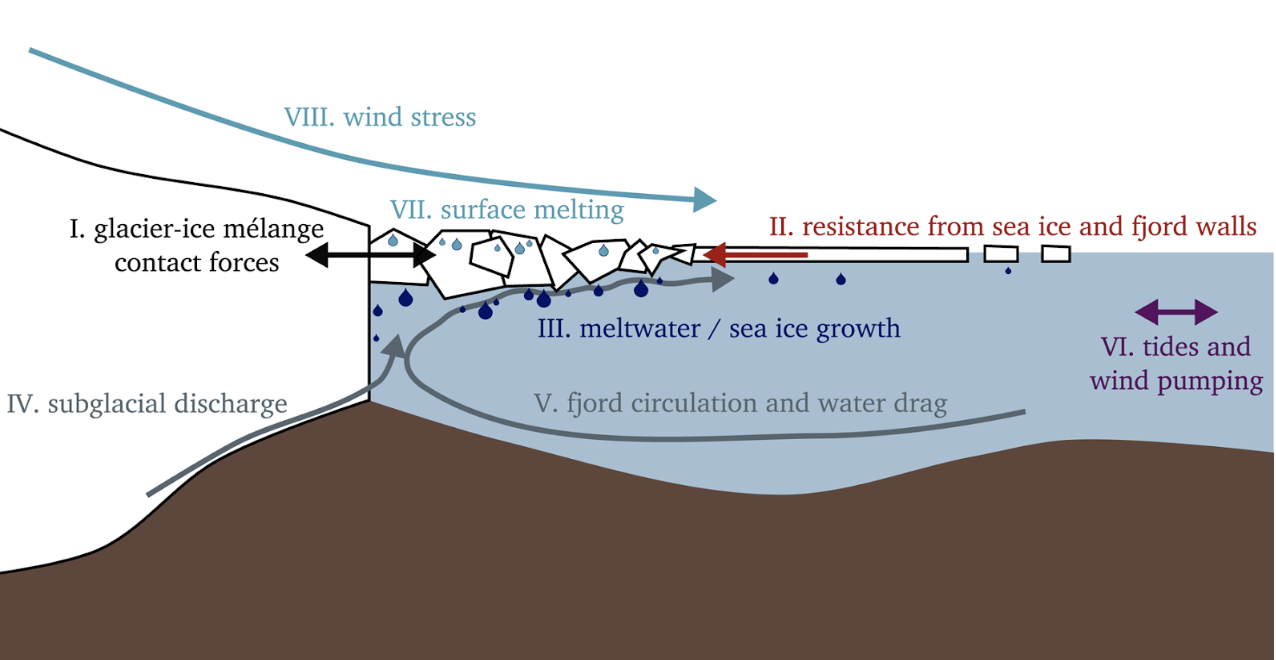
Polar bears are forced to adapt quickly, since glacier ice is very limited in the Arctic. On the southeast coast of Greenland, polar bears have implemented a new habitat: fjords. These bears live at the front of glaciers in fjords, called the glacial mélange, which is a mixture of sea ice, icebergs, and snow. Only polar bears in southeast Greenland live there all year round, using this habitat to breed, hunt, and sleep.

Figure 2. This Glacier-Ocean-Mélange System depicts the forces acting upon this mechanism at all times. These forces are important for keeping the system at equilibrium and habitable for polar bears. [adapted from Amundson et al. (2020)]

In a recent research study led by Kristin Laidre, Northeast and Southeast Greenland polar bear population migrations were tracked. The median distance of the polar bears in the northeast was 40km per four days. The median distance traveled for the southeast population was 10km per four days, which is statistically significantly lower. Laidre et al. (2022) found that the southeast polar bears traveled between neighboring fjords, or stayed in the same fjord all year. This adaptation shows behavioral plasticity (Peacock, 2022), as Southeast Greenland bears have not become locally extinct.

This subpopulation of polar bears is one out of 20, and is very small. They are smaller in size and have a slower reproduction rate, most likely due to trouble finding a mate in a small population, as well as their long generation time and low natality. It’s important to preserve this genetically isolated population to preserve their genetic diversity. Without this element, birth defects, either mental or physical, will occur. This leads to a population less fit for its environment. Genetic diversity is necessary for surviving natural selection and thriving in an ecosystem. 

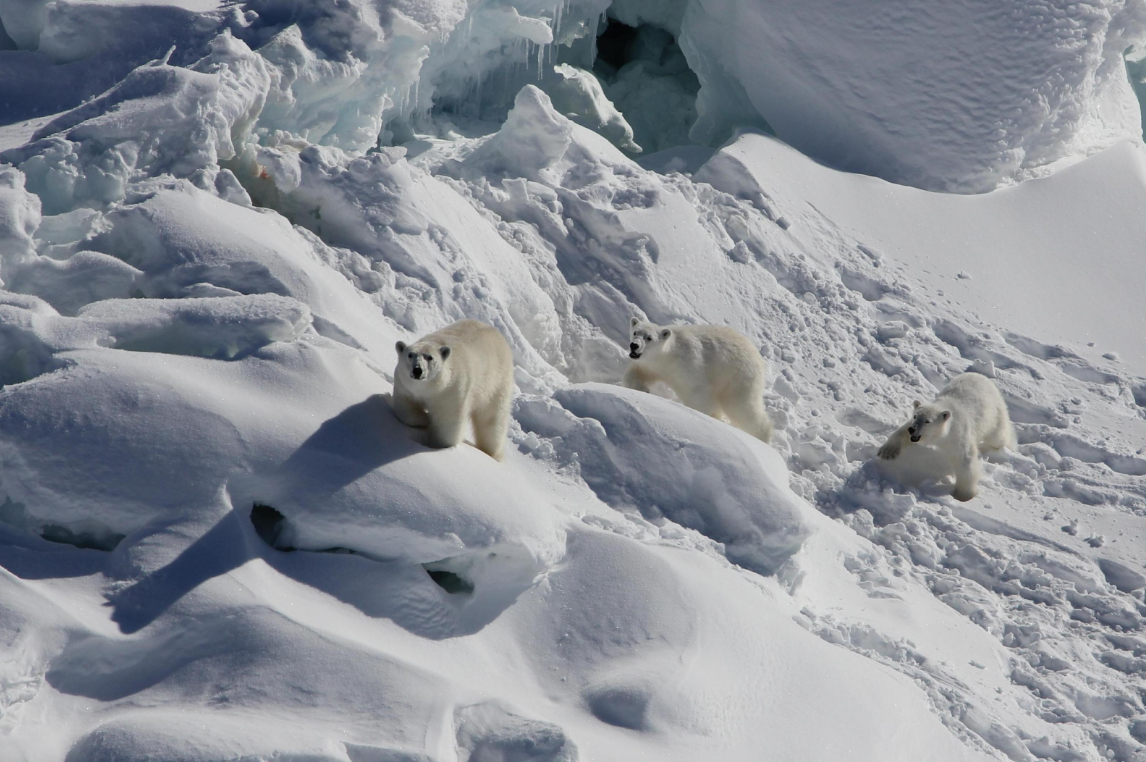
Figure 3. This photograph presents polar bears walking in the snowy fjords. Fjords are not flat, which makes it harder for these bears to travel, versus the flat ice that other polar bears have been hunting on for centuries. [adapted from Laidre et al. 2022]

“… I leave my fjord the next day, hoping to find another nearby, hopefully unoccupied. To my luck, one appears in my field of vision a few hundred meters away. To my surprise, a bob of seals rests on the glacial mélange. They are oblivious and unsuspecting of my presence. Minutes pass, and my stomach no longer rumbles. A successful hunt is always satisfactory. Now I can focus on my next need: my desire to find a mate and pass on my strong genes. It will not be too hard for me as I am a big male, with thick, insulated fur. I advance through the neighboring fjord, hopeful and confident. My story is just beginning.”

References:

Amundson, J., Kienholz, C., Hager, A., Jackson, R., Motyka, R., Nash, J., Sutherland, D., 2020: Formation, flow and break-up of ephemeral ice mélange at LeConte Glacier and Bay, Alaska. Journal of Glaciology, 66(258), 577-590. doi:10.1017/jog.2020.29.

Environmental Protection Agency, 2022: Climate Change Indicators: Arctic Sea Ice, https://www.epa.gov/climate-indicators/climate-change-indicators-arctic-sea-ice.

Dunham, W., 2022: Isolated Greenland Polar Bear Population Adapts to Climate Change. Reuters, Thomson Reuters, https://www.reuters.com/business/environment/isolated-greenland-polar-bear-population-adapts-climate-change-2022-06-16.

Glick, D., 2021: The Big Thaw. National Geographic, https://www.nationalgeographic.com/environment/article/big-thaw.

Greenfieldboyce, N., 2022: In a Place with Little Sea Ice, Polar Bears Have Found Another Way to Hunt, KTOO, https://www.ktoo.org/2022/06/20/in-a-place-with-little-sea-ice-polar-bears-have-found-another-way-to-hunt/.

Laidre, K. L. and 18 others, 2022: Glacial Ice Supports a Distinct and Undocumented Polar Bear Subpopulation Persisting in Late 21st-Century Sea-Ice Conditions, vol. 376(6599), 1333–1338, https://doi.org/10.1126/science.abk2793.

Maslin, M. , 2016: Forty years of linking orbits to ice ages, Nature, 540, 208–209, https://doi.org/10.1038/540208a.

Ogasa, N., 2022: Some Polar Bears in Greenland Survive on Surprisingly Little Sea Ice, Science News, https://www.sciencenews.org/article/polar-bear-greeland-sea-ice-glacial-melange-climate-change.

Peacock, E., 2022: A new polar bear Population, Science, vol. 376(6599), 1267–1268, https://doi.org/10.1126/science.abq5267.

National Snow and Ice Data Center, 2022: Glaciers, https://nsidc.org/learn/parts-cryosphere/glaciers/science-glaciers.

Rotations, Spin, and People

I hate to rotate. It makes me sick. And yet, every day I spin at 800 miles per hour, because living on a spinning earth does this to me. Why does the earth spin at all? [CalTech answer.] Did it always spin the way it does now? [No.] Could it spin in the other direction that would make the sun rise above the horizon in the West rather than the East? [No.] If not, why not? [Not sure yet.] I am pondering these questions as I will teach my first undergraduate class in ten days:

I plan to introduce how oceans and atmospheres circulate to distribute heat, water, and “stuff” like food and plastics across the globe. There is lots of rotation, lots of angular momentum, lots of torque and I am unsure, if a text book and lecture via Zoom will make much sense. So, today I discovered several fun and smart and insightful videos that I may even pose to my students as Homework or Exam questions 😉

The first set of videos I discovered today is Derek Muller’s Veritasium channel on YouTube. He covers a range of physics, math, and even biology topics, but I here focus on his wing nut problem. He entertains by explaining a strange and even bizarre observation made in space some 30 years ago. A Russian engineering astronaut noticed a rotating wing nut change its rotational axis repeatedly. Russia kept the observation top secret for over 10 years for reasons not entirely clear, but here is a modern attempt to explain what happened. It also applies to how tennis rackets rotate:

Now this reminded me of a problem that I encountered during my third year studying physics in Germany. I never solved or understood this so-called spinning-hard-boiled-egg problem that the Physics Girl describes so well. Her real name is Dianne Cowern and I use her videos in my graduate statistics class where her voice and physics shatters wine glasses via resonance. Today I discovered many more of her PBS Digital videos that all are filled with fun, beauty, and smart explanations. She plays with vortices in air and water and in between.

Now how does this relate to oceanography and meteorology? Well, we all live somewhere on the spinning top or egg or peanut that we call earth. Gravity keeps us grounded, but rotating objects can do strange things as the above two videos show. And when rotation becomes important we are not just dealing with linear momentum, but also angular momentum. When rotation becomes important, we must consider torques that generate angular momentum in ways similar to how forces generate linear momentum.

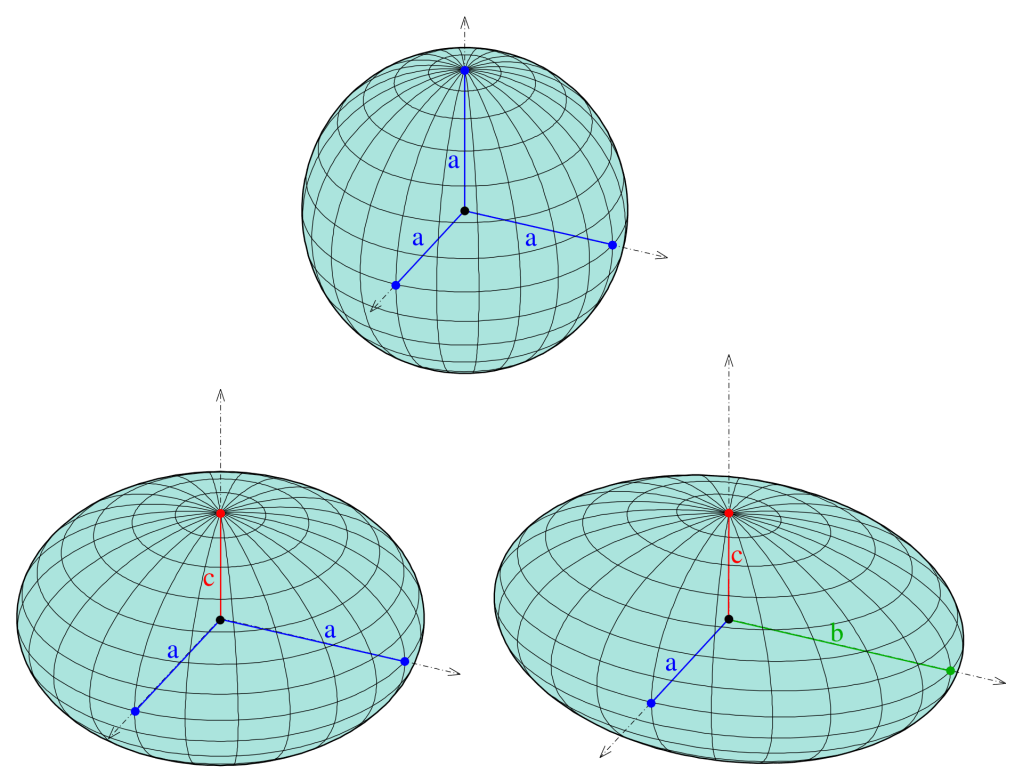
Rotation adds a strong and often counter-intuitive element because unlike a force that accelerates a car in the same direction that the force is applied, a force applied to a rotating system generates a torque perpendicular to both the force and the direction to the rotational axis. This can be confusing and one has to either watch the movies or go through advanced vector calculus. Furthermore, a rotating sphere acts differently than a rotating spheroid which acts differently from a rotating triaxial spheriod. Our peanut earth is the latter and thus has at least three axes of orientation (a and b and c) that all have different kinetic energy and angular momentum states. This makes for wobbly rotations which are sensitive to changes in both force balances and the distribution of masses like ice and water that can move to different locations at different times and stay there for a while.

For a perfect sphere three perpendicular lines from the center to the surface all have the same distance a (top) while for a spheriod only two of the three perpendicular lines have the same distance from the center (bottom right). If all three perpendiculars are different then we have something called a triaxial spheroid [Adapted from WikiPedia].

And how does this relate to climate science and my beloved glaciers in Greenland? Well, there is the “global wobbling” that caused ice ages and warm periods as the earth’s principal axis or rotation changes or wobbles. The “global wobble” was discussed in hilarious way a few years ago by the United States House of Representative’s “Committee on Science, Space, and Technology.” Closing this essay, I let Jon Steward of the Comedy Channel speak and hope you find his commentary and live experiment as funny as I do:

Is Petermann Gletscher Breaking Apart this Summer?

I am disturbed by new ocean data from Greenland every morning before breakfast these days. In 2015 we built a station that probes the ocean below Petermann Gletscher every hour. Data travels from the deep ocean via copper cables to the glacier surface, passes through a weather station, jumps the first satellite overhead, hops from satellite to satellite, falls back to earth hitting an antenna in my garden, and fills an old computer.

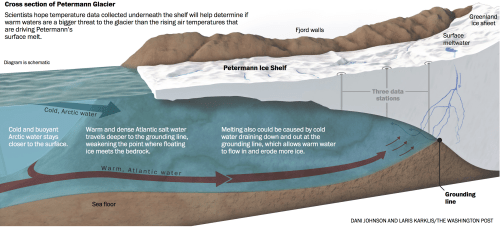
A 7-minute Washington Post video describes a helicopter repair mission of the Petermann data machine. The Post also reported first result that deep ocean waters under the glacier are heating up.

Sketch of Petermann Gletscher’s ice shelf with ocean sensor stations. The central station supports five cabled sensors that are reporting hourly ocean temperatures once every day. Graphics made by Dani Johnson and Laris Karklis for the Washington Post.

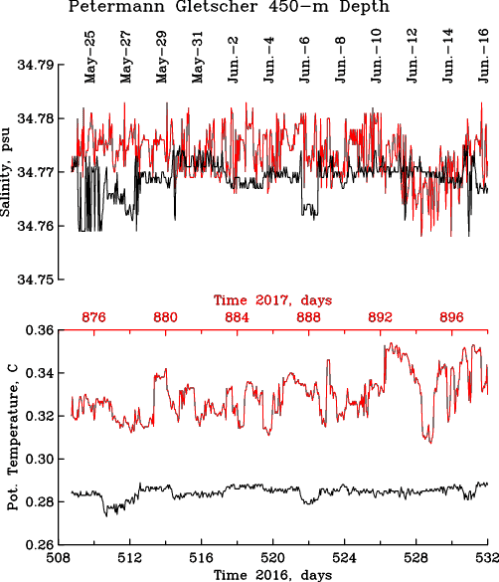
After two years I am stunned that the fancy technology still works, but the new data I received the last 3 weeks does worry me. The graph below compares ocean temperatures from May-24 through June-16 in 2017 (red) and 2016 (black). Ignore the salinity measurements in the top panel, they just tell me that the sensors are working extremely well:

Ocean temperature (bottom) and salinity (top) at 450-m depth below Petermann Gletscher from May-25 through June-16 2017 (red) and 2016 (black). Notice the much larger day-to-day temperature ups and downs in 2017 as compared to 2016. This “change of character” worries me more than anything else at Petermann right now.

The red temperature line in the bottom panel is always above the black line. The 2017 temperatures indicate waters that are warmer in 2017 than in 2016. We observed such warming for the last 15 years, but the year to year warming now exceeds the year to year warming that we observed 10 years ago. This worries me, but three features suggest a new ice island to form soon:

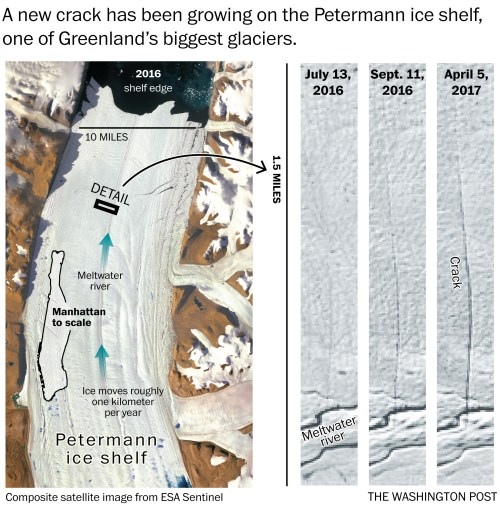
First, a new crack in the ice shelf developed near the center of the glacier the last 12 months. Dr. Stef Lhermitte of Delft University of Technology in the Netherlands discovered the new crack two months ago. The new rupture is small, but unusual for its location. Again, the Washington Post reported the new discovery:

New 2016/17 crack near the center of Petermann Gletscher’s ice shelf as reported by Washington Post on Apr.-14, 2017.

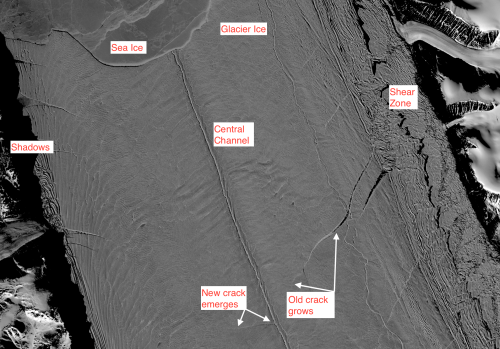
Second, most Petermann cracks develop from the sides at regular spaced intervals and emanate from a shear zone at the edge. Some cracks grow towards the center, but most do not. In both 2010 and 2012 Manhattan-sized ice islands formed when a lateral crack grew and reached the central channel. The LandSat image shows such a crack that keeps growing towards the center.

Segment of Petermann Gletscher from 31 May 2017 LandSat image. Terminus of glacier and sea ice are at top left.

And finally, let’s go back to the ocean temperature record that I show above. Notice the up and down of temperature that in 2017 exceeds the 2016 up and down range. Scientists call this property “variance” which measures how much temperature varies from day-to-day and from hour-to-hour. The average temperature may change in an “orderly” or “stable” or “predictable” ocean along a trend, but the variance stays the same. What I see in 2017 temperatures before breakfast each morning is different. The new state appears more “chaotic” and “unstable.” I do not know what will come next, but such disorderly behavior often happens, when something breaks.

I fear that Petermann is about to break apart … again.

Sea ice and 2016 Arctic field work

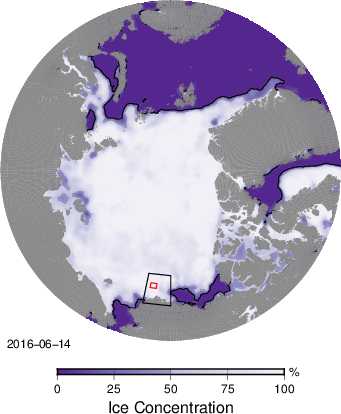
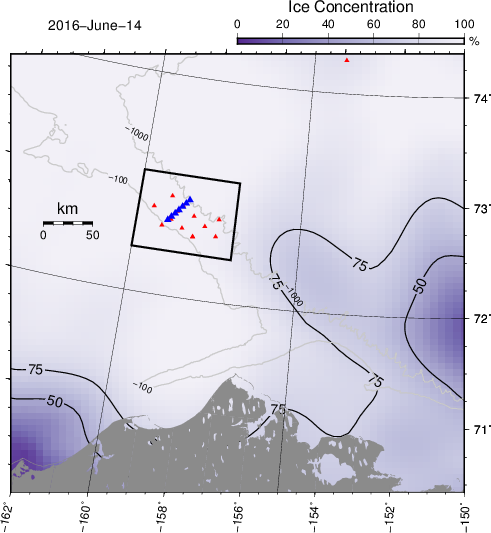
The sea ice in the Arctic Ocean is quickly disappearing from coastal areas as we are entering the summer melt season. This year I follow this seasonal event with nervous anticipation, because in October and November we will be out at sea working north of northern Alaska. We plan to deploy a large number of ocean sensors to investigate how sound propagates from the deep Arctic Ocean on to the shallow Chukchi Sea. This figure shows our study area with the ice cover as it was reported yesterday from space:

Ice concentration for June 14, 2016 from SSM/I imagery. Insert show study area to the north of Alaska and planned mooring locations (red box).

Ice concentration for June 14, 2016 from SSM/I imagery. Insert show study area to the north of Alaska and planned mooring locations (red box).

Zooming in a little further, I show the coast of Alaska along with 100 and 1000 meter contour of bottom depth over a color map of ice concentrations:

Ice concentrations from SSM/I to the north of norther Alaska with planned mooring locations across the sloping bottom. The 100 and 1000 meter contours are shown in gray with blue and red symbols representing locations of ocean and acoustic sensors, respectively.

Ice concentrations from SSM/I to the north of norther Alaska with planned mooring locations across the sloping bottom. The 100 and 1000 meter contours are shown in gray with blue and red symbols representing locations of ocean and acoustic sensors, respectively.

My responsibilities in this US Navy-funded project are the seven densely packed blue triangles. They indicate locations where I hope to measure continuously for a year ocean temperature, salinity, and pressure from which to construct sections of speed of sound and how it varies in time and space. I will also measure ice draft as well ice and ocean currents from which to estimate the roughness of the sea ice over time. Sea ice and ocean properties both impact sound propagation from deep to shallow water and vice versa.

A first question: What will the ice be like when we get there? This is the question that has the 40 or so people all working on this project anxiously preparing for the worst, but how can we expect what challenges are to come our way?

Doing my homework, I downloaded from the National Snow and Ice Data Center all gridded maps of ice concentrations that microwave satellites measured almost daily since 1978. Then I crunch the numbers on my laptop with a set of kitchen-sink Unix tools and code snippets such as

set ftp = 'ftp://sidads.colorado.edu'
set dir = 'pub/DATASETS/nsidc0081_nrt_nasateam_seaice/north'
...
wget -r -nd -l1 --no-check-certificate $ftp/$dir/$year/$file

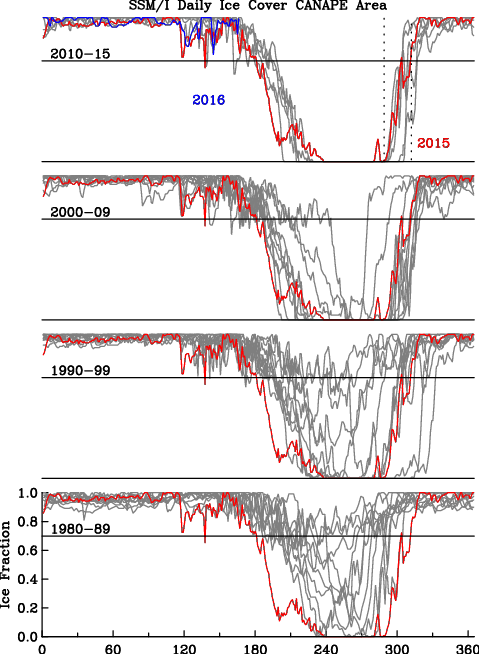
along with fancy and free Fortran and General Mapping Tools to make the maps shown above. With these tools and data I can then calculate how much sea ice covers any area at any time. The result for custom-made mooring area at almost daily resolution gives a quick visual that I use to prepare for our fall 2016 expedition. The dotted lines in the top panel indicate the dates we are in the area.

Time series of daily ice concentration in the study area for different decades from January-1 through Dec.-31 for each year from 1980 through 2015. Panels are sorted by decade. The red curve is for 2015 and is shown for comparison in all panels.

Time series of daily ice concentration in the study area for different decades from January-1 through Dec.-31 for each year from 1980 through 2015. Panels are sorted by decade. The red curve is for 2015 and is shown for comparison in all panels.

The story here is well-known to anyone interested in Arctic sea ice and climate change, but here it applies to a tiny spec of ocean between the 100 and 1000 meter isobath where we plan to deployed ocean sensors for a year in the fall of 2016. For the two decades of the last century, the ice cover looks like a crap shoot with 80% ice cover possible any month of the year and ice-free conditions unlikely but possible here or there for a week or two at most. The situation changed dramatically since about 2000. During the last six years our study area has always been free of ice from late August to early October, however, our 2016 expedition is during the transition from ice-free October to generally ice-covered early November, but, I feel, our saving grace is that the sea ice will be thin and mobile. I thus feel that we probably can work comfortable on account of ice for the entire period, but the winds and waves will blow us away …

Weather will be most uncomfortable, because fall is the Pacific storm season. And with little or only thin ice, there will be lots and lots of waves with the ship pitching and rolling and seeking shelter that will challenge us from getting all the work done even with 7 days for bad weather built into our schedule.

I worked in this area on larger ships in 1993, 2003, and in 2004. Here is a photo that Chris Linder of Woods Hole Oceanographic Institution took during a massive storm in the general vicinity in October of 2004. The storm halted all outside work on the 420 feet long USCGC Healy heading into the waves for 42 long and miserable hours:

Icebreaker taking on waves on the stern during a fall storm in the Beaufort Sea in October 2004. [Photo Credit: Chris Linder, Woods Hole Oceanographic Institution]

Icebreaker taking on waves on the bow during a fall storm in the Beaufort Sea in October 2004. [Photo Credit: Chris Linder, Woods Hole Oceanographic Institution]

Oh, I now also recall that during this four-week expedition we never saw land or the sun. It was always a drizzly gray ocean on a gray horizon. The Arctic Ocean in the fall is an often cruel and inhospitable place with driving freezing rain and fog.