Petermann Glacier’s 2012 ice island is heading south, the Canadian Coast Guard Ship Henry Larsen is heading north, and my passport went through the washer. Ticket agents at Philadelphia airport refused to accept my worn passport to get into Canada. My journey appeared at a dead-end, but ticket agents, U.S. State Department employees in downtown Philadelphia, and a Jordanian cab driver got me to Canada with a new passport, a new ticket, and a new lesson learnt in 4 hours. I did not believe it possible, but it was. I arrived in Canada with an entire day to spare.
Over the years I learnt to plan and budget generously for Arctic research, and then improvise with what is available. I was taught to bring spares of all critical equipment to prepare for loss and failure. I learnt to allow for extra time as missed planes, weather, and who knows what always make tight schedules tighter, like passports going through washers. I learnt that patience, civility, co-operations, and seeing the world through other people’s eyes and responsibilities get me farther than fighting. After I got my PhD in 1992, I learnt that the very people who cause troubles by enforcing rules and regulations are often also the most likely to know the way out of trouble. The ticket agent who denied my passport was also critical to help me get a new one. Thank you, Beth.
Our science party of eight from Delaware and British Columbia and the ship’s crew of 30-40 from Newfoundland will meet on the tarmac of St. John’s tomorrow at 4:30am, fly to and refuel at Iqaluit, Nunavut, and arrive at the U.S. Air Force Base at Thule, Greenland. The crew who got the ship from St. John’s to Thule will return with the plane home. It usually takes two days sailing north by north-west to reach Nares Strait from Thule, but this year the ice will be a challenge far greater than getting a new passport in 4 hours.
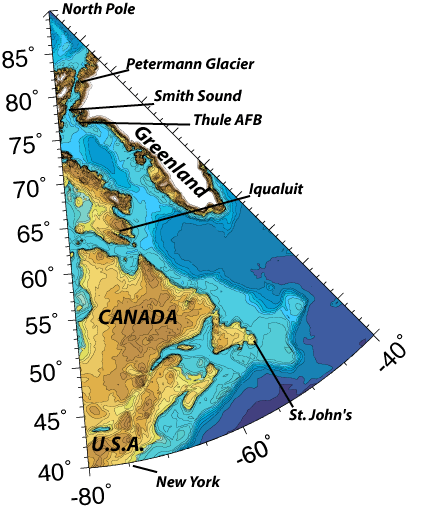
Western North-Atlantic and Arctic regions with Greenland in the west (top right) and Canada (left). Blue colors show bottom depth (light blue are shelf areas less than 200-m deep) and grey and white colors show elevations. Nares Strait is the 30-40 km wide channel to the north of Smith Sound, Baffin Bay is the body of water to the south of Thule.
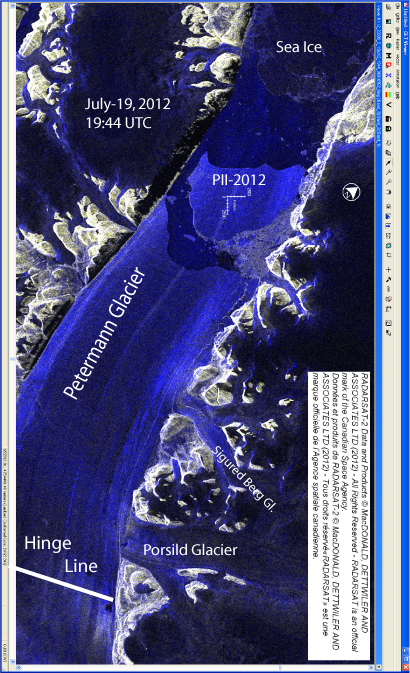
The ice island PII-2012 is moving rapidly towards the outer fjord at a rate that increased from 1 km/day last week to 2 km/day over the weekend. I expect it to be out of the fjord an in Nares Strait by the weekend when we were hoping to recover the moorings with data on ocean currents, ice thickness, and ocean temperature and salinities that we deployed in 2009. The ice island is threatening us from the north: Without a break-up, it is big enough to block the channel as another large ice island did for almost 6 months in 1962.
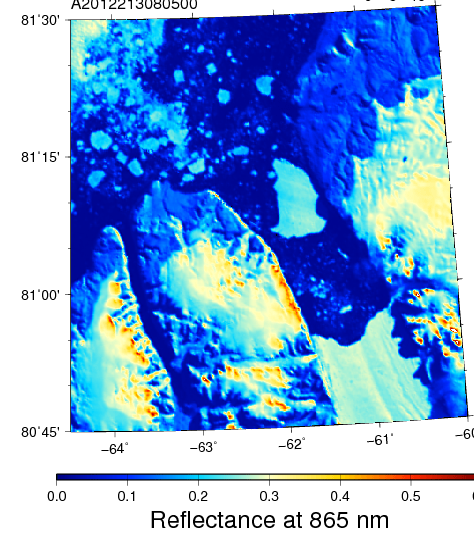
Petermann Glacier, Fjord, and Ice Island on July 31, 2012 at 08:05 UTC. Nares Strait is to the top left. Petermann Glacier, Greenland is on bottom right. PII-2012 is at the center.
At the southern entrance to Nares Strait, lots of multi-year ice is piling up near the constriction of Smith Sound. Winds and currents from the north usually flush this ice into Baffin Bay to the south, however, the same winds and currents will move the ice island out of Petermann Fjord and into Nares Strait. We will need patience, humility, and luck to get where we need to be to recover our instruments and data. A challenge that cannot be forced, we will likely wait and go with the flow rather than fight nature. We will have to play it smart. We are the only search and rescue ship for others. I am nervous, because this year looks far more difficult than did 2003, 2006, 2007, or 2009. In 2005 we were defeated by the winds, but that is a story for a different day.



 Icy Seas