Tag Archives: travel

Remote Air Strips in North Greenland

Where to land a plane in North Greenland? This remote wilderness has the last floating ice shelves in the northern hemisphere such as Petermann Gletscher. Two weeks ago Dr. Keith Nicholls of the British Antarctic Service (BAS) and I visited this glacier to fix both ice penetrating radars and ocean moorings that we had deployed in 2015 after drilling through more than 100 meters of glacier ice. The BAS radars measure how the ice thins and thickens during the year while my moorings measure ocean properties that may cause some of the melting. Keith and I are thinking how we can design an experiment that will reveal the physics of ocean-glacier interactions by applying what we have learnt the last 12 months. First, however, we need to figure out where to land a plane to build a base camp and fuel station in the wilderness.

I searched scientific, military, and industry sources to find places where planes have landed near Petermann Gletscher. The first landing, it seems, was a crash landing of an US B-29 bomber on 21 February 1947 at the so-called Kee Bird site. All 11 crew survived, the plane is still there even though it burnt after a 1994/95 restoration effort that got to the site in a 1962 Caribou plane landing on soft ground with a bulldozer aboard that is still there also. A Kee Bird forum contains 2014 photos and, most importantly for my purpose, a map.

Location of Kee Bird and other landing sites in North Greenland near Petermann Gletscher. [From Forum]

Location of Kee Bird and other landing sites in North Greenland near Petermann Gletscher. [From Michael Hjorth]

Michael Hjorth posted the map after visiting the region as the Head of Operation of Avannaa Resources. This small mineral exploration company was searching for zinc deposits and was working out of a camp a few miles to the north of the Kee Bird site and a few miles to the west of Petermann Gletscher. The Avannaa Camp was on the north-western side of an unnamed snaking lake in a valley to the south of Cecil Gletscher, e.g.,

Names of glaciers, capes, islands in Petermann Region over MODIS of Aug.-21, 2012.

Names of glaciers, capes, islands in Petermann Region over MODIS of Aug.-21, 2012.

Here are videos that show Twin Otter, helicopter, and camp operations all at the Avannaa site in 2013 and 2014:


The Avannaa camp of 2013 and 2014 was supplied from a more southern base camp at Cass Fjord that Avannaa Logistics and/or another mineral company, Ironbark.gl apparently reached via a chartered ship.
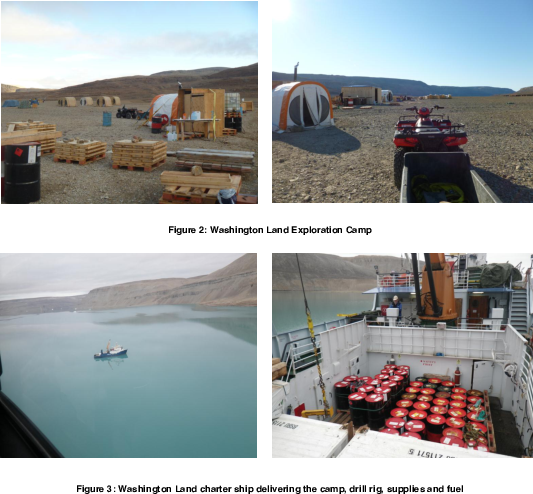
Cass Fjord Base Camp on southern Washington Land and Kane Basin. Credit: IronBark Inc.

Cass Fjord Base Camp on southern Washington Land and Kane Basin. Credit: IronBark Inc.

A summary of all 2013-14 Washington Land activities both at the Avannaa Camp next to Petermann Gletscher and the Cass Fjord Base Camp adjacent to Kane Basin is contained within this longer video of Michael Hjorth

The mining explorations are based on geological maps that Dr. Peter Dawes of the Geological Survey of Denmark and Greenland provided about 10-20 years ago. These publications contain excellent maps and local descriptions both of the geology and geography of the region as well as logistics. The perhaps most comprehensive of these is

Click to access map1_p01-48.pdf

from which I extract this map that shows both the Cass Fjord and Hiawatha Camps:

Dawes (2004): "Simplified geological map of the Nares Strait region ..." from Thule Air Force Base in the south to the Arctic Ocean in the north with Petermann Gletscher in the center of the top half.

Dawes (2004): “Simplified geological map of the Nares Strait region …” from Thule Air Force Base in the south to the Arctic Ocean in the north with Petermann Gletscher in the center of the top half.

while

Click to access gsb186p35-41.pdf

has this photo on how one of these landing strips looks like on a raised beach
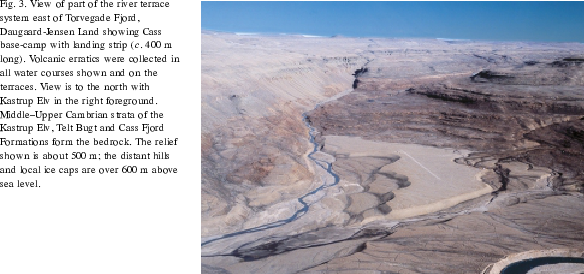
dawes2000-fig3

If we do plan future activities at Petermann Gletscher and/or Washington Land and/or areas to the north, then I feel that the Avannaa site may serve as a good semi-permanent base of operation for several years. It is here that Ken Borek Twin Otter landed several times. It is reachable with single-engine AS-350 helicopters that could be stationed there during the summer with a fuel depot to support field work on the ice shelf of Petermann Gletscher and the land that surrounds it. The established Cass Fjord Base Camp to the south would serve as the staging area for this Petermann Camp which has both a short landing strip suitable for Twin Otter and potential access from the ocean via a ship. Access by sea may vary from year to year, though, because navigation depends on the time that a regular ice arch between Ellesmere Island and Greenland near 79 N latitude breaks apart. There are years such as 2015, that sea ice denies access to Kane Basin to all ships except exceptionally strong icebreakers such as the Swedish I/B Oden or the Canadian CCGS Henry Larsen. In lighter ice years such as 2009, 2010, and 2012 access with regular or ice-strengthened ships is possible as demonstrated by the Arctic Sunrise and Danish Naval Patrol boats. International collaboration is key to leverage multiple activities and expensive logistics by land, air, or sea in this remote area of Greenland.
Petermann Gletscher Ocean Station Revisited

Standing on floating Petermann Gletscher last sunday, I called my PhD student Peter Washam out of bed at 5 am via our emergency Iridium phone to check the machine that Keith Nicholls and I had just repaired. We had prepared for this 4 months and quickly established that a computer in Delaware could “talk” to a computer in Greenland to receive data from the ocean 800 m below my feet on a slippery glacier. For comparison the Empire State Building is 480 m high. The closest bar was 5 hours away by helicopter at Thule Air Force Base from where Keith and I had come.

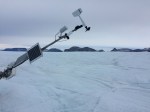
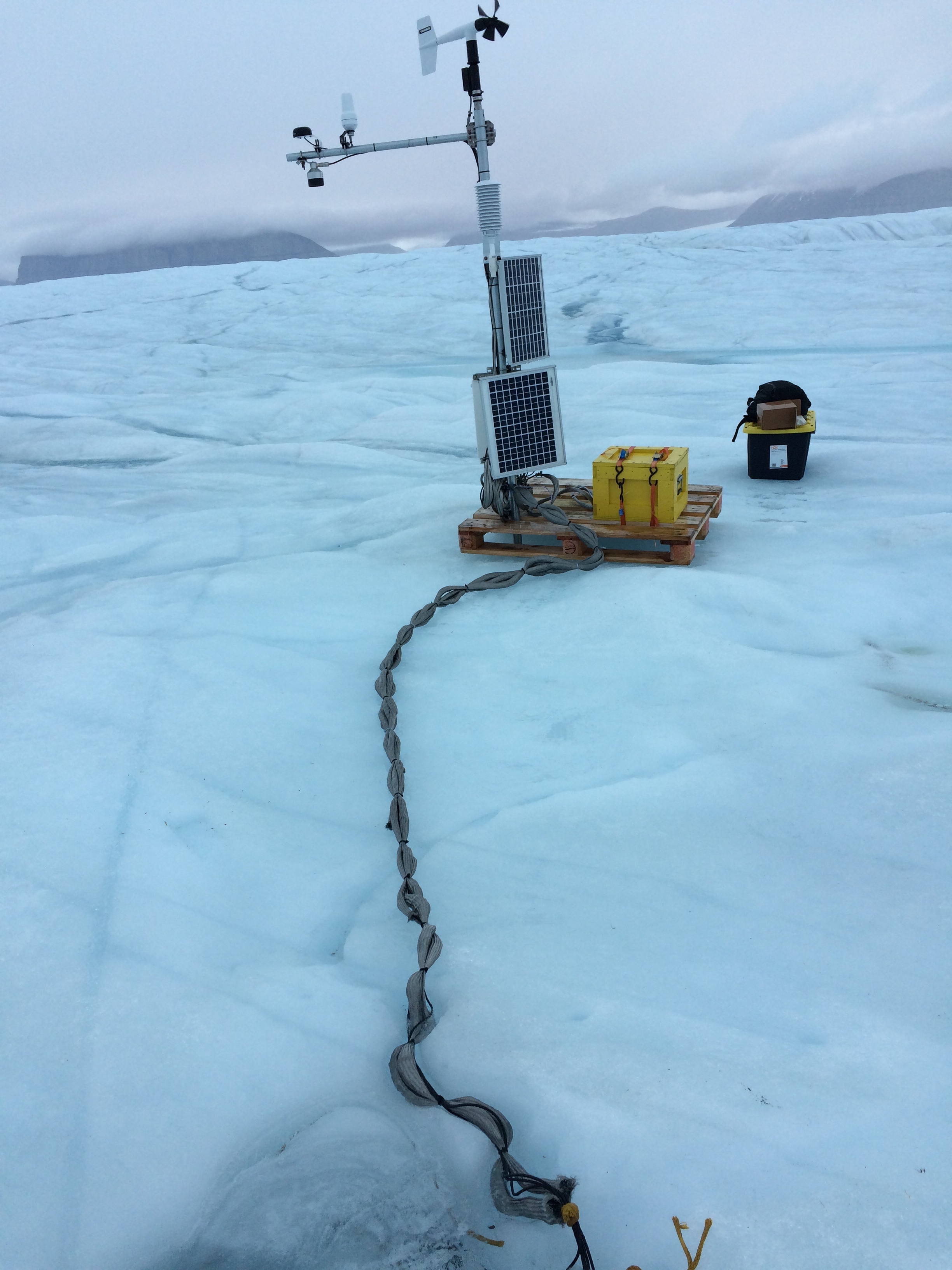
Cabled ocean observatory linked to a University of Delaware weather station on Petermann Gletscher, Greenland on 28 August 2016. View is to the north.

Refurbished ocean observatory linked via cables to a University of Delaware weather station on Petermann Gletscher, Greenland on 28 August 2016. View is to the north.

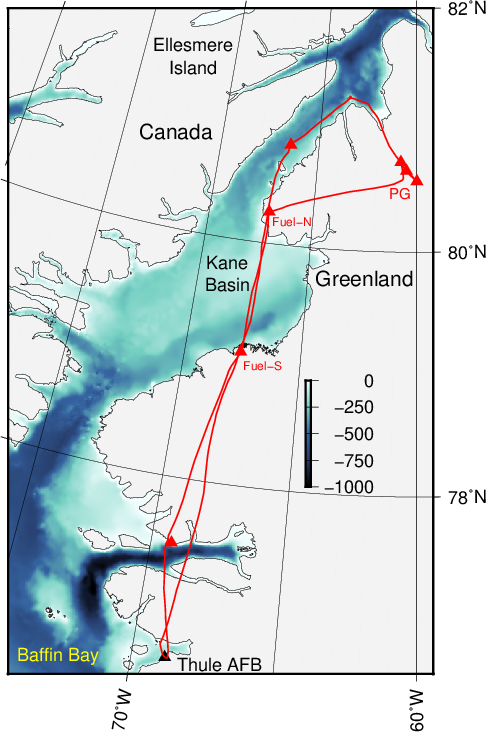
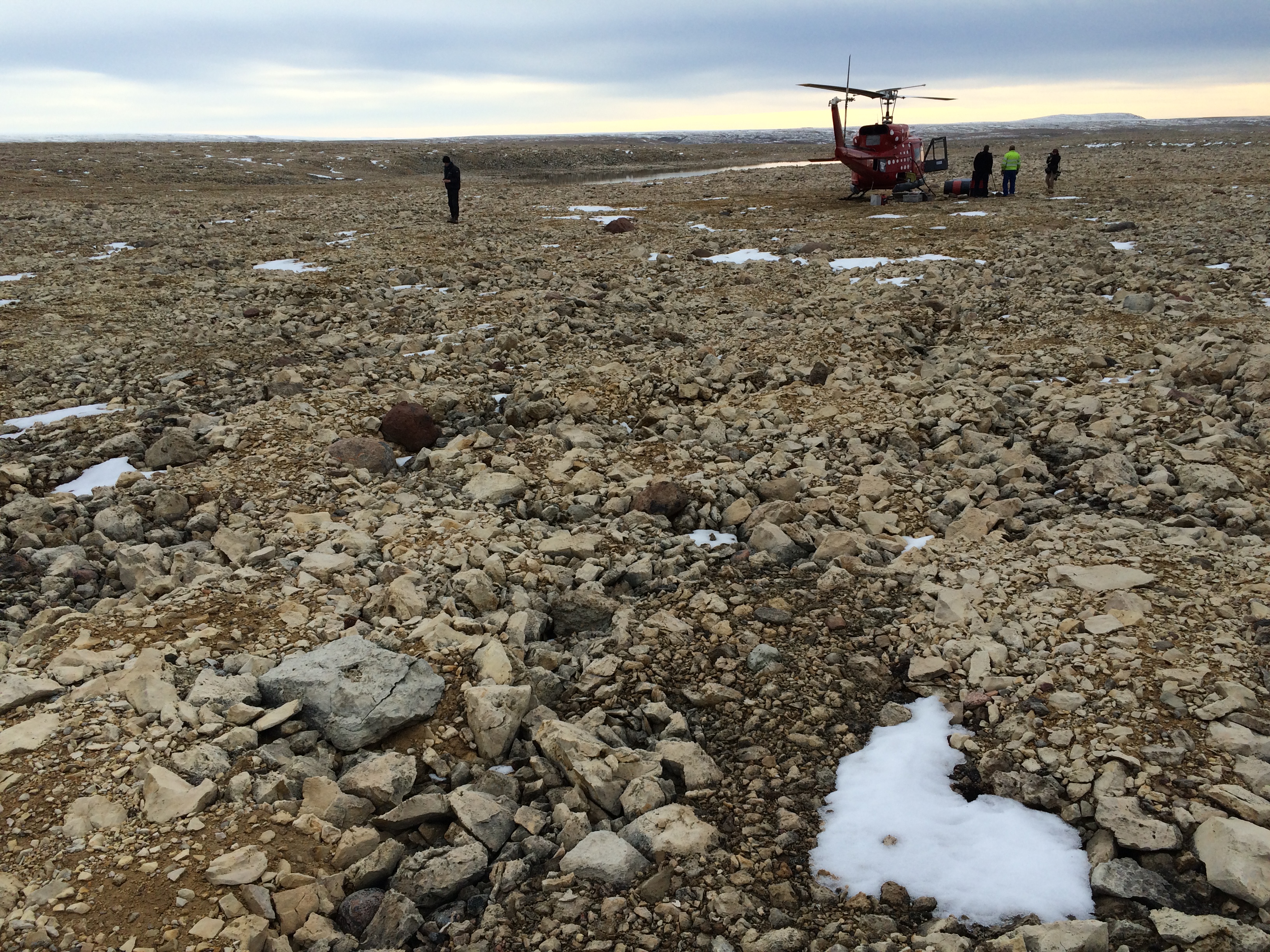
Remote Petermann Gletscher can be reached by helicopter only of one prepares at least two refueling stations along the way. Anticipating a potential future need, we had placed 1300 and 1600 liters of A1 jet fuel at two points from aboard the Swedish icebreaker Oden in 2015. The fuel was given to Greenland Air with an informal agreement that we could use the fuel for a 2016 or 2017 helicopter charter. Our first pit stop looked like this on the southern shores of Kane Basin

Refueling stop on north-eastern Inglefield Land on 27 August 2016. Air Greenland Bell-212 helicopter in the background, view is to the north.

Refueling stop on southern Washington Land on 27 August 2016. Air Greenland Bell-212 helicopter in the background, view is to the south towards Kane Basin.

Helicopter flight path on 27/28 August 2016 to reach Petermann Gletscher (PG) via southern (Fuel-S) and northern (Fuel-N) fuel stops in northern Inglefield and southern Washington Land, respectively. Background color is ocean bottom depth in meters.

Helicopter flight path on 27/28 August 2016 to reach Petermann Gletscher (PG) via southern (Fuel-S) and northern (Fuel-N) fuel stops in northern Inglefield and southern Washington Land, respectively. Background color is ocean bottom depth in meters.

Upon arrival at the first (northern-most) Peterman Gletscher (PG) station we quickly confirmed our earlier suspicion that vertical motion within the 100 m thick glacier ice had ruptured the cables connecting two ocean sensors below the ice to data loggers above. We quickly disassembled the station and moved on to our central station that failed to communicate with us since 11 February 2016. Keith predicted that here, too, internal glacier motions would have stretched the cables inside the ice to their breaking point, however, this was not to be the case.

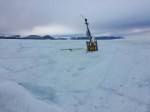
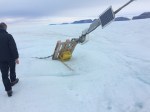
My first impression of this station was one of driftwood strewn on the beach of an ocean of ice:

Looks can be deceiving, however, and we found no damage to any electrical components from the yellow-painted wooden battery box housing two 12 Volt fancy “car batteries” at the bottom to the wind sensor on the top. Backed-up data on a memory card from one of two data loggers (stripped down computers that control power distribution and data collections) indicated that everything was working. The ocean recording from more than 800 meters below our feet was taken only a few minutes prior. In disbelief Keith and I were looking over a full year-long record of ocean temperature, salinity, and pressure as well as glacier motions from a GPS. This made our choices on what to do next very simple: Repair the straggly looking ocean-glacier-weather station, support it with a metal pole drilled 3.5 m into the glacier ice, and refurbish the adjacent radar station. We went to work for a long day and longer night without sleep.

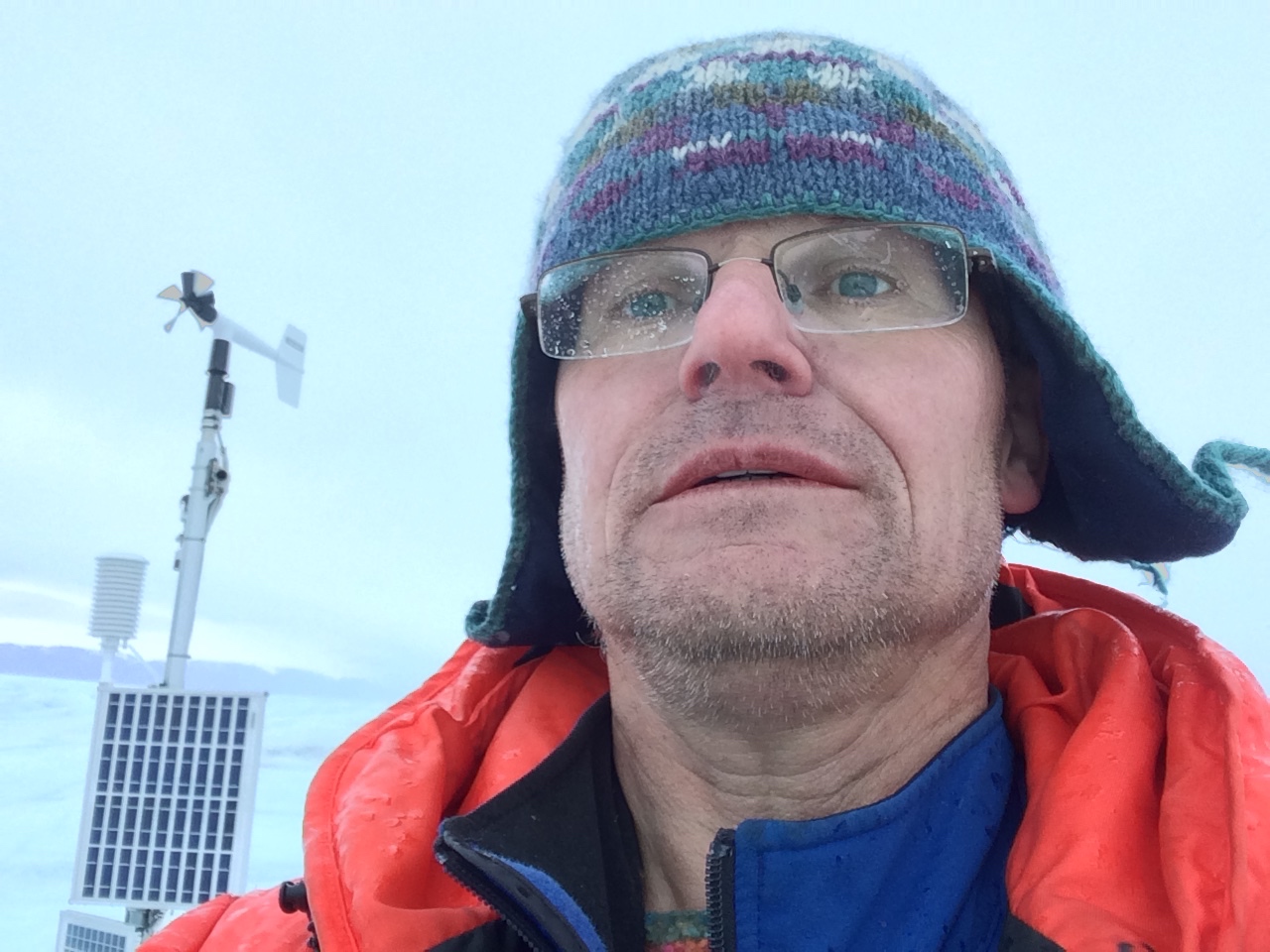
Selfie on Petermann Gletscher on sunday 28 August 2016 after 33 hours without sleep. Weather station and northern wall of Petermann in the clouds. It was raining, too.

Selfie on Petermann Gletscher on sunday 28 August 2016 after 33 hours without sleep. Weather station and northern wall of Petermann in the clouds. It was raining, too.

When all was done, University of Delaware graduate student Peter Washam did the last check at 5:30 am sunday morning. Since then our Greenland station accepts Iridium phone calls every three hours, sends its data home where I post it daily at

http://ows.udel.edu

The data from this station will become the center piece of Peter’s dissertation on glacier-ocean interactions. Peter was part of the British hot water drilling team who camped on the ice in 2015 for 3 weeks while I was on I/B Oden responsible for the work on the physical oceanography of the fjord and adjacent Nares Strait. Alan Mix of Oregon State University prepared and led the 2015 expedition giving us ship and helicopter time generously to support our work on the ice shelf of Petermann. Saskia Madlener documented the scope of the 2015 work in a wonderful set of three videos

Ocean & Ice – https://vimeo.com/178289799
Rocks & Shells – https://vimeo.com/178379027
Seafloor & Sediment – https://vimeo.com/169110567

A first peer-reviewed publication on this station and its data until 11 February 2016 will appear in the December 2016 issue of the open-access journal Oceanography with the title The Ice Shelf of Petermann Gletscher, North Greenland and its Connection to the Arctic and Atlantic Oceans.

Oceanographers in Thule, Greenland

Returning from Petermann Fjord and Gletscher, we left the Swedish icebreaker I/B Oden and its fine crew yesterday afternoon. Our military plane to southern Greenland is broken with spare parts needed to be shipped in from Air Force bases in the United States and Germany. Thule Air Force Base (AFB) at Pituffik is the northern-most US military installation that is maintained since the Cold War with lots of help from Danish authorities and workers. Thule AFB is a large airfield and supply center for much of northern Greenland and beyond. Air temperatures are in the 40ties and it feels very warm after sailing south for 3 days to get here.

As last year, the first thing I did after living for 5 weeks in tight quarters on a ship was head out into the wilderness. While almost everyone else was partying ashore after raiding the local supermarket for fresh fruit, vegetables, beer, and wine, Frederik and I headed out the to climb the mountain that I wanted to climb since I first set eyes on it in 2003. We did not set out until well past 6pm local time, but with lots of sunlight even past midnight, we set out. Who knows if and when we may get this opportunity again. There were also some geocaches.

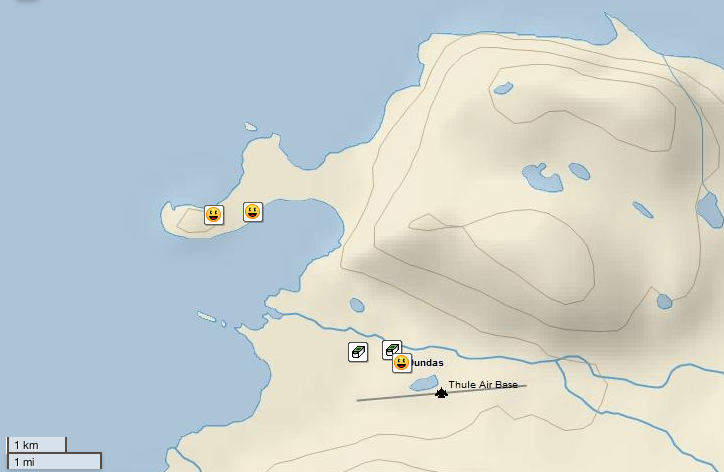
Geocaching map of Thule AFB, North Mountain, and Dundas Mountain. Smiley faces show that I found and opened the hidden treasures.

Geocaching map of Thule AFB, North Mountain, and Dundas Mountain. Smiley faces indicate that I found and opened the hidden treasures.

Frederik is Swedish ecologist whose work around Petermann Fjord was mostly land-based. Leading a group of 3-4 researchers, he was taking an inventory of plant and wild life in a methodical way by setting out a grid 2 meters by 2 meters at random locations. His team then painstakingly counted and recorded every bit of plant, seed, or animal excrement (=shit) that they could find and count. They were living in tents for 5-10 days at a time, returned to the ship via helicopter for a shower, a meal, and to change study area. Within 8 hours his group was usually gone again not to be seen for another 5-10 days.

In contrast to these intense “working hikes,” our leisurely 4 hour stroll was relaxing as he had to record nothing and did not have to lead anyone. Nevertheless, I got blisters on my feet that were well worth this guided nature tour as Frederik patiently answered all my questions on all the trees (1 inch high), all the flowers (1/3 inch), and all the animals that we we saw (falcons, hares, foxes). He also told me that during our 4 hour hike he saw more wild and plant-life than he had seen the entire 4 weeks earlier up north in Hall and Washington Land of Greenland and Ellesmere Island of Canada. There are shades of gray and there are many shades of bare.

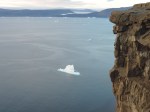
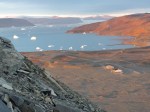
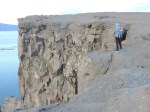
On our way out of town we followed the road to get to a bridge that crossed a big stream of run-off from the nearby Greenland ice sheet that was visible in the distance. Quickly, however, we noticed that the dusty roads are not really leading us to where we wanted to go, so we made our own path over the ridge to the north of town called creatively “North Mountain.” From there we hiked down to the beach of an isthmus that connects to the landmark Dundas Mountain with remains of the old village on this spit of sand and gravel. A group of Danes in trucks and on all-terrain vehicles greeted us at the bottom of Dundas Mountains. Frederik later told me that they were mostly trying to get information on women that may have arrived with us, but they also encouraged us to race up the 60 degree slope. The record apparently stands at 6 minutes and 45 seconds, but we were in no mood to race … quite the opposite: We wanted to take in the views and relax amidst stunning natural beauty in the rough:

Once atop I found the geocache I was looking for as well as a trackable treasure. When I recovered this trackable and posted the find online, I got an elated e-mail from Australia where the owner of the treasure lives. The treasure is now with me in Delaware where I will hide for other people to find and move along in a wonderful game of hide and seek and traveling.

Now that I am home again after 6 weeks away without real internet or e-mail access (imagine the horrors), I want to tell some of the many stories that involve a group of people doing science, making discoveries, and share what they find. Most of us are deeply grateful for the privilege to make these discoveries: It is people like you, my dear reader, because the funds for ships and planes and food and fuel and much more comes from organizations like the National Science Foundation, the National Aeronautics and Space Administration, as well as the US Department of Defence, but ultimately the funds all come from tax-paying citizens of a great country.

GPS, Geocaching, and Greenland Glaciers

Navigating ice, ocean, and land, brave women and men have always used the stars for guidance. Just think of the three kings who followed a star to witness the birth of Jesus Christ in Bethlehem 2015 years ago. They were 6 days late. Keeping track of time track was always difficult for navigating, especially at sea and the British Navy lost many ships as a result of poor time keeping. There are books written on the history of determining longitude, the best of which is called, well, “Longitude.” Now why would I ponder these questions and histories two hours before I am boarding the Swedish icebreaker Oden to travel by sea and ice to Petermann Glacier?

The Global Position System (GPS) that many of us have in our smart phones or tiny hand-held devices makes navigating easy. Both measure time as our civilization has put “stars” into space that guide hikers out in the back-country, urban dwellers to the next bar or restaurant, and missiles into a target the size of the dot over the letter “i” on a license plate of a car. Few know that the GPS satellites only sent time from an atomic clock to our GPS receivers and smart phones. Time is of the essence, there is something almost spiritual about time and how to define it. And time is linked to space not just because of Einstein’s theory of relativity, but also the way we measure space by measuring the time that waves travel through space.

Waiting for the plane to get 58 scientists to Thule to board the I/B Oden, I went for a geocaching trip an hour or two from the town of Kangerlussuaq. My wife got me into this 2 years ago as a way to explore areas via hiking without much planning. All we do is enter some GPS position of places where other people have placed “treasures” and we head out to find them. These geocaches are everywhere: within 100 feet of my home, in every city I went to in Poland, Sweden, or Germany, and now Greenland, too. My favorite GPS unit is a little hand-held $99 Garmin eTrex 10. It does a marvelous job to get me anywhere within about 3-6 feet (1-2 meters).

As part of our Petermann research, we also got four “fancy” GPS systems which we want to place on the ice shelf of Petermann Gletscher to measure tidal motions. The water under the glacier is connected to ocean that moves the Empire-State-Building thick ice up and down every 12 hours or so. We do not know by how much, though, and when it moves up and when it moves down. There should also be daily cycles and longer periods caused by winds and waves. Now these fancy $25,000 GPS are able to track over 400 satellites (not just the 9 that my Garmin does) and they receive the time information in a very raw and accurate format at more than one radio frequency in more than one way. If one has several of these, we got four, then it is possible to built a network that reduces common errors in position to a few millimeters in the horizontal, and 1-2 centimeter in the vertical after some smart processing. So these “fancy GPS” can sense the difference of the top of your smart phone from the bottom, and I do not mean its length or width, but its thin height. And this is blowing my mind. We need this accuracy to measure tides, and tides we will measure for the 20-30 days that we are working in and around Petermann Gletscher.

Wish us luck as we are heading from the green part of Greenland in the south to its white (ice), black (ocean), and gray (land) parts. There are few colors where we will be the next 4 weeks. Our internet will be gone, but I will try to send text files and small photos until we return on 4 September or so, but time will be hard to find. Wish all of us luck …

Preparing for Petermann One Day At a Time

Glaciers, Greenland, Adventure, Expedition, Ice, Polar Bears, Narwhales, oh the fun to go to Greenland.

Swedish icebreaker I/B Oden 22 July 2015 on its way to Thule. [Photo Credit: https://twitter.com/SjoV_isbrytning]

Swedish icebreaker I/B Oden 22 July 2015 on its way to Thule. [Photo Credit: https://twitter.com/SjoV_isbrytning%5D


This romantic notion is false and pretty pictures always lie. To prove my point, I just list what one scientist does 4 days before shipping out to Greenland for 5 weeks. [My wife left last week to visit our grown son in California. She knows the drill, focus, and strain that does not make good company. We have gone through such 4-8 weeks of separation many times during our 20+ years of marriage; her leaving a week before I do works rather well for us]:

04:45 Wake up
05:00 Check e-mail on iPhone in bed
05:05 Read Twitter feed: Canadian research ship diverted to break ice in Hudson Bay
05:10 Check references to outreach-related news
05:15 Read Wilson Quarterly article “The Race to the Arctic” on Arctic developments with global policy impacts
05:30 Shower and Dress
05:45 Check Iridium data collection to Oden, fix minor problem
06:00 Check Hans Island weather, winds still from the north at 10 kts
06:15 Clean up mess cat made, make coffee
06:30 Check latest satellite imagery on Nares Strait, beautiful Arctic lead (upwelling) and sediment plumes from streams and glaciers
07:00 Bicycling to work
07:15 Brief hallway meeting with new grant specialist
07:30 Checking news on Arctic Sea Ice Forums
07:35 Downloading and reading peer-reviewed papers for proposal writing
08:00 Distracted by Tamino’s post about Five signs of denial regarding climate change
08:00 NSF Proposal writing
08:30 Distracted, responding to international e-mails
09:00 Passing links and photos for future press release

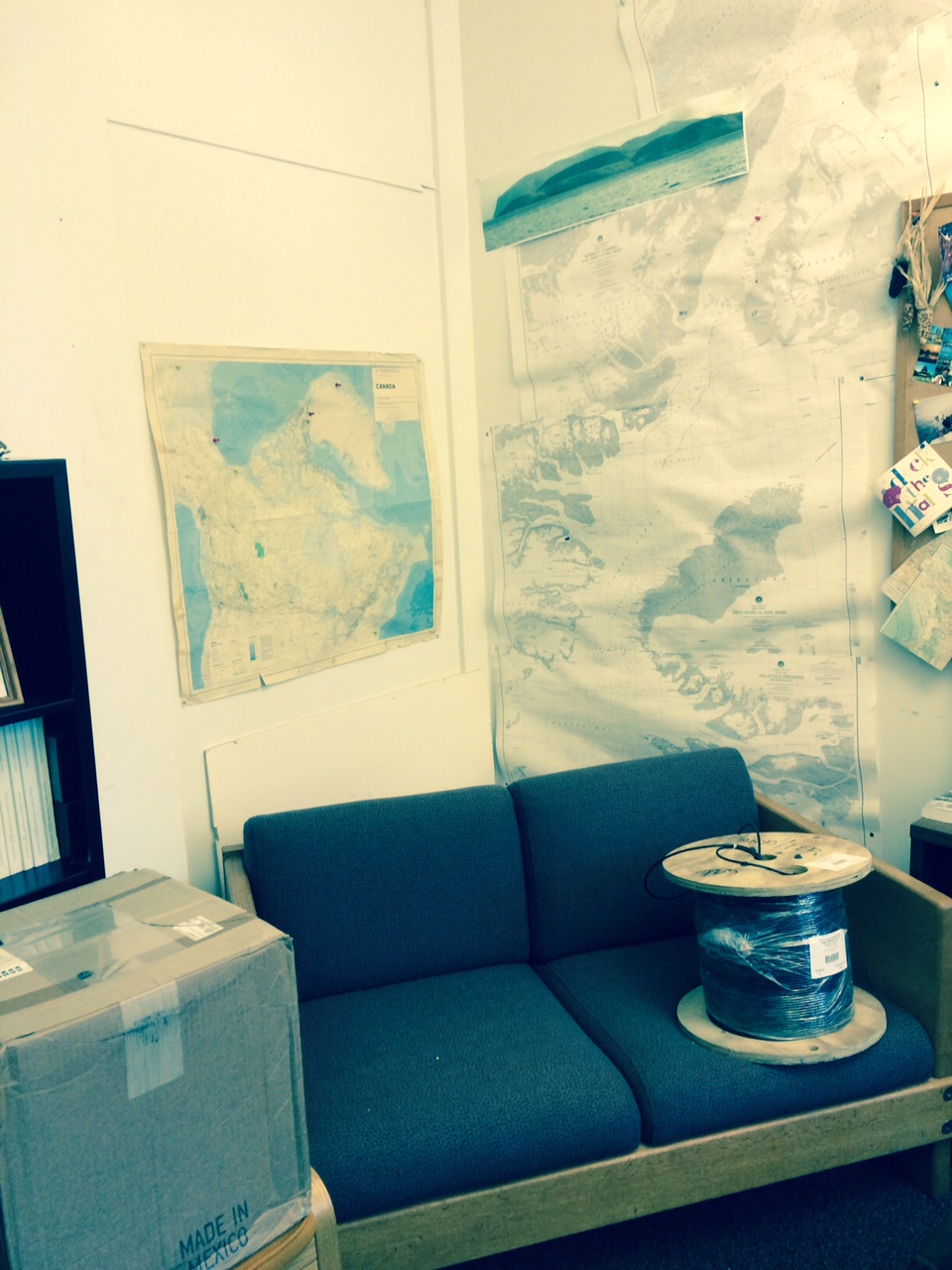
My littered office with 2 (of 10) drums of cable to connect ocean sensors through 300 m thick ice to Iridium satellite phone at the surface.

My littered office with 2 (of 10) drums of cable to connect ocean sensors through 300 m thick ice to Iridium satellite phone at the surface.

I am falling behind and feel the tension to get this NSF proposal finished by saturday. NSF stands for National Science Foundation, the proposal is asking for $500,000 to conduct a 3-year experiment with German and Norwegian scientists in the summers of 2016 and 2017. If successful, it will support two graduate students full time for two (MS) and three (PhD) years as well as two technicians for five months total. Peer-review of these proposals is brutal with perhaps a 1:7 success rate on average.

09:15 NSF proposal writing
09:40 Respond to former collaborator on an underwater acoustic communication project
09:45 Back to NSF proposal writing
10:00 Studying Sutherland and Cenedese (2009) on dynamics of the East Greenland Current interacting with canyons as explored by laboratory study
10:30 Converting Latex files to .pdf for uploads to NSF server
11:00 Read and edit UDel Press Release
11:15 Giving university administrators full access to current version of NSF proposal after uploading files to NSF servers
11:20 Heading to coffee shop for short bicycle break
12:00 UNAVCO gear arrived at office
12:05 Re-design the mechanics of the surface mount of the automated weather station to be deployed on Petermann Glacier

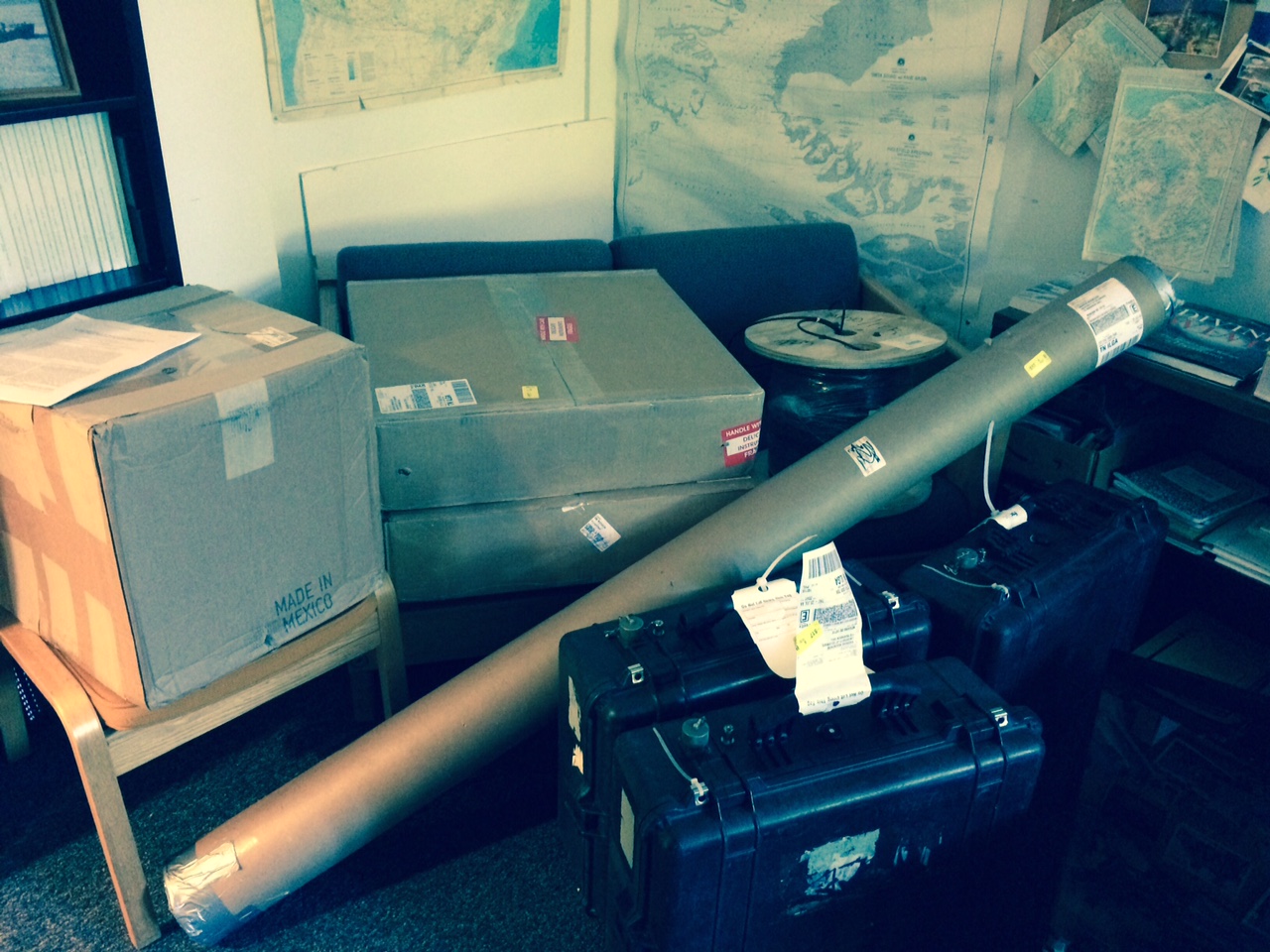
UNAVCO GPS systems for deployment on Petermann Gletscher.

12:45 Checking ice and weather in Nares Strait, Arctic Forecast
13:00 Back to proposal, writing/thinking about buoyant coastal currents interacting with canyons
16:00 Meet with PhD student on physics of GPS
16:15 Back to proposal writing
17:30 Graphical layout of proposal
18:15 Bicycle to Main Street for steak + margarita dinner
19:30 Home; set-up overdue MODIS processing
19:45 Edit this list, add links, and photos
19:55 Check Nares Strait weather and DMI Greenland ice
20:15 Daily Iridium data download from Oden works (equipment testing)


20:30 Posting this post
20:45 Editing and updating this post
21:00 Finished processing and posting on my web serverNares Strait MODIS imagery for the week