Tag Archives: Petermann

New ocean data from floating Petermann Glacier

#UDel Ocean-Weather station #Greenland on #petermann2015 calls home from 800 m under floating glacier with 2 weeks of new hourly data.

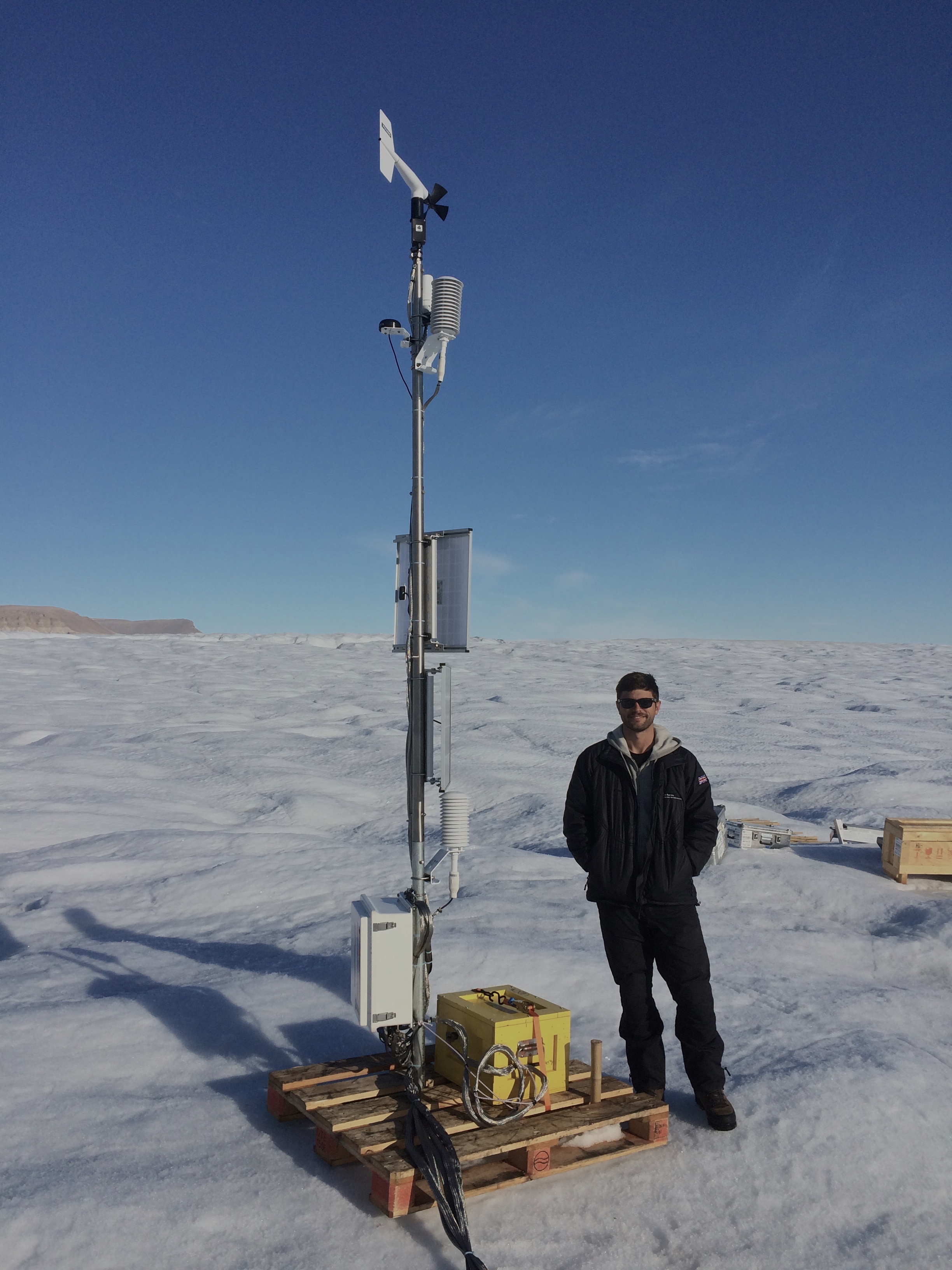
University of Delaware Ocean-Weather station on Petermann Glacier with the hot-water drilling team UDel and British Antarctic Survey after deployment Aug.-20, 2015 [Credit: Peter Washam, UDel]

University of Delaware Ocean-Weather station on Petermann Glacier with the hot-water drilling team UDel and British Antarctic Survey after deployment Aug.-20, 2015. Cables from ocean sensors emerge from the ice where the wooden cross is located on the right. [Credit: Peter Washam, UDel]

Map of Greenland's Petermann Gletscher, Fjord, and adjacent Nares Strait. The UDel Ocean-Weather station is the green dot on the floating ice shelf that does not have a red triangle. Blue dots in the ocean are where we collected ocean data from I/B Oden in August 2015. Green dots are ocean moorings which report via Iridium while red triangles are "fancy" GPS locations we instrumented for 12 days to measure vertical tidal elevations of the glacier.

Map of Greenland’s Petermann Gletscher, Fjord, and adjacent Nares Strait. The UDel Ocean-Weather station is the green dot on the floating ice shelf that does not have a red triangle. Blue dots in the ocean are where we collected ocean data from I/B Oden in August 2015. Green dots are ocean moorings which report via Iridium while red triangles are “fancy” GPS locations we instrumented for 12 days to measure vertical tidal elevations of the glacier.

My nerves are shot and I get depressed when the Ocean-Weather station does not call home when she should. We deployed the station last months on the floating section of Petermann Gletscher where she has moved steadily towards the ocean at about three meters per day. We measure this with GPS which is the black dot next to the temperature sensor above the head of the team that drilled the hole. It connected 5 ocean temperature, salinity, and pressure sensors to 800 meter depth below sea level. The data come from this great depth to the surface where it feeds into the weather station that then transmits data via an Iridium antenna to another Iridium antenna that sits atop my house. Let me run out and take a quick photo of it …
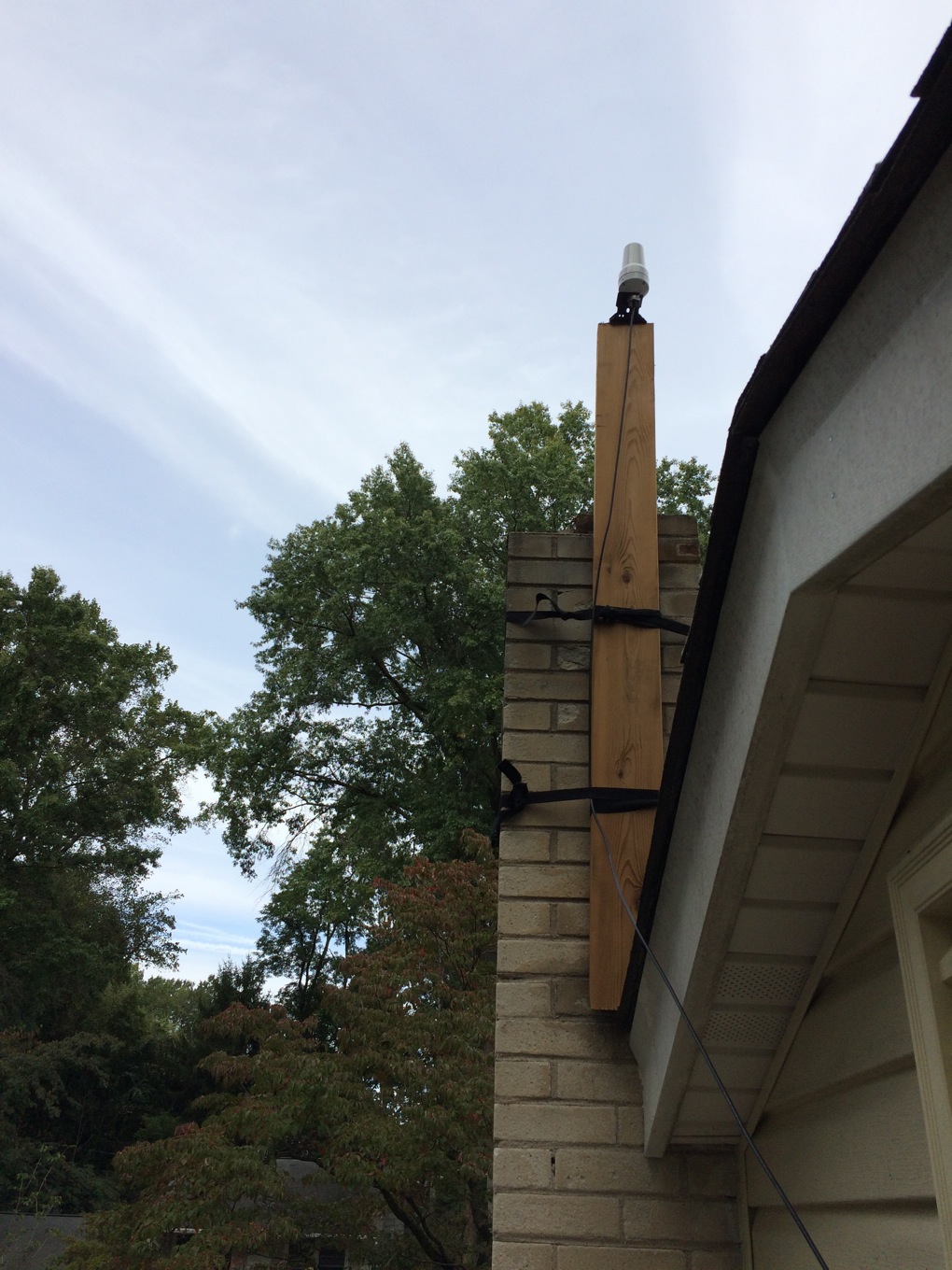
Iridium antenna atop my house in Newark, Delaware that receives data calls from Greenland.

Iridium antenna atop my house in Newark, Delaware that receives data calls from Greenland.

My problem with Iridium over the last 6 weeks has been that its (data) connectivity is spotty. For example, I received no data the last 2 weeks. This has been the longest time with no call and no new data. Designing the system, I decided against the more robust “Short-Burst-Data” SBD text messages. Instead I opted for a truly 2-way serial connection which, if a connection is established, allows more control as well as a more complete and gap-free data stream. The drawback of this serial connection via Iridium is lack of connectivity. Sometimes days or weeks go by without a successful connection even though computer codes are written to connect every 8 hours. I can change that by uploading new codes to the two Campbell CT1000 data loggers that control all sensors as well as data collection and communication via Iridium.

Today’s call was the first in two weeks, but it provided a complete data download without ANY gaps in the hourly time series of weather in the atmosphere (wind, temperature, humidity) and weather in the ocean (temperature, salinity, pressure). The ocean data show that about every 2 weeks with the spring-neap cycles, we see very large excursions of colder and fresher water appear at 2 sensors within about 30 meters of the glacier ice. It is too early to speculate on how this may relate to ocean circulation and glacier melting, but the large and frequent up and down do suggest a lot of ocean weather.

I am anxiously awaiting the next data call in about 5 hours to get the 8 hours of data. Wish me luck and a healthy Iridium satellite system where calls are about $0.90/minute. Today’s call took 5 minutes. This is what some of the (uncalibrated) data look like:
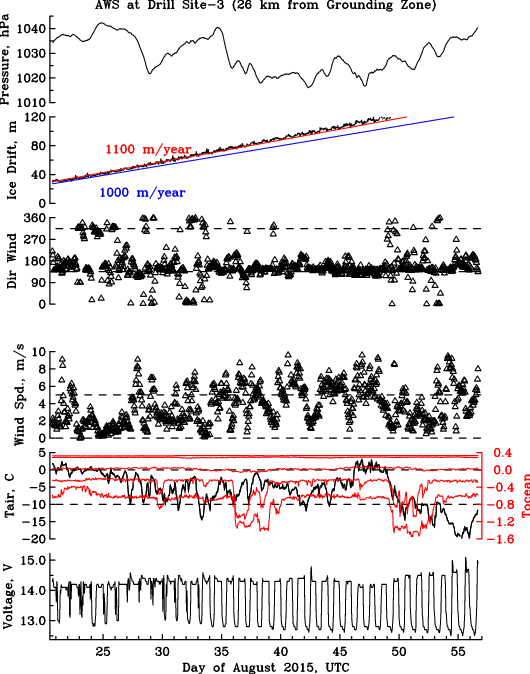
Ocean-Weather station data from Aug.-20 through Sept.-25 (today). Ocean temperatures at 5 vertical levels are shown as 5 red curves  in 5th panel from top. The black lines in that panel are air temperatures that reached -20 C this week.
Ocean-Weather station data from Aug.-20 through Sept.-25 (today). Ocean temperatures at 5 vertical levels are shown as 5 red curves in 5th panel from top. The black lines in that panel are air temperatures that reached -20 C this week.

Ocean Weather Below a Greenland Floating Glacier

Sensing the oceans below ice as thick as the Empire State Building is tall, we are revealing some of the mysteries of ocean melting of one of Greenland’s largest glaciers. The expedition to Petermann Fjord last month made possible the deployment of three ocean sensing stations that all call home daily via Iridium satellite phone to send us new data from 800 meters below sea level. The ice of the glacier at our stations is 100 to 300 meters thick and a whimsical cable with 3 tiny wires connects the instruments under the glacier to a home-made computer that calls home daily with new data. I am still stunned at the many marvels of technology that all came together to make this happen.

University of Delaware PhD student Peter Washam at the Ocean-Weather station on Petermann Gletscher after final installation 2015-Aug.-20, 17:00 UTC at 80 39.9697 N and 60 29.7135 W.

University of Delaware PhD student Peter Washam at the Ocean-Weather station on Petermann Gletscher after final installation 2015-Aug.-20, 17:00 UTC at 80 39.9697 N and 60 29.7135 W.

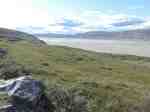
Panoramic view of the ocean-weather station on Petermann Gletscher. View is towards the south-east with Washington Land in the background.  [Photo credit: Peter Washam].

Panoramic view of the ocean-weather station on Petermann Gletscher. View is towards the south-east with Washington Land in the background. [Photo credit: Peter Washam].

It started with an off-the-shelf automated weather station that David Huntley at the University of Delaware put together for me with the non-standard addition of 5 serial ports that each allow one ocean sensor to be connected by cable to the weather station. It continued with the holes that Paul Anker and Keith Nicholls of the British Antarctic Service drilled through Petermann Gletscher. My PhD student Peter Washam was on the ice helping with the drilling, preparing the ocean sensors, and he is now processing some of the new ocean data.

AWS2015

The map above shows Petermann Gletscher (bottom right), Petermann Fjord, and adjacent Nares Strait. The red lines are bottom depths at 500 and 1000 meters while the thick black line shows the location where the 550-m thick glacier sits on bed rock. All glacier ice seaward of this black line is floating with warm ocean waters below. These waters enter the fjord at he sill at the entrance to Petermann Fjord which is about 450 meters deep. The blue dots are locations where last months we collected detailed profiles of ocean temperature salinity, and oxygen. The warmest water inside the fjord and under the glacier enters near the bottom at this sill. The green dots on the glacier are the 3 drill sites where we put our ocean sensors down while red triangles are “fancy” GPS receivers that we placed for almost 2 weeks on the glacier. The one triangle on land (bottom right) is a permanent GPS station at Kap Schoubye that UNAVCO maintains under the code name SCBY. We will reference our moving glacier GPS station (the glacier moves) to this fixed station on bed rock, but that’s a story for another day.

The ocean data are worked up by a small, but wonder group of men and women of all ages working out of the universities of Gothenburg (Sweden), Oxford (England), and Delaware (USA) as well as BAS (England). It is very much an informal group of people who like each other and met in strange ways over the last year or so with all of us juggling way too many projects for which we all have way too many ideas. Bottom-up collaboration and sharing at its best from the bottom up.

Two quick highlights rushed onto these pages before I have to run off to teach a class on signal processing:

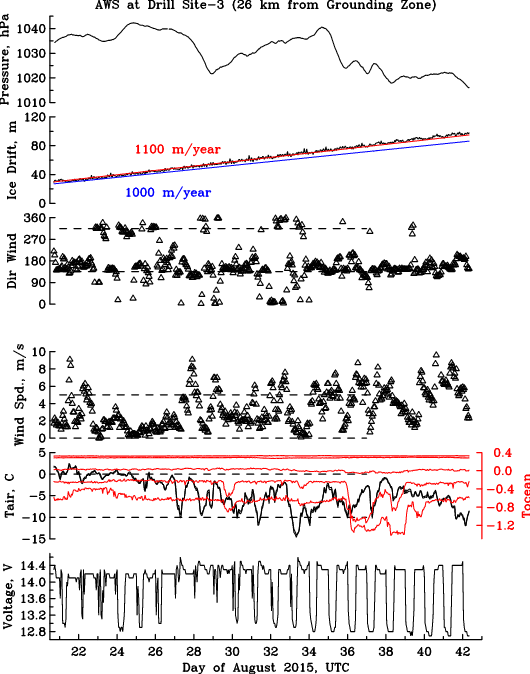
Measurements from the ocean weather station up until 2015-Sept.-11 as a function of time where Day-20 is Aug.-20 and Day-32 is Sept.-1. The station provides battery voltage (bottom panel), air and ocean temperatures, wind speed and direction, ice drift from GPS, and atmospheric pressure (top panel).

Measurements from the ocean weather station up until 2015-Sept.-11 as a function of time where Day-20 is Aug.-20 and Day-32 is Sept.-1. The station provides battery voltage (bottom panel), air and ocean temperatures, wind speed and direction, ice drift from GPS, and atmospheric pressure (top panel).

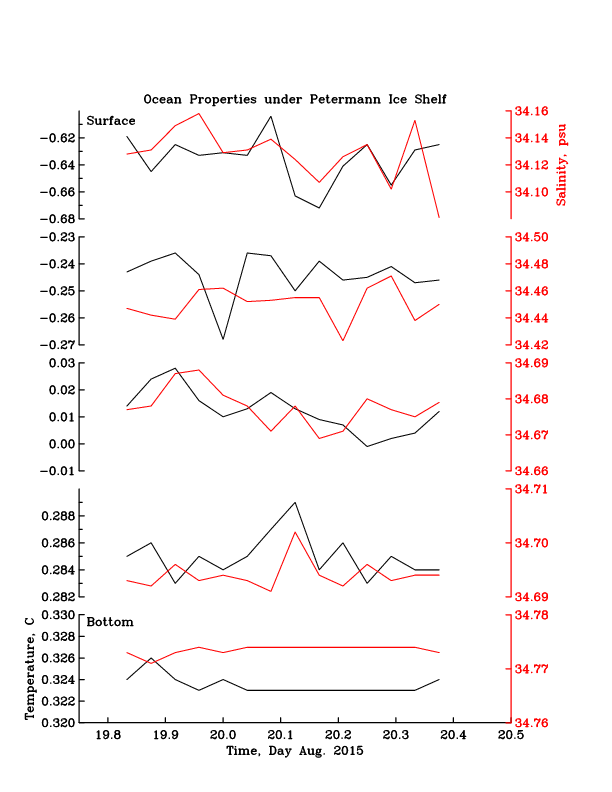
Ocean temperature (black) and salinity (red) observations from below the ice shelf of Petermann Gletscher at 5 different vertical levels from near the bottom (bottom panel) to the ice-ocean surface (surface panel).

Ocean temperature (black) and salinity (red) observations from below the ice shelf of Petermann Gletscher at 5 different vertical levels from near the bottom (bottom panel) to the ice-ocean surface (surface panel).The bottom of the ice shelf is about 90 meters below sea level.

Note that the scales for temperature and salinity are different at different vertical levels. The warmest water is always found near the bottom while both temperature and salinity under the ice shelf vary by a larger amount that we had initially expected. This means that there are direct and fast connections of the ocean under the glacier with waters inside the fjord and beyond. Notice also that air temperatures are well below freezing (0 degrees Celsius) for 2-3 weeks now while the ocean waters are well above freezing (-1.7 degrees Celsius) everywhere. Hence there is no melting at the surface while there is much melting at the bottom of the glacier. While trivial, this emphasizes the controlling influence that the oceans have on glaciers and ice shelves such as Petermann Gletscher. In the meantime, we got much exciting and fun work ahead of us.

Shout of thanks to NASA (and the US tax-payers) who funded this ocean-weather station at the University of Delaware at about $64,000 for a single year and NSF (and again the US taxpayers) who funded the larger ocean- and land-based experiments within which small part was embedded.

Münchow, A., Padman, L., and Fricker, H.A. (2014). Interannual changes of the floating ice shelf of Petermann Gletscher, North Greenland from 2000 to 2012, Journal of Glaciology, Vol. 60, No. 221, doi: 10.3189/2014JoG13J135

Johnson, H., Münchow, A., Falkner, K., & Melling, H. (2011). Ocean circulation and properties in Petermann Fjord, Greenland Journal of Geophysical Research, 116 (C1) DOI: 10.1029/2010JC006519

Rignot, E., & Steffen, K. (2008). Channelized bottom melting and stability of floating ice shelves Geophysical Research Letters, 35 (2) DOI: 10.1029/2007GL031765

Ocean Observing Station Reporting from Below Petermann Gletscher, Greenland

We discovered warm waters 800 meter down a hole drilled 100 m through Petermann Gletscher ice.  Every hour an ocean sensor querries temperature, salinity, and pressure and reports its readings to a weather station atop the glacier. The warm waters come from the Atlantic and enter the Arctic Ocean near Spitsbergen. Prior to hitting our sensors in an 800 m deep fjord in northern Greenland, the water moved along Siberia, Alaska, and northern Canada before snaking its way into Petermann, Greenland to perhaps melt this glacier from below while surface air temperatures are already below freezing. It is a long way from home for both those Atlantic waters and us scientists and crew here aboard the Swedish icebreaker Oden and four hardy explorers camping on the floating ice of Petermann Gletscher.

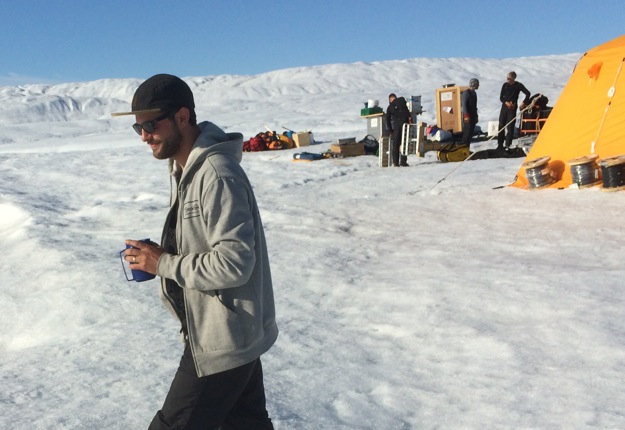
Peter Washam on Petermann Gletscher at an ice drilling camp. Cables and ropes against tent are used later to connect ocean sensors to the weather station.

Peter Washam on Petermann Gletscher at an ice drilling camp. Cables and ropes against tent are used later to connect ocean sensors to the weather station.

Keith, Paul, and Mike of the British Antarctic Survey as well as my graduate student Peter deployed 5 ocean sensors with cables and ropes. A weather station designed by David Huntley of the University of Delaware provides the command and control between ocean sensors, battery and solar panels, and the Iridium satellite modem to send data back home. For me this engineering project took over much of my life the last 6 months as all testing and coding has been done while traveling. Much problem-based learning took place not for pedagogic reasons, but as a necessity to make something special work. And work it does.

First 14 hours of ocean data from below the floating ice shelf of Petermann Gletscher as of 20. Aug. 2015. Top time series are from just under the ice shelf near 120 m while the bottom time series is from a sensor at 810 m below the surface.

First 14 hours of ocean data from below the floating ice shelf of Petermann Gletscher as of 20. Aug. 2015. Top time series are from just under the ice shelf near 120 m while the bottom time series is from a sensor at 810 m below the surface.

These are the first and only data from below a glacier in Greenland that do not involve a person tending to instruments, computers, and cables with a helicopter or aircraft waiting. Our observing system is fully automated and the first 14 hours of data were collected by my computer on the ship calling the computer on the weather station which then sends the data after some computer-to-computer hand-shaking.

The weakest and most fickle link in this chain is the Iridium satellite phone to move data through thin and cold air. Senator McCain of Arizona called the ship yesterday and was rudely disconnected by Iridium the same way that our ocean weather station is.

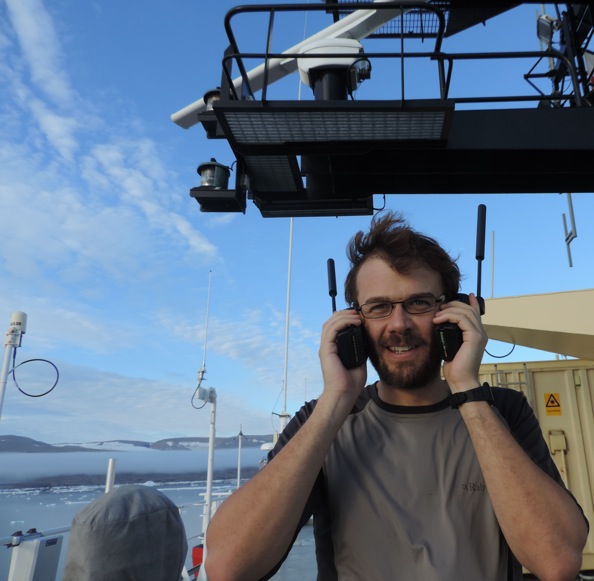
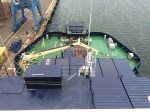
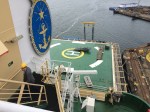
Rob Holden testing Iridium phones above the bridge of I/B Oden.

Rob Holden testing Iridium phones above the bridge of I/B Oden.

Unlike busy, engaged, and well-meaning politicians, however, the computers will tirelessly try again and again every three hours to send the data back that the weather station on Greenland accumulates no matter how well Iridium is connecting it to us.

Power is key as is a flexible budget that adapts to both scientific needs and environmental conditions. I here do not talk about politics in Washington, DC, but the design of the weather station that is powered by both batteries and solar panels while the Iridium modem is the most energy gobbling component of the ocean observing system. Hence it is switched off at all times except a 20 minute window every three hours. I will have to change this window to 20 minutes once per day in the winter when the station will have to operate in complete darkness. So, many challenges are still ahead which includes a mechanical design to fix a weather station on a melting glacier, but alas, winter here is already upon as with air temperatures on and off the glacier below freezing. New ice forms in the early morning hours already.

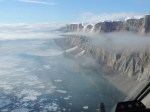
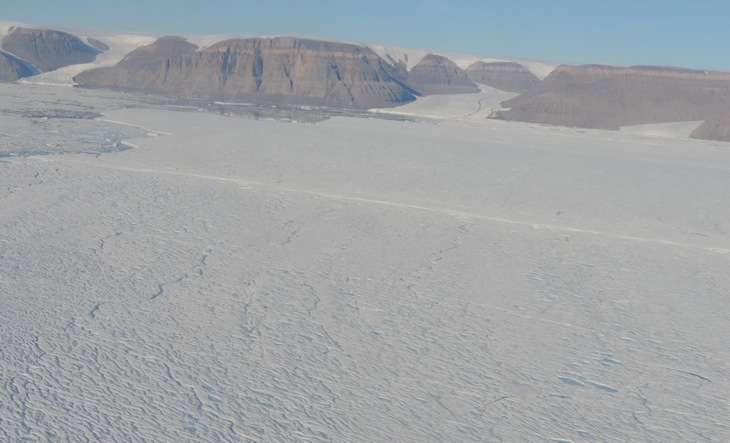
Terminus of Petermann Gletscher with Hubert (right), Belgrave (center), and Un-Named (left) Glaciers coming in from Hall Land in the north. The ocean is to the left (west).

Terminus of Petermann Gletscher with Hubert (right), Belgrave (center), and Un-Named (left) Glaciers coming in from Hall Land in the north. The ocean is to the left (west).

Sent from I/B Oden at 17:38 UTC on 20 Aug. 2015 at 81:26 N and 064:03 W

GPS, Geocaching, and Greenland Glaciers

Navigating ice, ocean, and land, brave women and men have always used the stars for guidance. Just think of the three kings who followed a star to witness the birth of Jesus Christ in Bethlehem 2015 years ago. They were 6 days late. Keeping track of time track was always difficult for navigating, especially at sea and the British Navy lost many ships as a result of poor time keeping. There are books written on the history of determining longitude, the best of which is called, well, “Longitude.” Now why would I ponder these questions and histories two hours before I am boarding the Swedish icebreaker Oden to travel by sea and ice to Petermann Glacier?

The Global Position System (GPS) that many of us have in our smart phones or tiny hand-held devices makes navigating easy. Both measure time as our civilization has put “stars” into space that guide hikers out in the back-country, urban dwellers to the next bar or restaurant, and missiles into a target the size of the dot over the letter “i” on a license plate of a car. Few know that the GPS satellites only sent time from an atomic clock to our GPS receivers and smart phones. Time is of the essence, there is something almost spiritual about time and how to define it. And time is linked to space not just because of Einstein’s theory of relativity, but also the way we measure space by measuring the time that waves travel through space.

Waiting for the plane to get 58 scientists to Thule to board the I/B Oden, I went for a geocaching trip an hour or two from the town of Kangerlussuaq. My wife got me into this 2 years ago as a way to explore areas via hiking without much planning. All we do is enter some GPS position of places where other people have placed “treasures” and we head out to find them. These geocaches are everywhere: within 100 feet of my home, in every city I went to in Poland, Sweden, or Germany, and now Greenland, too. My favorite GPS unit is a little hand-held $99 Garmin eTrex 10. It does a marvelous job to get me anywhere within about 3-6 feet (1-2 meters).

As part of our Petermann research, we also got four “fancy” GPS systems which we want to place on the ice shelf of Petermann Gletscher to measure tidal motions. The water under the glacier is connected to ocean that moves the Empire-State-Building thick ice up and down every 12 hours or so. We do not know by how much, though, and when it moves up and when it moves down. There should also be daily cycles and longer periods caused by winds and waves. Now these fancy $25,000 GPS are able to track over 400 satellites (not just the 9 that my Garmin does) and they receive the time information in a very raw and accurate format at more than one radio frequency in more than one way. If one has several of these, we got four, then it is possible to built a network that reduces common errors in position to a few millimeters in the horizontal, and 1-2 centimeter in the vertical after some smart processing. So these “fancy GPS” can sense the difference of the top of your smart phone from the bottom, and I do not mean its length or width, but its thin height. And this is blowing my mind. We need this accuracy to measure tides, and tides we will measure for the 20-30 days that we are working in and around Petermann Gletscher.

Wish us luck as we are heading from the green part of Greenland in the south to its white (ice), black (ocean), and gray (land) parts. There are few colors where we will be the next 4 weeks. Our internet will be gone, but I will try to send text files and small photos until we return on 4 September or so, but time will be hard to find. Wish all of us luck …

Sweden’s Icebreaker for Petermann Gletscher 2015

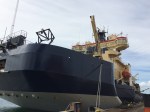
Sweden’s icebreaker I/B Oden will sail for Greenland this summer to pick up about 50 scientists to work the ice, land, water, and glaciers of north-west Greenland with Petermann Gletscher as its focus. I will be working with Celine Heuze of Gothenburg University, Jari Kruetsfeldt of Stockholm Technical University, and Christina, a Swedish High School teacher. Together we are responsible to run the water sampling and ocean sensing.

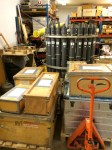
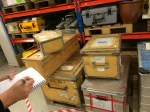
We met 3 weeks ago on the ship in Landskrona, Sweden where we loaded all our boxes filled with computers, electronics, bottles, rubber hoses, and some more computers. We also met the ship’s crew and a larger group of scientists and engineers from Oregon State University in the US, Gothenburg and Stockholm Universities in Sweden, and the Swedish Polar Research Secretariat that runs the ship. For 3 days we worked, ate, slept (somewhat), and worked some more to get ourselves and our equipment unpacked and organized.

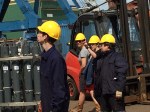
There is nothing romantic about working in an industrial area lugging boxes and stuff up and down stairs from back to front and back again. Despite all the cranes, winches, fork lifts, A-frames, and other tools, it is still back-breaking labor as much is still carried to and fro by hand while watching for heavy loads overhead, sharp corners below, and tight corners to maneuver around. Hard-hats and steel-toed boots are NOT optional. The only positive here is that shared pain brings people together to lower the pain via teamwork.

While most people seem fresh and happy, this wears off after 3 days of intense work not captured in photos. Sleep deprivation sets in as everyone tries to cram too much work into the 24 hours available. And yet, it is during these short and intense work periods, that new friendships and scientific collaborations emerge quickly even though people do not always look their best.

As an example, here is me as a zombie after about 4 nights with little sleep

As always, I try too much as I perform my duties on the water sampling and ocean sensing during the day and fight a nasty Iridium satellite communication problem  at night.  At the University of Delaware we designed, assembled, and shipped off to Sweden an air and ocean weather station to be deployed above and below the floating tongue of Petermann Gletscher. There was no time for testing as all gear to deployed on Petermann Gletscher in August had to be in Landskrona in May.

Despite the looks, I was ecstatic on the inside, because I had just solved a crucial sub-problem when an e-mail reached me that a small NASA grant was coming my way to actually pay for the science that I hope to do during this summer. This, however, is another story for another day.