Tag Archives: oceanography

Moira Dunbar, Arctic Exploration, and Women in Science

Throughout history, the ocean has been the domain of sea monsters, Neptune and men. The women found in nautical history are portrayed as distractions or a sailor’s connection to land.  Robert Louis Stevenson only wrote one female character in Treasure Island, Jim Hawkins’ mother, who only briefly graces the pages with her presence.  Pirates and sailors alike did not tolerate women on ships except for a captain’s wife, mistress, or daughter.

This attitude towards women in sailing continued even after American women were given the right to vote in 1920. Born 2 years earlier in Scotland, Moira Dunbar was an extraordinary woman fighting for her right to go to sea in the name of science.

Originally from Edinburgh, Dunbar emigrated to Canada in 1947, where she studied ice movement for the Joint Intelligence Bureau of Canada. She later moved to the Defense Research Board in 1952, where she fought notions that a woman couldn’t go to the Arctic on reconnaissance planes of the Royal Canadian Air Force. She co-authored Arctic Canada From the Air with Keith R. Greenaway in 1956. She logged over 600 flight hours and became the first woman to sail as part of a science crew on board a Royal Canadian Navy icebreaker.

The M/V Calanus as seen August 2007 in Iqualuit (formerly Frobisher Bay) on Baffin Island. Moira Dunbar published hydrographic data collected off Baffin Island from this ship in 1958.[Photo Credit: Andreas Muenchow]

Moira Dunbar persisted in breaking through barriers traditionally placed on her gender, blazing a trail for women in science and research. She wasn’t satisfied with standing by idle while her male colleagues went to the Arctic to study, in person, what she was researching, so she made her own way.

Since Dunbar’s entrance into the world of polar science, women have faced fewer challenges entering scientific fields, but are still underrepresented. Men occupied 74% of science and engineering jobs in the United States in 2006 according to a 2011 National Science Foundation (NSF) study. Within the sciences, even fewer women are in physical sciences and engineering.

Even though these statistics may appear daunting to a woman entering the sciences, there is good news: the number of women in science and engineering has been increasing steadily for a long time. From 1979 to 2008, the number of women and minorities as a percentage of full-time, full professors with science and engineering doctorates has more than quadrupled.

Every year, more women enter the sciences and my experience reflects this: entering Macalester College, St. Paul, MN in 2009 as a first-year female physics major, I found not a single woman in the graduating class. In contrast, I can now name at least 5 beside myself. And in such a small major (only 15-20 students), 5 is quite a large number. Women are heading out into the world of science, just as Moira Dunbar did more than 60 years ago. I know many women working on ships in both the Pacific and Atlantic Oceans as skippers, scientists, cooks, and engineers, and I am looking forward to boarding a Canadian Coast Guard Vessel later this summer for some Arctic research myself.

Greenland’s Glaciers, Science, Sea-Level, and Teachers

Science Magazine hit climate change hard today. They cover how Greenland’s glaciers and ice sheets change as they interact with the ocean and contribute to sea-level rise feature in 3 related stories. The reality check of these three stories puts a damper on the usual doomsday scenarios of those whose skill is limited to grabbing public attention to move a political agenda. Real science works differently:
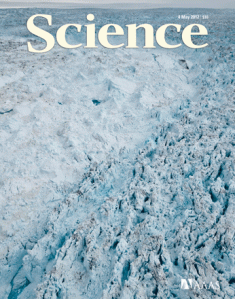
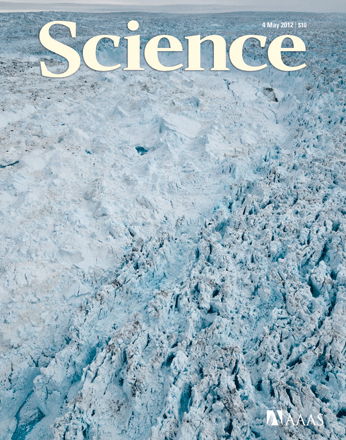
May-4, 2012 Science Magazine Cover: A jumble of icebergs forms in front of the heavily crevassed calving front of Jakobshavn Isbræ, one of the fastest outlet glaciers draining the Greenland Ice Sheet. The ~5-kilometer-wide ice front rises ~80 meters out of the water and extends more than 600 meters underwater. Recent research shows that the speeds of Greenland glaciers are increasing. See page 576. [Photo Credit: Ian Joughin, APL/UW]

The solid new research is that of Twila Moon, a graduate student at the University of Washington whose dissertation work relates to the evolution of Greenland’s outlet glaciers over the last 10 years. She uses data from Canadian, German, and Japanese radars flown on satellites. She applies fancy mathematics to the data and feds data and mathematics into modern computer codes. And with all that, she cracks the puzzle on how fast more than 200 of Greenland’s largest glaciers go to town, eh, I mean, to sea. Furthermore, she shows how this flow has changed over the last 10 years.

Twila Moon, graduate student and scientist at the University of Washington and first author of “21st-Century Evolution of Greenland Outlet Glacier velocities” that appeared in Science Magazine on May-4, 2012. [Photo Credit: APL/UW website]

Back in the days of 2008, crude, but simple back-on-the-envelope calculation suggested that Greenland contributes 0.8-2.0 meters to global sea-level rise by 2100. In stark contrast, the 2000-2010 data now reveals, that even the low-end estimate is too high by a factor of 10. A glacier here or there may accelerate at a large rate to give the 0.8-2.0 m, but these rates do not occur at the same time at all glaciers. Ms. Moon’s more comprehensive and careful analyses of accelerating glaciers bring down Greenland’s contributions to sea-level rise to below 0.1 m by 2100, that comes to about 1 mm/year or an inch in 30 years.

A commentary written by Professor Richard Alley relates to the ice-sheets that feed these glaciers. Dr. Alley is famous for his work on Greenland’s ice sheet as he participated in 2-Mile Time Machine, a project that revolutionized the way that we view climate and its variability the last 100,000 years. The title refers to the 2-mile long ice-core from Greenland’s ice-sheet that trapped and stored air and stuff from the last 100,000 years. Dr. Alley is also featured in Andrew Revkin’s dot-earth blog of the New York Times as the Singing Climatologist. His comment on “Modeling Ice-Sheet Flow” references Ms. Moon’s observations as evidence that ice sheets change quickly. It also contains the sentence that “The lack of a firm understanding of ice-sheet-ocean interaction, constrained by reliable ocean data, remains a critical obstacle to understanding future changes.” I could not agree more with this sentiment, these data are darn hard to come by … not as hard as getting to the bottom of the 2-mile time machine, though.
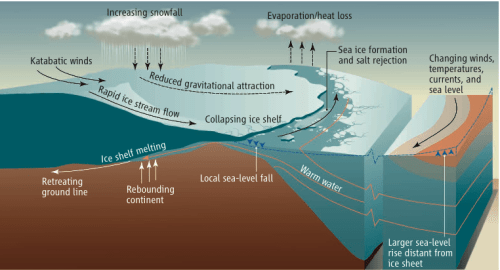
While Ms. Moon addressed changes in Greenland’s glaciers, Dr. Alley addressed the ice-sheets feeding those glaciers, another comment by physical oceanographer Dr. Josh Willis of NASA’s Jet Propulsion Laboratory relates to the sea-level changes caused by accelerating glaciers to make “Regional Sea-Level Projections.” He works mostly on massive computer models which devour massive amounts of data to get climate right. Sometimes this works, sometimes is does not, but he does comment that these earth system models give sea-level projections that are a factor 2 smaller than those derived from statistical relations and semi-empirical models using surface temperature and radiative forcing to extrapolate past trends into the future. The difference probably relates to smaller and more regional processes that involve the physics of ocean circulation and its interaction with ice-shelves off Antarctic and Greenland.
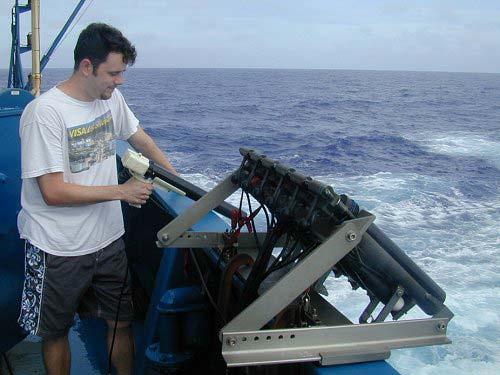
Dr. Josh Willis conducting an oceanographic experiment studying sea temperatures between New Zealand and Hawaii. [Credit: JPL/NASA]

My great oceanography hero, Henry Stommel of Woods Hole oceanographic Institution once wrote in his “View of the Sea,” that “Science is both an individual and a social activity.” I am sure that graduate student Ms. Moon, NASA researcher Dr. Willis, and veteran professor and science communicator Prof. Alley all work hard and lonely at night some nights … and party hard while discussing science and adventures over a beer, dinner, coffee in some city, remote field, or on a ship. The one group of people missing in this picture are … the science teachers, that is, those dedicated, over-worked, and under-paid professionals who encourage, motivate, and helped us to become scientists before we went to college.

The editorial of this week’s Science Magazine is entitled “Empowering Science Teachers.” It compares the social and professional status of pre-college science teachers in Finland and the USA. I will only say in the words of Anne Baffert, chemistry teacher at Salpointe Catholic High School in Tucson, Arizona, that too many science “… teachers work in a command-and-control environment, managed by those who lack any real understanding of how to improve the system.” The editorial suggests on how scientists can improve science teaching, such as “… active involvement in science through structured collaborations with scientists …” Apparently, Finland succeeds while we in the USA are challenged to get our graduate students into a pre-college class room teaching. More stuff for me to munch on here …

Petermann Ice Island(s) 2010 through 2011, Part-1

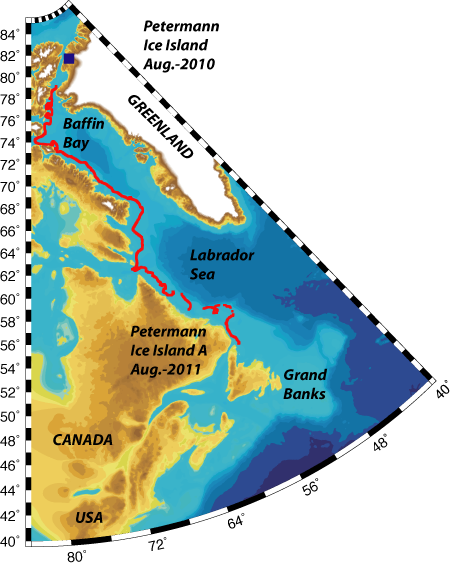
An ice island 4 times the size of Manhattan spawned from a remote floating glacier in north-western Greenland the first week in August of 2010, but it quickly broke into at least 3-4 very large pieces as soon as it flowed freely and encountered smaller, but real and rocky islands. A beacon placed on the ice transmit its location several times every day. It shows a rapid transit from the frigid, ice-infested Arctic waters off Canada’s Ellesmere, Devon, and Baffin Islands to the balmier coasts of Labrador and Newfoundland:

Track of Petermann Ice Island from Aug.-2010 through Aug.-2011 traveling in shallow water from northern Greenland along Baffin Island and Labrador to Newfoundland.

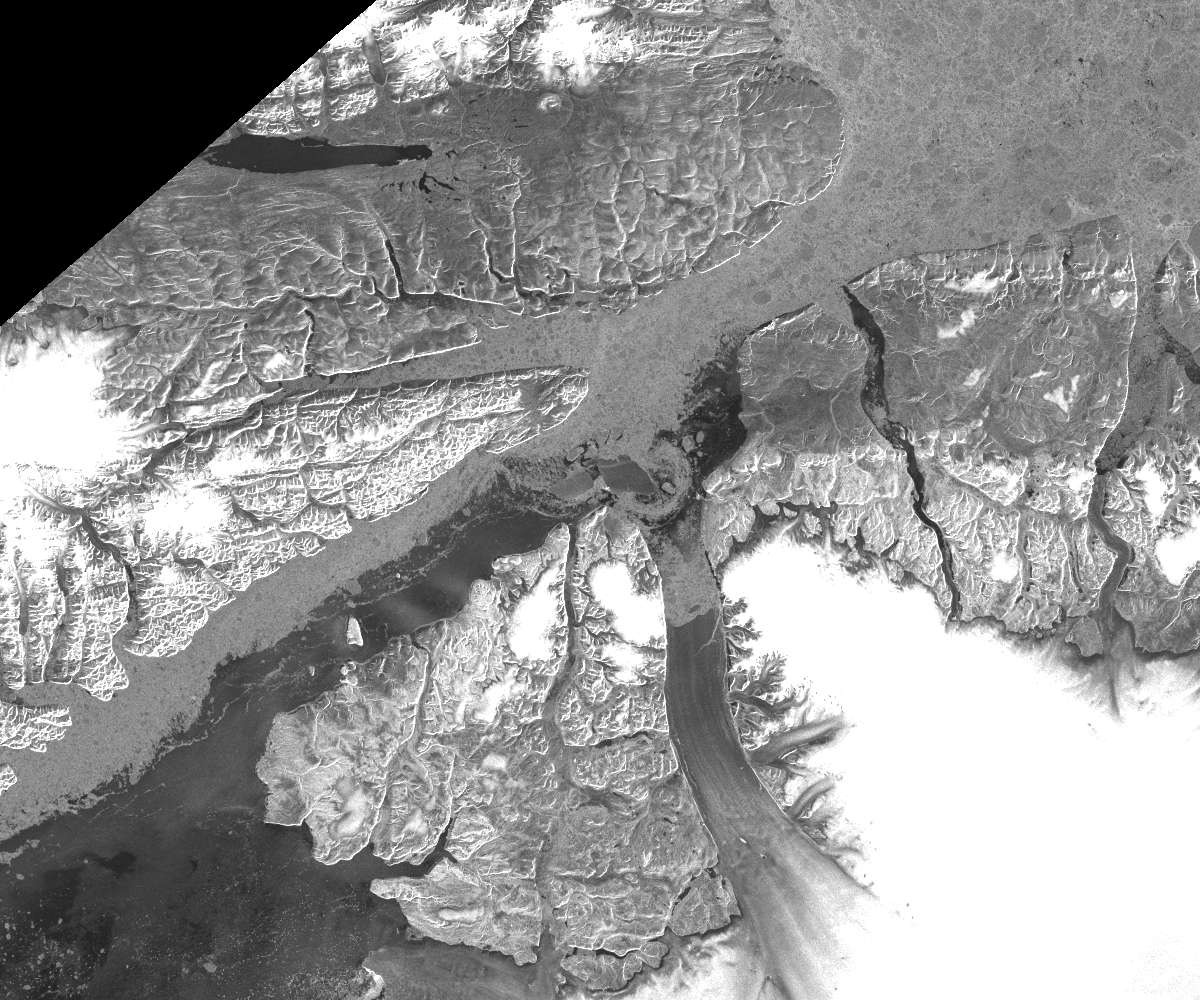
Initial progress was slow as it took the new ice island almost 30 days to wiggle itself free of the narrow constraints of Petermann Fjord:

Petermann Glacier discharges its large ice island into Nares Strait on Aug.-30, 2010.

As soon as it left its home port, it hit broke hit tiny Joe Island on Sept.-9, 2010 and broke into two pieces, PII-A and PII-B for Petermann Ice Island A and B. Not a good start for a new island setting out to sail all the way to Newfoundland where PII-A arrived a year later, but I am getting ahead of my story.

Petermann Ice Island breaks into two segments on Sept.-9, 2010 as seen in this radar image provided by the European Space Agency. Greenland is at the bottom right, Canada top left, the Arctic Ocean is at the top right.

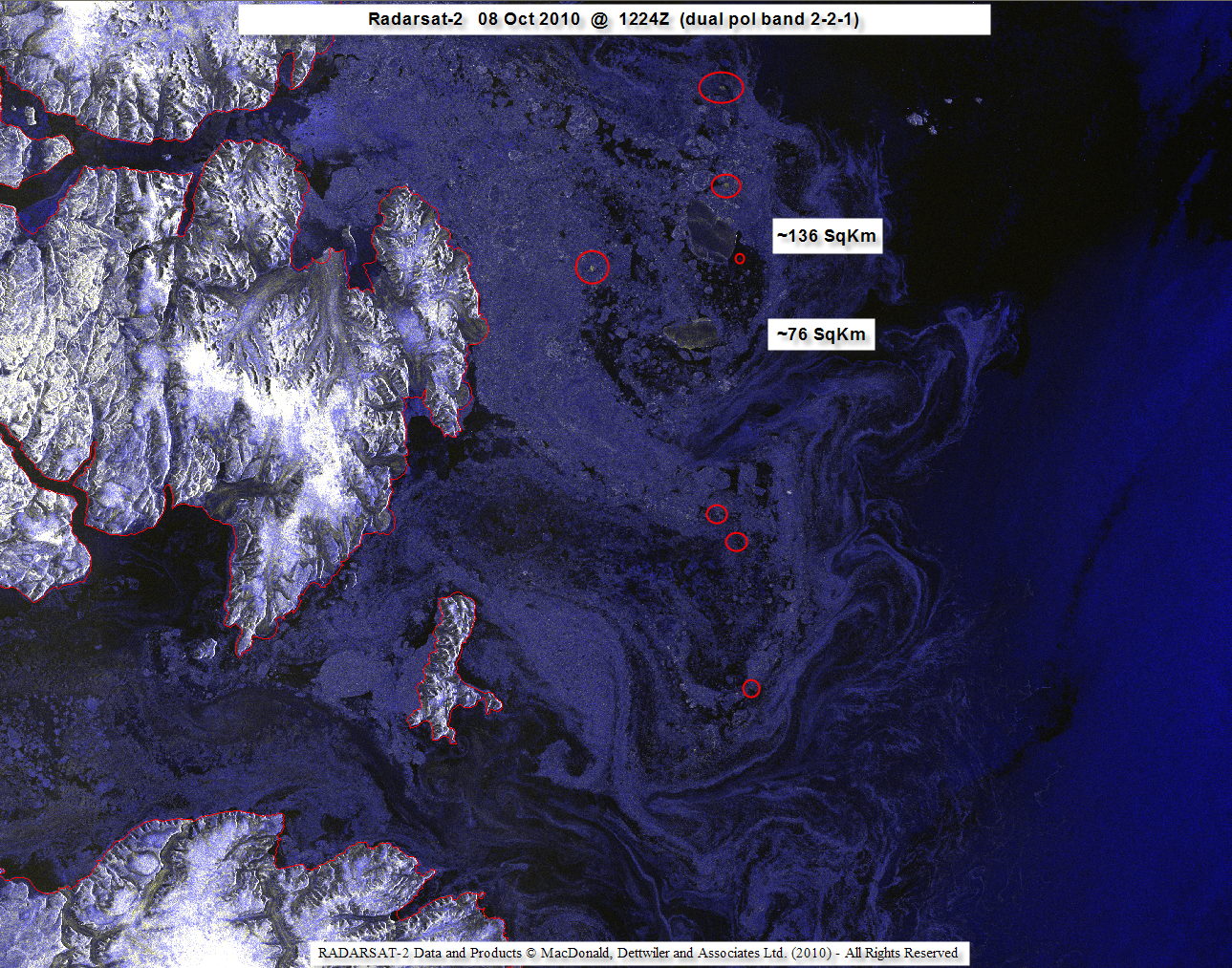
Once in Nares Strait both ice islands experienced a very strong and persistent ocean current. PII-A, about 1.5 the size of Manhattan went first followed by the larger (about 2.5 Manhattans) and thicker PII-B. Their tracks follow each other closely and they almost kiss on Oct.-8, 2010 when both are caught in the same eddy or meander of a prominent coastal current flowing south along Ellesmere and Devon Islands.

Pieces of Petermann Ice Island on Oct.-8, 2010 off southern Ellesmere Island about 600-km to the south of their origin. RadarSat imagery is courtesy of Luc Desjardins of the Canadian Ice Service, Government Canada.

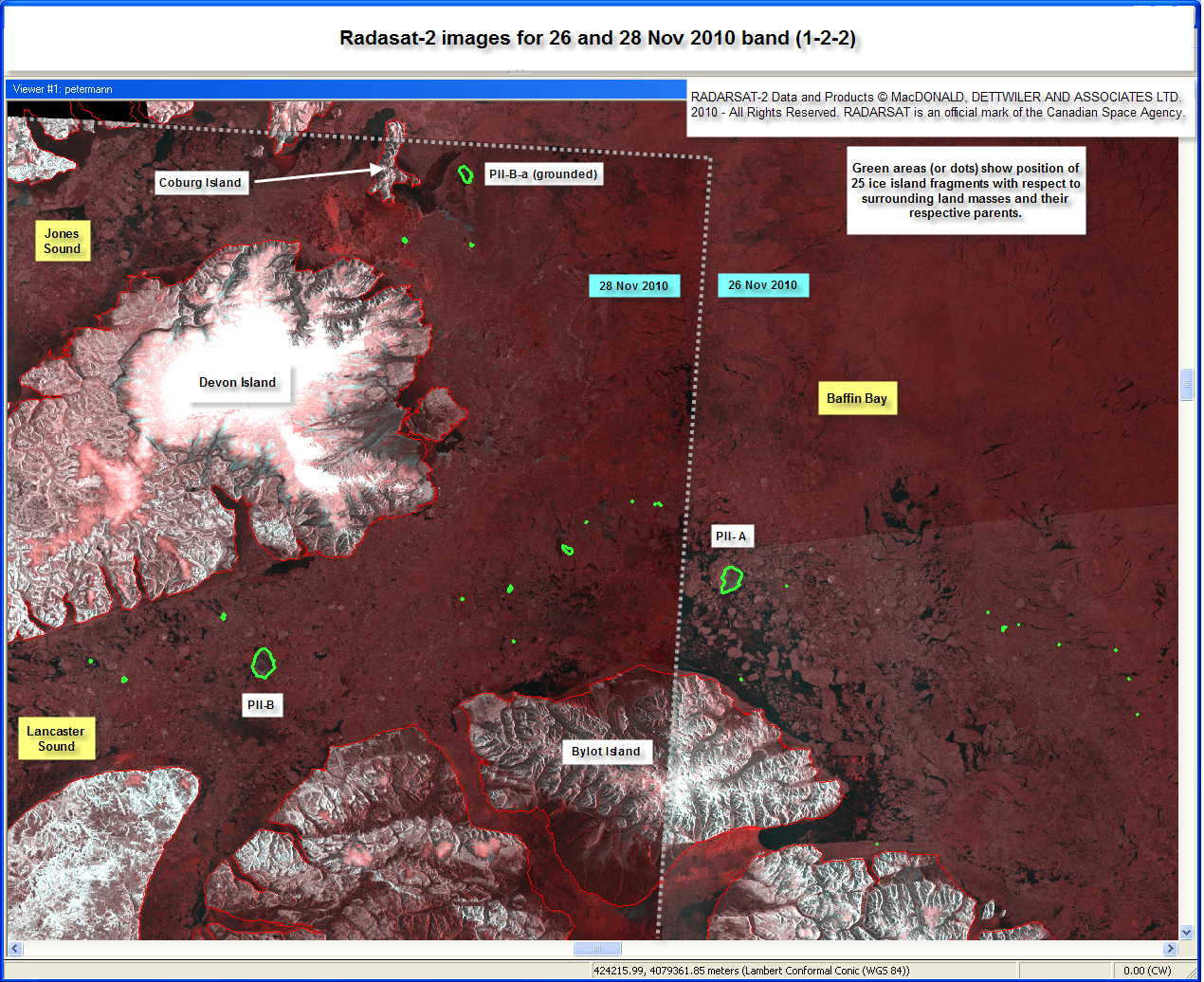
Within a week the larger 136 km^2 piece PII-B breaks into three pieces of 93.5, 28.9, and 11.3 km^2 by Oct.-16 while PII-A stays largely intact at 73.6 km^2. These are all very large islands, the land area of Manhattan is about 60 km^2 for comparison. Some of these pieces approach the coast, some become grounded for a few days to a few weeks, some break off smaller pieces and spawn massive ice bergs that are not always visible from space. PII-A enters Lancaster Sound a week ahead of PII-B on Nov.-14, but exits it within 2 weeks:

Multiple pieces spawned from Petermann Ice Island as seen by RadarSat on Nov.-26 and Nov.-28, 2010 composited and anotated by Luc Desjardins of the Canadian Ice Service, Government Canada.

Notice also the evolution of a string of segments that Luc Desjardins of the Canadian Ice Service identified as pieces from Petermann Glacier. Glacier ice has a darker radar backscatter signature than the sea ice around it. All these pieces eventually enter the Baffin Island Current, a prominent large ocean current that extends from the surface to about 200-300 m depth. The Petermann pieces are moved mostly by ocean currents, not winds, because there is more drag on the submerged pieces of the 40-150 meter thick glacier ice. In contrast, the much thinner sea ice is mostly driven by the winds. This is also the reason one often finds areas in the lee of icebergs and islands free of older ice which is swept away by the winds as the iceberg moves slower as it is driven by deeper ocean currents. I will talk more of these in a later post.

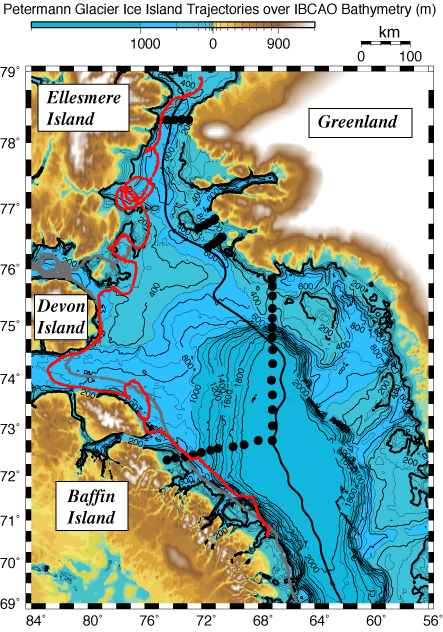
As part of a large oceanography program in northern Baffin Bay and Nares Strait in 2003, we collected ocean temperature, salinity, chemistry, and current data along lines roughly perpendicular to both Baffin Island in the west and Greenland in the east along with the trajectory of PII-A in the fall of 2010 (red dots) and the almost identical track of a much smaller ice island from Petermann Glacier that passed the area in 2008:

Map of the study area with trajectory of a 2010 (red) and 2008 (grey) beacons deployed on Petermann Glacier ice islands over topography along with CTD station locations (circles) and thalweg (black line). Nares Strait is to the north of Smith Sound.

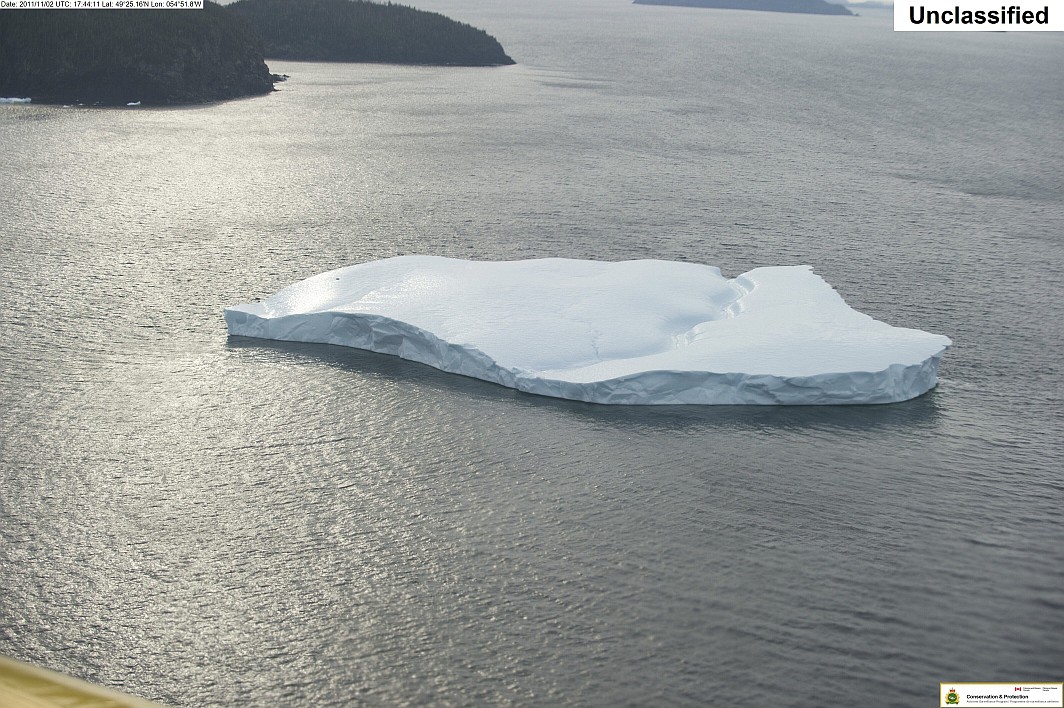
I will talk about these data and the subsequent tracks of PII-A and PII-B from 2010 into 2011 in Part-2 of this summary on how the first of this piece (PII-A) arrived off coastal Newfoundland in the late summer of 2011. Rest assured that there are many more pieces coming to coastal Labrador and Newfoundland in 2012 and 2013 where they put on a majestic display of abundant icebergs such as this last remnant of PII-A as seen from the air on Nov.-2, 2011 in Notre Dame Bay, Newfoundland.

Last surviving fragments of PII-A on Nov.-2, 2011 from a survey by air of southern Notre Dame Bay conducted by Canadian Ice Service, Government Canada..

Ice Arch off North-West Greenland Locks Ice Motion in Nares Strait

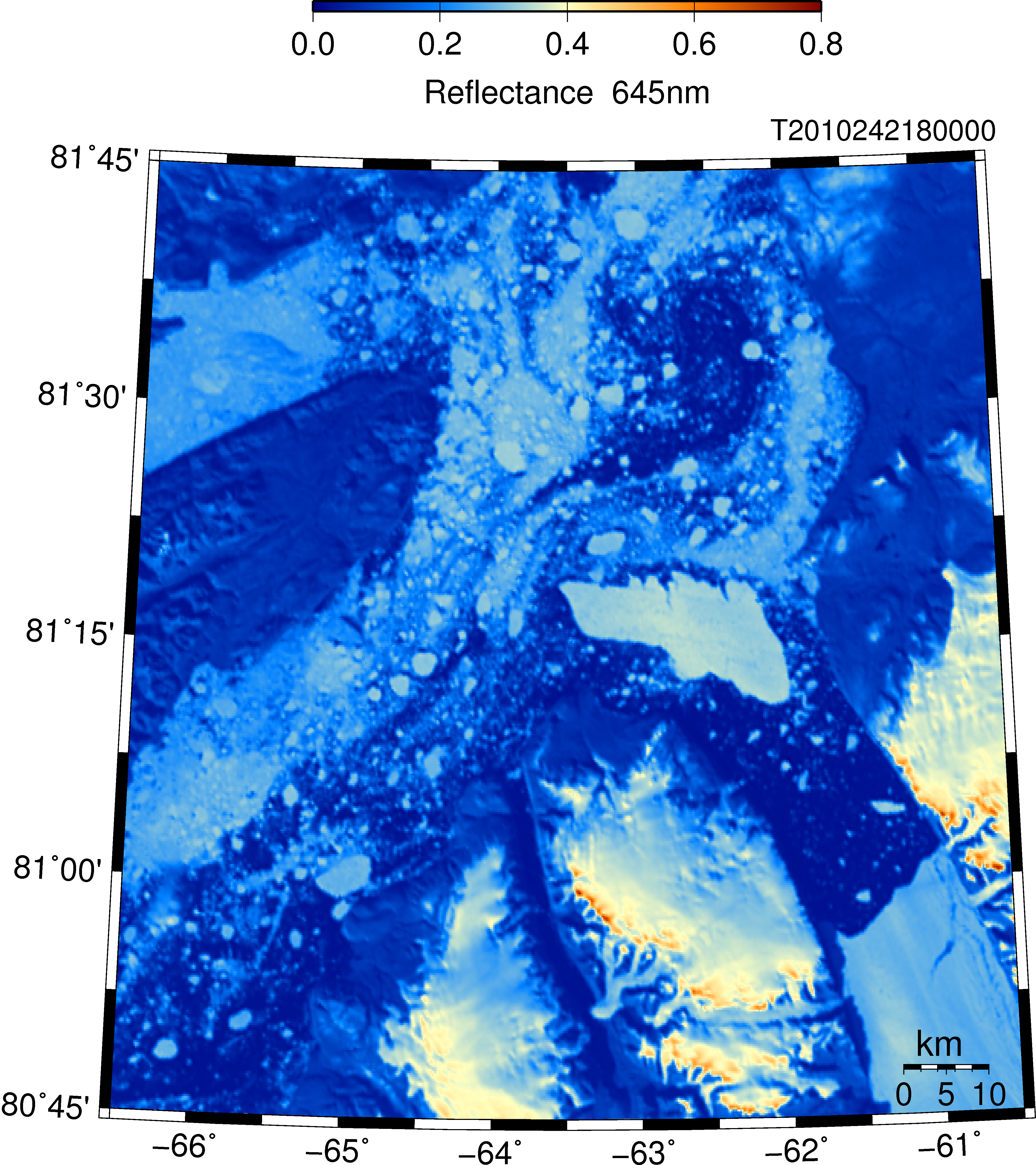
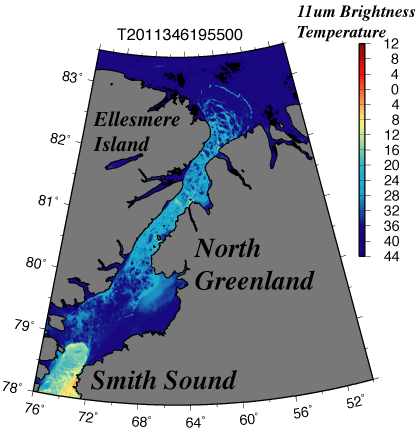
Winter has come to north-west Greenland as the sea ice of Nares Strait has locked itself to land and stopped movement of all ice from the Arctic Ocean in the north to Baffin Bay and the Atlantic Ocean in the south. While there is no sunlight for several more months now during the polar night, the warm ocean beneath the ice emits heat through the ice which becomes visible to heat-sensing satellites. The light yellow and reddish colors show thin ice while the darker bluish colors show thicker ice today:

Dec.-13, 2011 surface brightness temperature of Nares Strait showing an ice arch in Smith Sound separating thin and moving ice (reddish, yellow) from thick land-fast ice (blue).

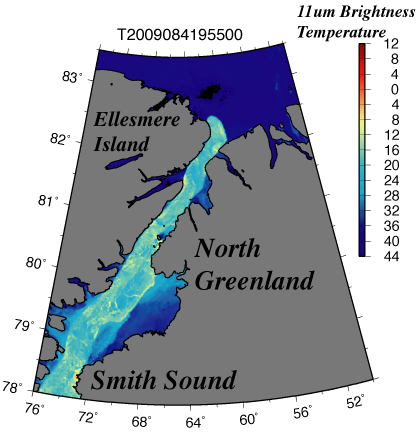
The prior 2010/11 winter was the first in several years that these normal conditions have returned. The ice arch in Smith Sound did not form in 2009/10, 2008/09, and 2007/08 winters while a weak arch in 2007/08 fell apart after only a few days. Conditions in 2009 were spectacular, as only a northern ice arch formed. Since the ocean moves from north to south at a fast and steady clip, it kept Nares Strait pretty clear of ice for most of the winter as no Arctic ice could enter these waters and all locally formed new “first-year ice” is promptly swept downstream:

March-25, 2009 map Nares Strait, north-west Greenland showing heat emitted during the polar night from the ocean and sensed by MODIS satellite.

The very thin and mobile ice in Nares Strait of 2009 exposed the ocean to direct atmospheric forcing for the entire year. I reported substantial warming of ocean bottom temperatures here during this period. This new 2011/12 ice arch formed the last few days. If it consolidates during the next weeks, then it is very likely to stay in place until June or July of 2012. It decouples the ocean from the atmosphere and, perhaps more importantly, prevents the Arctic Ocean from losing more of its oldest, thickest, and hardest sea ice. This is very good news for the Arctic which has lost much ice the last few years.

For more daily thermal MODIS imagery take a peek at http://muenchow.cms.udel.edu/Nares2011/Band31/ for 2011. Replace Nares2011 with Nares2003 or any other year, and an annual sequence appears. Furthermore, my PhD student Patricia Ryan just sent me a complete list of files that I need to process until 2017. Fun times.

Petermann Ice Island PII-A on the move again

Sitting stuck on the bottom at 80 meters depth for the past week off St. Anthony’s, PII-A is in the move again heading south by south-east (click on image to enhance). It is melting only at the surface, breaking off smaller icebergs, because the ocean water temperatures near the bottom are colder than the freezing point of fresh water. The ocean’s salinity ensures that the freezing point of sea water is close to -1.7 C while that of fresh water is 0.0 C. More details on how the waters off Labrador and Newfoundland looked like in 2009 within a climate context is Colbourne et al. (2010) (big file, slow link).

Petermann Ice Island PII-A on Aug.-7 and Aug.-14, 2011 off St. Anthony, Newfoundland over contours of bottom depth. Black dotted line is the track until Aug.-9, 2011 from a beacon on PI-A