Tag Archives: Greenland

Ice Arch off North-West Greenland Locks Ice Motion in Nares Strait

Winter has come to north-west Greenland as the sea ice of Nares Strait has locked itself to land and stopped movement of all ice from the Arctic Ocean in the north to Baffin Bay and the Atlantic Ocean in the south. While there is no sunlight for several more months now during the polar night, the warm ocean beneath the ice emits heat through the ice which becomes visible to heat-sensing satellites. The light yellow and reddish colors show thin ice while the darker bluish colors show thicker ice today:
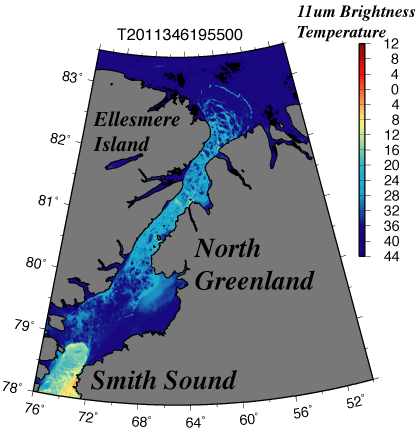
Dec.-13, 2011 surface brightness temperature of Nares Strait showing an ice arch in Smith Sound separating thin and moving ice (reddish, yellow) from thick land-fast ice (blue).

The prior 2010/11 winter was the first in several years that these normal conditions have returned. The ice arch in Smith Sound did not form in 2009/10, 2008/09, and 2007/08 winters while a weak arch in 2007/08 fell apart after only a few days. Conditions in 2009 were spectacular, as only a northern ice arch formed. Since the ocean moves from north to south at a fast and steady clip, it kept Nares Strait pretty clear of ice for most of the winter as no Arctic ice could enter these waters and all locally formed new “first-year ice” is promptly swept downstream:
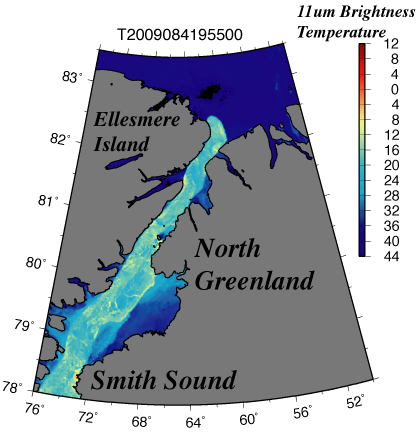
March-25, 2009 map Nares Strait, north-west Greenland showing heat emitted during the polar night from the ocean and sensed by MODIS satellite.

The very thin and mobile ice in Nares Strait of 2009 exposed the ocean to direct atmospheric forcing for the entire year. I reported substantial warming of ocean bottom temperatures here during this period. This new 2011/12 ice arch formed the last few days. If it consolidates during the next weeks, then it is very likely to stay in place until June or July of 2012. It decouples the ocean from the atmosphere and, perhaps more importantly, prevents the Arctic Ocean from losing more of its oldest, thickest, and hardest sea ice. This is very good news for the Arctic which has lost much ice the last few years.

For more daily thermal MODIS imagery take a peek at http://muenchow.cms.udel.edu/Nares2011/Band31/ for 2011. Replace Nares2011 with Nares2003 or any other year, and an annual sequence appears. Furthermore, my PhD student Patricia Ryan just sent me a complete list of files that I need to process until 2017. Fun times.
Why Petermann Glacier and Fjord?

The National Science Foundation (NSF) declined to fund a Physical-Ocean-Ice-Shelf-Experiment (POISE) at Petermann Fjord in northern Greenland this year. The reviews by three anonymous peers, a panel of eight scientists, and two sympathetic program managers were all very good, but not without criticism.

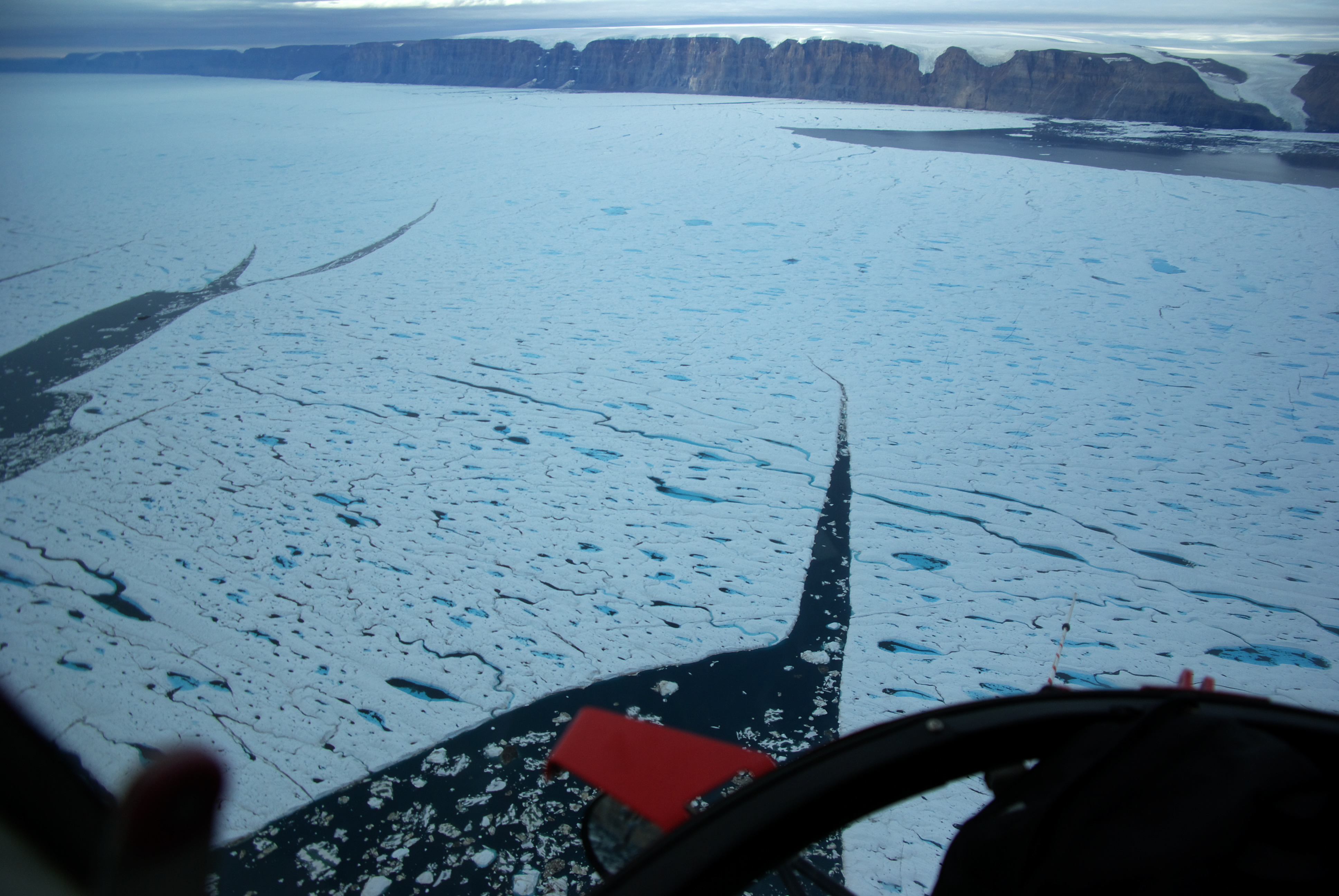
Floating ice shelf of Petermann Glacier in August 2009 as seen from a helicopter of the Canadian Coast Guard Ship Henry Larsen. View is to the south-east with the glacier to the left and the ocean to the right. Photo by David Riedel, British Columbia.

Our admittedly expensive 4-year proposal was rejected along with at least five competing proposals in the same general subject area, because we did not show why a study of ice-ocean interaction of glaciers and ice-sheets has to take place at Petermann Glacier, a remote location less than 800 miles from the North Pole. Claiming this glacier to be unique, we made a fatal mistake, because NSF cares little about each glacier, but cares much about the underlying physical problem, that is, how do tidewater glaciers with floating ice shelves interact with the ocean they float on.

There are several glaciers in Greenland that have extensive ice shelves. To the best of my knowledge, they are all in northern Greenland. Nioghalvfjerdsfjorden and Petermann Fjord contain the largest floating areas exposed to the oceans on the east and west coasts of Greenland, respectively. Both these glaciers have seen preliminary studies during the last 15 years including radar measurements that describe the geometry of the ice shelves, the bedrock below, as well as the ice streams to connect the glaciers to the inland ice. Smaller and less studied glaciers with past or present ice shelves are Steensby, Ryder, and C.F. Ostenfeldt in the north-west as well as Academy and Marie-Sophie glaciers in the north-east (Weidick, 1995).

The most extensive ice shelves are located around Antarctica, however, and one thus may wonder, what uniform physics can and should be studied in northern Greenland that also applies to the ice sheets in the south? I would need some scaling law or normalization scheme that connects many glaciers into an organizational scheme. In physical oceanography the near-balance of a density-driven (internal) pressure gradient and the effects of a rotating earth provides a dynamical scale that connects river discharges off Delaware, with ice patterns off Eastern Greenland, and algae bloom patters off northern Norway, among many other phenomena. What dynamical metric connects the ice sheets of Greenland to each other and to those off Antarctica?

Swirling Ice in Coastal Waters off Eastern Greenland

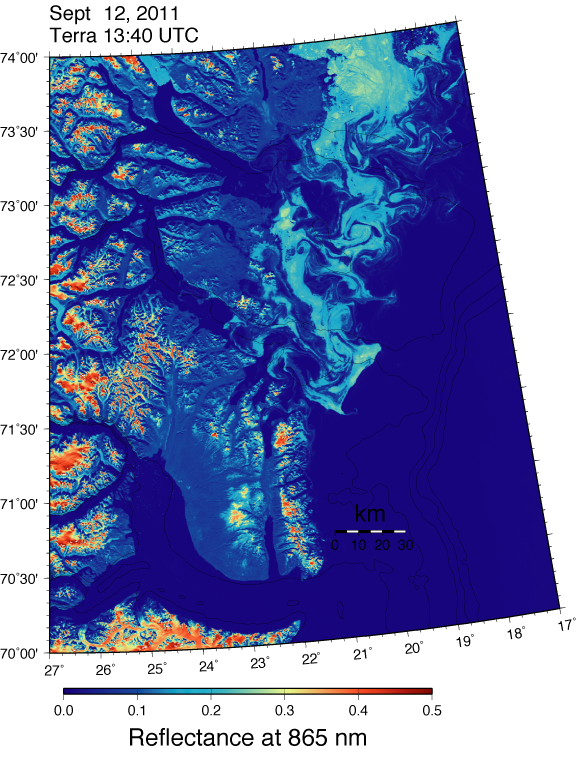
Nature provides us with art that is always changing in time and space. Delicate swirls and vortices give a rare glimpse of how the ocean’s surface looked today off eastern Greenland. The data originate from the MODIS/Terra satellite which from 440 miles above the earth captures light that is reflected from anything below. Here it shows the ice-free ocean (bottom right) and Greenland’s ice-free Scoresby Sound (bottom left) in very dark blues, lightly vegetated lands (left) in light blue, and a highly organized pattern of sea ice (top right) in white. The resolution of this image of light just beyond the visible, just beyond the red is about 300 yards and the swirls and elongated filaments are about 3-5 miles. To me, they vividly show the ocean’s surface circulation.

Swirling surface motion on the continental shelf off eastern Greenland Sept.-12, 2011 as indicated by sea ice. Black lines show contours of bottom depth from 300 to 1200 meters in 300 meter increments.

The physics of these motions are similar to those I was reading into another beautiful work of art to the north of Norway. The postulated physics involve the earth’s rotation as well as differences in density. The density of the ocean relates to its temperature a little and to its salinity a lot. Near the coast and at the surface, ocean waters are much fresher and thus lighter than they are offshore and at depth, because Greenland’s melting glaciers and sea ice are fresher than the waters of the Atlantic Ocean. The thin black lines show bottom depths to distinguish the deep Atlantic Ocean to the right in the image from the shallow continental shelf off eastern Greenland to the left in the image. Note that all the swirls, eddies, and filaments are within 30 kilometers (20 miles) off the coast in water less than 300-m deep. The same physics apply to the algal blooms off Norway which is the reason that the swirls and eddies are of similar size here and there as well.

Incidentally, the same physics also apply the discharges from rivers and estuaries such as the Delaware or Cheasapeake Bay. There, the pattern are not quiet as visible to the naked (satellite) eye as off Norway or Greenland, but if one takes measurements of the ocean, similar patterns of ocean salinity and velocity as, I speculate, they do here for the ice (Greenland) and algae blooms (Norway). While my academic journey of fresh water discharges started with the discharge of the Delaware River into the Atlantic almost 25 years ago, I am still fascinated by the many ways these patterns always come back to me. Physics and oceanography are beautiful in both their many natural manifestations and its unique balance of forces. There is so much more in how the oceans interact with the ice and glaciers off Greenland and elsewhere. To be continued …

Global Weight Watch: Slimmer Greenland and Fatter Tropics

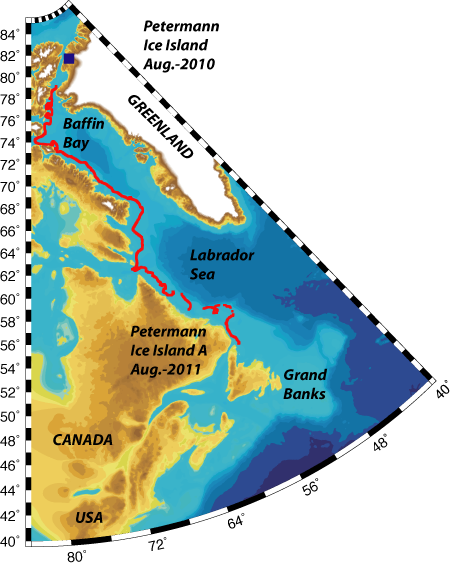
An ice island four times the size of Manhattan separated from Petermann Glacier, Greenland last year. Today one of these Manhattans reached the coast of Newfoundland. Never before has as large a piece of ice from Greenland reached this far south. Does this show a warming climate taping into Greenland’s 20 feet potential to raise global sea level?

Track of Petermann Ice Island from Aug.-2010 through Aug.-2011 traveling in shallow water from northern Greenland along Baffin Island and Labrador to Newfoundland.

Greenland’s glaciers always melt with pieces breaking off. This raises sea level if Greenland receives less snow atop than it loses ice at the bottom. For the last 10 years Greenland lost about 200 trillion pounds of mass, net, per year. [At 5 cents per pound, this pays off the federal debt within a year.] Distributing this mass over all oceans, we raise global sea level by one inch in 75 years. Nothing to worry about, but there is a twist: Weight watching satellites show that Greenland becomes thinner, while the Tropic grow fatter. Records of weight gain and loss are too short to draw firm conclusions, yet, but they are consistent across the globe and the trends of gain and loss are increasing, too.

We do not understand the physics, stability, and uncertainty of these increasing gains and losses well enough to make reliable predictions. If the climate over Greenland is stable, as it has been for the last 10,000 years, then this matters little. If the present equilibrium reaches a tipping point, where a small change will kick us into different stable state, then we can expect sea level to increase 10 times or more. We understand tipping points in theory, but not in practice. In practical terms, we do not know if our children must deal with two inches of sea level from Greenland by the end of this century or 80 inches or none at all. We know only too well, however, that low-lying places like Bangladesh, the Netherlands, and New Orléans struggle with the sea level we have now.

Greenland’s ice island off Newfoundland indicates a globally connected world. Burning stuff over Europe, America, and increasingly Asia creates heat that melts Greenland at a rate that is increasing. What happens in Greenland does not stay in Greenland, but it impacts Rome, Miami, and Shanghai. More ice and rising sea level will come. To play it safe, let’s think smartly what and how we burn. To play it loose and reckless: burn, baby, burn … or was it drill?

Uncertainty in the Physics and Philosophy of Climate Change

I wrote this post last year for the National Journal, but it also relates to the way I think about Petermann Glacier’s ice islands. There are now at least 4 larger ice islands that formed from last year’s single calving: one is the tourist attraction off Labrador and Newfoundland, a second has left Petermann Fjord last week, a third was grounded off Ellesmere Island for much of the year and is now where #1 was Nov.-2010, while the fourth … I do not know. Last I heart, it was grounded off central Baffin Island. With this much variation of where pieces of the ice island went, how can we possibly claim any skill in predicting anything?


Neither climate nor weather is linear, but this neither makes them unpredictable nor chaotic. The simple harmonic pendulum is the essence of a linear system with clear cause and effect relations. Oscillations are predictable as long as the initial forcing is small. Furthermore, a linear trend will show the pendulum to slow down due to friction. Corrections are straightforward.

Unfortunately, climate is not a simple, harmonic, or linear system. While this does not make it unpredictable or chaotic, it means that our “common sense” and loose talk of “totality of events” can easily fool us. We know that CO2 emissions for the last 150 years changed global temperatures. We also know that our current climate system has been very stable over the last 10,000 years. What we do not yet know is how small or how large a perturbations the last 150 years have been. If the pendulum is forced too much, if the spring is stretched too far, the system will find another stable state by breaking. Climate dynamics can find an adjustment less tuned to the areas where people presently live. This is what “tipping points” are about. Only numerical experimentation with the best physics and models will suggest how close to a different stable climate state we are. The IPCC process is one way to do so.

Ice cores from Greenland contain air bubbles 100,000 years old, which clearly demonstrate that our present climate state is the “anomaly of quiet” in terms of temperature fluctuations. The absence of large fluctuations for about 10,000 years made agriculture and advanced civilizations possible. The ice cores show that abrupt climate change has happened and may happen again, not this election cycle, but it is one possibility perhaps as likely as the possibility that climate change is mundane, linear, and follows trends that we can easily correct or mitigate later. Both are excellent hypotheses.

For scientists, these are exciting times as we conduct a massive, global experiment to see how much CO2 we can add to the atmosphere to perhaps find a different climate state. Dr. Terry Joyce, Senior Scientist at Woods Hole Oceanographic Institution once said: “I’m in the dark as to how close to an edge or transition to a new ocean and climate regime we might be. But I know which way we are walking. We are walking toward the cliff.” I agree with this sentiment, but add that we do not know if this cliff is a 1000 feet fall or a 2 feet step. Can we affort to wait until we know for sure? As a scientist I do not care. As a citizen, however, I think the time to act responsibly is now.