Tag Archives: glaciers

Petermann Glacier Ice Islands: Where are they now?

Two large calving events in 2010 and 2012 reduced the floating part of Petermann Gletscher by 44 km (28 miles) in length, 6 Manhattans (380 km^2) in area, and 42 gigatons in mass. But what’s a gigaton? Writing in The Atlantic Magazine, Julio Friedman states that if we put all people living on earth onto a scale, then we will get half a gigaton. So, Petermann’s two ice island weigh more than eighty times as all humanity combined. As a reminder, this is what the break-ups looked like:
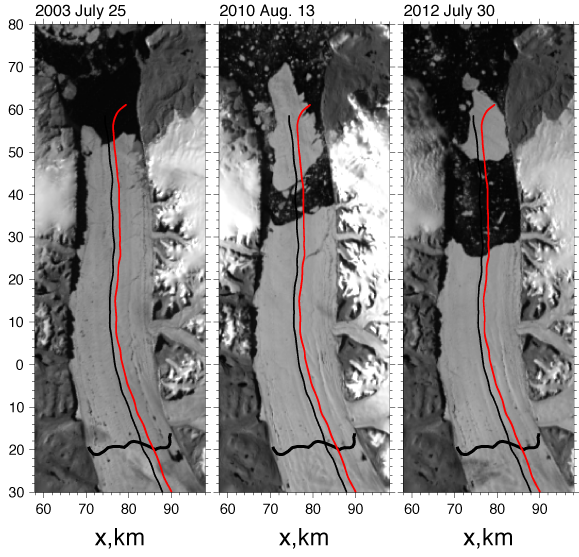
Petermann Gletscher in 2003, 2010, and 2012 from MODIS Terra in rotated co-ordinate system with repeat NASA aircraft overflight tracks flown in 2002, 2003, 2007, and 2010. Thick black line across the glacier near y = -20 km is the grounding line location from Rignot and Steffen (2008).

Petermann Gletscher in 2003, 2010, and 2012 from MODIS Terra in rotated co-ordinate system with repeat NASA aircraft overflight tracks flown in 2002, 2003, 2007, and 2010. Thick black line across the glacier near y = -20 km is the grounding line location from Rignot and Steffen (2008).

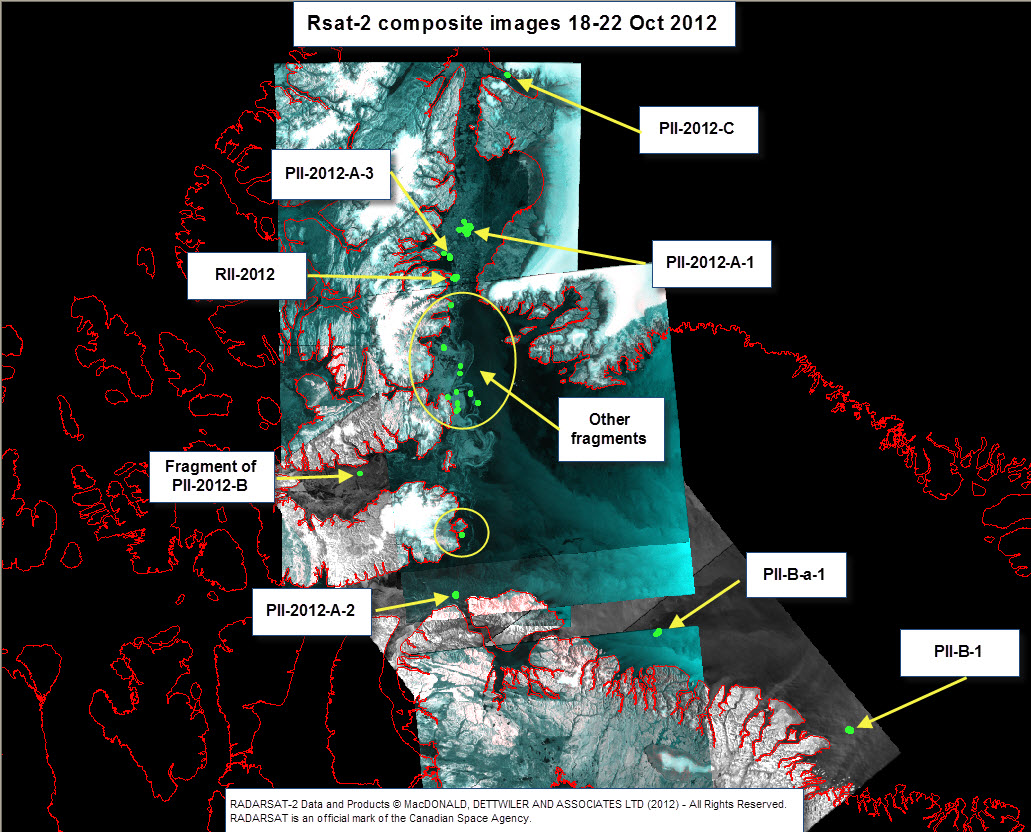
It turns out that the smaller 2012 ice island is just as heavy as the 2010 island, because it is much thicker, about 200 m, 600 feet, or half the height of the Empire State Building in Manhattan. These thick and thin islands have since left Petermann Fjord and Nares Strait for more southern climes. The thinnest piece reached Newfoundland in the summer of 2011 where it melted away. Most of the thicker, larger, and heavier ice islands from Petermann and Ryder Glaciers now litter almost the entire eastern seaboard of Canada as the two largest pieces have split, broken, and splintered into many smaller pieces. Each of these still represents an exceptionally large and dangereous piece of ice that can wipe any offshore oil platform off its foundation. Luc Desjardins of the Canadian Ice Service now tracks more than 40 segments, some still bigger than Manhattan, some as small as a football field. The distribution along the 1500 km (1000 miles) of coast is staggering:

RadarSat imagery of eastern Baffin Island (bottom, right), western Greenland (top, right), and Nares Strait with Petermann Fjord (top, left) with pieces of Petermann and Ryder Ice Islands identified. [Credit: Luc Lesjardins, Canadian Ice Service]

RadarSat imagery of eastern Baffin Island (bottom, right), western Greenland (top, right), and Nares Strait with Petermann Fjord (top, left) with pieces of Petermann and Ryder Ice Islands identified as green dots. [Credit: Luc Lesjardins, Canadian Ice Service]

What stands out is that most pieces are close to the coast of Canada. This is expected, because often the ocean moves in ways to balance pressure gradient and Coriolis forces as we live on an earth that rotates once every day around its axis. This force balance holds both in the ocean and the atmosphere. We are all familiar with winds around a low-pressure system such as Hurricane Sandy where the winds move air counter-clockwise around the eye (the center of low pressure). This eye of low pressure in our ocean story is permanently near the center of Baffin Bay. Ocean currents then move water counter-clockwise around this eye. This results in a flow to the south off Canada and a flow to the north off Greenland. On a smaller scale this balance holds also, such as Delaware Bay or Petermann Fjord, but I will not bore you with the details of graduate level physics of fluids in motions … as important as they may be.

So, almost all the ice islands we see in the above imagery will make their way further south towards the Grand Banks off Newfoundland. Some are grounded to the bottom of the shallow coastal ocean and may sit in place for a year, or a month, or until the next high tide will lift the ice off the bottom and move it back into deeper water. Some ice islands will keep moving rapidly, some will further break apart, but none will go away anytime soon. If you want to see some of Petermann’s Ice Islands for yourself, take the ferry from North Sidney, Nova Scotia to Port aux Basques, Newfoundland and Labrador and head for the Great Northern Peninsula. That’s what I hope to do one of the next summers.

ResearchBlogging.org
Johnson, H., Münchow, A., Falkner, K., & Melling, H. (2011). Ocean circulation and properties in Petermann Fjord, Greenland Journal of Geophysical Research, 116 (C1) DOI: 10.1029/2010JC006519

Münchow, A., & Garvine, R. (1993). Dynamical properties of a buoyancy-driven coastal current Journal of Geophysical Research, 98 (C11) DOI: 10.1029/93JC02112

Rignot, E., & Steffen, K. (2008). Channelized bottom melting and stability of floating ice shelves Geophysical Research Letters, 35 (2) DOI: 10.1029/2007GL031765
Petermann and Ryder Glacier Ice Island

Ice island from 2010 and 2012 calvings litter Nares Strait and northern Baffin Island, Canada. All these glacier fragments originate from Petermann and Ryder Gletscher in north-west Greenland. The image below is a composite that Luc Desjardins of the Canadian Ice Service compiled from RadarSat imagery. He painstakingly identified 25 segments in these imagery.

Ice Islands and fragments from Petermann and Ryder glacier 2010 and 2012 calvings. [Credit: Luc Desjardings, Canadian Ice Service]

The largest piece is PII-2012-A1 and it covers an area a little less than 2 Manhattans (100 km^2). We see it in Kane Basin for several weeks now as it pivots back and forth with the tides around the point where it is stuck to the bottom of the ocean. The second largest piece is RII-2012 roughly half the size of Manhattan (33 km^2) and it originates from Ryder Gletscher which is to the north by north-east of Petermann Gletscher. Trudy Wohleben identified this piece when it was entered Nares Strait from the north about 4 weeks ago and together we traced it back to Ryder Gletscher where it had lingered for several years. RII-2012 is now moving rapidly south and is about exit Nares Strait to enter Baffin Bay:

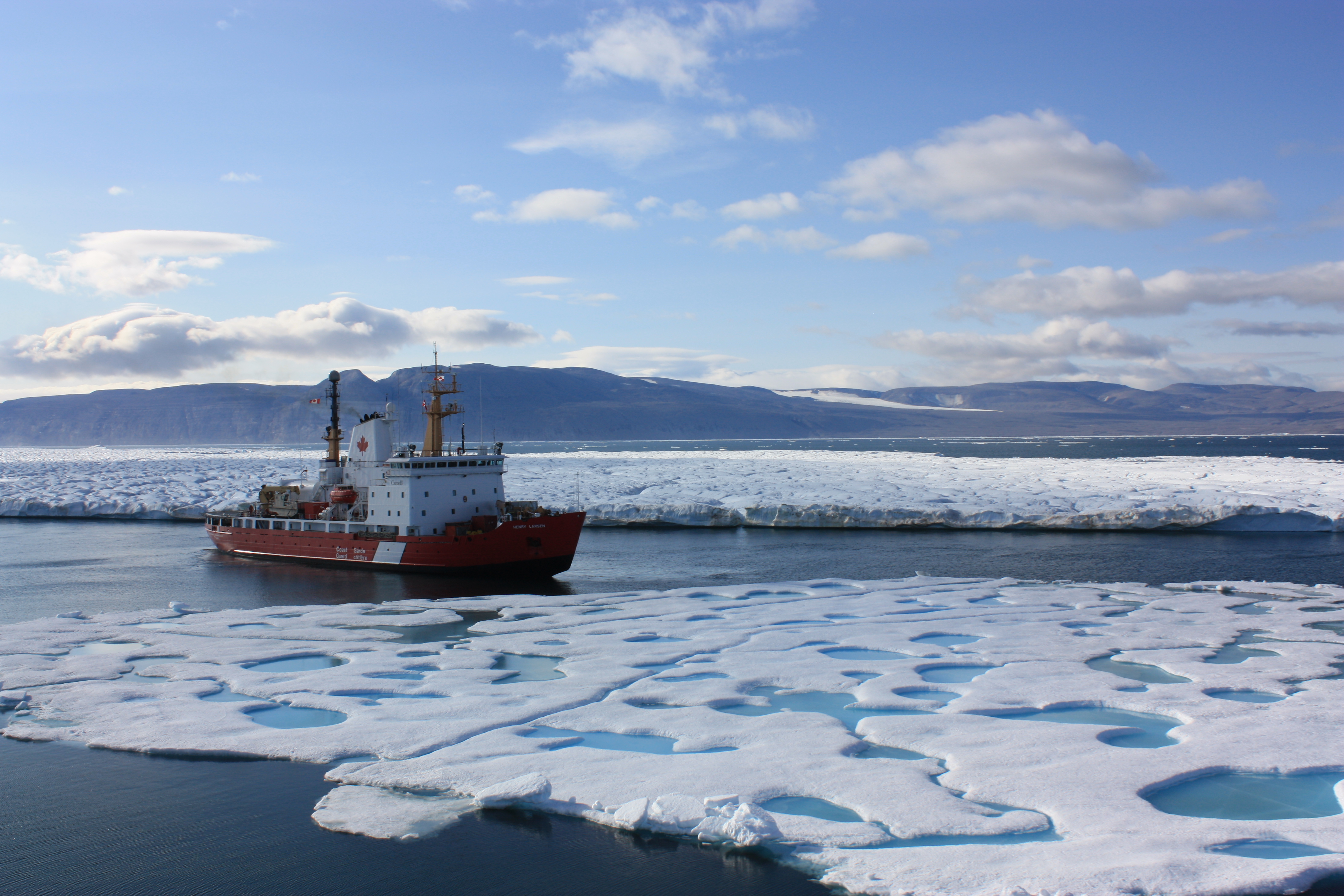
Two of these ice island send their position several time each day with the data made available at for PII-2010-B-a (9 km^2) and for PII-2012-A2 (13 km^2). The last piece broke off from Petermann on July 16, 2012 and it entered Nares Strait in August when we passed it during our explorations of Petermann Fjord on Aug. 10/11, 2012 aboard the CCGS Henry Larsen:

Canadian Coast Guard Ship Henry Larsen at the entrance to Petermann Fjord on Aug.-10, 2012. The ice island PII-2012 is in the background with puddles on sea ice in the foreground. Polaris Bay, Greenland is in the far back. [Photo Credit: CCGS Henry Larsen and Jo Poole.]

Petermann Glacier Shape and Melt Channels

Radars, lasers, and fancy computers all shape the way we see the shape of glaciers. An airplane flies along a line down the glacier with (1) a good GPS. It carries (2) a vertical laser that measures the distance from the plane to the surface below while (3) an ice-penetrating radar measures where the ice meets the ocean. All these data are distributed freely by the University of Kansas’ Center for Remote Sensing of Ice Sheets (CReSIS) that is part of NASA’s Operation IceBridge.

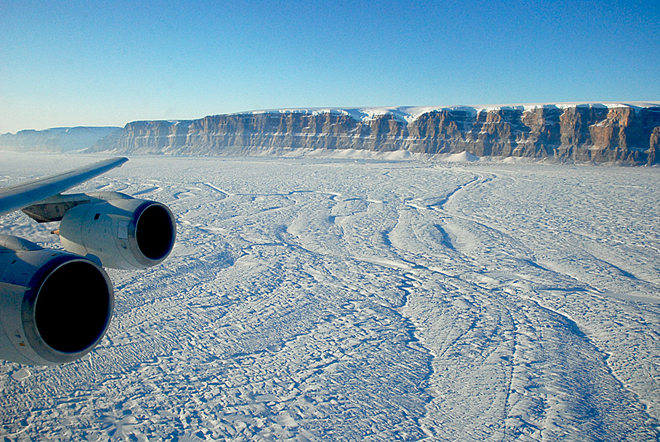
March-24, 2010 view of Petermann Glacier from NASA’s DC-8 aircraft. Photo credit goes to Michael Studinger of NASA’s IceBridge program who also blogged about this flight.

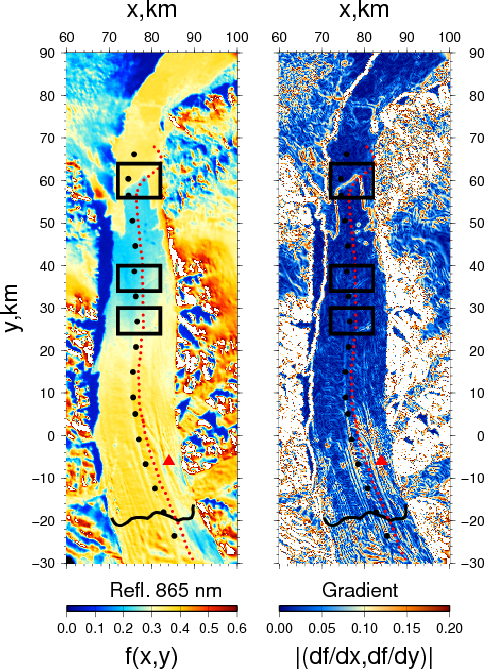
From CReSIS I gathered the data from Petermann Glacier before its break-up in 2010 and 2012. I show two flight tracks on a MODIS map for the same day that NASA’s DC-8 was collecting the shape data. There are two tracks as the airplane flies along the fjord out towards the ocean, turns, and flies back up inland. The seaward (red) track is slightly offset from the landward (black) track.

Petermann Glacier on March 24, 2010 from MODIS. The left panel shows the reflectance while the right panel shows the magnitude of the spatial gradient of this signal. Red and black dots are the flight tracks from which the shape of the glacier was measured by radar flown on a DC-8. The dark black line indicates where the glacier is grounded to bed rock ~500 meters below sea-level. The 3 boxes indicate location where the floating ice shelf terminated before 2010 (top box), after 2010 (middle box), and now (bottom box) due to the 2010 and 2012 ice islands. Top left are clouds, mountain shadows on left also.

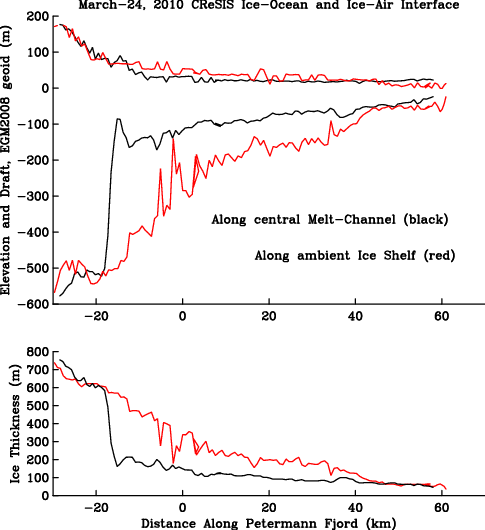
The laser gives us the top surface of the ice while the radar gives us the bottom surface. Connect these two and we get ice thickness. Below I show how these ice elevations change along the glacier. The ocean is to the right near 65 km while the grounding line of the glacier is near -20 km, so the part of the glacier that is floating on the ocean was about 80 km in 2010, that’s about 50 miles. Now why is the red shape so different from the black line?

Shape of Petermann Glacier’s floating ice shelf on March 24, 2010 (top panel) and ice thickness (bottom panel). Radar data from University of Kansas, Center for Remote Sensing of Ice Sheets (CReSIS) with EGM2008 geoid corrections applied by me.

Well, the two tracks were NOT the same and these data show that the glacier varies in thickness and shape at small scales. The floating ice-sheet has lots of topography. It has hills, valleys, channels, and troughs. It stuns me to see how long and how steep this one specific channel is: it changes by almost 200 meters in 2 km. That’s huge. We do not fully understand how these channels form, why they are there, if they change over time, or perhaps most importantly, how do they relate to the stability of this or other glaciers. A first theoreticial PhD thesis was recently submitted by Carl Gladish. It is thought-provoking, but it does not settle the issue. We do not even know how many such channels there are, but there are ideas on how to perhaps do this with data both in hand and more to be collected.

Simplifying future analyses, I changed my Petermann MODIS and CReSIS co-ordinate system from latitude and longitude to a distance in kilometers along and across the glacier. The standard MODIS “color” (lets call this f) varies as one walks the glacier in its along-stream (call this x) and across-stream (call this y) directions. The color f is a function of x and y which scientists write as f=f(x,y). Now compare this color f(x,y) with the SPATIAL CHANGE (call this the slopes) of color that I show in the right panel. The MODIS data are the same, but why do they look so different in the two panels?

Well, the slopes draw the eye to smaller scale features in the right panel. This technique sharpens edges, fronts, and small spatial irregularities that our eyes tend to skip over. Our brains are trained to integrate and to condense information looking for the largest patterns first. So, taking the difference between adjacent values to get slopes and shapes, I do exactly the opposite and make sure that small irregularities stand out:

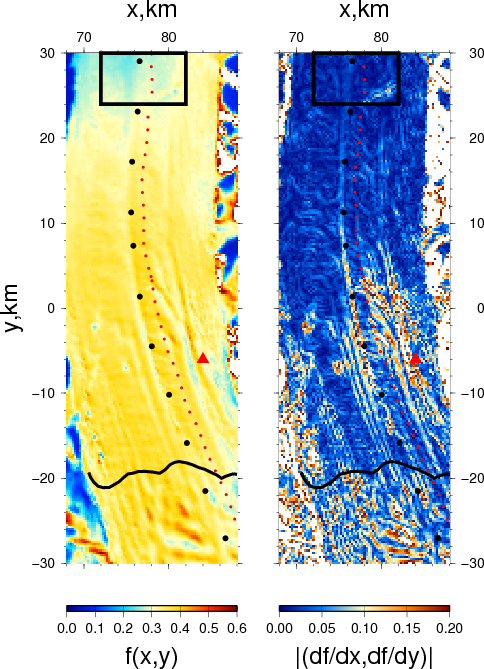
Close-up of March 24, 2010 MODIS image from the grounding line (black line at bottom) to the location of the present seaward front of the glacier (black box at top).

Notice the many stripes along the glacier near the bottom (x=0) right (y=80) near where the red triangle is. I believe these structures relate to sub-surface melt-channels of intense ice-ocean interactions, but belief is not truth and as scientists we must proof our believes and truths in ways that other people can check by repeating the experiments or calculations. There is so much more fun work to do, but, sadly, there are only 24 hours to a day.

Oh, and a (British) submarine is perhaps on the way to dive under this ice-shelf to take a close look and lots of data of under-ice topography, temperature, salinity, and bottom topography, if we can get a ship and experiment to get it there. So much work to do … [to be continued]

Petermann Ice Island 2012 Breaking Up

Dr. Preben Gudmandsen pioneered some of the early micro-wave remote sensors 30-40 years ago that are now used routinely to monitor sea ice, snow, and glaciers. Despite being “retired” for over 20 years, this Danish professor of Electrical Engineering is still very active in all things related to Nares Strait from sea ice, oceanography, glaciers, and winds. He is one of the main instigators to set up the automated weather station at Hans Island.

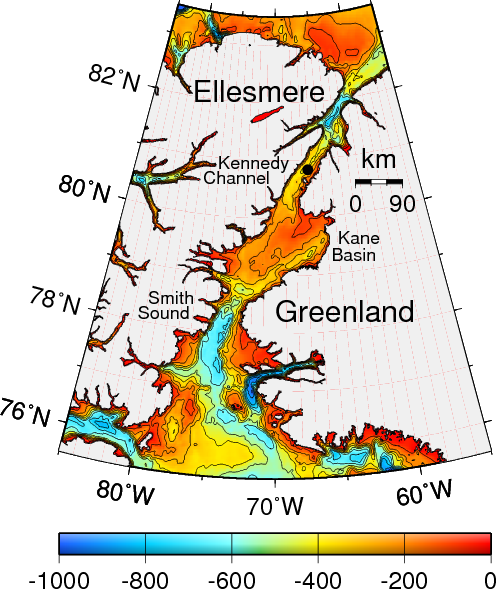
Nares Strait bottom depth (in meters) according to the International Bathymetric Chart of the Arctic Ocean (IBCAO, version 2, 2008). The black dot in the center of Nares Strait indicates Hans Island.

He also instigated the latest round of exchanges among “Friends of Nares Strait” about the fate of the ice island that broke off earlier this summer from Petermann Gletscher. He asked yesterday what may happen if PII-2012 reaches the sill separating northern Nares Strait and the Arctic Ocean from southern Nares Strait and the Atlantic Ocean. This sill is the deepest connection between the Arctic Ocean to the north and Baffin Bay in the south. The sill is in western Kane Basin off Ellesmere island and is about 220 meters deep.

So, to answer that question one needs to know three things: Where is the ice island, how deep is the water where it is, and how thick is the ice island. Before I could assemble these three things, however, the ice island has already broken into at least three pieces. Luc Desjardins of the Canadian Ice Service answered first by pointing this out. He has access to the commercial RadarSat data that few others have. So, here is the latest from MODIS which answers the first two questions:

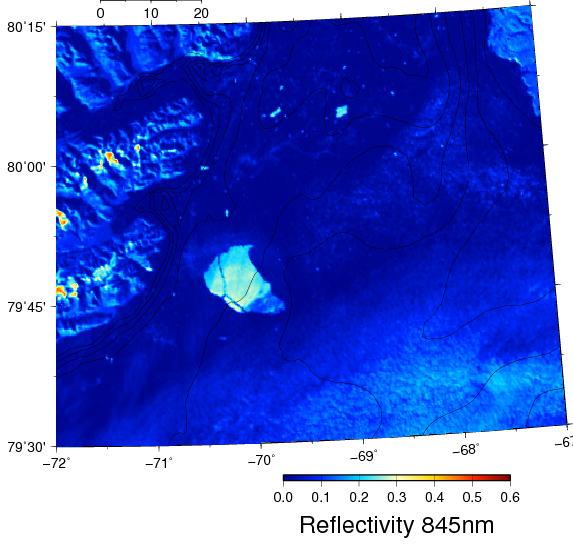
Petermann ice island 2012 (PII-2012) breaking apart on Sept.-1, 2012 near the sill of Nares Strait. Faint black lines are bottom contours of 200, 150, 100, and 50 meter depth (IBCAO-2). Bottom left has clouds, top right is the mountainous terrain of Ellesmere Island. The most southerly part of PII-2012 is the thickest as it was attached to the glacier earlier this year. The most northerly section connected to PII-2010 which passed a moored array in place near Hans Island on Sept.-22, 2010.

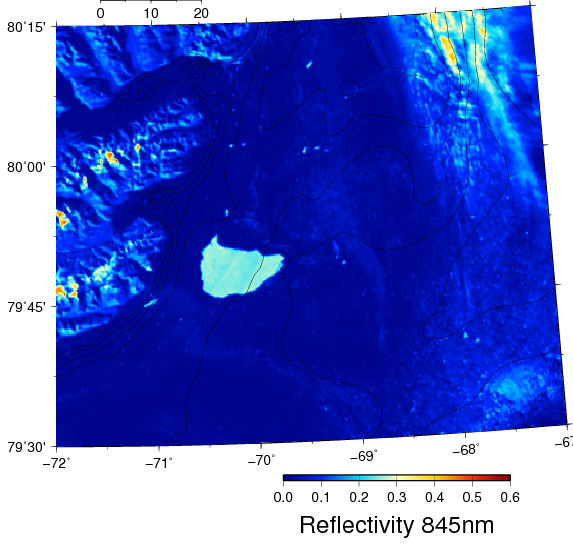
Petermann Ice Island 2012 as one piece on Aug.-30, 2012 19:20 UTC in Kane Basin over contours of bottom topography.

From the above two MODIS images over contours of bottom topography, the shallowest water that PII-2012 has seen is the 150-m contour to the east towards Greenland. It is possible, however, that PII-2012 may also have hit some shallow topographic feature not properly charted in IBCAO-2008 (there is a 2012 version, I just learnt) or not properly contoured by me. Lets move on the next question, how thick is this ice island?

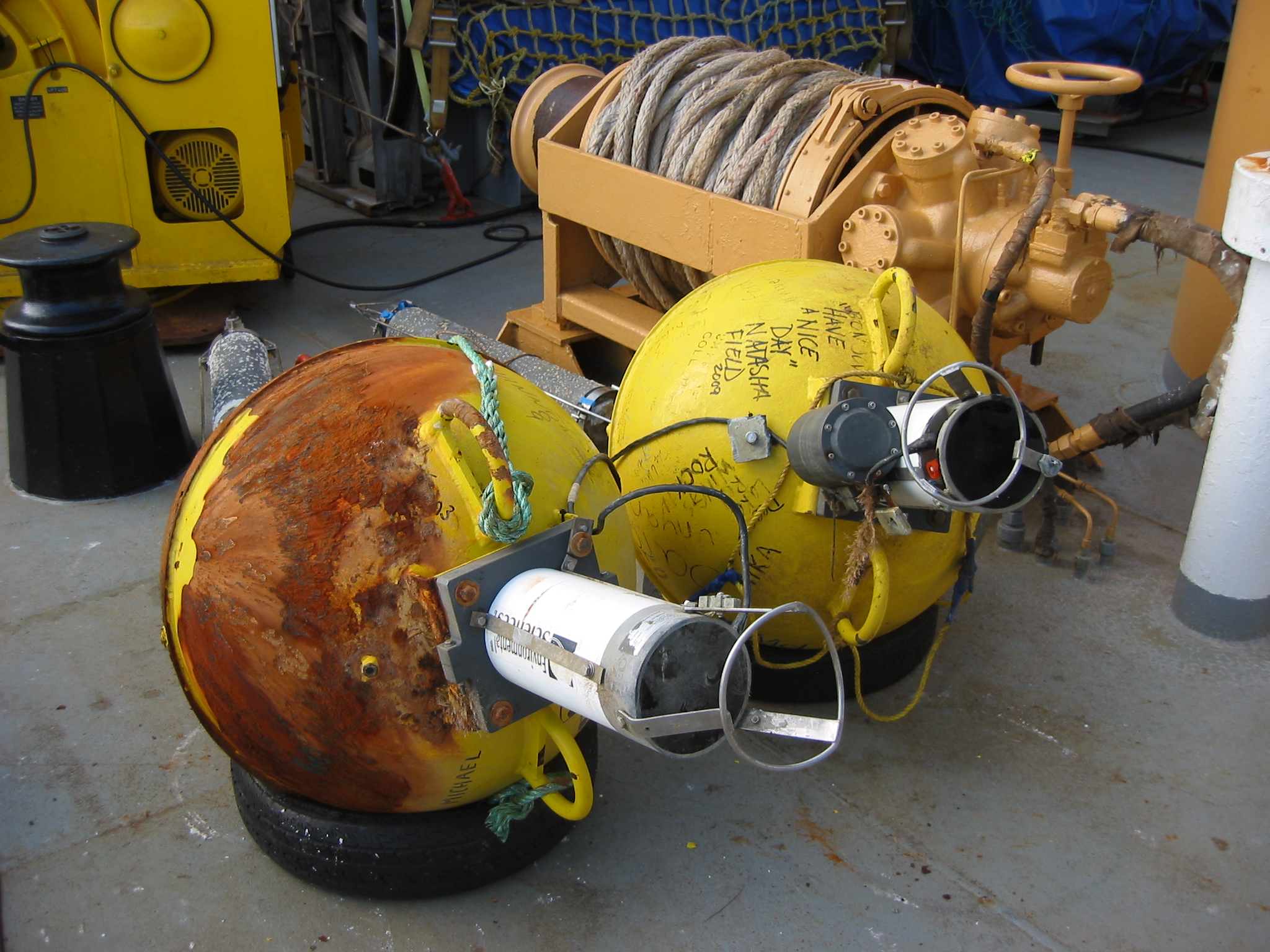
From data we recovered 3 weeks ago I can say, however, that PII-2012 is thicker than 144 meters. I base this estimate on the ice island that formed in 2010 and that passed over our moored array on Sept.-22, 2010. It hit two ice profiling sonars at 75 meters and damaged the stainless steel guard cage designed to protect the sensors (which they did), e.g.,

Two Ice Profiling Sonars (IPS) aboard the CCGS Henry Larsen in Aug.-2012. The bent stainless steel protective frame was bent by the 2010 ice island that hit both instruments in Sept.-2010. [Photo Credit: Andreas Muenchow]

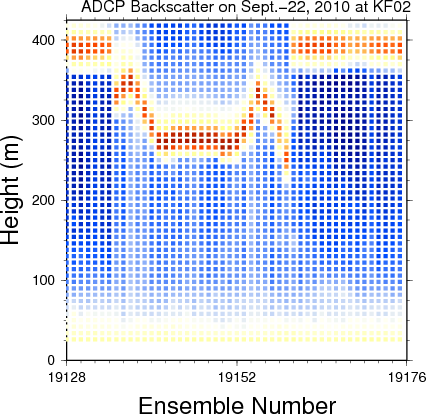
Another instrument moored deeper at ~360 meter depth sends out acoustic pings and measures how much sound comes back. A weak scatter like some microscopic plankton or grain of mud or sand in the water reflects little energy, but a hard surface like the ice floating atop reflects lots. And here is how a time series of this backscattered energy looks like when an ice island passes over:

A 24-hour segment of acoustic backscatter from a bottom-mounted acoustic Doppler current profiler is show to vary with time and height above the bottom. The dark red represents the sea surface and/or the bottom of ice floating on it. Vertical resolution is 8 meters, temporal resolution is 30 minutes for a 3-year deployment. The main purpose of this instrument is to measure ocean currents at the same spatial and temporal resolution as shown here for backscatter. PII-2012-B passed over the instrument on Sept.-22, 2010 and is here estimated to be about 144 meters thick.

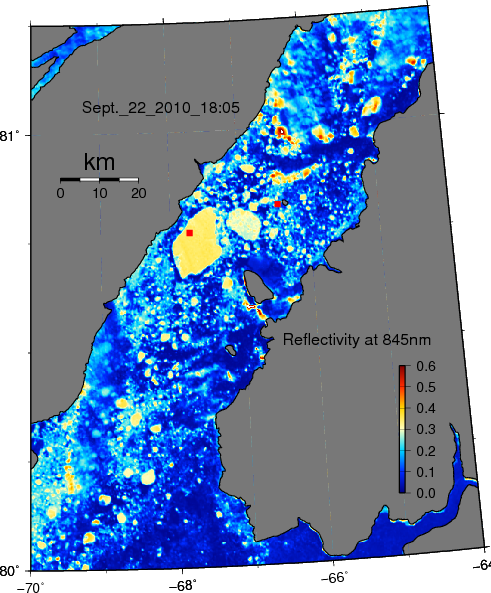
The exact place of the mooring and the time that PII-2010-B was on Sept.-22, 2010 is shown in this MODIS image of that day:

Location of ADCP mooring site (red square) with Petermann Ice Island 2010 segment B overhead on Sept.-22, 2010.

If you like puzzles, then you will like physical oceanography or any field of science or engineering. If you like puzzles, you will correctly notice, that the flat segment of PII-2010-B oriented parallel to the shores of Ellesmere Island fits the flat segment of PII-2012 that also has a hook to the north. These two segments were indeed connected before they separated from the glacier in 2010 and 2012. This is the reason, that the thickest part of the 2010 ice island is the shallowest part of the 2012 ice island, because the ice gets thicker towards the grounding line of Petermann Gletscher.

And finally, if you like puzzles, then you should consider a career in physical oceanography or physics or mathematics or electrical or mechanical or civil engineering. These are fields where jobs and careers are plentiful and people live long and happy lives: Preben chose Electrical Engineering 70 years ago in Denmark, I chose physical oceanography 30 years ago in Germany, and Allison chose physics 3 years ago in the U.S. of A. Sadly, few American students chose to compete for these jobs and lives, because they need to take a “difficult” undergraduate major. Allison did, she picked physics and oceanography, and so can you.

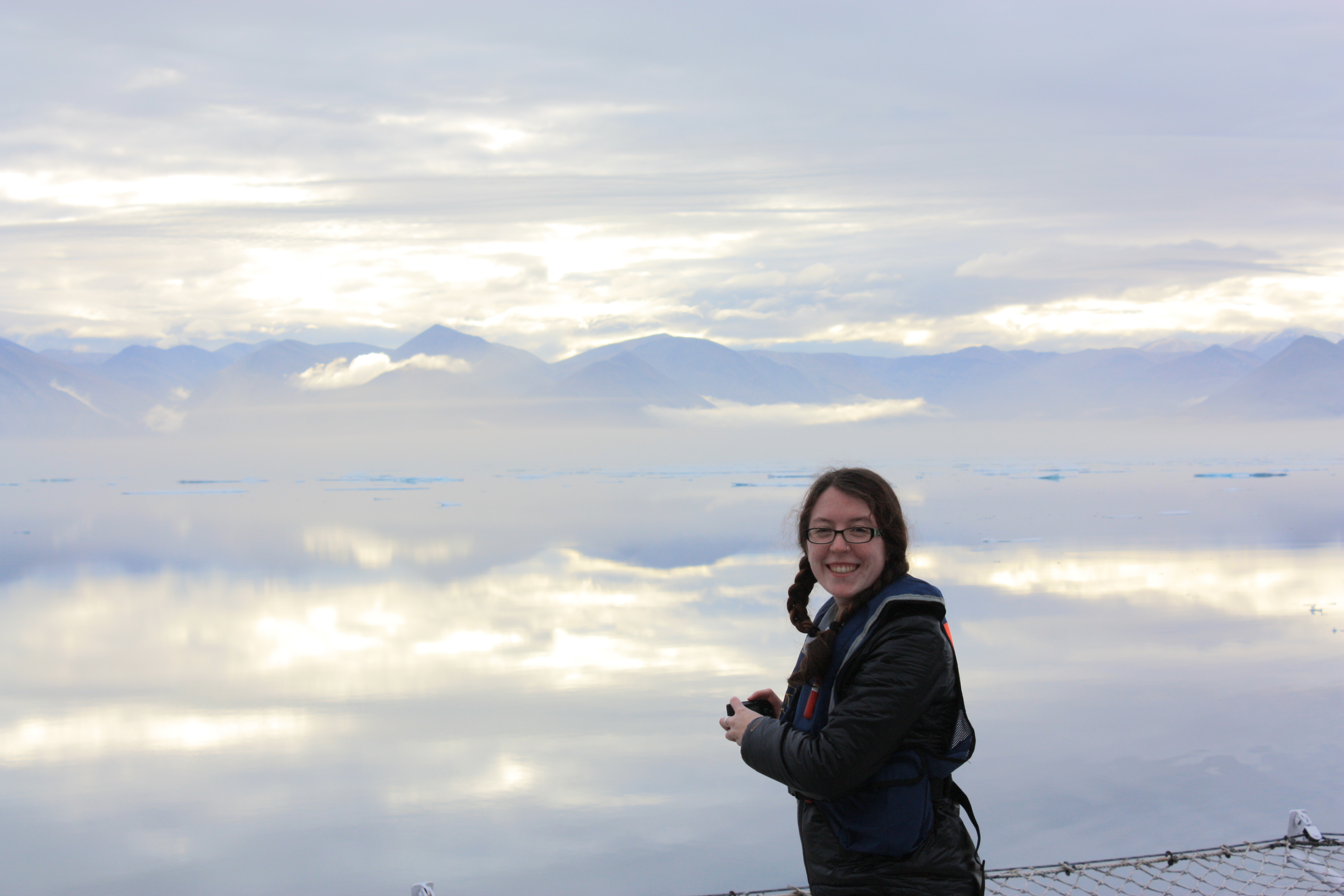
University of Delaware summer intern Allison Einolf from Macalester College, Minnesota in Nares Strait in Aug.-2012 aboard CCGS Henry Larsen. Allison studies physics. [Photo Credit: Jo Poole, British Columbia]

Arctic Ice Cover and Petermann Fjord, Glacier, and Ice Island Video Footage

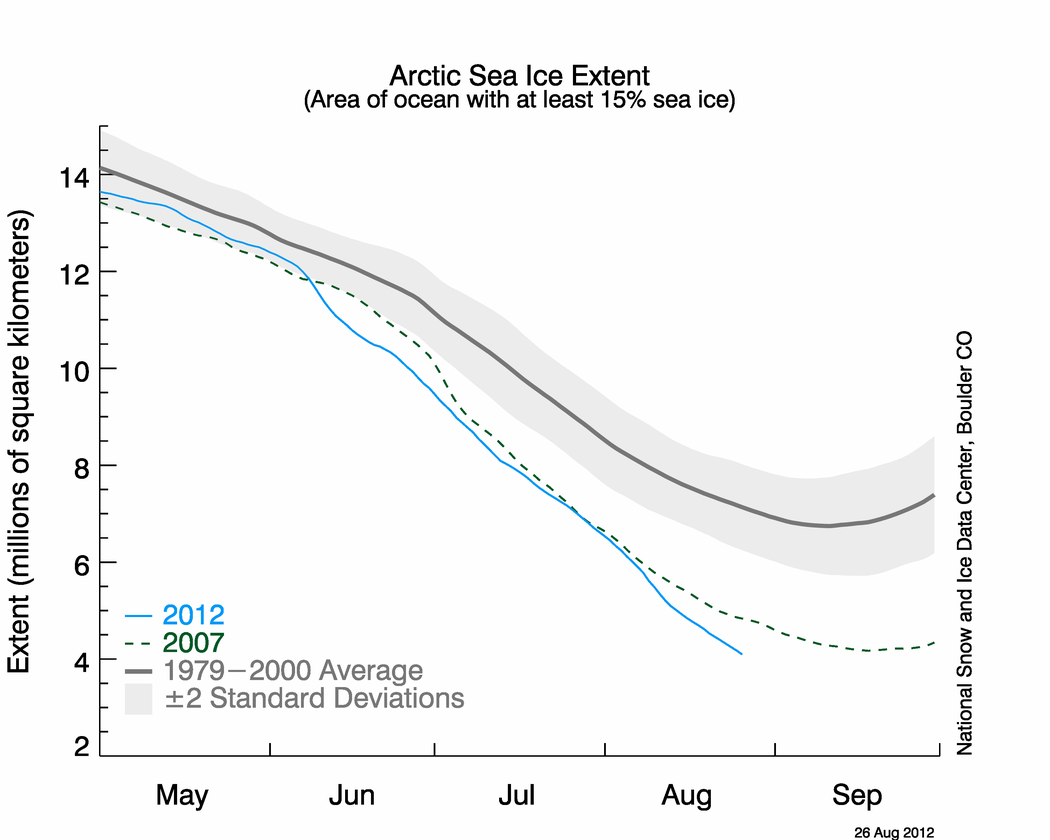
The National Snow and Ice Data Center announced today, that the Arctic Ice Area Extent has reached an absolute minimum breaking the record minimum of 2007 with still several weeks of potential melting and retreat to go. This has been anticipated for many weeks now with perhaps the most extensive coverage and intelligent discussions over at Neven’s Arctic Sea Ice Blog.

The graph above shows Arctic sea ice extent as of August 26, 2012, along with daily ice extent data for 2007, the previous record low year, and 1980, the record high year. 2012 is shown in blue, 2007 in green, and 1980 in orange. The 1979 to 2000 average is in dark gray. The gray area around this average line shows the two standard deviation range of the data. The 1981 to 2010 average is in sky blue. Sea Ice Index data. [Credit: National Snow and Ice Data Center]

This is as big a deal, because an ice-covered ocean reflects much more sunlight back into space in summer than a black ocean does that absorbs more heat: a positive feedback. This is why people in hot climates wear white, not black clothes, they like to stay cool. Furthermore, this decline has been ongoing for the last 30 years and the climate models that policy makers rely on did not predict this level of ice cover to occur for another 20-30 years. So, the warming climate and the changes it caused are on an accelerated schedule with regard to the Arctic Sea Ice cover. Also, the remaining ice cover is thinner than it used to be, because the multi-year ice keeps leaving the Arctic faster than it can be formed inside the Arctic. Both the Fram Strait to the east of Greenland and Nares Strait to the west of Greenland export this old, hard, and thick ice that ultimately melts further south. The ice that is left in the Arctic Ocean has become both thinner, younger, and softer, making it easier to melt the next summer.

On somewhat related news from the University of Delaware (UDel), we put two videos together that show a tiny, if spectacular example of a different area that has never been ice-free for at least 150 years when people were looking: Petermann Fjord. On August 10/11, 2012 the Captain and crew of the Canadian Coast Ship Henry Larsen gave us unfettered 18 hours access to the newly ice-free waters of this large glacier that discharges about 6% of the Greenland ice sheet. The UDel press release has the video that is also posted at youtube. As a less professionally assembled version is my first introductory iMovie project, e.g.,