
Tag Archives: glaciers

Glaciers, Geocaching, and Greenland Goals

I thought it silly when my wife suggested to go geocaching with her. She told me it was to hunt for treasures and as a professor of physical ocean science and engineering this was not for me. But my wife is persistent, I am curious, and when she explained that a GPS, hiking, and computer mapping was involved, I gave it a try and have been hooked ever since. My first geocaching hiking trip took place on Anacortes Island, Washington in 2013 where our youngest son then lived. Here we are walking past rock carved 10,000 years ago by a tiny glacier at N 48° 29.498 W 122° 41.799 N that discharged ice into Puget Sound:
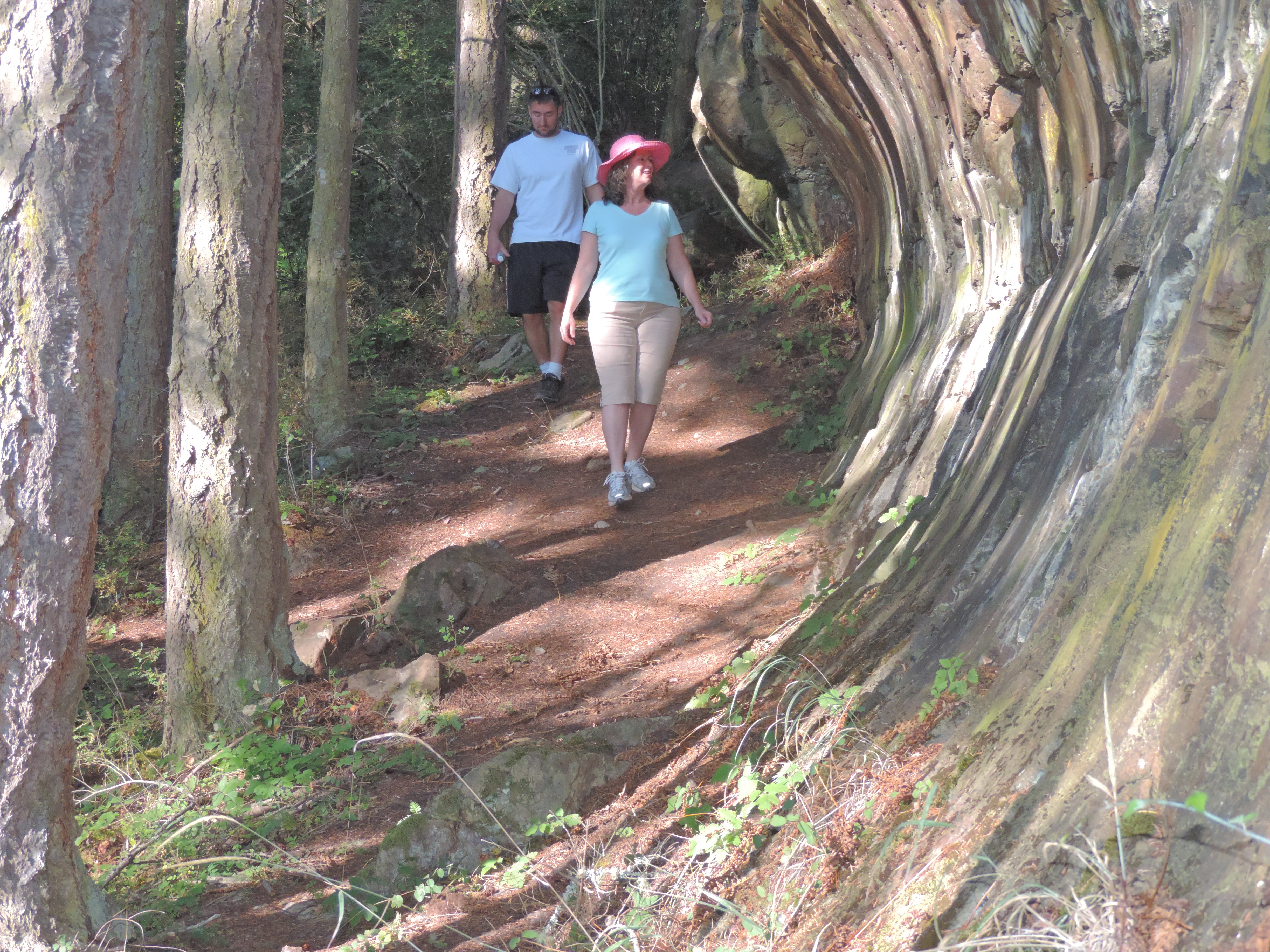
Glacier carved outcrop in Washington Park, Anacortes Island, WA.

Glacier carved outcrop in Washington Park, Anacortes Island, WA.

Since this first geocaching trip, I have found more than 200 geocaches in places small and remote and places large and urban. The treasure is in the walking and trying to find a path towards a destination, but the destination is secondary as many discoveries are made along the way.

This often happens in science also. One needs to know a destination, have a goal, formulate a hypothesis, but much science, learning, and discovering happens along the path towards that goal. With a GPS the destination is easy, it is a fixed point on earth, but it is harder in science. It can be useful to roam widely, but a set of intermediate goals can help to stay focused. For example, I want to understand how Greenland will change as we warm the earth. That’s a big question with impacts on floods in Europe, storms in the Americas, and rising sea level everywhere. This is a 100-year problem that many people work on; so my personal goal is to focus on how the oceans melt glaciers from below. This is a 10-year problem. It is a step towards the larger goal, but 10 years is still long even though I work with people in Germany, Canada, Denmark, England, Sweden, and Norway:

View to the south on the climb down from Tromsdalstinen.

View to the south on the decent from Tromsdalstinen on a geocaching trip in 2014 out of Tromso, Norway.

The photo above was made during one of my geocaching trip in northern Norway. Three physical oceanographers had gotten off the ship after they deployed ocean current measuring devices off eastern Greenland near a larger ice sheet. The experiment was designed to measure the ocean heat and its movement towards two large outlet glaciers. One has a wide and stable floating ice shelf, Nioghalvfjerdsfjorden (79N Glacier) while Zachariae Isstrom a few miles south lost its wide, long, and apparently unstable ice shelf that still shows in this 2002 image:

North-east Greenland: 79N Glacier and Zachariae Isstrom in 2002.

North-East Greenland in 2002 when both 79N Glacier (near 79 30′) and Zachariae Isstrom (near 79 00′) had extensive ice shelves (black areas are open ocean).

It puzzles me how two adjacent glaciers can and do behave so differently. If we understand how Greenland is melting, then we should explain the difference convincingly, but I am still looking for people who can. Lots of theories, lots of ideas, and lots of modeling, but there are not many observations to make the skimpy and often contradictory evidence convincing. And this finally leads me to my last point and the goal that I set for myself for the next 5-10 years:

I like to measure the ocean, the ice, and the air above and below floating glaciers via a small network of sensors. Now that two large ice islands spawned at Petermann Gletscher in 2010 and 2012, I believe that the remaining ice shelf will stay largely put for the next few years, that is, move at 1 km per year towards Nares Strait:
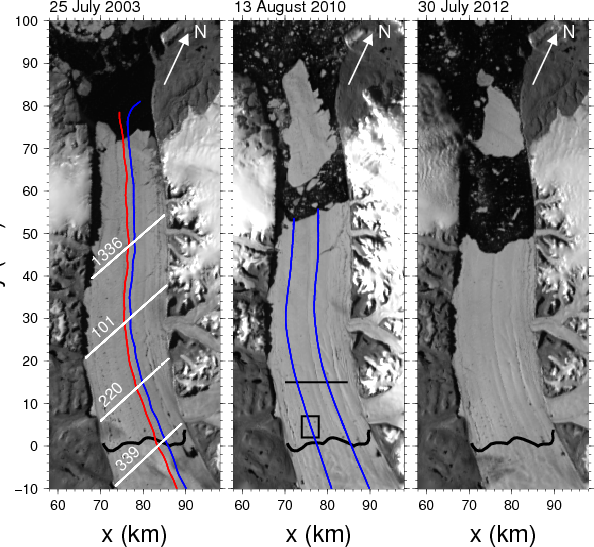
Petermann Gletscher through calving events. White lines show ICESat tracks; red (ambient ice shelf) and blue (central channel) show repeat-track airborne surveys.

Petermann Gletscher through calving events. White lines show ICESat tracks; red (ambient ice shelf) and blue (central channel) show repeat-track airborne surveys.

The hardest part in reaching this goal is to get measurements from under the 200-600 meter thick ice. This requires holes drilled through the glacier, it requires ocean sensors to be lowered into the water below the glacier, and it requires connections to relay data back to the surface at all hours for many year. I  perhaps have a first chance towards this goal when the Swedish icebreaker Oden will work for a month in Petermann Fjord this year. People from the British Antarctic Survey will be aboard and they plan to drill holes for other scientific purposes. When they are done, the holes freeze over, unless someone (me, me, me, please, pretty, pretty please) has instruments to put in there. I just word that I will be aboard the ship as well and I am feverishly working towards this goal with much help from others. More on this in later posts. All science is a group effort.

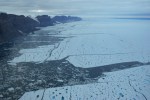
I close with a photo to show how the ice-covered ocean of Petermann Gletscher looks during the polar day. Would it not be great to know the temperature of the water below and the air above this more than 200 meter thick glacier ice at all times posted for everyone to use with an internet connection?
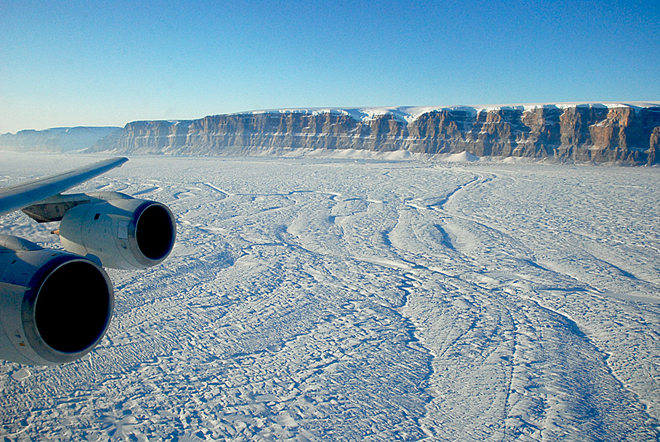
March-24, 2010 view of Petermann Glacier from NASA's DC-8 aircraft. Photo credit goes to Michael Studinger of NASA's IceBridge program.

March-24, 2010 view of Petermann Glacier from NASA’s DC-8 aircraft. Photo credit goes to Michael Studinger of NASA’s IceBridge program.
Icebergs, Islands, and Instruments off Isle de France, North-East Greenland

Leaving all land behind when FS Polarstern sailed for Greenland almost 2
weeks ago, we saw land again for a few hours last Sunday. A small
ice-capped island called Isle de France was ahead of us. Solid ice was to
the west, Continue reading

North Greenland Glacier Ice-Ocean Interactions 2014

I will travel to Spitsbergen in six weeks to board the German research icebreaker Polarstern. She will sail west across Continue reading

Petermann Gletscher Thawing and Thinning

Greenland’s tidewater glaciers are losing mass, through thinning and retreat, at an increasing rate. Greenland’s glaciers located north of 78 North latitude often end in ice shelves, floating extensions of the glaciers extending up to several tens of km into the adjacent fjords. While most ice shelves of North Greenland have been relatively stable, Petermann Gletscher lost more than 40% of its ice shelf area (36 giga tons) during two major calving events in 2010 and 2012. What remains of Greenland’s ice shelves is threatened by a changing climate, because both regional air and ocean temperatures continue to increase while Arctic sea ice cover continues to decline.

Petermann Gletscher through calving events. White lines show ICESat tracks; red (ambient ice shelf) and blue (central channel) show repeat-track airborne surveys.

Petermann Gletscher through calving events. White lines show ICESat tracks; blue (ambient ice shelf) and red (central channel) show repeat-track airborne surveys.

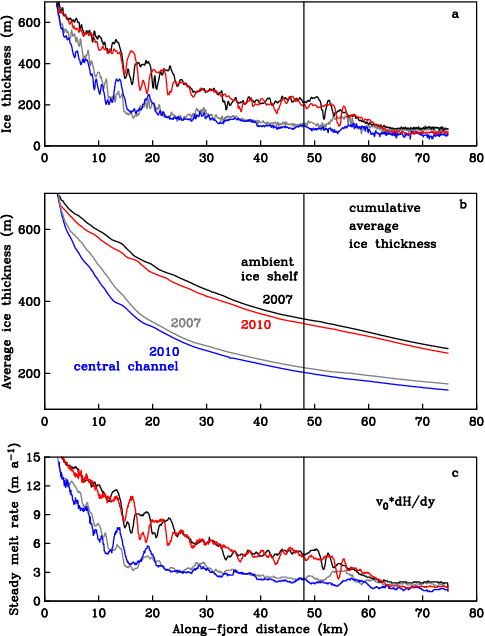
Using lasers and ice sounding radars aboard NASA planes (Operation IceBridge) as well as lasers on a now defunct satellite (ICESat), oceanographer Laurie Padman, glaciologist Helen A. Fricker, and I just passed peer-review with a study that estimates how much Petermann Gletscher has shrunk and melted over the last decade or so. The quick answer is about 5 meters per year:

(top) Change in ice thickness from 2007 to 2010 from repeat airborne missions. (middle) along-track mean thickness. (bottom) steady-state melt.

(top) Change in ice thickness from 2007 to 2010 from repeat airborne missions. (middle) along-track mean thickness. (bottom) steady-state melt.

In our study we distinguished between 1. a thinning of the floating ice shelf that moves along the glacier as new ice moves from the Greenland ice sheet on land out into the ocean and 2. a non-steady thinning at fixed locations as time passes. The situation is somewhat similar to the flow through a pipe (or river, if you wish) with a constriction. If the same amount of water entering the pipe comes out at the other end, then the flow has to speed up where the pipe becomes narrow. A floating glacier is not quite like water flowing through a pipe, because the ocean underneath and the air above can melt ice making the floating ice shelf thinner as it flows along. If the ice thickness changes along the floating glacier, then melting must take place for a glacier moving seaward at a constant rate. The ice thickness changes along the glacier, but stays constant at a fixed location. This is the steady-state melt.

The non-steady state thinning is the change in ice thickness at a fixed point observed at different times. We estimated this from observations taken along exactly the same tracks that the NASA aircraft flew in 2007 and 2010 before the break-up of Petermann Gletscher. Prior studies could not measure this, because the tracks were not the same or because the signal processing was not up to the task. We find that both the steady and the non-steady contribution is about 5 m per year each. These rates do not vary much between a thin central channel or a thick ambient ice shelf. This came as a little bit of a surprise, because the central channel is often also refered to as a “melt channel,” but it actually melts no different from any other section of the ice shelf. So, the question remains as to what causes the central and many other channels to be there in the first place. The place to look, I feel, is the area where the bed rock, the glacier ice, and the Arctic Ocean meet in what is called the grounding zone. It is here that the gigantic forces of water and ice pulverize rock while a mixture of rock and pressurized water is sand-blasting the ice. Talking about a rock and a hard place …

Our study will appear later this year in the Journal of Glaciology, but pre-prints can be downloaded here. The U.S. tax-paying public funded this study via grants that we received from NASA and NSF. They also funded substantial efforts to make sure, that all data reside in the public domain accessible to anyone anywhere.

Münchow, A., Padman, L., and Fricker, H.A. (2014). Interannual changes of the floating ice shelf of Petermann Gletscher, North Greenland from 2000 to 2012, Journal of Glaciology, in press

Johnson, H., Münchow, A., Falkner, K., & Melling, H. (2011). Ocean circulation and properties in Petermann Fjord, Greenland Journal of Geophysical Research, 116 (C1) DOI: 10.1029/2010JC006519

Rignot, E., & Steffen, K. (2008). Channelized bottom melting and stability of floating ice shelves Geophysical Research Letters, 35 (2) DOI: 10.1029/2007GL031765

First Research Mission for Norway’s new Icebreaker

The Norwegian government just committed ~$4,000,000 to explore ecosystems in the Arctic Ocean. This new study includes ocean surveys Continue reading