Did I ever see a Polar Bear?

When people hear that I have worked as a physical oceanographer in the Arctic for almost 20 years, their first question is often: “Did you ever see a Polar Bear?” The answer is a yes, but when we see bears, it is usually as a tiny moving speck of yellowish white near the white, icy, and hazy horizon. Only twice was it different. The first time was in October 2003 to the north-west off Arctic Alaska when a young bear swam towards and around the U.S. Coast Guard Cutter Healy doing station work:

Polar Bear seen Oct.-10, 2003 from aboard the USCGS Healy to the north-east of Alaska [Credit: Andreas Muenchow, University of Delawarel]

Polar Bear seen Oct.-10, 2003 from aboard the USCGC Healy to the north-east of Alaska [Credit: Andreas Muenchow, University of Delaware]

The second close encounter was last year as the Canadian Coast Guard Ship Henry Larsen was about to leave Nares Strait on Aug.-12. Out of the 100+ pictures snapped of this bear, the ship’s Steward Kirk McNeil of Labrador probably took the best shot:

Polar bear as seen in Kennedy Channel on Aug.-12, 2012. [Photo Credit: Kirk McNeil, Labrador from aboard the Canadian Coast Guard Ship Henry Larsen]

Polar bear as seen in Kennedy Channel on Aug.-12, 2012. [Photo Credit: Kirk McNeil, Labrador from aboard the Canadian Coast Guard Ship Henry Larsen]

This bear approached the drifting ship leisurely over a 10 minutes period from a large piece of ice that also drifted with the tides and currents. My PhD student Pat Ryan captured the last 2 minutes of this visit with her iPhone. The voice is hers (I also discern the voice of Ice Specialist Erin Clarke). Greenland is in the background to the east:

ADDENDUM Feb.-13, 2013: I just found this map of the spatial distribution of polar bears from a Dec.-23, 2012 article in the Washington Post by Juliet Eilperin entitled “Polar bear trade, hunting spark controversy.” Writing for the Wall Street Journal Feb.9, 2013, Zac Unger commented with the question “Are polar bears really disappearing?”

Polar bear population and their trends. [Source: Polar Bear Specialist Group. Laris Karklis/The Washington Post. Published on December 23, 2012, 5:24 p.m.]

Polar bear population and their trends. [Source: Polar Bear Specialist Group. Laris Karklis/The Washington Post. Published on December 23, 2012, 5:24 p.m.]

Addendum Feb.-25, 2013: A very funny bear commercial.

Antarctic Plane Crash Kills 3 Canadians

Polar research requires ships, planes, and helicopters to supply bases and move people, instruments, fuel, and food to places where instruments need to placed, recovered, or serviced. While these activities are fairly routine and safe where most of us live, they are neither routine nor safe in extreme cold, extreme winds, or extremely remote places such as Arctic Canada, Greenland, or Antarctica.

I just learnt from an NSF Press Release that a Kenn Borek Twin Otter crashed into Mount Elizabeth in the Queen Alexandra Range of the Transantarctic Mountains at an elevation of about 3,900 m or 11,000 feet less than 2 weeks ago. All three Canadian crew aboard were killed. The plane was in transit from a research station at the South Pole to the Italian station at Terra Nova Bay to support Italian field work.

A memorial ceremony for the aircrew at NSF's Amundsen-Scott South Pole Station [Photo Credit: Blaise Kuo Tiong, NSF]

A memorial ceremony for the aircrew at NSF’s Amundsen-Scott South Pole Station [Photo Credit: Blaise Kuo Tiong, NSF]

Here are the words of Dr. Kelly Falkner, Director of NSF’s Polar Division (source):

January 28, 2013
On behalf of the U.S. National Science Foundation and all in the U. S. Antarctic Program, I wish to extend our profound sympathies to the families, friends, and colleagues of the three Kenn Borek Twin Otter crew, whose deaths in Antarctica while en route to support the Italian national Antarctic science program have recently been confirmed.

We have been privileged to experience first-hand their professionalism, skill, and dedication to the arduous task of supporting science in an extremely remote and inhospitable environment. In many ways, their contributions make possible hard won but vital advances in scientific knowledge that serve all of mankind. Although everyone associated with the pursuit of science in Antarctica makes personal sacrifices to do so, very infrequently and sadly, some make the ultimate sacrifice.

While it may come as little consolation at this very sorrowful time, the families, friends, and colleagues of the crew members should know that the thoughts of everyone in the U.S. Antarctic Program were with them through the long ordeal of the past few days and remain so now.

To the families and friends of the crew, I commend your loved ones for their commitment and dedication to their profession and offer our condolences. The sense of loss is keenly felt throughout the U.S. program and no doubt throughout the international Antarctic community.

-NSF-

I am also thinking of Marty Bergmann, a Canadian Polar scientist turned administrator. He perished 2 summers ago in a plane crash outside Resolute, Nunavut in the Canadian High Arctic working his Government Canada job to tirelessly help others in their Arctic research. Unlike the photo below, I remember him with a massive ear-to-ear grin on his face and a twinkle in his eye.

The Royal Canadian Geographic Society will recognize Martin Bergmann, the director of the Polar Continental Shelf Program who died in a plane crash in Resolute last year, by creating a medal for excellence in Arctic leadership, science and exploration. [Credit: CBC News]

Martin Bergmann, Director of the Polar Continental Shelf Program who died in a plane crash in Resolute Aug.-20, 2011. [Credit: CBC News]

Academic Freedom and International Collaborations

Working in the Arctic is hard. Despite climate warming, despite diminishing ice cover, despite public interest and global impact, it is still a hostile and challenging place. It is also very expensive to get to. It usually takes me 2-4 days to travel from Delaware to the ship at Thule, Greenland. An icebreaker costs anywhere between $45,000 and $95,000 per day to operate. Last year’s recovery of scientific instrumentation and a survey of the oceanography of Nares Strait and Petermann Fjord used 8 days or almost $500,000 in ship time alone.

CCGS Henry Larsen at the entrance to Petermann Fjord in August 2012 adjacent to the 2012 Petermann Ice Island. [Photo Credit: Jon Poole and Canadian Coast Guard Ship Henry Larsen]

CCGS Henry Larsen at the entrance to Petermann Fjord in August 2012 adjacent to the 2012 Petermann Ice Island. [Photo Credit: Jon Poole and Canadian Coast Guard Ship Henry Larsen]

These large costs are best shared among different institutions and many countries, but they can be difficult to justify at times of shrinking economies and pressing needs to balance budgets. Personally, I feel strongly that these costs are justified if (a) the data, technology, or other information are shared and distributed as widely and speedily as possible and if (b) the science has been evaluated and vetted thoroughly and fairly by peers to ensure that the work has both intellectual merit and broader impacts.

Drs. Humfrey Melling and Kelly Falkner working in Baffin Baffin Bay aboard the USCGC Healy in 2003. [Photo Credit: Andreas Muenchow]

Drs. Humfrey Melling and Kelly Falkner working in Baffin Baffin Bay aboard the USCGC Healy in 2003. [Photo Credit: Andreas Muenchow]

My collaborative work the last 10 years with Drs. Humfrey Melling and Kelly Falkner in Nares Strait has passed such peer review, as the U.S. National Science Foundation funded a series of joint grant proposals. Such work requires international collaborative agreements as it involves moneys, ships, and legal rights of multiple parties. In 2003 a 5-year joint project contained an 11 page short agreement. The section on data sharing and publications consisted of these two sentences:

Subject to the “Access to Information and Privacy Acts”, Project Data and any other Project-related information shall be freely available to all Parties to this Agreement and may be used, disseminated or published, by any Party, and any time. Any proposed publication that incorporates a significant amount of Project information shall be provided to the other Party prior to public dissemination.

In 2013 a 1-year joint project of smaller scope required a legal (draft) document 19 pages long. The section on data sharing and publication now consists of almost 2 pages containing language like

Any technology, data, or other information of any kind related to or arising from the Project (collectively “Information”) shall be deemed confidential and neither Party may release any such Information to others in any way whatsoever without the prior written authorization of the other Party … The obligation of the Parties herein shall survive the expiration to which this Appendix is affixed and of which it is part.

I believe this is disturbing political climate change. I feel that it threatens my Academic Freedom and potentially muzzles my ability to publish data and interpretation and talk timely on science issues of potential public interest without government interference. Canadian officials convey that this language is a new standard template to simplify and streamline all collaborations that involve Canada’s Department of Fisheries and Oceans. It reminds me of last year’s chilling editorial in the pre-eminent British science magazine Nature appealing to the Canadian government to let its scientist speak freely about their science. The new draft language is excessively restrictive and potentially projects Canadian government control onto me and those I work for and with. I will propose changes to this language and hope that some of these will be accepted to further mutually beneficial exchange of information and data to the public without restrictions.

There are many such collaborations as almost all Arctic research is international and collaborative as it is expensive and hard to work in the Arctic … on so many levels. The ever-changing political climate just adds another challenge that I may very well fail, because I cannot in good conscience sign away my freedom to speak, publish, educate, learn, and share both of what I know and what I do not know. Both science and debate prosper in an atmosphere of openness that engages a wider public, but science and debate are diminished in the darkness of secrecy when only the politically correct have access.

ResearchBlogging.org
Editorial (2012). Frozen out Nature, 483 (7387), 6-6 DOI: 10.1038/483006a

O’Hara, K. (2010). Canada must free scientists to talk to journalists Nature, 467 (7315), 501-501 DOI: 10.1038/467501a

Petermann Glacier Ice Islands: Where are they now?

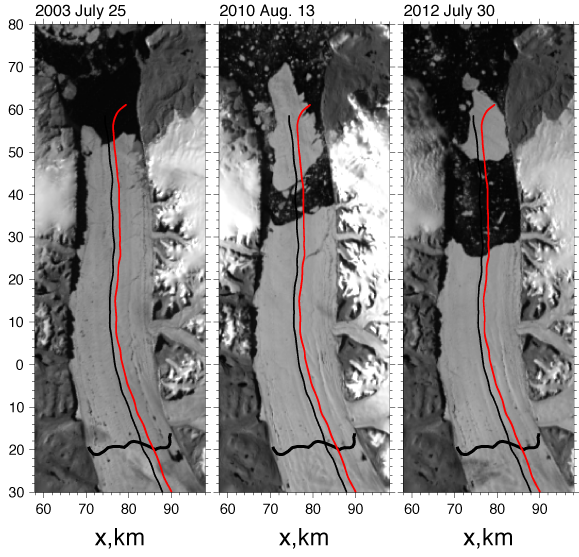
Two large calving events in 2010 and 2012 reduced the floating part of Petermann Gletscher by 44 km (28 miles) in length, 6 Manhattans (380 km^2) in area, and 42 gigatons in mass. But what’s a gigaton? Writing in The Atlantic Magazine, Julio Friedman states that if we put all people living on earth onto a scale, then we will get half a gigaton. So, Petermann’s two ice island weigh more than eighty times as all humanity combined. As a reminder, this is what the break-ups looked like:
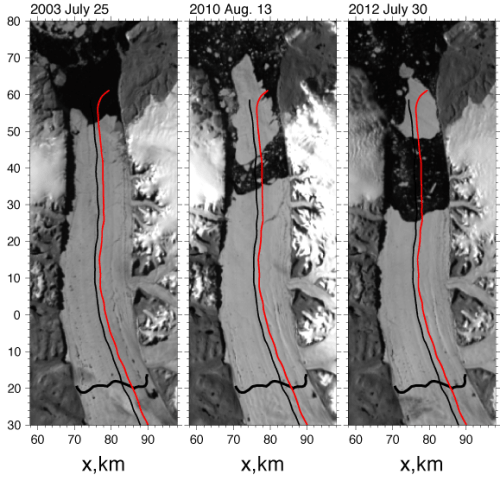
Petermann Gletscher in 2003, 2010, and 2012 from MODIS Terra in rotated co-ordinate system with repeat NASA aircraft overflight tracks flown in 2002, 2003, 2007, and 2010. Thick black line across the glacier near y = -20 km is the grounding line location from Rignot and Steffen (2008).

Petermann Gletscher in 2003, 2010, and 2012 from MODIS Terra in rotated co-ordinate system with repeat NASA aircraft overflight tracks flown in 2002, 2003, 2007, and 2010. Thick black line across the glacier near y = -20 km is the grounding line location from Rignot and Steffen (2008).

It turns out that the smaller 2012 ice island is just as heavy as the 2010 island, because it is much thicker, about 200 m, 600 feet, or half the height of the Empire State Building in Manhattan. These thick and thin islands have since left Petermann Fjord and Nares Strait for more southern climes. The thinnest piece reached Newfoundland in the summer of 2011 where it melted away. Most of the thicker, larger, and heavier ice islands from Petermann and Ryder Glaciers now litter almost the entire eastern seaboard of Canada as the two largest pieces have split, broken, and splintered into many smaller pieces. Each of these still represents an exceptionally large and dangereous piece of ice that can wipe any offshore oil platform off its foundation. Luc Desjardins of the Canadian Ice Service now tracks more than 40 segments, some still bigger than Manhattan, some as small as a football field. The distribution along the 1500 km (1000 miles) of coast is staggering:

RadarSat imagery of eastern Baffin Island (bottom, right), western Greenland (top, right), and Nares Strait with Petermann Fjord (top, left) with pieces of Petermann and Ryder Ice Islands identified. [Credit: Luc Lesjardins, Canadian Ice Service]

RadarSat imagery of eastern Baffin Island (bottom, right), western Greenland (top, right), and Nares Strait with Petermann Fjord (top, left) with pieces of Petermann and Ryder Ice Islands identified as green dots. [Credit: Luc Lesjardins, Canadian Ice Service]

What stands out is that most pieces are close to the coast of Canada. This is expected, because often the ocean moves in ways to balance pressure gradient and Coriolis forces as we live on an earth that rotates once every day around its axis. This force balance holds both in the ocean and the atmosphere. We are all familiar with winds around a low-pressure system such as Hurricane Sandy where the winds move air counter-clockwise around the eye (the center of low pressure). This eye of low pressure in our ocean story is permanently near the center of Baffin Bay. Ocean currents then move water counter-clockwise around this eye. This results in a flow to the south off Canada and a flow to the north off Greenland. On a smaller scale this balance holds also, such as Delaware Bay or Petermann Fjord, but I will not bore you with the details of graduate level physics of fluids in motions … as important as they may be.

So, almost all the ice islands we see in the above imagery will make their way further south towards the Grand Banks off Newfoundland. Some are grounded to the bottom of the shallow coastal ocean and may sit in place for a year, or a month, or until the next high tide will lift the ice off the bottom and move it back into deeper water. Some ice islands will keep moving rapidly, some will further break apart, but none will go away anytime soon. If you want to see some of Petermann’s Ice Islands for yourself, take the ferry from North Sidney, Nova Scotia to Port aux Basques, Newfoundland and Labrador and head for the Great Northern Peninsula. That’s what I hope to do one of the next summers.

ResearchBlogging.org
Johnson, H., Münchow, A., Falkner, K., & Melling, H. (2011). Ocean circulation and properties in Petermann Fjord, Greenland Journal of Geophysical Research, 116 (C1) DOI: 10.1029/2010JC006519

Münchow, A., & Garvine, R. (1993). Dynamical properties of a buoyancy-driven coastal current Journal of Geophysical Research, 98 (C11) DOI: 10.1029/93JC02112

Rignot, E., & Steffen, K. (2008). Channelized bottom melting and stability of floating ice shelves Geophysical Research Letters, 35 (2) DOI: 10.1029/2007GL031765

Climate Change Negotiations, 18 years in 83 Seconds

Cartoon alert: Several thousand delegates meet in Doha, Qatar all week to negotiate climate change actions and co-operation for the 18th time since 1995. Summing up 18 years of such negotiations, I just found an 83 second cartoon via Andrew Revkin’s DotEarth blog at the New York Times:

On a more serious note, Nature just published a commentary (.pdf) on how these international climate negotiations have evolved over time and perhaps lost their effectiveness. Their conclusion is that present United Nation structures hinder progress towards international co-operation to moderate climate change. Credit here goes to Roger Pielke’s blog where the original authors of the Nature Commentary give a brief summary of their findings.

ResearchBlogging.org

Schroeder, H., Boykoff, M., & Spiers, L. (2012). Equity and state representations in climate negotiations Nature Climate Change, 2 (12), 834-836 DOI: 10.1038/nclimate1742