Women In Science: Costs and Benefits

“Science remains institutionally sexist. Despite some progress, women scientists are still paid less, promoted less frequently, win fewer grants and are more likely to leave research than similarly qualified men.” [Nature, Mar.-7, 2013]

This is from yesterday’s special issue of Nature which prompted this tongue-in-cheek comment by Prof. Dr. Cristina Archer:

Can we put a dollar amount to how much it would cost to fill the gender gap with respect to salary disparity?

Here is the procedure:

1) N_w = number of women scientists in the US
2) S_w = average salary of the N_w women scientists in the US
3) S_m = average salary of the male scientist in the US
4) Delta = difference in salary between male and female scientists
5) Tot = total dollars that the female scientists should be receiving to fill the disparity = Delta * N_w

To get a sense of the order of magnitude, here are some values:

1) N_w = 93,400 (in 2008, from the Nature paper)
2) S_w = $60,000 (this is actually the median, not the average, in 2008)
3) S_m= $84,000 (median in 2008)
4) Delta = $24,000
5) Tot = $24,000 * 93,400 = $2,241,600,000 (yes, billions)

For the nerdy of us, I acknowledge that using the median instead of the average might give an overestimate of the final bonus, although the order of magnitude is correct.

Since the gender gap seems very expensive to fill (~$2 billions), it might be cheaper and easier to actually reduce the salary of all male scientists (N_m = 179,400). The total saved would be:

Tot2 = $24,000 * 179,400 = $4.3B (of course billions)

If that money could be donated to NSF, the benefits to research in the US would be incalculable.

So … who wants to be the first male scientist to give up 28% of his salary and start filling the gender gap?

I admit, that I was the first to volunteer.

ADDENDUM: This post is not meant to criticize any institution in any way or form. The fact that these issues are discussed openly reflects both sensitivity and progress towards a common goal of gender equality in science. There is also a student’s perspective that Allison Einolf posted here last summer which includes references to a 2011 NSF study on the issue.

Camels in Arctic Canada, Nature Reports

Camels roamed freely the boreal forests of Arctic Canada ages ago. Today, Natalia Rybczynski of the Canadian Museum of Nature in Ottawa published such findings in Nature Communications with Canadian and British scientists. Margaret Munro has the full story.

Illustration of the High Arctic camel on Ellesmere Island during the Pliocene warm period, about three and a half million years ago. [Credit: Julius Csotonyi/Canadian Museum of Nature]

Illustration of the High Arctic camel on Ellesmere Island during the Pliocene warm period, about three and a half million years ago. [Credit: Julius Csotonyi/Canadian Museum of Nature]

My first impression was that of hoax, but here is what the original science article says in the abstract:

Moreover, we report that these deposits have yielded the first evidence of a High Arctic camel, identified using collagen fingerprinting of a fragmentary fossil limb bone. Camels originated in North America and dispersed to Eurasia via the Bering Isthmus, an ephemeral land bridge linking Alaska and Russia. The results suggest that the evolutionary history of modern camels can be traced back to a lineage of giant camels that was well established in a forested Arctic.

Now, the camel is dead for 3.5 million years. It lived at a time when the earth’s climes, oceans, glaciers, and mountains were all different from what they are today with many ice ages that came and went. Bone fragments of this ancient camel were preserved by ice ages long past and today’s cold and dry desert climate of Ellesmere Island.

Good stuff comes out of Canada, and this includes Rick Mercer’s rant about Scientists in Canada 2013.

Rybczynski, N., Gosse, J., Richard Harington, C., Wogelius, R., Hidy, A., & Buckley, M. (2013). Mid-Pliocene warm-period deposits in the High Arctic yield insight into camel evolution Nature Communications, 4 DOI: 10.1038/ncomms2516

Shades of White as the Sun Rises over Nares Strait

After four months of total darkness the sun is back up in Nares Strait. It transforms the polar night into thousand shades of white as mountains, glaciers, and ice take in and throw back the new light. Our satellites receive some of the throw-away light as the landscape reflects it back into space. During the long dark winter months these satellites could only “see” heat, but this will change rapidly as Alert atop of Arctic Canada receives 30 minutes more sun with each passing day.

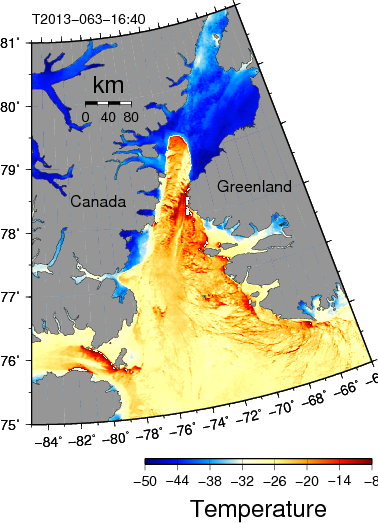
Surface temperature in degrees centigrade over northern Baffin Bay on March-4, 2013 16:20 UTC from MODIS Terra.

Surface temperature in degrees centigrade over northern Baffin Bay on March-4, 2013 16:20 UTC from MODIS Terra. Warm colors (reds) show thin and/or ice while cold colors (blues) suggest thick ice stuck in place.

A very strong ice arch at the southern entrance to Nares Strait separates thick (and cold) ice to north from thin (and warm) ice to the south. The thick and cold ice is not moving, it is stuck to land, but the ocean under the ice is moving fast from north to south. The ocean currents thus sweep the newly formed thin ice away to the south. This ice arch formed way back in early November just after the sun set for winter over Nares Strait.

Now that the sun is up, we can also “see” more structures in the ice by the amount of light reflected back to space. A very white surface reflects lots while a darker surface reflects less. We are looking at the many shades of white here … even though I color them in reds and blues:

Surface reflectance at 865 nm in northern Baffin Bay on March-4, 2013 16:20 UTC from MODIS Terra.

Surface reflectance at 865 nm in northern Baffin Bay on March-4, 2013 16:20 UTC from MODIS Terra. A true color image (which this is not) would show only white everywhere. Hence I show the very bright white as red and the less bright white as blue. This artificial enhancement makes patterns and structures more visible to the eye.

Zooming into the area where the ice arch separates thick ice to the north that is not moving from thin ice in the south that is swept away by ocean currents, I show this image at the highest possible resolution:

Surface reflectance at 865 nm at the southern entrance to Nares Strait on March-4, 2013. Contours are 200-m bottom depth showing PII2012 grounded at the north-eastern sector of the ice arch.

Surface reflectance at 865 nm at the southern entrance to Nares Strait on March-4, 2013. Contours are 200-m bottom depth showing PII2012 grounded at the north-eastern sector of the ice arch.

Note, however, that the sun is far to south and barely peeking over the horizon. This low sun angle shows up as shadows cast by mountains. And since the sun is still far to the south, the shadows cast are to the north. This “shadow” makes visible the ice island from Petermann Gletscher that anchors this ice arch as it is grounded. I labeled it PII2012 in the picture.

From laser measurements we know that the ice islands stands about 20 meter (or 60 feet) above the rest of the ice field. This height is enough to cast a visible shadow towards the north (slightly darker = less red) as well as a direct reflection off its vertical wall facing south (brighter = more red) towards the sun. At its thickest point, PII2012 is about 200 meters (~600 feet) thick. For this reason, I also show the 200-m bottom contour that moves largely from north to south along both Ellesmere Island, Canada on the left and Greenland on the right.

The sun brings great joy to all, especially those hardy souls who live in the far north. The sun’s rise also shows the delicate interplay of light and shadows that we can use to solve puzzles on how ice, oceans, and glaciers work. At the entrance of Nares Strait the playful delights of the sea ice, ocean currents, and ice islands gives us a large area of thin ice. The thin ice will soon melt and perhaps has already started to set into motion a spring bloom of ocean plants. Ocean critters will feed on these to start another cycle of life. Whales, seals, and polar bears all depend on it for 1000s of years now.

Sketch of the biological pieces that a large area of open water near a fixed ice edge like that of a polynya may support. [From Northern Journal>/a>]

Sketch of the biological pieces that a large area of open water near a fixed ice edge like that of a polynya may support. [From Northern Journal]

Book Review: Terra Incognita by Sara Wheeler

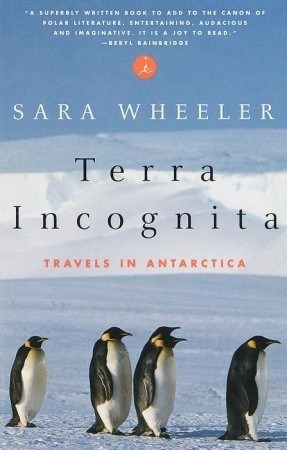
Ms. Wheeler is not the touchy-feely kind when she describes scientists and technicians in Antarctica during the 7-month that she spent with them in science camps. She turns awes and wonders into a refreshing set of stories about people and places. At a fast clip she surprises with delightful encounters describing a different breed of people in a different land. “Terra Incognita” is not all ice, mountains, deserts, and hardship, but it is about the people who live and work there. As a scientist I felt at times described like a caged animal on display in her writing. She pokes fun of subjects and self that the feeble may not always like. Her book made me laugh and smile often. It still does.

terra-incognita-by-sara-wheeler

The people in Ms. Wheeler’s book reminded me of many companions that I lived with in close quarters working on Arctic research vessels and out of remote field camps. She succeeds to show the essence of men and women who live science. With humor and gripping commentary she depicts the human side of science well. This is travel writing at its very best, ever since Bruce Chatwin stopped writing. Along with Ms. Wheeler’s first book “Travels in a Thin country” that is Chile, “Terra Incognita” reflects a healthy thirst for life, people, and wanderlust.

I just came across these beautiful words and imagery of “A young lady venturing Far North”

The Fourth Continent's avatarThe Fourth Continent

According to Inuit culture in Greenland, a person possesses six or seven souls. The souls take the form of tiny people scattered throughout the body.

By Annie Dillard.

I don’t know much about this yet, but the idea of six or seven souls sounds almost overbearing. With just one soul, you can feel enough love, and in times of sorrow, too much pain. Just a thought.

I do love this carving of an Inuit Soul in the picture below. It has a fluidity to it. It is as if after rough waves had crashed onto the stone countless times, a soul had woken up from all the noise and pushed its face out for the world to see.

View original post