
Category Archives: Oceanography

Swirling Ice in Coastal Waters off Eastern Greenland

Nature provides us with art that is always changing in time and space. Delicate swirls and vortices give a rare glimpse of how the ocean’s surface looked today off eastern Greenland. The data originate from the MODIS/Terra satellite which from 440 miles above the earth captures light that is reflected from anything below. Here it shows the ice-free ocean (bottom right) and Greenland’s ice-free Scoresby Sound (bottom left) in very dark blues, lightly vegetated lands (left) in light blue, and a highly organized pattern of sea ice (top right) in white. The resolution of this image of light just beyond the visible, just beyond the red is about 300 yards and the swirls and elongated filaments are about 3-5 miles. To me, they vividly show the ocean’s surface circulation.
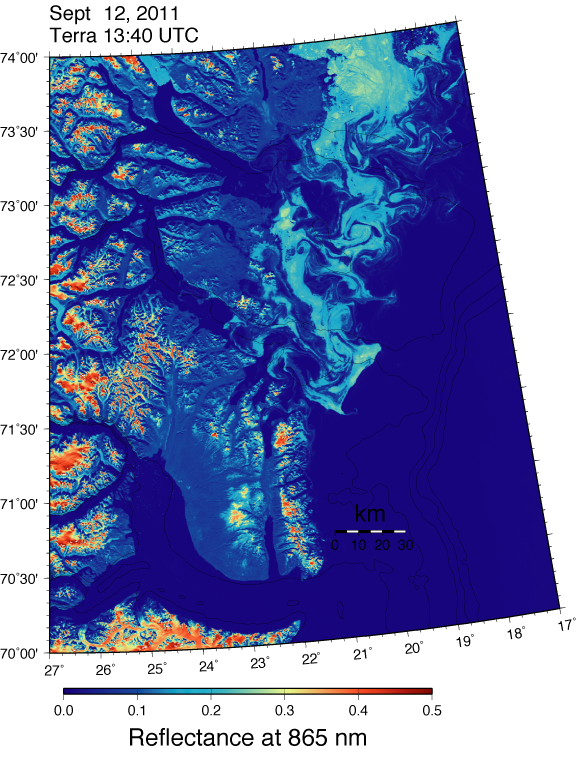
Swirling surface motion on the continental shelf off eastern Greenland Sept.-12, 2011 as indicated by sea ice. Black lines show contours of bottom depth from 300 to 1200 meters in 300 meter increments.

The physics of these motions are similar to those I was reading into another beautiful work of art to the north of Norway. The postulated physics involve the earth’s rotation as well as differences in density. The density of the ocean relates to its temperature a little and to its salinity a lot. Near the coast and at the surface, ocean waters are much fresher and thus lighter than they are offshore and at depth, because Greenland’s melting glaciers and sea ice are fresher than the waters of the Atlantic Ocean. The thin black lines show bottom depths to distinguish the deep Atlantic Ocean to the right in the image from the shallow continental shelf off eastern Greenland to the left in the image. Note that all the swirls, eddies, and filaments are within 30 kilometers (20 miles) off the coast in water less than 300-m deep. The same physics apply to the algal blooms off Norway which is the reason that the swirls and eddies are of similar size here and there as well.

Incidentally, the same physics also apply the discharges from rivers and estuaries such as the Delaware or Cheasapeake Bay. There, the pattern are not quiet as visible to the naked (satellite) eye as off Norway or Greenland, but if one takes measurements of the ocean, similar patterns of ocean salinity and velocity as, I speculate, they do here for the ice (Greenland) and algae blooms (Norway). While my academic journey of fresh water discharges started with the discharge of the Delaware River into the Atlantic almost 25 years ago, I am still fascinated by the many ways these patterns always come back to me. Physics and oceanography are beautiful in both their many natural manifestations and its unique balance of forces. There is so much more in how the oceans interact with the ice and glaciers off Greenland and elsewhere. To be continued …
Ocean Paintings off northern Norway

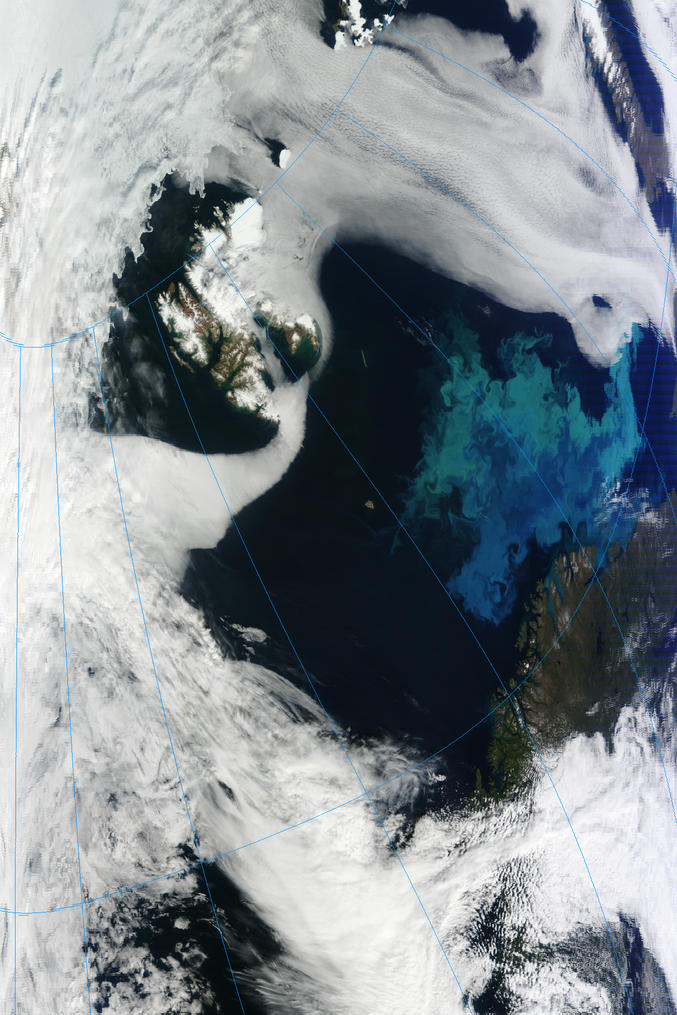
Someone is painting the ocean to the north of Norway and Russia in vivid colors, twirls, and twists for the last two to three days. The exuberance and rich detail reminds me of a Vincent van Gogh. While some may see a divine hand and design at work, I see tiny plants floating in a turbulent ocean. To see the ocean, one needs a satellite in space to cover this painting more than 1000 miles wide and long. To see the plants, one needs a microscope.

Algae blooms off northern Norway Aug.-16, 2011. Spitsbergen is seen in the top left, Norway bottom right, and Novaya Zemya to right.

The painting shown here is coarse and crude, because it is composed of dots that are two kilometers big, but anyone with a fast connection can download the same painting with dots that are two hundred and fifty meters big here. The canvas is bigger than your computer screen, so you will need to scroll around.

The colors are made by stuff in the ocean, called coccolithophores that reflects sunlight back to detectors (light catchers) on the MODIS satellite which for the last 11 years has cycled around the globe shooting a picture every five minutes as it flies overhead. It returns to the same spot every sixteen days, but since all tracks come always together over the North and South Pole, there are many images of the same region in the far north and south of this earth.

Scientists study ice and clouds and glaciers and small plants in and near the oceans using the numbers (digits) that the satellites sent back to earth. On land our soldiers in Afghanistan and Iraq use these and similar observations to prepare for sandstorms on land. Under water, our Navy Seals use them to prepare for visibility in coastal waters. So lots of stuff is done with these data, but the amazing thing to me, and I truly love my country for this, all these data are made available for all to see and for all to use as they see fit. If I download and crunch numbers, anyone can. I’ll teach you, too.

Petermann Ice Island Seen from International Space Station

Ron Garan aboard the International Space Station just send this photograph of Petermann Ice Island PII-A down to earth as reported by Jason Major.

Petermann Ice Island PII-A on July-25/26, 2011 as seen by MODIS/Terra and the International Space Station

While the detailed photo indicates that the ice island was about as close to the coast as it is long, it has since moved offshore and to the south. The ice island is on its way to clear the similar sized island of Belle Isle in the middle of a channel that separates Labrador in the north from Newfoundland in the south. The distance from the coast is not all that relevant, but the water depth is. Classical physical oceanography says so and I urge you to watch this MIT movie.

In a nutshell: The rotating earth limits large-scale flows, such as those that propel the ice island, to move in ways that seem to make no sense. More specifically, if there is a tiny change of the bottom depth, then the flow at all depths, and this includes the surface, will want to go around this obstacle to stay with the depth it started at. It is very hard to move water from water 200 meters deep such as on continental shelves to water 2000 meters deep such as further offshore. There are exceptions to this rule, of course, but they involve other forces that usually, but not always, are small.

It is so much fun to watch and predict where this ice island will move next, especially if one can be proven wrong so easily. “The proof of the pudding is,” as Cervantes has Don Quixote say so wisely, “in the eating.”