Category Archives: Ice Island

New Petermann Ice Island forming July-16, 2012

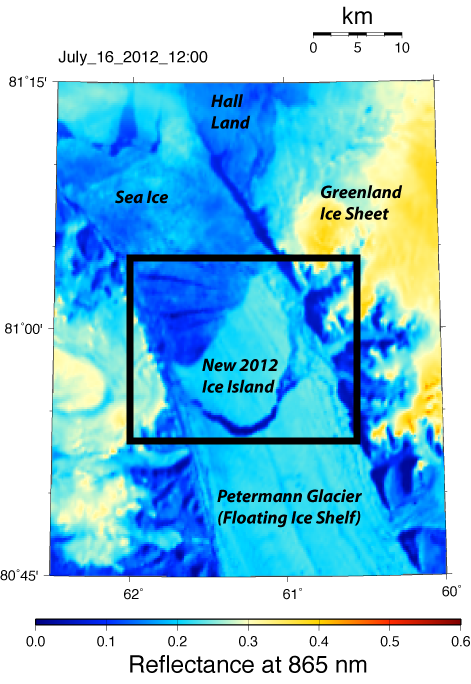
This morning Petermann Glacier lost another ice island of a size comparable to what it lost in 2010:

MODIS-Aqua image of July 16, 12:00 UTC of a new ice island forming from Petermann Glacier.

The break-off point has been visible for at least 8 years in MODIS imagery propagating at speeds of 1 km/year towards Nares Strait. The fracture also extended further across the floating ice sheet from the northern towards its southern side.

This event is still evolving, Trudy Wohleben of the Canadian Ice Service noticed it first (as in 2010) after reviewing MODIS imagery. Several people in several countries are monitoring and assessing the situation, but a first estimate of its size is 200 km^2 (3 Manhattans), I will revise this figure as soon as I got my hands on the raw data 120 +/- 5 km^2 or about 2 Manhattans.

The Canadian Coast Guard Ship Henry Larsen is scheduled to travel to Nares Strait (and Petermann Fjord) to recover moorings placed in 2009. These mooring data, if recovered, will contain ocean current, temperature, salinity, and ice thickness data at better than hourly intervals from 2009 through 2012.

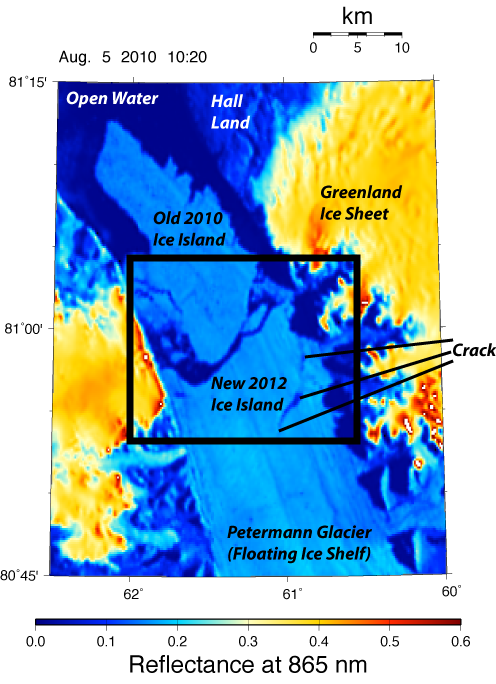
UPDATE: For comparison, I here show the 2010 imagery on the same scale using the same processing and colors. There will be more imagery this evening as MODIS-Terra passes over the area closer to nadir (better resolution or sharpness of the images). Furthermore, clouds seem to be disappearing.

The 2010 Petermann Glacier calving event also indicates the crack that broke off this morning as indicated. Note that the entire floating ice shelf moves by about 1 to 1.3 km per year, slightly less than a mile per year. The crack in 2010 is where the 2012 ice island formed.

EDIT: Changed 2012 MODIS-Terra figure which now has the correct (July 16, 2012) date that the data were taken.

Petermann Ice Islands Stuck in Ice

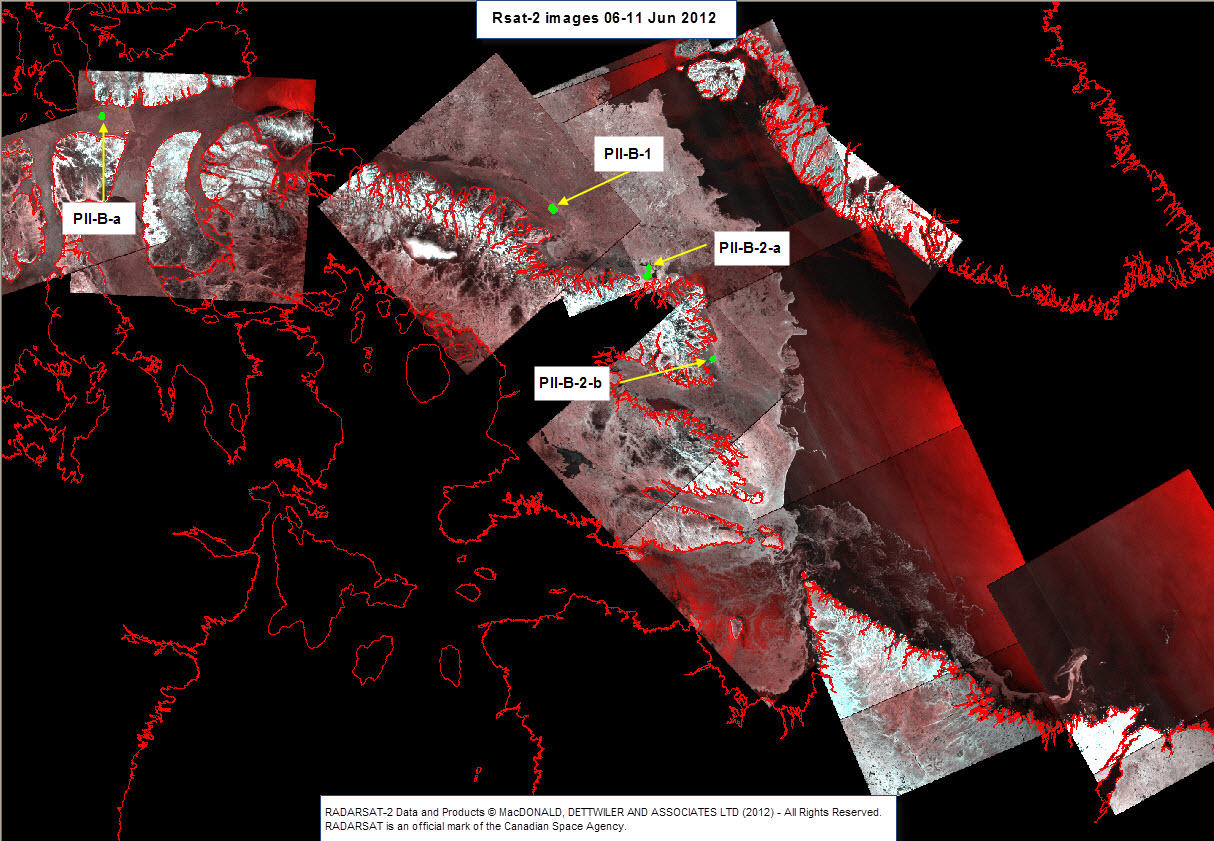
Several pieces of the Manhattan-sized ice island that broke off Petermann Glacier, Greenland in 2010 arrived, dispersed, and melted off Newfoundland last summer. They provided stunning displays visible to the naked eye from the coast. The Canadian Ice Service just distributed this set of radar images showing 4 pieces that are all grounded and/or stuck in ice. None are moving.

Overview of fragments of Ice Islands that broke off Petermann Glacier, Greenland in 2010 as of June-11, 2012 from RadarSat composites. [Credit: Luc Desjardins, Canadian Ice Service]

In the open ocean ice is moved by winds stressing the ice from above and by ocean currents stressing the ice from below. Typical sea ice varies in thickness from 1-5 meters (3-15 feet) which is much less than the 30-130 meters (90-400 feet) thick ice islands. Winds thus push thick ice islands much less than they do push the thinner sea ice. Thick ice islands are moved by ocean currents, not winds.

This is why oceanographers like myself love these bits of ice islands to bits: they tell us about the ocean below the surface that satellites do not see, but, sadly, all fragments are stuck either to the seafloor in shallow coastal waters or are cemented in place by immobile sea ice that is “land-fast:” Think of it as ice that is glued to land and to each other. This sheet of glued-together ice extends some distance offshore. The distance can be a few yards during a cold winter night in Maine or 100s of miles off Siberia. Offshore islands, rocky outcroppings, or grounded ice islands all anchor land-fast ice by adding local support and thus strength and stability to the immobile land-fast ice.

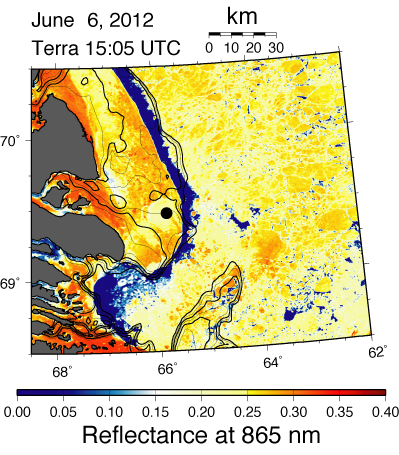
Too much talk, lets explain this with an image of the largest ice islands, called PII-B1. It is about 4 km wide and 9 km long. I dropped a black dot in its center as it is hard to see where to look in this image. I also show land in grey, open water in blue, and ice in shades of white and yellow:

Land-fast and mobile sea ice off Baffin Island with Petermann Ice Island PII-B1 grounded near the 150 meter isobath (black dot). Thick lines are 100, 200, and 300-m bottom depths. MODIS Terra data at 250-m resolution from June-6, 2012, 15:05 UTC.

There is clearly a 30-km wide band of ice attached to the land with a line of blue water separating it from ice that is mobile and has different signatures. A blue band of ocean has emerged, I speculate, as the result of winds from the south that moved the mobile ice to the north-east (to the right in the image). Neither the land-fast nor the grounded ice island PII-B1 embedded in it moved, so open water appears where there was mobile ice before. This is called a shore lead and I bet there are plenty of seals and whales feasting there now. Note also the arched entrance to Home Bay (bottom left) where loose ice is scattered towards the headland of Henry Kater Peninsula.

As summer is arriving fast in the Arctic, the land-fast ice will disappear, breaking up as the sun and air above and the ocean below weakens the ice by melting. This will expose the thicker ice islands and icebergs to wind-forced storms and waves more violently than it does now. And even those ice island grounded to the bottom of the ocean in shallow water will become free during a time of higher than normal sea level, perhaps during a spring tide, perhaps during strong winds from the north. Then these currently stuck-in-the-ice ice islands will continue their journey south towards Newfoundland and the Atlantic Ocean that they began in 2010 when they were born in northern Greenland.

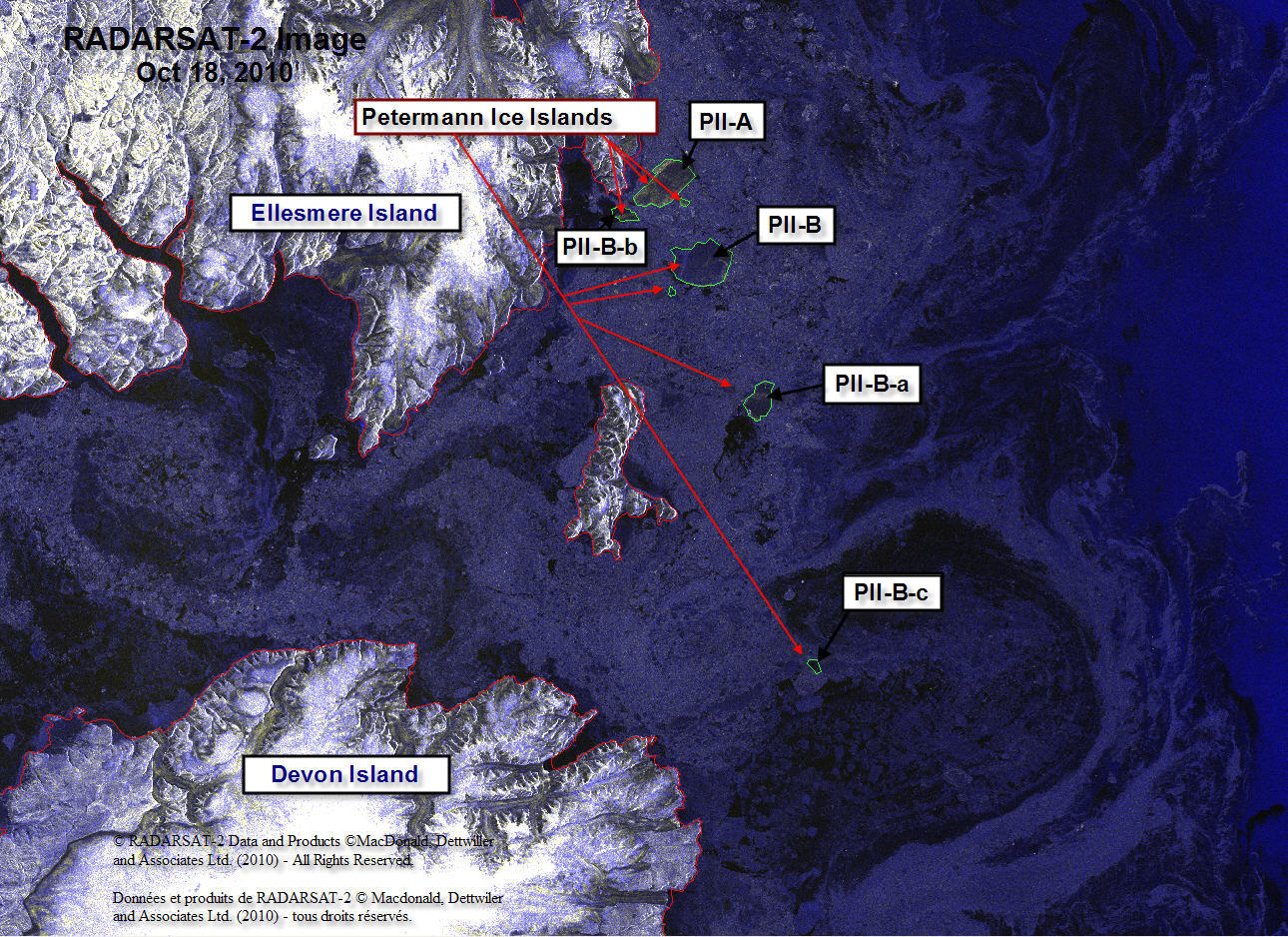
EDIT: For context I append an earlier RadarSat image from October-18, 2010 when all segments were much closer in space.

Petermann Ice Islands in northern Baffin Bay of Coburg Island, Canada at 76 N latitude on Oct.-18, 2010, about 2 month after they separated from Petermann Glacier, Greenland at 81N latitude. [Credit: Luc Desjardins, Canadian Ice Service]

Last Image of Nares Strait from Europe’s Environmental Satellite

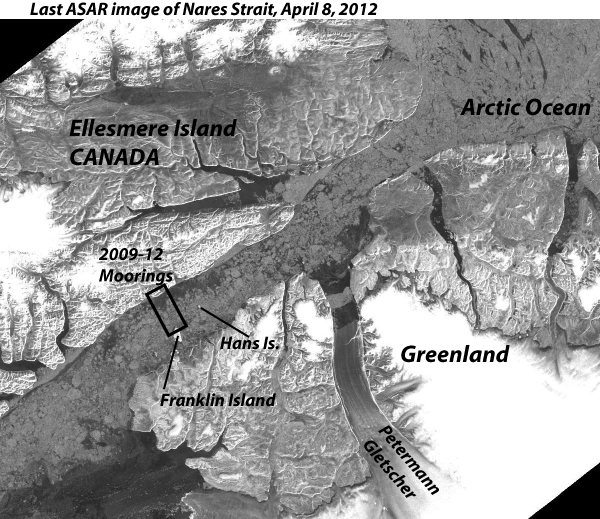
The European Space Agency announced today that one of its primary environmental satellites died. For over a months now engineers could neither receive data nor send commands to the 10-year old veteran of earth science research whose design life was 5 years. The last image received for my study area between northern Greenland and Canada shows Petermann Gletscher and ice-covered Nares Strait:

The rectangle between Franklin Island, Greenland and Ellesmere Island, Canada shows the site where in August 2012 we hopefully will recover data from an array of ice and ocean sensing equipment that we put there in 2009.

It was during this 2009 International Polar Year expedition to Nares Strait that I discovered satellite remote sensing in a new way, that is, accessing the raw digits sent down to earth from the NASA’s Aqua and Terra satellites that contain Moderate Resolution Imaging Spectroradiometer (MODIS) sensors. These two sensors are as old or older than its European companion. MODIS are now the only optical sensors at better than daily resolution which check the land, ocean, and ice now that the European satellite is not talking with us anymore.

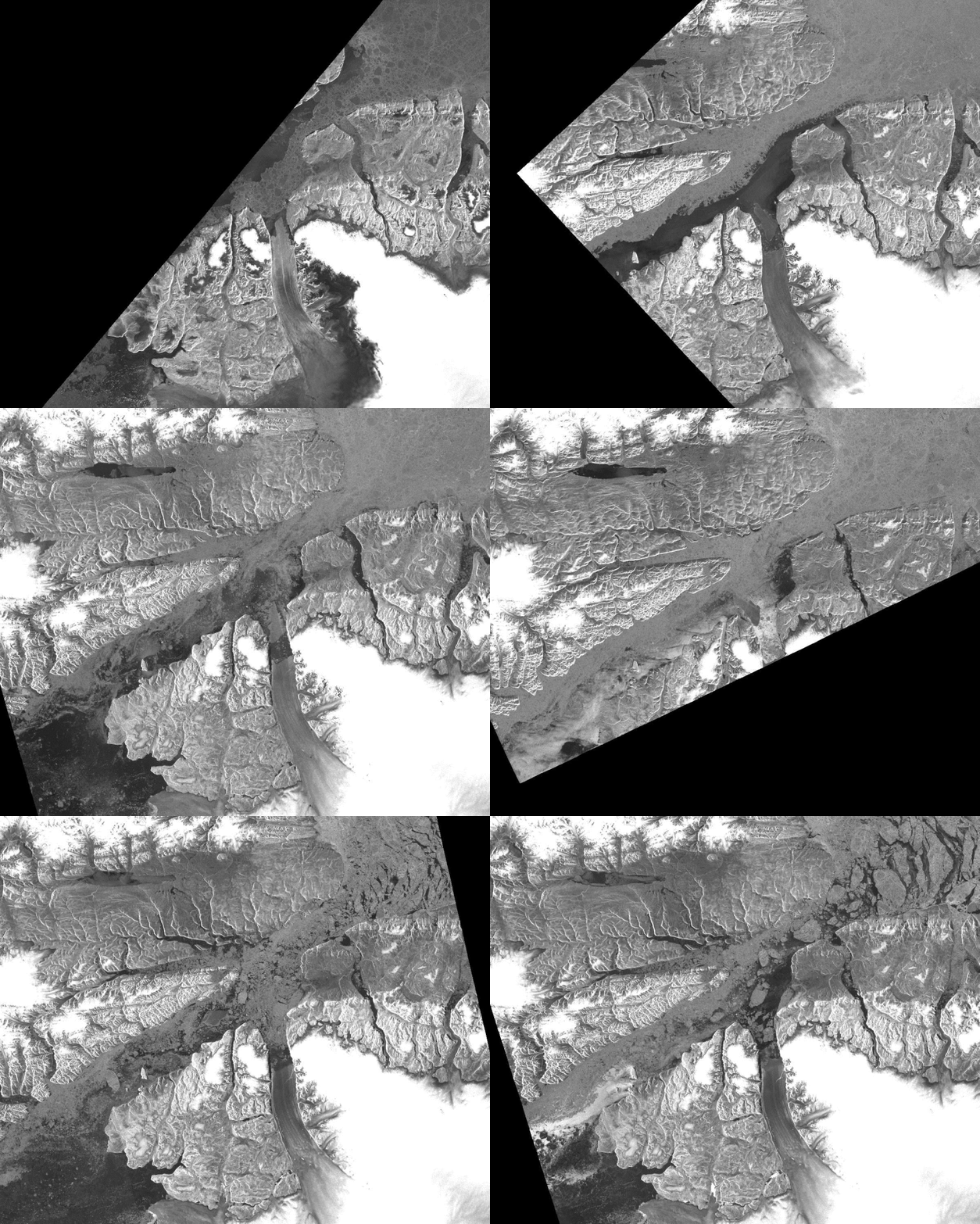
For me, the most spectacular use of Europe’s EnviSat was its ability to document how the 2010 Petermann Ice Island wiggled its way out of its constraining fjord into Nares Strait. A movie of daily radar images is attached:

Petermann Ice Island 2010 slow movement through Petermann Fjord, break-up on Joe Island, and swift movement southward in Nares Strait. Click on image to start movie.

Unlike its Canadian counterpart, RadarSat, the imagery from the European radar (ASAR) was distributed widely, free of charge, and became useful to research communities and a wider public. The Danish Meteorological Institute provides an archive of imagery from both US and European satellites for all of coastal Greenland that just lost its European imagery (http://ocean.dmi.dk/arctic/modis.uk.php). Unlike the now defunct EnviSat, RadarSat is a for-profit commercial enterprise unaffordable to scientists or a public. The Canadian government funded development, launch, and initial data processing before giving it away to a private corporation. Ironically, the largest paying customer for its expensive products is the Canadian Government, but the data are rarely used for public education or research. They may as well be secret.

So, the demise of EnviSat is sad news. It removes a semi-public eye in the sky. Lets hope, that its replacement by the European Space Agency receives the urgent attention that it deserves.

Ice Island Flotilla From Petermann Glacier Continue Southward Flow

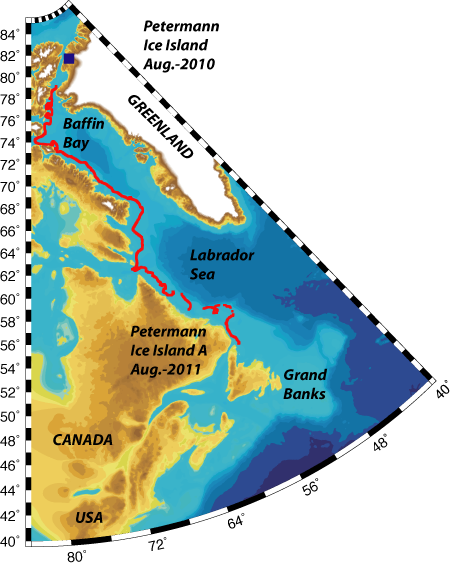
More icebergs and ice island from Greenland are heading south along northern North-America this year. Petermann Glacier’s first piece arrived last year off Newfoundland causing a local tourist sensation for a stunning display of ice along its shores. There are many more pieces from Petermann to come for a few more years.

Track of Petermann Ice Island from Aug.-2010 through Aug.-2011 traveling in shallow water from northern Greenland along Baffin Island and Labrador to Newfoundland.

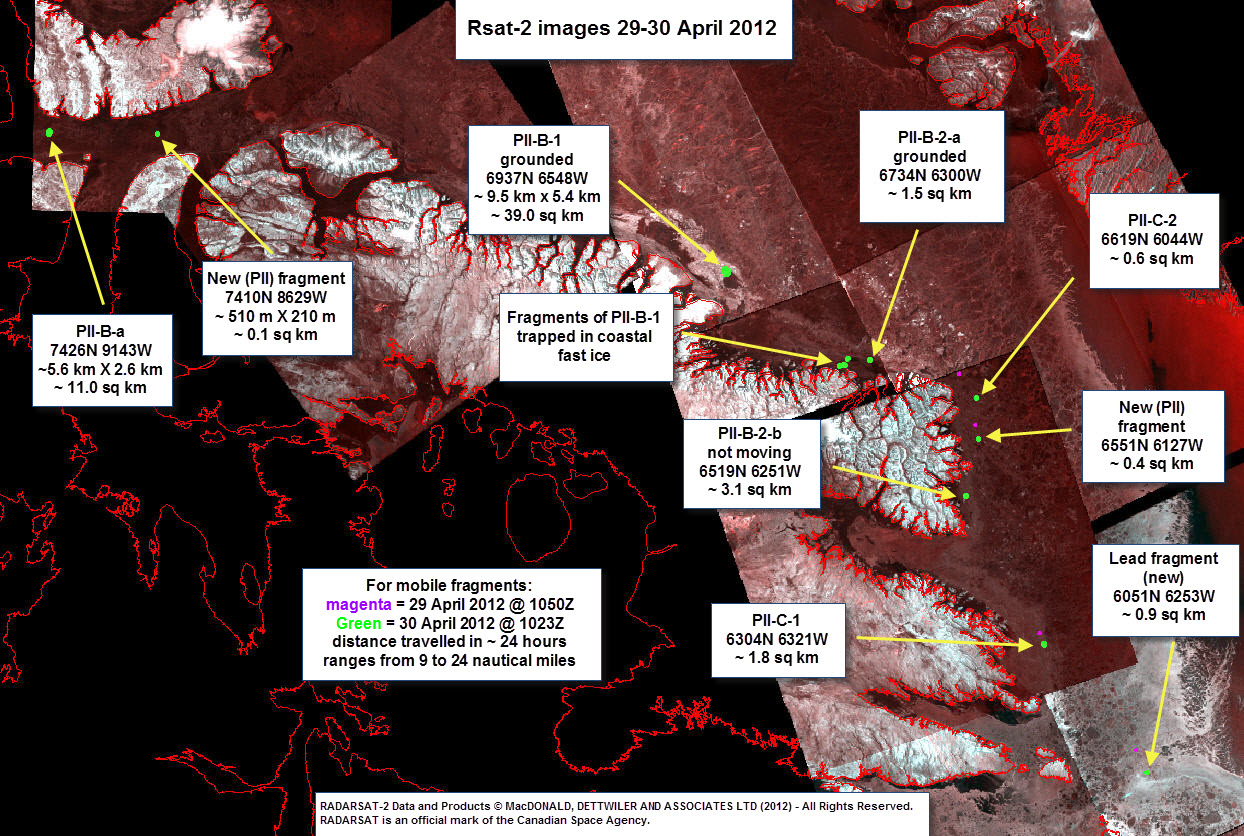
April 29/30, 2012 locations of Petermann Ice Island 2010 on their way south along northern North America. [Credit: Luc Desjardins, Canadian Ice Service]

Yet, how come that these arrivals are both so predictable in their pattern, but are almost impossible to pin down for an exact location and time? The answer involves mystical and fake forces, stunningly beautiful experiments, elegant mathematical equations, and, most important of all: spin.

The earth spins rapidly around its axis and neither ocean nor glaciers leave the planet for outer space. The obvious answer that gravity holds all the pieces in place is neither the correct nor the full answer. A subtle balance of several other forces makes Planet Earth the perfect place to keep us supplied with water to drink and air to breath. Additional forces besides gravity relate to the difference in pressure between the top and the bottom of the ocean as well as the rotational force that forces our car off the road if we speed too fast around a curve. The net effect of these is that earth fatter at the equator than at the North Pole. There appears to be more of gravity pulling us in at the North Pole than there is at the equator. Put another way, a scale measuring our own weight dips almost a pound more in Arctic Greenland than it does in the tropical forests of Borneo even if we do it naked in both places. Lose a pound of your weight instantly, travel to the far north. (GRACE)

This makes no sense intuitively, but common sense and intuition help little when it comes to how the ocean’s water and the atmosphere’s air move on a rotating planet. For example, we all know intuitively that a down-pour of rain flows down a slope into the ditch. It requires work to bring water up to the top of a hill or into the water towers to make sure that water flows when we open the faucet. Not true for the ocean at scales that relate to climate, weather, and changes of both. Here all water flows along, not down the hill. Better yet, it requires no work at all to keep it moving that way for all times. This is why Greenland’s ice keeps coming our way as soon as pieces break off. The earth’s spin makes it go around the hill, to speak loosely of pressure differences. Winds and friction have little effect. The ocean’s natural and usually stable state is in geostrophic balance. Geostrophy is a fancy word for saying that the ocean’s water flows along, not down a hill, because it is balanced by a fake and mystical Coriolis force that I will not explain. I teach a graduate class on Geophysical Fluid Dynamics for that.

In technical language, most of the oceans tend to flow along not down a pressure gradient. A kettle of boiling water discharges water from high pressure inside the kettle to the lower pressure in the kitchen. Yet the steam dissolved in the atmosphere moves around high or low-pressure systems. That’s how we read weather maps: Clockwise winds around high-pressure over Europe, North-America, and Asia to the north of the equator, counter-clockwise winds around low-pressure systems. If I apply this spin-law to Baffin Bay containing all the icebergs and ice islands, the spin rule states that these large and deep pieces flow along lines where the earth’s local rate of rotation, lets call it planetary spin f, divided by the local water depth, lets call it H, is a constant. So, to a first approximation, the icebergs and ice islands flow along a path where f/H is constant. If the planetary spin is constant, then the ice island follow lines of constant water depth H. There is more to the story, much more, such as the effects of waters of different densities residing next to each other, but I better continue this later, as I got a dinner date with a sweetheart and “Thermal Wind” can wait 😉

Pine Island Glacier Ice Island 2012 Shoving Off

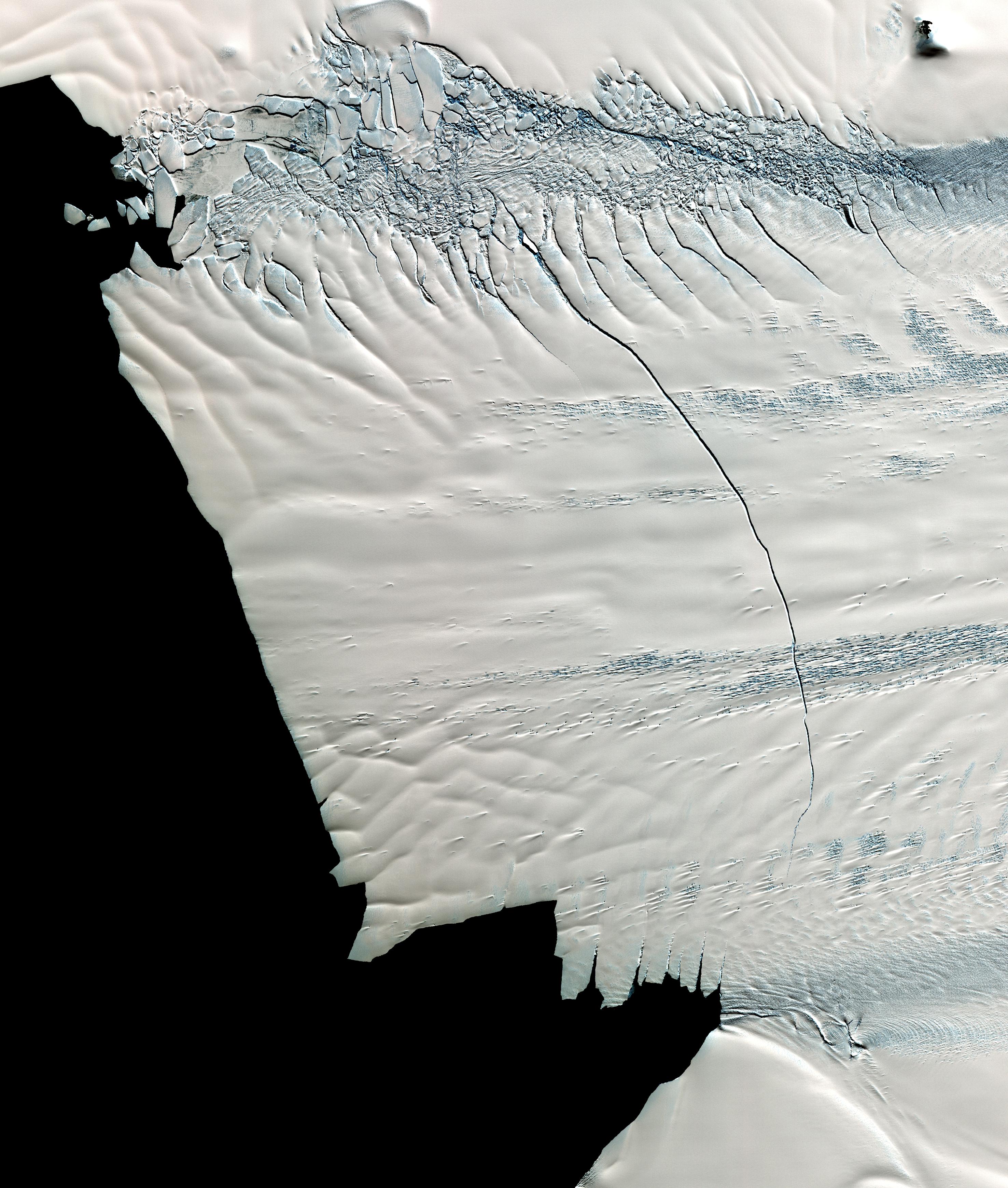
NASA published a stunningly crisp image of Pine Island Glacier (PIG), Antarctica yesterday that is already out of date, because the PIG is on the move. Glaciers change rapidly these days and the speed of the PIG is anything but glacial. The image below from Nov.-13, 2011 shows a massive crack that will develop into an ice island about 3-4 times larger than the one formed from Petermann Glacier, Greenland in 2010. While the image indicates that the part seaward of the crack is still attached, I am convinced that it is already moving independently of the glacier.
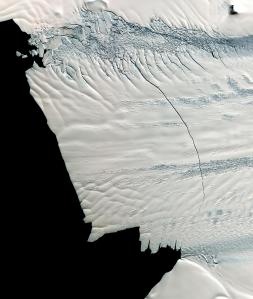
Nov.-13, 2011 image of Pine Island Glacier, Antarctica from the Advanced Spaceborne Thermal Emission and Reflection Radiometer (ASTER) instrument. Area shown cover 27 by 32 miles or 44 by 52 kilometers. Image Credit: NASA/GSFC/METI/ERSDAC/JAROS, and U.S./Japan ASTER Science Team.

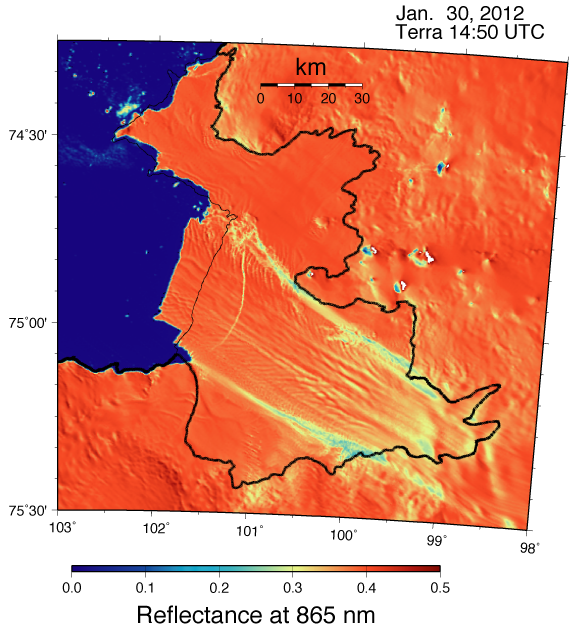
The same Terra space craft that provides the very crisp and high-resolution ASTER image also has sensors that image a larger area at slightly coarser 250 meter resolution. And monday was again an exceptionally clear day over Pine Island Glacier that revealed this (false color) image of radiation received at a “color” that is out of range of our eyes, the near infrared (865 nanometers):
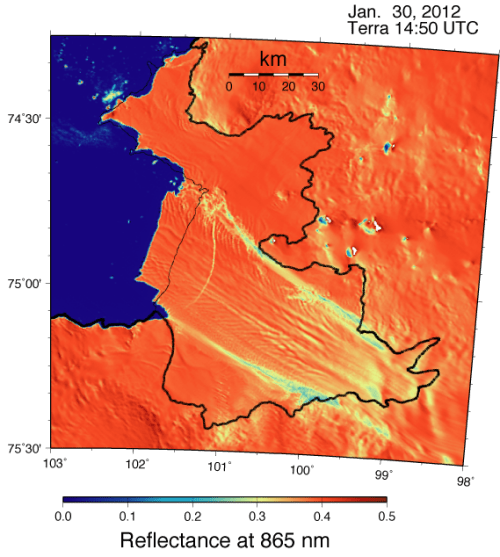
Pine Island Glacier, Antarctica as seen Jan.-30, 2012 from MODIS sensors on Terra spacecraft. The crack is visible as the white line. For reference I am also showing where the front of the glacier was seven years ago with a thin black line. The thick black line shows where the glacier is grounded to the bedrock more than 1000 meters deep (grounding line).

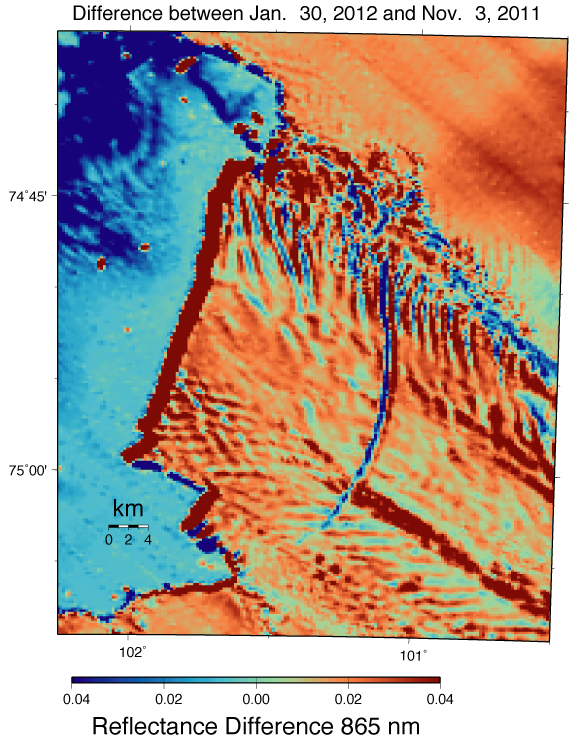
The glacier has advanced a fair amount, the crack breaking off is a perfectly normal event. This is what tidewater glaciers do, they move out to sea and break off icebergs and ice islands. Subtracting the January-30, 2012 image from a Nov.-3, 2011, I think that the thick red line below shows how far and fast the new ice island has moved the last 3 months. Its speed is at least ten times that of the glacier behind the crack:
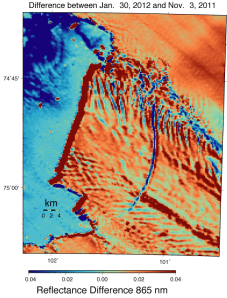
Difference of two MODIS images, thick red line on left (seaward edge of glacier) shows the area that the new ice island had moved into on Jan.-30, 2012 that was water on Nov.-3, 2011.

Lets leave the boring crack alone, nothing to worry there. What is important at Pine Island Glacier is the retreat of the grounding line, the location where ice, ocean, and bedrock meet. All ice located seaward of the grounding line is floating and does not add to rising global sea level. [Actually, it does raise sea level a tiny amount on account of subtle nonlinearity on how volume of water and ice are influenced by temperature, salinity, and pressure, but lets neglect this detail for now as everyone else does for a good reason).

It is the ice landward of the grounding line that will raise sea level as it passes the grounding line and becomes floating ice. And the thickness of this part of the glacier is decreasing at a rapid and alarming rate, because the glacier is melting from below by the ocean and much of the bedrock landward is below sea level, thus allowing the PIG to become “unhinged.”

The problem with this process is that we cannot see it as easy from space, as we can see changes at the surface. The ocean melting does not give the stunning images that portray drama, concern, and excitement the same way that new ice islands do. Yet, for most large glaciers like Pine Island, Antarctic and Petermann, Greenland, the oceans are eroding and melting these glaciers from below. It is the physics on how this works that we scientists do not yet know and understand very well. It is one thing to have a theory and perhaps a model, but only hard data from the ice and the ocean will give us the confidence and understanding to make smart decisions that balance our energy use contributing to global warming with the need to economically develop. Smart development allows us to live better lives and cope with calamities, some of which may be caused by global warming and the sea level rise it brings.