Author Archives: Andreas Muenchow

Back-Packing to Pioneer Basin in California’s High Sierra: Beaches and Swimming and Trout

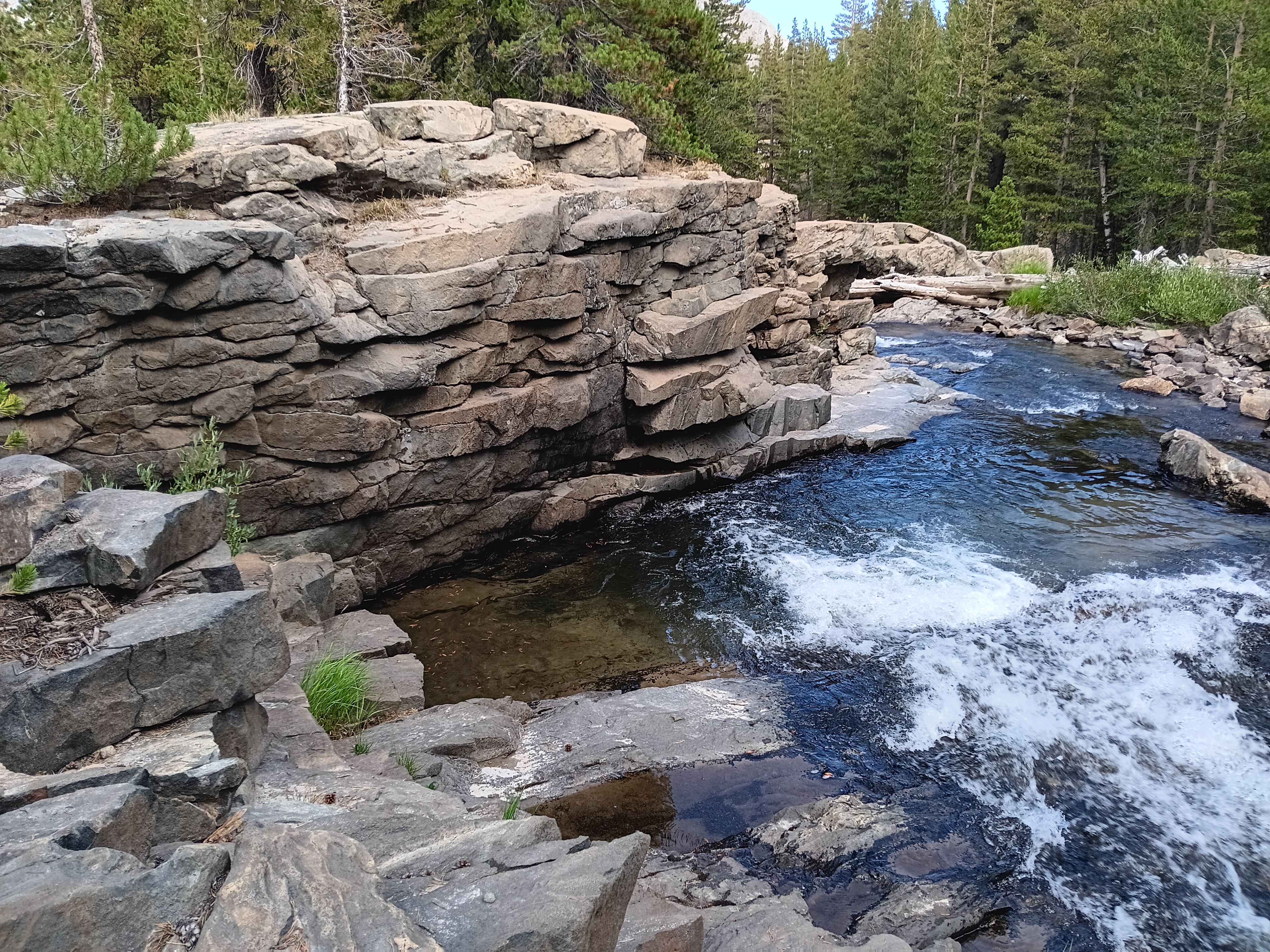
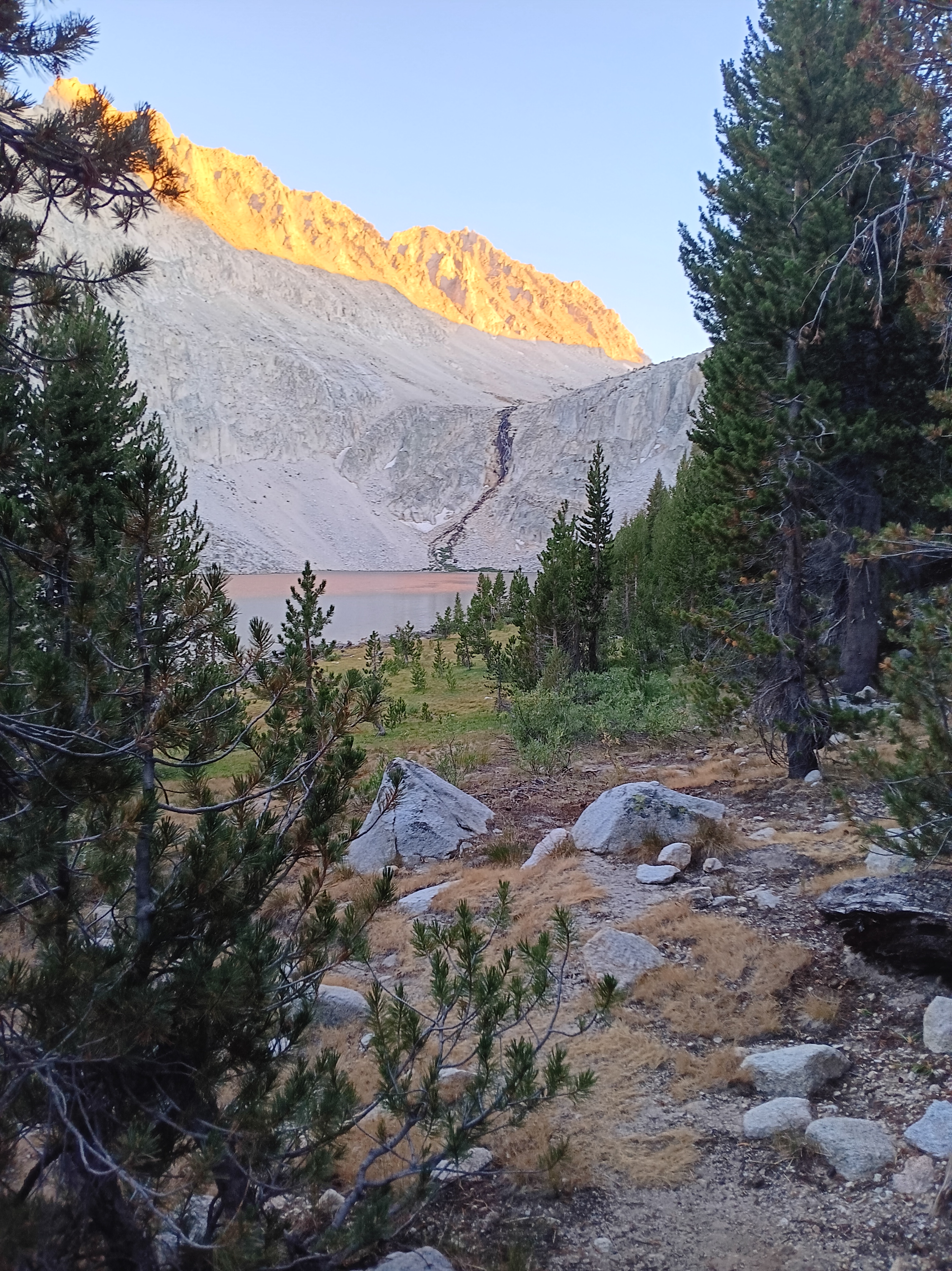
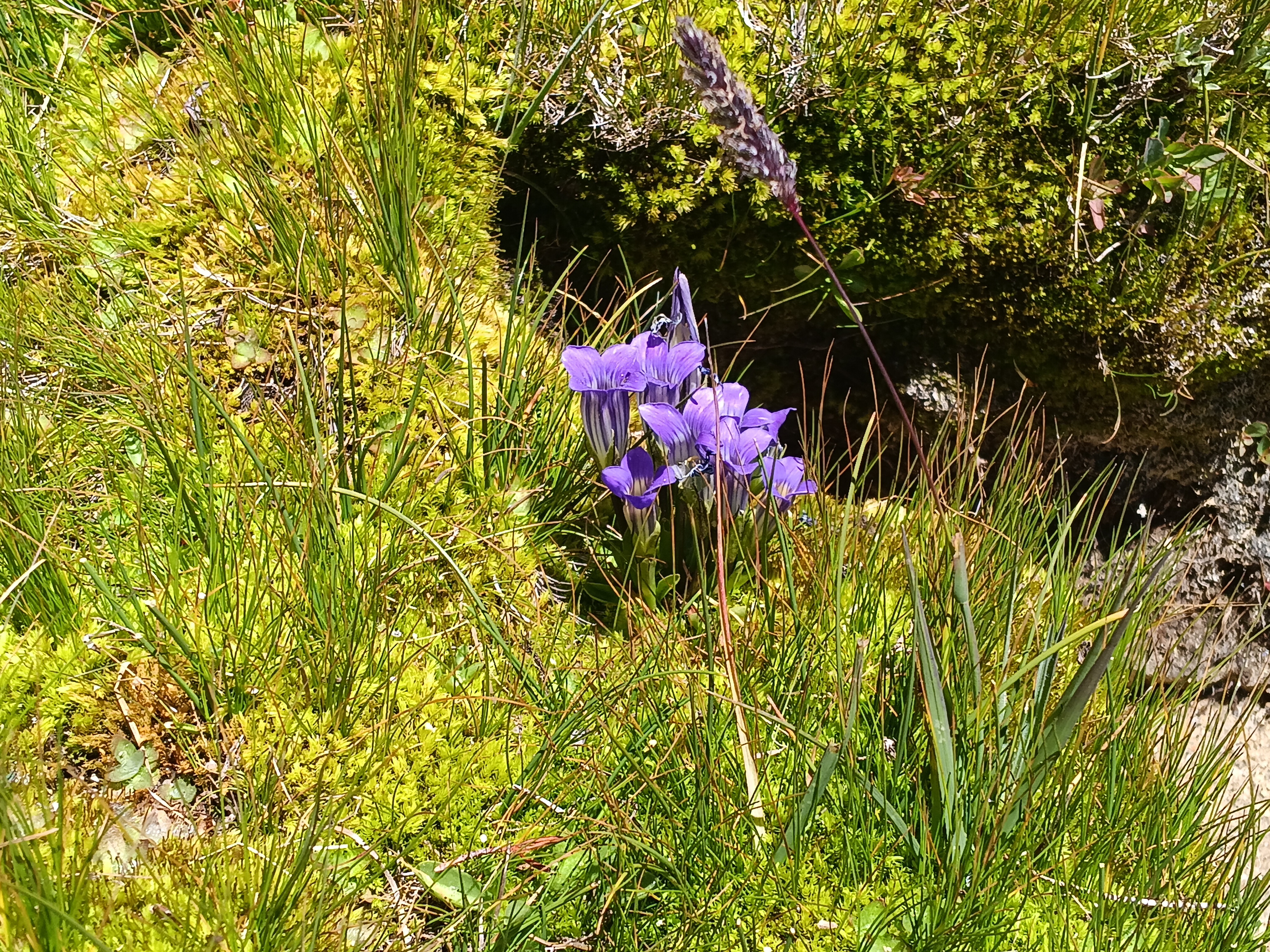
Pavla stopped her Suburu Outback on the side of the road in Tuoloume Meadows, Yosemite National Park to pick up a 63-year old hitchhiker who tried to reach his remote Parker/Mono trailhead. First, however, Pavla had to take a swim in the wild local river. Thus she provided the aging back-packer, that was me, with an expert lesson on what to do in California’s back-country when one sees a pristine lake or stream: undress and jump in. And so I did with some hesitation, admittedly, the water was cold after all. Jumping naked into a stream after an attractive woman who had just picked me up from the side of a road, I do not do that naturally, but Pavla taught me how to swim in places like these:

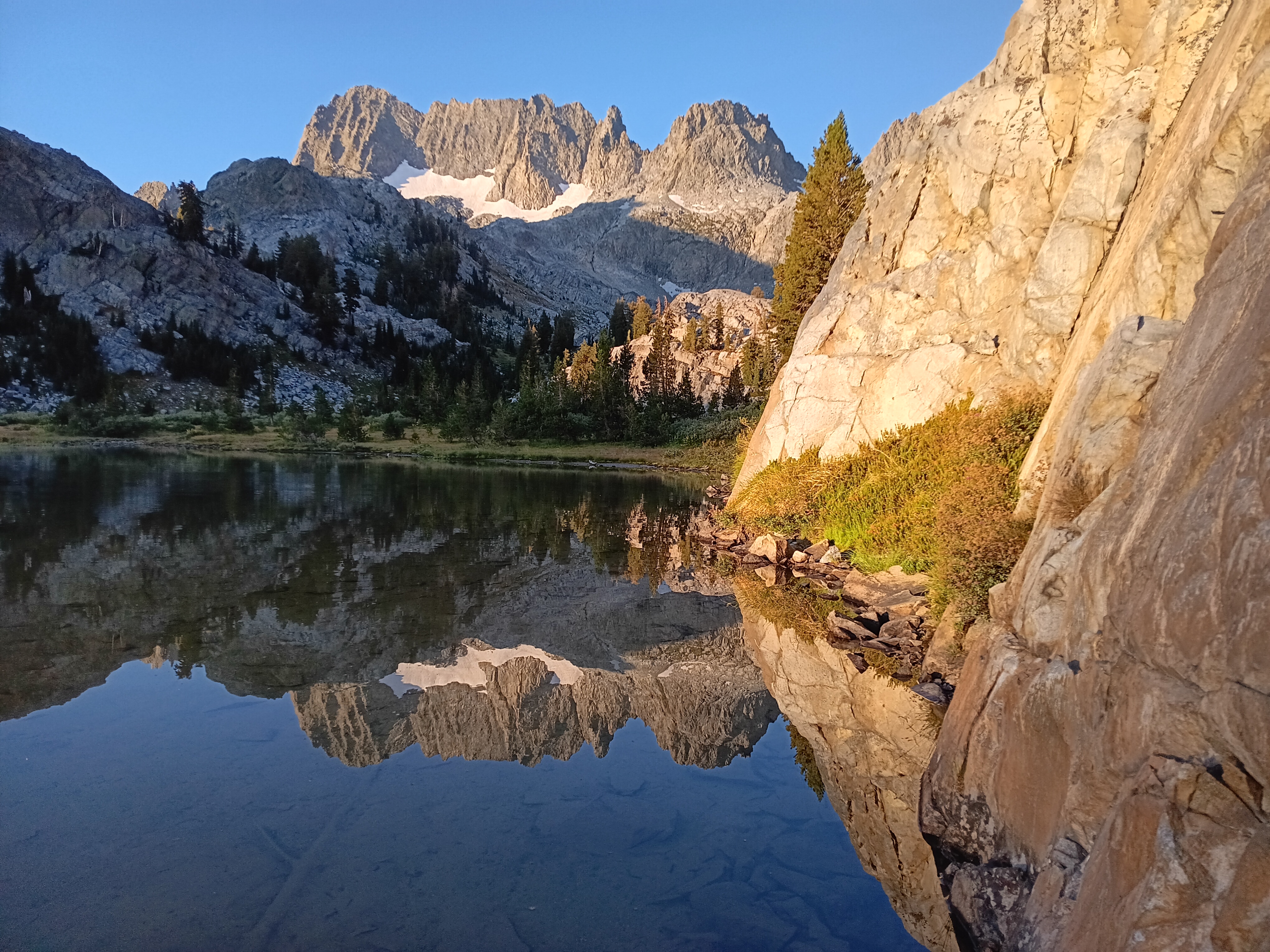
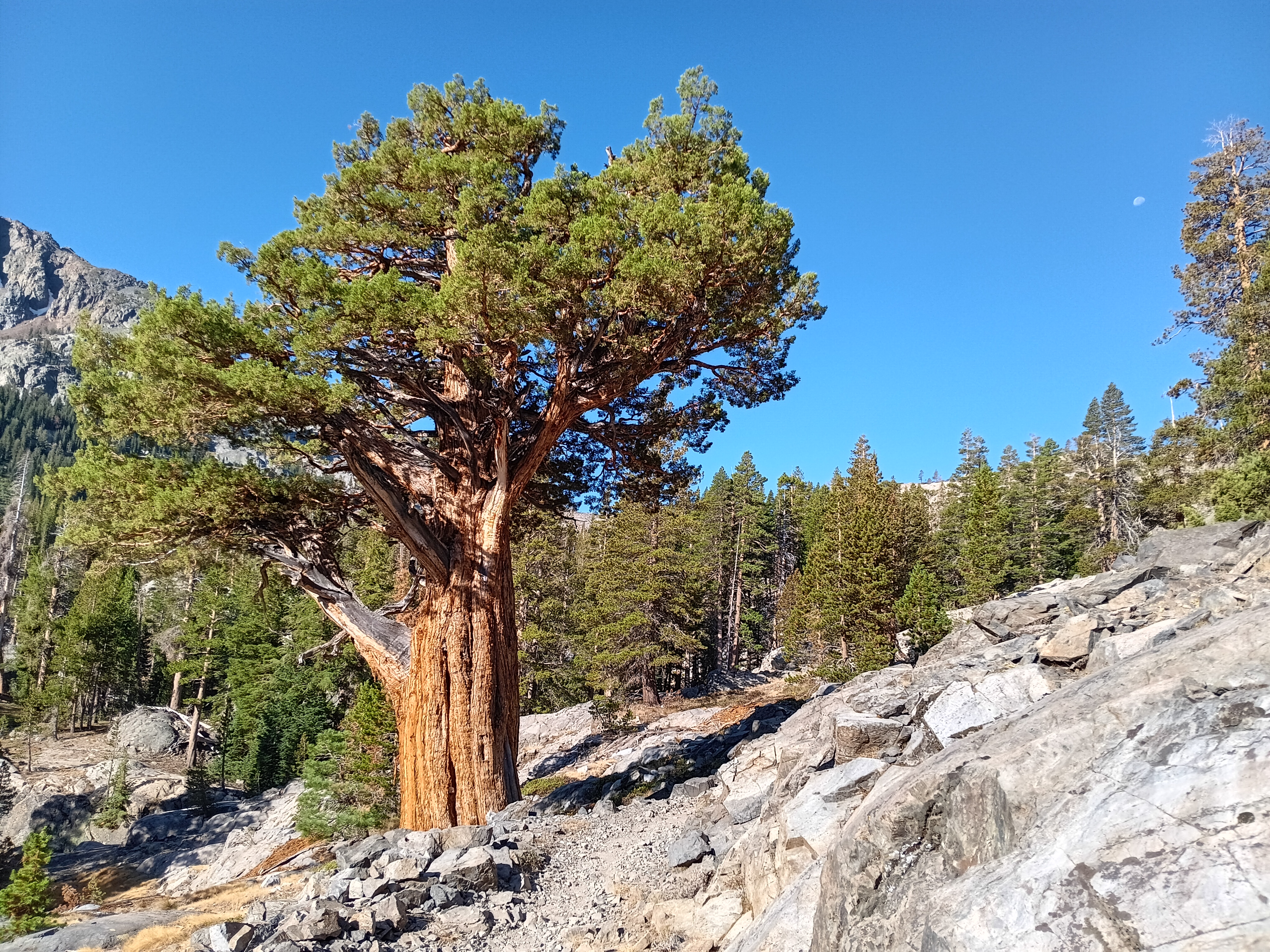
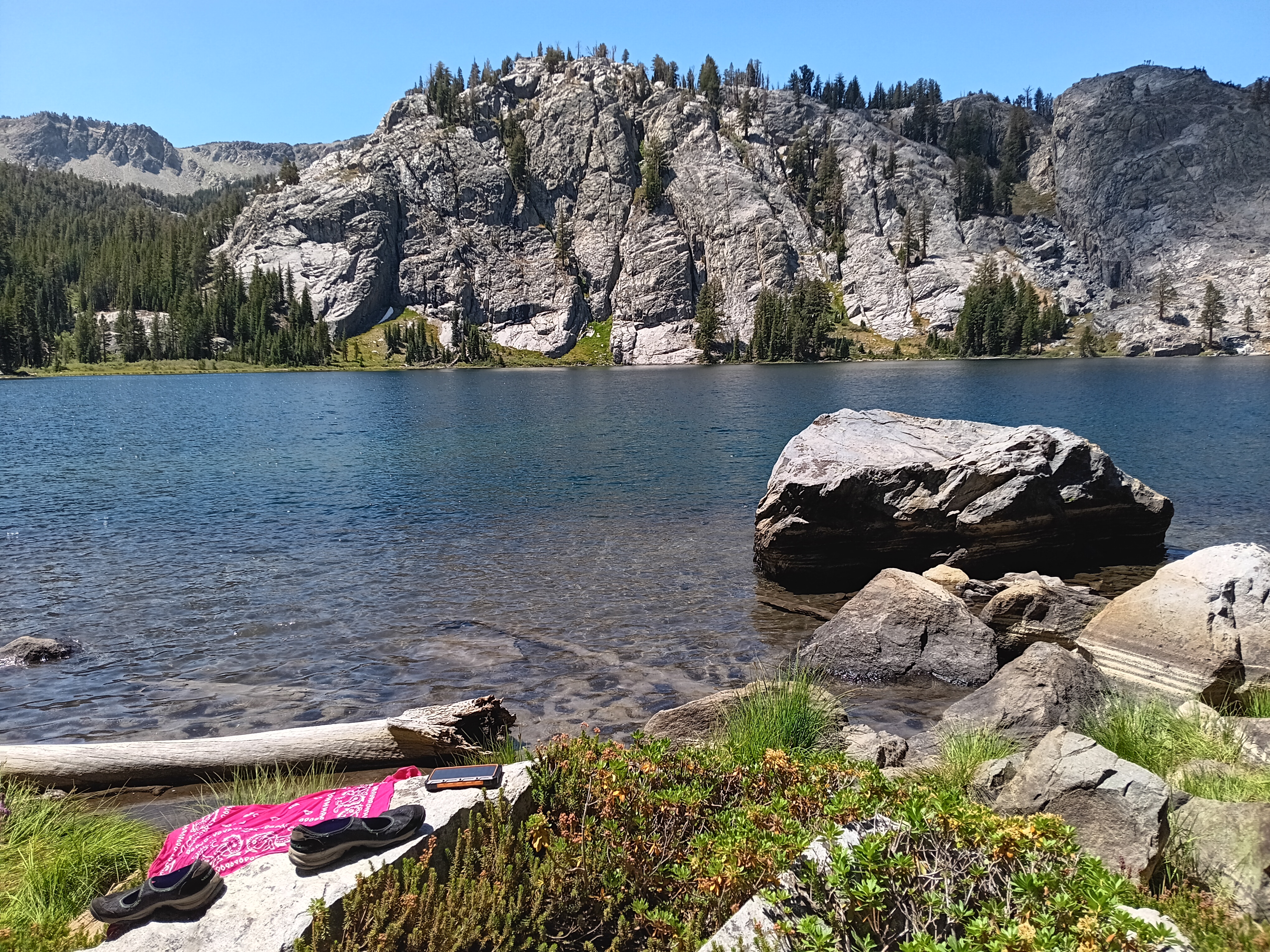
Minaret reflections in Ediza Lake (top left, Aug.-13), Western Cedar tree along the way (top right, Aug.-13), Rush Creek (bottom, Aug.-11), and Rosalie Lake (right center, Aug.-13).

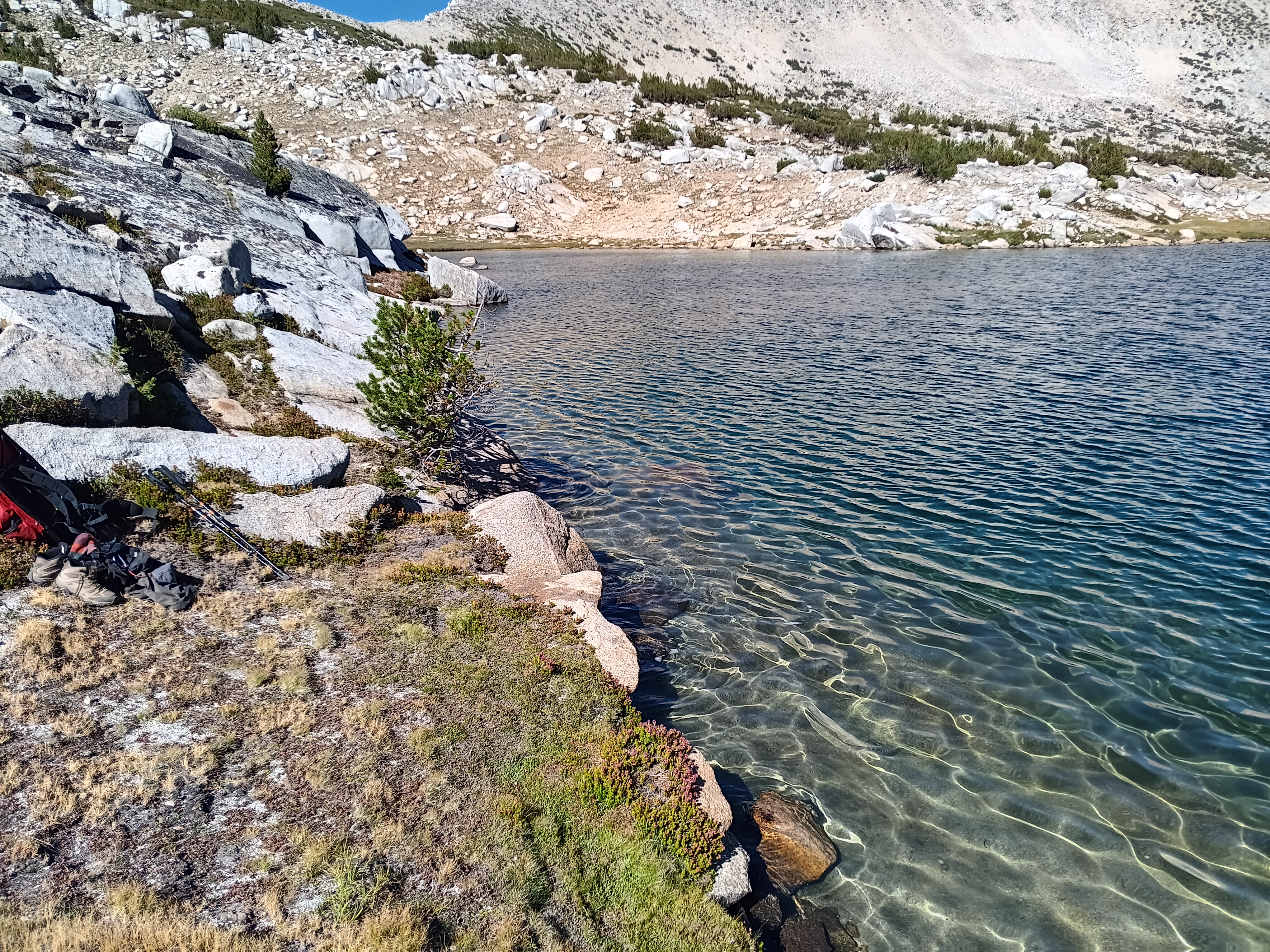
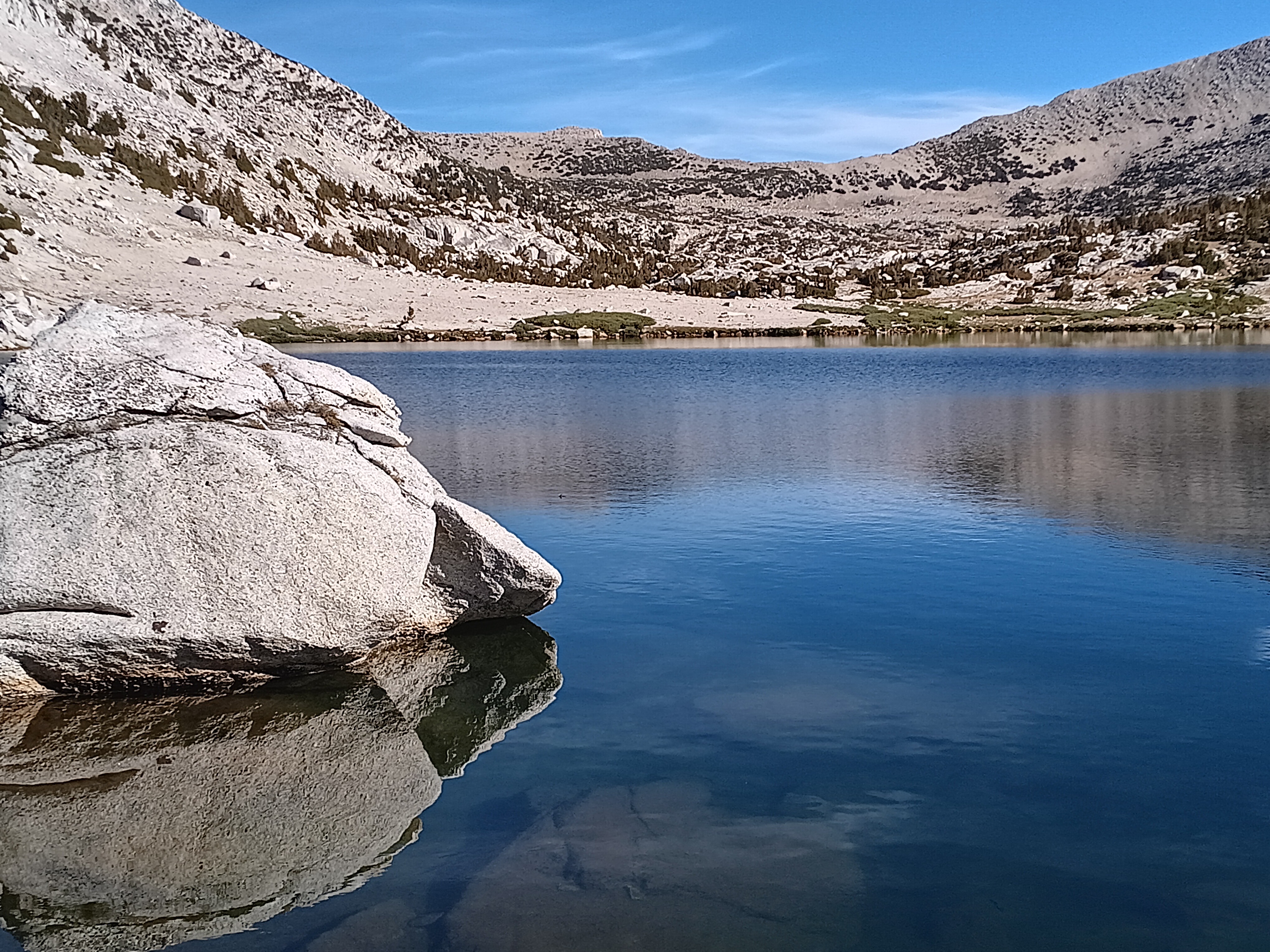
I swam the next 14 days in Rush Creek, Emerald Lake, Ediza Lake, Shadow Lake, Rosalie Lake, McCloud Lake, Duck Lake, Purple Lake, Lake Virginia, Big McGee Lake, Fourth Recess Lake, Pioneer Lake-10817, Pioneer Lake-10871, Pioneer Lake-11194, and lastly Trail Lake. And at each of these daily swims I was alone in or at the water. Only McCloud Lake I shared with two anglers early in the morning, but this lake was about 1/2 mile from the bus stop to the town of Mammoth Lakes, California, where I resupplied myself with food a week into my hike. Passing over Duck Pass the next day, I was now on my way towards Pioneer Basin which was the main goal of this years’ trip into mountains.

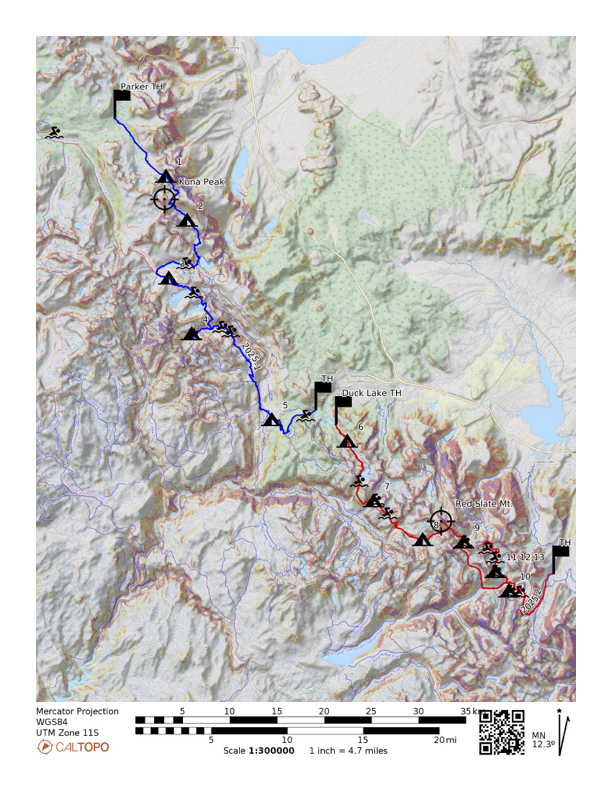
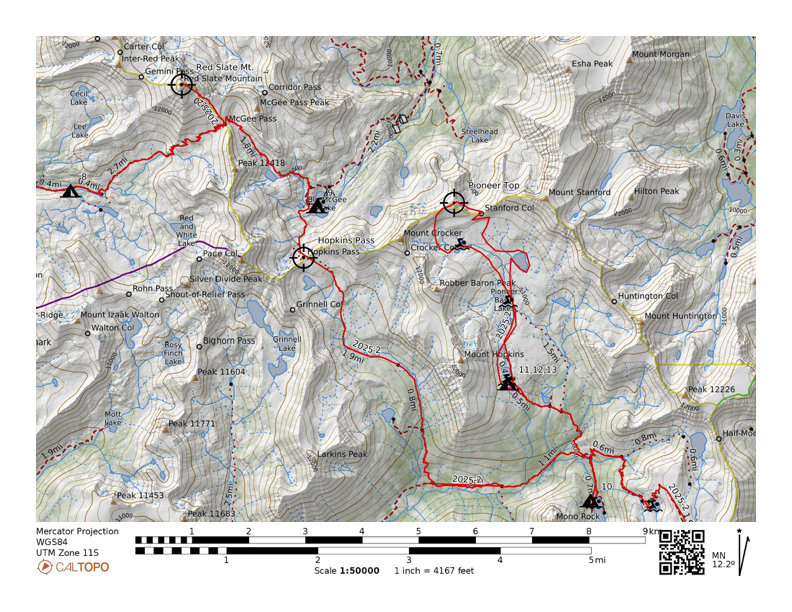
Tracks, camps, and swims during 2025 back-packing trip Aug. 9-22. Flags indicate trailheads with entry in Yosemite National Park in the north (blue track) and John Muir Wilderness in the south (red track). Crosshairs are at Kuna Mountain (13,008′ or 3965 m) in the north and Red Slate Mountain (13,135′ or 4002 m) in the south. Right panel is a close up of McGee Pass, Red Slate Mountain, Hopkins Pass, and Pioneer Basin.

Pavla encouraged me to get into Pioneer Basin which she described as a wild, beautiful, and flatish place with many lakes and no trails. And so it was my home for 3 days and nights. The lack of trails scared me at first, because my 2024 California hike challenged me when my trail disappeared for 3 days in Ansel Adams Wilderness. The “trail” was there in theory, but it was overgrown by waist high brush, young trees, leave piles, and fallen trees after several forest fires raged through the area 10 or 20 years ago. This was at lower altitudes of 7,500′ (2300 m) and thus well below the treeline. In contrast, Pioneer Basin is above the treeline near 11,000′ (3300 m) and surrounded on 3 sides by high mountains to ease navigation. Nevertheless, it was tricky to reach from the north-west, because I had to cross two high passes only one of which had an established trail.

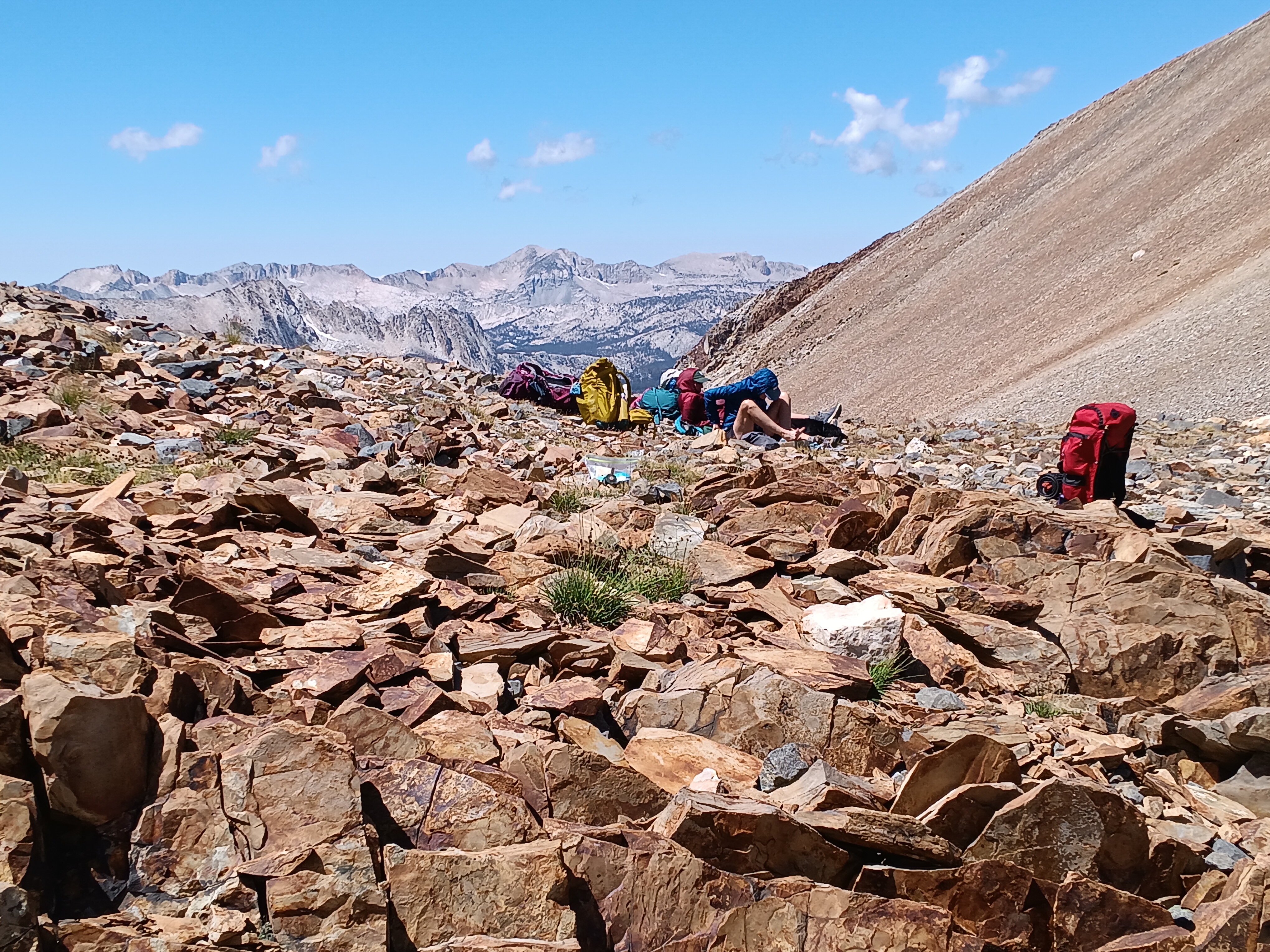
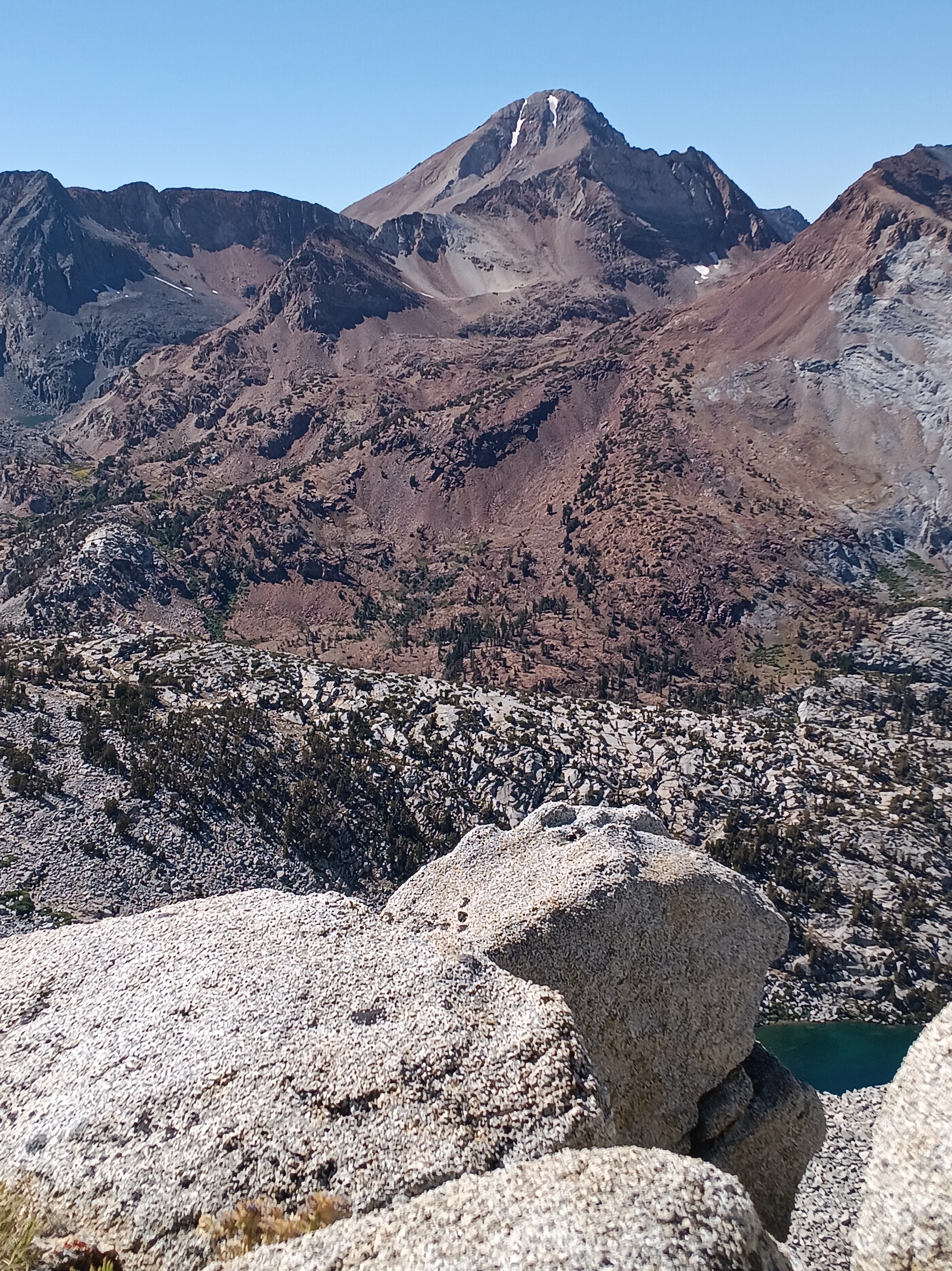
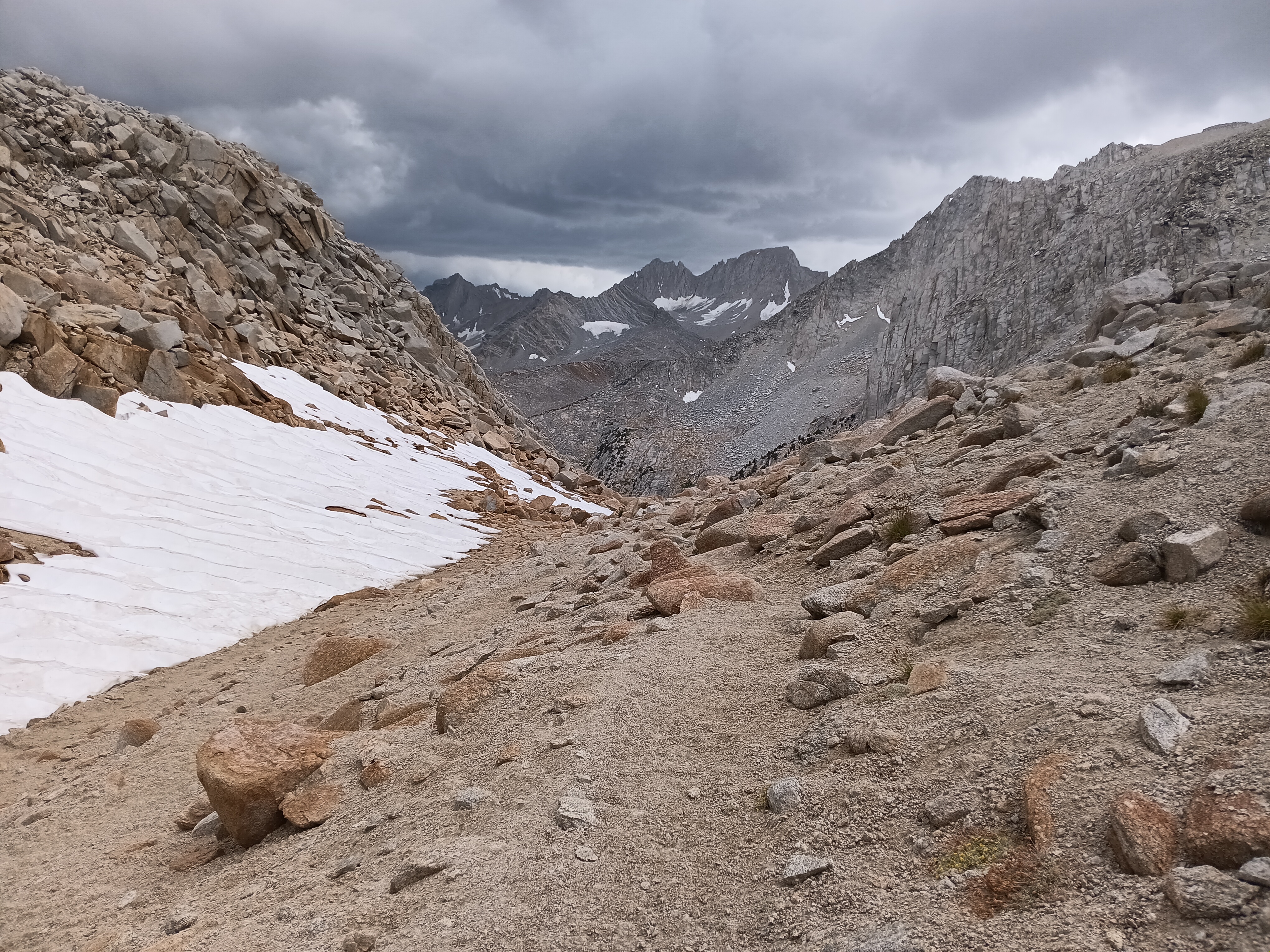
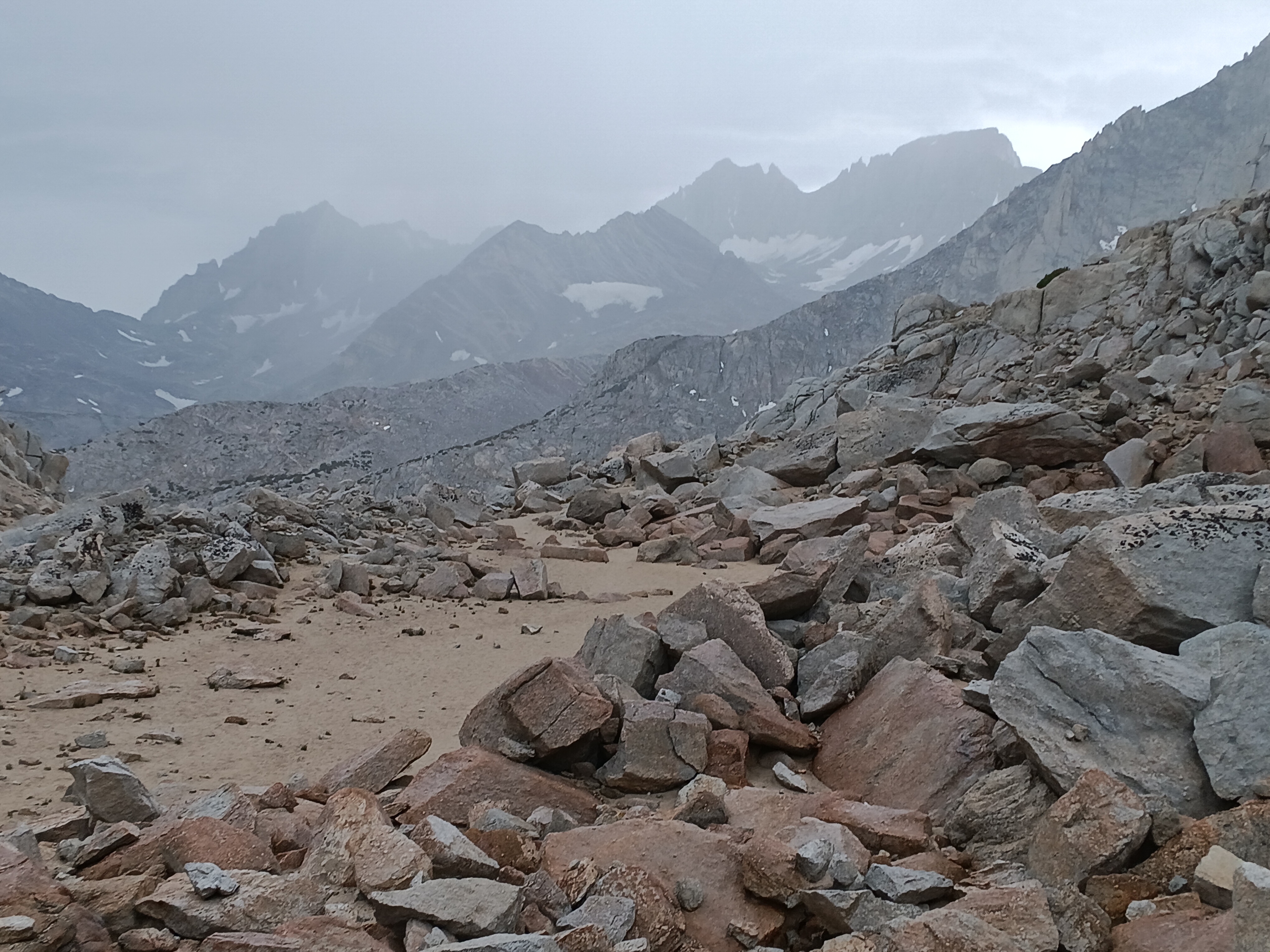
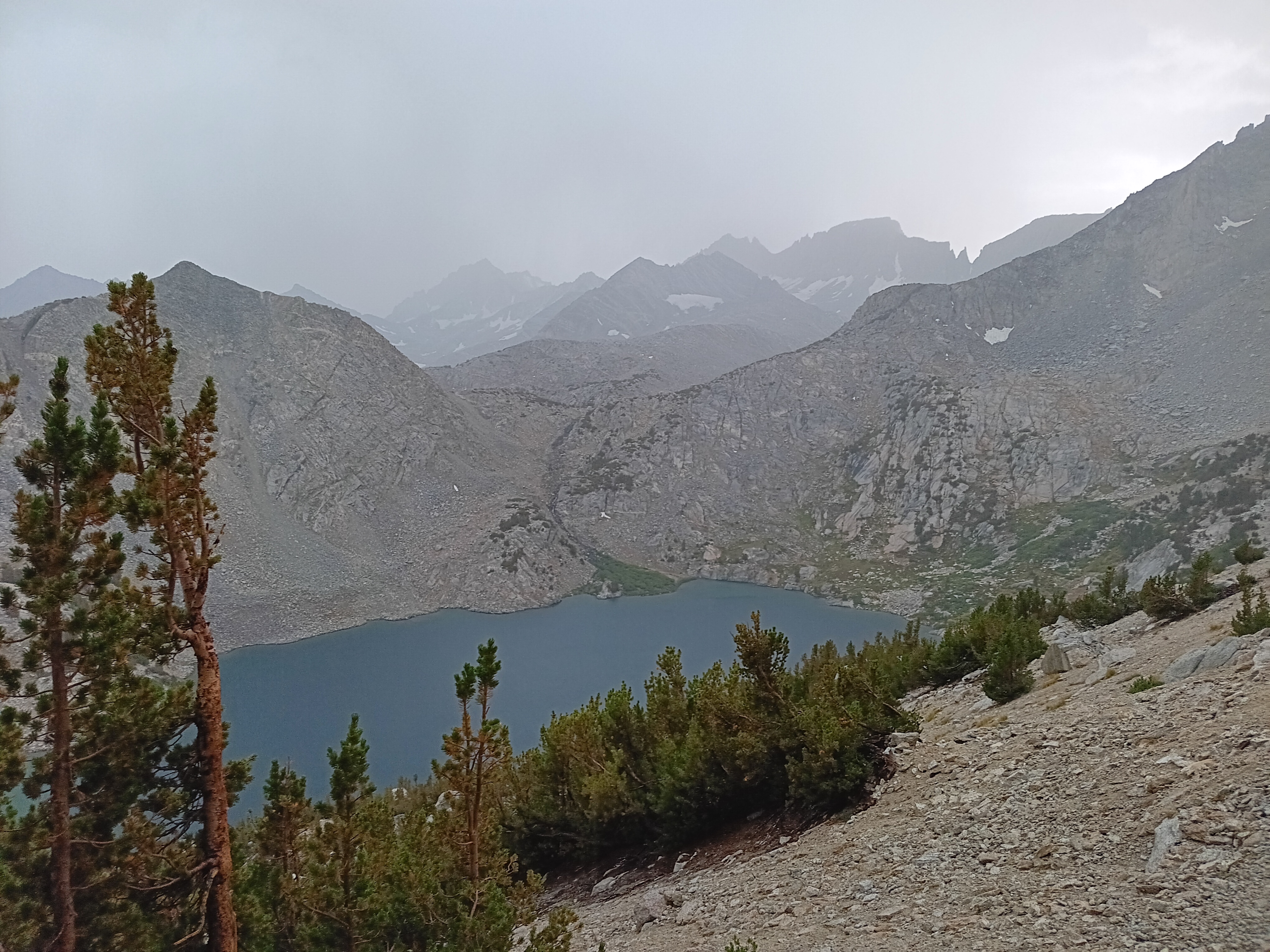
McGee Pass came first after hiking down to and then up Fish Creek to its origin below the snow fields of Red Slate Mountain. I hiked loosely with two parents my age and their grown two daughters and their dog. I had met them 3 days prior climbing up to Duck Lake and we kept meeting each other on the trail with few other people. We had lunch together atop McGee Pass at 11,900′ (3600 m) when I decided to climb the mountain following yet another tip of Pavla. Without my backpack the climb up Red Slate Mountain was at first delightful, but later became steep and strenuous. Much to my surprise, I suddenly had cell phone coverage near the top and I sent photos to my wife Dragonfly back home. It felt strange and funny to sit atop high mountains talking to Dragonfly who was walking below tall skyscrapers near Manhattan’s Fifth Avenue. She was not eager to talk, because she tried frantically to escape rain and traffic with a group of friends. Her husband, meanwhile, sits mellow atop the worlds with nearby clouds and far horizons as his only companions:

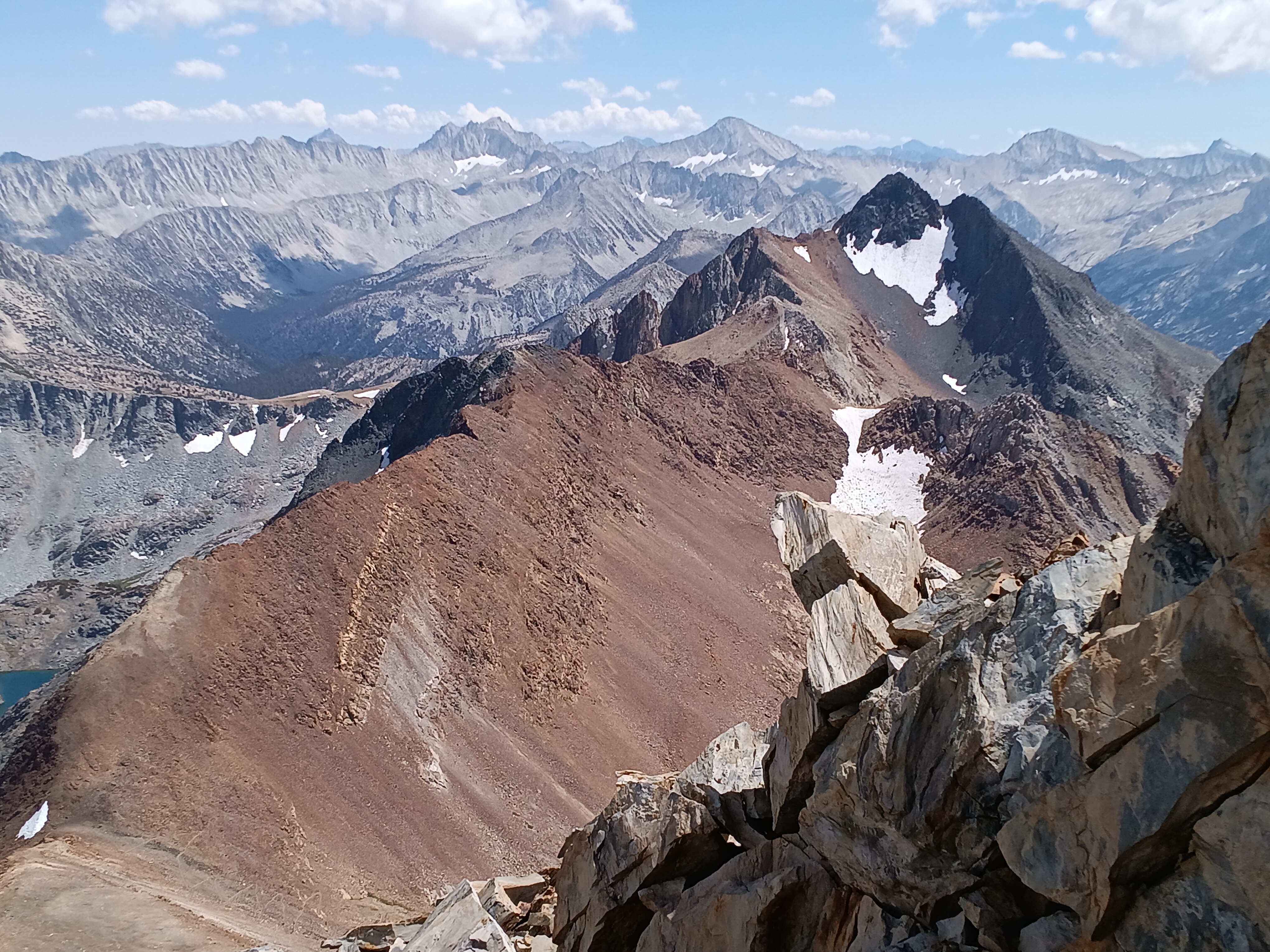
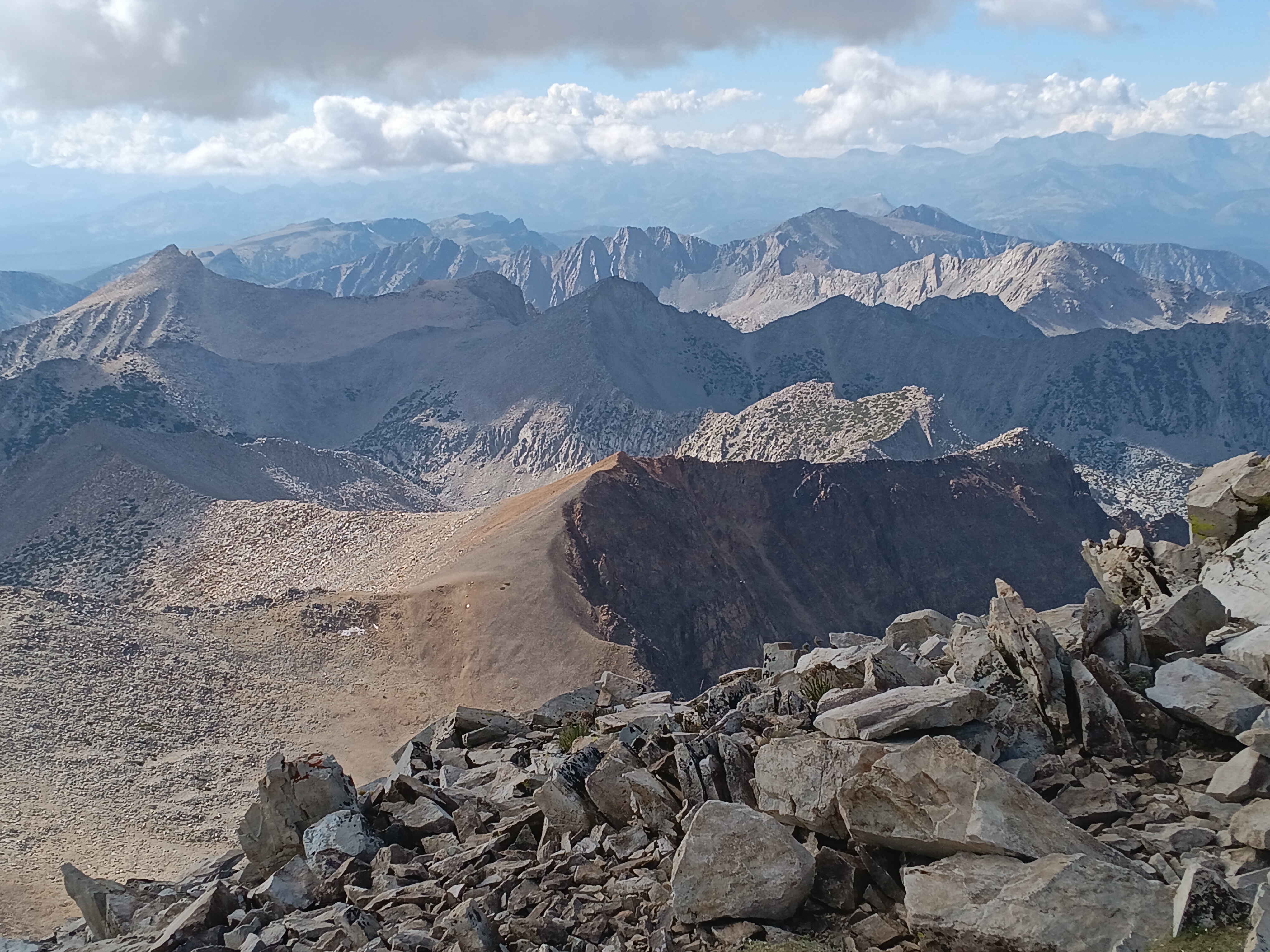
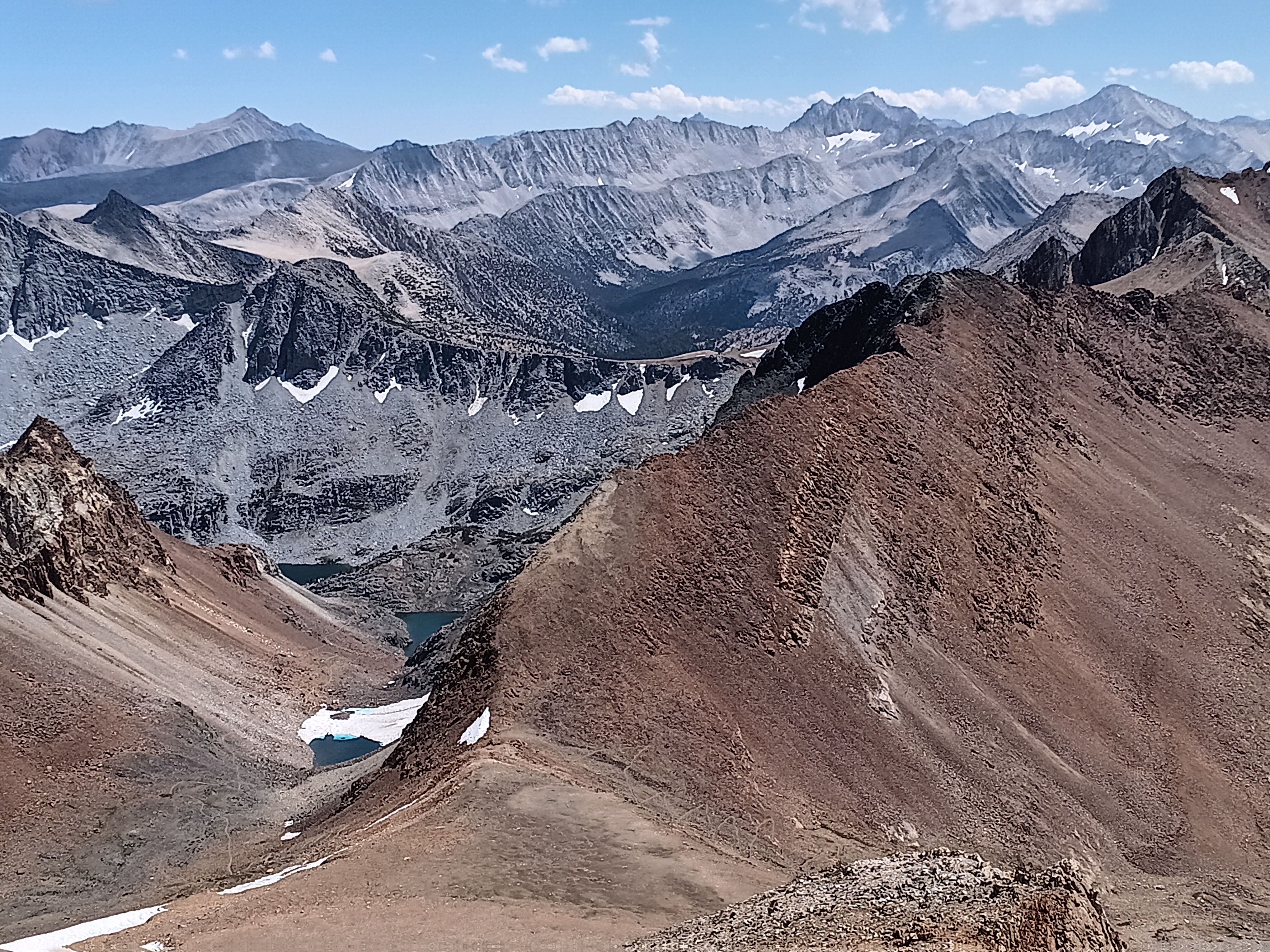
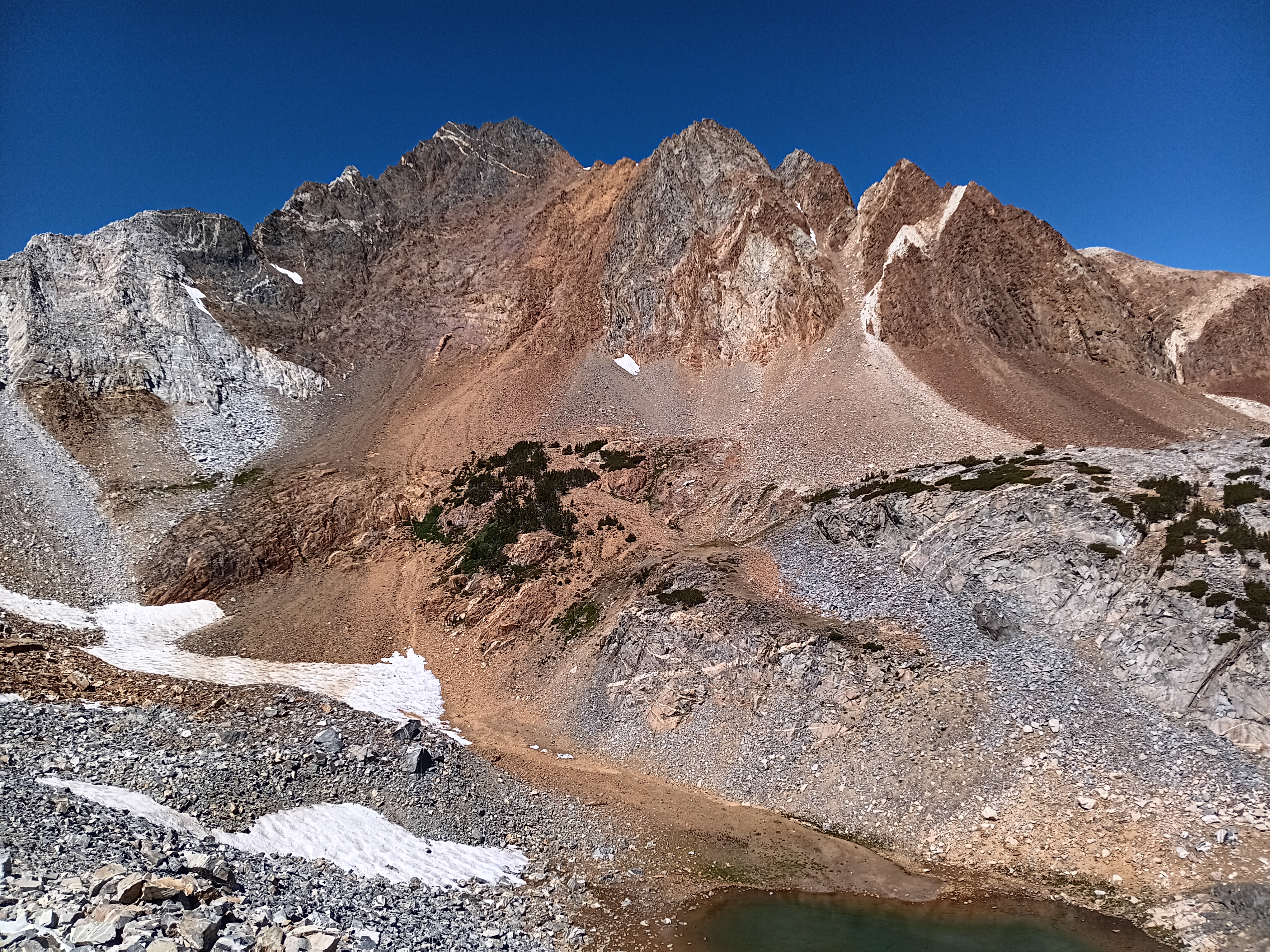
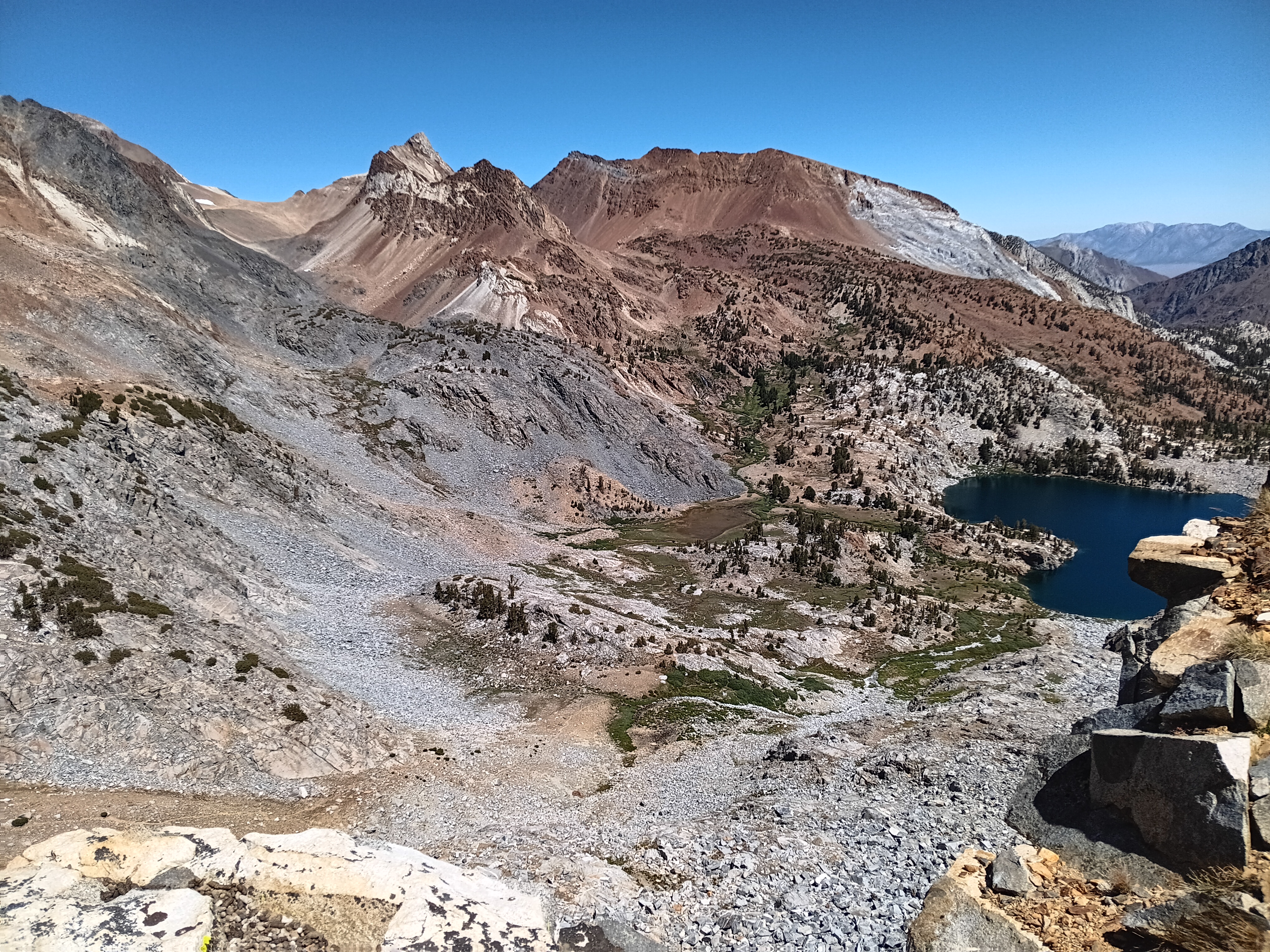
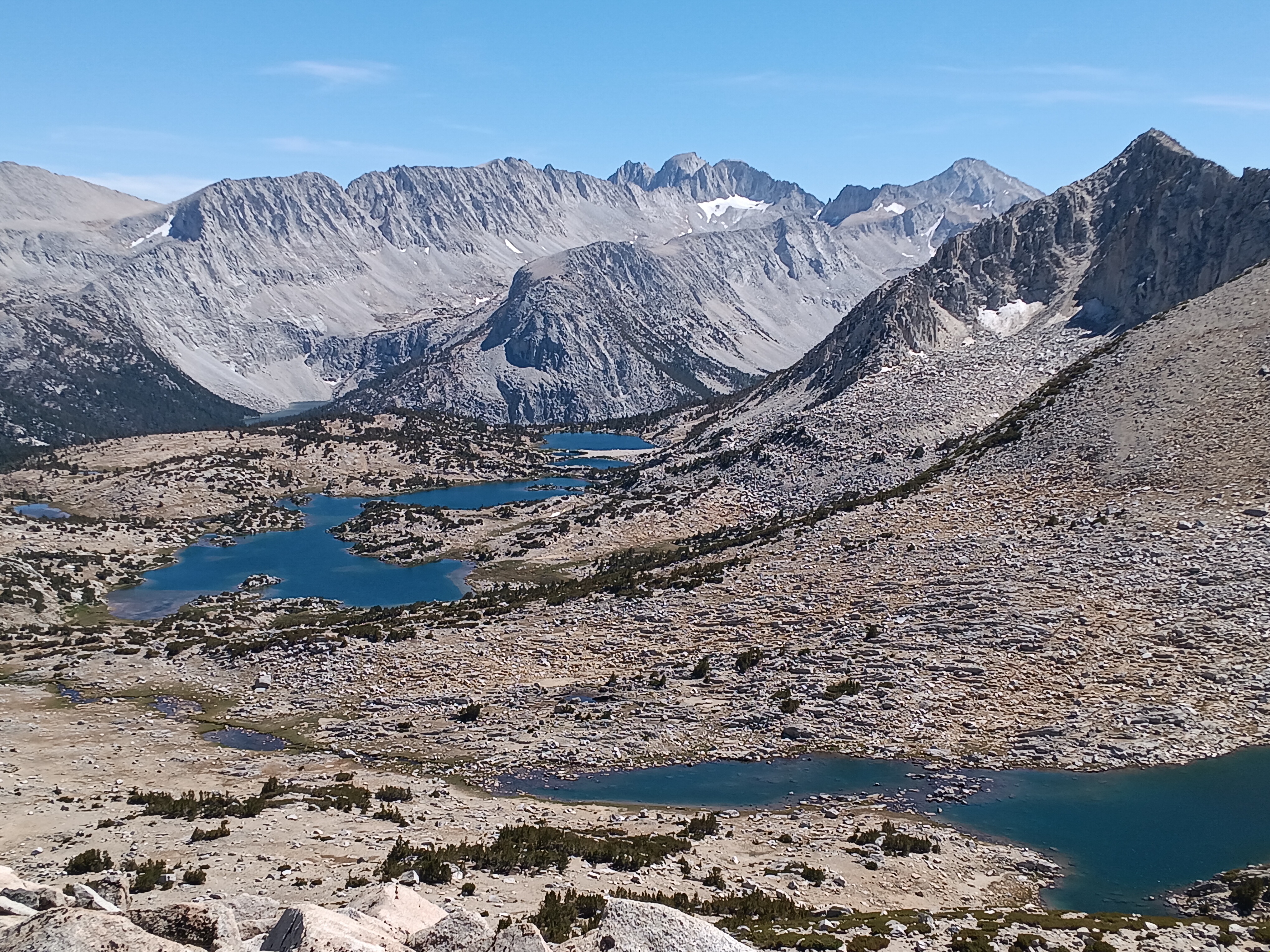
Lunch at McGee Pass (top left) and views from Red Slate Mountain towards Red and White Mountain (top right), towards north into Yosemite (center right), and towards south (bottom). The bottom photo shows three lakes with a faint path on the left and a zig-zag path up to McGee Pass on the right. The mountains in the far back are Mills, Abbott, and Dade Mountains that merge together at the end of the long ridge that bounds Fourth Recess. I crossed all these ranges the next 5 days to exit via Mono Pass to the east (left) of Fourth Recess. Hopkins Pass crosses the lower center ridge near a triangular snow patch. Pioneer Valley is to the left (outside frame) of the wooded Hopkins Valley. [Aug.-17, 2025.]

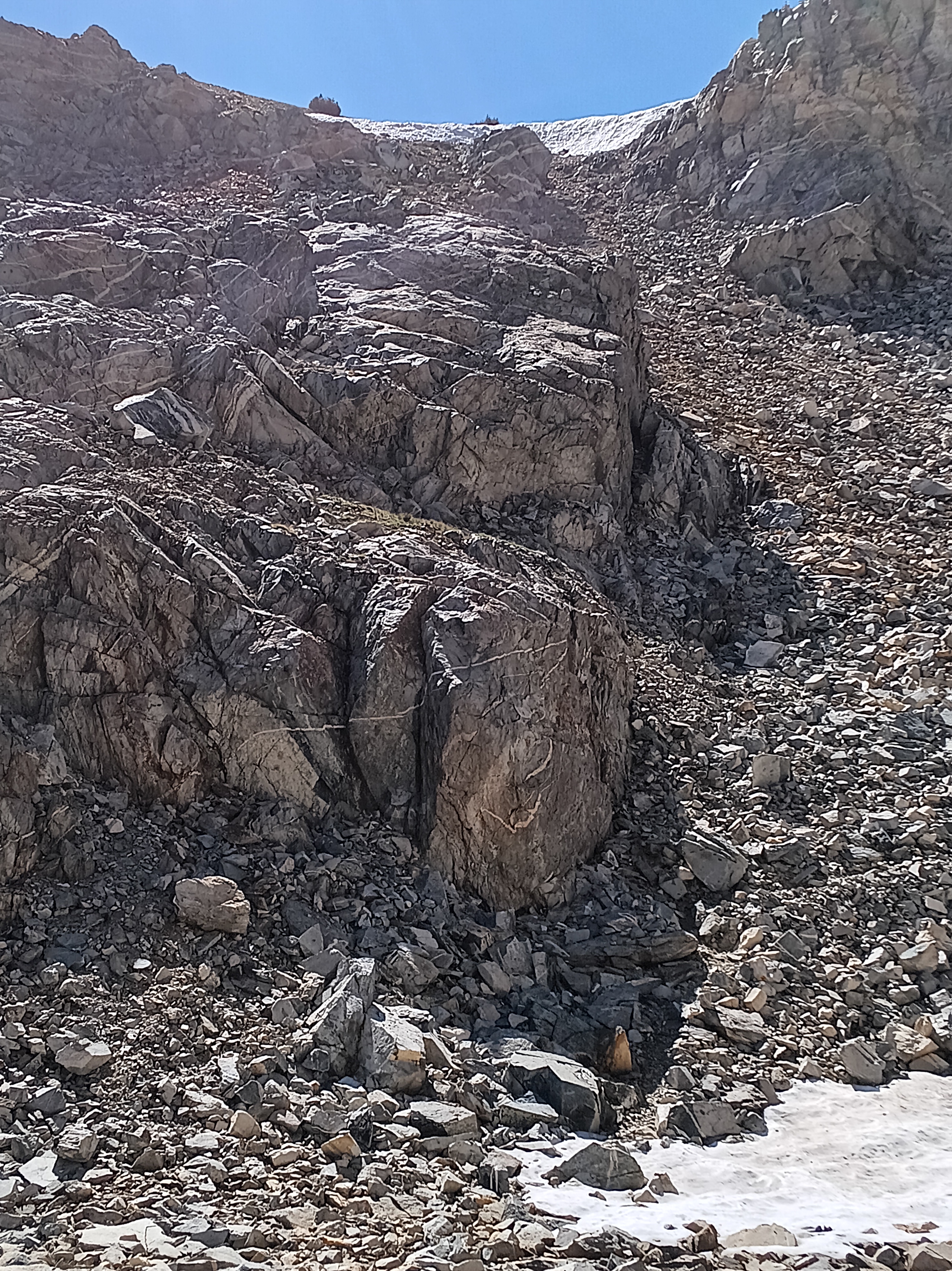
When I came down the mountain and reached my campsite at the lowest lake in the photo above (Big McGee Lake) it was 7 pm. I met my earlier hiking companions, told them about my adventures atop the mountain, and went for a swim just as the sun set for the day. I slept well that night, but got up early to climb over Hopkins Pass along a sketchy, barely existing path. Detailed descriptions of the route I found in Backpacking from McGee Creek to Pioneer Basin via Hopkins Pass by Inga Aksamit. She also moderates an outstanding Facebook group on the John Muir Trail that I used for my 2024 backpacking trip. Thanks to this guide the crossing of Hopkins Pass went well. It included an almost vertical scramble up a cliff on all fours to reach a tiny ice cap near the top.

The last 400′ (120 m) of Hopkins Pass at 11,470′ (3500 m) up a bouldery cliff with a snow wedge above (left) along with views from the top such as Red and White Mountain (top right) and towards my campground at Bigh McGee Lake (bottom right). [Aug.-18, 2025.]

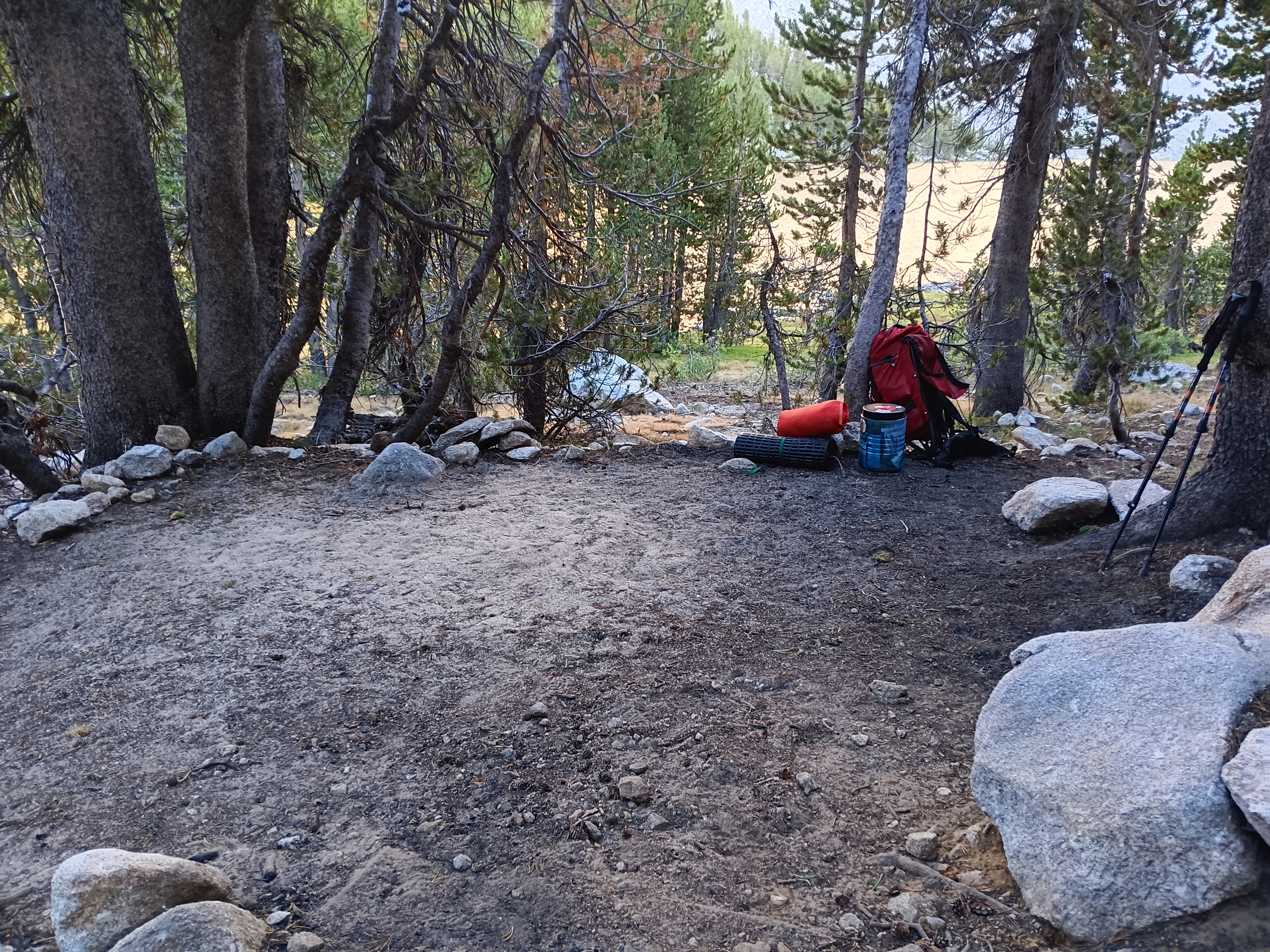
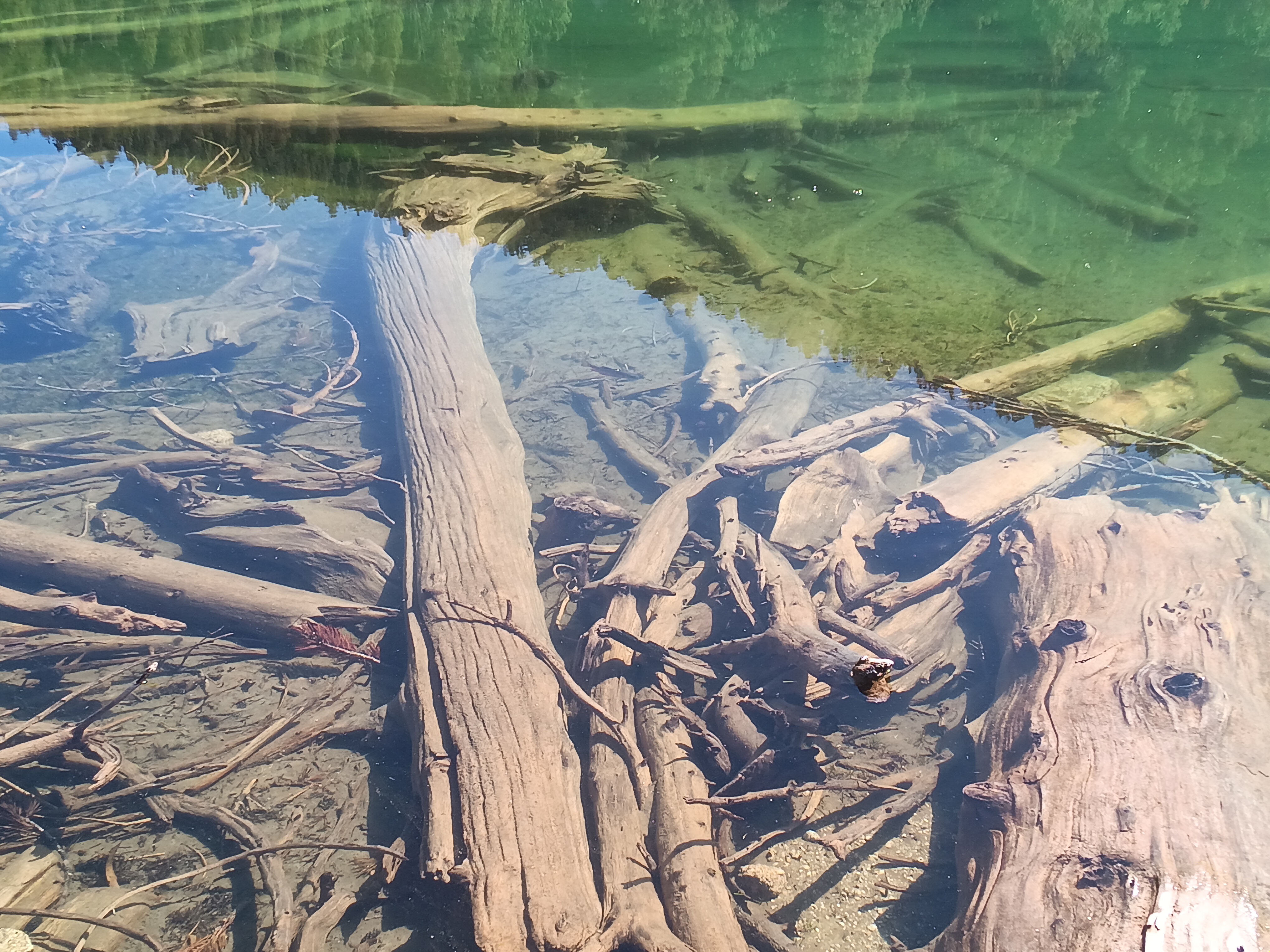
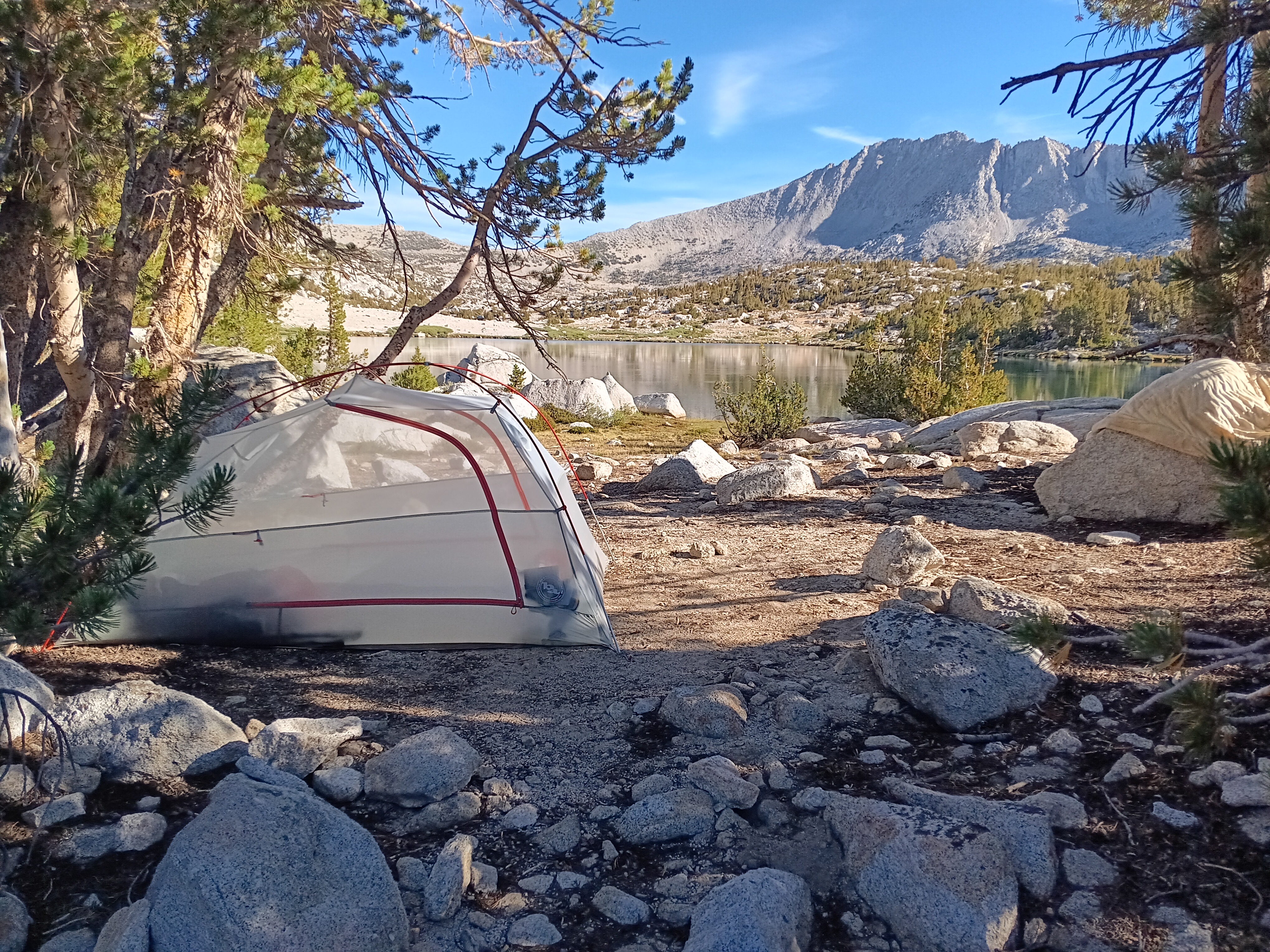
Heading down Hopkins Valley without a trail or difficulties, I reached Mono Creek at 9,300′ (2800 m) in the afternoon. I navigated an unexpected cliff above the treeline (easily done) and a massive pile of fallen trees (harder) that forced me to bush-wack for an hour. Escaping the mosquito infested Mono Valley, I camped a mile uphill at the georgeous Fourth Access Lake. It featured an outstanding and flat campground in the pines with views of lake, mountains, and waterfall; someone even had made a most comfortable bench out of wood. The lake was nearby and I had both an evening and morning swim before heading into Pioneer Basin. The Lake was also stoke full with trout:

Campground at Fourth Recess Lake (top left), my swimming spot among the wooden logs and trout (bottom left), and the view from my camp (right panel). Two people camped on the other side of the lake. [Aug.-19, 2025.]

A short 3 hour walk the next morning got me to Pioneer Basin where I dropped my backpack at 11 am to spent the next 2 hours looking for a place to pitch my tent for the next 3 nights. It was surprisingly hard to find the right spot, but I found it after talking to a young man in his mid 30ies who had just “skied” down Hopkins Peak. Inspired by him, I did something similar the next day, but first he helped me find a good camping sites. I generally like to sleep under trees, pine trees in particular, and I was looking for a shady spot as it was warm and I intended to do some dozing after swimming in the nearby lake. Again, I had many trouts for watching and company, but back to the skiing I did the next day down the upper reaches at Pioneer Basin:

My camp in Pioneer Basin (top left) at the far end of the larger lake with the Fourth Acess Ridge in the background (center left). Fourth Access Valley becomes clearer at bottom left with the many lakes of Pioneer Basin in the foreground as seen from above Standford Col looking south. Looking north from the same location, I see Red Slate Mountain dominating the landscape (right panel). I had climbed it 3 days prior. [Aug.-20/21, 2025.]

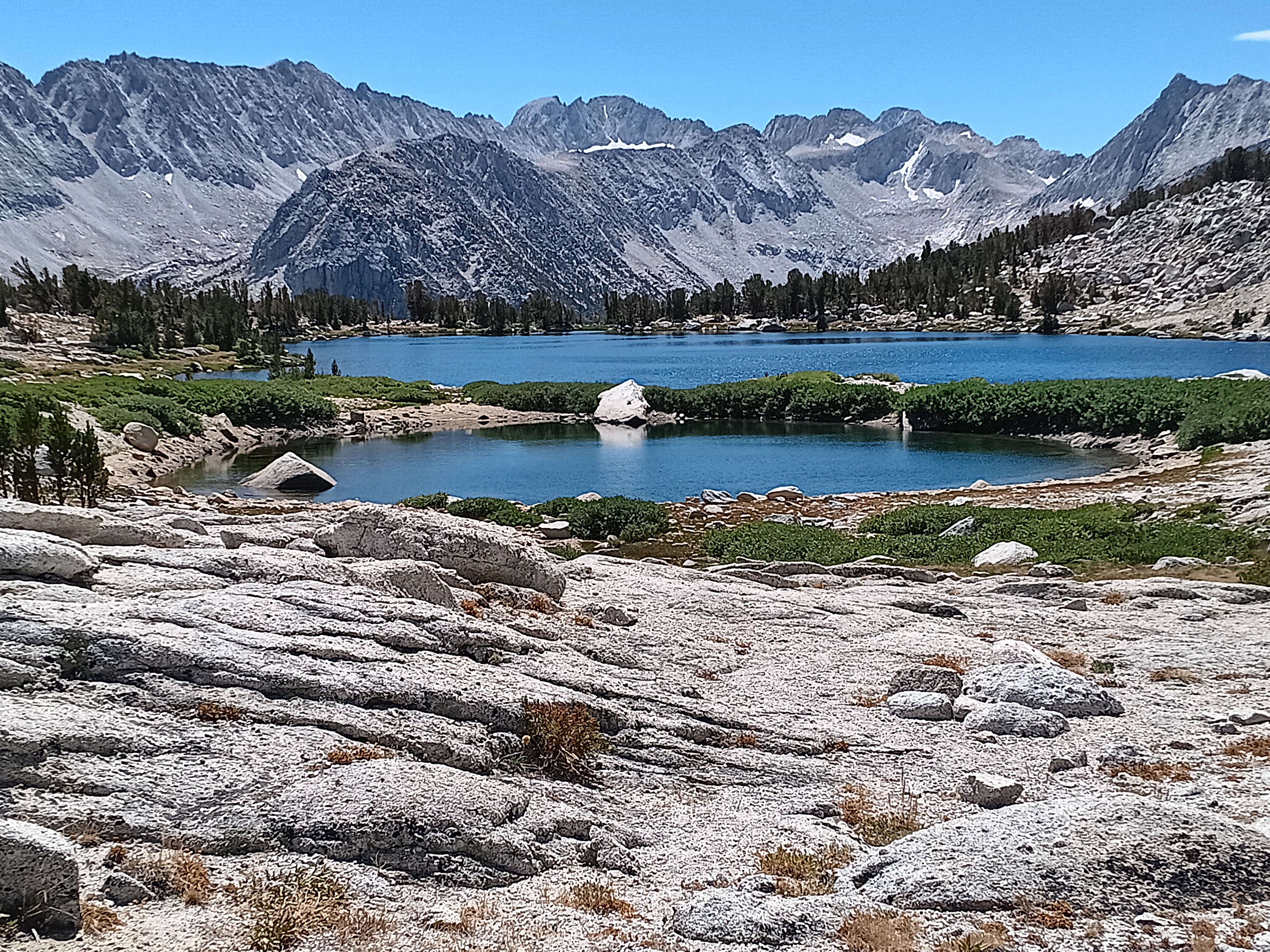
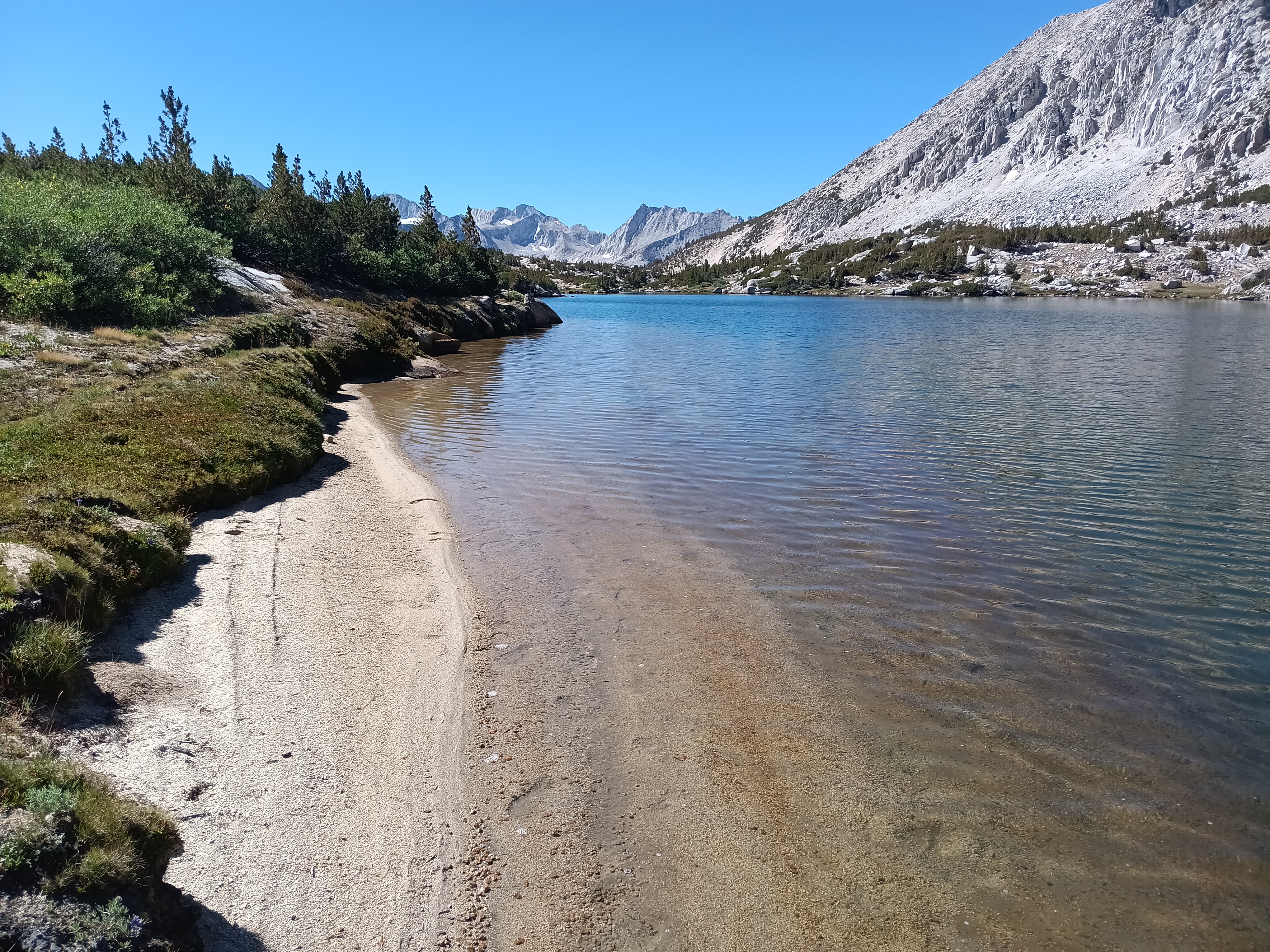
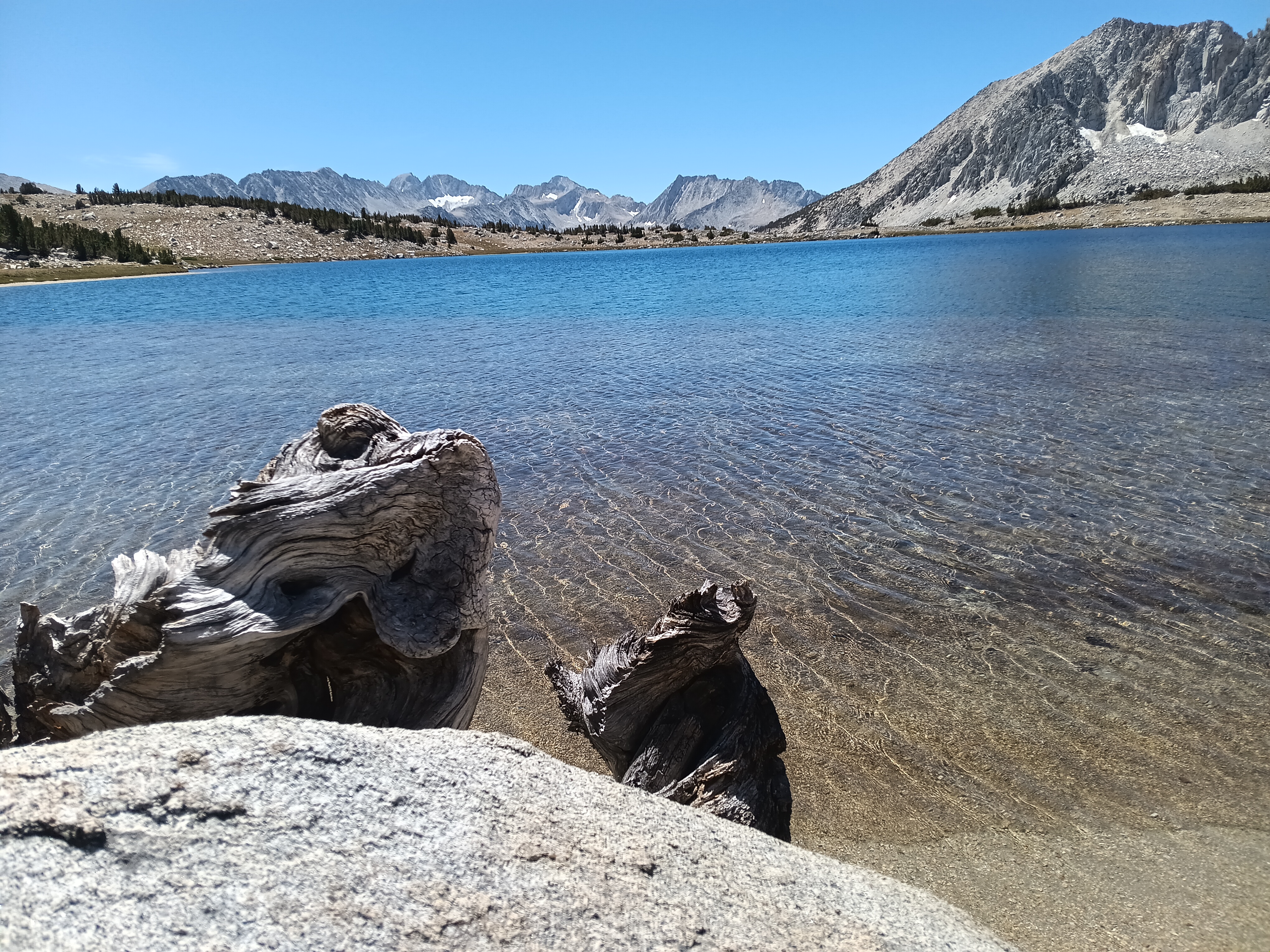
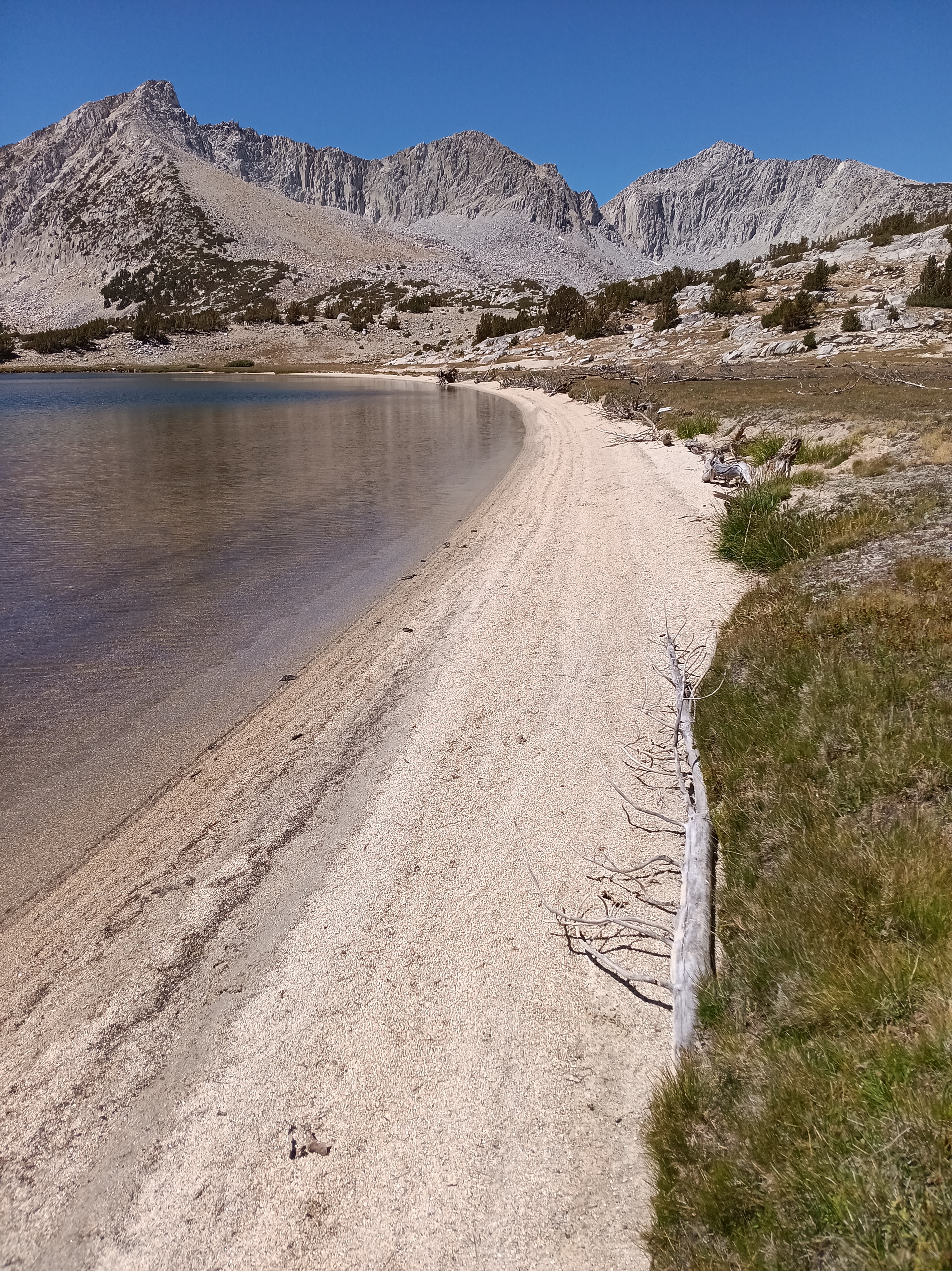
Most of the mountains surrounding Pioneer Basin are steep, very steep, but they tend to be a bit sandy, not quite, but the soil on the steep slope is free of bolders with alot of scree, smallish pebbles, really. It is almost impossible to gain traction hiking up such slopes, as one slides down and sinks in. In contrast, heading down such slopes, I found to be like skiing with the hiking poles to keep balance in a controlled slide. Just like skiing one sinks into the scree, slides down, and makes turns by setting poles and shifting balance. What takes 3-5 hours to climb up takes 15 minutes to slide down. Fun … the downhill part that is. So I hiked the basin, swam in 3 of the 7 lakes several times, and even had a lazy day doing nothing but watching the trout in the water, the birds in the sky, and the sun rise and fall. Heaven on earth that I shared with a total of 3 people in 3 days, that is, each person has 2 lakes for themselves every day. And the beaches of the lakes, too, were wild, sandy, and sunny:

Swimming the many lakes of the High Sierra Nevada, I felt fresh and clean and happy. Last year my wife Dragonfly told me to do this also and carry swim trunks, but for some reason I only swam once during the 36 days that I was hiking across mountains and past lakes in 2024. What made this year different was Pavla who picked me up at Tuoloume Meadows. She added to Dragonfly’s suggestions by forcefully setting an example for me. It thus seems that it takes a village to teach an old man new tricks. The swimming will stay with me as lake swimming added a new comfort to the adventure that is hiking for many days and weeks.

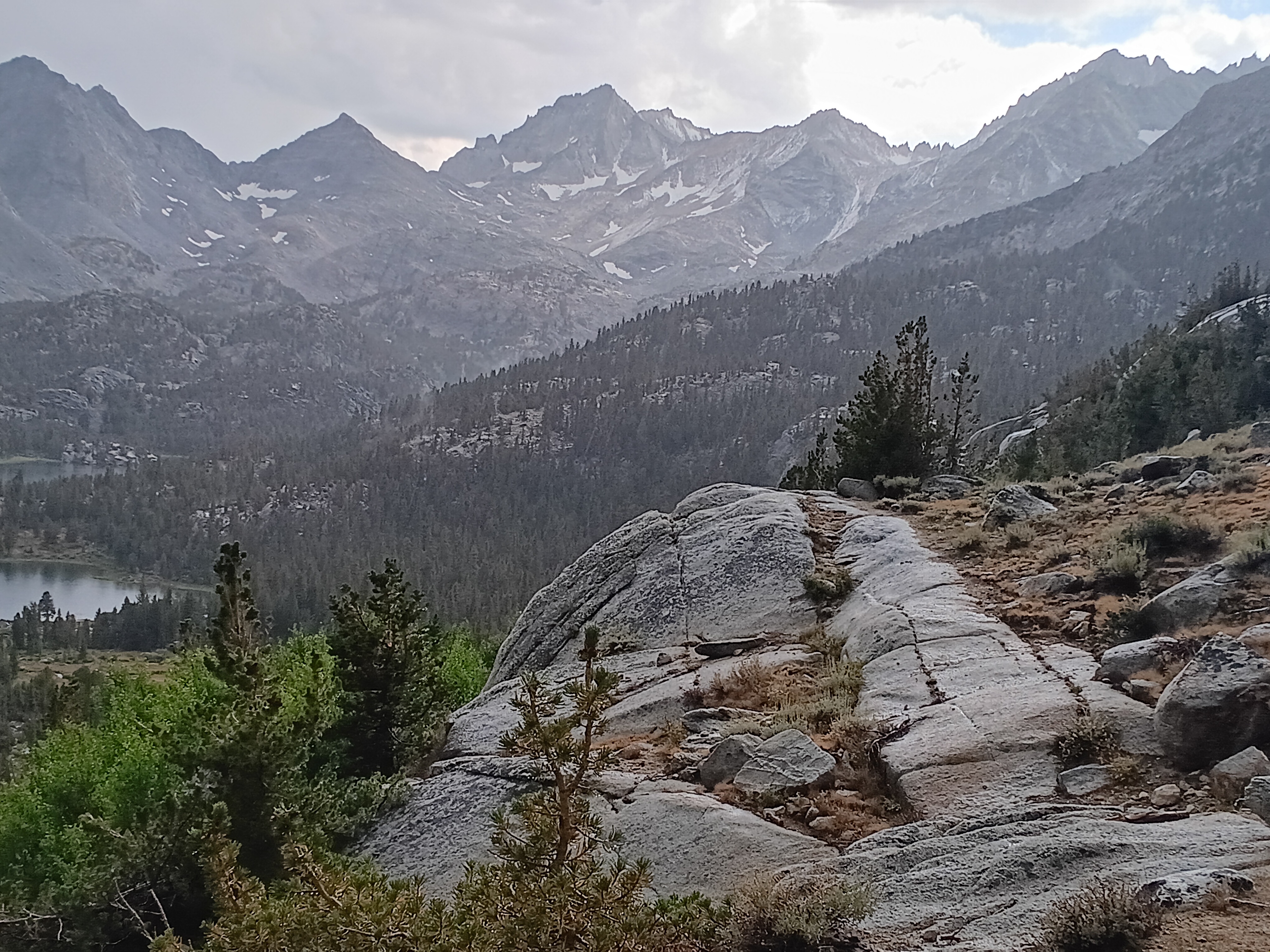
P.S.: My 14-day hike covered about 120 miles (190 km), so I comfortably saunter about 10 miles/day with about 40-45 lbs on my back. If pressed, such as by thunder and lightning and rain that hit me the last day at 12,000′ high Mono Pass, I got enough reserves to do an additional 5-7 miles at the end of the day to get down Mono Pass (top left) with Abbot and Dale Mountains in the dark clouds above Ruby Lake. No swimming there … this year.

Exploring Greenland’s Coastal Currents: A Journey of Discovery with Icebreaker Polarstern

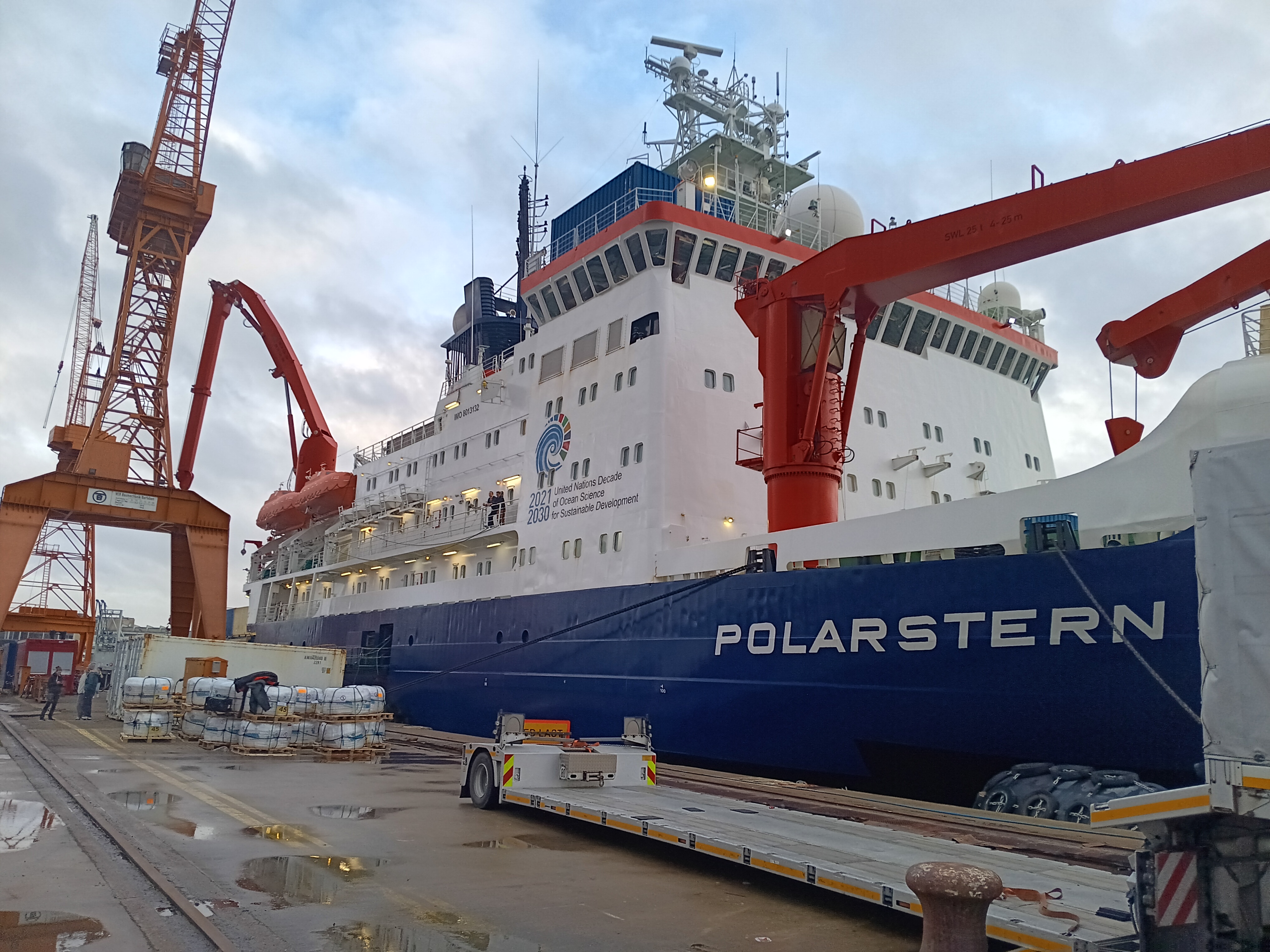
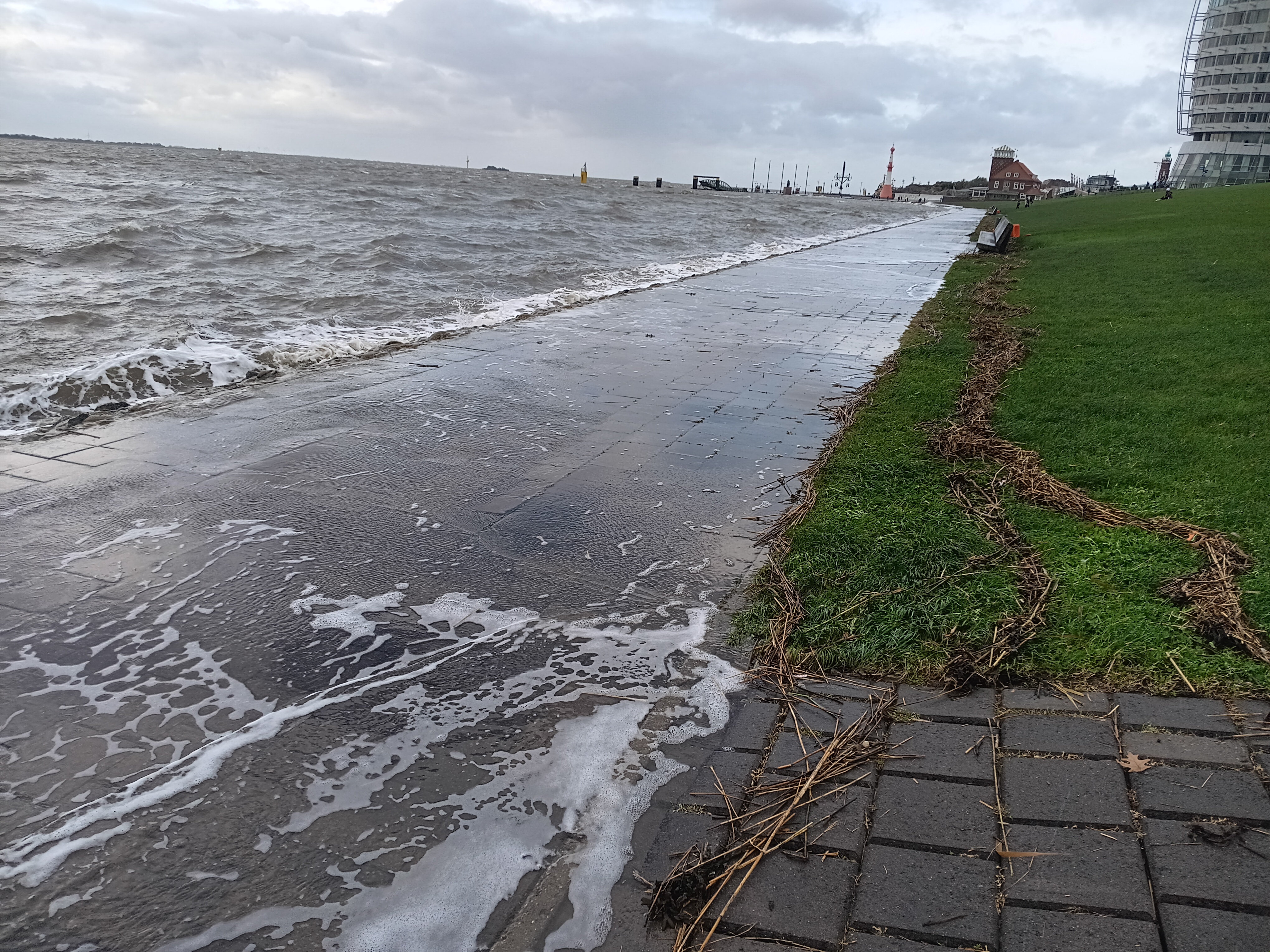
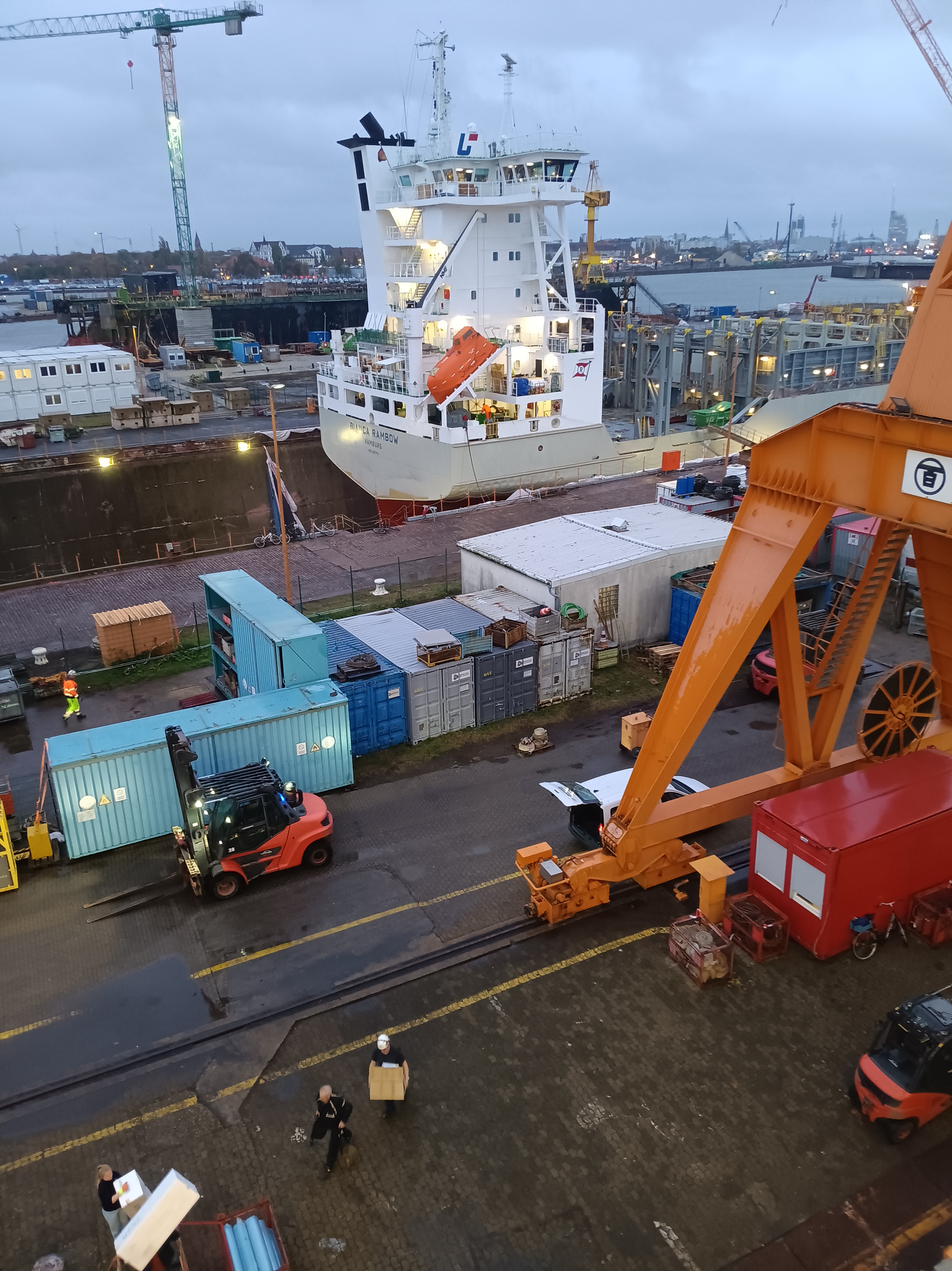
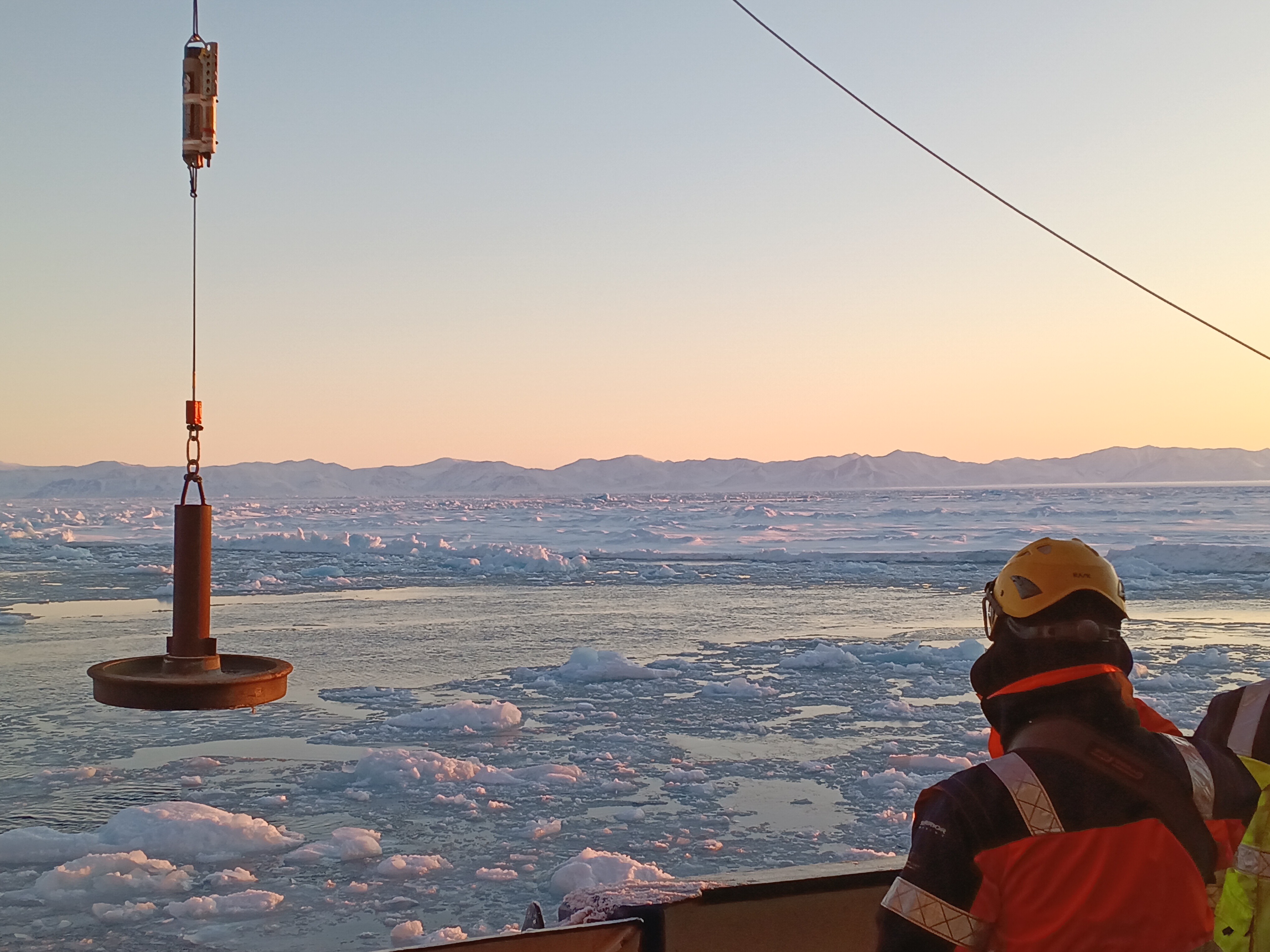
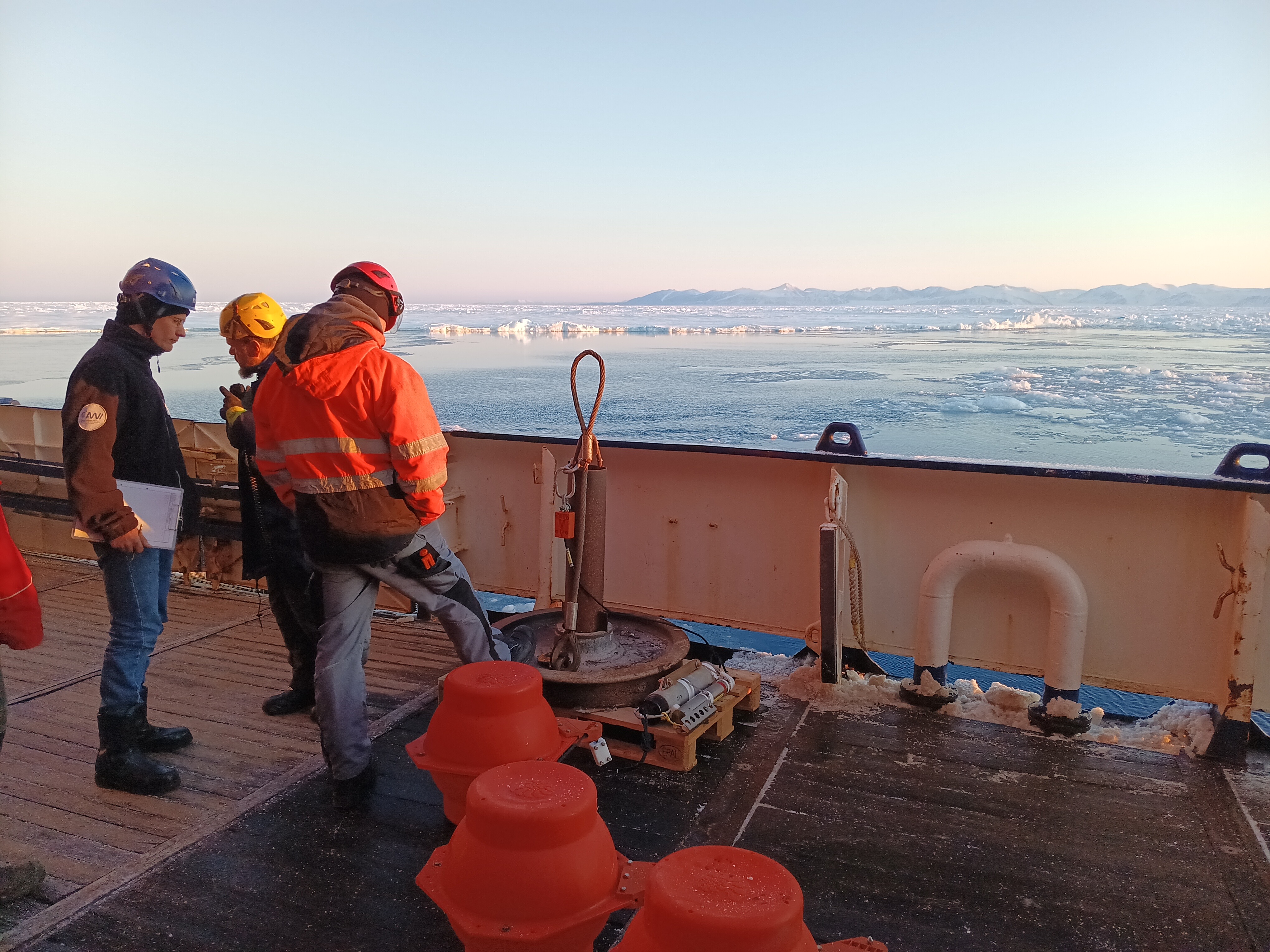
Icebreaker Polarstern reached its home port of Bremerhaven in Germany just before Orkan “Joshua” hit northern Germany hard. The ship returned after 3 month at sea with 48 crew and 46 scientists working on ocean biology, chemistry, and physics. The 7-week expedition from Svalbard to Greenland and back to Germany culminated 3 years of planing and preparations led by the Alfred Wegener Institute (AWI). As one of 46 scientists I stepped onto the ship almost two months ago in Longyearbyen. We planned to explore what moves ice and fresh Arctic water into the Atlantic Ocean with sensors to probe the coastal circulation.  Analyzing these data, I will now live in Bremerhaven for a few months.

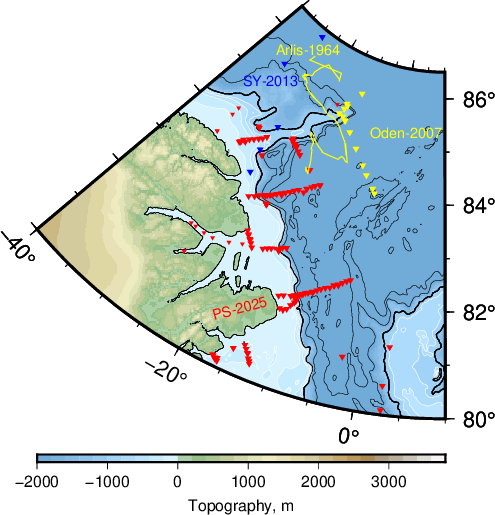
The map above shows where we went to the north of Greenland. I am coloring the coastal ocean shallower than 1000 m in light blue and the deeper ocean in dark blue. Our 2025 Polarstern data are the red symbols while yellow and blue symbols show data locations from 1964 ice island, 2007 icebreaker,  and 2013 helicopter surveys. This area contains the last and thickest sea ice of the Arctic Ocean and prior ocean observations originate from floating ice islands that both the Soviet Union and the U.S.A. used during the Cold War 1947-91 such as the Arlis-1964 track (yellow line). Helicopter surveys collected a few data in 2013 (blue symbols) while the Swedish icebreaker Oden collected data along two lines farther offshore (yellow symbols).

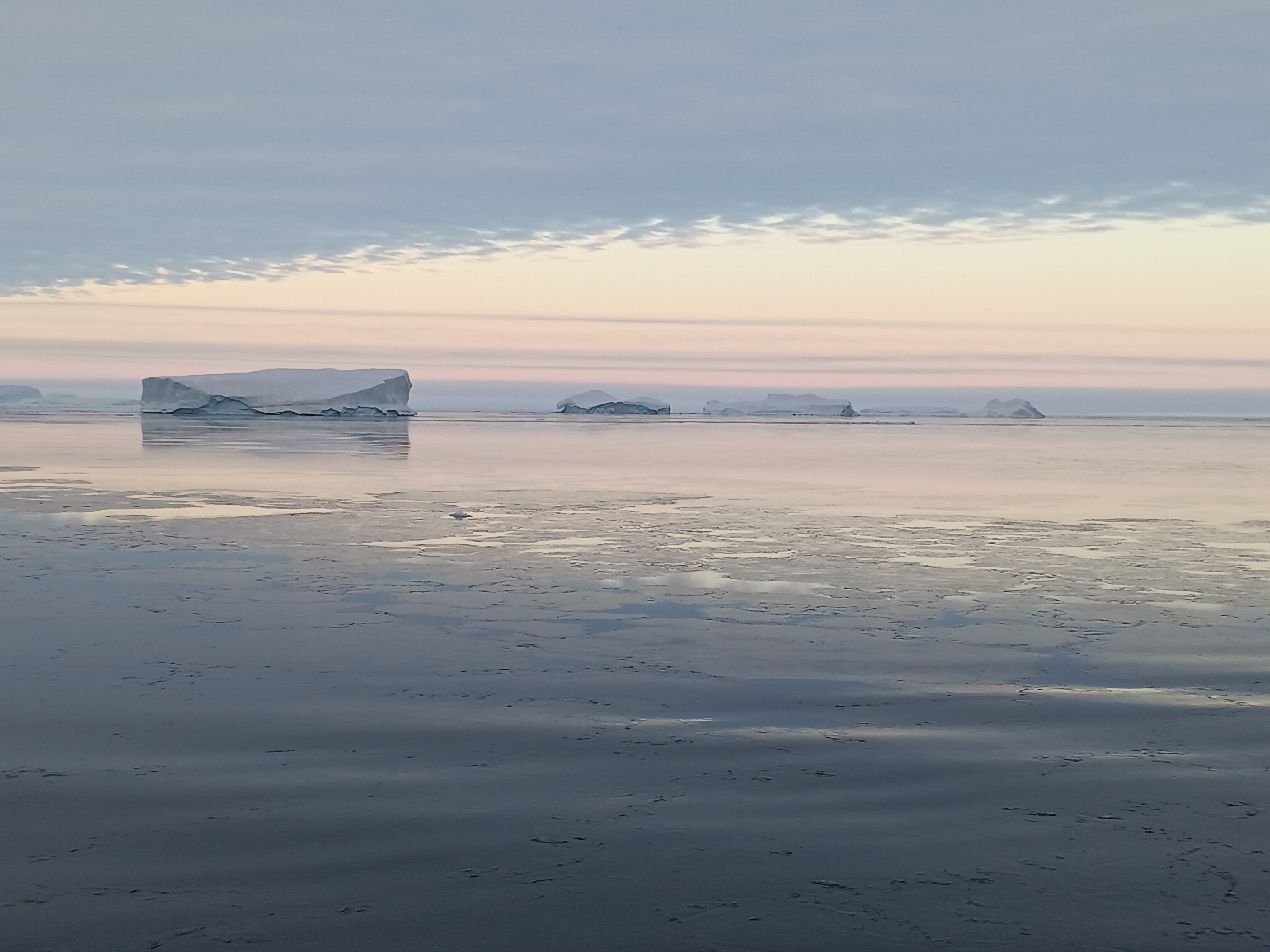
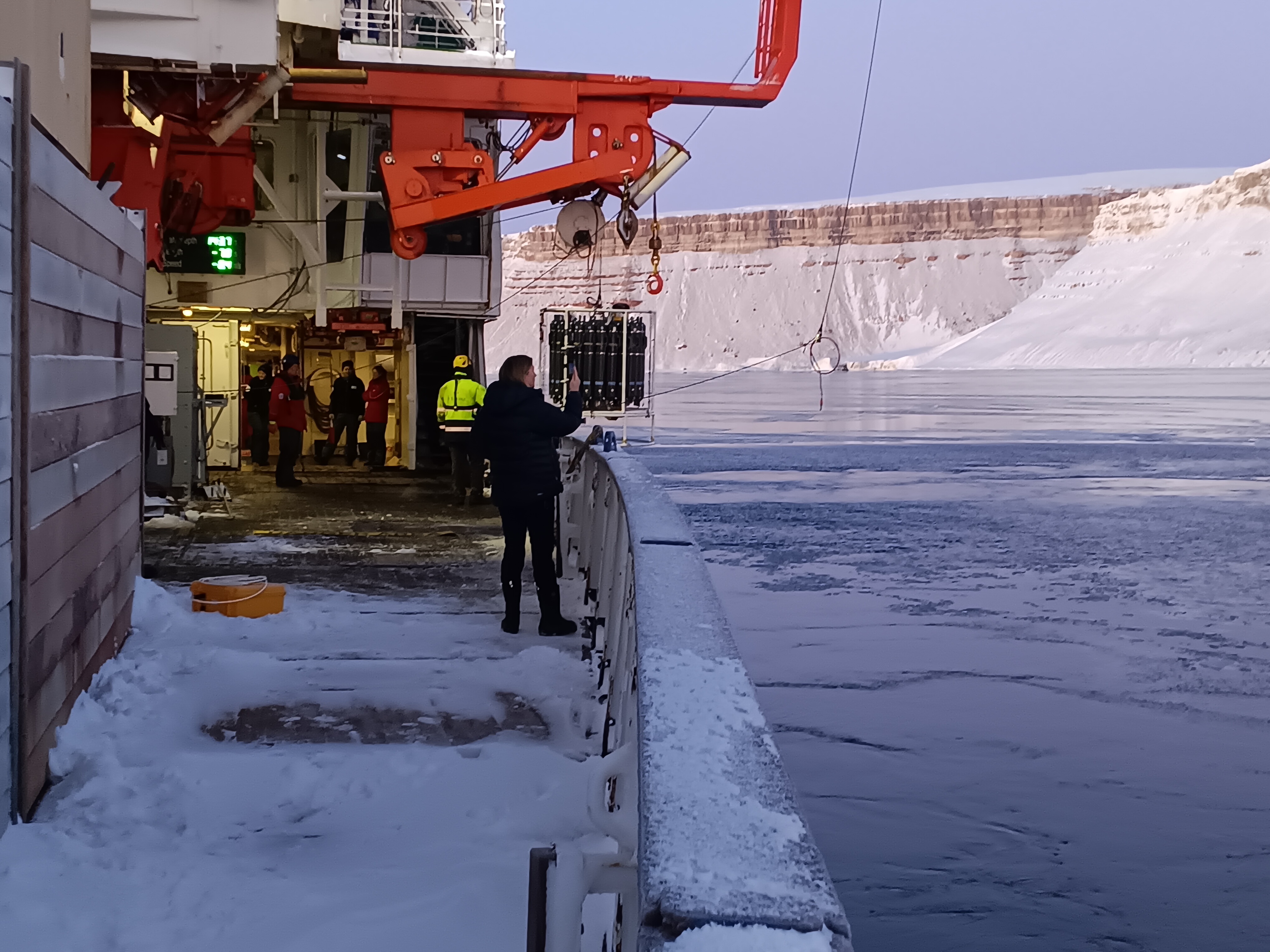
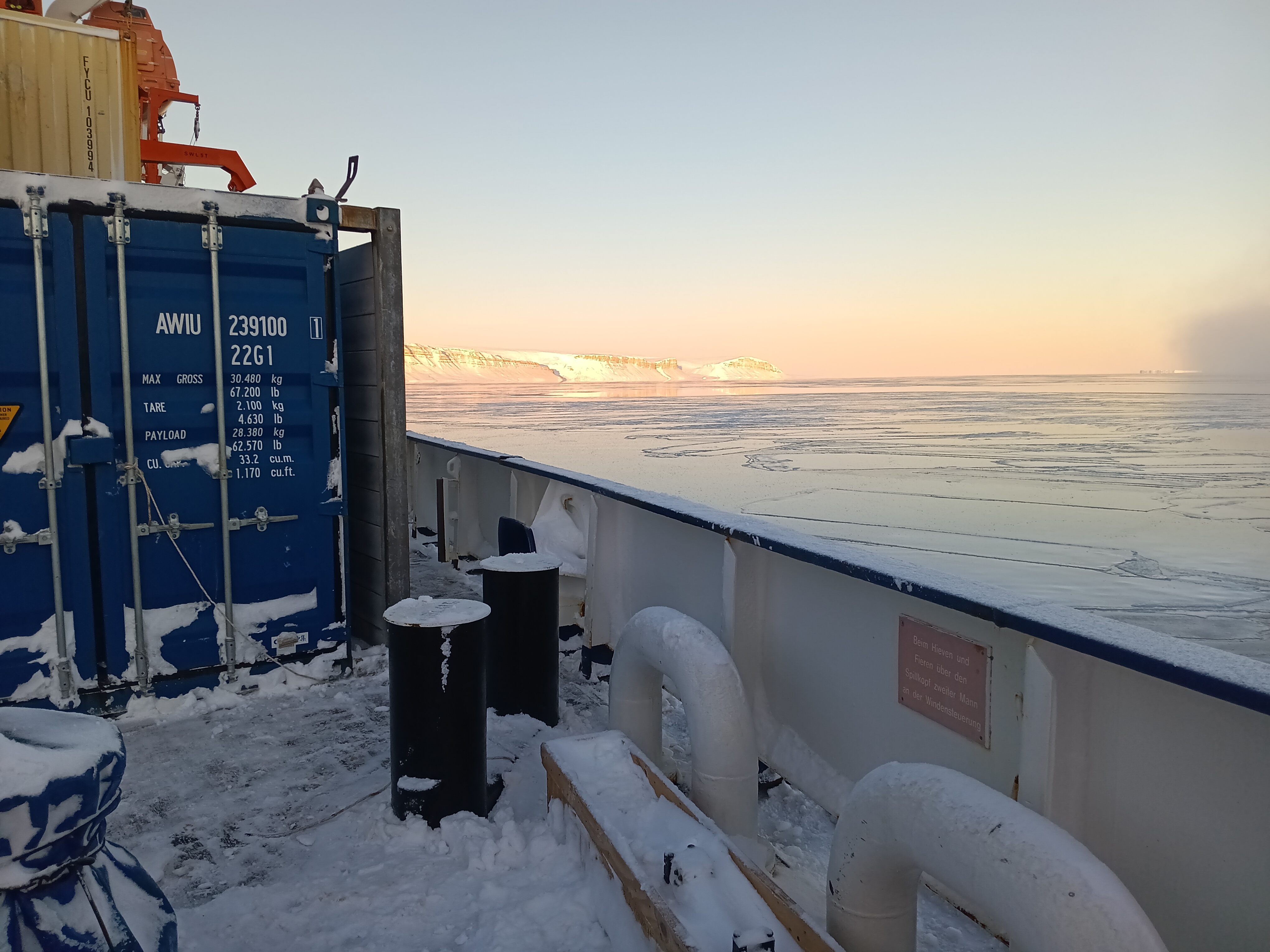
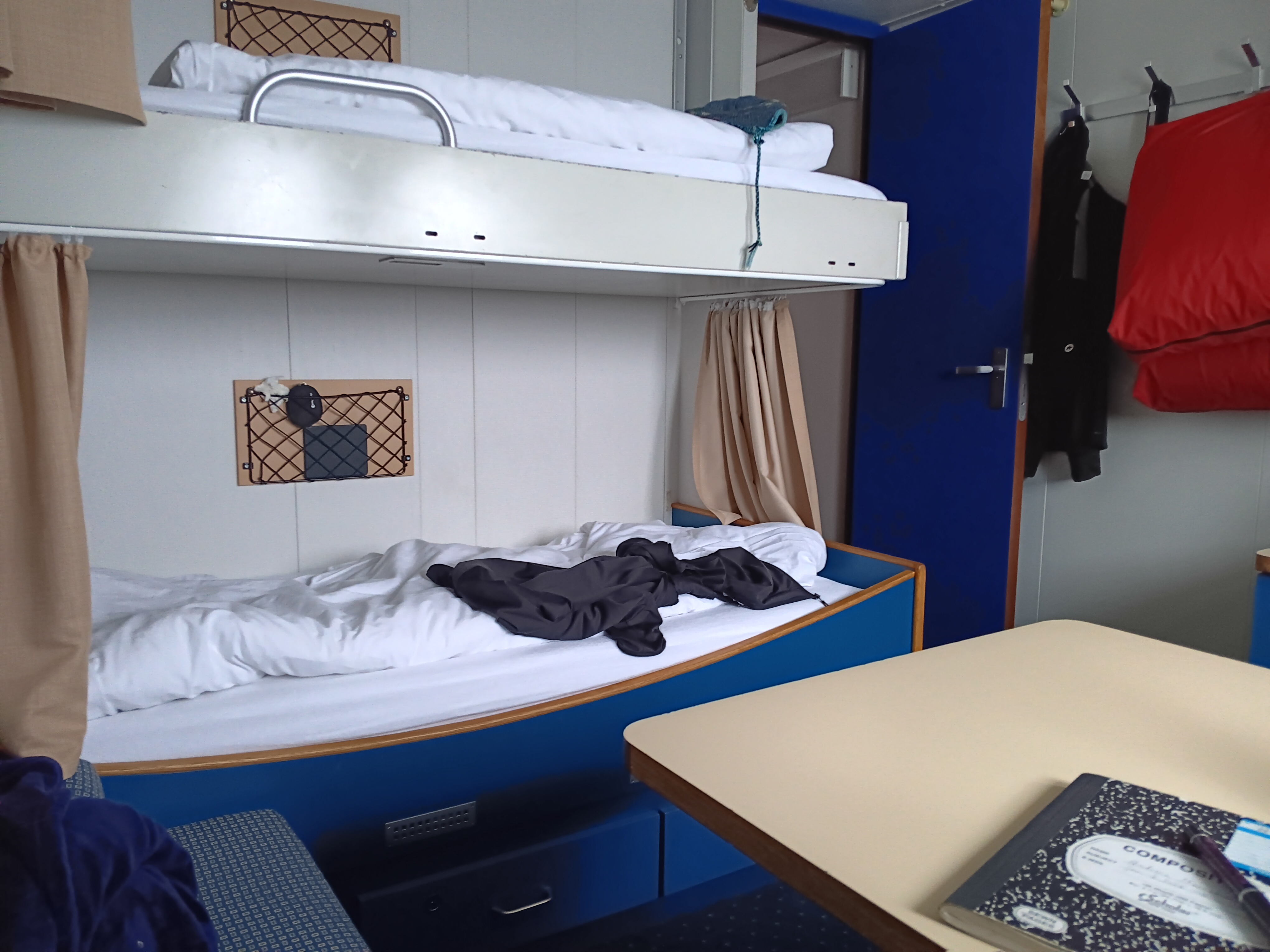
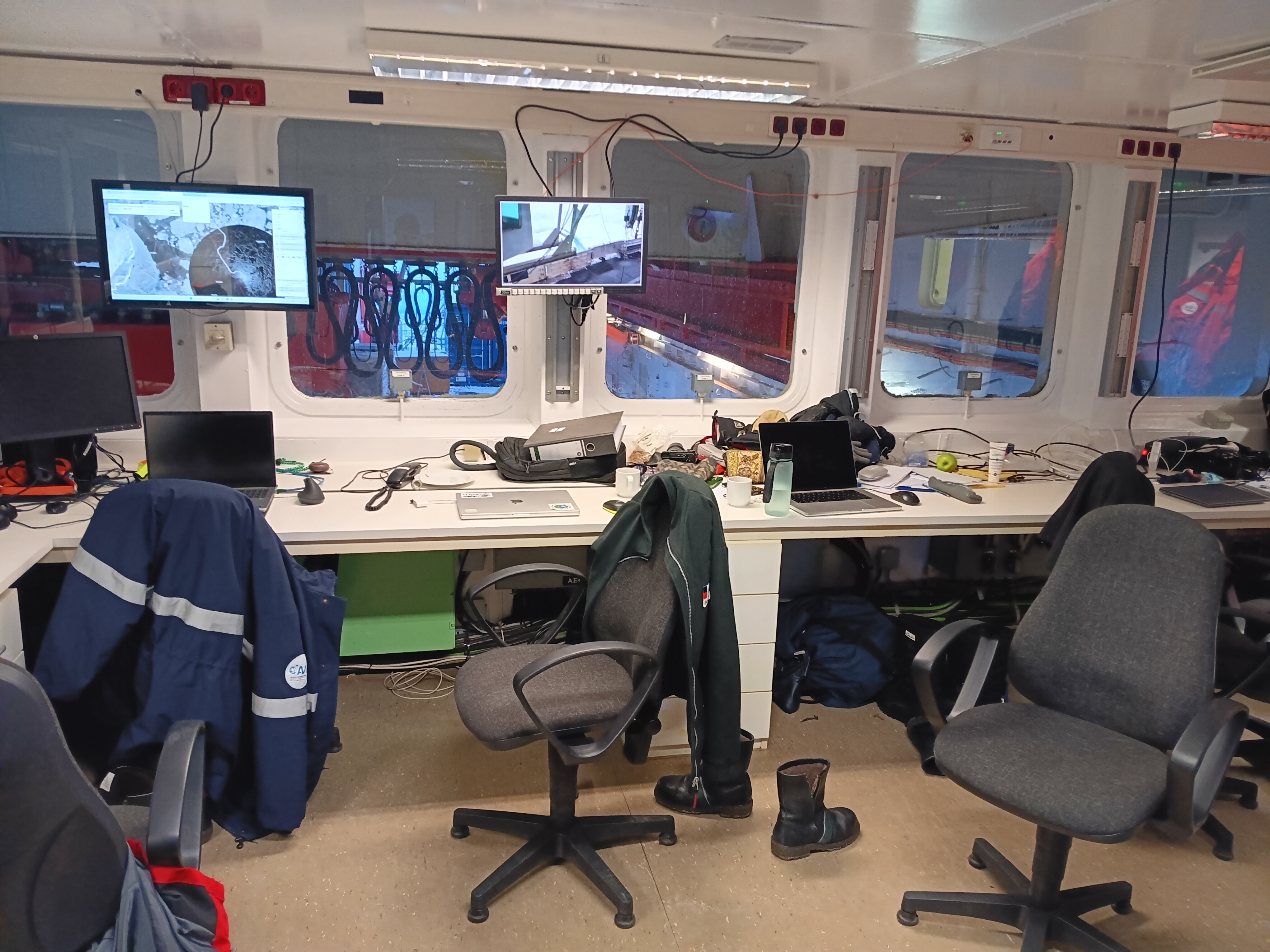
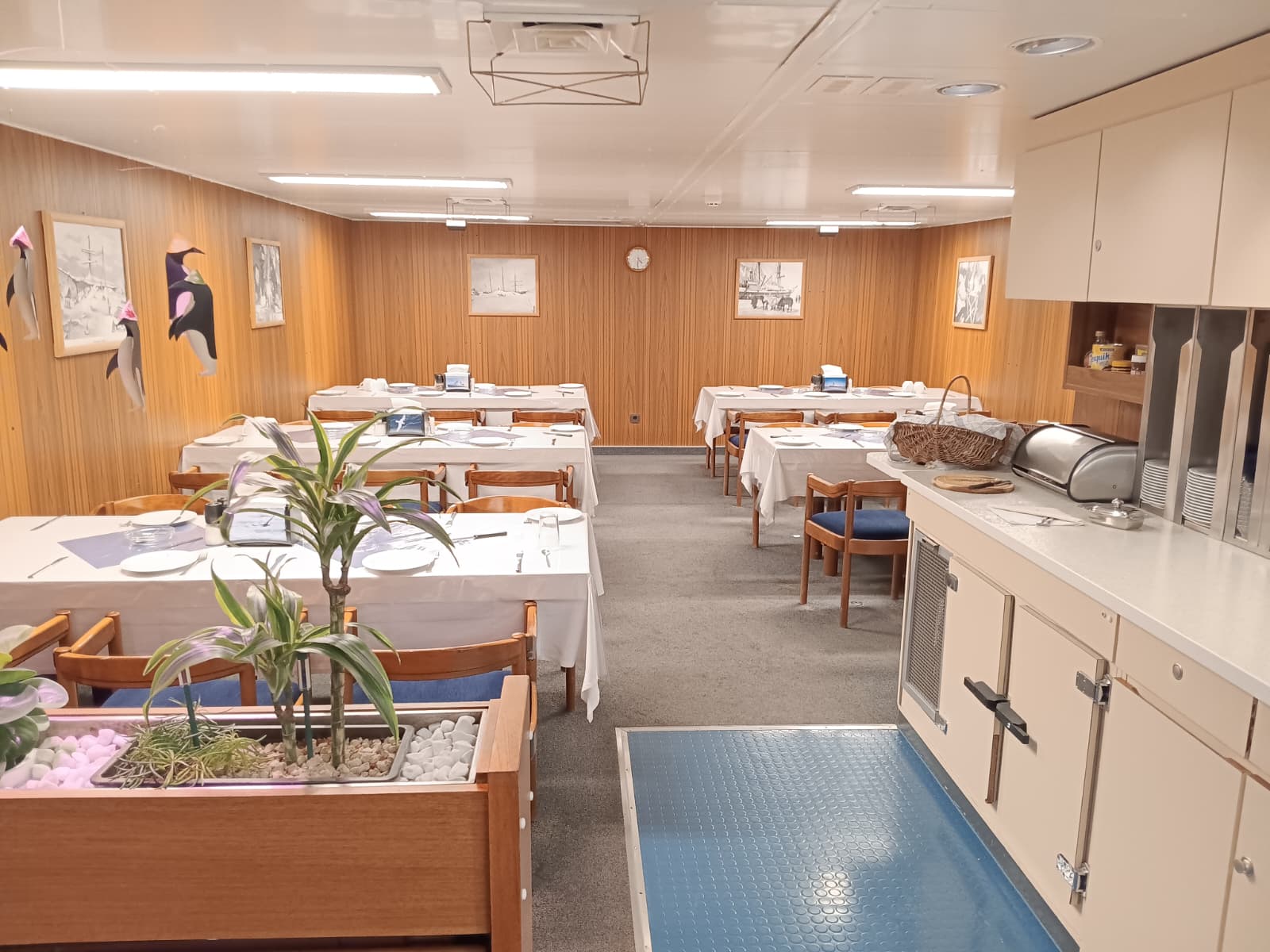
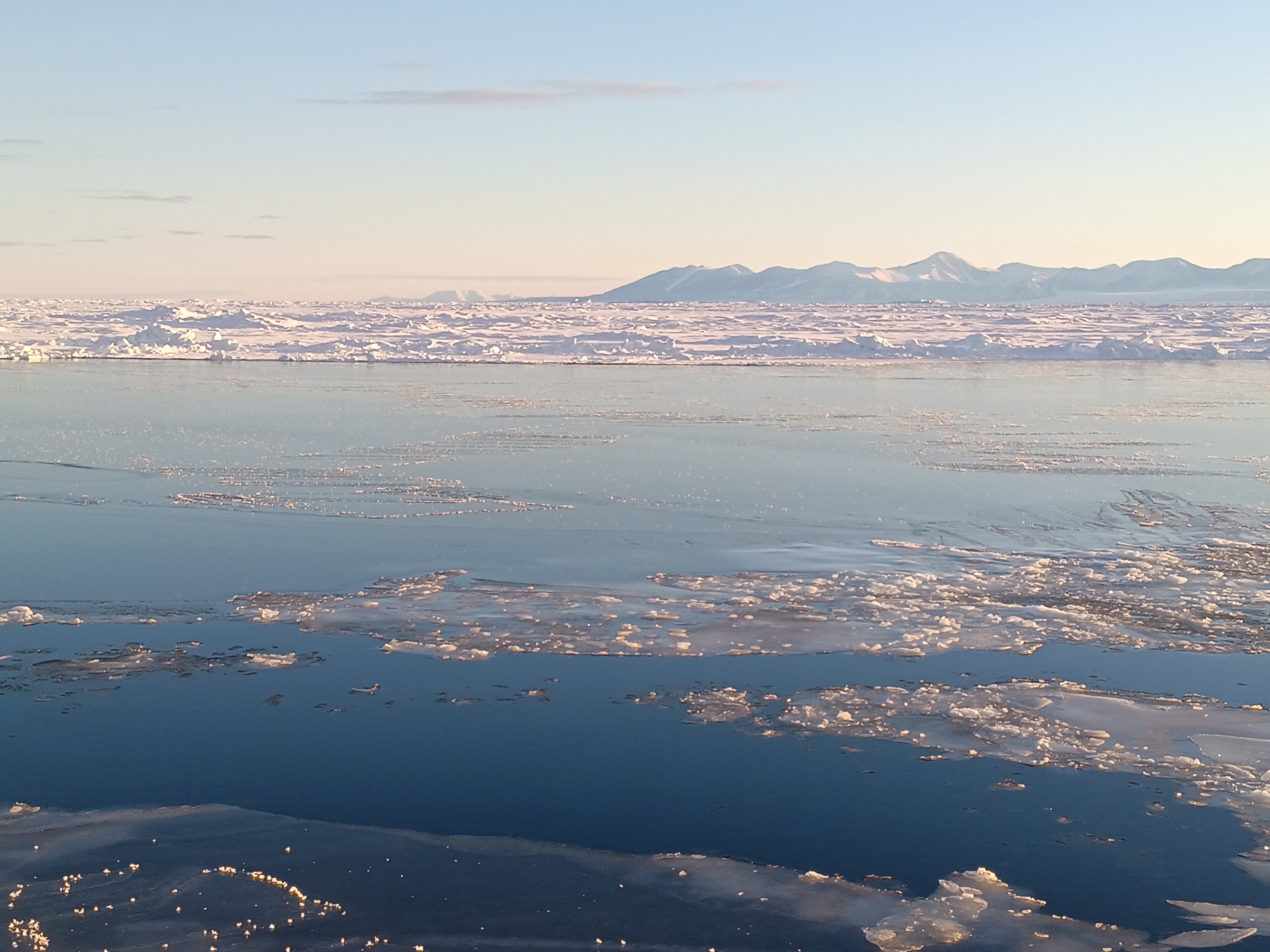
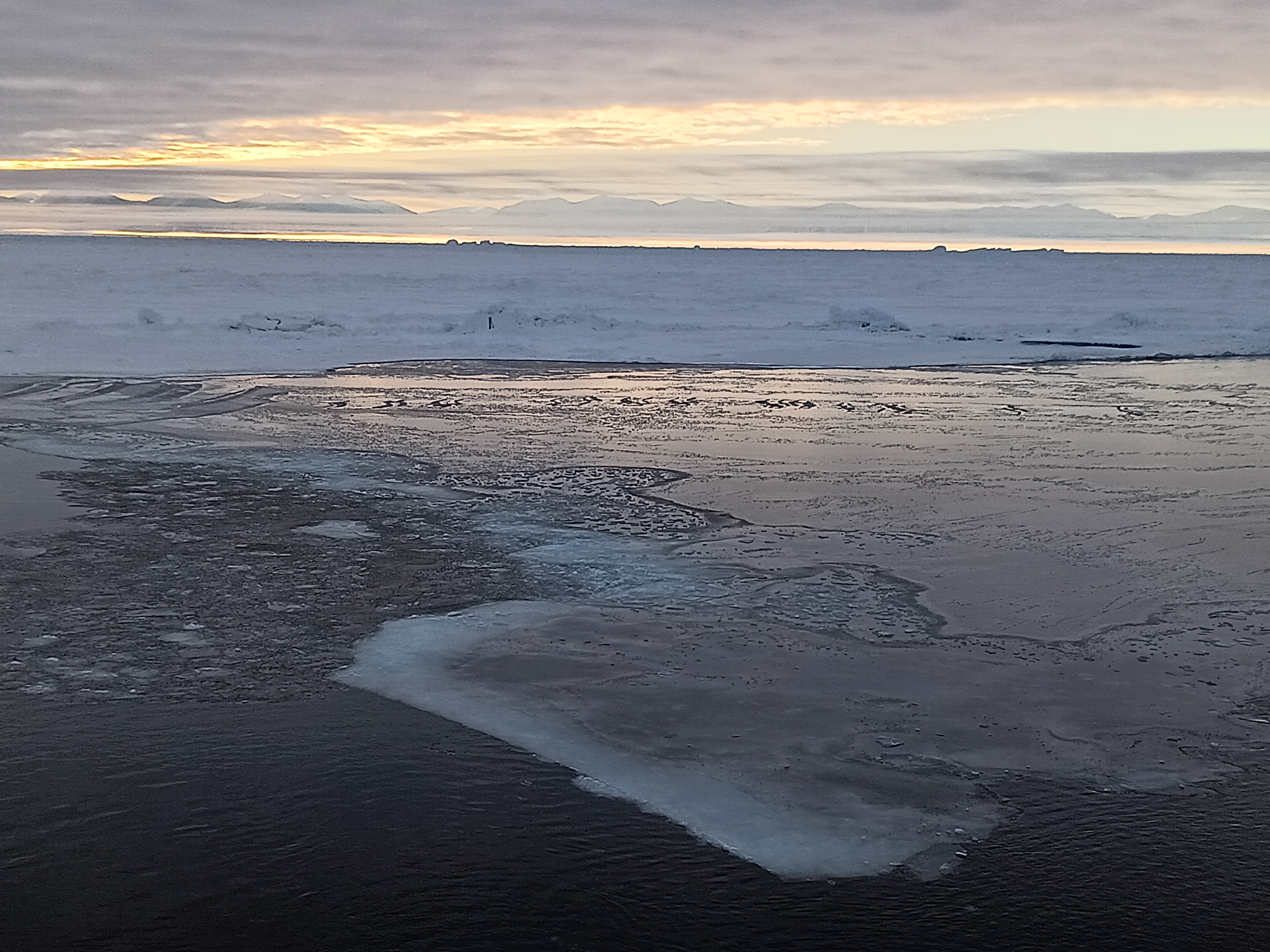
Now how does Greenland look from the ship? Well, there is always ice and it is always cold. The coldest days we had near the coast when the skies were clear. The coldest day we had -20 C, that is -4 F for my American friends, but most of the time we had clouds and storms with temperatures warmer at -12 C (10 F) with clouds and little visibility. It snowed alot and shoveling the ship’s deck was an almost daily chore. A relaxing “cruise” it was not. We worked sensors systems in the windy cold outside during all hours of the day and night. Pictures like the above were almost always taken during my 8 hours “off” that for me was from 08:00 to 16:00, because my shift was from 16:00 to 24:00. After a phone call to my wife after midnight and a peppermint tea to warm up, I slept from 01:00 to breakfast at 07:30. As almost all scientists aboard I shared my cabin with others, so there is not too much privacy. The photos below show my bunk bed (I slept atop), shared work spaces, and the rarely empty dining room. We often ate in shifts, too, because not all 50 people would fit the dining room in one sitting. So we often had 2 sittings. A comfortable living room was next door for desert, tea, coffee, games, and conversations.

Now what about science, you may ask. Here we made a major discovery, I felt. A mathematician used her craft to predict a coastal current to the north of Greenland that, I admit, made no sense to me as it contradicted 30+ years of training and intuition in which direction such currents would flow, that is, the coast should be on the right hand side looking in the direction of the flow. The curious thing was that to the north of Greenland it should go in the opposite direction, that is, with the coast on the left. In Claudia’s numerical computer model run for months on super computers, this current-in-the-wrong-direction was a both prominent and persistent feature. I always discarded it as an unrealistic feature of some computer code run amok. And yet, when we actually reach the coast of northern Greenland and I measure ocean currents from a ship sensor that runs 24/7 to tell me current speed and direction, here this weired or “wrong” current was. It screamed at me from the screen the moment I plotted the data and shared it with Claudia who was aboard with the comment: “Your model is right and my intuition was wrong. Your current is at the same location, the same speed, and in the same direction as your model said it would.” Furthermore, a distinct and separate way to estimate ocean currents from ocean temperature and salinity observations showed the exact same thing. That’s now two good complementary confirmation of the current that nobody has ever seen or measured … until now that we aboard Polarstern did so on Sept.-23, 2025:

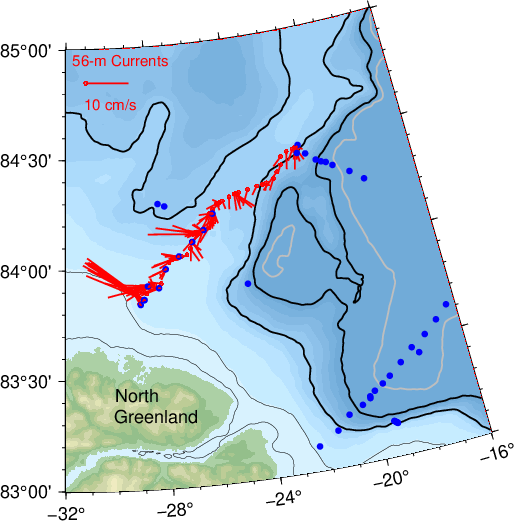
The map on the left shows our study area to the north of North Greenland. On it in red are sticks whose length indicate the speed or strength of the ocean current (at 56 meters below the surface) while its orientation gives the direction of the current. The light blue is shallow and dark blue is deep water as before. The current is sluggish offshore with a weak component to the south. In contrast, closest to the coast of North Greenland we find long sticks that point to towards the left (west by north-west). This is Claudia’s Coastal Current.

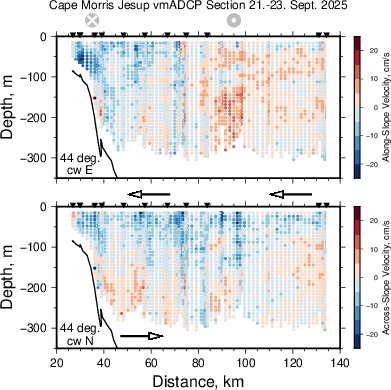
The two plots on the left provide more detail, as it shows how the current varies with depth and distance from the coast along a line from the coast towards offshore. The bottom of the shallow ocean is the black line from 100-m to 350-m meter at a distance of 20-40 km from the coast. The top-left panel shows the current (in colors) across the section where blue colors indicate currents flow into the page while red colors indicate currents that flow out of the page towards us viewing it with the coast on the left. The bottom-left panel shows the velocity component along the section with a flow that is mostly onshore near the surface.

There is so much more to this story as well as additional stories, notice the red dots in the top-left panel between 150-m and 300-m depth that indicate a strong flow to the south and east, but I save this for later. I also do not wish to tell you about the two ocean sensors we quickly deployed at this location to stay there until we, perhaps, recover them with new data next year or the year there after. I do wish to close this essay, however, with the view of Greenland that we had where we discovered Claudia’s coastal current. Science is fun, exciting, and always surprises.

Faith, Freedom, and War: German Summer School in Ukraine
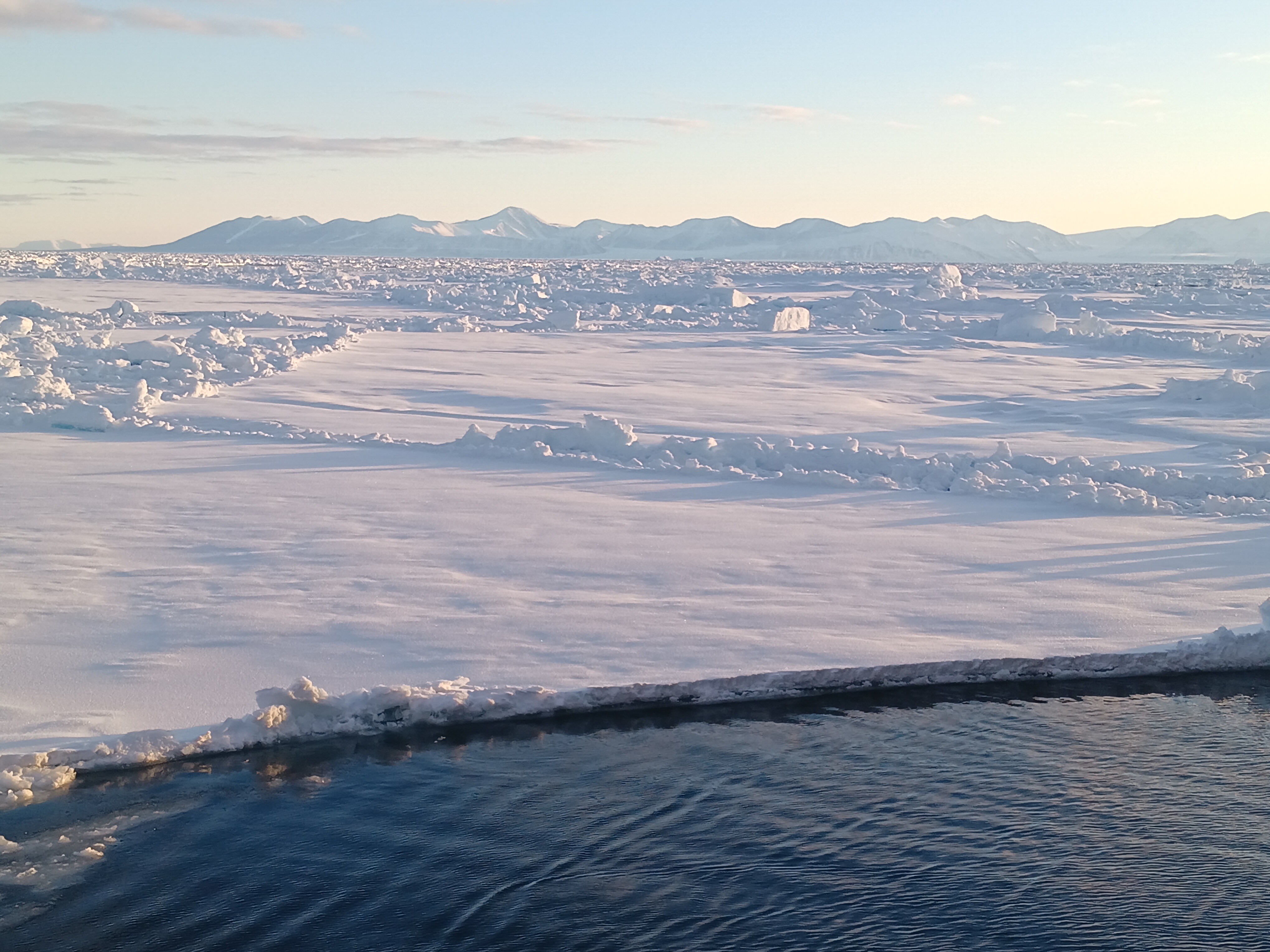
The Ukrainian Catholic University in Lviv invited me to teach at their Summer Language School. Until last week I worked with ~50 Ukrainian students from about 10 in the morning to 5 in the evening monday through saturday. We met daily in classrooms, on the lawn outside, and in pubs over food and beer. The main purpose of the Summer School for the 17-21 year old students was to learn German as their second, third, or fourth foreign language. Their Ukrainian teachers knew every rule of German grammar, spoke perfect German, and half of them had PhDs in German literature, linguistics, education, and/or language theory.

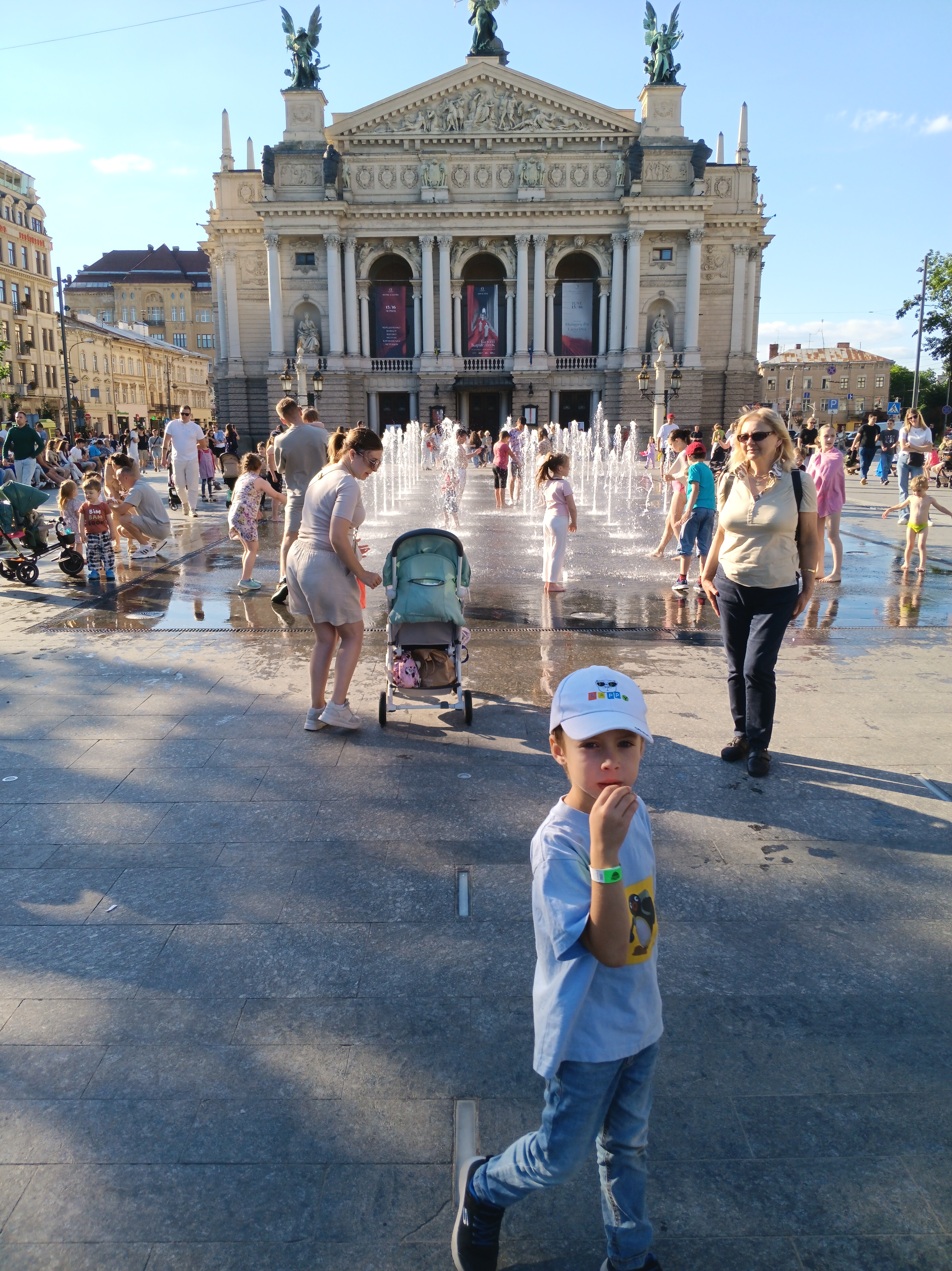
Students and teachers alike love their country, their faith, and their freedom deeply. All hate the war that Russia wages on them personally: Every day Russia tries to kill them by drones and missiles, tries to erase their history, tries to pillage their resources, and tries to exterminate their language, culture, and freedom. Russia’s war is present in Ukraine at every location for every person at all times. Nevertheless, I went to open-air concerts, bars, restaurants, and churches filled with joyous young and old people with and without small children. This very public life serves as a defiant and powerful act of resistance to Russia’s war as does vibrant street art and music.
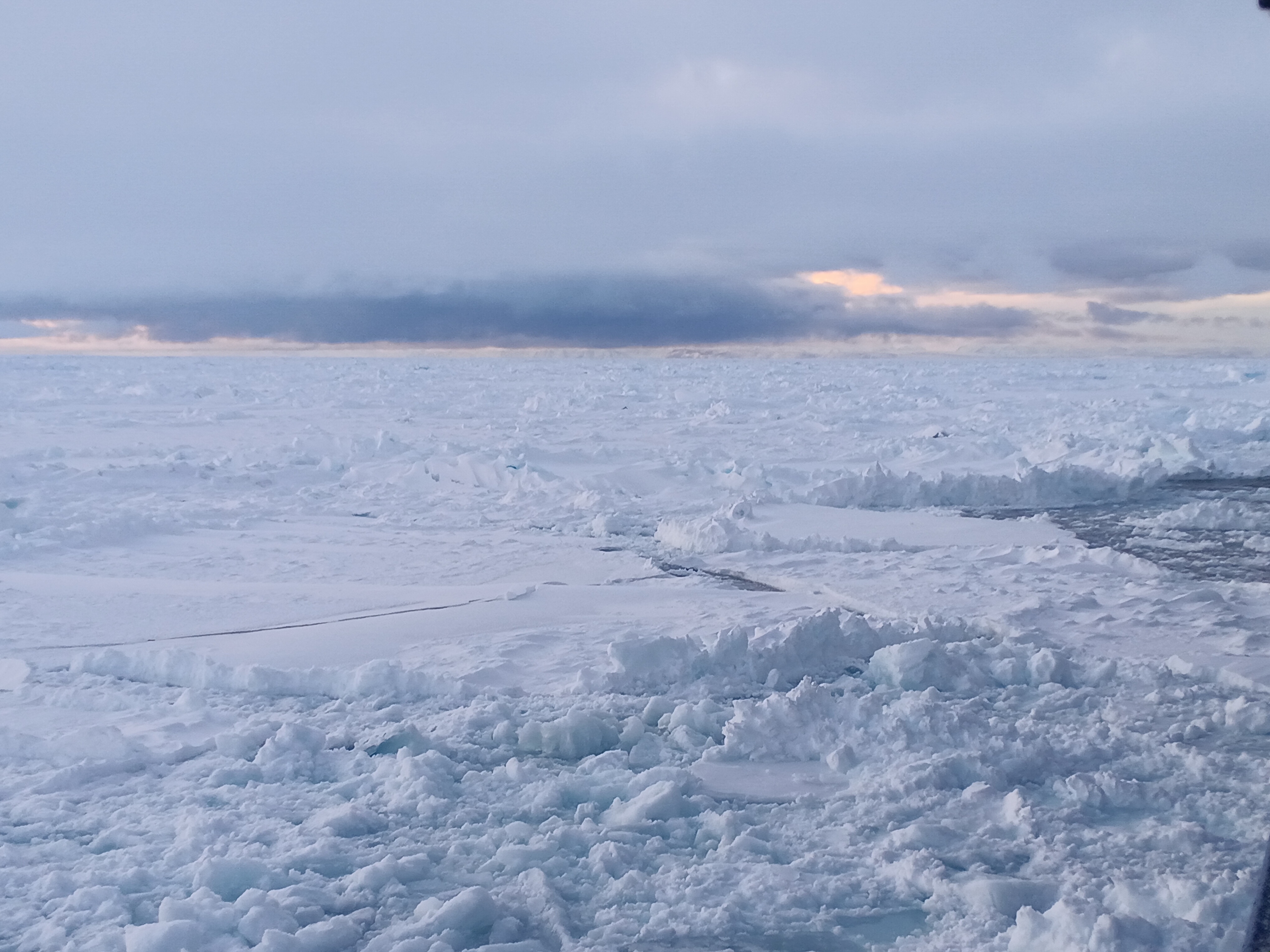
The people of Ukraine need our weapons to protect their freedom to be human and to be free from the violence, terror, and oppression imposed by Russia on them. Never have I seen a people believing in God as strongly as the Ukrainian students and teachers whom I met last 3 weeks. Furthermore, Lviv centers many overlapping faiths with churches of the Greek Catholic, Roman Catholic, Armenian Catholic, Ukrainian Orthodox, Russian Orthodox, and even a small Jewish community. Furthermore, I met both atheist and agnostic students studying at the Ukrainian Catholic University. This rich and diverse tapestry of believes exists in overlapping circles of ancient history, song, prayers, and common purpose. All are united and opposed to Russia’s terror of random death by drone or missile. People are tired, yes, tired and exhaused by 3.5 years of war, but people are united for the noble purpose to be free, to be at peace with their neighbors, and to be part of a liberal and democratic Europe. Russia responded to these desires with war, because Russia perceives a free, creative, and productive Ukraine as a threat to its own sclerotic, decadent, and corrupt society.

Unlike Russia, Ukraine values individual life and liberty, but Russia has 4 soldiers for every one Ukraine has. How can I best help my Ukrainian friends in their just defence to protect their freedom and to be part of a peaceful Europe? They need air defence radars and missile systems, they need artillery shells and cannons, they need tanks, helicopters, and fighter jets, they need drones and electronic jamming gear. I struggle with this question, write and call my U.S. senators and Congresswoman in Delaware to support Ukraine, and talk to friends and family about my travels to Ukraine, but it all seems puny and I am frustrated and impatient. In those moments I recall the wise words passed on to me 2 weeks ago by an older man of Irish-Catholic faith:

Act like the world depends on you,
but pray it depends on God.

Ignatius of Antioch (~100 AD)
Ignatius of Antioch

Walking Lviv, Ukraine: Art, Life, War, and History

An air raid alarm interupted my first night’s sleep near Rynok Square in Lviv, Ukraine at 2:30 am on June-12, 2024 after 22 hours on a train the day prior. Sirens outside, mobile loud-speakers on the streets, and my cell phone all blared the message “Attention. Air Raid Alert. Proceed to the nearest shelter. Don’t be careless. Your overconfidence is your weakness.” Unsure on what to do, I listened, if there was any commotion outside my AirBnB in the stairways of the 3-story appartment building with residents moving whom I could follow. As there was no such noise, I did nothing, and quickly fell back asleep. At 5 am I woke again, got up to check e-mail when yet another such alarm started. This time I decided to go outside to see what the city does during an air-raid alarm at 6 am. All I saw were a few men my age cleaning the sidewalks and joggers passing me in a forested park:

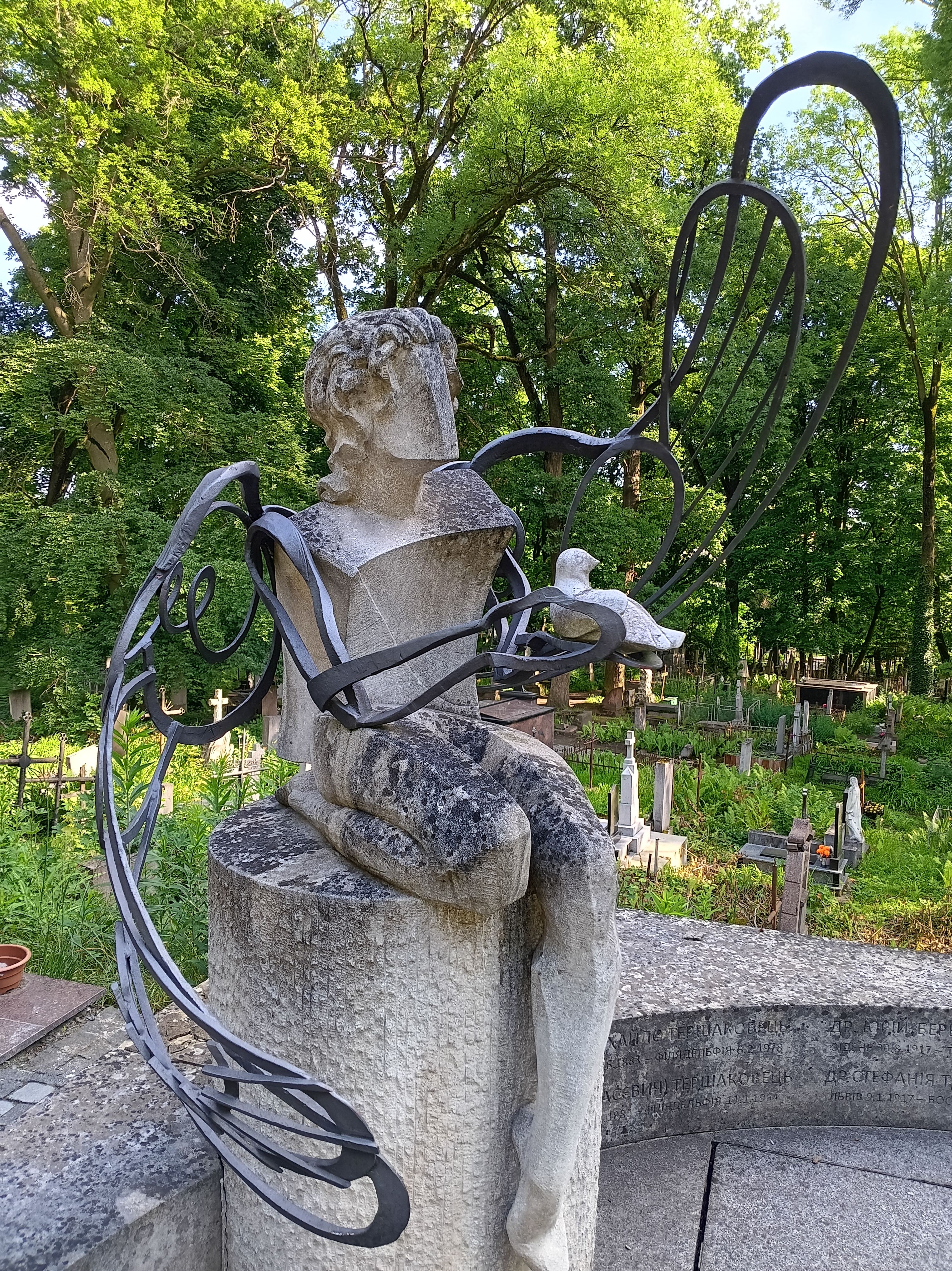
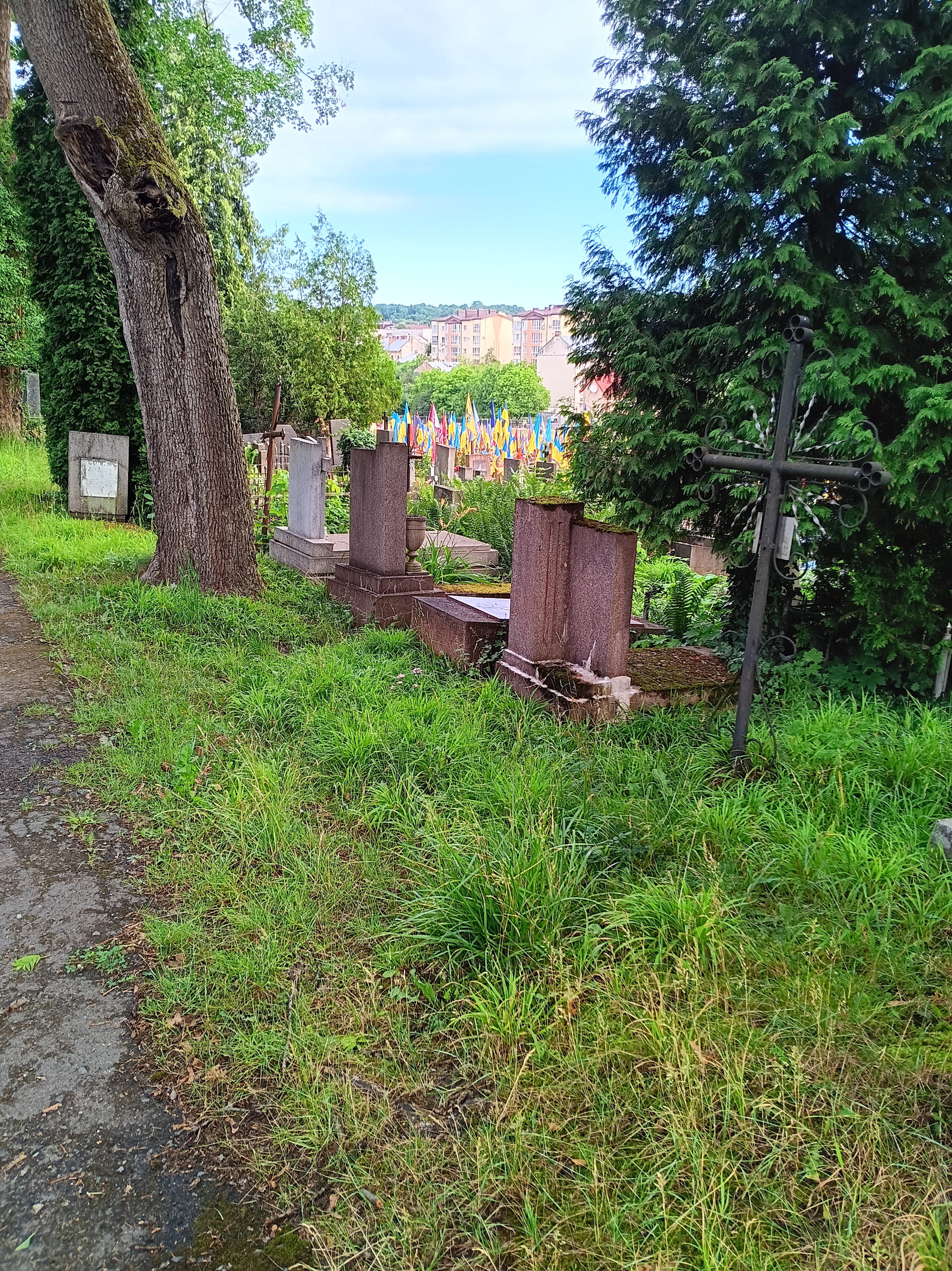
My plan for the day was to find the 250-year old Lychakiv Cemetery that was established 1787 when the Habsburg Empire of Austria-Hungary controlled Lviv and Galicia as a result of the the First Partition of Poland in 1772. The cemetery is a large wooded park in a hilly area near the Botanical Gardens to the East of the city. Today it is a “State History and Culture Museeum” of Ukraine that Polish and Ukrainian volunteers have restored, both lovingly and at times illegally, for the last 50 years. Prominent Lviv citizens of culture, science, and politics as well as soldiers and victims of war and oppression both past and present are buried here. Meandering paths lead through lush vegetation with old trees and artful sculptures, grave stones, and icons.

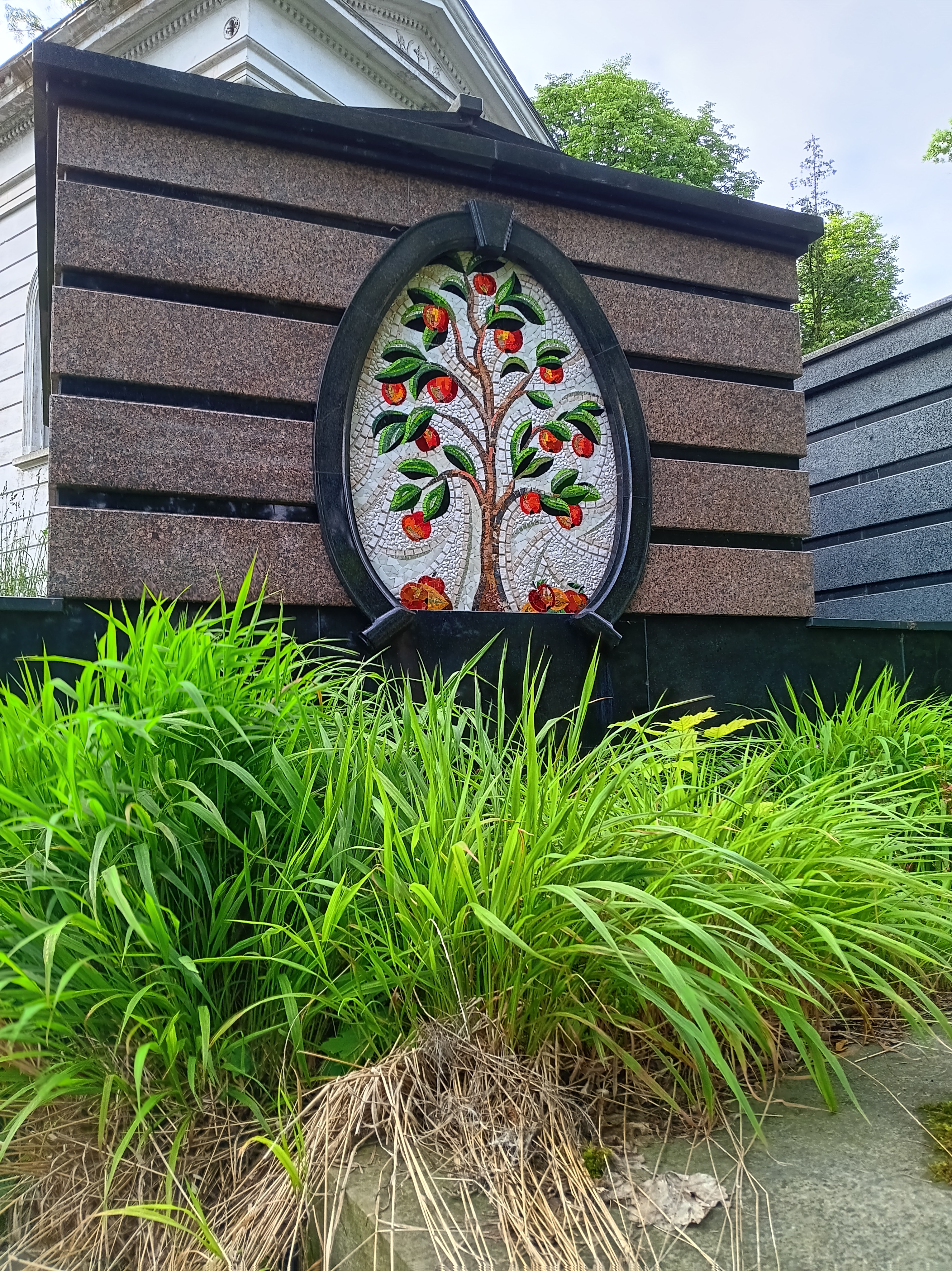
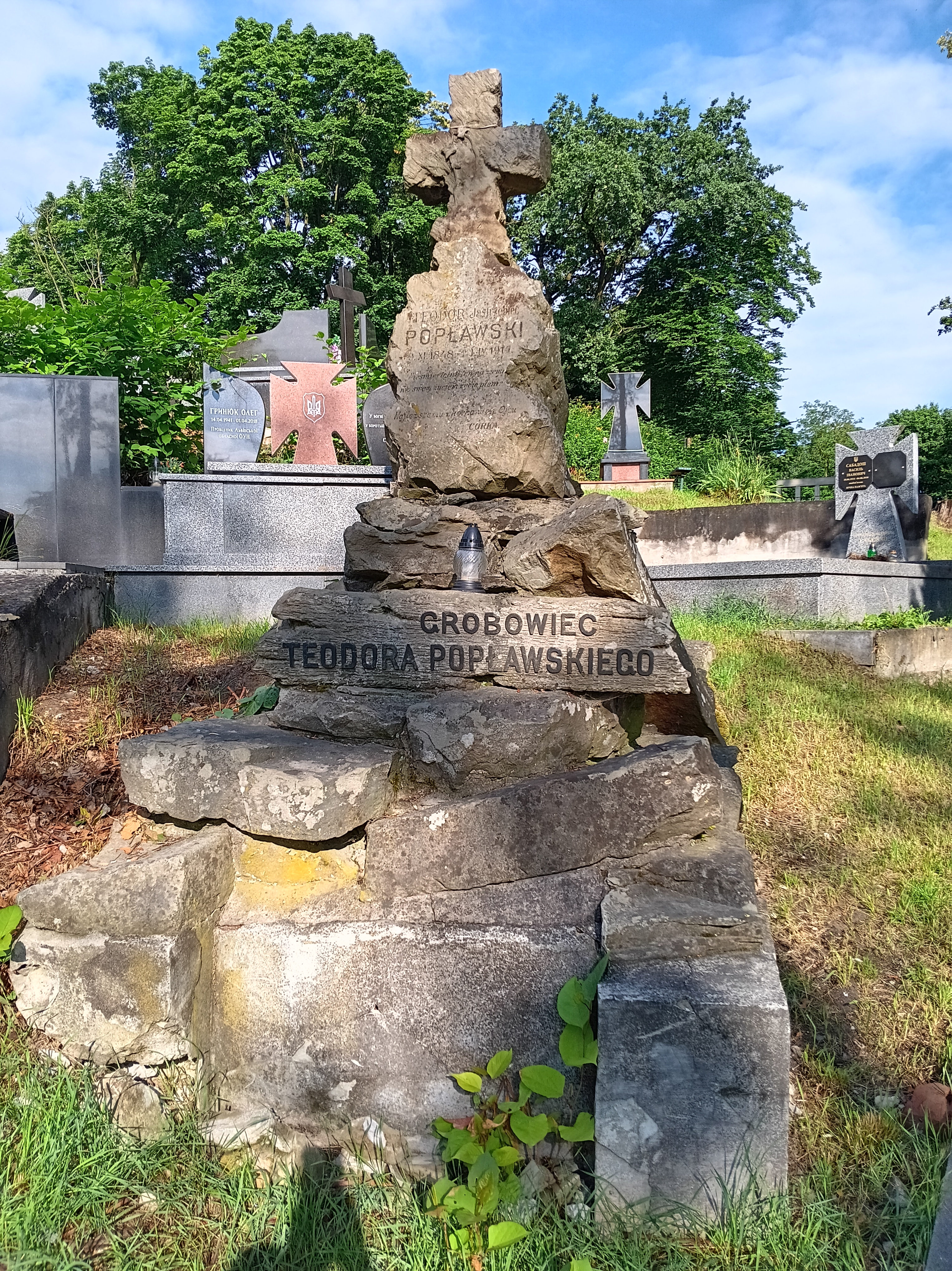
I spent well over 3 hours wandering along wide and narrow pathways up and down the hillsides to marvel at artful displays to remember those who walked the streets of Lviv the last 250 years. The style of letters, mosaics, sculptures, and vegitation changed from section to section all added over the centuries when different countries ruled Lviv from the Austria-Hungarian empire (1792-1918), the newly establish Poland (1918-39), the Soviet Union (1939-41), Nazi Germany (1941-44), the Soviet Union (1944-91) until it finally became part of independent Ukraine in 1991.

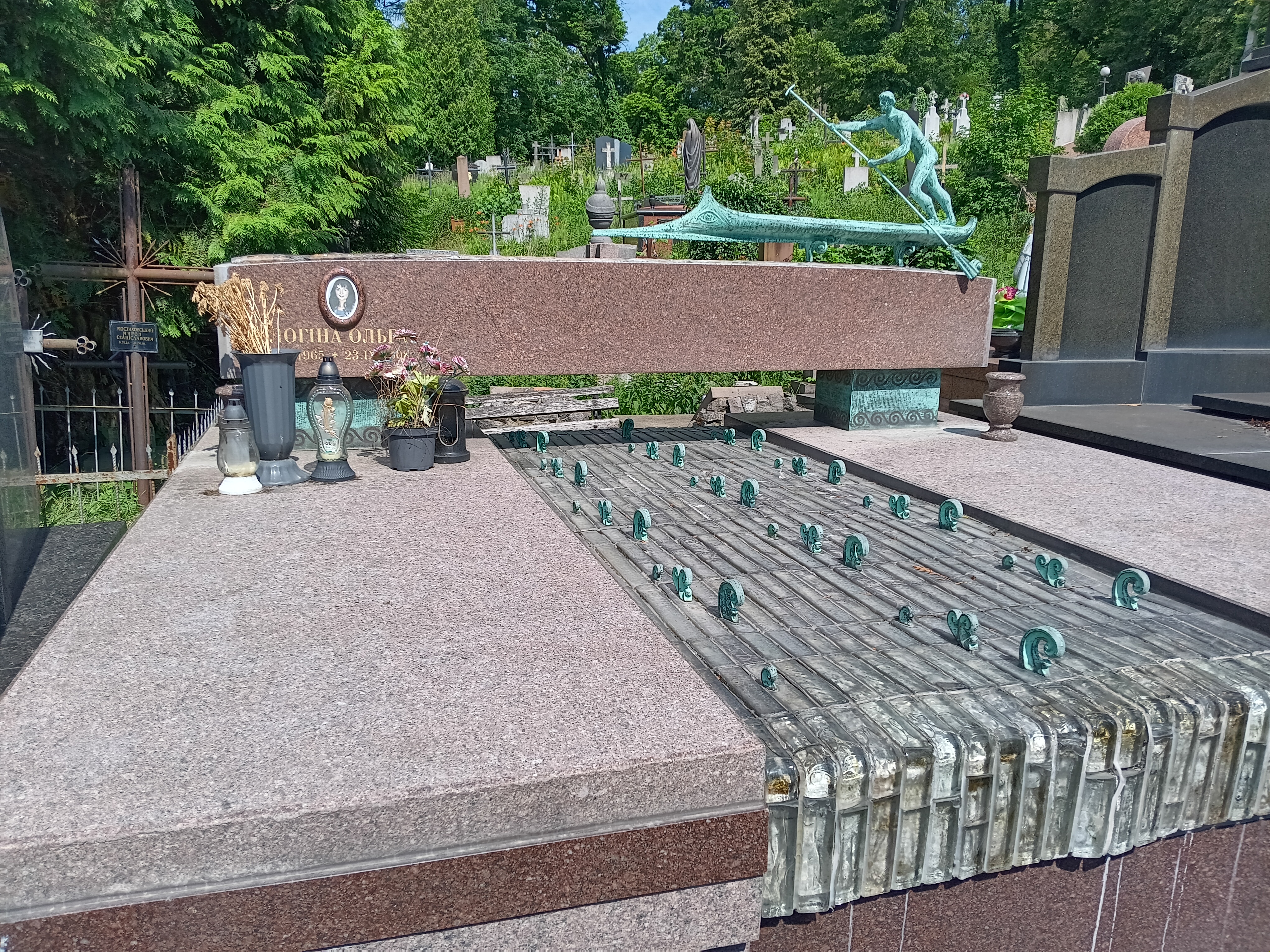
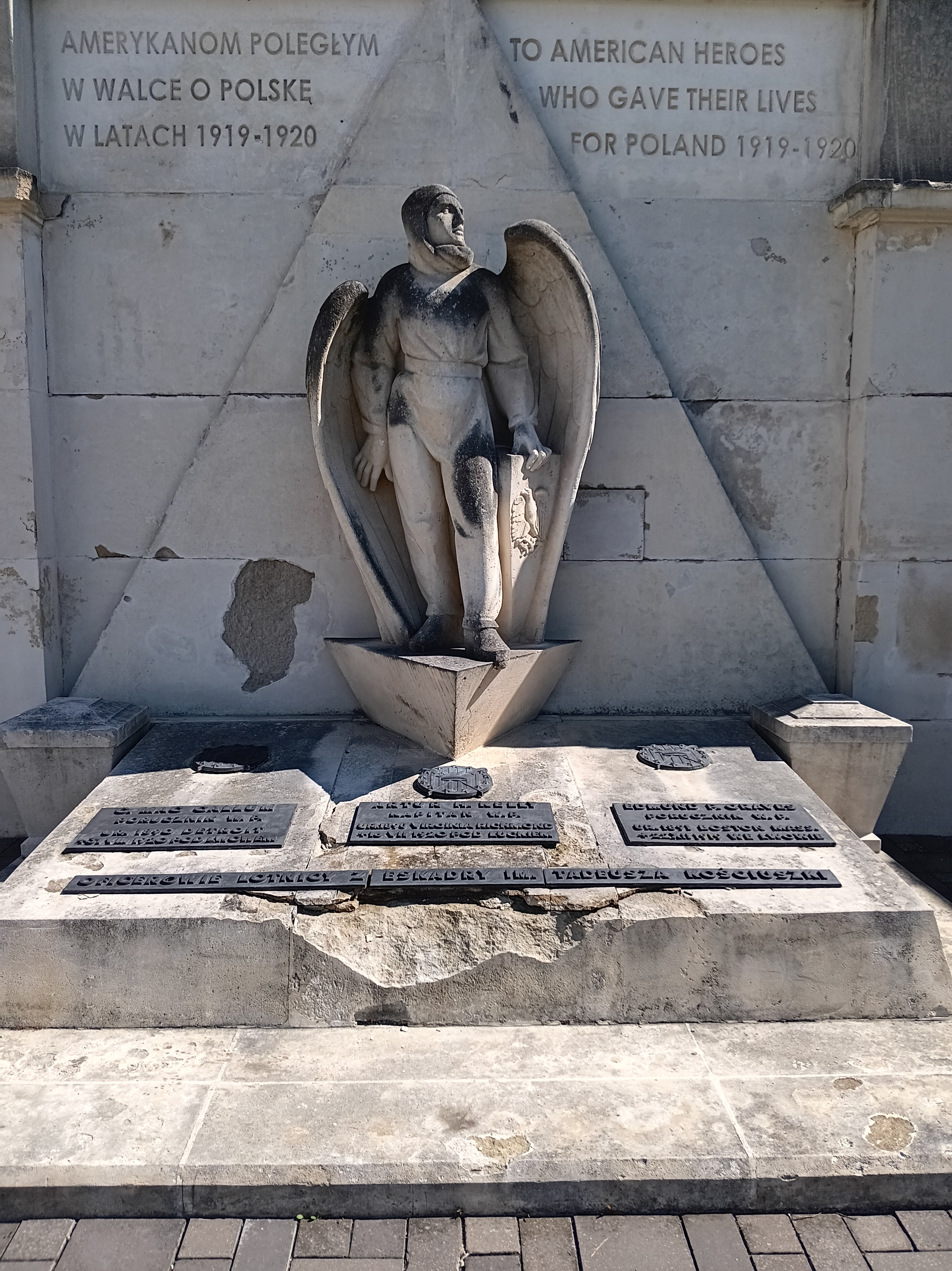
My favorite memorial is that of a person on a boat crossing a wavy river. The copper-colored boat even as an eye at its forward head just above the water line. The river appears to come down from the wooded hill behind it, but the boat floats above the the water bridging the river perhaps indicating another “spiritual” dimension. It all merges in a harmoneous way in multiple directions indicating both time and space. The river falls down at the edge, however, the river also falls farther towards graves of soldiers from both past (1918-19) and present (2014-present) wars. Three Americans aviators such as Edmund Pike Graves are burried here also. More than 100 years ago they supported Polish troops flying early bi-planes against Ukrainian nationalists.

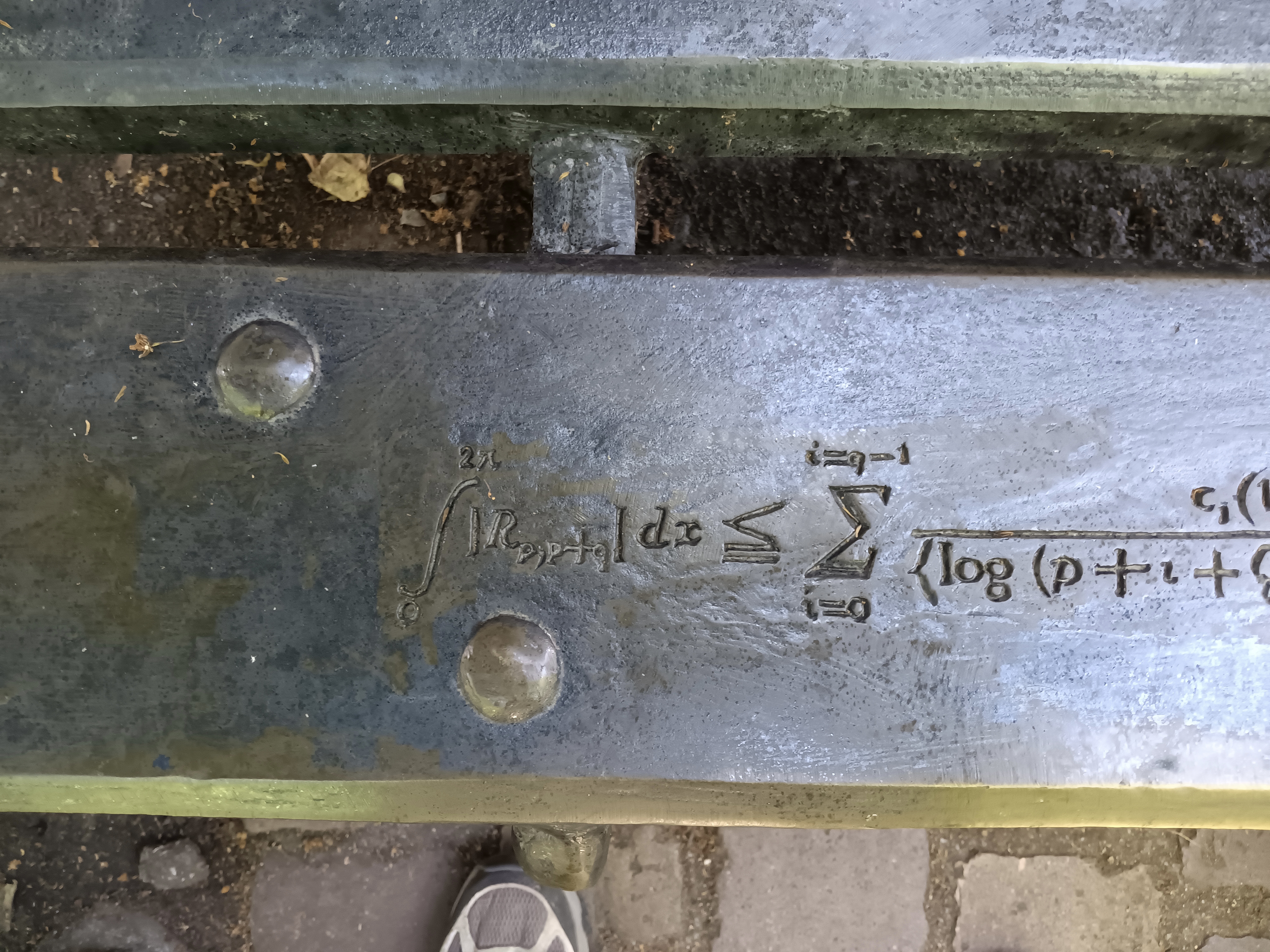
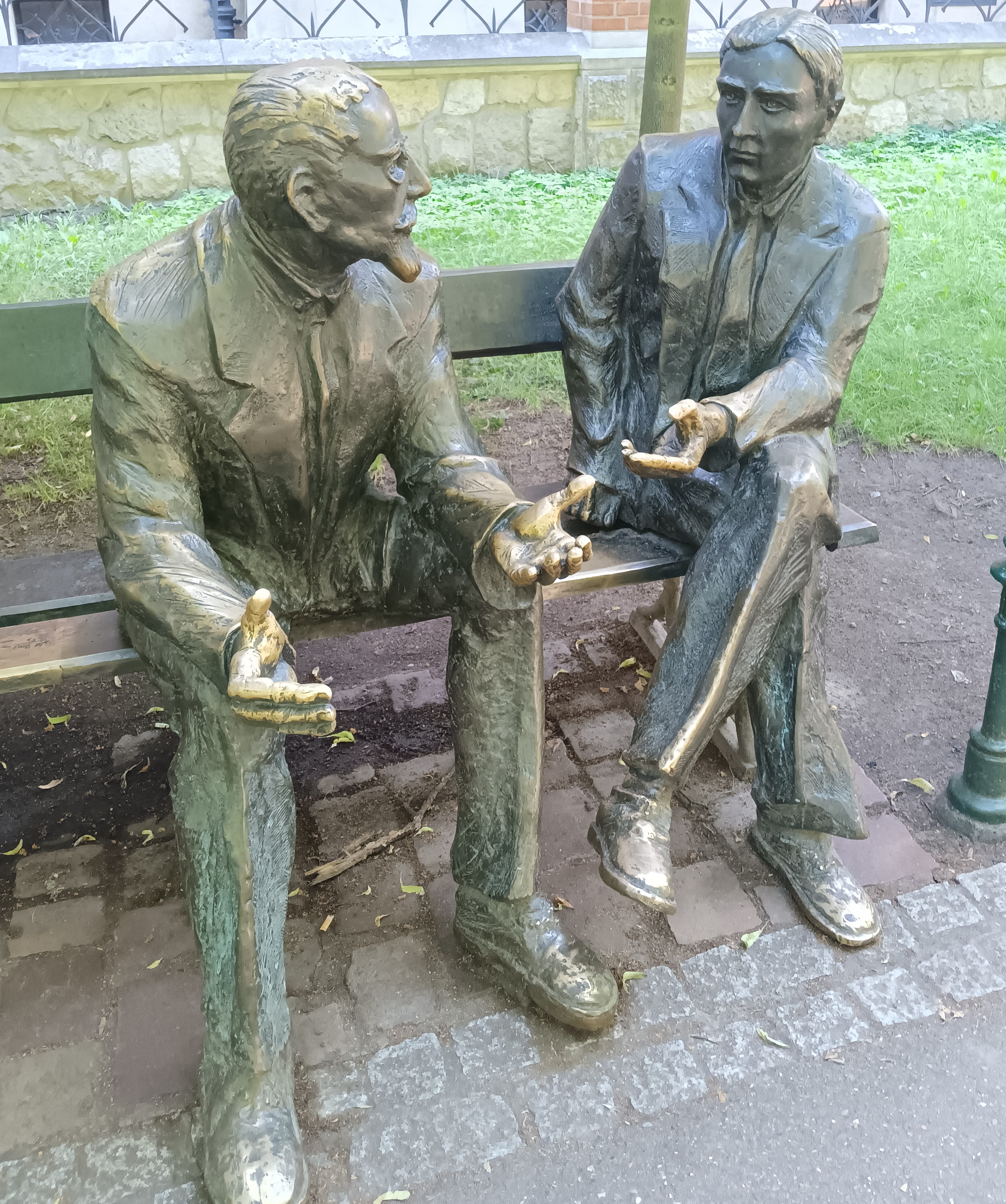
Among the many graves is that of the Polish mathematician Stefan Banach (1892-1945) who did pioneering work in the 1930ies when he was teaching at Lviv University. His fundamental work on vector spaces (“Functional Analysis” in English or “Funktionen Theorie” in German) applies to how I analyze climate data from the waters, ice, and glaciers around Greenland. Learning about Banach and the Lwow School of Mathematics, I discovered that the scientists living and working in Lwow/Lviv until 1939 also contributed to the Manhattan Project and the Nuclear Age. On my subsequent visit to Krakow in Poland 200 miles to the West, I found a bench in a park with a sculpture of Dr. Banach and some of his work:

A young Dr. Banach sits on the right in a conversation during his school years in Krakow. He left to teach mathematics in Lviv in 1918 where he lived until lung cancer killed him at age 53 in 1945. He is burried near the entrance of the cementary.

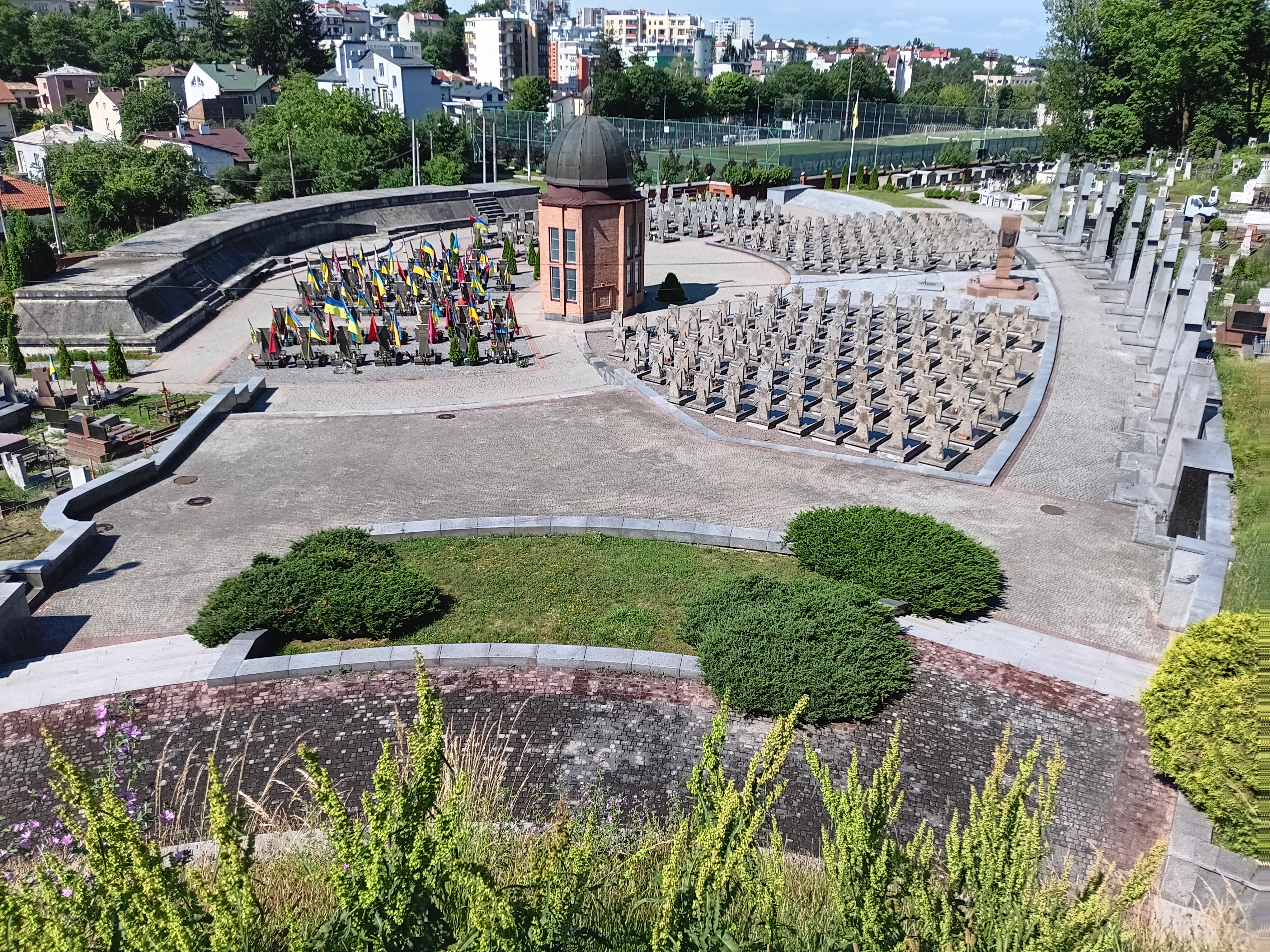
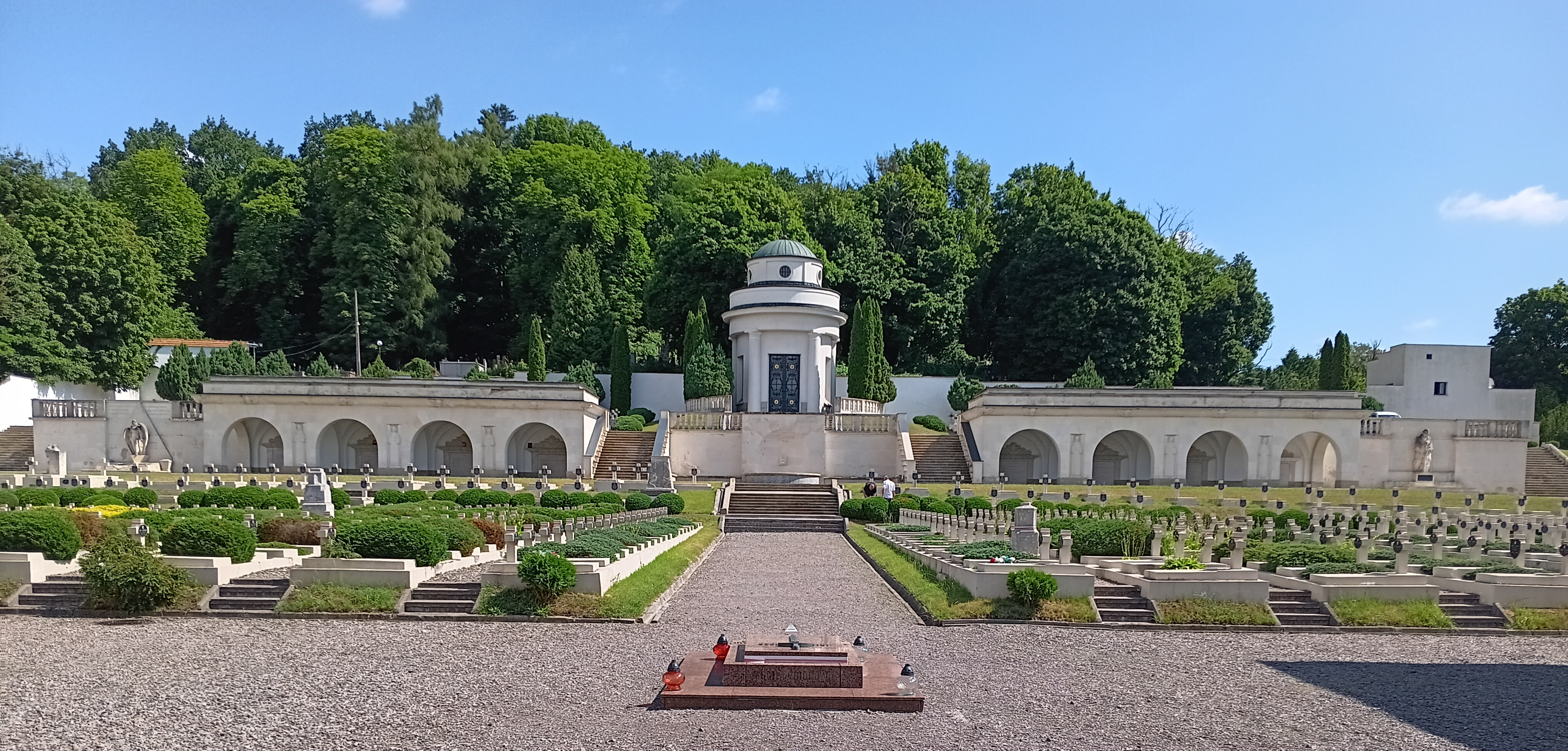
Figure: Polish Military Cemetery 1918-20 (“Eaglets Cemetery”) in Lviv, Ukraine of the 1918-20 war between Poland and Ukrainian Army of Galicia (bottom) adjacent to the memorial to the Ukrainian Galician Army (top left). Three U.S. American aviators are burried here also (top right).

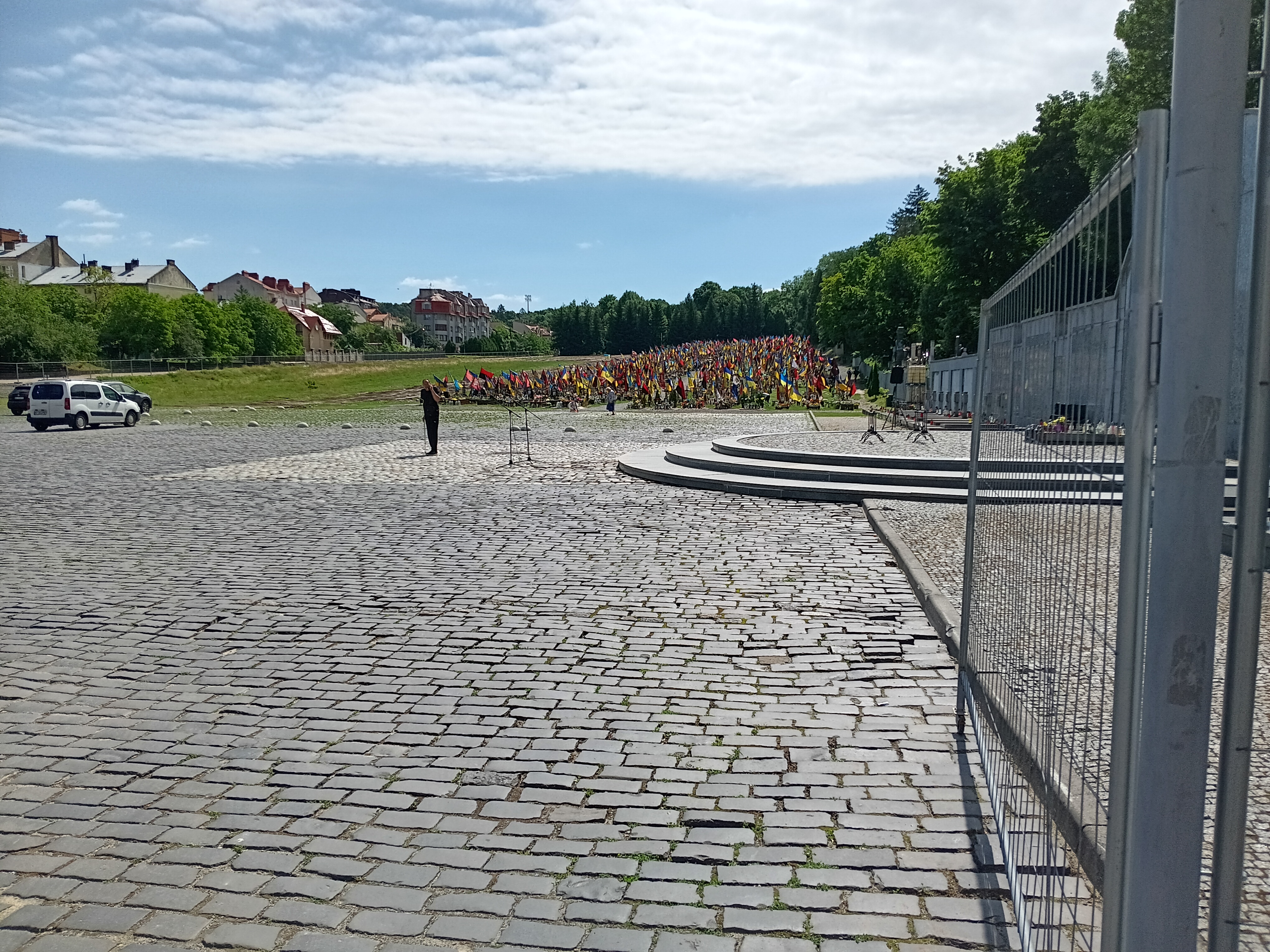
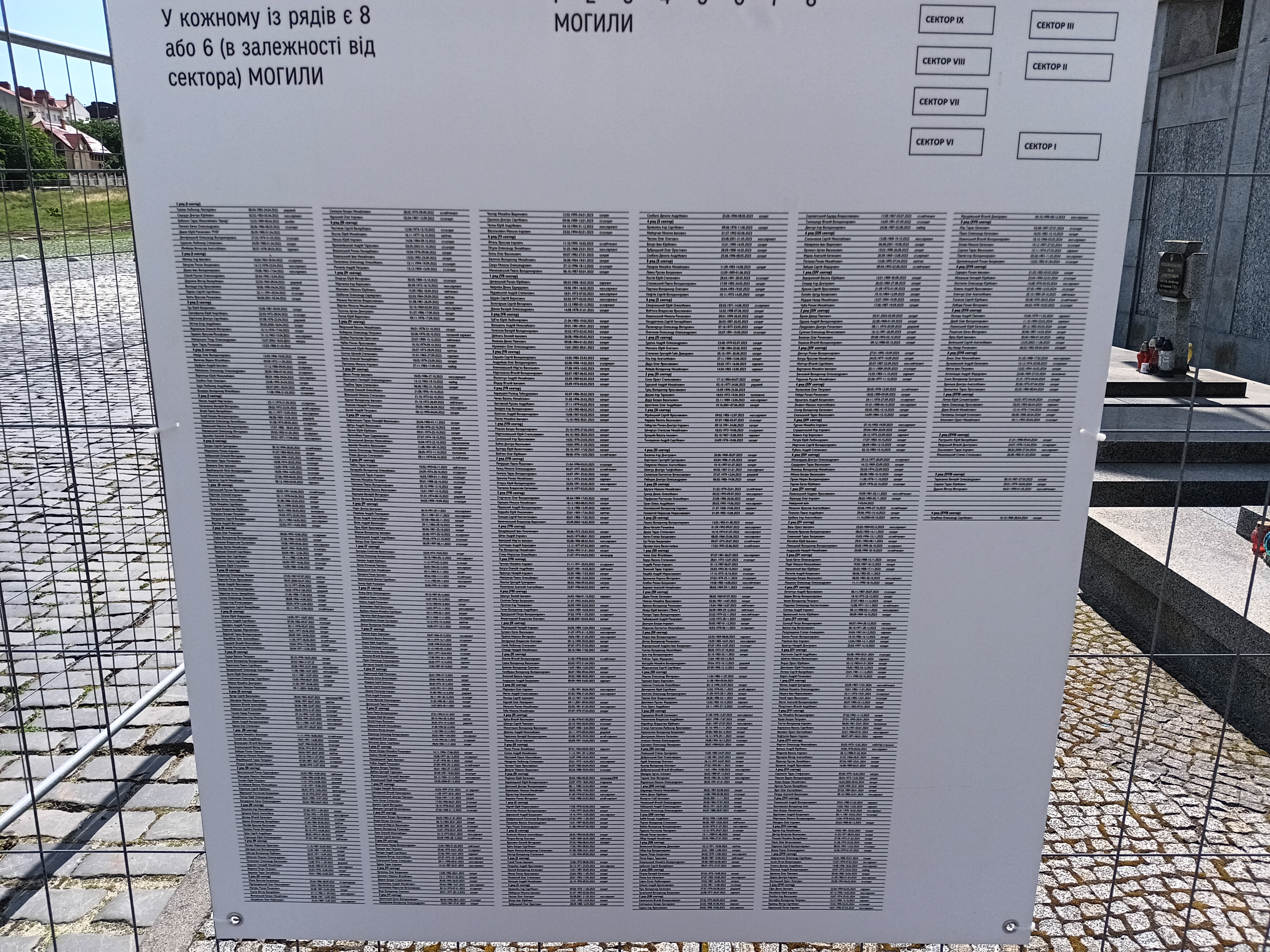
The last burial field I visited only from a distance, because it is here where Lviv buries her current war dead. Almost every day new graves are dug and filled. From the distance it looks like an ocean of flags both of the blue and yellow of Ukraine and a range of battle and historical flags of different military units. I noticed that the people who enter this section first checked a large board near the entrance to see where in this section their loved-ones are buried. The long list of names and grave locations includes the dates of birth (1962-2005) and death (2022-present).

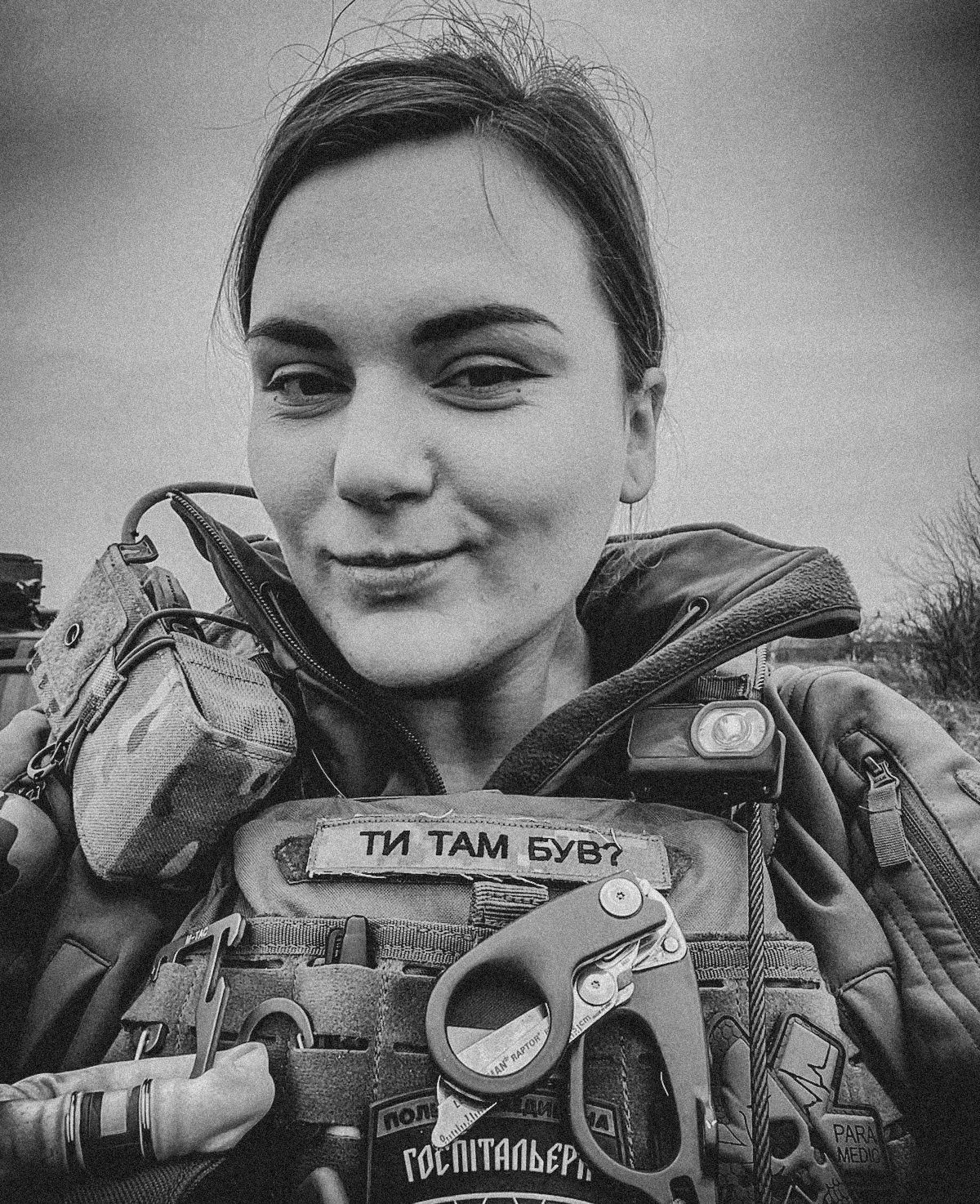
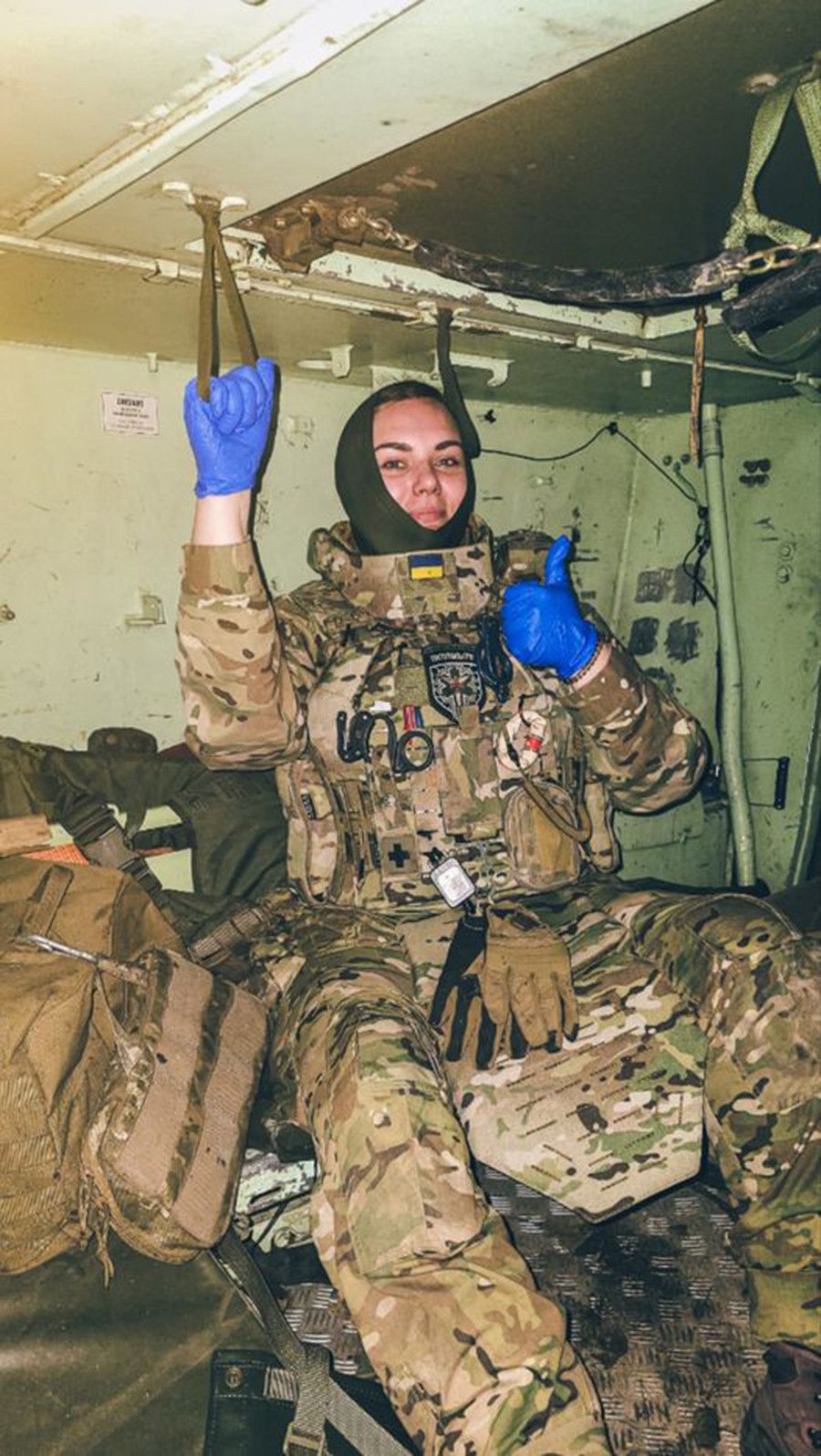
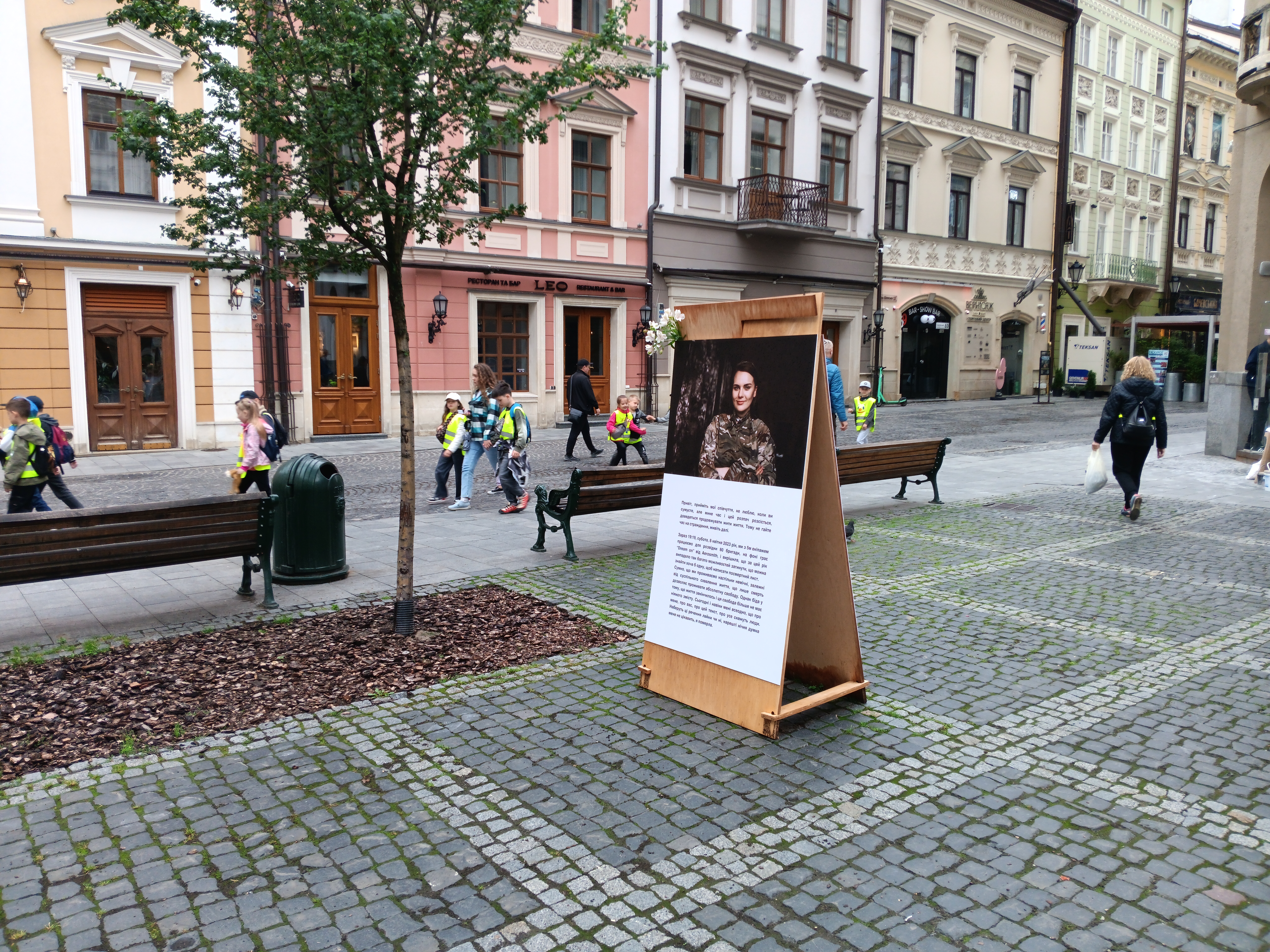
The war and terror forced by Russia onto Ukraine presents itself on main squares in central Lviv as well. One prominent public space that I passed every day included about 16 poster boards of 25-year old combat medic Iryna Tsybukh whom Russian invaders killed near Kharkiv the week before my arrival in Lviv. And every days I saw school children, shoppers, workers, and tourists passing this place dedicated to a brave local women. A year before her burial at Lychakiv Cemetery she wrote to her younger brother describing her wishes in case of her death

I don’t like seeing you mourn, but time and this despair will pass, and we’ll have to continue living life. So don’t waste time suffering; live on.

Iryna Tsybukh (1998-2024)

An equally eloquent obiturary appeared in the New York Times on Aug.-22, 2024. I took the photo of a poster board in Lviv bottom right, the other photos are from her Instagram page and public sources.

This was my only my second of four day as a tourist in Lviv, but here and then I decided to extend my stay. The public life I saw, the people I met, the food I ate, the art I admired, and the history I smelled at every corner made me extend my stay for another 4 days. There was a concert at the Opera and a Ukrainian Wine Festival on the weekend I did not want to miss. Furthermore, I will travel to Lviv again this summer, but this time I will stay for 2-3 weeks as part of a summer language program of the Ukrainian Catholic University. I met one of its mentors on the bus from Lviv to Krakow in Poland as we both returned from there by train to Germany. I am very excited to meet, converse, eat, and live with young Ukrainian students for 2-3 weeks.

References:

Mick, C., 2011: Incompatible Experiences: Poles, Ukrainians and Jews in lviv under Soviet and German Occupation, 1939-44, Journal of Contemporary History, 46 (2), 336-363.

Snyder, T., 2003a: The causes of the Ukrainian-Polish Ethnic Cleansing 1943, Past & Present, 179, 197-234.

Snyder, T., 2003b: The Reconstruction of Nations – Poland Ukraine, Lithuania, Belarus 1569-1999. Yale University Press, New Haven, CT, 367 pp.

Snyder, T., 2010: Bloodlands – Europe between Hitler and Stalin, Basic Books, New York, NY, 524 pp.

Zhurzhhenko, T., 2013: The border as Pain and Memory – Commemorating the Polish-Ukrainian Conflict of 1918-1919 in Lviv and Przemysl, Nationalities Papers: The Journal of Nationalism and Ethnicity, DOI:10.1080/00905992.2013.801416.

Greenland Ocean Expeditions, Science, and Fun

Science and Greenland both combine discovery, adventure, and diverse people. I do this work free of academic constraints, responsibilities, and pay, because I retired from my university three months ago drawing on savings that accumulated since 1992 with my first job in San Diego, California. It was there and then, that my interest in polar physics started, but my first glimpse of Greenland had to wait until 1997 when a Canadian icebreaker got me to the edge of the ice in northern Baffin Bay between Canada and Greenland. It was a cold and foggy summer day as these pre-digital photos show:

Almost 25 years later I visited the area again with Her Danish Majesty Ship HDMS Lauge Koch, a Danish Navy vessel, which surveyed the coastal waters between Disko Bay in the south and Thule Air Base (now Pituffik Space Base) in the north. Two Danish goverment agencies led this expedition: the Geological Survey of Denmark and Greenland (Dr. Sofia Ribeirio, GEUS) and the Danish Metorological Institute (Dr. Steffen Olsen, DMI). Our small team of 11 scientists and 12 soldiers surveyed the seafloor with fancy acoustics, drilled into the bottom with piston corers, fished for plankton with towed nets, and collected water properties with both electronics and bottle samples. As this was during the Covid-19 pandemic, all scientists had to be both vaccinated and tested prior to boarding the flight from Copenhagen to Greenland. We also quarantined for 3 days in Aasiaat, Greenland prior to boarding the ship.

Now in retirement, I thoroughly enjoy the time to just just revisit the places and people via photos that finally get organized. More importantly, I finally feel free to explore the data fully that we collected both on 14 separate expeditions to Greenland between 1997 and 2021. For example, only in retirement did I discover that Baffin Bay was visited in 2021 by both a Canadian and an American in addition to our Danish ship. Data from these separate Baffin Bay experiments are all online and can be downloaded by anyone. I did so and processed them for my own purposes. Furthermore, NASA scientists of the Ocean Melts Greenland program flew airplanes all over Greenland to drop ocean sensors to profile and map the coastal ocean with fjords and glaciers hard to reach by ships. All these are highly complementary data that describe how icy glaciers, deep fjords, coastal oceans, and deep basins connect with each other and the forces that winds, sea ice, and abundant icebergs impose on them.

It requires a bit of skill and computer code, however, to process data from different ships, countries, and sensors into a common format to place onto a common map for different years, but here is one such attempt to organize:

There is one map for each of 9 years, i.e., station locations are shown in a top (2014, 2015, 2016), center (2017, 2018, 2019), and bottom row (2020, 2021, 1968). Land is gray with Canada on the left (west) and Greenland on the right (east) while the solid contour lines represent the 500-m and 1000-m water depth. Each colored symbol represents one station where the ship stopped to deploy a sensor package to measure temperature, depth, and salinity of the ocean water from the surface to the bottom of the ocean adjacent to the ship. The different colors represent data from Canada in red, Denmark in green, and USA in blue. The light blue color represents historical data from a study that investigated the waters after a nuclear armed B-52 bomber crashed into the ocean near Thule/Pituffik on 17 Jan. 1968 with one nuclear war head still missing. A Wikipedia story called 1968 Thule Air Base B-52 Crash provides details, references, and Cold War context, but lets return to the data and ocean physics:

Notice a single red dot near the bottom center of some maps such as 2015, 2017, or 2021. For this single dot I show the actual temperature and salinity data and how it varies with depth (labeled pressure, at 100-m depth the pressure is about 100 dbar) and from year to year:

The two bottom panels show how temperature (left) and salinity (right) change with depth (or pressure). Notice that the coldest water near freezing temperature of -1.8 degrees Celsius (29 Fahrenheit) occurs between 30-m and 200-m depth (30 to 200 dbar in pressure). Below this depth the ocean water actually becomes warmer to a depth of about 500-600 m to then become cooler again. The effects of pressure on temperature are removed, this is why I call this potential temperature and label it “Pot. Temp.” The warmest waters at 600-m depth are also the most salty (about 34.5 grams of salt per 1000 grams of water). This saltiness makes this water heavier and denser than the colder waters above. This is a common feature that one finds almost anywhere in polar regions. The top panel shows the same data without reference to depth (or pressure), but contours of density show how this property changes with temperature and salinity. It takes a little mental gymnastic to “see” how density always increases as pressure increases, but the main thing here is that both salinity and temperature can change the density of seawater.

Sketch of ocean current systems off Greenland and eastern Canada. Colors represent topography of ocean, land, and Greenland ice sheet.

U.S. Coast Guard, International Ice Patrol

The origin of the warmer (and saltier) waters is the Atlantic Ocean to the south. Currents move heat along the coast of Greenland to the north. Icebergs in Baffin Bay extend into this Atlantic Layer and thus move first north along the coast of Greenland before turning west in the north and then south along the coast of Canada. This deep ocean heat does reach coastal tidewater glaciers which are melted by this warm ocean water. So the year-to-year changes of temperature and salinity determine in part how much the coastal glaciers of Greenland melt. The temperature and salinity maxima change from year to year being warmest in 2015 and 2017 and coldest in 2019 and 2021. No “global warming” here, but notice what happens closer to the bottom at 1500-m, say. These waters are separated from the Atlantic and Arctic Oceans to the south and north by water depths that do not exceed 600-m in the south and 400-m in the north. These almost stagnant waters increase their temperatures steadily from 2003 to 2015 to 2017 to 2019 to 2021. This is the global warming signal.

My former student Melissa Zweng published a more thorough and formal study in 2006 using all then available data from Baffin Bay between 1916 and 2003. Her Figure-7 shows the results for those parts of Baffin Bay that are deeper than 2000-m for two different depth ranges. Notice that the year to year variations (up and down) is small, but a steady increase in temperature is apparent from perhaps -0.3 Celsius in 1940 to -0.05 in 2003 for the 1400-1600 m depth range. We also did a very formal error analysis on the straight line we fitted to the data and find that deep temperatures increase by +0.03 C/decade. We are 95% sure, that the error or uncertainty on this warming is +/- 0.015 C/decade. So there is a 1 in 20 chance, that our deep warming trend is below +0.005 C/decade and an equal 1 in 20 chance, that our warming trend exceed +0.045 C/decade. In 19 out of 20 cases the (unknown) true warming value is between 0.005 and 0.045 C/decade.

So, more than 20 years have passed since Melissa’s work. The data I here showed between 2003 and 2021 thus gives us a chance to test our statistical predictions that we made 20 years ago. So, deep temperatures should be between 0.01 and 0.09 degrees Celsius warmer than they were in 2003. I have not done this test yet, but science is fun even if the data are old.

After getting off the ship at Thule Air Base (now called Pituffik Space Base) in 2021, us scientists climbed Dundas Mountain to stretch our legs, take in the varied landscape, and view our ship and home for a week from a distance. Notice how small HDMS Lauge Koch at the pier appears. All photos below were taken by geophysicist Dr. Katrine Juul Andresen of Aarhus University, Denmark:

References:

Münchow, A., Falkner, K.K. and Melling, H.: Baffin Island and West Greenland Current Systems in northern Baffin Bay. Progr. Oceanogr., 132, 305-317, 2015.

Ribeiro, S., Olsen, S. M., Münchow, A., Andresen, K. J., Pearce, C., Harðardóttir, S., Zimmermann, H. H., & Stuart-Lee, A.: ICAROS 2021 Cruise Report. Ice-ocean interactions and marine ecosystem dynamics in Northwest Greenland. GEUS, Danmarks og Grønlands Geologiske Undersøgelse Rapport, 70, 2021.

Zweng, M.M. and Münchow, A.: Warming and Freshening of Baffin Bay, 1916-2003. J. GEOPHYS. RES., 111, C07016, doi:10.1029/2005JC003093, 2006.