Monthly Archives: March 2013

Greenland, Frederica de Laguna, and Early Convergences

Not sure why, but this 1929 photo of two young scientists working off Greenland has been in my mind for the last 3 days. It shows a 23-year old graduate student of Anthropology from Columbia University, Frederica de Laguna, with one of her mentors, Archaeologist Dr. Therkel Mathiassen from Denmark. They were digging near Upernavik, Greenland for evidence of long-lost people living in north-west Greenland. It changed the life of Frederica de Laguna, the graduate student, as this summer in Greenland revealed the deep passion that she lived for 75 years after this photo was taken: Arctic Anthropology, the study of people, places, cultures. To me the photo shows an exuberant, yet relaxed and deep happiness after tiresome, yet immensely fulfilling work.
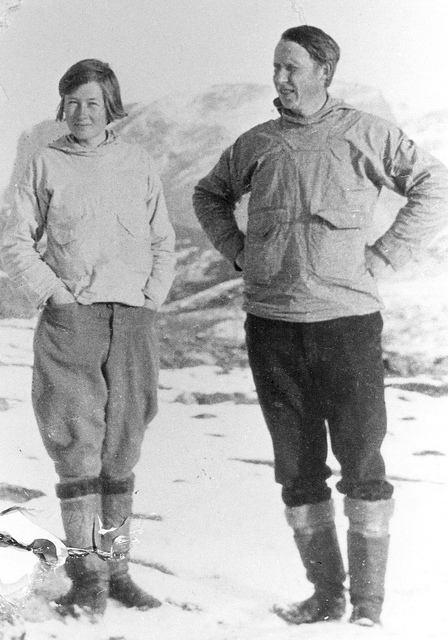
Frederica de Laguna with Therkel Mathiassen in 1929 near Upernavik, Greenland. [From Bryn Mawr College's Collections

Frederica de Laguna with Therkel Mathiassen in 1929 near Upernavik, Greenland. [From Bryn Mawr College’s Collections]


My strange obsession with Frederica de Laguna relates to convergent story lines that I am still trying to untangle. Her advisor at Columbia was Franz Boas who as a German physicist lived on southern Baffin Island during the First International Polar Year 1883/84 to study “everything” that he saw and experienced around Cumberland Sound which was a northern base for the whaling industry. His description of a massive iceberg is so detailed, that I feel comfortable to conclude, that he describes an ice island from Petermann Glacier about 1600 miles to the north. After his Arctic field work he emigrated to New York to become one of the founders of American Anthropology in the 20th century. Frederica de Laguna was one of his last graduate students, receiving her PhD in 1933 while digging in Alaska.
Inuit women and children visiting the Hans Egede in Greenland in 1930. [From Cambridge University]

Inuit women and children visiting the Hans Egede in Greenland in 1930. [From Cambridge University]


It took Frederica and her companion 18 days to sail from Copenhagen, Denmark to Upernavik, Greenland aboard the Hans Egede. Two of her sailing companions, a Dr. Krueger from Germany and his assistant Age Rose Bjare of Denmark were planing to explore the geology of Ellesmere Island and areas to the west of it in northern Canada and disappeared. In her autobiography she writes succinctly: “I don’t like Dr. Krueger. He thinks too much of himself.” This sentiment is also reflected by the Canadian police officer who described him as a “punk outfit and a badly overloaded sledge.” Her return sail she shared with Dr. Alfred Wegener, a German geophysicist and his group returning from initial explorations of Disko Bay, Greenland testing the first snowmobiles for a larger expedition to take place the following year in 1930. They probably provided one of the first descriptions of Jacobshavn Isbrae, a fast-moving Greenland outlet glacier. In 1929 it still had a substantial ice-shelf that disintegrated the last 15 years and is lost to history.
The evolution of Jacobshavn Isbrae retreat from 1851 through present. [From NASA's Earth Observatory]

The evolution of Jacobshavn Isbrae retreat from 1851 through present. [From NASA’s Earth Observatory]


Alfred Wegener lost his life the following year when he tried to rescue companions who maintained a weather station on Greenland’s ice-sheet. His largest scientific contribution was the idea, that continents move, that North-America, Greenland, and Europe once connected, perhaps, and had drifted apart over the millenia. Since he did not have a physical mechanism detailed, it took oceanographers another 50 years to sort that part out, Wegner’s idea of continents adrift was ridiculed by the establishment at the time and eventually forgotten. It took another 30-40 years for it to revolutionize geology as a dynamic discipline. Plate tectonics is the standard now that explains earthquakes, vulcanoes, and much more. It perhaps did not help Dr. Wegner with the geologists like Dr. Krueger, that he was trained in physics, as was Dr. Boas, the advisor of the now renowned Arctic anthropologist Francisca de Laguna of Bryn Mawr College in Pennsylvania.

The observant reader will notice how many Germans are in this set of story lines. Franz Boas was Jewish and thrived,in the Americas, Hans Krueger was a pompous idiot who disappeared, and Alfred Wegener was a tragic hero. All were German scientists, all converged with Frederica de Laguna in 1929 just when she emerged as a powerful mind of her own as a young graduate student in a field dominated by men. When Germany invaded Poland and France 10 years later, Dr. Frederica de Laguna was teaching her passions at Bryn Mawr College outside Philadelphia. When the war came to America, she asked for a leave of absence to serve in Naval Intelligence where she became a Lieutenant Commander. Her superiors at Bryn Mawr considered this a waste of her time, but she disagreed, and so do I. It is the many personal choices we make, both small and large, that form our personal histories, our science, our selves, and the larger history that we all live … [to be continued]

Davis, R. (2006). Frederica de Laguna of Bryn Mawr College Arctic Anthropology, 43 (2), 21-27 DOI: 10.1353/arc.2011.0075

VanStone, J., & de Laguna, F. (1980). Voyage to Greenland: A Personal Initiation into Anthropology Ethnohistory, 27 (2) DOI: 10.2307/481234

Fredericade Laguna in 1993 at age 87; she worked until age 98 [From New York Times, photo by Bill Roth, Anchorage Daily News]

Frederica de Laguna in 1993 at age 87; she worked until age 98. [From New York Times, photo by Bill Roth, Anchorage Daily News]
Melting Mountain Glaciers: Changing Planet Video

A short video clip explains in stunning clarity how mountain glaciers change. The example is Mount Kilimanjaro in Tanzania, Africa. The video is produced professionally by NBC and NSF and contains actor Gregory Peck, writer Ernest Hemingway, as well glaciologists Lonnie Thompson and Douglas Hardy.

Lonnie Thompson has perhaps traveled the world for ice cores and published its science implications more extensively than anyone else. At a recent meeting in San Francisco I heart him deliver an engaging and fun presentation. His writing is most accessible in terms of clarity and context.

Thompson, L. (2002). Kilimanjaro Ice Core Records: Evidence of Holocene Climate Change in Tropical Africa Science, 298 (5593), 589-593 DOI: 10.1126/science.1073198

Oceanography and Icebergs in Baffin Bay: LCDR Edward “Iceberg” Smith

In 1928 Edward H. “Iceberg” Smith took the 125 feet long Coast Guard Cutter “Marion” on an 8,100 mile journey from Boston, MA to New York City, NY via Disko Bay, Greenland. Along the way he defined operational Arctic Oceanography to explain and predict iceberg entering the busy sea lanes off North-America. The Titanic was sunk in 1912, the International Ice Patrol was formed in 1914, and LCDR Smith sailed to Greenland in 1928. The data are priceless 85 years later still. I used them to place modern observations from 2003 into a context of climate variations. First, however, let me give credit to one of the pioneers on whose scientific shoulders I stand:

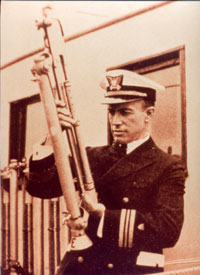
Edward H. "Iceberg" Smith of the US Coast Guard with reversing thermometer.

Edward H. “Iceberg” Smith of the US Coast Guard with reversing thermometer.

“Iceberg” Smith entered the Coast Guard Academy at age 21 in 1910 and served during World War I as a navigator on Atlantic convoy escort duty. After this war his ship was detailed to the International Ice Patrol and he became one of its first scientific observers at age 32 in 1921. As such he was sent for a year to Bergen, Norway in 1925 to learn the latest theories in physical oceanography. Scandinavian explorers like Nansen, Ekman, Sverdrup, Bjerknes, and Helland-Hansen defined physical oceanography at this time by applying physics on a rotating earth to phenomena that they observed from ships sailing at sea or ships frozen in Arctic ice. Much of this revolutionary work is now elementary oceanography taught in introductory courses, but then, nobody knew much about why ice and ocean move they way they do. It was time to put ideas to a thorough test which is what “Iceberg” Smith did, when he got his ship and orders to explore in 1928.

USCGC Marion built in 1927 [from http://laesser.org/125-wsc/]

USCGC Marion built in 1927. Note the scale indicated by a person standing on the lower deck. [From http://laesser.org/125-wsc]

Armed with new ideas, knowledge, and the tiny USCGC Marion “Iceberg” Smith set to out to map seas between Labrador, Baffin Island, and Greenland to explain and predict the number of icebergs to enter the North-Atlantic Ocean. During his 10 weeks at sea he mapped ocean currents from over 2000 discrete measurements of temperature and salinity at many depths. This was before computers, GPS, and electronics. In 1928 this was slow to work with cold water collected in bottles with “reversing thermometers” that cut off the mercury to preserve temperatures measured in the ocean at depth to be read later aboard. Salinity was measured at sea by tedious chemical titrations. Imagine doing all of this from a rocking and rolling shallow draft cutter that bounces in icy seas for 10 weeks within fog much of the time. No radar to warn of icebergs either, and you want to study icebergs, so you move exactly where they are or where you think they are coming from. And they though that the Titanic was unsinkable.

Iceberg in the fog off Upernarvik, Greenland in July of 2003. [Photo Credit: Andreas Muenchow]

Iceberg in the fog off Upernavik, Greenland in July of 2003. [Photo Credit: Andreas Muenchow]

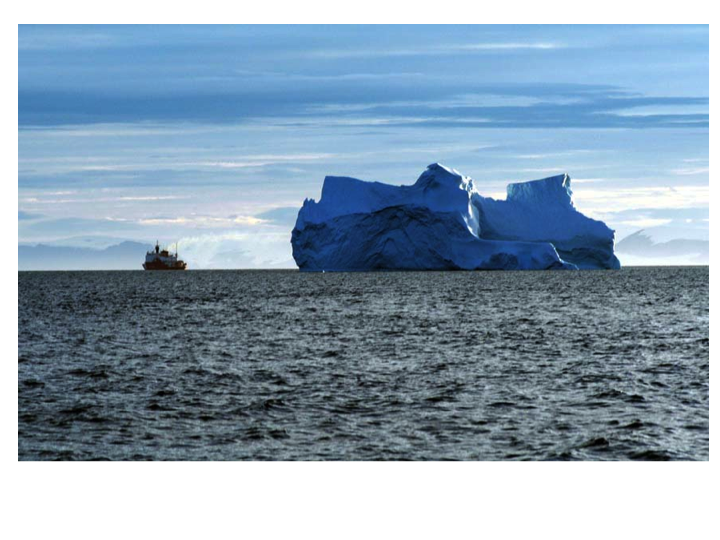
USCGC Healy in northern Baffin Bay in July 2003 with iceberg. Ellesmere Island is in the background.

USCGC Healy in northern Baffin Bay in July 2003 with iceberg. Ellesmere Island is in the background.

The 1928 Marion Expedition was the first US Coast Guard survey in Baffin Bay while the last such expedition took place 2003. Unlike “Iceberg” Smith we then had military grade GPS, radar, and sonar systems. These sensor systems allowed me to directly measure ocean currents from the moving ship every minute continuously from the surface to about 600 meters down. Oh, we also took water samples in bottles, but temperature, depth, and salinity are all measured electronically about 24 times every second. As a result we can actually test, if the physics that had to be assumed to be true in 1928 actually are true. As it turns out, the old theory to estimate currents from temperature and salinity sections works well off Canada, but not so well off Greenland. Furthermore, we found several eddies or vortices in the ocean from the current profiling sonars.

And finally, it took Edward H. “Iceberg” Smith only 3 years to publish most of his data and insightful interpretations while I am still working on both his and my own data 85 years and 10 years later, respectively. Sure, I got more data from a wider range of moored, ship-borne, and air-borne sensors, but I do wonder, if I really consider my data and interpretations as careful and think as thorough as LCDR Smith did. Furthermore, he had no computers and performed all calculations, crafted all graphs, and typed all reports tediously by hand. I would not want to trade, but all this makes me admire his skills, dedication, and accomplishments even more.

Dr Helen Johnson on acoustic Doppler current profiler (sonar to measure ocean velocity) watch aboard the USCGC Healy in Baffin Bay in 2003. [Photo credit: Andreas Muenchow]

Dr Helen Johnson on acoustic Doppler current profiler (sonar to measure ocean velocity) watch aboard the USCGC Healy in Baffin Bay in 2003. [Photo credit: Andreas Muenchow]

P.S.: The New Yorker has three stories on the subject published in 1938, 1949, and 1959. I eagerly await to read those.

ResearchBlogging.orgSmith, E. (1928). EXPEDITION OF U. S. COAST GUARD CUTTER MARION TO THE REGION OF DAVIS STRAIT IN 1928 Science, 68 (1768), 469-470 DOI: 10.1126/science.68.1768.469

Oceanography, Technology, and Ships

Sea-going oceanography is in transition. Times are exciting as we developed new tools, sensors, and ideas on how to observe the ocean and the stuff that lives in it, floats on it, and is submerged below it. I just learned about an awesome interview with Eli Kintisch which is posted as a podcast at the American Association for the Advancement of Science:

Better technology, but less money: Eli Kintisch discusses the crossroads facing U.S. oceanography.(Podcast)

I will write more about this, but I have to run off to meet with an electrical engineer to discuss ideas on how we perhaps can get data from bottom-mounted sensors out of the ocean in ice-covered seas instantly, rather than waiting 2-3 years to get instruments back with a ship.

Kintisch, E. (2013). A Sea Change for U.S. Oceanography Science, 339 (6124), 1138-1143 DOI: 10.1126/science.339.6124.1138

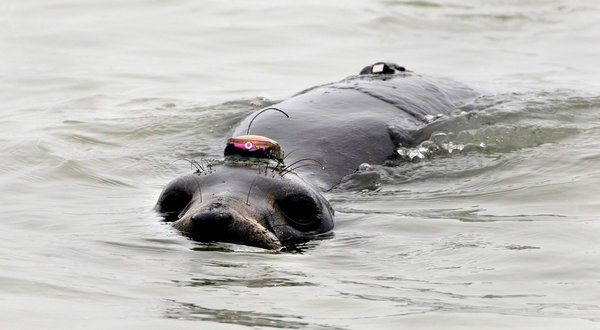
Seal with ocean sensor.

Seal with ocean sensor.

Elephant seal off Antarctica with ocean sensor transmitting data via satellite [Credit Lars Boehme]

Elephant seal off Antarctica with ocean sensor transmitting data via satellite [Credit Lars Boehme]

CCGS Henry Larsen in thick and multi-year ice of Nares Strait in August 2009. View is to the south with Greenland in the background. [Photo Credit: Dr. Helen Johnson]

CCGS Henry Larsen in thick and multi-year ice of Nares Strait in August 2009. View is to the south with Greenland in the background. [Photo Credit: Dr. Helen Johnson]

Women In Science: Costs and Benefits

“Science remains institutionally sexist. Despite some progress, women scientists are still paid less, promoted less frequently, win fewer grants and are more likely to leave research than similarly qualified men.” [Nature, Mar.-7, 2013]

This is from yesterday’s special issue of Nature which prompted this tongue-in-cheek comment by Prof. Dr. Cristina Archer:

Can we put a dollar amount to how much it would cost to fill the gender gap with respect to salary disparity?

Here is the procedure:

1) N_w = number of women scientists in the US
2) S_w = average salary of the N_w women scientists in the US
3) S_m = average salary of the male scientist in the US
4) Delta = difference in salary between male and female scientists
5) Tot = total dollars that the female scientists should be receiving to fill the disparity = Delta * N_w

To get a sense of the order of magnitude, here are some values:

1) N_w = 93,400 (in 2008, from the Nature paper)
2) S_w = $60,000 (this is actually the median, not the average, in 2008)
3) S_m= $84,000 (median in 2008)
4) Delta = $24,000
5) Tot = $24,000 * 93,400 = $2,241,600,000 (yes, billions)

For the nerdy of us, I acknowledge that using the median instead of the average might give an overestimate of the final bonus, although the order of magnitude is correct.

Since the gender gap seems very expensive to fill (~$2 billions), it might be cheaper and easier to actually reduce the salary of all male scientists (N_m = 179,400). The total saved would be:

Tot2 = $24,000 * 179,400 = $4.3B (of course billions)

If that money could be donated to NSF, the benefits to research in the US would be incalculable.

So … who wants to be the first male scientist to give up 28% of his salary and start filling the gender gap?

I admit, that I was the first to volunteer.

ADDENDUM: This post is not meant to criticize any institution in any way or form. The fact that these issues are discussed openly reflects both sensitivity and progress towards a common goal of gender equality in science. There is also a student’s perspective that Allison Einolf posted here last summer which includes references to a 2011 NSF study on the issue.