Tag Archives: ice

Heat Sensing Eyes “See” Arctic Ice Thickness

The Arctic sea ice is disappearing before our eyes as we extended them into space in the form of satellites. Every summer for the last few years the area covered by ice is shrinking during the summer when 24 hours of sunlight give us plenty of crisp images. But what about winter? What about now? And does a picture from space tell us how thick the ice is?
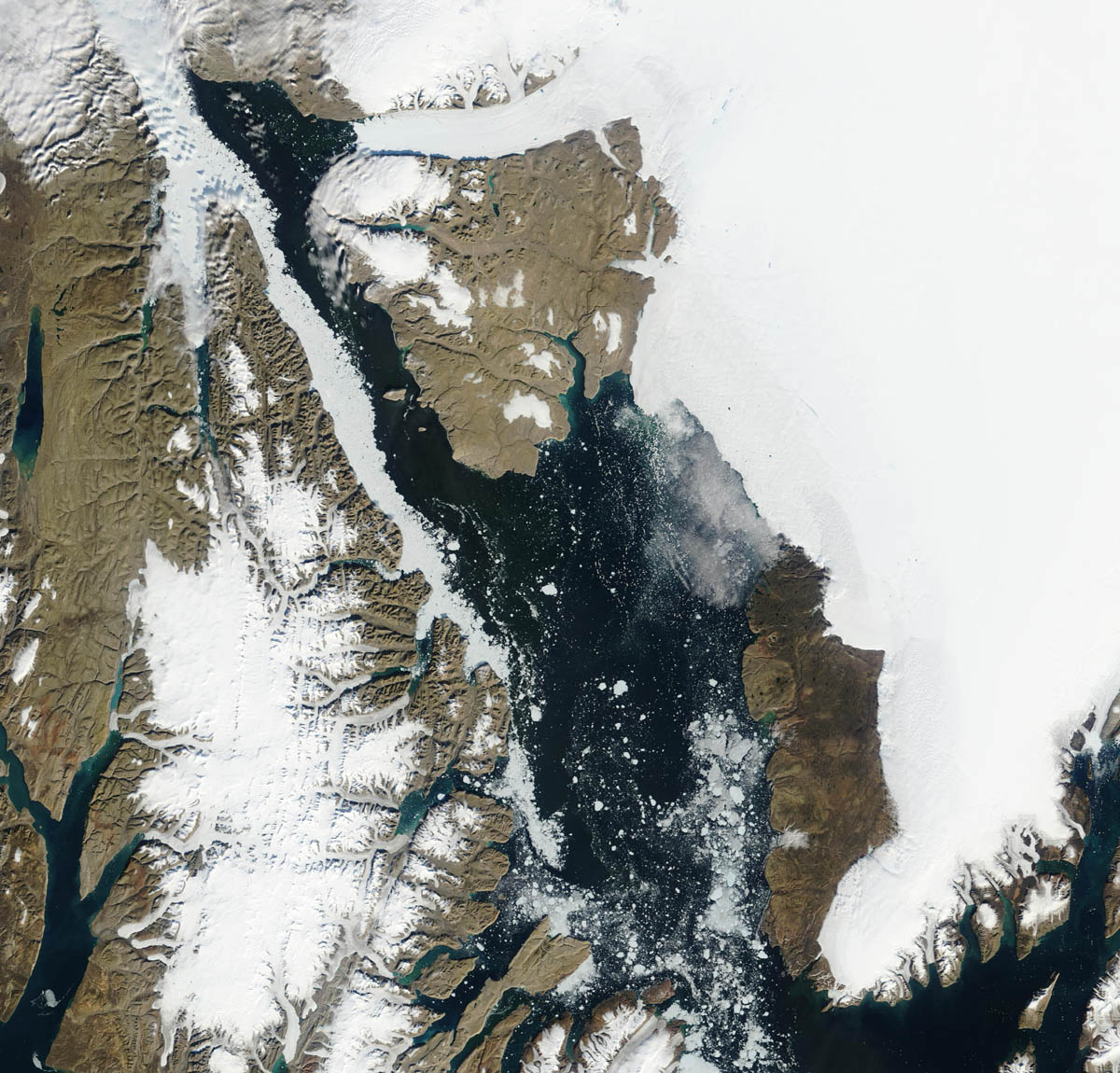
Nares Strait between northern Greenland and Canada on Aug.-13, 2005 with Petermann and Humboldt Glaciers at top and center right from MODIS imagery using red, blue, and green channels.

It is dark in the winter near the north pole as the sun is below the horizon 24 hours each day, but there are many ways to “see” in the dark as flying bats aptly show. They send out sound that bounce off objects from which bats reconstruct objects around them. We use radar from space to do to the same with radio waves to “see” different types of ice at night from satellites. We can also use tiny amounts of heat stored in water, ice, snow, and land to “see” at night. Someone breathing down your neck at a cold dark corner will make our heart beat faster as we “see” the heat not with our eyes, but with our skin. I digress, as I really want to talk about icy Arctic seas and how we can perhaps “see” how thick it is with our eyes in the sky.

The most accurate and pain-staking way to measure ice thickness is drill holes through it. This is back-breaking, manual labor away from the comforts of a ship or a camp. One person watches with a shot-gun for polar bear searching for food, not our food, we are the food. The scientist who does this sweaty, dangerous work on our Nares Strait expeditions is Dr. Michelle Johnston of Canada’s National Research Council. She is a petite, attractive, and smart woman who is calm, competent, and comfortable when she leads men like her bear-like helper Richard Lanthier into the drilling battles with the ice. She gets dirty, cold, and wet when on her hands and knees setting up, drilling, cutting, measuring:
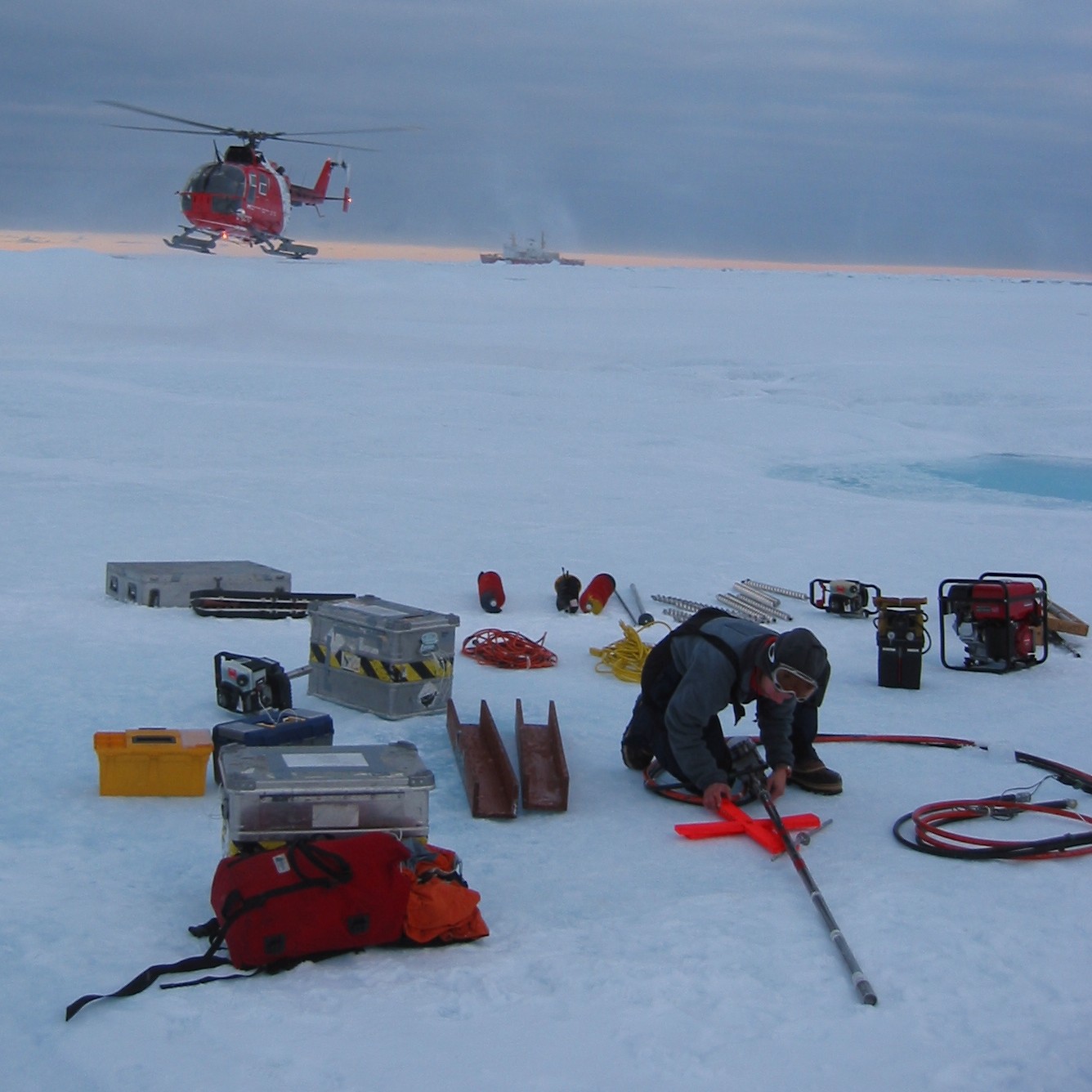
Dr. Michelle Johnston assembling ice drilling gear in Nares Strait with Greenland on the horizon. The Canadian Coast Guard Ship Henry Larsen in the background with its helicopter hovering.

She measures temperatures within the ice and tries to crush it to find out how strong it is. All of this information guides ship operators on what dangers they face operating in icy seas. Drilling over 250 such holes across a small floe on the other (eastern) side of Greenland, Dr. Hajo Eicken showed how one large ice floe changes from less 1 meter to more than 5 meters in thickness. He also discovered that the percentage of thick and thin ice of his single 1 mile wide ice chunk is similar to the percentages measured by a submarine along a track longer than 1000 miles.
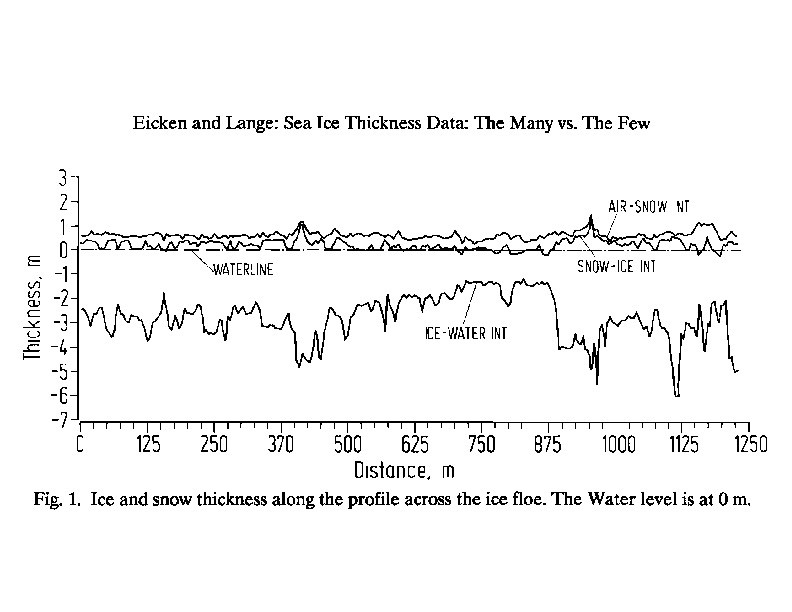
This was a surprising result in 1989 and we use it to estimate ice thickness more leisurely sipping coffee in our office. From the same satellite that gives us crisp true color images in summer as shown above, we get false color images of temperature as shown below.
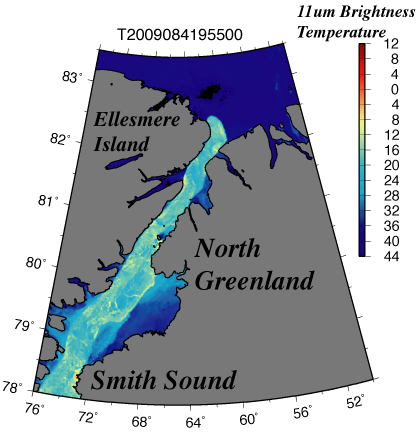
Map of Nares Strait, north-west Greenland on March-25, 2009 showing heat emitted during the polar night from the ocean through the ice, and sensed by MODIS satellite.

A graduate student of mine, Claire Macdonald, is trying to convert these temperature readings into ice thickness for Nares Strait. She showed me the first promising results today. The plot below shows the distribution of “thermal” ice thickness for a small square in Nares Strait Dec.-1, 2008 through Mar.-1, 2009 when no clouds were in the area. Note the two distinct and separate clusters with thicknesses below 1 meter and above 2 meters. They represent thin ice formed in 2009 after an upstream ice arch blocked all flow of thicker ice from the Arctic Ocean to Nares Strait. The thicker ice passed the study area at times when the thick, hard multi-year Arctic ice entered Nares Strait freely from the Arctic Ocean.
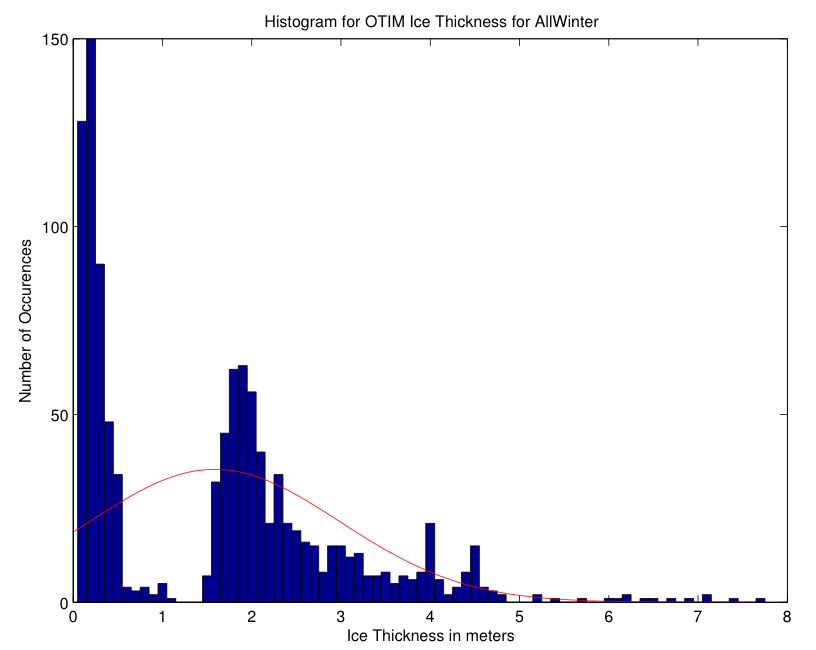
Distribution of "thermal" ice thickness from satellite for Nares Strait Dec.-1, 2008 through Mar.-1, 2009. (Credit: Claire Macdonald, Jan.-26, 2012)

Much work remains to be done: Claire is comparing the “thermal” ice thickness with “acoustic” ice thickness measured by sonars moored in the water below the ice. It then will be exciting to explore “thermal” thicknesses for all of Nares Strait. Winds and ocean currents will pile ice up in some areas making it thicker while they spread ice out making it thinner. Claire and I have worked with such wind and ocean data. Science is never finished as each question answered raises a host of new ones.
Pine Island Glacier on the Move

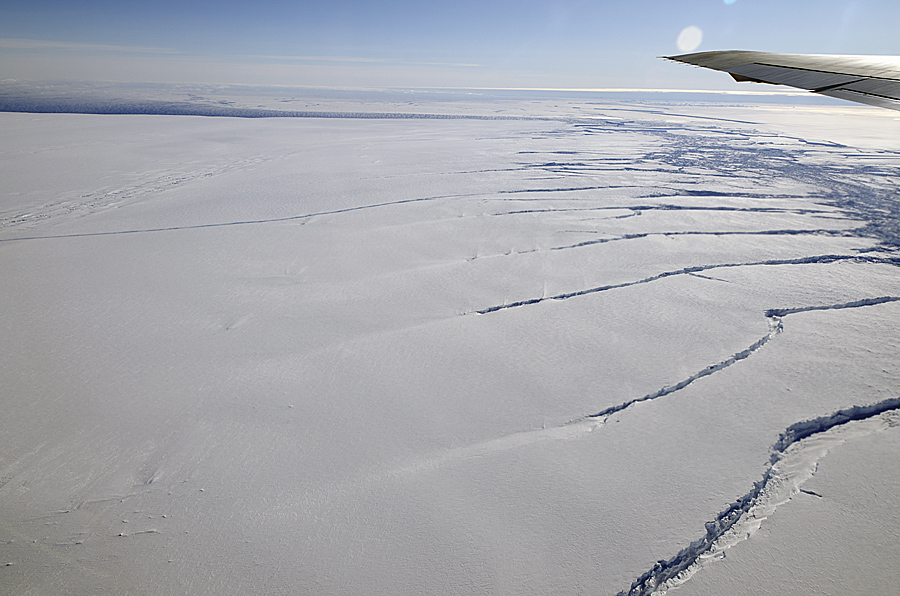
Pine Island Glacier, Antarctica, is the focus of a large observational effort to better understand how glaciers and floating ice shelves interact with the ocean.

Pine Island Glacier (view is to the north, ocean in the top left) with crevasses and large crack extending from the east (right) to the west (left) as seen from aboard NASA's DC-8 research aircraft in October 2011. Credit: Michael Studinger/NASA

Scientists, pilots, technicians, and students working with NASA’s IceBridge and NSF’s Antarctic programmes tried hard for several years now to reach this glacier, set up a base, and drill through the 400-600 m thick ice shelf to reach the ocean. The data from these gargantuan efforts will reveal physics of ice-ocean interactions. This process is poorly represented in the climate models that are used to project past and present climates into the future. Harsh and hostile conditions cut these efforts short today, again, as reported by OurAmazingPlanet.

The expedition leader, NASA’s Dr. Bindschadler wrote today, that

A decision had been made by NSF the day we left McMurdo that if the helos were not able to be flown to PIG by Saturday, January 7, this year’s field work would be cancelled … We worked through our cargo—some had not been seen for two years when we tested our equipment at Windless Bight—preparing for either helos or the Twin Otter to start moving us onto the ice shelf. Neither came. Weather worsened.

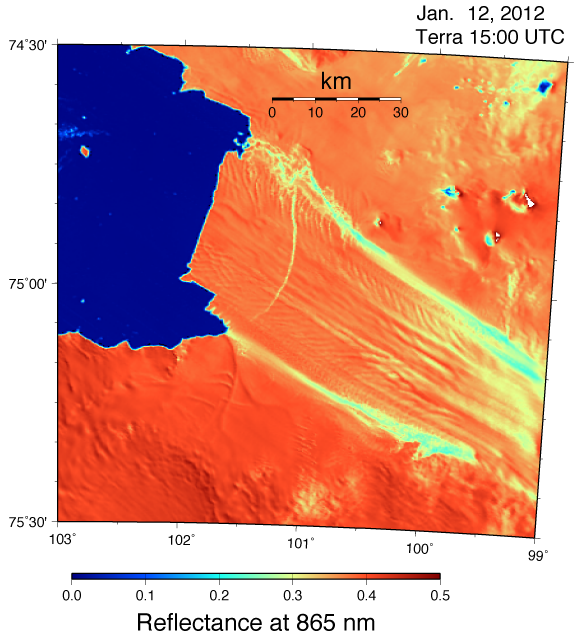
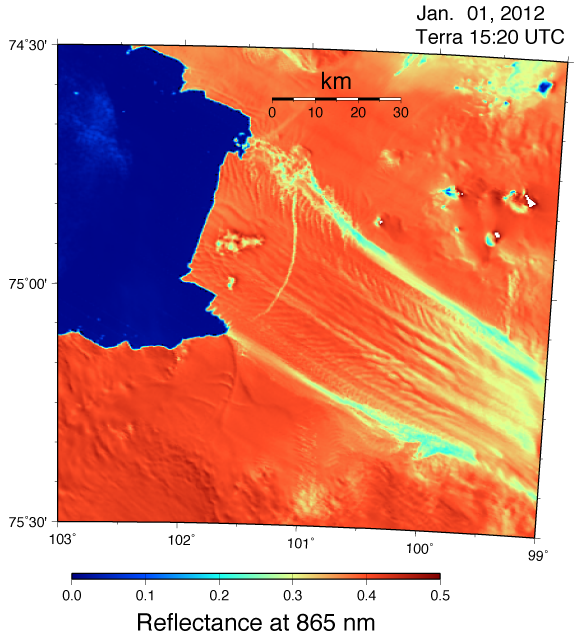
Despite this dramatic turn of events, skies were clear over Pine Island Glacier today as they on New Year Jan.1, 2012. Two MODIS images show detailed features at 250-m resolution. I here show the near infra-“red” signals that the satellite receives (865 nm). The dark ocean reflects little of red (low reflectance) as it is all absorbed while the bright snow and ice reflects lots of red (high reflectance). Recall that the color “white” looks white, because it reflects all colors into our eyes including red, while “black” absorbs all colors, so none are left to reach our eyes.

Pine Island Glacier and Bay, Antarctica on Jan.-1, 2012 as seen by MODIS Terra, notice the whitish crack near the center of the image.

I show lots of the near infra-“red” as, well, red, and I color little red as blue. I chose the colors of the “crayons” to do the coloring. The technical term for this is contouring. Formally, I am depicting a function f=f(x,y) where f is the amount of red and x and y are locations east and north, respectively.

Pine Island Glacier and Bay, Antarctica on Jan.-12, 2012 as seen by MODIS Terra, notice the whitish crack near the center of the image.

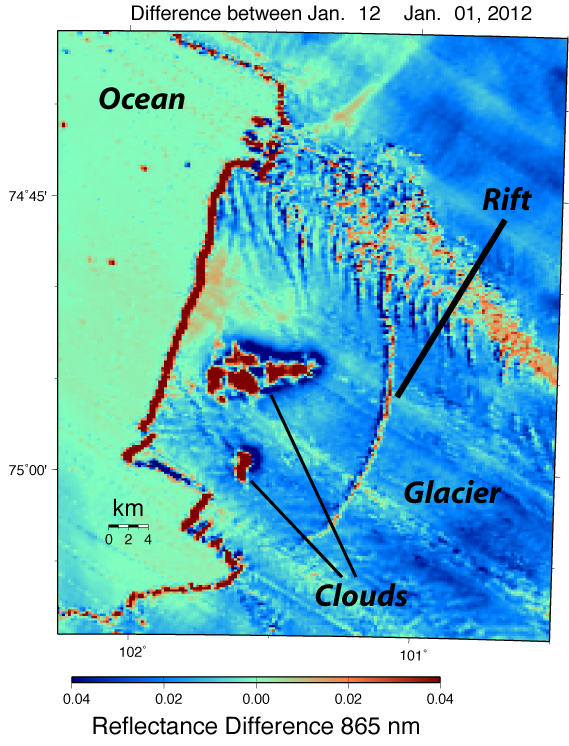
They almost look the same, don’t they? If they were identical, then the difference would get zero. Except, glaciers move, especially this one. It is also about to spawn a large ice island. A crack was first reported in Oct.-2011 by scientists aboard a DC-8 of a NASA Icebridge flight. This crack is also widening as, I speculate, the front moves faster seaward of the crack than it does landward. My question is if I can see movements in these easily accessible public MODIS images. And my first answer, to be refined later, is 80 meters per day plus or minus 50%:

Difference of reflectance by subtracting Jan.-1 reflectances from those on Jan.-12, 2012. Very dark red colors show large positive numbers, meaning that the ice occupies a place on Jan.-12 that was water on Jan.1.

I am neither a glaciologist nor a remote sensing person, so I may be running a few red lights differencing two images and assign meaning to it. For example, I estimate the speed at which the front of the glacier moves by dividing the width of the very dark thick red line (about 1 km wide) by 12 days to get 80 meters per day or 3.5 meters per hour. The error here is at least 2 pixels (500-m), about half the estimated speed. My assumption here is that the high reflectance on Jan.-12 at a location with a low reflectance on Jan.1 means that the “bright” glacier has moved to a place that was “dark” ocean before. There is more to this, but I have to start somewhere.

Incidentally, Dr. Bindschadler, the leader of the current Pine Island field project who had to leave the base camp near Pine Island Glacier today, is the very person who wrote a wonderful peer-reviewed paper in 2010 with the title “Ice Sheet Change Detection by Satellite Image Differencing.” I will need to study it more closely … along with the vagarities of field work in polar regions.

It is difficult to get data from the field as opposed to data from remote sensing or modeling. This is especially true for remote and hostile locations the ice and the oceans interact. It is frustrating to be sent home early because of inclement weather and the very narrow window of opportunity when the few available helicopters and planes can fly or the ships can sail near Antarctica and Greenland.

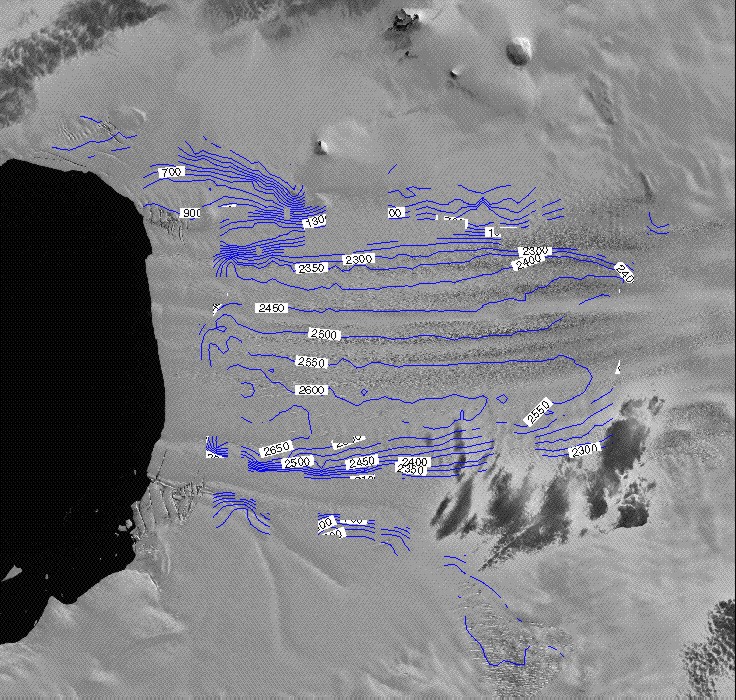
EDIT Jan.-13: The National Snow and Ice Center estimated speeds of Pine Island Glacier as determined from two LandSat images from 1986 and 1988:

Contours of glacier speeds in meter per year of Pine Island Glacier from 1986 and 1988 LandSat Imagery, National Snow and Ice Center

These speeds are very different, 2-3 km per year versus 1 km in 12 days. The former estimate is made from 2 carefully geolocated images 2 years apart without a crack across the floating glacier, while my estimate yesterday is more noisy, but it is for a segment of the glacier that is barely connected to it. Perhaps we should consider the segment seaward fo the crack a separate ice island that is moving with the ocean rather than the glacier?

Ice Drift from Nares Strait to Newfoundland: The 1871 Polaris Expedition and Petermann Ice Islands

“Nineteen ship-wrecked members of the Polaris expedition of 1871-72
drifted on ice floes a distance of over 2500 km from Nares Strait near
79°N latitude to Newfoundland. Surviving this six months long ordeal,
they inadvertently mapped for the first time a drift of icy waters
from the Arctic to the North Atlantic Ocean. That they survived to
tell the tale is tribute to two Inuit, Joe Ebierbing and Hans Hendrik,
whose hunting skills and diligence provided food for the entire party
(Hendrik, 1878). Almost a century later, 1962-64, ice island WH-5 was
carefully tracked via ships and aircraft from north of Ellesmere
Island (83°N) to the Atlantic via Nares Strait (Nutt, 1966). The
movements of ice and water so revealed are one link in the global
hydrological cycle whose significance to global climate has yet to be
understood …” [from Muenchow et al. (2007)]

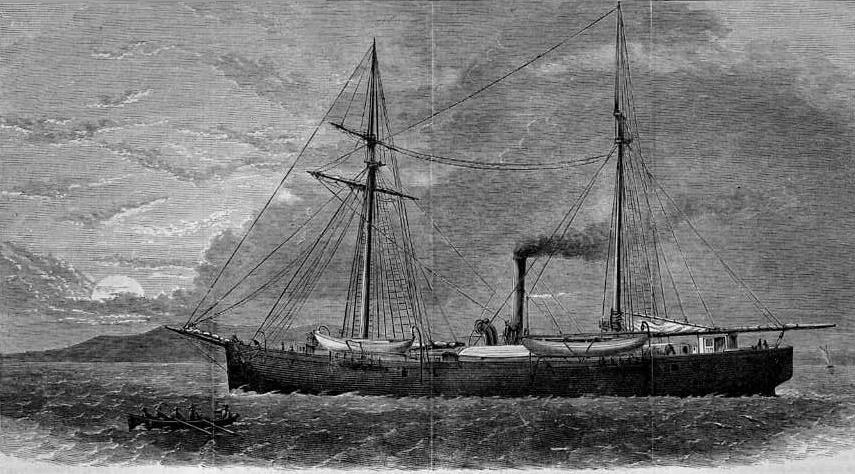
'Captain Hall's Arctic Expedition -- The "Polaris"'', a wood engraving published in ''Harper's Weekly'', May 1873.

The BBC contacted me this morning asking great questions related to the Petermann Ice Islands and icebergs. These reminded me of the opening paragraph quoted from a paper on the oceanography of Nares Strait. I published it in 2007 with two friends and fellow sailors of icy waters, Kelly Falkner and Humfrey Melling. In 2003 we sailed together on the US Coast Guard icebreaker Healy and making detailed measurements on ice, water,and bottom sediments. We reported strong southward currents from the Arctic Ocean into Baffin Bay opposing the local winds. Ocean currents were particular strong about 100 meters below the surface on the Canadian coast of Nares Strait. I am still working on these data as they relate to the flux of fresher Arctic waters into the Atlantic Ocean and their climate impacts.

There is history and drama in these places: Hall Basin is named after the leader of the Polaris Expedition, Charles Francis Hall, an American who was likely poisoned in 1871 with arsenic by his German Chief Scientist Dr. Emil Bessel aboard the Polaris beset in ice in Hall Basin. Bessel has a tiny fjord off Greenland named after him, it is located about 10 miles south of Petermann Fjord, named after August Heinrich Petermann, a German cartographer who traveled little himself but mapped much of what others had traveled. Joe Island, named after the Inuit hunter Joe Ebierbing of the Polaris ice drift, is the island that broke the 2010 Petermann Ice Island at the entrance of Petermann Fjord into PII-A and PII-B. The second Inuit hunter of the infamous 1872 drift, Hans Hendrick has Hans Island named after him which is very much in the center of Nares Strait and is currently claimed by both Canada and Denmark.

The Wikipedia entry on the Polaris Expedition has a well-written introduction while the book by Pierre Berton”The Arctic Grail”provides the story along with many other foolish and professional travails to reach the North Pole during the 19th and early 20th centuries.

Ice Arch off North-West Greenland Locks Ice Motion in Nares Strait

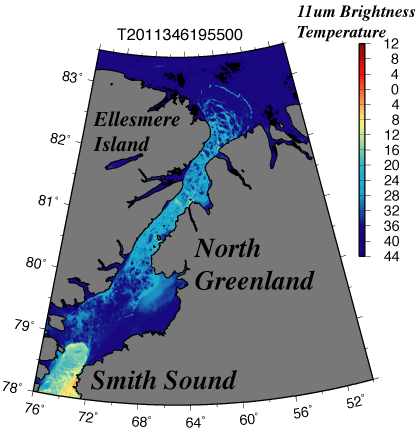
Winter has come to north-west Greenland as the sea ice of Nares Strait has locked itself to land and stopped movement of all ice from the Arctic Ocean in the north to Baffin Bay and the Atlantic Ocean in the south. While there is no sunlight for several more months now during the polar night, the warm ocean beneath the ice emits heat through the ice which becomes visible to heat-sensing satellites. The light yellow and reddish colors show thin ice while the darker bluish colors show thicker ice today:

Dec.-13, 2011 surface brightness temperature of Nares Strait showing an ice arch in Smith Sound separating thin and moving ice (reddish, yellow) from thick land-fast ice (blue).

The prior 2010/11 winter was the first in several years that these normal conditions have returned. The ice arch in Smith Sound did not form in 2009/10, 2008/09, and 2007/08 winters while a weak arch in 2007/08 fell apart after only a few days. Conditions in 2009 were spectacular, as only a northern ice arch formed. Since the ocean moves from north to south at a fast and steady clip, it kept Nares Strait pretty clear of ice for most of the winter as no Arctic ice could enter these waters and all locally formed new “first-year ice” is promptly swept downstream:

March-25, 2009 map Nares Strait, north-west Greenland showing heat emitted during the polar night from the ocean and sensed by MODIS satellite.

The very thin and mobile ice in Nares Strait of 2009 exposed the ocean to direct atmospheric forcing for the entire year. I reported substantial warming of ocean bottom temperatures here during this period. This new 2011/12 ice arch formed the last few days. If it consolidates during the next weeks, then it is very likely to stay in place until June or July of 2012. It decouples the ocean from the atmosphere and, perhaps more importantly, prevents the Arctic Ocean from losing more of its oldest, thickest, and hardest sea ice. This is very good news for the Arctic which has lost much ice the last few years.

For more daily thermal MODIS imagery take a peek at http://muenchow.cms.udel.edu/Nares2011/Band31/ for 2011. Replace Nares2011 with Nares2003 or any other year, and an annual sequence appears. Furthermore, my PhD student Patricia Ryan just sent me a complete list of files that I need to process until 2017. Fun times.

Swirling Ice in Coastal Waters off Eastern Greenland

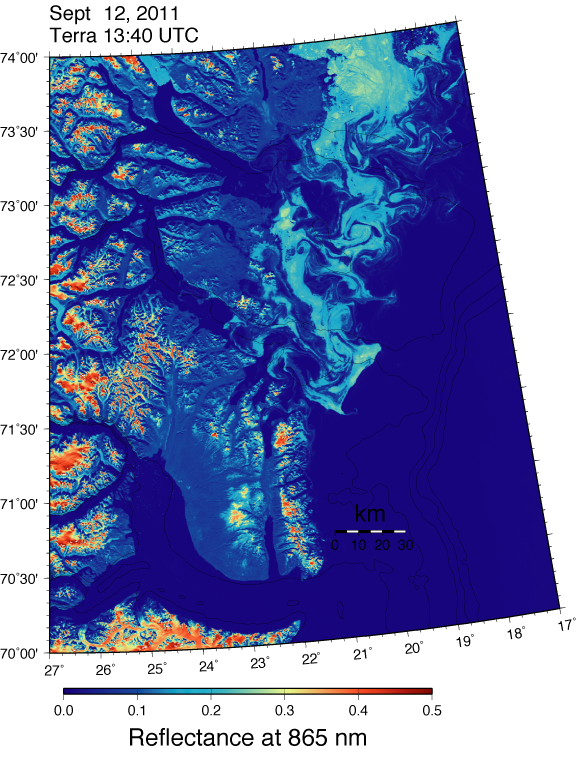
Nature provides us with art that is always changing in time and space. Delicate swirls and vortices give a rare glimpse of how the ocean’s surface looked today off eastern Greenland. The data originate from the MODIS/Terra satellite which from 440 miles above the earth captures light that is reflected from anything below. Here it shows the ice-free ocean (bottom right) and Greenland’s ice-free Scoresby Sound (bottom left) in very dark blues, lightly vegetated lands (left) in light blue, and a highly organized pattern of sea ice (top right) in white. The resolution of this image of light just beyond the visible, just beyond the red is about 300 yards and the swirls and elongated filaments are about 3-5 miles. To me, they vividly show the ocean’s surface circulation.

Swirling surface motion on the continental shelf off eastern Greenland Sept.-12, 2011 as indicated by sea ice. Black lines show contours of bottom depth from 300 to 1200 meters in 300 meter increments.

The physics of these motions are similar to those I was reading into another beautiful work of art to the north of Norway. The postulated physics involve the earth’s rotation as well as differences in density. The density of the ocean relates to its temperature a little and to its salinity a lot. Near the coast and at the surface, ocean waters are much fresher and thus lighter than they are offshore and at depth, because Greenland’s melting glaciers and sea ice are fresher than the waters of the Atlantic Ocean. The thin black lines show bottom depths to distinguish the deep Atlantic Ocean to the right in the image from the shallow continental shelf off eastern Greenland to the left in the image. Note that all the swirls, eddies, and filaments are within 30 kilometers (20 miles) off the coast in water less than 300-m deep. The same physics apply to the algal blooms off Norway which is the reason that the swirls and eddies are of similar size here and there as well.

Incidentally, the same physics also apply the discharges from rivers and estuaries such as the Delaware or Cheasapeake Bay. There, the pattern are not quiet as visible to the naked (satellite) eye as off Norway or Greenland, but if one takes measurements of the ocean, similar patterns of ocean salinity and velocity as, I speculate, they do here for the ice (Greenland) and algae blooms (Norway). While my academic journey of fresh water discharges started with the discharge of the Delaware River into the Atlantic almost 25 years ago, I am still fascinated by the many ways these patterns always come back to me. Physics and oceanography are beautiful in both their many natural manifestations and its unique balance of forces. There is so much more in how the oceans interact with the ice and glaciers off Greenland and elsewhere. To be continued …