Tag Archives: Greenland

Nares Strait 2012: First Petermann Ice Island Photos

The CCGS Henry Larsen dropped its science party of nine at Resolute on Cornwallis Island near the center of Lancaster Sound. We are staying at the “Polar Continental Shelf Project” which is a Government Canada base for science and logistics people working all over the Canadian High Arctic. Over dinner we met a group of graduate students, botanists, whom we had met 4 days ago at Alexandra Fjord where they were living since June. I had missed the rendezvous on the water then, because I freakishly tried to refurbish a tide gauge that we recovered in the morning and re-deployed in the afternoon. One of the students, Anne, told Renske and me, that they saw narwhales at Alexandra Fjord for the first time in at least 4 summers that she lived there. I wonder, if those were the same narwhales that we Petermann Fjord.
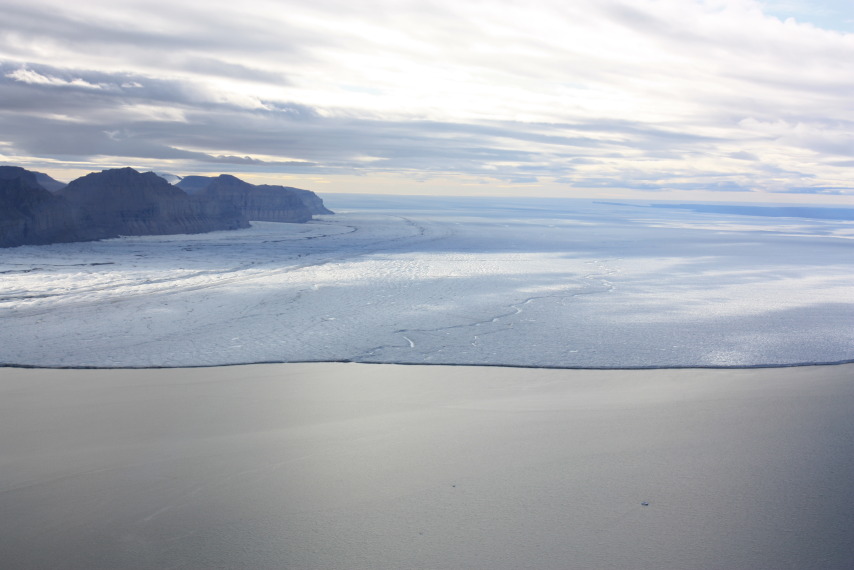
North-eastern portion of Petermann Glacier on Aug.-11, 2012, the meandering river is the centerline, view is almost due east. [Photo Credit: Canadian Coast Guard Ship Henry Larsen.]

Which brings me to the purpose of this quick blog entry: The Internet on land, while not much faster than on the ship, is more stable. This allowed me to download the first photos of both the ice island at the entrances of Petermann Fjord and the new front of the glacier far into the fjord. The pictures were taken from the helicopter checking on the ice island last Friday as we worked sections deep inside the fjord. It was a frantic day of data collection in stunned scenery. It was challenging to stay focused on keeping sensors, computers, and winches running smoothly with so much natural beauty in all directions. I will post more photos in higher resolution as soon as we are getting home late sunday night. As a first teaser, however, here the first of many photos and videos. The two photos below I degraded from 4-6 MB to 0.1-0.2 MB to allow for limited bandwidth up north.
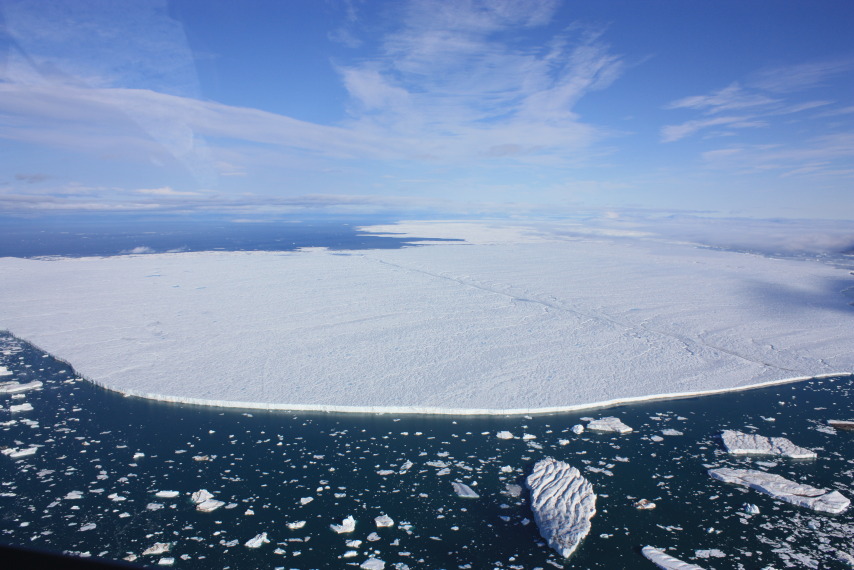
Petermann Ice Island 2012 (PII-2012) as seen Aug.-11, 2012 at the entrance of Petermann Fjord. The view is to the north-west. [Photo Credit: Canadian Coast Guard Ship Henry Larsen.]

Addendum: Last night I uploaded the 4.6 MB version of the image. Photo credit should again be given to Canadian Coast Guard Ship Henry Larsen, it was Jo Poole of British Columbia who took the picture using the official ship’s camera. Leaving for Iqualuit in 3 hours.
Nares Strait 2012: Charting New Waters in Petermann Fjord

By Andreas Muenchow, off Joe Island, Greenland, Aug.-11, 2012

We just left Petermann Fjord, squeezing by a Manhattan-sized ice island blocking much of its entrance. An armada of 100s of ship-sized tabular icebergs were all jockeying for positions behind the big one. Captain Wayne Duffett of the Canadian Coast Guard commanded the CCGS Henry Larsen into the new waters of Petermann Fjord, Greenland, with skill, experience, and a calculated dose of daring, trusting both his instincts and his crew. These new waters were formed when Petermann Glacier lost as much as 1/3 of its floating ice shelf during massive break-off events in 2010 and again in 2012. The Henry Larsen was the first and only ship for years to sail and survey this mare incognita for the last 22 hours. It was a long day.

I slept only one of the last 24 hours, skipped dinner, and will head for breakfast in 10 minutes. Being excited and working hard with 24 hours of daylight is exhausting, draining, but also immensely satisfying. We completed a spatial bathymetric survey, collected water and water properties along the new seaward face of the glacier from the surface to 1200 meter depth, and did the same for a section along the axis of the fjord that used to be covered by an ice-shelf.

I tried to document and capture the changing icy seas and their interactions with both land and ocean by taking plenty of photos and video, to later share with those who cannot be here. Several pods of narwhales — they really do have 3-ft long tusks (a tooth really) — were feeding on ocean fronts within a mile of Petermann Glacier’s new face…

Breakfast is ready; I am sending this off as is, without much editing (too tired) {Editor’s note:  Good thing there are those less distracted by the excitement of new icy worlds to do some proofreading…}, then some sleep while those who sleep will install a new weather station on Joe Island.  Science aboard a ship like the CCGS Henry Larsen never really stops…

Nares Strait 2012: Entering Uncharted Waters

Allison Einolf, Aug.-11, 2012

As scientists, we are constantly exploring new things, but usually our exploration is within the realm of knowledge. Rarely do we get an opportunity to sail unexplored waters or tread where no one has tread before. Yesterday, our location was plotted inside of what was the Petermann Glacier on the now outdated navigational chart. We were in uncharted waters.

As a child, I read hundreds and hundreds of books about exploration. Some were fictional, some were historical, some were futuristic, and some were mythical. I read about traveling to the furthest reaches of the universe or the depths of the ocean. I read about fantasy worlds, I read about sailing off into the distance with the only goal being adventure, and I longed for the life of an adventurer. So I made igloos out of blankets, and my younger brother and I fought off dragons and found new worlds in our basement and the nearby parks.

Growing up, I became slightly disappointed that most of the world we live in is charted and mapped and although I love being able to get directions online, it took the adventure out of things. I came to accept that I would have to find different ways to explore the world around me, and I turned my love of adventure to science.  I would never have guessed that science would bring me to a place of complete unknowns.

I was excited when we saw the Petermann Ice Island at the mouth of the fjord. I was thrilled and amazed, and I kept on taking pictures instead of going inside to get a hat and gloves. That was when it first sunk in that no one had seen this before. The ice island has been talked about and examined from satellite imagery, but no one previously had gotten so close that they almost felt like they could touch it.

I was filled with awe as I took pictures because I realized I could only see the edges of it near the ship, where it was narrower, and that it was so huge that I could barely comprehend it’s size. Pat and Jo got to go up in the helicopter with the ice specialist to check out the extent of the ice, and it was impossible to get the whole island in a photo, even from 3000ft in the air. Although there have been many jokes about the comparison of the ice island to the size of Manhattan, I think it was appropriate. Manhattan may not be a very large island, but it is immense in character, and the ice island is twice it’s physical size and definitely has character of it’s own. The rolling hills and rivers and lakes that cover the surface of the ice may not be as large as the lakes I am used to, but the expanse of white goes on forever. It’s awe-inspiring.

My excitement at the edge of the ice island was nothing compared to my exhilaration as we broke through the ice at the mouth of the fjord and sailed into uncharted waters. Of course the edges of the fjord have been charted, and they can be seen from satellite imagery, but nothing was known about what lay under the ice.

As we lowered the first rosette and brought back the first water samples, I once again realized that we were pioneers. We were the first to be here, since the water here has been covered in ice for at least 180 years, and probably much, much longer. We were the first to take water samples, and the first to take depth soundings. We are explorers. The adventure of it has had me smiling constantly since we first saw the ice island, and I don’t think that anything I write will come anywhere close to describing the wonder of how it feels to be here.


Nares Strait 2012: First Challenges and Petermann Ice Island Coming

Petermann Glacier’s 2012 ice island is heading south, the Canadian Coast Guard Ship Henry Larsen is heading north, and my passport went through the washer. Ticket agents at Philadelphia airport refused to accept my worn passport to get into Canada. My journey appeared at a dead-end, but ticket agents, U.S. State Department employees in downtown Philadelphia, and a Jordanian cab driver got me to Canada with a new passport, a new ticket, and a new lesson learnt in 4 hours. I did not believe it possible, but it was. I arrived in Canada with an entire day to spare.

Over the years I learnt to plan and budget generously for Arctic research, and then improvise with what is available. I was taught to bring spares of all critical equipment to prepare for loss and failure. I learnt to allow for extra time as missed planes, weather, and who knows what always make tight schedules tighter, like passports going through washers. I learnt that patience, civility, co-operations, and seeing the world through other people’s eyes and responsibilities get me farther than fighting. After I got my PhD in 1992, I learnt that the very people who cause troubles by enforcing rules and regulations are often also the most likely to know the way out of trouble. The ticket agent who denied my passport was also critical to help me get a new one. Thank you, Beth.

Our science party of eight from Delaware and British Columbia and the ship’s crew of 30-40 from Newfoundland will meet on the tarmac of St. John’s tomorrow at 4:30am, fly to and refuel at Iqaluit, Nunavut, and arrive at the U.S. Air Force Base at Thule, Greenland. The crew who got the ship from St. John’s to Thule will return with the plane home. It usually takes two days sailing north by north-west to reach Nares Strait from Thule, but this year the ice will be a challenge far greater than getting a new passport in 4 hours.

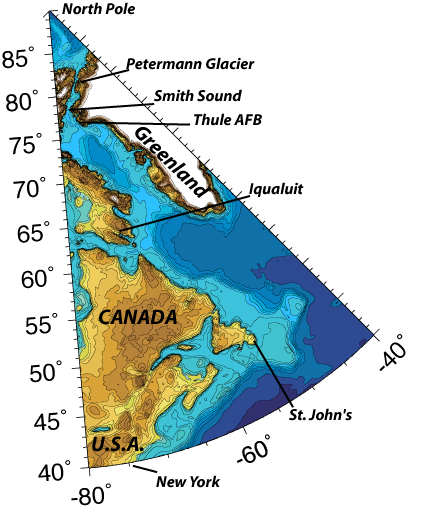
Western North-Atlantic and Arctic regions with Greenland in the west (top right) and Canada (left). Blue colors show bottom depth (light blue are shelf areas less than 200-m deep) and grey and white colors show elevations. Nares Strait is the 30-40 km wide channel to the north of Smith Sound, Baffin Bay is the body of water to the south of Thule.


The ice island PII-2012 is moving rapidly towards the outer fjord at a rate that increased from 1 km/day last week to 2 km/day over the weekend. I expect it to be out of the fjord an in Nares Strait by the weekend when we were hoping to recover the moorings with data on ocean currents, ice thickness, and ocean temperature and salinities that we deployed in 2009. The ice island is threatening us from the north: Without a break-up, it is big enough to block the channel as another large ice island did for almost 6 months in 1962.

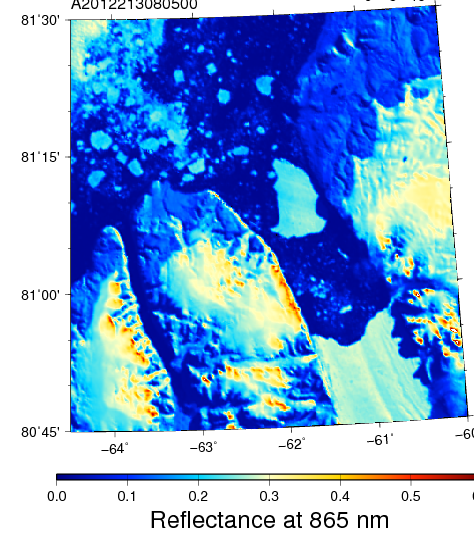
Petermann Glacier, Fjord, and Ice Island on July 31, 2012 at 08:05 UTC. Nares Strait is to the top left. Petermann Glacier, Greenland is on bottom right. PII-2012 is at the center.


At the southern entrance to Nares Strait, lots of multi-year ice is piling up near the constriction of Smith Sound. Winds and currents from the north usually flush this ice into Baffin Bay to the south, however, the same winds and currents will move the ice island out of Petermann Fjord and into Nares Strait. We will need patience, humility, and luck to get where we need to be to recover our instruments and data. A challenge that cannot be forced, we will likely wait and go with the flow rather than fight nature. We will have to play it smart. We are the only search and rescue ship for others. I am nervous, because this year looks far more difficult than did 2003, 2006, 2007, or 2009. In 2005 we were defeated by the winds, but that is a story for a different day.

The currents and winds of Nares Strait

[Editor’s Note: Undergraduate Allison Einolf of Macalester College in Minnesota summarizes her work at the University of Delaware that was supervised by Andreas Muenchow as part of an NSF-funded summer internship.]

I’m about to fly to Thule, Greenland for a research expedition into the Nares Strait. We had planed to survey Petermann Fjord, but our proposed cruise track is facing an obstacle twice the size of Manhattan.

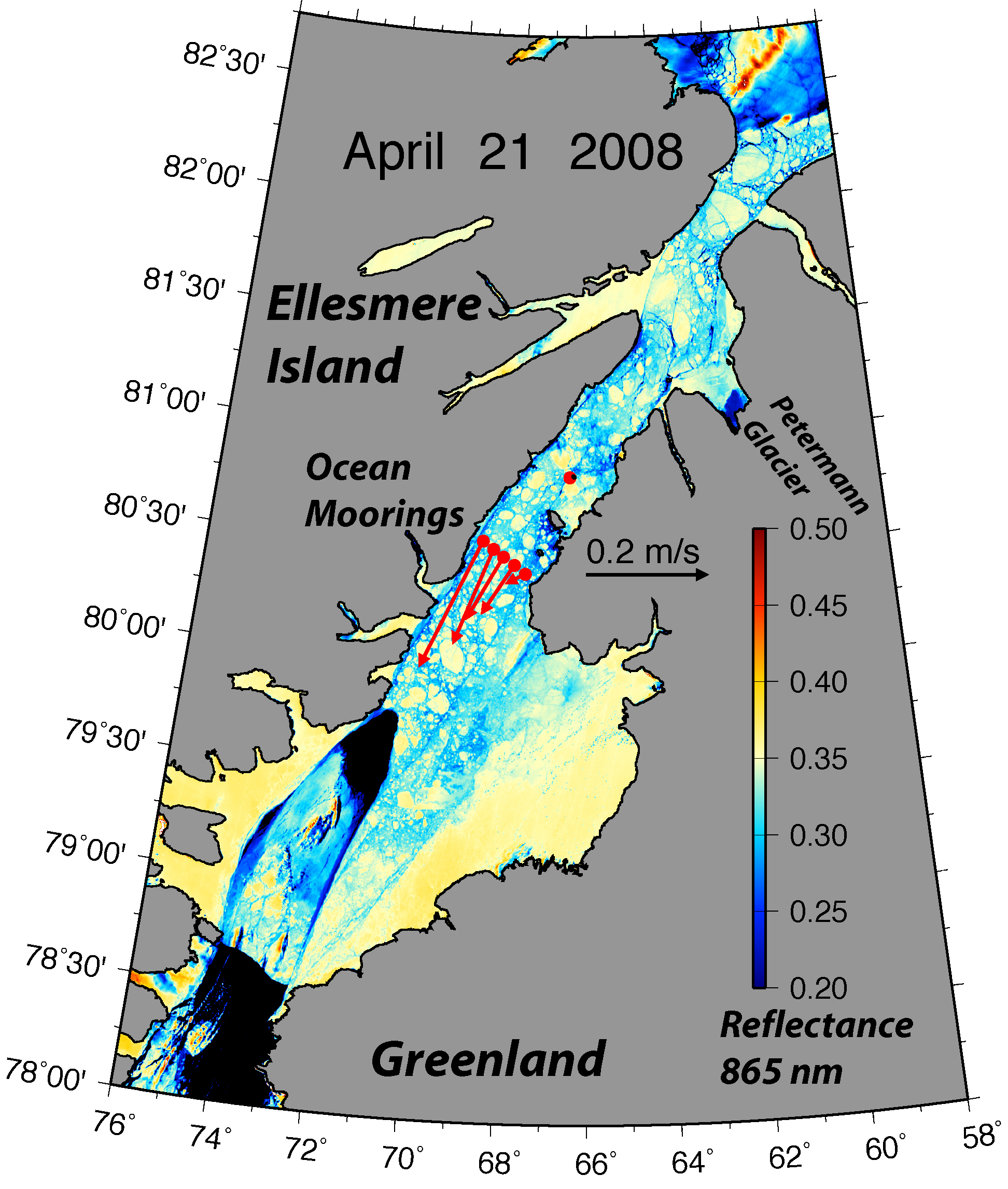
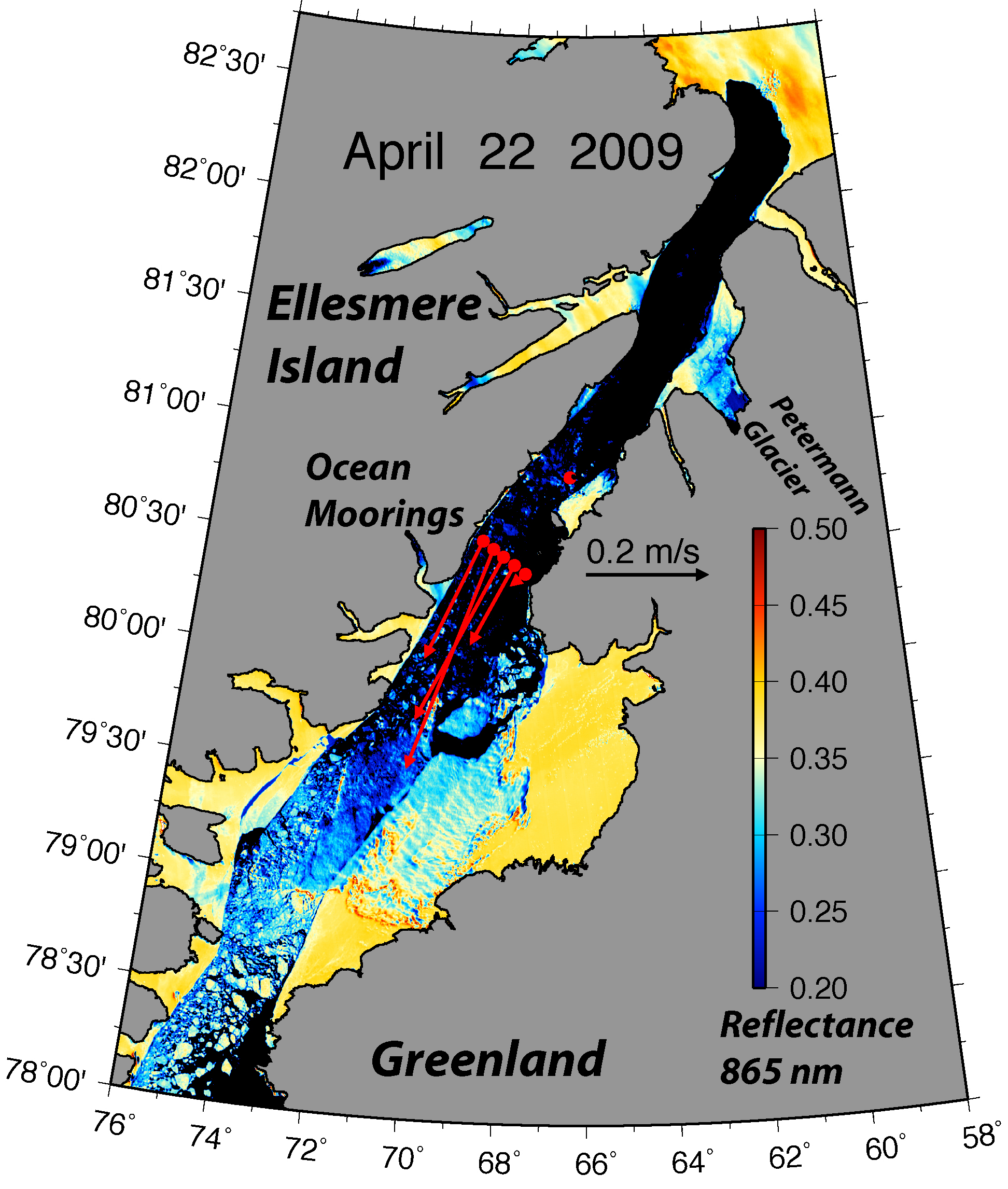
We’re heading up north to pick up instruments that have recorded current velocities, salinity, temperature, and ice thickness in Nares Strait since 2009. I’ve been working all summer on data retrieved on a similar cruise three years ago, focusing on what effects the ice arches have on currents north of the ice arches.

Nares Strait MODIS satellite imagery of the study area and ice arch April 21, 2008. Red dots are instrument locations. Arrows show current velocities.

Nares Strait MODIS satellite imagery of the study area and ice arch April 22, 2009. Red dots are instrument locations. Arrows show current velocities. Note the lack of the southern ice arch, but the presence of one north of the study area.

Continue reading