Ocean Weather Below a Greenland Floating Glacier

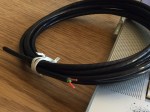
Sensing the oceans below ice as thick as the Empire State Building is tall, we are revealing some of the mysteries of ocean melting of one of Greenland’s largest glaciers. The expedition to Petermann Fjord last month made possible the deployment of three ocean sensing stations that all call home daily via Iridium satellite phone to send us new data from 800 meters below sea level. The ice of the glacier at our stations is 100 to 300 meters thick and a whimsical cable with 3 tiny wires connects the instruments under the glacier to a home-made computer that calls home daily with new data. I am still stunned at the many marvels of technology that all came together to make this happen.
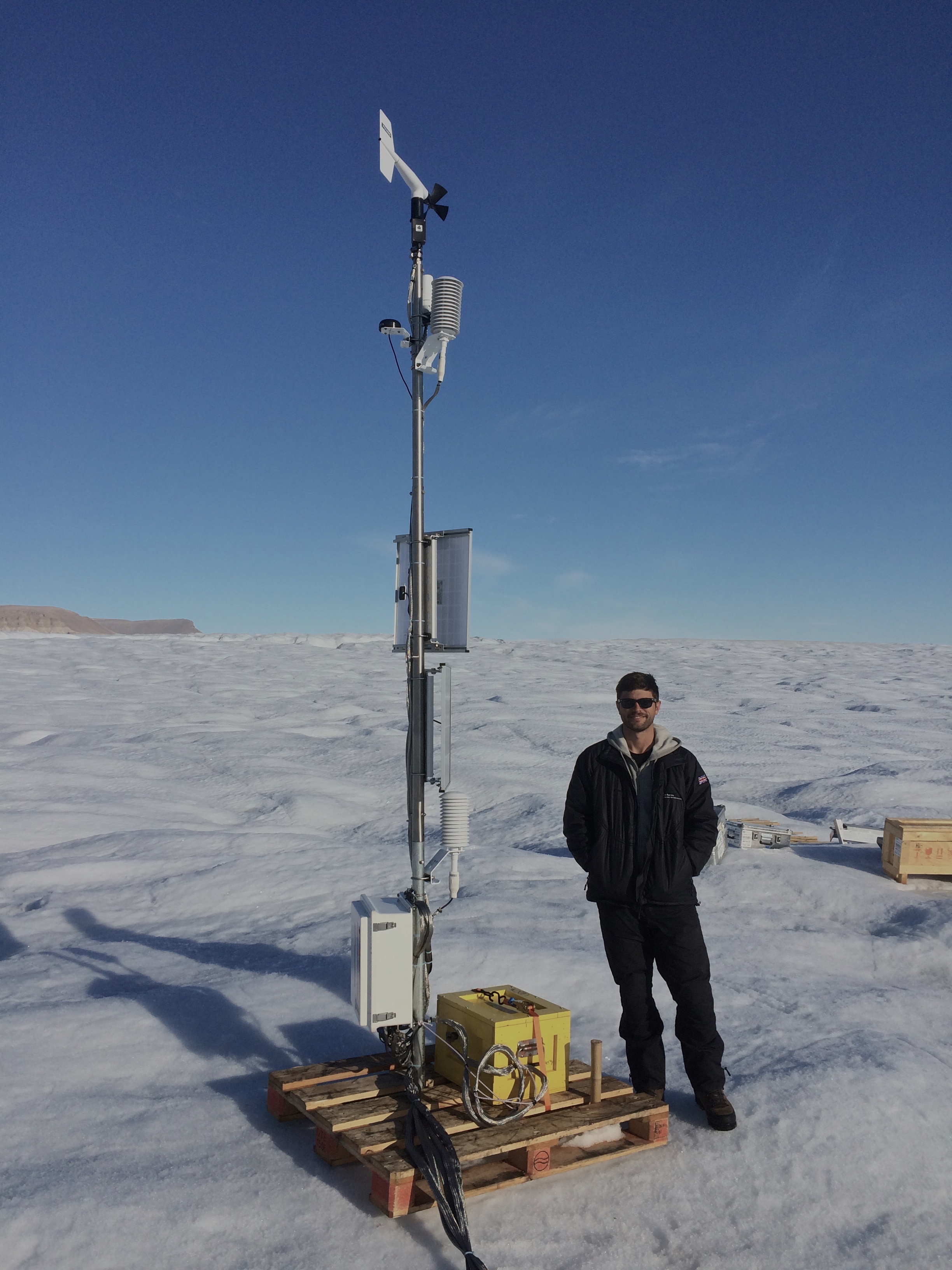
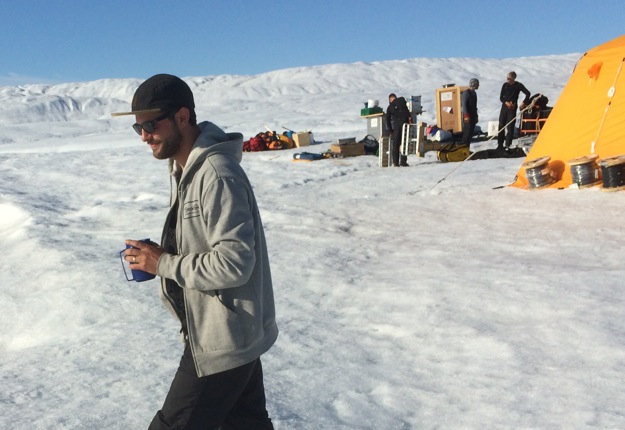
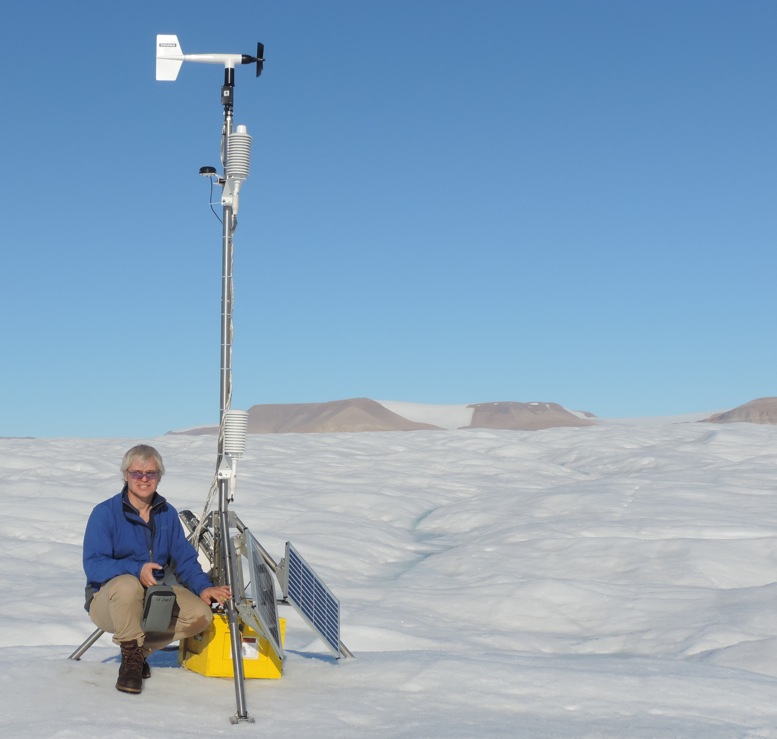
University of Delaware PhD student Peter Washam at the Ocean-Weather station on Petermann Gletscher after final installation 2015-Aug.-20, 17:00 UTC at 80 39.9697 N and 60 29.7135 W.

University of Delaware PhD student Peter Washam at the Ocean-Weather station on Petermann Gletscher after final installation 2015-Aug.-20, 17:00 UTC at 80 39.9697 N and 60 29.7135 W.

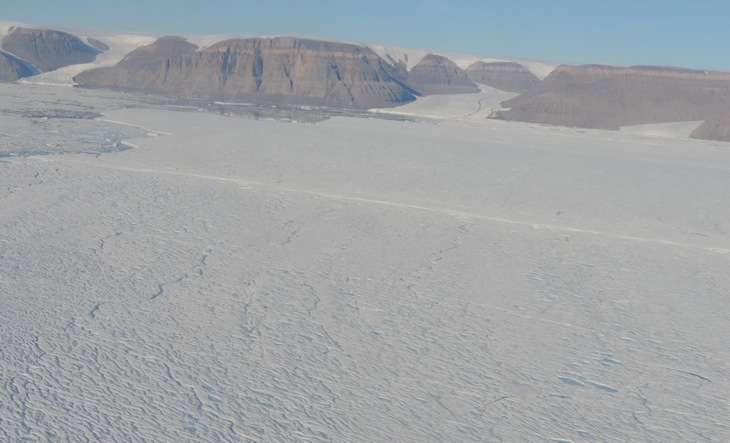
Panoramic view of the ocean-weather station on Petermann Gletscher. View is towards the south-east with Washington Land in the background.  [Photo credit: Peter Washam].

Panoramic view of the ocean-weather station on Petermann Gletscher. View is towards the south-east with Washington Land in the background. [Photo credit: Peter Washam].

It started with an off-the-shelf automated weather station that David Huntley at the University of Delaware put together for me with the non-standard addition of 5 serial ports that each allow one ocean sensor to be connected by cable to the weather station. It continued with the holes that Paul Anker and Keith Nicholls of the British Antarctic Service drilled through Petermann Gletscher. My PhD student Peter Washam was on the ice helping with the drilling, preparing the ocean sensors, and he is now processing some of the new ocean data.

AWS2015

The map above shows Petermann Gletscher (bottom right), Petermann Fjord, and adjacent Nares Strait. The red lines are bottom depths at 500 and 1000 meters while the thick black line shows the location where the 550-m thick glacier sits on bed rock. All glacier ice seaward of this black line is floating with warm ocean waters below. These waters enter the fjord at he sill at the entrance to Petermann Fjord which is about 450 meters deep. The blue dots are locations where last months we collected detailed profiles of ocean temperature salinity, and oxygen. The warmest water inside the fjord and under the glacier enters near the bottom at this sill. The green dots on the glacier are the 3 drill sites where we put our ocean sensors down while red triangles are “fancy” GPS receivers that we placed for almost 2 weeks on the glacier. The one triangle on land (bottom right) is a permanent GPS station at Kap Schoubye that UNAVCO maintains under the code name SCBY. We will reference our moving glacier GPS station (the glacier moves) to this fixed station on bed rock, but that’s a story for another day.

The ocean data are worked up by a small, but wonder group of men and women of all ages working out of the universities of Gothenburg (Sweden), Oxford (England), and Delaware (USA) as well as BAS (England). It is very much an informal group of people who like each other and met in strange ways over the last year or so with all of us juggling way too many projects for which we all have way too many ideas. Bottom-up collaboration and sharing at its best from the bottom up.

Two quick highlights rushed onto these pages before I have to run off to teach a class on signal processing:
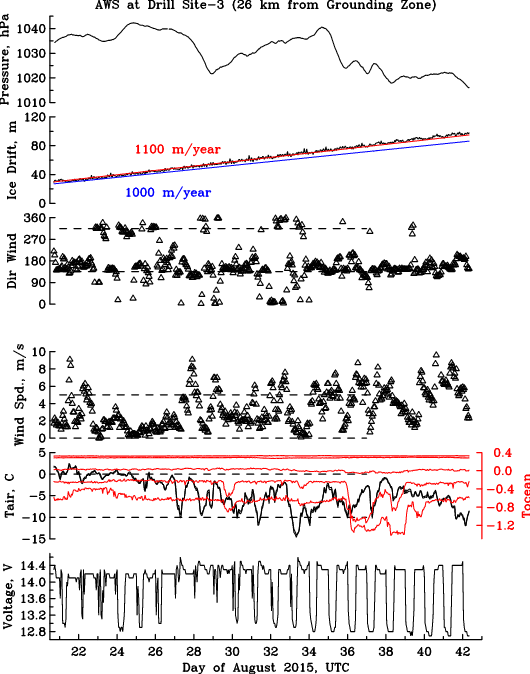
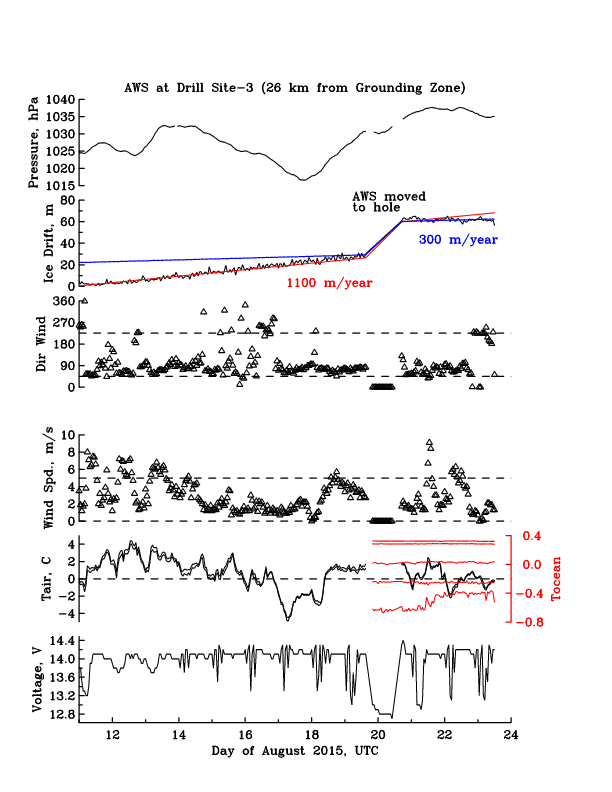
Measurements from the ocean weather station up until 2015-Sept.-11 as a function of time where Day-20 is Aug.-20 and Day-32 is Sept.-1. The station provides battery voltage (bottom panel), air and ocean temperatures, wind speed and direction, ice drift from GPS, and atmospheric pressure (top panel).

Measurements from the ocean weather station up until 2015-Sept.-11 as a function of time where Day-20 is Aug.-20 and Day-32 is Sept.-1. The station provides battery voltage (bottom panel), air and ocean temperatures, wind speed and direction, ice drift from GPS, and atmospheric pressure (top panel).

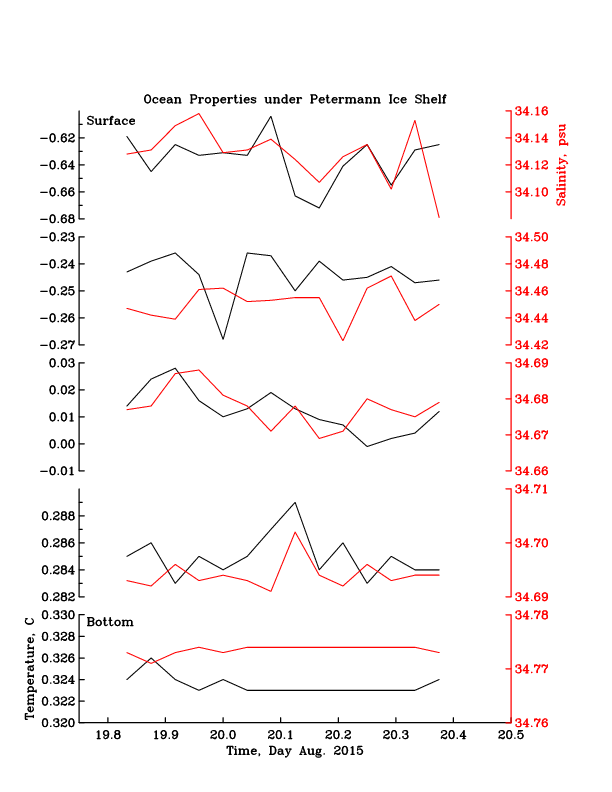
Ocean temperature (black) and salinity (red) observations from below the ice shelf of Petermann Gletscher at 5 different vertical levels from near the bottom (bottom panel) to the ice-ocean surface (surface panel).

Ocean temperature (black) and salinity (red) observations from below the ice shelf of Petermann Gletscher at 5 different vertical levels from near the bottom (bottom panel) to the ice-ocean surface (surface panel).The bottom of the ice shelf is about 90 meters below sea level.

Note that the scales for temperature and salinity are different at different vertical levels. The warmest water is always found near the bottom while both temperature and salinity under the ice shelf vary by a larger amount that we had initially expected. This means that there are direct and fast connections of the ocean under the glacier with waters inside the fjord and beyond. Notice also that air temperatures are well below freezing (0 degrees Celsius) for 2-3 weeks now while the ocean waters are well above freezing (-1.7 degrees Celsius) everywhere. Hence there is no melting at the surface while there is much melting at the bottom of the glacier. While trivial, this emphasizes the controlling influence that the oceans have on glaciers and ice shelves such as Petermann Gletscher. In the meantime, we got much exciting and fun work ahead of us.

Shout of thanks to NASA (and the US tax-payers) who funded this ocean-weather station at the University of Delaware at about $64,000 for a single year and NSF (and again the US taxpayers) who funded the larger ocean- and land-based experiments within which small part was embedded.

Münchow, A., Padman, L., and Fricker, H.A. (2014). Interannual changes of the floating ice shelf of Petermann Gletscher, North Greenland from 2000 to 2012, Journal of Glaciology, Vol. 60, No. 221, doi: 10.3189/2014JoG13J135

Johnson, H., Münchow, A., Falkner, K., & Melling, H. (2011). Ocean circulation and properties in Petermann Fjord, Greenland Journal of Geophysical Research, 116 (C1) DOI: 10.1029/2010JC006519

Rignot, E., & Steffen, K. (2008). Channelized bottom melting and stability of floating ice shelves Geophysical Research Letters, 35 (2) DOI: 10.1029/2007GL031765
Oceanographers in Thule, Greenland

Returning from Petermann Fjord and Gletscher, we left the Swedish icebreaker I/B Oden and its fine crew yesterday afternoon. Our military plane to southern Greenland is broken with spare parts needed to be shipped in from Air Force bases in the United States and Germany. Thule Air Force Base (AFB) at Pituffik is the northern-most US military installation that is maintained since the Cold War with lots of help from Danish authorities and workers. Thule AFB is a large airfield and supply center for much of northern Greenland and beyond. Air temperatures are in the 40ties and it feels very warm after sailing south for 3 days to get here.

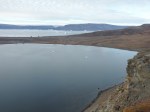
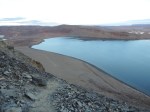
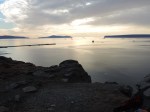
As last year, the first thing I did after living for 5 weeks in tight quarters on a ship was head out into the wilderness. While almost everyone else was partying ashore after raiding the local supermarket for fresh fruit, vegetables, beer, and wine, Frederik and I headed out the to climb the mountain that I wanted to climb since I first set eyes on it in 2003. We did not set out until well past 6pm local time, but with lots of sunlight even past midnight, we set out. Who knows if and when we may get this opportunity again. There were also some geocaches.

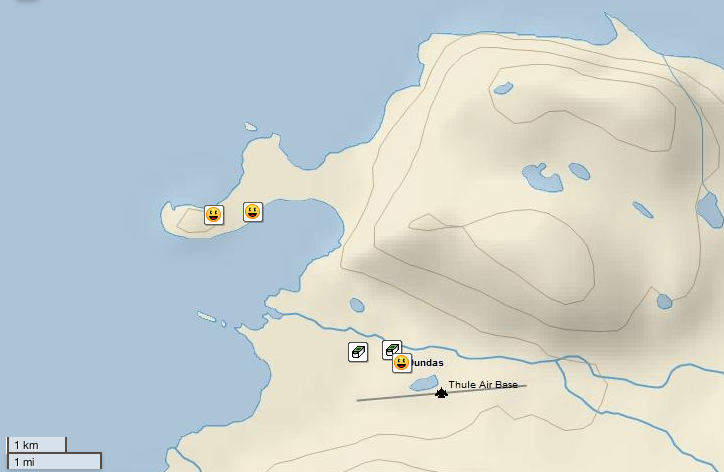
Geocaching map of Thule AFB, North Mountain, and Dundas Mountain. Smiley faces show that I found and opened the hidden treasures.

Geocaching map of Thule AFB, North Mountain, and Dundas Mountain. Smiley faces indicate that I found and opened the hidden treasures.

Frederik is Swedish ecologist whose work around Petermann Fjord was mostly land-based. Leading a group of 3-4 researchers, he was taking an inventory of plant and wild life in a methodical way by setting out a grid 2 meters by 2 meters at random locations. His team then painstakingly counted and recorded every bit of plant, seed, or animal excrement (=shit) that they could find and count. They were living in tents for 5-10 days at a time, returned to the ship via helicopter for a shower, a meal, and to change study area. Within 8 hours his group was usually gone again not to be seen for another 5-10 days.

In contrast to these intense “working hikes,” our leisurely 4 hour stroll was relaxing as he had to record nothing and did not have to lead anyone. Nevertheless, I got blisters on my feet that were well worth this guided nature tour as Frederik patiently answered all my questions on all the trees (1 inch high), all the flowers (1/3 inch), and all the animals that we we saw (falcons, hares, foxes). He also told me that during our 4 hour hike he saw more wild and plant-life than he had seen the entire 4 weeks earlier up north in Hall and Washington Land of Greenland and Ellesmere Island of Canada. There are shades of gray and there are many shades of bare.

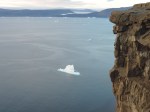
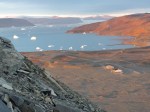
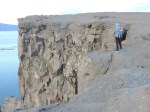
On our way out of town we followed the road to get to a bridge that crossed a big stream of run-off from the nearby Greenland ice sheet that was visible in the distance. Quickly, however, we noticed that the dusty roads are not really leading us to where we wanted to go, so we made our own path over the ridge to the north of town called creatively “North Mountain.” From there we hiked down to the beach of an isthmus that connects to the landmark Dundas Mountain with remains of the old village on this spit of sand and gravel. A group of Danes in trucks and on all-terrain vehicles greeted us at the bottom of Dundas Mountains. Frederik later told me that they were mostly trying to get information on women that may have arrived with us, but they also encouraged us to race up the 60 degree slope. The record apparently stands at 6 minutes and 45 seconds, but we were in no mood to race … quite the opposite: We wanted to take in the views and relax amidst stunning natural beauty in the rough:

Once atop I found the geocache I was looking for as well as a trackable treasure. When I recovered this trackable and posted the find online, I got an elated e-mail from Australia where the owner of the treasure lives. The treasure is now with me in Delaware where I will hide for other people to find and move along in a wonderful game of hide and seek and traveling.

Now that I am home again after 6 weeks away without real internet or e-mail access (imagine the horrors), I want to tell some of the many stories that involve a group of people doing science, making discoveries, and share what they find. Most of us are deeply grateful for the privilege to make these discoveries: It is people like you, my dear reader, because the funds for ships and planes and food and fuel and much more comes from organizations like the National Science Foundation, the National Aeronautics and Space Administration, as well as the US Department of Defence, but ultimately the funds all come from tax-paying citizens of a great country.

Taking the Pulse of Petermann Gletscher

Posted by Pat Ryan for Andreas Muenchow

23-August-2015 at 80:57.3 N 061:27.1 W

(note correction below)

I just may have made a discovery that I cannot share with anyone on the ship right now. The giant mass of ice that is Petermann Gletscher just slowed down moving only 1 meter per day for the last 3 days rather than the 3 meters per day that it usually does and that has been reported in the scientific literature. This measurement comes from the newly deployed University of Delaware weather station that also contains a not-so-fancy $300 Garmin GPS as well as 5 ocean sensors that measure temperature and salinity about 95-m, 115-m, 300-m, 400-m, and 810-m below the surface of the floating and moving ice.

Time Series of Glacier Drift

Time Series of Glacier Drift (correction appears below)

As the glacier puts on the breaks, I also see a rather dramatic increase in ocean temperature from -0.6 to -0.35 degrees Celsius within about 10-m of the ice-ocean interface. The saltiness of the ocean also increased from below 34.1 to above 34.2 practical salinity units that you can think of as grams of salt per kilogram of water, roughly. Only 20 m below in the water column, the opposite is happening: The water there cools a little bit and becomes fresher. This suggests some mixing as the salinity differences become smaller and heat from the lower layer moves up towards the ice. Some force must be applied to the fluid to do this. Recall that a force is mass times acceleration. The force of a mosquito splashing on the wind shield of your car is small, because the mass of the mosquito is small even though its acceleration (from zero to the speed of your car) is large. Now imaging this glacier: Its mass is enormous, so you only need to change its velocity a tiny amount, from 3 to 1 meter per day, say, to generate a massive amount of force.

Photo of helicopter deck with Belgrave (left) and Petermann (right) Glaciers in back Aug.-23, 2015; view is to the north-east.

Photo of helicopter deck with Belgrave (left) and Petermann (right) Glaciers in back Aug.-23, 2015; view is to the north-east.

As I look outside my cabin window right now, I see the terminus of Petermann sitting there innocently not appearing to do much, but it is literally changing the face of the earth as it moves fast, slows down, moves some more, and over 1000s of years cut a very deep fjord and perhaps canyon deep into the mountains and even deeper into the sea floor. The helicopters are whizzing overhead right now returning all the gear that was needed to drill through 100s of meters of hard glacier ice to provide access holes to both ocean and sediments that has been in total darkness for many 100s of years.

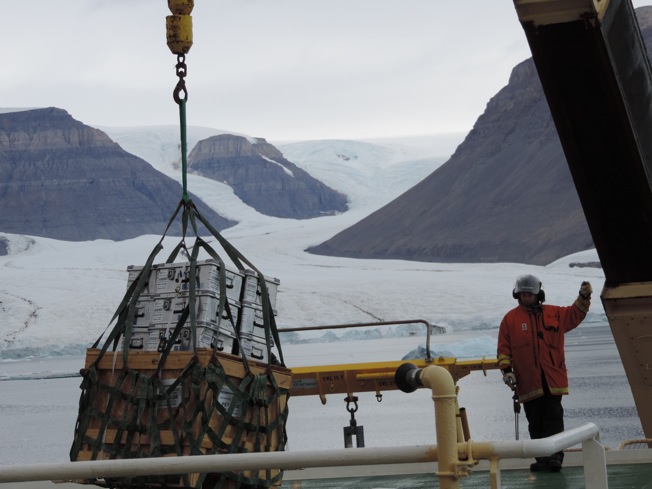
Photo of helicopter delivering cargo from the finished ice camp back to the ship on 23 Aug. 2015.

Photo of helicopter delivering cargo from the finished ice camp back to the ship on 23 Aug. 2015.

Still, there is life down there, lots of it Anne Jennings, who closely looks at the sediment cores, tells me. We speculate that the life is supported by vigorous ocean flow that connects the open fjord with the glacier covered deep ocean. Food stuff like plankton may move some distance under the floating glacier to support a population of other critters that I know nothing about. No narwhals this year so far, though.

So why I am writing this up here rather than share it with people on the ship? Well, this is Sunday morning and there was much to celebrate last night when the ice drilling team returned after 2 weeks camping on the ice and collecting data from their three drill holes. Furthermore, the the ocean weather station reported for the first time in over 2 days uploading all the data I show above. This happened well past midnight and several of us discussed the data and future plans in the cafeteria until 1:30 am. So the people not working right now are all sleeping (10:30 am here) as we probably will work through the night to map the Atlantic waters flowing into the fjord at its sill towards Nares Strait …  which we have not yet done over the 3 weeks we have been in the area. I probably also should help with unloading the helicopters or getting the Chief Scientist Alan the data files he needs to catalogue the water samples we collected last night. Work on Oden never stops … as there is so much to do as we are barely scratching the surface or bottom of the ocean here. [Incoming helicopter, 4th one since I wrote these lines too fast, perhaps.]

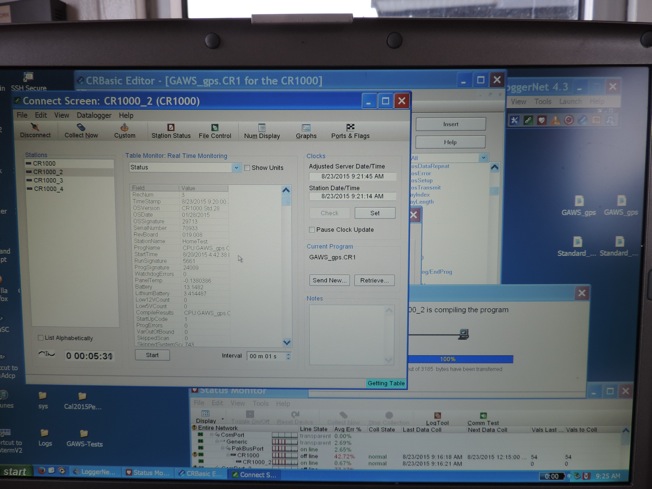
Screenshot of a successful RS-232 serial connection from ship to ocean weather station on Petermann Gletscher and ocean sensors deployed 810 m below the glacier’s ice surface with active real time data transmissions. This session uploaded new codes to the secondary data logger to activates its secondary back-up memory.

Screenshot of a successful RS-232 serial connection from ship to ocean weather station on Petermann Gletscher and ocean sensors deployed 810 m below the glacier’s ice surface with active real time data transmissions. This session uploaded new codes to the secondary data logger to activates its secondary back-up memory.

Correction:

Petermann Gletscher did slow down the last few days by about 10% as measured by the GPS at the UDel ocean-weather station. The suggested slow-down to 300 meters per year, however, is false, because I did not properly take into account how the station was moved by 30 meters to the south-west. The correct and updated estimate is the figure below. Please discard the the above figure erroneous.

Sorry for the confusion … more data coming from this station will place the short term change in glacier speeds into a larger context. Furthermore, the present “cheap” GPS system will need to be verified by a set of three “fancy” differential UNAVCO GPS that were recovered today, but we have not yet decoded the data contained on those units.

Back to CTD profiling the water properties across the sill at the entrance to Petermann Fjord that we will have to complete by 3 am or in about 6 hours.

Time Series of Glacier Drift (Corrected)

Time Series of Glacier Drift (Corrected)

Ocean Observing Station Reporting from Below Petermann Gletscher, Greenland

We discovered warm waters 800 meter down a hole drilled 100 m through Petermann Gletscher ice.  Every hour an ocean sensor querries temperature, salinity, and pressure and reports its readings to a weather station atop the glacier. The warm waters come from the Atlantic and enter the Arctic Ocean near Spitsbergen. Prior to hitting our sensors in an 800 m deep fjord in northern Greenland, the water moved along Siberia, Alaska, and northern Canada before snaking its way into Petermann, Greenland to perhaps melt this glacier from below while surface air temperatures are already below freezing. It is a long way from home for both those Atlantic waters and us scientists and crew here aboard the Swedish icebreaker Oden and four hardy explorers camping on the floating ice of Petermann Gletscher.

Peter Washam on Petermann Gletscher at an ice drilling camp. Cables and ropes against tent are used later to connect ocean sensors to the weather station.

Peter Washam on Petermann Gletscher at an ice drilling camp. Cables and ropes against tent are used later to connect ocean sensors to the weather station.

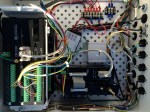
Keith, Paul, and Mike of the British Antarctic Survey as well as my graduate student Peter deployed 5 ocean sensors with cables and ropes. A weather station designed by David Huntley of the University of Delaware provides the command and control between ocean sensors, battery and solar panels, and the Iridium satellite modem to send data back home. For me this engineering project took over much of my life the last 6 months as all testing and coding has been done while traveling. Much problem-based learning took place not for pedagogic reasons, but as a necessity to make something special work. And work it does.

First 14 hours of ocean data from below the floating ice shelf of Petermann Gletscher as of 20. Aug. 2015. Top time series are from just under the ice shelf near 120 m while the bottom time series is from a sensor at 810 m below the surface.

First 14 hours of ocean data from below the floating ice shelf of Petermann Gletscher as of 20. Aug. 2015. Top time series are from just under the ice shelf near 120 m while the bottom time series is from a sensor at 810 m below the surface.

These are the first and only data from below a glacier in Greenland that do not involve a person tending to instruments, computers, and cables with a helicopter or aircraft waiting. Our observing system is fully automated and the first 14 hours of data were collected by my computer on the ship calling the computer on the weather station which then sends the data after some computer-to-computer hand-shaking.

The weakest and most fickle link in this chain is the Iridium satellite phone to move data through thin and cold air. Senator McCain of Arizona called the ship yesterday and was rudely disconnected by Iridium the same way that our ocean weather station is.

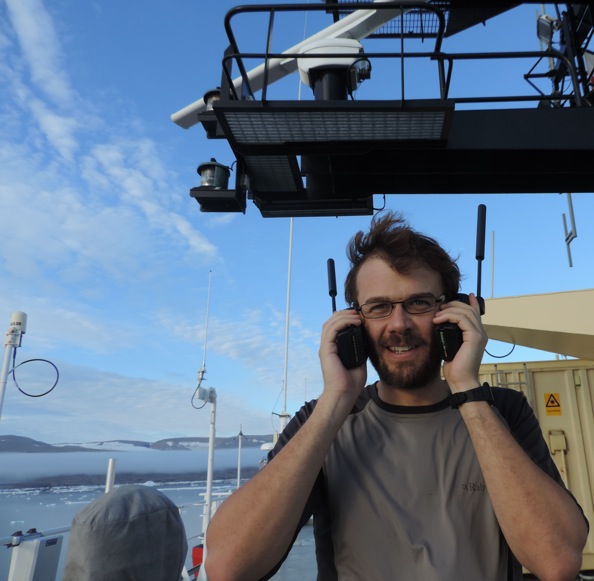
Rob Holden testing Iridium phones above the bridge of I/B Oden.

Rob Holden testing Iridium phones above the bridge of I/B Oden.

Unlike busy, engaged, and well-meaning politicians, however, the computers will tirelessly try again and again every three hours to send the data back that the weather station on Greenland accumulates no matter how well Iridium is connecting it to us.

Power is key as is a flexible budget that adapts to both scientific needs and environmental conditions. I here do not talk about politics in Washington, DC, but the design of the weather station that is powered by both batteries and solar panels while the Iridium modem is the most energy gobbling component of the ocean observing system. Hence it is switched off at all times except a 20 minute window every three hours. I will have to change this window to 20 minutes once per day in the winter when the station will have to operate in complete darkness. So, many challenges are still ahead which includes a mechanical design to fix a weather station on a melting glacier, but alas, winter here is already upon as with air temperatures on and off the glacier below freezing. New ice forms in the early morning hours already.

Terminus of Petermann Gletscher with Hubert (right), Belgrave (center), and Un-Named (left) Glaciers coming in from Hall Land in the north. The ocean is to the left (west).

Terminus of Petermann Gletscher with Hubert (right), Belgrave (center), and Un-Named (left) Glaciers coming in from Hall Land in the north. The ocean is to the left (west).

Sent from I/B Oden at 17:38 UTC on 20 Aug. 2015 at 81:26 N and 064:03 W

A roller coaster ride in the Arctic

Posted by Pat Ryan, Graduate Student (Thursday, August 13, 2015)

It’s been a busy week.  The events that transpired during and since the initial installation of the weather station on Petermann Glacier gave us some ups and some downs (therein the roller coaster).  I’ve shared below (in italics) some of the emails that document the saga as it unfolded.

On Monday morning, we heard from Andreas:

I just got back after 12 hours working on Petermann Gletscher where I was given a helicopter for the day to accomplish the following:

1. Deploy very fancy sub-centimeter GPS receivers we got from UNAVCO (Peter of UDel);
2. Find a suitable site to place the Udel weather station with their 5 ocean sensors attached (Keith Nicholls of BAS);
3. Deploy the Udel weather station prior to the ice shelf drilling (I did this).

Less glamorous, I spent most of the day in packing and moving boxes while two helicopters were buzzing overhead coming and going as the first drill site was moved to a second drill site. At the end of the day, however, our weather station went up. It was not a pretty job as we had only an hour left before we had to be back on the ship, but the weather station is now sited and returns data on a regular schedule. It does work. 

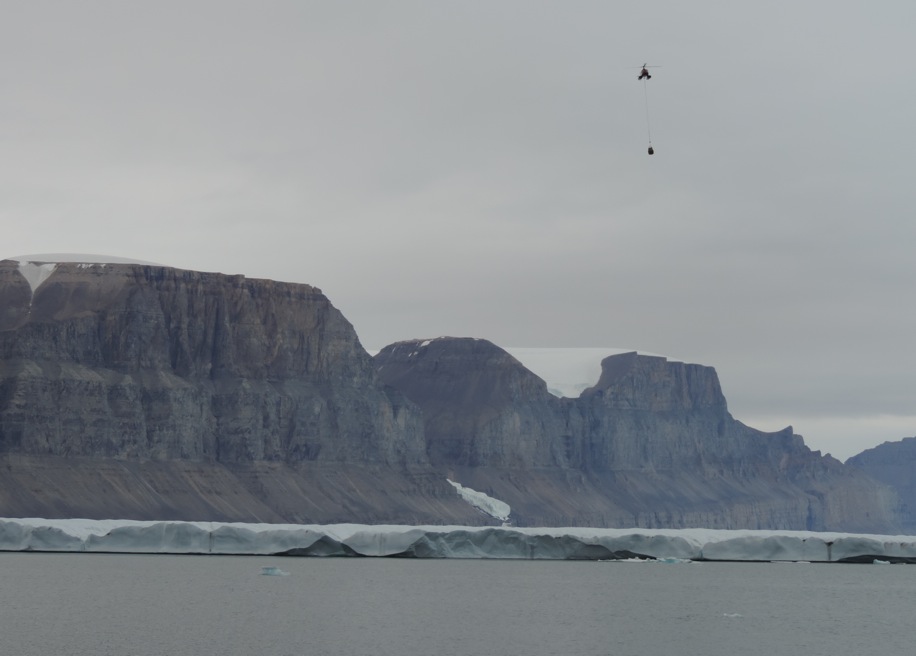
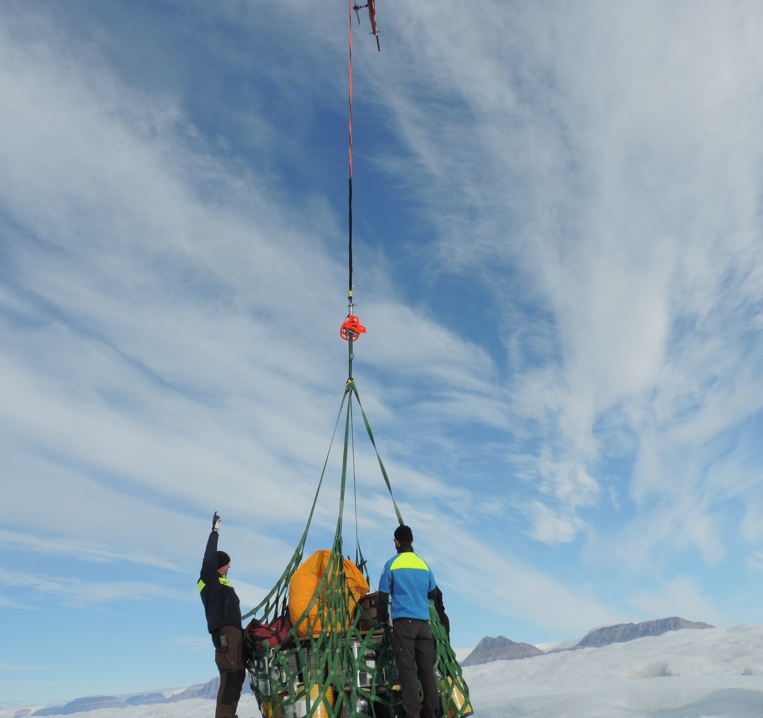
Helicopter transport of instruments via sling load.

Helicopter transport of instruments via sling load.

Here is a picture that shows the station’s current installation at site-3  which is temporary as Andreas will modify the mounting design after 5 ocean sensors are attached to it early next week. The shown design would not survive strong winter winds and excessive surface melting in the summer.

University of Delaware automated weather station on Petermann Gletscher (view to north-east).

University of Delaware automated weather station on Petermann Gletscher (view to north-east).

On Tuesday, our spirits were somewhat crushed when Andreas informed us that he had heard nothing from the station for 5 hours. As it was scheduled to automatically send data on an hourly basis, this was somewhat disappointing. Both Andreas (from the ship) and I (at home) attempted to manually connect to the station.  Neither of us was successful.  We all waited somewhat impatiently to hear from the station. Andreas was hopeful that he could get back to the site in order to diagnose and repair any problems that had arisen.

This morning (Thursday) I woke up to the following delightful email from Andreas. The subject line is Greeland Weather Station Working!!!

Hi all:

I am ecstatic to report that our weather station on Petermann Gletscher is alive collecting and reporting data. The earlier shut-down, 8-hours after deployment on Aug.-10, was caused by Iridium satellite transmissions, not the set-up of hardware or software of the weather station itself. I attach a plot of the data collected so far that is being used by the ship’s operators to prepare and plan for flight operations over the glacier. There will be a massive increase in helicopter flying, because on Saturday the CBS 60-Minute team will arrive via helicopter from Qaanaaq, Greenland about 250 miles to the south.

The five ocean sensors are NOT yet plugged into the UDel observing system, because ice-drilling operations at that site will not start until Monday or Tuesday. Our graduate student Peter Washam is on the glacier right now. The so-called Ice-Shelf team just completed a second drill hole near the grounding line of Petermann Gletscher where ice and water are expected to be as thick as the Empire State Building is tall. The picture shows Peter at that (second) drill site shortly after the camp there was established there Monday. The weather station was set-up about 13 km seaward  at what will become the third drill site. Hopefully he did not forget to re-program the ocean sensors to move bits and bytes along the 600 m long serial cable (4800 baud) at a slower rate than we used them in an calibration test lowering them from the ship to the 600 m deep bottom of the ocean near Petermann Fjord.

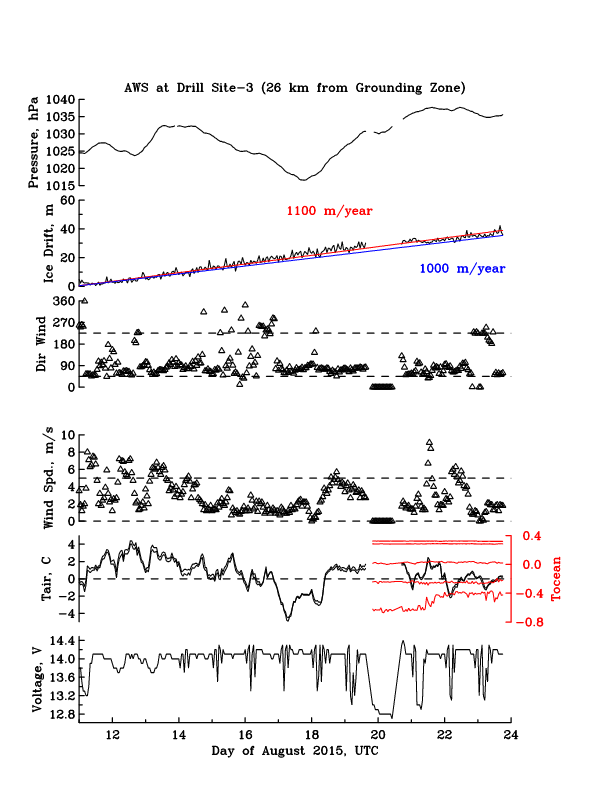
AWS-Aug13

The 2 1/2 day long time series (link above) shows air temperature about 0.5 and 2.0 m above the ice as well as wind speed and direction as well as atmospheric pressure. A GPS unit shows that the station is drifting about 3 m per day towards the ocean as is expected for this fast moving glacier moving about 1.2 km per year.

My spirits are high after several days of anxious anticipation and waiting for a call from the weather station. Wish us luck.

Andreas (aboard I/B Oden at 81 32.28′ N 062 04.0′ W on 09:49 UTC)

Since the iridium system is designed to gather data until it can be successfully transmitted, short periods of communication black-outs are not expected to be a problem.  The data storage is limited, so we are hopeful that the communication failure was temporary and any future lapses will be equally short-lived.

We soon should have have ocean data of salinity and temperature conditions under the glacier when the additional instruments have been lowered through the ice next week.  That will be the story of our next post.