Category Archives: Oceanography

Greenland’s Glaciers, Science, Sea-Level, and Teachers

Science Magazine hit climate change hard today. They cover how Greenland’s glaciers and ice sheets change as they interact with the ocean and contribute to sea-level rise feature in 3 related stories. The reality check of these three stories puts a damper on the usual doomsday scenarios of those whose skill is limited to grabbing public attention to move a political agenda. Real science works differently:
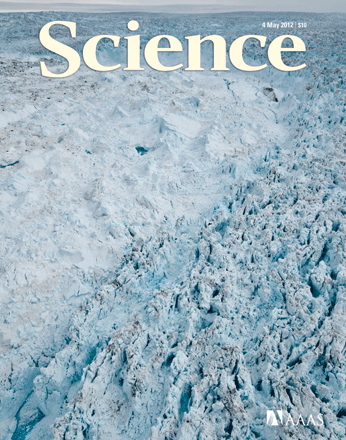
May-4, 2012 Science Magazine Cover: A jumble of icebergs forms in front of the heavily crevassed calving front of Jakobshavn Isbræ, one of the fastest outlet glaciers draining the Greenland Ice Sheet. The ~5-kilometer-wide ice front rises ~80 meters out of the water and extends more than 600 meters underwater. Recent research shows that the speeds of Greenland glaciers are increasing. See page 576. [Photo Credit: Ian Joughin, APL/UW]

The solid new research is that of Twila Moon, a graduate student at the University of Washington whose dissertation work relates to the evolution of Greenland’s outlet glaciers over the last 10 years. She uses data from Canadian, German, and Japanese radars flown on satellites. She applies fancy mathematics to the data and feds data and mathematics into modern computer codes. And with all that, she cracks the puzzle on how fast more than 200 of Greenland’s largest glaciers go to town, eh, I mean, to sea. Furthermore, she shows how this flow has changed over the last 10 years.

Twila Moon, graduate student and scientist at the University of Washington and first author of “21st-Century Evolution of Greenland Outlet Glacier velocities” that appeared in Science Magazine on May-4, 2012. [Photo Credit: APL/UW website]

Back in the days of 2008, crude, but simple back-on-the-envelope calculation suggested that Greenland contributes 0.8-2.0 meters to global sea-level rise by 2100. In stark contrast, the 2000-2010 data now reveals, that even the low-end estimate is too high by a factor of 10. A glacier here or there may accelerate at a large rate to give the 0.8-2.0 m, but these rates do not occur at the same time at all glaciers. Ms. Moon’s more comprehensive and careful analyses of accelerating glaciers bring down Greenland’s contributions to sea-level rise to below 0.1 m by 2100, that comes to about 1 mm/year or an inch in 30 years.

A commentary written by Professor Richard Alley relates to the ice-sheets that feed these glaciers. Dr. Alley is famous for his work on Greenland’s ice sheet as he participated in 2-Mile Time Machine, a project that revolutionized the way that we view climate and its variability the last 100,000 years. The title refers to the 2-mile long ice-core from Greenland’s ice-sheet that trapped and stored air and stuff from the last 100,000 years. Dr. Alley is also featured in Andrew Revkin’s dot-earth blog of the New York Times as the Singing Climatologist. His comment on “Modeling Ice-Sheet Flow” references Ms. Moon’s observations as evidence that ice sheets change quickly. It also contains the sentence that “The lack of a firm understanding of ice-sheet-ocean interaction, constrained by reliable ocean data, remains a critical obstacle to understanding future changes.” I could not agree more with this sentiment, these data are darn hard to come by … not as hard as getting to the bottom of the 2-mile time machine, though.
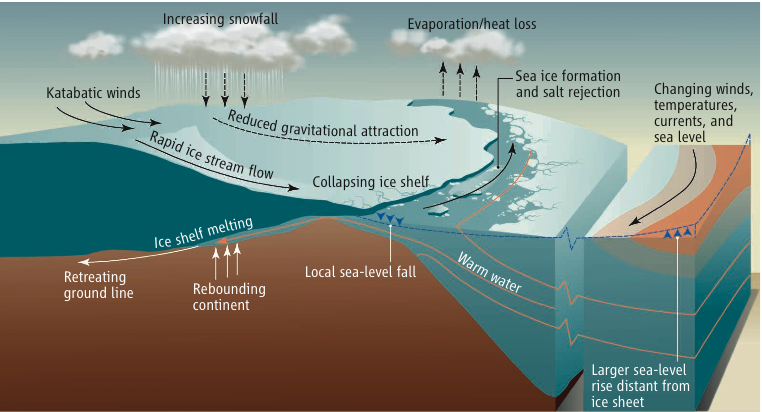
While Ms. Moon addressed changes in Greenland’s glaciers, Dr. Alley addressed the ice-sheets feeding those glaciers, another comment by physical oceanographer Dr. Josh Willis of NASA’s Jet Propulsion Laboratory relates to the sea-level changes caused by accelerating glaciers to make “Regional Sea-Level Projections.” He works mostly on massive computer models which devour massive amounts of data to get climate right. Sometimes this works, sometimes is does not, but he does comment that these earth system models give sea-level projections that are a factor 2 smaller than those derived from statistical relations and semi-empirical models using surface temperature and radiative forcing to extrapolate past trends into the future. The difference probably relates to smaller and more regional processes that involve the physics of ocean circulation and its interaction with ice-shelves off Antarctic and Greenland.
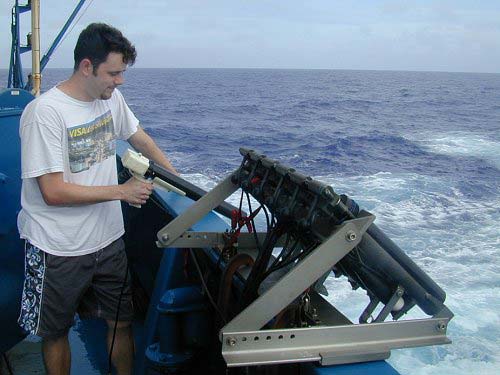
Dr. Josh Willis conducting an oceanographic experiment studying sea temperatures between New Zealand and Hawaii. [Credit: JPL/NASA]

My great oceanography hero, Henry Stommel of Woods Hole oceanographic Institution once wrote in his “View of the Sea,” that “Science is both an individual and a social activity.” I am sure that graduate student Ms. Moon, NASA researcher Dr. Willis, and veteran professor and science communicator Prof. Alley all work hard and lonely at night some nights … and party hard while discussing science and adventures over a beer, dinner, coffee in some city, remote field, or on a ship. The one group of people missing in this picture are … the science teachers, that is, those dedicated, over-worked, and under-paid professionals who encourage, motivate, and helped us to become scientists before we went to college.

The editorial of this week’s Science Magazine is entitled “Empowering Science Teachers.” It compares the social and professional status of pre-college science teachers in Finland and the USA. I will only say in the words of Anne Baffert, chemistry teacher at Salpointe Catholic High School in Tucson, Arizona, that too many science “… teachers work in a command-and-control environment, managed by those who lack any real understanding of how to improve the system.” The editorial suggests on how scientists can improve science teaching, such as “… active involvement in science through structured collaborations with scientists …” Apparently, Finland succeeds while we in the USA are challenged to get our graduate students into a pre-college class room teaching. More stuff for me to munch on here …
Ice Island Flotilla From Petermann Glacier Continue Southward Flow

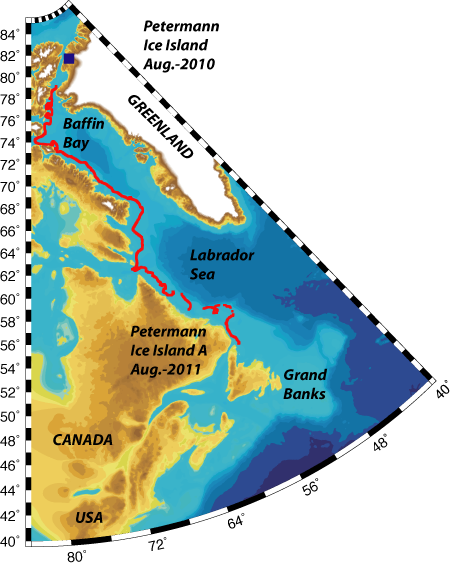
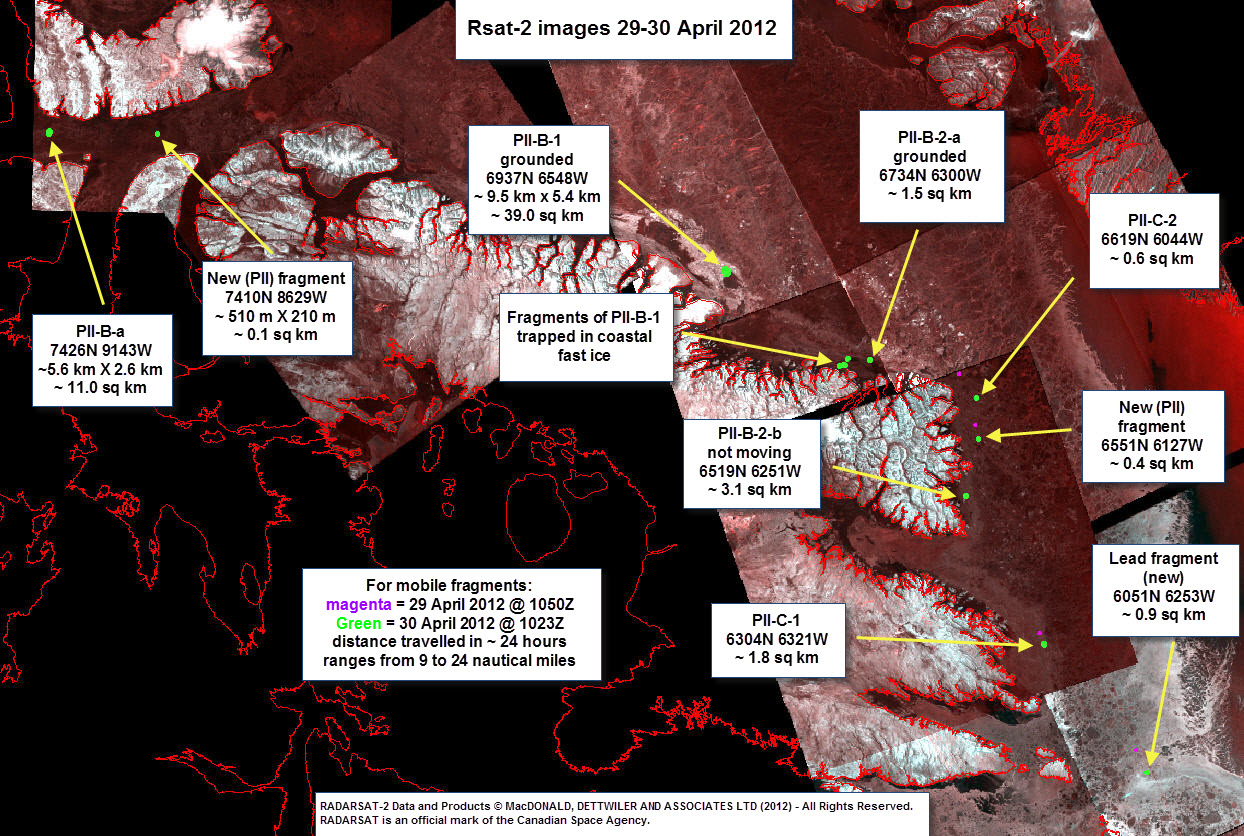
More icebergs and ice island from Greenland are heading south along northern North-America this year. Petermann Glacier’s first piece arrived last year off Newfoundland causing a local tourist sensation for a stunning display of ice along its shores. There are many more pieces from Petermann to come for a few more years.

Track of Petermann Ice Island from Aug.-2010 through Aug.-2011 traveling in shallow water from northern Greenland along Baffin Island and Labrador to Newfoundland.

April 29/30, 2012 locations of Petermann Ice Island 2010 on their way south along northern North America. [Credit: Luc Desjardins, Canadian Ice Service]

Yet, how come that these arrivals are both so predictable in their pattern, but are almost impossible to pin down for an exact location and time? The answer involves mystical and fake forces, stunningly beautiful experiments, elegant mathematical equations, and, most important of all: spin.

The earth spins rapidly around its axis and neither ocean nor glaciers leave the planet for outer space. The obvious answer that gravity holds all the pieces in place is neither the correct nor the full answer. A subtle balance of several other forces makes Planet Earth the perfect place to keep us supplied with water to drink and air to breath. Additional forces besides gravity relate to the difference in pressure between the top and the bottom of the ocean as well as the rotational force that forces our car off the road if we speed too fast around a curve. The net effect of these is that earth fatter at the equator than at the North Pole. There appears to be more of gravity pulling us in at the North Pole than there is at the equator. Put another way, a scale measuring our own weight dips almost a pound more in Arctic Greenland than it does in the tropical forests of Borneo even if we do it naked in both places. Lose a pound of your weight instantly, travel to the far north. (GRACE)

This makes no sense intuitively, but common sense and intuition help little when it comes to how the ocean’s water and the atmosphere’s air move on a rotating planet. For example, we all know intuitively that a down-pour of rain flows down a slope into the ditch. It requires work to bring water up to the top of a hill or into the water towers to make sure that water flows when we open the faucet. Not true for the ocean at scales that relate to climate, weather, and changes of both. Here all water flows along, not down the hill. Better yet, it requires no work at all to keep it moving that way for all times. This is why Greenland’s ice keeps coming our way as soon as pieces break off. The earth’s spin makes it go around the hill, to speak loosely of pressure differences. Winds and friction have little effect. The ocean’s natural and usually stable state is in geostrophic balance. Geostrophy is a fancy word for saying that the ocean’s water flows along, not down a hill, because it is balanced by a fake and mystical Coriolis force that I will not explain. I teach a graduate class on Geophysical Fluid Dynamics for that.

In technical language, most of the oceans tend to flow along not down a pressure gradient. A kettle of boiling water discharges water from high pressure inside the kettle to the lower pressure in the kitchen. Yet the steam dissolved in the atmosphere moves around high or low-pressure systems. That’s how we read weather maps: Clockwise winds around high-pressure over Europe, North-America, and Asia to the north of the equator, counter-clockwise winds around low-pressure systems. If I apply this spin-law to Baffin Bay containing all the icebergs and ice islands, the spin rule states that these large and deep pieces flow along lines where the earth’s local rate of rotation, lets call it planetary spin f, divided by the local water depth, lets call it H, is a constant. So, to a first approximation, the icebergs and ice islands flow along a path where f/H is constant. If the planetary spin is constant, then the ice island follow lines of constant water depth H. There is more to the story, much more, such as the effects of waters of different densities residing next to each other, but I better continue this later, as I got a dinner date with a sweetheart and “Thermal Wind” can wait 😉

Heat Sensing Eyes “See” Arctic Ice Thickness

The Arctic sea ice is disappearing before our eyes as we extended them into space in the form of satellites. Every summer for the last few years the area covered by ice is shrinking during the summer when 24 hours of sunlight give us plenty of crisp images. But what about winter? What about now? And does a picture from space tell us how thick the ice is?

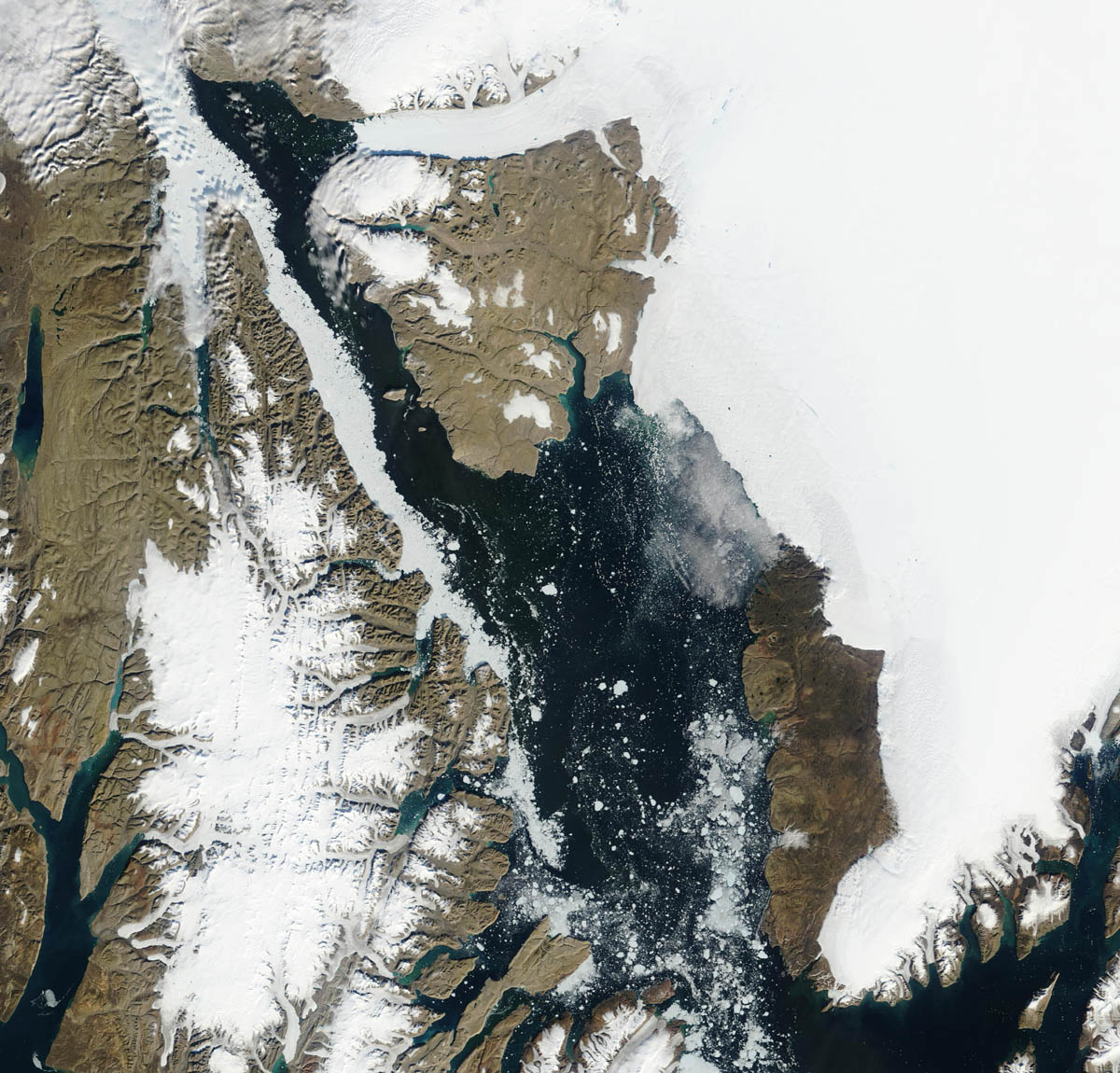
Nares Strait between northern Greenland and Canada on Aug.-13, 2005 with Petermann and Humboldt Glaciers at top and center right from MODIS imagery using red, blue, and green channels.

It is dark in the winter near the north pole as the sun is below the horizon 24 hours each day, but there are many ways to “see” in the dark as flying bats aptly show. They send out sound that bounce off objects from which bats reconstruct objects around them. We use radar from space to do to the same with radio waves to “see” different types of ice at night from satellites. We can also use tiny amounts of heat stored in water, ice, snow, and land to “see” at night. Someone breathing down your neck at a cold dark corner will make our heart beat faster as we “see” the heat not with our eyes, but with our skin. I digress, as I really want to talk about icy Arctic seas and how we can perhaps “see” how thick it is with our eyes in the sky.

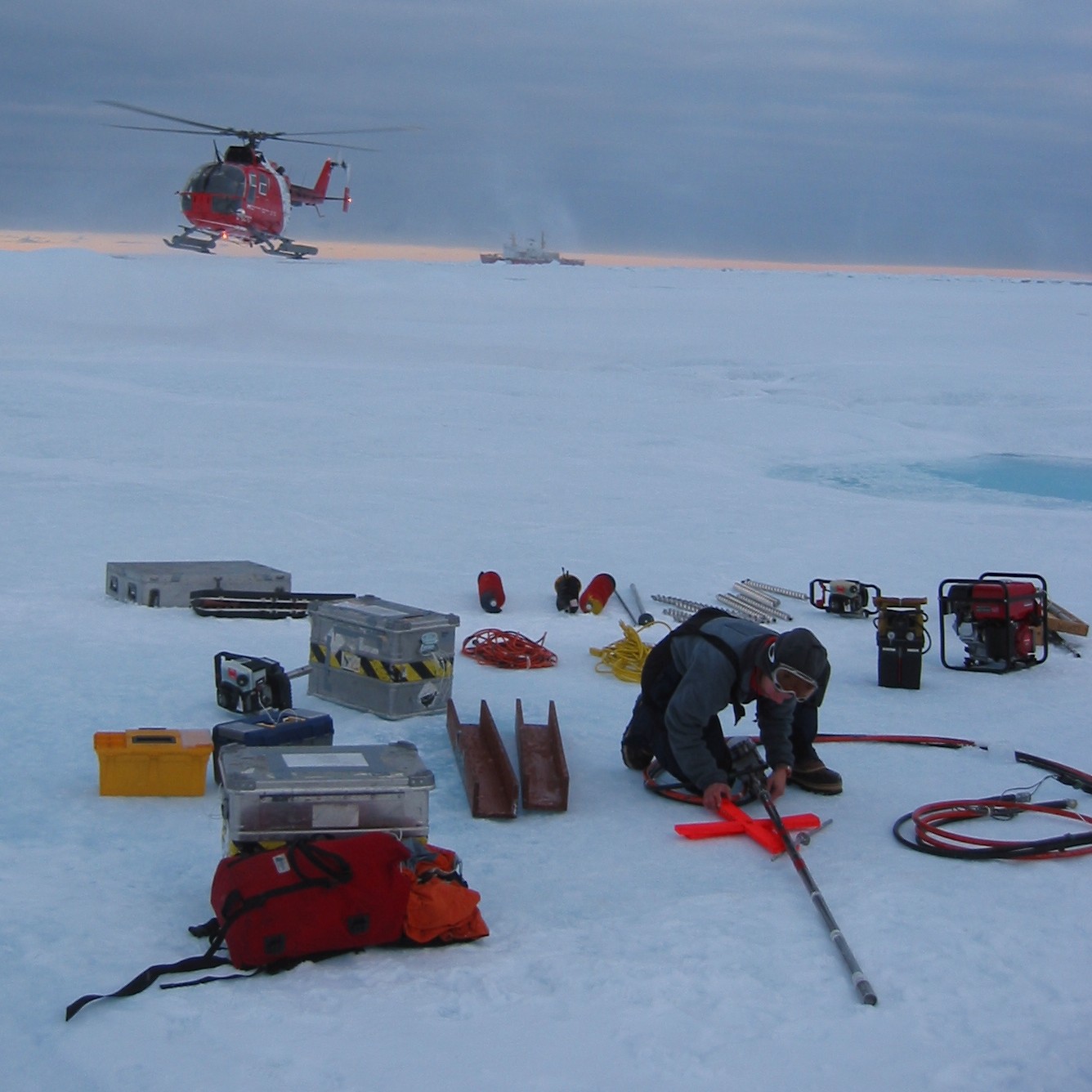
The most accurate and pain-staking way to measure ice thickness is drill holes through it. This is back-breaking, manual labor away from the comforts of a ship or a camp. One person watches with a shot-gun for polar bear searching for food, not our food, we are the food. The scientist who does this sweaty, dangerous work on our Nares Strait expeditions is Dr. Michelle Johnston of Canada’s National Research Council. She is a petite, attractive, and smart woman who is calm, competent, and comfortable when she leads men like her bear-like helper Richard Lanthier into the drilling battles with the ice. She gets dirty, cold, and wet when on her hands and knees setting up, drilling, cutting, measuring:

Dr. Michelle Johnston assembling ice drilling gear in Nares Strait with Greenland on the horizon. The Canadian Coast Guard Ship Henry Larsen in the background with its helicopter hovering.

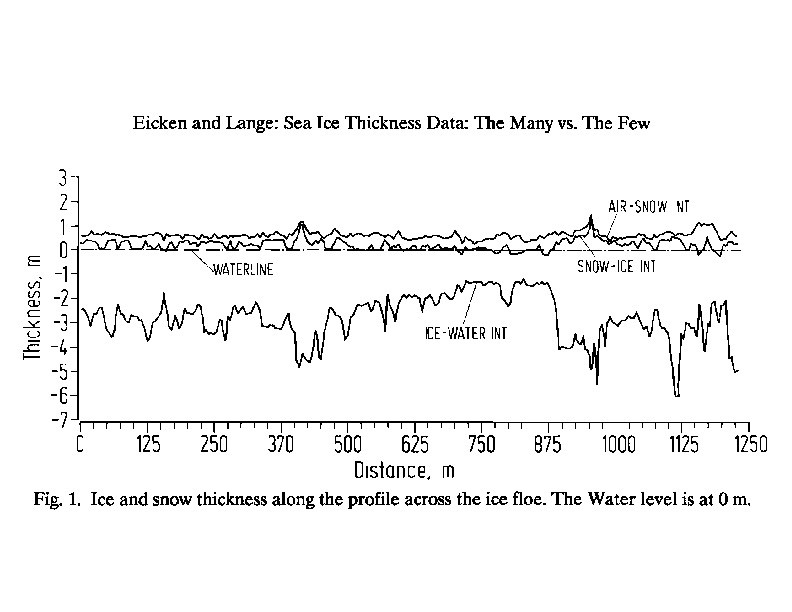
She measures temperatures within the ice and tries to crush it to find out how strong it is. All of this information guides ship operators on what dangers they face operating in icy seas. Drilling over 250 such holes across a small floe on the other (eastern) side of Greenland, Dr. Hajo Eicken showed how one large ice floe changes from less 1 meter to more than 5 meters in thickness. He also discovered that the percentage of thick and thin ice of his single 1 mile wide ice chunk is similar to the percentages measured by a submarine along a track longer than 1000 miles.

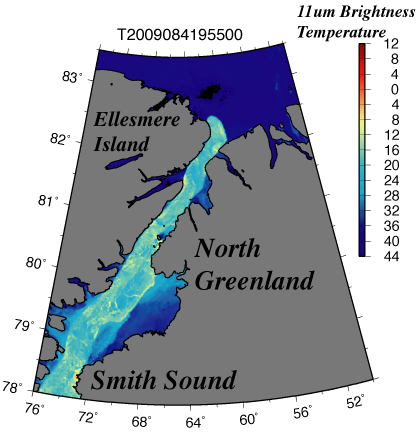
This was a surprising result in 1989 and we use it to estimate ice thickness more leisurely sipping coffee in our office. From the same satellite that gives us crisp true color images in summer as shown above, we get false color images of temperature as shown below.

Map of Nares Strait, north-west Greenland on March-25, 2009 showing heat emitted during the polar night from the ocean through the ice, and sensed by MODIS satellite.

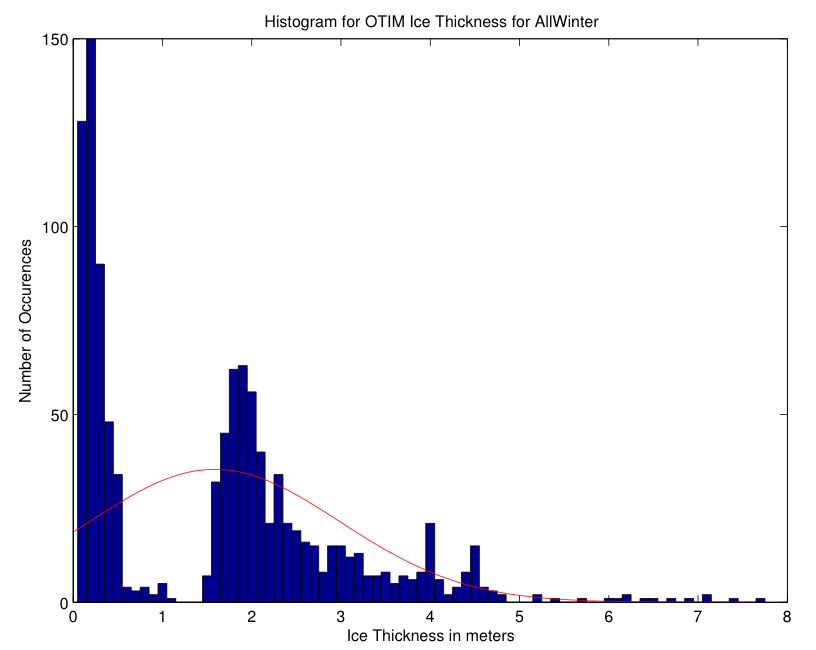
A graduate student of mine, Claire Macdonald, is trying to convert these temperature readings into ice thickness for Nares Strait. She showed me the first promising results today. The plot below shows the distribution of “thermal” ice thickness for a small square in Nares Strait Dec.-1, 2008 through Mar.-1, 2009 when no clouds were in the area. Note the two distinct and separate clusters with thicknesses below 1 meter and above 2 meters. They represent thin ice formed in 2009 after an upstream ice arch blocked all flow of thicker ice from the Arctic Ocean to Nares Strait. The thicker ice passed the study area at times when the thick, hard multi-year Arctic ice entered Nares Strait freely from the Arctic Ocean.

Distribution of "thermal" ice thickness from satellite for Nares Strait Dec.-1, 2008 through Mar.-1, 2009. (Credit: Claire Macdonald, Jan.-26, 2012)

Much work remains to be done: Claire is comparing the “thermal” ice thickness with “acoustic” ice thickness measured by sonars moored in the water below the ice. It then will be exciting to explore “thermal” thicknesses for all of Nares Strait. Winds and ocean currents will pile ice up in some areas making it thicker while they spread ice out making it thinner. Claire and I have worked with such wind and ocean data. Science is never finished as each question answered raises a host of new ones.

Physics and Engineering of Breaking Dams, Glaciers, and Tides

The title “Bombing Hitler’s Dams” fascinated me when I saw it featured on my TiVo last night. The story told was that of a group led by a smart, creative, and somewhat crazy Cambridge University engineer Dr. Hugh Hunt trying to recreate all the engineering elements needed to blow up a dam with a bomb that skips along the surface of the water the same way that a flat stone skips over a calm pond. While we all know intuitively how to throw a flat stone at the right speed at the correct angle, imagine to do it from an aircraft dropping a bomb to skip a few hundred yards over the surface of a reservoir, kiss the dam, sink, then blow it up via a depth charge. After many elaborate tests starting with 3 foot baby’s pool 5 inches deep, the show concluded with the real blowing up of real dam in northern Canada by a much enlarged group of engineers, construction workers, students, pilots, contractors, etc.

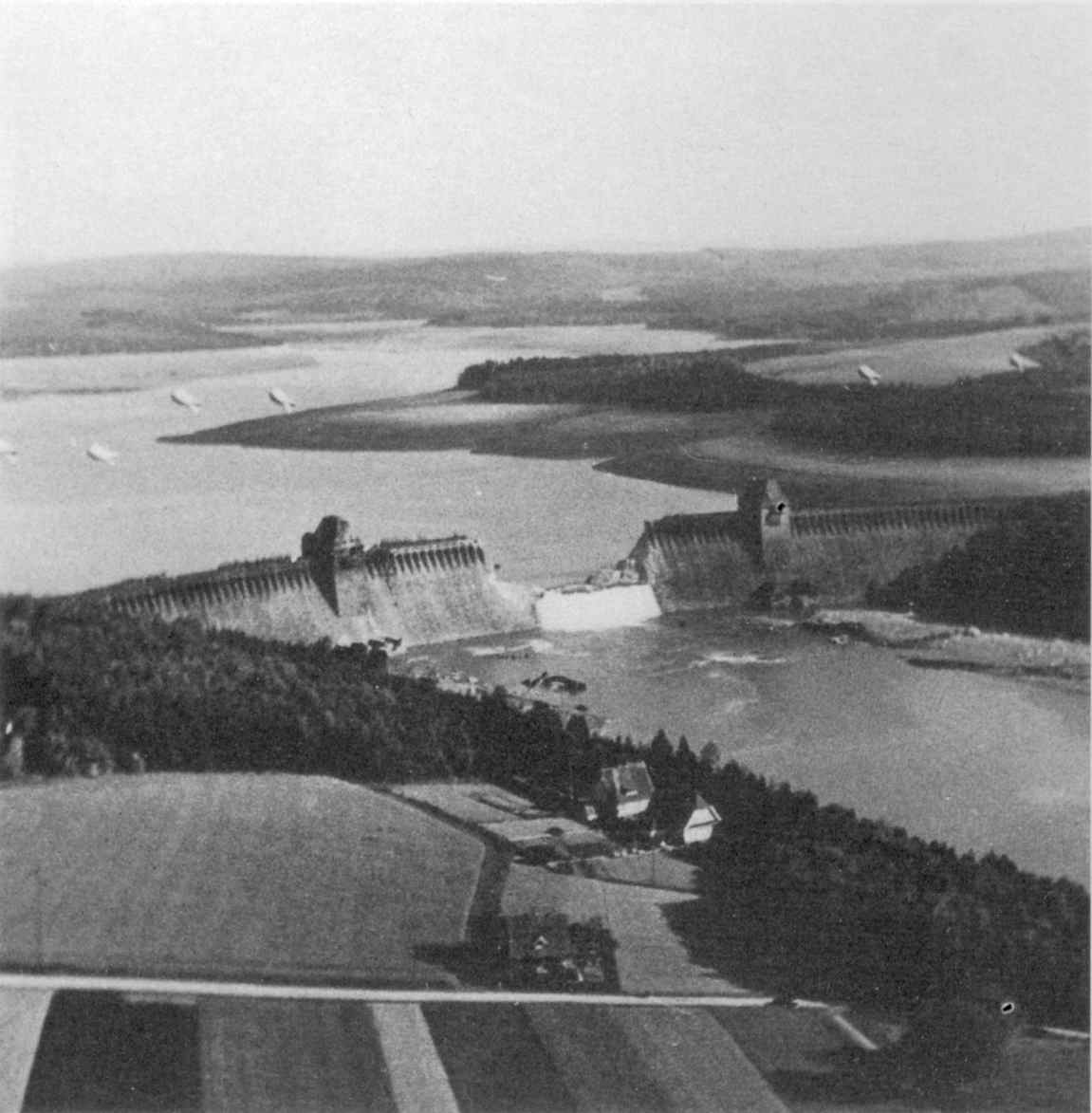
Photograph of the breached Möhne Dam taken by Flying Officer Jerry Fray of No. 542 Squadron from his Spitfire PR IX, six Barrage balloons are above the dam

If you think this is hard to do, it is. On May 16/17, 1943 a British bombing raid called “Operation Chastise” deployed cylindrical drums filled with explosives like skipping stones to hop over torpedo nets meant to protect the dams from subsurface mines. Two of three targeted dams were blown up, 53 airmen perished, German heavy industry in the Rhine-Ruhr valley was disrupted for 4 months, and over 1500 civilians drowned in the flood wave created by the breaking dams:

The story reminds my of my adviser, Dr. Richard Garvine (an aeronautical engineer by training) whom I met in 1986 while a physics student from Germany studying physical oceanography for a year in Bangor, Wales. Rather than returning to Germany, I went to the United States for graduate school where I met my sweetheart. One of my first graduate assignment was to study the “breaking dam” problem (Stoker, 1948: “The Formation of Breakers and Bores”, Communications of Pure and Applied Mathematics, 1, 1-87). The “breaking dam” problem is now a classical problem in fluid dynamics that relates to breaking waves, tsunamis, tides, as well as the discharge of fresh water from cooling plants, estuaries, and glaciers. I applied it to tides in the Conway Estuary in North-Wales for my MS thesis that the Swedish Royal Society saw fit to publish as my first contribution to science.

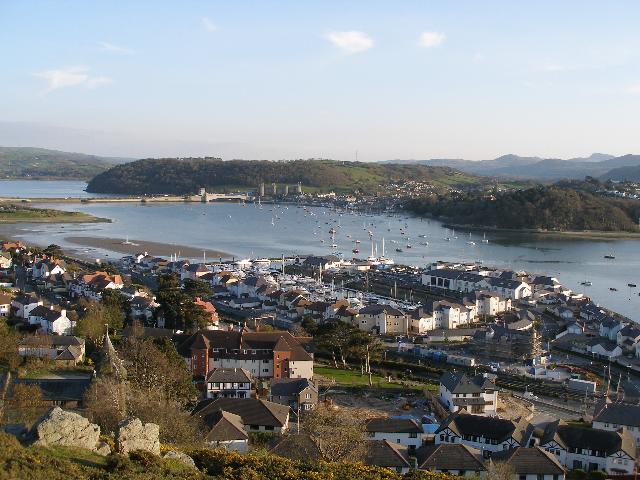
Conwy Estuary at its mouth near high tide.

I stole the above photo of the Conway Estuary, North Wales from a set of beautiful travelogues of an area where I camped for 6 weeks to guard instruments that measured currents along the 50 km tidal reach of this beautiful estuary. The tides rush in like the waves of a breaking dam, yet, they do not break (no bore forms, why?). To model the physics, I needed to study the work done by American, British, and French engineers who labored hard to defeat Nazi Germany by blowing up actual dams developing new and applying old ideas in physics and engineering along the way. Studying their work, I got my answer, too.

Addendum: A review of the aftermath and devastation of the 1943 flood wave from a German perspective is posted here with original photos from both British and German sources.

Melting Greenland’s Icebergs and Ice Islands by the Ocean

The BBC keeps asking good and penetrating questions about the fate of Greenland’s many icebergs in general and Petermann Glacier’s Ice Island in particular. A poor telephone connection across the Atlantic this morning prevented an interview, but made me answer a number of questions in writing. When answering these questions, I was thinking of those icebergs and ice islands one finds in abundance in the frigid waters of Baffin Bay, the Labrador Sea, and next to Greenland. I am not talking about what happens once icebergs enter the subtropical Atlantic Ocean and meet the Gulf Stream to the south of the Grand Banks, that is a different story.

USCG Healy besides massive iceberg in northern Baffin Bay, July 2003

1. What can icebergs tell us about oceans?

Icebergs are particles that track averaged ocean currents over the top 200-m or so. These currents are often refered to as “geostrophic” currents which is really a different word for an ocean force balance between pressure gradients (estimated from measurements of temperature and salinity changes with depth at many locations) and the Coriolis force due to the earth’s rotation. This is why RADM Edward H. “Iceberg” Smith of the US Coast Guard spent so much time sailing and taking measurements off northern Canada in the 1920ies and 1930ies as part of the International Ice Patrol. His outstanding publications 80 years old are a first example on how to apply theory (the Scandinavian or Bergen School of the 1920ies regarding dynamical physical oceanography) to a very specific application.

2. How does the trajectory of the ice-islands/ and other icebergs show information about the ocean currents?

Ice islands and icebergs are thick (50-200 m) and mostly submerged below the surface. Hence they are largely moved by the ocean currents about 30-200 m below the surface. I think of them as ocean drifters with a very large and deep drogue element that changes with time as the iceberg melts or tips over. This is different from sea ice that may reach only 5-m into the water column and thus only “sees” the very surface layer of the ocean that is largely influenced by winds. This is not entirely true for icebergs, because they are driven by ocean currents below the thin (10-20 m) ocean “mixed layer” that sea ice is embedded in.

3. What are the current unknowns or poorly understood parameters with regards to iceberg science and iceberg interactions with oceans in the High Arctic?

I think the problem with any prediction scheme of individual particles is that the ocean always has a strong turbulent and unpredictable part to it. This problem is fundamentally no different from trying to predict where oil from a spill will come ashore. We can do it “on average” rather well, but we are very poor trying to do in one specific case for a specific iceberg (or spill). Oh, this certainly also applies to climate predictions, easy to do “on average,” very hard to do in a specific case for a specific time and place that may be affected.

4. What sort of temperatures would the water be?

Meltwater plumes at zero salinity with pieces of ice floating in it have a temperature of 0 C, meltwater plumes with pieces of ice in it at ocean salinities have temperatures of about -1.8C, depending on the amount of sunlight and how much mixing takes place, these fresh and very thin surface layers (1-10 meters) can heat up substantially fast, and cool just as fast. In June/July you have 24 hours of sunlight, so temperatures of 4-10 C are not out of the ordinary, but these waters will do very little melting, because most of the mass is well below a 10 m depth of such fresh surface plumes.

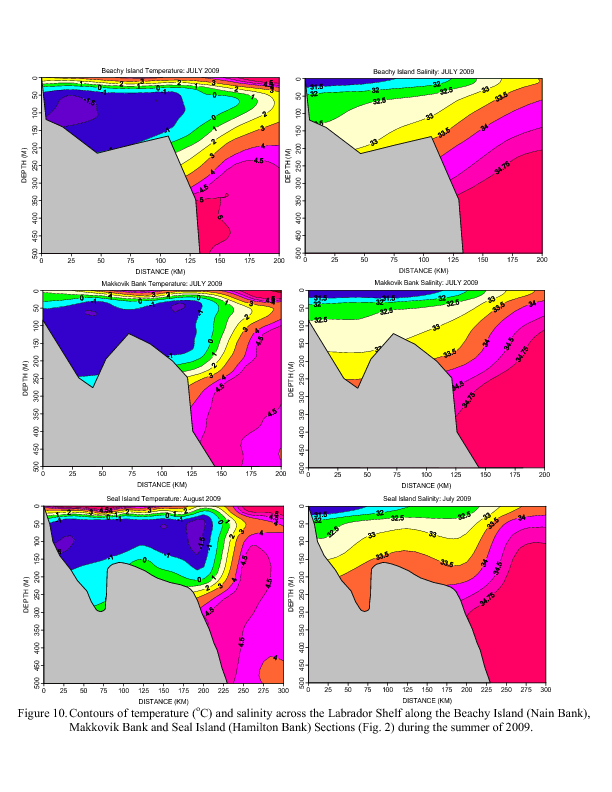
Temperature (left) and salinity (right) distribution off Labrador in the summer of 2009 with depth and distance from the coast (from Colbourne et al., 2010). Note the very cold waters near the freezing point (blue and purple) on the continental shelf below 50-m depth.

5. How would changes in ocean stratification and temperature alter the melting of icebergs?

First, ocean temperature (or heat) and stratification are two very different things. In the Arctic almost all stratification is done by salinity, temperature is a tracer that has very little effect on density stratification. This is also the reason, that most of the ocean’s heat in the Arctic is at depths 200-400 m below the surface. This warm water does NOT rise towards the surface, because it is also salty water, it is often refered to the Atlantic Layer. This deep reservoir of heat is what many oceanographers (myself included) have in mind when they talk about the melting of Greenland’s glaciers by the ocean from below.

Petermann Glacier, for example, has a grounding line at 600-m below the surface. This grounding line is in contact with the heat from the Atlantic Layer that is melting it, but the melted water is fresh and cold, immediately stratifying the water column under the ice, so a source of energy is needed also to move or mix this cold fresh melt water away. An inclined slope may do so, tides may do so, internal waves traveling and breaking on the interface between cold-fresh and warm-salty waters may do so. At Petermann Glacier this Atlantic layer does not reach most of the floating element of this glacier, because it is only 100-200 m thick and thus does not extend into the heat of the Atlantic Layer. So, vertical stratification and location of heat are two different things.

Breaking waves on an interface due to a shear instability, i.e., flow in the (fresh and cold) upper layer is less than the flow in the denser (warm and salty) lower layer.

Second, think of ocean stratification as a blanket that insulates one region from the other. Removing the blanket requires kinetic energy (something or someone has to do the work, doing work requires energy). As you melt freshwater ice via conduction of heat to the ice, the melt has zero salinity and a temperature at the freezing point. This zero salinity water acts as the insolation blanket that reduces the heat reaching the ice. So, again, you need (a) a source of kinetic energy to do work to break down the stratification (of salinity) to (b) enable the transfer of heat from the ocean to the ice.

6. Can you recommend any key journal papers you think we should read?

The classical paper on this subject is [Gade, H.G., 1979: Melting of ice in sea water: A primitive model with application to the Antarctic Ice Shelf and Icebergs. J. Phys. Oceanogr., 9, 189-198], but this paper is a thorough theoretical development. I have professors of glaciology asking me what it means, so the material is not easy to penetrate. In a 2011 publication on the oceanography of Petermann Fjord impacting this Glacier, we made extensive use of the arguments and concepts presented in Gade (1979). That publication is more readable and accessible.

Its first author is Dr. Helen Johnson at Oxford University with whom I have collaborated since 2003 aboard US and Canadian icebreakers. She also published an illustrated diary of our 2007 expedition to Nares Strait.

ADDED Jan-12: My mind yesterday was unclear on the in situ temperature at which glacier ice of zero salinity is melting in seawater such as found on the Labrador shelf. The comment below points this out concisely, while this link to TheNakedScientist perhaps provides the longer and more visual explanation. Another fun explanation of the melting and freezing of ice in a salt solution relates to the making of ice cream. A subsurface temperature at -1.5 C at a salinity of 33.5 psu such as found on the Labrador shelf does melt the zero salinity ice of the iceberg somewhat. A boundary layer consisting of fresh meltwater will lower the salinity adjacent to the iceberg which will increase the freezing point which will reduce the melting until a new stable equilibria is reached.