Category Archives: Oceanography

Nares Strait 2012: Charting New Waters in Petermann Fjord

By Andreas Muenchow, off Joe Island, Greenland, Aug.-11, 2012

We just left Petermann Fjord, squeezing by a Manhattan-sized ice island blocking much of its entrance. An armada of 100s of ship-sized tabular icebergs were all jockeying for positions behind the big one. Captain Wayne Duffett of the Canadian Coast Guard commanded the CCGS Henry Larsen into the new waters of Petermann Fjord, Greenland, with skill, experience, and a calculated dose of daring, trusting both his instincts and his crew. These new waters were formed when Petermann Glacier lost as much as 1/3 of its floating ice shelf during massive break-off events in 2010 and again in 2012. The Henry Larsen was the first and only ship for years to sail and survey this mare incognita for the last 22 hours. It was a long day.

I slept only one of the last 24 hours, skipped dinner, and will head for breakfast in 10 minutes. Being excited and working hard with 24 hours of daylight is exhausting, draining, but also immensely satisfying. We completed a spatial bathymetric survey, collected water and water properties along the new seaward face of the glacier from the surface to 1200 meter depth, and did the same for a section along the axis of the fjord that used to be covered by an ice-shelf.

I tried to document and capture the changing icy seas and their interactions with both land and ocean by taking plenty of photos and video, to later share with those who cannot be here. Several pods of narwhales — they really do have 3-ft long tusks (a tooth really) — were feeding on ocean fronts within a mile of Petermann Glacier’s new face…

Breakfast is ready; I am sending this off as is, without much editing (too tired) {Editor’s note:  Good thing there are those less distracted by the excitement of new icy worlds to do some proofreading…}, then some sleep while those who sleep will install a new weather station on Joe Island.  Science aboard a ship like the CCGS Henry Larsen never really stops…

Nares Strait 2012: Renske’s Take on Mooring Recovery

This is a wonderful description by Dr. Renske Gelderloos of Oxford University of what mooring recoveries are all about, taken from her blog.

Mooring Day!

6 August

Today is mooring day! My function on board has officially been changed from scientist to full-time photographer for the day. We want as many photos as we can get from the equipment as it comes out of the water, so that we can always go back later and see if something happened before, during or after the recovery. And it is a beautiful sunny day; very photogenic!

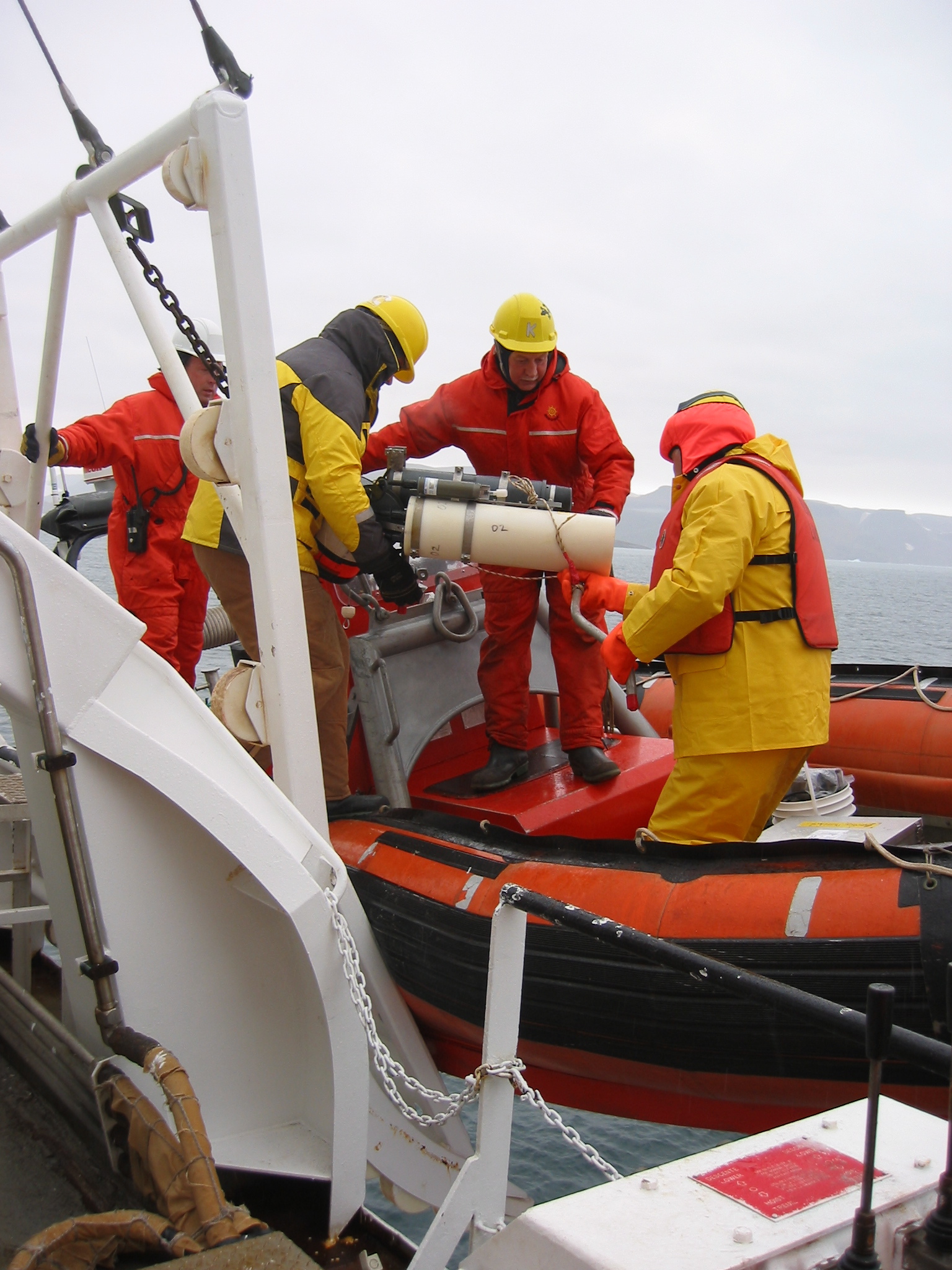
Recovering the moorings is really our number-one priority on this field trip, so everyone is both excited and anxious whether we will be able to recover all of the seven moorings in this section. Ron has already contacted three of them yesterday evening, so that is a very good start. Contacting a mooring works as follows: Ron sends out a signal to the mooring at a given frequency. If the mooring receives this signal it will respond with another signal. Because these moorings are in the water for a very long time (three years in this case), the release switches are programmed to be asleep two thirds of the time and awake only one third of the time to save battery. The mooring only responds if it is awake, so it may take a few minutes to get a response. Once the mooring has confirmed that it is still in the position where it was left three years ago and awake, we go towards the mooring and check that there is no ice overlaying the site (or if there is a little and it is not too thick, ‘just push it away a little bit’ with our icebreaker). Then Ron sends out another signal to lure the mooring to the surface. This signal opens the acoustic release that holds the mooring down to its anchor. The floatation devices that are attached to the mooring line rush upwards to the surface. At this point everyone stares over the railing to try and be the first one to spot it. Today the weather was so calm that we could actually hear them come up, so it was easy. When the mooring is spotted, the FRC is launched with two crew members, who tow the mooring to the boat and attach the heavy things one by one to the crane. Then the crane tows them up to the deck.

Recovering an Acoustic Doppler Current Profiler (ADCP) mooring in 2009.
 

The first four moorings were recovered before lunch (which is from 11.30 to 12.30 here) and it looked like we were going to set a new record today. The fifth mooring after lunch also came in according to plan, but then our luck had run out. The sixth mooring refused to respond, no matter how long we tried. After a while we decided to try and contact the seventh mooring, but again without success. We steamed to the location of the seventh mooring in the hope of getting a response, still with no success. Then suddenly the sixth mooring decided it was willing to communicate after all. Apparently it had just been having some puberty issues refusing to wake up, but now it responded to our mating call. Quickly we steamed back to the site of the sixth mooring, opened the released and successfully recovered the mooring. We tried to get into contact with the last mooring, but unfortunately it was all in vain. We will probably try again on the way back, but we may need to accept that the mooring is just not there anymore.

The scientific successes and endavours of this day were celebrated at the bar that night with a drink. It was a long, eventful and in the end scientifically successful day.

Nares Strait 2012: Renske’s View from the Helicopter

As has been mentioned before on this blog, Dr. Renske Gelderloos, from Oxford University, is a fellow traveler on the CCGS Larsen this summer.  She, too, is blogging about her experience.  Below we reblog her post on the helicopter trip, another exciting and beautiful account of doing science in the Arctic, this one even with a couple pictures!  [Note that the pictures in the blog post are from other trips to the same area — limited internet connectivity to the ship does not permit transmission of current images.]  We will post some of her other entries here, but you can find her blog directly at this link.

Nares Strait from the air, and the first CTD section

5 August 2012

Today started with a nice surprise! During the eight-o-clock science meeting after breakfast the chief officer popped in to say that the helicopter would fly out for an ice survey and that it could take two extra passengers. I immediately volunteered, and as Allison and I had never flown in a helicopter before we would be the lucky ones today.

Ice along the Ellesmere Island coast viewed from the helicopter during an ice survey in 2007.

Together with helicopter pilot Don and ice surveyor Erin we flew off in northeasterly direction. Erin’s job was to maps the ice conditions in the channel ahead of the boat, and see whether there was possibly a better route (less ice-covered) for the boat to take. As Hans Island lay in the helicopter range, we decided to land on this island and do a quick check of the weather station there. The weather station looks like a pole on the top of the island (Hans Island is basically a bit-oversized rock…), firmly held down to the ground with three strings. On top of the pole is a weather vane that also measures the wind speed, and attached to the pole on other heights are a thermometer and a fancy measurement device that measures the incoming solar radiation. The pole also has batteries and a solar panel to provide electricity, and a communication device that sends the data to the more populated part of the world so that it is available immediately. This is unlike our oceanographic moorings under water, which we need to physically recover on the site before we can get the data. Dave had asked us to take photos of the instruments, so we landed the helicopter for a close look. All the instruments appeared to be in remarkably good shape. The previous time this weather station was serviced a polar bear had taken a fancy on it, but fortunately none of the kind had happened this time. When we had done all our duties we flew back over Ellesmere Island to see a glacier from closer by: astonishing!

At the end of the day we finally arrived at the site of our mooring array. As we need the deck crew for mooring recoveries (in particular for the crane and the FRC, which is the small inflatable boat that can be launched from the ship), and the deck crew on Canadian coastguard vessels works from 8 to 5 on weekdays, chief scientist Humfrey decided to do a CTD (Conductivity-Temperature-Depth) section first. This had the additional advantage that we would have the CTD data from this section and the moorings overlapping for an intercomparison between the two.

The multi-coloured mountains of Ellesmere Island

Around 7 o’clock in the evening we were ready for the first trial cast. We had already done ‘dry’ tests, which means we just checked whether the computer was willing to talk to the CTD sensors and the other way around, and whether the values we got were somewhat reasonable. The quantities we measure are the conductivity, the temperature and the pressure. From those quantities we can calculate the salinity of the water (the other way to measure salinity is to take a water sample and take it to a laboratory, so by using the conductivity of the water we can measure the salinity at every location from the surface to the bottom which gives a lot more information than just a few samples), as well as the density. For a CTD cast the sensors are tied to a frame, and the frame is lowered, using a winch, from the deck to the water and subsequently from the surface to just above the bottom of the ocean. The data is sent to our computer real time through the cable that is holding the frame, so we can do a visual inspection and get all excited during the cast. After the trial run things started to really speed up and everyone took up a task. Humfrey supervised, Jo did the winch, Dave (after a subtle hint) kindly provided tea with goodies (thanks Dave!), I monitored the data on the computer screen and made sure the data was saved, and Andreas did a quick-and-dirty first post-processing of the data which enabled us all to see the results of our measurements in almost real time. Just before midnight the section was completed, I took some pictures of the midnight sun and we could all go to sleep.

Nares Strait 2012: Grounded in St. John’s, Cod, and Crossing of Lines

Hurry-up and wait: The rushed 5 am arrival at St. John’s airport this morning turned into a six-hour wait and a canceled departure for Thule, Greenland. Crew, officers, and scientists are all grounded and spend an extra night waiting. There is lots of talk about screeching-in and uncertainty if membership in the “Order of the Blue Noses” or the “Order of the Gold Dragons” substitutes the more mundane “screeching-in.” Let me explain:

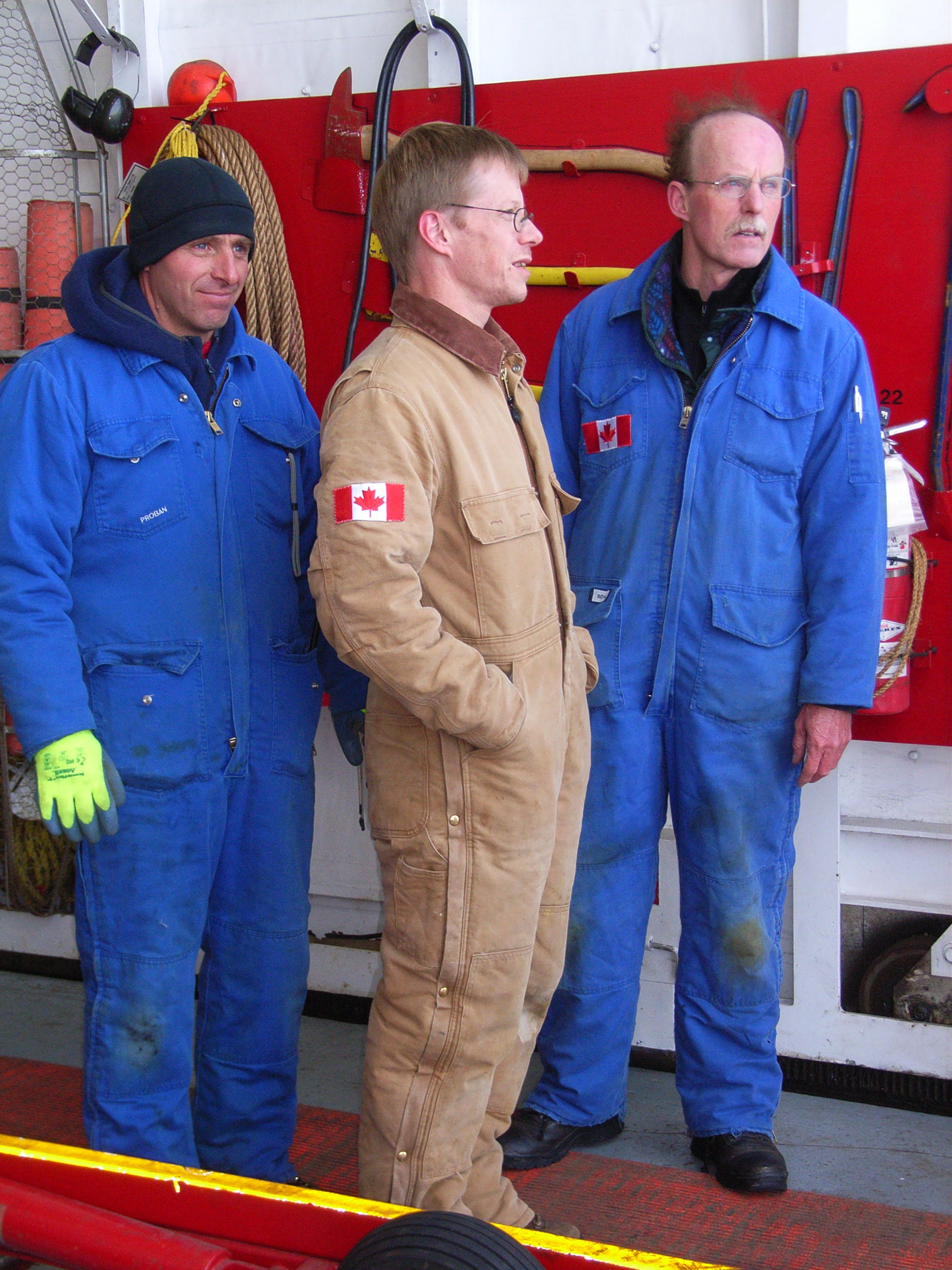
Canadian authorities aboard CCGS Henry Larsen.

The CCGS Henry Larsen originates from St. John’s and most of its officers and crew are local to the town, island, and icy waters offshore where cod once ruled supreme until mis-managed industrial-scale offshore trawling almost wiped the cod out and destroyed much of the local economy that was based on cod for centuries.

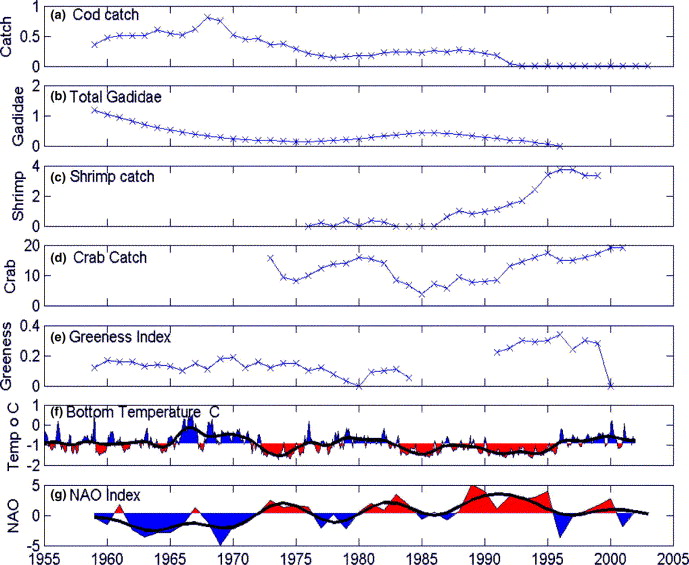
Time series of (a) catch of cod (in 106 tonnes) over the Newfoundland and Labrador shelf (b) the total abundance of Gadidae over the southern Newfoundland shelf (c) the catch of shrimp and (d) crab over the Newfoundland and Labrador shelf (e) the greenness index from the Continuous Plankton Recorder (CPR) over the southern Newfoundland Shelf (f) bottom temperature from inshore on the southern Newfoundland shelf and (g) the North Atlantic Oscillation (NAO) index. The heavy solid lines in panels (f) and (g) represent low-pass filtered smoothed curves of the plotted data. [From DeYoung et al, 2004: Detecting regime shifts in the ocean, Prog. Oceanogr., 60, 143-164.]

The CCGS Henry Larsen has two crew who rotate on and off the ship every 4-8 weeks. Over the years I have met many crew who hailed from families who had worked the cod on smaller, inshore boats. They are superb and experienced sailors who know how to handle and run ships and all attached to it in harsh and icy waters. But how does this relate to screech and cod? Let me digress a moment by comparing US and Canadian Coast Guards:

The U.S. Coast Guard’s ice breaker operates 24-hours/day under military rules without alcohol or overtime to be had. In contrast, the civilian Canadian Coast Guard operates less hours at full strength with some alcohol and some overtime served in moderation. The cultures aboard US and Canadian vessels differ: US ships are permanently in training with young crew on 6-month deployments moving to a new assignment each year, while Canadian ships are working with an older, more experienced, and steady crews. The Canadian crews do the same amount of work in 12-18 instead 24 hours with 1/3 the staff. Ironically, US ships have more “unclassified” electronic capabilities with many more advanced sensor systems. Both ships also have “classified” sensors and missions that I know nothing about, but I digress. Cod and screech are potentially aboard Canadian ships operating out of Newfoundland only.

CCGS Henry Larsen crew at work: Deployment of a tide gauge (subsurface pressure sensor) in Alexandra Fjord. This is one of the instruments we will recover from Nares Strait that was deployed in 2009.

Our small motley crew of eight scientists this year consists of 4 Canadians from British Columbia, 3 Americans from Delaware, and 1 Dutch from England. Yesterday night we all converged at a fine restaurant on Ducksworth Street in downtown St. John’s, Newfoundland. A dispute is still raging among us on what is valid proof of earlier”screeching-in?” I learnt the hard way, that “laminated certificates” are invalid, but what about “un-laminated certificates?” The former are easily obtained in the vibrant port city of St. John’s with its many bars and pubs. The “un-laminated certificates” may be valid, if signed and authenticated by an officer of the CCGS Henry Larsen aboard said ship, but enforcement has been selective.

There are also arguments, that a crossing of the Arctic Circle (certified by a Commanding Officer of a Canadian Coast Guard ship) or the crossing of the International Dateline north of the Arctic Circle (certified by a Commanding Officer the CCGS Henry Larsen) may supersede the more common “screeching-in” ceremonies and certificates. I am the main person making these arguments facing authorities with powers that exceed mine by far.

Our failure to leave for Thule, Greenland today may give some of us a chance to get potentially needed “screeching-in” certificates, but I very much doubt that these “laminated certificates” carry much weight. Time will tell. It will also tell if we get to Thule tomorrow. Hurry-up and wait.

The currents and winds of Nares Strait

[Editor’s Note: Undergraduate Allison Einolf of Macalester College in Minnesota summarizes her work at the University of Delaware that was supervised by Andreas Muenchow as part of an NSF-funded summer internship.]

I’m about to fly to Thule, Greenland for a research expedition into the Nares Strait. We had planed to survey Petermann Fjord, but our proposed cruise track is facing an obstacle twice the size of Manhattan.

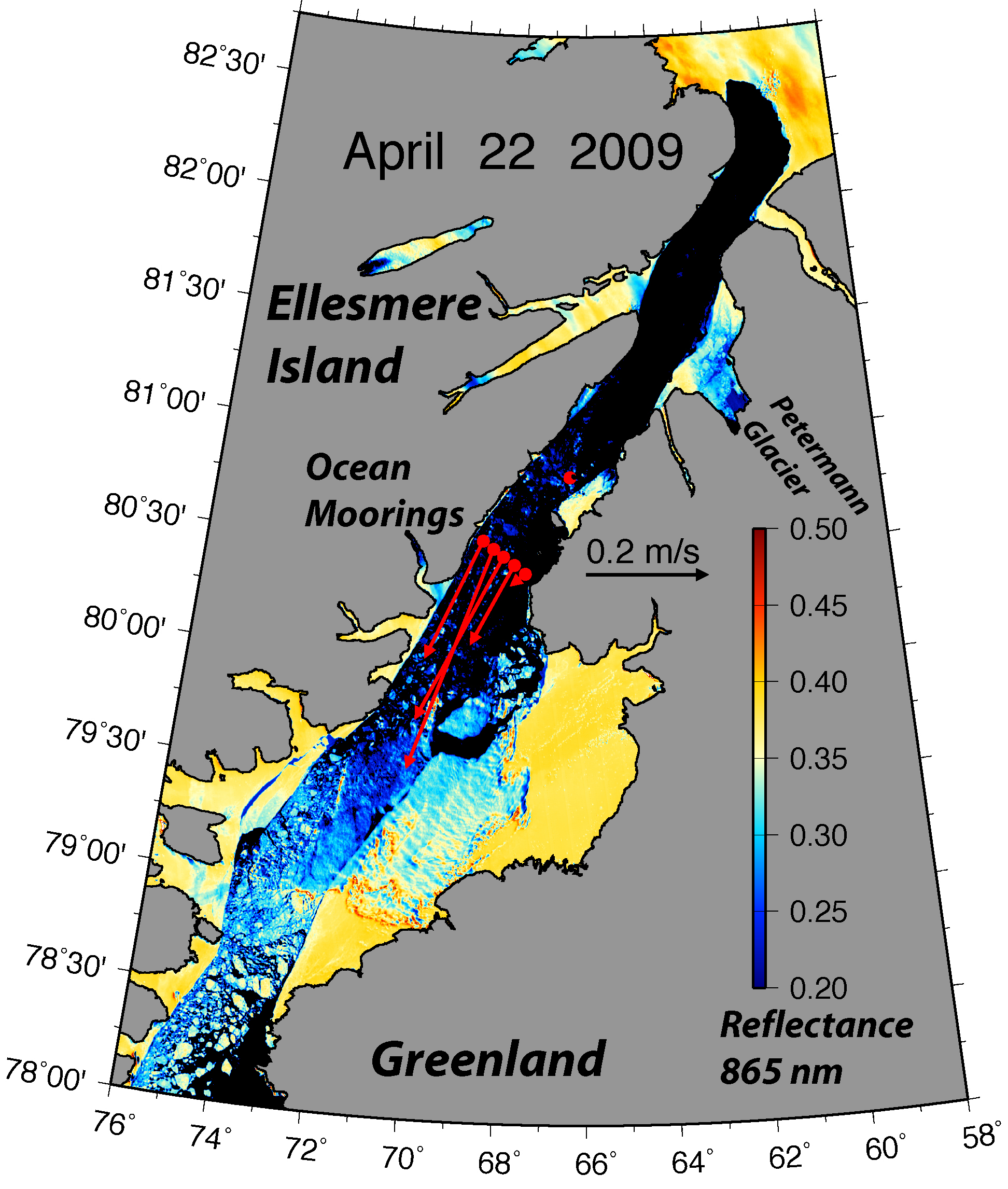
We’re heading up north to pick up instruments that have recorded current velocities, salinity, temperature, and ice thickness in Nares Strait since 2009. I’ve been working all summer on data retrieved on a similar cruise three years ago, focusing on what effects the ice arches have on currents north of the ice arches.

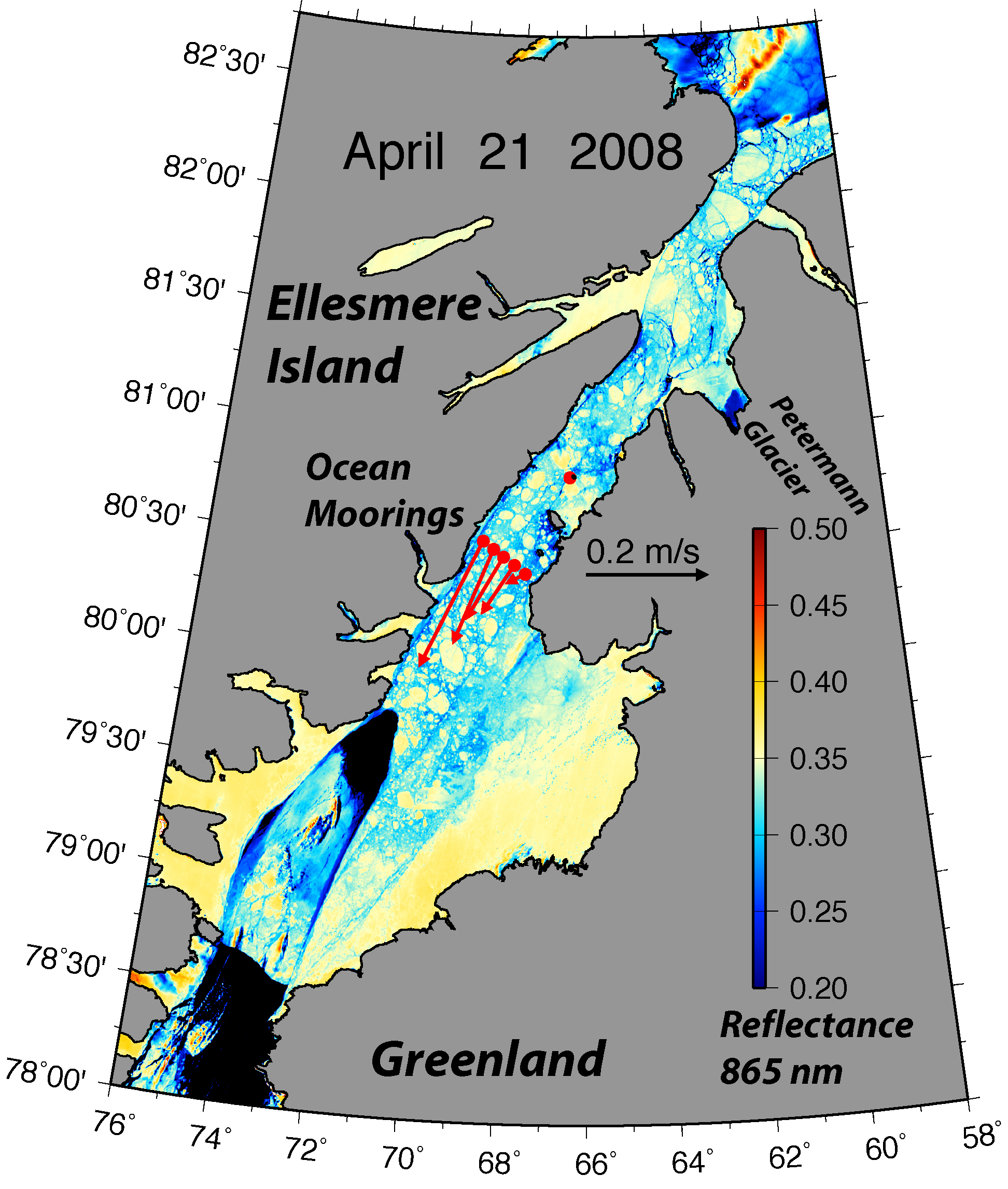
Nares Strait MODIS satellite imagery of the study area and ice arch April 21, 2008. Red dots are instrument locations. Arrows show current velocities.

Nares Strait MODIS satellite imagery of the study area and ice arch April 22, 2009. Red dots are instrument locations. Arrows show current velocities. Note the lack of the southern ice arch, but the presence of one north of the study area.

Continue reading