Category Archives: Ice Cover

Arctic Ice Cover and Petermann Fjord, Glacier, and Ice Island Video Footage

The National Snow and Ice Data Center announced today, that the Arctic Ice Area Extent has reached an absolute minimum breaking the record minimum of 2007 with still several weeks of potential melting and retreat to go. This has been anticipated for many weeks now with perhaps the most extensive coverage and intelligent discussions over at Neven’s Arctic Sea Ice Blog.
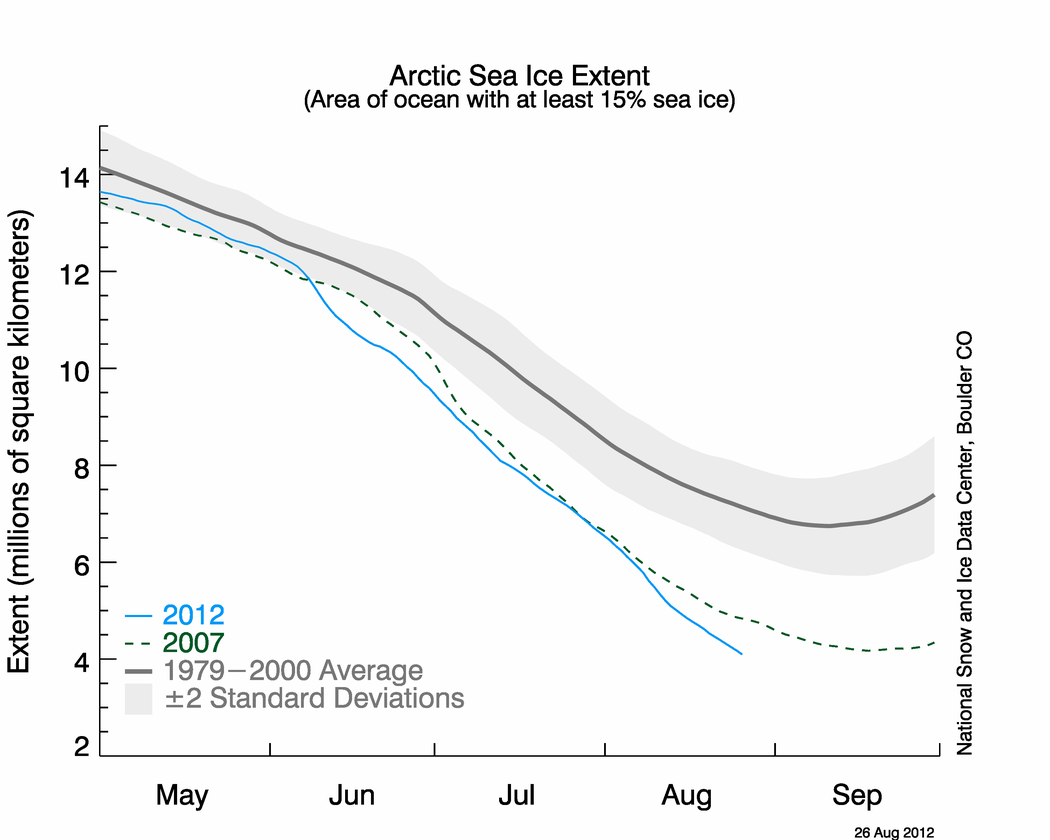
The graph above shows Arctic sea ice extent as of August 26, 2012, along with daily ice extent data for 2007, the previous record low year, and 1980, the record high year. 2012 is shown in blue, 2007 in green, and 1980 in orange. The 1979 to 2000 average is in dark gray. The gray area around this average line shows the two standard deviation range of the data. The 1981 to 2010 average is in sky blue. Sea Ice Index data. [Credit: National Snow and Ice Data Center]

This is as big a deal, because an ice-covered ocean reflects much more sunlight back into space in summer than a black ocean does that absorbs more heat: a positive feedback. This is why people in hot climates wear white, not black clothes, they like to stay cool. Furthermore, this decline has been ongoing for the last 30 years and the climate models that policy makers rely on did not predict this level of ice cover to occur for another 20-30 years. So, the warming climate and the changes it caused are on an accelerated schedule with regard to the Arctic Sea Ice cover. Also, the remaining ice cover is thinner than it used to be, because the multi-year ice keeps leaving the Arctic faster than it can be formed inside the Arctic. Both the Fram Strait to the east of Greenland and Nares Strait to the west of Greenland export this old, hard, and thick ice that ultimately melts further south. The ice that is left in the Arctic Ocean has become both thinner, younger, and softer, making it easier to melt the next summer.

On somewhat related news from the University of Delaware (UDel), we put two videos together that show a tiny, if spectacular example of a different area that has never been ice-free for at least 150 years when people were looking: Petermann Fjord. On August 10/11, 2012 the Captain and crew of the Canadian Coast Ship Henry Larsen gave us unfettered 18 hours access to the newly ice-free waters of this large glacier that discharges about 6% of the Greenland ice sheet. The UDel press release has the video that is also posted at youtube. As a less professionally assembled version is my first introductory iMovie project, e.g.,

Nares Strait 2012: Renske’s View from the Helicopter

As has been mentioned before on this blog, Dr. Renske Gelderloos, from Oxford University, is a fellow traveler on the CCGS Larsen this summer.  She, too, is blogging about her experience.  Below we reblog her post on the helicopter trip, another exciting and beautiful account of doing science in the Arctic, this one even with a couple pictures!  [Note that the pictures in the blog post are from other trips to the same area — limited internet connectivity to the ship does not permit transmission of current images.]  We will post some of her other entries here, but you can find her blog directly at this link.

Nares Strait from the air, and the first CTD section

5 August 2012

Today started with a nice surprise! During the eight-o-clock science meeting after breakfast the chief officer popped in to say that the helicopter would fly out for an ice survey and that it could take two extra passengers. I immediately volunteered, and as Allison and I had never flown in a helicopter before we would be the lucky ones today.

Ice along the Ellesmere Island coast viewed from the helicopter during an ice survey in 2007.

Together with helicopter pilot Don and ice surveyor Erin we flew off in northeasterly direction. Erin’s job was to maps the ice conditions in the channel ahead of the boat, and see whether there was possibly a better route (less ice-covered) for the boat to take. As Hans Island lay in the helicopter range, we decided to land on this island and do a quick check of the weather station there. The weather station looks like a pole on the top of the island (Hans Island is basically a bit-oversized rock…), firmly held down to the ground with three strings. On top of the pole is a weather vane that also measures the wind speed, and attached to the pole on other heights are a thermometer and a fancy measurement device that measures the incoming solar radiation. The pole also has batteries and a solar panel to provide electricity, and a communication device that sends the data to the more populated part of the world so that it is available immediately. This is unlike our oceanographic moorings under water, which we need to physically recover on the site before we can get the data. Dave had asked us to take photos of the instruments, so we landed the helicopter for a close look. All the instruments appeared to be in remarkably good shape. The previous time this weather station was serviced a polar bear had taken a fancy on it, but fortunately none of the kind had happened this time. When we had done all our duties we flew back over Ellesmere Island to see a glacier from closer by: astonishing!

At the end of the day we finally arrived at the site of our mooring array. As we need the deck crew for mooring recoveries (in particular for the crane and the FRC, which is the small inflatable boat that can be launched from the ship), and the deck crew on Canadian coastguard vessels works from 8 to 5 on weekdays, chief scientist Humfrey decided to do a CTD (Conductivity-Temperature-Depth) section first. This had the additional advantage that we would have the CTD data from this section and the moorings overlapping for an intercomparison between the two.

The multi-coloured mountains of Ellesmere Island

Around 7 o’clock in the evening we were ready for the first trial cast. We had already done ‘dry’ tests, which means we just checked whether the computer was willing to talk to the CTD sensors and the other way around, and whether the values we got were somewhat reasonable. The quantities we measure are the conductivity, the temperature and the pressure. From those quantities we can calculate the salinity of the water (the other way to measure salinity is to take a water sample and take it to a laboratory, so by using the conductivity of the water we can measure the salinity at every location from the surface to the bottom which gives a lot more information than just a few samples), as well as the density. For a CTD cast the sensors are tied to a frame, and the frame is lowered, using a winch, from the deck to the water and subsequently from the surface to just above the bottom of the ocean. The data is sent to our computer real time through the cable that is holding the frame, so we can do a visual inspection and get all excited during the cast. After the trial run things started to really speed up and everyone took up a task. Humfrey supervised, Jo did the winch, Dave (after a subtle hint) kindly provided tea with goodies (thanks Dave!), I monitored the data on the computer screen and made sure the data was saved, and Andreas did a quick-and-dirty first post-processing of the data which enabled us all to see the results of our measurements in almost real time. Just before midnight the section was completed, I took some pictures of the midnight sun and we could all go to sleep.

Nares Strait 2012: Heading North Passing Petermann Fjord and Ice Islands

Andreas Muenchow, Aug.-7, 2012 in Hall Basin

Petermann Fjord is within sight and at least 5 ship-sized segments from Petermann Glacier are around us drifting to and fro with the tides. RadarSat imagery received this morning aboard the CCGS Henry Larsen indicates that the Manhattan-sized ice island PII-2012 has moved over 3 nautical miles seaward in the last 36 hours (5 kilometers per day) during winds from the south-west. The north-eastern tip of PII-2012 has left the fjord past Offley Island.

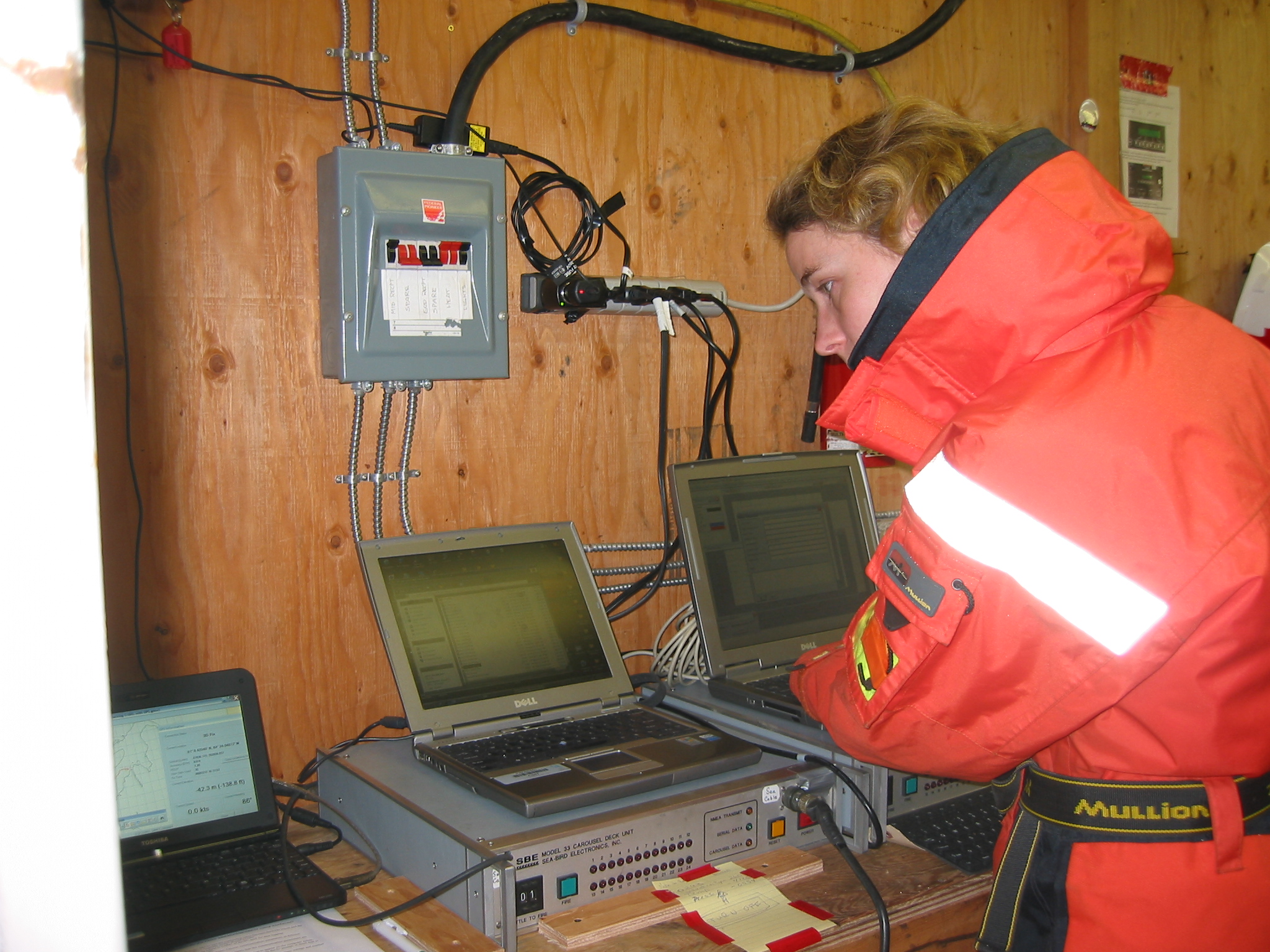
We are about 20 miles to the south at 81 degrees 14 minutes north and 65 degrees west firing bottles to collect water samples across a section that Petermann’s ice island PII-2012 will cross perhaps as early as the next week. Dr. Renske Gelderloos just tells the bridge from a van on the fore deck, that all 12 bottles have been fired as the instrument package traveled from the surface to 451 meter depth and back. Additionally, we collect temperature and salinity more continuously as an electromagnetic sensor is lowered via the same cable as the bottles. I am one of two winch operators while Dr. Gelderloos is the command and control center next to me operating 3 laptops concurrently.

Dr. Renske Gelderloos of Oxford University in command and control of data collection operations aboard the CCGS Henry Larsen.

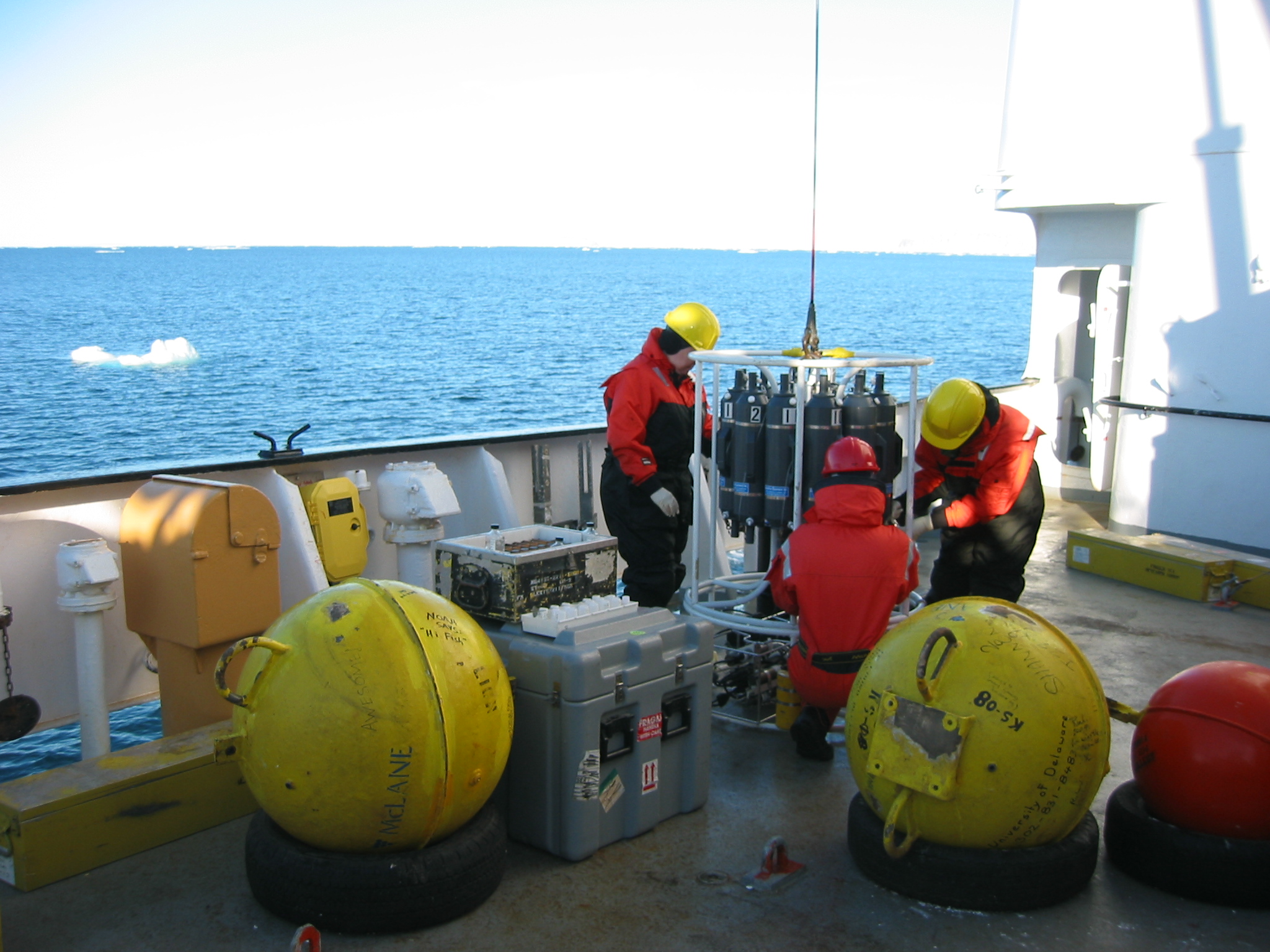
Pat Ryan (left), Humfrey Melling (center), and Allison Einolf (right) collecting water samples aboard the CCGS Henry Larsen in Hall Basin in August 2012.

PhD student Patricia Ryan, dressed in a warm Mustang suit, is one of the water samplers to transfer water into tiny sample bottles for later chemical analyses. She just hands me a USB JumpDrive with 3-years of data of temperature, salinity, and pressure from a moored sensor we recovered yesterday. The latest profile is completed and I am off to process the new data further.

I missed dinner at 5pm, because it took us 5 hours until 8pm local time to finish the 7 stations of a section from Greenland to Ellesmere Island, Canada. I am back to writing now at 11:35 pm local time after lots of cheerful banter, quick clean-up for the day, 2 beers at the bar, and an hour staring into Petermann Fjord from the west-by-northwest. I can’t see the ice island even though I see Offley Island and I know the ice island is right next to it. The ice sheet spilling over the vertical walls of Petermann Fjord are visible in the distance, too. It is raining now. Air temperatures are 0.7 degrees Celsius (about 34 Fahrenheit) which is a little cooler than is normal for this time of the year. We are now another 50 km to the north at 81 degrees and 44 minutes North latitude that is farther north of Petermann Fjord and its ice island.

I can see five ship-sized segments of Petermann Glacier’s ice shelf, but I cannot discern the Manhattan-sized PII-2012 across Hall’s Basin. We have open water to our south and some loosely scattered ice to our north along Ellesmere Island. We are still heading north towards Robeson Channel to perhaps reach Alert on the Arctic Ocean or to perhaps repeat a section that was done for the first and last time in 2003 when the USCC Healy was here at the beginning of our Nares Strait project. It is past midnight now, Wednesday has started, time for bed. [81 49’ N, 63 09’ W at 04:20 UTC, 00:20 local]

The currents and winds of Nares Strait

[Editor’s Note: Undergraduate Allison Einolf of Macalester College in Minnesota summarizes her work at the University of Delaware that was supervised by Andreas Muenchow as part of an NSF-funded summer internship.]

I’m about to fly to Thule, Greenland for a research expedition into the Nares Strait. We had planed to survey Petermann Fjord, but our proposed cruise track is facing an obstacle twice the size of Manhattan.

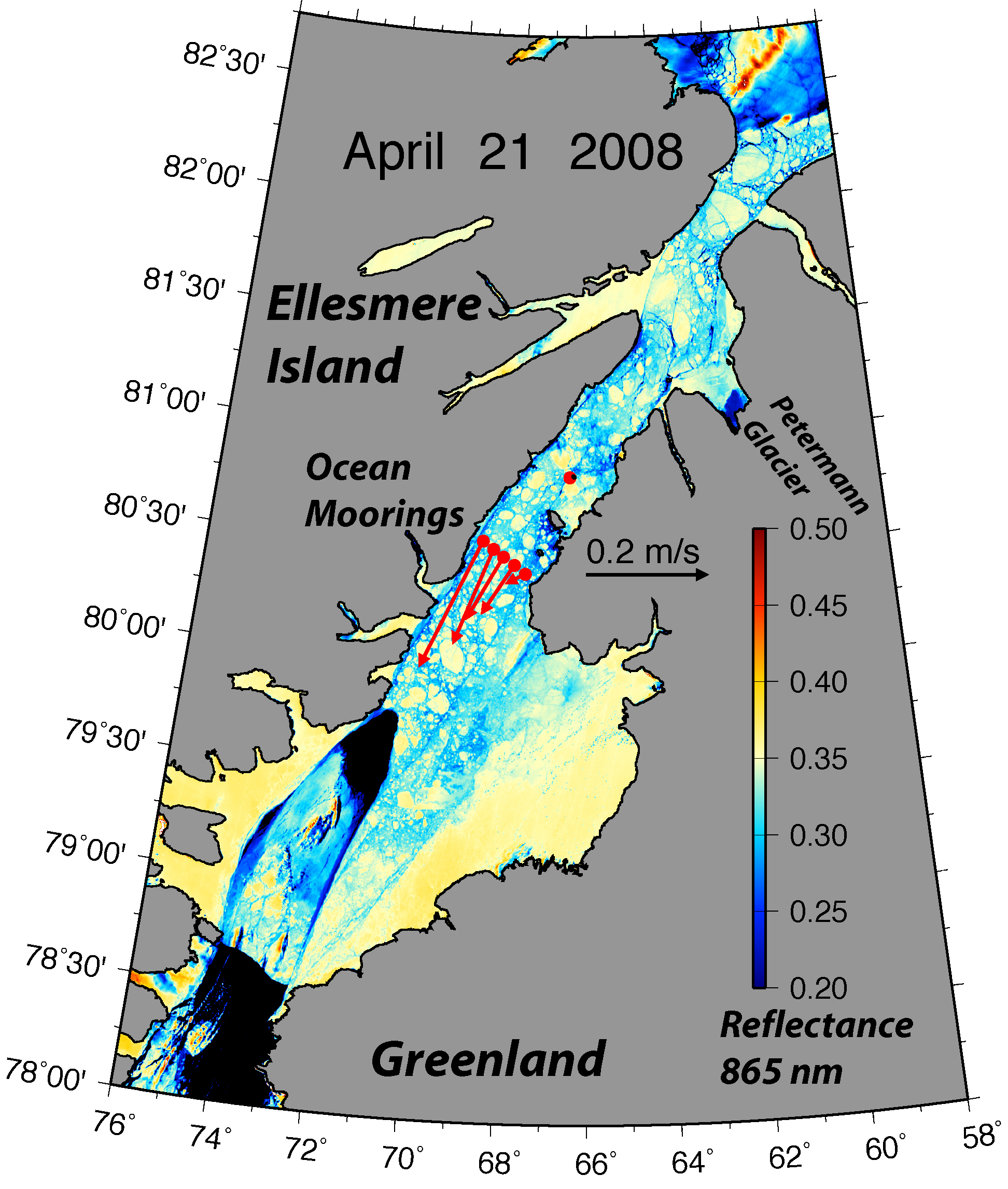
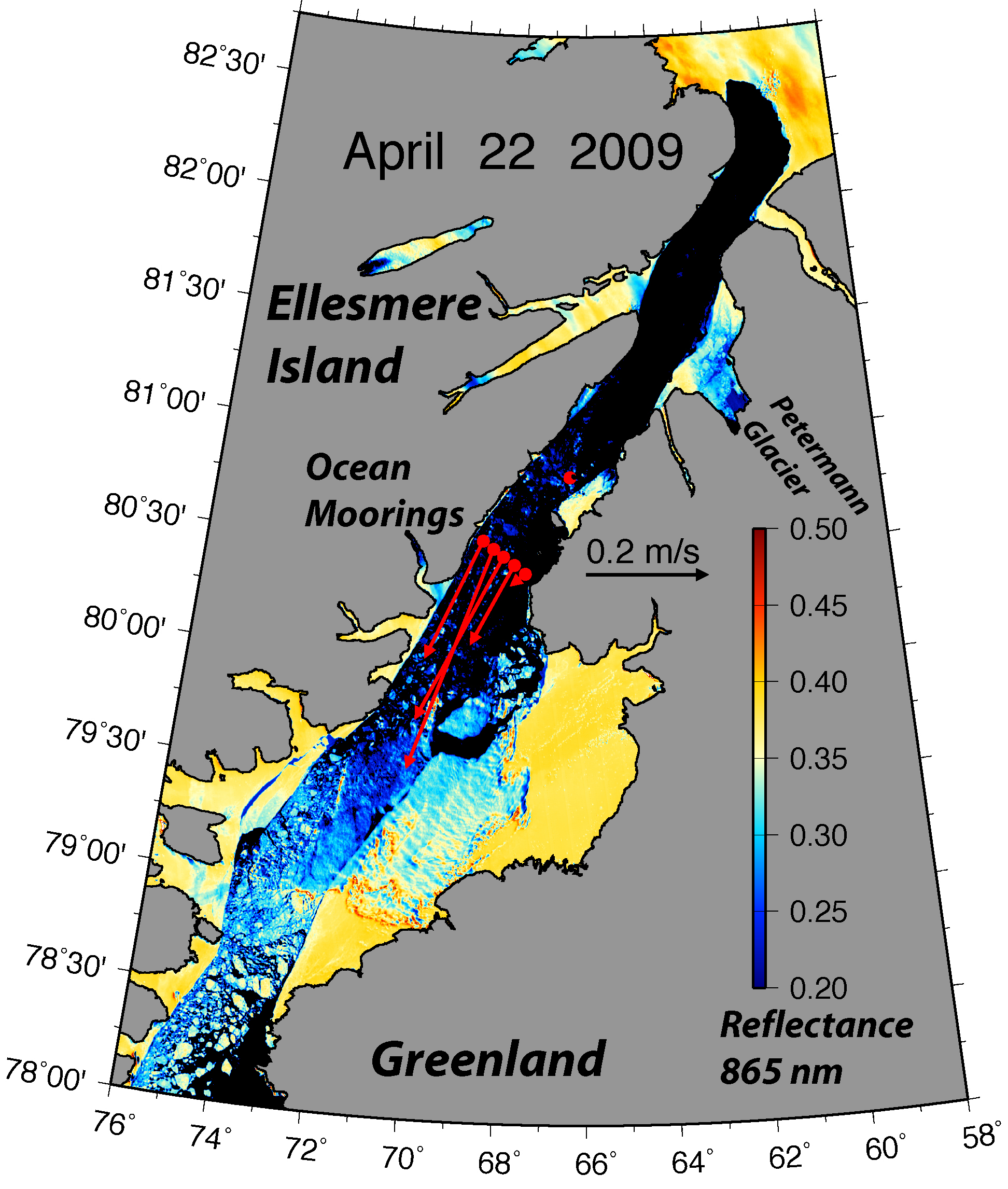
We’re heading up north to pick up instruments that have recorded current velocities, salinity, temperature, and ice thickness in Nares Strait since 2009. I’ve been working all summer on data retrieved on a similar cruise three years ago, focusing on what effects the ice arches have on currents north of the ice arches.

Nares Strait MODIS satellite imagery of the study area and ice arch April 21, 2008. Red dots are instrument locations. Arrows show current velocities.

Nares Strait MODIS satellite imagery of the study area and ice arch April 22, 2009. Red dots are instrument locations. Arrows show current velocities. Note the lack of the southern ice arch, but the presence of one north of the study area.

Continue reading

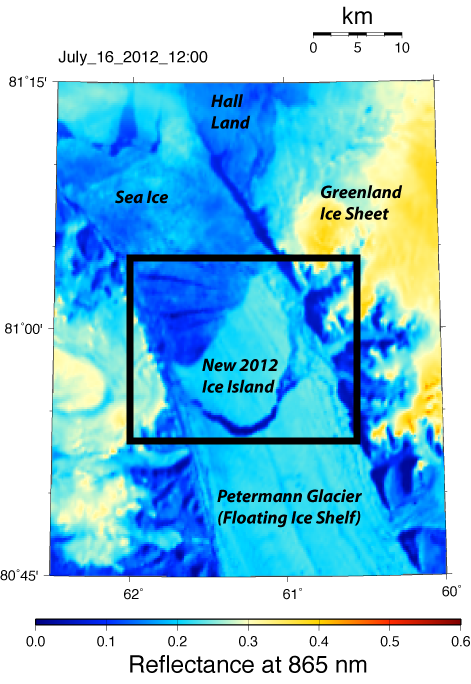
New Petermann Ice Island forming July-16, 2012

This morning Petermann Glacier lost another ice island of a size comparable to what it lost in 2010:

MODIS-Aqua image of July 16, 12:00 UTC of a new ice island forming from Petermann Glacier.

The break-off point has been visible for at least 8 years in MODIS imagery propagating at speeds of 1 km/year towards Nares Strait. The fracture also extended further across the floating ice sheet from the northern towards its southern side.

This event is still evolving, Trudy Wohleben of the Canadian Ice Service noticed it first (as in 2010) after reviewing MODIS imagery. Several people in several countries are monitoring and assessing the situation, but a first estimate of its size is 200 km^2 (3 Manhattans), I will revise this figure as soon as I got my hands on the raw data 120 +/- 5 km^2 or about 2 Manhattans.

The Canadian Coast Guard Ship Henry Larsen is scheduled to travel to Nares Strait (and Petermann Fjord) to recover moorings placed in 2009. These mooring data, if recovered, will contain ocean current, temperature, salinity, and ice thickness data at better than hourly intervals from 2009 through 2012.

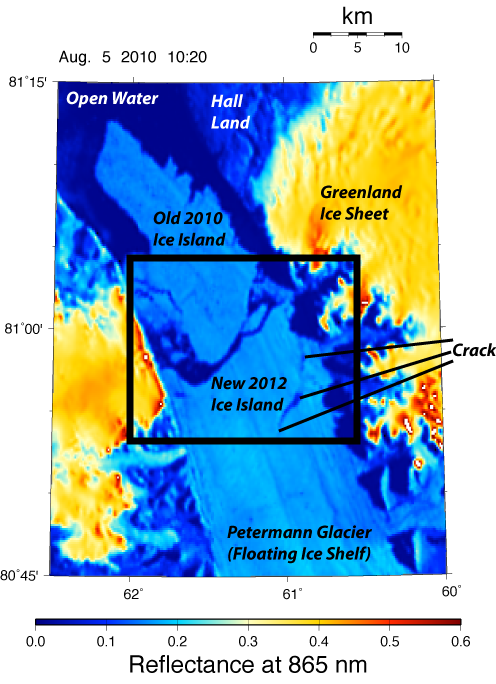
UPDATE: For comparison, I here show the 2010 imagery on the same scale using the same processing and colors. There will be more imagery this evening as MODIS-Terra passes over the area closer to nadir (better resolution or sharpness of the images). Furthermore, clouds seem to be disappearing.

The 2010 Petermann Glacier calving event also indicates the crack that broke off this morning as indicated. Note that the entire floating ice shelf moves by about 1 to 1.3 km per year, slightly less than a mile per year. The crack in 2010 is where the 2012 ice island formed.

EDIT: Changed 2012 MODIS-Terra figure which now has the correct (July 16, 2012) date that the data were taken.