Category Archives: Greenland

Taking the Pulse of Petermann Gletscher

Posted by Pat Ryan for Andreas Muenchow

23-August-2015 at 80:57.3 N 061:27.1 W

(note correction below)

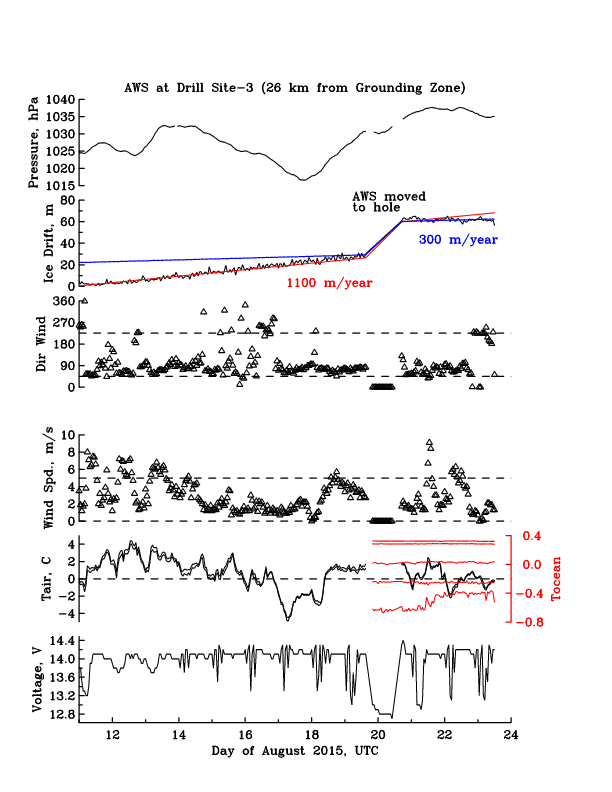
I just may have made a discovery that I cannot share with anyone on the ship right now. The giant mass of ice that is Petermann Gletscher just slowed down moving only 1 meter per day for the last 3 days rather than the 3 meters per day that it usually does and that has been reported in the scientific literature. This measurement comes from the newly deployed University of Delaware weather station that also contains a not-so-fancy $300 Garmin GPS as well as 5 ocean sensors that measure temperature and salinity about 95-m, 115-m, 300-m, 400-m, and 810-m below the surface of the floating and moving ice.
Time Series of Glacier Drift

Time Series of Glacier Drift (correction appears below)

As the glacier puts on the breaks, I also see a rather dramatic increase in ocean temperature from -0.6 to -0.35 degrees Celsius within about 10-m of the ice-ocean interface. The saltiness of the ocean also increased from below 34.1 to above 34.2 practical salinity units that you can think of as grams of salt per kilogram of water, roughly. Only 20 m below in the water column, the opposite is happening: The water there cools a little bit and becomes fresher. This suggests some mixing as the salinity differences become smaller and heat from the lower layer moves up towards the ice. Some force must be applied to the fluid to do this. Recall that a force is mass times acceleration. The force of a mosquito splashing on the wind shield of your car is small, because the mass of the mosquito is small even though its acceleration (from zero to the speed of your car) is large. Now imaging this glacier: Its mass is enormous, so you only need to change its velocity a tiny amount, from 3 to 1 meter per day, say, to generate a massive amount of force.
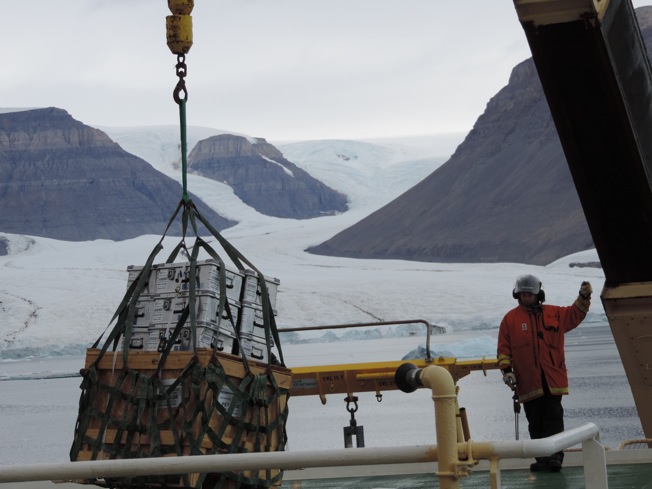
Photo of helicopter deck with Belgrave (left) and Petermann (right) Glaciers in back Aug.-23, 2015; view is to the north-east.

Photo of helicopter deck with Belgrave (left) and Petermann (right) Glaciers in back Aug.-23, 2015; view is to the north-east.

As I look outside my cabin window right now, I see the terminus of Petermann sitting there innocently not appearing to do much, but it is literally changing the face of the earth as it moves fast, slows down, moves some more, and over 1000s of years cut a very deep fjord and perhaps canyon deep into the mountains and even deeper into the sea floor. The helicopters are whizzing overhead right now returning all the gear that was needed to drill through 100s of meters of hard glacier ice to provide access holes to both ocean and sediments that has been in total darkness for many 100s of years.
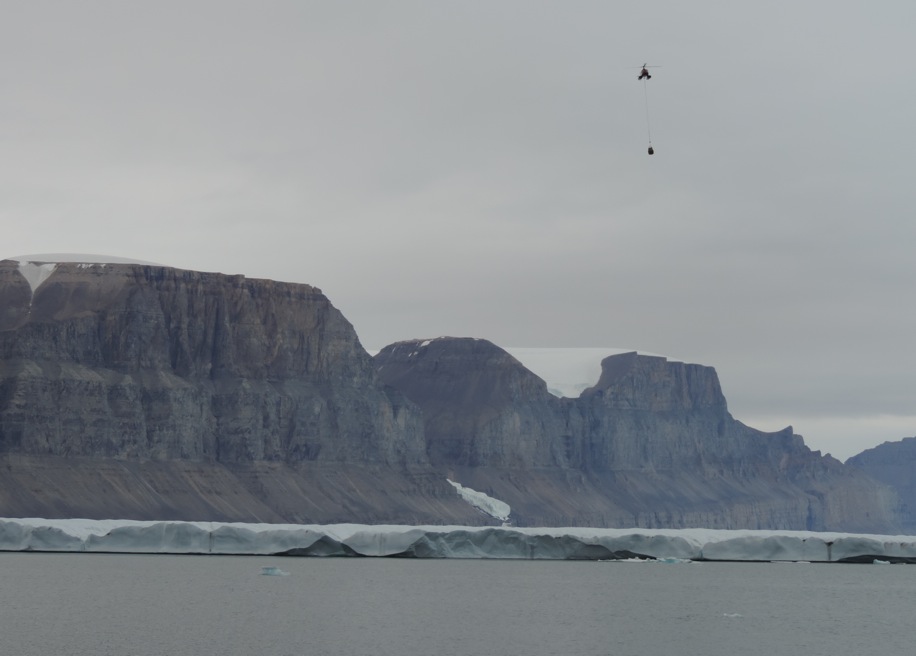
Photo of helicopter delivering cargo from the finished ice camp back to the ship on 23 Aug. 2015.

Photo of helicopter delivering cargo from the finished ice camp back to the ship on 23 Aug. 2015.

Still, there is life down there, lots of it Anne Jennings, who closely looks at the sediment cores, tells me. We speculate that the life is supported by vigorous ocean flow that connects the open fjord with the glacier covered deep ocean. Food stuff like plankton may move some distance under the floating glacier to support a population of other critters that I know nothing about. No narwhals this year so far, though.

So why I am writing this up here rather than share it with people on the ship? Well, this is Sunday morning and there was much to celebrate last night when the ice drilling team returned after 2 weeks camping on the ice and collecting data from their three drill holes. Furthermore, the the ocean weather station reported for the first time in over 2 days uploading all the data I show above. This happened well past midnight and several of us discussed the data and future plans in the cafeteria until 1:30 am. So the people not working right now are all sleeping (10:30 am here) as we probably will work through the night to map the Atlantic waters flowing into the fjord at its sill towards Nares Strait …  which we have not yet done over the 3 weeks we have been in the area. I probably also should help with unloading the helicopters or getting the Chief Scientist Alan the data files he needs to catalogue the water samples we collected last night. Work on Oden never stops … as there is so much to do as we are barely scratching the surface or bottom of the ocean here. [Incoming helicopter, 4th one since I wrote these lines too fast, perhaps.]
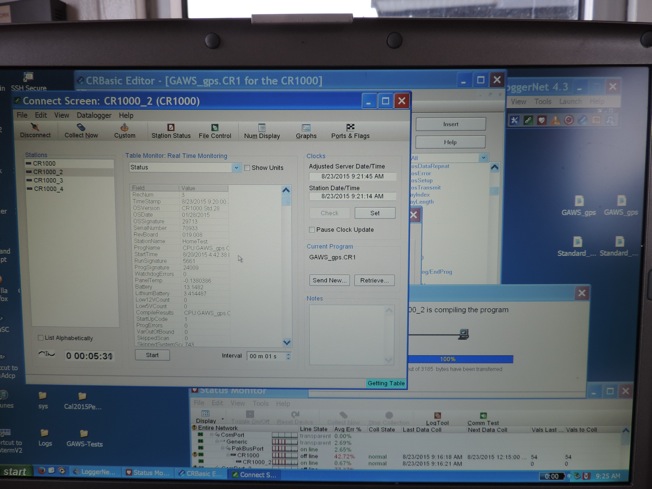
Screenshot of a successful RS-232 serial connection from ship to ocean weather station on Petermann Gletscher and ocean sensors deployed 810 m below the glacier’s ice surface with active real time data transmissions. This session uploaded new codes to the secondary data logger to activates its secondary back-up memory.

Screenshot of a successful RS-232 serial connection from ship to ocean weather station on Petermann Gletscher and ocean sensors deployed 810 m below the glacier’s ice surface with active real time data transmissions. This session uploaded new codes to the secondary data logger to activates its secondary back-up memory.

Correction:

Petermann Gletscher did slow down the last few days by about 10% as measured by the GPS at the UDel ocean-weather station. The suggested slow-down to 300 meters per year, however, is false, because I did not properly take into account how the station was moved by 30 meters to the south-west. The correct and updated estimate is the figure below. Please discard the the above figure erroneous.

Sorry for the confusion … more data coming from this station will place the short term change in glacier speeds into a larger context. Furthermore, the present “cheap” GPS system will need to be verified by a set of three “fancy” differential UNAVCO GPS that were recovered today, but we have not yet decoded the data contained on those units.

Back to CTD profiling the water properties across the sill at the entrance to Petermann Fjord that we will have to complete by 3 am or in about 6 hours.
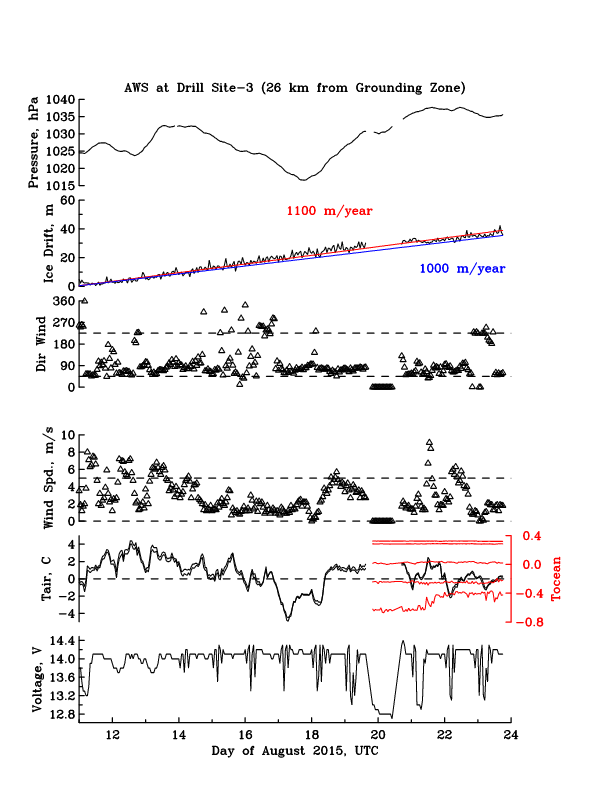
Time Series of Glacier Drift (Corrected)
Time Series of Glacier Drift (Corrected)
Ocean Observing Station Reporting from Below Petermann Gletscher, Greenland

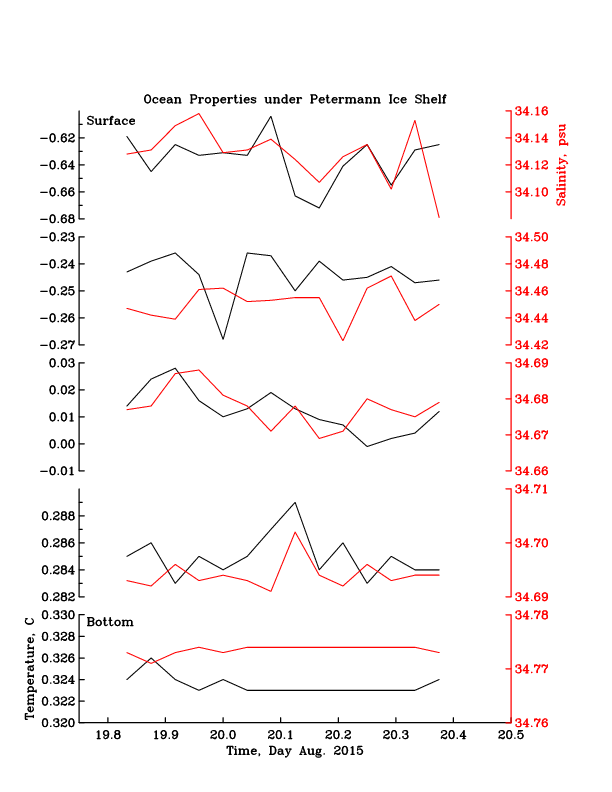
We discovered warm waters 800 meter down a hole drilled 100 m through Petermann Gletscher ice.  Every hour an ocean sensor querries temperature, salinity, and pressure and reports its readings to a weather station atop the glacier. The warm waters come from the Atlantic and enter the Arctic Ocean near Spitsbergen. Prior to hitting our sensors in an 800 m deep fjord in northern Greenland, the water moved along Siberia, Alaska, and northern Canada before snaking its way into Petermann, Greenland to perhaps melt this glacier from below while surface air temperatures are already below freezing. It is a long way from home for both those Atlantic waters and us scientists and crew here aboard the Swedish icebreaker Oden and four hardy explorers camping on the floating ice of Petermann Gletscher.

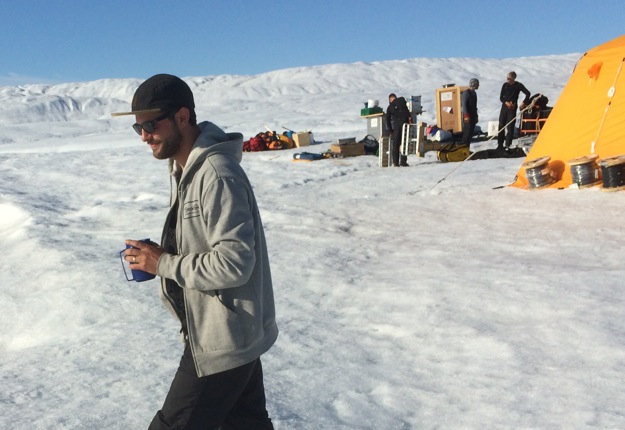
Peter Washam on Petermann Gletscher at an ice drilling camp. Cables and ropes against tent are used later to connect ocean sensors to the weather station.

Peter Washam on Petermann Gletscher at an ice drilling camp. Cables and ropes against tent are used later to connect ocean sensors to the weather station.

Keith, Paul, and Mike of the British Antarctic Survey as well as my graduate student Peter deployed 5 ocean sensors with cables and ropes. A weather station designed by David Huntley of the University of Delaware provides the command and control between ocean sensors, battery and solar panels, and the Iridium satellite modem to send data back home. For me this engineering project took over much of my life the last 6 months as all testing and coding has been done while traveling. Much problem-based learning took place not for pedagogic reasons, but as a necessity to make something special work. And work it does.

First 14 hours of ocean data from below the floating ice shelf of Petermann Gletscher as of 20. Aug. 2015. Top time series are from just under the ice shelf near 120 m while the bottom time series is from a sensor at 810 m below the surface.

First 14 hours of ocean data from below the floating ice shelf of Petermann Gletscher as of 20. Aug. 2015. Top time series are from just under the ice shelf near 120 m while the bottom time series is from a sensor at 810 m below the surface.

These are the first and only data from below a glacier in Greenland that do not involve a person tending to instruments, computers, and cables with a helicopter or aircraft waiting. Our observing system is fully automated and the first 14 hours of data were collected by my computer on the ship calling the computer on the weather station which then sends the data after some computer-to-computer hand-shaking.

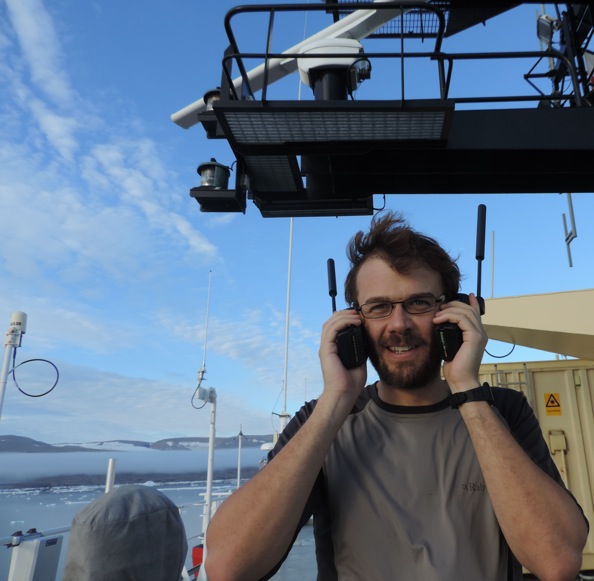
The weakest and most fickle link in this chain is the Iridium satellite phone to move data through thin and cold air. Senator McCain of Arizona called the ship yesterday and was rudely disconnected by Iridium the same way that our ocean weather station is.

Rob Holden testing Iridium phones above the bridge of I/B Oden.

Rob Holden testing Iridium phones above the bridge of I/B Oden.

Unlike busy, engaged, and well-meaning politicians, however, the computers will tirelessly try again and again every three hours to send the data back that the weather station on Greenland accumulates no matter how well Iridium is connecting it to us.

Power is key as is a flexible budget that adapts to both scientific needs and environmental conditions. I here do not talk about politics in Washington, DC, but the design of the weather station that is powered by both batteries and solar panels while the Iridium modem is the most energy gobbling component of the ocean observing system. Hence it is switched off at all times except a 20 minute window every three hours. I will have to change this window to 20 minutes once per day in the winter when the station will have to operate in complete darkness. So, many challenges are still ahead which includes a mechanical design to fix a weather station on a melting glacier, but alas, winter here is already upon as with air temperatures on and off the glacier below freezing. New ice forms in the early morning hours already.

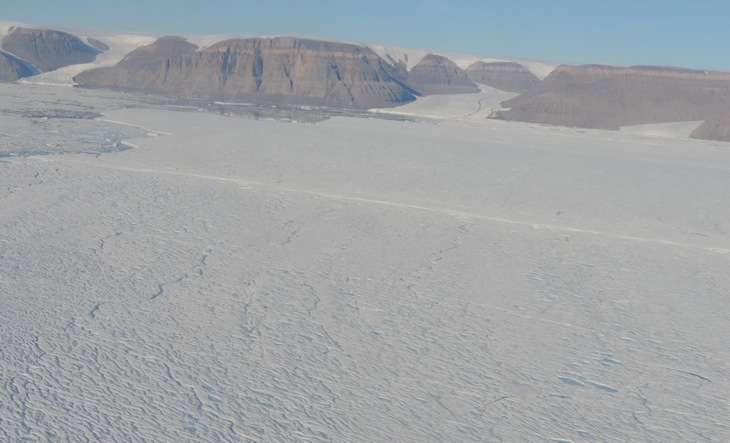
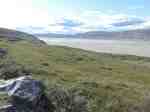
Terminus of Petermann Gletscher with Hubert (right), Belgrave (center), and Un-Named (left) Glaciers coming in from Hall Land in the north. The ocean is to the left (west).

Terminus of Petermann Gletscher with Hubert (right), Belgrave (center), and Un-Named (left) Glaciers coming in from Hall Land in the north. The ocean is to the left (west).

Sent from I/B Oden at 17:38 UTC on 20 Aug. 2015 at 81:26 N and 064:03 W

GPS, Geocaching, and Greenland Glaciers

Navigating ice, ocean, and land, brave women and men have always used the stars for guidance. Just think of the three kings who followed a star to witness the birth of Jesus Christ in Bethlehem 2015 years ago. They were 6 days late. Keeping track of time track was always difficult for navigating, especially at sea and the British Navy lost many ships as a result of poor time keeping. There are books written on the history of determining longitude, the best of which is called, well, “Longitude.” Now why would I ponder these questions and histories two hours before I am boarding the Swedish icebreaker Oden to travel by sea and ice to Petermann Glacier?

The Global Position System (GPS) that many of us have in our smart phones or tiny hand-held devices makes navigating easy. Both measure time as our civilization has put “stars” into space that guide hikers out in the back-country, urban dwellers to the next bar or restaurant, and missiles into a target the size of the dot over the letter “i” on a license plate of a car. Few know that the GPS satellites only sent time from an atomic clock to our GPS receivers and smart phones. Time is of the essence, there is something almost spiritual about time and how to define it. And time is linked to space not just because of Einstein’s theory of relativity, but also the way we measure space by measuring the time that waves travel through space.

Waiting for the plane to get 58 scientists to Thule to board the I/B Oden, I went for a geocaching trip an hour or two from the town of Kangerlussuaq. My wife got me into this 2 years ago as a way to explore areas via hiking without much planning. All we do is enter some GPS position of places where other people have placed “treasures” and we head out to find them. These geocaches are everywhere: within 100 feet of my home, in every city I went to in Poland, Sweden, or Germany, and now Greenland, too. My favorite GPS unit is a little hand-held $99 Garmin eTrex 10. It does a marvelous job to get me anywhere within about 3-6 feet (1-2 meters).

As part of our Petermann research, we also got four “fancy” GPS systems which we want to place on the ice shelf of Petermann Gletscher to measure tidal motions. The water under the glacier is connected to ocean that moves the Empire-State-Building thick ice up and down every 12 hours or so. We do not know by how much, though, and when it moves up and when it moves down. There should also be daily cycles and longer periods caused by winds and waves. Now these fancy $25,000 GPS are able to track over 400 satellites (not just the 9 that my Garmin does) and they receive the time information in a very raw and accurate format at more than one radio frequency in more than one way. If one has several of these, we got four, then it is possible to built a network that reduces common errors in position to a few millimeters in the horizontal, and 1-2 centimeter in the vertical after some smart processing. So these “fancy GPS” can sense the difference of the top of your smart phone from the bottom, and I do not mean its length or width, but its thin height. And this is blowing my mind. We need this accuracy to measure tides, and tides we will measure for the 20-30 days that we are working in and around Petermann Gletscher.

Wish us luck as we are heading from the green part of Greenland in the south to its white (ice), black (ocean), and gray (land) parts. There are few colors where we will be the next 4 weeks. Our internet will be gone, but I will try to send text files and small photos until we return on 4 September or so, but time will be hard to find. Wish all of us luck …

Petermann Glacier Tidal Heaving

Some glaciers float on the ocean around Antarctica and Greenland. Petermann Gletscher in North Greenland is one of these. It spawned massive Manhattan-sized ice islands in 2010 and 2012. Could tides influence when and where such break-ups occur? After all, the tides under the floating glacier move the ice up and down. But how does a 50 km long, 15 km wide, and 300 m thick floating glacier pivots about its “hinge?” Does it do so like a rigid plate of steel or does it bend and buckle like jelly? I do not know, because nobody has measured the tidal motions of Petermann’s floating ice. So, one of many projects this summer will be to measure tides on Petermann with fancy GPS systems.

Shape of the floating part of Petermann Gletscher (right panel) drom laser altimeters along two tracks flown along the glacier in 2014 (left panel).

Shape of the floating portion of Petermann Gletscher from laser altimeters (right panel) along two tracks flown along the glacier in May of 2014 (left panel).

Martin Jakobsson of Stockholm University posed these questions, sort of, when he asked us American oceanographers, if we had any fancy GPS units to work with one he plans to put high on a cliff overlooking Petermann Fjord. He needs exact positions to map the bottom of the ocean. The cliff-GPS station is fixed while he moves about in a small boat that also has a GPS. Taking the difference of the raw travel times received by the cliff-GPS and the boat-GPS, he can reduce GPS position errors from several meters to several centimeters. People call this differential GPS and he wondered if we oceanographers had any use of it to perhaps give him the tidal corrections he also needs as the measures bottom depths from a boat. Well, this was not initially part of our plan and we did not get funded to study the glacier or the tides under it, but his question got me thinking while Alan Mix of Oregon State University did some organizing. One always squeezes extra science into such great opportunities. Discoveries lurk everywhere to inquiring minds.

Small survey boat loaded onto I/B Oden in Landskrona, Sweden, June 2015.

Small survey boat loaded onto I/B Oden in Landskrona, Sweden, June 2015.

Alan managed to find not one, not two, but three fancy GPS units from an organization that I had never heart of. It is called UNAVCO:

UNAVCO, a non-profit university-governed consortium, facilitates geoscience research and education using geodesy. We challenge ourselves to transform human understanding of the changing Earth by enabling the integration of innovative technologies, open geodetic observations, and research, from pole to pole.

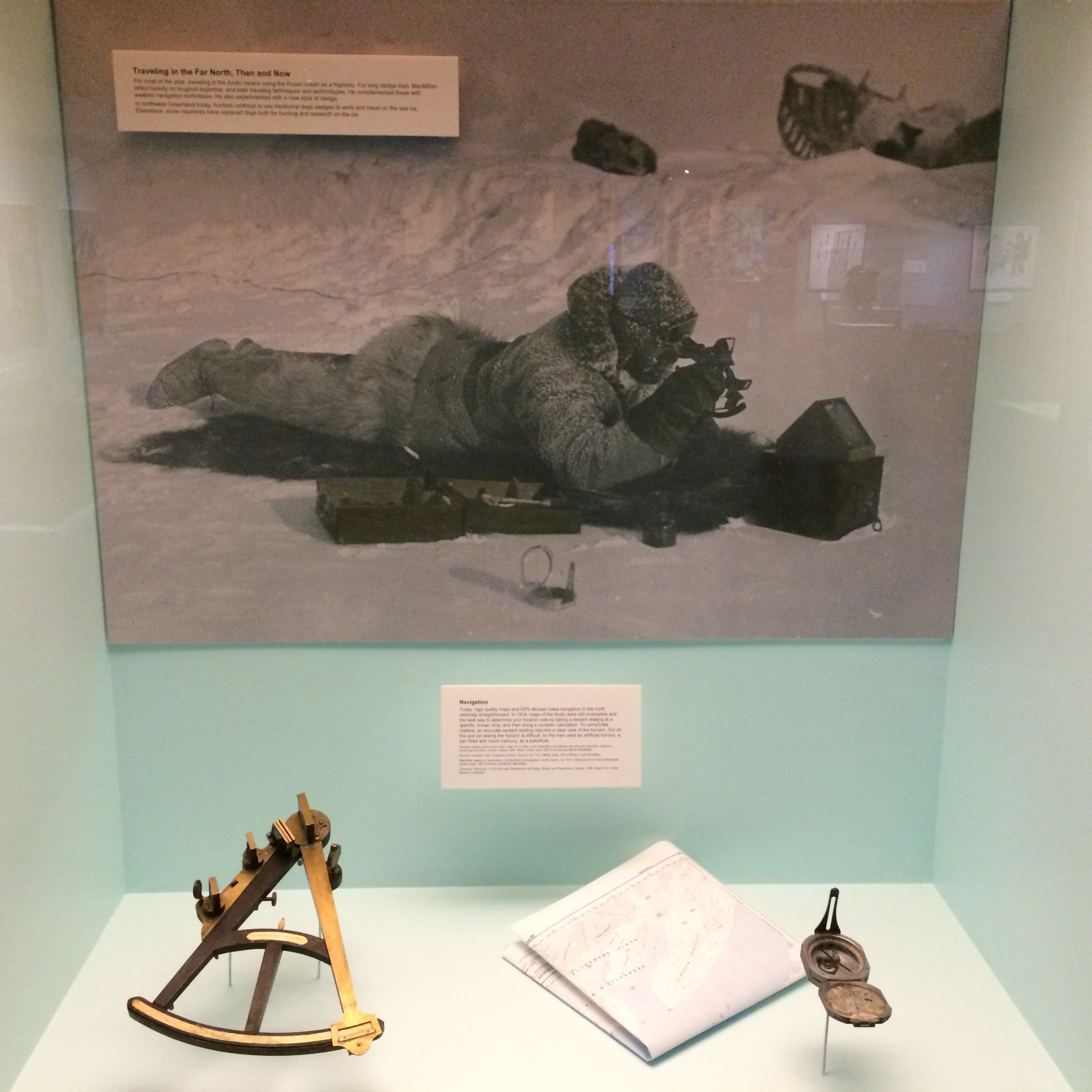
“Geodetic observations” are measurements of locations on the earth’s surface. In the old days surveyors walked about with sextant, clocks, tripods, and optical devices to fix a location and reference it to another. Nowadays satellites and lasers do this faster, but I digress. Suffice it to say, UNAVCO is giving us 3 fancy GPS system to carry with us to Petermann Gletscher to make measurements of tides on the ice. So we can pick 3 locations on the ice where we leave these GPS for the 3-4 weeks next month. I have never done this before, so there will be lots of new learning.

Navigation during early Arctic exploration. Photo taken during a visit of the Peary MacMillan Arctic Museeum at Bowdoin University in Brunswick, Maine.

Navigation during early Arctic exploration. Photo taken during a visit of the Peary MacMillan Arctic Museeum at Bowdoin University in Brunswick, Maine.

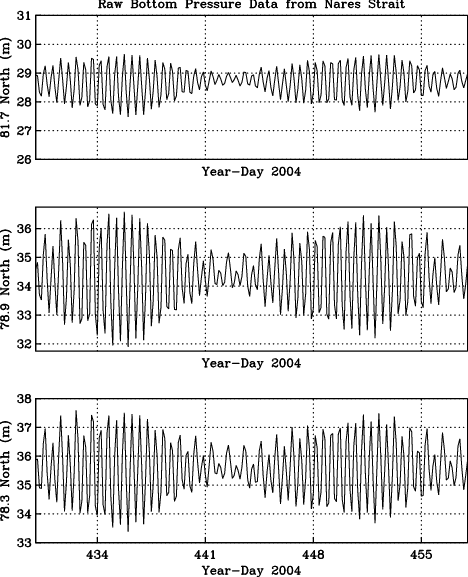
I have worked with tides since plunging my head into tidal mud-flats of north-west Germany where I grew up and camping on the shores of the Conwy Estuary in North-Wales where I collected data for my MS thesis. Below I show a 4 week record from three locations in Nares Strait where the tidal elevations range from more than 4 meters at the southern entrance to less than 2 meters in Hall Basin next to Petermann Fjord. The data are from bottom pressure sensors that were deployed for 3-9 years, but I here only want to show the spring-neap cycle. So we already have some idea on how the tides in the ocean next to Petermann Glacier behave.

Sea level fluctuations in meters for 28 days at Discovery Harbor or Fort Conger, Canada near 81.7 N latitude (top), Alexandra Fjord, Canada near 78.9 N latitude (middle), and Foulke Fjord, Greenland near 78.3 N latitude (bottom).

Sea level fluctuations in meters for 28 days at Discovery Harbor or Fort Conger, Canada near 81.7 N latitude (top), Alexandra Fjord, Canada near 78.9 N latiude (middle), and Foulke Fjord, Greenland near 78.3 N latitude (bottom).

Models of tides in Nares Straits do really well if, and only if, the bottom topography is known. And this is where Martin’s mapping of the ocean floor in Petermann Fjord and our tidal observations on the floating glacier come together: We both need good bottom topography, we both use fancy GPS, and we both need to know tides to get accurate bottom depths and we need to know bottom depths to predict tides.

Oceanography of Nares Strait Ice Flushing

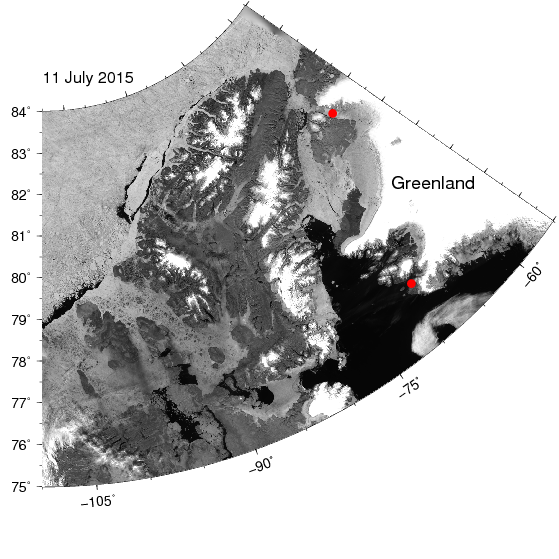
I need the ice out of Nares Strait, a 20 mile wide and 300 miles long pathway to the North Pole between northern Canada and Greenland. The ice blocks our way to Petermann Fjord where a large glacier pushes thick ice out so sea as a floating ice shelf. We plan to drill through the floating section of the glacier that is about as thick as the Empire State Building is high. The ship to get us there is the Swedish icebreaker Oden (Location Map). She is passing the Faroe Islands to the north-west of Scotland and will arrive in 2 weeks at Thule Air Force Base where we will meet her.

Image of northern Greenland (top right) and Ellesmere Island (center) showing open water as black, land as gray, and sea ice as gray/white. The two red dots are Thule Air Force Base in the south and Petermann Glacier in the north. Note the bands of black water along the coast of Ellesmere Island that result from east to west blowing winds that move ice offshore.

Image of northern Greenland (top right) and Ellesmere Island (center) showing open water as black, land as gray, and sea ice as gray/white. The two red dots are Thule Air Force Base in the south and Petermann Glacier in the north. Note the bands of black water along the coast of Ellesmere Island that result from east to west blowing winds that move ice offshore and reduce the southward flow in Nares Strait.

The voyage from Thule to Petermann usually takes about 2-3 days, but if the sea ice does not flush out with the generally southward currents, then it may take a week or two wrecking havoc to our busy science schedule. So, why is the ice still lingering in Nares Strait this year?

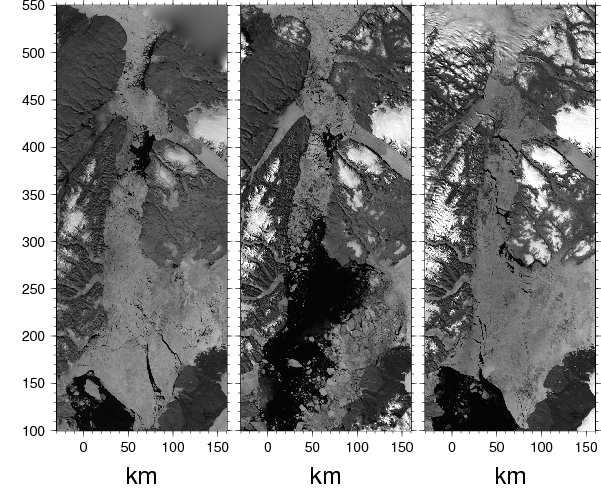
Nares Strait ice cover in July of 2015 (left), 2014 (center), and 2013 (right) from MODIS Terra.

Nares Strait ice cover in July of 2015 (left), 2014 (center), and 2013 (right) from MODIS Terra.

There are three parts to the answer: First, a sturdy ice arch at the southern entrance of Nares Strait has to break. It has done so only last week. Second, a strong and perhaps oscillating flow has to thoroughly collapse the large pieces of ice at a narrow choke point that is Smith Sound. This has not happened yet. And third, a persistent flow to the south has to flush out ice into Baffin Bay to the south faster than it enters from the Arctic Ocean in the north. This flow is much weaker at the moment than is normal, because winds in the Arctic Ocean have been from east to west right now. These winds moved water (and ice) offshore to the north, so sealevel along northern Greenland and Canada drops. We can see this in today’s satellite imagery as prominent black bands of open water along the coast of northern Canada.

Lets take a closer look of this same image and zoom in on the southern part of Nares Strait as it looked this morning.

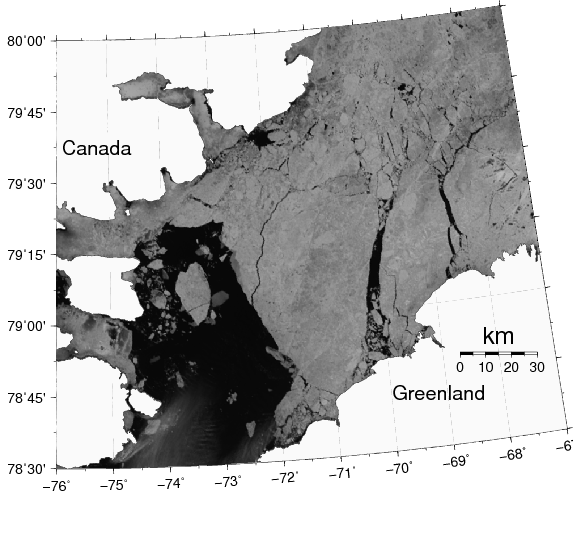
Collapsing ice arch at the southern entrance to Nares Strait on 13 July 2015 from MODIS AQUA.

Collapsing ice arch at the southern entrance to Nares Strait on 13 July 2015 from MODIS AQUA.

What used to be a solid frozen mass of ice along the Greenland coast (bottom right) has become a broken and loose mass of smaller ice floes. The larger blocks farther from the coast are now sliding southward as the loose ice along the coast reduces friction or lubricates the edges. The sides lose their grip on the ice and the entire construction fails and collapses. A most beautiful video on the stability of arches is posted by Open University here about lines of action or thrust.

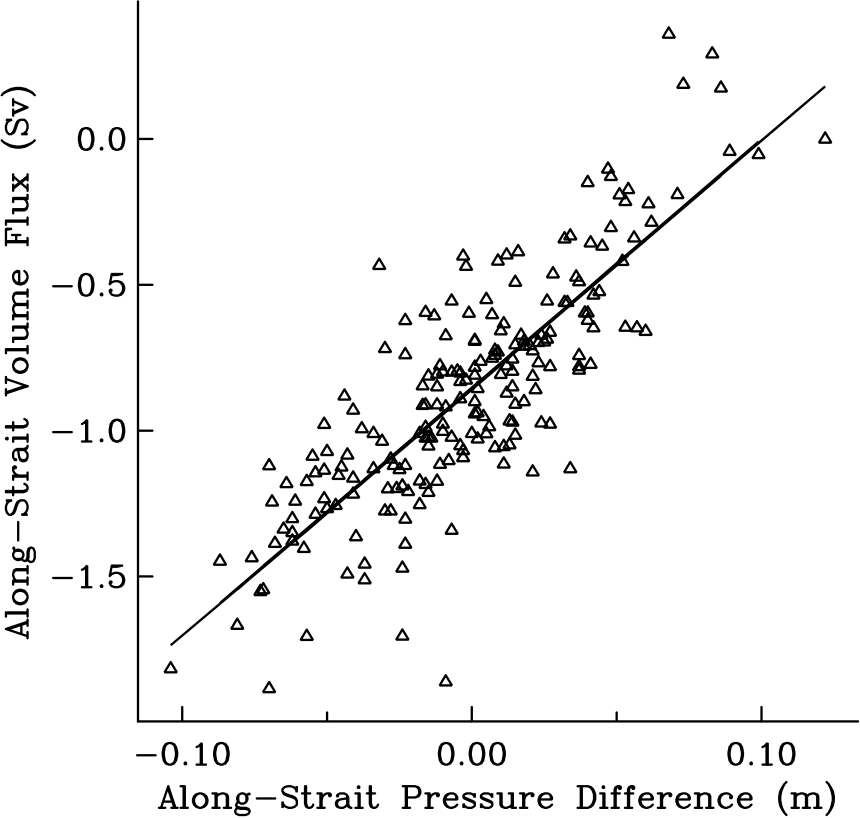
All we now need for the ice to flush out of Nares Strait is a weakening or reversal of the winds at the other northern entrances to Nares Strait. Much of the generally southward flow is caused by the ocean’s surface being higher in the north than it is in the south. There are details that I am skipping, but basically much of the flow rolls downhill like a ball. And with the winds up north being from east to west, there is not much of a hill that the water can flow down, so we got somewhat stagnant waters. I have actually measured the height of this “hill of water” many times over the many years with ocean sensors that measure how much water is above them. This figure summarizes 3 years of data collected every 3 hours or so

Graph showing how water flow (called “volume flux”) varies with the steepness of the hill (called “pressure gradient”). The “hill” is at most 10 centimeters or 3 inches) high. [Adapted from Muenchow, 2015]

Now there is more to the “hill” story that is modified near the surface by the earth’s rotation in a fluid that has different densities at different depths. In a nutshell, the surface flow is 2-3 times as strong as the depth averaged flow. Furthermore, the surface flow on the Canadian side of Nares Strait is often twice as strong as that closer to Greenland, but all these spatial variations in flow actually help to smash large pieces of ice by moving and rotating them different sides of the same large piece of ice differently.

So, lets all hope that we get a few days of strong winds from the north flowing south, that should clear Nares Strait quickly before Oden arrives there in 2 weeks time. Those winds from the north not only flush out ice from Nares Strait, they also keep it nicely on one, the Canadian side. Earth rotation does wonderful and magical things to fluids such as water and air.

Muenchow, A, 2015: Volume and freshwater flux observations from Nares Strait to the west of Greenland at daily time scales from 2003 to 2009. J. Phys. Oceanogr., re-submitted July 2015, .pdf