Category Archives: Greenland

Exploring Greenland’s Coastal Currents: A Journey of Discovery with Icebreaker Polarstern

Icebreaker Polarstern reached its home port of Bremerhaven in Germany just before Orkan “Joshua” hit northern Germany hard. The ship returned after 3 month at sea with 48 crew and 46 scientists working on ocean biology, chemistry, and physics. The 7-week expedition from Svalbard to Greenland and back to Germany culminated 3 years of planing and preparations led by the Alfred Wegener Institute (AWI). As one of 46 scientists I stepped onto the ship almost two months ago in Longyearbyen. We planned to explore what moves ice and fresh Arctic water into the Atlantic Ocean with sensors to probe the coastal circulation.  Analyzing these data, I will now live in Bremerhaven for a few months.
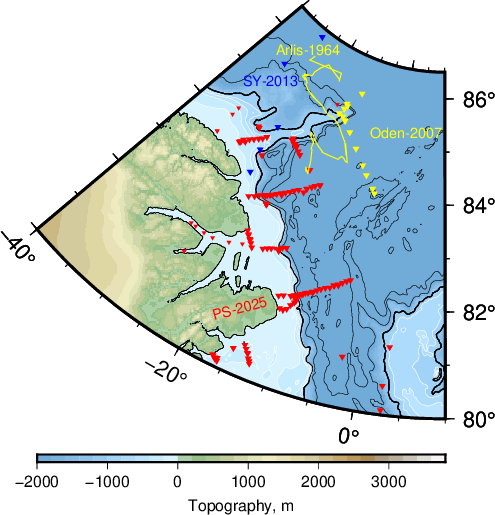
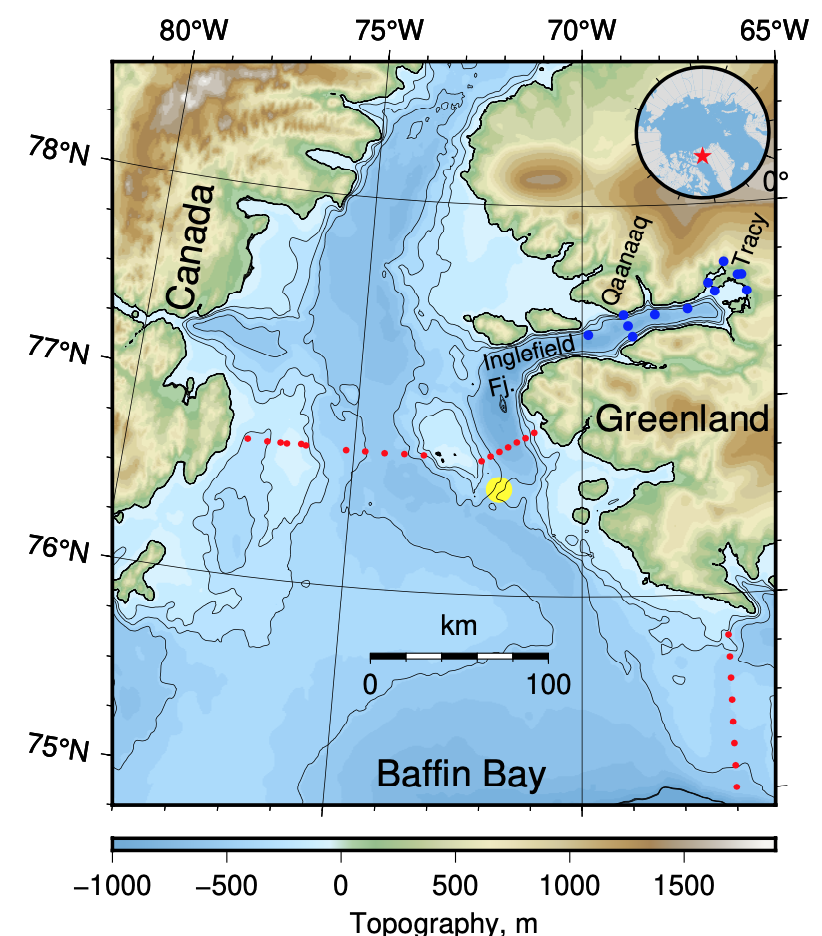
The map above shows where we went to the north of Greenland. I am coloring the coastal ocean shallower than 1000 m in light blue and the deeper ocean in dark blue. Our 2025 Polarstern data are the red symbols while yellow and blue symbols show data locations from 1964 ice island, 2007 icebreaker,  and 2013 helicopter surveys. This area contains the last and thickest sea ice of the Arctic Ocean and prior ocean observations originate from floating ice islands that both the Soviet Union and the U.S.A. used during the Cold War 1947-91 such as the Arlis-1964 track (yellow line). Helicopter surveys collected a few data in 2013 (blue symbols) while the Swedish icebreaker Oden collected data along two lines farther offshore (yellow symbols).
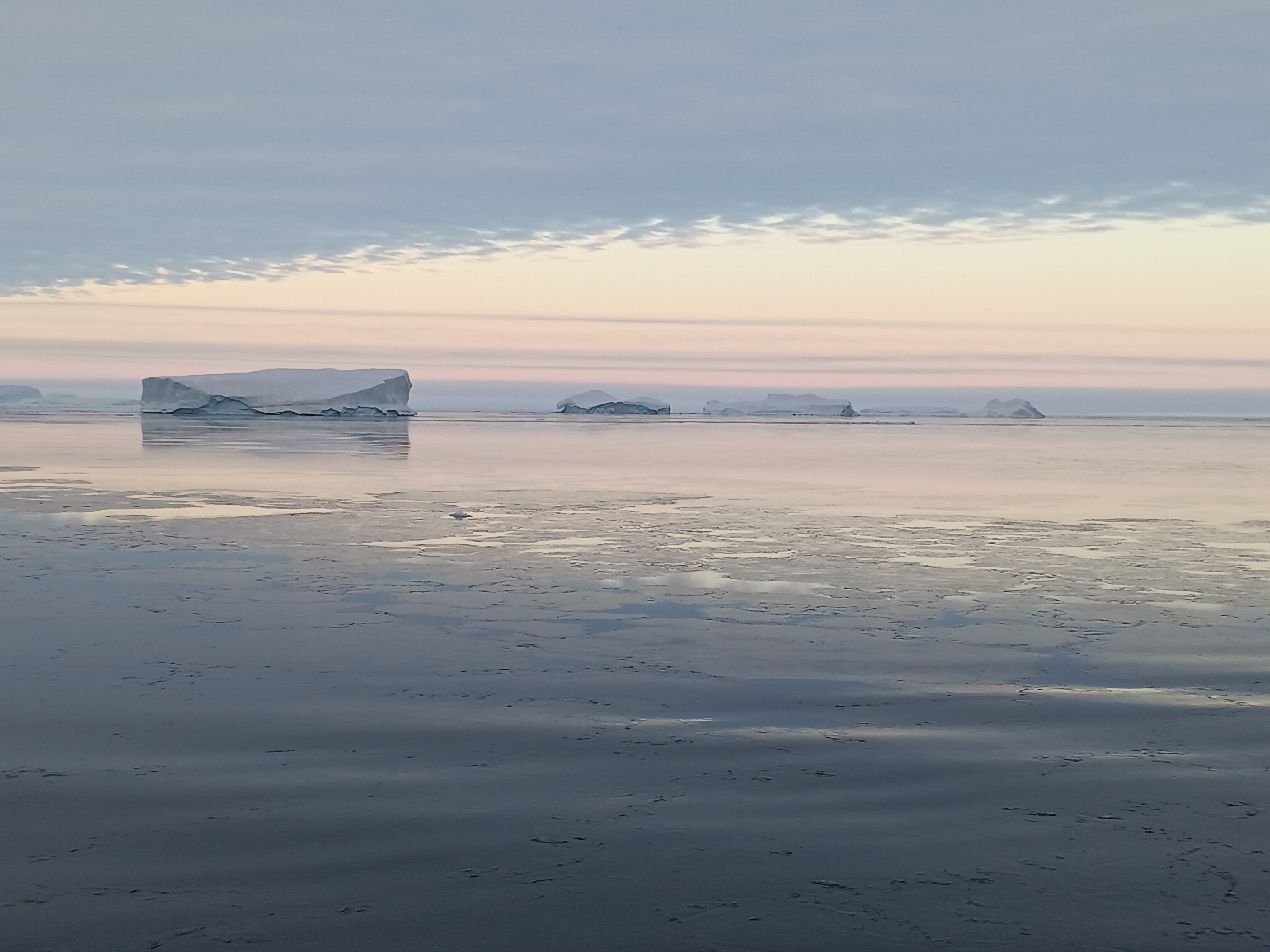
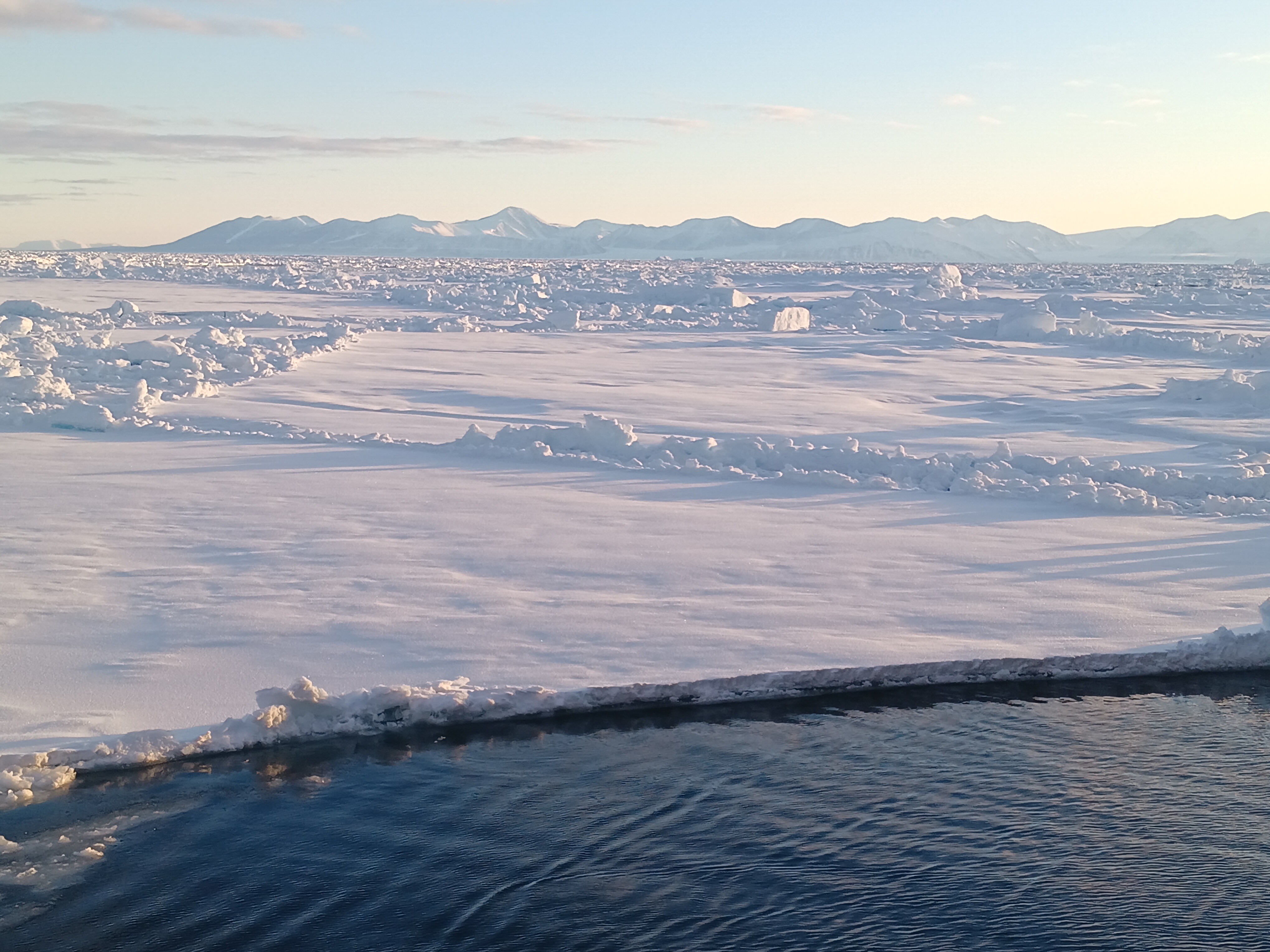
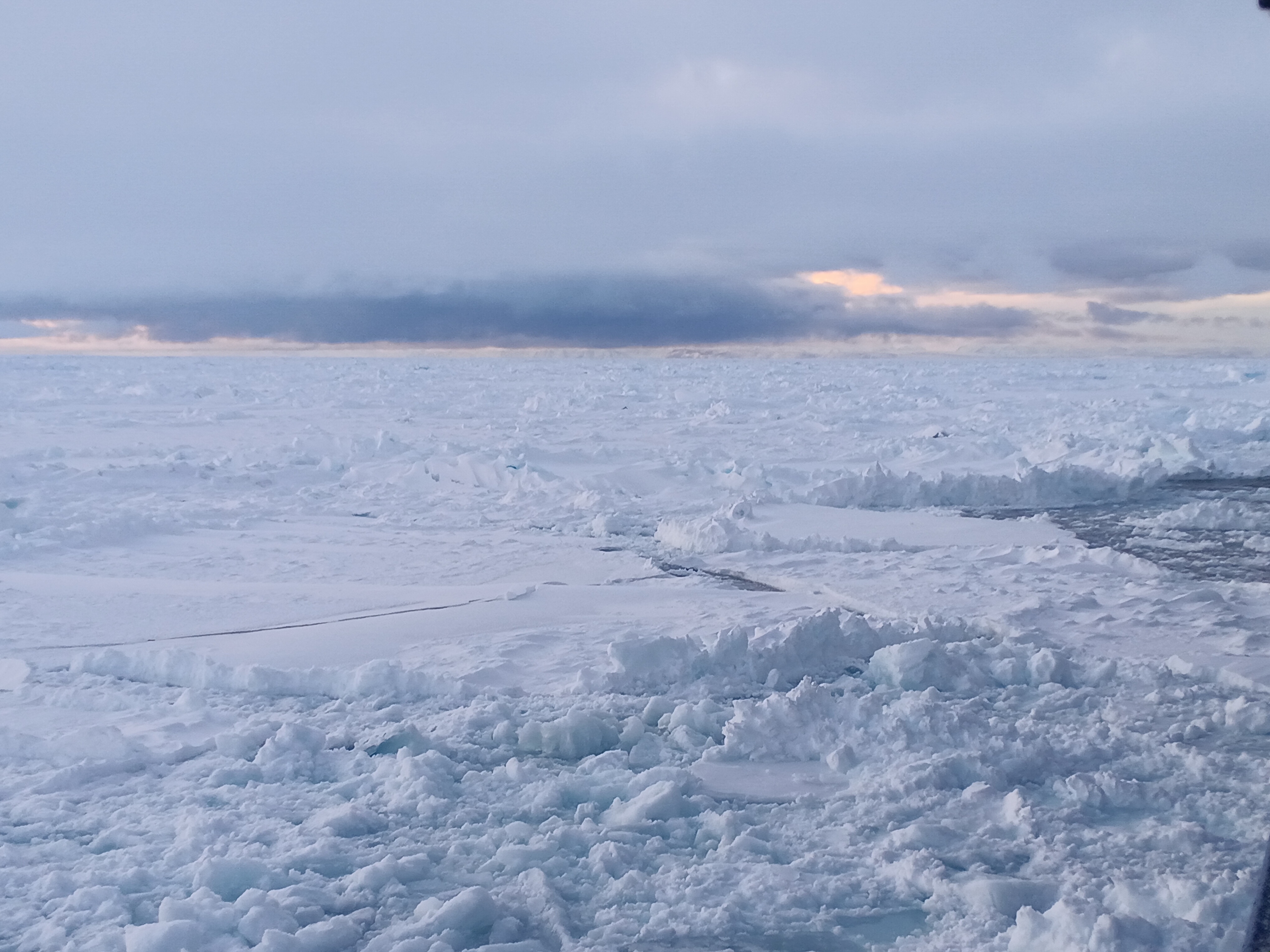
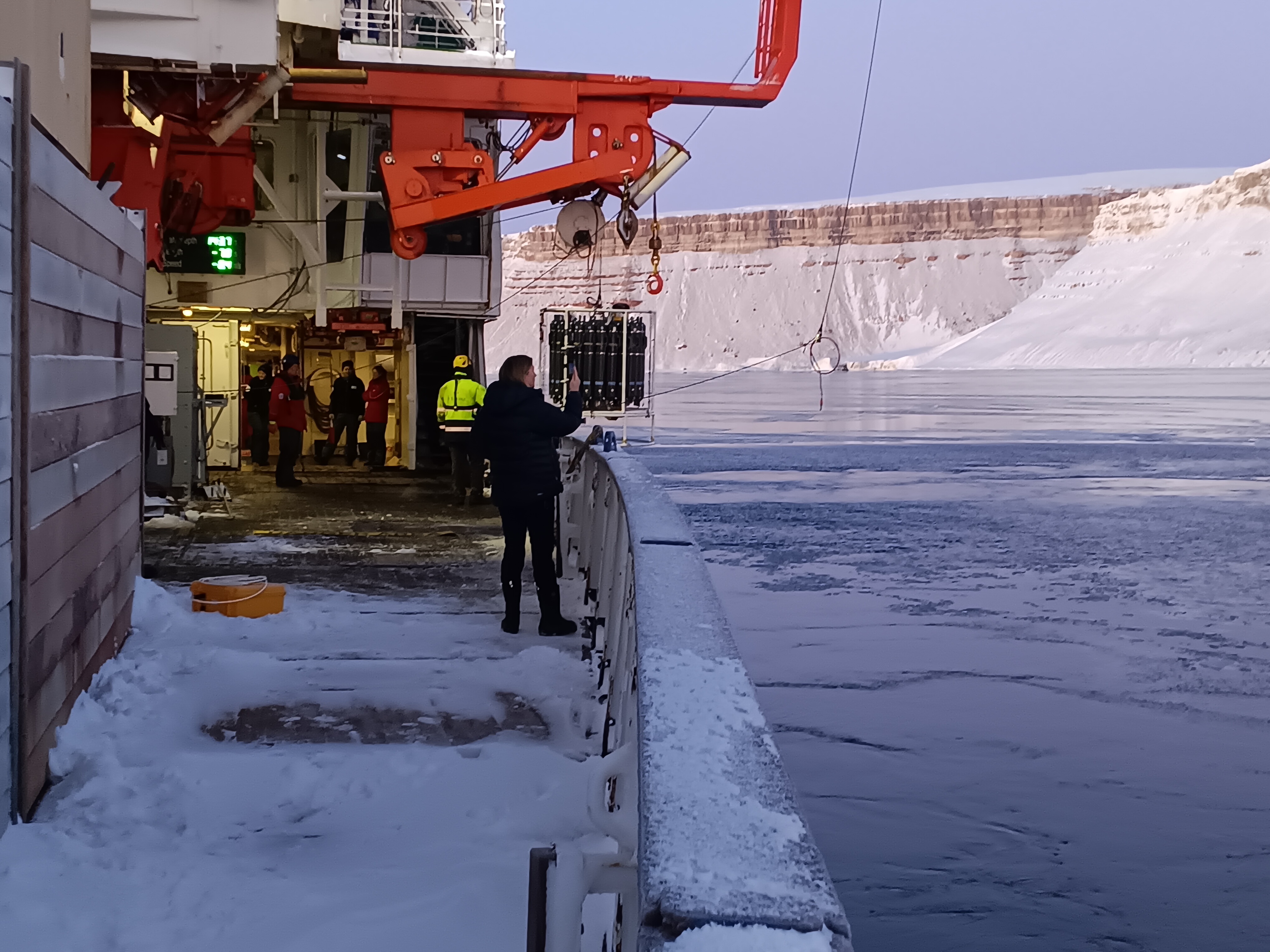
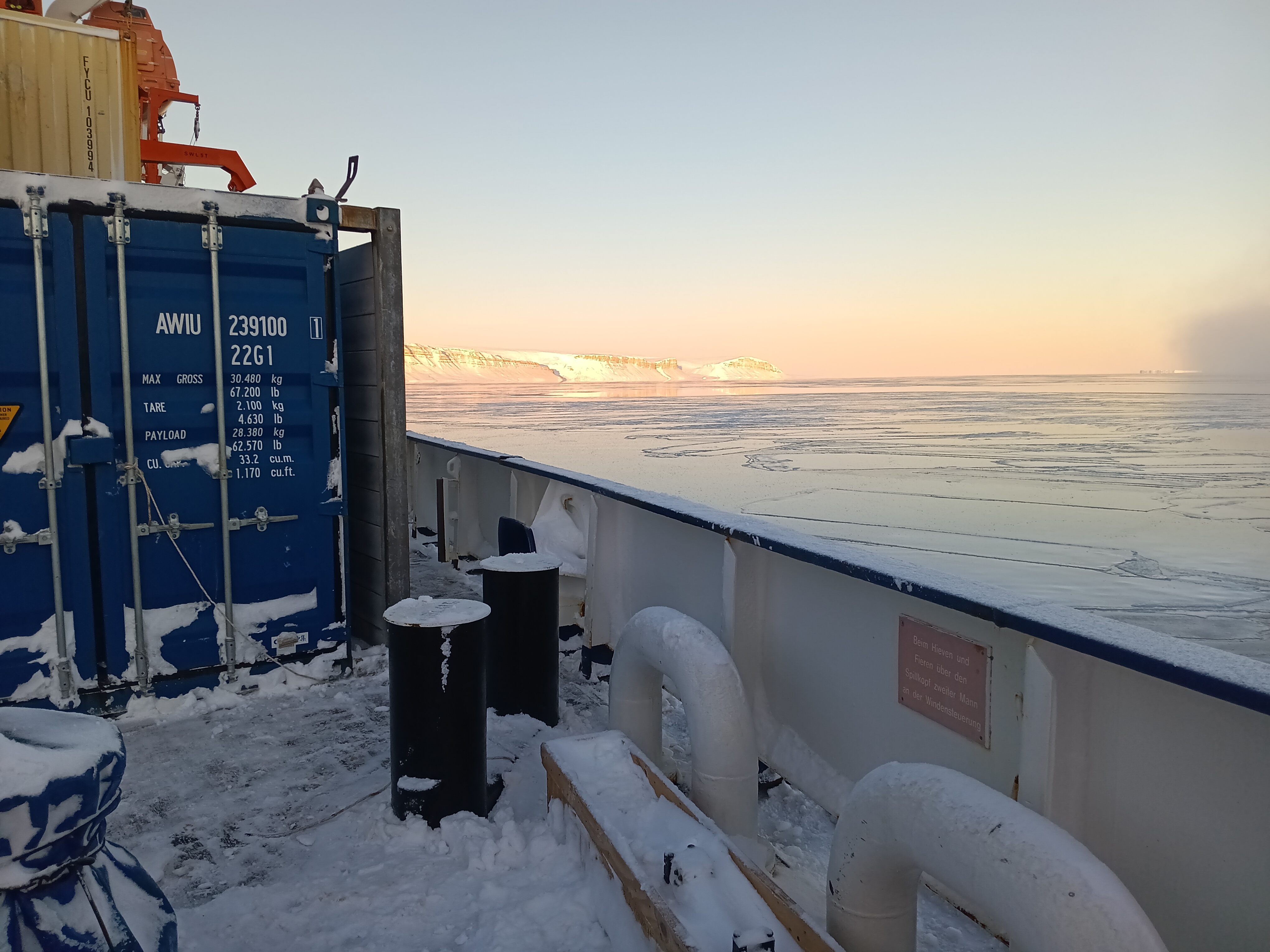
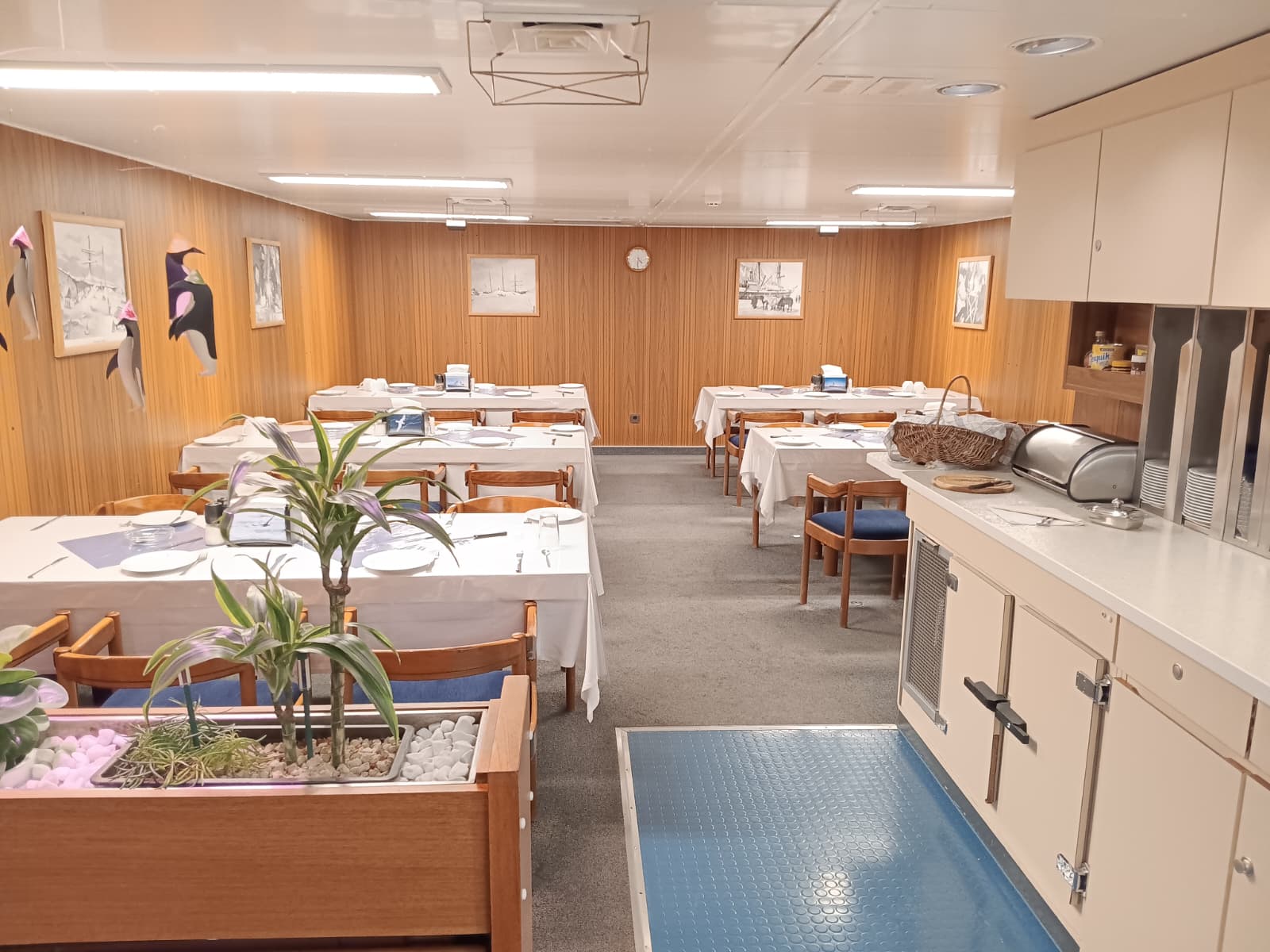
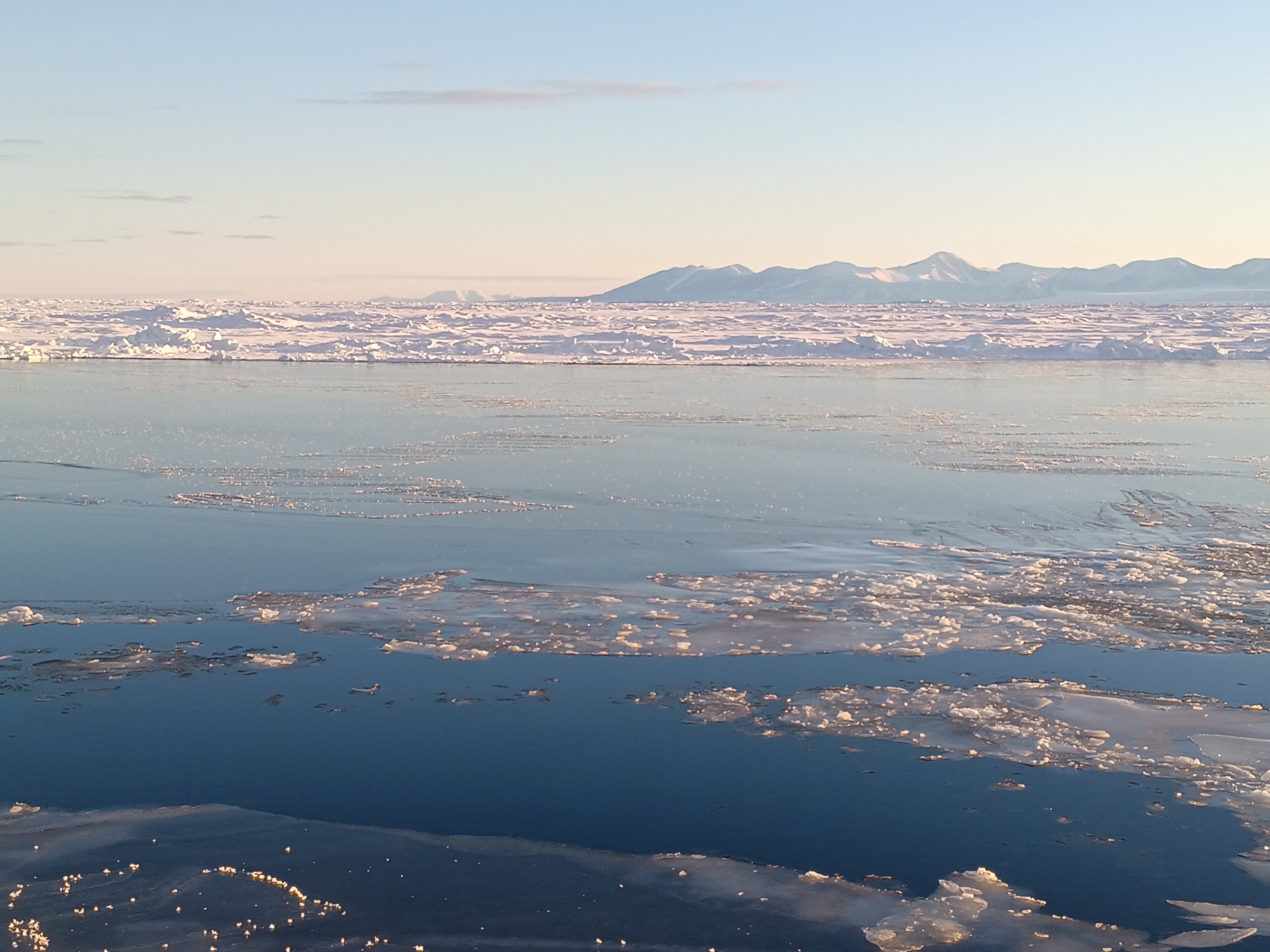
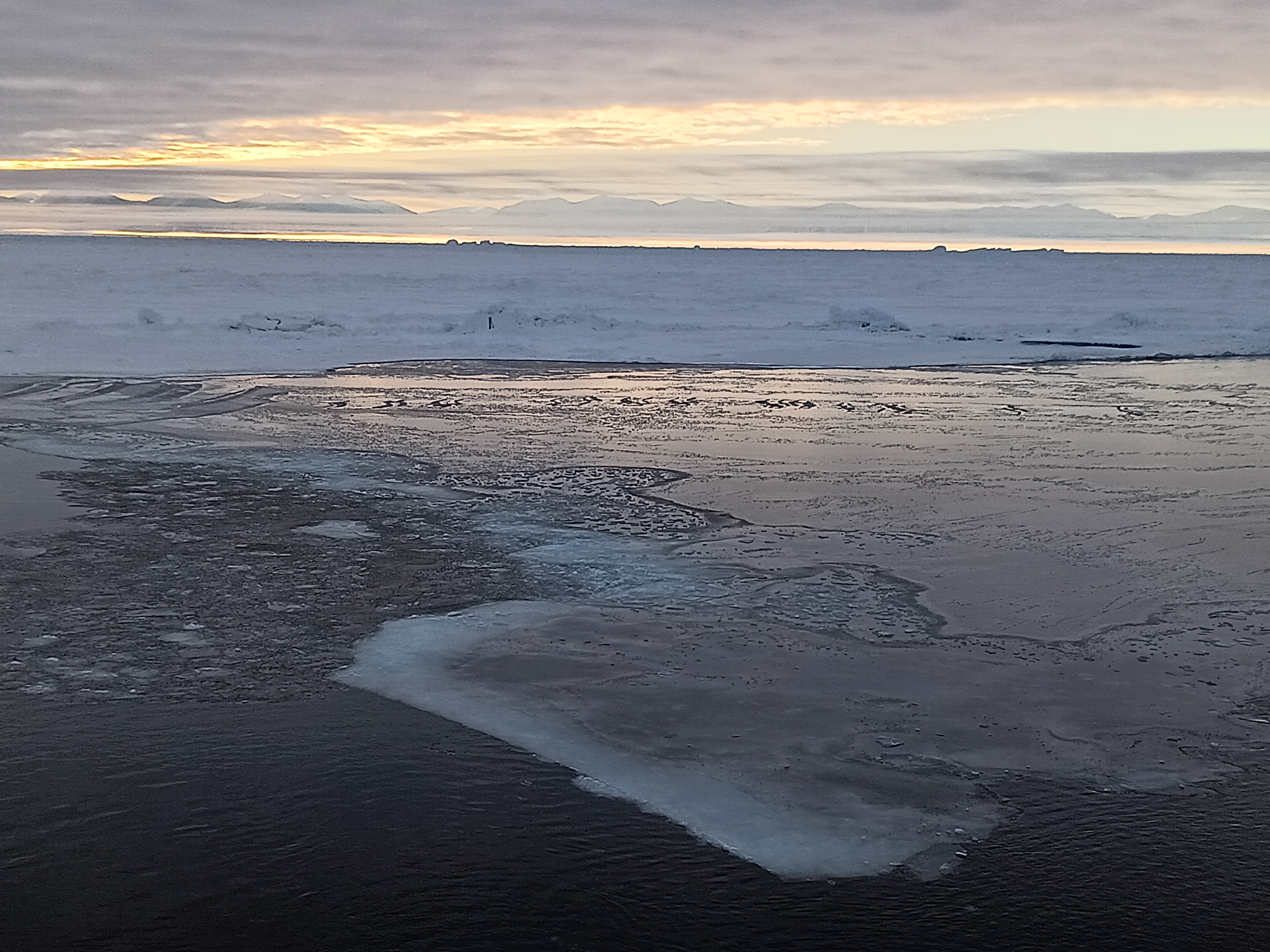
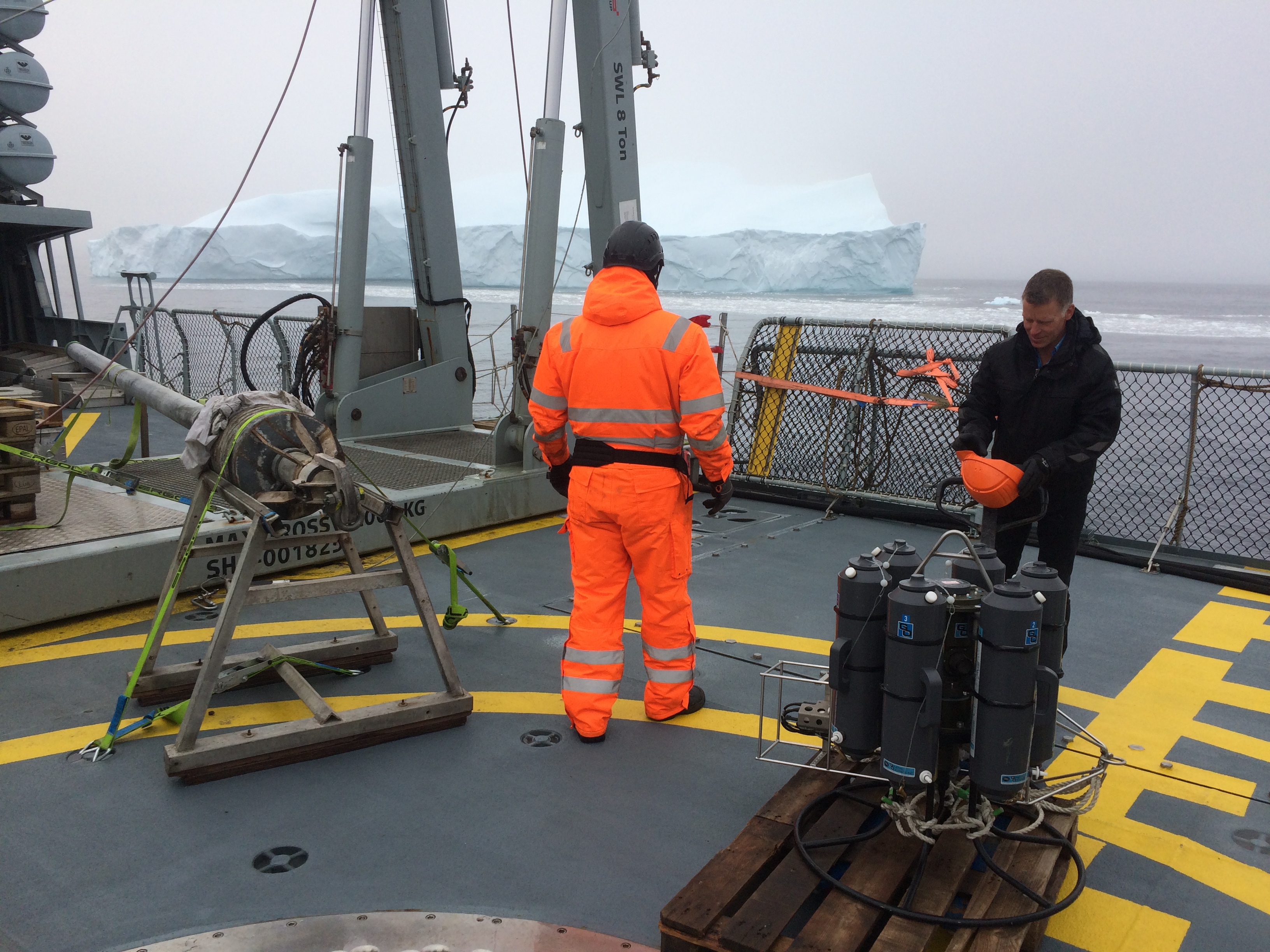
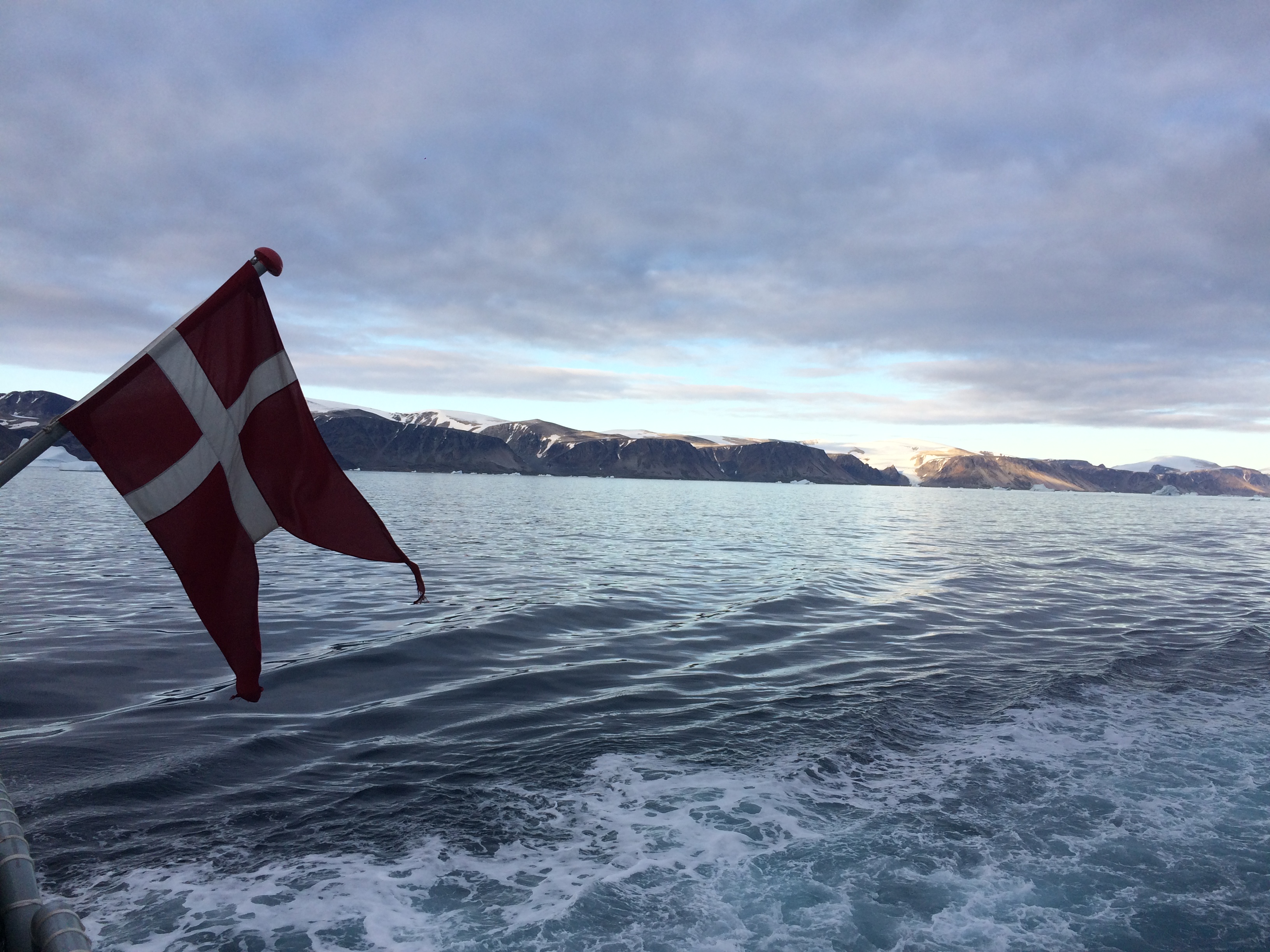
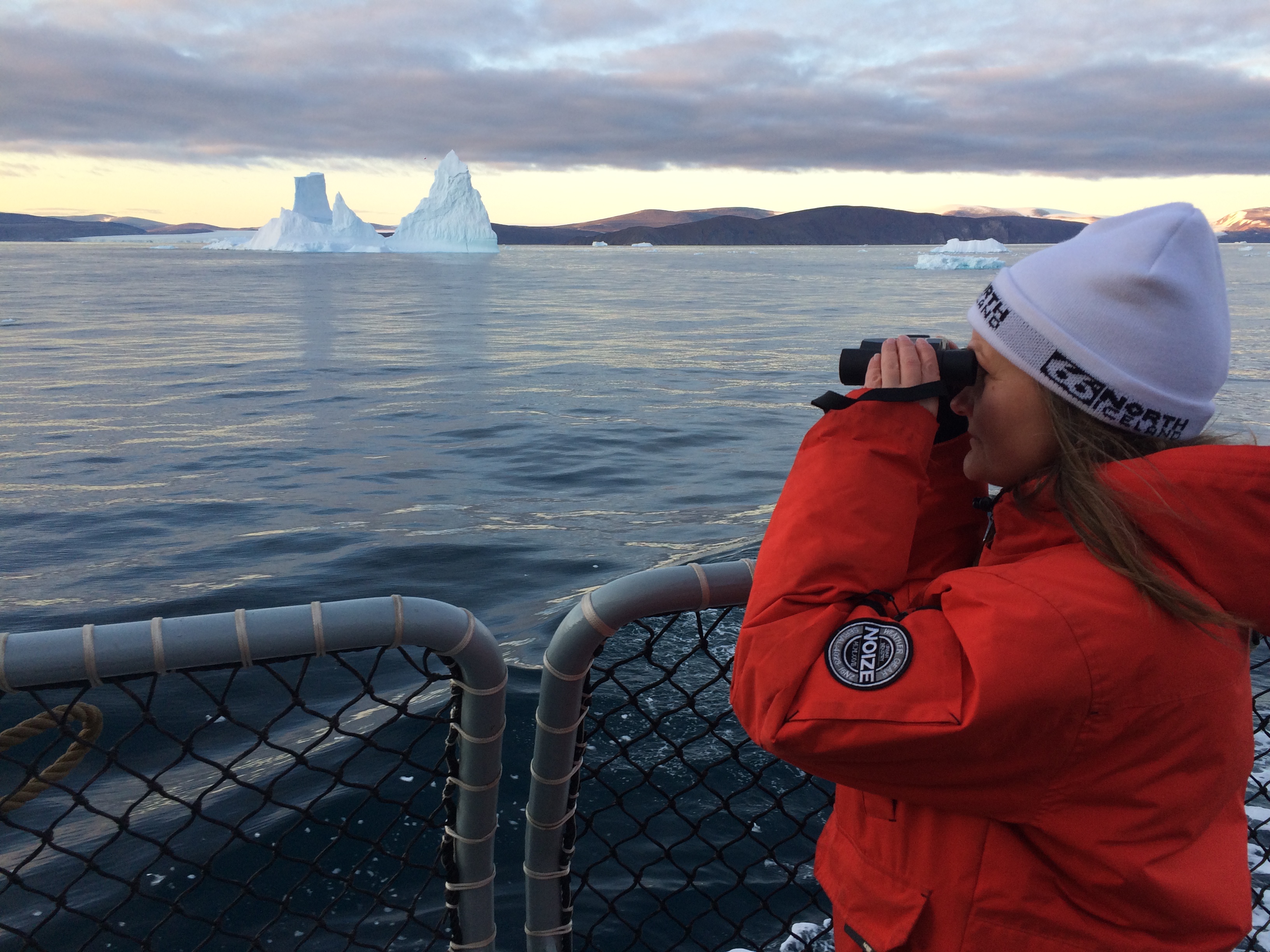
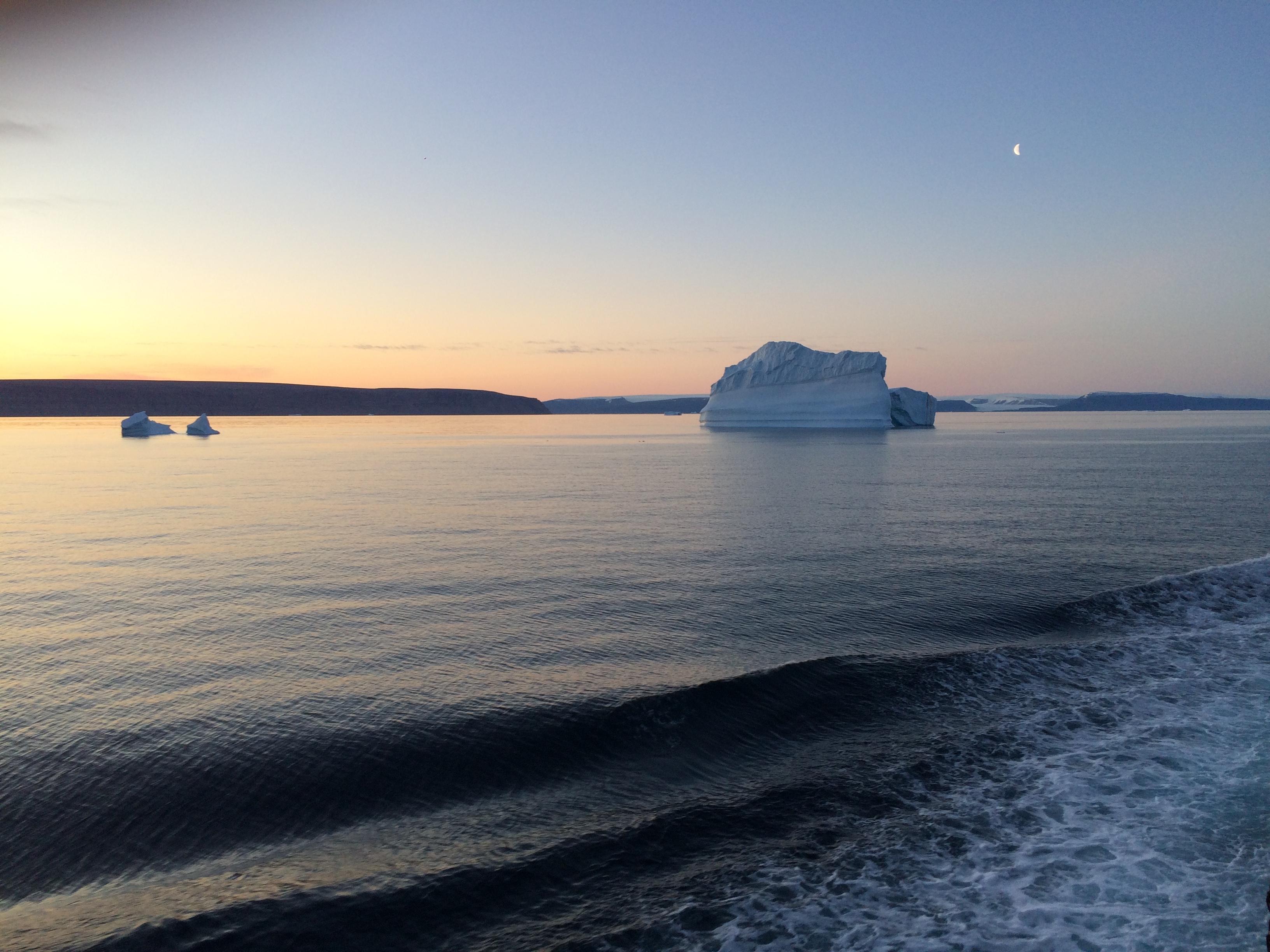
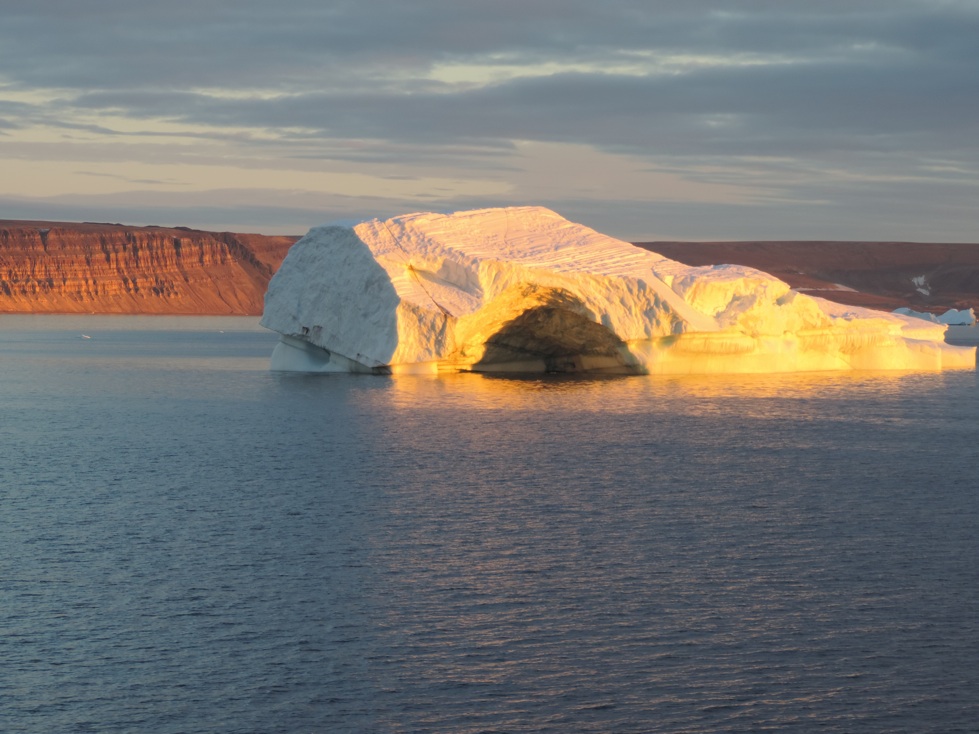
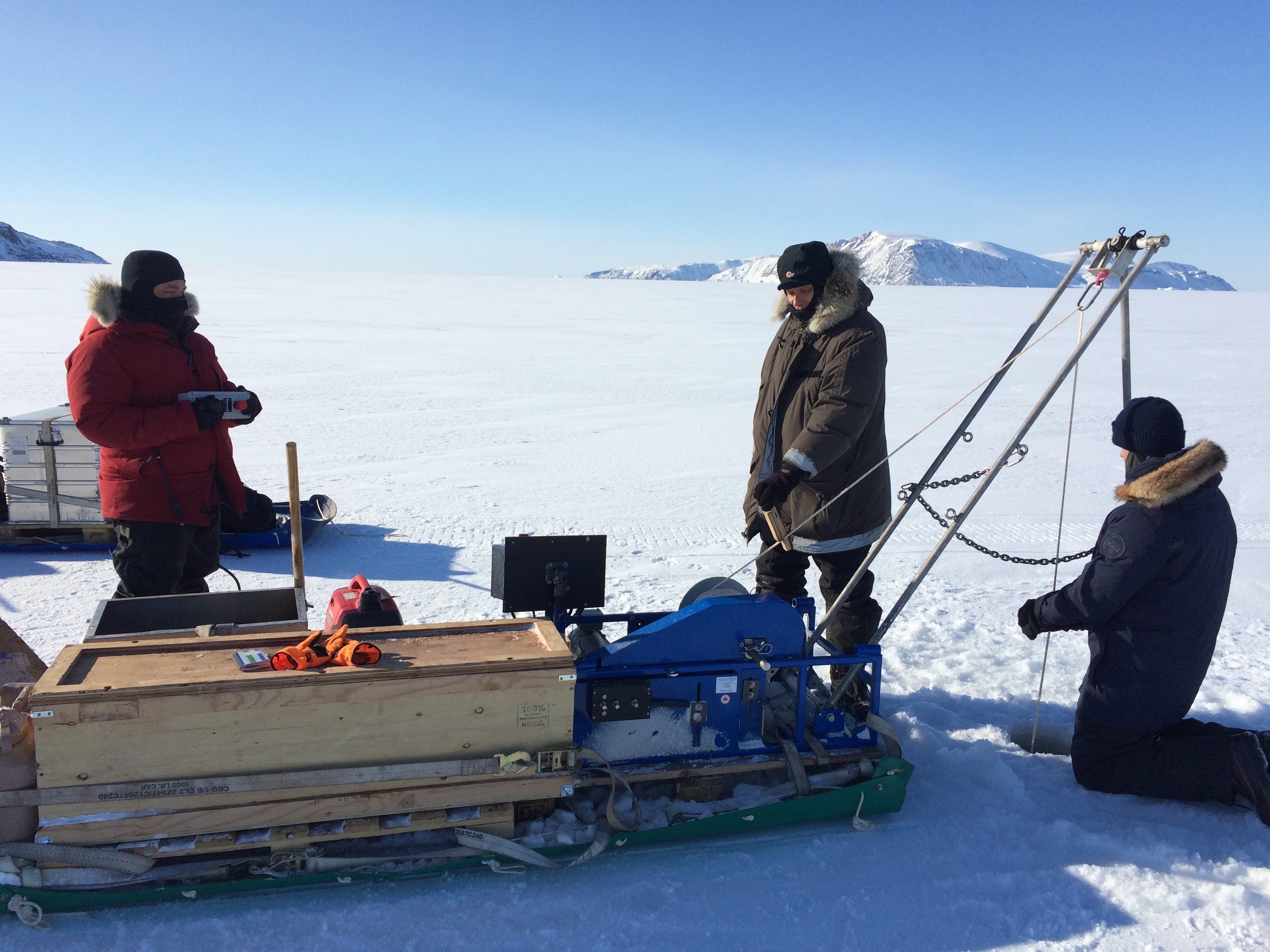
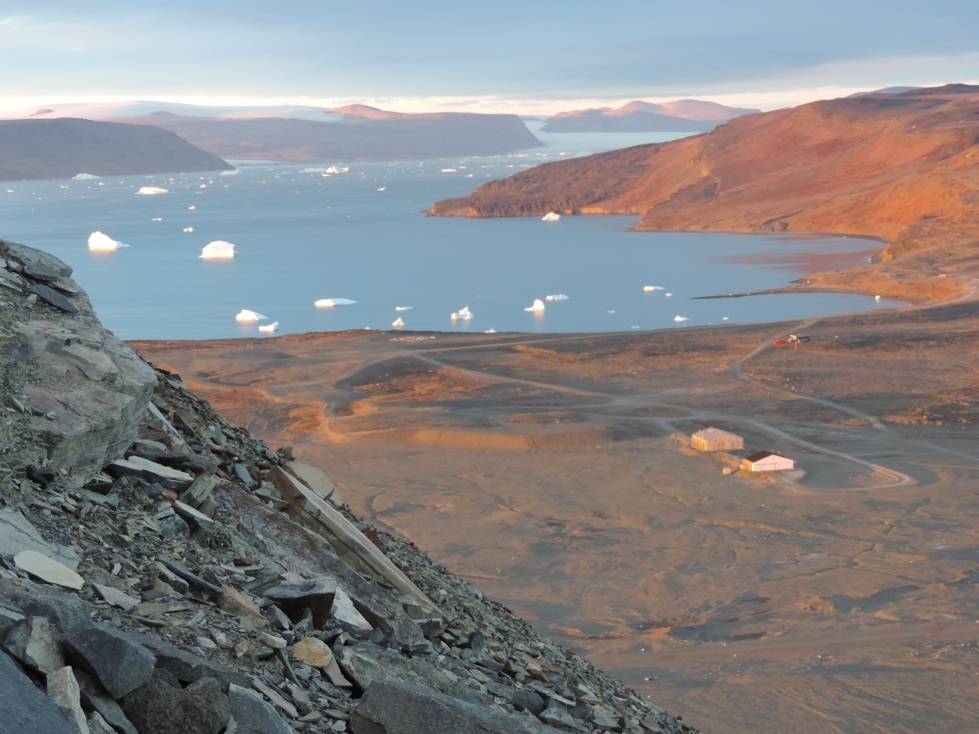
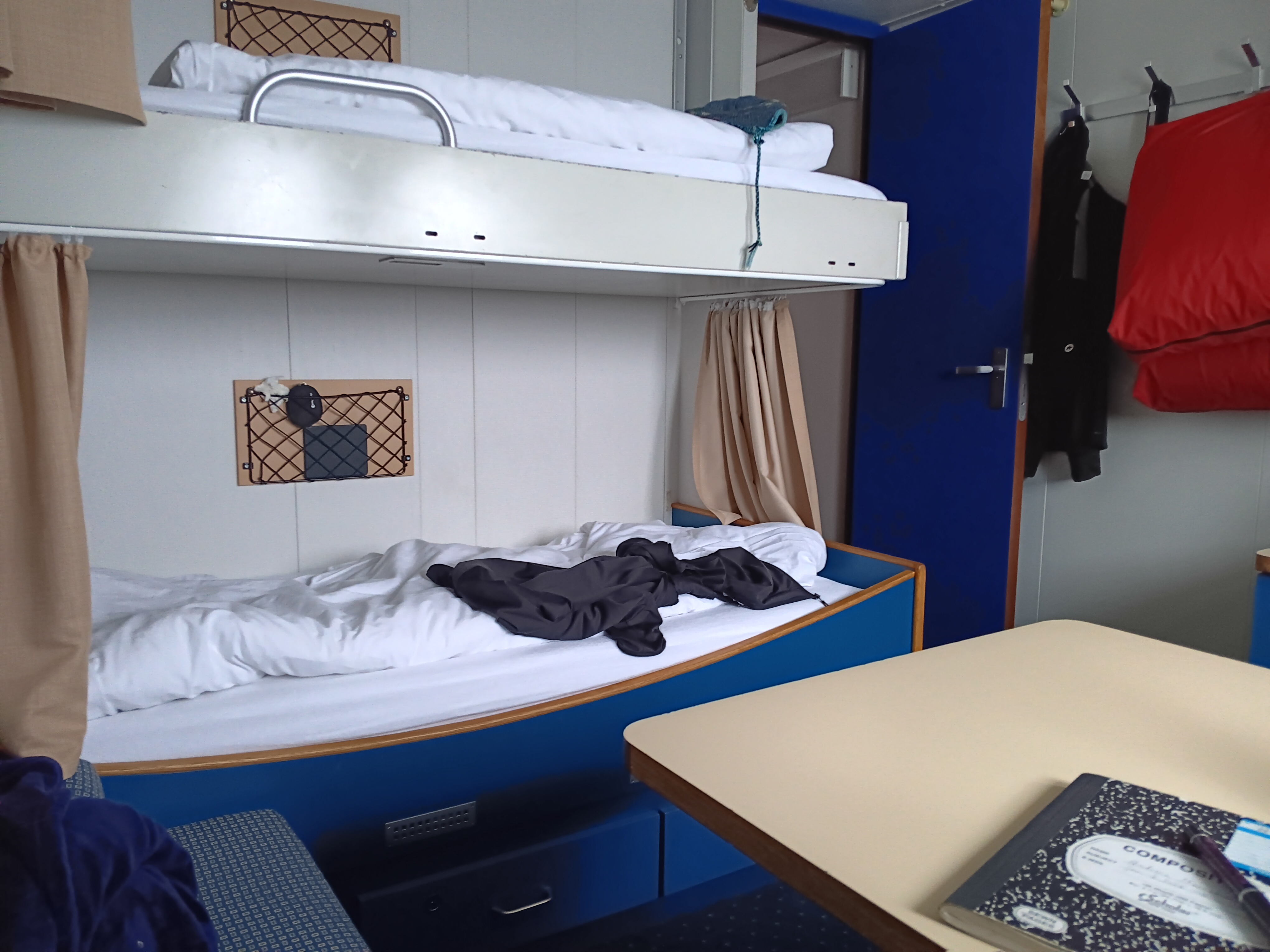
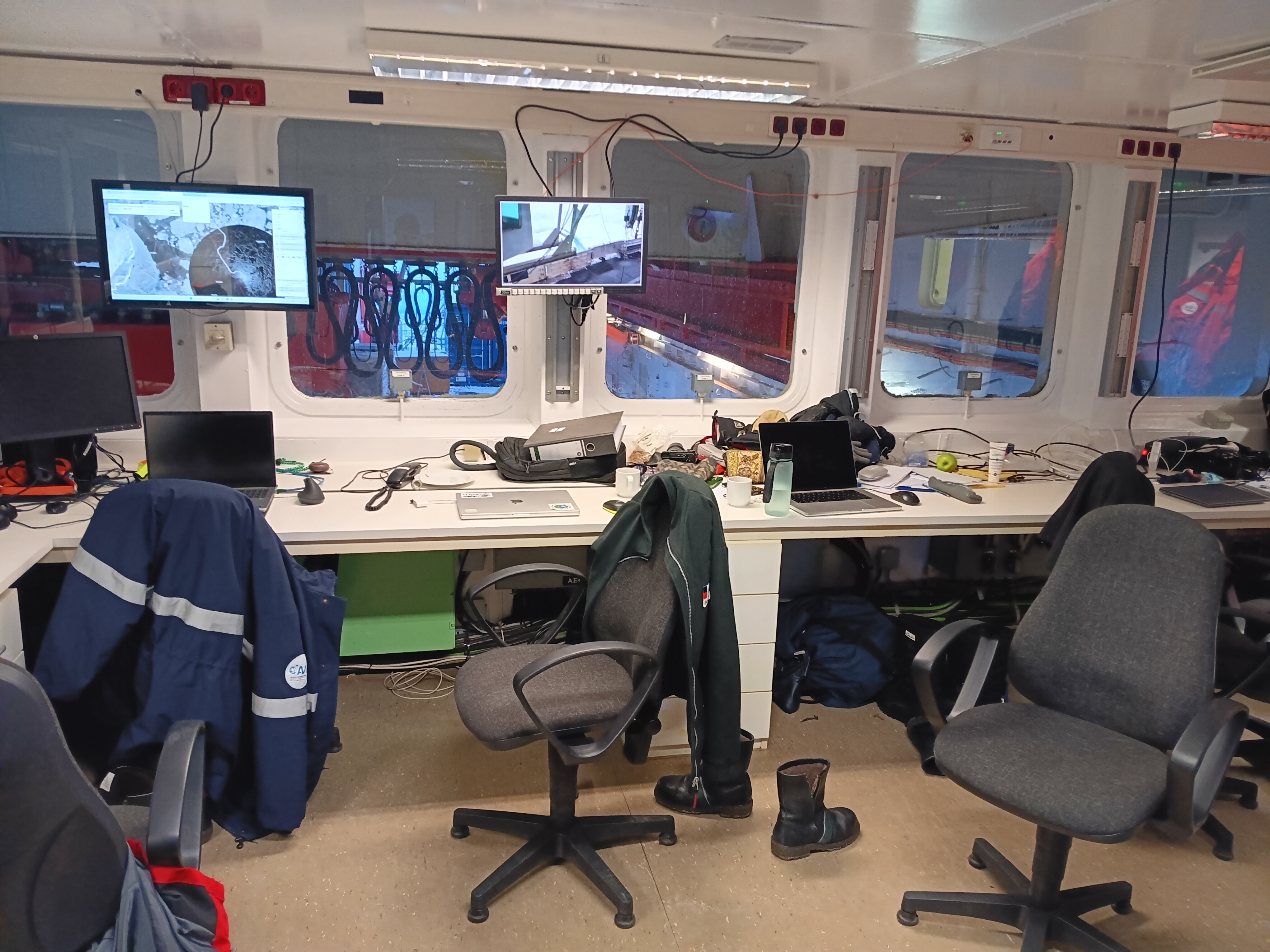
Now how does Greenland look from the ship? Well, there is always ice and it is always cold. The coldest days we had near the coast when the skies were clear. The coldest day we had -20 C, that is -4 F for my American friends, but most of the time we had clouds and storms with temperatures warmer at -12 C (10 F) with clouds and little visibility. It snowed alot and shoveling the ship’s deck was an almost daily chore. A relaxing “cruise” it was not. We worked sensors systems in the windy cold outside during all hours of the day and night. Pictures like the above were almost always taken during my 8 hours “off” that for me was from 08:00 to 16:00, because my shift was from 16:00 to 24:00. After a phone call to my wife after midnight and a peppermint tea to warm up, I slept from 01:00 to breakfast at 07:30. As almost all scientists aboard I shared my cabin with others, so there is not too much privacy. The photos below show my bunk bed (I slept atop), shared work spaces, and the rarely empty dining room. We often ate in shifts, too, because not all 50 people would fit the dining room in one sitting. So we often had 2 sittings. A comfortable living room was next door for desert, tea, coffee, games, and conversations.
Now what about science, you may ask. Here we made a major discovery, I felt. A mathematician used her craft to predict a coastal current to the north of Greenland that, I admit, made no sense to me as it contradicted 30+ years of training and intuition in which direction such currents would flow, that is, the coast should be on the right hand side looking in the direction of the flow. The curious thing was that to the north of Greenland it should go in the opposite direction, that is, with the coast on the left. In Claudia’s numerical computer model run for months on super computers, this current-in-the-wrong-direction was a both prominent and persistent feature. I always discarded it as an unrealistic feature of some computer code run amok. And yet, when we actually reach the coast of northern Greenland and I measure ocean currents from a ship sensor that runs 24/7 to tell me current speed and direction, here this weired or “wrong” current was. It screamed at me from the screen the moment I plotted the data and shared it with Claudia who was aboard with the comment: “Your model is right and my intuition was wrong. Your current is at the same location, the same speed, and in the same direction as your model said it would.” Furthermore, a distinct and separate way to estimate ocean currents from ocean temperature and salinity observations showed the exact same thing. That’s now two good complementary confirmation of the current that nobody has ever seen or measured … until now that we aboard Polarstern did so on Sept.-23, 2025:
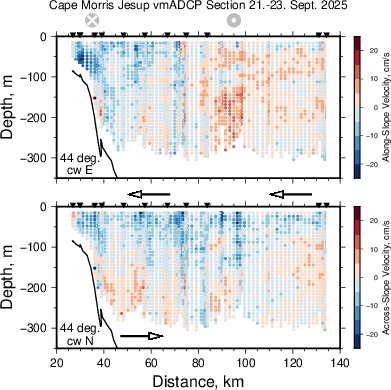
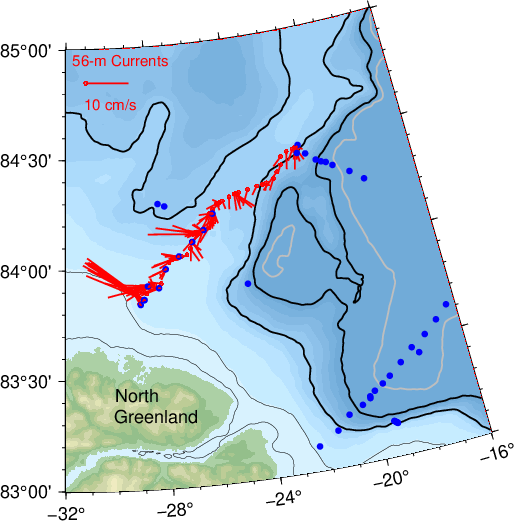
The map on the left shows our study area to the north of North Greenland. On it in red are sticks whose length indicate the speed or strength of the ocean current (at 56 meters below the surface) while its orientation gives the direction of the current. The light blue is shallow and dark blue is deep water as before. The current is sluggish offshore with a weak component to the south. In contrast, closest to the coast of North Greenland we find long sticks that point to towards the left (west by north-west). This is Claudia’s Coastal Current.

The two plots on the left provide more detail, as it shows how the current varies with depth and distance from the coast along a line from the coast towards offshore. The bottom of the shallow ocean is the black line from 100-m to 350-m meter at a distance of 20-40 km from the coast. The top-left panel shows the current (in colors) across the section where blue colors indicate currents flow into the page while red colors indicate currents that flow out of the page towards us viewing it with the coast on the left. The bottom-left panel shows the velocity component along the section with a flow that is mostly onshore near the surface.

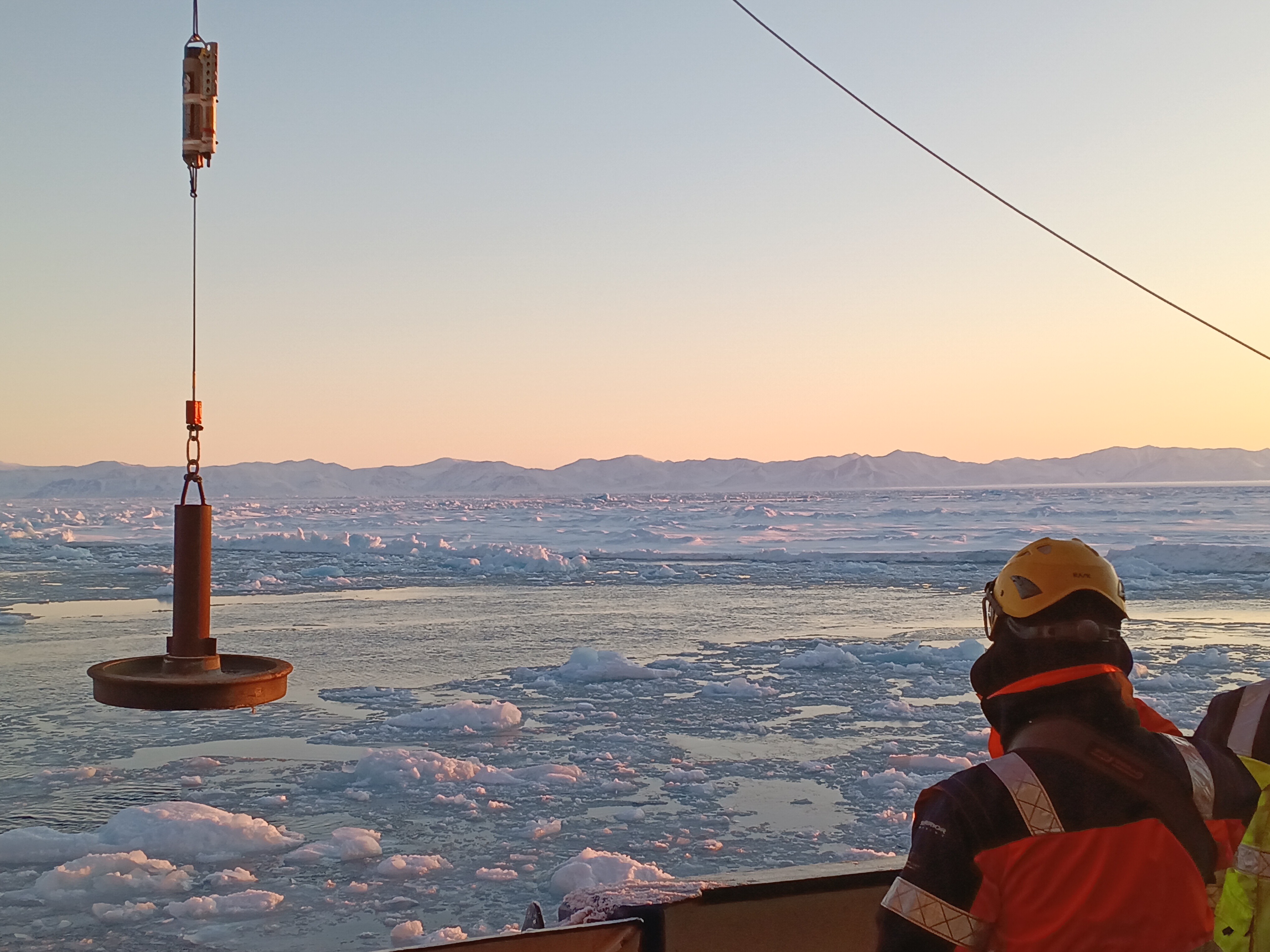
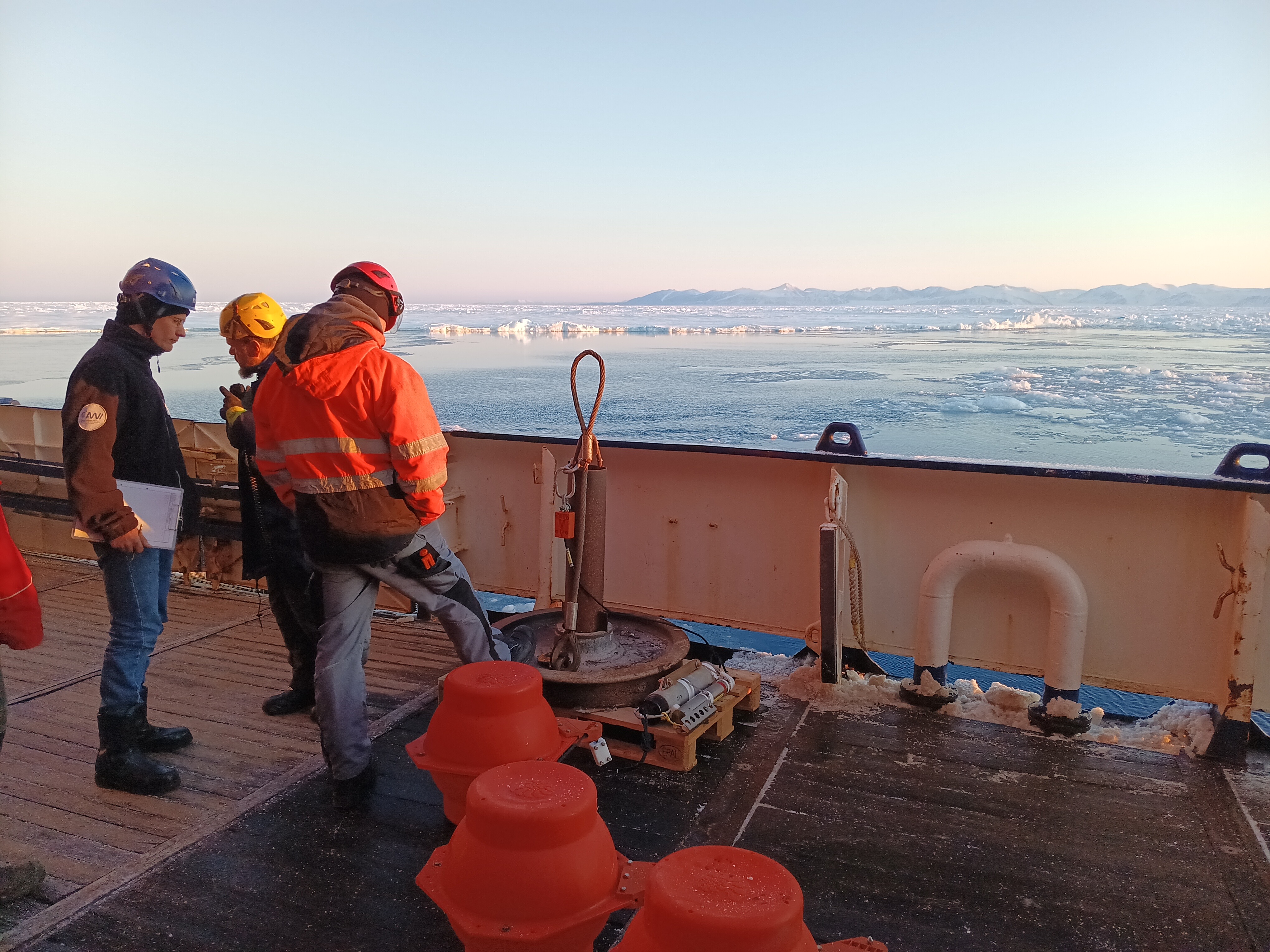
There is so much more to this story as well as additional stories, notice the red dots in the top-left panel between 150-m and 300-m depth that indicate a strong flow to the south and east, but I save this for later. I also do not wish to tell you about the two ocean sensors we quickly deployed at this location to stay there until we, perhaps, recover them with new data next year or the year there after. I do wish to close this essay, however, with the view of Greenland that we had where we discovered Claudia’s coastal current. Science is fun, exciting, and always surprises.
Greenland Ocean Expeditions, Science, and Fun

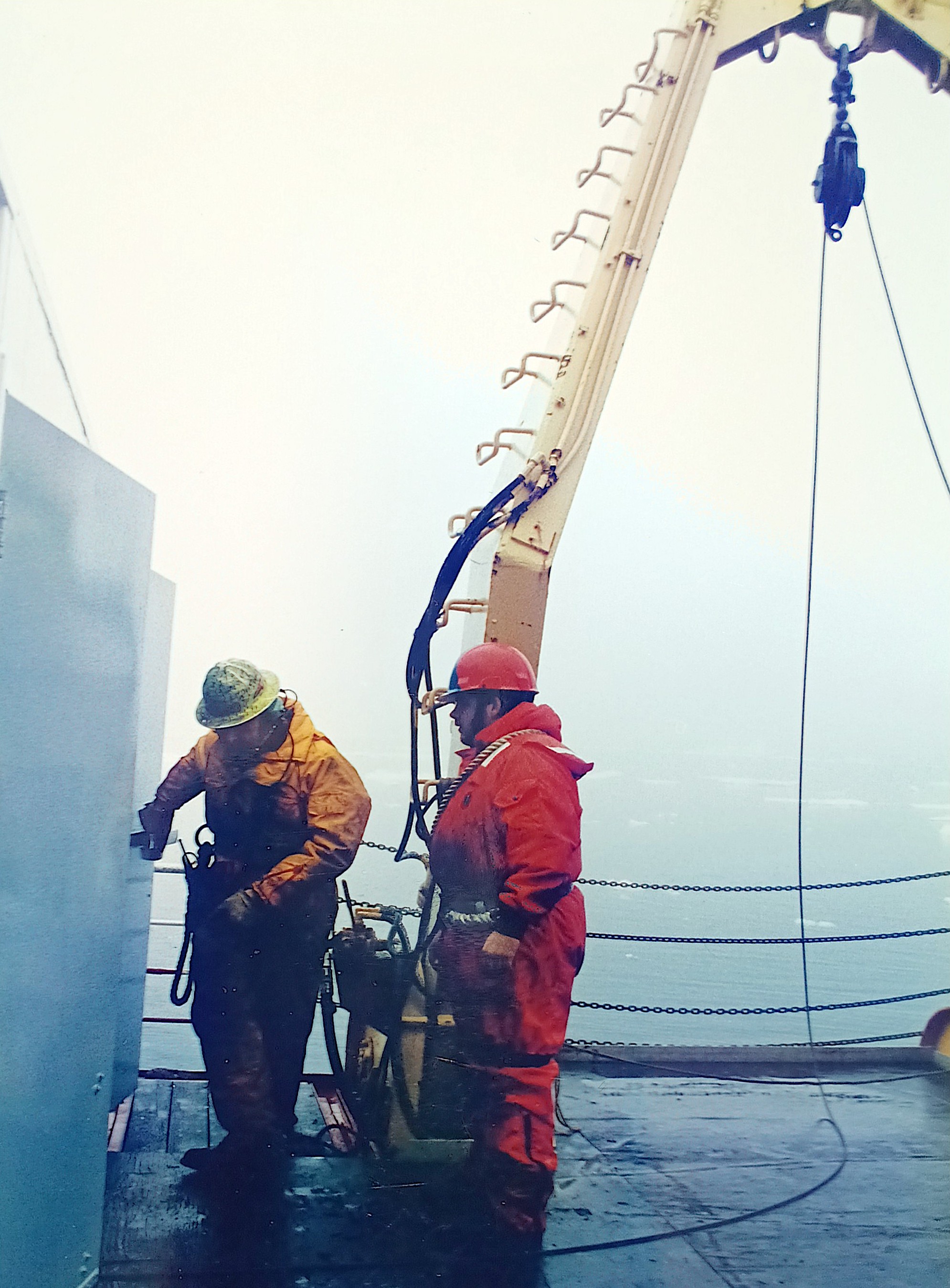
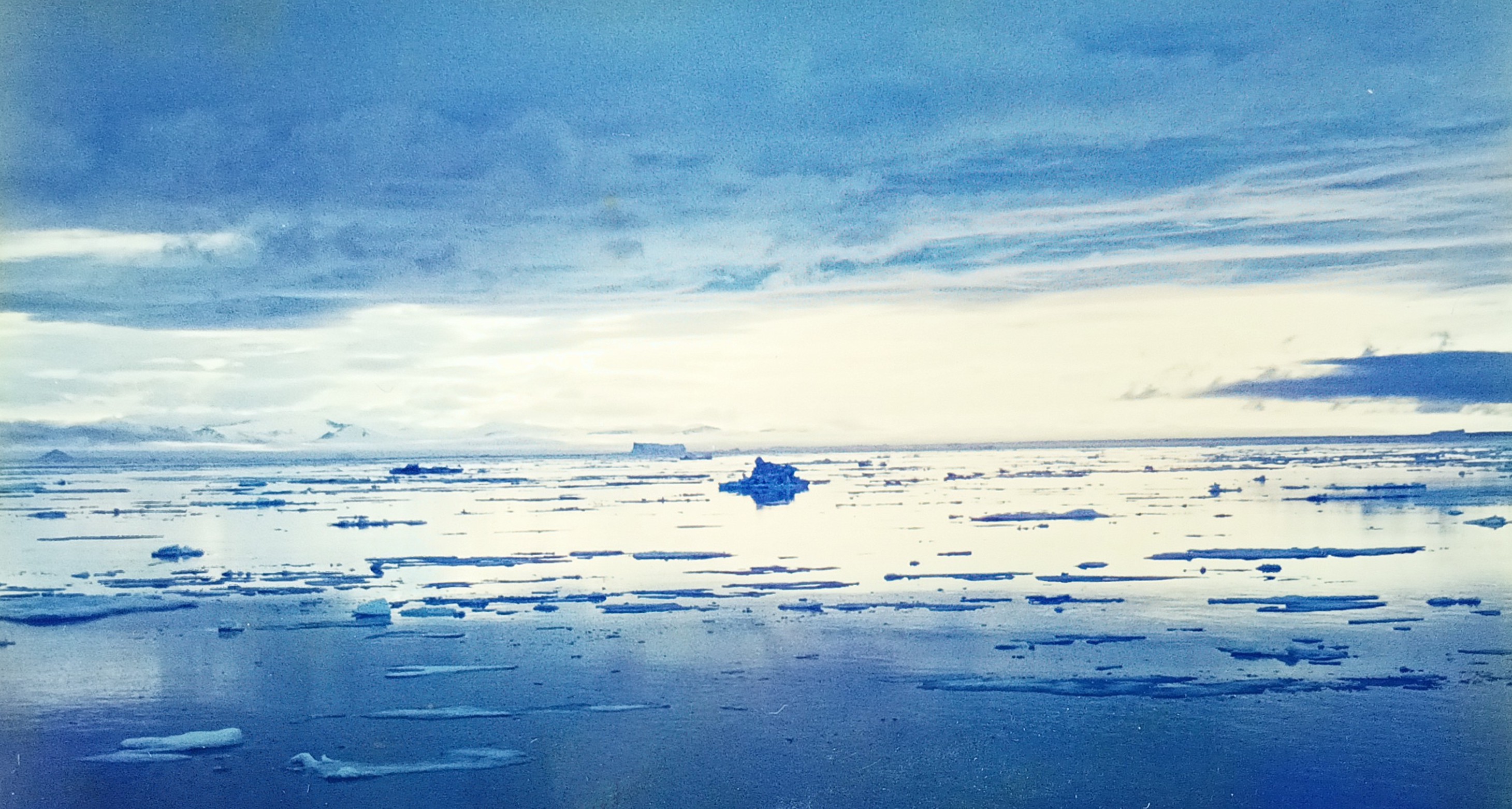
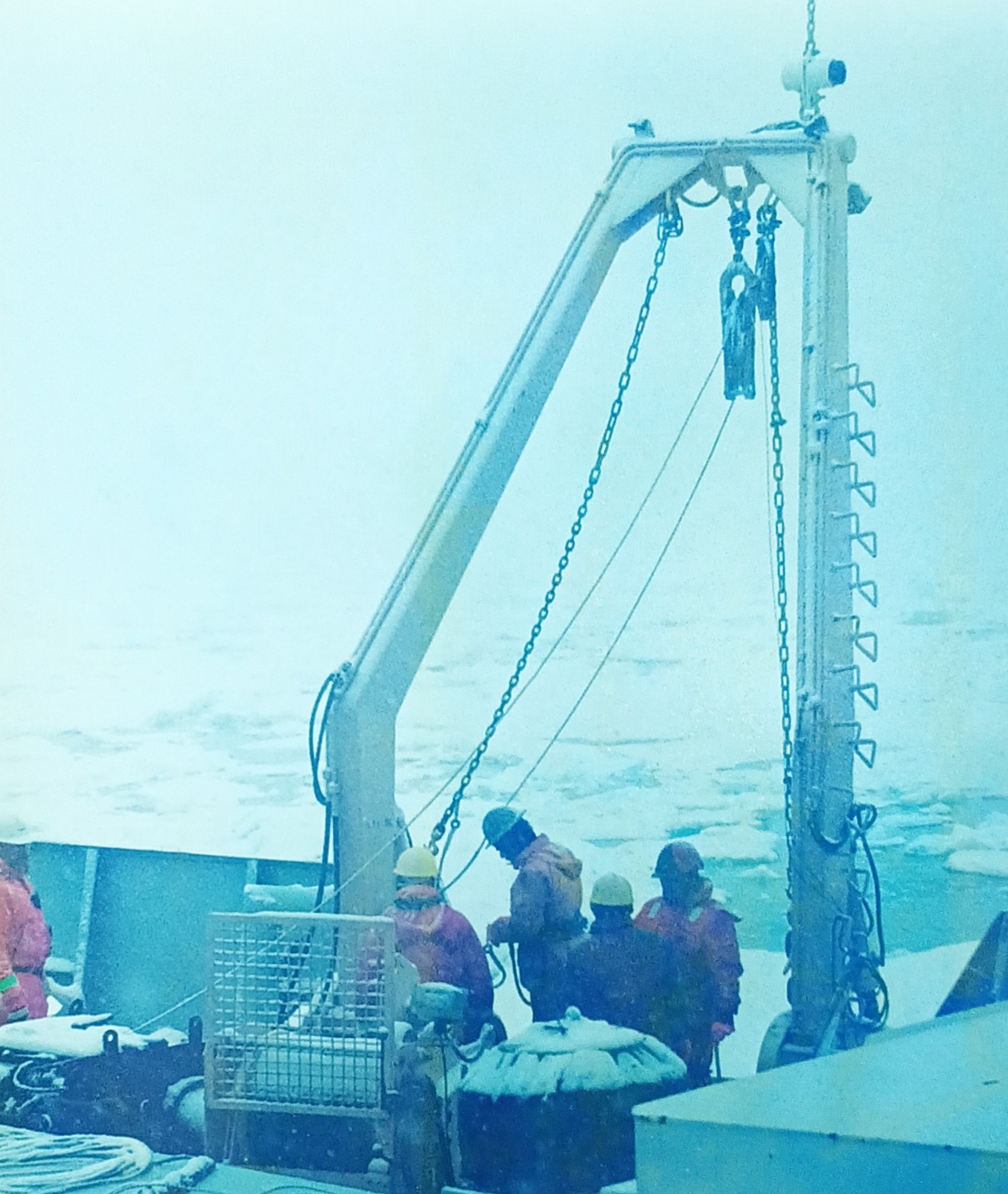
Science and Greenland both combine discovery, adventure, and diverse people. I do this work free of academic constraints, responsibilities, and pay, because I retired from my university three months ago drawing on savings that accumulated since 1992 with my first job in San Diego, California. It was there and then, that my interest in polar physics started, but my first glimpse of Greenland had to wait until 1997 when a Canadian icebreaker got me to the edge of the ice in northern Baffin Bay between Canada and Greenland. It was a cold and foggy summer day as these pre-digital photos show:

Almost 25 years later I visited the area again with Her Danish Majesty Ship HDMS Lauge Koch, a Danish Navy vessel, which surveyed the coastal waters between Disko Bay in the south and Thule Air Base (now Pituffik Space Base) in the north. Two Danish goverment agencies led this expedition: the Geological Survey of Denmark and Greenland (Dr. Sofia Ribeirio, GEUS) and the Danish Metorological Institute (Dr. Steffen Olsen, DMI). Our small team of 11 scientists and 12 soldiers surveyed the seafloor with fancy acoustics, drilled into the bottom with piston corers, fished for plankton with towed nets, and collected water properties with both electronics and bottle samples. As this was during the Covid-19 pandemic, all scientists had to be both vaccinated and tested prior to boarding the flight from Copenhagen to Greenland. We also quarantined for 3 days in Aasiaat, Greenland prior to boarding the ship.

Now in retirement, I thoroughly enjoy the time to just just revisit the places and people via photos that finally get organized. More importantly, I finally feel free to explore the data fully that we collected both on 14 separate expeditions to Greenland between 1997 and 2021. For example, only in retirement did I discover that Baffin Bay was visited in 2021 by both a Canadian and an American in addition to our Danish ship. Data from these separate Baffin Bay experiments are all online and can be downloaded by anyone. I did so and processed them for my own purposes. Furthermore, NASA scientists of the Ocean Melts Greenland program flew airplanes all over Greenland to drop ocean sensors to profile and map the coastal ocean with fjords and glaciers hard to reach by ships. All these are highly complementary data that describe how icy glaciers, deep fjords, coastal oceans, and deep basins connect with each other and the forces that winds, sea ice, and abundant icebergs impose on them.
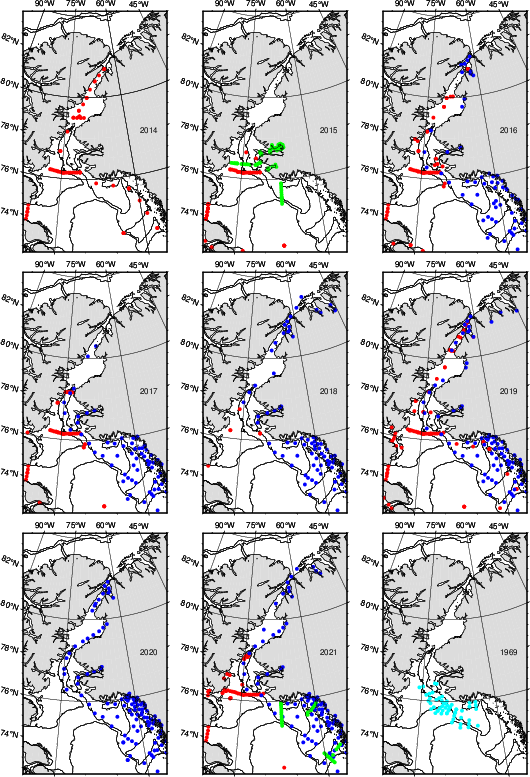
It requires a bit of skill and computer code, however, to process data from different ships, countries, and sensors into a common format to place onto a common map for different years, but here is one such attempt to organize:

There is one map for each of 9 years, i.e., station locations are shown in a top (2014, 2015, 2016), center (2017, 2018, 2019), and bottom row (2020, 2021, 1968). Land is gray with Canada on the left (west) and Greenland on the right (east) while the solid contour lines represent the 500-m and 1000-m water depth. Each colored symbol represents one station where the ship stopped to deploy a sensor package to measure temperature, depth, and salinity of the ocean water from the surface to the bottom of the ocean adjacent to the ship. The different colors represent data from Canada in red, Denmark in green, and USA in blue. The light blue color represents historical data from a study that investigated the waters after a nuclear armed B-52 bomber crashed into the ocean near Thule/Pituffik on 17 Jan. 1968 with one nuclear war head still missing. A Wikipedia story called 1968 Thule Air Base B-52 Crash provides details, references, and Cold War context, but lets return to the data and ocean physics:

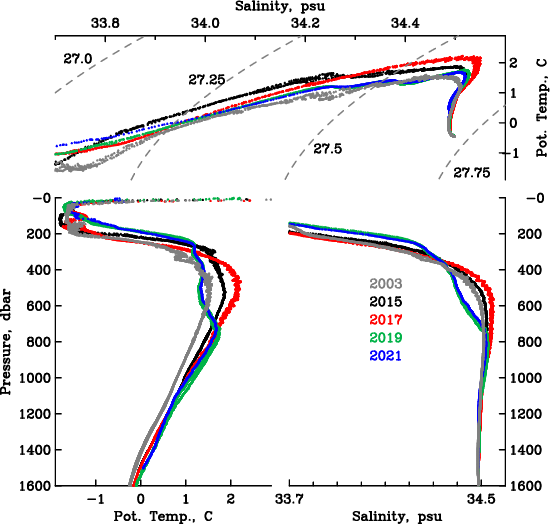
Notice a single red dot near the bottom center of some maps such as 2015, 2017, or 2021. For this single dot I show the actual temperature and salinity data and how it varies with depth (labeled pressure, at 100-m depth the pressure is about 100 dbar) and from year to year:

The two bottom panels show how temperature (left) and salinity (right) change with depth (or pressure). Notice that the coldest water near freezing temperature of -1.8 degrees Celsius (29 Fahrenheit) occurs between 30-m and 200-m depth (30 to 200 dbar in pressure). Below this depth the ocean water actually becomes warmer to a depth of about 500-600 m to then become cooler again. The effects of pressure on temperature are removed, this is why I call this potential temperature and label it “Pot. Temp.” The warmest waters at 600-m depth are also the most salty (about 34.5 grams of salt per 1000 grams of water). This saltiness makes this water heavier and denser than the colder waters above. This is a common feature that one finds almost anywhere in polar regions. The top panel shows the same data without reference to depth (or pressure), but contours of density show how this property changes with temperature and salinity. It takes a little mental gymnastic to “see” how density always increases as pressure increases, but the main thing here is that both salinity and temperature can change the density of seawater.

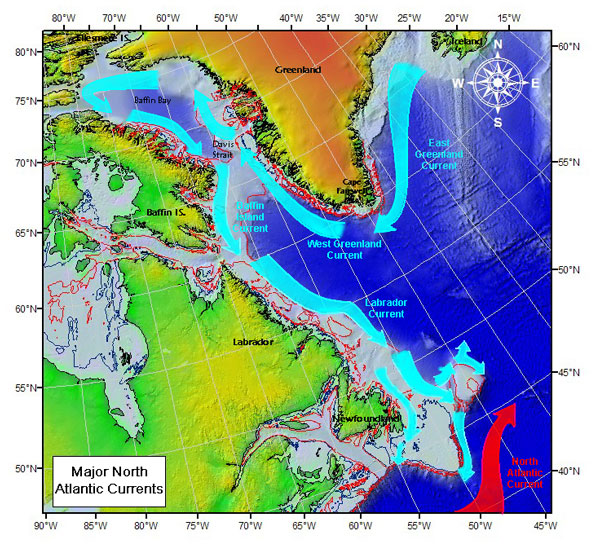
Sketch of ocean current systems off Greenland and eastern Canada. Colors represent topography of ocean, land, and Greenland ice sheet.

U.S. Coast Guard, International Ice Patrol

The origin of the warmer (and saltier) waters is the Atlantic Ocean to the south. Currents move heat along the coast of Greenland to the north. Icebergs in Baffin Bay extend into this Atlantic Layer and thus move first north along the coast of Greenland before turning west in the north and then south along the coast of Canada. This deep ocean heat does reach coastal tidewater glaciers which are melted by this warm ocean water. So the year-to-year changes of temperature and salinity determine in part how much the coastal glaciers of Greenland melt. The temperature and salinity maxima change from year to year being warmest in 2015 and 2017 and coldest in 2019 and 2021. No “global warming” here, but notice what happens closer to the bottom at 1500-m, say. These waters are separated from the Atlantic and Arctic Oceans to the south and north by water depths that do not exceed 600-m in the south and 400-m in the north. These almost stagnant waters increase their temperatures steadily from 2003 to 2015 to 2017 to 2019 to 2021. This is the global warming signal.

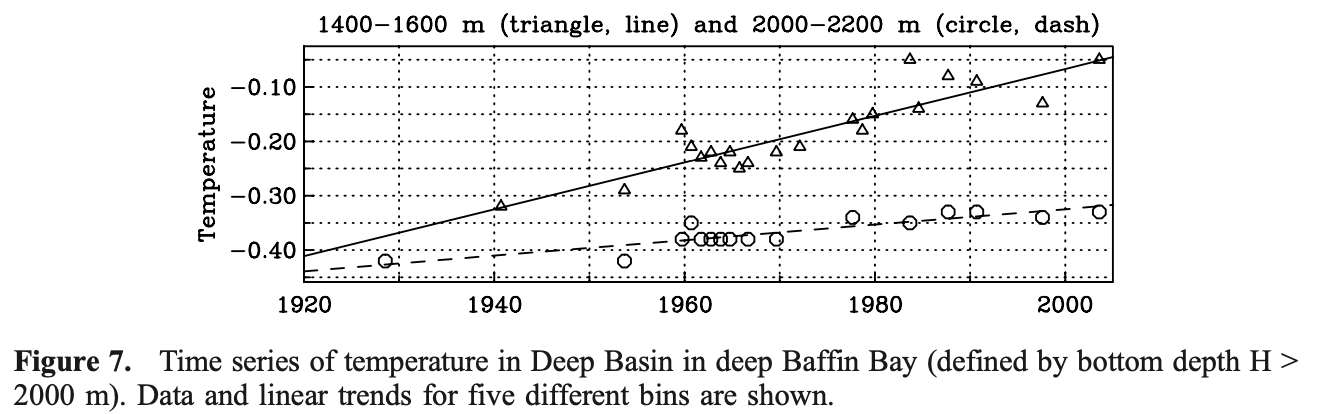
My former student Melissa Zweng published a more thorough and formal study in 2006 using all then available data from Baffin Bay between 1916 and 2003. Her Figure-7 shows the results for those parts of Baffin Bay that are deeper than 2000-m for two different depth ranges. Notice that the year to year variations (up and down) is small, but a steady increase in temperature is apparent from perhaps -0.3 Celsius in 1940 to -0.05 in 2003 for the 1400-1600 m depth range. We also did a very formal error analysis on the straight line we fitted to the data and find that deep temperatures increase by +0.03 C/decade. We are 95% sure, that the error or uncertainty on this warming is +/- 0.015 C/decade. So there is a 1 in 20 chance, that our deep warming trend is below +0.005 C/decade and an equal 1 in 20 chance, that our warming trend exceed +0.045 C/decade. In 19 out of 20 cases the (unknown) true warming value is between 0.005 and 0.045 C/decade.
So, more than 20 years have passed since Melissa’s work. The data I here showed between 2003 and 2021 thus gives us a chance to test our statistical predictions that we made 20 years ago. So, deep temperatures should be between 0.01 and 0.09 degrees Celsius warmer than they were in 2003. I have not done this test yet, but science is fun even if the data are old.

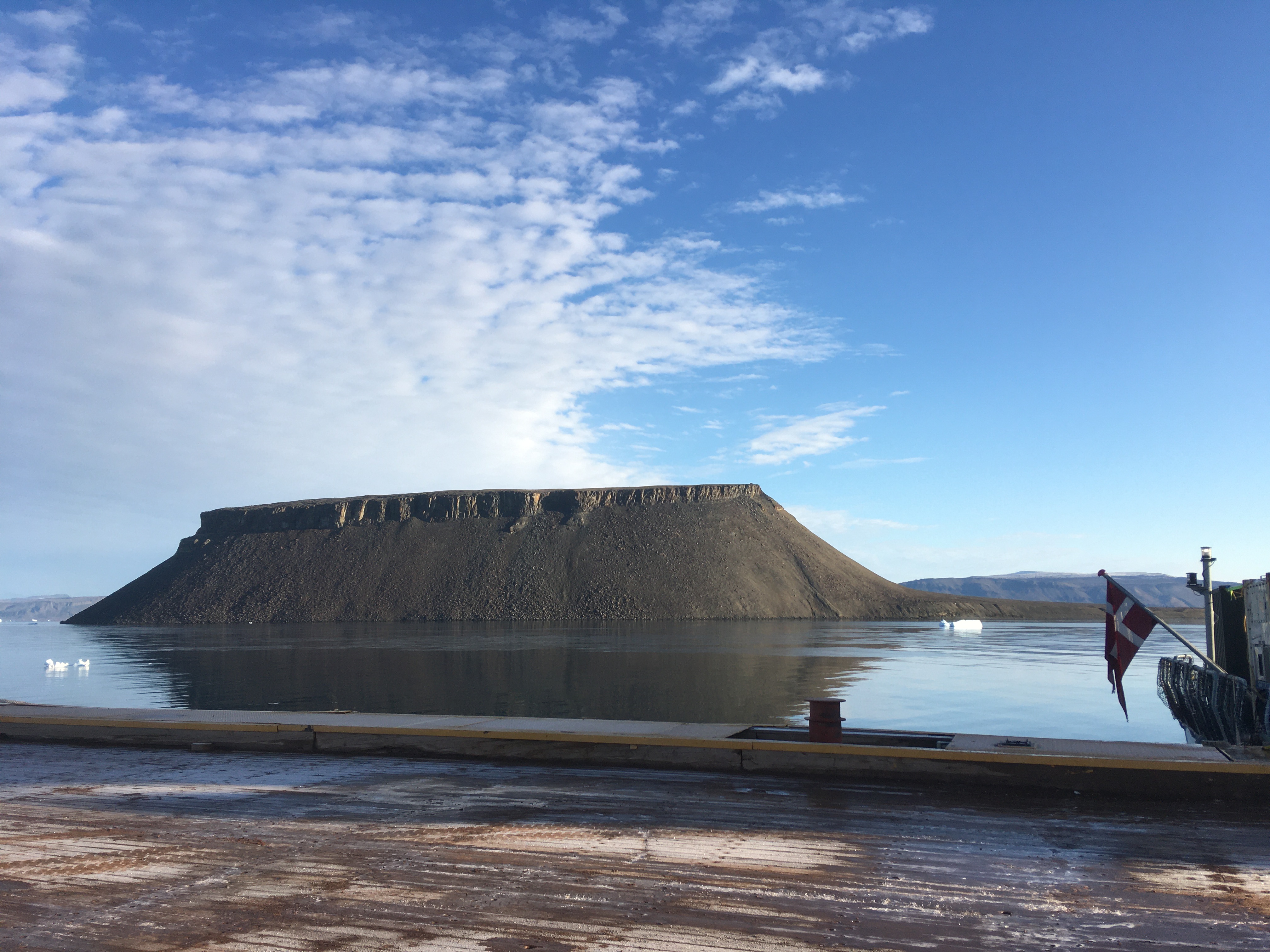
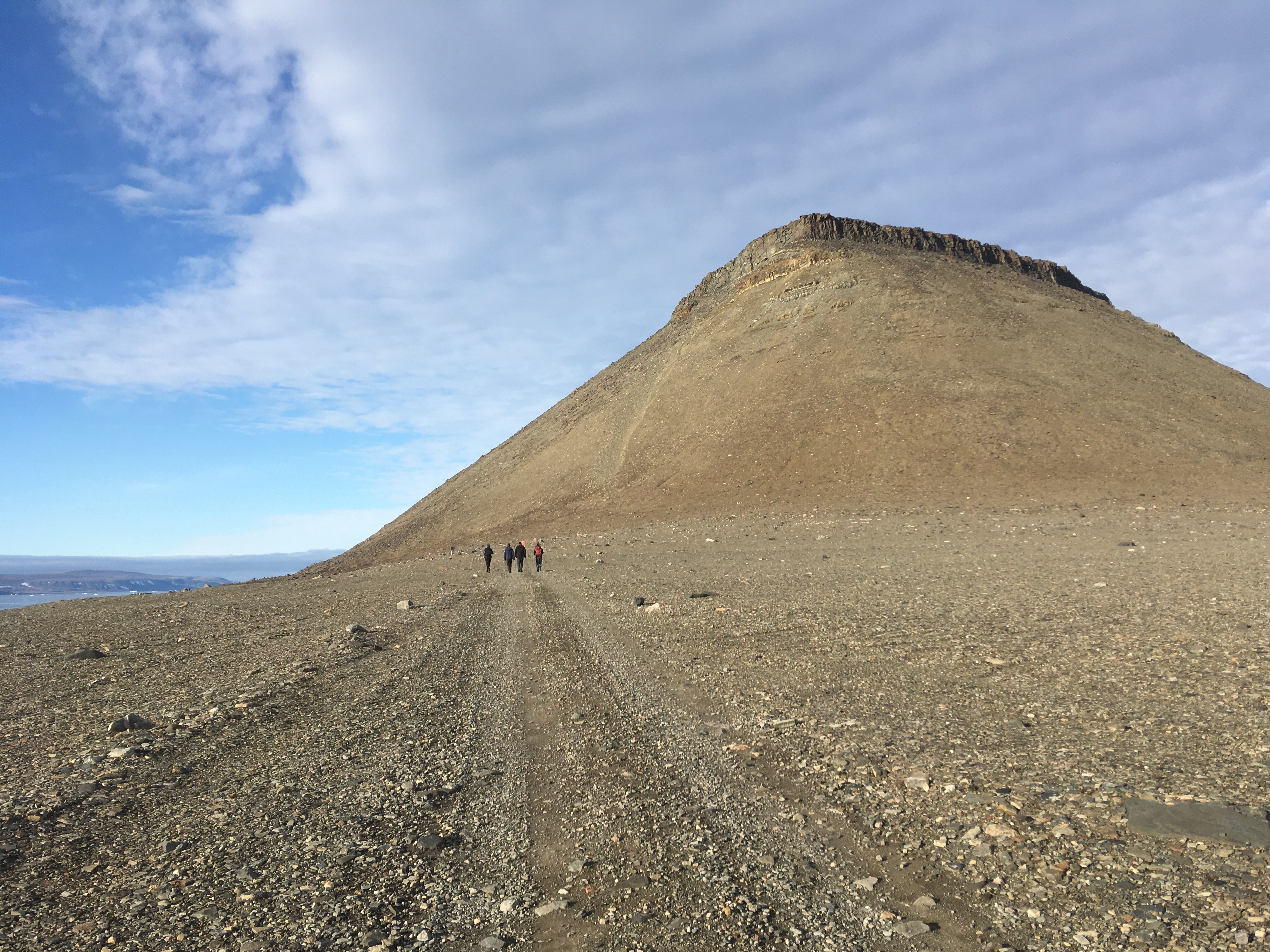
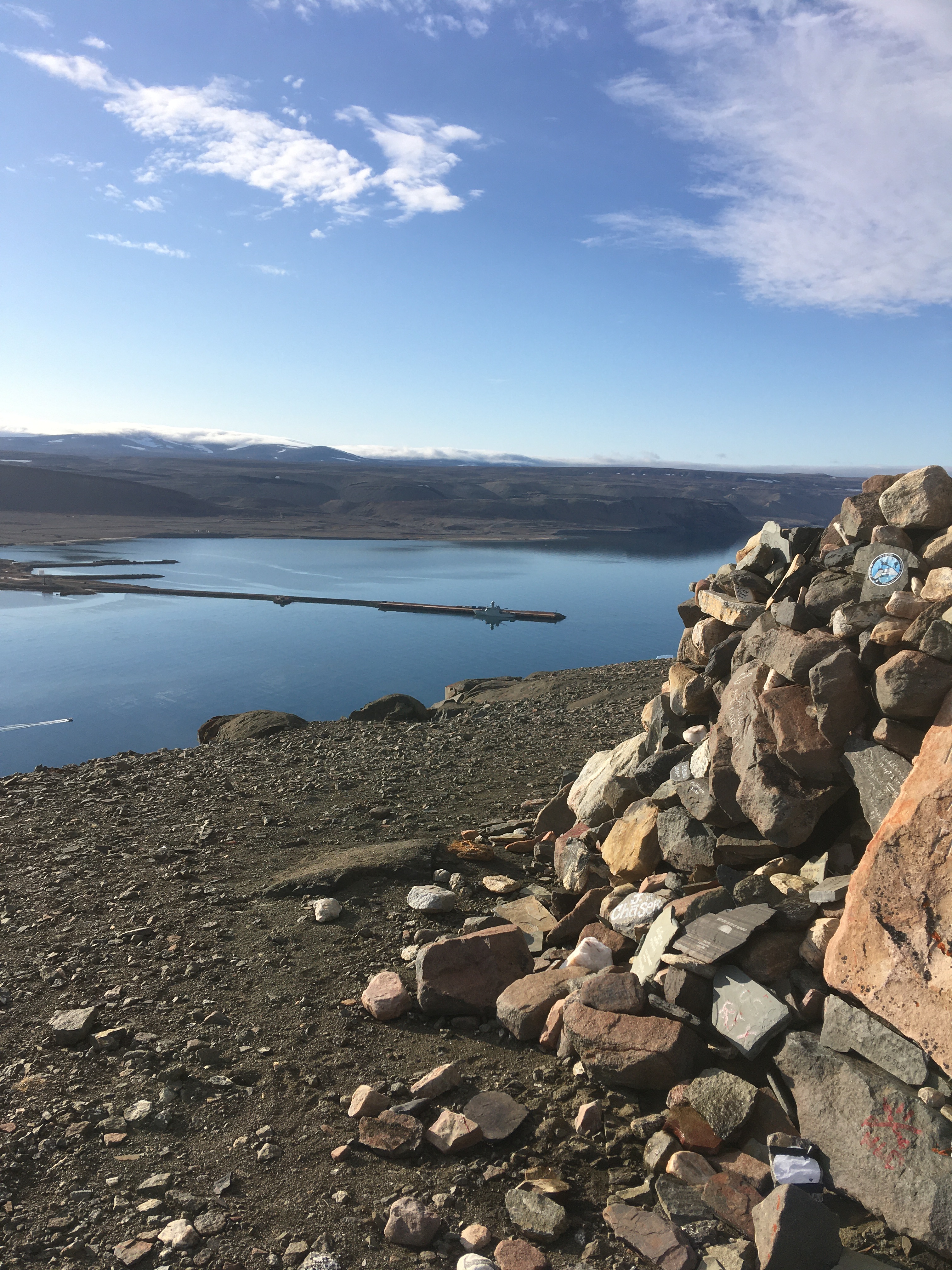
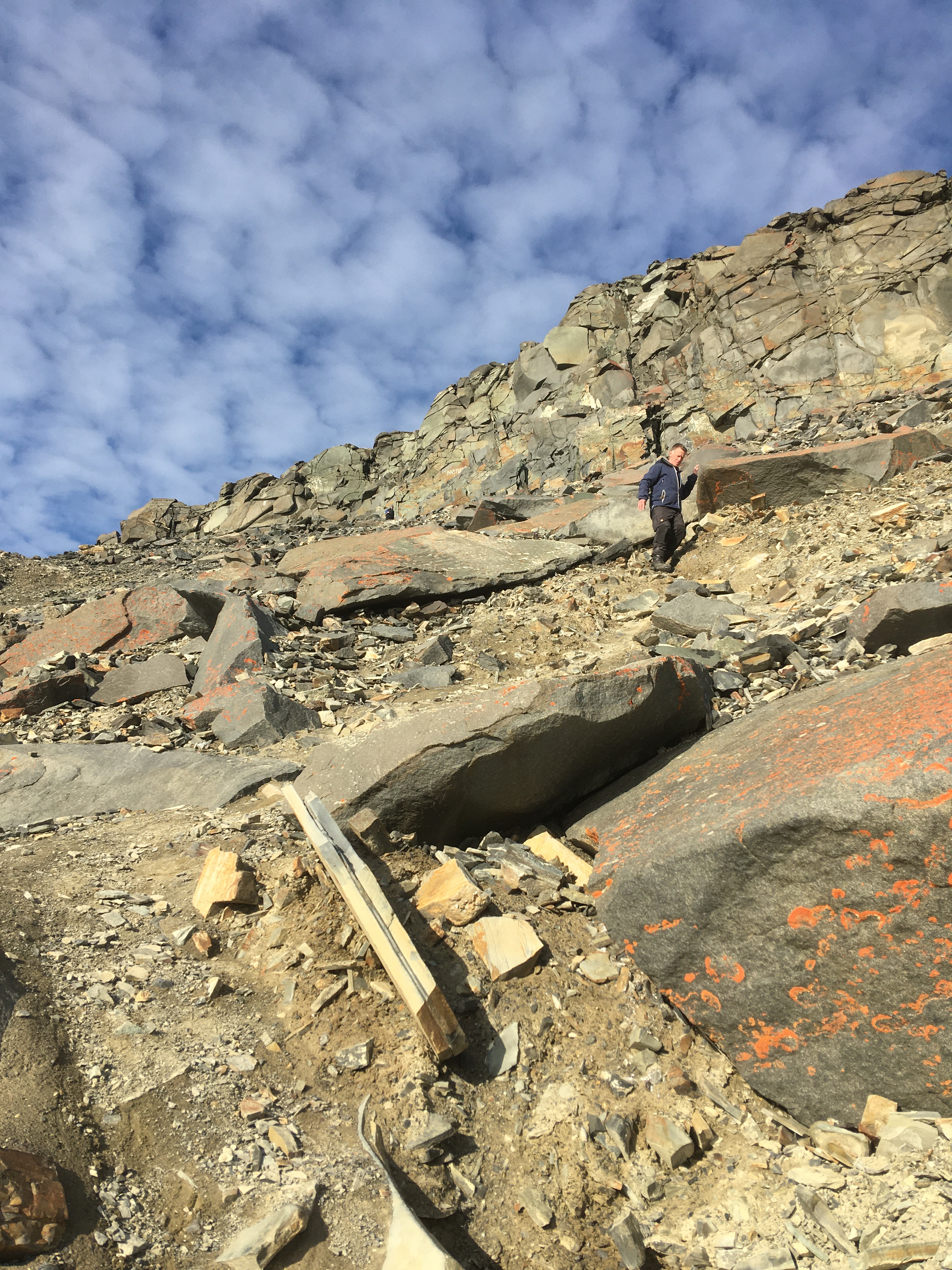
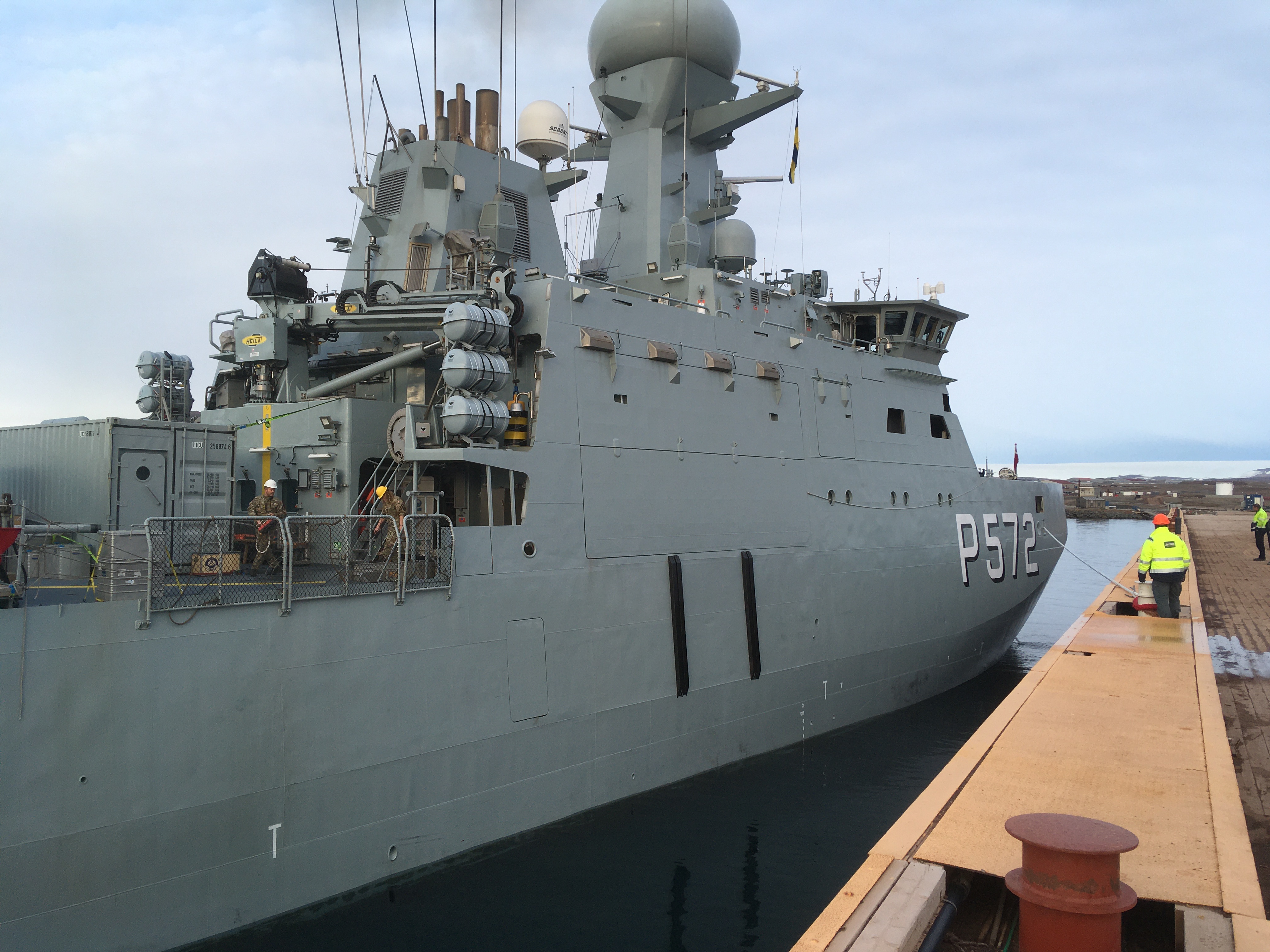
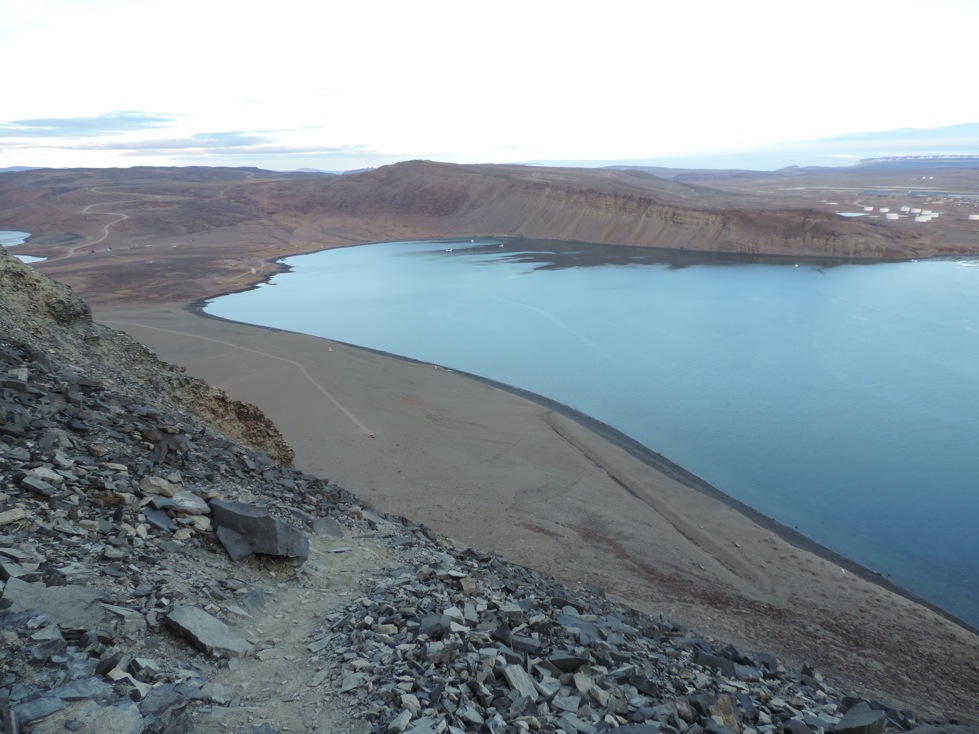
After getting off the ship at Thule Air Base (now called Pituffik Space Base) in 2021, us scientists climbed Dundas Mountain to stretch our legs, take in the varied landscape, and view our ship and home for a week from a distance. Notice how small HDMS Lauge Koch at the pier appears. All photos below were taken by geophysicist Dr. Katrine Juul Andresen of Aarhus University, Denmark:
References:

Münchow, A., Falkner, K.K. and Melling, H.: Baffin Island and West Greenland Current Systems in northern Baffin Bay. Progr. Oceanogr., 132, 305-317, 2015.

Ribeiro, S., Olsen, S. M., Münchow, A., Andresen, K. J., Pearce, C., Harðardóttir, S., Zimmermann, H. H., & Stuart-Lee, A.: ICAROS 2021 Cruise Report. Ice-ocean interactions and marine ecosystem dynamics in Northwest Greenland. GEUS, Danmarks og Grønlands Geologiske Undersøgelse Rapport, 70, 2021.

Zweng, M.M. and Münchow, A.: Warming and Freshening of Baffin Bay, 1916-2003. J. GEOPHYS. RES., 111, C07016, doi:10.1029/2005JC003093, 2006.

Greenland on my Worried Mind

My President Donald J. Trump threatens to take Greenland and does not rule out force to do so. A conflict emerges between the current United States’ administration and the people of Greenland and Denmark. My loyalities as an American citizen lie with the U.S. Constitution and the people of Denmark and Greenland. I worry about my government’s malicious incompetence when it interacts with friends and allies of more than 100 years such as Denmark. This tiny NATO country (half the size of South Carolina) of 6 million people (like Wisconsin or Minnesota) supported us during our 20-year long war in Afghanistan. Their price in blood (people killed) was as high as ours relative to their population [Source]. Hence I consider the statement of my current Secretary of Defence Pete Hegseth malicious, incompetent, and shameful when he responds to my Vice-President J.D. Vance that “… I fully share your loathing of the European free-loading. It’s PATHETIC …” [his caps, not mine].

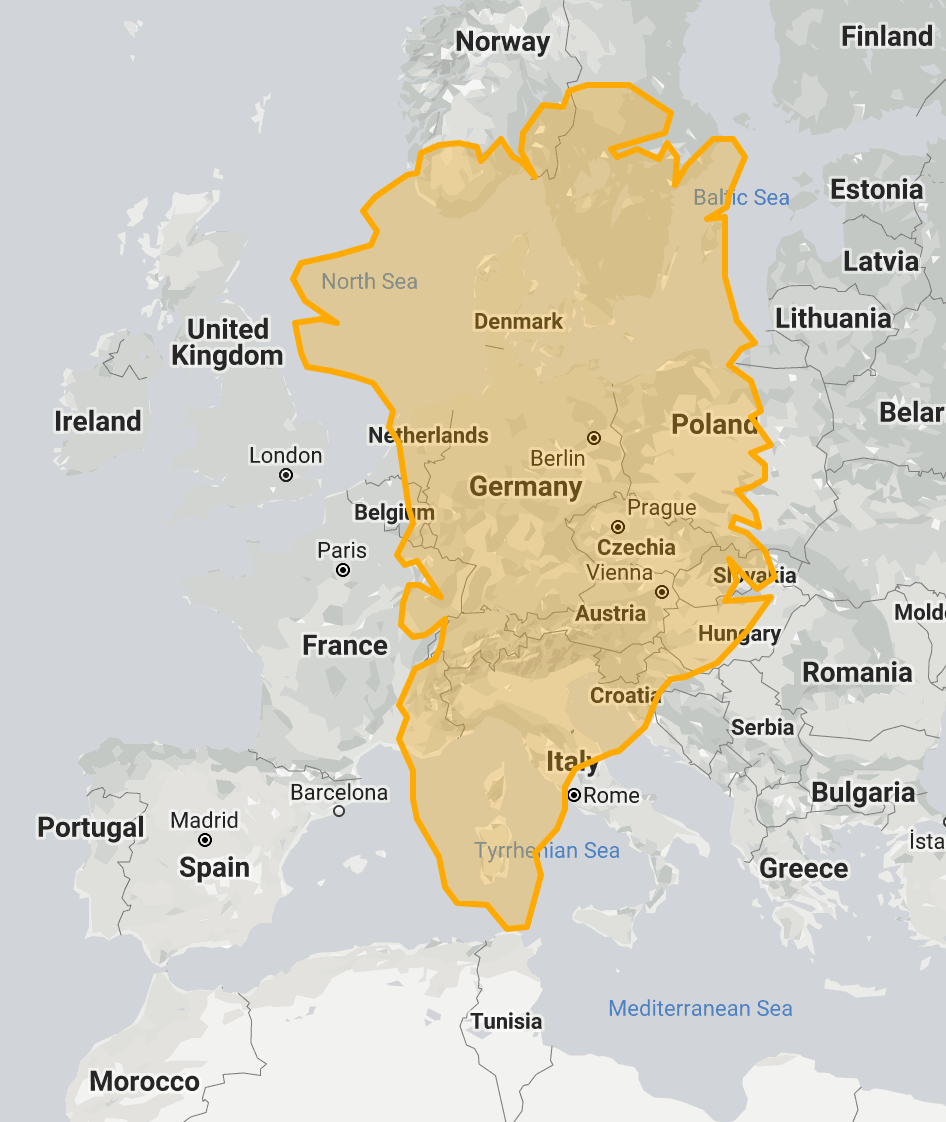
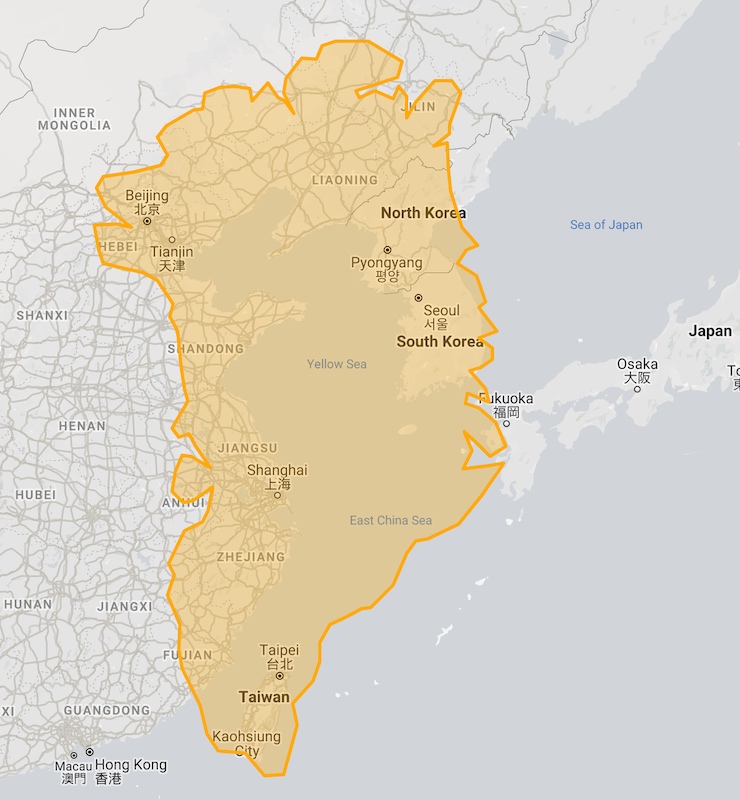
Greenland to scale over USA (left), Europe (center), and Asia (right).

Greenland is large, but only 55,000 people live there. Its northern reaches have been mapped only about 100 years ago by small groups of Danish explorers, scientists, and Inuit hunters moving by dog-sleds. Some died, but most survived. Even today, the Danish military patrols the northern reaches by dog sleds and satellite phones. These Sirius patrols consist of six teams of 2 Special Forces soldiers each who cover an area about the size of New England without encountering another person during months of steady traveling.

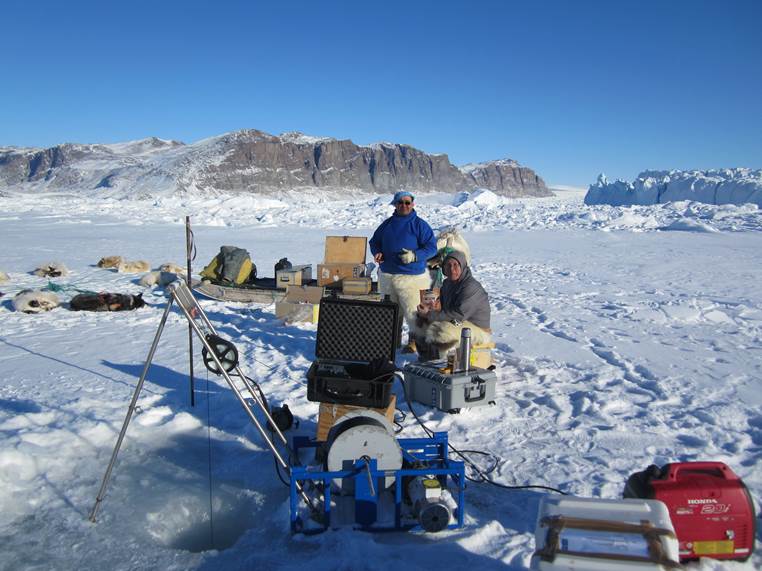
I traveled to Greenland 1997, 2003, 2005, 2006, 2007, 2012, 2014, 2015, 2016, 2017, 2018, 2021 and, hopefully, again in 2025. As a polar scientist my work relates to the physics of oceans and glaciers. All this work involves ships and people from the United States of America as well as Canada, Germany, Sweden, and Denmark. So I spent about 12 months of my life on ships in the coastal waters of Greenland, but in 2017 I also lived for 6 weeks at Thule Air Base which is now called Pituffik Space Base. We then surveyed the coastal waters and glaciers via daily snowmobile trips on the 1-3 feet thick sea ice. I met Inuit hunters both on the sea ice working and on base visiting. I met Danish Soldiers in Thule/Pituffik who in prior lives climbed out of the torpedo tubes of U.S. submarines and stormed beaches in Somalia and/or Yemen in joint military missions. I met Danish dentists, grocers, barristas, carpenters, policemen, cooks, electricians, and plumbers. They all support shared values of democracy, freedom, and respect for each other. They are our friends, not our enemies. They are good people, they are European, and they are not “PATHETIC” as current U.S. government officials call them.

Greenland near Thule Air Base or Pituffik Space Base in the fall of 2015 and spring of 2017.

More than 400 Danes and Greenlanders operate the base such as providing heat, water, food, plumbing, snow removal, civil administration, medical services, and general repair of all things non-military. They also form the experienced backbone of the base, because most of them have worked here for 5, 10, 20, or more years. In contrast, the U.S. soldiers rotate in and out every year as did my former father-in-law when Thule housed up to 11,000 US soldiers during the Cold War.

Today my Vice-President visits this Pituffik in North-West Greenland for a few hours. I do not know, but I doubt he will even spent the night where about 150 Americans operate large radar installations as well as an large airport and deep water seaport. I also doubt he, his wife, or National Security Advisors will gain understanding of people, place, or culture during their brief fly-by. They did get the firm message from the leaders of both Danish and Greenlandic governments, however, that they are not wanted. The uninvited U.S. officials changed plans and visited a remote military base at Pituffik rather than to expose themselves to Greenlanders and Danes in public at the central population center of Sisimut during a national sport’s event.

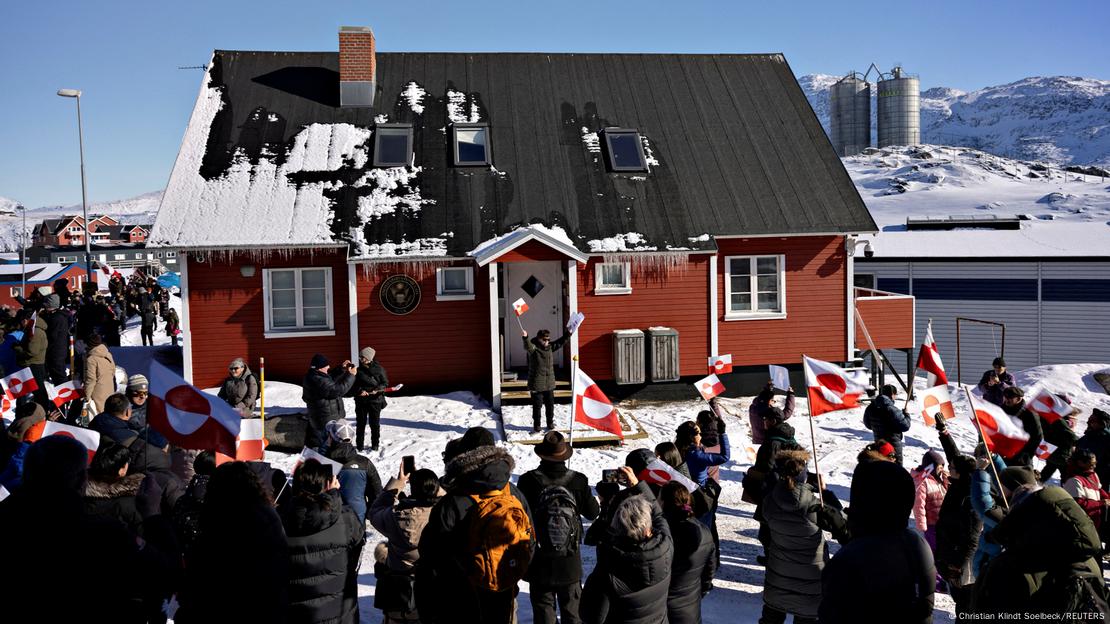
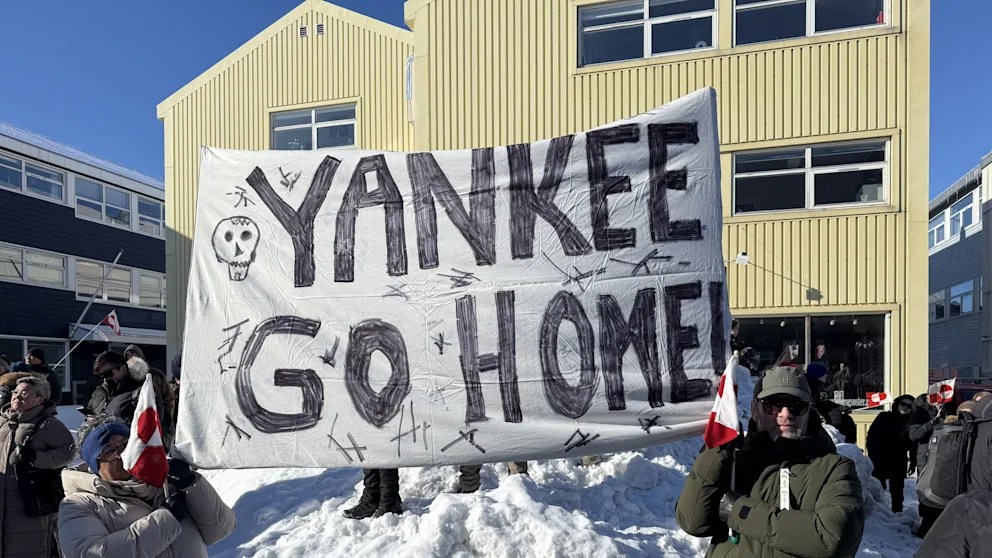
Two weeks ago almost 2% of Greenland’s population took to the streets in their capital Nuuk to expressed their views regarding their country [Source]. Relative to population, this would be the same, as if 6 million Americans would march in Washington, DC. Perhaps we need such a march to prevent the ongoing “Russification of the USA” where the malicious incompetence of my current government shreds the Law and undermines the Constitution of our United States of America.

Viking and Inuit in Greenland

While Viking rulers of Kyiv in Ukraine formally converted to Christianity in 988 CE at the outer limits of eastern Europe, two small viking settlements emerged at the southern tip of Greenland close to the Americas. The Norse settlers of Greenland left Iceland with 25 ships, but 11 of these either turned back to Iceland or were lost at sea. The remaining 14 boats arrived near 61 N latitude to establish an “Eastern” settlement which over time grew to more than 190 farms and 12 churches. Farther north near 64 N latitude a smaller “Western” settlement eventually grew to about 90 farms and four churches near Nuuk, today’s capital of Greenland. The “Western” settlement had a warmer and milder continental climate, because their farms were located far inland within a wide and complex fjord system that sheltered the farmers from atrocious coastal storms. The “Eastern” settlement was hit harder by these storms, because here the farms were closer to shore, closer to the icesheet, and closer to the center of the North-Atlantic storm activity.

North-Atlantic location map with Norse trading routes between Europe and Greenland adapted from Jackson et al. (2018)

For about 200-300 years the settlements flourished and reached a population of about 4,000 people. They paid taxes to the King of Norway, donated tithes to their churches, and imported clothing, iron, and food stuff from Scandinavia. They paid with ivory from narwhales and walrus that they hunted in Disko Bay at 69 N latitude. Three viking hunters scratched their names in stone on a cairn they built about 1333 CE on an island near Upernavik at 73 N latitude (Francis, 2011). At these “Northern Hunting Grounds” the vikings from both “Eastern” and “Western” settlements likely met the Inuit of the Thule culture who at the time were moving south along West Greenland after a 3000 km migration from coastal Alaska within a few generations.

Runestone of Kingittorsuaq found at 72°57′55″N 56°12′45″W stating “Erlingur the son of Sigvat and Bjarni Þorðar’s son and Eindriði Oddr’s son, the washingday (Saturday) before Rogation Day, raised this mound and rode…” [Photo Credit: Ukendt /Nationalmuseet, Danmark]

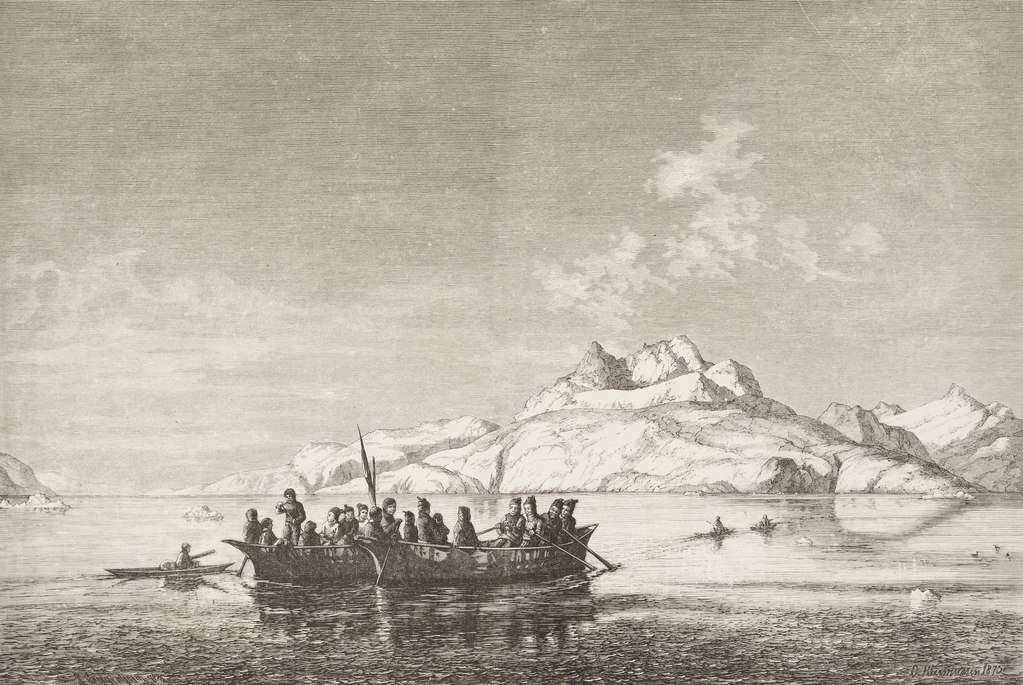
The modern Inuit of the Thule culture arrived in Greenland about 200-300 years after the vikings did. They arrived on foot, by dog sled, and in umiaks from the Bering Sea area of Alaska and Siberia (Friesen, 2016). They were equally adept to hunt caribou on land with bow and arrow, seals on sea ice with spears, and whales on open ocean with sophisticated harpoons. They crossed Smith Sound at 79 N latitude about 1300 CE to reach Greenland spreading south towards the viking settlements and north-east towards Fram Strait separating Greenland from Svalbard. On a beach off Independence Fjord in North-East Greenland at almost 83 N latitude Eigil Knuth found the frame of one of their skin-hulled umiak in 1949 (Knuth, 1952).

Umiak in Greenland as depicted by Carl Rasmussen in 1875 adapted from https://en.wikipedia.org/wiki/Umiak

The vikings built “permanent” houses of stone, farmed the land, and kept sheep, goat, and cows. They hunted walrus and narwhal for its ivory to trade with Europe to import metals, clothes, and foods. Their diet until about 1300 CE was high on terrestrial and low on marine resources as indicated by isotopic studies of their bone structure. This changed when a cooling climate challenged animal husbandry in Greenland and the Norse transitioned towards a marine-based diet of fish, seals, and marine mamals (Jackson et al., 2018).

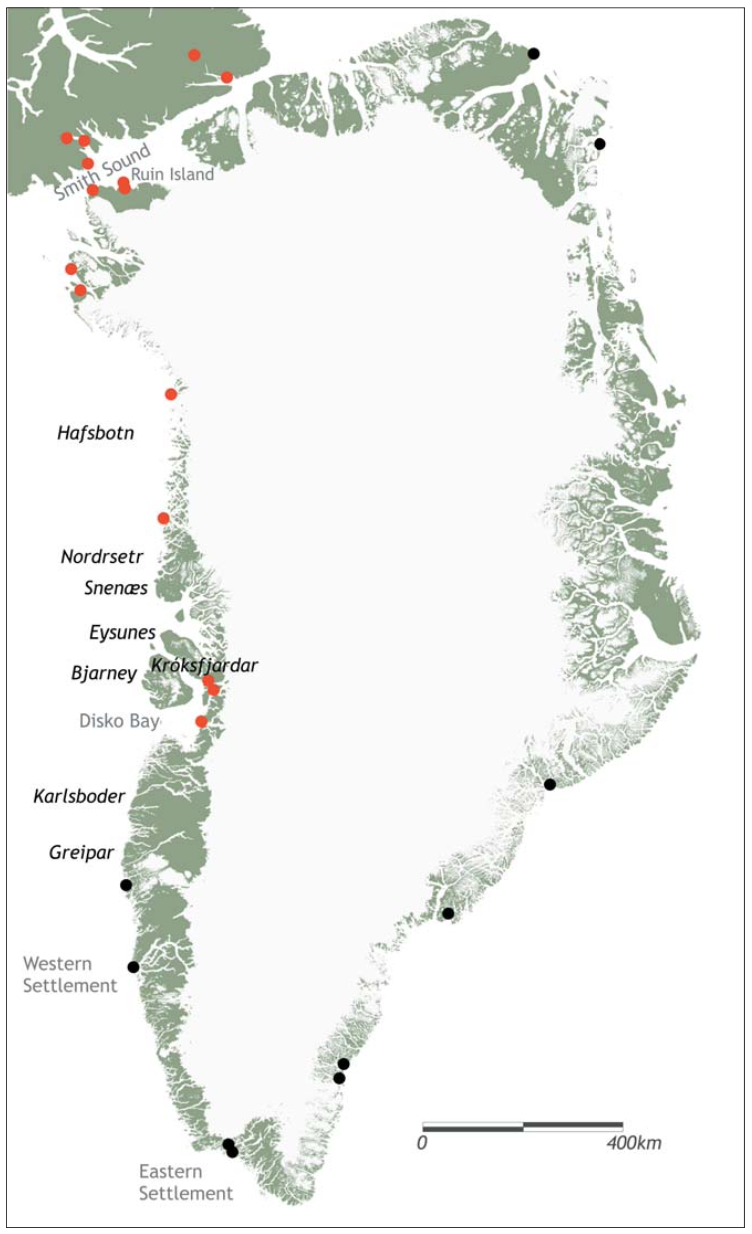
Map of Greenland and Ellesmere Islands adapted from Gullov (2008). Red symbols indicate Norse artifacts found at Inuit sites occupied in the 13th and 14th century while black dots represent location of such artifacts at 15th and 16th century.

In contrast, the Inuit embraced a more mobile life-style as entire family units moved large distances to new sites from year to year and seasonally from summer to winter camps. Their hunting was tied to the sea ice and they developed fancy techniques to hunt larger whales, walrus, and polar bears for food, fuel, and clothing. Their technologies and behaviors adapted rapidly in an extreme environment and climate that kept changing in time. Inuit often viewed themselves and their animal prey as mutually connected with energies flowing from animal to Inuit and vice versa. Both were part of one nature which changes in time on many different cycles that one needs to read and understand for survival. This view differed from that of the more pastoral vikings who saw themselves and their homes as “safe inner spaces” and everything on the outside as “wild and hostile” nature. They constantly tried to modify, improve, and control the landscape while the Inuit moved and adapted within it (Jackson et al., 2018).

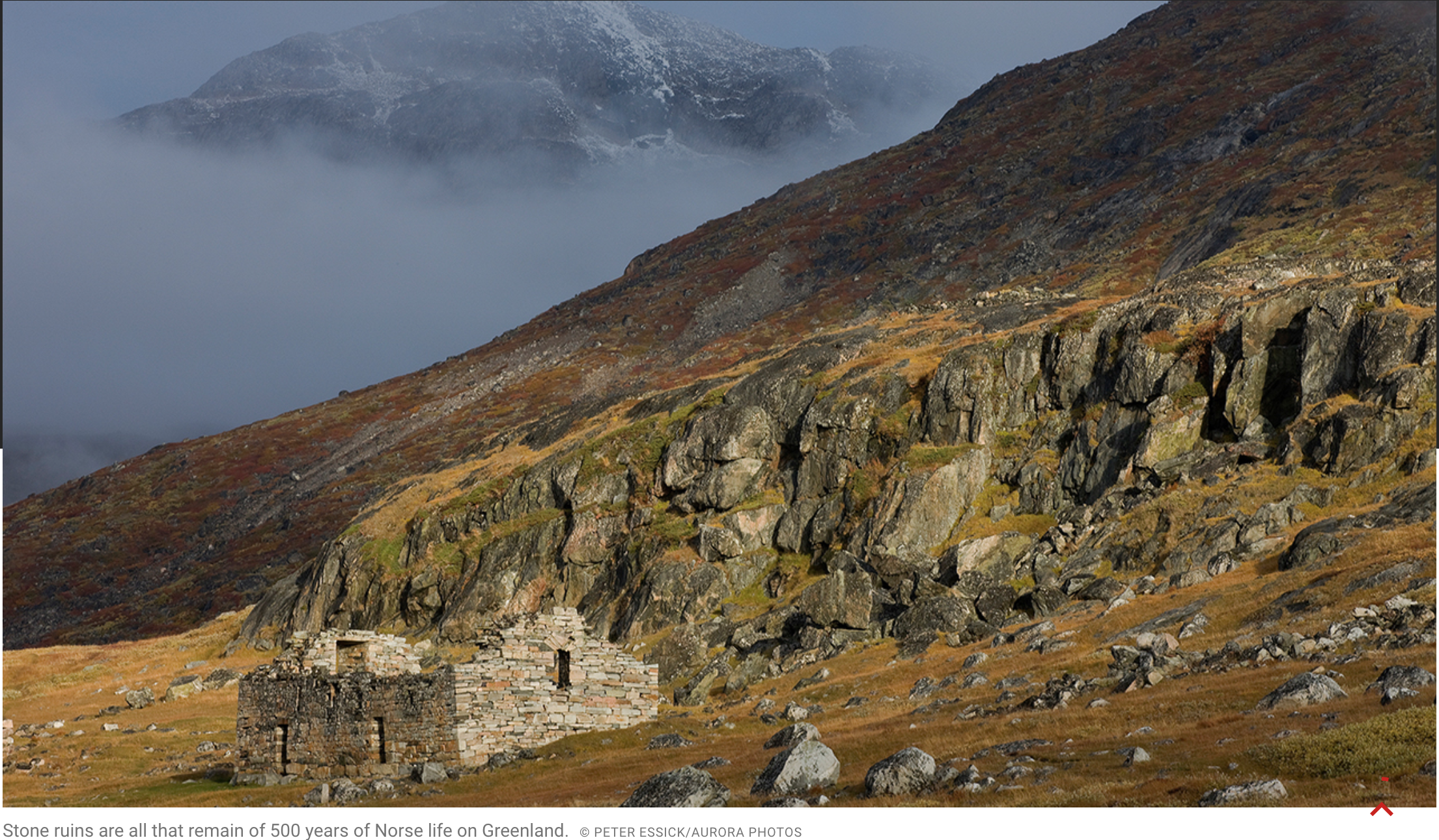
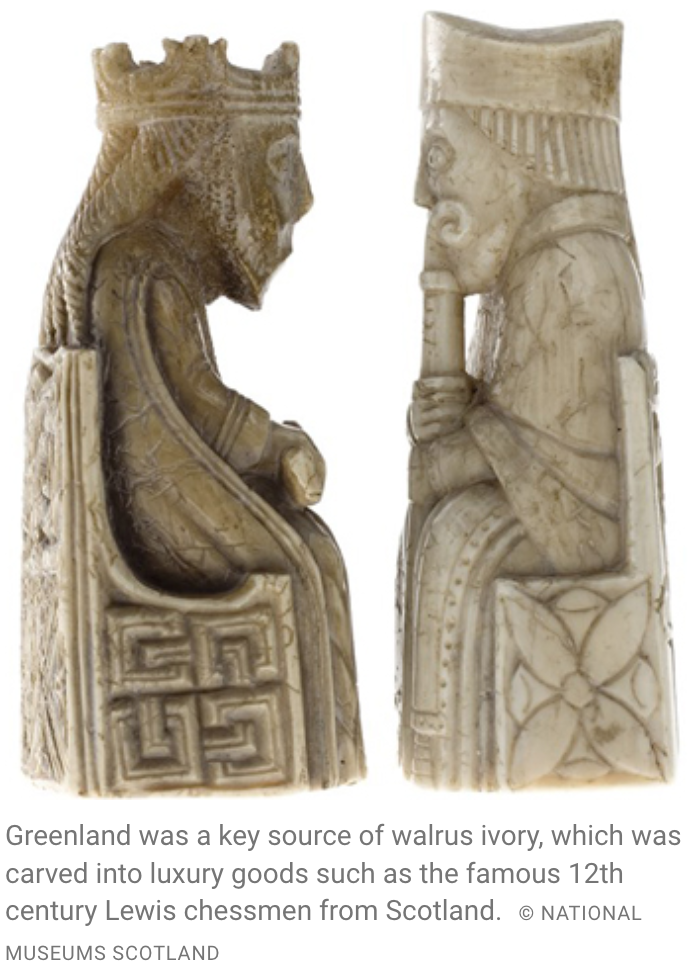
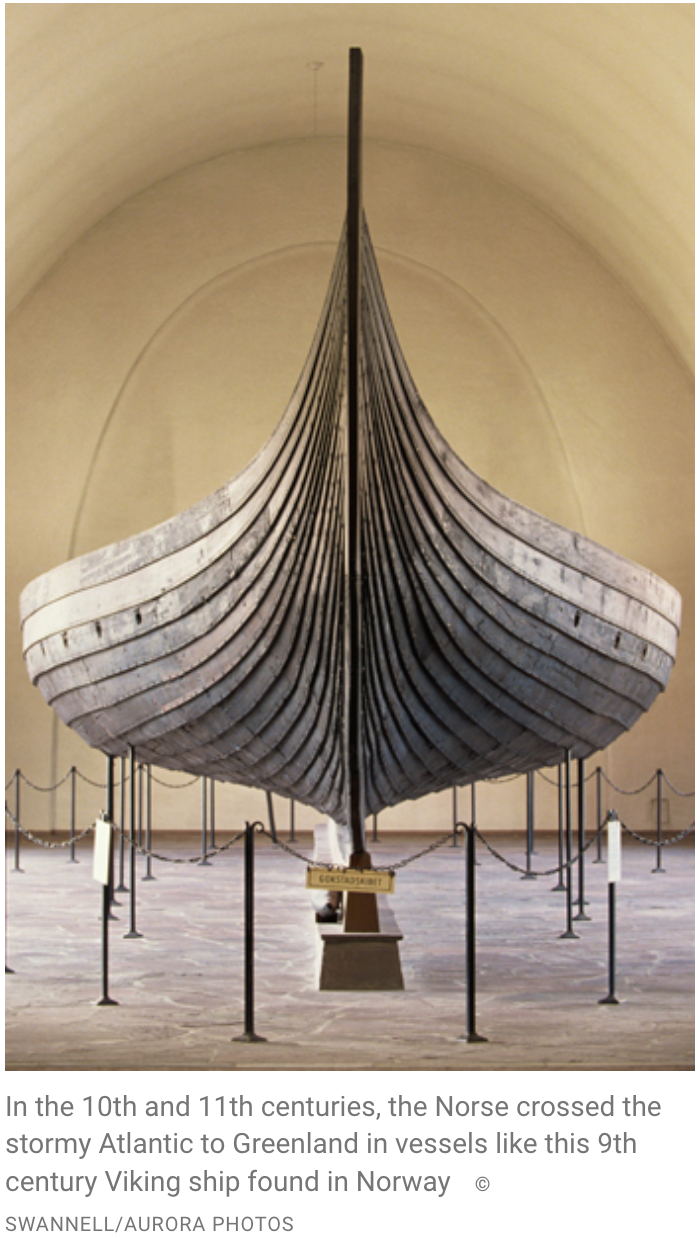
Viking settlement on Greenland (left), chess figures from walrus ivory (center), and viking longboat from the 10th century.

The vikings vanished without a trace in the 15th century. Their fate is still researched and debated in academic and popular outlets alike. In contrast, the Inuit expanded their range along all of Greenland where in the 18th and 19th centuries they were “re-discovered” in the South by Danish and Moravian colonists and missionaries and in the North by the English Navy, American adventurers, and Danish scientists.

In 1910 two Danes Knut Rasmussen and Peter Freuchen established a trading post at North Star Bay near 77 N Latitude. They called “Thule.” Over the next 20 years Thule became a focal point of about 200 nomadic Inughuit that all are direct descendants of the Thule culture Inuit. There are about 700 of them today and most still live in Qaanaaq. Linguist Stephen Pax Leonard lived among them for a year in 2010/11 when he produced a 10 minute video that documents contemporary Inuit life and language.

Contemporary photos of Qaanaaq and Thule region. Photos on left panel by Dr. Steffen Olsen near Tracy Glacier in Inglefield Fjord while images in right panel are of North Star Bay and Thule Air Base by the author.

References:

Francis, C.S., 2011: The Lost Western Settlements of Greenland, 1342, California State Univ. Sacramento, MA Thesis, 84 pp.

Friesen, T.M., 2016: Pan-Arctic Population Movements, Chap.-28 of “The Prehistoric Arctic,” Oxford Univ. Press, 988 pp.

Gullov, H.C., 2008: The Nature of Contact between Native Greenlanders and Norse, J. North Atlantic, 1, 16-24.

Jackson, R., J. Arneborg, A. Dugmore, C. Madsen, T. McGovern, K. Smiarowski, R. Streeter, 2018: Disequilibrium, Adaptation, and the Norse Settlement of Greenland, Human Ecology, 46 (5), https://doi.org/10.1007/s10745-018-0020-0.

Kintsch, E., 2016: Why did Greenland’s Vikings disappear? Science, 10.1126/science.aal0363, accessed as https://www.science.org/content/article/why-did-greenland-s-vikings-disappear

Knuth, E., 1952: An Outline of the Archaeology of Peary Land, Arctic, 5(1), pp. 17-33.

Greenland Glacier-Driven Ocean Circulation

Greenland’s coastal glaciers melt, shrink, and add to globally rising sealevel. They also drive local ocean currents that move icebergs around unless they are stuck on the bottom. The glaciers’ melt is cold fresh water while the adjacent ocean is both salty and warm. Checking on what we may expect against observations, I here use data from NASA’s Ocean Melts Greenland initiative that dropped ocean probes from an airplane into the ice waters off coastal Greenland to measure ocean temperature and salinity.

For six years these data show how the coastal ocean off Greenland varies from location to location next to glaciers as well as from year to year. More specifically, I picked Melville Bay in North-West Greenland for both its many glaciers and many dropped NASA ocean sensors. The ocean data allow me to estimate ocean currents by using a 100 year old physics method. I just taught this to a small class of undergraduate science students at the University of Delaware. My students are strong in biology, but weak on ocean physics. This essay is for them.

Melville Bay is a coastal area off north-west Greenland between the town of Upernavik (Kalaallisut in Greenlandic) near 73 N latitude where 1100 people live and the village of Savissivik (Havighivik in Inuktun) at 76 N latitude where 60 Inuit live. There are no other towns or settlements between these two villages that are about as far apart as Boston is from Philadelphia, PA. Imagine there were no roads from Boston to New York to Philadelphia but only one large glacier next to another large glacier. This is Melville Bay.

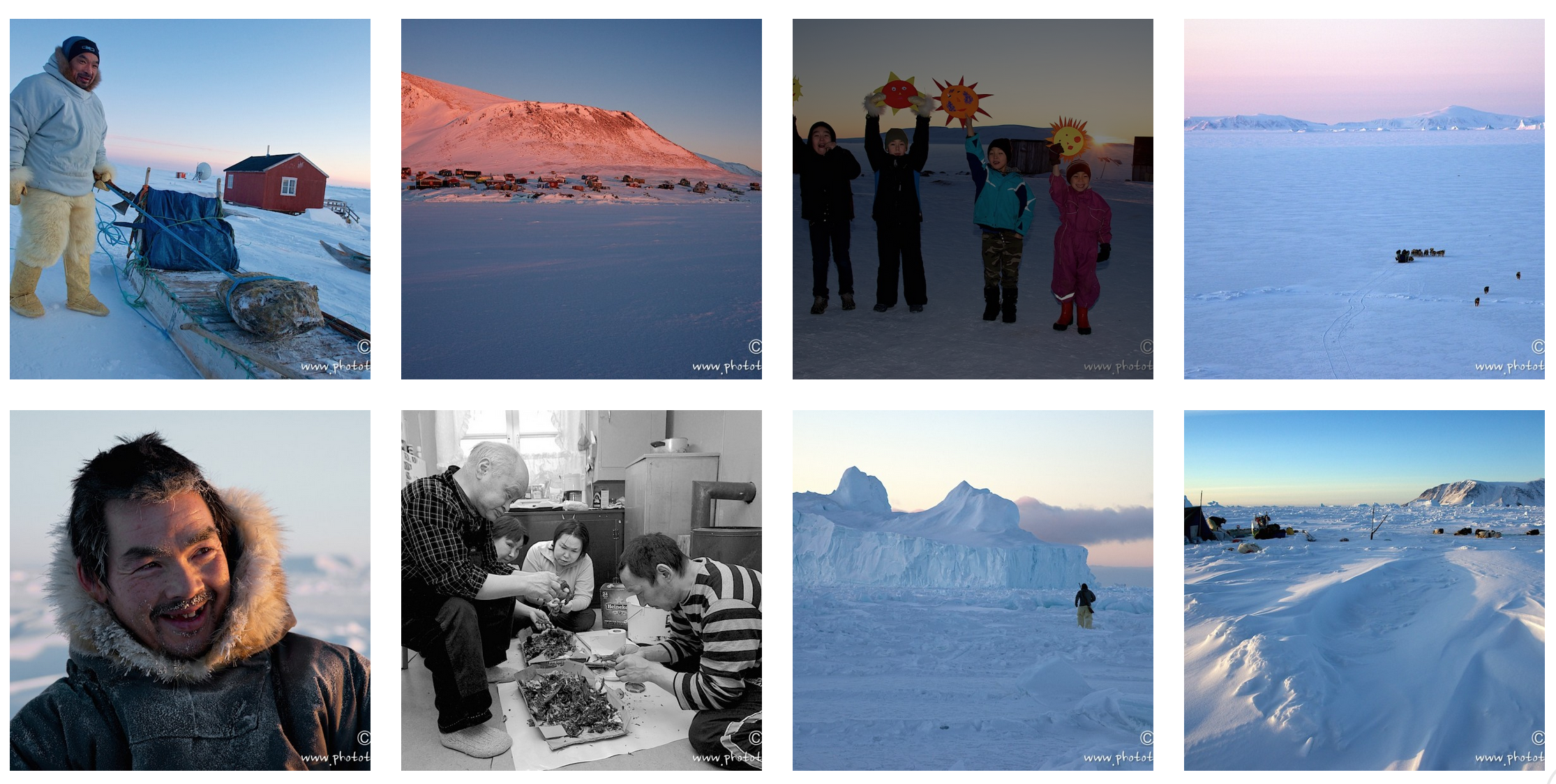
Below I show an excellent set of photos of Savissivik by a French husband and wife team who visited in 2013/14. Their photographic gallery captures elements of contemporary subsistence living in remote Greenland where animals like seals, birds, fish, narwhal, and polar bears provide food, fuel, clothing, and income.

NASA dropped some 50 ocean sensors into Melville Bay froma plane during the short summer seasons each year 2016 through 2021. I met NASA pilots, engineers, and scientists doing their experiments when I was doing mine from a snowmobile in April of 2017 and again with Danish friends from a Navy ship in August of 2021, but these are stories for another day.

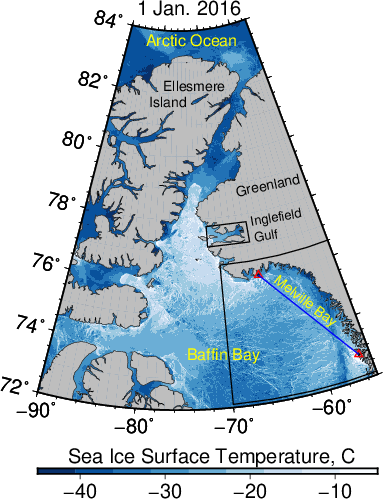
Let me start with a map of where NASA dropped their ocean profiling floats into Melville Bay and thus introduce the data. While the surface waters are usually near the freezing point, waters 300-400 meters deep down are much warmer. They originate from the Atlantic Ocean to the south and one of the goals of NASA’s “Ocean Melts Greenland” campaigns was to determine if and how these Atlantic waters reach the coastal glaciers. Most glaciers of Melville extend into this warm ocean layer and thus are melted by the ocean.

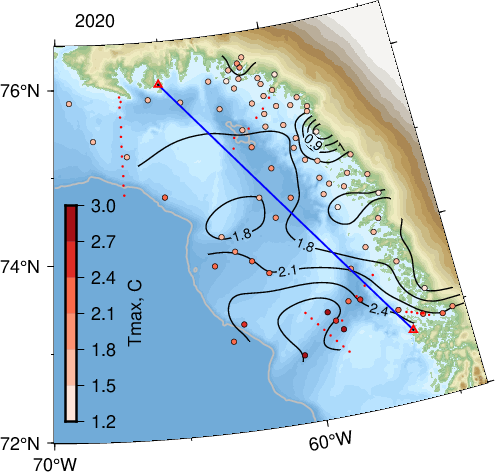
In the map above I paint the maximal temperatures in red and the bottom depths in blue tones. The profile on the right shows data for all depths at one station. As salinity increases uniformly (red curve) the temperature increases to a maximum near 300-m depth (black curve). It is this maximal subsurface temperature that I extract for each station and then put on the contour and station map on the left. The straight blue line connects Upernavik in the south with Sassivik in the north. It is an arbitrary line, coast-to-coast cutting across Melville Bay.

The warmest warm waters we find near Upernavik in the south and within a broad submarine canyon that brings even warmer waters from Baffin Bay towards the coast. Temperatures here exceed 2.4 or even 2.7 degrees Celsius. Most coastal waters along Melville Bay have a temperature maximum of about 1.5 to 1.8 degrees Celcius (about 35 Fahrenheit) and this “warm Atlantic” ocean water melts the coastal glaciers. The ocean melts the glaciers summer and winter while the warm air melts it only in summer.

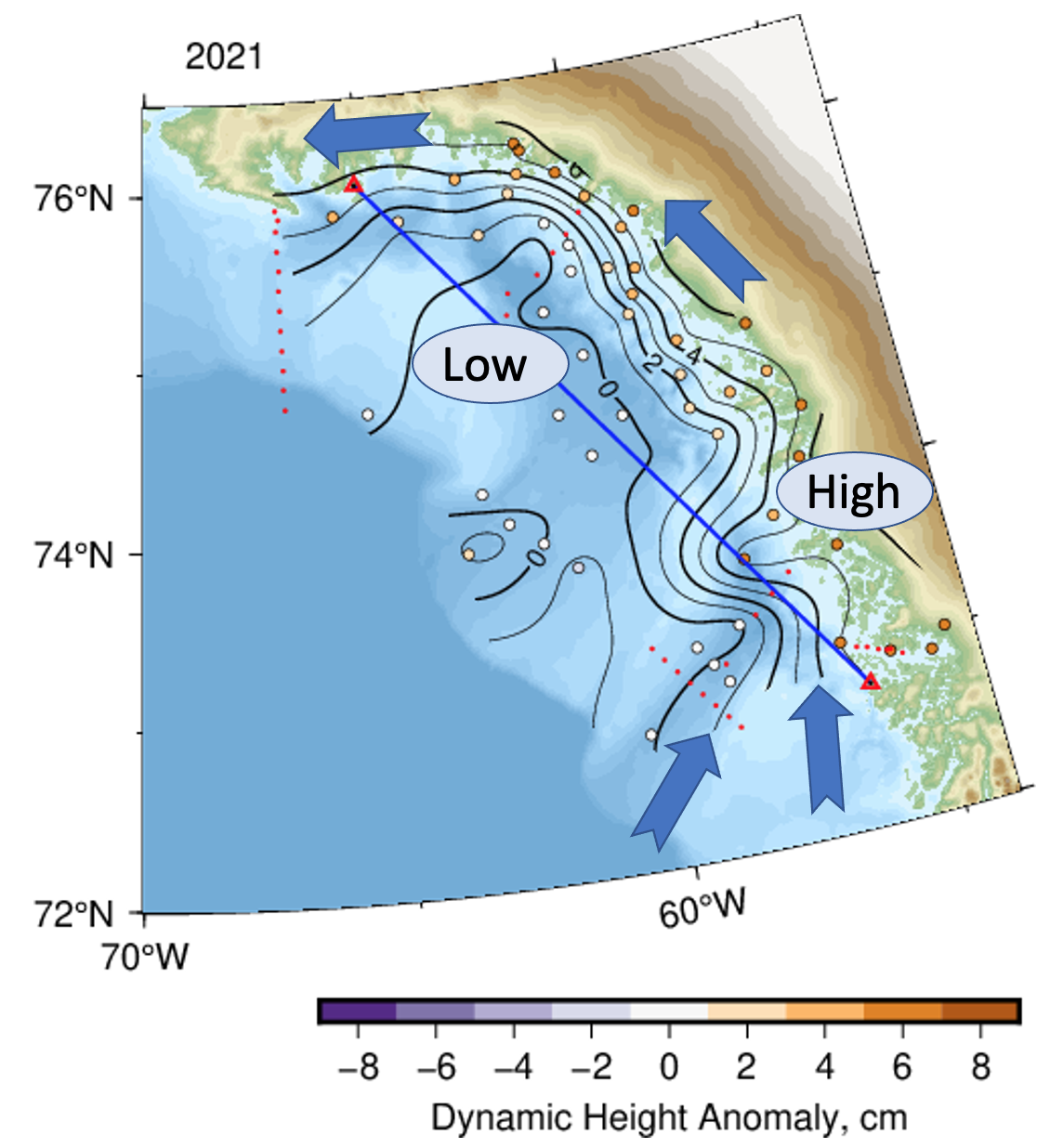
There is more, because the glaciers’ melt also discharge fresh water into the ocean where it mixes to to form a layer of less dense or buoyant water. The buoyant waters create a local sealevel that is a little higher along the coast than farther offshore. The map above indicates that this “little higher sealevel” comes to about 4 cm or 2 inches. If this pressure difference across the shore is balanced by the Coriolis force, as it often does, then an along-shore coastal current results. This coastal current would move all icebergs from south to north unless they get stuck on the bottom. Along the northern coastline of Melville Bay the surface flow is from east to west. The coastal current is strongest near Savissivik where we find a (geostrophic) surface current larger than 40 cm/s. At that speed an iceberg would move more than 21 miles per day. Such strong surface flows are exceptional and diminish rapidly with depth. Hence a freely floating iceberg with a draft of several hundred meters would move much slower than the surface current.

I met a hunter from Savissivik in April of 2017 and for a fast-moving night we discussed the state of local fishing, hunting, living, traveling, and working on the sea ice next to the glaciers of Melville Bay. He invited me to become his apprentice. As such I would now ask him about the surface currents outside his home. Which way does he observe the icebergs to move in summer or winter? Has hunting on the sea ice in winter changed over his life time? When is it safe to travel there with a dog-sled? Could he and I perhaps work together during the spring to deploy ocean sensors through the sea ice? I am dreaming again …