Category Archives: Global Warming

Rising Seas, Storms, and Flooding

Ocean waters are rising and flooding inland waters in Delaware and elsewhere. Some of this is perfectly regular and normal such as the up and down of the tides. Some of it is irregular and normal such as caused by storms, river discharges, waves, and weather. And some is caused by global warming as we continue to burn coal and oil to power our economies. Lets have a quick look at what all this looks like and try to put this into some perspective, but Sandy’s 5.3 feet surge last monday was second to the 5.5 feet surge that hit Lewes in 1962.
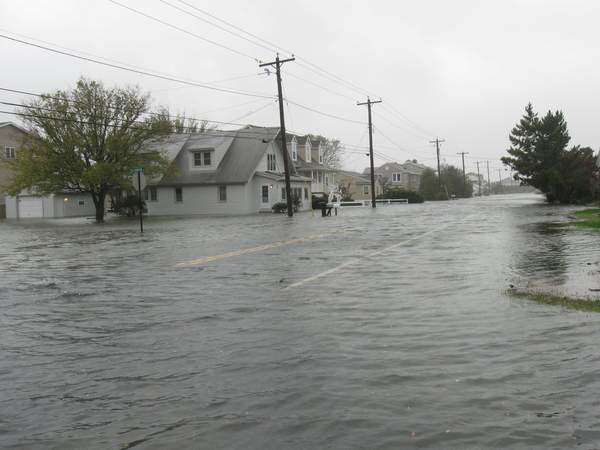
Cedar Street in Lewes flooded on Monday, October 29. (Photo by: Don Bland), as published by Cape Gazette.

The up and down of the tides each day is about 3 feet in Lewes, Delaware. This large change in sea level is so regular, normal, and predictable, that I remove it from all further discussion, because I want to know how extreme an event this week’s storm Sandy was. For this purpose I downloaded all the hourly tide gauge data from Lewes, Delaware from NOAA. The record starts in 1957 and is ongoing. Here is how the record looks for the last 4 weeks including the surge caused by Sandy last monday:
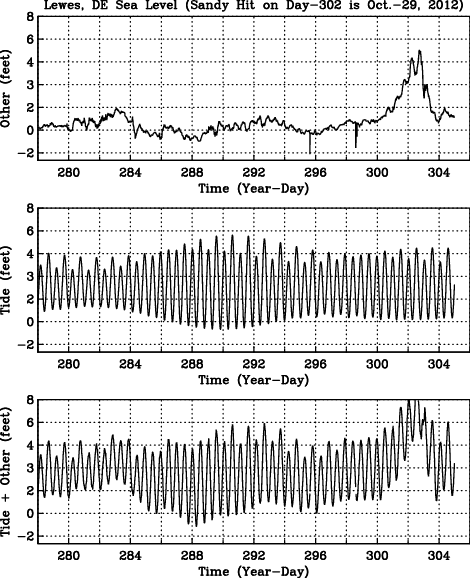
Sandy’s storm surge added 5.3 feet to the regular tide which is second-largest surge in the historical record. The largest surge at Lewes, DE was caused by the 1962 Ash Wednesday Storm that added 5.5 feet to the regular sea level:
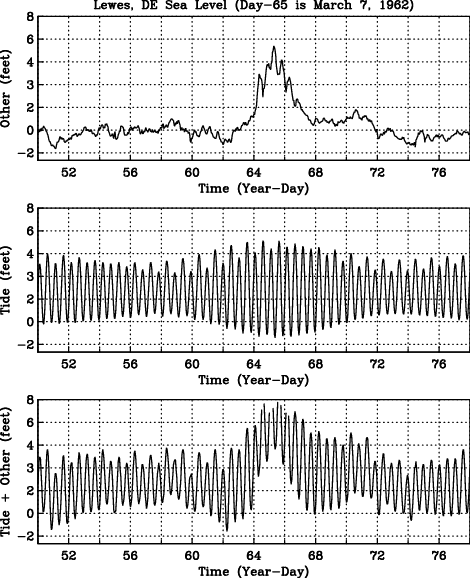
So while Sandy was a very large surge, it was neither unprecedented nor a once in a century event. Furthermore, and this is where I come back to global warming, the 5.3 feet 2012 surge of Sandy includes the last 50 years of steady sea level rise which comes to about an inch every 10-15 years or about half a foot in the ~50 years between 1962 and 2012. So, a repeat of the 1962 storm system would cause a 6.0 feet and not the 5.5 feet surge that took place in 1962.

Furthermore, while the real size of the surge depends on where the center of the storm makes land-fall or where you are relative to the storm, the rising seas caused by global warming are much more uniform, that is, they are little different in Boston, New York, Lewes, Norfolk, or even San Francisco:
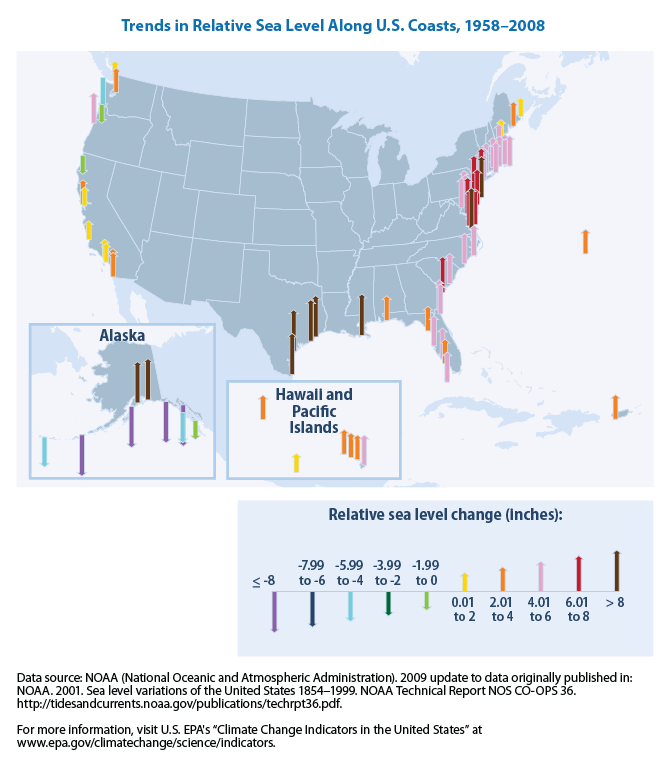
So, global warming and the rising seas it causes are both real and here to stay. Global warming provides the upward creeping background sea level to which larger tides, waves, and surges add. The combined effect of all these cause the coastal flooding. So 50 years from now, a rare, but perhaps perfectly natural freak storm like Sandy will cause a storm surge of 5.8 instead 5.3 feet on account of global warming. About 1/3 of this added sea level is caused by the oceans expanding as they warm, another 1/3 is caused by melting glaciers and ice sheets in Greenland and Antarctica, and the last 1/3 is caused by other processes. So, what happens on Greenland or China does not stay there, it impacts present and future sea level in Lewes, DE.

Hurricane Sandy, Global Warming, and the Butterfly Effect

I am stupid. I do not believe in Global Warming. No need to believe in what you know. And I know that globally averaged air temperatures increased for the last 150 years or so. I did the math myself using observations to conclude, that air temperatures around northern Greenland and Ellesmere Island increased 5 times the global average over the last 25 years (Greenland’s Warming, Melting, and Sliding to Sea). So, why am I stupid?

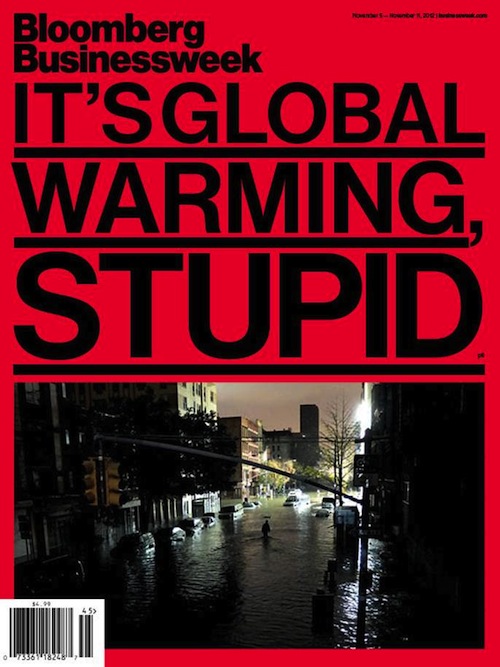
Cover of Bloomberg Businessweek, Nov.-5, 2012

I am stupid, because I totally disagree with what has just hit the news stand about Hurricane Sandy’s impact on the eastern seaboard of North America: It’s Global Warming, Stupid screams this week’s edition of Bloomberg Businessweek with a dramatic cover draped in red.

I do not deny that some element of global warming scenarios contributed in some way to this storm, but so did the butterfly I rescued earlier this year from my cat Zoe. The butterfly flapping her wings, I am convinced, contributed to the atmospheric turbulence and thus the weather we got, including Sandy. If this sounds crazy, it is, but so is the headline. We can argue all day, if Global Warming or my Butterfly Effect contributed more significantly to Sandy, but we will not come to a firm scientific conclusion.

The Businessweek article has some excellent points on page three with regard to climate change and policies that we can and should make to reduce carbon emissions, but it discredits these well-reasoned policies by using flood waters in Manhattan as the call for action with a screaming headline calling me stupid. If we make policies based on ill-informed drama, political manipulations, and without supporting good empirical evidence, then we do harm.

A shallow and short-term political victory does not address the deep and long-term social problems posed by climate change. Solutions to these problems such as carbon-trading, energy efficiency, smart growth, and adaptations are all endangered, if we chose to exploit emotions of the moment. This sets us up for an equally ill-informed and short-sighted political backlash. We ignore science at our own peril. This cuts both ways with regard to the political hackery and partisan politics on the issue of climate change. I can’t stand it, but then, I am stupid.

ADDENDUM Nov.-2: An excellent description of the storm’s evolution and relation to climate was published in Science Magazine.

Arctic Sea Ice Cover and Extreme Weather Explained

Addendum Sept.-24, 2012: A New Climate State, Arctic Sea Ice 2012 (video by Peter Sinclair).

I just discovered an outstanding interview that Dr. Jennifer Francis of Rutgers University gave to a non-profit community radio station out of Vancouver, British Columbia.

Jennifer Francis Interview 20120910

She connects and explains global warming, its much amplified signal in the Arctic, the extreme record minimal Arctic sea ice cover this summer, and how the warming Arctic and its disappearing sea ice impacts our weather in the northern hemisphere by slowing down the atmospheric jet stream separating polar from mid-latitude air masses. She explains all of this in non-technical language without loss of accuracy.

Dr. Jennifer Francis, Rutgers University [Photo Credit: ARCUS]

If this program piques your interest and you want to read more, Andrew Revkin of the New York time has led an informed discussion at his New York Times blog Dot Earth. And finally, Climate Central presented and illustrated Dr. Francis’ observations and ideas rather well with graphics and videos.

Arctic Ice Cover and Petermann Fjord, Glacier, and Ice Island Video Footage

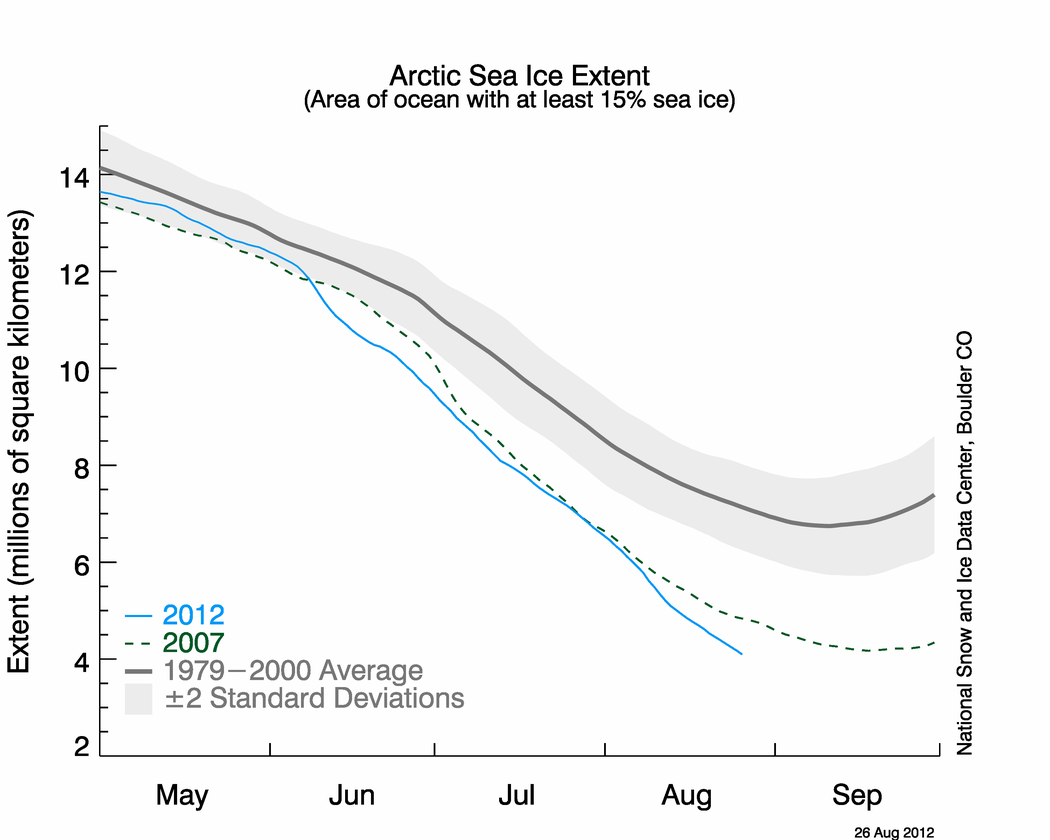
The National Snow and Ice Data Center announced today, that the Arctic Ice Area Extent has reached an absolute minimum breaking the record minimum of 2007 with still several weeks of potential melting and retreat to go. This has been anticipated for many weeks now with perhaps the most extensive coverage and intelligent discussions over at Neven’s Arctic Sea Ice Blog.

The graph above shows Arctic sea ice extent as of August 26, 2012, along with daily ice extent data for 2007, the previous record low year, and 1980, the record high year. 2012 is shown in blue, 2007 in green, and 1980 in orange. The 1979 to 2000 average is in dark gray. The gray area around this average line shows the two standard deviation range of the data. The 1981 to 2010 average is in sky blue. Sea Ice Index data. [Credit: National Snow and Ice Data Center]

This is as big a deal, because an ice-covered ocean reflects much more sunlight back into space in summer than a black ocean does that absorbs more heat: a positive feedback. This is why people in hot climates wear white, not black clothes, they like to stay cool. Furthermore, this decline has been ongoing for the last 30 years and the climate models that policy makers rely on did not predict this level of ice cover to occur for another 20-30 years. So, the warming climate and the changes it caused are on an accelerated schedule with regard to the Arctic Sea Ice cover. Also, the remaining ice cover is thinner than it used to be, because the multi-year ice keeps leaving the Arctic faster than it can be formed inside the Arctic. Both the Fram Strait to the east of Greenland and Nares Strait to the west of Greenland export this old, hard, and thick ice that ultimately melts further south. The ice that is left in the Arctic Ocean has become both thinner, younger, and softer, making it easier to melt the next summer.

On somewhat related news from the University of Delaware (UDel), we put two videos together that show a tiny, if spectacular example of a different area that has never been ice-free for at least 150 years when people were looking: Petermann Fjord. On August 10/11, 2012 the Captain and crew of the Canadian Coast Ship Henry Larsen gave us unfettered 18 hours access to the newly ice-free waters of this large glacier that discharges about 6% of the Greenland ice sheet. The UDel press release has the video that is also posted at youtube. As a less professionally assembled version is my first introductory iMovie project, e.g.,

Record Warming and Melting of Greenland

These are admittedly daily data, and yes, it is warm in summer everywhere, and yes, when it is warm, snow and ice melt at the surface. Here is the latest image of Greenland’s warming and melting that I lifted (figure and caption) straight from today’s NASA release:

Extent of surface melt over Greenland’s ice sheet on July 8, 2012 (left) and July 12, 2012 (right). Measurements from three satellites showed that on July 8, about 40 percent of the ice sheet had undergone thawing at or near the surface. In just a few days, the melting had dramatically accelerated and an estimated 97 percent of the ice sheet surface had thawed by July 12. In the image, the areas classified as “probable melt” (light pink) correspond to those sites where at least one satellite detected surface melting. The areas classified as “melt” (dark pink) correspond to sites where two or three satellites detected surface melting. Image credit: Jesse Allen, NASA Earth Observatory and Nicolo E. DiGirolamo, SSAI and Cryospheric Sciences Laboratory


Continue reading