Category Archives: Arctic Glacier

Sun Sets over Petermann Gletscher

Lights are out. Our ocean weather station on a floating glacier of northern Greenland confirms what the U.S. Naval Observatory reports for location 60 degrees and 30 minutes West longitude and 80 degrees and 40 minutes North latitude: As of today the sun is no longer above the horizon and will not rise until 23 February 2016. Total darkness means no solar power for the station that will have to survive on a fancy car battery temperatures as low as -50 degrees centigrade. Last week with the sun still up our station recorded -30.4 degrees celsius about 4 feet above the ice. How long will the station survive on that car battery?
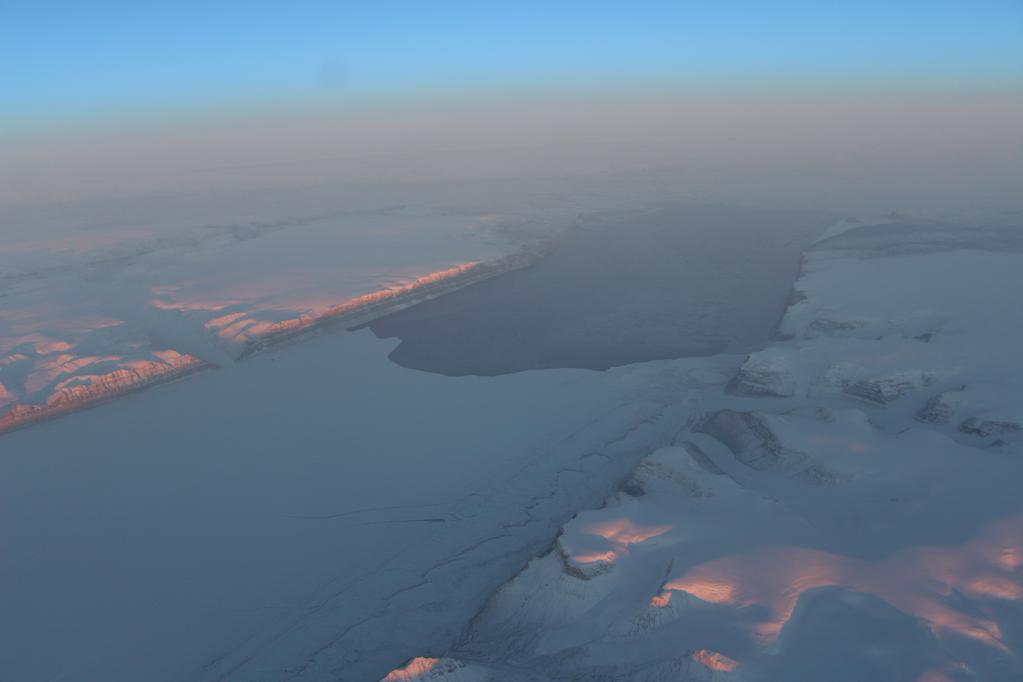
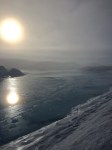
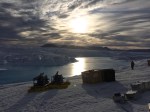
Petermann Gletscher at dawn on 5 Oct. 2015 as captured by NASA Operation IceBridge. Our Ocean Weather Station is in the corner bottom left.

Petermann Gletscher at dawn on 5 Oct. 2015 as captured by NASA Operation IceBridge. Our Ocean Weather Station is in the corner bottom left.

Without power the station does not function, because each sensor, each computer, and each telephone call via the Iridium satellite system requires electricity. Without power I am in the dark about what the station does or what ocean or air temperatures are. Since I do have power at the moment, well, I got new data. For example, there is a voltage that the station sends me …
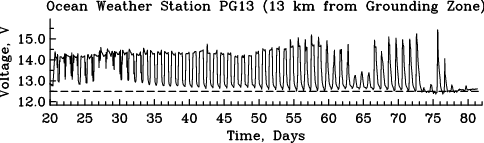
Voltage at Ocean Weather Station on Petermann Gletscher.

Voltage at Ocean Weather Station on Petermann Gletscher.

… whenever the sun is up, the solar panels recharge the battery and the voltage goes up. As I use electricity, the voltage goes down. Lets ignore a small temperature effect and details on how much electricity we draw at what “amperage.” Instead, lets focus on the regular up and down of voltage for the last 60 days and how it suddenly went flat. The flat line at 12.5 Volts tells me that the sun is down. The station now uses the car battery, but how long will this last? Quick answer is … a day, if I am dumb. Or 150 days, if I am smart. Time will tell, if I made a mistake in either my power budget or my computer code that gives and takes power to a range of sensors. Scary stuff, and my little sister Christina Parsons can attest, how nervous I was, when I uploaded new power-saving software that I wrote from my attic at home to the station in Greenland. The station did take the new software, restarted itself, and works making one data call each day instead of three. Data are still collected every hour, but I save 20% of total power.

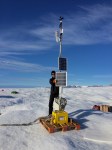
Power is something in Watts (40 W Light bulb anyone?) and you have to multiply voltage by current draw (0.5 Amps anyone?) to estimate the power needs of the device drawing 0.5 Amp current at 12 Volts. Incidentally, 0.5 Amps is what the Iridium satellite phone draws when it calls me with new data. Let me check my power budget, if this is true … nope, it only takes 0.365 Amps, so it takes 12 volts times 0.365 Amps equal 4.4 Watts which is about 1/10 of that 40 W light bulb you are looking at, perhaps, or the station we put up: the yellow box is the car battery powering all the gadgets you see and many more you do not:

What I just showed you is the beginning of a power budget that I had to make to get my station through the night, now that there is no more sun for the next 4-5 months. My car batteries are rated to give 110 Watts for an hour, so if I run my 4.4 W satellite phone all the time, I would be out of battery juice after 110 Watt-Hours divided by 4.4 Watts equals 25 hours. That’s bad, real bad, especially since one should not run a car battery to zero and the battery at -30 degrees Celsius may only give me half the power than it would at the more usual 15 degrees Celsius we got outside. The solution to this problem is to use the phone only for a few minutes each day, say 5 minutes. So, since I am using the phone only 5 minutes out of the 1440 minutes that each day has, it takes about 1440 minutes divided by 5 minutes times 25 hours equals 300 days for the phone running 5 minutes each day to run down the battery. Magic this math is not, but it shows how important it is to use resources (electricity) wisely. There are times and places where it is not possible to plug your iPhone into a power outlet. You get the picture … well, here are some that University of Delaware PhD student Peter Washam took who was part of the ice drilling team during last summer’s deployment of the ocean weather station:

So, as of this morning at 4 am Delaware time, the station now in total darkness tells me that the ocean temperatures 700 meters below the 100 meter thick glacier are +0.3 degrees Celsius while air temperatures 2 meters above the ice are -11.1 degrees Celsius. Now what that means to the melting of the glacier by the ocean, I will have to tell you at another time in more detail. These data are the ONLY data from below any glacier to the north of the equator. We are really breaking new ground and are making new discoveries as we go along … as long as there is power. Hopefully there is no dumb mistake in my power budget.
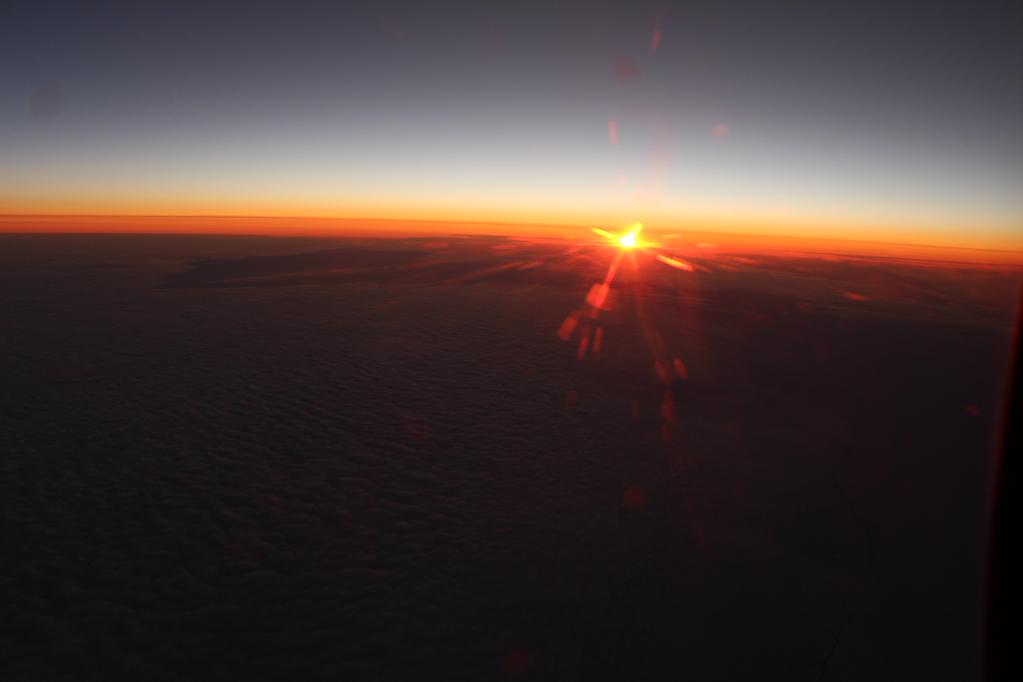
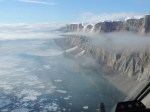
Sun over the horizon of Greenland as seen during NASA's Operation IceBridge Flight in October 2015.

Sun over the horizon of Greenland as seen during NASA’s Operation IceBridge Flight in October 2015.

New ocean data from floating Petermann Glacier

#UDel Ocean-Weather station #Greenland on #petermann2015 calls home from 800 m under floating glacier with 2 weeks of new hourly data.

University of Delaware Ocean-Weather station on Petermann Glacier with the hot-water drilling team UDel and British Antarctic Survey after deployment Aug.-20, 2015 [Credit: Peter Washam, UDel]

University of Delaware Ocean-Weather station on Petermann Glacier with the hot-water drilling team UDel and British Antarctic Survey after deployment Aug.-20, 2015. Cables from ocean sensors emerge from the ice where the wooden cross is located on the right. [Credit: Peter Washam, UDel]

Map of Greenland's Petermann Gletscher, Fjord, and adjacent Nares Strait. The UDel Ocean-Weather station is the green dot on the floating ice shelf that does not have a red triangle. Blue dots in the ocean are where we collected ocean data from I/B Oden in August 2015. Green dots are ocean moorings which report via Iridium while red triangles are "fancy" GPS locations we instrumented for 12 days to measure vertical tidal elevations of the glacier.

Map of Greenland’s Petermann Gletscher, Fjord, and adjacent Nares Strait. The UDel Ocean-Weather station is the green dot on the floating ice shelf that does not have a red triangle. Blue dots in the ocean are where we collected ocean data from I/B Oden in August 2015. Green dots are ocean moorings which report via Iridium while red triangles are “fancy” GPS locations we instrumented for 12 days to measure vertical tidal elevations of the glacier.

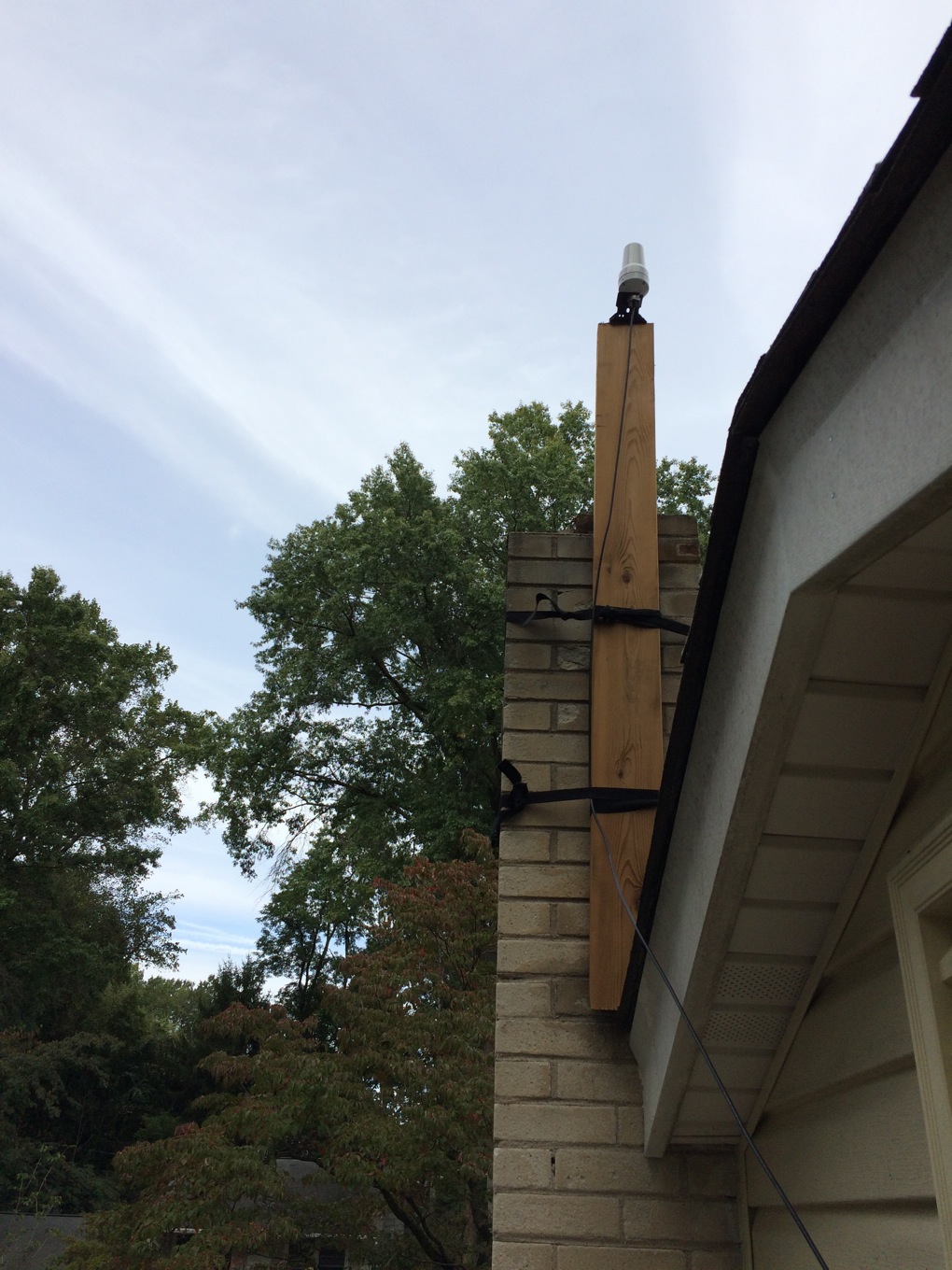
My nerves are shot and I get depressed when the Ocean-Weather station does not call home when she should. We deployed the station last months on the floating section of Petermann Gletscher where she has moved steadily towards the ocean at about three meters per day. We measure this with GPS which is the black dot next to the temperature sensor above the head of the team that drilled the hole. It connected 5 ocean temperature, salinity, and pressure sensors to 800 meter depth below sea level. The data come from this great depth to the surface where it feeds into the weather station that then transmits data via an Iridium antenna to another Iridium antenna that sits atop my house. Let me run out and take a quick photo of it …

Iridium antenna atop my house in Newark, Delaware that receives data calls from Greenland.

Iridium antenna atop my house in Newark, Delaware that receives data calls from Greenland.

My problem with Iridium over the last 6 weeks has been that its (data) connectivity is spotty. For example, I received no data the last 2 weeks. This has been the longest time with no call and no new data. Designing the system, I decided against the more robust “Short-Burst-Data” SBD text messages. Instead I opted for a truly 2-way serial connection which, if a connection is established, allows more control as well as a more complete and gap-free data stream. The drawback of this serial connection via Iridium is lack of connectivity. Sometimes days or weeks go by without a successful connection even though computer codes are written to connect every 8 hours. I can change that by uploading new codes to the two Campbell CT1000 data loggers that control all sensors as well as data collection and communication via Iridium.

Today’s call was the first in two weeks, but it provided a complete data download without ANY gaps in the hourly time series of weather in the atmosphere (wind, temperature, humidity) and weather in the ocean (temperature, salinity, pressure). The ocean data show that about every 2 weeks with the spring-neap cycles, we see very large excursions of colder and fresher water appear at 2 sensors within about 30 meters of the glacier ice. It is too early to speculate on how this may relate to ocean circulation and glacier melting, but the large and frequent up and down do suggest a lot of ocean weather.

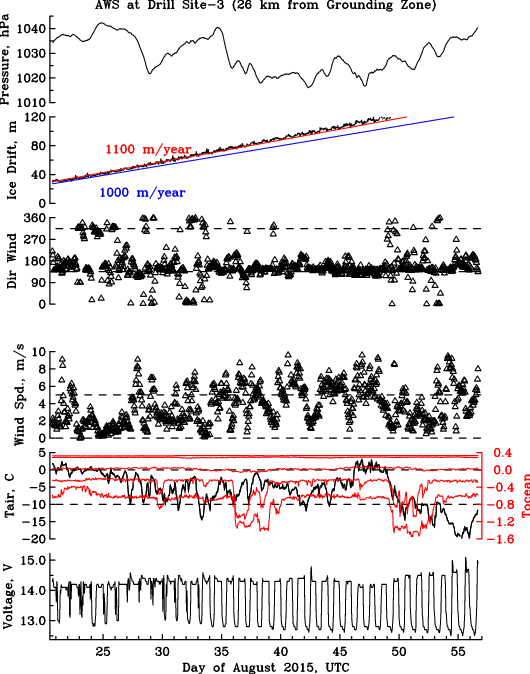
I am anxiously awaiting the next data call in about 5 hours to get the 8 hours of data. Wish me luck and a healthy Iridium satellite system where calls are about $0.90/minute. Today’s call took 5 minutes. This is what some of the (uncalibrated) data look like:

Ocean-Weather station data from Aug.-20 through Sept.-25 (today). Ocean temperatures at 5 vertical levels are shown as 5 red curves  in 5th panel from top. The black lines in that panel are air temperatures that reached -20 C this week.

Ocean-Weather station data from Aug.-20 through Sept.-25 (today). Ocean temperatures at 5 vertical levels are shown as 5 red curves in 5th panel from top. The black lines in that panel are air temperatures that reached -20 C this week.

Taking the Pulse of Petermann Gletscher

Posted by Pat Ryan for Andreas Muenchow

23-August-2015 at 80:57.3 N 061:27.1 W

(note correction below)

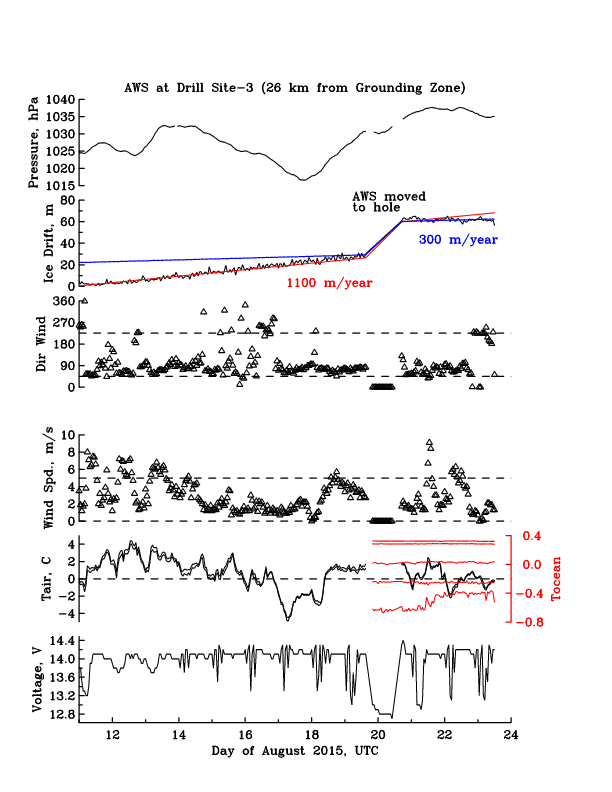
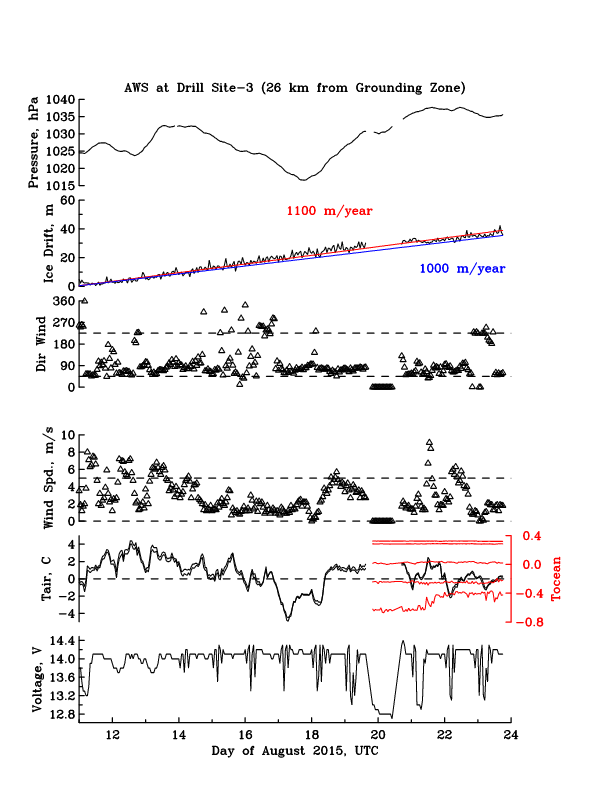
I just may have made a discovery that I cannot share with anyone on the ship right now. The giant mass of ice that is Petermann Gletscher just slowed down moving only 1 meter per day for the last 3 days rather than the 3 meters per day that it usually does and that has been reported in the scientific literature. This measurement comes from the newly deployed University of Delaware weather station that also contains a not-so-fancy $300 Garmin GPS as well as 5 ocean sensors that measure temperature and salinity about 95-m, 115-m, 300-m, 400-m, and 810-m below the surface of the floating and moving ice.

Time Series of Glacier Drift

Time Series of Glacier Drift (correction appears below)

As the glacier puts on the breaks, I also see a rather dramatic increase in ocean temperature from -0.6 to -0.35 degrees Celsius within about 10-m of the ice-ocean interface. The saltiness of the ocean also increased from below 34.1 to above 34.2 practical salinity units that you can think of as grams of salt per kilogram of water, roughly. Only 20 m below in the water column, the opposite is happening: The water there cools a little bit and becomes fresher. This suggests some mixing as the salinity differences become smaller and heat from the lower layer moves up towards the ice. Some force must be applied to the fluid to do this. Recall that a force is mass times acceleration. The force of a mosquito splashing on the wind shield of your car is small, because the mass of the mosquito is small even though its acceleration (from zero to the speed of your car) is large. Now imaging this glacier: Its mass is enormous, so you only need to change its velocity a tiny amount, from 3 to 1 meter per day, say, to generate a massive amount of force.

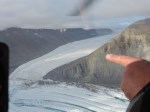
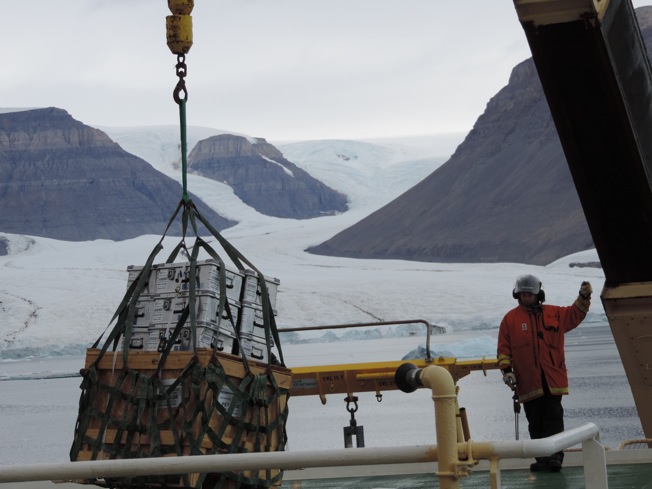
Photo of helicopter deck with Belgrave (left) and Petermann (right) Glaciers in back Aug.-23, 2015; view is to the north-east.

Photo of helicopter deck with Belgrave (left) and Petermann (right) Glaciers in back Aug.-23, 2015; view is to the north-east.

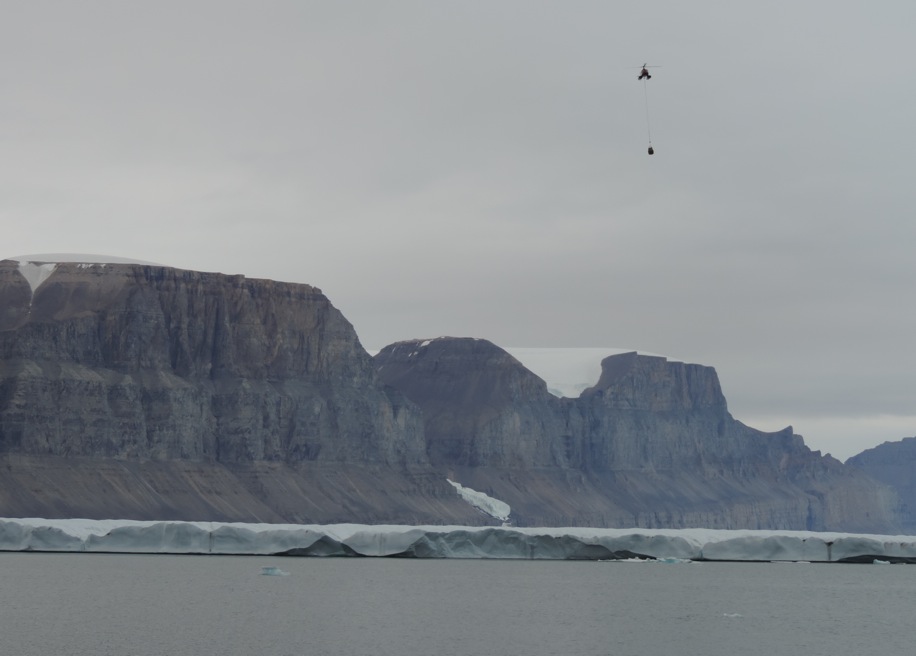
As I look outside my cabin window right now, I see the terminus of Petermann sitting there innocently not appearing to do much, but it is literally changing the face of the earth as it moves fast, slows down, moves some more, and over 1000s of years cut a very deep fjord and perhaps canyon deep into the mountains and even deeper into the sea floor. The helicopters are whizzing overhead right now returning all the gear that was needed to drill through 100s of meters of hard glacier ice to provide access holes to both ocean and sediments that has been in total darkness for many 100s of years.

Photo of helicopter delivering cargo from the finished ice camp back to the ship on 23 Aug. 2015.

Photo of helicopter delivering cargo from the finished ice camp back to the ship on 23 Aug. 2015.

Still, there is life down there, lots of it Anne Jennings, who closely looks at the sediment cores, tells me. We speculate that the life is supported by vigorous ocean flow that connects the open fjord with the glacier covered deep ocean. Food stuff like plankton may move some distance under the floating glacier to support a population of other critters that I know nothing about. No narwhals this year so far, though.

So why I am writing this up here rather than share it with people on the ship? Well, this is Sunday morning and there was much to celebrate last night when the ice drilling team returned after 2 weeks camping on the ice and collecting data from their three drill holes. Furthermore, the the ocean weather station reported for the first time in over 2 days uploading all the data I show above. This happened well past midnight and several of us discussed the data and future plans in the cafeteria until 1:30 am. So the people not working right now are all sleeping (10:30 am here) as we probably will work through the night to map the Atlantic waters flowing into the fjord at its sill towards Nares Strait …  which we have not yet done over the 3 weeks we have been in the area. I probably also should help with unloading the helicopters or getting the Chief Scientist Alan the data files he needs to catalogue the water samples we collected last night. Work on Oden never stops … as there is so much to do as we are barely scratching the surface or bottom of the ocean here. [Incoming helicopter, 4th one since I wrote these lines too fast, perhaps.]

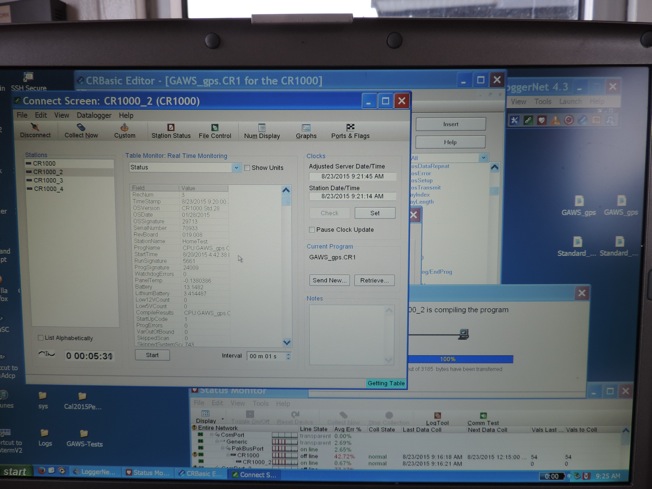
Screenshot of a successful RS-232 serial connection from ship to ocean weather station on Petermann Gletscher and ocean sensors deployed 810 m below the glacier’s ice surface with active real time data transmissions. This session uploaded new codes to the secondary data logger to activates its secondary back-up memory.

Screenshot of a successful RS-232 serial connection from ship to ocean weather station on Petermann Gletscher and ocean sensors deployed 810 m below the glacier’s ice surface with active real time data transmissions. This session uploaded new codes to the secondary data logger to activates its secondary back-up memory.

Correction:

Petermann Gletscher did slow down the last few days by about 10% as measured by the GPS at the UDel ocean-weather station. The suggested slow-down to 300 meters per year, however, is false, because I did not properly take into account how the station was moved by 30 meters to the south-west. The correct and updated estimate is the figure below. Please discard the the above figure erroneous.

Sorry for the confusion … more data coming from this station will place the short term change in glacier speeds into a larger context. Furthermore, the present “cheap” GPS system will need to be verified by a set of three “fancy” differential UNAVCO GPS that were recovered today, but we have not yet decoded the data contained on those units.

Back to CTD profiling the water properties across the sill at the entrance to Petermann Fjord that we will have to complete by 3 am or in about 6 hours.

Time Series of Glacier Drift (Corrected)

Time Series of Glacier Drift (Corrected)