Author Archives: Andreas Muenchow

New Ice Island Forming at Pine Island Glacier, Antarctica

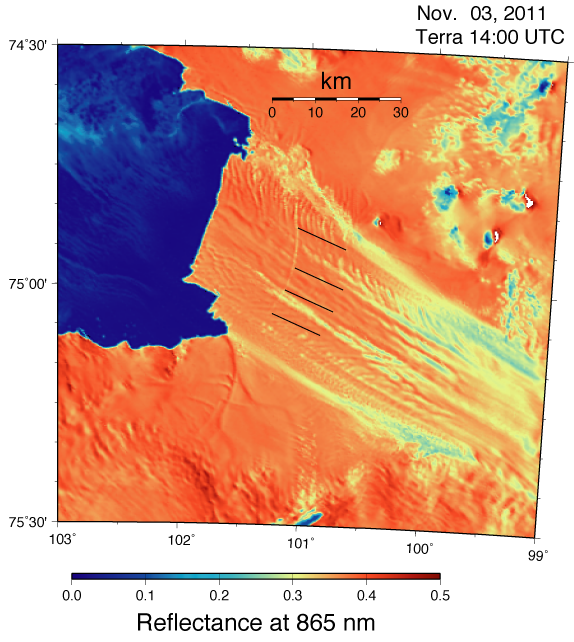
A new ice island is about to form as spring and summer arrive in Antarctica. NASA researchers working on Pine Island Glacier (PIG) as part of the IceBridge Mission discovered a 30 km wide rift some 25 km from the ocean during overflights in a DC-8 research aircraft.The rift will eventually will break off into a tabular iceberg about 10 times the size of Manhattan. The rift is wide enough to be visible in optical satellite imagery that has a spatial resolution of 250 meters. A BBC report credits NASA scientist stating that this large calving of an ice island is part of a natural, roughly decadal cycle.

Pine Island Glacier from MODIS/Terra with crack visible at 250-m spatial resolution.

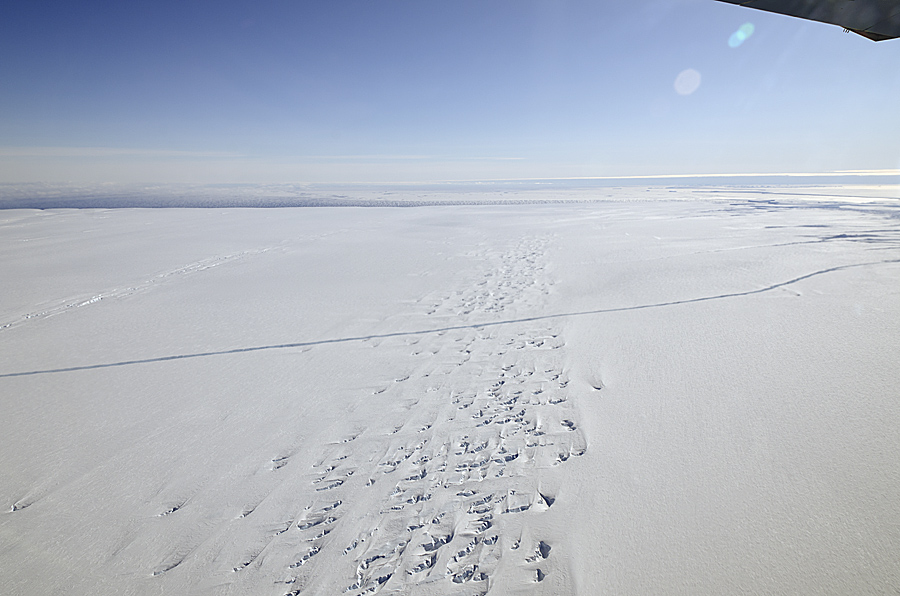
A crack runs across the floating ice shelf of Pine Island Glacier in Antarctica, seen from NASA's DC-8 on Oct. 14, 2011. Credit: Michael Studinger/NASA

Antarctic massive ice sheets contain 70% of all freshwater and 90% of all ice on earth. Most of this is contained within the stable East Antarctic ice sheet where temperatures have increased little. In contrast, the West Antarctic ice sheet has seen warming by about 0.2 degrees Celsius and a net loss of ice to raise global sea level by perhaps 2-3 inches in 100 years. The grounding line Pine Island Glacier (where ocean, bedrock, and ice meet) has retreated for several decades as warmer ocean waters near the bottom cross a sill and plunge into a landward depression of the bedrock. This leads to enhanced melting of the floating ice-sheet and a potential instability that could lead to a collapse of the ice-shelf and much enhanced discharge of the Pine Island Glacier to draw down a large fraction of the West Antarctic Ice Sheet.

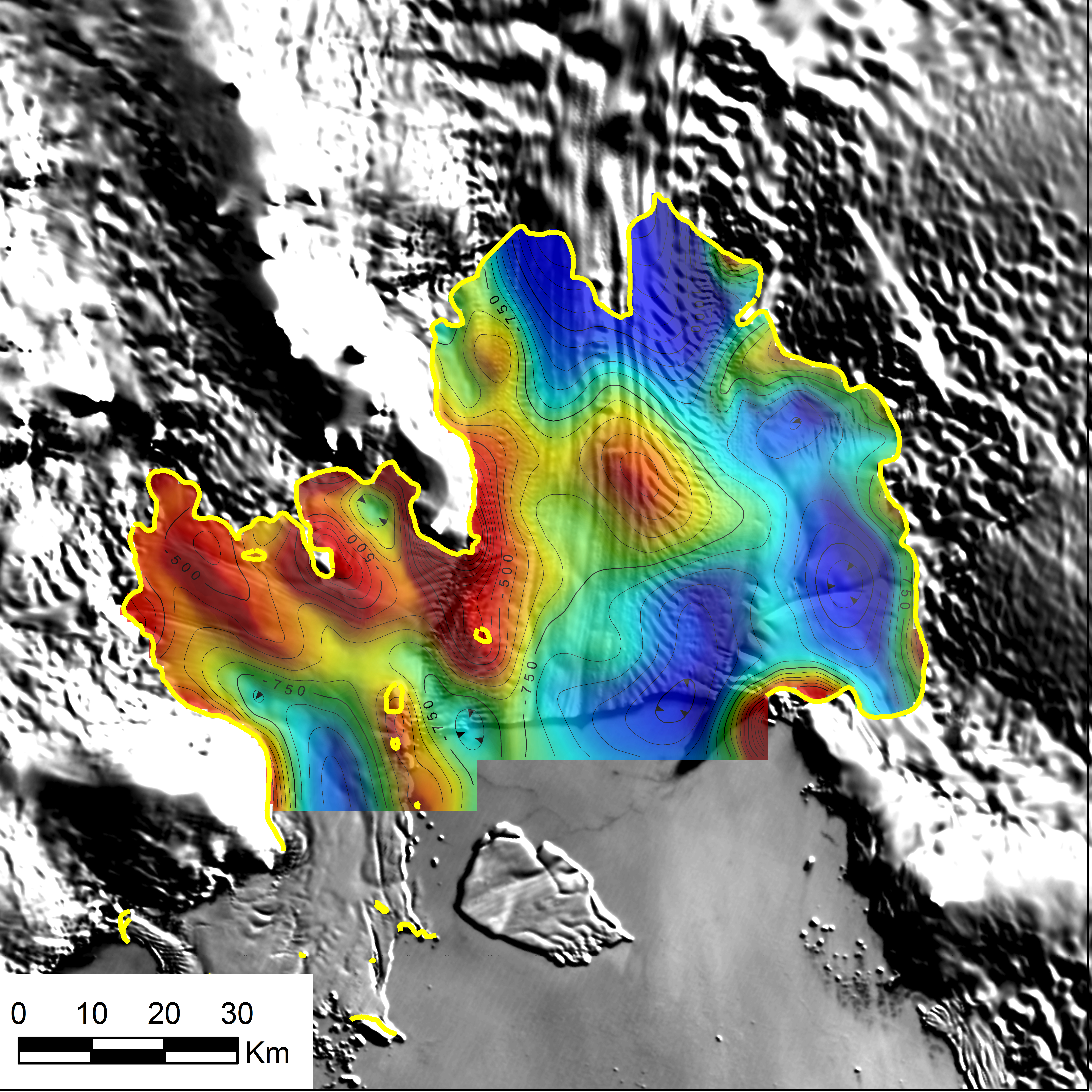
Bottom topography under Pine Island Glacier and grounding line. Blue colors show greater depths and its connection to the open ocean (bottom, north). (credit: NASA)

A similar physical process, albeit at a smaller scale, is potentially working at Petermann Glacier off Greenland where the grounding line is at a local maximum of bedrock elevation. Petermann’s grounding line has probably not moved substantially the last 100 years or so.

More detail on the evolving Pine Island Glacier, Antarctica event can be found at a NASA media briefing.

Global Warming, Signal to Noise, and the History of Doubt

A smart graduate student in our Physical Ocean Science and Engineering program (lets call him/her XXXX) sent me an e-mail yesterday night

Hi Andreas,

I stumbled upon this article tonight and thought you might find it interesting: http://www.climatedepot.com/a/12797/Exclusive-Nobel-PrizeWinning-Physicist-Who-Endorsed-Obama-Dissents-Resigns-from-American-Physical-Society-Over-Groups-Promotion-of-ManMade-Global-Warming

XXXX

I have been reading a lot on this very subject the last weeks and find that the intersection of science, policy, communication, politics, and history a fascinating area of new learning. My response to XXX was thus

XXXX:

This is sad, but neither news nor particular interesting. Dr. Giaever received his Nobel prize in physics for work he did on semi-conductors over 50 years ago. Based on his statements on religion, I am pretty sure, that he has not kept up with the modern peer-reviewed literature on statistics, climate dynamics, or any geophysical field.

He may have missed (or willfully ignored?) work such as Santer et al. (2011): “Separating Signal and Noise in Atmospheric Temperature Changes: The Importance of Timescale” to appear in JGR later this year. I placed a copy of the paper (in press) at

http://muenchow.cms.udel.edu/classes/MAST811/Santer2011.pdf

as it is hard to find right now, even though it is causing a storm in the blogosphere.

If you want to follow critical, skeptical, and credible discussions on climate and its variability (and perhaps the above paper) of actually active atmospheric scientists that fall neither into an “alarmist” nor a “denying” camp, then you may find Dr. Judith Curry’s (University of Georgia)

http://judithcurry.com/2011/09/12/santer-on-timescales-of-temperature-trends/

or Dr. Roger Pielke, Sr. (Colorado State University)

http://pielkeclimatesci.wordpress.com/2011/09/07/comments-on-the-new-paper-separating-signal-and-noise-in-atmospheric-temperature-changes-the-importance-of-timescale-by-santer-et-al-2011/

If you are interested in the historical and political content of this pseudo-debate, you may find Oreskes and Conway (2010) book entitled “Merchants of Doubt: How a Handful of Scientists Obscured the Truth on Issues from Tobacco Smoke to Global Warming” at

http://www.amazon.com/Merchants-Doubt-Handful-Scientists-Obscured/dp/1596916109

I read the book over the weekend and could not put it down. Dr. Santer is an atmospheric scientist working at Los Alamos National Laboratory and has been a lead-author of the IPCC since 1995 while Dr. Oreskes is a science historian working and teaching at UCSD/Scripps.

andreas

Ocean Warming off Greenland near Petermann Glacier

Testifying before the Select Committee on Energy Independence and Global Warming last year, I fumbled one question asked by the Honorable Chairman Edward J. Markey (D-MA): “Is it warming in the Petermann Glacier area?” I was unsure how the regionally relevant ocean temperatures had changed and how it impacts the melting glacier. A year late, we got the answer.

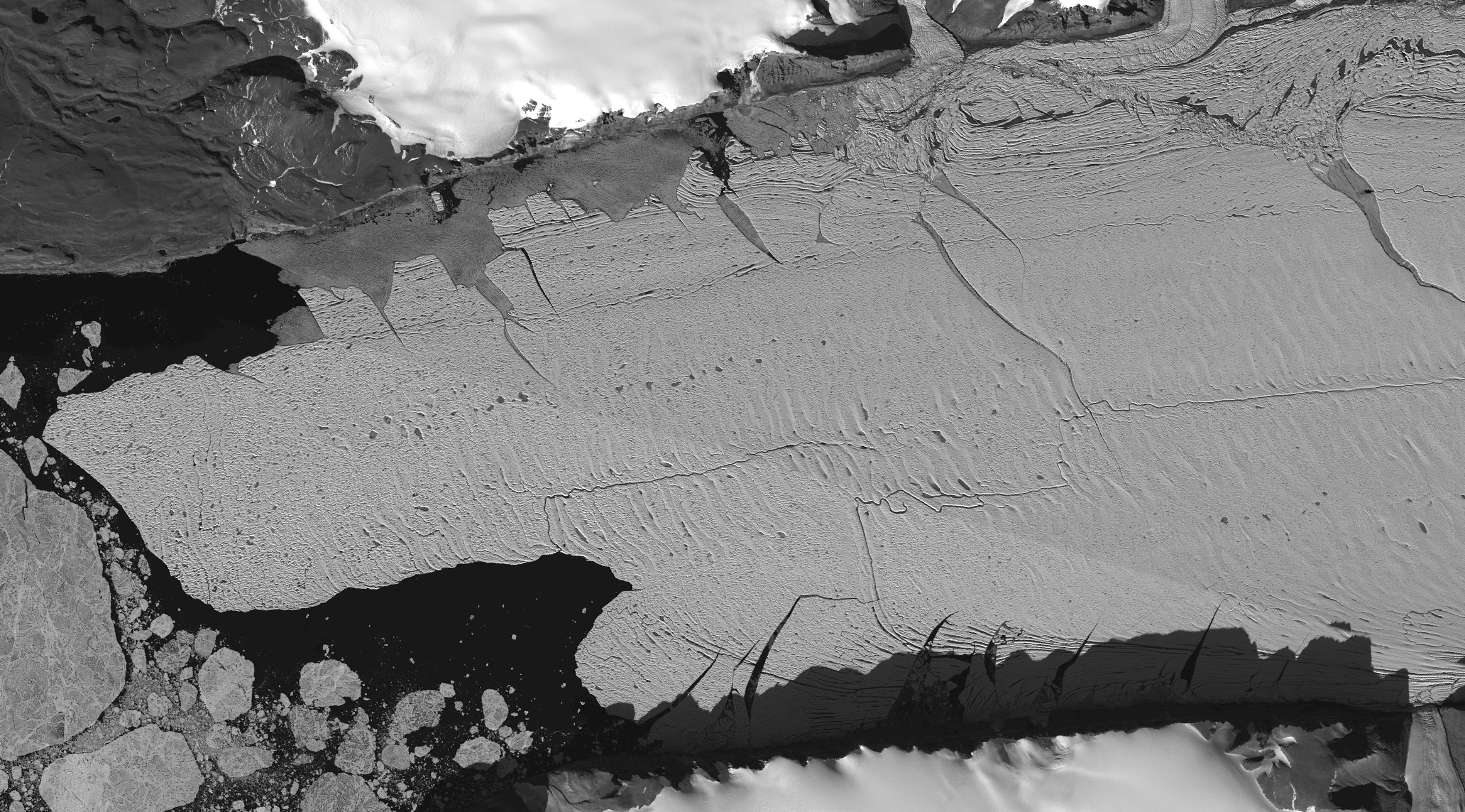
Floating ice shelf of Petermann Glacier on July 22, 2010 (NASA).

I was thinking of my former student Ms. Zweng. Three years earlier she had published a thorough analysis of ocean temperatures in Baffin Bay, that showed statistically significant warming by 0.11 +/- 0.06 degrees centigrade per decade for the 1916 through 2003 period (Zweng and Muenchow, 2006). But Baffin Bay is more than 800 miles away and it is not clear if those waters actually can make it to Petermann Fjord. I was also thinking of data in hand from only 80 miles away in Nares Strait whose waters definitely make it into Petermann, but I had not yet done the analyzes and thus did not know what the data would tell me. Now I do, and the peer-reviewed results (Muenchow et al., 2011) were published last week in Oceanography.

Time series of temperature (bottom) salinity (top) from the bottom of the ocean in Nares Strait between northern Greenland and Canada (from Muenchow et al, 2011). Trends are indicated for the 2003-06 and 2007-09 periods.

The data come from thermometers taking readings for years every 15 minutes. We placed the instruments on the bottom of the 300 meter deep ocean in 2003, recovered them in 2006, threw them back into the ocean in 2007 and found them again in 2009. We got data from three such instruments in 2003-06 and five in 2007-09 that all pretty much show the same thing: Bottom temperature change little during the 2003-06 period and about 0.06 +/- 0.02 degrees centigrade per year during the 2007-09 period of oberservations. Putting this together, we find a warming of 0.023 +/- 0.015 degrees centigrade per year. Next question would be, does this observed ocean warming in Nares Strait matter with regard to Petermann Glacier?

My current answer is a strong no. First, there is so much ocean heat already inside Petermann Fjord to melt away the entire floating section of the glacier (Johnson et al., 2011), that the extra ocean warming in recent years makes little difference. Second, the trends are from very short data sets that are dominated by physics unrelated to warming or could relate to a sequence of a few strong events that could either relate to man-made global warming or natural fluctuation at longer decadal cycles. This detection of signals in noise is a common problem in both engineering and geophysics, it is a required class for all our graduate students.

Very closely related is a paper entitled “Separating Signal and Noise in Atmospheric Temperature Changes: The Importance of Timescale” by Santer et al. (2011). Elegantly and comprehensively the authors expose and quantify the challenges one faces trying to extract the man-made warming signal from globally averaged near surface air temperature records sensed both from satellites and simulated in a number of numerical models. For this variable, the authors conclude convincingly, one needs records between 15-20 years long to extract a statistically significant man-made global warming signal from the much larger noise of natural variability.

So, if I had done my homework better last year, this should have been my answer to the question if it is warming in the Petermann Glacier area: “Yes, both the ocean and the atmosphere are warming in the Petermann region, but this may have little or no impact on the changing Petermann Glacier. Today we do not even know why Petermann Glacier has a floating ice shelf. Since we do not yet understand the physics of ice-ocean interactions, we can neither know nor predict what changes it has in store for us.”

Why Petermann Glacier and Fjord?

The National Science Foundation (NSF) declined to fund a Physical-Ocean-Ice-Shelf-Experiment (POISE) at Petermann Fjord in northern Greenland this year. The reviews by three anonymous peers, a panel of eight scientists, and two sympathetic program managers were all very good, but not without criticism.

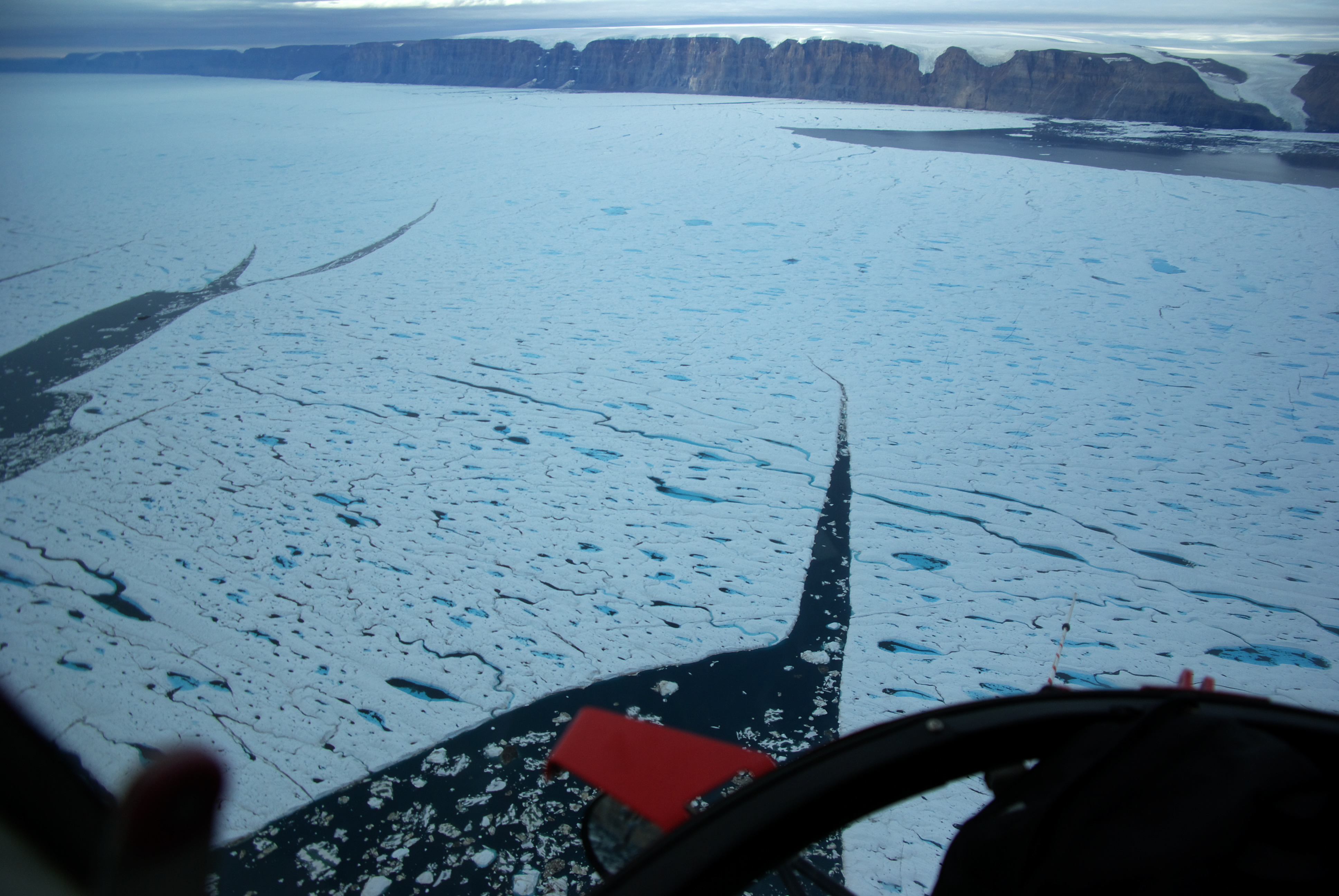
Floating ice shelf of Petermann Glacier in August 2009 as seen from a helicopter of the Canadian Coast Guard Ship Henry Larsen. View is to the south-east with the glacier to the left and the ocean to the right. Photo by David Riedel, British Columbia.

Our admittedly expensive 4-year proposal was rejected along with at least five competing proposals in the same general subject area, because we did not show why a study of ice-ocean interaction of glaciers and ice-sheets has to take place at Petermann Glacier, a remote location less than 800 miles from the North Pole. Claiming this glacier to be unique, we made a fatal mistake, because NSF cares little about each glacier, but cares much about the underlying physical problem, that is, how do tidewater glaciers with floating ice shelves interact with the ocean they float on.

There are several glaciers in Greenland that have extensive ice shelves. To the best of my knowledge, they are all in northern Greenland. Nioghalvfjerdsfjorden and Petermann Fjord contain the largest floating areas exposed to the oceans on the east and west coasts of Greenland, respectively. Both these glaciers have seen preliminary studies during the last 15 years including radar measurements that describe the geometry of the ice shelves, the bedrock below, as well as the ice streams to connect the glaciers to the inland ice. Smaller and less studied glaciers with past or present ice shelves are Steensby, Ryder, and C.F. Ostenfeldt in the north-west as well as Academy and Marie-Sophie glaciers in the north-east (Weidick, 1995).

The most extensive ice shelves are located around Antarctica, however, and one thus may wonder, what uniform physics can and should be studied in northern Greenland that also applies to the ice sheets in the south? I would need some scaling law or normalization scheme that connects many glaciers into an organizational scheme. In physical oceanography the near-balance of a density-driven (internal) pressure gradient and the effects of a rotating earth provides a dynamical scale that connects river discharges off Delaware, with ice patterns off Eastern Greenland, and algae bloom patters off northern Norway, among many other phenomena. What dynamical metric connects the ice sheets of Greenland to each other and to those off Antarctica?

Swirling Ice in Coastal Waters off Eastern Greenland

Nature provides us with art that is always changing in time and space. Delicate swirls and vortices give a rare glimpse of how the ocean’s surface looked today off eastern Greenland. The data originate from the MODIS/Terra satellite which from 440 miles above the earth captures light that is reflected from anything below. Here it shows the ice-free ocean (bottom right) and Greenland’s ice-free Scoresby Sound (bottom left) in very dark blues, lightly vegetated lands (left) in light blue, and a highly organized pattern of sea ice (top right) in white. The resolution of this image of light just beyond the visible, just beyond the red is about 300 yards and the swirls and elongated filaments are about 3-5 miles. To me, they vividly show the ocean’s surface circulation.

Swirling surface motion on the continental shelf off eastern Greenland Sept.-12, 2011 as indicated by sea ice. Black lines show contours of bottom depth from 300 to 1200 meters in 300 meter increments.

The physics of these motions are similar to those I was reading into another beautiful work of art to the north of Norway. The postulated physics involve the earth’s rotation as well as differences in density. The density of the ocean relates to its temperature a little and to its salinity a lot. Near the coast and at the surface, ocean waters are much fresher and thus lighter than they are offshore and at depth, because Greenland’s melting glaciers and sea ice are fresher than the waters of the Atlantic Ocean. The thin black lines show bottom depths to distinguish the deep Atlantic Ocean to the right in the image from the shallow continental shelf off eastern Greenland to the left in the image. Note that all the swirls, eddies, and filaments are within 30 kilometers (20 miles) off the coast in water less than 300-m deep. The same physics apply to the algal blooms off Norway which is the reason that the swirls and eddies are of similar size here and there as well.

Incidentally, the same physics also apply the discharges from rivers and estuaries such as the Delaware or Cheasapeake Bay. There, the pattern are not quiet as visible to the naked (satellite) eye as off Norway or Greenland, but if one takes measurements of the ocean, similar patterns of ocean salinity and velocity as, I speculate, they do here for the ice (Greenland) and algae blooms (Norway). While my academic journey of fresh water discharges started with the discharge of the Delaware River into the Atlantic almost 25 years ago, I am still fascinated by the many ways these patterns always come back to me. Physics and oceanography are beautiful in both their many natural manifestations and its unique balance of forces. There is so much more in how the oceans interact with the ice and glaciers off Greenland and elsewhere. To be continued …