Polar bears are endangered and need protection. They hunt and eat meat to survive. Seals are such meat as are scientists walking and working on the sea ice. I am planing an experiment in polar bear habitat. Do I need a gun to protect myself and my students working with me? About 10 people told me “YES” last week, all with experience working in polar bear habitat. Who am I to say no? Encounters between bears and people happen, but only rarely. None of the 10 people advising me to carry a shotgun or rifle ever discharged their weapon or had a bear encounter.
![Polar bear as seen in Kennedy Channel on Aug.-12, 2012. [Photo Credit: Kirk McNeil, Labrador from aboard the Canadian Coast Guard Ship Henry Larsen]](https://icyseas.org/wp-content/uploads/2012/08/polarbear-kirkmcneil_0418.jpg?w=500&h=281)
Polar bear as seen in Kennedy Channel on Aug.-12, 2012. [Photo Credit: Kirk McNeil, Labrador from aboard the Canadian Coast Guard Ship Henry Larsen]
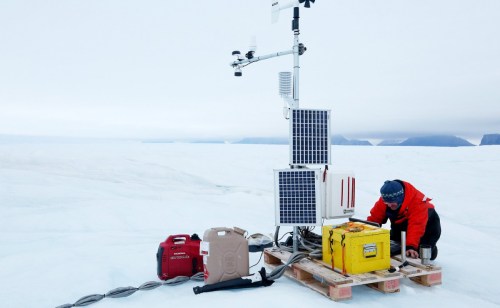
In 3 month’s time I hope to do ~20 day trips from Thule Air Base near Pituffik, Greenland to explore the oceanography and acoustics of the local fjord covered by sea ice. The US National Science Foundation supports this work, maintains a dormitory where we sleep, and provides us with two snowmobiles. We will use these motorcycles on skies to reach science stations on the ice covering Wolstenholme Fjord. We will drill 10” holes through 3-5 feet of sea ice, set-up an electric winch connected to a small generator, and probe the ocean’s temperature, salinity, bottom depth, and ice thickness to prepare for a quiet acoustic communication system to move data under water from the outer fjord to the pier at Thule and the internet.
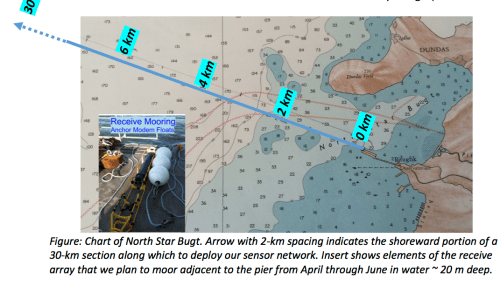
Leading this science effort, I will have to estimate and manage potential risks which include encounters with polar bears. I will have to decide how much money to allocate to each risk that then may not be available for other activities such as to support students, buy better sensors, or return in the summer. The first and almost always best response is to hire a local hunter who knows the area along with its bears, ice, and weather. There are about 600 people living in Qaanaaq about 100 miles to the north. Most of them are children and grand-children who were forcibly removed from Pituffik in 1952 when more than 13,000 Americans built a large air field during the height of the Cold War. The local llanguage spoken in remote Qaanaaq is the Inuktitut dialect of north-west Greenland, the first foreign language learnt in school is Danish, and English is not widely spoken, however, Qaanaaq has two non-Inuit villagers who originate from Denmark and Japan.
Relations between Qaanaaq and Thule Air Base are complex and sensitive with regard to politics and finances. One of many perspective is that of Kim Petersen who writes in Dissident Voice about “The Struggle against Colonialism and Imperialism in Kalaallit Nunaat.” Kalaallit Nunaat refers to Greenland in the local language. While the forced removal of native populations from Pituffik to Qaanaaq in 1952 and the crash of a nuclear armed B-52 bomber into Wolstenholme Fjord in 1968 are not in dispute, the political arguments presented seem to me rather narrow, one-dimensional, and rooted in a tired ideological Left-Wing mode of conspiracy-thinking. Does this perspective represent the community of Qaanaaq? Perhaps I need to ask someone who may know:
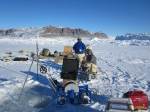
![Working on the sea ice off northern Greenland [Photo credit, Steffen Olsen]](https://icyseas.org/wp-content/uploads/2016/12/image002.jpg?w=500&h=375)
Working on the sea ice off northern Greenland [Photo credit, Steffen Olsen]
It is not straight-forward to bring a gun to Greenland as it requires a large amount of paper work. Another layer of regulations relates to bringing a gun to an US military installation. Shooting a polar bear is a burocratic and political nightmare, because strict quotas exist for the “taking” of polar bears. International complications include Canada, because the quotas are assigned to Canadian and Greenlandic hunters from the same bear population. It is a sensitive topic in many dimensions, a riddle for which I have no solution.
How much time do I spent to prepare for an unlikely event such as a fatal polar bear encounter? Could I not argue with ethics that were instilled into me when hiking in the back-country of Denali National Park (no guns there). Park rangers then told me that I enter bear habitat and should do so respectfully with minimal impact. They gave me useful pointers on how to lower contact and I saw no bears hiking for 4 days alone without a gun, but grizzlies eat berries while polar bears do not.
So, should I carry a gun, if I am not ready to kill a bear while working in bear country? I can accept the consequences of injury and death for myself, however, I cannot do so for those who are with me. Perhaps this then is a path to a solution: Discuss this with all who will be with me on the ice.

![Polar bear as seen in Kennedy Channel on Aug.-12, 2012. [Photo Credit: Kirk McNeil, Labrador from aboard the Canadian Coast Guard Ship Henry Larsen]](https://icyseas.org/wp-content/uploads/2012/08/polarbear-kirkmcneil_0418.jpg)
![Working on the sea ice off northern Greenland [Photo credit, Steffen Olsen]](https://icyseas.org/wp-content/uploads/2016/12/image002.jpg)

 Icy Seas