Monthly Archives: March 2016

The Ice Shelf of Petermann Gletscher, North Greenland and its ocean below: Introductions

“In 1921 owing to starvation I had to go directly from Cape Heiberg-Juergensen to our cache at Cape Agassiz … during this journey the greater part of the glacier was mapped.” — Lauge Koch, 1928

Traveling by dog sled, Geologist Lauge Koch mapped Petermann Gletscher in 1921 after he and three Inuit companions crossed it on a journey to explore northern North Greenland. They discovered and named Steensby, Ryder, and H.C. Ostenfeld Glaciers that all had floating ice shelves as does Petermann (Ahnert, 1963; Higgins, 1990). In Figure 1 I reproduce the historic map of Koch (1928) that also contains his track in in 1917 and 1921 both across the terminus and across its upstream ice stream. In 1921 all four starved travelers returned safely after living off the land. Four years earlier, however, they were not so lucky: two traveling companions died on a similar journey in 1917 (Rasmussen, 1923).
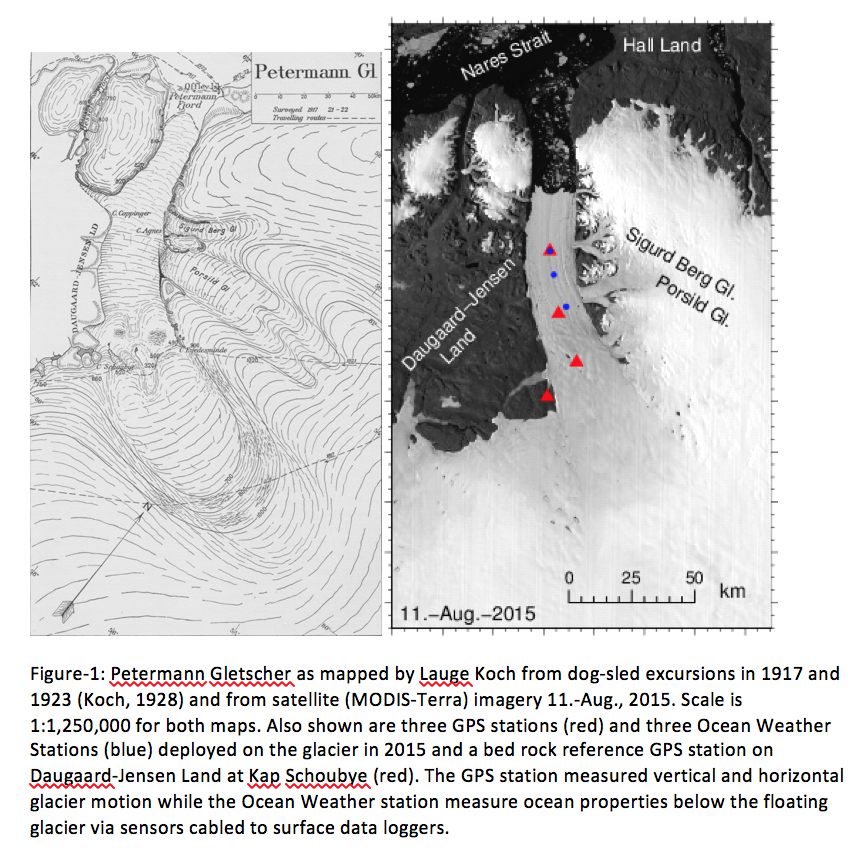
Maps of Petermann Gletscher by Lauge Koch from 1917 and 1921 dog sleds and 2015 from MODIS-Terra.

Only 20 years after Lauge Koch’s expeditions by dog sled, air planes and radar arrived in North Greenland with the onset of the Cold War. The Arctic Ocean to the north became a battle space along with its bordering land and ice masses of northern Greenland, Ellesmere Island, Canada, Alaska, and Siberia. Weather stations were established in 1947 at Eureka by aircraft and in 1950 at Alert by US icebreaker to support military aviation (Johnson, 1990). In 1951 more than 12,000 US military men and women descended on a small trading post called Thule that Knud Rasmussen and Peter Freuchen had established 40 years earlier to support their own and Lauge Koch’s dog-sled expeditions across Greenland (Freuchen, 1935). “Operation Blue Jay” built Thule Air Force Base as a forward station for fighter jets, nuclear armed bombers, and early warning radar systems. The radars were to detect ballistic missiles crossing the Arctic Ocean from Eurasia to North America while bombers were to retaliate in case of a nuclear attack from the Soviet Union.

An F-102 jet of the 332d Fighter-Interceptor Squadron at Thule AFB in 1960. [Credit: United States Air Force]

An F-102 jet of the 332d Fighter-Interceptor Squadron at Thule AFB in 1960. [Credit: United States Air Force]

About another 60 years later, the jets, the bombers, and the communist threat were all gone, but the Thule Air Force Base is still there as the gateway to North Greenland. It is also the only deep water port within a 1,000 mile radius where US, Canadian, Danish, and Swedish ships all stop to receive and discharge their crews and scientists. Since 2009 Thule AFB also serves as the northern base for annual Operation IceBridge flights over North Greenland to map the changing ice sheets and glaciers.

The establishment of military weather stations and airfields in the high Arctic coincided with the discovery of massive ice islands drifting freely in the Arctic Ocean. On Aug.-14, 1946 airmen of the 46th Strategic Reconnaissance Squadron of the US Air Force discovered a moving ice islands with an area of about 200 square that was kept secret until Nov.-1950 (Koenig et al, 1950). Most of these ice islands originated from rapidly disintegrating ice shelves to the north of Ellesmere island (Jeffries, 1992; Copland 2007), however, the first historical description of an ice islands from Petermann Gletscher came from Franz Boas in 1883 who established a German station in Cumberland Sound at 65 N latitude and 65 W longitude as part of the first Polar Year.

Petermann Ice Island of 2012 at the entrance of Petermann Fjord. The view is to the north-west with Ellesmere Island, Canada in the background. [Photo Credit: Jonathan Poole, CCGS Henry Larsen]

Petermann Ice Island of 2012 at the entrance of Petermann Fjord. The view is to the north-west with Ellesmere Island, Canada in the background. [Photo Credit: Jonathan Poole, CCGS Henry Larsen]

Without knowing the source of the massive tabular iceberg the German physicist Franz Boas reported detailed measurements of ice thickness, extend, and undulating surface features of an ice island in Cumberland Sound that all match scales and characteristics of Petermann Gletscher (Boas, 1885). These characteristics were first described by Dr. Richard Croppinger, surgeon of a British Naval expedition in 1874/75 (Nares, 1876). Dr. Croppinger identified the terminus of Petermann Gletscher as a floating ice shelf when he noticed vertical tidal motions of the glacier from sextant measurements a fixed point (Nares, 1876). His observations on tides were the last until a group of us deployed 3 fancy GPS units on the glacier last summer.

These fancy GPS receivers give centimeter accuracy vertical motions at 30 second intervals. Here is what the deployment of 3 such units in August of 2015 gives me:
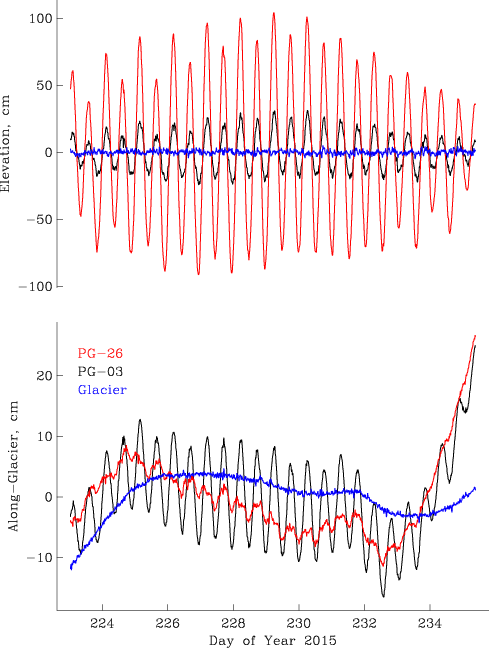
Vertical (top) and horizontal (bottom) motion of Petermann Gletscher from GPS referenced to a GPS base station on bed rock at Kap Schoubye. Note the attenuation of the tide from 26 km sea ward of the grounding line (red) to at the grounding line (black) and 15 km landward of the grounding line (blue). The horizontal location motion has the mean motion removed to emphasize short-term change over the much, much larger forward motion of the glacier that varies from about ~700 (black) to ~1250 meters per year (red).

Vertical (top) and horizontal (bottom) motion of Petermann Gletscher from GPS referenced to a GPS base station on bed rock at Kap Schoubye. Note the attenuation of the tide from 26 km sea ward of the grounding line (red) to at the grounding line (black) and 15 km landward of the grounding line (blue). The horizontal location motion has the mean motion removed to emphasize short-term change over the much, much larger forward motion of the glacier that varies from about ~700 (black) to ~1250 meters per year (red).

We have indeed come a far way during the last 150 years or so. Mapping of remote landscape and icescape by starvation and dog-sled has been replaced by daily satellite imagery. Navigation by sextant and a mechanical clock has been replaced by GPS and atomic clock whose errors are further reduced by a local reference GPS. These fancy units and advanced data processing allow me to tell the vertical difference between the top of my iPhone sitting on a table in my garden from the table.
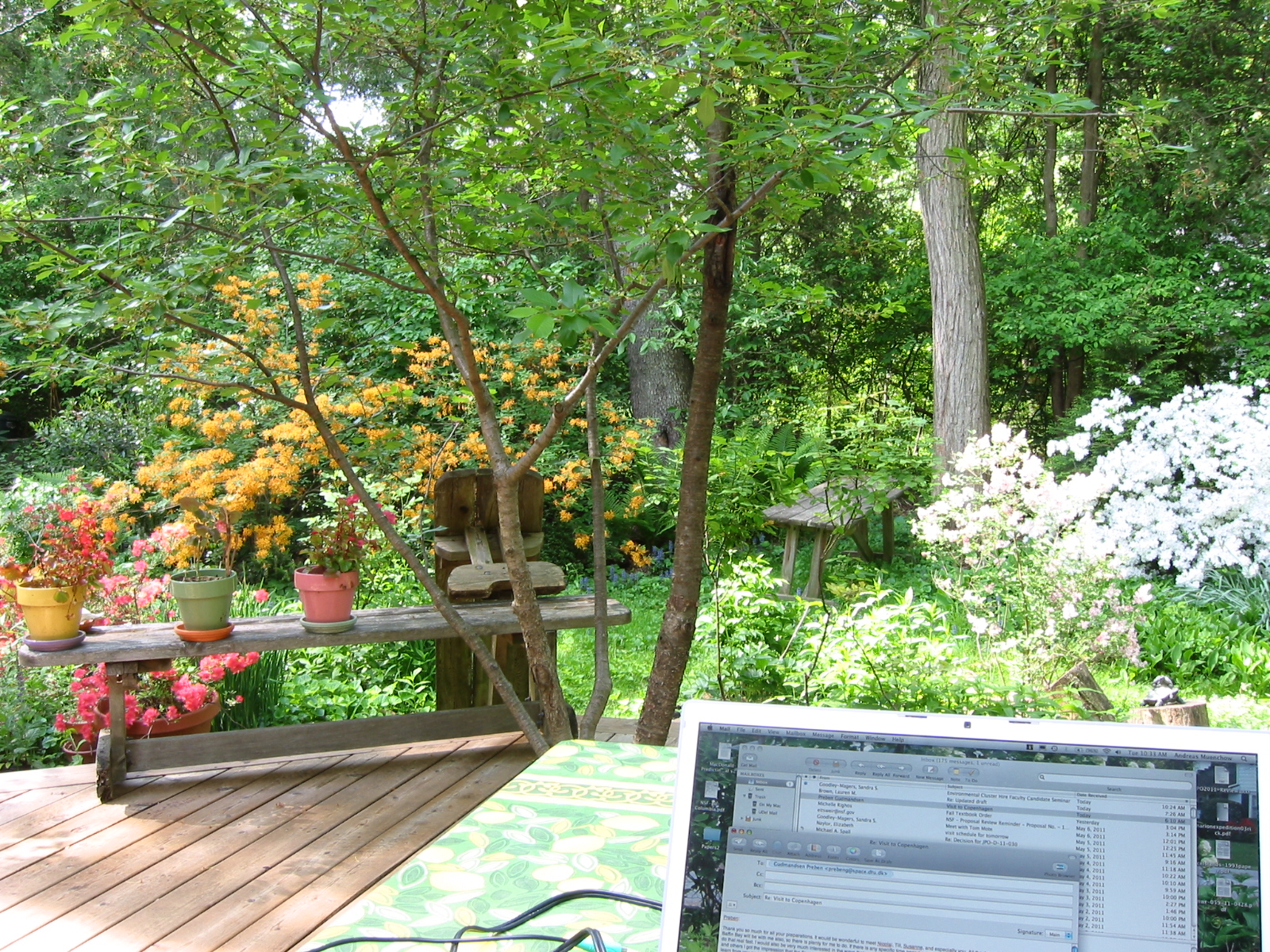
Working at in the garden at home preparing for field work.

Working at in the garden at home preparing for field work near Petermann Fjord.

P.S.: This is the first in a series of essays that I am currently developing into a peer-reviewed submission to the Oceanography Magazine of the Oceanography Society. The work is funded by NASA and NSF with grants to the University of Delaware.

Ahnert, F. 1963. The terminal disintegration of Steensby Gletscher, North Greenland. Journal of Glaciology 4 (35): 537-545.

Boas, F. 1885. Baffin-Land, geographische Ergebnisse einer in den Jahren 1883 und 1884 ausgeführten Forschungsreise. Petermann’s Mitteilungen Ergänzungsheft 80: 1-100.

Copland, L., D.R. Mueller, and L. Weir. 2007. Rapid loss of the Ayles Ice Shelf, Ellesmere Island, Canada. Geophysical Research Letters 34 (L21501): doi:10.1029/2007GL031809.

Freuchen, P. 1935. Arctic adventures: My life in the frozen North. Farrar & Rinehard, NY, 467 pp.

Higgins, A.K. 1990. North Greenland glacier velocities and calf ice production. Polarforschung 60 (1): 1-23.

Jeffries, M. 1992. Arctic ice shelves and ice islands: Origin, growth, and disintegration, physical characteristics, structural-stratigraphic variability, and dynamics. Reviews of Geophysics 30 (3):245-267.

Johnson, J.P. 1990. The establishment of Alert, N.W.T., Canada. Arctic 43 (1): 21-34.

Koch, L., 1928. Contributions to the glaciology of North Greenland. Meddelelser om Gronland 65: 181-464.

Koenig, L.S., K.R. Greenaway, M. Dunbar, and G. Hattersley-Smith. 1952. Arctic ice islands. Arctic 5: 67-103.

Münchow, A., K.K. Falkner, and H. Melling. 2015. Baffin Island and West Greenland current systems in northern Baffin Bay. Progress in Oceanography 132: 305-317.

Münchow, A., L. Padman, and H.A. Fricker. 2014. Interannual changes of the floating ice shelf of Petermann Gletscher, North Greenland, from 2000 to 2012. Journal of Glaciology 60 (221): doi:10.3189/2014JoG13J135.

Nares, G. 1876. The official report of the recent Arctic expedition. John Murray, London,

Rassmussen, K., 1921: Greenland by the Polar Sea: the Story of the thule Expedition from Melville Bay to Cape Morris Jessup, translated from the Danish by Asta and Rowland Kenney, Frederick A. Stokes, New York, NY, 327 pp.
Thule, Greenland in Sharp Focus

I want to fly like an eagle
To the sea
Fly like an eagle
Let my spirit carry me

Steve Miller Band, 1976

The eagle “sees” the ground, because the twinkling sensation of light tickles her nerves. Today’s cameras work without the twinkle and tickle. They store numbers (digits) that approximate the amount of light passing through the lens. Satellite sensors work the same way. The data they beam to earth give me the soaring feeling of flying like an eagle, but there is more to the bits and bytes and digits sent home from space to our iPhones, laptops, and the internet.

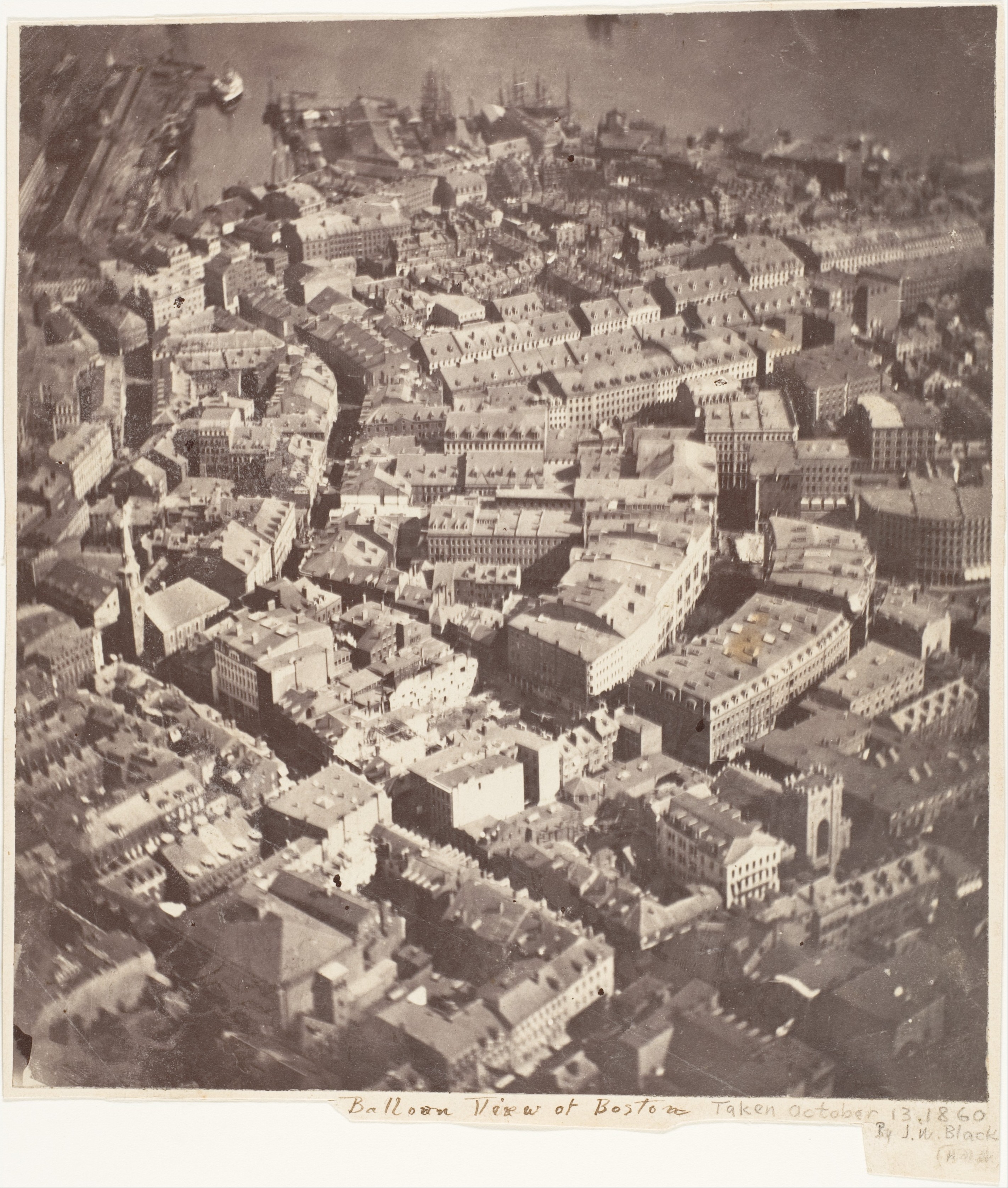
Aerial photo taken Oct.-13, 1860 of Boston, MA by J.W. Black.

Aerial photo taken Oct.-13, 1860 Boston, MA from a balloon by J.W. Black.

The Metropolitan Museum of Art in New York houses the earliest existing aerial photo that was taken from a balloon hovering 600 meters above Boston, Massachusetts. Within a year the American Civil War broke out and this new technology became an experimental tool of war. It advanced rapidly, when air craft replaced the balloon during the First World War. Sharp photos of bombed-out battle and killing fields along the entire Western Front in France were taken by both Allied and German soldiers every day. Placing these photos on a map for efficient analyses of how a land- sea- or ice-scape changes over time, however, was impossible, because photos do not record precise locations.

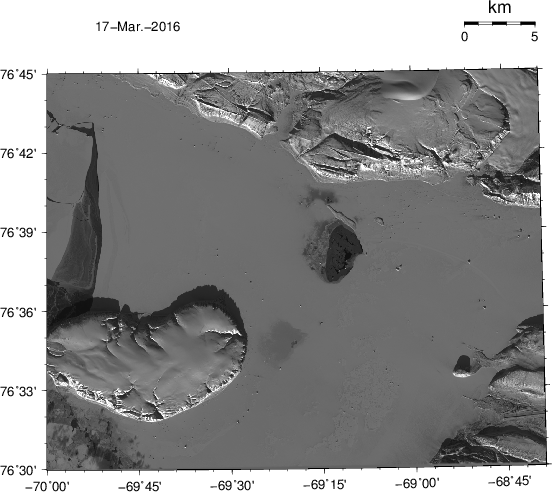
Modern satellite photos are different. We now have fancy radar beams, computers, and several Global Position Systems (GPS) with atomic clocks to instantly calculation satellite tracks every second. This is why we now can both take photos from space AND map every dot or pixel that is sensed by the satellite moving overhead at 17,000 miles an hour snapping pictures from 430 miles above. The camera is so good that it resolves the ground at about 45 feet (15 meters). This is what such a (LandSat) picture looks like

LandSat photo/map of Thule, Greenland Mar.-17, 2016. The airfield of Thule Air Force Base is seen near the bottom on the right. The island in ice-covered Westenholme Fjord is Saunders Island (bottom left) while the glacier top right is Chamberlin Gletscher.

LandSat photo/map of Thule, Greenland Mar.-17, 2016. The airfield of Thule Air Force Base is seen near the bottom on the right. The island in ice-covered Westenholme Fjord is Saunders Island (bottom left) while the glacier top right is Chamberlin Gletscher.

Everyone can download these photos from the United States Geological Survey which maintains a wonderful photo and data collection archive at

http://earthexplorer.usgs.gov

but the tricky part is to turn these images or photos into maps which I have done here. More specifically, I wrote a set of c-shell and nawk scripts along with Fortran programs on my laptop to attach to each number for the light sensed by the satellite (the photo) another two numbers (the map). These are latitude and longitude that uniquely fix a location on the earth’s surface. A “normal” photo today has a few “Mega-Pixels,” that is, a few million dots. Each scene of LandSat, however, has about 324 million dots. This is why you can discern both the runways of Thule Air Force Base at 68 degrees 45′ West longitude and 76 degrees 32′ North latitude. The pier into the ice-covered ocean is just a tad to the south of Dundas Mountain at 68:54′ W and 76:34′ N. A scale of 5 kilometers is shown at the top on the right. For spatial context, here is a photo of the pier with the mountain in the background, that is, the object shown in the photo such as mountain, ship, and Helen serves a rough, but imprecise reference:

Dr. Helen Johnson in August 2009 on the pier of Thule AFB with CCGS Henry Larsen and Dundas Mountain in the background. [Credit: Andreas Muenchow]

Dr. Helen Johnson in August 2009 on the pier of Thule AFB with CCGS Henry Larsen and Dundas Mountain in the background. [Credit: Andreas Muenchow]

This photo shows the airfield and Saunders Island

Thule AFB with its airport, pier, and ice-covered ocean in the summer. The island is Saunders Island. The ship is most likely the CCGS Henry Larsen in 2007. [Credit: Unknown]

Thule AFB with its airport, pier, and ice-covered ocean in the summer. The island is Saunders Island. The ship is most likely the CCGS Henry Larsen in 2007. [Credit: Unknown]

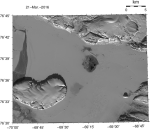
The satellite image of the ice-covered fjord with Thule, Saunders Island, and Chamberlin Gletschers shows a richly texture field of sea ice. The sea ice is stuck to land and not moving except in the west (top left) where it starts to break up as seen by the dark gray piece that shows ‘black’ water peeking from below a very thin layer of new ice. There is also a polynya at 69:15′ W and 76:39′ N just to the south of an island off a cape. A polynya is open water that shows as black of very dark patches. A similar albeit weaker feature also shows to the east of Saunders Island, but it is frozen over, but the ice there is not as thick as it is over the rest of Westenholme Fjord. I suspect that larger tidal currents over shallow water mix ocean heat up to the surface to keep these waters covered by water or dangerously thin ice. There are also many icebergs grounded in the fjord. They cast shadows and from the length of these shadows one could estimate their height. Here is another such photo from 2 days ago:

LandSat photo/map of Thule, Greenland Mar.-21, 2016. The airfield of Thule Air Force Base is seen near the bottom on the right. The island in ice-covered Westenholme Fjord is Saunders Island (bottom left) while the glacier top right is Chamberlin Gletscher.

LandSat photo/map of Thule, Greenland Mar.-21, 2016. The airfield of Thule Air Force Base is seen near the bottom on the right. The island in ice-covered Westenholme Fjord is Saunders Island (bottom left) while the glacier top right is Chamberlin Gletscher.

I am using the satellite data and maps here to plan an experiment on the sea ice of Westenholme Fjord. Next year in March/April I will lead a team of oceanographers, engineers, and acousticians to place and test an underwater network to send data from the bottom of the ocean under the sea ice near Saunders Island to the pier at Thule and from there on to the internet. We plan to whisper from one underwater listening post to another to communicate over long ranges (20-50 kilometers) via a network of relay stations each operating smartly at very low energy levels. We will deploy these stations through holes drilled through the landfast ice 1-2 meters thick. The work is very exploratory and is funded by the National Science Foundation. Wish us luck, as we can and will use it … along with aerial photography that we turn into maps.

Mapping North Greenland 100 years ago

Living off the land, Greenland’s early explorers ate their dogs, fungi, and roots of plants a few inches high to not starve to death. There is nothing romantic in the detailed reports of Knud Rasmussen, Peter Freuchen, and Lauge Koch that mapped in much detail coastlines, glaciers, and fjords of North Greenland between Thule in the west and Independence Fjord in the east. These Danes worked and lived closely with Inuit hunters and their families at what still is the northern edge of where a small number of people can survive by hunting seals, walrus, whales, and polar bears on the ice and musk ox, reindeer, and rabbits on land. Most people did not live as long and as well as we do now, because life and food were always in short supply.

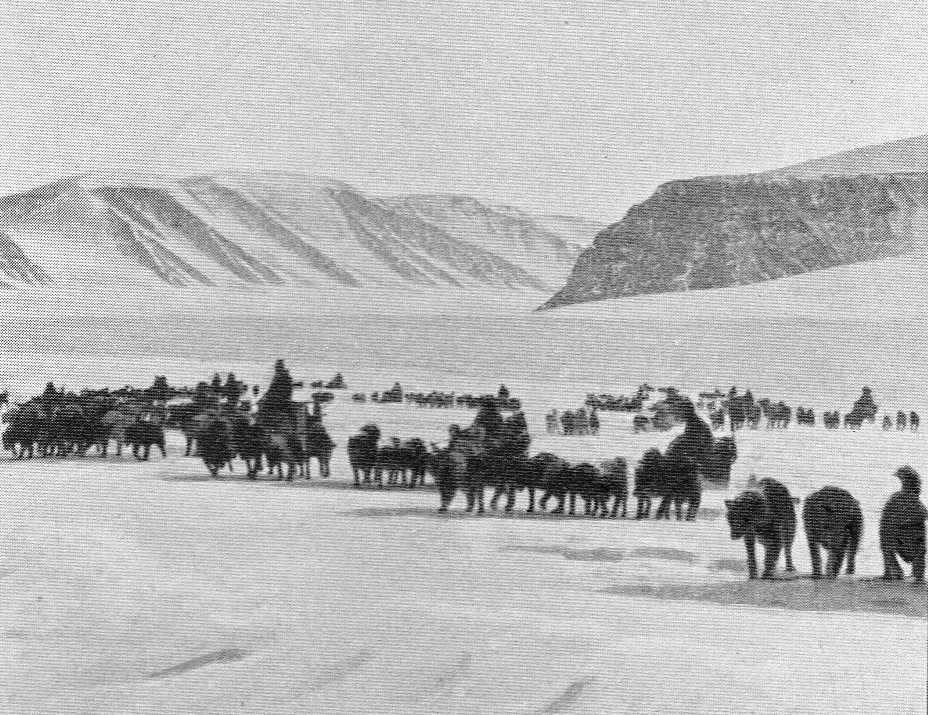
Ascent of the Inland ice in April 1912 as the First Thule Expedition starts from Clemens Markham's Glacier to Independence Fjord. All 4 explorers returned, but only 8 of the 54 dogs did.

Ascent of the Inland ice in April 1912 as the First Thule Expedition starts from Clemens Markham’s Glacier to Independence Fjord. All 4 explorers returned, but only 8 of the 54 dogs did.

I am reading the reports of the First Thule Expedition of 1912 (4 people), the Second Thule Expedition of 1917 (7 people), and the Bicentenary Jubilee Expedition of 1921 (4 people). Each person had its own dog sled team with 10-14 dogs per team. Knud Rasmussen and Peter Freuchen with Uvdloriaq and Inukitsoq successfully crossed the ice sheet in 1912 from east to west and back. Only 5 of the 7 members of the Second Thule Expedition returned, because Greenlander Hendrik Olsen disappeared while hunting wolves which may have killed him and the Swedish scientist Dr. Thorild Wulff starved to death when he gave up walking as witnessed by Lauge Koch and Inuit Nasaitsordluarsuk and Inukitsoq.

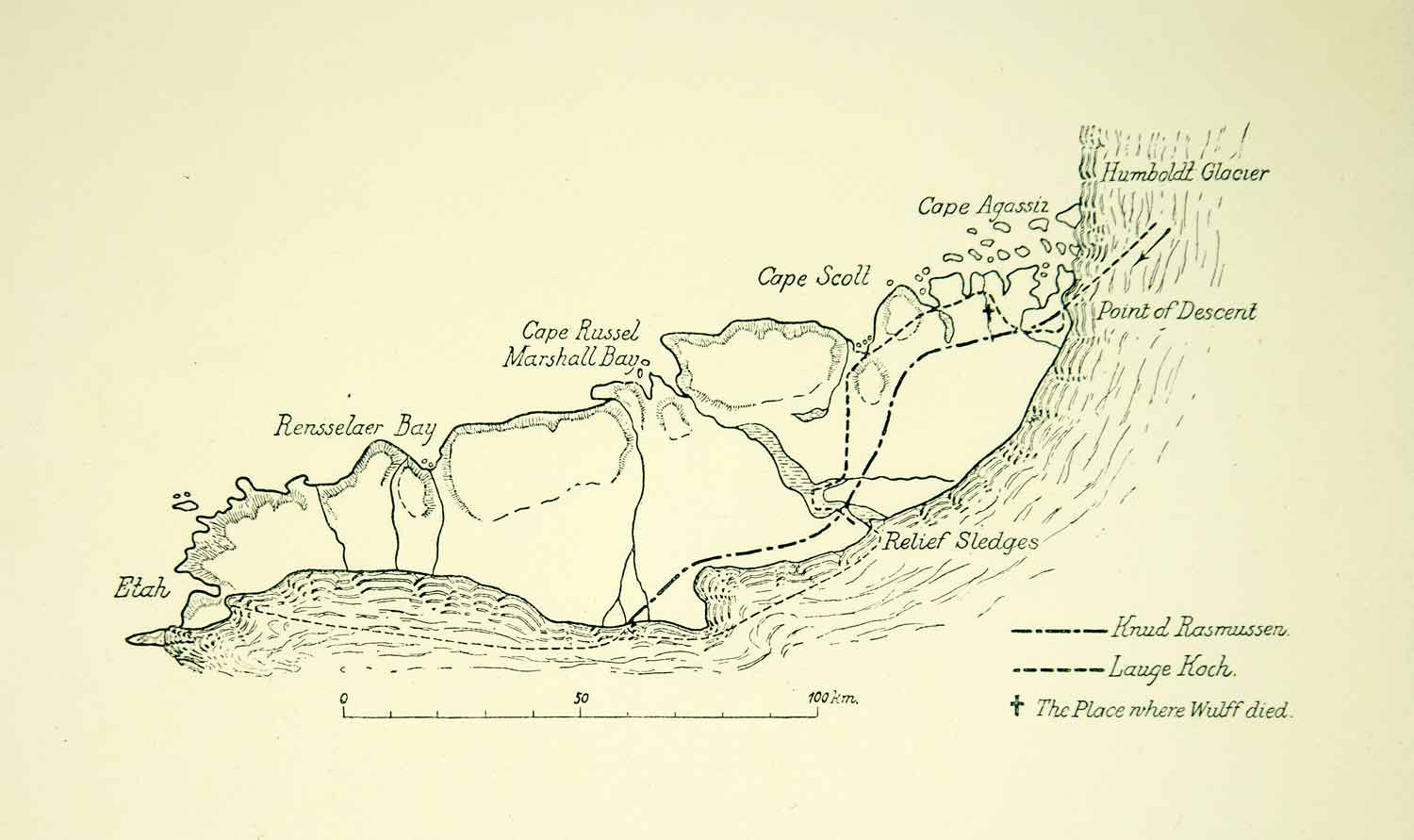
Map detail of Inglefield Land with tracks from Second Thule Expedition after leaving the ice sheet, from Rasmussen (1923). Humboldt Glacier is on the right with Kane Basin to the top.

Map detail of northern Inglefield Land with tracks from Second Thule Expedition after leaving the ice sheet with the location of Dr. Wulff’s death. Humboldt Glacier is on the right with Kane Basin to the top. From Rasmussen (1923).

This last death cast a life-long spell on Lauge Koch who never forgave Knud Rasmussen and Peter Freuchen for insisting on a formal Court of Inquiry in local Greenland and not remote Denmark to clear Lauge Koch of any wrong-doing. Both believed that Koch had acted properly when he choose to live and walk and not starve with Wulff, but they felt that local Inuit witnesses and local knowledge in Greenland would make the legal task to clear Koch easier sooner than a more removed Court in Denmark.

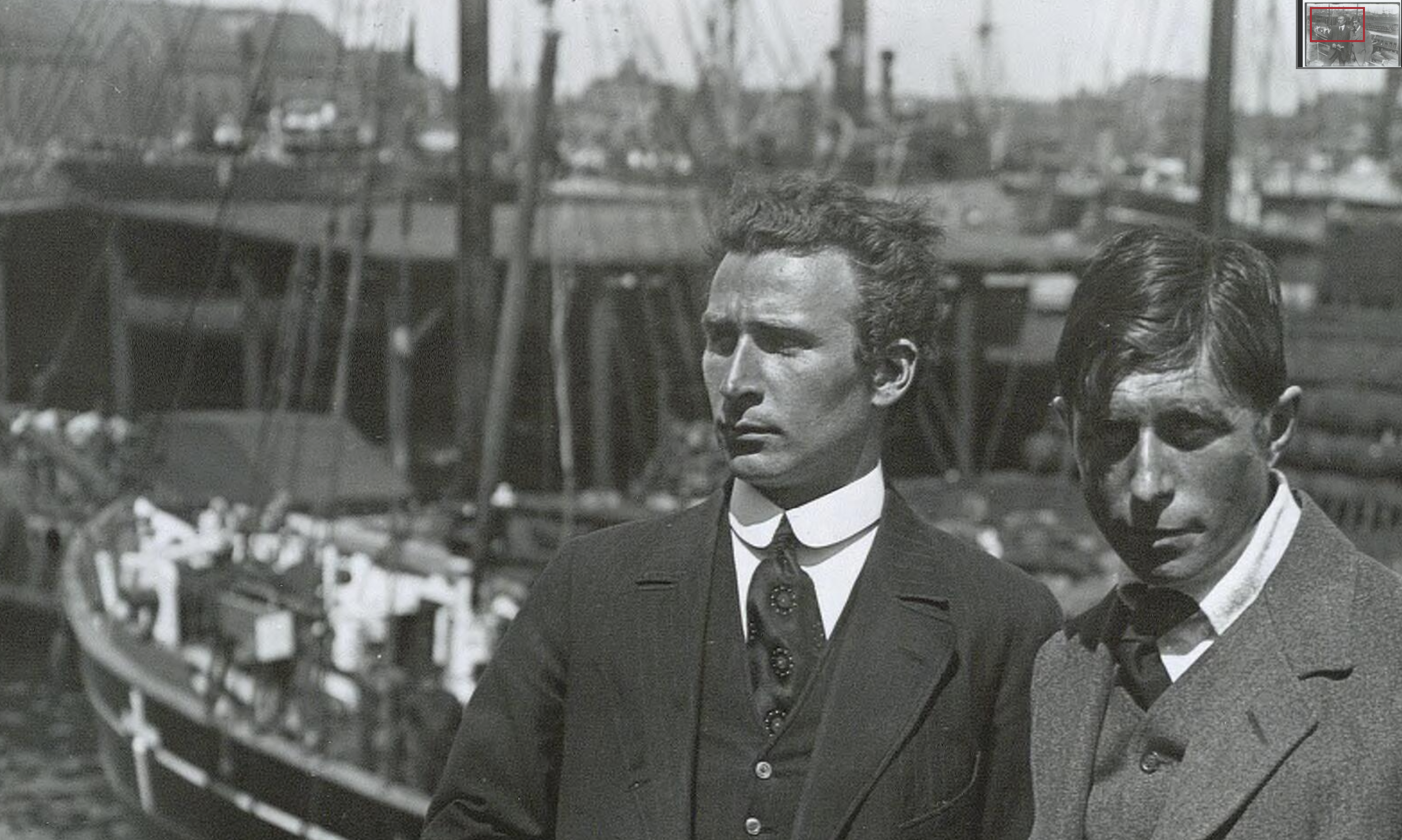
Knud Rasmussen (right) and Lauge Koch (left). [Photo: Holger Damgaard, National Library of Denmark.

Knud Rasmussen (right) and Lauge Koch (left). [Photo: Holger Damgaard, National Library of Denmark.

The Freuchen family on a visit to Denmark: Naravana, Pipaluk, Peter, and Mequsaq [Source: Freuchen, P., 1953: Vagrant Viking. Julian Messner Inc., NY, 312 pp.]

The Freuchen family on a visit to Denmark: Naravana, Pipaluk, Peter, and Mequsaq [Source: Freuchen, P., 1953: Vagrant Viking. Julian Messner Inc., NY, 312 pp.]

These Danish expeditions represent the second phase of exploration of North Greenland after the quest of national glory to reach the farthest north by British and Americans was settled when Robert Peary claimed to have reached the North Pole in 1909. The many American and English expeditions through Nares Strait from about 1853 (Elisha Kane) had relied on native guides, hunters, and polar skills, but the sheer number of whites and their massive material wealth change both local cultures and wildlife. For example, the early Europeans and American explorers provided guns and new technologies which were traded for furs, clothing, and local knowledge of survival. In return Inuit families provided food, clothing, and native polar technologies. These often proved crucial for survival as demonstrated by Joe Eberling and Hans Hendrik with their families who kept 18 people alive for 6 months in 1873 when their party of British and German men was stranded on an ice floe drifting more than 1800 miles to the south until they were picked up by a whaling ship off Labrador.

After the “Imperial” expeditions ended with the “conquest of the North Pole” in 1909, the local Inuit were left without contact to southern material goods such ammunition for their guns until Knud Rasmussen and Peter Freuchen privately founded the Thule Trading Post in Westenholme Fjord. Their goal was to set up a base to support their aspiration to explore and map northern Greenland via small expeditions and to show a link between Denmark and the people living in what was then called the Thule district of Greenland. Their choice of location was excellent and even today, Thule is still the hub to get to northern Greenland by ship or by air. I traveled through Thule in 2003, 2006, 2007, 2009, 2012, and 2015 as I boarded US, Canadian, or Swedish icebreaker at this only deep water north of the polar circle outside Scandinavia.

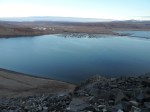
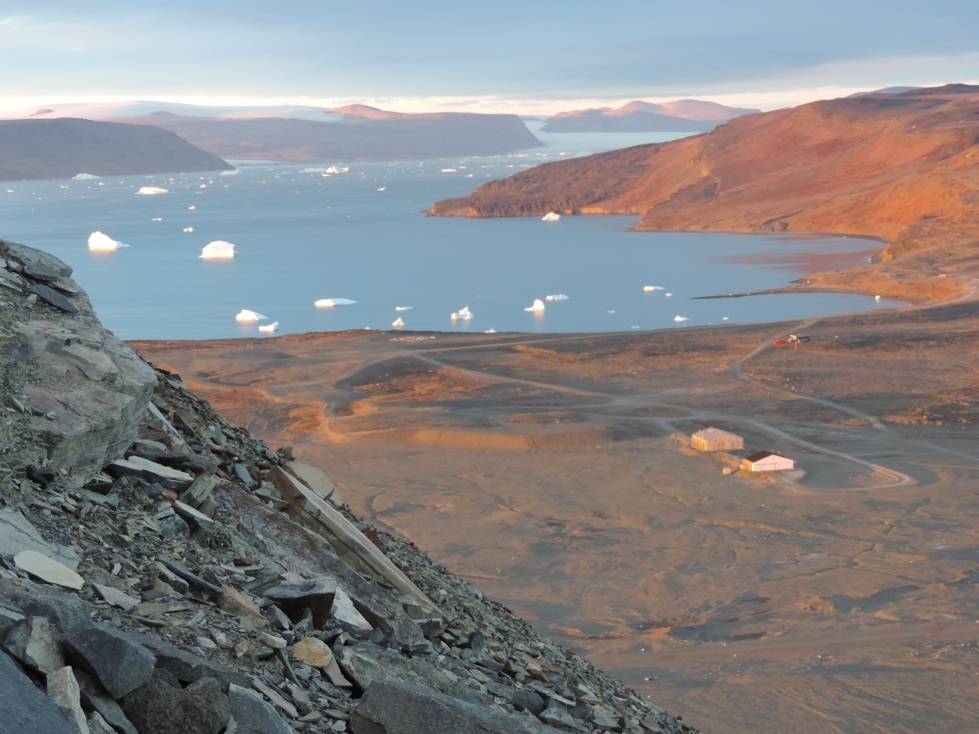
Inner section of Westenholme Fjord to the north-east of Thule AFB as seen on the descent from Dundas Mountain during sunset on Sept.-2, 2015,

Inner section of Westenholme Fjord to the north-east of Thule AFB as seen on the descent from Dundas Mountain during sunset on Sept.-2, 2015,

Peter Freuchen, Lauge Koch, and Knud Rasmussen were all in their 20ies and 30ies when they traveled across a harsh, unvisited, and at times beautiful landscape. Despite local help, skill, and knowledge to adapt to this environment, Greenland almost killed them by starvation or accident as it did to some of their companions. They all were excellent writers and communicators who found the moneys to pay for their adventures in creative ways. Knud died young in 1933 at age 54 in Copenhagen while Peter buried his Inuit wife Navarana in 1921 when he was only 35 years old, but lived another 36 years. Lauge Koch became an international academic authority on the geology and geography of Greenland until he died at age 72 in 1964. They all lived rich, admired, and controversial lives with their writing, their maps, their loves, and above all their frail humanity.

Maps of North Greenland before (top) and after (bottom) the First and Second Thule Expeditions from Rasmussen (1923).

Maps of North Greenland before (top) and after (bottom) the First and Second Thule Expeditions from Rasmussen (1923).

Freuchen, P., 1953: Vagrant viking, my life and adventures, Julian Messner, Inc. New York, NY, 312 pp.

Hendrik, H, 1878: Memoirs of Hans Hendrik, the Arctic traveler serving under Kane, Hayes, Hall, and Nares 1853-1876, reprinted in Cambridge University Press, Cambridge, UK, 100 pp.

Koch, L., 1926: Report on the Danish Bicentenary Jubilee Expedition north of Greenland 1920-23, 232 pp.

Rasmussen, K., 1912: Report of the First Thule Expedition 1912.

Rasmussen, K., 1923: Greenland by the Polar Sea: The story of the Thule Expedition from Melville Bay to Cape Morris Jesup, Frederick A. Stokes Company, New York, NY, 328 pp.