Travels by Mind to the Glaciers and Oceans off North-East Greenland

Our minds travel easier than the body. My eyes have never seen East Greenland, but I moved across its white glaciers, turquoise streams, green valleys, and black oceans many times. Reading expedition reports of Peter Freuchen from 1912, I feel north-east Greenland as he climbs with 3 companions and about 50 dogs down an icy cliff from the lifeless desert of the inland ice to the more fertile coastal plains. They are hungry and depend on the sparse vegetation that supports the musk ox, fox, and rabbit that they must hunt to eat.

Photo credits go to travelers dedicated to reach the northernmost parts of Greenland that they call Arctic Thule

There is more to my mental voyages than fingers on maps, photos, and worn reports. The physical scientist in me thirsts for observations to answer nagging questions on if and why and how the physical world is the way that we think we see it. For this I probe the air, the ice, and the oceans in ways that are not visible to the naked eye. I dislike traveling on a fixed surface that is defined by where I stand. The darkness of the unknown attracts me. What is below the pink pebble on the beach? What is beyond the horizon? How did stone and ice get here? Where will it all go next? These are the questions that drive me … today to North-East Greenland where two large glaciers eastward into a coastal ocean as they have not yet carved a fjord the way that the westward flowing Petermann Glacier has done on the other, western side of Greenland.

Map of North-East Greenland [From: Bennike and Weidick, 1999, Geology of Greenland Survey Bulletin, 183, 57-60.]

Map of North-East Greenland [From: Bennike and Weidick, 1999, Geology of Greenland Survey Bulletin, 183, 57-60.]

My travels started on a train to Boston to meet fellow coastal oceanographers in Biddefort, Maine. On friday an eminent German oceanographer and fellow gardener asked me a simple question on what is ice, what is land, and what is glacier on a fuzzy small paper copy of the area shown both above and below. In the satellite imagery below the black tones represent open water, the bright whites represent ice caps at high altitude, and the grey represents either land or diffuse mobile sea ice. The land comes in sharper focus in the image from 2009 as almost all sea-ice is frozen into one single sheet of ice that does not move, it is called land-fast ice and is distinct from glaciers, but that is harder to see. The two images also show the range of sea ice cover at the height of summer: Sept.-1, 2002 represents minimal and Sept.-1, 2009 represents maximal ice cover. Looking at over 30 years of satellite data from this area, I find lots of variations from year to year, but no trend that stands out from above the natural noise. I digress … maybe.
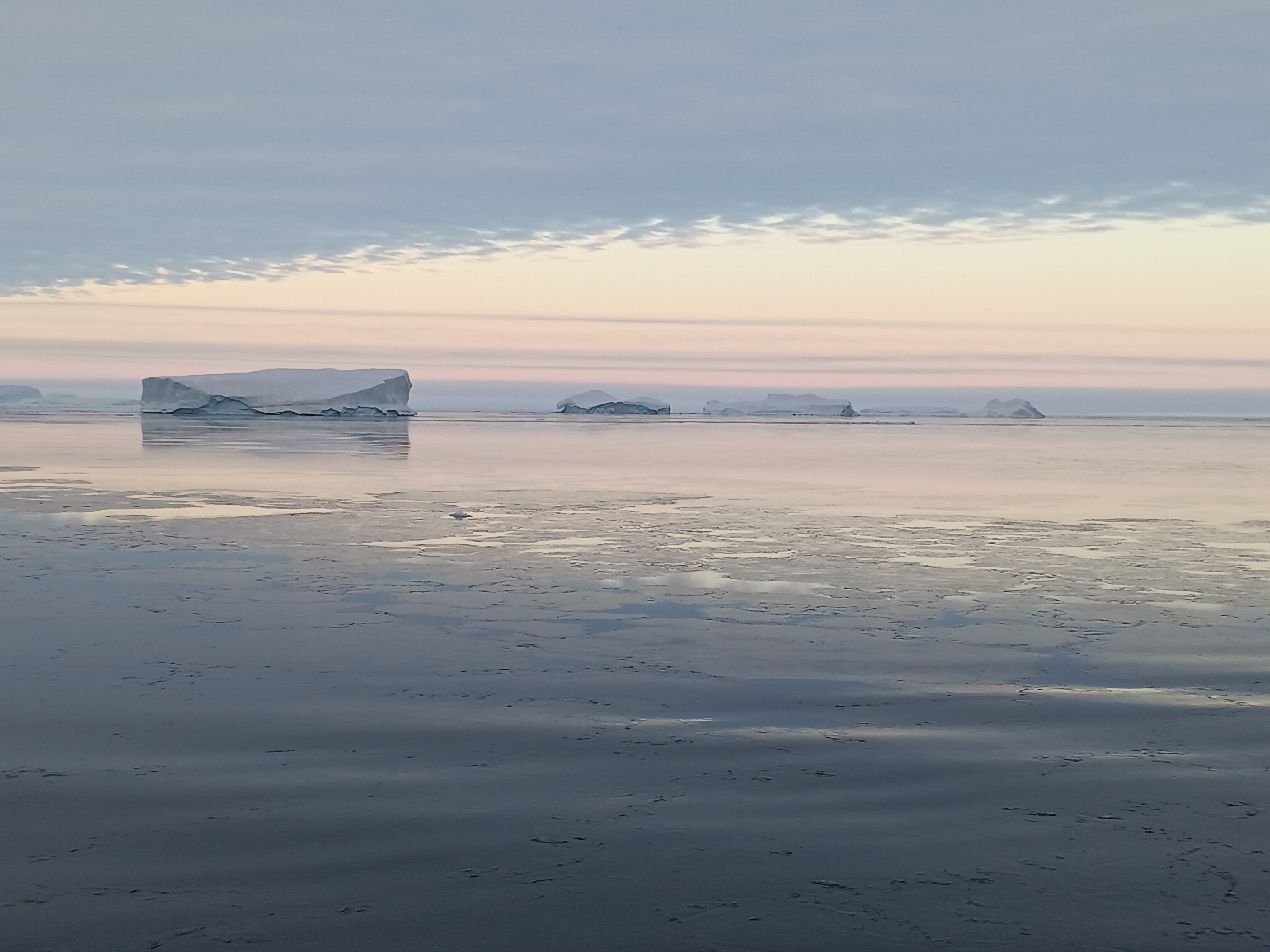
NiogHalv_2002
.
NiogHalv_2009

Now why is the ice cover so different from one year to the next? As a physical oceanographer my first two instincts are to get data of the bottom depth of the ocean and to get a feel for what the ocean temperature and salinity in the ocean looks like. These two pieces to a larger puzzle help me to say something about ocean circulation and heating. So, here is what the topography above and below sea level looks like:

Map of North-East Greenland showing land elevations in red and yellow and bottom depths in blue. Data are  from IBCAO-2 and contoured in 100-m intervals.

Map of North-East Greenland showing land elevations in red and yellow and bottom depths in blue. Data are from IBCAO-2 and contoured in 100-m intervals.

For scale, the map shows an area that would fit Boston near the top in the north and Washington, DC near the bottom in the south. Using the fasted trains in the US of America, it takes almost 7 hours and costs $250 one-way. Notice that there is a deeper trough that circles from the south past both glaciers to the west towards the north-east. This trough feeds the glaciers with warmer waters as it cuts off a shallower bank (my students both called it a sandbar) to the east. We will next have a vertical look at a vertical slice from the deeper waters in the east, to the shoal in the middle, and on to the trough in the west along the line of red triangles. The data along this section were collected by the German research icebreaker PolarStern which visited this part of Greenland in 2002. Along the section it collected profiles of ocean temperature, salinity, and much more:

Section of density (top), temperature (middle), and salinity (bottom) across the shelf off North-East Greenland in the summer of 2002. The view is to the north with Greenland on the left (west) and the deep Fram Strait to the right (east). Symbols show station locations. White areas indicate bottom topography.

Section of density (top), temperature (middle), and salinity (bottom) across the shelf off North-East Greenland in the summer of 2002. The view is to the north with Greenland on the left (west) and the deep Fram Strait to the right (east). Symbols indicate station locations. White areas indicate bottom topography.

The warmest waters in the section we find at 300 m depth both offshore in the east and in the deep trough in the west. These warm waters are also dense because they are salty. Based on the known bottom depth, it is not clear how this dense but warm water gets into the fjord where the floating glacier contacts the bed-rock and ocean near 700 m depth some 80 km landward of its terminus. It is possible that the bottom depths have not all been charted in enough detail to connect the warmer deep ocean waters with the glacier. We can safely ignore the warm and fresh waters within about 30-40 meters of the surface as they are merely melted sea-ice heated by 24 hours of sunlight. This layer is of little importance with regard to the adjacent glaciers.

An easy-to-miss, but revealing tidbit of substance in these data are the sloping lines of density: As we move from km-150 to km-200 we find that both salinity and density slope upward from about 150-m depth to 100-m depth. Such slopes often indicate currents, but to “see” this, one needs training in ocean physics on a rotating earth. Nevertheless, the more upward slope we observe, the more southward flow we can infer. The situation is reversed in the trough next to the coast. Here we find a downward slope of density as we move from km-0 to km-40. The inferred (geostrophic) ocean current with this slope is from south to north. It is this current that is postulated to drive the warm waters towards the glacier within this trough. Putting these two currents together, we find a clock-wise circulation around the shallow submarine bank. I will want to be more precise on how strong these currents are and how they vary from year to year and how the strength of these currents perhaps also relates the ice cover, but this cannot all be done tonight.

So let me conclude my virtual voyage of arm-chair discovery with a HUGE thank you to all those scientists and governments that put their data online for ANYONE to use as they see fit. ALL data presented in this post I found on the internet from very reputable sources such as IBCAO (bottom depth), NASA (satellite imagery), Danish Meteorological Institute (weather stations), and the German Alfred-Wegener Institute (ocean temperature and salinity). There is more to discover, ways to travel, and stories to be told. The mind controls the body or so we wish.

Budéus, G., & Schneider, W. (1995). On the hydrography of the Northeast Water Polynya Journal of Geophysical Research, 100 (C3) DOI: 10.1029/94JC02024

Falck, E. (2001). Contribution of waters of Atlantic and Pacific origin in the Northeast Water Polynya Polar Research, 20 (2) DOI: 10.3402/polar.v20i2.6517

Wadhams, P., Wilkinson, J., & McPhail, S. (2006). A new view of the underside of Arctic sea ice Geophysical Research Letters, 33 (4) DOI: 10.1029/2005GL025131

Thule on My Mind: Deep Water Port and Air Force Base

I am an air force brat. My father and my father-in-law enlisted in the German and US Air Forces, respectively. They served during the Cold War when I was born in 1961 a few month after the Berlin Wall went up. My father-in-law was stationed in Thule, Greenland, a northern forward base with radars to detect ballistic missiles, fighter jets to intercept planes, and bombers to retaliate in nuclear war. About 60 years later, the fighter jets, bombers, and communist threat are all gone, but the base is still there, and to me it is the gateway to North Greenland. Both US and Canadian Coast Guard icebreakers call its port to receive or discharge crews and scientists such as myself in 2003, 2006, 2007, 2009, and 2012.

An F-102 jet of the 332d Fighter-Interceptor Squadron at Thule AFB in 1960. [Credit: United States Air Force]

An F-102 jet of the 332d Fighter-Interceptor Squadron at Thule AFB in 1960. [Credit: United States Air Force.]

Today about 58,000 people live on Greenland spread over an area three times the size of Texas. On July 9, 1951 about 12,000 men arrived by ships to build the base. The 1953 film “Operation Blue Jay” documents the context, people, scenery, logistics, and construction that made today’s Thule Air Force Base (AFB).

The place should really be called by its native name Pituffik, but in 1953 about 130 Greenlanders living nearby were forcibly moved about 100 km to the north to what is now the town Qaanaaq, population 600. Lots of stories here, but I want to focus on the port of Thule:

Thule AFB with its airport, pier, and ice-covered ocean in the summer. The island is Saunders Island. The ship is most likely the CCGS Henry Larsen in 2007. [Credit: Unknown]

Thule AFB with its airport, pier, and ice-covered ocean in the summer. The island is Saunders Island. The ship is most likely the CCGS Henry Larsen in 2007. [Credit: Unknown]

CCGS Henry Larsen in North Star Bay on Aug.-2, 2012 at the pier at Thule. Dundas Mountain is visible as is the Greenland Ice Sheet in the background to the south-east. [Credit: Andreas Muenchow]

CCGS Henry Larsen in North Star Bay on Aug.-2, 2012 at the pier at Thule. Dundas Mountain is visible as is the Greenland Ice Sheet in the background to the south-east. [Credit: Andreas Muenchow]

Dr. Helen Johnson in August 2009 on the pier of Thule AFB with CCGS Henry Larsen and Dundas Mountain in the background. [Credit: Andreas Muenchow]

Dr. Helen Johnson in August 2009 on the pier of Thule AFB with CCGS Henry Larsen and Dundas Mountain in the background. [Credit: Andreas Muenchow]

Pier at Thule in Aug.-2012 with the Air Force Base and the Greenland Ice Sheet in the background. [Credit: Andreas Muenchow]

Pier at Thule in Aug.-2012 with the Air Force Base and the Greenland Ice Sheet in the background. [Credit: Andreas Muenchow]

The Port of Thule is the northernmost deep-water port in the world. It was meant as temporary structure in 1951 when it was built within less than 3 weeks around 4 barges each 76 meters long and 15 meters wide. These barges contained self-raising jacks to lift themselves up out of the water. Each barge was then supported with 12 concrete filled cylinders with steel-jackets to protect them from moving ice. In 2006 the so-called DeLong pier was repaired as some of the underwater support columns had developed cracks as the steel used in 1951 did not conform to modern engineering standards.

Thule Pier showing support cylinders during its 2006 repair [Credit: Appledorn Marine Engineering Inc., Portsmouth, NH]

Thule Pier showing support cylinders during its 2006 repair [Credit: Appledorn Marine Engineering Inc., Portsmouth, NH]

I learnt all of this last week writing yet another proposal. A group of electrical and system engineers, computer scientists and oceanographers submitted a high-risk proposal to the National Science Foundation. Together we plan to build the prototype of an underwater communication network. I think of it as a cell-phone tower system under water. The goal is to get ocean data transmitted under water over long distances for a long time. This has never been done in the Arctic, but we would like to connect such a network to pier of Thule AFB so that our ocean data can be relayed back via satellites and internet connections. That’s the idea and that’s why Thule is on my mind …

Arctic sea ice near Thule, Greenland during transition from land-fast (Mar.-4, 2013) to mobile (May-22, 2013) ice along with tentative sensor array (red) and 2003 track of bottom survey (blue). Contours are 50, 100, 150, and 200-m bottom depth. Dark areas are open water, white areas are snow or ice, land topography is naturally illuminated by a low sun-angle on Mar.-4. [Data from MODIS Terra.]

Arctic sea ice near Thule, Greenland during transition from land-fast (Mar.-4, 2013) to mobile (May-22, 2013) ice along with tentative sensor array (red) and 2003 track of bottom survey (blue). Contours are 50, 100, 150, and 200-m bottom depth. Dark areas are open water, white areas are snow or ice, land topography is naturally illuminated by a low sun-angle on Mar.-4. [Data from MODIS Terra.]

Elwood, N.J. and J.W. Gaithwaite (2007). Perpetuating a Pier, Civil Engineering, 77 (5), 62-67.

Land-Fast Ice Cover off North Greenland: Will NASA bite?

When a large outlet glacier of North Greenland (Petermann Gletscher) discharged an ice island four times the size of Manhattan in August of 2010, the United States’ Congress held formal inquiries on its cause within days of the event. Congressmen, scientists, and the global media speculated that this event and concurrent severe droughts in Russia and floods in Asia were tied to record-breaking air temperatures and global warming. Reviewing available data, Johnson et al. (2011) cautioned that most melting of floating ice shelves such as Petermann Gletscher is dominated by physical ocean processes below, not above the ice (Reeh, 2001, Rignot and Steffen, 2008). The National Journal asked me to write an essay to answer the question: “Is Climate Change Causing Wild Weather?” which I answered with a nerdy No, but …. Motivated by questions asked during the congressional hearing, I showed that waters in Petermann Fjord (a) originate from the Arctic Ocean to the north, (b) contain heat of Atlantic origin, and (c) have warmed significantly since 2003 (Muenchow et al., 2011).

Petermann Gletscher from MODIS Terra. Repeat NASA along-glacier flight tracks are shown in the left and middle panels. White line across the glacier are ICESat tracks. Thick black line across the glacier near y = 0 km is the grounding line location from Rignot and Steffen (2008). Dark areas within 2 km off the western wall are mountain shadows.

Petermann Gletscher from MODIS Terra. Repeat NASA along-glacier flight tracks are shown in the left and middle panels. White line across the glacier are ICESat tracks. Thick black line across the glacier near y = 0 km is the grounding line location from Rignot and Steffen (2008). Dark areas within 2 km off the western wall are mountain shadows.

When I reported here that the same glacier discharged yet another ice island in July 2012, this one “only” twice the size of Manhattan, I was not so sure anymore, that this was merely another extreme event caused by natural processes. Furthermore, only 4 weeks later I was aboard the CCGS Henry Larsen working in Petermann Fjord and Nares Strait to recover instruments that we had deployed in 2009. Witnessing dramatic change off North Greenland from my first visit in 2003 to my last in 2012, I will send NASA a proposal on monday. If suported, it would enable me to test the idea, that a changing sea ice cover off North Greenland over the last 30 years or so relates to the retreat and decay of glaciers north of 76 N latitude. Most of these glaciers connect the Greenland Ice Sheet to the ocean via floating ice shelves as does Petermann.

This is an image that shows land-fast ice in Nares Strait next to Petermann with the large ice-arch blocking all flow of ice to the south where we see open water or thin ice:

June-10, 2012 MODIS-Terra image showing location of moored array that was deployed in Aug. 2009 to be recovered in Aug. 2012.

June-10, 2012 MODIS-Terra image showing location of moored array that was deployed in Aug. 2009 and that we recovered in Aug. 2012.

Contrast the conditions in June 2012 above with in April of 2009 below. The southern ice-arch failed to form in 2009, there is much open water and loose, thin ice next to Petermann Fjord, but a northern ice-arch formed and prevented all flow of thick ice from the Arctic Ocean into Nares Strait or Petermann to glue it all together as it did in 2012 (or right now for that matter):

Largely ice-free Nares Strait on April 2009 with concurrent ocean velocity.

Largely ice-free Nares Strait on April 2009 with concurrent ocean velocity.

My main question is this: Has the changing sea ice cover next to glaciers anything to do with the break-up of many large glaciers all around North Greenland that we have observed the last few years? Is the removal of the summer sea ice from the many fjords of North Greenland a normal occurrence or is this a new regime that flushes many fjords free of ice in summer? Does the available record of air and ocean observations allow us to explain observed change? I believe that the public has all the data (MODIS, SSM/I, ICESat, etc) to answer these questions, but it will need a little work to actually provide quantifiable answers with error bars to pass academic peer review. Anyone is more than welcome to help and maybe even learn or apply skills for a graduate degree and well-paying jobs in physics or engineering.

ADDENDUM (16:33 EDT): As a result of Greenland losing so much mass and ice, the geographic North Pole started in 2005 to move abruptly towards Greenland. This was reported earlier this week by Nature after the research was accepted for publication at Geophys. Res. Let.

Johnson, H., Münchow, A., Falkner, K., & Melling, H. (2011). Ocean circulation and properties in Petermann Fjord, Greenland Journal of Geophysical Research, 116 (C1) DOI: 10.1029/2010JC006519

Münchow, A., Falkner, K., Melling, H., Rabe, B., & Johnson, H. (2011). Ocean Warming of Nares Strait Bottom Waters off Northwest Greenland, 2003–2009 Oceanography, 24 (3), 114-123 DOI: 10.5670/oceanog.2011.62

Reeh, N., H. H. Thomsen, A. K. Higgins, and A. Weidick (2001). Sea ice and the stability of north and northeast Greenland floating glaciers Annals of Glaciology, 33, 474-480

Rignot, E., & Steffen, K. (2008). Channelized bottom melting and stability of floating ice shelves Geophysical Research Letters, 35 (2) DOI: 10.1029/2007GL031765

The Turbulence of Van Gogh and the Labrador Shelf Current

Vincent Van Gogh painted his most turbulent images when insane. The Labrador Current resembles Van Gogh’s paintings when it becomes unstable. There is no reason that mental and geophysical instability relate to each other. And yet they do. Russian physicist Andrey Kolmogorov developed theories of turbulence 70 years ago that Mexican physicist applied to some of Van Gogh’s paintings such as “Starry Sky:”

Vincent Van Gogh's "Starry Sky" painted in June 1889.

Vincent Van Gogh’s “Starry Sky” painted in June 1889.

The whirls and curls evoke motion. The colors vibrate and oscillate like waves that come and go. There are rounded curves and borders in the tiny trees, the big mountains, and the blinking stars. Oceanographers call these rounded curves eddies when they close on themselves much as is done by a smooth wave that is breaking when it hits the beach in violent turmoil.

Waves come in many sizes at many periods. The wave on the beach has a period of 5 seconds maybe and measures 50 meters from crest to crest. Tides are waves, too, but their period is half a day with a distance of more than 1000 km from crest to crest. These are scales of time and space. There exist powerful mathematical statements to tell us that we can describe all motions as the sum of many waves at different scales. Our cell phone and computer communications depend on it, as do whales, dolphins, and submarines navigating under water, but I digress.

The Labrador Shelf Current off Canada moves ice, icebergs, and ice islands from the Arctic down the coast into the Atlantic Ocean. To the naked eye the ice is white while the ocean is blue. Our eyes in the sky on NASA satellites sense the amount of light and color that ice and ocean when hit by sun or moon light reflects back to space. An image from last friday gives a sense of the violence and motion when this icy south-eastward flowing current off Labrador is opposed by a short wind-burst in the opposite direction:

Ice in the Labrador Current as seen by MODIS-Terra on May 3, 2013.

Ice in the Labrador Current as seen by MODIS-Terra on May 3, 2013. Blue colors represent open water while white and yellow colors represent ice of varying concentrations.

Flying from London to Chicago on April 6, 2008, Daniel Schwen photographed the icy surface of the Labrador Current a little farther south:

Ice fields seen in Labrador Current April 6, 2008 from a plane. [Photo Credit: Daniel Schwen]

Ice fields seen in Labrador Current April 6, 2008 from a plane. [Photo Credit: Daniel Schwen]

Ice in the Labrador Current as seen by MODIS-Terra on April 6, 2008. Blue colors represent open water while white and yellow colors represent ice of varying concentrations.

Ice in the Labrador Current as seen by MODIS-Terra on April 6, 2008. Blue colors represent open water while white and yellow colors represent ice of varying concentrations.

The swirls and eddies trap small pieces of ice and arrange them into wavy bands, filaments, and trap them. The ice visualizes turbulent motions at the ocean surface. Also notice the wide range in scales as some circular vortices are quiet small and some rather large. If the fluid is turbulent in the mathematical sense, then the color contrast or the intensity of the colors and their change in space varies according to an equation valid for almost all motions at almost all scales. It is this scaling law of turbulent motions that three Mexican physicists tested with regard to Van Gogh’s paintings. They “pretended” that the painting represents the image of a flow that follows the physics of turbulent motions. And their work finds that Van Gogh indeed painted intuitively in ways that mimics nature’s turbulent motions when the physical laws were not yet known.

There are two take-home messages for me: First, fine art and physics often converge in unexpected ways. Second, I now want to know, if nature’s painting of the Labrador Shelf Current follows the same rules. There is a crucial wrinkle in motions impacted by the earth rotations: While the turbulence of Van Gogh or Kolmogorov cascades energy from large to smaller scales, that is, the larger eddies break up into several smaller eddies, for planetary-scale motions influenced by the Coriolis force due to earth’s rotation, the energy moves in the opposite direction, that is, the large eddies get larger as the feed on the smaller eddies. There is always more to discover, alas, but that’s the fun of physics, art, and oceanography.

Aragón, J., Naumis, G., Bai, M., Torres, M., & Maini, P. (2008). Turbulent Luminance in Impassioned van Gogh Paintings Journal of Mathematical Imaging and Vision, 30 (3), 275-283 DOI: 10.1007/s10851-007-0055-0

Ball, P. (2006). Van Gogh painted perfect turbulence news@nature DOI: 10.1038/news060703-17

Wu, Y., Tang, C., & Hannah, C. (2012). The circulation of eastern Canadian seas Progress in Oceanography, 106, 28-48 DOI: 10.1016/j.pocean.2012.06.005

Petermann Photos, Places, and People

Petermann Gletscher sent off Manhattan-sized islands of ice in 2010 and 2012 that now litter the eastern seaboard of Canada from its farthest northern Ellesmere Island to its farthest eastern Newfoundland. The ice is streaming south along thousands of miles within icy Arctic waters. Petermann Gletscher itself is flat, hard to grasp by the naked eye, its endless expanse of white vanishes into the horizon when we look towards the Greenland Ice Sheet ALONG the glacier:
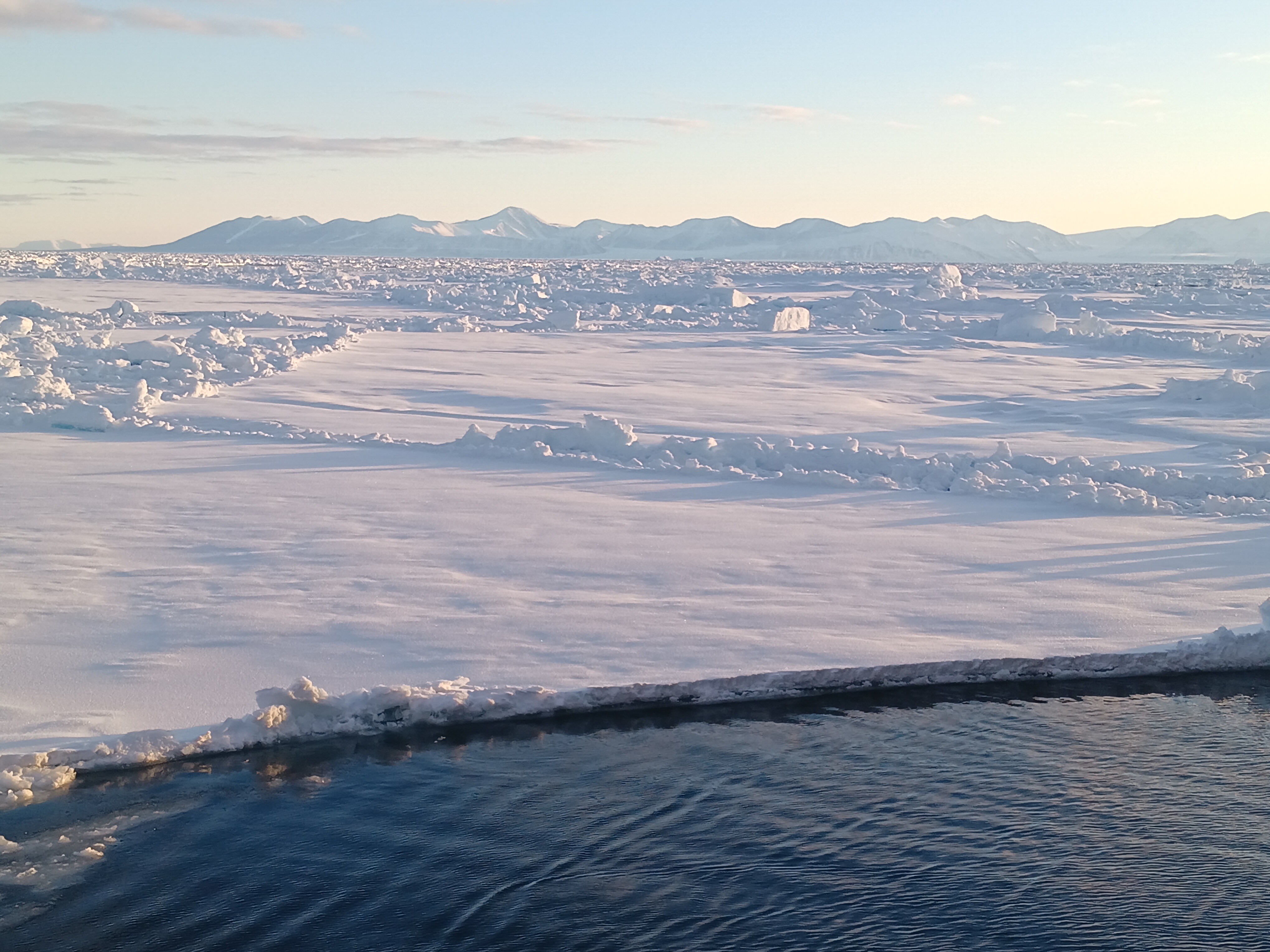
North-eastern section of Petermann Glacier on Aug.-11, 2012, the meandering river is the centerline, view is almost due east. [Photo Credit: Canadian Coast Guard Ship Henry Larsen.]
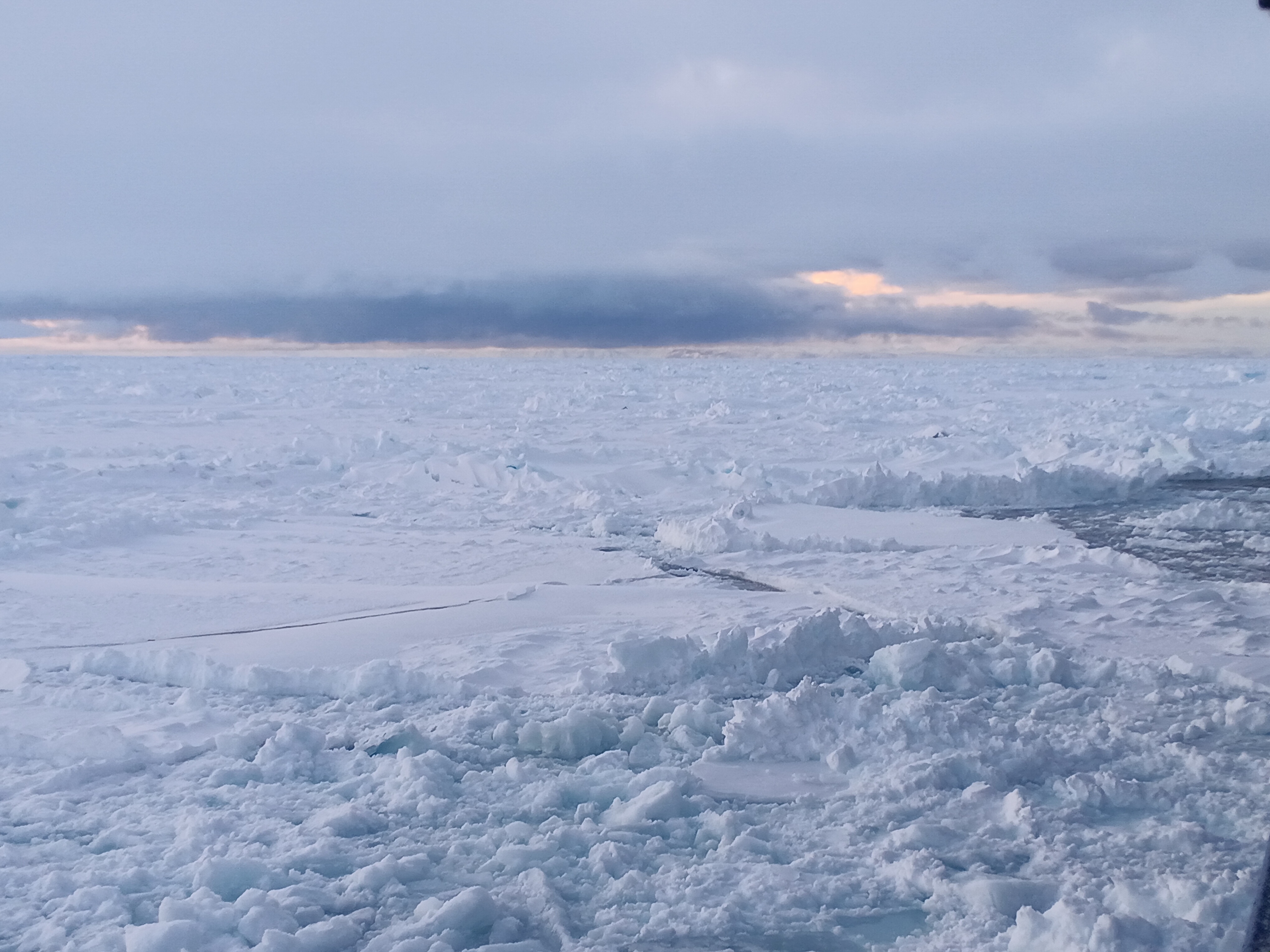
North-eastern portion of Petermann Glacier on Aug.-11, 2012, the meandering river is the centerline, view is almost due east with Kap Fulford and Kap Agnes on the left center and Daugaard Jensen Land in the background on the right. [Photo Credit: Canadian Coast Guard Ship Henry Larsen.]

Next, lets look ACROSS Petermann from roughly the same latitude. This perspective is more dramatic as vertical cliffs give shape, cliffs are cut by smaller side-glaciers. More specifically, we see the CCGS Henry Larsen helicopter flying down Belgrave Glacier as we look across Petermann which flows from the Greenland Ice Sheet on the left out to sea on the right. On the other (south-western) side we see Faith Glacier in the background about 10 miles away.

Seaward front of Petermann Glacier Aug.-11, 2012. View is from a small side-glacier towards the south-east across Petermann Fjord with Petermann Gletscher to the left (east). [Photo Credit: Erin Clarke, Canadian Coast Guard Ship Henry Larsen]

Seaward front of Petermann Glacier Aug.-11, 2012. View is from a small side-glacier (Belgrave Gl.) towards a similar glacier (Faith Gl.) across Petermann Fjord with Petermann Gletscher flowing from the left out to sea on the right. [Photo Credit: Erin Clarke, Canadian Coast Guard Ship Henry Larsen]

Contrasting large Petermann Gletscher, the many smaller glaciers on both its sides evoke drama as ice plunges down from 3000 feet above in a rage of forms, colors, and shapes. These side glaciers have their own side glaciers that sometimes rival the Alpine glaciers in Europe, Asia, and the Americas that most of us are more familiar with.

Some side glaciers have names, but they are rarely seen on maps and charts. The side glaciers are mapped, but photos are hard to find. Flying over them last year, I was utterly lost. Reviewing photos now, I remember people, smells, computer troubles, and exciting ocean discoveries. Nevertheless, I am hard pressed to place the places we saw on a map or name them. Distances are deceiving, the air is clean and 50-80 miles of visibility are common. A moment later, I cannot see the other side of the ship as we are suddenly in clouds and fog. Everything is always in motion, the ice, the water, the ship, the clouds, all of this without strong reference points like the exit or distance signs on a Turnpike, Interstate, or Autobahn.

Northern Kennedy Channel near the entrance to Petermann Fjord with Kap Morton in cloud banks. [Credit: Andreas Muenchow]

Northern Kennedy Channel near the entrance to Petermann Fjord with Kap Morton in cloud banks. [Credit: Andreas Muenchow]

And along comes Espen Olsen, a frequent contributor to Neven’s Arctic Sea Ice blog and forums, and discovers a plethora of names that I can check, google, and use to remember expeditions to Petermann over the last 10 years with many good friends. So with his help and that of other explorers like Lauge Koch, Tony Higgins, and the collected wisdom of the U.S. Defense Mapping Agency, I labeled some prominent glaciers and capes on an Aug,-21, 2012 MODIS-Terra image that I constructed from data that NASA provide to anyone free of charge. I chose this image and time, because the 2012 ice island is already in Nares Strait and thus out of sight:

Names of glaciers, capes, islands in Petermann Region over MODIS of Aug.-21, 2012.

Names of glaciers, capes, islands in Petermann Region over MODIS of Aug.-21, 2012.

Espen tells me that his Danish sources are protected by copyright (I still like to cite them), but the aviation maps of the U.S. military are in the public domain and can be downloaded from the University of Texas in Austin Library, e.g.,

Petermann Gletscher and surroundings extracted from U.S. Defense Mapping Agency Chart ONC A5 (January 1991).

Petermann Gletscher and suroundings extracted from U.S. Defense Mapping Agency Chart ONC A5 (January 1991).

while the modified version of Figure-2 from Dr. Tony Higgins 1990 publication is available at the Alfred Wegener Institute. Nevertheless, it should only be used for non-profit educational purposes or as a reference:

Petermann Gletscher extend and topography from 1953 through 1978 (from Higgins, 1990) with 2012 terminus position drawn in by hand.

Petermann Gletscher extend and topography from 1953 through 1978 (from Higgins, 1990) with 2012 terminus position drawn in by hand.

With all these details out-of-the-way, we can now start placing photos into places and add names to them. Perhaps others like Espen Olsen can write or edit Wiki entries or correct the false latitude and longitudes that populate the many databases that provide such information on the web. Over the next weeks and months I will try to post as many photos of Petermann’s natural beauty along with an evolving MODIS map that names and shows places. Here are just a few teasers without further comment except what’s in the captions.

The merging of Sigurd Berg and Hubert Glaciers which discharge into Petermann Gletscher on its eastern wall. The view is landward towards the north-east as the helicopter flies in from Petermann. [Credit: Barbara O'Connell, Canadian Coast Guard]

The merging of Hubert (left) and Sigurd Berg (right) Glaciers which discharge into Petermann Gletscher on its eastern wall. The view is landward towards the north-east as the helicopter flies in from Petermann. [Credit: Barbara O'Connell, Canadian Coast Guard]

Petermann Gletscher and Fjord in Aug.-2012. View is to the north-west with Faith Glacier (top left) and Kap Lucie Marie (top right) showing the western wall of Petermann. [Photo Credit: CCGS Henry Larsen]

Petermann Gletscher and Fjord in Aug.-2012. View is to the north-west with Faith Glacier (top left) and Kap Lucie Marie (top right) showing the western wall of Petermann. [Photo Credit: CCGS Henry Larsen]

Looking down Belgrave Glacier discharging into Petermann Gletscher at its terminus in Aug. 2012 [Credit: CCGS Henry Larsen]

Looking down Belgrave Glacier discharging into Petermann Gletscher at its terminus in Aug. 2012 [Credit: CCGS Henry Larsen]

Higgins, A.K. (1990). Northern Greenland glacier velocities and calf ice production Polarforschung, 60, 1-23 Other: 0032-2490

Cockpit’s View of Greenland’s Glaciers, Ice-Sheets, and Sea-Ice

The glaciers and ice-sheets of Greenland retreat and melt in a warming world. Towering almost 3000 meters above sea level the ice-sheet is so thick and heavy that it depresses the bedrock underneath below current sea-level. Monitoring the ice-sheet, outlet glaciers, and sea ice of Greenland, NASA’s Operation IceBridge flies aircraft packed with radars, lasers, and optical sensors each spring and summer all over Greenland. There are exciting blogs written by the scientists aboard as they live and work out of Greenland. And today I discovered that they also provide video feeds as their plane conducts measurements. Here is an example from yesterday:

I am not entirely sure on the exact location off south-east Greenland, perhaps this is the area near Helheim Glacier, e.g.,

Greenland's bed-rock elevation from Bamber et al. (2003) digital elevation model based on remotely sensed surveys of the 1970ies and 1990ies gridded at 5 km resolution.

Greenland’s bed-rock elevation from Bamber et al. (2003) digital elevation model based on remotely sensed surveys of the 1970ies and 1990ies gridded at 5 km resolution.

but this will become clear as soon as the data are released to the public. This usually happens within a few months. The wide and open data distribution and access is one of the greatest things about this mission. If you want to see where the plane is now, this is the screenshot I took just now (site)

Locations of NASA's P3 air plane near Jacobshavn Isbrae on April-10, 2013.

Locations of NASA’s P3 air plane near Jacobshavn Isbrae on April-10, 2013.

The evolution of Jacobshavn Isbrae retreat from 1851 through present. [From NASA's Earth Observatory]

The evolution of Jacobshavn Isbrae retreat from 1851 through present. [From NASA's Earth Observatory]

Jacobshavn lost its buttressing ice-shelf during the last decade and now rapidly discharges ice from the Greenland ice-sheet directly into the ocean at a rapid rate. Most likely, the ice-shelf was melted by the ocean from below (Holland et al., 2008). This type of accelerated discharge raises global sea-level, because ice previously sitting on Greenland’s bedrock moves into the ocean where it eventually will melt. In response to the ice removed, the bed-rock rises as there is less mass above it to hold it down (Khan et al, 2010). All this has actually been measured by satellites (mass-loss) and ground-based GPS (bed-rock response). We live in a dynamic and rapidly changing world where our sensors and software show new patterns of physics that have never been seen before. There is so much more to discover …

Csatho, B., Schenk, T., Van Der Veen, C., & Krabill, W. (2008). Intermittent thinning of Jakobshavn Isbræ, West Greenland, since the Little Ice Age Journal of Glaciology, 54 (184), 131-144 DOI: 10.3189/002214308784409035

Holland, D., Thomas, R., de Young, B., Ribergaard, M., & Lyberth, B. (2008). Acceleration of Jakobshavn Isbræ triggered by warm subsurface ocean waters Nature Geoscience, 1 (10), 659-664 DOI: 10.1038/ngeo316

Khan, S., Wahr, J., Bevis, M., Velicogna, I., & Kendrick, E. (2010). Spread of ice mass loss into northwest Greenland observed by GRACE and GPS Geophysical Research Letters, 37 (6) DOI: 10.1029/2010GL042460

Greenland, Frederica de Laguna, and Early Convergences

Not sure why, but this 1929 photo of two young scientists working off Greenland has been in my mind for the last 3 days. It shows a 23-year old graduate student of Anthropology from Columbia University, Frederica de Laguna, with one of her mentors, Archaeologist Dr. Therkel Mathiassen from Denmark. They were digging near Upernavik, Greenland for evidence of long-lost people living in north-west Greenland. It changed the life of Frederica de Laguna, the graduate student, as this summer in Greenland revealed the deep passion that she lived for 75 years after this photo was taken: Arctic Anthropology, the study of people, places, cultures. To me the photo shows an exuberant, yet relaxed and deep happiness after tiresome, yet immensely fulfilling work.

Frederica de Laguna with Therkel Mathiassen in 1929 near Upernavik, Greenland. [From Bryn Mawr College's Collections

Frederica de Laguna with Therkel Mathiassen in 1929 near Upernavik, Greenland. [From Bryn Mawr College's Collections]


My strange obsession with Frederica de Laguna relates to convergent story lines that I am still trying to untangle. Her advisor at Columbia was Franz Boas who as a German physicist lived on southern Baffin Island during the First International Polar Year 1883/84 to study “everything” that he saw and experienced around Cumberland Sound which was a northern base for the whaling industry. His description of a massive iceberg is so detailed, that I feel comfortable to conclude, that he describes an ice island from Petermann Glacier about 1600 miles to the north. After his Arctic field work he emigrated to New York to become one of the founders of American Anthropology in the 20th century. Frederica de Laguna was one of his last graduate students, receiving her PhD in 1933 while digging in Alaska.
Inuit women and children visiting the Hans Egede in Greenland in 1930. [From Cambridge University]

Inuit women and children visiting the Hans Egede in Greenland in 1930. [From Cambridge University]


It took Frederica and her companion 18 days to sail from Copenhagen, Denmark to Upernavik, Greenland aboard the Hans Egede. Two of her sailing companions, a Dr. Krueger from Germany and his assistant Age Rose Bjare of Denmark were planing to explore the geology of Ellesmere Island and areas to the west of it in northern Canada and disappeared. In her autobiography she writes succinctly: “I don’t like Dr. Krueger. He thinks too much of himself.” This sentiment is also reflected by the Canadian police officer who described him as a “punk outfit and a badly overloaded sledge.” Her return sail she shared with Dr. Alfred Wegener, a German geophysicist and his group returning from initial explorations of Disko Bay, Greenland testing the first snowmobiles for a larger expedition to take place the following year in 1930. They probably provided one of the first descriptions of Jacobshavn Isbrae, a fast-moving Greenland outlet glacier. In 1929 it still had a substantial ice-shelf that disintegrated the last 15 years and is lost to history.
The evolution of Jacobshavn Isbrae retreat from 1851 through present. [From NASA's Earth Observatory]

The evolution of Jacobshavn Isbrae retreat from 1851 through present. [From NASA's Earth Observatory]


Alfred Wegener lost his life the following year when he tried to rescue companions who maintained a weather station on Greenland’s ice-sheet. His largest scientific contribution was the idea, that continents move, that North-America, Greenland, and Europe once connected, perhaps, and had drifted apart over the millenia. Since he did not have a physical mechanism detailed, it took oceanographers another 50 years to sort that part out, Wegner’s idea of continents adrift was ridiculed by the establishment at the time and eventually forgotten. It took another 30-40 years for it to revolutionize geology as a dynamic discipline. Plate tectonics is the standard now that explains earthquakes, vulcanoes, and much more. It perhaps did not help Dr. Wegner with the geologists like Dr. Krueger, that he was trained in physics, as was Dr. Boas, the advisor of the now renowned Arctic anthropologist Francisca de Laguna of Bryn Mawr College in Pennsylvania.

The observant reader will notice how many Germans are in this set of story lines. Franz Boas was Jewish and thrived,in the Americas, Hans Krueger was a pompous idiot who disappeared, and Alfred Wegener was a tragic hero. All were German scientists, all converged with Frederica de Laguna in 1929 just when she emerged as a powerful mind of her own as a young graduate student in a field dominated by men. When Germany invaded Poland and France 10 years later, Dr. Frederica de Laguna was teaching her passions at Bryn Mawr College outside Philadelphia. When the war came to America, she asked for a leave of absence to serve in Naval Intelligence where she became a Lieutenant Commander. Her superiors at Bryn Mawr considered this a waste of her time, but she disagreed, and so do I. It is the many personal choices we make, both small and large, that form our personal histories, our science, our selves, and the larger history that we all live … [to be continued]

Davis, R. (2006). Frederica de Laguna of Bryn Mawr College Arctic Anthropology, 43 (2), 21-27 DOI: 10.1353/arc.2011.0075

VanStone, J., & de Laguna, F. (1980). Voyage to Greenland: A Personal Initiation into Anthropology Ethnohistory, 27 (2) DOI: 10.2307/481234

Fredericade Laguna in 1993 at age 87; she worked until age 98 [From New York Times, photo by Bill Roth, Anchorage Daily News]

Frederica de Laguna in 1993 at age 87; she worked until age 98. [From New York Times, photo by Bill Roth, Anchorage Daily News]