Tag Archives: Petermann

Land-Fast Ice Cover off North Greenland: Will NASA bite?

When a large outlet glacier of North Greenland (Petermann Gletscher) discharged an ice island four times the size of Manhattan in August of 2010, the United States’ Congress held formal inquiries on its cause within days of the event. Congressmen, scientists, and the global media speculated that this event and concurrent severe droughts in Russia and floods in Asia were tied to record-breaking air temperatures and global warming. Reviewing available data, Johnson et al. (2011) cautioned that most melting of floating ice shelves such as Petermann Gletscher is dominated by physical ocean processes below, not above the ice (Reeh, 2001, Rignot and Steffen, 2008). The National Journal asked me to write an essay to answer the question: “Is Climate Change Causing Wild Weather?” which I answered with a nerdy No, but …. Motivated by questions asked during the congressional hearing, I showed that waters in Petermann Fjord (a) originate from the Arctic Ocean to the north, (b) contain heat of Atlantic origin, and (c) have warmed significantly since 2003 (Muenchow et al., 2011).

Petermann Gletscher from MODIS Terra. Repeat NASA along-glacier flight tracks are shown in the left and middle panels. White line across the glacier are ICESat tracks. Thick black line across the glacier near y = 0 km is the grounding line location from Rignot and Steffen (2008). Dark areas within 2 km off the western wall are mountain shadows.

Petermann Gletscher from MODIS Terra. Repeat NASA along-glacier flight tracks are shown in the left and middle panels. White line across the glacier are ICESat tracks. Thick black line across the glacier near y = 0 km is the grounding line location from Rignot and Steffen (2008). Dark areas within 2 km off the western wall are mountain shadows.

When I reported here that the same glacier discharged yet another ice island in July 2012, this one “only” twice the size of Manhattan, I was not so sure anymore, that this was merely another extreme event caused by natural processes. Continue reading

Petermann Photos, Places, and People

Petermann Gletscher sent off Manhattan-sized islands of ice in 2010 and 2012 that now litter the eastern seaboard of Canada from its farthest northern Ellesmere Island to its farthest eastern Newfoundland. The ice is streaming south along thousands of miles within icy Arctic waters. Petermann Gletscher itself is flat, hard to grasp by the naked eye, its endless expanse of white vanishes into the horizon when we look towards the Greenland Ice Sheet ALONG the glacier:

North-eastern section of Petermann Glacier on Aug.-11, 2012, the meandering river is the centerline, view is almost due east. [Photo Credit: Canadian Coast Guard Ship Henry Larsen.]

North-eastern portion of Petermann Glacier on Aug.-11, 2012, the meandering river is the centerline, view is almost due east with Kap Fulford and Kap Agnes on the left center and Daugaard Jensen Land in the background on the right. [Photo Credit: Canadian Coast Guard Ship Henry Larsen.]

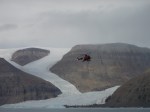
Next, lets look ACROSS Petermann from roughly the same latitude. This perspective is more dramatic as vertical cliffs give shape, cliffs are cut by smaller side-glaciers. More specifically, we see the CCGS Henry Larsen helicopter flying down Belgrave Glacier as we look across Petermann which flows from the Greenland Ice Sheet on the left out to sea on the right. On the other (south-western) side we see Faith Glacier in the background about 10 miles away.

Seaward front of Petermann Glacier Aug.-11, 2012. View is from a small side-glacier towards the south-east across Petermann Fjord with Petermann Gletscher to the left (east). [Photo Credit: Erin Clarke, Canadian Coast Guard Ship Henry Larsen]

Seaward front of Petermann Glacier Aug.-11, 2012. View is from a small side-glacier (Belgrave Gl.) towards a similar glacier (Faith Gl.) across Petermann Fjord with Petermann Gletscher flowing from the left out to sea on the right. [Photo Credit: Erin Clarke, Canadian Coast Guard Ship Henry Larsen]

Contrasting large Petermann Gletscher, the many smaller glaciers on both its sides evoke drama as ice plunges down from 3000 feet above in a rage of forms, colors, and shapes. These side glaciers have their own side glaciers that sometimes rival the Alpine glaciers in Europe, Asia, and the Americas that most of us are more familiar with.

Some side glaciers have names, but they are rarely seen on maps and charts. The side glaciers are mapped, but photos are hard to find. Flying over them last year, I was utterly lost. Reviewing photos now, I remember people, smells, computer troubles, and exciting ocean discoveries. Nevertheless, I am hard pressed to place the places we saw on a map or name them. Distances are deceiving, the air is clean and 50-80 miles of visibility are common. A moment later, I cannot see the other side of the ship as we are suddenly in clouds and fog. Everything is always in motion, the ice, the water, the ship, the clouds, all of this without strong reference points like the exit or distance signs on a Turnpike, Interstate, or Autobahn.

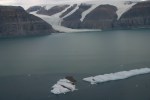
Northern Kennedy Channel near the entrance to Petermann Fjord with Kap Morton in cloud banks. [Credit: Andreas Muenchow]

Northern Kennedy Channel near the entrance to Petermann Fjord with Kap Morton in cloud banks. [Credit: Andreas Muenchow]

And along comes Espen Olsen, a frequent contributor to Neven’s Arctic Sea Ice blog and forums, and discovers a plethora of names that I can check, google, and use to remember expeditions to Petermann over the last 10 years with many good friends. So with his help and that of other explorers like Lauge Koch, Tony Higgins, and the collected wisdom of the U.S. Defense Mapping Agency, I labeled some prominent glaciers and capes on an Aug,-21, 2012 MODIS-Terra image that I constructed from data that NASA provide to anyone free of charge. I chose this image and time, because the 2012 ice island is already in Nares Strait and thus out of sight:

Names of glaciers, capes, islands in Petermann Region over MODIS of Aug.-21, 2012.

Names of glaciers, capes, islands in Petermann Region over MODIS of Aug.-21, 2012.

Espen tells me that his Danish sources are protected by copyright (I still like to cite them), but the aviation maps of the U.S. military are in the public domain and can be downloaded from the University of Texas in Austin Library, e.g.,

Petermann Gletscher and surroundings extracted from U.S. Defense Mapping Agency Chart ONC A5 (January 1991).

Petermann Gletscher and suroundings extracted from U.S. Defense Mapping Agency Chart ONC A5 (January 1991).

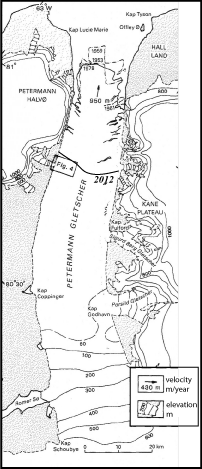
while the modified version of Figure-2 from Dr. Tony Higgins 1990 publication is available at the Alfred Wegener Institute. Nevertheless, it should only be used for non-profit educational purposes or as a reference:

Petermann Gletscher extend and topography from 1953 through 1978 (from Higgins, 1990) with 2012 terminus position drawn in by hand.

Petermann Gletscher extend and topography from 1953 through 1978 (from Higgins, 1990) with 2012 terminus position drawn in by hand.

With all these details out-of-the-way, we can now start placing photos into places and add names to them. Perhaps others like Espen Olsen can write or edit Wiki entries or correct the false latitude and longitudes that populate the many databases that provide such information on the web. Over the next weeks and months I will try to post as many photos of Petermann’s natural beauty along with an evolving MODIS map that names and shows places. Here are just a few teasers without further comment except what’s in the captions.

The merging of Sigurd Berg and Hubert Glaciers which discharge into Petermann Gletscher on its eastern wall. The view is landward towards the north-east as the helicopter flies in from Petermann. [Credit: Barbara O'Connell, Canadian Coast Guard]

The merging of Hubert (left) and Sigurd Berg (right) Glaciers which discharge into Petermann Gletscher on its eastern wall. The view is landward towards the north-east as the helicopter flies in from Petermann. [Credit: Barbara O’Connell, Canadian Coast Guard]

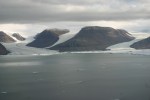
Petermann Gletscher and Fjord in Aug.-2012. View is to the north-west with Faith Glacier (top left) and Kap Lucie Marie (top right) showing the western wall of Petermann. [Photo Credit: CCGS Henry Larsen]

Petermann Gletscher and Fjord in Aug.-2012. View is to the north-west with Faith Glacier (top left) and Kap Lucie Marie (top right) showing the western wall of Petermann. [Photo Credit: CCGS Henry Larsen]

Looking down Belgrave Glacier discharging into Petermann Gletscher at its terminus in Aug. 2012 [Credit: CCGS Henry Larsen]

Looking down Belgrave Glacier discharging into Petermann Gletscher at its terminus in Aug. 2012 [Credit: CCGS Henry Larsen]

Higgins, A.K. (1990). Northern Greenland glacier velocities and calf ice production Polarforschung, 60, 1-23 Other: 0032-2490

Petermann Glacier Ice Islands: Where are they now?

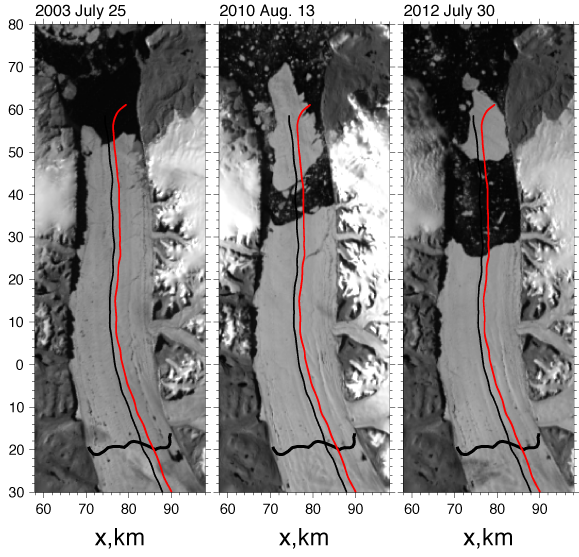
Two large calving events in 2010 and 2012 reduced the floating part of Petermann Gletscher by 44 km (28 miles) in length, 6 Manhattans (380 km^2) in area, and 42 gigatons in mass. But what’s a gigaton? Writing in The Atlantic Magazine, Julio Friedman states that if we put all people living on earth onto a scale, then we will get half a gigaton. So, Petermann’s two ice island weigh more than eighty times as all humanity combined. As a reminder, this is what the break-ups looked like:

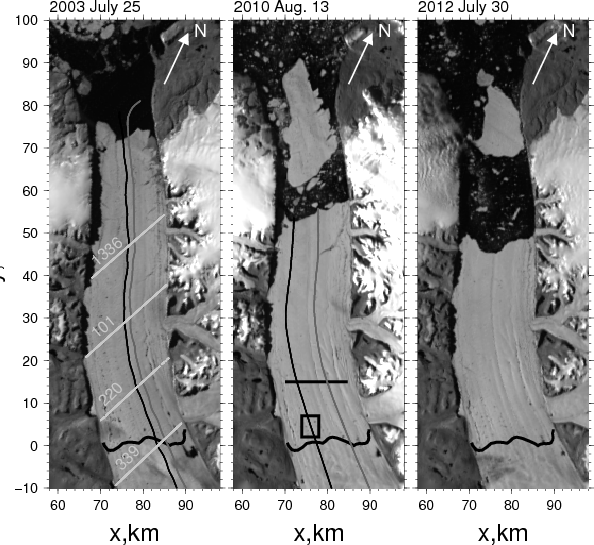
Petermann Gletscher in 2003, 2010, and 2012 from MODIS Terra in rotated co-ordinate system with repeat NASA aircraft overflight tracks flown in 2002, 2003, 2007, and 2010. Thick black line across the glacier near y = -20 km is the grounding line location from Rignot and Steffen (2008).

Petermann Gletscher in 2003, 2010, and 2012 from MODIS Terra in rotated co-ordinate system with repeat NASA aircraft overflight tracks flown in 2002, 2003, 2007, and 2010. Thick black line across the glacier near y = -20 km is the grounding line location from Rignot and Steffen (2008).

It turns out that the smaller 2012 ice island is just as heavy as the 2010 island, because it is much thicker, about 200 m, 600 feet, or half the height of the Empire State Building in Manhattan. These thick and thin islands have since left Petermann Fjord and Nares Strait for more southern climes. The thinnest piece reached Newfoundland in the summer of 2011 where it melted away. Most of the thicker, larger, and heavier ice islands from Petermann and Ryder Glaciers now litter almost the entire eastern seaboard of Canada as the two largest pieces have split, broken, and splintered into many smaller pieces. Each of these still represents an exceptionally large and dangereous piece of ice that can wipe any offshore oil platform off its foundation. Luc Desjardins of the Canadian Ice Service now tracks more than 40 segments, some still bigger than Manhattan, some as small as a football field. The distribution along the 1500 km (1000 miles) of coast is staggering:

RadarSat imagery of eastern Baffin Island (bottom, right), western Greenland (top, right), and Nares Strait with Petermann Fjord (top, left) with pieces of Petermann and Ryder Ice Islands identified. [Credit: Luc Lesjardins, Canadian Ice Service]

RadarSat imagery of eastern Baffin Island (bottom, right), western Greenland (top, right), and Nares Strait with Petermann Fjord (top, left) with pieces of Petermann and Ryder Ice Islands identified as green dots. [Credit: Luc Lesjardins, Canadian Ice Service]

What stands out is that most pieces are close to the coast of Canada. This is expected, because often the ocean moves in ways to balance pressure gradient and Coriolis forces as we live on an earth that rotates once every day around its axis. This force balance holds both in the ocean and the atmosphere. We are all familiar with winds around a low-pressure system such as Hurricane Sandy where the winds move air counter-clockwise around the eye (the center of low pressure). This eye of low pressure in our ocean story is permanently near the center of Baffin Bay. Ocean currents then move water counter-clockwise around this eye. This results in a flow to the south off Canada and a flow to the north off Greenland. On a smaller scale this balance holds also, such as Delaware Bay or Petermann Fjord, but I will not bore you with the details of graduate level physics of fluids in motions … as important as they may be.

So, almost all the ice islands we see in the above imagery will make their way further south towards the Grand Banks off Newfoundland. Some are grounded to the bottom of the shallow coastal ocean and may sit in place for a year, or a month, or until the next high tide will lift the ice off the bottom and move it back into deeper water. Some ice islands will keep moving rapidly, some will further break apart, but none will go away anytime soon. If you want to see some of Petermann’s Ice Islands for yourself, take the ferry from North Sidney, Nova Scotia to Port aux Basques, Newfoundland and Labrador and head for the Great Northern Peninsula. That’s what I hope to do one of the next summers.

ResearchBlogging.org
Johnson, H., Münchow, A., Falkner, K., & Melling, H. (2011). Ocean circulation and properties in Petermann Fjord, Greenland Journal of Geophysical Research, 116 (C1) DOI: 10.1029/2010JC006519

Münchow, A., & Garvine, R. (1993). Dynamical properties of a buoyancy-driven coastal current Journal of Geophysical Research, 98 (C11) DOI: 10.1029/93JC02112

Rignot, E., & Steffen, K. (2008). Channelized bottom melting and stability of floating ice shelves Geophysical Research Letters, 35 (2) DOI: 10.1029/2007GL031765

Shots of Airborne Lasers at Petermann Gletscher, Greenland

If shots of whiskey make you dizzy, shots of laser stun. NASA stunned me this week, when I discovered that they provide millions such shots of Greenland from which to construct detailed images of the landscape. The shots are free, no age-limit. This is better than the usual remote sensing or photography of “just” brightness. The laser gives us height, and not just the perception of it by shadows and fake angles of illumination, but hard and direct measurements of, well, height above sea level. Have a look at several million such shots of Petermann Gletscher taken in 2010 before the glacier broke to Manhattan-sized pieces:
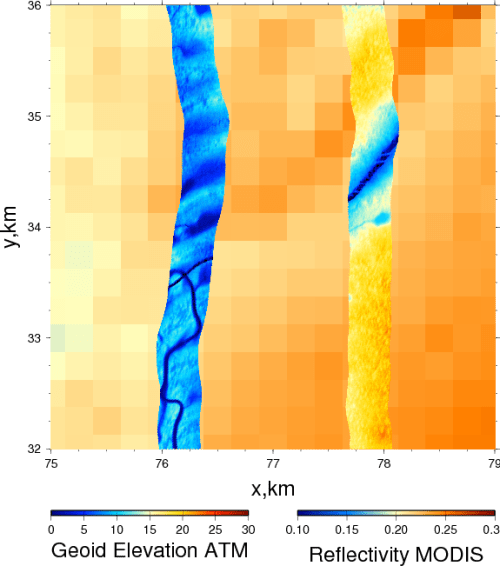
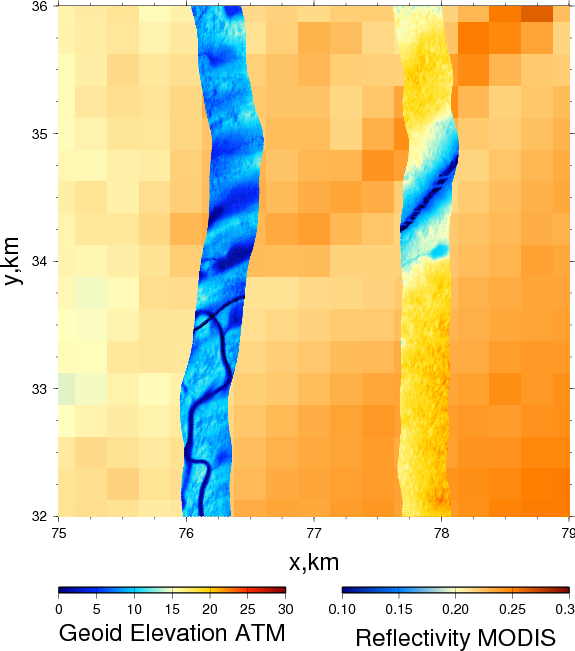
Petermann Glacier surface elevation from laser shots on Mar.-24, 2010 at the site where the Manhattan-sized ice island formed Aug.-6, 2010. The background shows the same scene at the same time at 250-m resolution from MODIS (see below). Colors along the 350-m wide laser track line show height above sea level in meters.
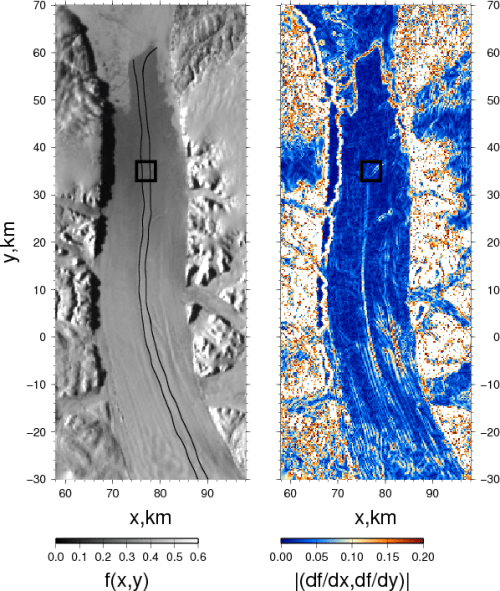
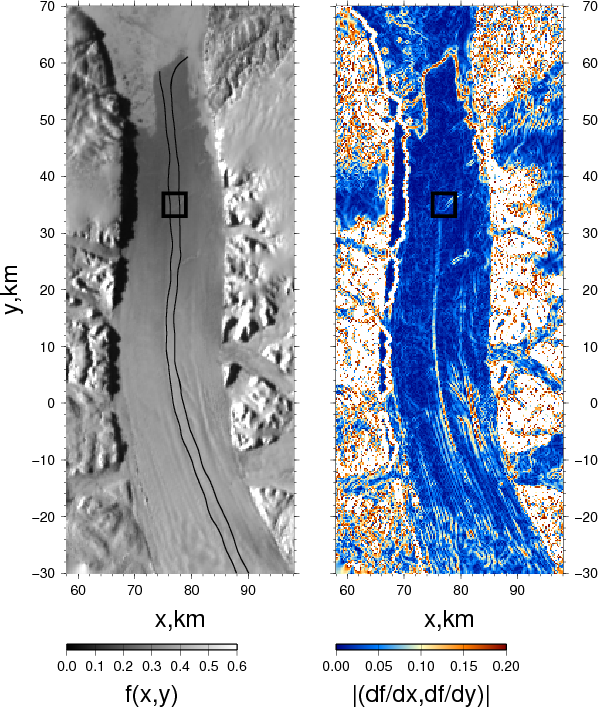
Petermann Glacier on March 24, 2010 as seen from MODIS satellite at 250-m resolution with two flight tracks along which laser data are collected. The black box shows the site of the figure above. The color figure on the right shows the slope or gradients of the data shown on left. It emphasizes regions where brightness changes fast. Multivariate calculus is useful!

We see two tracks: the one on right (east) has the ice stick more than 20-m above sea level (yellow colors) while about a mile to left (west) the ice’s surface elevation is only 10-m above sea level (light blue). Since the ice is floating and densities of ice and water are known, we can invert this height into an ice thickness. Independent radar measurements from the same track prove that this “hydrostatic” force balance holds, the glacier is indeed floating, so, multiply surface elevation by 10 and you got a good estimate of ice thickness. The dark blue colors of thin ice show meandering rivers and streams, ponds and undulations, as well as a rift or hairline fracture from east to west. This rift is visible both in the right and left track, it is the line along which the glacier will break to form the 2010 ice island. All ice towards the top of this rift has long left the glacier and some of it has hit Newfoundland as seen from the International Space Station by astronaut Ron Garan:
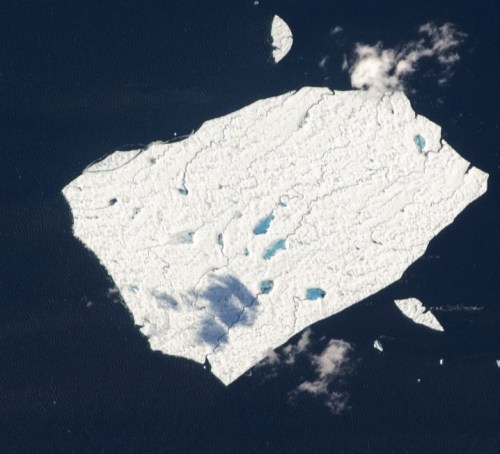
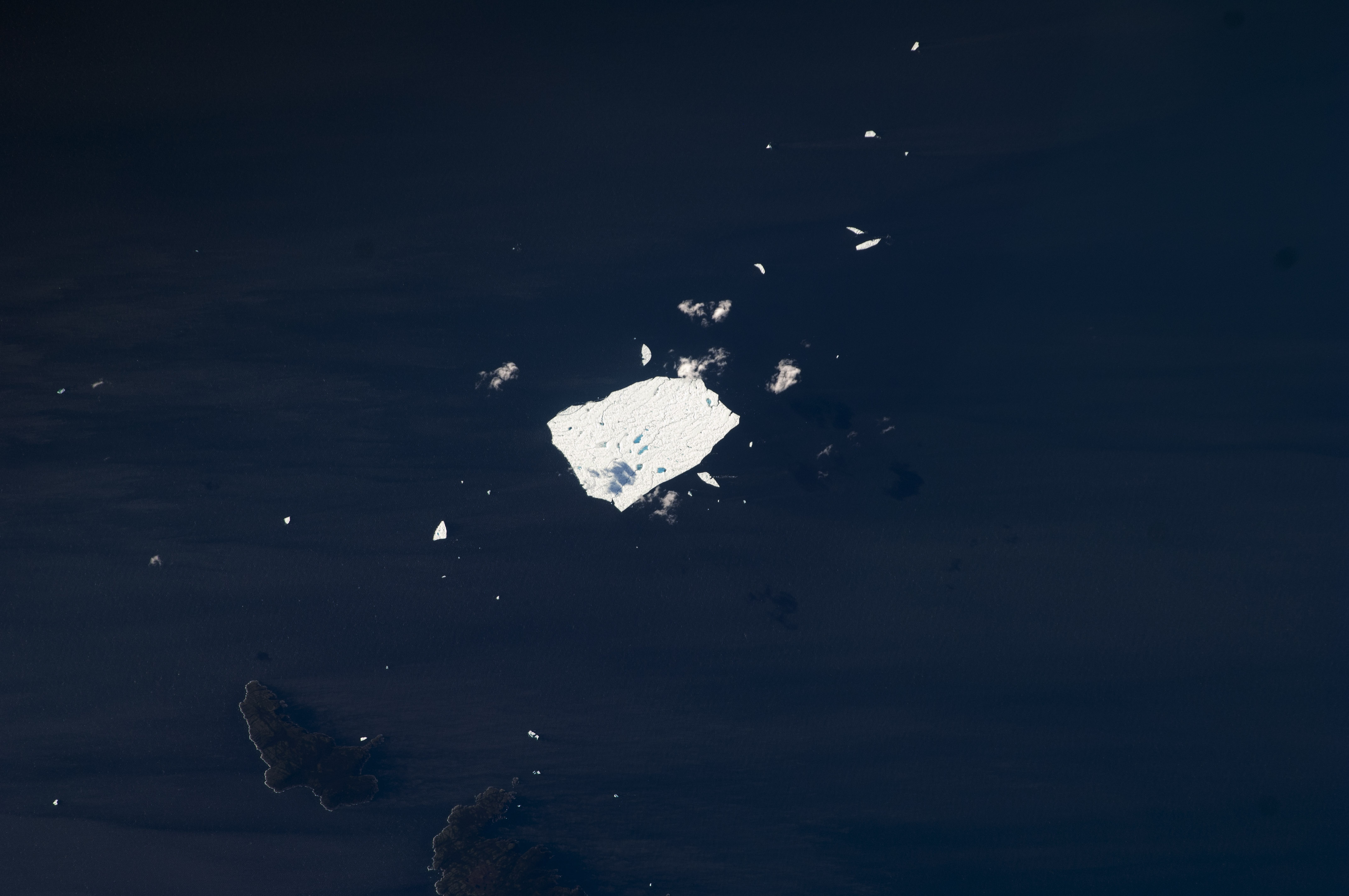
Last remnant of Petermann Ice Island 2010-A as seen from the International Space Station on Aug.-29, 2011 when it was about 3.5 km wide and 3 km long [Photo credit: Ron Garan, NASA]

Both are images of Petermann ice. The photo measures the brightness that hits the lens, but the laser measures both brightness and ice thickness. The laser acts like flash photography: When it is dark, we use a flash to provide the light to make the object “bright.” Now imagine that your camera also measures the time between the flash leaving your camera and brightness from a reflecting object to return it. What you think happens at an instant actually takes time as light travels fast, but not infinitely fast. So you need a very exact clock to measure the distance from your camera to the object. Replace the flash of the camera with a laser, replace the lens of your camera with a light detector and a timer, place the device on a plane, and you got yourself an airborne topographic altimeter. So, what use is there for this besides making pretty and geeky pictures?

The laser documents some of the change in “climate change.” Greenland’s glaciers and ice-sheets are retreating and shrinking. Measuring the surface and bottom of the ice over Greenland with lasers and radars gives ice thickness. The survey lines above were flown in 2002, 2003, 2007, 2010, and 2011. These data are a direct and accurate measure on how much ice is lost or gained at Petermann Gletscher and what is causing it. My bet is on the oceans which in Nares Strait and Petermann Fjord have increased the last 10 years to melt the floating glacier from below.

There is more, but Mia Zapata of the Gits sings hard of “Another Shot of Whiskey.” What a voice …

ResearchBlogging.org

Johnson, H., Münchow, A., Falkner, K., & Melling, H. (2011). Ocean circulation and properties in Petermann Fjord, Greenland Journal of Geophysical Research, 116 (C1) DOI: 10.1029/2010JC006519

Krabill, W., Abdalati, W., Frederick, E., Manizade, S., Martin, C., Sonntag, J., Swift, R., Thomas, R., & Yungel, J. (2002). Aircraft laser altimetry measurement of elevation changes of the greenland ice sheet: technique and accuracy assessment Journal of Geodynamics, 34 (3-4), 357-376 DOI: 10.1016/S0264-3707(02)00040-6

Münchow, A., Falkner, K., Melling, H., Rabe, B., & Johnson, H. (2011). Ocean Warming of Nares Strait Bottom Waters off Northwest Greenland, 2003–2009 Oceanography, 24 (3), 114-123 DOI: 10.5670/oceanog.2011.62

Thomas, R., Frederick, E., Krabill, W., Manizade, S., & Martin, C. (2009). Recent changes on Greenland outlet glaciers Journal of Glaciology, 55 (189), 147-162 DOI: 10.3189/002214309788608958

Nares Strait Ice Arches and Petermann Ice Island 2012

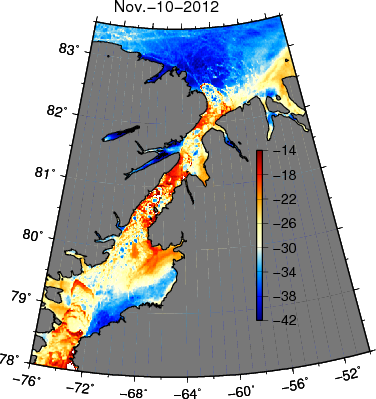
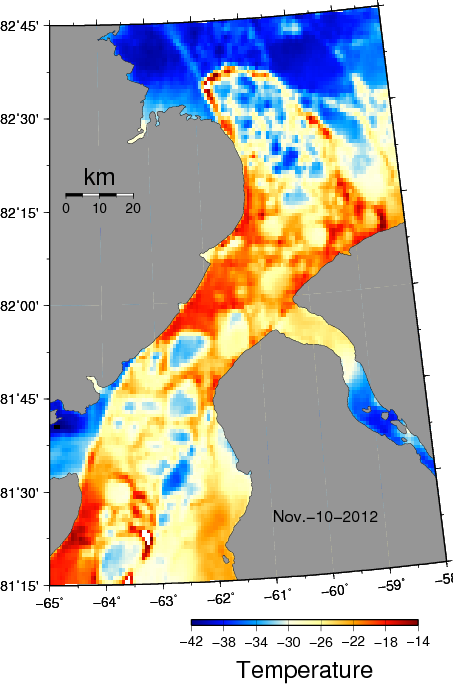
Arching barriers of ice locked solidly to land are presently closing off Nares Strait for all ice leaving or entering this ocean passage from the Arctic to the North Atlantic Oceans. Gothic cathedrals have flying buttressing to hold them in place while ice arches have buttressing land that keeps them stable. The sea ice becomes land-fast until these ice arches collapse in June or early July. As the ocean under the ice is still moving, generally from north to south, one often finds very thin ice or even open water to the immediate south of these ice arches. Some of these temperature signals let us “see” large ice structures even in the dark of night which in Nares Strait lasts from early October to late March.

Surface temperature in degrees Celsius for Nares Strait on Nov.-10, 2012 from MODIS Terra. Thick ice is blue (cold) while thin ice is red (warm).

Surface temperature at the northern entrances to Nares Strait with the Arctic Ocean to the north.

Surface temperature at the southern entrance of Nares Strait with the North Atlantic Ocean to the south.

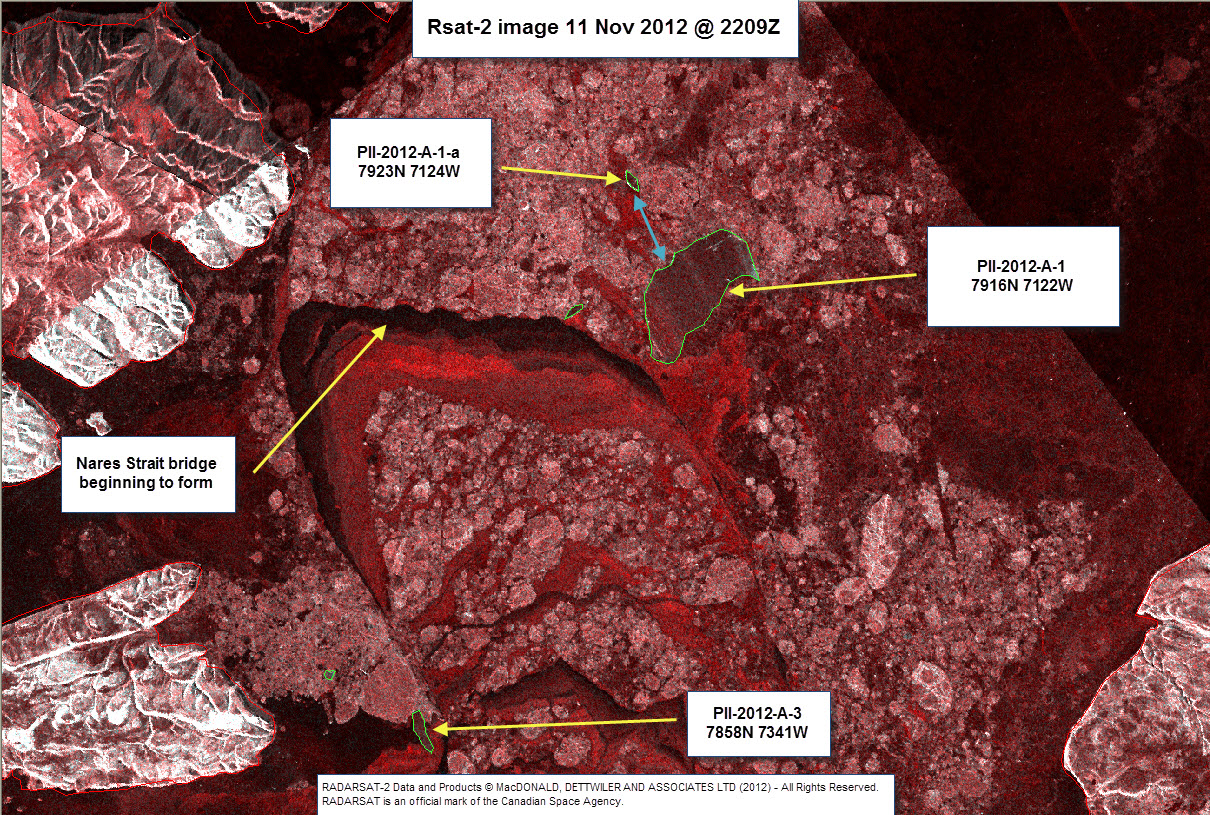
Southern entrance of Nares Strait as seen from RADARSAT showing ice arch formation in more spatial detail than MODIS temperatures do. Note the embedded ice island PII-2012 from Petermann Gletscher at the north-eastern edge of the ice arch. [Credit: Luc Desjardins, Canadian Ice Service]

These ice arches usually form in December or January, but this year they form a little earlier than usual. In some years such as 2006/07 or 2009/10 and 2010/11 they did not form at all and thick multi-year ice left the Arctic via a passage that is now closed. This leaves only Fram Strait to the east of Greenland for such export this year.

It appears that the large ice island that broke free from Petermann Gletscher earlier this year provides some stabilizing support to the southern ice arch as it is anchoring its north-eastern corner where it is possibly grounded. The depth of the ice island PII-2012-A1 is about 180 to 200 meters thick. I derived this estimate from both NASA’s Airborne Topographic Mapper (ATM) and the University of Kansas’s Radar Depth Sounder both flown concurrently on a DC-8 plane that surveyed Petermann Gletscher on May-7, 2011 with PII-2012-A1 still attached:

Profile of Petermann Glacier from laser (red) and radar (black) measurements on May-07, 2011. The 2012 break-up is indicated by a spike of the red under-ice topography near km-22. Bottom profiles from laser assume hydrostatic balance of floating ice.

The ATM is a scanning laser that measures the distance from the DC-8 to the surface within 0.2 meters (about 6-7 inches). If I know both the true sea level surface (I do, it’s called the geoid) and if the ice is floating undisturbed, then I can convert the surface elevation into a bottom draft. The red curve outlines the “theoretical” bottom of the glacier. This curve is masked by a thicker black curve that is a radar-derived image of the under-side of the glacier. Nothing theoretical about that one. These radar measurements agree closely with the red curves indicating an almost perfectly balanced floating glacier. This “balance” breaks down at two important points: (1) Near -20 km the glacier bottom is shallower than the red draft curve and it is here that the glacier sits on land as it is not floating. (2) Near +22 km we see a large red spike. This is the location of the 2012 break-up.

So, the 2012 ice-island that is anchoring the ice arch in southern Nares Strait is the piece of the glacier to the right of the red spike and with these data I can now conclude that PII-2012 was 11 km long, 15 km wide, and about 200 m deep. This Manhattan-sized ice-cube weights about 30 gigatons (10^12 kg), but “… that doesn’t mean much — who goes to the store and buys a gigaton of carrots? For a sense of perspective, a gigaton is about twice the mass of all people on earth …” [James Fallows writing for The Atlantic]. Hence this little ice-cube weights 50 times as much as do all people living on earth today. Incidentally, it is also the amount of CO2 that all humanity adds each year to the atmosphere. Coincidence.

Front of Petermann Glacier Aug.-11, 2012. View is from a small side-glacier towards the south-east across Petermann Fjord with Petermann Gletscher to the left (east). [Photo Credit: Erin Clark, Canadian Coast Guard Ship Henry Larsen]