Category Archives: Ice Cover

Shades of White as the Sun Rises over Nares Strait

After four months of total darkness the sun is back up in Nares Strait. It transforms the polar night into thousand shades of white as mountains, glaciers, and ice take in and throw back the new light. Our satellites receive some of the throw-away light as the landscape reflects it back into space. During the long dark winter months these satellites could only “see” heat, but this will change rapidly as Alert atop of Arctic Canada receives 30 minutes more sun with each passing day.
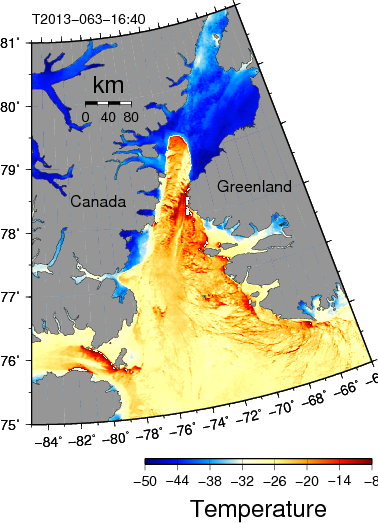
Surface temperature in degrees centigrade over northern Baffin Bay on March-4, 2013 16:20 UTC from MODIS Terra.

Surface temperature in degrees centigrade over northern Baffin Bay on March-4, 2013 16:20 UTC from MODIS Terra. Warm colors (reds) show thin and/or ice while cold colors (blues) suggest thick ice stuck in place.

A very strong ice arch at the southern entrance to Nares Strait separates thick (and cold) ice to north from thin (and warm) ice to the south. The thick and cold ice is not moving, it is stuck to land, but the ocean under the ice is moving fast from north to south. The ocean currents thus sweep the newly formed thin ice away to the south. This ice arch formed way back in early November just after the sun set for winter over Nares Strait.

Now that the sun is up, we can also “see” more structures in the ice by the amount of light reflected back to space. A very white surface reflects lots while a darker surface reflects less. We are looking at the many shades of white here … even though I color them in reds and blues:

Surface reflectance at 865 nm in northern Baffin Bay on March-4, 2013 16:20 UTC from MODIS Terra.

Surface reflectance at 865 nm in northern Baffin Bay on March-4, 2013 16:20 UTC from MODIS Terra. A true color image (which this is not) would show only white everywhere. Hence I show the very bright white as red and the less bright white as blue. This artificial enhancement makes patterns and structures more visible to the eye.

Zooming into the area where the ice arch separates thick ice to the north that is not moving from thin ice in the south that is swept away by ocean currents, I show this image at the highest possible resolution:

Surface reflectance at 865 nm at the southern entrance to Nares Strait on March-4, 2013. Contours are 200-m bottom depth showing PII2012 grounded at the north-eastern sector of the ice arch.

Surface reflectance at 865 nm at the southern entrance to Nares Strait on March-4, 2013. Contours are 200-m bottom depth showing PII2012 grounded at the north-eastern sector of the ice arch.

Note, however, that the sun is far to south and barely peeking over the horizon. This low sun angle shows up as shadows cast by mountains. And since the sun is still far to the south, the shadows cast are to the north. This “shadow” makes visible the ice island from Petermann Gletscher that anchors this ice arch as it is grounded. I labeled it PII2012 in the picture.

From laser measurements we know that the ice islands stands about 20 meter (or 60 feet) above the rest of the ice field. This height is enough to cast a visible shadow towards the north (slightly darker = less red) as well as a direct reflection off its vertical wall facing south (brighter = more red) towards the sun. At its thickest point, PII2012 is about 200 meters (~600 feet) thick. For this reason, I also show the 200-m bottom contour that moves largely from north to south along both Ellesmere Island, Canada on the left and Greenland on the right.

The sun brings great joy to all, especially those hardy souls who live in the far north. The sun’s rise also shows the delicate interplay of light and shadows that we can use to solve puzzles on how ice, oceans, and glaciers work. At the entrance of Nares Strait the playful delights of the sea ice, ocean currents, and ice islands gives us a large area of thin ice. The thin ice will soon melt and perhaps has already started to set into motion a spring bloom of ocean plants. Ocean critters will feed on these to start another cycle of life. Whales, seals, and polar bears all depend on it for 1000s of years now.

Sketch of the biological pieces that a large area of open water near a fixed ice edge like that of a polynya may support. [From Northern Journal>/a>]

Sketch of the biological pieces that a large area of open water near a fixed ice edge like that of a polynya may support. [From Northern Journal]

Did I ever see a Polar Bear?

When people hear that I have worked as a physical oceanographer in the Arctic for almost 20 years, their first question is often: “Did you ever see a Polar Bear?” The answer is a yes, but when we see bears, it is usually as a tiny moving speck of yellowish white near the white, icy, and hazy horizon. Only twice was it different. The first time was in October 2003 to the north-west off Arctic Alaska when a young bear swam towards and around the U.S. Coast Guard Cutter Healy doing station work:

Polar Bear seen Oct.-10, 2003 from aboard the USCGS Healy to the north-east of Alaska [Credit: Andreas Muenchow, University of Delawarel]

Polar Bear seen Oct.-10, 2003 from aboard the USCGC Healy to the north-east of Alaska [Credit: Andreas Muenchow, University of Delaware]

The second close encounter was last year as the Canadian Coast Guard Ship Henry Larsen was about to leave Nares Strait on Aug.-12. Out of the 100+ pictures snapped of this bear, the ship’s Steward Kirk McNeil of Labrador probably took the best shot:

Polar bear as seen in Kennedy Channel on Aug.-12, 2012. [Photo Credit: Kirk McNeil, Labrador from aboard the Canadian Coast Guard Ship Henry Larsen]

Polar bear as seen in Kennedy Channel on Aug.-12, 2012. [Photo Credit: Kirk McNeil, Labrador from aboard the Canadian Coast Guard Ship Henry Larsen]

This bear approached the drifting ship leisurely over a 10 minutes period from a large piece of ice that also drifted with the tides and currents. My PhD student Pat Ryan captured the last 2 minutes of this visit with her iPhone. The voice is hers (I also discern the voice of Ice Specialist Erin Clarke). Greenland is in the background to the east:

ADDENDUM Feb.-13, 2013: I just found this map of the spatial distribution of polar bears from a Dec.-23, 2012 article in the Washington Post by Juliet Eilperin entitled “Polar bear trade, hunting spark controversy.” Writing for the Wall Street Journal Feb.9, 2013, Zac Unger commented with the question “Are polar bears really disappearing?”

Polar bear population and their trends. [Source: Polar Bear Specialist Group. Laris Karklis/The Washington Post. Published on December 23, 2012, 5:24 p.m.]

Polar bear population and their trends. [Source: Polar Bear Specialist Group. Laris Karklis/The Washington Post. Published on December 23, 2012, 5:24 p.m.]

Addendum Feb.-25, 2013: A very funny bear commercial.

Nares Strait Ice Arches and Petermann Ice Island 2012

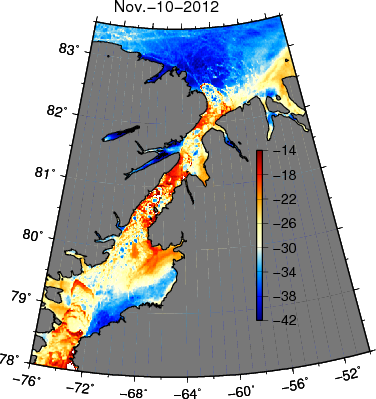
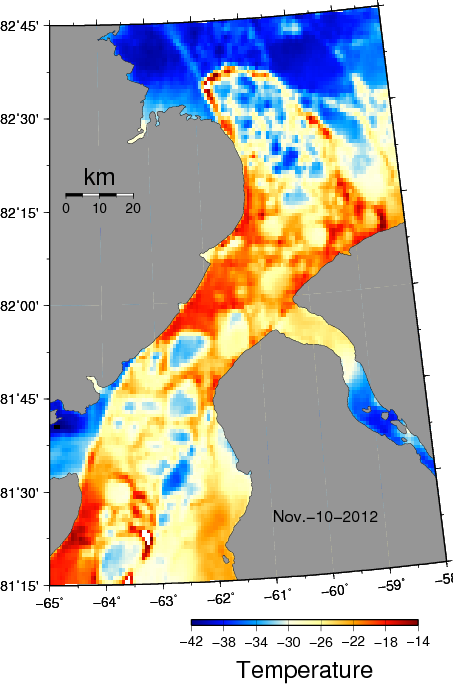
Arching barriers of ice locked solidly to land are presently closing off Nares Strait for all ice leaving or entering this ocean passage from the Arctic to the North Atlantic Oceans. Gothic cathedrals have flying buttressing to hold them in place while ice arches have buttressing land that keeps them stable. The sea ice becomes land-fast until these ice arches collapse in June or early July. As the ocean under the ice is still moving, generally from north to south, one often finds very thin ice or even open water to the immediate south of these ice arches. Some of these temperature signals let us “see” large ice structures even in the dark of night which in Nares Strait lasts from early October to late March.

Surface temperature in degrees Celsius for Nares Strait on Nov.-10, 2012 from MODIS Terra. Thick ice is blue (cold) while thin ice is red (warm).

Surface temperature at the northern entrances to Nares Strait with the Arctic Ocean to the north.

Surface temperature at the southern entrance of Nares Strait with the North Atlantic Ocean to the south.

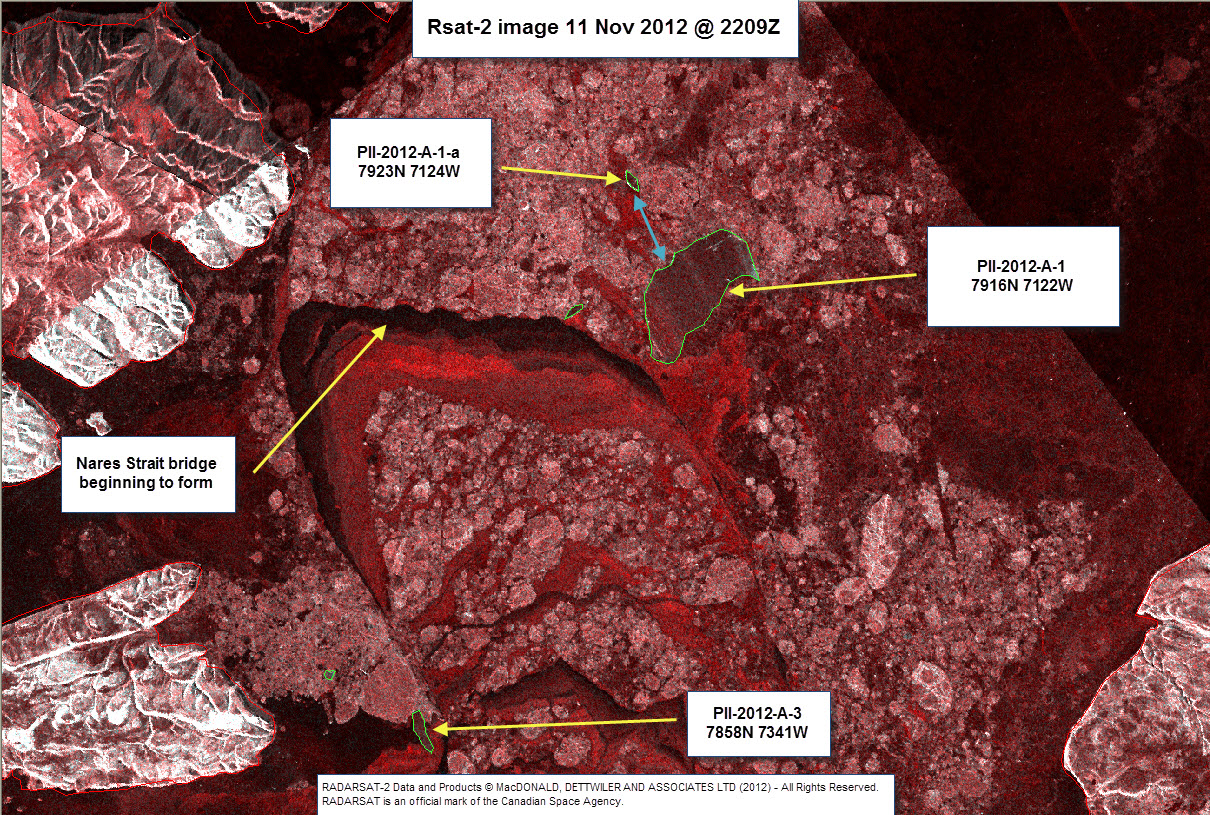
Southern entrance of Nares Strait as seen from RADARSAT showing ice arch formation in more spatial detail than MODIS temperatures do. Note the embedded ice island PII-2012 from Petermann Gletscher at the north-eastern edge of the ice arch. [Credit: Luc Desjardins, Canadian Ice Service]

These ice arches usually form in December or January, but this year they form a little earlier than usual. In some years such as 2006/07 or 2009/10 and 2010/11 they did not form at all and thick multi-year ice left the Arctic via a passage that is now closed. This leaves only Fram Strait to the east of Greenland for such export this year.

It appears that the large ice island that broke free from Petermann Gletscher earlier this year provides some stabilizing support to the southern ice arch as it is anchoring its north-eastern corner where it is possibly grounded. The depth of the ice island PII-2012-A1 is about 180 to 200 meters thick. I derived this estimate from both NASA’s Airborne Topographic Mapper (ATM) and the University of Kansas’s Radar Depth Sounder both flown concurrently on a DC-8 plane that surveyed Petermann Gletscher on May-7, 2011 with PII-2012-A1 still attached:

Profile of Petermann Glacier from laser (red) and radar (black) measurements on May-07, 2011. The 2012 break-up is indicated by a spike of the red under-ice topography near km-22. Bottom profiles from laser assume hydrostatic balance of floating ice.

The ATM is a scanning laser that measures the distance from the DC-8 to the surface within 0.2 meters (about 6-7 inches). If I know both the true sea level surface (I do, it’s called the geoid) and if the ice is floating undisturbed, then I can convert the surface elevation into a bottom draft. The red curve outlines the “theoretical” bottom of the glacier. This curve is masked by a thicker black curve that is a radar-derived image of the under-side of the glacier. Nothing theoretical about that one. These radar measurements agree closely with the red curves indicating an almost perfectly balanced floating glacier. This “balance” breaks down at two important points: (1) Near -20 km the glacier bottom is shallower than the red draft curve and it is here that the glacier sits on land as it is not floating. (2) Near +22 km we see a large red spike. This is the location of the 2012 break-up.

So, the 2012 ice-island that is anchoring the ice arch in southern Nares Strait is the piece of the glacier to the right of the red spike and with these data I can now conclude that PII-2012 was 11 km long, 15 km wide, and about 200 m deep. This Manhattan-sized ice-cube weights about 30 gigatons (10^12 kg), but “… that doesn’t mean much — who goes to the store and buys a gigaton of carrots? For a sense of perspective, a gigaton is about twice the mass of all people on earth …” [James Fallows writing for The Atlantic]. Hence this little ice-cube weights 50 times as much as do all people living on earth today. Incidentally, it is also the amount of CO2 that all humanity adds each year to the atmosphere. Coincidence.

Front of Petermann Glacier Aug.-11, 2012. View is from a small side-glacier towards the south-east across Petermann Fjord with Petermann Gletscher to the left (east). [Photo Credit: Erin Clark, Canadian Coast Guard Ship Henry Larsen]

Arctic Sea Ice Cover and Extreme Weather Explained

Addendum Sept.-24, 2012: A New Climate State, Arctic Sea Ice 2012 (video by Peter Sinclair).

I just discovered an outstanding interview that Dr. Jennifer Francis of Rutgers University gave to a non-profit community radio station out of Vancouver, British Columbia.

Jennifer Francis Interview 20120910

She connects and explains global warming, its much amplified signal in the Arctic, the extreme record minimal Arctic sea ice cover this summer, and how the warming Arctic and its disappearing sea ice impacts our weather in the northern hemisphere by slowing down the atmospheric jet stream separating polar from mid-latitude air masses. She explains all of this in non-technical language without loss of accuracy.

Dr. Jennifer Francis, Rutgers University [Photo Credit: ARCUS]

If this program piques your interest and you want to read more, Andrew Revkin of the New York time has led an informed discussion at his New York Times blog Dot Earth. And finally, Climate Central presented and illustrated Dr. Francis’ observations and ideas rather well with graphics and videos.

Ice Thickness in Nares Strait 2008 and 2009

[Editor’s Note: Undergraduate Julie Jones of the University of Delaware summarizes her work that was supervised by Helga Huntley as part of an NSF-funded summer internship.]

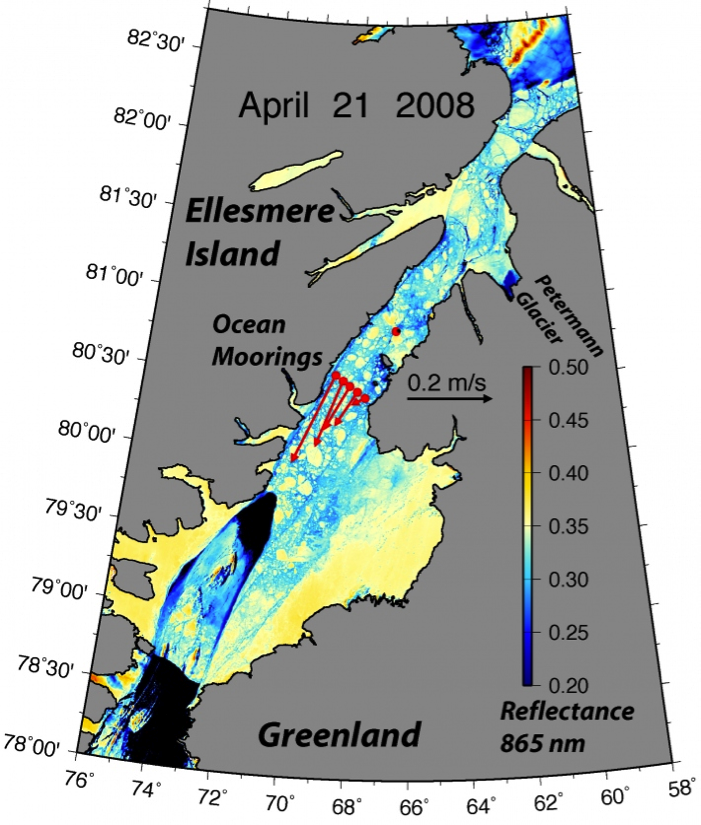
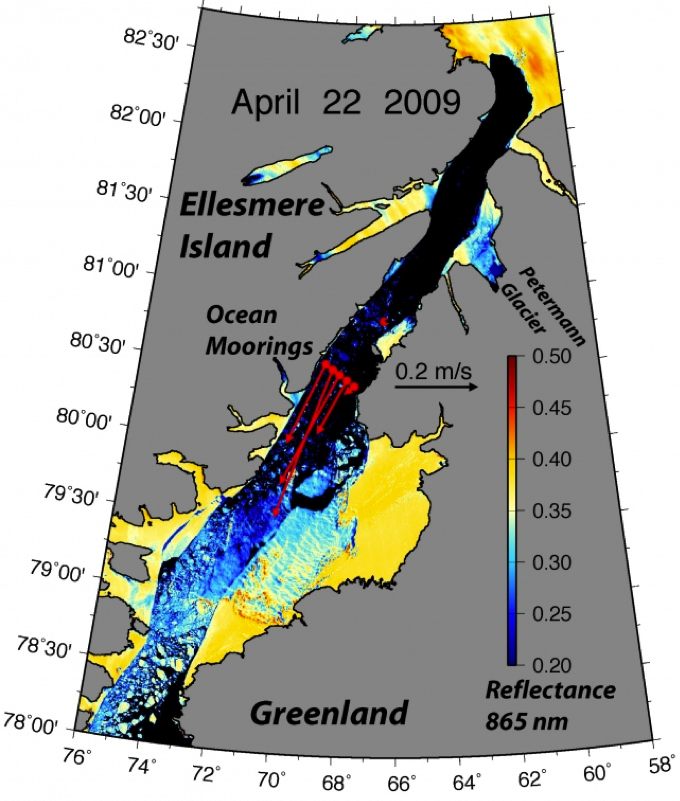
Three years ago in 2009 Andreas Muenchow left from Delaware for Greenland with students Pat Ryan and Berit Rabe to recover instruments that recorded salinity, temperature, current velocities, and ice thickness in Nares Strait since 2007.  This summer, I used those observations to estimate ice thickness for April through June in 2008 and compare them to estimates for the same spring period in 2009.  An ice bridge had formed in 2008 but not in 2009.  Working as a group, we wanted to investigate the effect of ice arches on the ice thickness.  Allison Einolf, another summer intern who focused on ocean currents during the same time periods and Andreas produced these maps that introduce the study area, spatial ice cover, and mean ocean currents:

Image

Nares Strait MODIS satellite imagery of the study area and ice arch April 21, 2008. Red dots are instrument locations. Arrows show current velocities.

Image

Nares Strait MODIS satellite imagery of the study area and ice arch April 22, 2009. Red dots are instrument locations. Arrows show current velocities. Note the lack of the southern ice arch, but the presence of one north of the study area.

I used Matlab for most of the data processing, more specifically the Ice Profiling Sonar (IPS) Processing Toolbox for Matlab provided by the manufacturer of the instrument that collected the data: ASL Environmental Sciences, Inc. First I transformed the data from the IPS instrument into a range time series.  I then manually “despiked” the data, taking out any data points that were likely due to bubbles or fish within the acoustic path from the sensor system to the ice above and back.  In a second step I wrote a function using sound speed data from Andreas, atmospheric pressure from Dr. Samelson at Oregon State University, and pressure (depth) data from the IPS instrument to get a time series of the thickness of the ice.  In a third step I applied a Lanczos raised cosine filter that was taught as part of a 2012 Summer Intern Page Workshop. Hence I finally had some nicely filtered data for the periods of the April-June of 2008 and 2009.

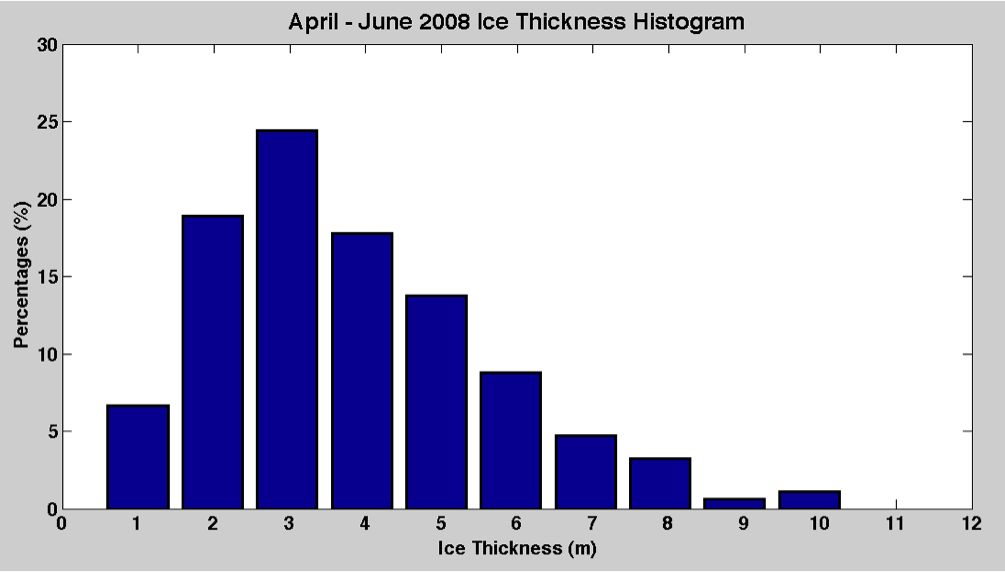
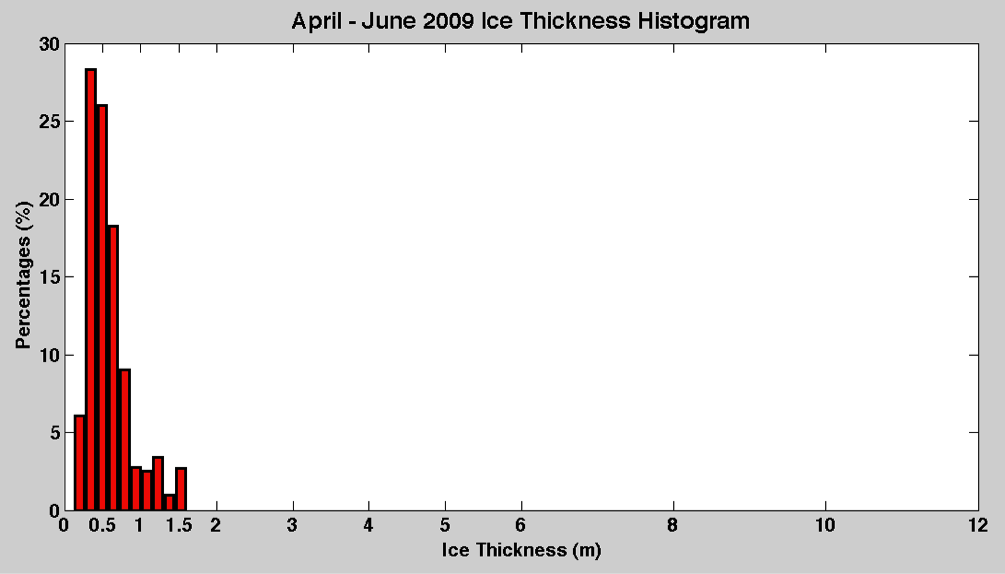
Now the results:  Just as we expected, there was much thicker ice in the 2008 spring with a southern ice arch present than there was in the spring of 2009 when no such ice arch was present:

Histogram for April – June 2008 ice. There is a peak at 3 meters, with almost 25% of the ice that thick.

Histogram for April – June 2009 ice. The ice does not get thicker then 2 meters with most of the ice thinner than one meter.

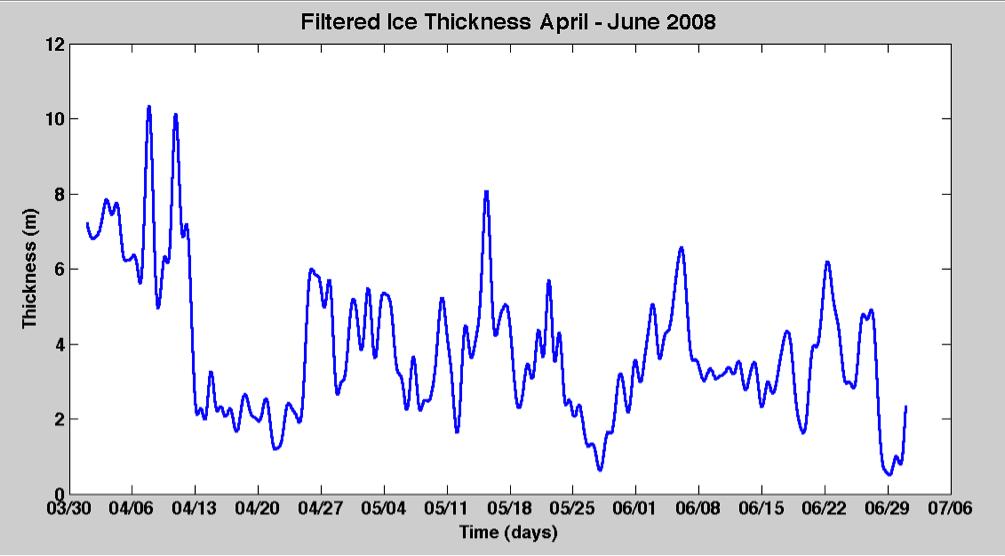
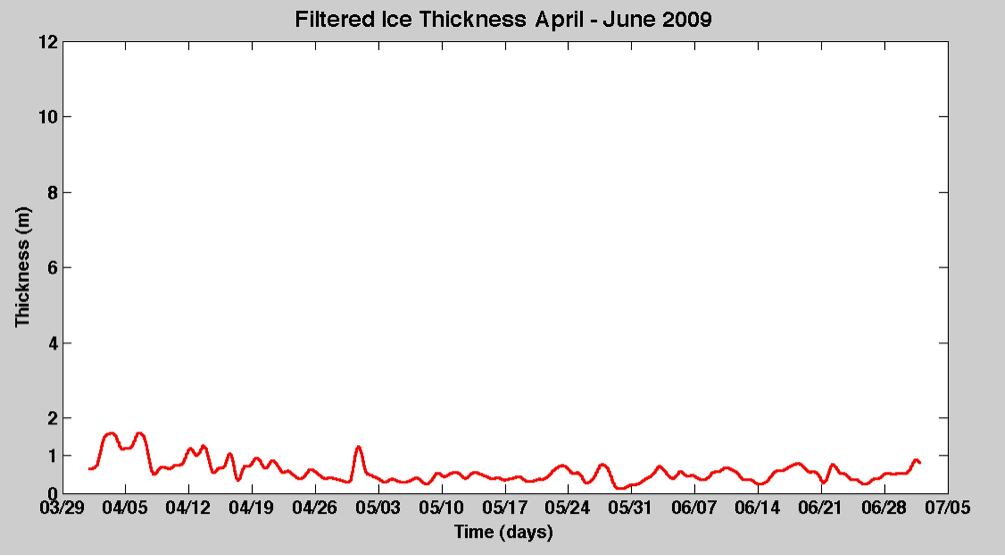
The histograms show thicker ice in 2008, about 2-6 meters on average and with some ice even reaching 10 meters.  In 2009, the ice doesn’t get thicker than 2 meters with most of the ice being thinner than 1 meter.  More specifically, the mean ice thickness for April – June 2008 (2009) is 3.8 (0.58) meters with a standard deviation of 1.8 (0.29) meters.  This further shows that there was thicker ice in 2008 than there was in 2009.  I attributed the cause for the thin 2009 ice to ice flowing freely through Nares Strait all winter and spring as no ice arch in the south blocked such flow.  The ice, thus, did not spend enough time in the high Arctic to thicken.

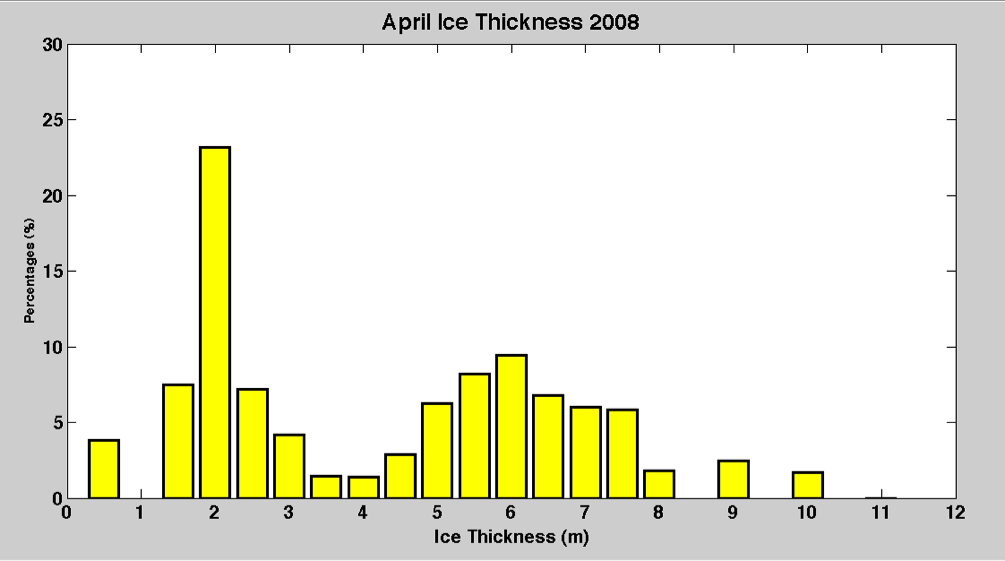
I noticed something else in my histograms when the 2008 ice bridge collapsed.

April 2008 ice thickness

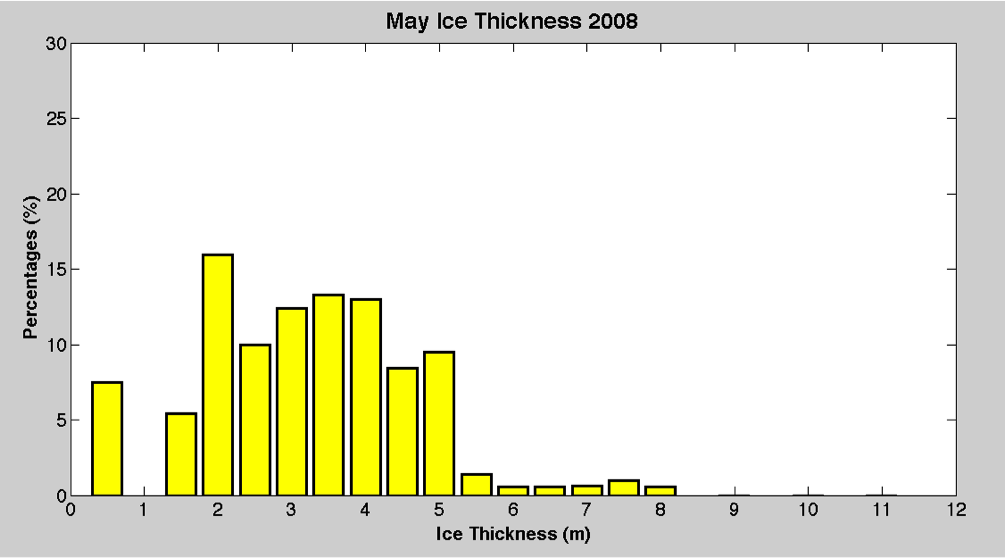
May 2008 ice thickness

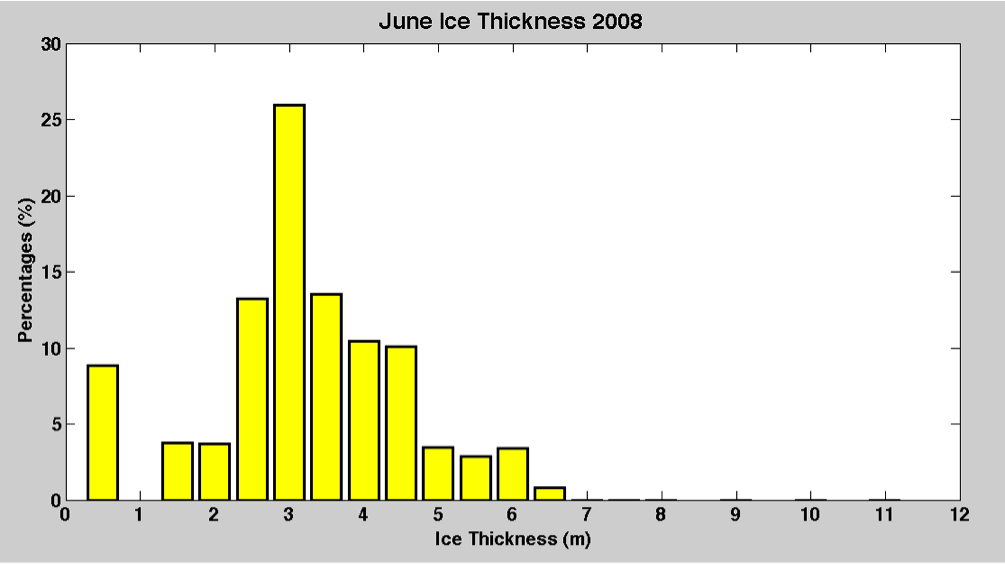
June 2008 Ice Thickness

The monthly histograms show that the ice in April and May is thicker than the ice in June.  We know that the 2008 ice bridge collapsed near June 6th, so it is interesting and it makes a lot of sense that the ice in June would be thinner than the ice two months earlier.

The mean ice thickness for April 2008 was 4.6 meters with a standard deviation of 2.40 meters.  In May 2008 the mean ice thickness was 3.5 meters with a standard deviation of 1.40 meters.  Lastly, in June the mean ice thickness was 3.5 meters with a standard deviation of 1.30 meters.  The ice thickness decreased after April and the variability decreases in June, which helps detect the bridge collapse in the data.

Lastly here are the filtered time series of April – June of 2008 and 2009.

Filtered time series for April – June 2008

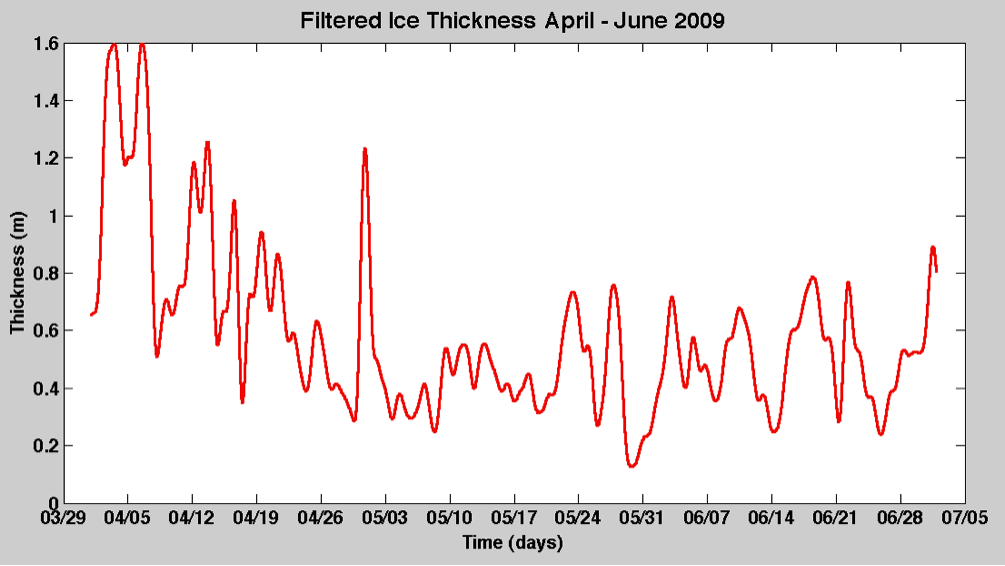
Filtered time Series for April – June 2009 with the same scale as 2008 (above figure)

Filtered time series for April – June 2009 with a different scale to see the variability over time more clearly.

Hopefully we can see more interesting and exciting results from the instruments that the Nares Strait team picked up this summer even though they were hit hard by the 2010 Petermann Ice Island!

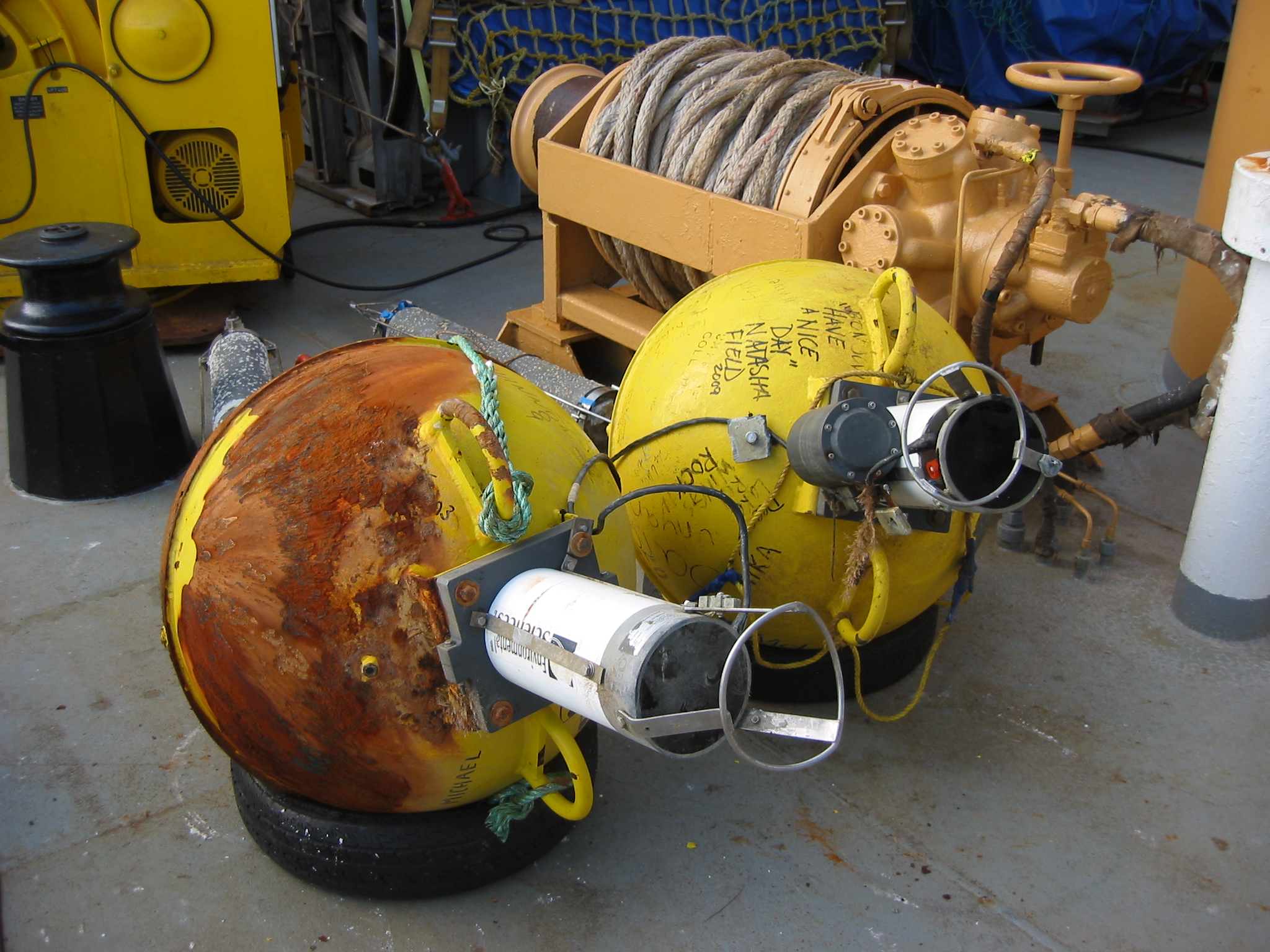
Two Ice Profiling Sonars (IPS) aboard the CCGS Henry Larsen in Aug.-2012. The protective stainless steel frame was bent by the 2010 ice island that hit both instruments in Sept.-2010. [Photo Credit: Andreas Muenchow]