Category Archives: health
Back-Packing to Pioneer Basin in California’s High Sierra: Beaches and Swimming and Trout

Pavla stopped her Suburu Outback on the side of the road in Tuoloume Meadows, Yosemite National Park to pick up a 63-year old hitchhiker who tried to reach his remote Parker/Mono trailhead. First, however, Pavla had to take a swim in the wild local river. Thus she provided the aging back-packer, that was me, with an expert lesson on what to do in California’s back-country when one sees a pristine lake or stream: undress and jump in. And so I did with some hesitation, admittedly, the water was cold after all. Jumping naked into a stream after an attractive woman who had just picked me up from the side of a road, I do not do that naturally, but Pavla taught me how to swim in places like these:

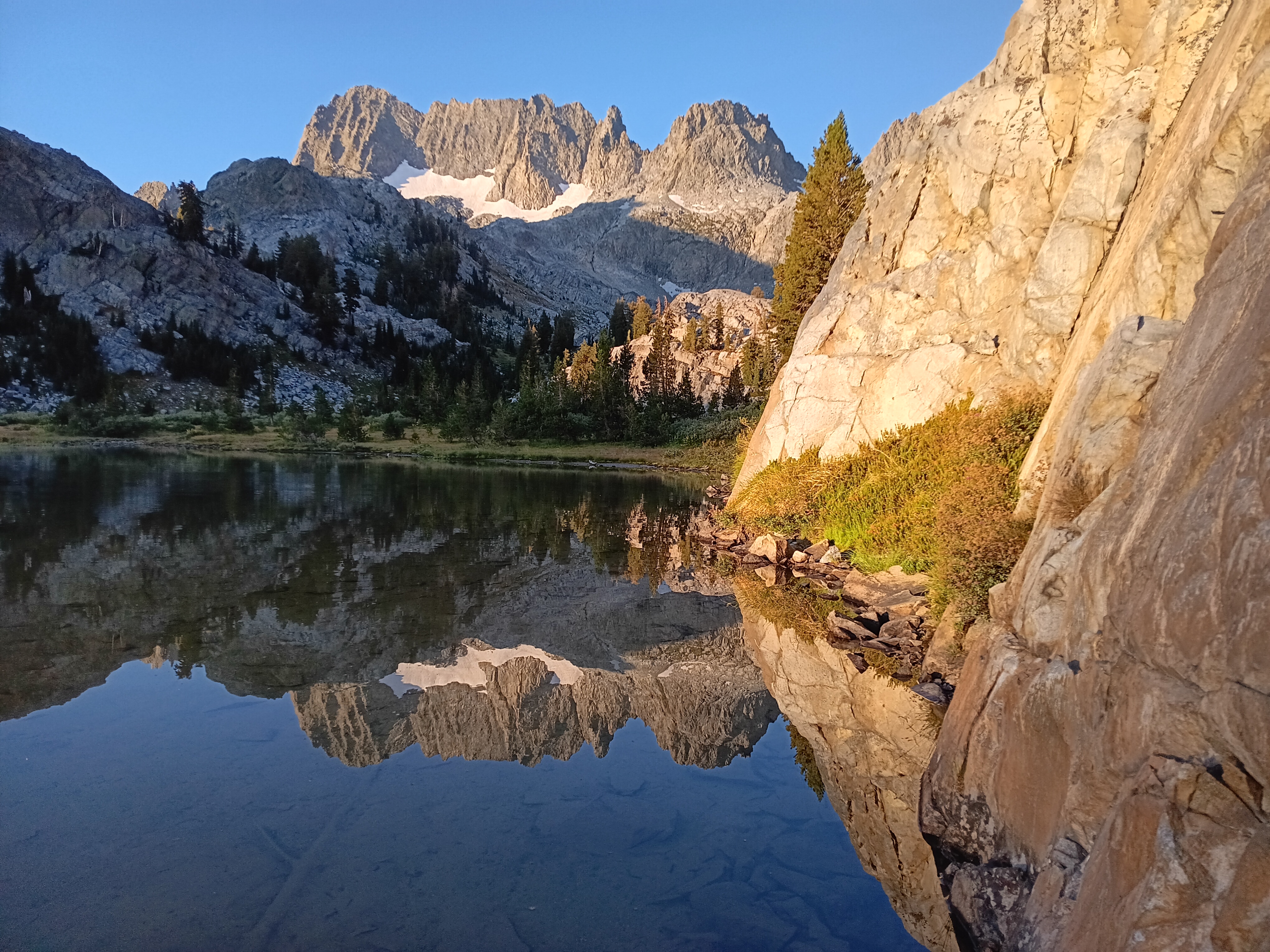
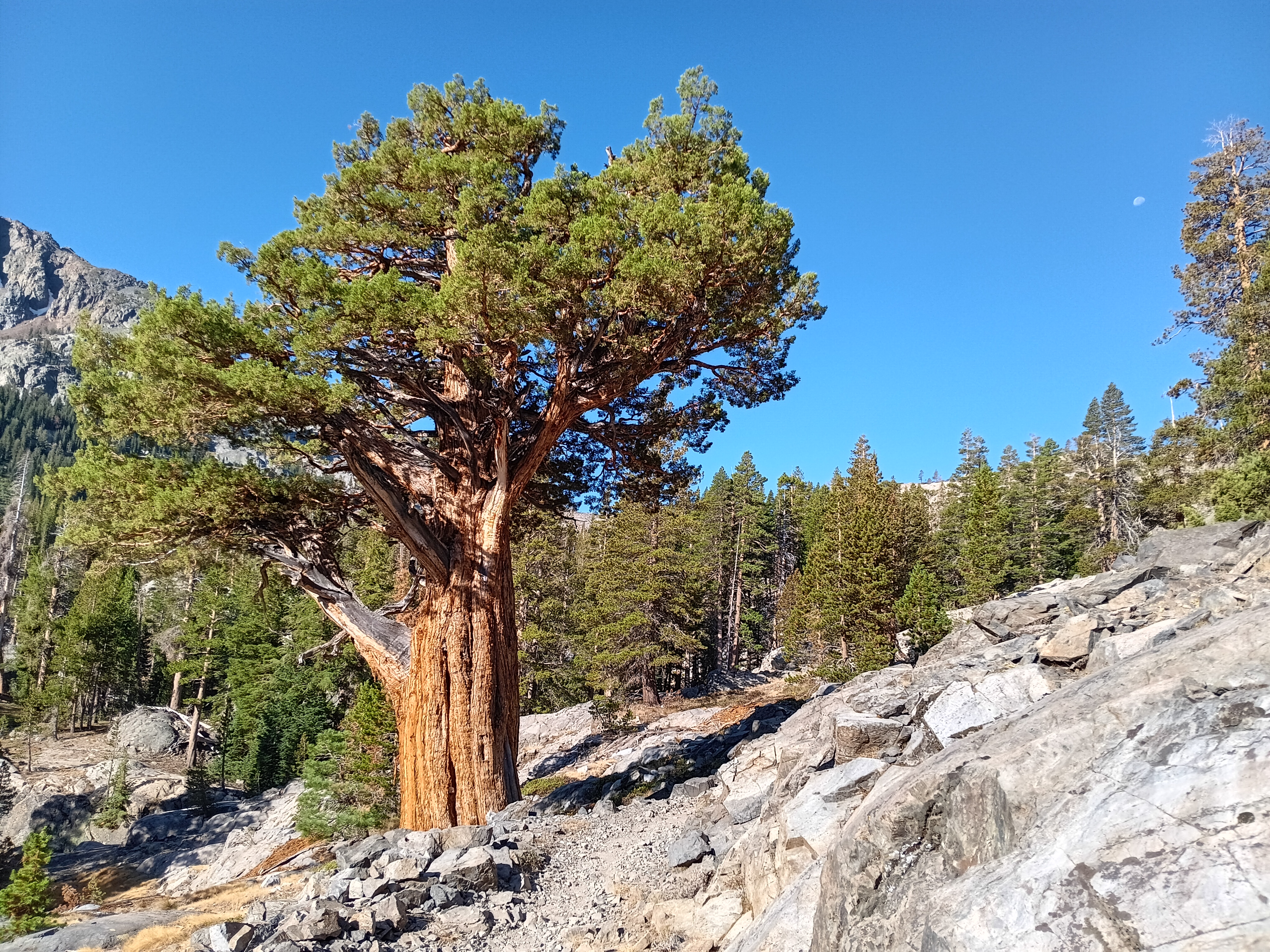
Minaret reflections in Ediza Lake (top left, Aug.-13), Western Cedar tree along the way (top right, Aug.-13), Rush Creek (bottom, Aug.-11), and Rosalie Lake (right center, Aug.-13).

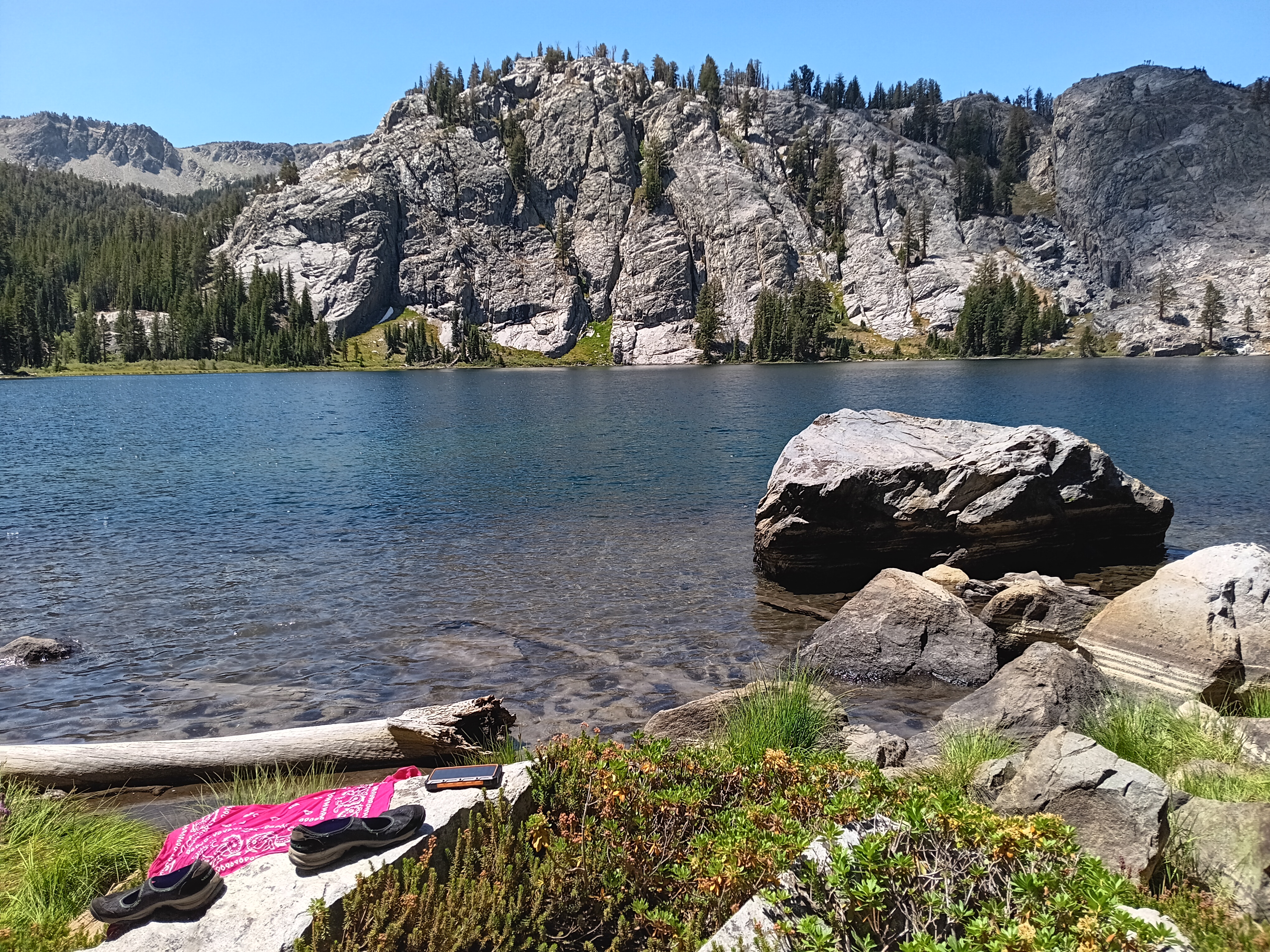
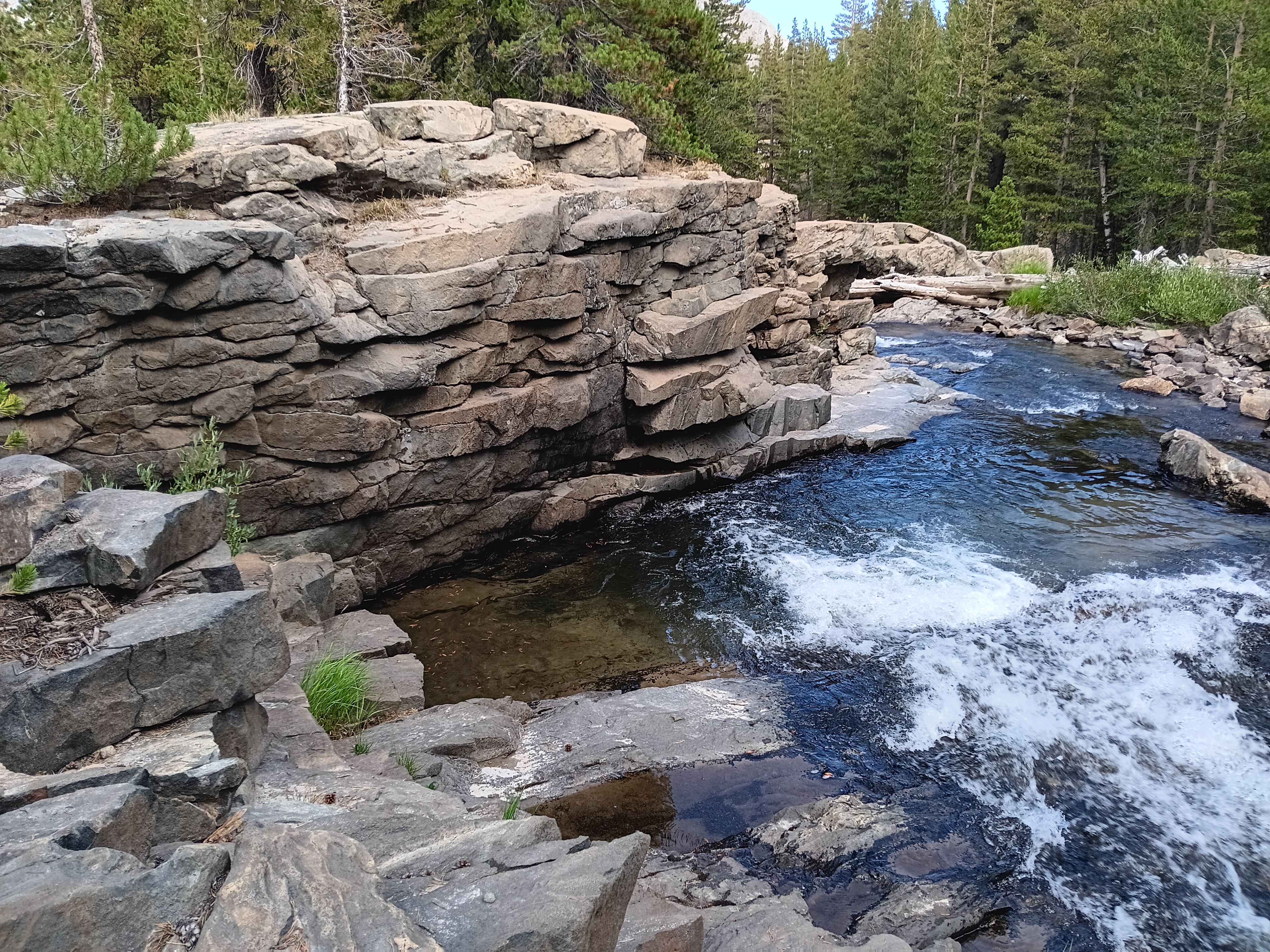
I swam the next 14 days in Rush Creek, Emerald Lake, Ediza Lake, Shadow Lake, Rosalie Lake, McCloud Lake, Duck Lake, Purple Lake, Lake Virginia, Big McGee Lake, Fourth Recess Lake, Pioneer Lake-10817, Pioneer Lake-10871, Pioneer Lake-11194, and lastly Trail Lake. And at each of these daily swims I was alone in or at the water. Only McCloud Lake I shared with two anglers early in the morning, but this lake was about 1/2 mile from the bus stop to the town of Mammoth Lakes, California, where I resupplied myself with food a week into my hike. Passing over Duck Pass the next day, I was now on my way towards Pioneer Basin which was the main goal of this years’ trip into mountains.

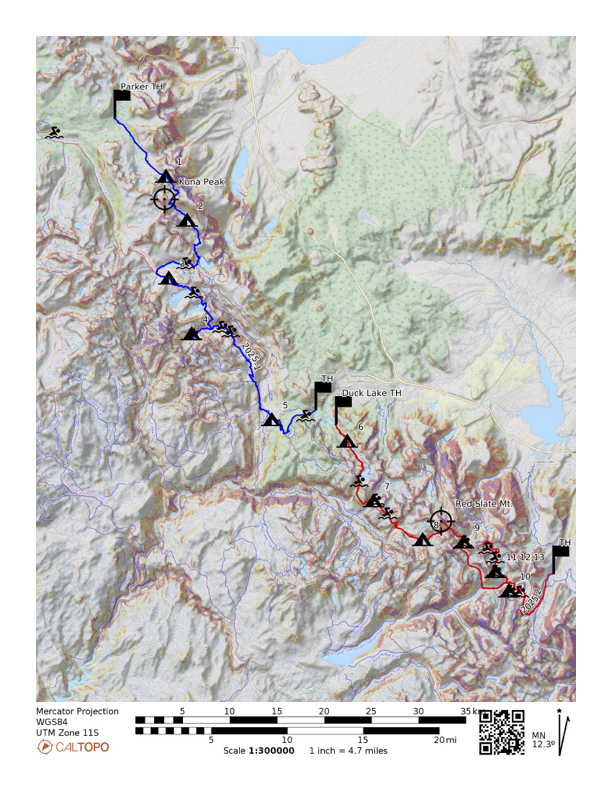
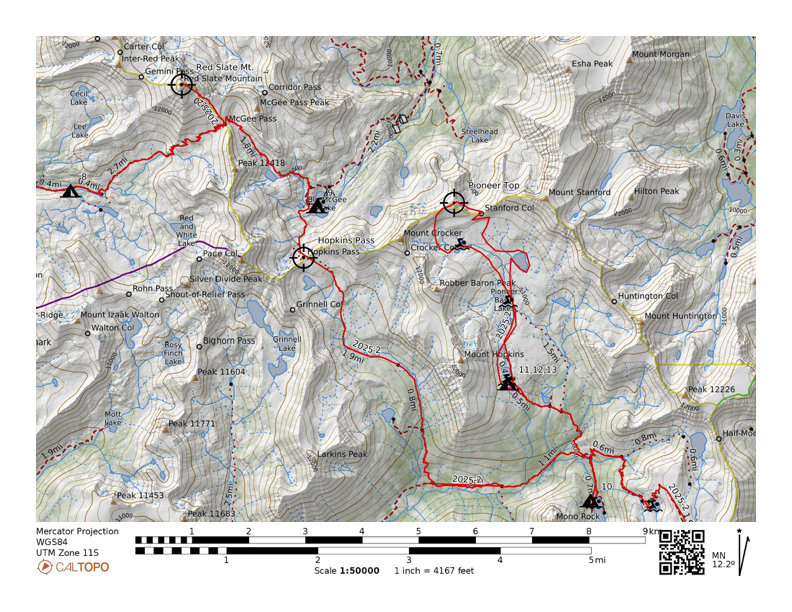
Tracks, camps, and swims during 2025 back-packing trip Aug. 9-22. Flags indicate trailheads with entry in Yosemite National Park in the north (blue track) and John Muir Wilderness in the south (red track). Crosshairs are at Kuna Mountain (13,008′ or 3965 m) in the north and Red Slate Mountain (13,135′ or 4002 m) in the south. Right panel is a close up of McGee Pass, Red Slate Mountain, Hopkins Pass, and Pioneer Basin.

Pavla encouraged me to get into Pioneer Basin which she described as a wild, beautiful, and flatish place with many lakes and no trails. And so it was my home for 3 days and nights. The lack of trails scared me at first, because my 2024 California hike challenged me when my trail disappeared for 3 days in Ansel Adams Wilderness. The “trail” was there in theory, but it was overgrown by waist high brush, young trees, leave piles, and fallen trees after several forest fires raged through the area 10 or 20 years ago. This was at lower altitudes of 7,500′ (2300 m) and thus well below the treeline. In contrast, Pioneer Basin is above the treeline near 11,000′ (3300 m) and surrounded on 3 sides by high mountains to ease navigation. Nevertheless, it was tricky to reach from the north-west, because I had to cross two high passes only one of which had an established trail.

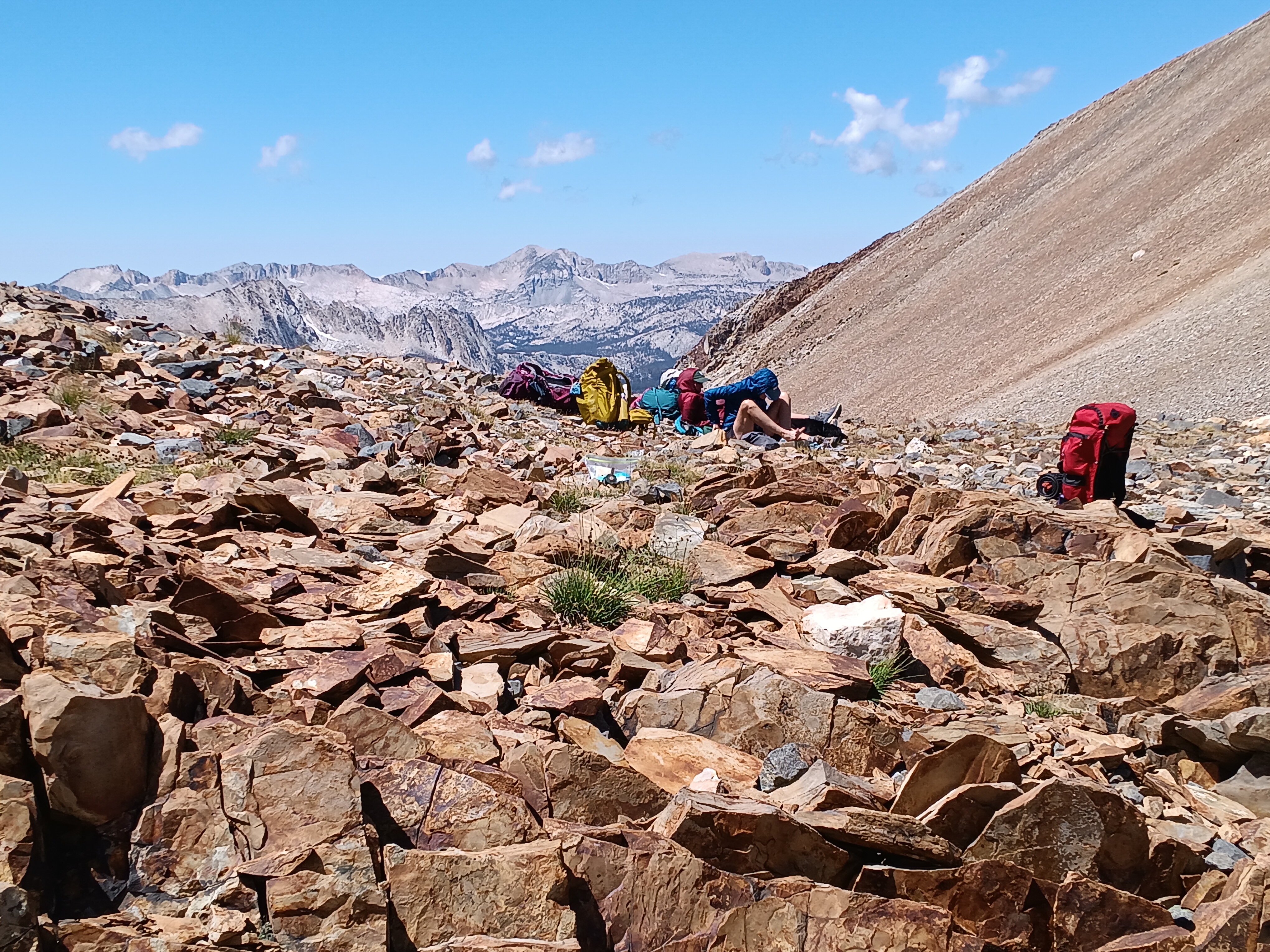
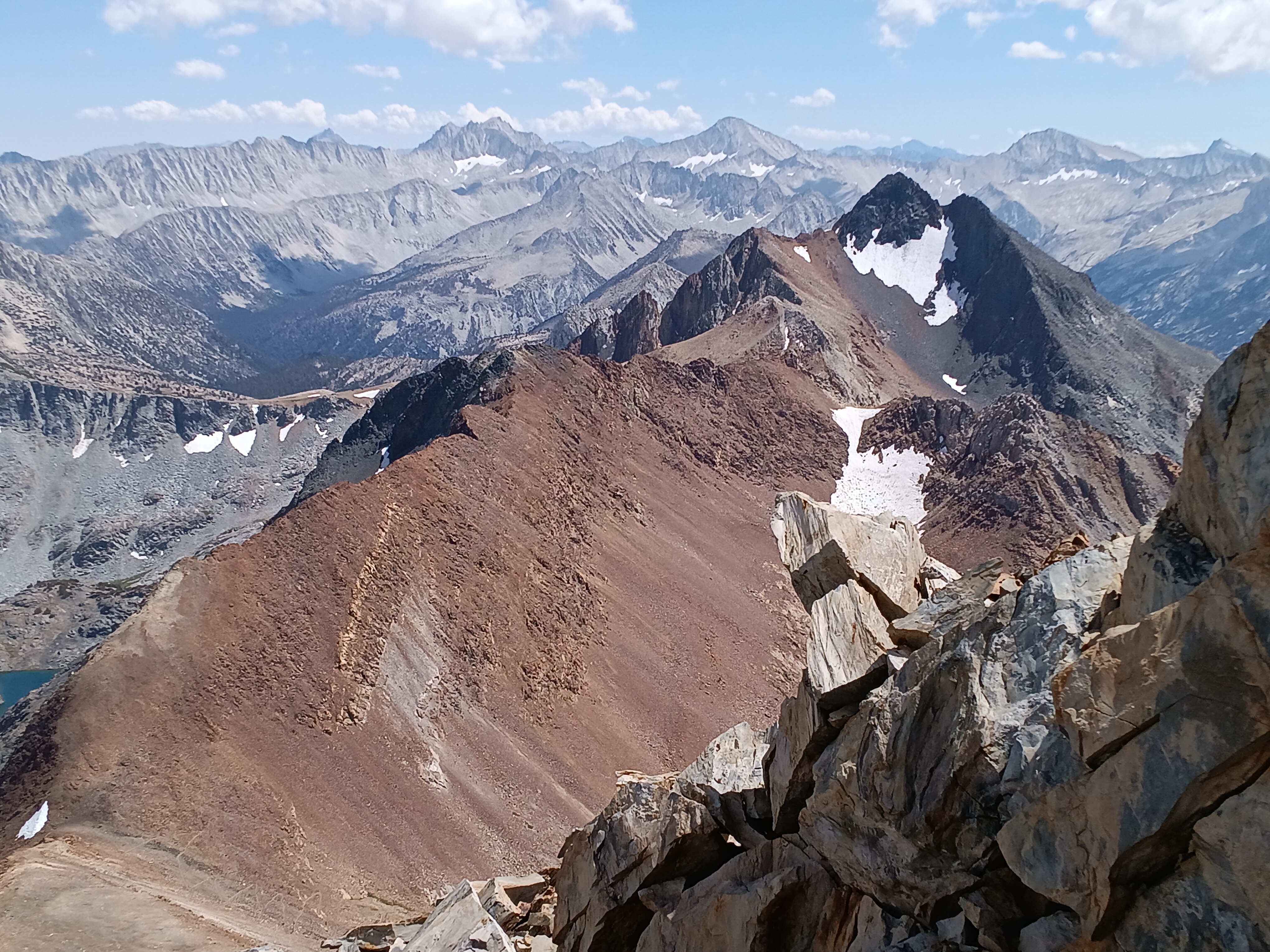
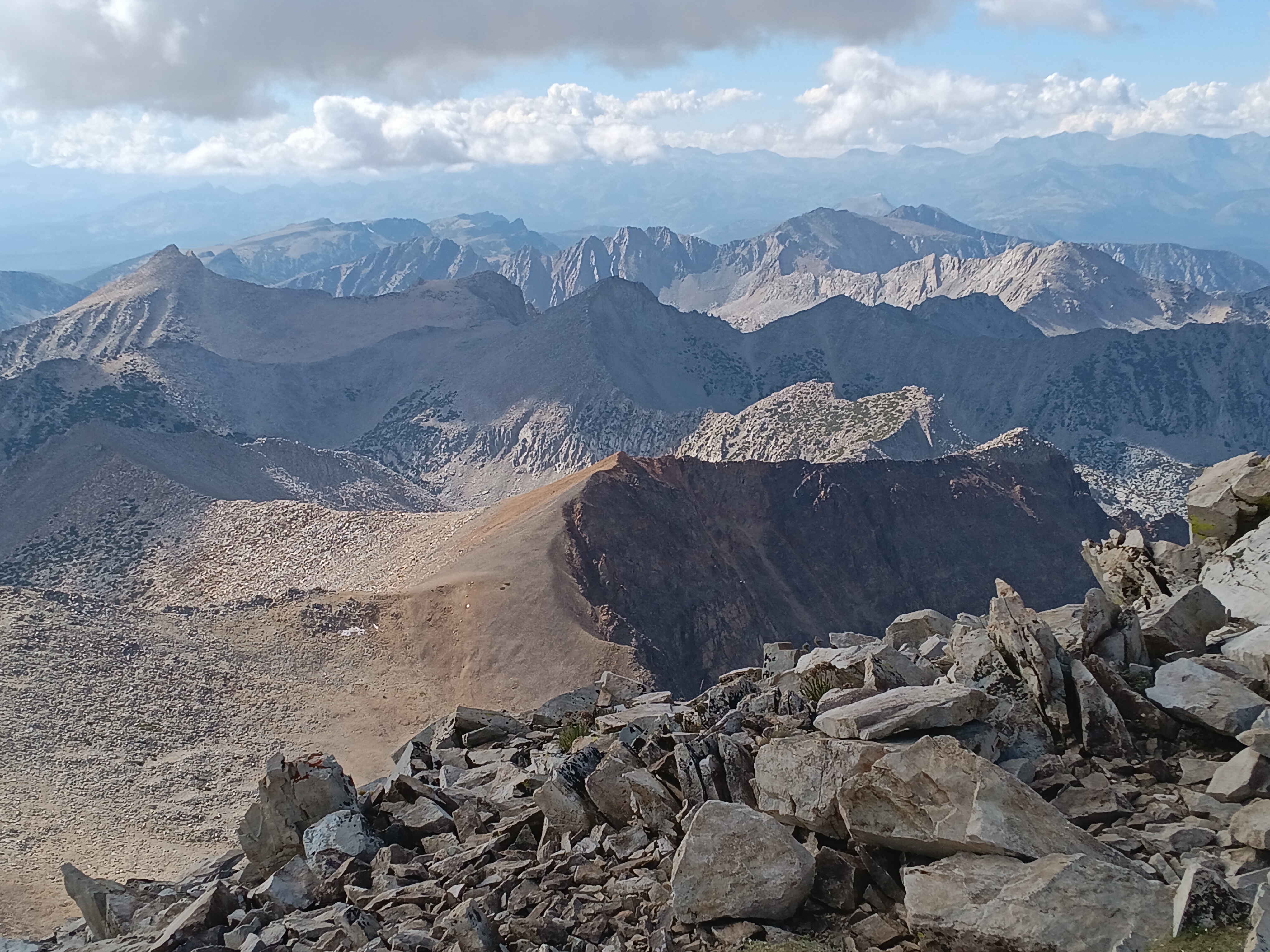
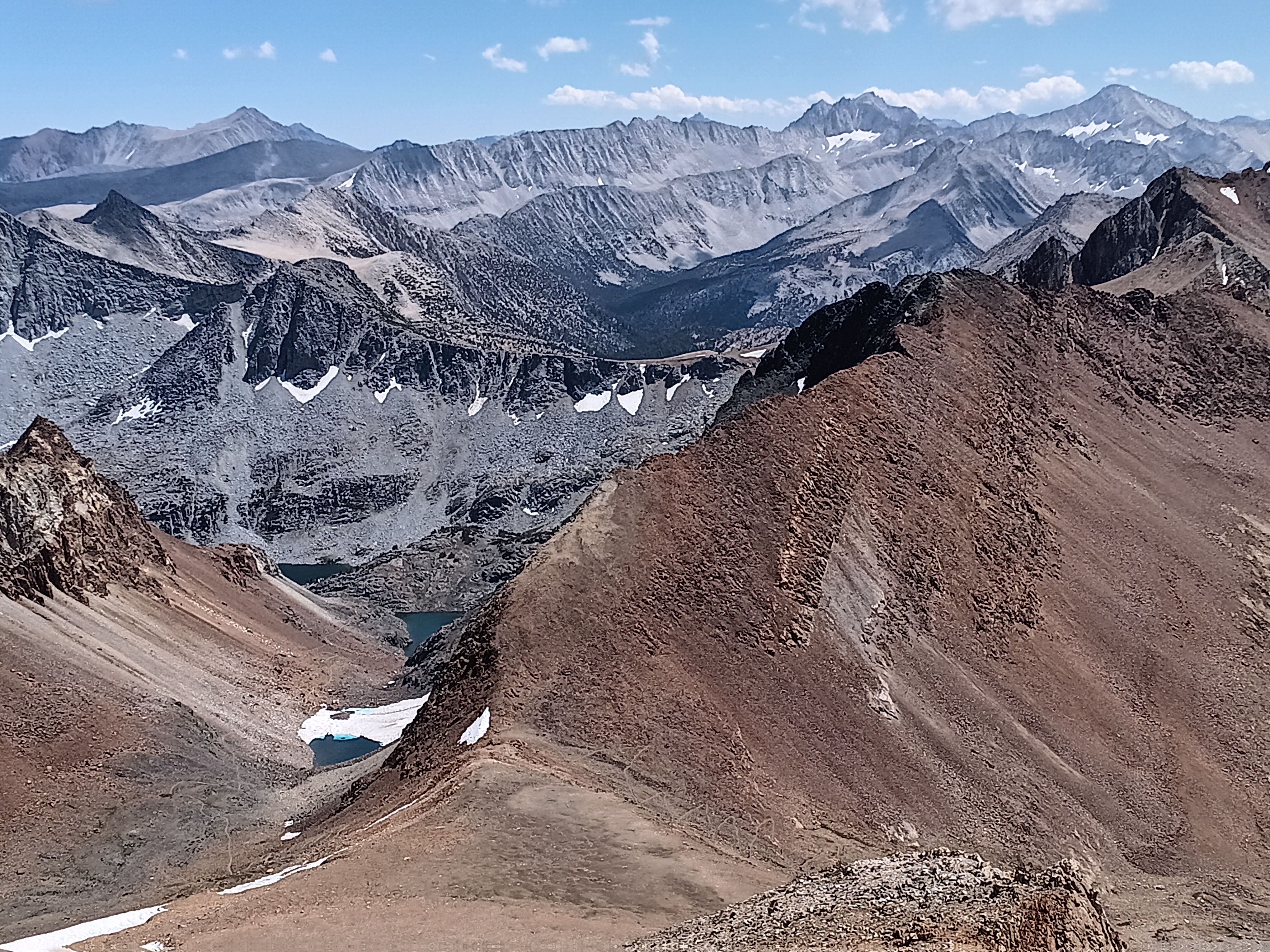
McGee Pass came first after hiking down to and then up Fish Creek to its origin below the snow fields of Red Slate Mountain. I hiked loosely with two parents my age and their grown two daughters and their dog. I had met them 3 days prior climbing up to Duck Lake and we kept meeting each other on the trail with few other people. We had lunch together atop McGee Pass at 11,900′ (3600 m) when I decided to climb the mountain following yet another tip of Pavla. Without my backpack the climb up Red Slate Mountain was at first delightful, but later became steep and strenuous. Much to my surprise, I suddenly had cell phone coverage near the top and I sent photos to my wife Dragonfly back home. It felt strange and funny to sit atop high mountains talking to Dragonfly who was walking below tall skyscrapers near Manhattan’s Fifth Avenue. She was not eager to talk, because she tried frantically to escape rain and traffic with a group of friends. Her husband, meanwhile, sits mellow atop the worlds with nearby clouds and far horizons as his only companions:

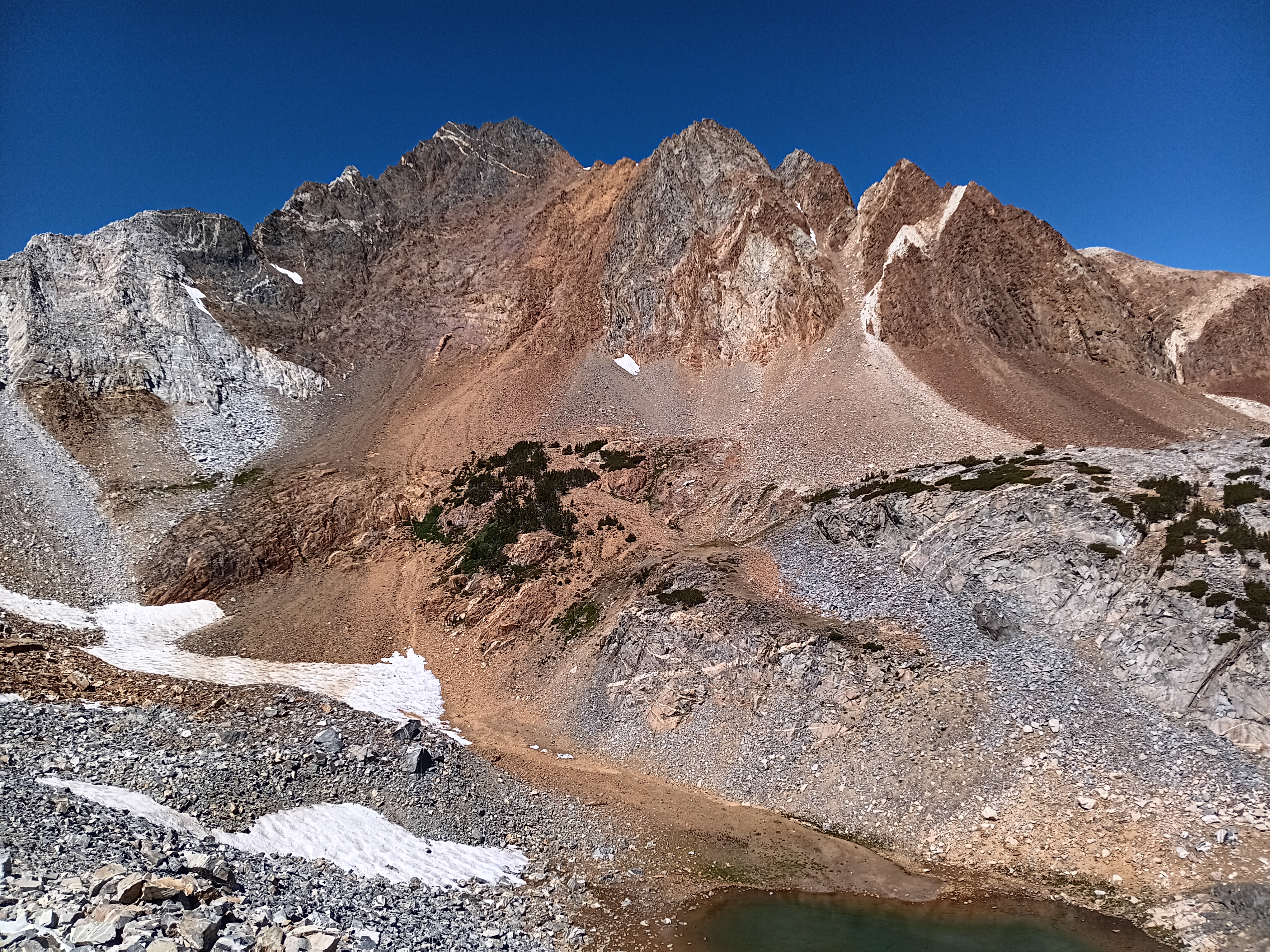
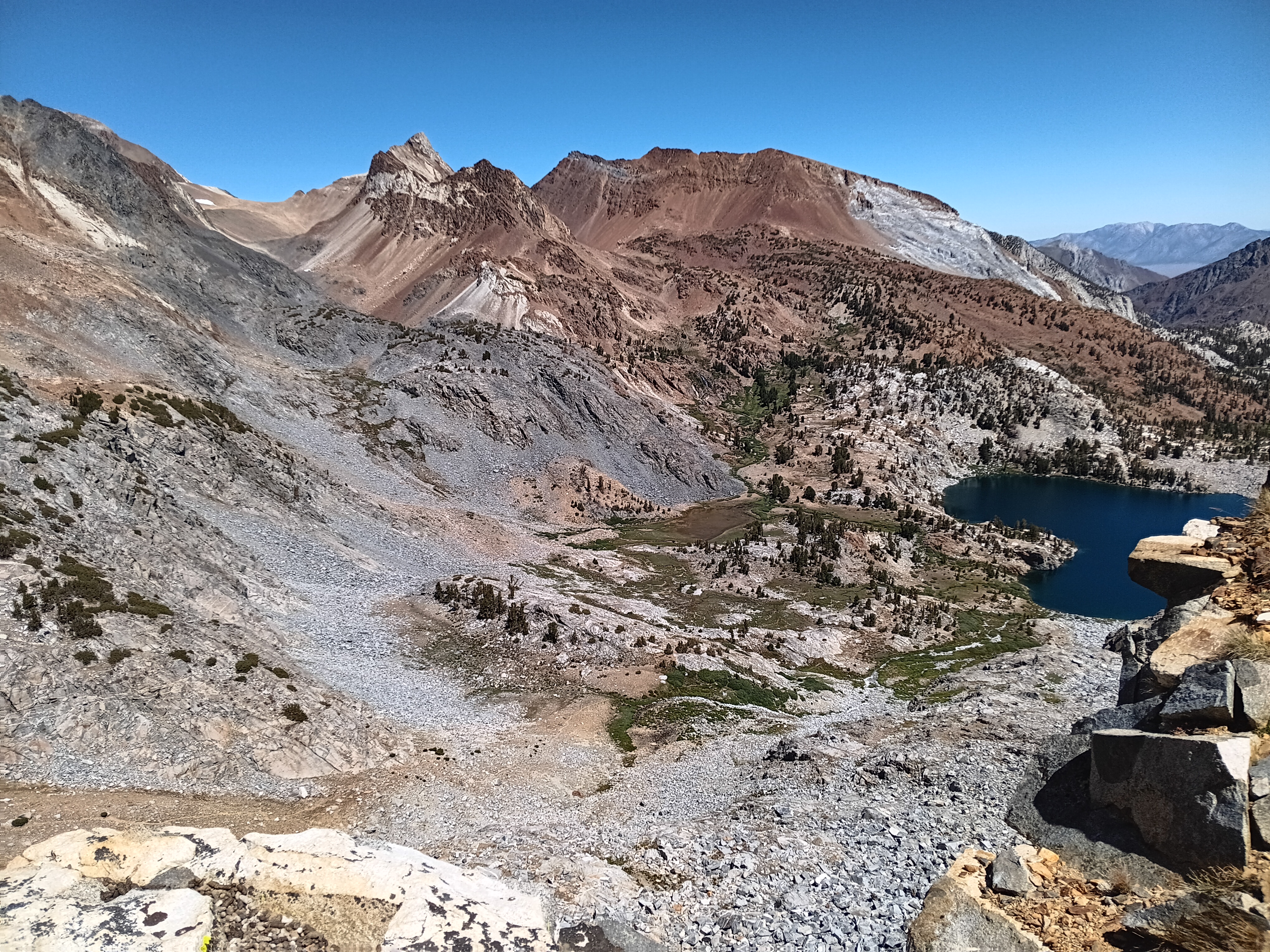
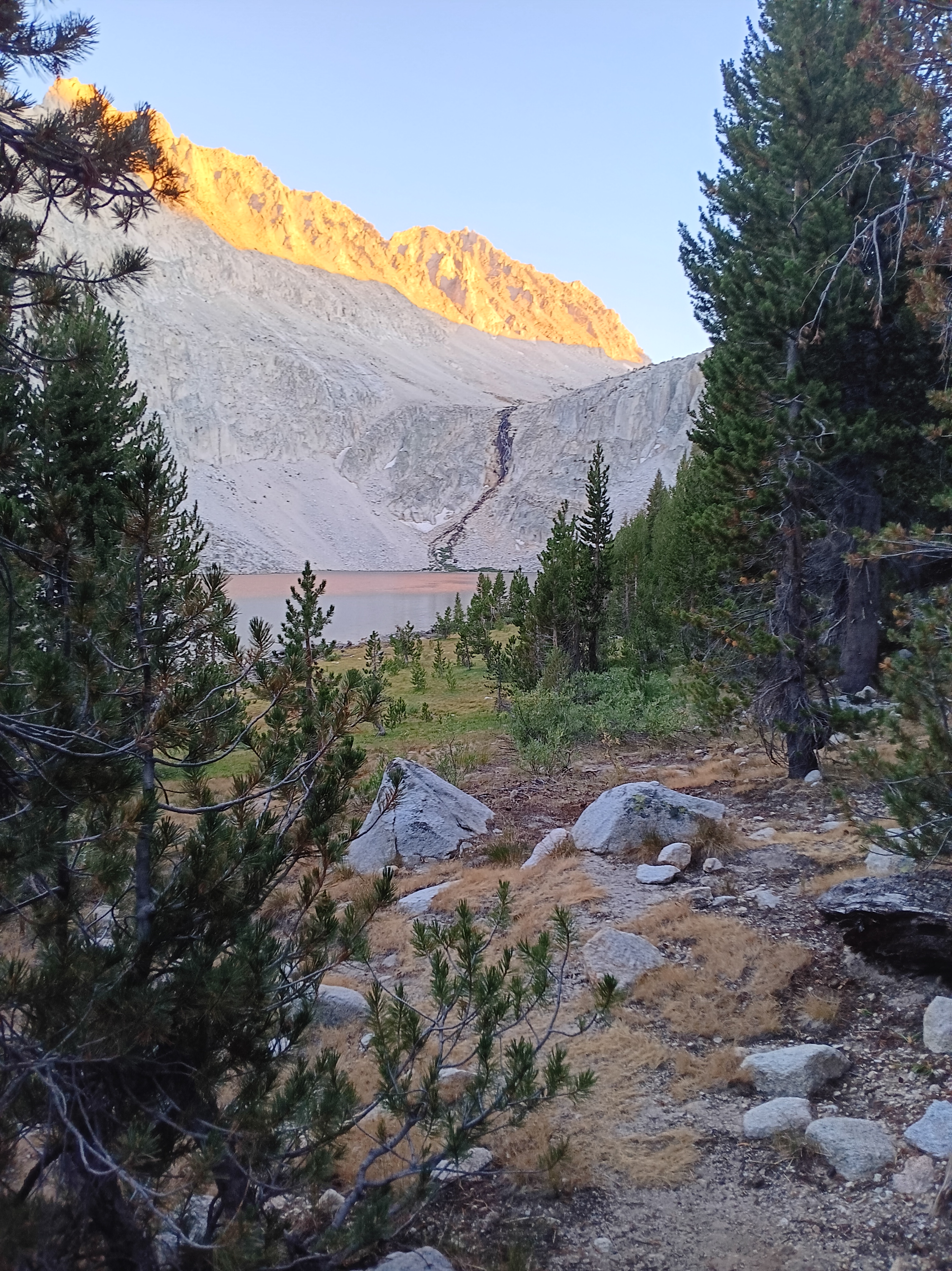
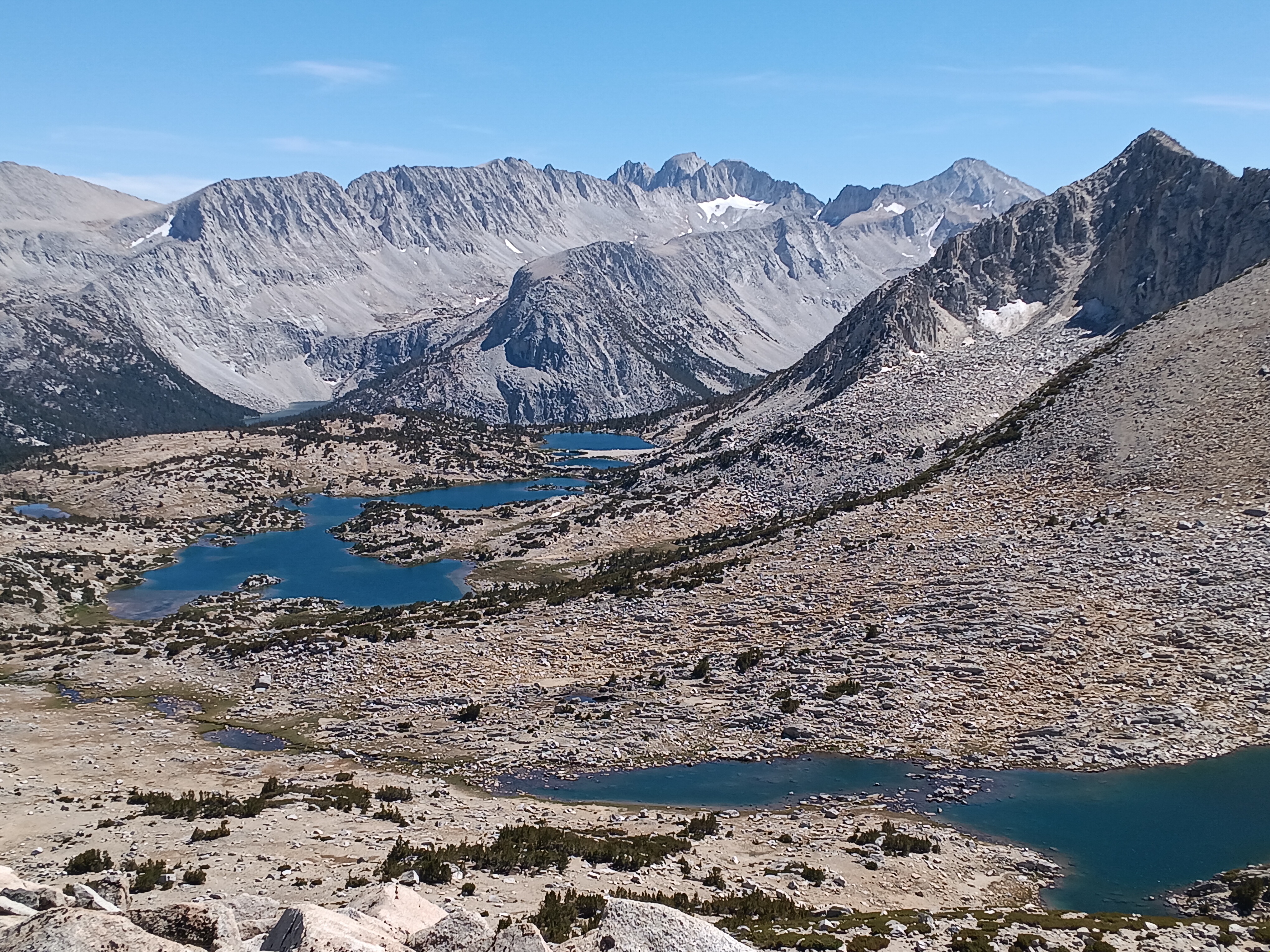
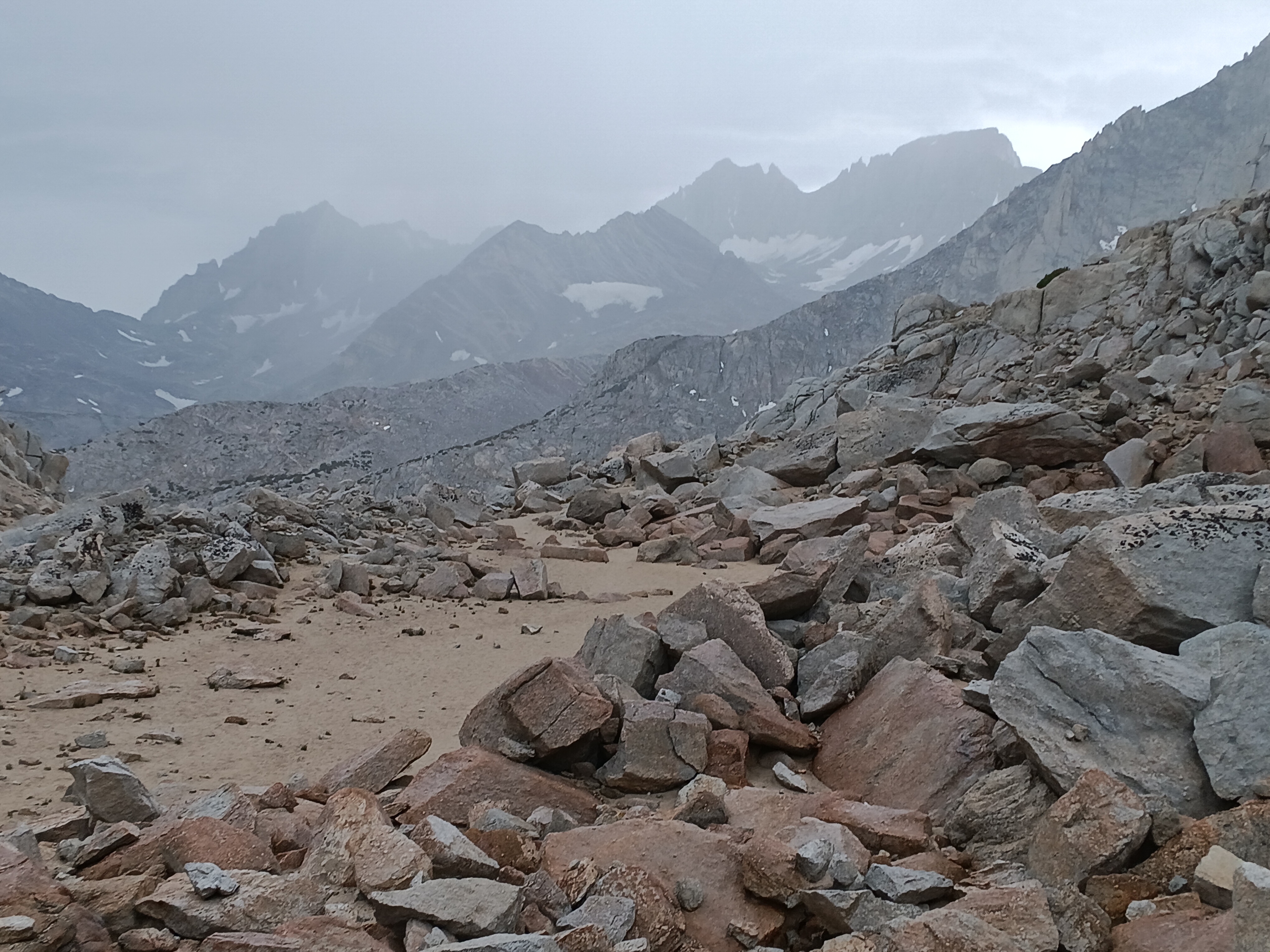
Lunch at McGee Pass (top left) and views from Red Slate Mountain towards Red and White Mountain (top right), towards north into Yosemite (center right), and towards south (bottom). The bottom photo shows three lakes with a faint path on the left and a zig-zag path up to McGee Pass on the right. The mountains in the far back are Mills, Abbott, and Dade Mountains that merge together at the end of the long ridge that bounds Fourth Recess. I crossed all these ranges the next 5 days to exit via Mono Pass to the east (left) of Fourth Recess. Hopkins Pass crosses the lower center ridge near a triangular snow patch. Pioneer Valley is to the left (outside frame) of the wooded Hopkins Valley. [Aug.-17, 2025.]

When I came down the mountain and reached my campsite at the lowest lake in the photo above (Big McGee Lake) it was 7 pm. I met my earlier hiking companions, told them about my adventures atop the mountain, and went for a swim just as the sun set for the day. I slept well that night, but got up early to climb over Hopkins Pass along a sketchy, barely existing path. Detailed descriptions of the route I found in Backpacking from McGee Creek to Pioneer Basin via Hopkins Pass by Inga Aksamit. She also moderates an outstanding Facebook group on the John Muir Trail that I used for my 2024 backpacking trip. Thanks to this guide the crossing of Hopkins Pass went well. It included an almost vertical scramble up a cliff on all fours to reach a tiny ice cap near the top.

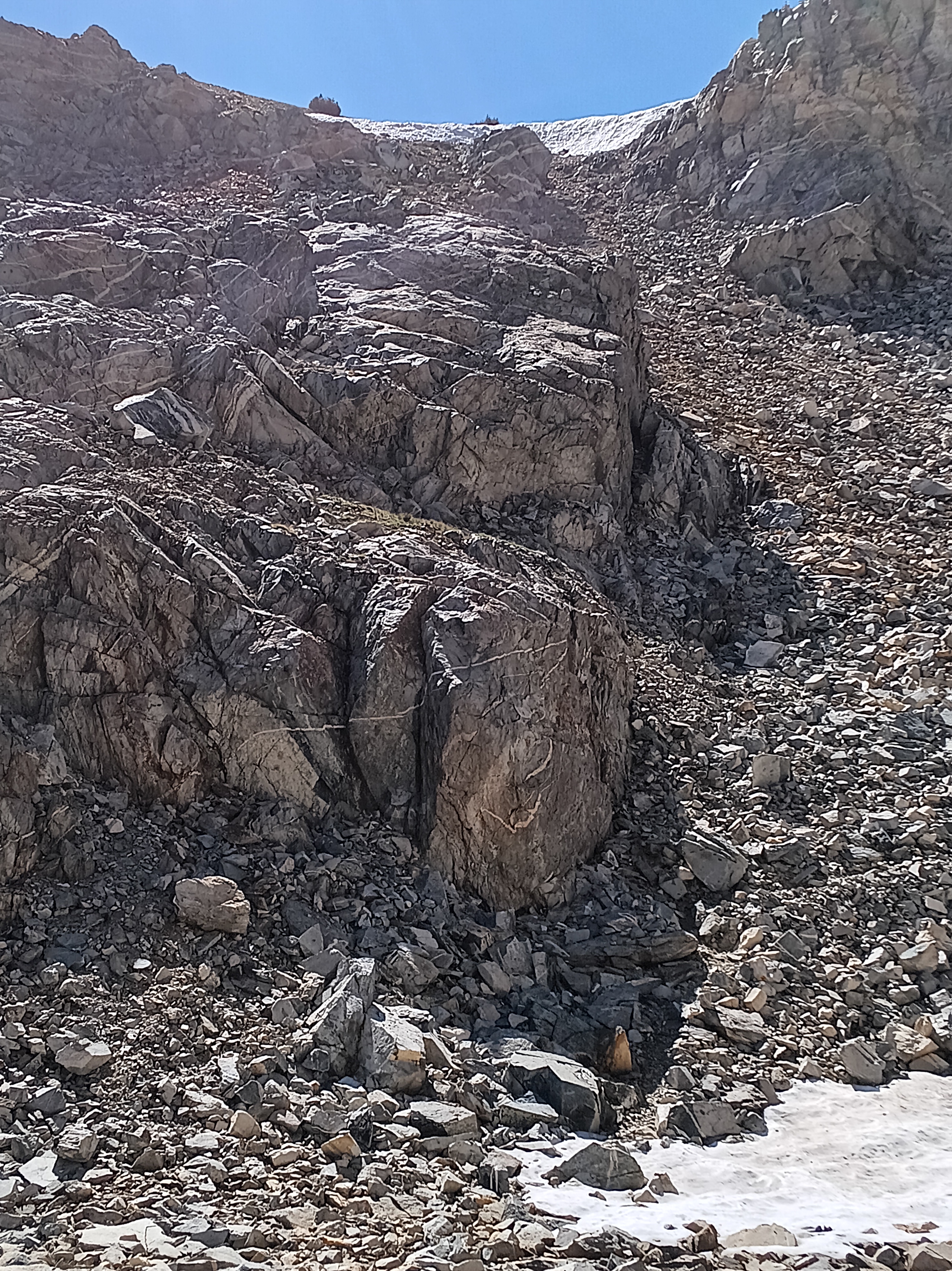
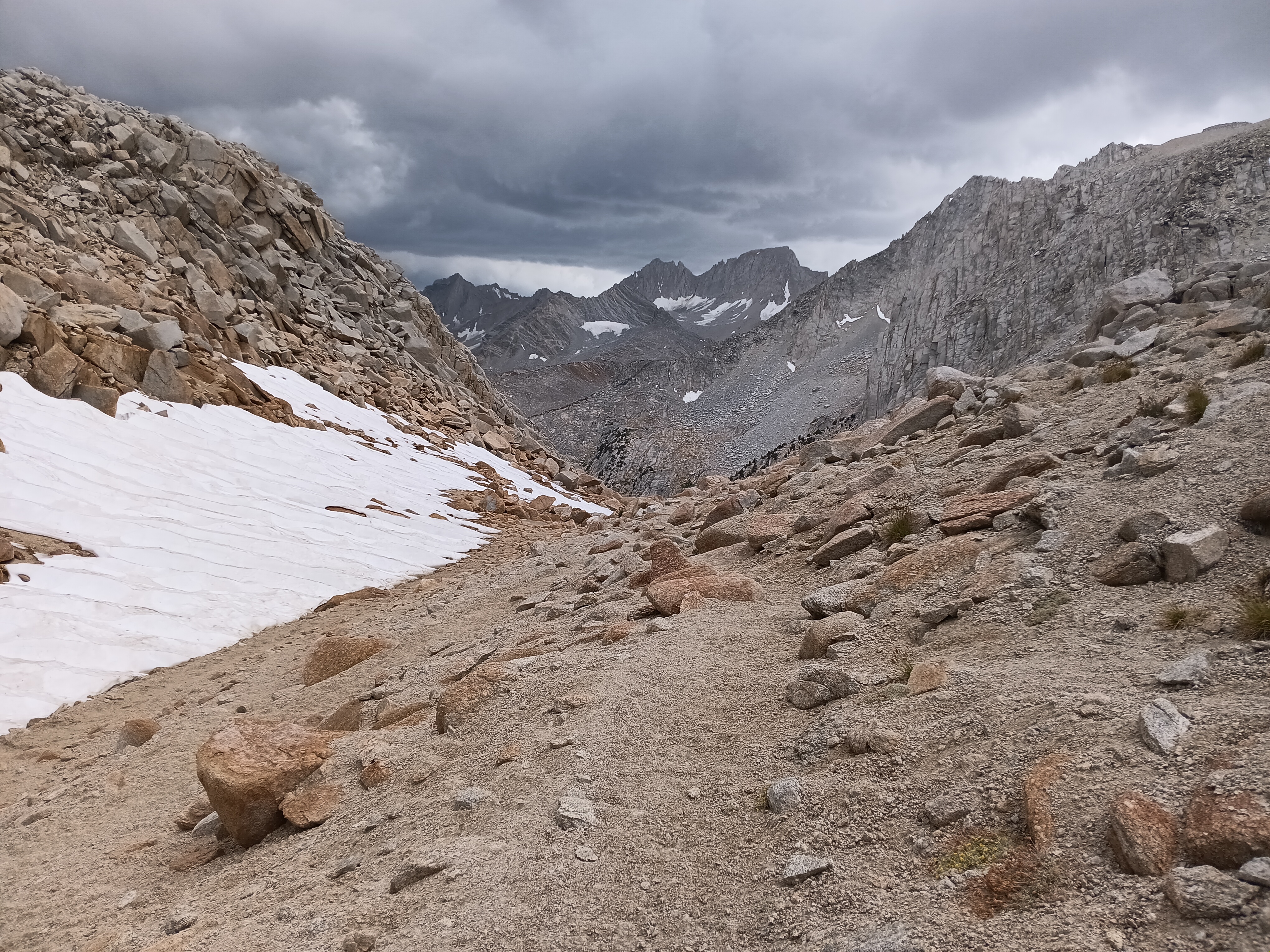
The last 400′ (120 m) of Hopkins Pass at 11,470′ (3500 m) up a bouldery cliff with a snow wedge above (left) along with views from the top such as Red and White Mountain (top right) and towards my campground at Bigh McGee Lake (bottom right). [Aug.-18, 2025.]

Heading down Hopkins Valley without a trail or difficulties, I reached Mono Creek at 9,300′ (2800 m) in the afternoon. I navigated an unexpected cliff above the treeline (easily done) and a massive pile of fallen trees (harder) that forced me to bush-wack for an hour. Escaping the mosquito infested Mono Valley, I camped a mile uphill at the georgeous Fourth Access Lake. It featured an outstanding and flat campground in the pines with views of lake, mountains, and waterfall; someone even had made a most comfortable bench out of wood. The lake was nearby and I had both an evening and morning swim before heading into Pioneer Basin. The Lake was also stoke full with trout:

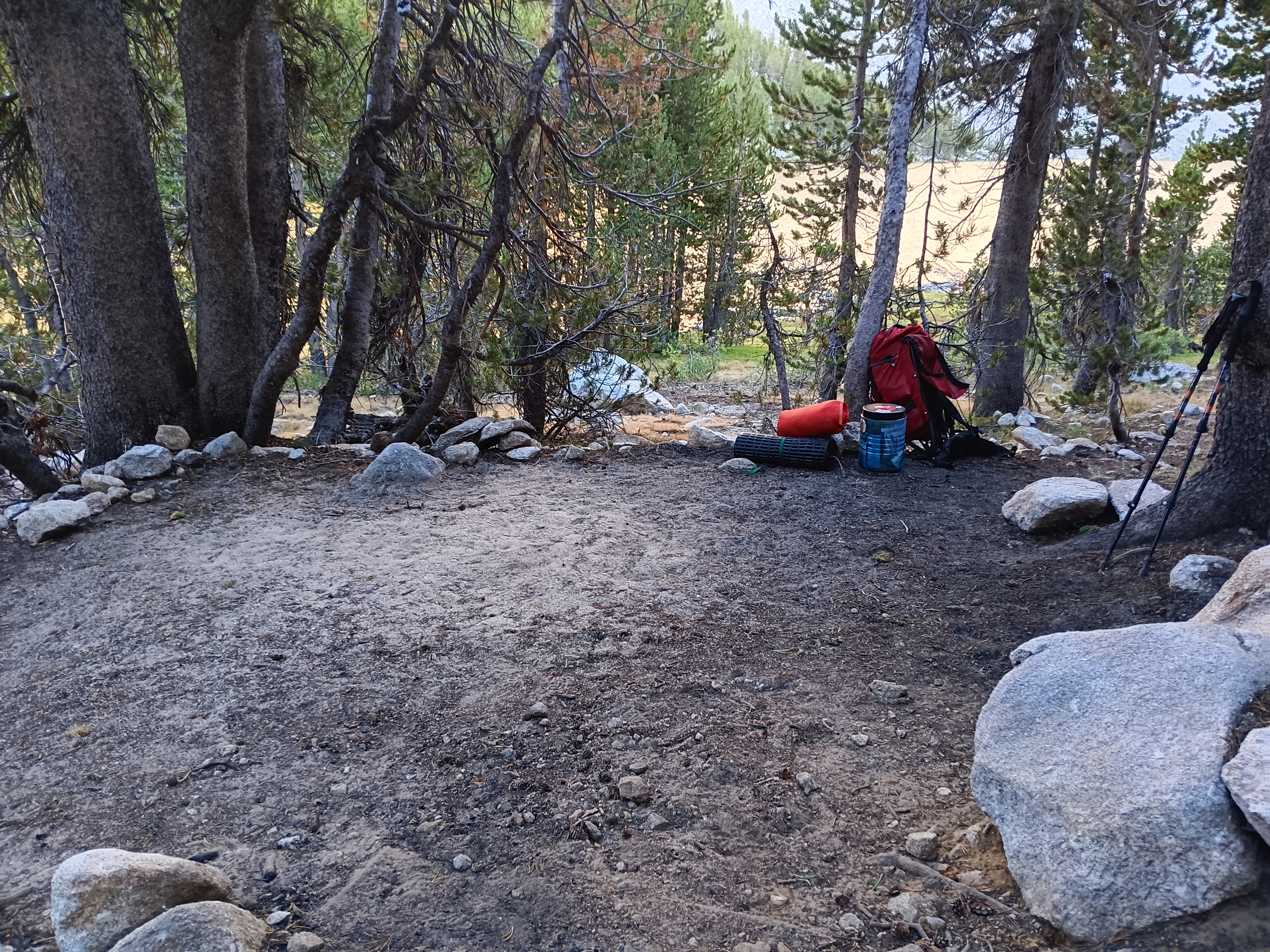
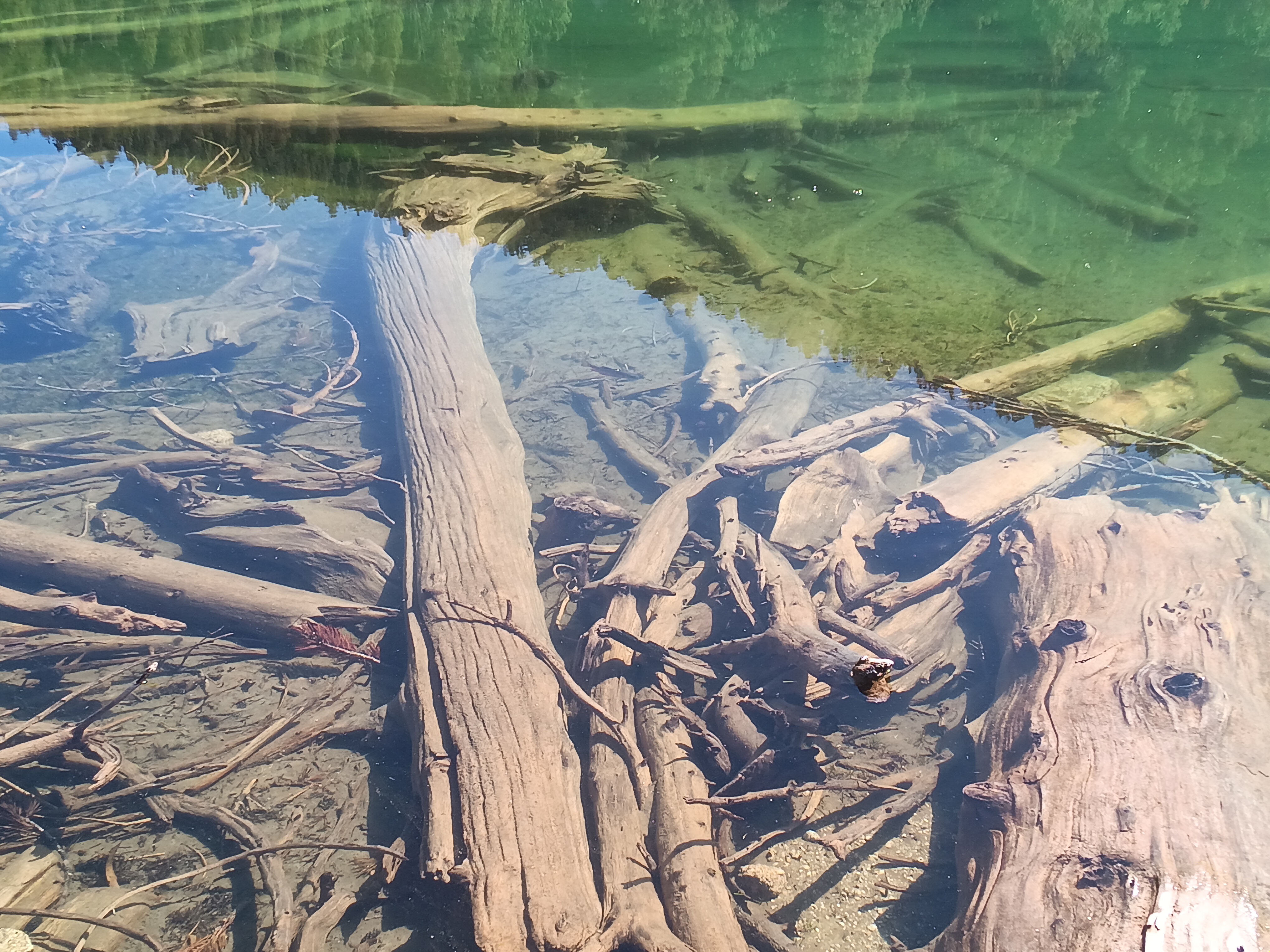
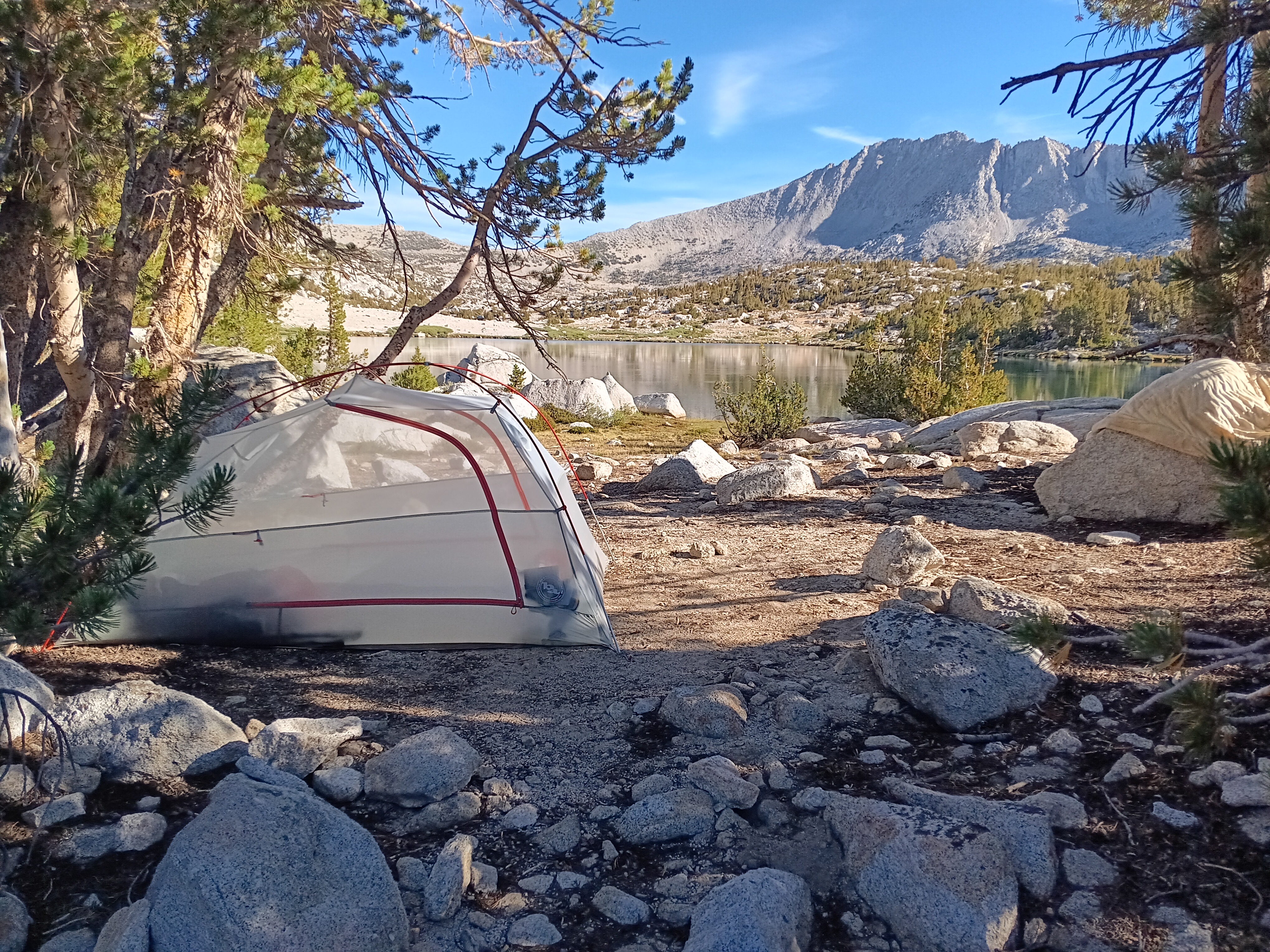
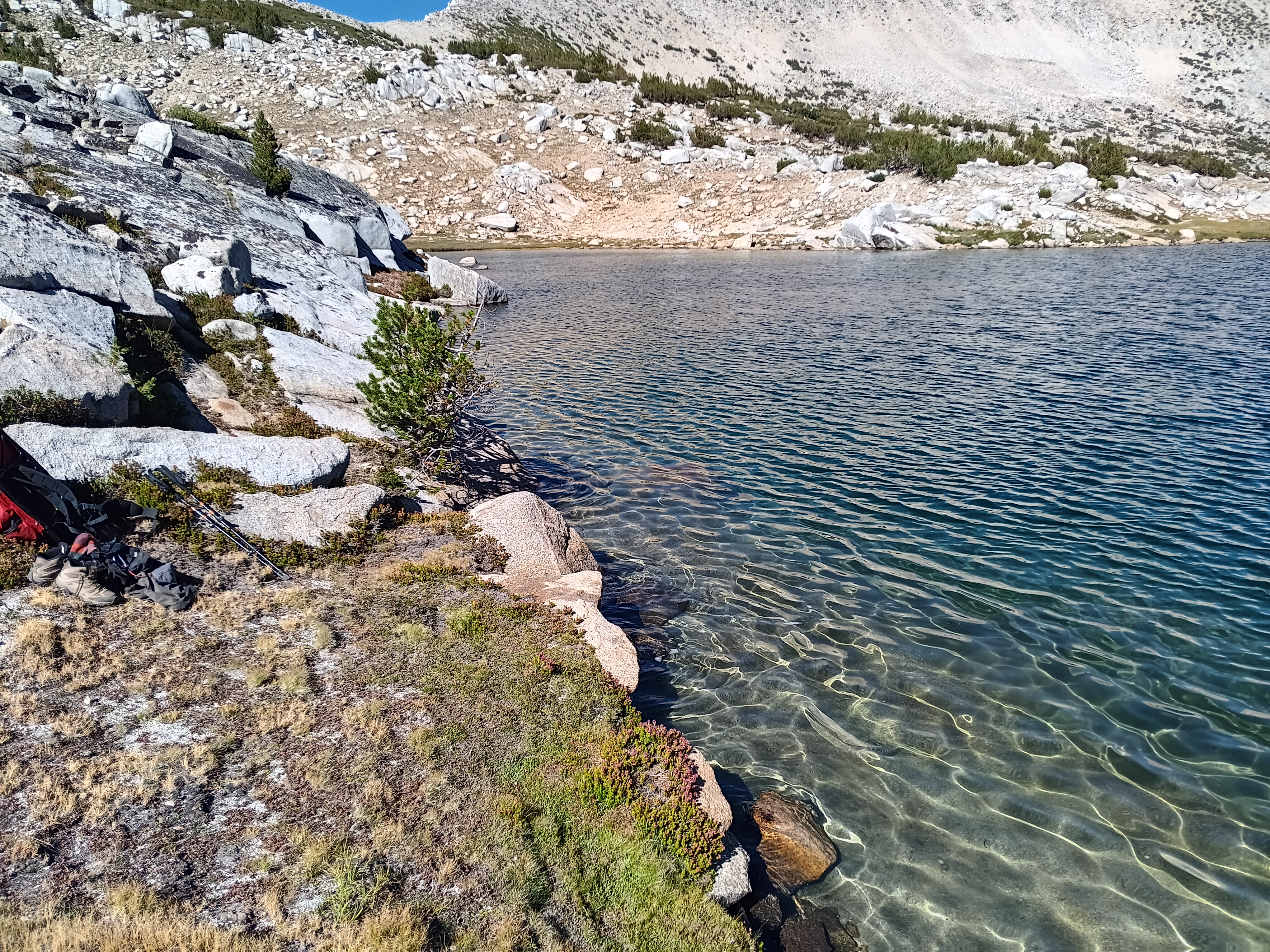
Campground at Fourth Recess Lake (top left), my swimming spot among the wooden logs and trout (bottom left), and the view from my camp (right panel). Two people camped on the other side of the lake. [Aug.-19, 2025.]

A short 3 hour walk the next morning got me to Pioneer Basin where I dropped my backpack at 11 am to spent the next 2 hours looking for a place to pitch my tent for the next 3 nights. It was surprisingly hard to find the right spot, but I found it after talking to a young man in his mid 30ies who had just “skied” down Hopkins Peak. Inspired by him, I did something similar the next day, but first he helped me find a good camping sites. I generally like to sleep under trees, pine trees in particular, and I was looking for a shady spot as it was warm and I intended to do some dozing after swimming in the nearby lake. Again, I had many trouts for watching and company, but back to the skiing I did the next day down the upper reaches at Pioneer Basin:

My camp in Pioneer Basin (top left) at the far end of the larger lake with the Fourth Acess Ridge in the background (center left). Fourth Access Valley becomes clearer at bottom left with the many lakes of Pioneer Basin in the foreground as seen from above Standford Col looking south. Looking north from the same location, I see Red Slate Mountain dominating the landscape (right panel). I had climbed it 3 days prior. [Aug.-20/21, 2025.]

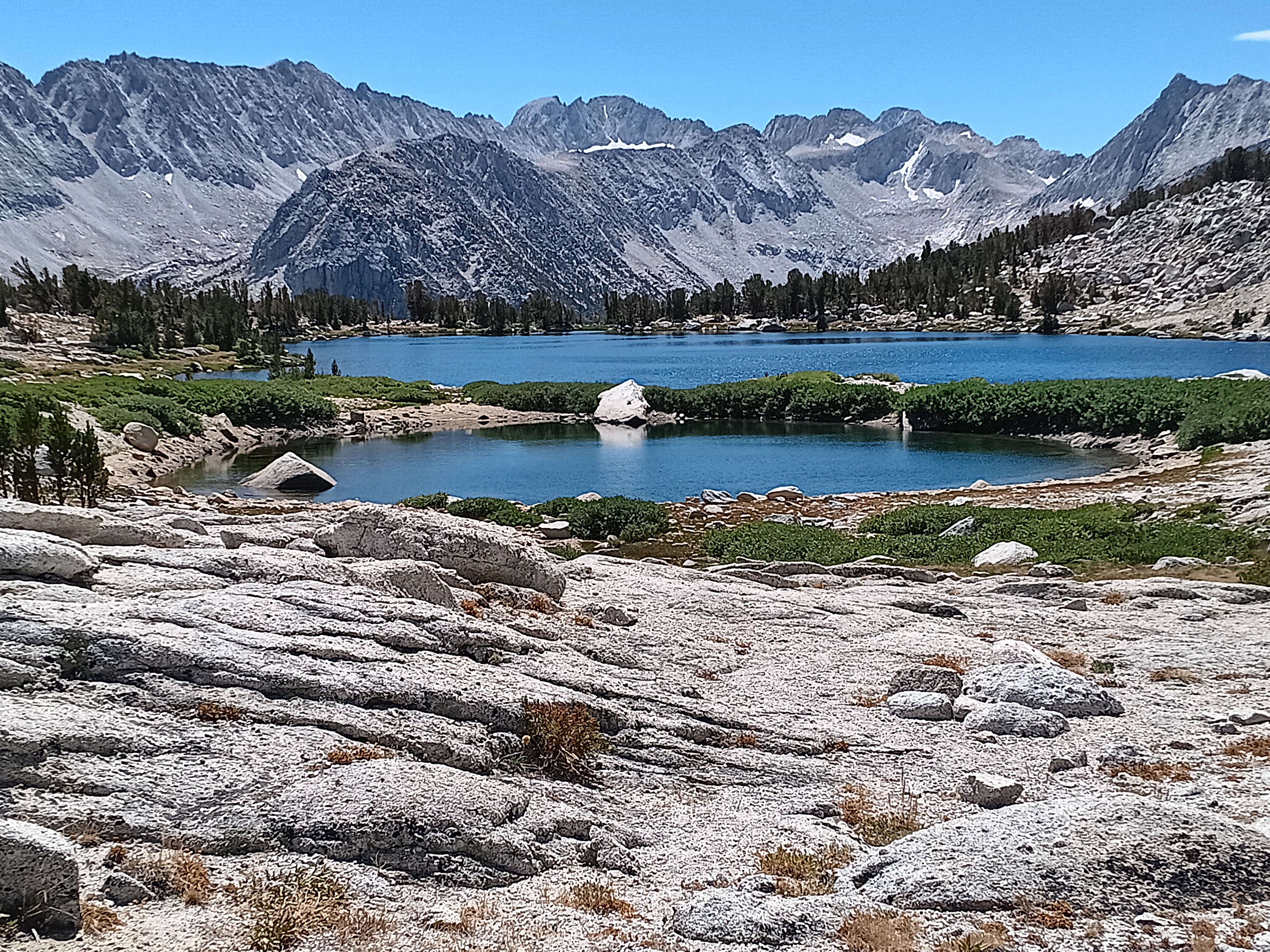
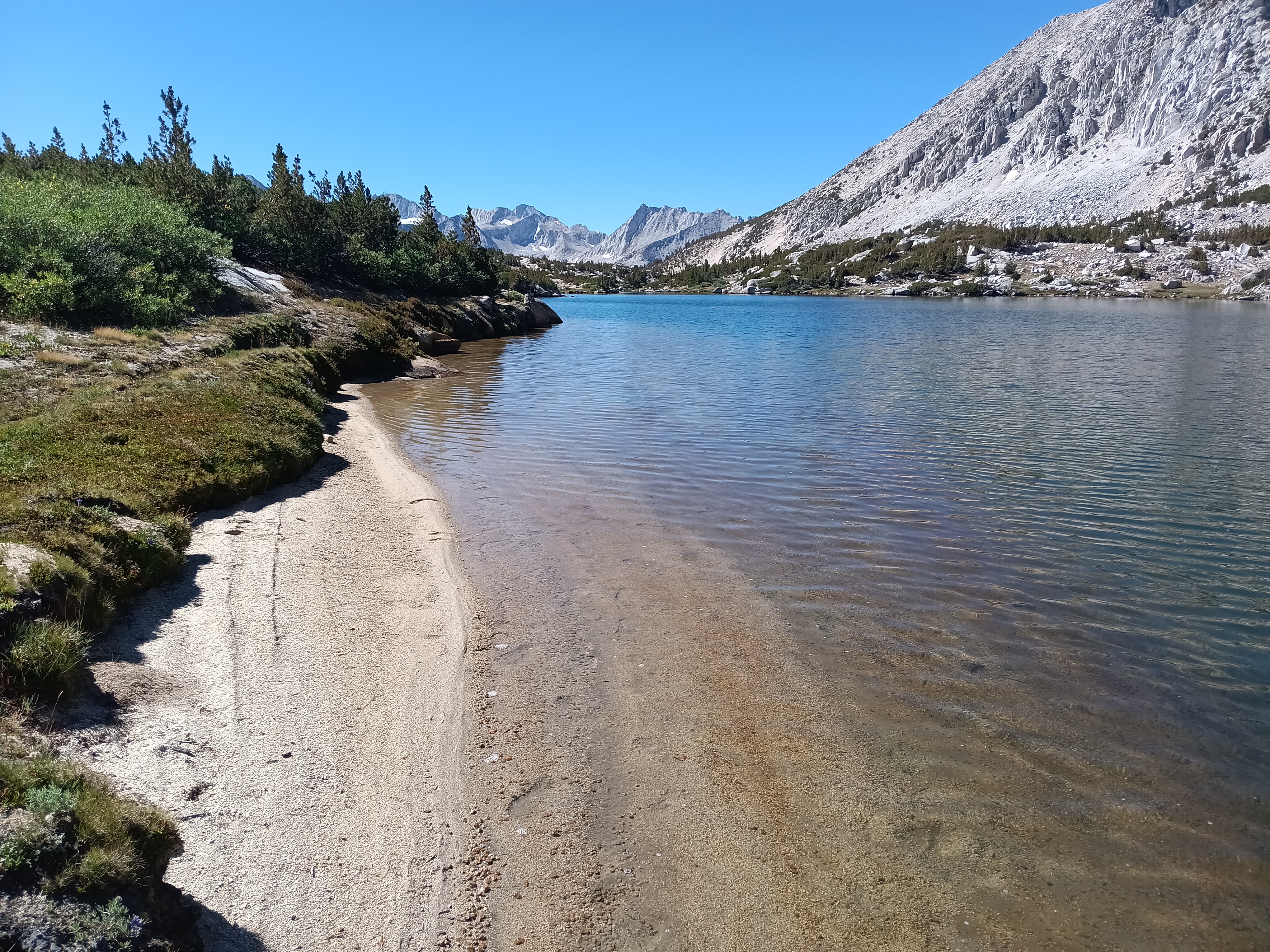
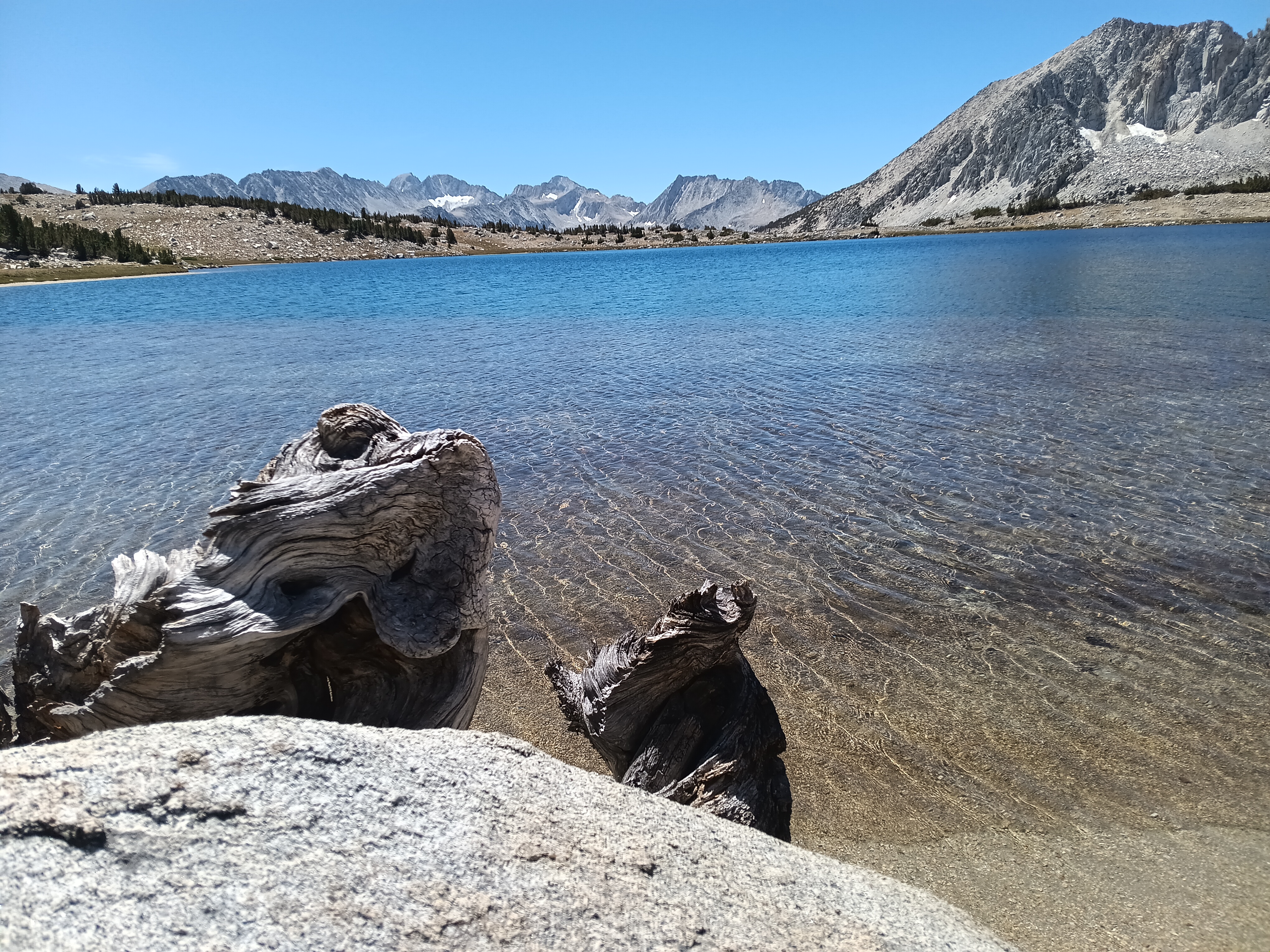
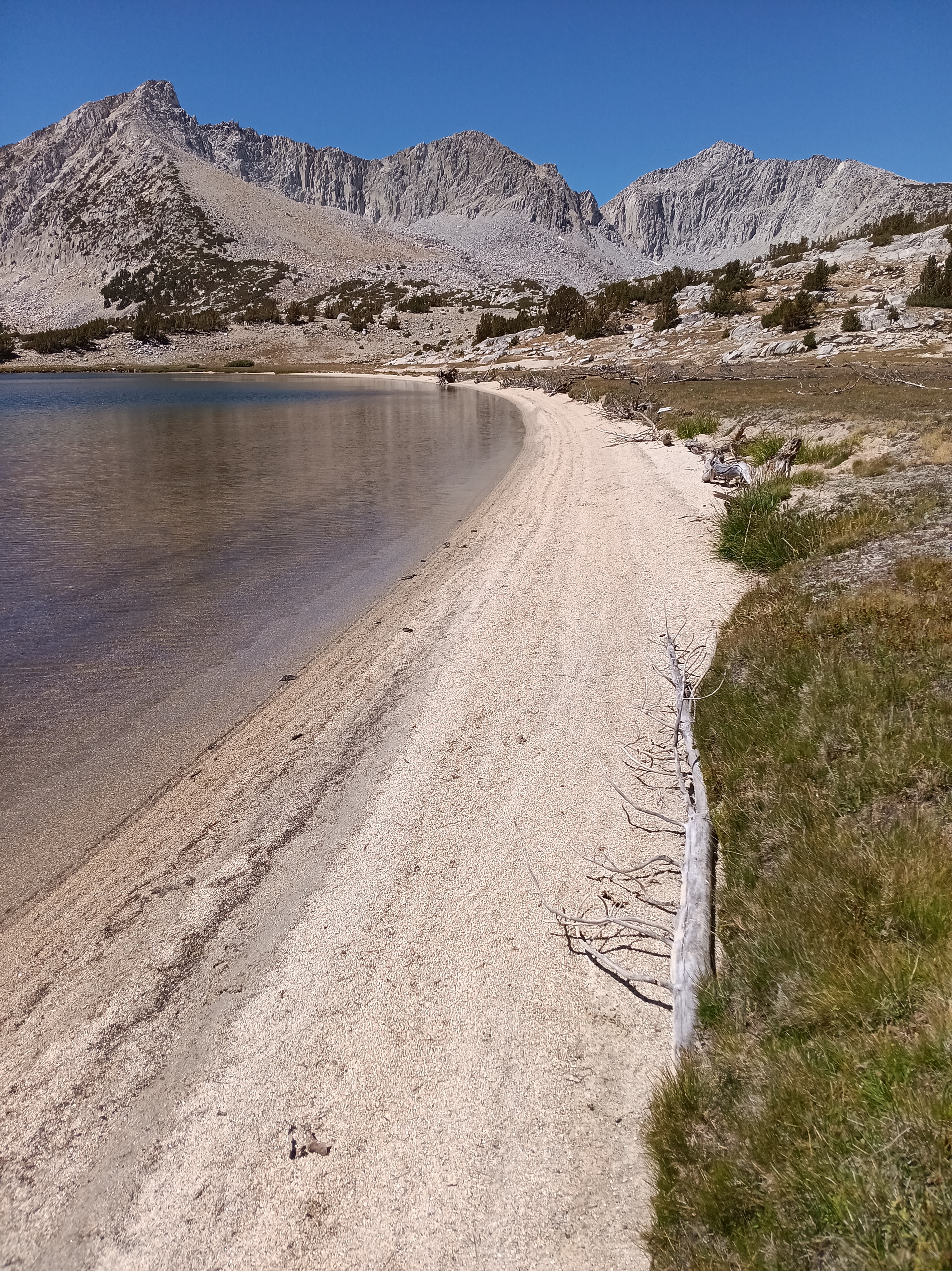
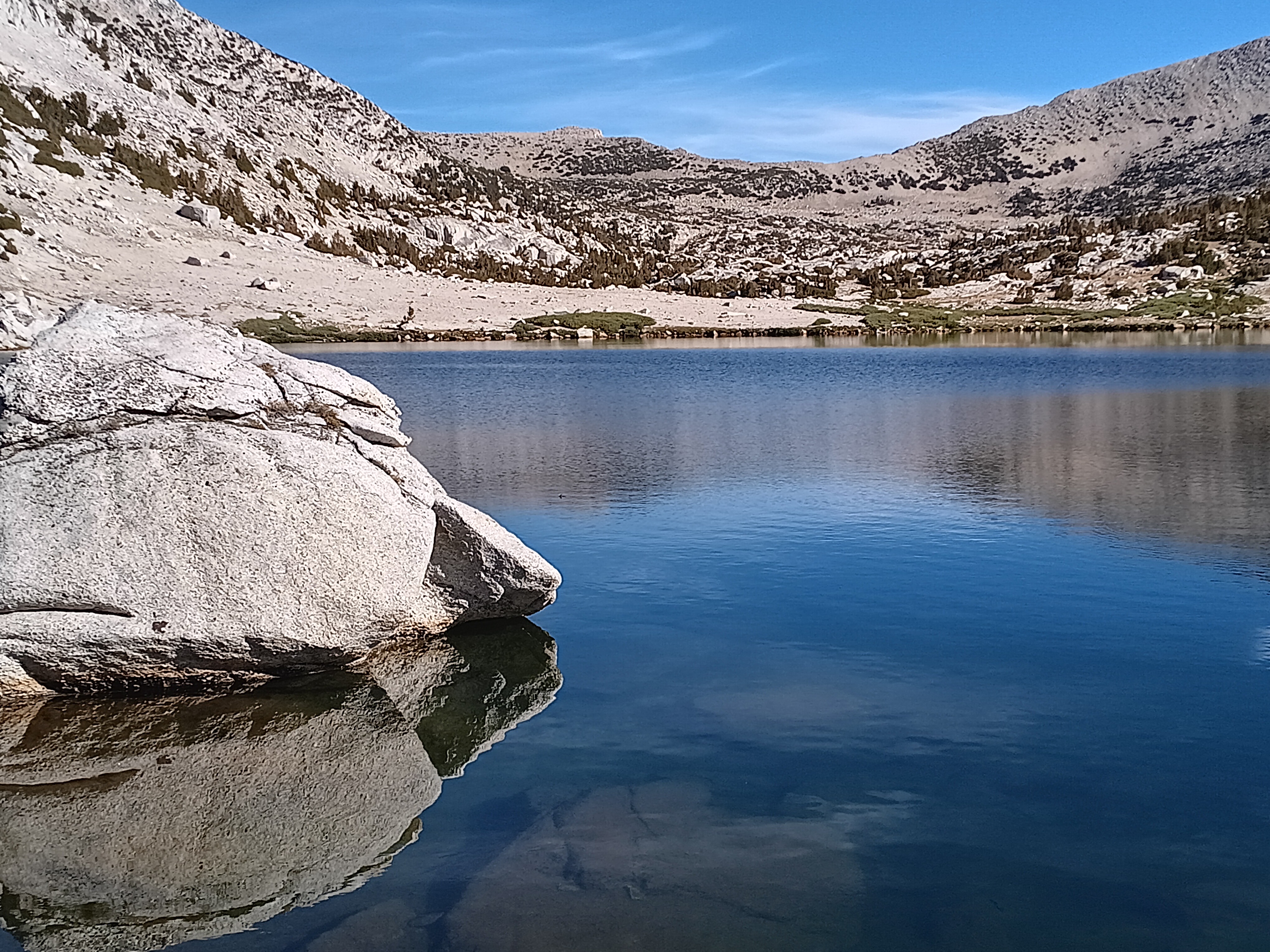
Most of the mountains surrounding Pioneer Basin are steep, very steep, but they tend to be a bit sandy, not quite, but the soil on the steep slope is free of bolders with alot of scree, smallish pebbles, really. It is almost impossible to gain traction hiking up such slopes, as one slides down and sinks in. In contrast, heading down such slopes, I found to be like skiing with the hiking poles to keep balance in a controlled slide. Just like skiing one sinks into the scree, slides down, and makes turns by setting poles and shifting balance. What takes 3-5 hours to climb up takes 15 minutes to slide down. Fun … the downhill part that is. So I hiked the basin, swam in 3 of the 7 lakes several times, and even had a lazy day doing nothing but watching the trout in the water, the birds in the sky, and the sun rise and fall. Heaven on earth that I shared with a total of 3 people in 3 days, that is, each person has 2 lakes for themselves every day. And the beaches of the lakes, too, were wild, sandy, and sunny:

Swimming the many lakes of the High Sierra Nevada, I felt fresh and clean and happy. Last year my wife Dragonfly told me to do this also and carry swim trunks, but for some reason I only swam once during the 36 days that I was hiking across mountains and past lakes in 2024. What made this year different was Pavla who picked me up at Tuoloume Meadows. She added to Dragonfly’s suggestions by forcefully setting an example for me. It thus seems that it takes a village to teach an old man new tricks. The swimming will stay with me as lake swimming added a new comfort to the adventure that is hiking for many days and weeks.

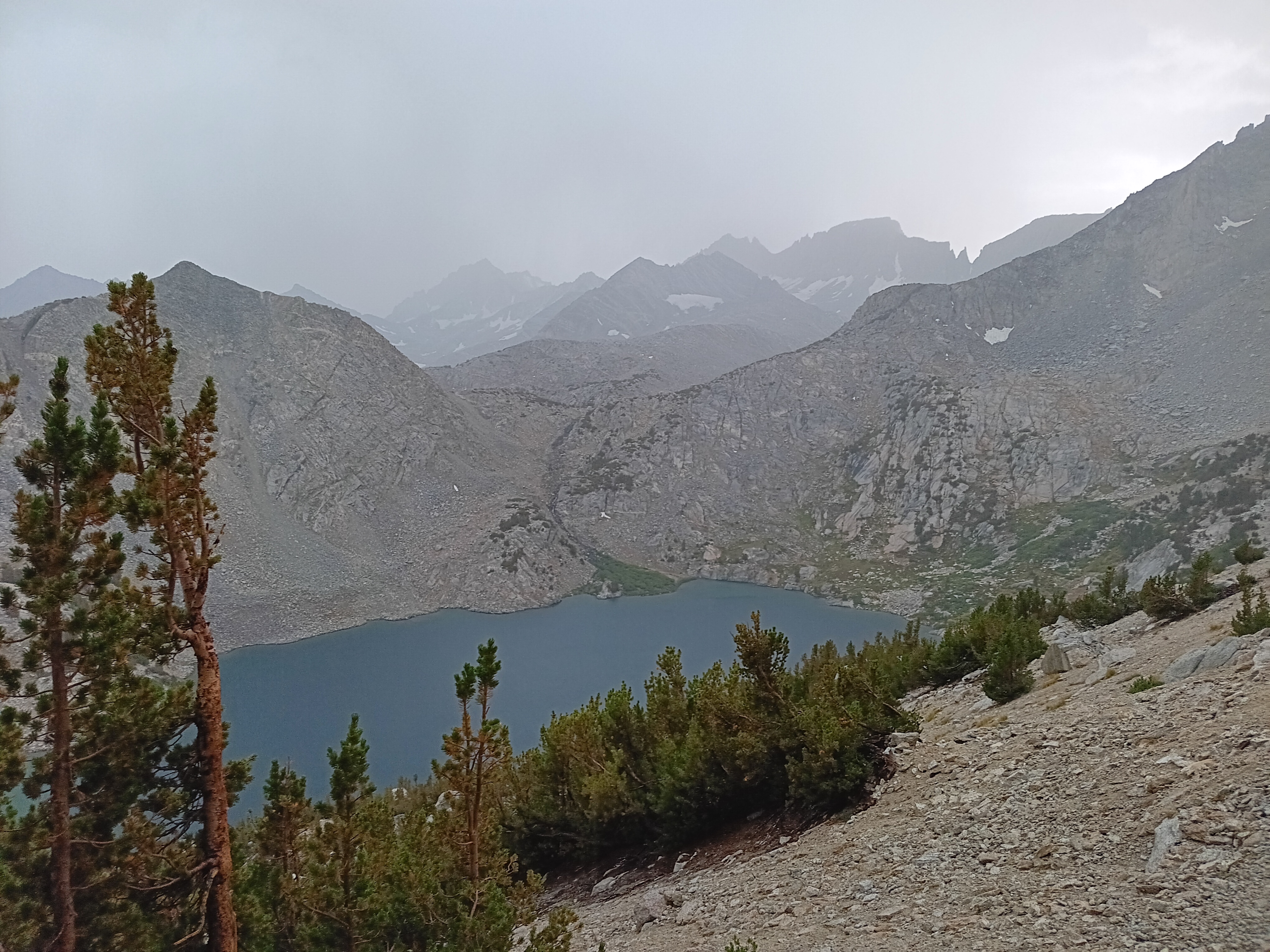
P.S.: My 14-day hike covered about 120 miles (190 km), so I comfortably saunter about 10 miles/day with about 40-45 lbs on my back. If pressed, such as by thunder and lightning and rain that hit me the last day at 12,000′ high Mono Pass, I got enough reserves to do an additional 5-7 miles at the end of the day to get down Mono Pass (top left) with Abbot and Dale Mountains in the dark clouds above Ruby Lake. No swimming there … this year.

Lessons from a 35-day Hike in California’s Sierra Nevada Wilderness

I started my California hike in the wrong direction heading south rather than north trying to reach the Ansel Adams Wilderness on my way to Yosemite National Park. It took me two hours to notice my error and another hour to get back to my starting point. Thus I was already exhaused with blisters on my feet before my hike had even started. “Expert move” my trail diary states dryly, as I had spent the prior 5 months pouring over maps, gear, and spreadsheets. And yet, I could not tell north from south. A more serious error the next day almost ended my big pre-retirement adventure on its second day.

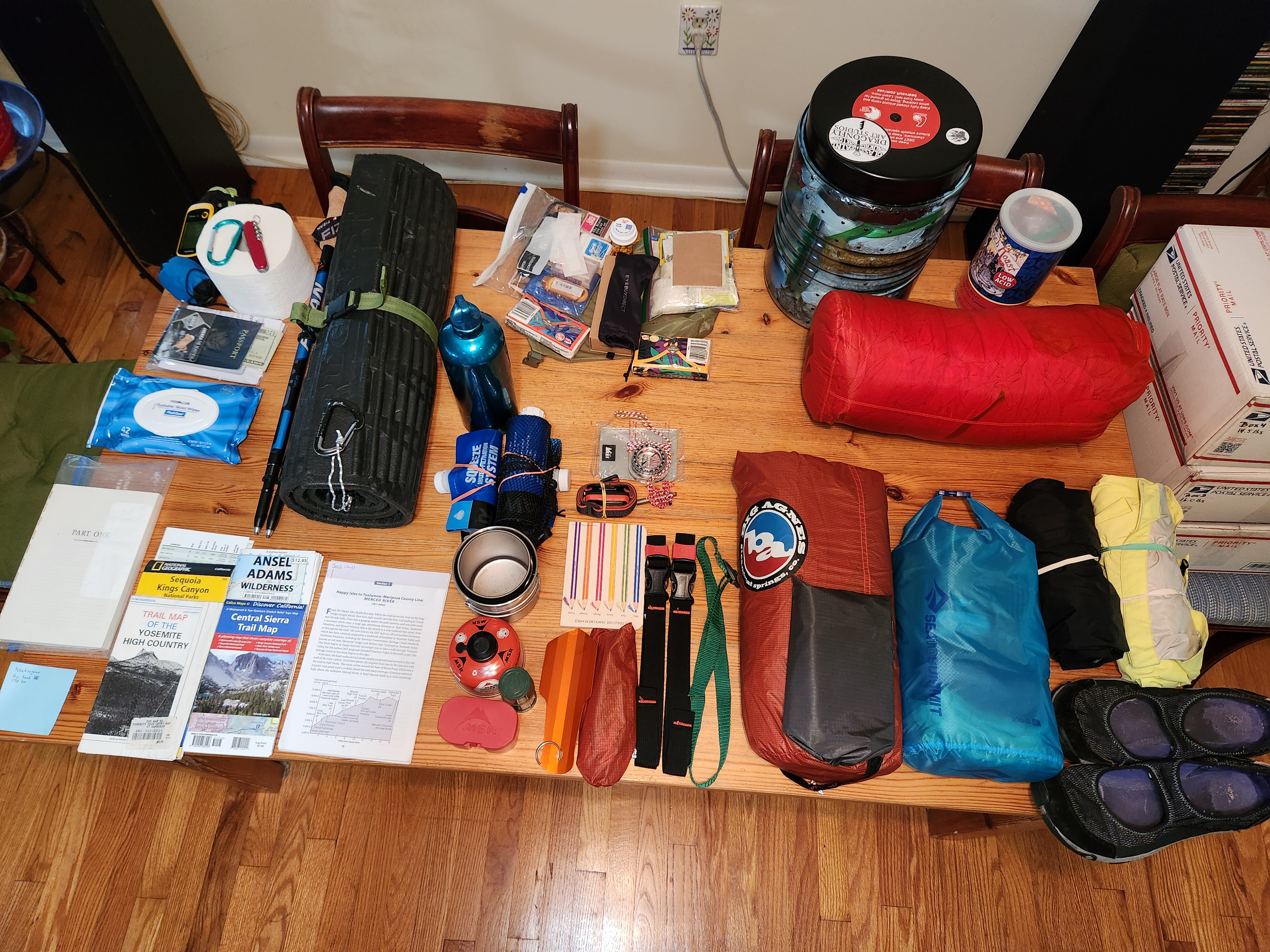
The photo above on the left shows my three U.S. Postal Service packages with food to resupply my backpack filled with the stuff in the center photo. Each food package weighted about 14 lbs (~6.5 kg) to give me 3500 kcal for each of 7 days. So I was planing for a 28-day trip, but it turned out that I spent 35 days in the wilderness and used only 2 of those 3 resupply packages. I also feasted on restaurant food the day before my hike in Mammoth Lakes (a large steak on Aug.-9), the day of my first resupply stop in Yosemite Valley (an unlimited breakfast buffet on Aug.-19), the day of my first shower at Reds Meadow (a double cheeseburger for dinner and a massive breakfast burito on Aug.-26), and the day of my second and last resupply stop at Vermillion Valley Resort (a pizza with 4 beers for dinner and a Lumberjack breakfast on Sept.-1/2). My body shed 20 lbs (8 kg) during those 5 weeks in the mountains.

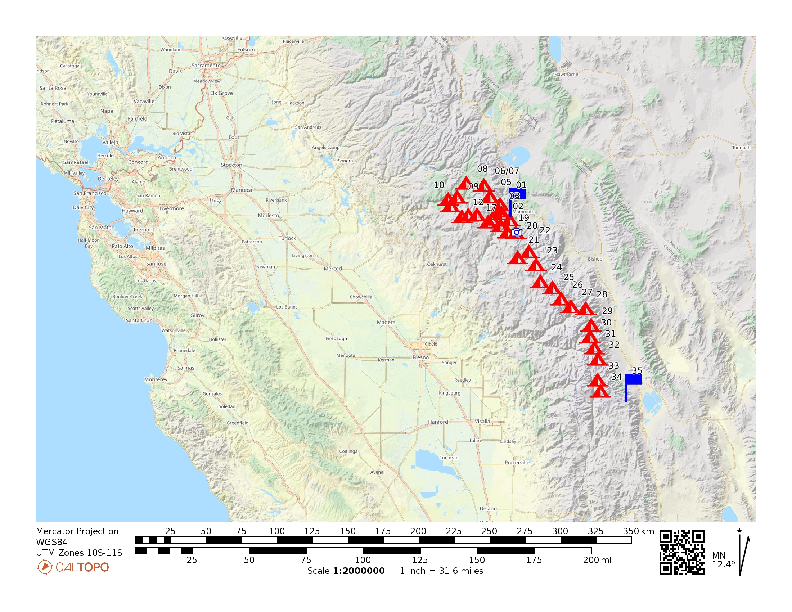
The map below shows San Francisco, the Central Valley of California, and the Sierra Nevada Mountains with my start (north) and end (south) point in blue. The red symbols show where I pitched my tent. The first part is a loop into and out of the backcountry of Yosemite National Park. Starting at Devil’s Postpile National Monument near Mammouth Lakes, I walked to Yosemite Village in 9 and back in 8 days. The second part was much easier as I stayed mostly on the John Muir Trail heading south for about 17 days. My lowest campsite was at 4000′ (1220 m) in Yosemite Village where I picked up first food resupply package while my highest campsite was at 11,700′ (3560 m) just below Muir Pass where I helped a Park Ranger with the evacuation of a hurt hiker by a police helicopter. You can access the interactive map at

https://caltopo.com/m/T8T7780/EDPCGF0HVB07PMG6

to zoom in for more detail.

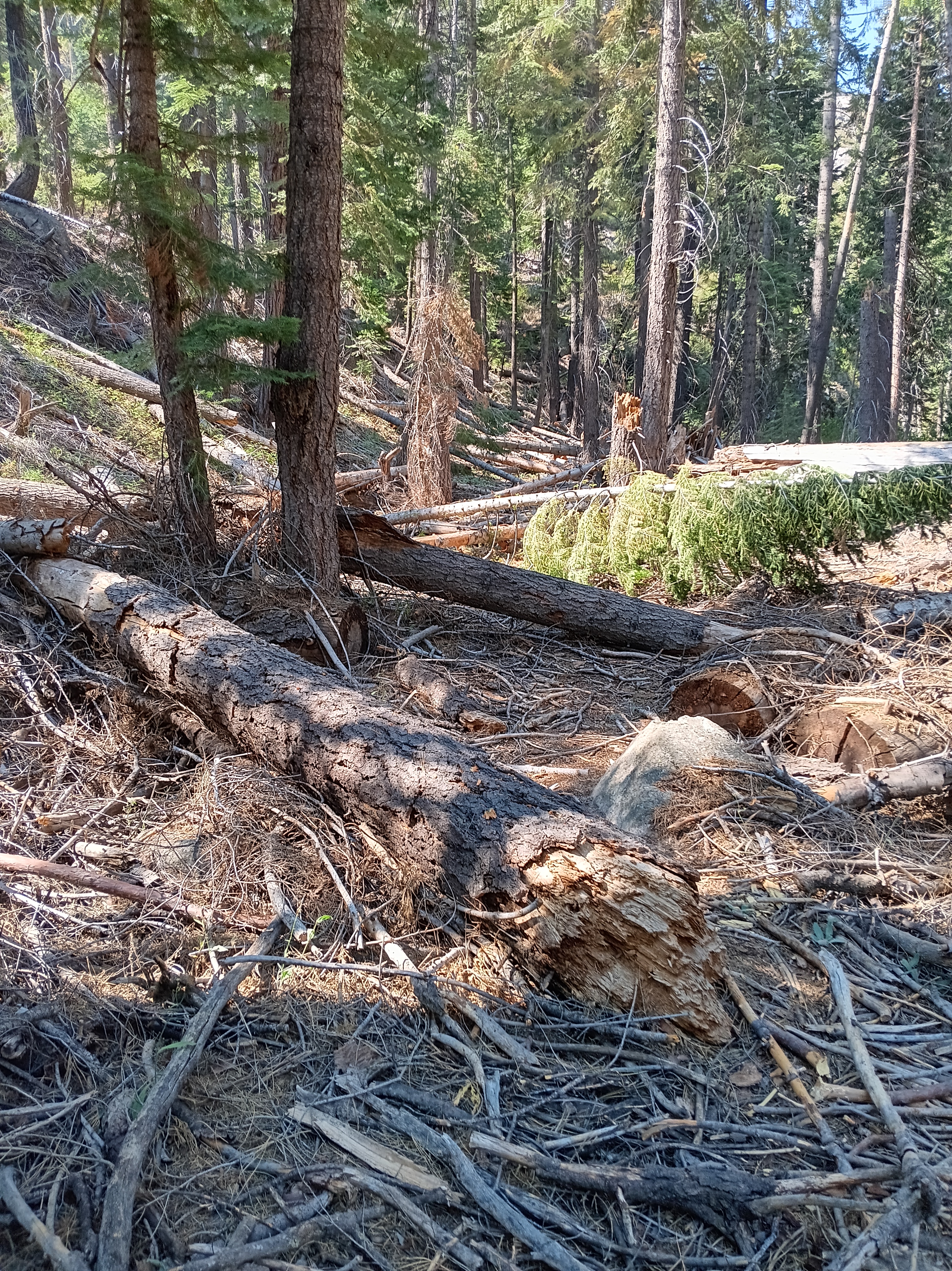
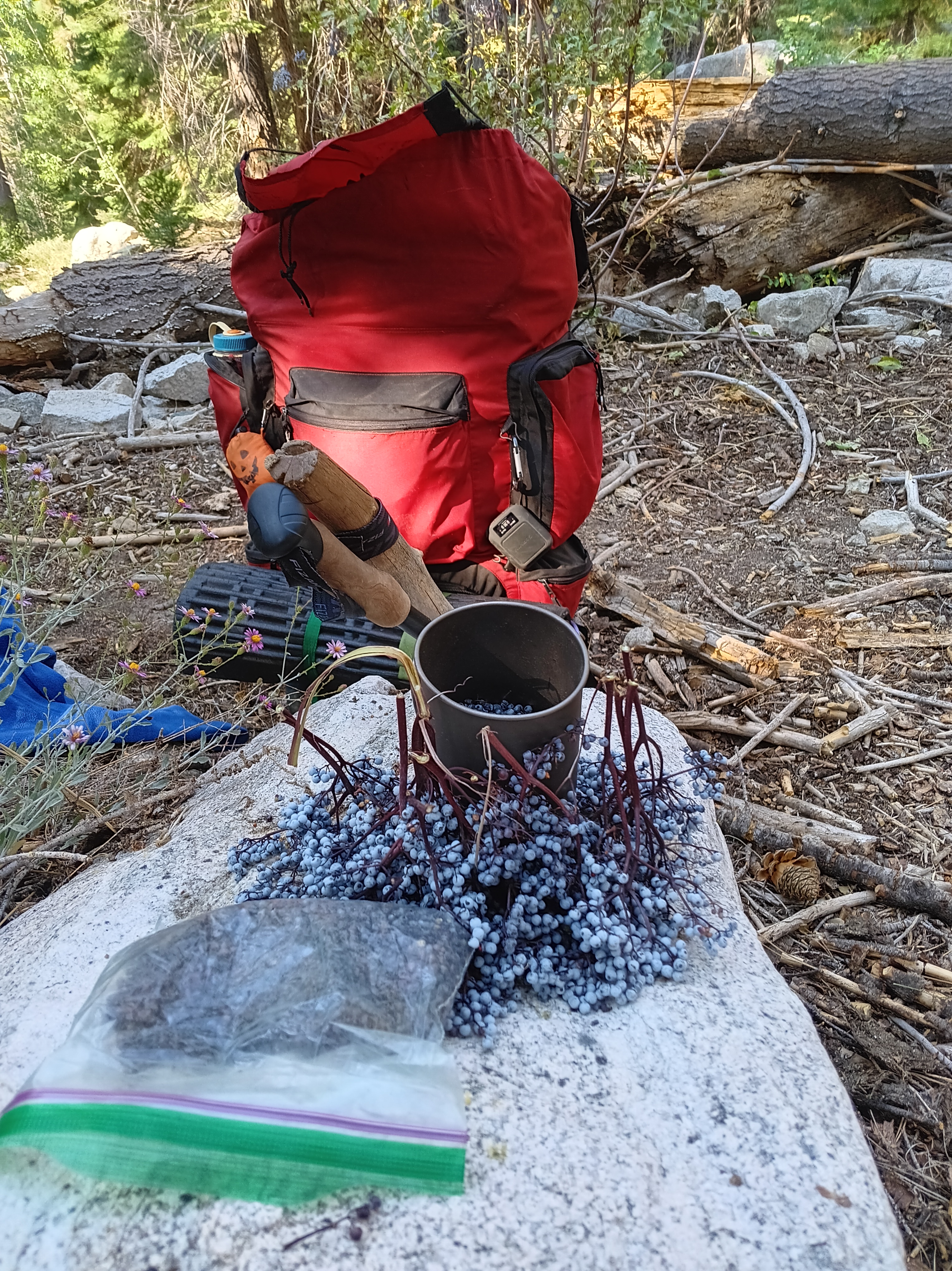
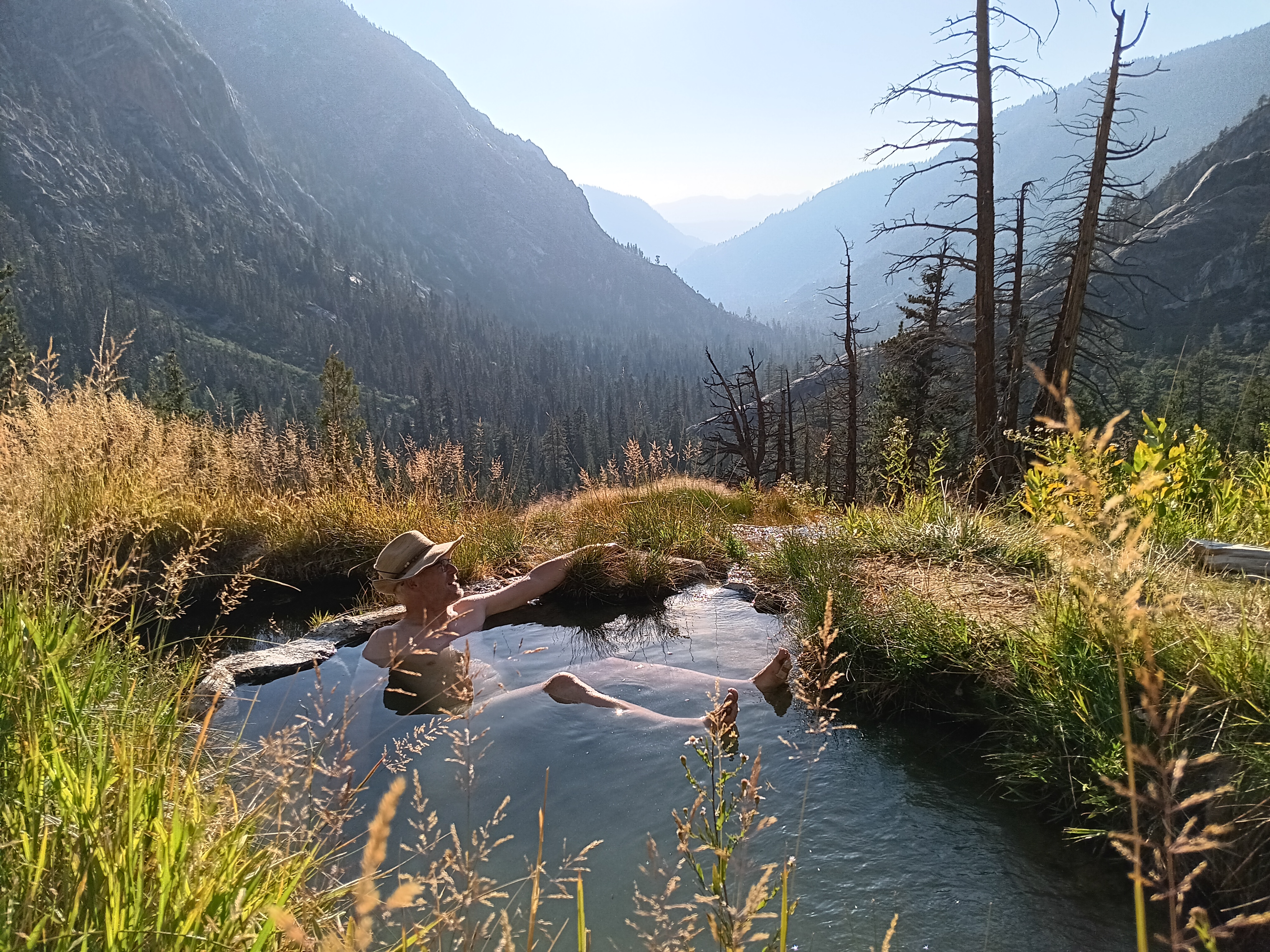
On Day-20 I found Ida Bell Hot Springs in Fish Valley. It was rough to get there, because that day I had to climb over and under constant wood piles created by toppled trees. The photo below on the left show the path that is littered by fallen trees along the steeply sloping V-shapped valley. This went on for 3 miles or 3 hours. Without the wood piles I usually hike at twice that speed. A more fun way to get slowed down, though, is to find, collect, and cook wild elderberries (middle photo below). Setting up camp along Fish Creek later, eating dinner with elderberry soup for desert, I went another 1.5 miles to look for the hot springs.

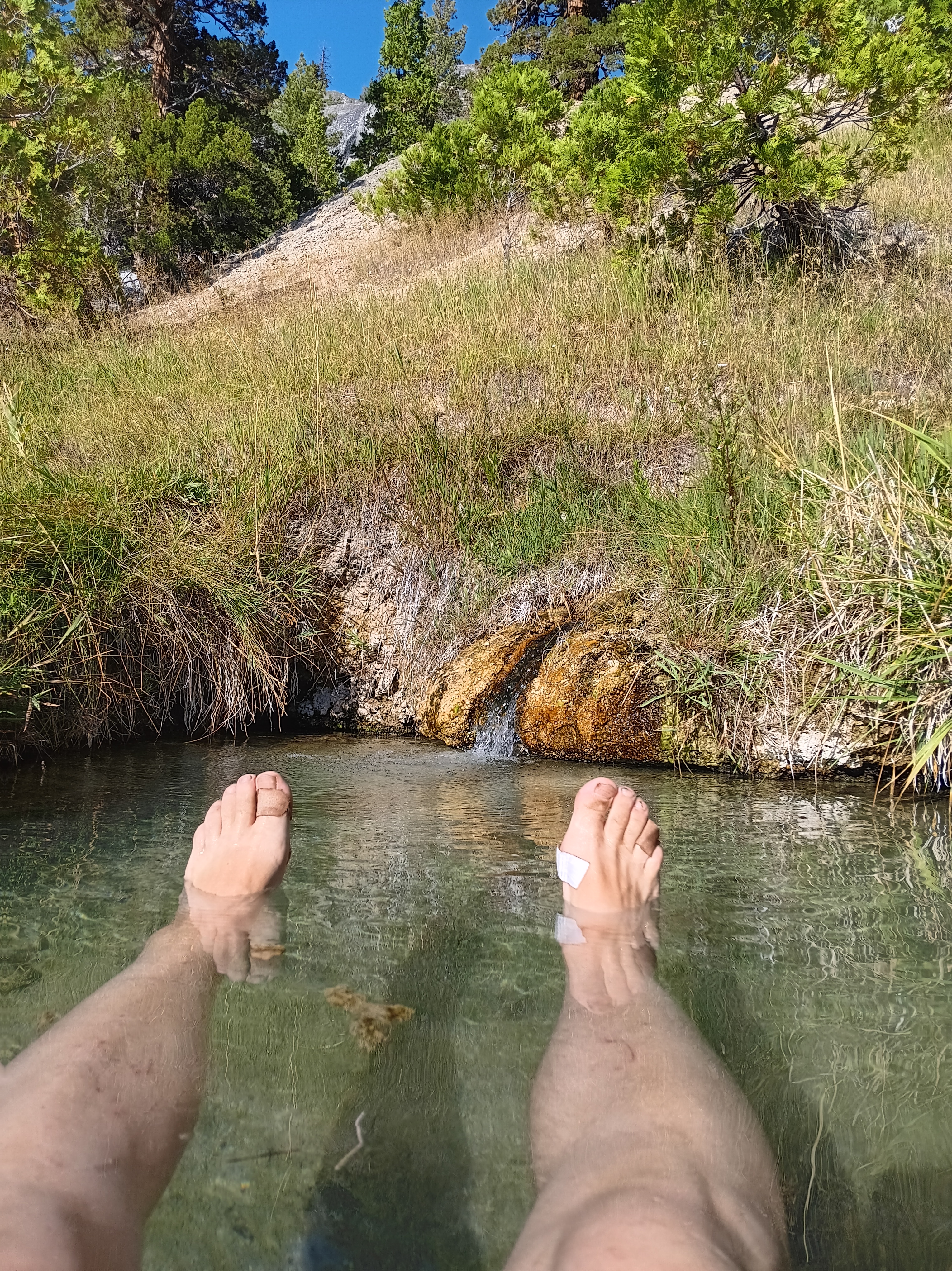
There are several hot springs, the hot water just emerges from rocks in the ground and is pooled (right photo with my blistered feet), but the one I liked best is at 7536′ (my tent was at 7133′). Its location offers a stunning view downstream into Fish Valley from where I had walked that day. The photo in the bottom shows me during a 2 hour soaking. And before I went to sleep at 8pm, I had another elderberry soup that I cooked with a tiny bit of water and the protein/dextrose/sugar mix that usually refurbishes my muscles at the end of each day. My trail diary states “Elderberries and soup were out of this world.” It was certainly one of many highlights of my 35 days walking in the wilderness.

Now, why did my adventure almost fail on the second day? Looking back, I did not know how to read maps just yet. My high resolution paper map has a dotted line that connects Minaret Lake with Cecile Lake, and Iceberg Lake just north of my trailhead (see map below). A dotted line means “Unmaintained Trail,” but I now know that this generally means that there is no trail at all. One thus has to “bushwack,” however, this dotted line was above the tree line near 10300′ (3140 m) without vegitation. Instead it was all rocks, boulders, talus, and scree. My trail diary states “… hard scramble almost vertical at times is hard with a heavy pack …” All was well initially, because I carefully navigated across a field of boulders, but these disappeared near the shore of Cecile Lake where dense vegitation gave the false impression of a more even ground. And here I twisted my ankle really bad. Initially I thought it was broken, but since I could wiggle my toe, I was lucky. Taking off my backpack, shoes, and socks, I cooled my ankle in the lake for an hour to minimize swelling. I then limped slowly along Cecile Lake at 10240′ and down past a tiny glacier discharging into Iceberg Lake at 9774′. Here I camped for the night nursing my ankle.

The Minaret Mountains in the west with Minaret, Cecile, Iceberg, and Ediza Lakes to the east along with my first two camping locations. The cross-hair indicates where my injury occured near the “unmaintained trail” indicated by the dotted line. Notice the steep slopes up and down from Cecile Lake.

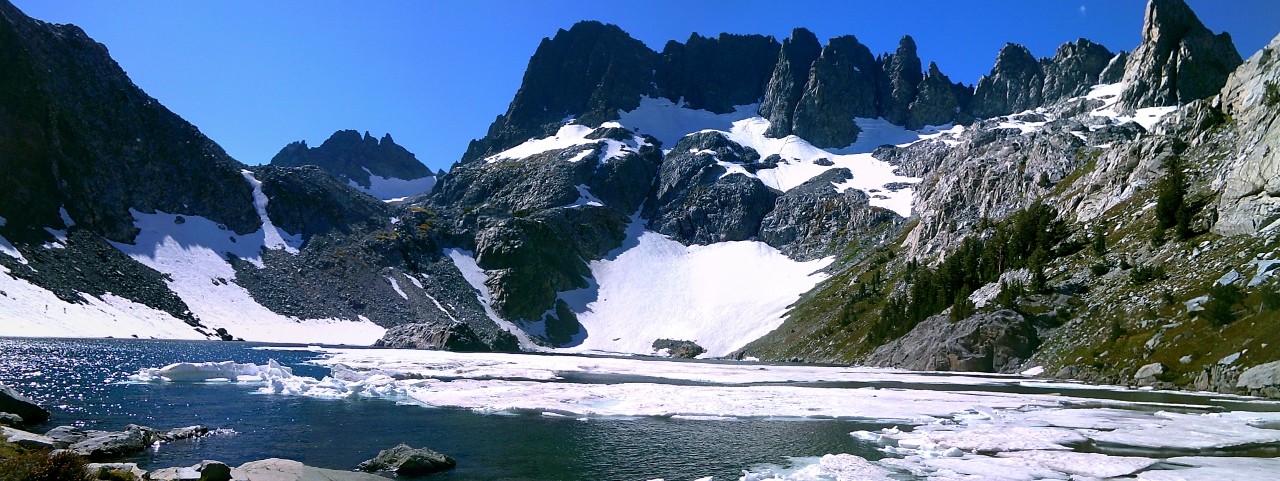
I walked and limped only 6 miles this day and cooled my ankle again in Iceberg Lake with a view on two small glaciers discharging their ice into the correctly names Iceberg Lake. There are no photos, because I had bricked my cell phone the night before by turning it off to save power not knowing the PIN of my SIM-cards. So I found this image of Iceberg Lake posted by Denise at beaut-tree.net

Iceberg Lake in the fore and Minarets in the back. The view is from north to south. Cecile Lake is above the dam or step ledge on the left. The photo was taken in 2011, but the snow and ice fields were not that different when I limped down with a swollen ankle on Aug.-11, 2024.

I was much surprised how well sleep, rest, and a positive attitude heals the body. As a result I walked 8 careful miles the next day only as my body allowed and felt comfortable. My trail diary states “… I need to be very careful where to place each step … I learnt my lesson. No bushwacking even if there is a dotted line on the map.”

There was another lesson, though, that served me well the next 33 days: Listen to your body and enjoy the moment. If your body wants to stop for a rest, a nap, or the day, do so. Hence I never knew where I would be at the end of the day or sleep the day after. There was a general plan, but the path was the goal and I quickly abandoned any plan or goal that was not fun or caused pain here or there. This, I believe, is why I succeeded to enjoy every day of the 35 days in the mountains. Mental fitness trumps physical fitness.

Data Obsessions while in Self-Quarantine

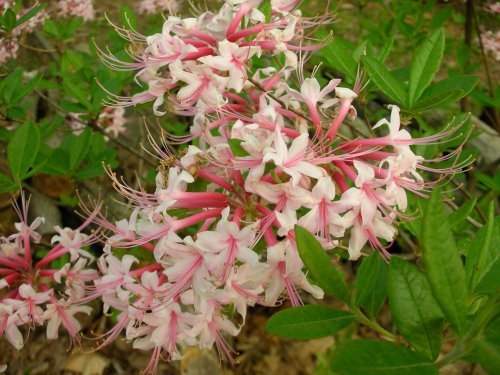
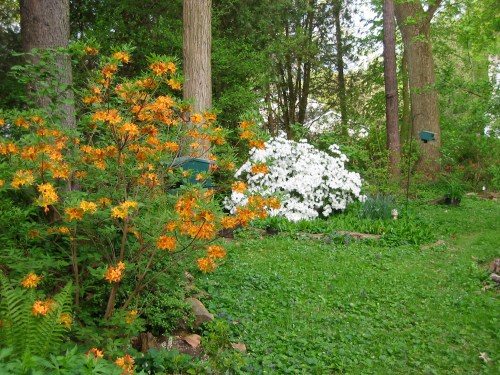
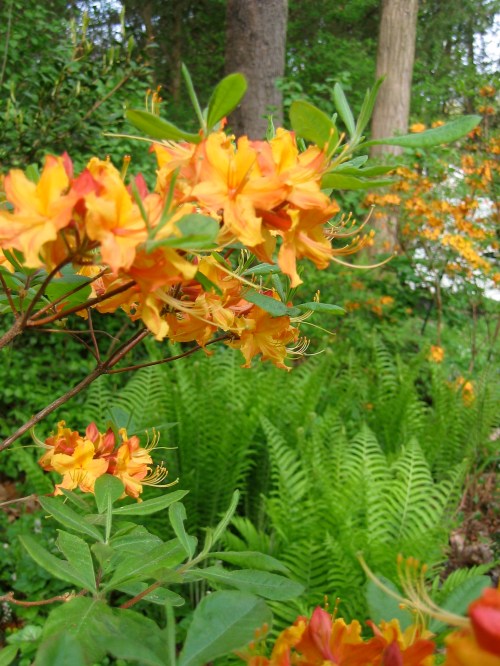
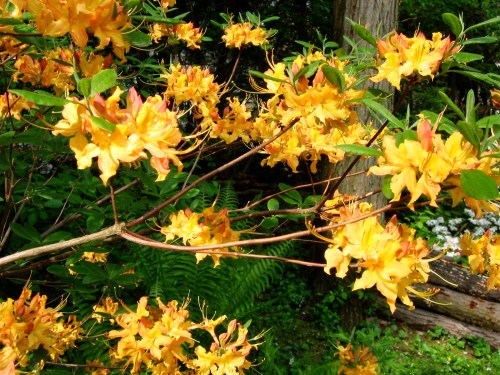
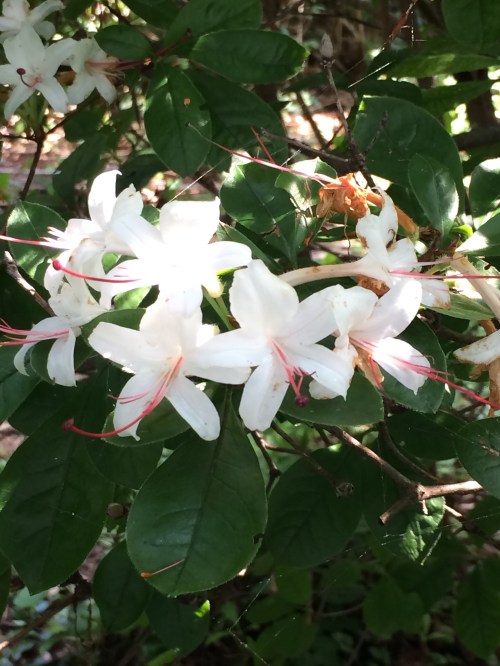
I sit in my home office looking into a garden which explodes in yellow from the forsythia with splashes of pink from the camellias. Both flourish after a large shading cherry tree fell down a few years ago. The tree stump is covered by moss and provides a natural border. My native American Flame azaleas (Rhododendron calendulaceum) now stand 8 feet tall in front after I planted them in 2001 as 3 inch sticks. They are the pride of my garden along with Piedmont, Sweet, Okonee, and Plum azaleas all purchased from Callaway Gardens in Georgia. They grow well, because I correctly predicted that the warmer climate zones of Georgia would move northward towards Delaware. Here are the azaleas in blooms in early May or four weeks from now:

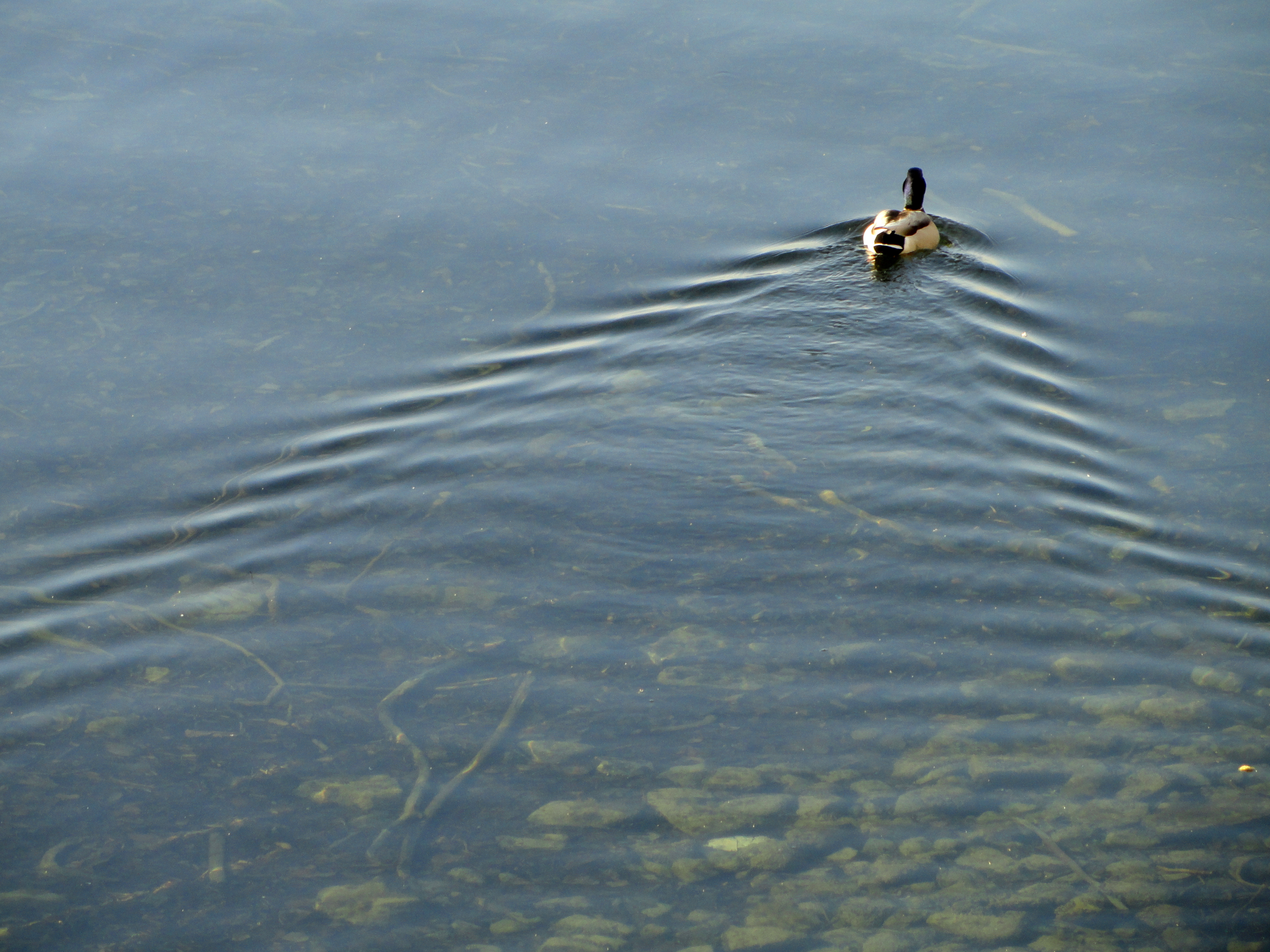
These are distractions, because I need to process and analyze ocean velocity data off Greenland. My student from South Korea rightfully expects numbers that she can work with for her Masters degree. We plan to meet via Zoom video call every Friday and Wednesday. She is ordered to stay at home in Maryland while I am ordered to stay at home in Delaware. We also meet Monday and Wednesday evenings when I teach “Waves” via Zoom to eight University of Delaware graduate students from China, South Korea, Thailand, and the USA. Our topic yesterday was the waves in the wakes of a ship or a duck or an island. To me physics are as beautiful as are the flowers in my garden:

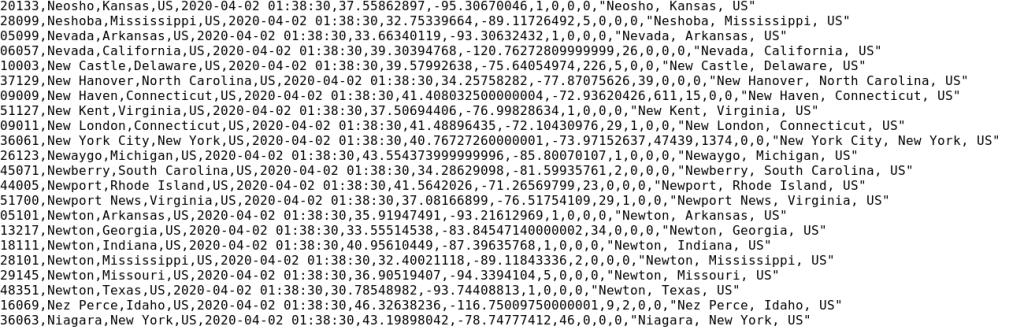
Now these are the things that I should work on during my self-quarantine, but I am obsessed and distracted with new data. The Johns Hopkins University in Baltimore, MD distributes data on the number of people who were diagnosed with Covid-19, who died of it, and who have recovered. While it is easy to access their excellent data displays as global health authorities report them, the actual raw digital data files are accessible at

https://github.com/CSSEGISandData/COVID-19

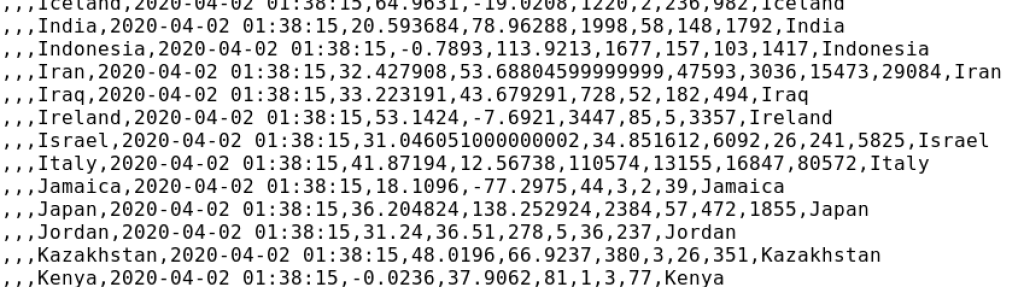
These data require computer programming and data handling skills that a well trained physical ocean, climate, or data scientist masters. The raw data, however, do not tell a story, because it just looks like gibberish,

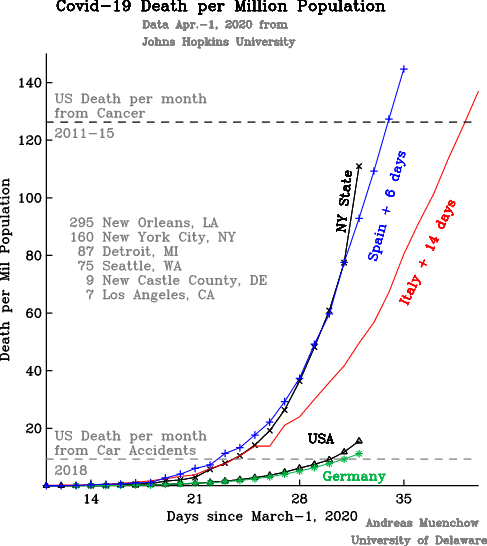
but there is a most orderly system to this madness. With 143 lines of computer code (one C-shell and two awk scripts) I convert these data into a single graph to tell a story:

First, I focus only on the number of people who have died, because I consider this the most reliable (albeit morbid and depressing) estimate of how the virus is spreading.

Second, I present the number of people who died relative to the population. It hardly seems fair to compare the numbers from the USA with 327 million people to those of Malta with only 0.5 million people. The technical term is “normalization,” that is, all numbers are relative to 1 Million people. So, 5 dead in Malta give 10 dead per million. The same 10 dead per million correspond to 3270 dead Americans. This way I am comparing apples to apples as opposed to Americans to Maltese.

Third, I want to compare the spread of the pandemic over time on different continents, different countries, different states, and different cities. This requires to time-shift countries hit by the virus earlier than others. In the above graph, for example, I moved the curve for Italy 14-days forward and that of Spain 6-days forward relative to all other places listed.

Fourth, I am most interested in New York State (population 20 million), because it contains New York City (population 8 million) and, I believe, it gives Americans a good idea what is coming. Furthermore, I believe, that the Government of New York State is a little more efficient, smart, and forward-thinking than many other government entities. It also has resources not necessarily available to less affluent communities.

The curve for New York State initially (until Mar.-25) followed the trajectory of Italy 14 days earlier, but then it switched over to the steeper trajectory of Spain 6 days earlier. Notice that Italy’s curve has a flatter trajectory than the steep curve of Spain and New York State. From Mar.-28 to Mar.-31 the New York curve was almost exactly that of Spain 6 days ago, but yesterday, the number of people dying in New York grew even faster than those in Spain or Italy ever did. This is scary stuff.

Yesterday, New York State had about 111 dead per million people. While this is still less than the 180 dead per million people that both Italy and Spain had yesterday, it may take only 4-5 additional days for New York State to reach those numbers also, but I still do not know what these numbers mean. I do not “feel” them. So I try to compare them to other causes of death such as people getting killed every month in (a) car accidents (9 per million) or (b) gun violence (8 per million) or (c) cancer (126 per million). These references help me to visualize the scale and impact of this pandemic.

So, while Covid-19 has killed about as many people in the US the last 4 weeks as people died in car accidents, in New York State the number of Covid-19 dead is about to exceed those who died of cancer in this same period. The hardest hit place in the US, however, is not New York City (160 dead per million), but New Orleans (295 dead per million). The County or Parish of New Orleans, Louisiana has about 400,000 people or a little less than New Castle County in Delaware where I live, but New Orleans has 115 dead compared to 5 in New Castle County (9 dead per million).

There are a few bright spots and I want to close on those. Los Angeles (7 dead per million) and California (5 dead per million) are doing remarkable well as does Germany (11 dead per million). Despite physical separations from others, I feel closer to friends, family, and neighbors both overseas and across the street. With more than 10 feet distance we have impromptu get-togethers between the door and the end of the driveway of 4 different households. I am happy to know that my neighbor Joyce from Kenya is safe back home living quarantined across the street with her African friends from Mali. She runs Water for Life which is a small non-profit that provides clean drinking water for rural communities in Kenya. It makes me happy to know her as a neighbor across the street.

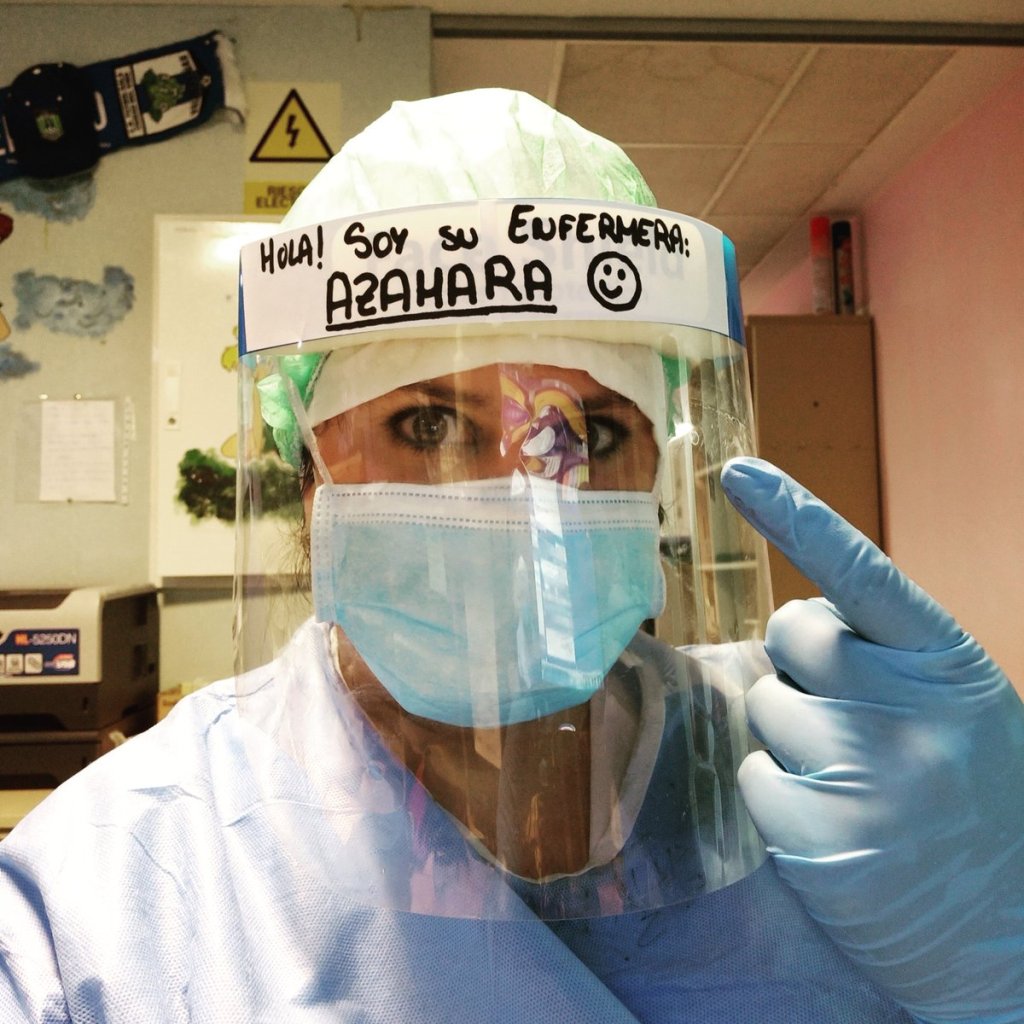
And then there are the true warriors who fight this virus while endangering themselves to help others. Here is a nurse from Spain whose photo at work I took from her Twitter feed. We are all surrounded by wonderful and beautiful people.

Waves

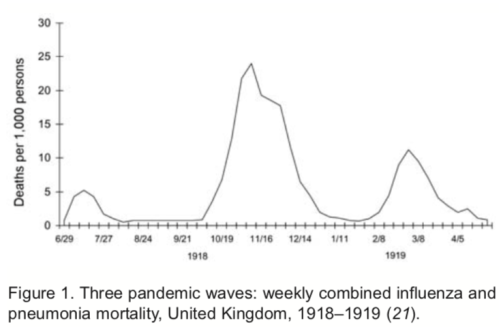
Almost 300 years ago a brave scientist boldly stated that everything can be described as waves. It took mathematicians another 200 years to prove that Joseph Fourier, the bold scientist, had it right. I am comforted by this fact while the Covid-19 pandemic appears to grow without bounds. And yet, bounds do exist, because Fourier states that what goes up must come down. This includes the global Covid-19 pandemic of 2020/21 as well as the Influenza pandemic of 1918/19. The latter had three distinct peaks in the United Kingdom that varied both in amplitude and duration:

Adapted from Taubenberger, J.K. and D.M. Morens: 1918 Influenza: The mother of all pandemics, Emerging Infectious Diseases, 12 (1), 2006.

This pandemic of 100 years ago came in three distinct pulses in the spring of 1918, in the fall of 1918, and in the winter of 1919. The graph shows that during the first wave about 0.5% of all infected people died while the second and third wave were more deadly with 2.5% and 1.3% fatality rates. These rates are somewhat similar to those we see today with Covid-19, but there is much we do not yet know.

We do not yet know, for example, how long it will take for the Covid-19 waves to pass through populations. We do not know the amplitude of the waves either, because it all depends on how well we distance ourselves from each other both now and into the future to minimize transmission of the virus. There is no control, yet, because no vaccine exist, but smart distancing will impact how many people will get infected (the amplitude) over time (the period).

These two factors (amplitude and duration) will determine how many of our friends, partners, parents, brothers, and sisters we will lose to the virus. As the German Chancellor Angela Merkel said yesterday: “Im Moment ist nur Abstand Ausdruck von Fuersorge,” which translates as “At the moment only distance is an expression of care.”

German Chancellor Angela Merkel on Mar.-18, 2020 on German TV.

Waves change as they propagate from one medium to another. As ocean wave forms move from deep to shallow water they change both amplitude and speed until they eventually break. I view today’s Covid-19 waves in a similar way.

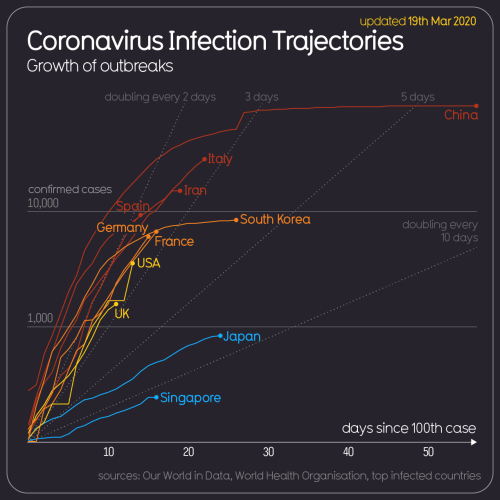
Covid-19 waves will propagate through all societies on our planet, but they will propagate differently in different regions, countries, and societies. Amplitudes, periods, and propagation speeds will differ. Some of this is already visible by global statistics that are collected and shared in real time:

From https://informationisbeautiful.net/visualizations/covid-19-coronavirus-infographic-datapack/

The spread of the virus in China differs from that in South Korea which differs from that in Iran, Italy, Germany, and the United States. Different political systems, different skills of and trust in governments, and different personal behaviors all provide a different medium within which these waves propagate and, eventually, will dissipate.

This is day-8 for me and my wife to distance ourselves from our friends, family, and neighbors. We are fine. My wife turns the bedroom into a painted mural while I read and write at home and spent much time in the spring garden. It slowly sinks in, that this will not be over next week or next month. The goal is to make the amplitude as small as possible by spreading the period out as long as possible which will allow our hospitals, nurses, and doctors to provide the best care for those who need it. As a wise woman said yesterday: “At the moment only distance is an expression of care.”

Reference:

Taubenberger, J.K. and D.M. Morens: 1918 Influenza: The mother of all pandemics, Emerging Infectious Diseases, www.cdc.gov/eid, 12 (1), 2006.”