Author Archives: Andreas Muenchow

Nares Strait Ice Bridge and Arctic Ice Thickness Change

The ice of the Arctic Ocean is rapidly disappearing. This happens every summer, but for the last 30 years there is a little less ice left at the end of each summer than there was the year before. The areas covered by ice are not only shrinking, the ice is also getting thinner, or so many do believe.

To check out such claims, we placed sound systems on the ocean floor of Nares Strait from which to find out how much the thickness of the ice above has changed. We started this in 2003, were told to stop it in 2009, but privately parked our instruments where they would collect data. We must get to check our sound systems and retrieve the private recordings, because otherwise Poseidon will claim our possessions for parking violations. The Canadian Coast Guard Ship Henry Larsen, we hope, will help us to negotiate water and ice to get us deep into Nares Strait as she and her crew did so well in 2006, 2007, and last in 2009.

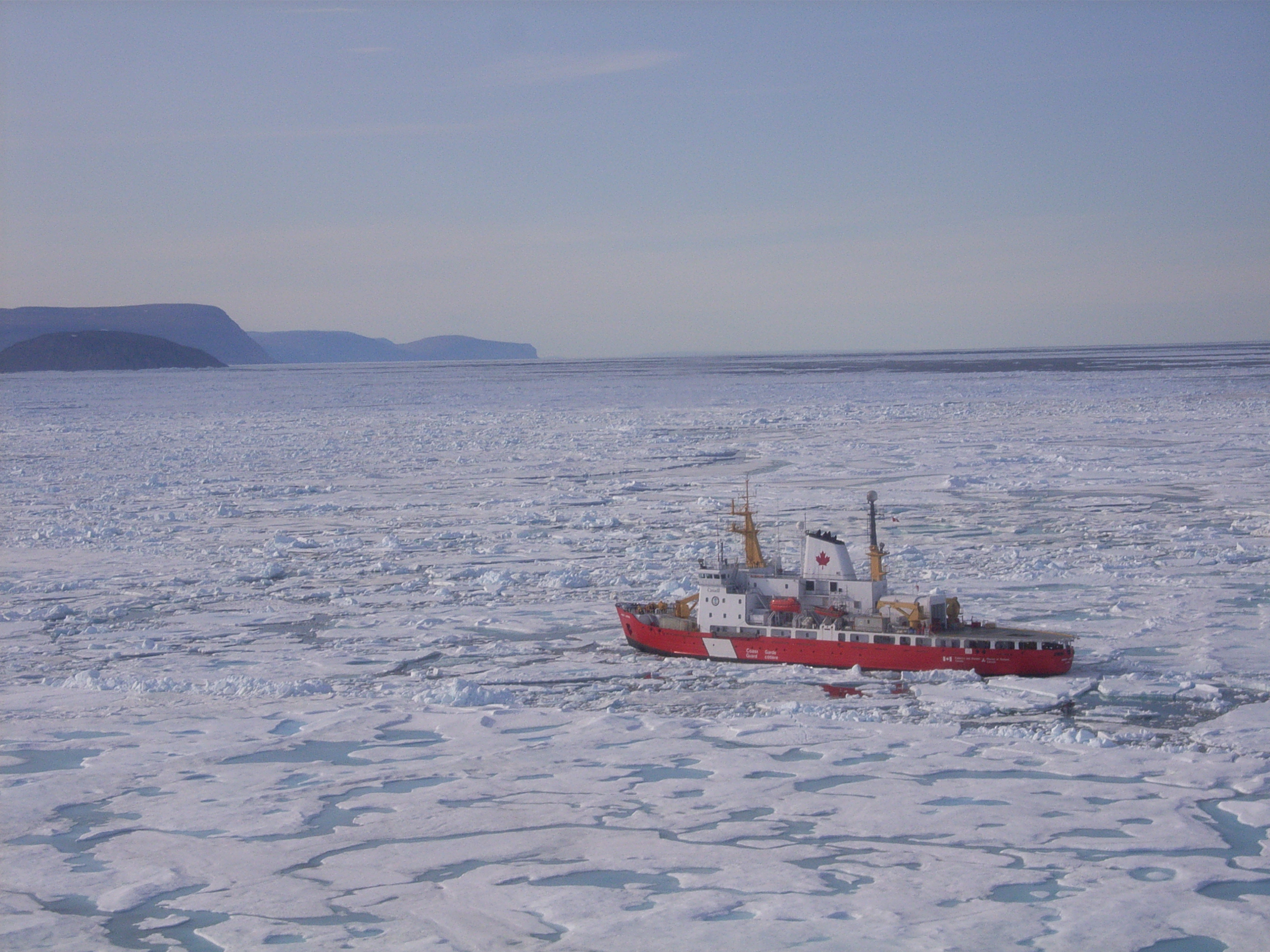
CCGS Henry Larsen in thick and multi-year ice of Nares Strait in August 2009. View is to the south with Greenland in the background. [Photo Credit: Dr. Helen Johnson]

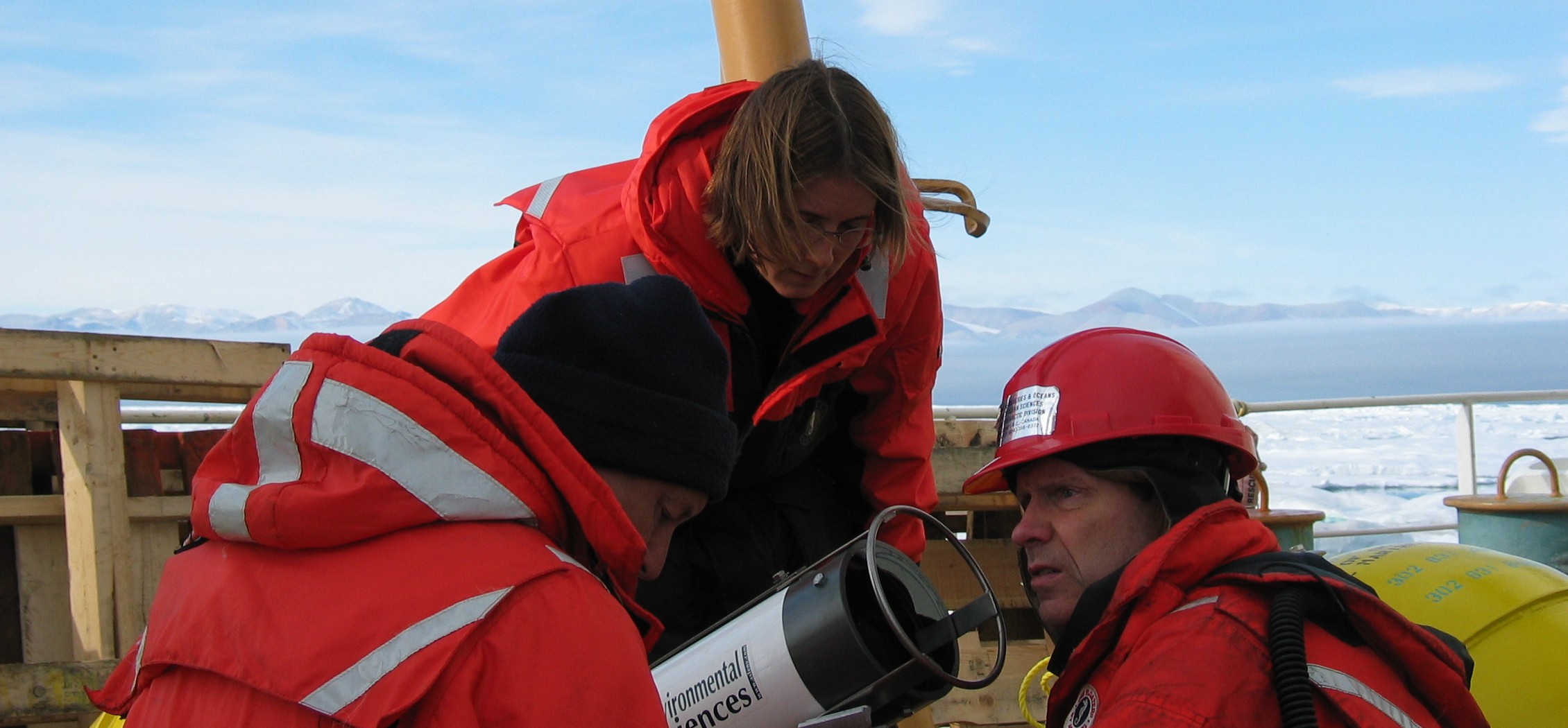
The ice profiling sonar sounds system before its first deployment in Nares Strait in August 2003 from aboard the USCGC Healy. It measure ice thickness many times each seconds for up to 3 years. View is to the north-west with Ellesmere Island, Canada in the background. Listening in are Jay Simpkins (left), Helen Johnson, and Peter Gamble.

Nares Strait to the west of northern Greenland is one of two major gates for the thickest, the hardest, and the oldest ice to leave the Arctic for the Atlantic Ocean [Fram Strait to the east of Greenland is the other.] This gate is closed at the moment by an arching ice bridge that locks all ice in place. No ice can leave the Arctic via Nares Strait as long as these arches hold. The ice arch acts as a dam that holds back the flood of ice that will come streaming south hard once the dam breaks. And break it will, usually between the end of June and July.

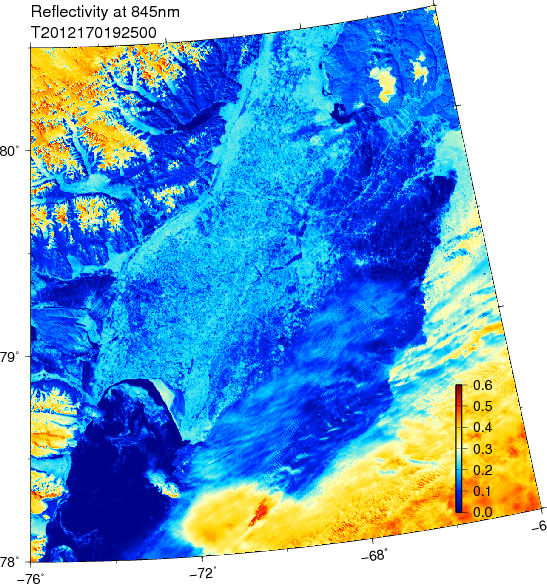
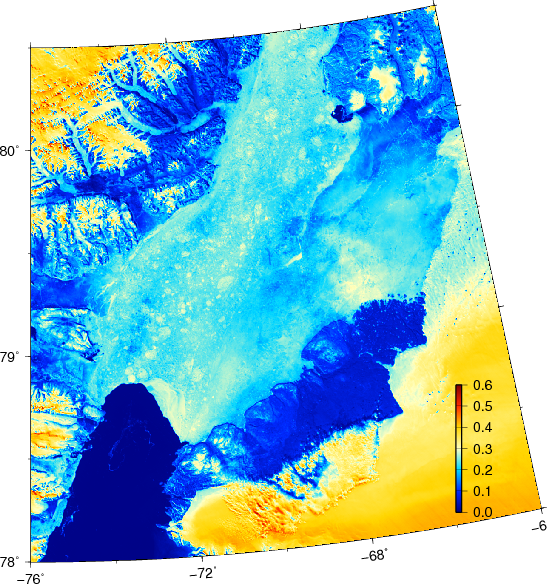
Ice arch in southern Nares Strait as seen by MODIS Terra on June-18, 2012. Greenland is on the right, Canada on the left. The dark blue colors in the bottom-left are open water, yellow are the ice caps of Greenland and Ellesmere Island and lighter shades of blue are warm ice or land. Humboldt Glacier is the on the right-center where Nares Strait is at its widest with Kane Basin at about 80 N latitude.

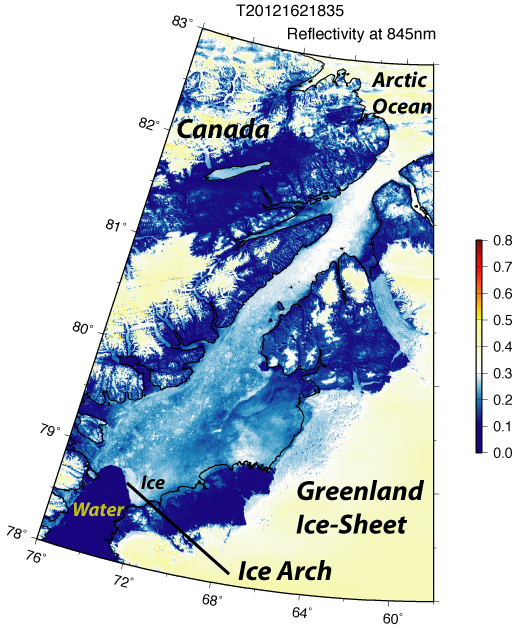
Nares Strait Jun.-10, 2012 image showing land-fast ice between northern Greenland and Canada as well as the ice arch in the south (bottom left) separating sea ice from open water (North Water). The coastline is indicated as the black line.

The sooner it breaks, the more old ice the Arctic will lose and the better it is for us to get an icebreaker to where must be to recover our instruments and data. The data will tell us if the ice has changed the last 9 years.

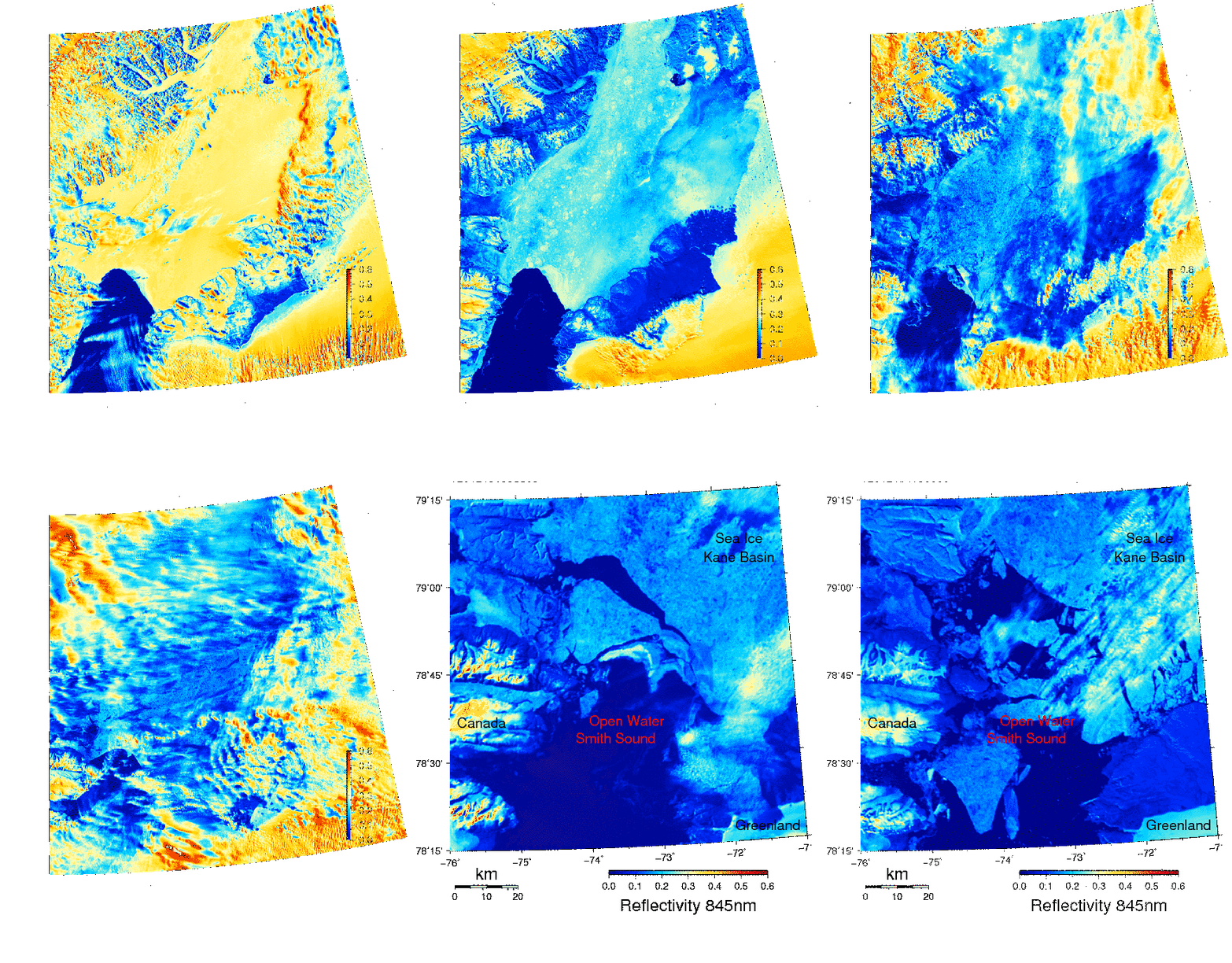
I processed and archived maps of Nares Strait satellite images to guide 2003-2012 analyses of how air, water, and ice change from day to day. Ice arches formed as expected during the 2003/04, 2004/05, and 2005/06 winters lasting for about 180-230 days each year. In 2006/07 no ice arch formed, ice streamed freely southward all year, and this certainly contributed to the 2007 record low ice cover. In 2007/08 the arch was in place for only 65 days. In 2009/10, 2010/11, and now 2011/12 ice cover appear normal as the arches formed in December and lasted until July.

We live in exciting times of dramatic change, some to the better and some to the worse. Some of the change is caused by global warming while most is probably not. We do not know for sure, but most of the evidence points towards us people as a major driver of the change we observe in the Arctic and elsewhere. Nevertheless, climate and its change is one grand puzzle that no single scientist, no single discipline, no single country, and no single continent can solve. There are many pieces that all contribute to how and why the Arctic ice changes the way it does. And this includes the ice arches of Nares Strait. There are many mysteries and unresolved physics in what makes these ice arches tick and what makes them blow to bits, but blow they will … watch it, it’s fun, and perfectly natural.

EDIT: This movie shows just how stable the ice arch is at the moment.

Petermann Ice Islands Stuck in Ice

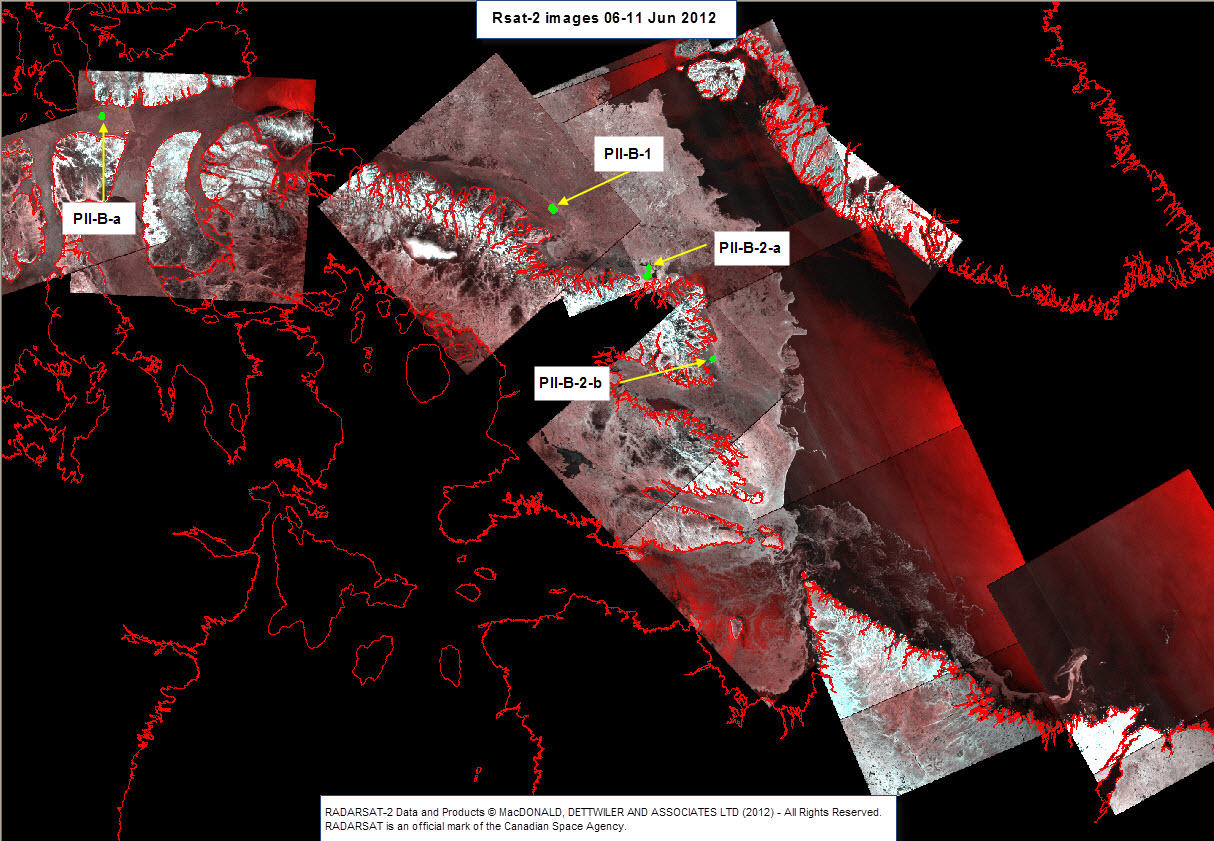
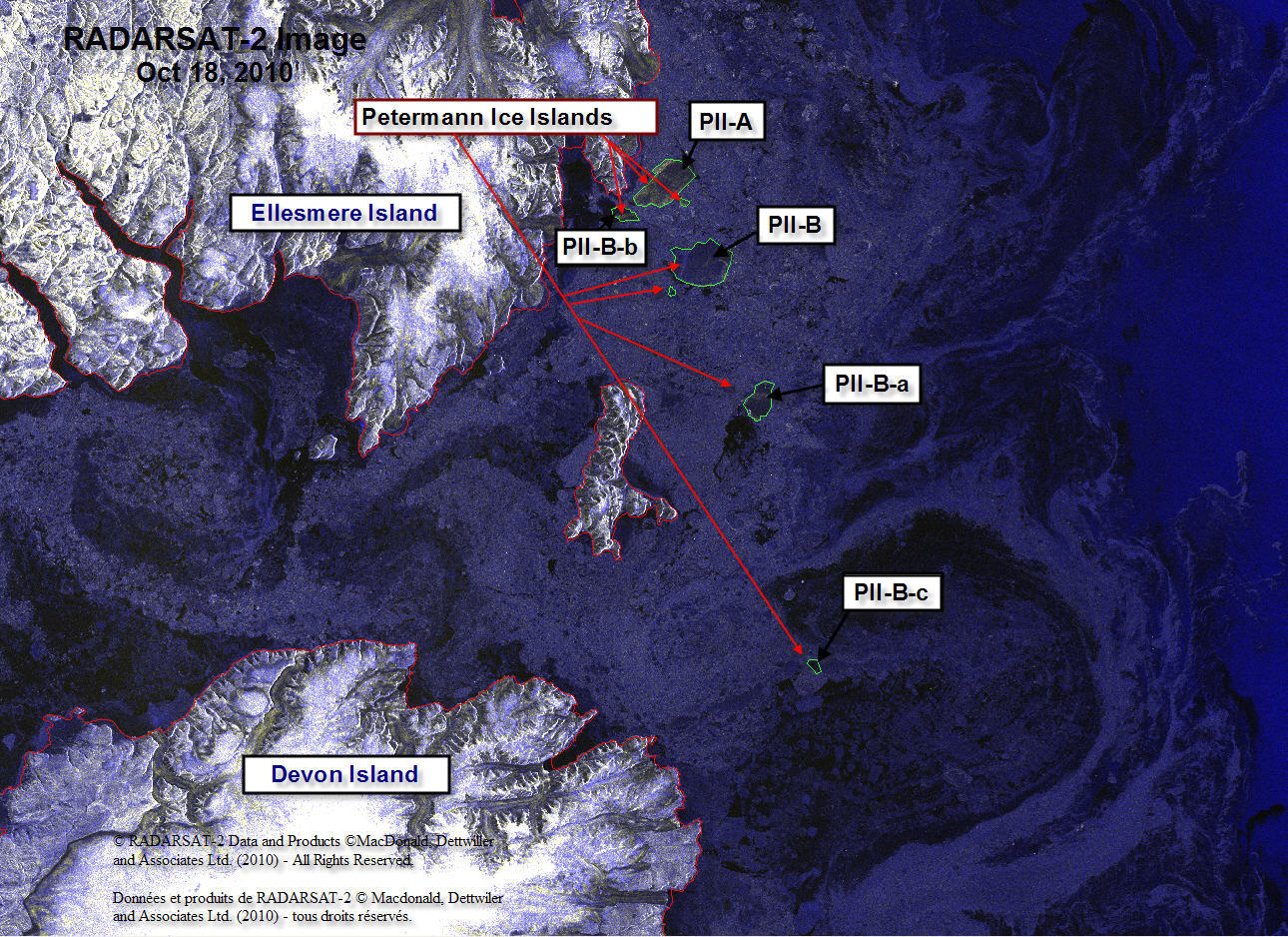
Several pieces of the Manhattan-sized ice island that broke off Petermann Glacier, Greenland in 2010 arrived, dispersed, and melted off Newfoundland last summer. They provided stunning displays visible to the naked eye from the coast. The Canadian Ice Service just distributed this set of radar images showing 4 pieces that are all grounded and/or stuck in ice. None are moving.

Overview of fragments of Ice Islands that broke off Petermann Glacier, Greenland in 2010 as of June-11, 2012 from RadarSat composites. [Credit: Luc Desjardins, Canadian Ice Service]

In the open ocean ice is moved by winds stressing the ice from above and by ocean currents stressing the ice from below. Typical sea ice varies in thickness from 1-5 meters (3-15 feet) which is much less than the 30-130 meters (90-400 feet) thick ice islands. Winds thus push thick ice islands much less than they do push the thinner sea ice. Thick ice islands are moved by ocean currents, not winds.

This is why oceanographers like myself love these bits of ice islands to bits: they tell us about the ocean below the surface that satellites do not see, but, sadly, all fragments are stuck either to the seafloor in shallow coastal waters or are cemented in place by immobile sea ice that is “land-fast:” Think of it as ice that is glued to land and to each other. This sheet of glued-together ice extends some distance offshore. The distance can be a few yards during a cold winter night in Maine or 100s of miles off Siberia. Offshore islands, rocky outcroppings, or grounded ice islands all anchor land-fast ice by adding local support and thus strength and stability to the immobile land-fast ice.

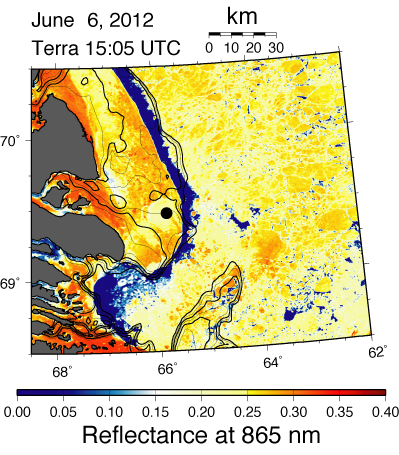
Too much talk, lets explain this with an image of the largest ice islands, called PII-B1. It is about 4 km wide and 9 km long. I dropped a black dot in its center as it is hard to see where to look in this image. I also show land in grey, open water in blue, and ice in shades of white and yellow:

Land-fast and mobile sea ice off Baffin Island with Petermann Ice Island PII-B1 grounded near the 150 meter isobath (black dot). Thick lines are 100, 200, and 300-m bottom depths. MODIS Terra data at 250-m resolution from June-6, 2012, 15:05 UTC.

There is clearly a 30-km wide band of ice attached to the land with a line of blue water separating it from ice that is mobile and has different signatures. A blue band of ocean has emerged, I speculate, as the result of winds from the south that moved the mobile ice to the north-east (to the right in the image). Neither the land-fast nor the grounded ice island PII-B1 embedded in it moved, so open water appears where there was mobile ice before. This is called a shore lead and I bet there are plenty of seals and whales feasting there now. Note also the arched entrance to Home Bay (bottom left) where loose ice is scattered towards the headland of Henry Kater Peninsula.

As summer is arriving fast in the Arctic, the land-fast ice will disappear, breaking up as the sun and air above and the ocean below weakens the ice by melting. This will expose the thicker ice islands and icebergs to wind-forced storms and waves more violently than it does now. And even those ice island grounded to the bottom of the ocean in shallow water will become free during a time of higher than normal sea level, perhaps during a spring tide, perhaps during strong winds from the north. Then these currently stuck-in-the-ice ice islands will continue their journey south towards Newfoundland and the Atlantic Ocean that they began in 2010 when they were born in northern Greenland.

EDIT: For context I append an earlier RadarSat image from October-18, 2010 when all segments were much closer in space.

Petermann Ice Islands in northern Baffin Bay of Coburg Island, Canada at 76 N latitude on Oct.-18, 2010, about 2 month after they separated from Petermann Glacier, Greenland at 81N latitude. [Credit: Luc Desjardins, Canadian Ice Service]

Ice Arches and Gothic Cathedrals

Soaring towards heaven awash in light, Gothic Cathedrals awed medieval kings, jesters, and peasants alike. Their upward pointing arches allowed walls of stained windows to filter light into these massive buildings when most dwellings from royal castle to decrepit hut were dark, damp, and filthy. While the power of god was both invoked and abused, it was physics and engineering that allowed these cathedrals to scrape the skies. A delicate balance of forces is of the essence to avoid accelerations and collapse.

Arched windows within an arch inside the Cathedral of Reims, France.

Hence it should not surprise that ice arches buttressed by land show similar elegance and stability, but also dramatic collapse. When these ice arches form and collapse is one factor to determine when the Arctic Ocean will be free of ice in summer.

June-10, 2012 ice arch in Nares Strait between northern Greenland and Canada. The arch has been in place since Dec.-8, 2011.

Nares Strait Jun.-10, 2012 image showing land-fast ice between northern Greenland and Canada as well as the ice arch in the south (bottom left) separating sea ice from open water (North Water).

The Nares Strait ice arch forms between December and April most winters. Unlike the medieval cathedrals it consists of blocks of ice. Once in place, the arch shuts down all ice movement. The ocean water under the ice moves undisturbed southward sweeping newly formed ice away. This creates the North-Water polynya, first reported by William Baffin in his ship logs in 1616. The North Water supports wild life for millenia providing food and trading items for people. Even viking remnants from the time the first Gothic Cathedrals were built in Europe were found here: sections of chain mail, iron point blades, cloth, and boat rivets.

I want the ice arch in Nares Strait to collapse as soon as possible so that a Canadian ice breaker can get us to where we like to recover instruments and data that we deployed in 2009. And while I researched the stability of ice arches and studied Moira Dunbar’s 1969 satellite imagery, I came across a wonderful NOVA broadcast on medieval skyscrapers of glass and stone.” PBS stations will show it on Sept.-9, 2012.

Digging a little deeper, I also found a series of Open University podcasts and videos. My favorite 3-minute segment covers lines of thrust where barely connected irregular blocks of wood form a surprisingly stable yet wobbly arching bridge. If you want to build your own arch, then play interactively for fun with the physics of stone arches.

Since I want to understand and predict when the ice arch of Nares Strait collapses, I must understand how medieval architects and engineers designed their Gothic Cathedrals. I will also need understand why some cathedrals are still standing while others collapsed. My icy building blocks in Nares Strait are not as solid as the stones of Reims Cathedral, but unlike the medieval scientists, today we have computers and mathematics to help … as well as more than 800 more years of experience in science and engineering.

Last Image of Nares Strait from Europe’s Environmental Satellite

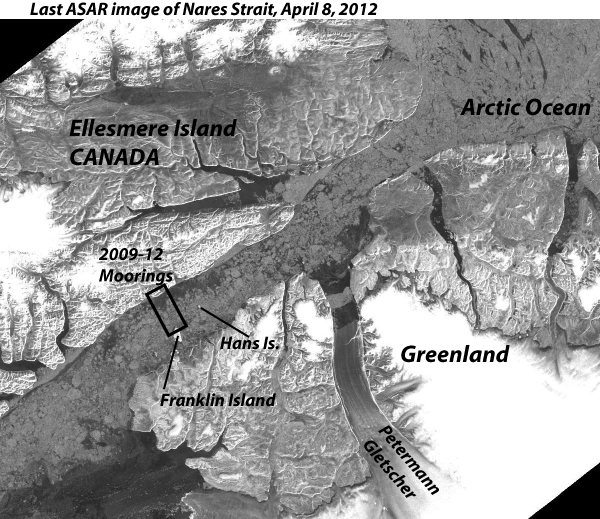
The European Space Agency announced today that one of its primary environmental satellites died. For over a months now engineers could neither receive data nor send commands to the 10-year old veteran of earth science research whose design life was 5 years. The last image received for my study area between northern Greenland and Canada shows Petermann Gletscher and ice-covered Nares Strait:

The rectangle between Franklin Island, Greenland and Ellesmere Island, Canada shows the site where in August 2012 we hopefully will recover data from an array of ice and ocean sensing equipment that we put there in 2009.

It was during this 2009 International Polar Year expedition to Nares Strait that I discovered satellite remote sensing in a new way, that is, accessing the raw digits sent down to earth from the NASA’s Aqua and Terra satellites that contain Moderate Resolution Imaging Spectroradiometer (MODIS) sensors. These two sensors are as old or older than its European companion. MODIS are now the only optical sensors at better than daily resolution which check the land, ocean, and ice now that the European satellite is not talking with us anymore.

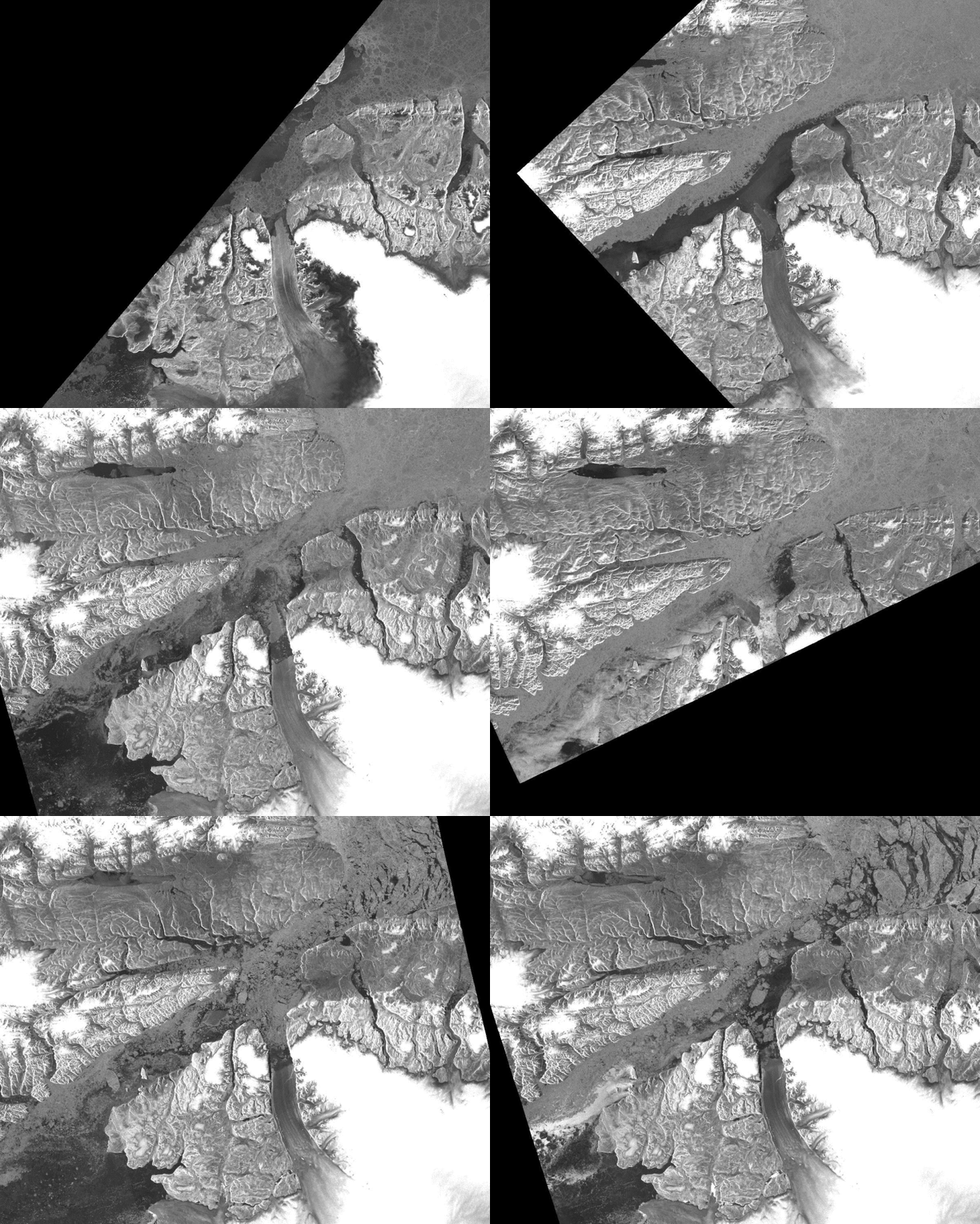
For me, the most spectacular use of Europe’s EnviSat was its ability to document how the 2010 Petermann Ice Island wiggled its way out of its constraining fjord into Nares Strait. A movie of daily radar images is attached:

Petermann Ice Island 2010 slow movement through Petermann Fjord, break-up on Joe Island, and swift movement southward in Nares Strait. Click on image to start movie.

Unlike its Canadian counterpart, RadarSat, the imagery from the European radar (ASAR) was distributed widely, free of charge, and became useful to research communities and a wider public. The Danish Meteorological Institute provides an archive of imagery from both US and European satellites for all of coastal Greenland that just lost its European imagery (http://ocean.dmi.dk/arctic/modis.uk.php). Unlike the now defunct EnviSat, RadarSat is a for-profit commercial enterprise unaffordable to scientists or a public. The Canadian government funded development, launch, and initial data processing before giving it away to a private corporation. Ironically, the largest paying customer for its expensive products is the Canadian Government, but the data are rarely used for public education or research. They may as well be secret.

So, the demise of EnviSat is sad news. It removes a semi-public eye in the sky. Lets hope, that its replacement by the European Space Agency receives the urgent attention that it deserves.

Greenland’s Glaciers, Science, Sea-Level, and Teachers

Science Magazine hit climate change hard today. They cover how Greenland’s glaciers and ice sheets change as they interact with the ocean and contribute to sea-level rise feature in 3 related stories. The reality check of these three stories puts a damper on the usual doomsday scenarios of those whose skill is limited to grabbing public attention to move a political agenda. Real science works differently:

May-4, 2012 Science Magazine Cover: A jumble of icebergs forms in front of the heavily crevassed calving front of Jakobshavn Isbræ, one of the fastest outlet glaciers draining the Greenland Ice Sheet. The ~5-kilometer-wide ice front rises ~80 meters out of the water and extends more than 600 meters underwater. Recent research shows that the speeds of Greenland glaciers are increasing. See page 576. [Photo Credit: Ian Joughin, APL/UW]

The solid new research is that of Twila Moon, a graduate student at the University of Washington whose dissertation work relates to the evolution of Greenland’s outlet glaciers over the last 10 years. She uses data from Canadian, German, and Japanese radars flown on satellites. She applies fancy mathematics to the data and feds data and mathematics into modern computer codes. And with all that, she cracks the puzzle on how fast more than 200 of Greenland’s largest glaciers go to town, eh, I mean, to sea. Furthermore, she shows how this flow has changed over the last 10 years.

Twila Moon, graduate student and scientist at the University of Washington and first author of “21st-Century Evolution of Greenland Outlet Glacier velocities” that appeared in Science Magazine on May-4, 2012. [Photo Credit: APL/UW website]

Back in the days of 2008, crude, but simple back-on-the-envelope calculation suggested that Greenland contributes 0.8-2.0 meters to global sea-level rise by 2100. In stark contrast, the 2000-2010 data now reveals, that even the low-end estimate is too high by a factor of 10. A glacier here or there may accelerate at a large rate to give the 0.8-2.0 m, but these rates do not occur at the same time at all glaciers. Ms. Moon’s more comprehensive and careful analyses of accelerating glaciers bring down Greenland’s contributions to sea-level rise to below 0.1 m by 2100, that comes to about 1 mm/year or an inch in 30 years.

A commentary written by Professor Richard Alley relates to the ice-sheets that feed these glaciers. Dr. Alley is famous for his work on Greenland’s ice sheet as he participated in 2-Mile Time Machine, a project that revolutionized the way that we view climate and its variability the last 100,000 years. The title refers to the 2-mile long ice-core from Greenland’s ice-sheet that trapped and stored air and stuff from the last 100,000 years. Dr. Alley is also featured in Andrew Revkin’s dot-earth blog of the New York Times as the Singing Climatologist. His comment on “Modeling Ice-Sheet Flow” references Ms. Moon’s observations as evidence that ice sheets change quickly. It also contains the sentence that “The lack of a firm understanding of ice-sheet-ocean interaction, constrained by reliable ocean data, remains a critical obstacle to understanding future changes.” I could not agree more with this sentiment, these data are darn hard to come by … not as hard as getting to the bottom of the 2-mile time machine, though.

While Ms. Moon addressed changes in Greenland’s glaciers, Dr. Alley addressed the ice-sheets feeding those glaciers, another comment by physical oceanographer Dr. Josh Willis of NASA’s Jet Propulsion Laboratory relates to the sea-level changes caused by accelerating glaciers to make “Regional Sea-Level Projections.” He works mostly on massive computer models which devour massive amounts of data to get climate right. Sometimes this works, sometimes is does not, but he does comment that these earth system models give sea-level projections that are a factor 2 smaller than those derived from statistical relations and semi-empirical models using surface temperature and radiative forcing to extrapolate past trends into the future. The difference probably relates to smaller and more regional processes that involve the physics of ocean circulation and its interaction with ice-shelves off Antarctic and Greenland.

Dr. Josh Willis conducting an oceanographic experiment studying sea temperatures between New Zealand and Hawaii. [Credit: JPL/NASA]

My great oceanography hero, Henry Stommel of Woods Hole oceanographic Institution once wrote in his “View of the Sea,” that “Science is both an individual and a social activity.” I am sure that graduate student Ms. Moon, NASA researcher Dr. Willis, and veteran professor and science communicator Prof. Alley all work hard and lonely at night some nights … and party hard while discussing science and adventures over a beer, dinner, coffee in some city, remote field, or on a ship. The one group of people missing in this picture are … the science teachers, that is, those dedicated, over-worked, and under-paid professionals who encourage, motivate, and helped us to become scientists before we went to college.

The editorial of this week’s Science Magazine is entitled “Empowering Science Teachers.” It compares the social and professional status of pre-college science teachers in Finland and the USA. I will only say in the words of Anne Baffert, chemistry teacher at Salpointe Catholic High School in Tucson, Arizona, that too many science “… teachers work in a command-and-control environment, managed by those who lack any real understanding of how to improve the system.” The editorial suggests on how scientists can improve science teaching, such as “… active involvement in science through structured collaborations with scientists …” Apparently, Finland succeeds while we in the USA are challenged to get our graduate students into a pre-college class room teaching. More stuff for me to munch on here …