Tag Archives: Nares Strait

Nares Strait 2012: Renske’s Take on Mooring Recovery

This is a wonderful description by Dr. Renske Gelderloos of Oxford University of what mooring recoveries are all about, taken from her blog.

Mooring Day!

6 August

Today is mooring day! My function on board has officially been changed from scientist to full-time photographer for the day. We want as many photos as we can get from the equipment as it comes out of the water, so that we can always go back later and see if something happened before, during or after the recovery. And it is a beautiful sunny day; very photogenic!

Recovering the moorings is really our number-one priority on this field trip, so everyone is both excited and anxious whether we will be able to recover all of the seven moorings in this section. Ron has already contacted three of them yesterday evening, so that is a very good start. Contacting a mooring works as follows: Ron sends out a signal to the mooring at a given frequency. If the mooring receives this signal it will respond with another signal. Because these moorings are in the water for a very long time (three years in this case), the release switches are programmed to be asleep two thirds of the time and awake only one third of the time to save battery. The mooring only responds if it is awake, so it may take a few minutes to get a response. Once the mooring has confirmed that it is still in the position where it was left three years ago and awake, we go towards the mooring and check that there is no ice overlaying the site (or if there is a little and it is not too thick, ‘just push it away a little bit’ with our icebreaker). Then Ron sends out another signal to lure the mooring to the surface. This signal opens the acoustic release that holds the mooring down to its anchor. The floatation devices that are attached to the mooring line rush upwards to the surface. At this point everyone stares over the railing to try and be the first one to spot it. Today the weather was so calm that we could actually hear them come up, so it was easy. When the mooring is spotted, the FRC is launched with two crew members, who tow the mooring to the boat and attach the heavy things one by one to the crane. Then the crane tows them up to the deck.

Recovering an Acoustic Doppler Current Profiler (ADCP) mooring in 2009.
 

The first four moorings were recovered before lunch (which is from 11.30 to 12.30 here) and it looked like we were going to set a new record today. The fifth mooring after lunch also came in according to plan, but then our luck had run out. The sixth mooring refused to respond, no matter how long we tried. After a while we decided to try and contact the seventh mooring, but again without success. We steamed to the location of the seventh mooring in the hope of getting a response, still with no success. Then suddenly the sixth mooring decided it was willing to communicate after all. Apparently it had just been having some puberty issues refusing to wake up, but now it responded to our mating call. Quickly we steamed back to the site of the sixth mooring, opened the released and successfully recovered the mooring. We tried to get into contact with the last mooring, but unfortunately it was all in vain. We will probably try again on the way back, but we may need to accept that the mooring is just not there anymore.

The scientific successes and endavours of this day were celebrated at the bar that night with a drink. It was a long, eventful and in the end scientifically successful day.

Nares Strait 2012: Renske’s View from the Helicopter

As has been mentioned before on this blog, Dr. Renske Gelderloos, from Oxford University, is a fellow traveler on the CCGS Larsen this summer.  She, too, is blogging about her experience.  Below we reblog her post on the helicopter trip, another exciting and beautiful account of doing science in the Arctic, this one even with a couple pictures!  [Note that the pictures in the blog post are from other trips to the same area — limited internet connectivity to the ship does not permit transmission of current images.]  We will post some of her other entries here, but you can find her blog directly at this link.

Nares Strait from the air, and the first CTD section

5 August 2012

Today started with a nice surprise! During the eight-o-clock science meeting after breakfast the chief officer popped in to say that the helicopter would fly out for an ice survey and that it could take two extra passengers. I immediately volunteered, and as Allison and I had never flown in a helicopter before we would be the lucky ones today.

Ice along the Ellesmere Island coast viewed from the helicopter during an ice survey in 2007.

Together with helicopter pilot Don and ice surveyor Erin we flew off in northeasterly direction. Erin’s job was to maps the ice conditions in the channel ahead of the boat, and see whether there was possibly a better route (less ice-covered) for the boat to take. As Hans Island lay in the helicopter range, we decided to land on this island and do a quick check of the weather station there. The weather station looks like a pole on the top of the island (Hans Island is basically a bit-oversized rock…), firmly held down to the ground with three strings. On top of the pole is a weather vane that also measures the wind speed, and attached to the pole on other heights are a thermometer and a fancy measurement device that measures the incoming solar radiation. The pole also has batteries and a solar panel to provide electricity, and a communication device that sends the data to the more populated part of the world so that it is available immediately. This is unlike our oceanographic moorings under water, which we need to physically recover on the site before we can get the data. Dave had asked us to take photos of the instruments, so we landed the helicopter for a close look. All the instruments appeared to be in remarkably good shape. The previous time this weather station was serviced a polar bear had taken a fancy on it, but fortunately none of the kind had happened this time. When we had done all our duties we flew back over Ellesmere Island to see a glacier from closer by: astonishing!

At the end of the day we finally arrived at the site of our mooring array. As we need the deck crew for mooring recoveries (in particular for the crane and the FRC, which is the small inflatable boat that can be launched from the ship), and the deck crew on Canadian coastguard vessels works from 8 to 5 on weekdays, chief scientist Humfrey decided to do a CTD (Conductivity-Temperature-Depth) section first. This had the additional advantage that we would have the CTD data from this section and the moorings overlapping for an intercomparison between the two.

The multi-coloured mountains of Ellesmere Island

Around 7 o’clock in the evening we were ready for the first trial cast. We had already done ‘dry’ tests, which means we just checked whether the computer was willing to talk to the CTD sensors and the other way around, and whether the values we got were somewhat reasonable. The quantities we measure are the conductivity, the temperature and the pressure. From those quantities we can calculate the salinity of the water (the other way to measure salinity is to take a water sample and take it to a laboratory, so by using the conductivity of the water we can measure the salinity at every location from the surface to the bottom which gives a lot more information than just a few samples), as well as the density. For a CTD cast the sensors are tied to a frame, and the frame is lowered, using a winch, from the deck to the water and subsequently from the surface to just above the bottom of the ocean. The data is sent to our computer real time through the cable that is holding the frame, so we can do a visual inspection and get all excited during the cast. After the trial run things started to really speed up and everyone took up a task. Humfrey supervised, Jo did the winch, Dave (after a subtle hint) kindly provided tea with goodies (thanks Dave!), I monitored the data on the computer screen and made sure the data was saved, and Andreas did a quick-and-dirty first post-processing of the data which enabled us all to see the results of our measurements in almost real time. Just before midnight the section was completed, I took some pictures of the midnight sun and we could all go to sleep.

Nares Strait 2012: Tide Gauge Recovered after 9 Years

Andreas Muenchow, Aug.-8, 2012, off Cape Baird

In 2003 we deployed a tide gauge that was recovered today after attempts in 3 different years to do so failed. Discovery Harbor near Fort Conger was the most northern location at 81 42’ North and 64 1’ West of a large moored array placed in 2003. It was at Fort Conger, that Lt. Greeley of the U.S. Army waited in vain for a supply ship that never arrived, but this sad story is for another day and I like to write about happier news: Our 2003 tide gauge lay in wait for 9 years and 1 day precisely. A 2006 attempt to reach this northern location by ship failed on account of heavy ice cover, a 2007 attempt by helicopter succeeded to establish acoustic communications, but failed to recover the sensor package, and a 2009 attempt by ship failed again because of difficult ice conditions.

The odds of a recovery were slim, but 4 hours ago a crew of five found the tide gauge the same way that skilled fishermen of Newfoundland recover lost traps and fish for halibut: with a line of hooks operating small ships smartly. Chief Officer Brian Legge, Seamen Derick Stone and Carl Rose, as well as scientists Ron Lindsay and Jonathon Poole found the proverbial needle (read tide gauge) in the hey stack (read Arctic Ocean). The entrance to Discovery Harbor was guarded by yet another ship-sized piece of Petermann Glacier ice, this one grounded, as well as several large and small sea ice floes, all moving rapidly with the tides and currents. Even navigating the zodiac through this maze to a fixed location was a major accomplishment.

The long-lost tide gauge is a 2 feet cylinder filled with electronics, but 9 years moored to the floor at 20 meter depth turned it into a complex biology habitat attracting wild life much like the artificial reefs created along Delaware by sunken New York City’s discarded subway trains. Mollusks, seaweed, clams, barnacle, algae, and bacterial slime all attached themselves to every surface. Arctic shrimp perhaps feeding on algae or slime were captured along with the gauge. Seaman Derick Stone, who has never seen an Arctic shrimp (neither have I), quickly brushed it away and back into the ocean muttering something about  “Scorpions in the Arctic.” A second specimen was captured alive and returned to the ocean after a brief inspection. It was agreed, that there was no enough meat on this 2-inch long and skinny shrimp

As a sign of respect to the gods of the icy seas a majority of PhDs aboard solemnly swore to give the long lost sensor 3 days of rest before stripping it bare to reveal its guts, check health and status and retrieve recordings. Pranksters aboard this ship, at least one with a PhD, already alerted me to schemes of hostile capture and ransom requests; I suspect ransom to be paid in treasures, valuable certificates, and screech. Little do these pranksters know of web streaming, local area networks, advanced image processing, and other counter-intelligence operations … to be continued.

P.S.: Oh, we also completed section work (temperature, salinity, water samples) in Robeson Channel to the north of Petermann Fjord where a few segments of Petermann Glaciers former ice shelf are both grounded and moving off the coast of Greenland. Presently off Cape Baird to perhaps recover an automated weather station to be placed instead at Joe Island at the southern entrance to Petermann Fjord, weather permitting. We got 40 kts winds from the south, braking waves, as well as balmy air temperatures of 4 degrees Celsius or so.

Nares Strait 2012: Of Cod’s Tongues, Scrunchions, Screech — and so much more

Allison Einolf, Aug.-8, 2012

Tomorrow will mark our first full week aboard the CCGS Henry Larsen. In one week, I have learned a lot of things, ranging from what cod tongues taste like to the details of sea ice crystal formation to the usefulness of a balaclava in the Arctic. It’s been an incredible week.

Being on the Larsen is almost like being on a mobile town from Newfoundland. Most of the crew speak in heavy accents that sound more Irish than what I would normally consider Canadian, and cod tongues, scrunchions, and Screech are normal fare. I tasted cod tongues today, and I made my entire table laugh with the face I made. They aren’t bad, but I’m not fond of seafood that tastes particularly fishy, and I should’ve gotten tartar sauce with them. Scrunchions I didn’t try (Dave, one of the Canadian scientists, describes them as “essence of pork”), but Screech is something I actually like.

Andreas and Pat had instilled in me a fear of Screech before we came to the ship. The vague stories of screeching ceremonies (in which you become an honorary Newfoundlander) painted a false picture of a terrifying rum known as Screech. In reality, it’s quite tasty rum, and it’s now my go-to drink at the bar.

The last few days have been full to the brim with the retrieval of moorings from 2009 and CTD and rosette survey lines. We successfully retrieved 6 of 7 sets of instruments that were deployed here in 2009, but so far at least two of the instruments were severely damaged. A few of them seem to have hitched a ride with the Petermann ice island in 2010, and they are definitely worse for it.

Today we finished the second of our survey lines. We alternate between lowering the conductivity, temperature, and depth sensor (CTD) and the rosette, which collects bottles of water at different depths. We then do what Humfrey Melling calls “piddling the bottles,” or collecting samples from the collected water. We’re taking samples to process for data regarding barium, oxygen-18, salinity, and nutrients like phosphate or sulfate.

In the week we’ve been on the Larsen, I’ve learned a lot and even gained a few pounds from the huge servings of food we’re given at every meal. It’s amazing how quickly I’ve settled in. I feel like I’ve been here much longer than a week, but I’m glad I haven’t because it means I get another week and a half on this ship in the beautiful wilderness of the Arctic.


Nares Strait 2012: Heading North Passing Petermann Fjord and Ice Islands

Andreas Muenchow, Aug.-7, 2012 in Hall Basin

Petermann Fjord is within sight and at least 5 ship-sized segments from Petermann Glacier are around us drifting to and fro with the tides. RadarSat imagery received this morning aboard the CCGS Henry Larsen indicates that the Manhattan-sized ice island PII-2012 has moved over 3 nautical miles seaward in the last 36 hours (5 kilometers per day) during winds from the south-west. The north-eastern tip of PII-2012 has left the fjord past Offley Island.

We are about 20 miles to the south at 81 degrees 14 minutes north and 65 degrees west firing bottles to collect water samples across a section that Petermann’s ice island PII-2012 will cross perhaps as early as the next week. Dr. Renske Gelderloos just tells the bridge from a van on the fore deck, that all 12 bottles have been fired as the instrument package traveled from the surface to 451 meter depth and back. Additionally, we collect temperature and salinity more continuously as an electromagnetic sensor is lowered via the same cable as the bottles. I am one of two winch operators while Dr. Gelderloos is the command and control center next to me operating 3 laptops concurrently.

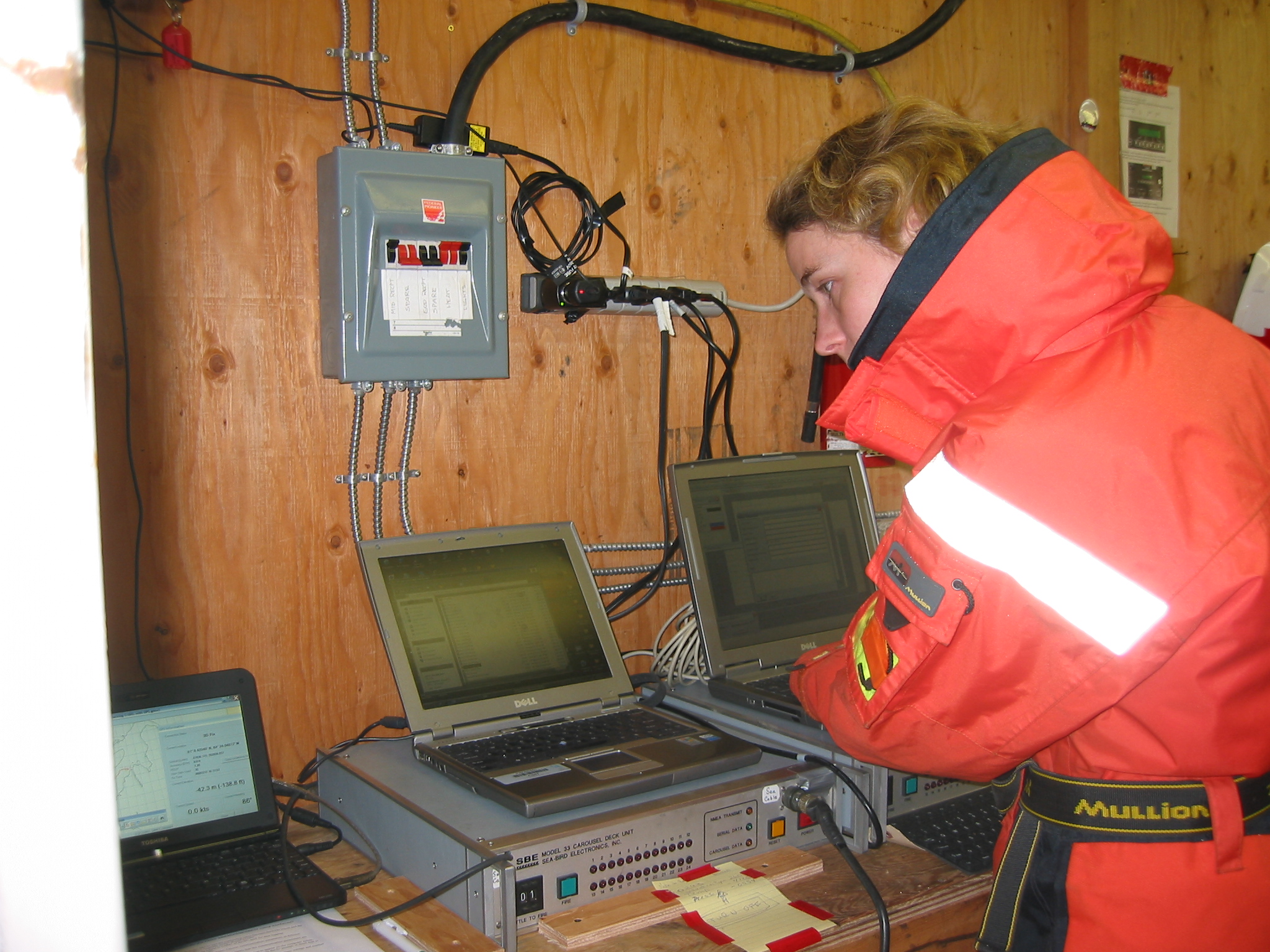
Dr. Renske Gelderloos of Oxford University in command and control of data collection operations aboard the CCGS Henry Larsen.

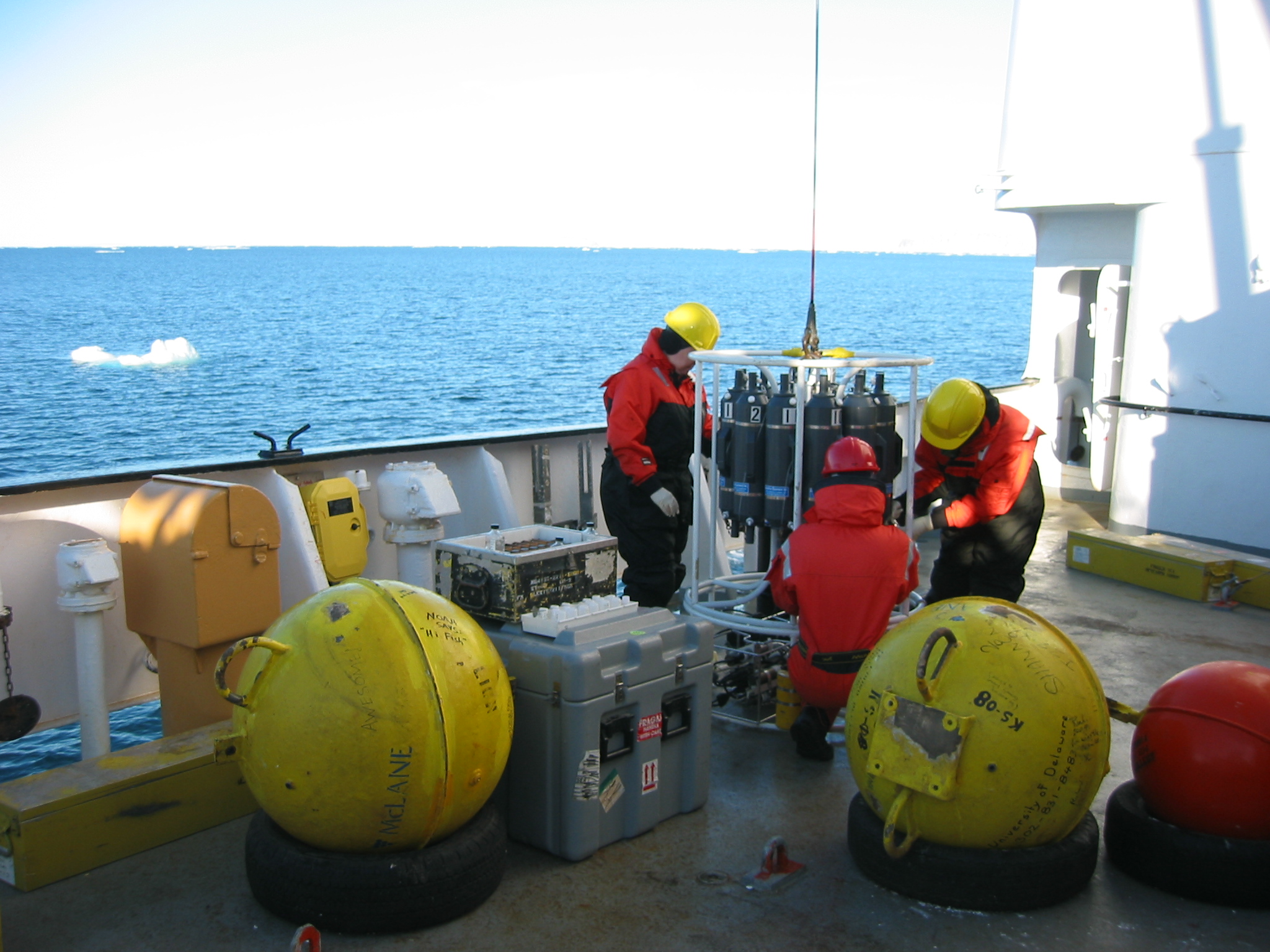
Pat Ryan (left), Humfrey Melling (center), and Allison Einolf (right) collecting water samples aboard the CCGS Henry Larsen in Hall Basin in August 2012.

PhD student Patricia Ryan, dressed in a warm Mustang suit, is one of the water samplers to transfer water into tiny sample bottles for later chemical analyses. She just hands me a USB JumpDrive with 3-years of data of temperature, salinity, and pressure from a moored sensor we recovered yesterday. The latest profile is completed and I am off to process the new data further.

I missed dinner at 5pm, because it took us 5 hours until 8pm local time to finish the 7 stations of a section from Greenland to Ellesmere Island, Canada. I am back to writing now at 11:35 pm local time after lots of cheerful banter, quick clean-up for the day, 2 beers at the bar, and an hour staring into Petermann Fjord from the west-by-northwest. I can’t see the ice island even though I see Offley Island and I know the ice island is right next to it. The ice sheet spilling over the vertical walls of Petermann Fjord are visible in the distance, too. It is raining now. Air temperatures are 0.7 degrees Celsius (about 34 Fahrenheit) which is a little cooler than is normal for this time of the year. We are now another 50 km to the north at 81 degrees and 44 minutes North latitude that is farther north of Petermann Fjord and its ice island.

I can see five ship-sized segments of Petermann Glacier’s ice shelf, but I cannot discern the Manhattan-sized PII-2012 across Hall’s Basin. We have open water to our south and some loosely scattered ice to our north along Ellesmere Island. We are still heading north towards Robeson Channel to perhaps reach Alert on the Arctic Ocean or to perhaps repeat a section that was done for the first and last time in 2003 when the USCC Healy was here at the beginning of our Nares Strait project. It is past midnight now, Wednesday has started, time for bed. [81 49’ N, 63 09’ W at 04:20 UTC, 00:20 local]